

Page 1

1U Server System
User Manual
N800G3
P/N: 2015-MNU-000023
November, 2015 (Revision A)
Page 2

Page 3

Copyright Notice
All rights, including copyright, in the content of this manual are owned or controlled by IESC
and protected by the Taiwan and international copyright act.
No one may, transmit, adapt, assign, compile, rent, sale, change, copy, reproduce, distribute,
publish, display, broadcast, or use in any way the content of this manual, in whole or in part,
for any other purpose whatsoever without the prior written permission of IESC.
Trademarks
All product names or brands mentioned herein are the trademarks of IESC, its subsidiaries or
other respective owners in Taiwan, United States and other countries.
Disclaimer
This manual provides the information in relation to the set-up and installation of the product
herein. Nothing herein may be construed as granting any right or license relating to any
intellectual property rights of this manual or product. Unless otherwise provided in the
Purchase and Sale Agreement for this product, manufacturer and distributor of this product
will not be liable whatsoever relating to the distribution and/or use of this product. In addition,
manufacturer and distributor of this product hereby specifically disclaim any express or
implied warranties of merchantability, fitness for a particular purpose, or non-infring ement of
third party rights in connection with this product.
Manufacturer of this product may have the right to change specifications and product
descriptions at any time without notice.
Page 4
Page 5

Contents
About This Manual ................................................................................................................ i
Conventions .......................................................................................................................................... i
Safety Symbols ..................................................................................................................................... ii
Safety Precautions............................................................................................................................... iii
Operation Safety ...................................................................................................................... iii
Electrical Safety ........................................................................................................................ iv
Battery Replacement Safety .................................................................................................... iv
Laser Peripherals or Devices Safety ........................................................................................ v
Intended Application Uses ........................................................................................................ v
Site Selection ........................................................................................................................... vi
Tools Required ......................................................................................................................... vi
Regulatory and Integration Inf ormation .............................................................................................. vii
Regulatory Compliance Identification Numbers ...................................................................... vii
Product Regulatory Com plianc e ............................................................................................. vii
Power Cords ............................................................................................................................. ix
Rack Mount Instructions ...................................................................................................................... x
1 Introduction ................................................................................................................... 1
1.1 Audience Assumptions ............................................................................................................. 1
1.2 Manual Organization ................................................................................................................ 1
1.3 Packing Checklist ..................................................................................................................... 1
1.4 Specifications ........................................................................................................................... 2
1.5 Product Features ...................................................................................................................... 3
1.6 System Overview ...................................................................................................................... 4
1.6.1 Server Chassis Layout .............................................................................................. 4
1.6.2 Front View ................................................................................................................. 6
1.6.3 Back View .................................................................................................................. 6
1.6.4 Buttons and System LED Information ....................................................................... 7
1.6.5 System Thermal Solution ........................................................................................ 10
2 Hardware Operations ................................................................................................ 2-1
2.1 Before You Start .................................................................................................................... 2-1
2.1.1 Power Off ............................................................................................................... 2-1
2.2 Chassis Cover ....................................................................................................................... 2-2
2.2.1 To remove the chassis cover .................................................................................. 2-3
2.2.2 To install the chassis cover .................................................................................... 2-3
2.3 Motherboard .......................................................................................................................... 2-4
2.3.1 To remove the motherboard ................................................................................... 2-5
2.3.2 To install the motherboard ...................................................................................... 2-5
2.4 Power Supplies ...................................................................................................................... 2-5
2.4.1 To remove the power supply .................................................................................. 2-6
2.4.2 To install the power supply ..................................................................................... 2-6
2.5 Power Distribution Board ....................................................................................................... 2-7
2.5.1 To remove the power distribution board ................................................................. 2-7
2.5.2 To install the power distribution board .................................................................... 2-8
2.6 System Fans .......................................................................................................................... 2-8
2.6.1 To remove the system fans .................................................................................... 2-9
2.6.2 To install the system fans ....................................................................................... 2-9
2.7 PCI-E Expansion Cards and Riser Cards ............................................................................. 2-9
2.7.1 To remove the expansion cards and the riser cards ............................................ 2-10
2.7.2 To install the expansion cards and riser cards ..................................................... 2-12
2.8 10G NIC Card ...................................................................................................................... 2-12
Page 6

To remove the 10G NIC card ............................................................................... 2-13
2.8.1
2.8.2 To install the 10G NIC card .................................................................................. 2-13
2.9 RAID Card ........................................................................................................................... 2-15
2.9.1 To remove the RAID card ..................................................................................... 2-15
2.9.2 To install the RAID card ........................................................................................ 2-16
2.10 2.5”SATA HDDs ................................................................................................................... 2-16
2.10.1 To remove the HDD .............................................................................................. 2-16
2.10.2 To install the HDD................................................................................................. 2-17
2.11 3.5”SATA HDDs ................................................................................................................... 2-18
2.11.1 To remove the HDD .............................................................................................. 2-19
2.11.2 To install the HDD................................................................................................. 2-20
2.12 2.5” HDD Backplane ............................................................................................................ 2-21
2.12.1 To remove the 2.5” HDD backplane ..................................................................... 2-22
2.12.2 To install the 2.5” HDD backplane ........................................................................ 2-22
2.13 3.5” HDD Backplane ............................................................................................................ 2-23
2.13.1 To remove the 3.5”HDD backplane ...................................................................... 2-24
2.13.2 To install the 3.5” HDD backplane ........................................................................ 2-24
2.14 Fan Duct .............................................................................................................................. 2-25
2.14.1 To remove the fan duct ......................................................................................... 2-25
2.14.2 To install the fan duct ........................................................................................... 2-26
3 Connectors ................................................................................................................ 3-1
3.1 Backplane Connectors .......................................................................................................... 3-1
3.2 Power Distribution Board Connec t ors ................................................................................... 3-3
4 Cable Routing ............................................................................................................ 4-1
Appendix China RoHS Regulations ................................................................................... I
Page 7

About This Manual
Conventions
Safety Symbols
Safety Precautions
Regulatory and Integration Information
Rack Mount Instructions
Page 8

Page 9
About This Manual
i
About This Manual
Conventions
To make sure that you perform certain tasks properly, take note of the following symbols used
throughout this manual.
Warning:
Caution:
Important:
Note:
Information to prevent injury to yourself when trying to complete a
task.
Information to prevent damage to the components when trying to
complete a task.
Information that you must follow to complete a task.
Tips and information to aid in completing a task.
2015-MNU-000023
Page 10
ii
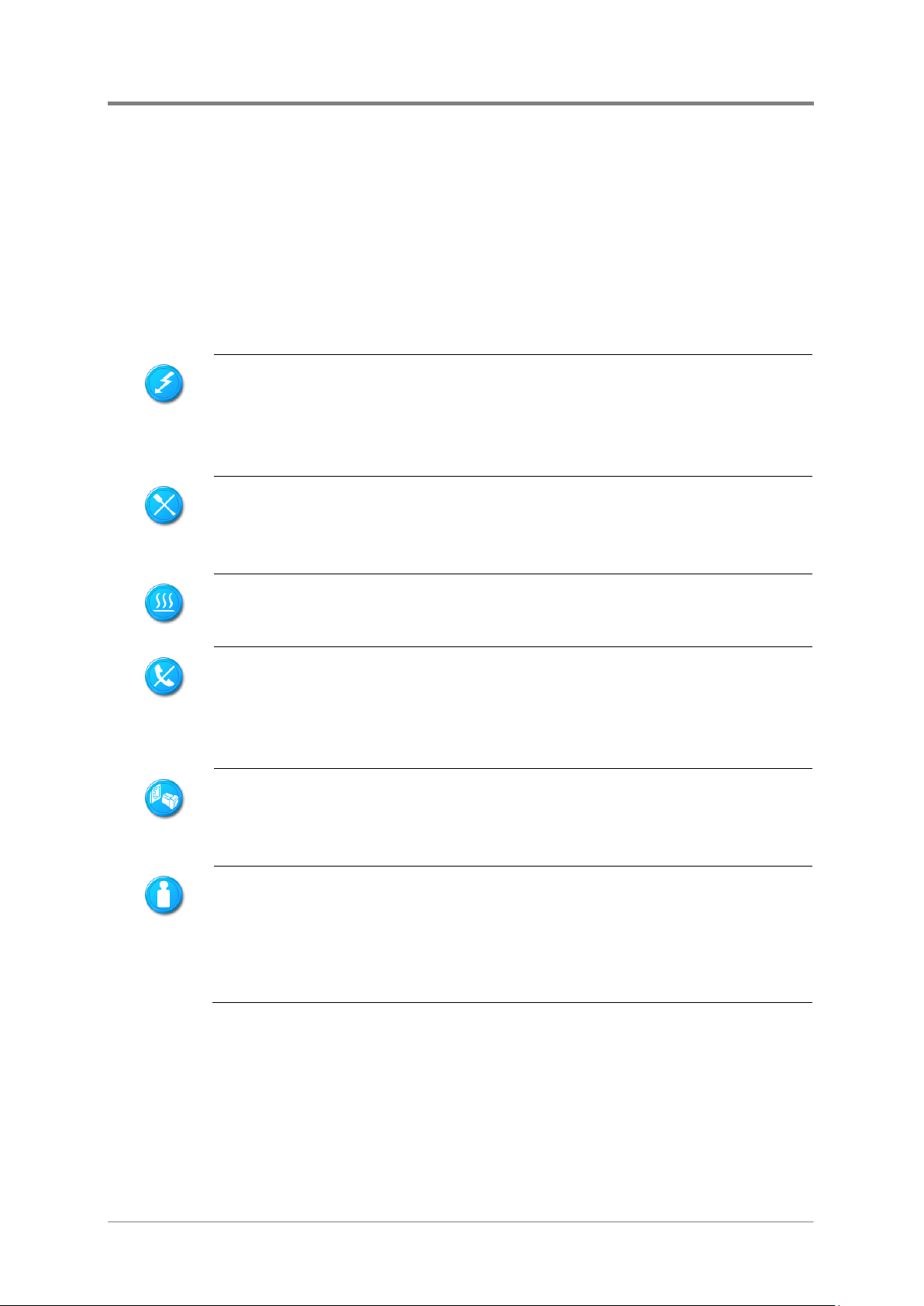
Indicates the potential hazard of energy circuits or electric shock. To reduce
Any surface or area of the equipment marked with this symbol
To reduce the risk of injury from electric shock hazards, do not
to cool before touching it.
receptacle.
This symbol, on power supplies or systems, indicates that the equipment is
To reduce the risk of injury from electric shock, remove all power
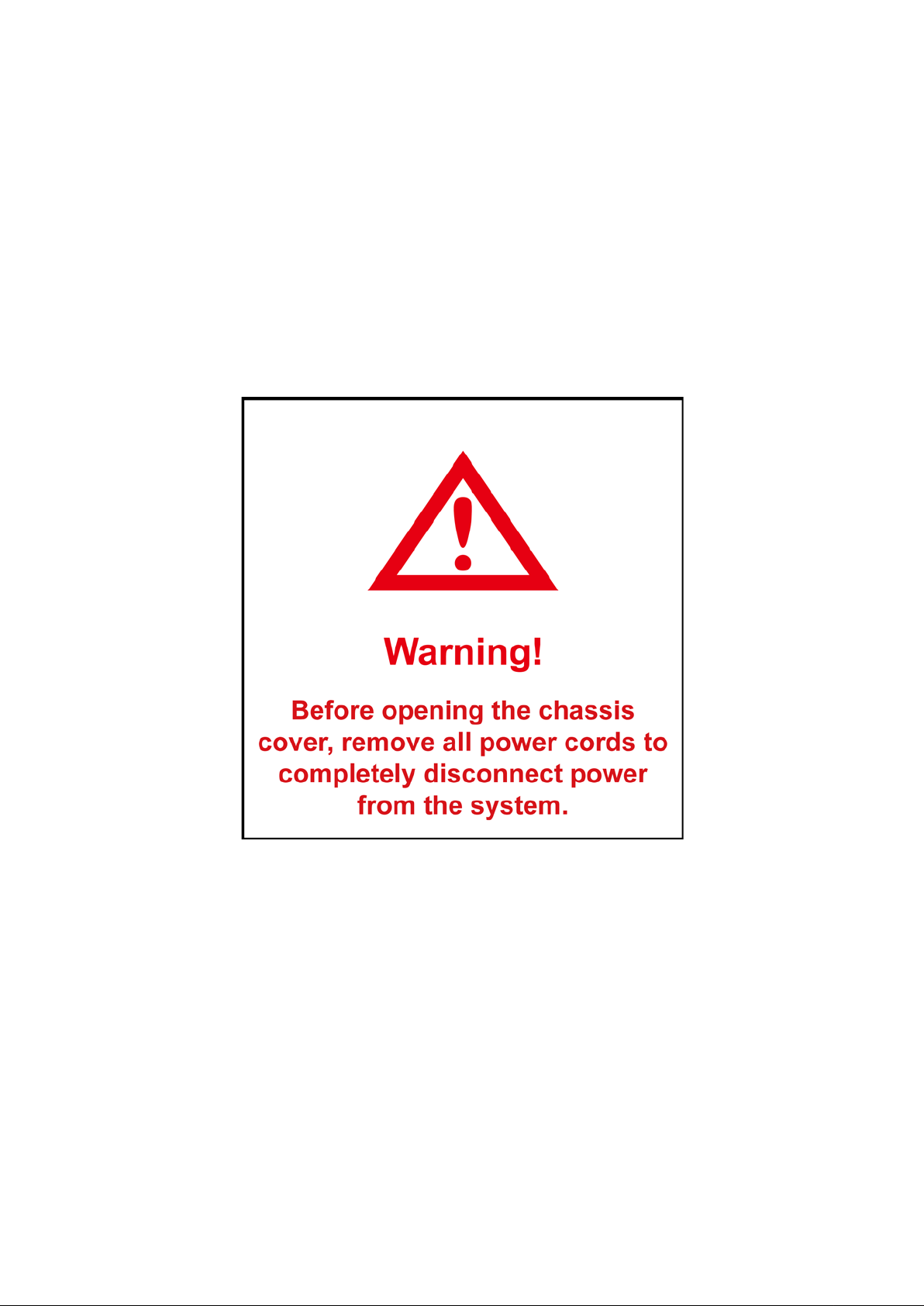
cords to completely disconnect power from the system.
This symbol indicates that the component exceeds the recommended weight
About the Manual
Safety Symbols
Before troubleshooting, you must be familiar with the safety information listed below. In order
to avoid any potential hazards, the following symbols may be placed on some components of
the server.
The shape and the color of symbols shown below are mainly for your reference. Please take
the actual shipment as standard.
the risk of injury from electric hazards, do not open this enclosure.
Warning:
indicates the presence of electric shock hazards. The enclosed area contains
no operator serviceable parts.
Indicates the potential hazard of electric shock. The enclosed area contains
no user of field serviceable parts. Do not open for any reason.
Warning:
open this enclosure.
Indicates the presence of a hot surface or hot component.
Warning: To reduce the risk of injury from a hot component, allow the surface
Weight i n kg.
Weight i n lb.
Any RJ45 receptacle marked with this symbol indicates a network interface
connection.
Warning: To reduce the risk of electric shock, fire, or damage to the
equipment, do not plug telephone or telecommunications connectors into this
supplied by multiple sources of power.
Warning:
for one individual to handle safely.
Warning: To reduce the risk of personal injury or damage to the equipment,
observe local occupational health and safety requirements and guidelines for
manual material handling.
2015-MNU-000023
Page 11

About This Manual
iii
Regarding the standards of workstation regulations, do not place the server in the visual
hot. Do not touch them. Check whether the fans are functioning properly.
Safety Precautions
Observe the following safety precautions when you are connecting or disconnecting any
device.
field of the user, because of the glossy front of the case.
The product is non-consumer product and for profession technical person used only.
Operation Sa fety
Any operation on this server must be conducted by certified or experienced engineers.
Before operating your server, carefully read all the manuals included with the server
package.
Before using the server, make sure that all cables are correctly connected and power
cords are not damaged. If any damage is detected, contact your dealer as soon as
possible.
To avoid short circuits, keep paper clips, screws, and staples away from connectors, slots,
sockets and circuitry.
Before opening the chassis panels, make sure all power cords are unplugged.
Avoid dust, humidity, and extreme temperatures; place the server on a stable surface.
If the power supply is broken, do not try to fix it by yourself. Contact an authorized dealer.
It is recommended that you wear gloves when assembling or disassembling the server to
protect from cuts and scrapes.
When the server is powered on, heat sinks and the surfaces of certain IC devices may be
2015-MNU-000023
Page 12

iv
possible shock from touching two surfaces with different electrical potentials.
About the Manual
Electrical Safety
Before installing or removing signal cables, ensure that the power cords for the system
unit and all attached devices are unplugged.
To prevent electric shock hazard, disconnect the power cable from the electrical outlet
before relocating the system.
When adding or removing any additional device to or from the system, ensure that the
power cords for those devices are unplugged before the signal cables are connected. If
possible, disconnect all power cords from the existing system before you add a device.
Use one hand, when possible, to connect or disconnect signal cables to prevent a
This product is equipped with a three-wire power cable and plug for user safet y. Use the
power cable with a properly grounded electrical outlet to avoid electric shock.
Motherboards, adapters, and disk drives are sensitive to static electricity discharge. These
devices are wrapped in antistatic bags to prevent this damage. Take the following
precautions:
If you have an antistatic wrist strap available, use it while handling the device.
Do not remove the device from the antistatic bag until y ou are ready to ins t all the device in
the system unit.
With the device still in its antistatic bag, touch it to a metal frame of the system.
Grasp cards and boards by the edges. Hold d riv es by the frame. Avoid touching the solder
joints or pins.
If you need to lay the device down while it is out of the antistatic bag, lay it on the antistatic
bag. Before picking it up again, touch the antistatic bag and the metal frame of the system
unit at the same time.
Handle the devices carefully to prevent permanent damage.
Battery Replacemen t Safety
This server is provided with an internal Lithium battery or battery pack. There is a danger of
explosion and risk of personal injury if the battery is incorrectly replaced or mistreated.
For more information about battery replacement or proper disposal, contact an authorized
reseller or your authorized service provider.
2015-MNU-000023
Page 13

About This Manual
v
Do not attempt to recharge the battery.
Replace only with the spare parts designated for this product.
Return to manufacturer for servicing.
This server contains an internal Lithium Manganese Dioxide, or a Vanadium Pentoxide, or an
alkaline battery pack. There is risk of fire and burns if the battery pack is not handled properly.
To reduce the risk of personal injury:
Do not expose to temperatures higher than 70°C.
Do not disassemble, crush, puncture, shorten external contacts, or dispose i n fire or w ater.
Batteries should not be littered along with the general household waste. Please use the publ ic
collection system or return them to the supplier.
Laser Peripherals or De vi ces Safety
To avoid risk of radiation exposure and/or personal injury:
Do not open the enclosure of any laser peripheral or device.
Laser peripherals or devices are not user serviceable.
Intended Application Uses
This product was evaluated as Information Technology Equipment (ITE), which may be
installed in offices, schools, computer rooms, and similar commercial type locations. The
suitability of this product for other product categories and environments (such as medical,
industrial, residential, alarm systems, and test equipment), other than an ITE application, may
require further evaluation.
2015-MNU-000023
Page 14

vi
Clean, dry, and free of airborne particles (other than normal room dust).
About the Manual
Site Selection
The system is designed to operate in a typical office environment. Choose a site that is:
Well-ventilated and away from sources of heat including direct sunlight and radiators.
Away from sources of vibration or physical shock.
Isolated from strong electromagnetic fields produced by electrical devices.
In regions that are susceptible to electrical storms, we recommend you plug your system
into a surge suppresser and disconnect telecommunication lines to y our modem during an
electrical storm.
Provided with a properly grounded wall outlet.
Provided with sufficient space to access the power supply cord(s), because they serve as
the product's main power.
Mechanical Loading – Mounting of the equipment in the rack should be such that a
hazardous condition is not achieved due to uneven mechanical loading.
Tools Required
A cross screwdriver or a flat screwdriver is needed to install or remove the components in the
server.
2015-MNU-000023
Page 15

vii
Table i Product Safety Requirements
About This Manual
Regulatory and Integration Information
Regulatory Compliance Identi fication Numbers
For the purpose of regulatory compliance certifications and identification, this server is
assigned a serial number. This server serial number can be found on the product label, along
with the required approval markings and information. When requesting certification
information for this product, always refer to this serial number. This serial number should not
be confused with the marketing name or model number.
Product Regulatory Compliance
Worldwide Safety approvals can be supplied according to the requirements from Marketing or
Customer.
Product Safety Compliance
This server complies with the following safety requirements:
IEC 60950-1 Safety of Information Technology Equipment
EN 60950-1 Safety of Information Technology Equipment Including Electrical
Business Equipment, European Committee for Electrotechnical
Standardization (CENELEC)
UL 60950-1 Safety of Information Technology Equipment
UL 94 Tests for Flammability of Plastic Materials for Parts in Devices &
Appliances
GB4943 Safety of Information Technology Equipment
Product EMC Compliance
This product has been tested and verified to comply with the following electromagnetic
compatibility (EMC) regulations.
Communications Commission N otice
Part 15 of the Federal Communications Commission (FCC) Rules and Regulations has
established Radio Frequency (RF) emission limits to provide an interference-free radio
frequency spectrum. Many electronic devices, including computers, generate RF energy
incidental to their intended function and are, therefore, covered by these rules. These rules
place computers and related peripheral devices into two classes, A and B, depending upon
their intended installation. Class A devices are those that may reasonably be expected to be
2015-MNU-000023
Page 16

viii
Table ii European Union EMC Requirements
About the Manual
installed in a business or commercial environment. Class B devices are those that may
reasonably be expected to be installed in a residential environment (for example, personal
computers). The FCC requires devices in both classes to bear a label indicating the
interference potential of the device, as well as additional operating instructions for the user.
The rating label on the device shows which class (A or B) the equipment falls into. Class A
devices do not have an FCC logo or FCC ID on the label. Class B devices have an FCC logo
or FCC ID on the label. Once the class of the device is determined, refer to the following
corresponding statement.
Class A Equipment
This equipment has been tested and found to comply with the limits for a Class A digital
device, pursuant to Part 15 of the FCC Rules. These limits are designed to provide
reasonable protection against harmful interference when the equipment is operated in a
commercial environment. This equipment generates, uses, and can radiate radio frequency
energy and, if not installed and used in accordance with the instructions, may cause harmful
interference to radio communications. Operation of this equipment in a residential area is
likely to cause harmful interference, in which case the user will be required to correct the
interference at personal expense.
Declaration of Conformity for Produ ct s M ar ked with the FCC Logo—United States Only
This device complies with Part 15 of the FCC Rules Operation and is subject to the following
two conditions: (1) this device may not cause harmful interference, and (2) this device must
accept any interference received, including interference that may cause undesired operation.
For questions regarding your product, please contact the supplier.
To identify this product, refer to the Part, Series, or Model number found on the product.
European Union Notice
Products with the CE Marking comply with both the EMC Directive (89/336/EEC) and the
Low-Voltage Directive (73/23/EEC) issued by the Commission of the European Community.
Compliance with these directives implies conformity to the following European Norms (in
brackets are the equivalent international standards):
EN55022 (CISPR 22) Electromagnetic Interference
EN55024 (IEC61000-4-2,3,4,5,6,8,11) Electromagnetic Immunity
EN61000-3-2 (IEC61000-3-2) Power Line Harmonics
EN61000-3-3 (IEC61000-3-3) Power Line Flicker
2015-MNU-000023
Page 17
ix
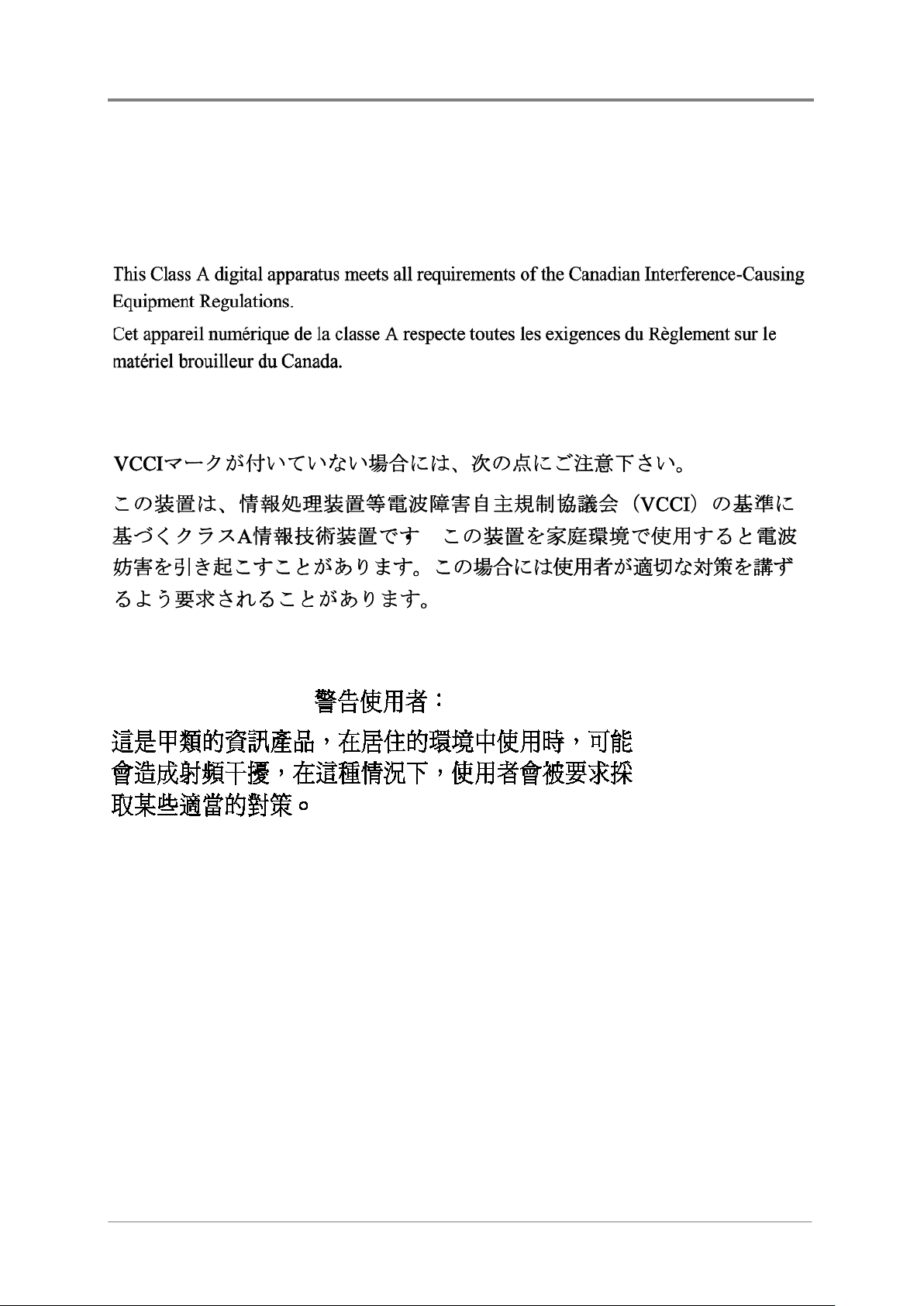
Canadian Notice (Avis Canadien)
Class A Equipment
Japanese Notice
About This Manual
Taiwanese Notice
Power Cords
The power cord set included in the server meets the requirements for use in the country
where the server was purchased. If this server is to be used in another country, purchase a
power cord that is approved for use in that country.
The power cord must be rated for the product and for the voltage and current marked on the
product's electrical ratings label. The voltage and current rating of the cord should be greater
than the voltage and current rating marked on the product. In addition, the cross-sectional
area of the wires must be a minimum of 1.00mm² or 18AWG, and the length of the cords must
be between 1.8m (6 feet) and 3.6m (12 feet). If you have questions about the type of power
cord to use, contact an authorized service provider.
2015-MNU-000023
Page 18

x
About the Manual
Route power cords so that they will not be walked on or pinched by items placed upon or
against them. Pay particular attention to the plug, electrical outlet, and the point where the
cords exit from the product.
Rack Mount Instructions
The following or similar rack-mount instructions are included with the installation instructions:
Elevated Operating Ambient - If installed in a closed or multi-unit rack assembly, the
operating ambient temperature of the rack environment may be greater than room
ambient. Therefore, consideration should be given to installing the equipment in an
environment compatible with the maximum ambient temperature (Tma) specified by the
manufacturer.
Reduced Air Flow - Installation of the equipment in a rack should be such that the amount
of air flow required for safe operation of the equipment is not compromised.
Mechanical Loading - Mounting of the equipment in the rack should be such that a
hazardous condition is not achieved due to uneven mechanical loading.
Circuit Overloading - Consideration should be given to the connection of the equipment to
the supply circuit and the effect that overloading of the circuits might have on overcurrent
protection and supply wiring. Appropriate consideration of equipment nameplate ratings
should be used when addressing this concern.
Reliable Earthing - Reliable earthing of rack-mounted equipment should be maintained.
Particular attention should be given to supply connections other than direct connections to
the branch circuit (e.g. use of power strips).
2015-MNU-000023
Page 19

Chapter 1
Introduction
Audience Assumptions
Manual Organization
Packing Checklist
Specifications
Product Features
System Overview
Page 20

Page 21

Introduction
1
Table 1-1 Manual Introduction
Table 1-2 Packing Checklist
1 Introduction
1.1 Audience Assumptions
This document is for the person who installs, administers, and troubleshoots servers and
storage systems. IESC assumes you are qualified in the servicing of computer equipment and
trained in recognizing hazards in products with hazardous energy levels.
1.2 Manual Organization
This manual introduces the chassis along with the hardware information, and how to replace
the hardware and connect the cables. This manual is generally organized as follows:
Introduction
Hardware
Operations
Connectors
Cable Connections
Appendix
General server introduction.
The operation of the components on the chassis, such as power
supply, power distribution board, system fans, backplane, and riser
card.
Information about connectors on the various boards in the system.
How to connect cables correctly.
China RoHS Regulations information.
1.3 Packing Checklist
Make sure you have all the co mponents shipped with your sy stem. If any item contained in the
package is damaged or missing, please contact your local dealer for replacement. In addition,
keep the box and packing materials for possible future use. The server is shipped with the
following:
Chassis
Cables
2015-MNU-000023
1U rack-mounted chassis
Main power cable, backplane power cable, SATA HDD cable,
system fan cables, front pa
nel cables, and so forth
Page 22

2
Table 1-3 Specifications
Introduction
1.4 Specifications
The table below is the technical specification for the server.
Height: 4.32cm
Dimensions
Width: 44.80cm
Length: 75.20cm
Maxi-weight: 12.1KG (8x2.5”HDDs)
Weight
Maxi-weight: 12.9KG (4x3.5”HDDs)
Operating System: +5°C ~ +35°C
Temperature
Non-operating System: -40°C ~ +70°C (with package)
Operating System: +20% ~ +80%
Humidity
Non-operating System: +10% ~ +90% (with package)
Voltage 100-240V AC input, 50/60Hz
Current
7.4-3.7A
2015-MNU-000023
Page 23
3
1.5 Product Features
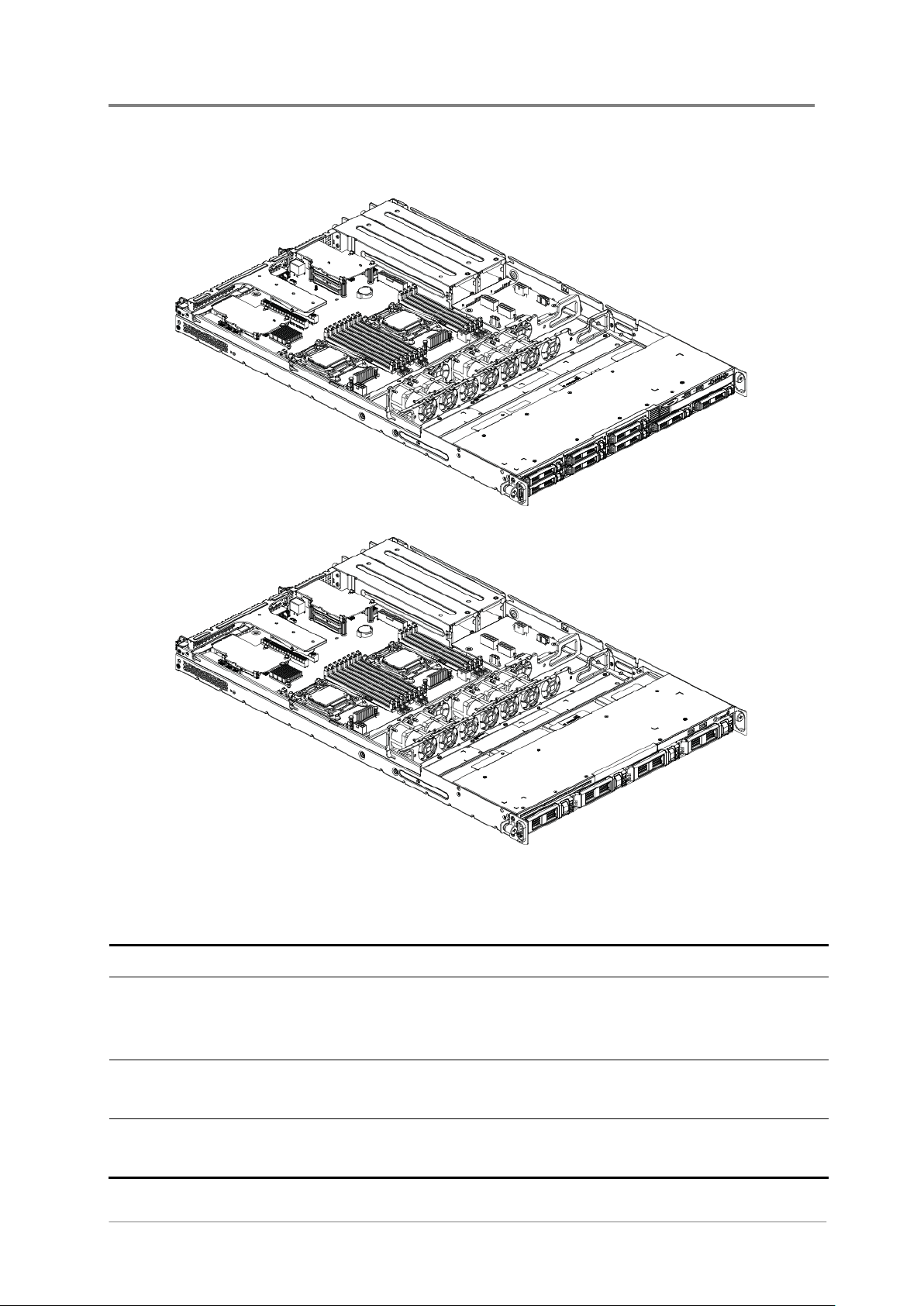
Figure 1-2 Product Introduction - 4x3.5” HDDs
Table 1-4 Product Features
Figure 1-1 Product Introduction - 8x2.5” HDDs
Introduction
Chassis
Power
Storage
Backplane
1U rack-mounted chassis
1x550W power supply Platinum version
Or 2x550W load balance and redundant power supplies Platinum
version
8x2.5” hot-pluggable HDDs
Or 4x3.5” hot-pluggable HDDs
2.5” HDD Backplane
Or 3.5” HDD Backplane
2015-MNU-000023
Page 24
4
Introduction
System Fan
Number of fan cage: 7
Single Fan Size: 40mm x 40mm x 56mm
1.6 System Overview
1.6.1 Server Chas sis Layout
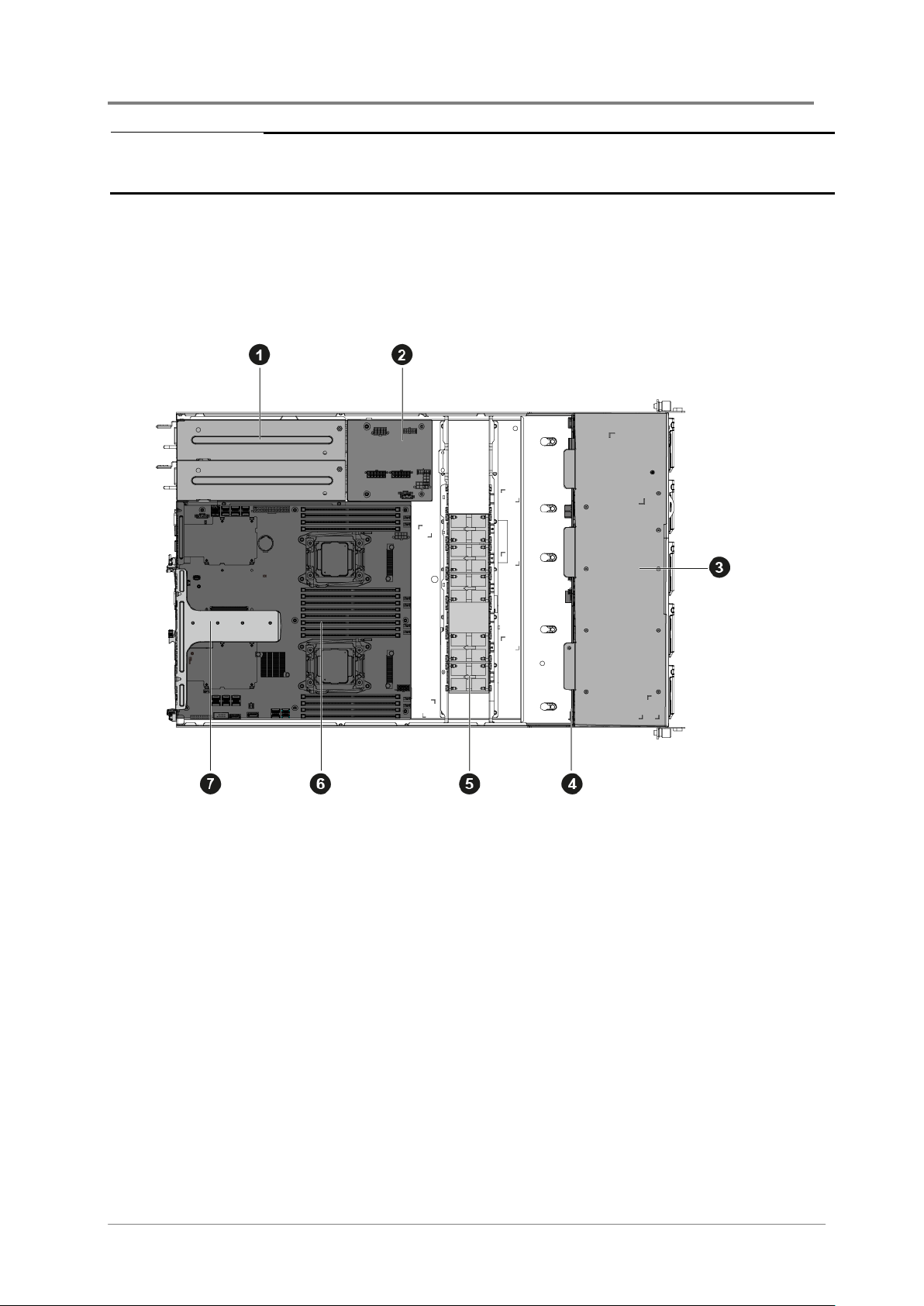
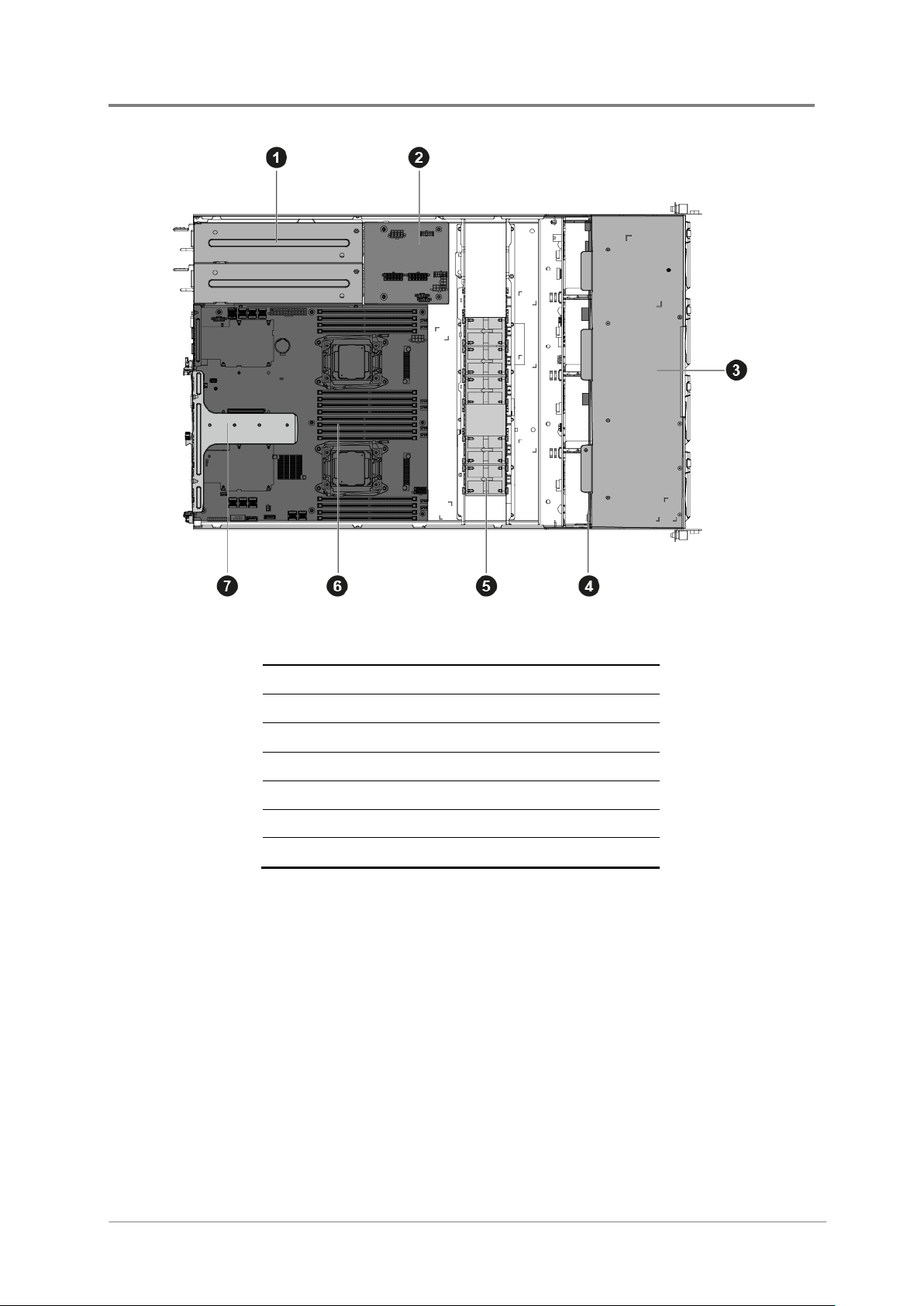
Figure 1-3 System Overview – 8x2.5”HDDs
2015-MNU-000023
Page 25
Introduction
5
Figure 1-4 System Overview – 4x3.5”HDDs
Power Distribution Board
Motherboard
1
Power Supplies
2
3
4
5
HDDs
HDD Backplane
System Fans
6
7
Expansion Card Bracket
2015-MNU-000023
Page 26
6
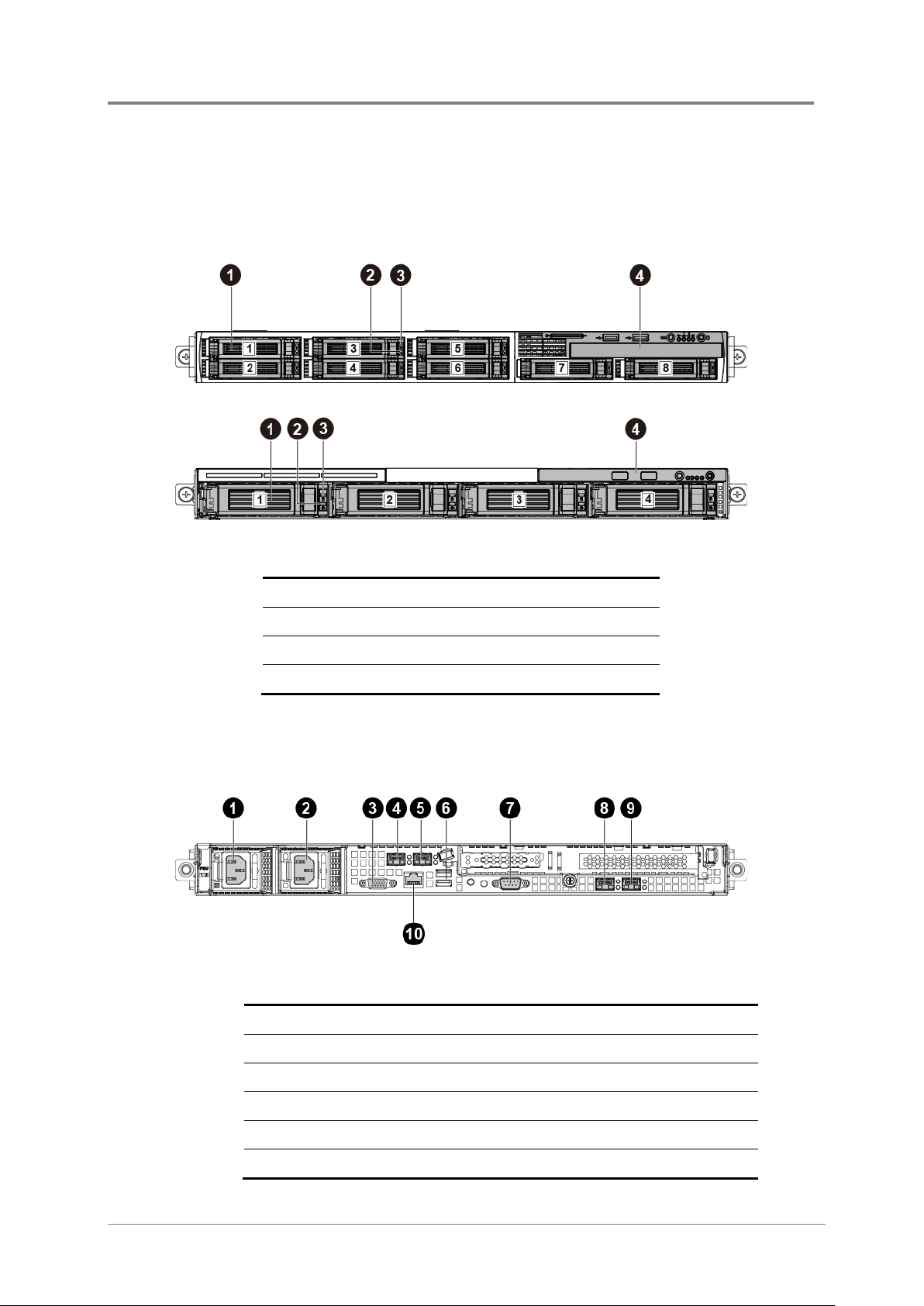
Figure 1-5 Front View – 8x2.5”HDDs
Figure 1-6 Front View – 4x3.5”HDDs
AC Power Connector 1
VGA Connector
10G NIC Port 3
Introduction
1.6.2 Front View
The system supports up to eight 2.5” HDDs or four 3.5” HDDs. The front view of this 1U server
allows easy access to HDDs. In addition, the front panel with buttons and system LEDs is
located on the front.
HDDs
1
HDD Status LED
2
HDD Activity LED
3
4 Front Panel
1.6.3 Back View
The server back view includes the connectors of the external system devices.
Figure 1-7 Back View
1
AC Power Connector 2
2
3
10G NIC Port 4
4
5
Dual USB Port
6
2015-MNU-000023
Page 27
Introduction
7
Figure 1-8 Front Panel Buttons and LEDs – 8x2.5”HDDs
10G NIC Port 2
Management Port
Serial Port
7
8
10G NIC Port 1
9
10
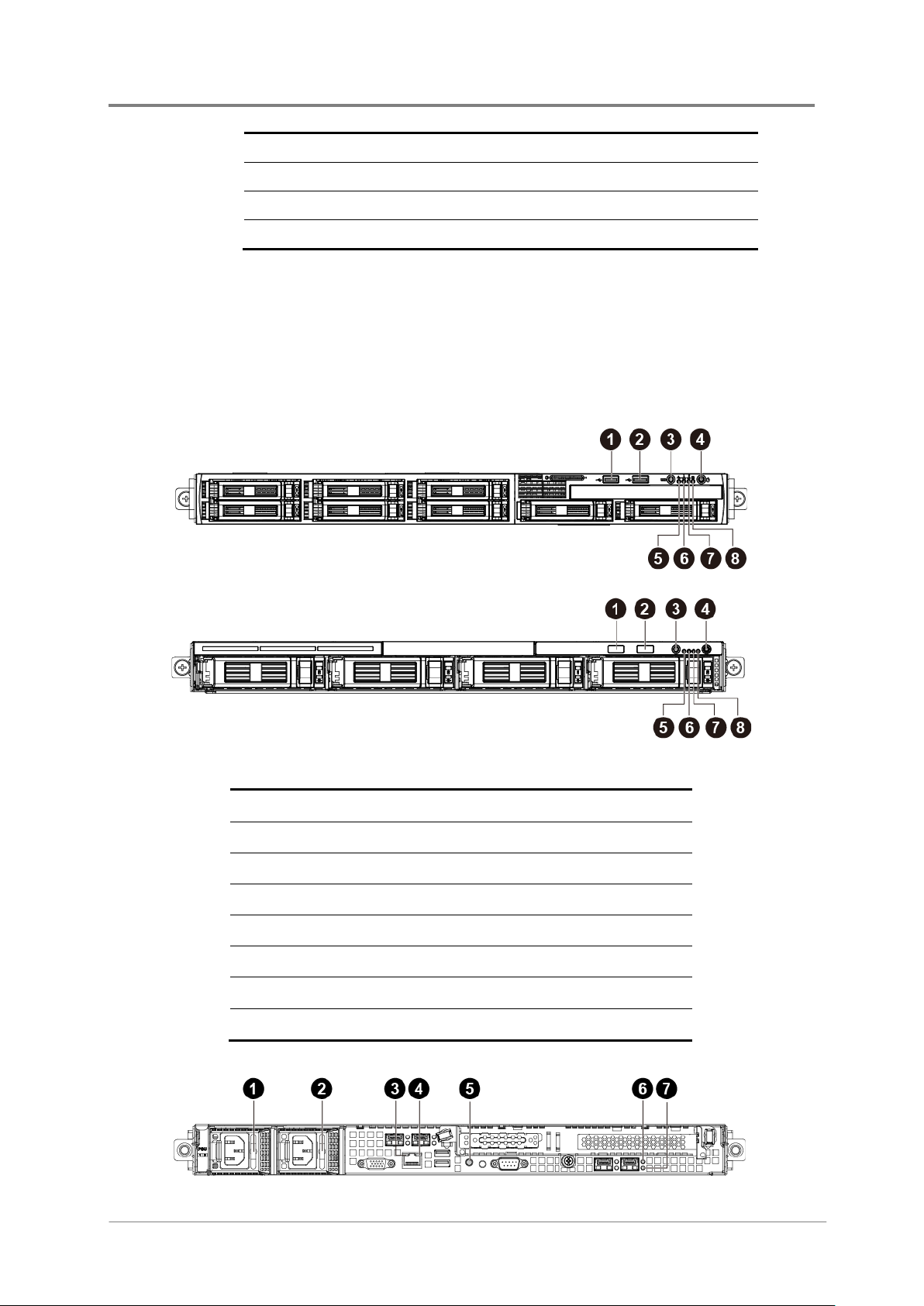
1.6.4 Buttons and Sys tem LED Information
This server is equipped with system LED indicators, and buttons located on the front panels.
The front panel status LEDs allow constant monitoring of basic system functions while the
server is operating. These LEDs provide visual cues to the status of power and ID of
motherboard.
Figure 1-9 Front Panel Buttons and LEDs – 4x3.5”HDDs
1 USB Port 0
2 USB Port 1
3 ID LED/Button
4 Power LED/Button
5 System Health LED
6 Activity LED of NIC Port 1
7 Activity LED of NIC Port 2
8 HDD Stauts LED
2015-MNU-000023
Page 28
8
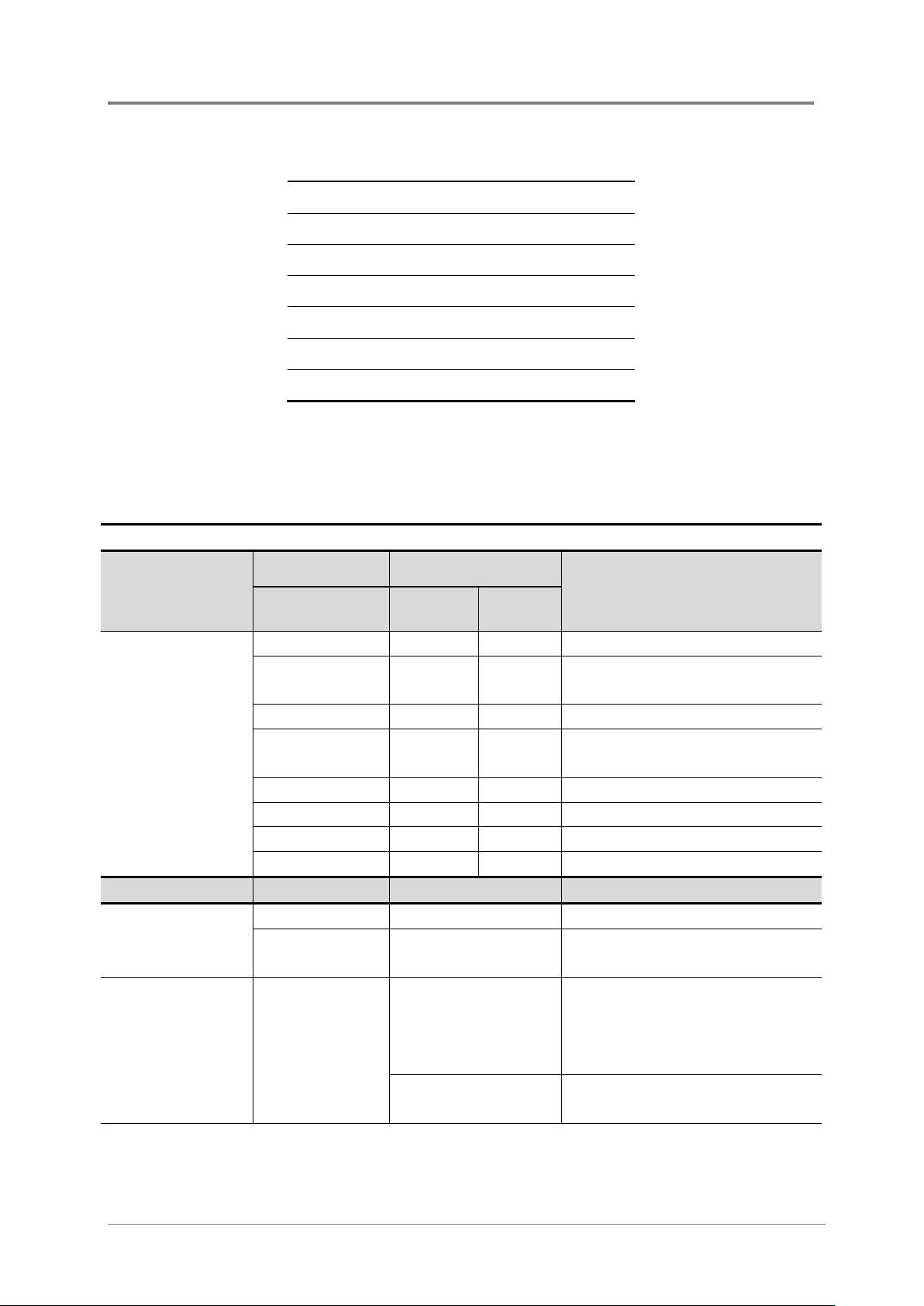
Figure 1-10 Back View LED
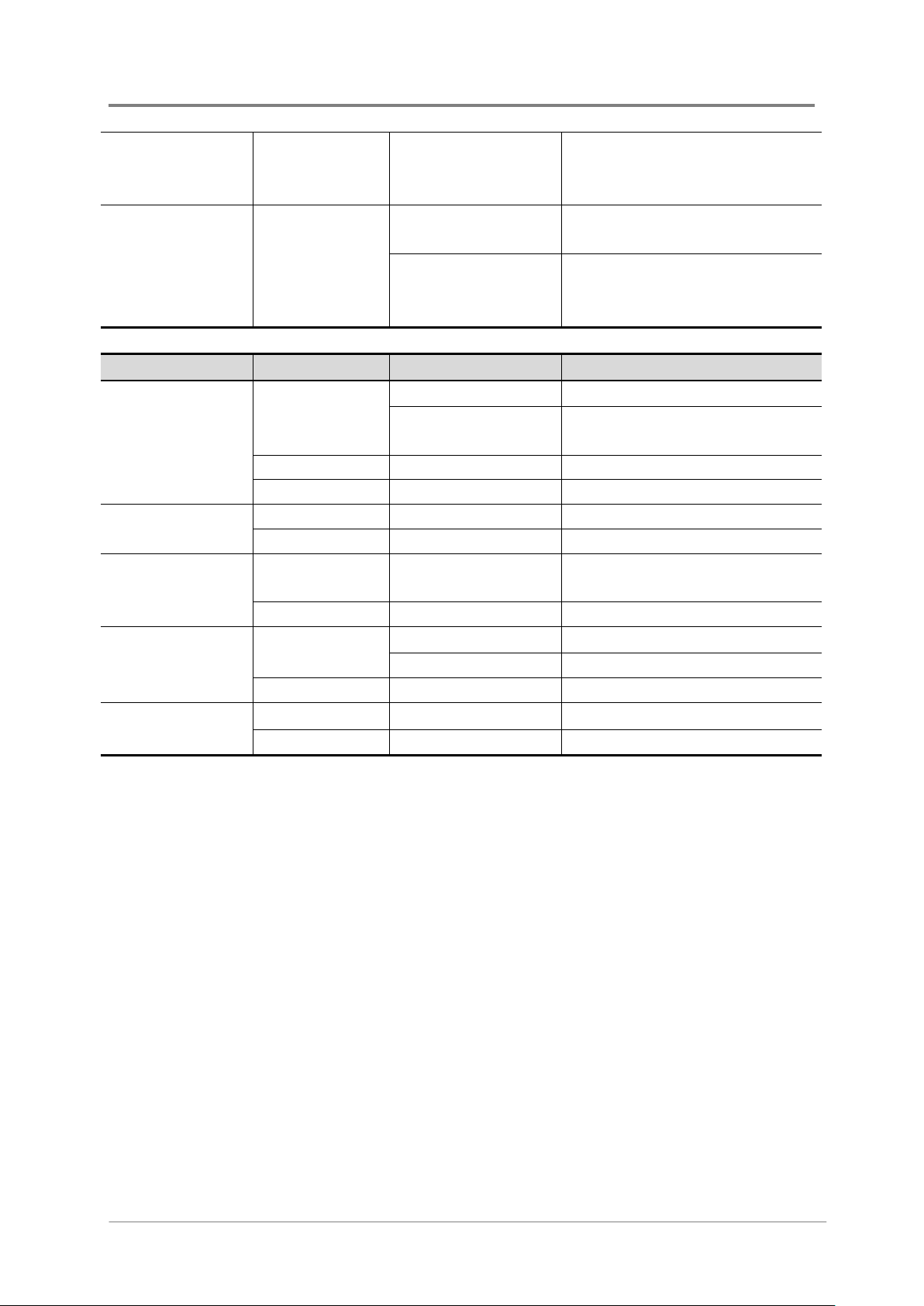
Table 1-5 LED Information
Front View LEDs
Off
Off
Off
Empty HDD slot
Idle:On
Access:Blinking
Off Off
Access:Blinking
Blinking
On
On
Rebuilding
On
Off
On
Failed
LED Type
Color
Status
Function
power off.
pressed.
via software.
Introduction
1 AC Power LED 1
2 AC Power LED 2
3 Speed LED of Management Port
4 Link/Activity LED of Management Port
5 UID LED
6 Link/Activity LED of 10G NIC Port
7 Speed LED of 10G NIC Port
The detailed LED information is shown below:
Activity LED Status LED
LED Type
Green Green Red
On Off On Off line in the RAID mode
2.5”/3.5”HDD
Idle:On
Tray LEDs
Blinking Off Off Hot spare
Off Off On Missing in the RAID mode
Green On DC power is power on.
Power LED
- Off
ID LED Blue
Function
Online
On Off Identify/Locate HDD
No AC power or DC power is
(IPMI) the identification
On
command is enabled, or the ID
button on the front panel is
Blinking
Unit selected for identification
2015-MNU-000023
Page 29
9
- Off
online/access
access
Back View LEDs
LED Type
Color
Status
Function
On
DC power is power on.
The power supply is in
hibernation.
Amber
On
abnormal
Management Port
Green
On
The network is connected.
-
Off
The network is disconnected.
Lind/Activity LED
The network is connected, and
is accessing.
-
Off
No connection.
Amber
On
Link at other speed.
Blinking
Introduction
No identification, or the ID
button on the front panel is not
pressed.
Onboard SATA HDD
HDD ACT LED Green
Green
AC Power LED
- Off AC power is power off.
Speed LED of
of Management
Port
Link/Activity LED
Green Blinking
- Off No access.
Green
of 10G NIC Port
No onboard SATA HDD online
Off
Onboard SATA HDD online/no
Blinking
On LAN link/no access
Blinking LAN link/access
Speed LED of
Green On Link at 10Gbps speed.
10G NIC Port
2015-MNU-000023
Page 30
10
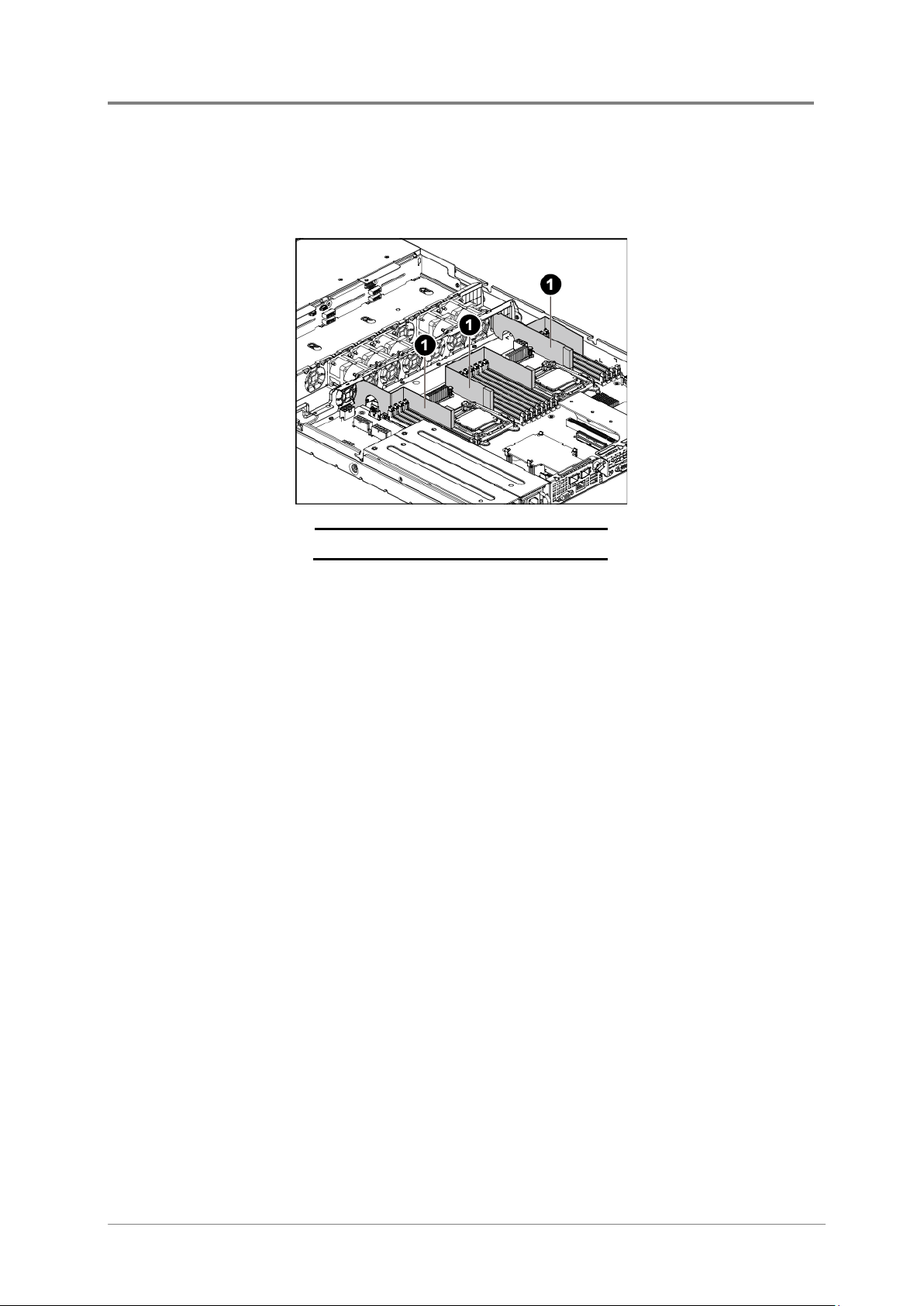
Fan Duct
Introduction
1.6.5 System Thermal Solutio n
This server provides a thermal solution to keep proper cooling. The components in the
following figure must be installed in place.
Figure 1-11 Thermal Solution
1
2015-MNU-000023
Page 31

Chapter 2
Hardware Operations
Before You Start
Chassis Cover
Motherboard
Power Supplies
Power Distribution Board
System Fans
PCI-E Expansion Cards and Riser Cards
10G NIC Card
RAID Card
2.5” SATA HDDs
3.5” SATA HDDs
2.5” HDD Backplane
3.5” HDD Backplane
Fan Duct
Page 32

Page 33

Hardware Operations
2-1
Figure 2-1 Pressing the Power Button
The components shown in this chapter are mainly for your reference. Please take the
actual shipment as standard.
To reduce the risk of injury from electric shock, remove the power cor
disconnect power from the system.
Moving the Power On/Off switch to the Of f position does not completely remov e pow er
from the system. Some portions of the power supply and
remain active. Disconnect all power
power from the system.
2 Hardware Operations
This chapter describes the hardware setup procedures that you have to perform when
replacing system components. It also gives detailed information on the internal components
and how to replace them.
2.1 Before You Start
Take note of the following operations before you start to remove or install internal
components.
2.1.1 Power Off
d to completely
some internal circuitr y
cords from the server to completely remove
To press the power button:
Press the power button to toggle the server to standby. The power LED in green turns
off.
2015-MNU-000023
Page 34

2-2
Figure 2-2 Unplugging the Power Cords
the server, see “2.1.1 Power Off”.
Hardware Operations
To remove the power cords:
First unplug the power cords from the AC outlet and then from the server.
2.2 Chassis Cover
The server is a 2U form factor designed for easy assembly and disassembly, making the
replacement of internal components very convenient.
Reminder
Before you remove or install the chassis cover, please follow the step below:
Step 1:
Make sure the server is not turned on or connected to the AC power. To power off
2015-MNU-000023
Page 35

2-3
2.2.1 To remove the chassis cover
Figure 2-3 Removing the Chassis Cover
Release the screw on the chassis cover.
Press the button along the direction of the arrow.
Simultaneously slide the cover horizontally to the back and remove it.
Hardware Operations
2.2.2 To install the chassis cover
Locate the chassis cover to the right position on the chassis as shown below and then slide
it to the front until it is closed.
Figure 2-4 Sliding the Chassis Cover to the Front
2015-MNU-000023
Page 36

2-4
Figure 2-5 Tightening the Screw
Before you remove or install the motherboard assembly, please follow the steps below:
:
connected to the AC power . To power off
Step 2:
Remove the chassis cover. To remove the chassis cover, see “2.2 Chassis
Cover”.
Step 3:
“2.7 PCI-E Expansion Card”.
Step 4:
This
cooling.
Hardware Operations
Secur e the chassis cover with one screw.
system must be operated with the chassis cover installed to ensure proper
2.3 Motherboard
The location of motherboard on the server is shown below:
Figure 2-6 Motherboard Location
Reminder
Step 1
Make sure the server is not turned on or
the server, see “2.1.1 Power Off”.
Remove the PCI-E expansion card. To remove the PCI-E expansion card, see
Disconnect all necessary cables.
2015-MNU-000023
Page 37

2-5
2.3.1 To remove the motherboard
Figure 2-7 Removing the Motherboard
Hardware Operations
Remove the nine screws that secure the motherboard.
Remove the motherboard out of the chassis along the direction of the arrow.
2.3.2 To install the motherboard
Reverse the steps above to install the motherboard.
2.4 Power Supplies
This server is designed with two 550W load balance and redundant pow er supplies platinum
version, or one 550 power supply platinum version
The location of power supplies on the server is shown below:
Figure 2-8 Power Supply Locations
.
2015-MNU-000023
Page 38

2-6
Step 1:
Disconnect all necessary cables.
Figure 2-9 Removing the Power Supply
Figure 2-10 Installing the Power Supply
Hardware Operations
Reminder
Before you remove or install the power supply, please follow the steps below:
2.4.1 To remove the power supply
Pr ess the retaining clip on the right side of the power supply along the direction of the
arrow.
At the same time, pull out the power supply. (The power supply takes considerable force to
remove.)
2.4.2 To install the power supply
Insert the replacement power supply firmly into the bay. The retaining clip should snap.
Connect the AC power cord to the replacement power supply.
2015-MNU-000023
Page 39

2-7
2.5 Power Distribution Board
Figure 2-11 Power Distribution Board Location
Before you remove or install the power distribution board, please follow the steps below:
Make sure the server is not turned on or connected to the AC p ower. To power off
the server, see “2.1.1 Power Off”.
“2.2 Chassis
Cover”.
Supplies”.
Step 4:
Disconnect all the necessary cables.
Figure 2-12 Removing the Power Distribution Board
The location of power distribution boards is shown below:
Hardware Operations
Reminder
Step 1:
Step 2:
Remove the chassis cover. To remove the chassis cover, see
Step 3:
Remove the power supply. To remove the power supply, see “2.4 Power
2.5.1 To remove the power distribution board
Loos en t he four screws that secure the power distribution board.
Lift the top power distribution board out of the chassis.
2015-MNU-000023
Page 40

2-8
Figure 2-13 System Fan Locations
Before you remove or install the system fans, please follow the steps below:
:
server is not turned on or connected to the AC power. To power off
the server, see “2.1.1 Power Off”.
:
“2.2 Chassis
Cover”.
Step 3:
Disconnect all the necessary cables.
Hardware Operations
2.5.2 To install the power distribution board
Reverse the steps above to install the power distribution boards.
2.6 System Fans
Subdividing the motherboard area and the backplane area is a metal cage that holds the
system fans. This server contains five system fans which are located inside the chassis.
These system fans maintain the ideal temperature for the motherboard, backplane and disk
drives.
The location of system fans is shown below:
Reminder
Step 1
Step 2
Make sure the
Remove the chassis cover. To remove the chassis cover, see
2015-MNU-000023
Page 41

2-9
2.6.1 To remove the system fans
Figure 2-15 PCI-E Expansion Card Assembly Location
Take the system fan out of the system fan cage.
Figure 2-14 Removing the System Fan
Hardware Operations
2.6.2 To install the system fans
Reverse the steps above to install the system fans.
2.7 PCI-E Expansion Cards and Riser Cards
This server is designed with two PCI-E riser cards to support the expansion cards.
The location of the PCI-E epxansion card assembly is shown below:
2015-MNU-000023
Page 42

2-10
Step 1:
Make sure the server is not turned on or connected to the AC p ower. To power off
Step 2:
Remove the chassis cover. To remove the chassis cover, see “2.2 Chassis
Cover”.
Step 3:
Figure 2-16 Removing the PCI-E Expansion Card Assembly
Figure 2-17 Removing the PCI-E Expansion Card on t he Right Side
Hardware Operations
Reminder
Before you remove or install the expansion cards and the riser cards, please follow the
steps below:
the server, see “2.1.1 Power Off”.
Disconnect all the necessary cables.
2.7.1 To remove the expansion cards and the riser cards
Open the flipped lock to the horizontal position.
Loos en t he thumbscrew that secures the PCI-E expansion card assembly.
Rem ove the PCI-E expansion card assembly.
Rot at e the slot-cover fastener on the right side to unlock the expansion card.
Meanwhile remove the expansion card, and the slot-cover fastener snaps back
automatically.
2015-MNU-000023
Page 43

Hardware Operations
2-11
Figure 2-19 Removing the Expansion Card on the Left Side
Unscrew the riser card on the right side.
Rem ove the riser card on the right ride along the direction of the arrow.
Figure 2-18 Removing the Riser Card
Rot at e the slot-cover fastener on the left side to unlock the expansion card.
Meanwhile remove the expansion card, and the slot-cover fastener snaps back
automatically.
2015-MNU-000023
Page 44

2-12
Figure 2-21 10G NIC Card Location
Hardware Operations
Unscrew the riser card on the left side.
Rem ove the riser card on the left side along the direction of the arrow.
Figure 2-20 Removing the Riser Card on the Left Side
2.7.2 To install the expansion cards and riser cards
Reverse the steps above to install the expansion cards and riser cards.
2.8 10G NIC Card
The location of the 10G NIC card is shown below:
2015-MNU-000023
Page 45

2-13
Step 1:
Make sure the server is not turned on or connected to the AC p ower. To power off
Step 2:
Remove the chassis cover. To remove the chassis cover, see “2.2 Chassis
Cover”.
“2.7 PCI-E Expansion Card”.
Step 4:
Figure 2-22 Removing the10G NIC card
Figure 2-23 Installing the Riser Card
Reminder
Before you remove or install the NIC card, please follow the steps below:
the server, see “2.1.1 Power Off”.
Step 3:
Remove the PCI-E expansion card. To remove the PCI-E expansion card, see
Hardware Operations
Disconnect all the necessary cables.
2.8.1 To remove the 10G NIC card
Loos en t he retaining clips that secure the 10G NIC card.
Rem ove the 10G NIC card out of the motherboard as indicated.
2.8.2 To install the 10G NIC card
Install the riser card in the slot on the motherboard.
2015-MNU-000023
Page 46

2-14
Figure 2-24 Installing the Four Pillars
Hardware Operations
Install the four pillars on the motherboard.
Align the 10G NIC card to the I/O slot with a proper angle.
Open the retaining clips on the four pillars, and simultaneously press down the 10G NIC
card in the direction as indicated. Ensure that the retaining clips lock the NIC card in place.
Figure 2-25 Installing the 10G NIC Card
2015-MNU-000023
Page 47

2-15
2.9 RAID Card
Figure 2-26 RAID Card Location
Before you remove or install the RAID card, please follow the steps below:
Make sure the server is not turned on or connected to the AC p ower. To power off
the server, see “2.1.1 Power Off”.
.2 Chassis
Cover”.
“2.7 PCI-E Expansion Card”.
Step 4:
Disconnect all the necessary cables.
Figure 2-27 Removing the RAID Card
The location of the RAID card is shown below:
Hardware Operations
Reminder
Step 1:
Step 2:
Remove the chassis cover. To remove the chassis cover, see “2
Step 3:
Remove the PCI-E expansion card. To remove the PCI-E expansion card, see
2.9.1 To remove the RAID card
Loos en t he retaining clips that secure the RAID card.
Lift the RAID card out of the chassis.
2015-MNU-000023
Page 48

2-16
Figure 2-28 2.5” SATA HDD Loc a tions
Figure 2-29 Sliding out the HDD Ass em bly
•
•
Hardware Operations
2.9.2 To install the RAID card
Reverse the steps above to install the RAID card.
2.10 2.5”SATA HDDs
The server can support 8x2.5” hot-pluggable SATA HDDs. Each HDD is with an adapter
bracket. Y ou don’t need to power-off the system when removing or installing a HDD.
The location of the 2.5” HDDs on the server is shown below:
Take note of the drive tray orientation before sliding it out.
The tray will not fit back into the bay if inserted incorrectly.
2.10.1 To remove the HDD
Push the release button.
Pull the lever open.
Slide the HDD assembly out of the HDD bay.
2015-MNU-000023
Page 49

2-17
Loos en t he four screws that secure the HDD.
L ift the HDD out of the HDD tray.
Figure 2-30 Removing the HDD
Hardware Operations
2.10.2 To install the HDD
Pla c e the HDD to the HDD tray.
Figure 2-31 Placing the HDD
2015-MNU-000023
Page 50

2-18
Figure 2-33 Installing the HDD Ass e mbly
Make sure that the HDD is connected to the HDD connector on the backplane.
Hardware Operations
Secure the HDD to the HDD tray with four screws.
Figure 2-32 Securing the Screws
Car ef ully insert the HDD assembly into the HDD bay with the lever lifted until it completely
enters the HDD bay.
Push the lever back in place.
2.11 3.5”SATA HDDs
The server can support 4x3.5” hot-pluggable SATA HDDs. Each HDD is with an adapter
bracket. Y ou don’t need to power-off the system when removing or installing a HDD.
2015-MNU-000023
Page 51

2-19
The location of the 3.5” HDDs on the server is shown below:
Figure 2-34 3.5” SATA HDD Locations
Figure 2-35 Sliding out the HDD Ass em bly
•
•
Take note of the drive tray orientation before sliding it out.
The tray will not fit back into the bay if inserted incorrectly.
Hardware Operations
2.11.1 To remove the HDD
Push the release button.
Pull the lever open.
Slide the HDD assembly out of the HDD bay.
2015-MNU-000023
Page 52

2-20
Hardware Operations
Loos en t he four screws that secure the HDD.
L ift the HDD out of the HDD tray.
Figure 2-36 Removing the HDD
2.11.2 To install the HDD
Pla c e the HDD to the HDD tray.
Figure 2-37 Placing the HDD
Secure the HDD to the HDD tray with four screws.
Figure 2-38 Securing the Screws
2015-MNU-000023
Page 53

Hardware Operations
2-21
Figure 2-39 Installing the HDD Ass e mbly
Figure 2-40 2.5” HDD Backplane Location
Make sure that the HDD is connected to the HDD connector on the backplane.
Car ef ully insert the HDD assembly into the HDD bay with the lever lifted until it c ompletely
enters the HDD bay.
Push the lever back in place.
2.12 2.5” HDD Backplane
The backplane can support up to eight 2.5” HDDs with adapter bracket in the system. The
design incorporates a hot-swappable feature to allow easy replacement of HDDs. The SATA
connectors on the backplane connect to the motherboard to provide power and indicate HDD
access and failure.
The location of 2.5” HDD backplane is shown below:
2015-MNU-000023
Page 54

2-22
Before you remove or install the HDD backplane, please follow the steps below:
Make sure the server is not turned on or connected to the AC p ower. To power off
the server, see “2.1.1 Power Off”.
.2 Chassis
Cover”.
Step 3:
Remove the HDDs.To remove a HDD, see ”2.10 2.5” SATA HDDs”.
Step 4:
Figure 2-42 Removing the 2.5” HDD Backplane
Hardware Operations
Reminder
Step 1:
Step 2:
Remove the chassis cover. To remove the chassis cover, see “2
Disconnect all the necessary cables.
2.12.1 To remove the 2.5” HDD backpl an e
Remove the screws that secure the HDD cage.
Rem ove the HDD cage along the direction of the arrow.
Figure 2-41 Removing the 2.5” HDD Cage
Loos en t he screws that secure the backplane to the HDD cage.
Rem ove the backplane from the HDD cage.
2.12.2 To install the 2.5” HDD backplane
Reverse the steps above to install the backplane.
2015-MNU-000023
Page 55

Hardware Operations
2-23
Figure 2-43 3.5” HDD Backplane Location
Before you remove or install the 3.5” HDD backplane, please follow the steps below:
Make sure the server is not turned on or connected to the AC p ower. To power off
the server, see “2.1.1 Power Off”.
.2 Chassis
Cover”.
Step 3:
Remove the HDDs.To remove a HDD, see ”2.11 3.5”SATA HDDs”.
Step 4:
Disconnect all the necessary cables.
2.13 3.5” HDD Backplane
The backplane can support up to four 3.5” HDDs with adapter bracket in the system. The
design incorporates a hot-swappable feature to allow easy replacement of HDDs. The SATA
connectors on the backplane connect to the motherboard to provide power and indicate HDD
access and failure.
The location of 3.5” HDD backplane is shown below:
Reminder
Step 1:
Step 2:
Remove the chassis cover. To remove the chassis cover, see “2
2015-MNU-000023
Page 56

2-24
Figure 2-44 Removing the 3.5” HDD Cage
Figure 2-45 Removing the 3.5” HDD Backplane
Hardware Operations
2.13.1 To remove the 3.5”HDD backplane
Remove the screws that secure the HDD cage.
Rem ove the HDD cage along the direction of the arrow.
Loos en t he screws that secure the backplane to the HDD cage.
Rem ove the backplane from the HDD cage.
2.13.2 To install the 3.5” HDD backplane
Reverse the steps above to install the backplane.
2015-MNU-000023
Page 57

2-25
2.14 Fan Duct
Figure 2-46 Fan Duct Location
Step 1:
Make sure the server is not turned on or connected to the AC power. To power off
Step 2:
Remove the chassis cover. To remove the chassis cover, see “2.2 Chassis
Cover”.
Step 3:
Disconnect all the necessary cables.
The location of fan duct is shown below:
Hardware Operations
Reminder
Before you remove or install the 3.5” HDD backplane, please follow the steps below:
the server, see “2.1.1 Power Off”.
2.14.1 To remove the fan duct
Lift the fan duct out of the chassis cover.
Figure 2-47 Removing the Fan Duct
2015-MNU-000023
Page 58

2-26
Hardware Operations
2.14.2 To install the fan duct
Reverse the steps above to install the fan duct.
2015-MNU-000023
Page 59

Chapter 3
Connectors
Backplane Connectors
Power Distribution Board Connect ors
Page 60

Page 61

3-1
3 Connectors
Figure 3-1 8x2.5”HDDs SATA Backplane
Backplane Power Connector
Backplane SATA Connectors 1, 2
3.1 Backplane Connectors
8x2.5” HDD backplane is shown as below:
Connectors
1 SATA HDD Connectors 1, 2 8 SGPIO Connector 1
SATA HDD Connectors 3, 4
2
SATA HDD Connectors 5, 6
3
SATA HDD Connector 7
4
SATA HDD Connector 8
5
6
SGPIO Connector 2
7
9 CPLD JTAG Connector
10 Backplane SATA Connectors 7, 8
Backplane SATA Connectors 5, 6
11
Backplane SATA Connectors 3, 4
12
13
2015-MNU-000023
Page 62

3-2
Figure 3-2 4x3.5”HDDs SATA Backplane
SATA HDD Connector 2
SATA HDD Connector 4
Backplane SATA Connector 2
Backplane SATA Connector 4
Backplane SATA Connector 1
Connectors
4x3.5” HDD backplane is shown as below:
1 SATA HDD Connector 1 8 SGPIO Connector 2
2
SATA HDD Connector 3
3
4
Backplane Power Connector
5
6
LED Connector
7
9 Backplane SATA Connector 3
10 CPLD JTAG Connector
11
SGPIO Connector 1
12
13
2015-MNU-000023
Page 63

3-3
3.2 Power Distribution Board Connect ors
Figure 3-3 Power Distribution Board
Connectors
1 System Power Connector 5 P12VA Power Connector 2
2 P12VA Power Connector 1 6 PMBus Connector
3 System Power Connector 7 Power Supply Connector 2
4 Backplane Power Connector 8 Power Supply Connector 1
2015-MNU-000023
Page 64

Page 65

Chapter 4
Cable Routing
Page 66

Page 67

4-1
4 Cable Routing
Cable Routing
2015-MNU-000023
Page 68

Page 69

Appendix
China RoHS Regulations
Page 70

Page 71

I
Appendix China RoHS Regulations
Figure I China RoHS Regulations
Appendix
2015-MNU-000023
Page 72

Page 73

June, 2015 (Revision A)
Board Manual
B800G3
P/N: 2015-MNU-000009
Page 74

Copyright Notice
All rights, including copyright, in the content of this manual are owned or controlled by
Inventec Corporation and protected by the Taiwan and international copyright act.
No one may, transmit, adapt, assign, compile, rent, sale, change, copy, reproduce, distribute,
publish, display, broadcast, or use in any way the content of this manual, in whole or in part,
for any other purpose whatsoever without the prior written permission of Inventec
Corporation.
Trademarks
All product names or brands mentioned herein are the trademarks o f Inventec Corporation, its
subsidiaries or other respective owners in Taiwan, United States and other countries.
Disclaimer
This manual provides the information in relation to the set-up and installation of the product
herein. Nothing herein may be construed as granting any right or license relating to any
intellectual property rights of this manual or product. Unless otherwise provided in the
Purchase and Sale Agreement for this product, manufacturer and distributor of this product
will not be liable whatsoever relating to the distribution and/or use of this product. In addition,
manufacturer and distributor of this product hereby specifically disclaim any express or
implied warranties of merchantability, fitness for a particular purpose, or non-infring ement of
third party rights in connection with this product.
Manufacturer of this product may have the right to change specifications and product
descriptions at any time without notice.
Page 75

Page 76

Contents
About This Manual ............................................................................................................... i
1 Introduction................................................................................................................ 1-1
1.1 Audience Assumptions ...................................................................................... 1-1
1.2 Manual Organization ......................................................................................... 1-1
1.3 Product Features ............................................................................................... 1-2
1.4 Motherboard Layout .......................................................................................... 1-4
1.5 Back Panel LED Information .............................................................................. 1-6
2 Hardware Operation .................................................................................................. 2-1
2.1 Before Y ou Start ................................................................................................ 2-1
2.2 Screw Hole ........................................................................................................ 2-2
2.3 System Battery .................................................................................................. 2-2
2.3.1 To remove the system battery ........................................................................ 2-3
2.3.2 To install the system battery ........................................................................... 2-3
2.4 Processor .......................................................................................................... 2-4
2.4.1 To remove the heat sink ................................................................................. 2-4
2.4.2 To install the heat sink .................................................................................... 2-5
2.4.3 To remove the processor ................................................................................ 2-5
2.4.4 To install the processor ................................................................................... 2-7
2.5 System Memory ................................................................................................ 2-7
2.5.1 To remove a DIMM ......................................................................................... 2-9
2.5.2 To install a DIMM ............................................................................................ 2-9
3 Connectors and Jumpers .......................................................................................... 3-1
3.1 PMBus Connector (J27) .................................................................................... 3-1
3.2 2x12 Pin Power Connector (J33) ....................................................................... 3-2
3.3 2x4 Pin Power Connector (J62, J63) ................................................................. 3-3
3.4 Fan Connectors (J64, J65, J66, J67, J68, J69, J70, J71) .................................. 3-4
3.5 SA TA Connector (J12) ....................................................................................... 3-4
3.6 SATA DOM Connector (J18) .............................................................................. 3-5
3.7 SATA DOM Power Connector (J93) ................................................................... 3-6
3.8 HD_MiniSAS Connector (J73,J74,J76,J77,J78,J79) / SATA HD_MiniSAS
Connector (J13) / SSATA HD_MiniSAS Connector (J32) / ASM1061 SATA HD_MiniSAS
Connector (J36) .............................................................................................................. 3-7
3.9 SGPIO Connector (J11) ................................................................................... 3-10
3.10 2x12 Pin SSI Front Panel Connector (J28) ...................................................... 3-10
3.11 Internal USB Connector (J45) ........................................................................... 3-11
3.12 PCI-E Slot (J22, J81) ....................................................................................... 3-12
3.13 OCP Slots (J21, J24, J75) ............................................................................... 3-14
3.14 Jumper settings ............................................................................................... 3-16
Page 77

3.14.1 BIOS Recovery Jumper (J7)......................................................................... 3-16
3.14.2 ME Recovery Jumper (J8) ............................................................................ 3-17
3.14.3 Clear Password Jumper (J9) ........................................................................ 3-17
3.14.4 Clear CMOS Jumper (J23) ........................................................................... 3-18
3.14.5 QPI Slow Jumper (J26) ................................................................................ 3-19
3.14.6 Intruder Header (J40) ................................................................................... 3-19
Appendix China RoHS Regulations .................................................................................. I
List of Figures
Figure 1-1 Motherboard Overview ............................................................................ 1-2
Figure 1-2 Connector and Component Location of Motherboard ............................... 1-4
Figure 1-3 Back Panel LEDs ..................................................................................... 1-6
Figure 2-1 Screws Placement ................................................................................... 2-2
Figure 2-2 System Battery Location .......................................................................... 2-3
Figure 2-3 Pulling the System Batter y out of the Holder ............................................ 2-3
Figure 2-4 Putting the System Battery into the Holder............................................... 2-4
Figure 2-5 Location of Processors ............................................................................ 2-4
Figure 2-6 Removing the Heat Sink .......................................................................... 2-5
Figure 2-7 Opening the Load Plate ........................................................................... 2-5
Figure 2-8 Lifting the Processor out of the So c ket ..................................................... 2-6
Figure 2-9 Closing the Load Plate ............................................................................. 2-6
Figure 2-10 Installing the PnP Cap ........................................................................... 2-6
Figure 2-11 Pointing the Golden Corner toward the Socket....................................... 2-7
Figure 2-12 Location of System Memories ................................................................ 2-8
Figure 2-13 DIMM Socket Location ........................................................................... 2-8
Figure 2-14 Lifting the DIMM out of the Socket ......................................................... 2-9
Figure 2-15 Pressing the Retaining Clips Outward .................................................... 2-9
Figure 2-16 Inserting the DIMM into the Socket ...................................................... 2-10
Figure 3-1 PMBus Connector.................................................................................... 3-1
Figure 3-2 2x12 Pin Power Connector ...................................................................... 3-2
Figure 3-3 2x4 Pin Power Connector ........................................................................ 3-3
Figure 3-4 Fan Connectors ....................................................................................... 3-4
Figure 3-5 SATA Connector ...................................................................................... 3-4
Figure 3-5 SATA DOM Connector ............................................................................. 3-5
Figure 3-5 SATA DOM Power Connector .................................................................. 3-6
Figure 3-5 HD_MiniSAS Connector .......................................................................... 3-7
Figure 3-5 SGPIO Connector .................................................................................. 3-10
Figure 3-5 2x12 Pin SSI Front Panel Connector ..................................................... 3-10
Figure 3-5 Internal USB Connector .......................................................................... 3-11
Figure 3-5 PCI-E x16 Slots ..................................................................................... 3-12
Page 78

Figure 3-6 OCP Slots .............................................................................................. 3-14
Figure 3-6 BIOS Recovery Jumper ......................................................................... 3-16
Figure 3-7 ME Recovery Jumper ............................................................................ 3-17
Figure 3-8 Clear Password Jumper......................................................................... 3-18
Figure 3-9 Clear CMOS Jumper ............................................................................. 3-18
Figure 3-11 QPI Slow Jumper ................................................................................. 3-19
Figure 3-10 Intruder Header.................................................................................... 3-19
Appendix Figure I China RoHS Regulations ................................................................. I
List of Tables
Table i Product Safety Requirements ........................................................................... vi
Table ii European Union EMC Requirements ............................................................. viii
Table 1-1 Manual Introduction ..................................................................................... 1-1
Table 1-2 Product Features ....................................................................................... 1-2
Table 1-3 LED Information of NIC Port ...................................................................... 1-6
Table 3-1 Pin Definition of PMBus Connector (J27) .................................................. 3-1
Table 3-3 Pin Definition of 2x12 Pin Power Connector (J33) ..................................... 3-2
Table 3-5 Pin Definition of 2x4 Pin Power Connector (J62) ....................................... 3-3
Table 3-5 Pin Definition of 2x4 Pin Power Connector (J63) ....................................... 3-3
Table 3-6 Pin Definition of Fan Connectors (J64,J65,J66,J67,J68,J69,J70,J71) ....... 3-4
Table 3-8 Pin Definition of SATA Connector (J12) ..................................................... 3-5
Table 3-8 Pin Definition of SATA DOM Connector (J18) ............................................ 3-5
Table 3-8 Pin Definition of SATA DOM Power Connector (J93) ................................. 3-6
Table 3-8 Pin Definition of HD_MiniSAS Connectors (J73,J74,J76,J77,J78,J79) ...... 3-7
Table 3-8 Pin Definition of SATA HD_MiniSAS Connector (J13) ................................ 3-8
Table 3-8 Pin Definition of SSATA HD_MiniSAS Connector (J32) ............................. 3-8
Table 3-8 Pin Definition of ASM1061 SATA HD_MiniSAS Connector (J36) ............... 3-9
Table 3-8 Pin Definition of SGPIO Connector (J11) ................................................. 3-10
Table 3-8 Pin Definition of 2x12 Pin SSI Front Panel Connector (J28) ..................... 3-11
Table 3-8 Pin Definition of Internal USB Connector (J45) ......................................... 3-11
Table 3-8 Pin Definition of PCI-E x16 Slots (J22, J81) ............................................. 3-12
Table 3-10 Pin Definition of the OCP Slots (J21, J24, J75) ........................................ 3-15
Table 3-10 BIOS Recovery Jumper Function (J7) ...................................................... 3-17
Table 3-11 ME Recovery Jumper Function (J8) ......................................................... 3-17
Table 3-12 Clear Password Jumper Function (J9) ................................................... 3-18
Table 3-13 Clear CMOS Jumper Function (J23)...................................................... 3-18
Table 3-15 QPI Slow Jumper Function (J26) ........................................................... 3-19
Table 3-14 Intruder Header Function (J40) .............................................................. 3-19
Page 79

About This Manual
Conventions
Safety Symbols
Safety Precautions
Regulatory and Integration Information
Page 80

Page 81

i
About This Manual
About This Manual
Conventions
To make sure that you perform certain tasks properly, take note of the following symbols used
throughout this manual.
Warning:
Caution:
Important:
Note:
Information to prevent injury to yourself when trying to complete a
task.
Information to prevent damage to the components when trying to
complete a task.
Information that you must follow to complete a task.
Tips and information to aid in completing a task.
2015-MNU-000009
Page 82

ii
Indicates the potential hazard of energy circuits or electric shock. To reduce the
Indicates the presence of a hot surface or hot component.
This symbol, on power supplies or systems, indicates that the equipment is
About This Manual
Safety Symbols
Before troubleshooting, you must be familiar with the safety information listed below. In order
to avoid any potential hazards, the following symbols may be placed on some components of
the server.
The shape and the color of symbols shown below are mainly for your reference. Please take
the actual shipment as standard.
risk of injury from electric hazards, do not open this enclosure.
Warning: Any surface or area of the equipment marked with this symbol
indicates the presence of electric shock hazards. The enclosed area contains no
operator serviceable parts.
Indicates the potential hazard of electric shock. The enclosed area contains no
user of field serviceable parts. Do not open for any reason.
Warning: To reduce the risk of injury from electric shock hazards, do not open
this enclosure.
Weight i n kg
Weight i n lb
Warning: To reduce the risk of injury from a hot component, allow the surface to
cool before touching it.
Any RJ45 receptacle marked with this symbol indicates a network interface
connection.
Warning: To reduce the risk of electric shock, fire, or damage to the equipment,
Do not plug telephone or telecommunications connectors into this receptacle.
supplied by multiple sources of power.
Warning: To reduce the risk of injury from electric shock, remove all power
cords to completely disconnect power from the system.
This symbol indicates that the component exceeds the recommended weight for
one individual to handle safely.
Warning: To reduce the risk of personal injury or damage to the equipment,
observe local occupational health and safety requirements and guidelines for
manual material handling.
2015-MNU-000009
Page 83

iii
About This Manual
Safety Precautions
Observe the following safety precautions when you are connecting or disconnecting any
device.
Reg ar ding the standards of workstation regulations, do not place the server in the visual
•
field of the user, because of the glossy front of the case.
The product is non-consumer product and for profession technical person used only.
•
Operation Sa fety
Any operation on this server must be conducted by certified or experienced engineers.
•
Before operating your server, carefully read all the manuals included with the server
•
package.
Before using the server, make sure that all cables are correctly connected and power
•
cords are not damaged. If any damage is detected, contact your dealer as soon as
possible.
To avoid short circuits, keep paper clips, screws, and staples away from connectors, slots,
•
sockets and circuitry.
Before opening the chassis panels, make sure all power cords are unplugged.
•
Avoid dust, humidity, and extreme temperatures, place the server on a stable surface.
•
If the power supply is broken, do not try to fix it by yourself. Contact an authorized dealer.
•
I t is recommended that you wear gloves when assembling or disassembling the server to
•
protect from cuts and scrapes.
When the server is powered on, heat sinks and the surfaces of certain IC devices may be
•
hot. Do not touch them. Check whether the fans are functioning properly.
Electrical Safety
Before installing or removing signal cables, ensure that the power cords for the system
•
unit and all attached devices are unplugged.
To prevent electric shock hazard, disconnect the power cord from the electrical outlet
•
before relocating the system.
When adding or removing any additional devices to or from the system, ensure that the
•
power cords for those devices are unplugged before the signal cables are connected. If
possible, disconnect all power cords from the existing system before you add a device.
2015-MNU-000009
Page 84

iv
About This Manual
Use one hand, when possible, to connect or disconnect signal cables to prevent a
•
possible shock from touching two surfaces with different electrical potentials.
This product is equipped with a three-wire power cord and plug for user safety. Use the
•
power cord with a properly Grounded electrical outlet to avoid electric shock.
Motherboards, adapters, and disk drives are sensitive to static electricity discharge. These
devices are wrapped in antistatic bags to prevent this damage. Take the following
precautions:
If you have an antistatic wrist strap available, use it while handling the device.
•
Do not remove the device from the antistatic bag until you are ready to i ns t all the device in
•
the system unit.
With the device still in its antistatic bag, touch it to a metal frame of the system.
•
Grasp cards and boards by the ed ges. Hold drives by the frame. Av oid touching the solde r
•
joints or pins.
If you need to lay the device down while it is out of the antistatic bag. Lay it on the
•
antistatic bag. Before picking it up again, touch the antistatic bag and the metal frame of
the system unit at the same time.
Handle the devices carefully to prevent permanent damage.
•
Battery Replacemen t Safety
This server is provided with an internal Lithium battery or battery pack. There is a danger of
explosion and risk of personal injury if the battery is incorrectly replaced or mistreated.
For more information about battery replacement or proper disposal, contact an authorized
reseller or your authorized service provider.
This server contains an internal Lithium Manganese Dioxide, or a Vanadium Pentoxide, or an
alkaline battery pack. There is risk of fire and bur ns if the battery pack is not handled properly.
To reduce the risk of personal injury:
Do not attempt to recharge the battery.
•
Do not expose to temperatures higher than 70°C.
•
Do not disassemble, crush, puncture, shorten external contacts, or dispose in fire or
•
water.
Replace only with the spare parts designated for this product.
•
2015-MNU-000009
Page 85

v
About This Manual
Batteries should not be littered along with the general household waste. Please use the public
collection system or return them to the supplier.
Laser Peripherals or De vi ces Safety
To avoid risk of radiation exposure and/or personal injury:
Do not open the enclosure of any laser peripheral or device.
•
Laser peripherals or devices are not user serviceable.
•
Return to manufacturer for servicing.
•
Intended Application Uses
This product was evaluated as Information Technology Equipment (ITE), which may be
installed in offices, schools, computer rooms, and similar commercial type locations. The
suitability of this product for other product categories and environments (such as medical,
industrial, residential, alarm systems, and test equipment), other than an ITE application, may
require further evaluation.
Site Selection
The system is designed to operate in a typical office environment. Choose a site that is:
Clean, dr y, and free of airborne particles (other than normal room dust).
•
Well-ventilated and away from sources of heat including direct sunlight and radiators.
•
A way fr om sourc es of vibration or physical shock.
•
I solat ed fr om strong electromagnetic fields produced by electrical devices.
•
I n regions that are susceptible to electrical storms, we recommend you plug your system
•
into a surge suppresser and disconnect telecommunication lines to your modem during an
electrical storm.
Provided with a properly Grounded wall outlet.
•
Provided with suff icient space to access the power supply cord(s), because they serve as
•
the product's main power.
2015-MNU-000009
Page 86

vi
About This Manual
Tools Required
A cross screwdriver or a flat screwdriver is needed to install or remove the components in the
server.
Regulatory and Integration Information
Regulatory Compliance Identi fication Numbers
For the purpose of regulatory compliance certifications and identification, this motherboard is
assigned a serial number. This server serial number can be found on the product label, along
with the required approval markings and information. When requesting certification
information for this product, always refer to this serial number. This serial number should not
be confused with the marketing name or model number.
Product Regulatory Compliance
Worldwide Safety approvals can be supplied according to the requirements from Marketing or
Customer.
Product Safety Compliance
The motherboard complies with the following safety requirements:
Table i Product Safety Requirements
IEC 60950-1 Safety of Information Technology Equipment
EN 60950-1 Safety of Information Technology Equipment Including Electrical
Business Equipment, European Committee for Electrotechnical
Standardization (CENELEC)
UL 60950-1 Safety of Information Technology Equipment
UL 94 Tests for Flammability of Plastic Materials for Parts in Devices &
Appliances
GB4943 Safety of Information Technology Equipment
Product EMC Compliance
This product has been tested and verified to comply with the following electromagnetic
compatibility (EMC) regulations.
Communications Commission Notice
Part 15 of the Federal Communications Commission (FCC) Rules and Regulations has
established Radio Frequency (RF) emission limits to provide an interference-free radio
2015-MNU-000009
Page 87

vii
About This Manual
frequency spectrum. Many electronic devices, including computers, generate RF energy
incidental to their intended function and are, therefore, covered by these rules. These rules
place computers and related peripheral devices into two classes, A and B, depending upon
their intended installation. Class A devices are those that may reasonably be expected to be
installed in a business or commercial environment. Class B devices are those that may
reasonably be expected to be installed in a residential environment (for example, personal
computers). The FCC requires devices in both classes to bear a label indicating the
interference potential of the device as well as additional operating instructions for the user.
The rating label on the device shows which class (A or B) the equipment falls into. Cla s s A
devices do not have an FCC logo or FCC ID on the label. Class B devices have an FCC logo
or FCC ID on the label. Once the class of the device is determined, refer to the following
corresponding statement.
Class A Equipment
This equipment has been tested and found to comply with the limits for a Class A digital
device, pursuant to Part 15 of the FCC Rules. These limits are designed to provide
reasonable protection against harmful interference when the equipment is operated in a
commercial environment. This equipment generates, uses, and can radiate radio frequency
energy and, if not installed and used in accordance with the instructions, may cause harmful
interference to radio communications. Operation of this equipment in a residential area is
likely to cause harmful interference, in which case the user will be required to correct the
interference at personal expense.
Declaration of Conformity for Products Marked with the FCC Logo—United States Only
This device complies with Part 15 of the FCC Rules Operation and is subject to the following
two conditions: (1) this device may not cause harmful interference, and (2) this device must
accept any interference received, including interference that may cause undesired operation.
For questions regarding your product, please contact the supplier.
To identify this product, refer to the Part, Series, or Model number found on the product.
European Union Notice
Products with the CE Marking comply with both the EMC Directive (89/336/EEC) and the
Low-Voltage Directive (73/23/EEC) issued by the Commission of the European Community.
Compliance with these directives implies conformity to the following European Norms (in
brackets are the equivalent international standards):
2015-MNU-000009
Page 88

viii
About This Manual
Table ii European Union EMC Requirements
EN55022 (CISPR 22) Electromagnetic Interference
EN55024 (IEC61000-4-2,3,4,5,6,8,11) Electromagnetic Immunity
EN61000-3-2 (IEC61000-3-2) Power Line Harmonics
EN61000-3-3 (IEC61000-3-3) Power Line Flicker
Canadian Notice (Avis Canadien)
Class A Equipment
Japanese Notice
Taiwanese Notice
2015-MNU-000009
Page 89

Chapter 1
Introduction
Audience Assumptions
Manual Organization
Product Features
Motherboard Layout
System LED Information
Page 90

Page 91

Introduction
1-1
Hardware Operation
1 Introduction
1.1 Audience Assumpti ons
This document is for the person who installs, administers, and troubleshoots motherboard.
Inventec Corporation assumes you are qualified in the servicing of computer equipment and
trained in recognizing hazards in products with hazardous energy levels.
1.2 Manual Organization
This manual introduces the motherboard along with the hardware information and how to
replace the hardware. This manual is generally organized as follows:
Table 1-1 Manual Introduction
Introduction
Connectors and
Jumpers
Appendix
General motherboard introduction and LED information.
The operation of the components on the motherboard, such as
system battery, processor, system memory, and so forth.
Necessary information such as the locations and functions of
connectors and jumpers on the motherboard.
China RoHS Regulations information.
2015-MNU-000009
Page 92

1-2
Processor
Hardware Operations
1.3 Product Features
This chapter provides the detailed features for processor, chipset, system memory, onboard
storage, NIC, VGA, I/O and PCI slot with pictures for your reference.
Figure 1-1 Motherboard Overview
®
This motherboard supports Intel
Xeon™ E5-2600 V3 product family based on Intel® C610
Wellsburg platform chipset. The following highlights are the main features of the motherboard.
Table 1-2 Product Features
®
XeonTM E5-2600 V3 product family
Chipset
System Memory
2x Intel
Designed up to 145W
Dual I ntel Sockets R3 (LGA2011-3)
Intel C610 Wellsburg
16x DDR4 2133MHz/s UDIMM/RDIMM/LRDIMMs
4x DDR4 channel per CPU
1.2V DDR4 standard I/O voltage
Up to 8 ranks supported per channel, 1, 2, or 4 ranks
per DIMM
Max memory capacity up to 256GB per processor
NIC
Server Management
2015-MNU-000009
Intel
I350 supports dual ports 1G Base-T connection
82599 supports dual ports SFP+ connection
ASPEED AST2400, IPMI2.0 Complaint
®
NH I350/82599 OCP NIC
Page 93

1-3
VGA
Introduction
1 management RJ45 port with 10/100Mbps
Onboard Storage Ports
Rear IO Ports
14x 6Gb/s SATA III connectors
1x 6Gb/s SATA port connected to 1 SATA connector
1x 6Gb/s SATA_DOM port connected to 1 SA TA_DOM
connector
8x 6Gb/ s SAT A ports connected to 2 HD_MiniSATA
connectors
4x 6Gb/ s SAT A ports connected to 1 HD_MiniSATA
connector (2 ASM1061 Platforms)
Intel RSTe RAID 0/1/10/5
AHCI m o d e
ASPEED AST2400 embedded
2x 1Gb RJ45 Ports on I350 NIC, 2x SFP+ ports on
82599 NIC
3x USB 3.0 ports
1x VGA connector
1x Serial port
1x UID Button/LED
Onboard Slots
1x BMC reset button
1 RJ45 management port
2x PCI-E x16 slot
3x OCP x8 slot
2015-MNU-000009
Page 94

1-4
1
ME Recovery Jumper (J8)
2
PMBus Connector (J27)
4
CPU1 PE2A HD_MiniSAS Connector (J79)
CPU1 PE2C HD_MiniSAS Connector (J76) (on SKU 301
CPU1 PE2D HD_MiniSAS Connector (J77) (on SKU 301
8
Power Connector 1 (J33)
Hardware Operations
1.4 Motherboard Layout
The layout of the motherboard is shown below. Each connector and major component is
identified by number.
Figure 1-2 Connector and Component Location of Motherboard
3 CPU1 NIC OCP Slot (J75)
5 CPU1 PE2B HD_MiniSAS Connector (J78)
6
motherboard; not featured on SKU 302)
7
motherboard; not featured on SKU 302)
2015-MNU-000009
Page 95

1-5
9
Battery (BH1)
11
Fan Connector 7 (J71)
12
Fan Connector 6 (J70)
13
Power Connector 3 (J62)
15
CPU1 DIMM Sockets (J50, J51, J52, J53)
17
Fan Connector 4 (J68)
18
CPU0 DIMM Sockets (J57, J56, J55, J54)
19
Fan Connector 3 (J67)
20
Fan Connector 2 (J66)
21
CPU 0
23
Fan Connector 1 (J65)
24
Fan Connector 0 (J64)
25
CPU0 DIMM Sockets (J49, J48, J47, J46)
26
CPU0 PE1A HD_MiniSAS Connector (J73)
27
CPU0 PE1B HD_MiniSAS Connector (J74)
29
SATA DOM Connector (J18)
30
HD_MiniSAS Connector 0/Onboard SATA Connector 2~5 (J13)
31
SATA Connector (J12)
33
HD_MiniSAS Connector 1/Onboard SSATA Connector 0~3 (J32)
HD_MiniSAS SA TA Connector (connected to ASM1061) (J36) (on
36
SGPIO Connector (J11)
38
CPU0 PCIe Slot 6 (J81)
40
Clear Password Jumper (J9)
42
BIOS Recovery Jumper (J7)
44
CPU1 PCIe Slot 7 (J22)
Introduction
CPU1 DIMM Sockets(J61, J60, J59, J58)
10
14 CPU1
16 Fan Connector 5 (J69)
22 Power Connector 2 (J63)
28 SATA DOM Power Connector (J93)
32 Internal USB2.0 Connector (J45)
34 SSI Front Panel Connector (J28)
35
SKU 301 motherboard; not featured on SKU 302)
37 CPU0 NIC OCP Slot (J21)
39 Intruder Jumper (J40)
41 QPI SLOW Mode Jumper (J26)
43 Clear CMOS Jumper (J23)
2015-MNU-000009
Page 96

1-6
45
CPU0 HBA OCP Slot (J24)
47
BMC Reset Button (SW2)
48
UID Button/LED (SW1)
49
TFM Connector (J10)
51
Management Port (J5)
1
Management Port Speed LED
2
Management Port Link/Activity LED
3
UID LED
Type of
LED
Link/Activity
Speed
LED
On
LAN link
Off
No connection
Link/Activity LED
Blinking
LAN link/Access
Off
No access
On
LAN link/No access
Blinking
LAN link/Access
On
Linked to the network at 100Mbps
-
Off
Linked to the network at 10Mbps
Hardware Operations
46 Serial Port (J102)
50 USB3.0 Connector (J4)
52 VGA Connector (J3)
1.5 Back Panel LED Infor m ation
The back panel LED informatio n displays details regarding the NIC LEDs, the management
port LED and the ID LED. The NIC port and management port contains two LEDs that show
the status of network activity, link or speed.
Figure 1-3 Back Panel LEDs
The detailed LED information is shown below:
Table 1-3 LED Informatio n of NIC Port
Color Status
Management Port Speed
Management Port
1Gbe NIC Ports
Link/Activity
Green
Green
Green
Off No connection
1Gbe Speed
2015-MNU-000009
Green
Amber
On Linked to the network at 1Gbe
Page 97

1-7
Blinking
LAN link/Access
Introduction
10Gbe NIC Ports
Link/Activity
Green
Off No connection
On LAN link/No access
2015-MNU-000009
Page 98

Page 99

Chapter 2
Hardware Operations
Before You Start
Screw Holes
System Battery
Processor
System Memory
Page 100

 Loading...