

Page 1
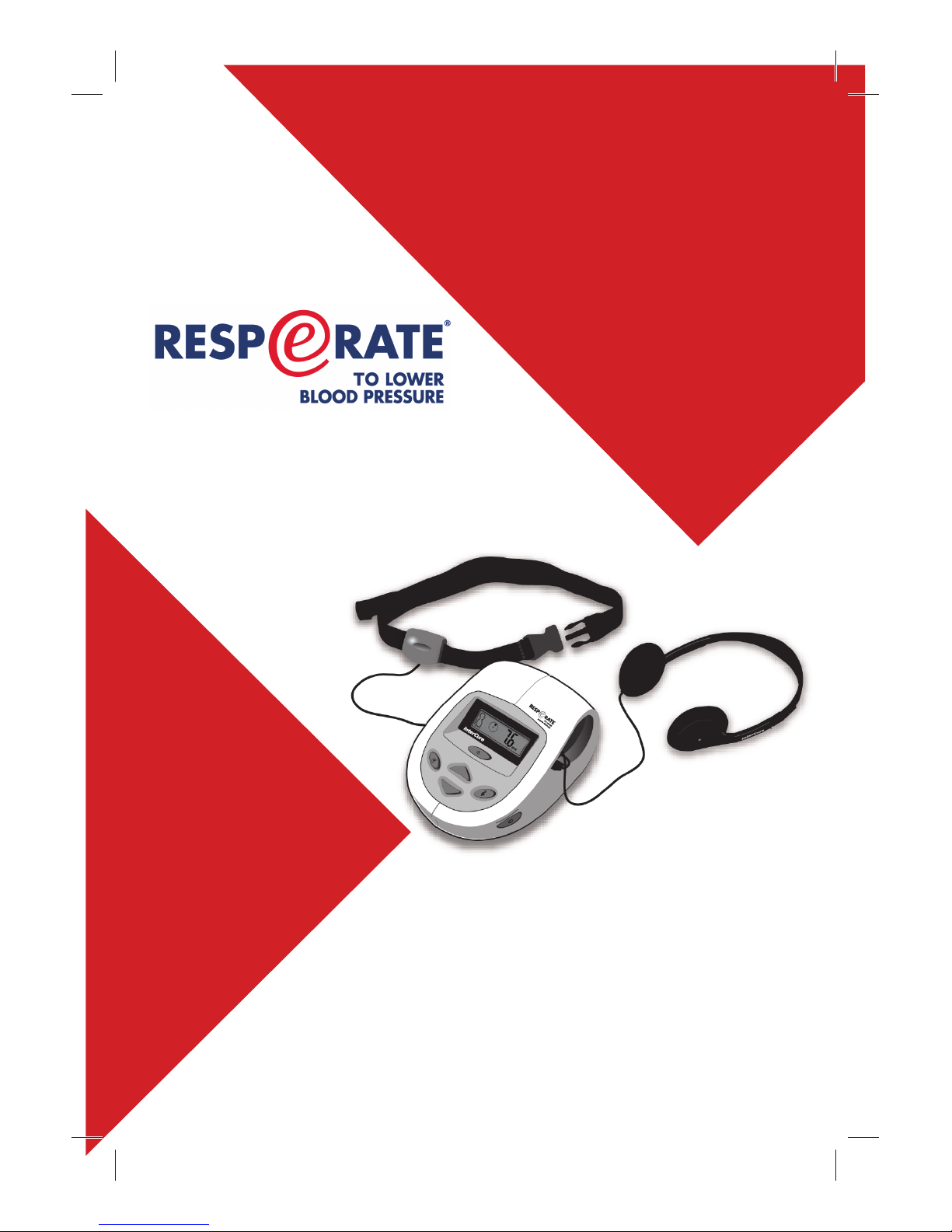
User Manual
Page 2

Contacts
Web: www.resperate.com
E-mail: [email protected]
Telephone:
USA: 1-877-988-9388 (Toll Free)
United Kingdom: 0800-177-7778 (Toll Free)
Other Countries: +1-646-652-5800 (USA)
Manufactured by InterCure Ltd., Lod, Israel
www.intercure.com
Telephone:
+972-73-220-7000
Copyright © 2002–2007 InterCure, Inc. All rights reserved. RESPeRATE,
RESPeRATE To Lower Blood Pressure, and InterCure are trademarks of InterCure.
Page 3

1
Table of Contents
Welcome: RESPeRATE To Lower Blood Pressure
Introduction
The therapeutic power of breathing
Breathing with RESPeRATE makes the difference
To achieve best results
Exploring Your RESPeRATE Device
RESPeRATE device and components
RESPeRATE display
Using Your RESPeRATE Device
Preparing to Use RESPeRATE
Step 1: Set-Up
Step 2: Determine the best position for the
sensor
Step 3: Put on the sensor belt
Step 4: Put on the headphones
Using RESPeRATE
Step 1: Turn RESPeRATE on
Step 2: Breathe normally (Recognition Phase)
Step 3: Breathe according to the guiding tones
(Breathing Exercise Phase)
Step 4: Therapeutic Breathing Zone
3
4
4
5
7
7
8
10
10
11
12
13
14
14
15
16
18
Page 4

2
Personalizing RESPeRATE
Adjusting volume
Selecting the melody
Viewing and changing the duration of
a session
Turning the voice instructions on/off
Changing the language of voice instructions
Displaying the Breathing Gauge
Assessment of Your Performance
To view Performance Statistics
Performance Statistics
Errors and Troubleshooting
Error Messages
Troubleshooting
Sensor Position Help Mode
Warranty and Additional Product Information
Cleaning and Maintenance
Technical Information and Approvals
Technical Information
Country Specific Market Clearance
Indication for Use
RESPeRATE Limited Warranty
Customer Support
22
22
22
23
24
24
25
26
27
28
34
34
36
39
41
42
42
42
43
44
45
Page 5
3
Welcome:
RESPeRATE To Lower
Blood Pressure
Introduction
Congratulations on the
purchase of your RESPeRATE,
the first medical device
clinically proven to lower
blood pressure (BP) in an
effective and pleasant way.
This User Manual provides all the information you
need to use RESPeRATE effectively. It will guide you to
therapeutic breathing and a lowering of blood pressure within
a few weeks. Let’s begin lowering blood pressure, one breath
at a time.
Note: RESPeRATE should only be used as part of your
overall health program for achieving goal blood
pressure, as recommended by your doctor.
RESPeRATE can be safely used in conjunction with
medication and lifestyle modifications such as diet
and exercise.
Page 6
4
The therapeutic power of breathing
Modern science has only recently confirmed that structured,
therapeutic breathing, performed correctly, can significantly
lower blood pressure. The therapeutic power of breathing
has been known for centuries and is used predominantly in
relaxation techniques such as meditation and yoga.
Effortless
therapeutic breathing can be difficult to perform
on your own
effectively without years of training and individualized coaching.
RESPeRATE makes therapeutic paced breathing easy to do on
your own.
Breathing with RESPeRATE makes
the difference
RESPeRATE’s patented “Interactive Paced Breathing” technology,
ingeniously takes advantage of the body’s natural tendency
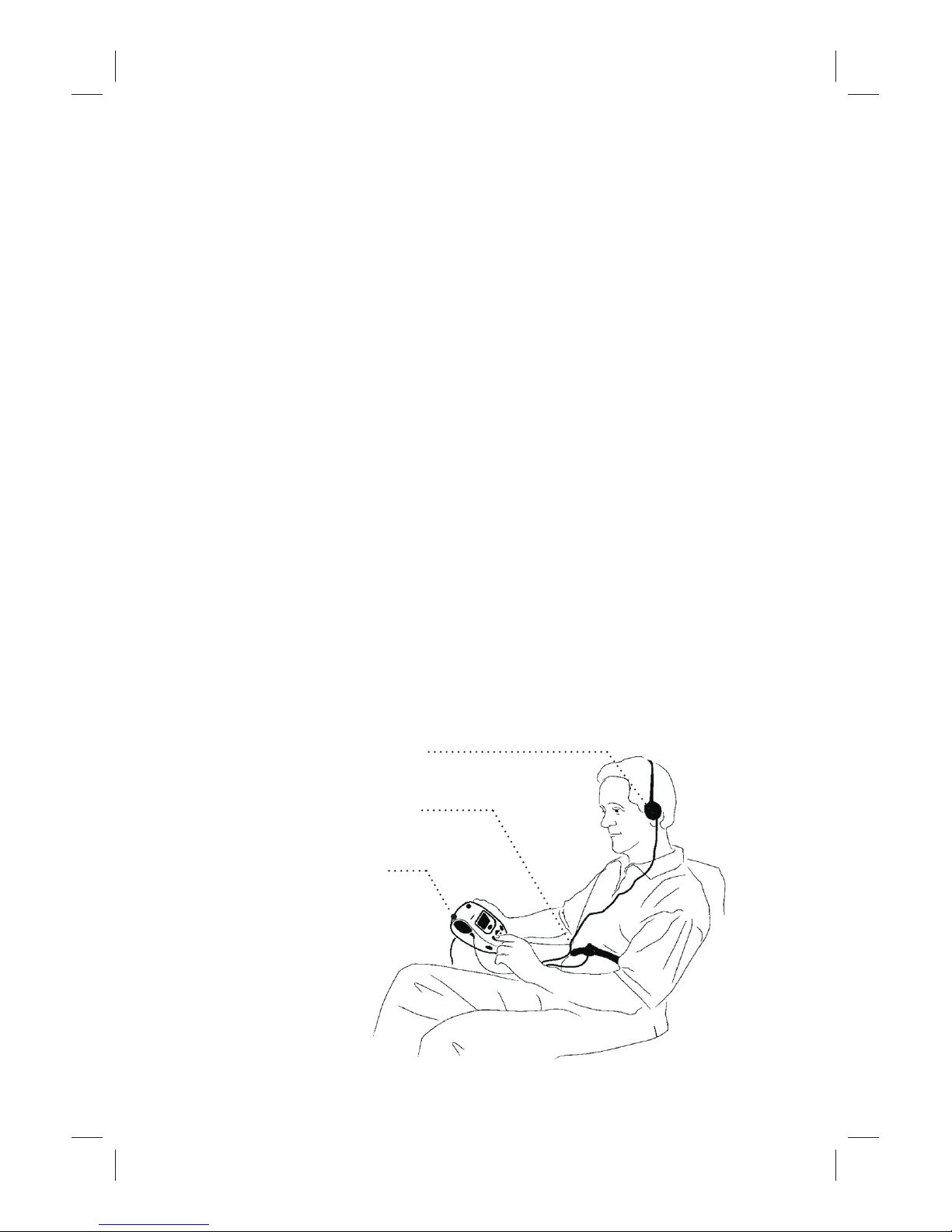
to follow external rhythms. Composed of a Breathing Sensor,
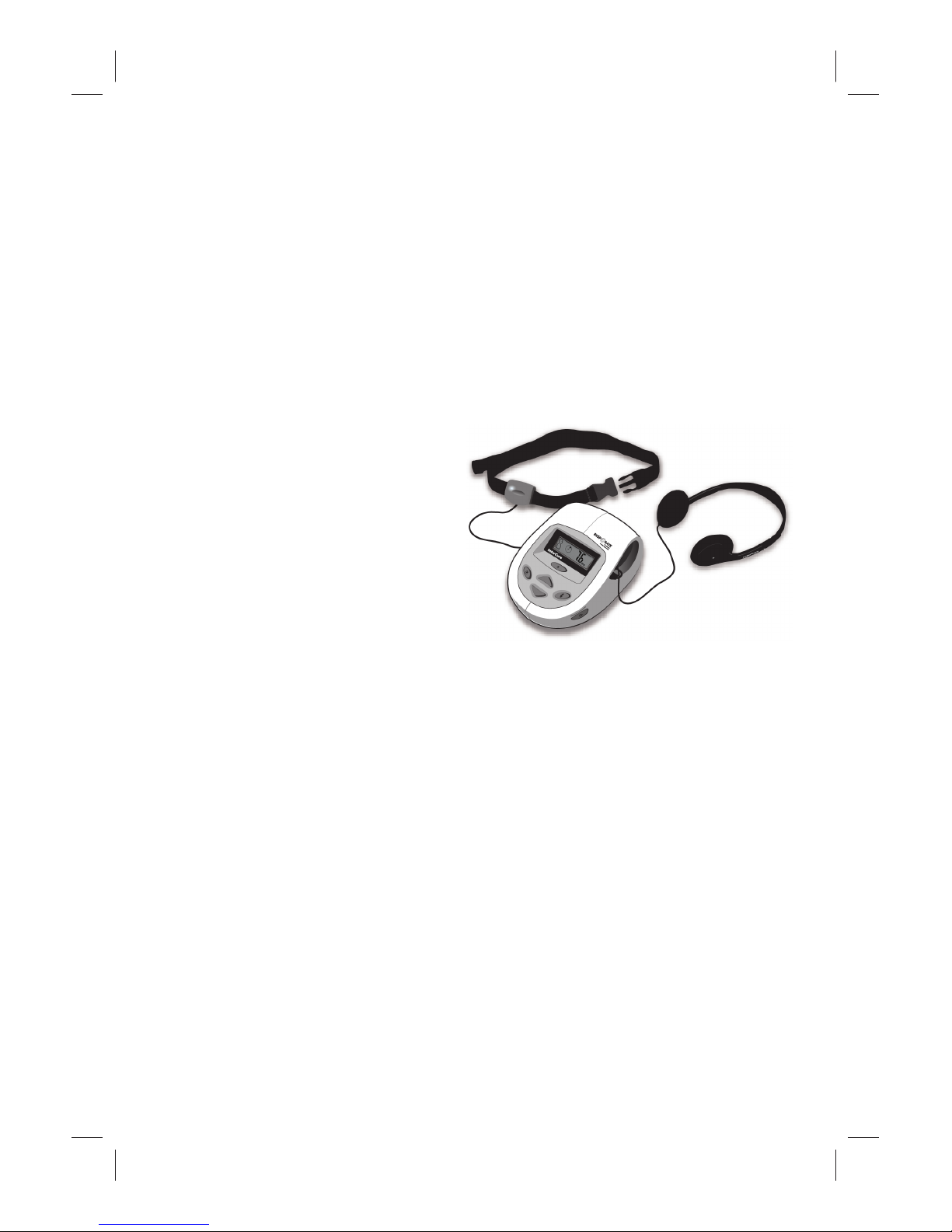
a computerized unit and headphones, RESPeRATE
Headphones
Breathing Sensor
Computerized unit
Page 7
5
automatically analyzes your individual breathing pattern.
It then
creates a personalized melody as it subliminally
paces you to
slower breathing to reach the Therapeutic
Breathing Zone of
less than 10 breaths per minute.
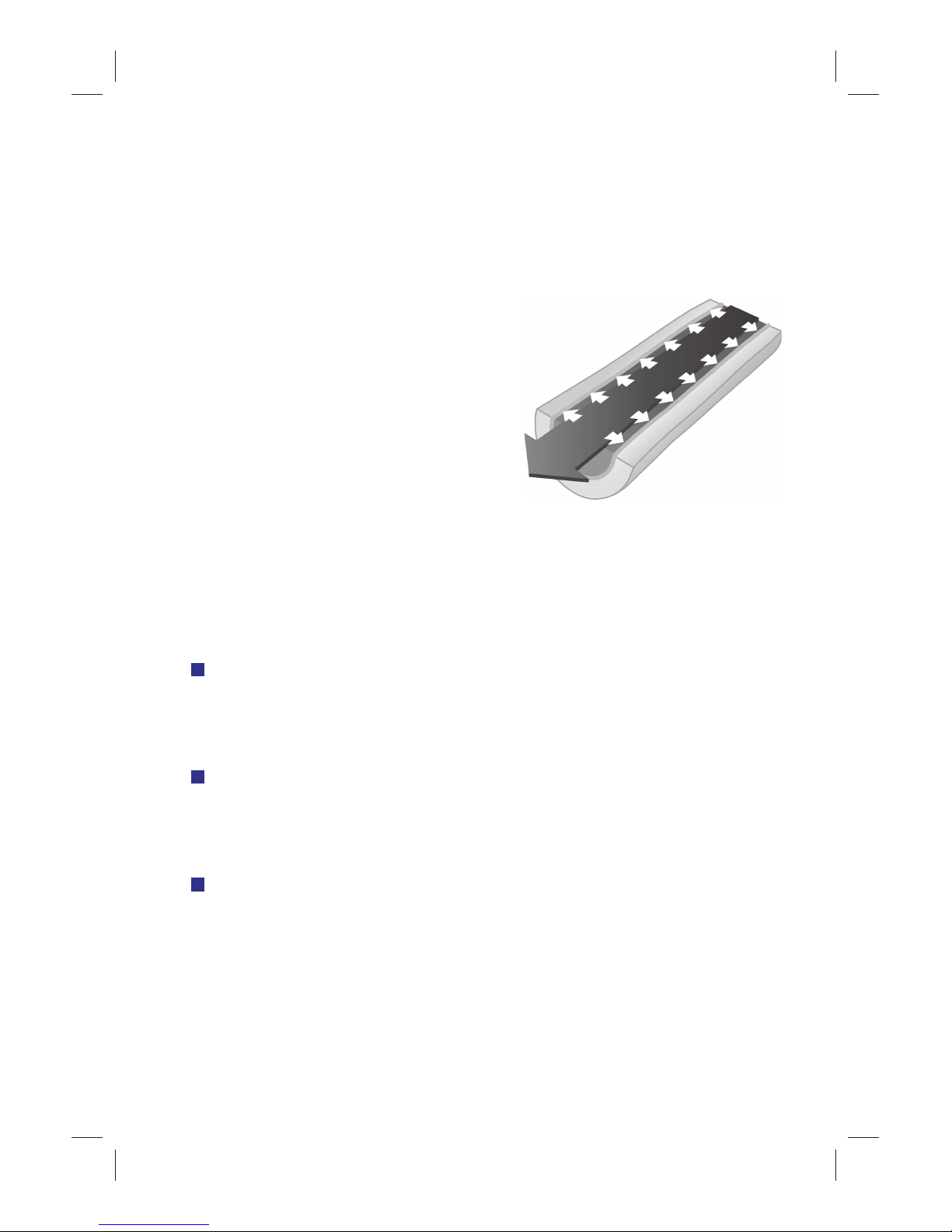
The physiological result? The
muscles surrounding the small
blood vessels in your body dilate
and relax. Blood is allowed to
flow more freely, and pressure is
significantly lowered. After each
exercise with RESPeRATE, your
breathing returns to its normal
rate and pattern. Nevertheless, the beneficial effect on blood
pressure will accumulate.
To achieve best results
Create a relaxing environment for your RESPeRATE
sessions. Sit in a comfortable chair in a quiet room
where there are minimal distractions.
“Therapeutic breathing” occurs when you breathe
slower than 10 breaths per minute without an effort.
Breathe lightly and naturally without force or tension.
Your goal is to log at least 10 minutes of slow
therapeutic breathing per session. With as little as
40 minutes of slow breathing per week, significant
blood pressure lowering. Additional use may provide
even better results. Daily sessions, if possible, are
recommended.
Page 8

6
Be patient. As with any physical exercise program, you
can expect to see notable progress within 3-4 weeks.
Continue using RESPeRATE regularly and you will
experience additional, sustained reductions in blood
pressure.
Page 9
7
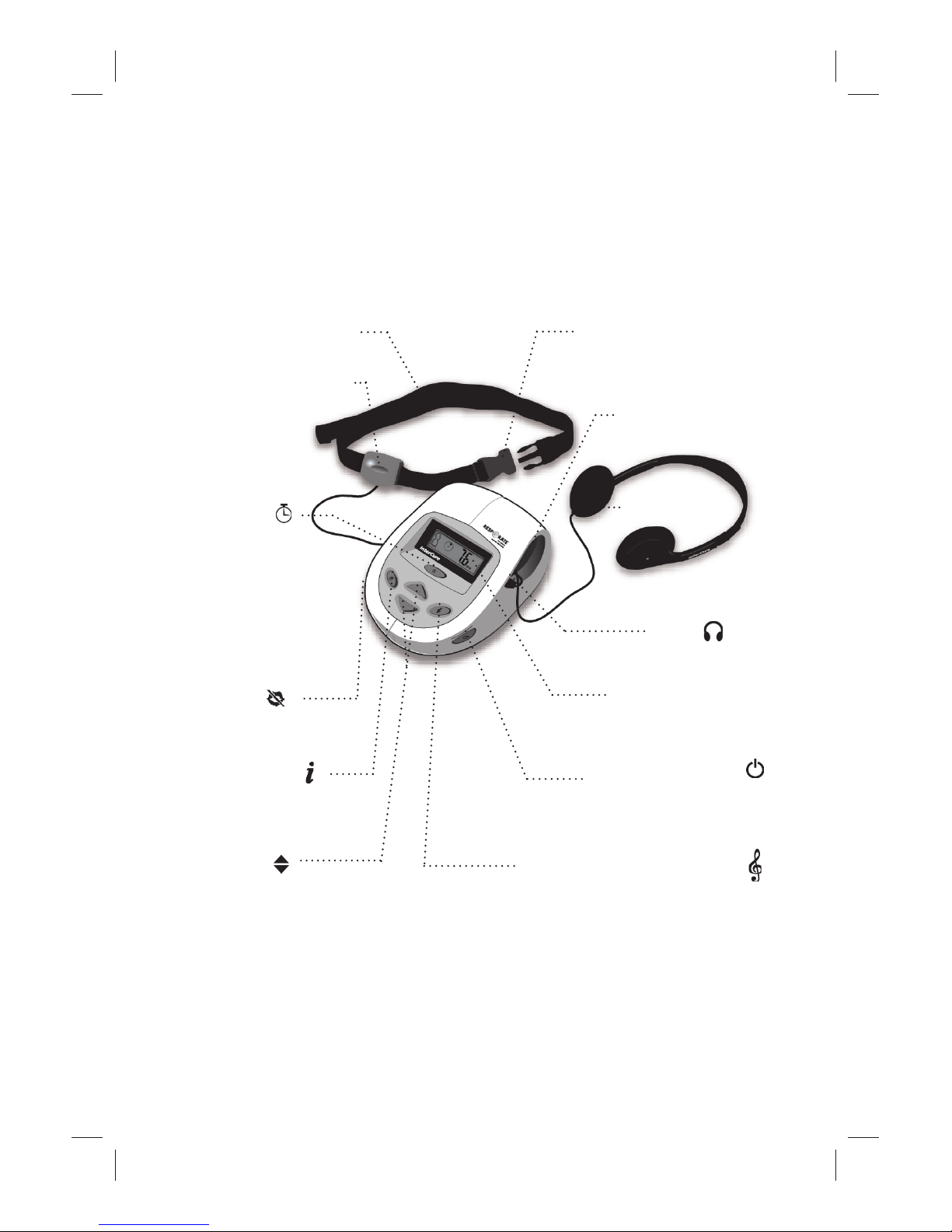
Exploring Your RESPeRATE Device
RESPeRATE Device and Components
Elastic belt
Breathing Sensor
Session Duration
button
Voice Instructions
On/Off
button
Info button
Volume Up/Down
buttons
Buckle
Storage
compartment
Headphones
Headphones
Jack
Display screen
On/Off
(orange) button
Melody Selection button
Page 10
8
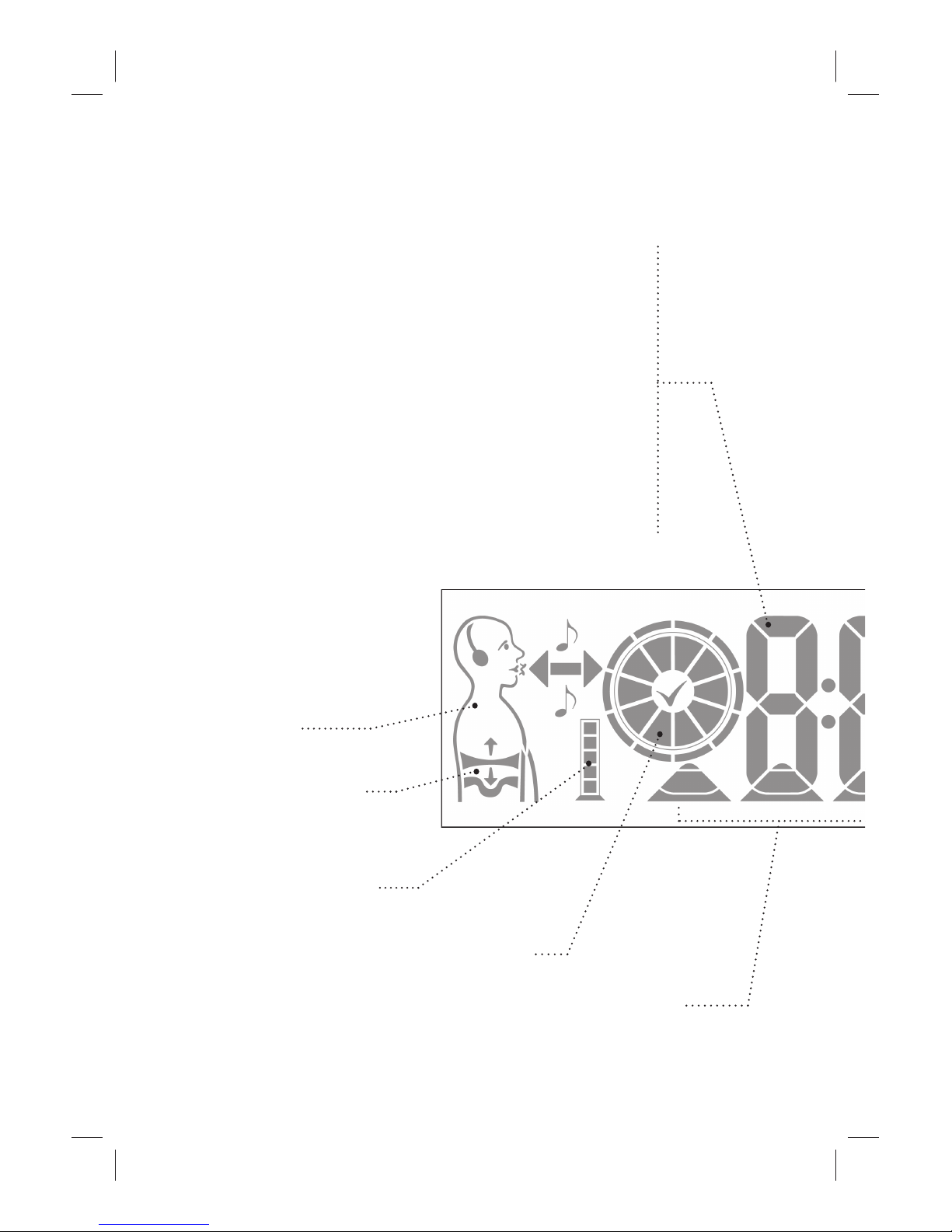
RESPeRATE Display
Main Display
The following values appear here:
Weekly Therapeutic Breathing Time
Breaths per minute
Volume level
Melody selection number
Statistics
Therapeutic minutes
Session duration (minutes)
User selection (Duo model only)
Guiding Figure
(with guiding arrows
and notes)
Sensor Belt Errors
(tight/loose/improper)
Breathing Gauge
10 - Therapeutic Minutes Clock
4 Breath Recognition Triangles
Page 11
9
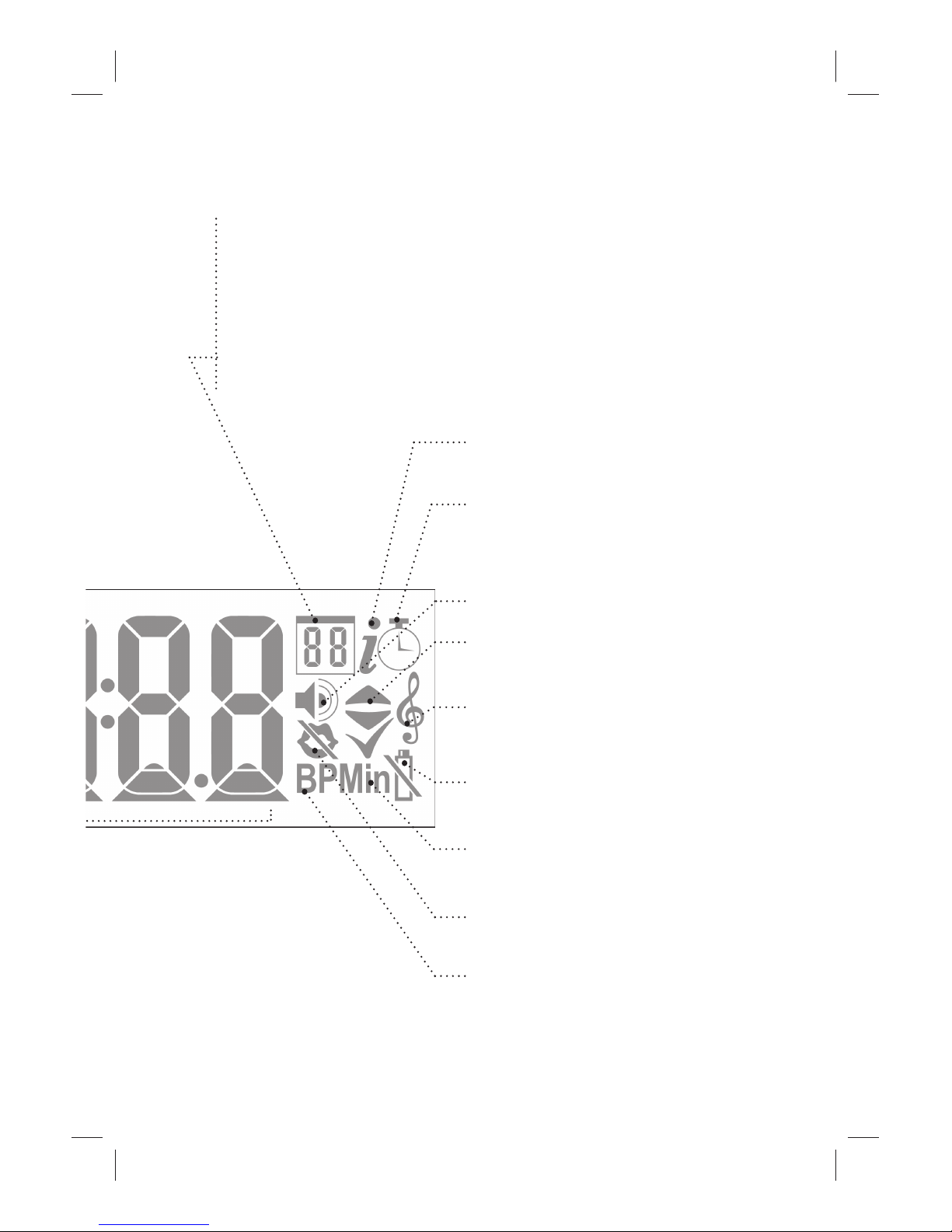
Secondary Display
Session duration (seconds)
Statistic report period
Info Function symbol
Session Duration symbol
Volume Level symbol
Scroll Up/Down symbol
Melody Selection symbol
Low Battery symbol
Therapeutic Minutes symbol
Voice Instructions Muted symbol
Breaths Per Minute symbol
Page 12
10
Using Your
RESPeRATE Device
Preparing to Use RESPeRATE
Step 1: Set–Up
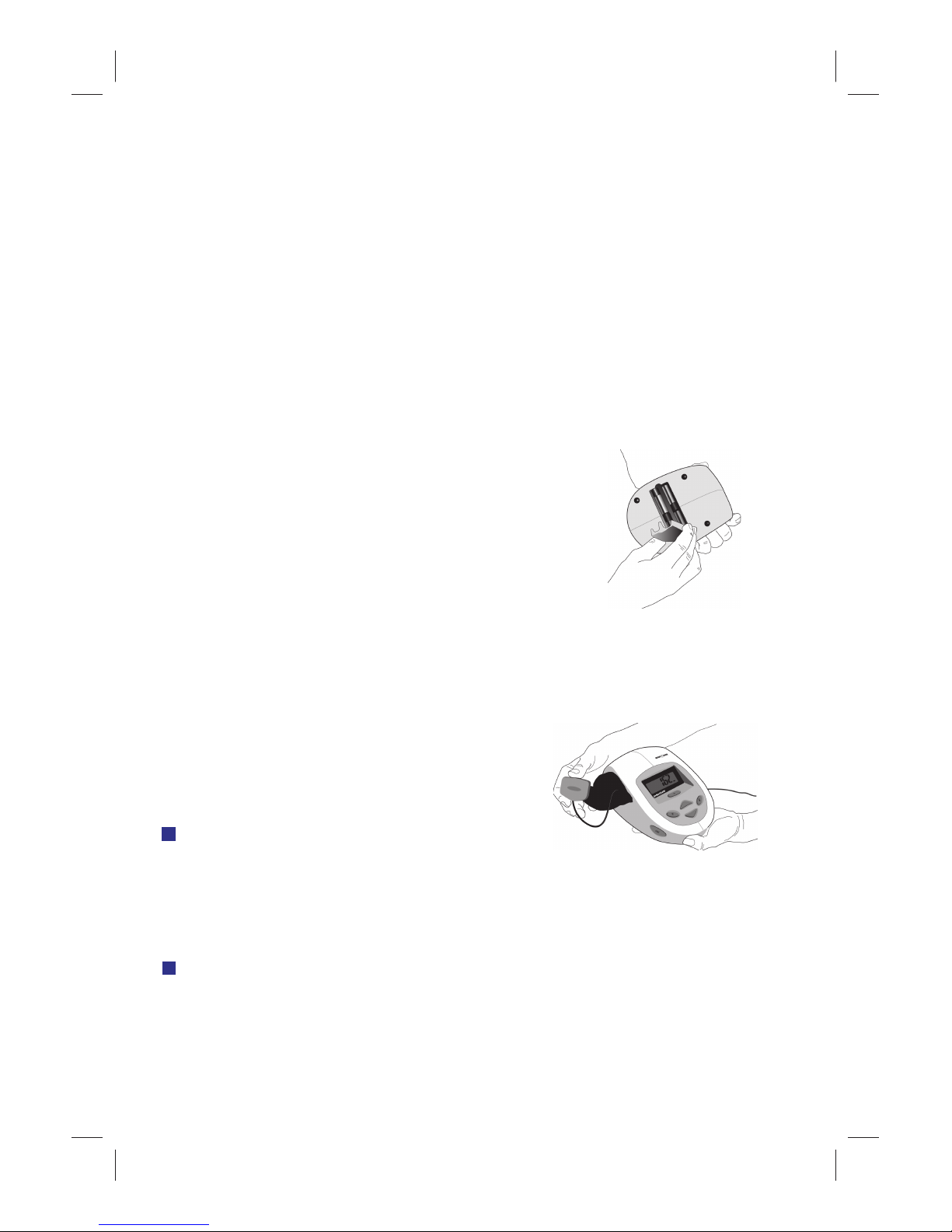
I. Install the batteries.
When using RESPeRATE for the first time,
install the 4 AA batteries in the battery
compartment at the back of the device.
Position the batteries as shown inside the
compartment.
II. Take out the headphones and sensor.
Carefully remove the headphones
and the sensor from the storage
compartment located within the top
part of the device itself.
Pull the cables with care. Both the
sensor cable and headphones are
already connected to the main unit from the inside of the
storage compartment.
Return the sensor to its compartment at the end of each
session. It’s best not to wind the cable around the sensor.
Page 13
11
Step 2: Determine the best position for the
sensor
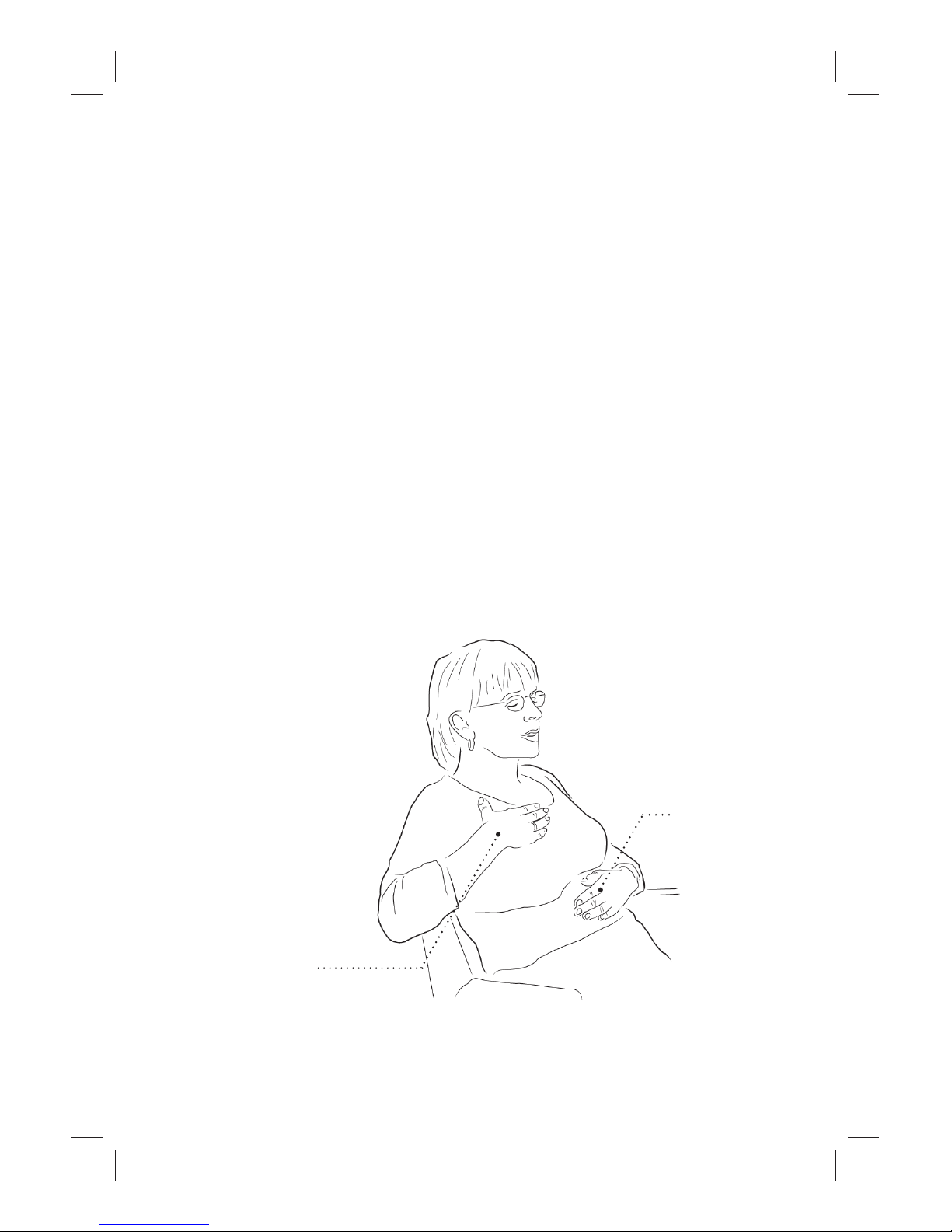
Breathing involves movement of the chest, abdomen, or
both. The best position for the sensor depends on how
you breathe. The following procedure helps to determine
if you breathe predominantly from the chest or abdomen.
Sit comfortably on a chair. Lean back and place your right
hand on the right side of the chest. Place your left hand
on the upper abdomen, above the navel. Breathe normally.
Feel which hand moves first when you start to inhale and
exhale. That is the location to place your Breathing Sensor.
Loosen any tight clothes or belt that might restrict your natural
breathing.
Left hand
on upper
abdomen
Right hand
on right
chest
Determining the best position for the sensor
If you are unable
to determine the
preferred position,
place the sensor on
your upper
abdomen.
Page 14
12
Step 3: Put on the sensor belt
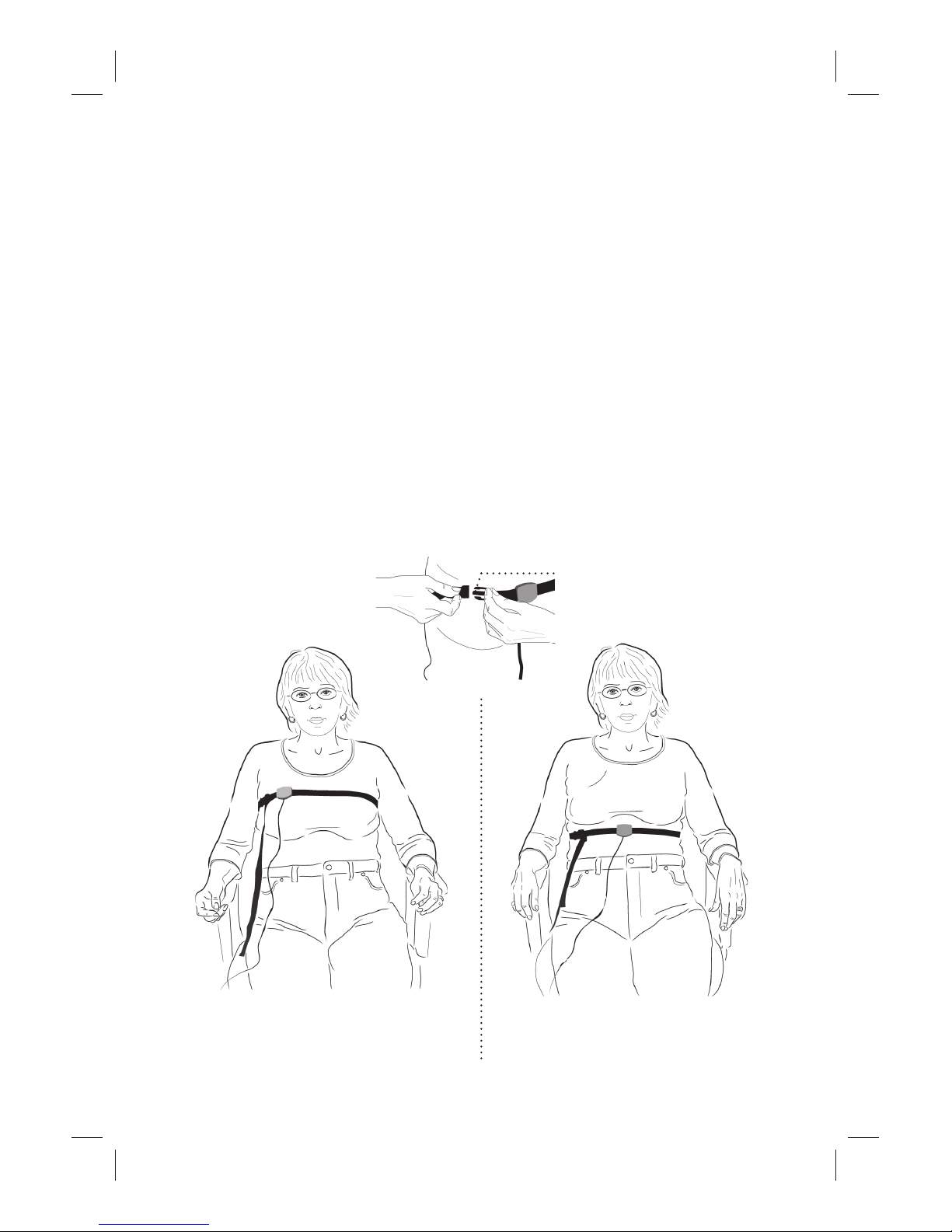
Place the sensor belt around your upper abdomen or chest.
The sensor belt must be worn over the clothes. Buckle it
up at the front of the body with the cable below the sensor (See Step 2 to determine the best position for the
sensor.)
Check that the label side of the sensor is placed against your
body and that the cable extends downward.
While sitting, position the sensor unit and adjust the belt to fit
snugly. Be sure it is neither too tight nor too loose. Slide the
blue sensor unit slightly left and right along the belt to ensure
it can slide freely.
Buckle
Chest sensor position
Upper abdomen sensor position
Page 15

13
Step 4: Put on the headphones
Put on the headphones. Verify that the headphones are
plugged into the jack, which is located on the right-hand side
of device, marked with the ( ) icon.
When the headphones are fully inserted into the jack, listen for
a “click”.
Put on the headphones. Lean back slightly, as sitting forward
restricts your breathing movement.
You’re ready to begin your RESPeRATE session.
Page 16
14
Using RESPeRATE
Step 1: Turn RESPeRATE On
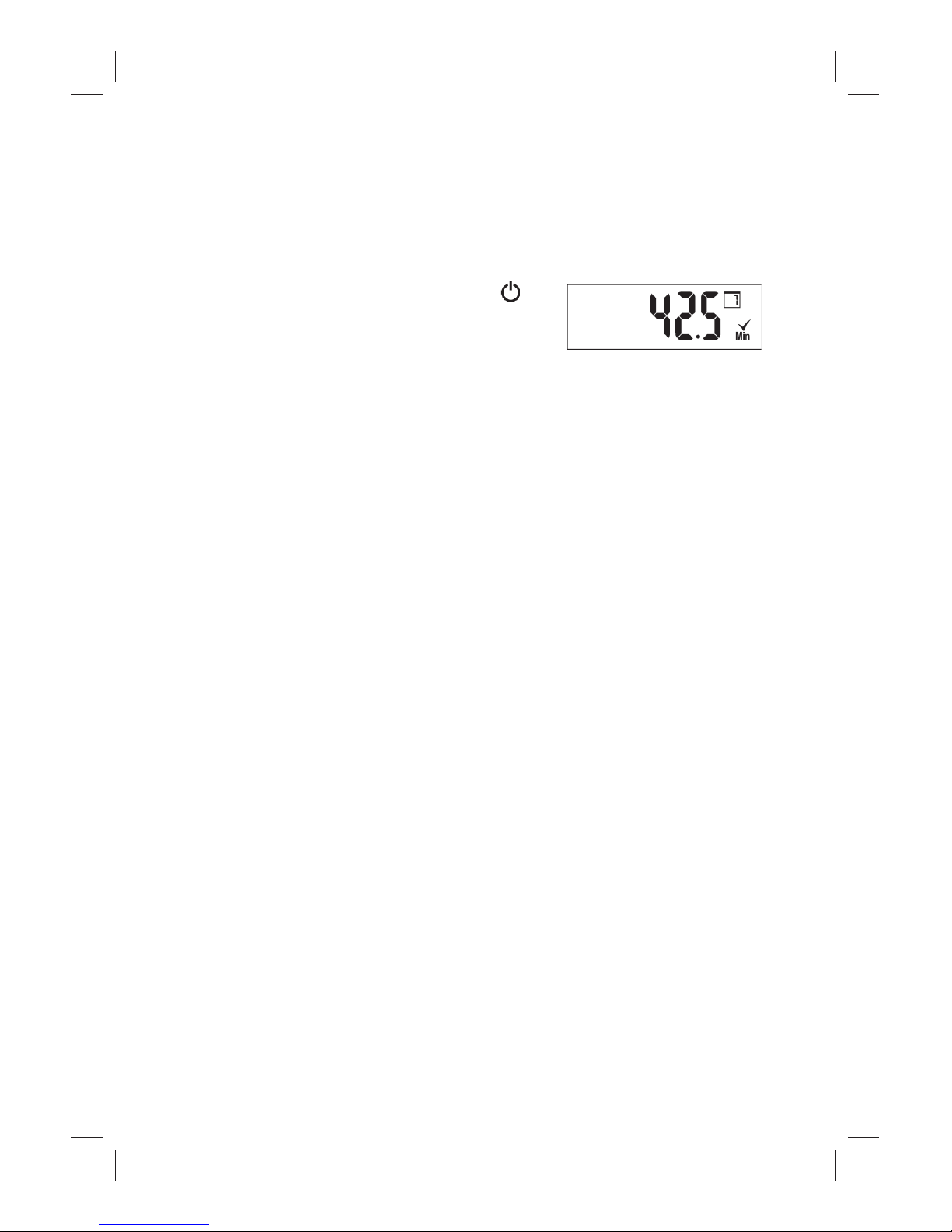
Press the orange On/Off button ( ),
located on the right-hand side of
the device. At first, RESPeRATE
momentarily displays your Weekly
Therapeutic Breathing Time. This is the
total time in minutes that you have
spent in the Therapeutic Breathing Zone
over the last 7 days.
Note: Therapeutic breathing time is accumulated when
you breathe slower than 10 breaths per minute as
guided by RESPeRATE. To achieve best results, we
recommend that you accumulate at least 40 minutes
of Weekly Therapeutic Breathing Time. When
first used, this number will show “0” minutes.
Once you have used the device for 7 days, this
number shows a “running tab”. With each new
day, it adds a day and drops a day of your daily
therapeutic breathing time. It will never show “0”
minutes again unless you have accumulated zero
therapeutic breathing time for 7 consecutive days
.
RESPeRATE Duo™ model only: Select User 1 or User 2
The RESPeRATE Duo model allows two users to store the
performance statistics in separate memories (See page 26 for
additional information).
Weekly Therapeutic
Time display
Page 17
15
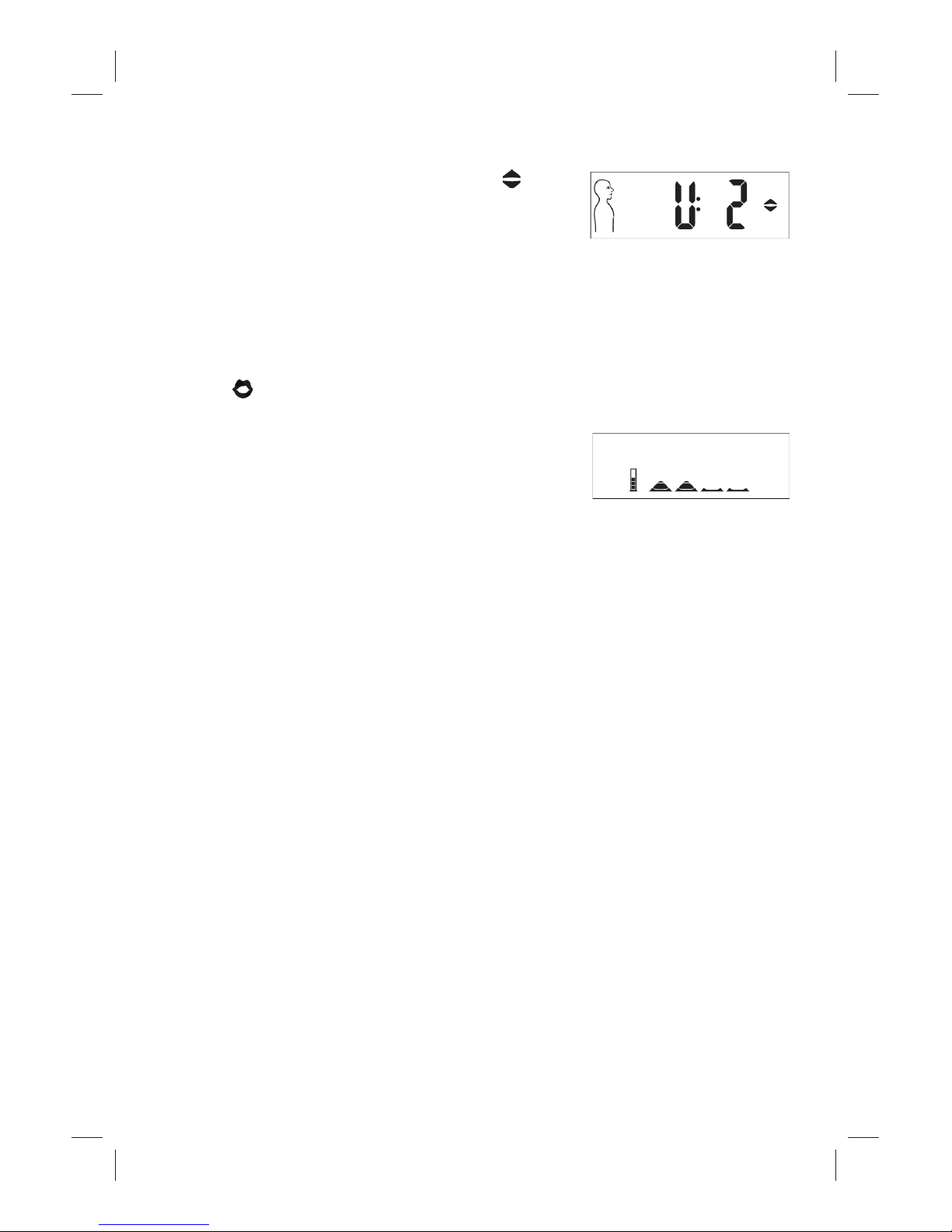
Press the UP or DOWN button ( ) to
select User 1(U1) or User 2 (U2). If no
button is pressed within 5 seconds,
RESPeRATE automatically begins the
session, storing the memory under the
last user.
Step 2: Breathe normally (Recognition Phase)
( voice instruction)
At
the beginning of each session,
breathe normally. It is not recommended
to purposely try to breathe slowly or
deeply. Simply allow RESPeRATE to
learn your natural breathing rate
and pattern.
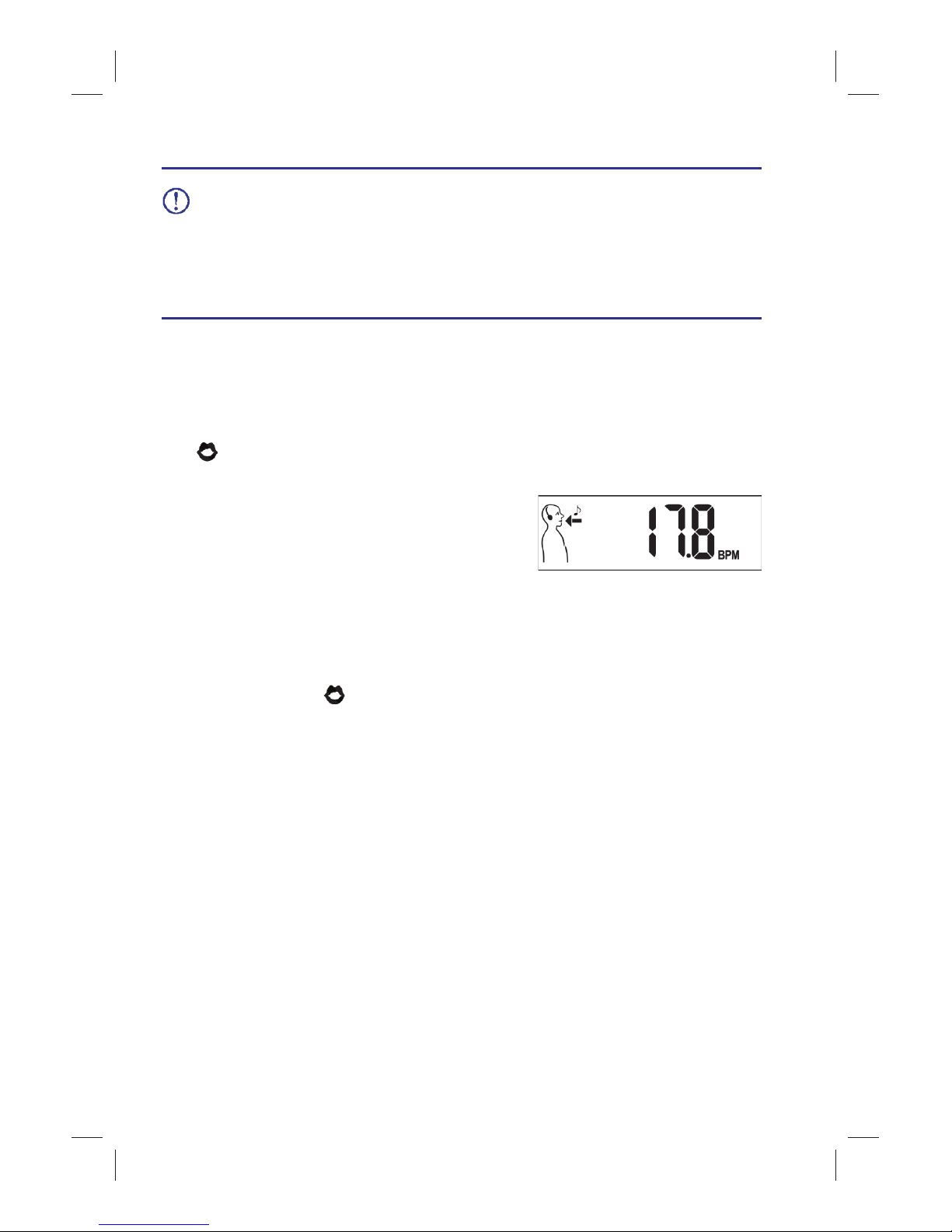
Each breath that RESPeRATE detects is represented by two short
”recognition tones”as well as changes in the Breathing Gauge.
A short high note is heard when you start to inhale. A short
low note is heard when you start to exhale. The vertical Breathing
Gauge that appears on the display fills as you breathe in and
empties as you breathe out.
Each breath detected and analyzed by the device appears as a
triangle on the display. Once four breaths have been analyzed,
(and four triangles appear on the display), a melody begins.
This is the start of the Breathing Exercise Phase.
Recognition Phase
display
Choosing user
(Duo model only)
Page 18
16
If the “recognition tones” or Breathing Gauge do
not match
your feeling of breathing out, the sensor
needs to be positioned
differently. Please refer to the
Troubleshooting section, Sensor Position Help Mode,
page 39.
Step 3: Breathe according to the guiding
tones (Breathing Exercise Phase)
( voice instruction)
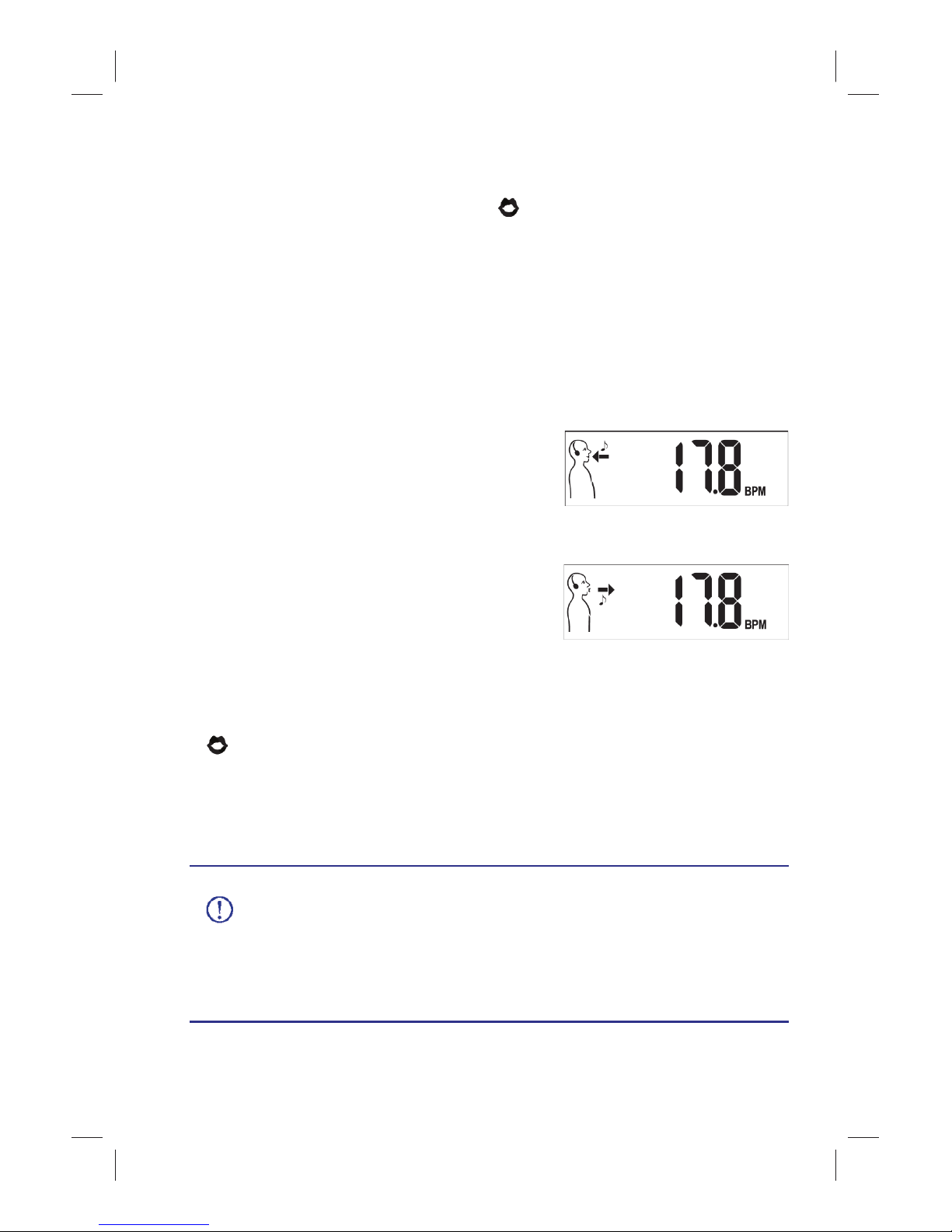
Once RESPeRATE has recognized
four stable breaths, it displays your
breathing rate in minutes (e.g. 17.8
breaths per minute, or BPM). The
Breathing Exercise Phase begins
now , signified by the start of the
melody and the voice instruction to “
breathe according to the
guiding tones
” ( ).
RESPeRATE composes a melody according to your individual
breathing pattern made up of two distinct guiding tones.
By gradually prolonging the breathe-in and breathe-out
tones, RESPeRATE gently slows your breathing toward the
Therapeutic Breathing Zone of less than 10 breaths per minute.
Simply synchronize your breathing with the breathe-in and
breathe-out guiding tones of your personalized melody.
Inhale gradually when you hear the high tone and exhale
gradually when you hear the low tone. Breathe comfortably
without effort and avoid holding your breath.
First minute display with
guiding figure
Page 19
17
To assist you in distinguishing between the two tones, voice
instructions of “
in
”, “
out
” ( ) accompany the first few
breaths. The movements of the “guiding figure” are
synchronized with the guiding arrows and tones.
Within a few breaths, the voice instructions stop, but you are to
“
close your eyes, and continue following the guiding tones
.”
( ) After one minute, the “guiding figure” and arrows
disappear. This is because a visual guide requires far more
attention than an auditory guide, which reduces the
therapeutic effect.
If you are having difficulty learning to synchronize your
breathing with the guiding tones, try changing the
melody to #4 (Personalizing RESPeRATE, Selecting a
Melody, page 22.)
Breathe-in
with the high tone
Breathe-out
with the low tone
Page 20
18
Step 4: Therapeutic Breathing Zone
( voice instruction)
Once your breathing has slowed
down to below 10 breaths per
minute, you are notified that
you are entering the Therapeutic
Breathing Zone.
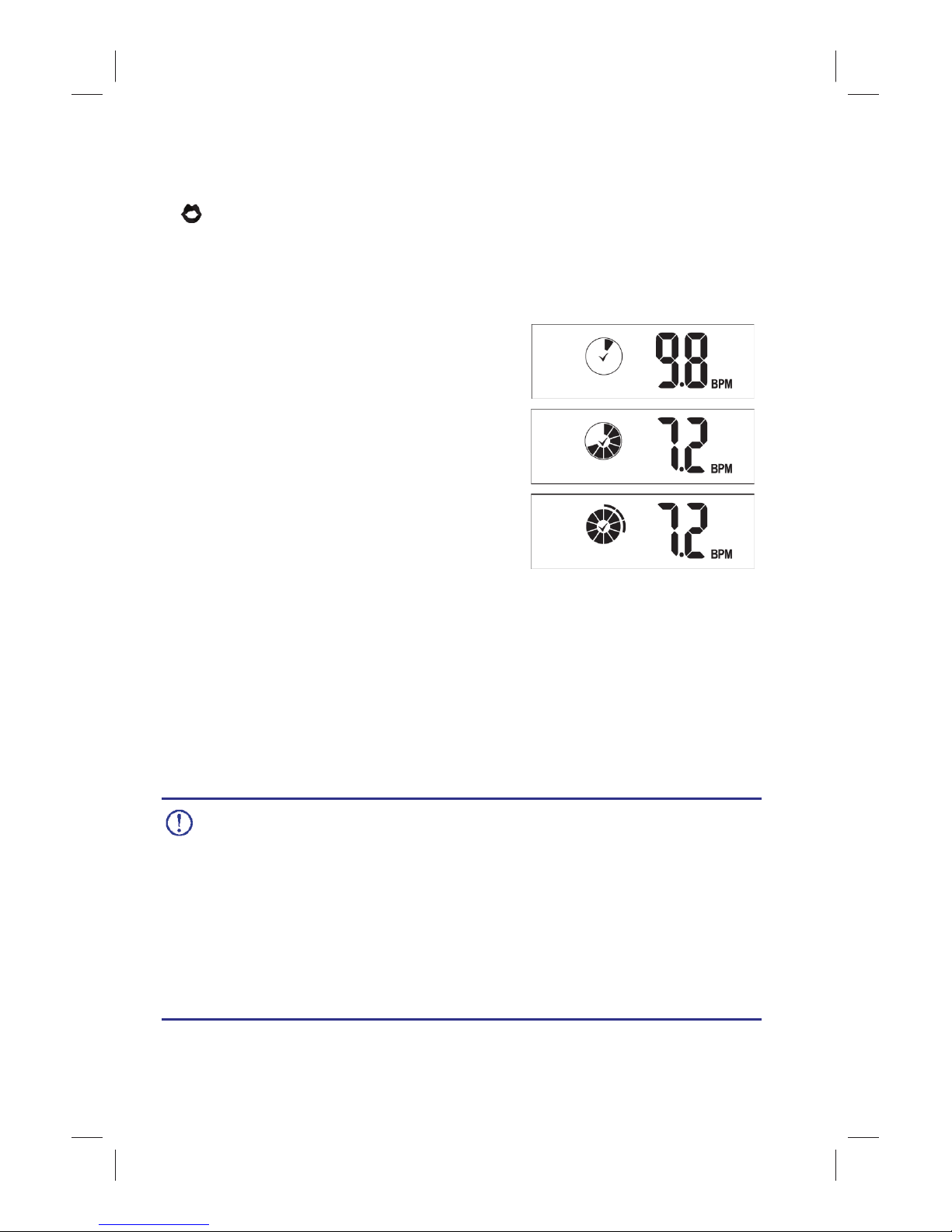
The“10–Therapeutic Minutes clock”
icon appears on the display, as well
as your breathing rate (eg. 9.8 bpm
in the top figure).
Each additional minute spent in
the Therapeutic Breathing Zone
appears as an additional segment
filled in on the clock. Once the
“10–Therapeutic Minutes clock” (bottom figure) is completely
filled (10 minutes), a second ring appears around the original
clock. It continues to fill in with each additional minute spent
in the Therapeutic Breathing Zone.
Your goal for each session is to achieve at least 10
minutes of your 15-minute breathing session in the
Therapeutic Breathing Zone.
Please complete the 15-minute exercise session. The
more therapeutic minutes accumulated, the better
the likelihood for a greater blood pressure reduction.
10–Therapeutic Minutes
Clock icon
Therapeutic Zone display
Page 21

19
To view the exact time spent in
the Therapeutic Breathing Zone
during the current session, press the
information ( ) button at any time
during the session.
If the guiding tones become too
slow to follow effortlessly, or if one of the tones is either too
short or too long to follow, stop following the guiding tones
and breathe naturally. You may take off the headphones for
a short time. Within a few breaths, RESeRATE automatically
adapts itself to your present breathing pattern and gently
begins the slowing process again.
This is neither a fault nor a mistake. It is RESPeRATE’s interactive
way to keep pulling you towards your individual slowest
breathing rate by using prolonged exhalation that remains
comfortable.
It is counter-productive to overly prolong your inhale or
exhale periods beyond what is comfortable for you, or to
momentarily hold your breath in order to keep in sync with
the melody. For more information, see the tips that follow.
RESPeRATE automatically ends the session after 15 minutes.
It notifies you, “
Session is ending. Bye for now
,” ( ) 20
seconds before the end. It gradually lowers the volume until it
completely shuts off (To change the session default duration,
see page 23).
Info button display for
current Therapeutic
Minutes accumulated
Page 22

20
We recommend that you store the RESPeRATE sensor and
belt in the compartment at the top of the device in order
to protect it from damage. It is best not to wind the cable
around the sensor.
Important tips:
Be patient — results are at hand. While the
pleasant experience of each RESPeRATE session is
immediate, achieving a sustained blood pressure
lowering result can require 3-4 weeks of regular use.
Breathe effortlessly. In order to effectively lower
blood pressure, it is essential to breathe effortlessly
during the entire RESPeRATE session. Normal breathing
is usually 12–18 breaths per minute. In the first few
sessions, your slowest comfortable breathing rate
achieved might be higher than 10 breaths per minute.
Don’t push yourself. Within a few RESPeRATE sessions,
your breathing rate will likely decrease to below 10 BPM.
Breathe gradually. Avoid holding your breath after
inhalation. Effortless breathing is best achieved by a
gradual inhalation through the nose, then a gradual
exhalation through the mouth.
One easy way to prolong exhalation is to purse your lips
as if you were blowing out a candle.
Page 23

21
Avoid other breathing techniques. During the RESPeRATE
session, we don’t recommend other breathing techniques such
as breath-holding or Buteyko. These maneuvers require effort
which is counter-productive to lowering blood pressure.
The more therapeutic breathing minutes, the better!
Be sure to accumulate no less than 40 therapeutic breathing
minutes per week. Remember that the more time spent in
the Therapeutic Breathing Zone, the better your chances of
achieving greater blood pressure reduction.
Remember, it’s not a competition. The slowest breathing
rate and pattern that is comfortable for each individual
varies from person to person and from day to day. Only
you can decide when breathing becomes uncomfortable.
The goal is to reach the Therapeutic Zone of slower than 10
breaths per minute, not to reach as slow a breathing rate
as possible. Making an effort to achieve an excessively slow
breathing rate (i.e. below 5 breaths per minutes) may not be
as beneficial in lowering blood pressure levels.
Stay awake. RESPeRATE is very relaxing. Some users have
been known to fall asleep. If snoozing, your breathing may
become faster and you may not be able to accumulate
Therapeutic Minutes. It’s best to stay awake.
Page 24
22
Personalizing RESPeRATE
RESPeRATE provides you with a number of options to
personalize the volume, melody, duration of a session, voice
instructions and Breathing Gauge.
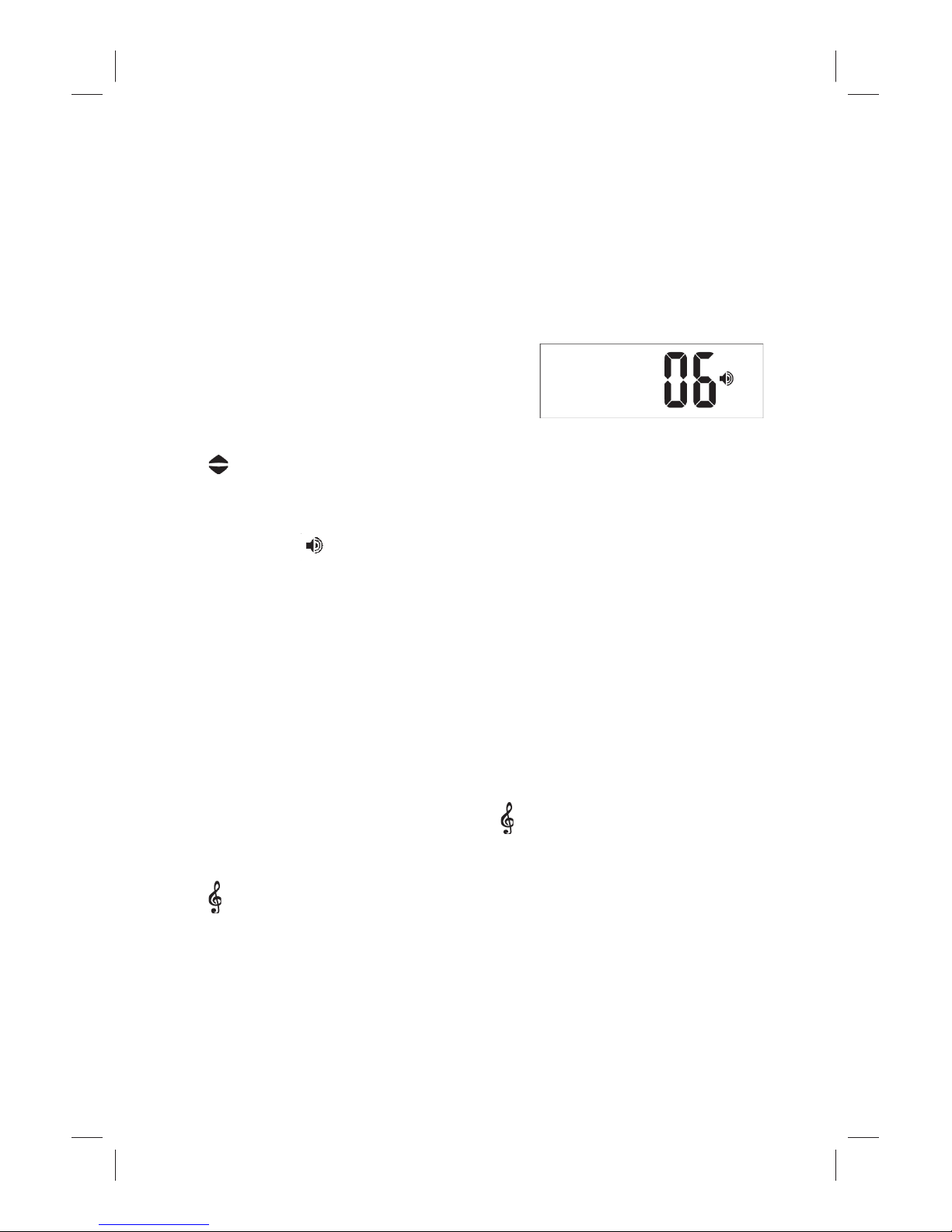
Adjusting the Volume
To adjust the volume:
Press the Up or Down button
( ) repeatedly, until you reach
the volume you prefer.
The volume ( ) icon is displayed with the current volume
level. After a few seconds, RESPeRATE automatically returns to
the previous display.
For your convenience, RESPeRATE stores your last selecte d
volume, and uses it by default in the next session.
Selecting the Melody
To select a melody:
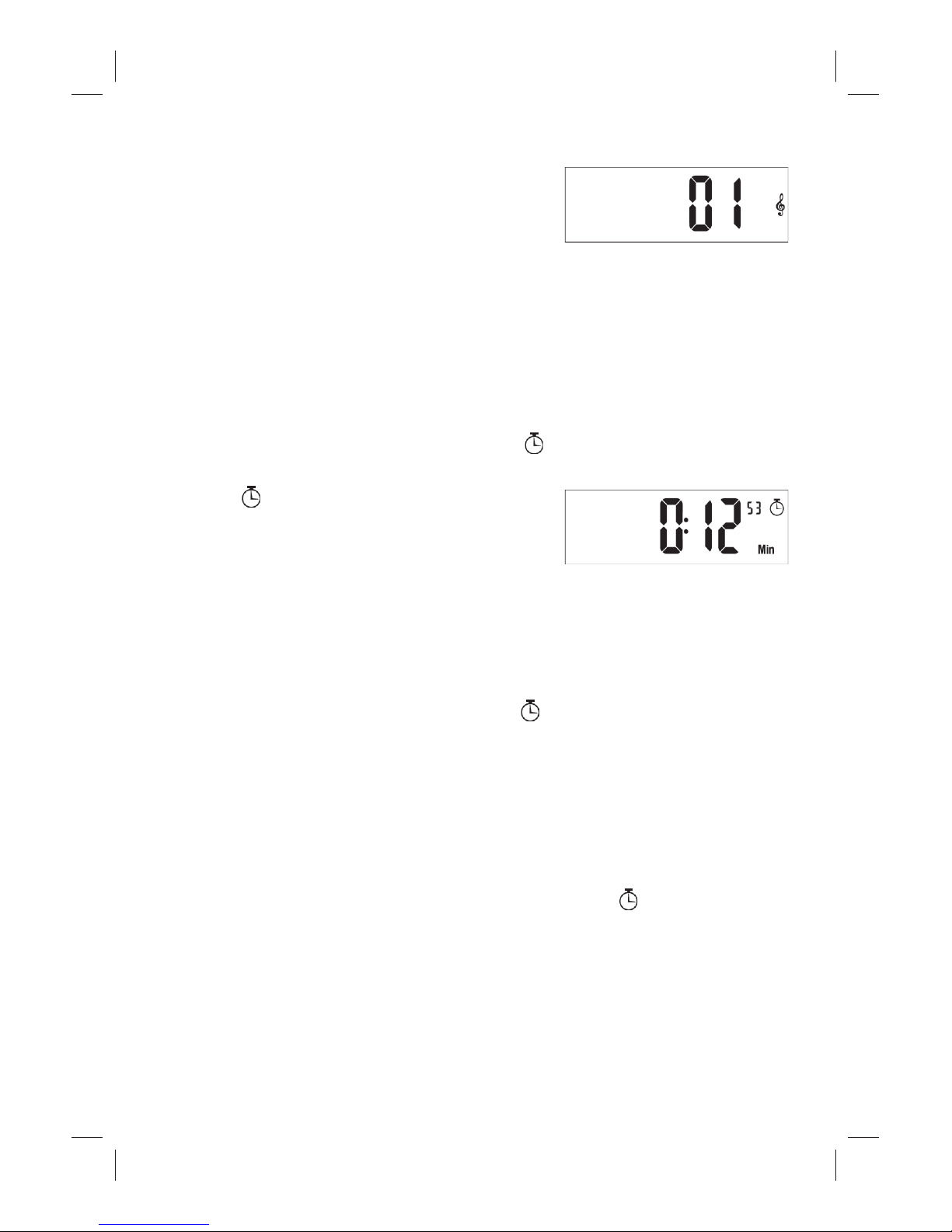
Press the Melody Selection ( ) button repeatedly,
until you reach the melody you prefer.
The ( ) icon is displayed with the selected melody number.
Please
note that this change can only be made during the Breathing
Exercise Phase.
Volume adjustment
display
Page 25
23
For your convenience, RESPeRATE
stores your last selected melody, and
uses it by default in the next session.
Viewing and Changing the Duration of a
Session
To view the duration of your current session:
Press the Session Duration ( ) button.
The ( ) icon is displayed with the
remaining time of the session in
minutes and seconds (small
numbers). After a few seconds,
RESPeRATE automatically returns
to the previous display.
To extend or shorten the duration of your current session:
Press the Session Duration ( ) button and then press
the Up or Down button to reach your preferred
duration time.
By default, RESPeRATE automatically shuts off after 15 minutes.
To extend or shorten the duration of the default session:
1. Hold down the Session Duration ( ) button until
the display blinks with your current default session duration.
Melody selection display
Session duration display
Page 26

24
2. Use the Up or Down ( ) buttons to extend or
shorten the default session duration.
3.
Press the Session Duration ( ) button again, in
order to save the new Default duration. The display stops
blinking and the new default session duration is saved.
Turning the Voice Instructions On/Off
To turn voice instructions on/off:
Press the Voice Instruction On/Off ( ) button
(located on the left–hand side of RESPeRATE).
RESPeRATE voice instructions are activated by default. Please
note that even when muted, some error messages, essential
for operating the device, are still provided by voice instructions.
Page 27
25
Displaying the Breathing Gauge
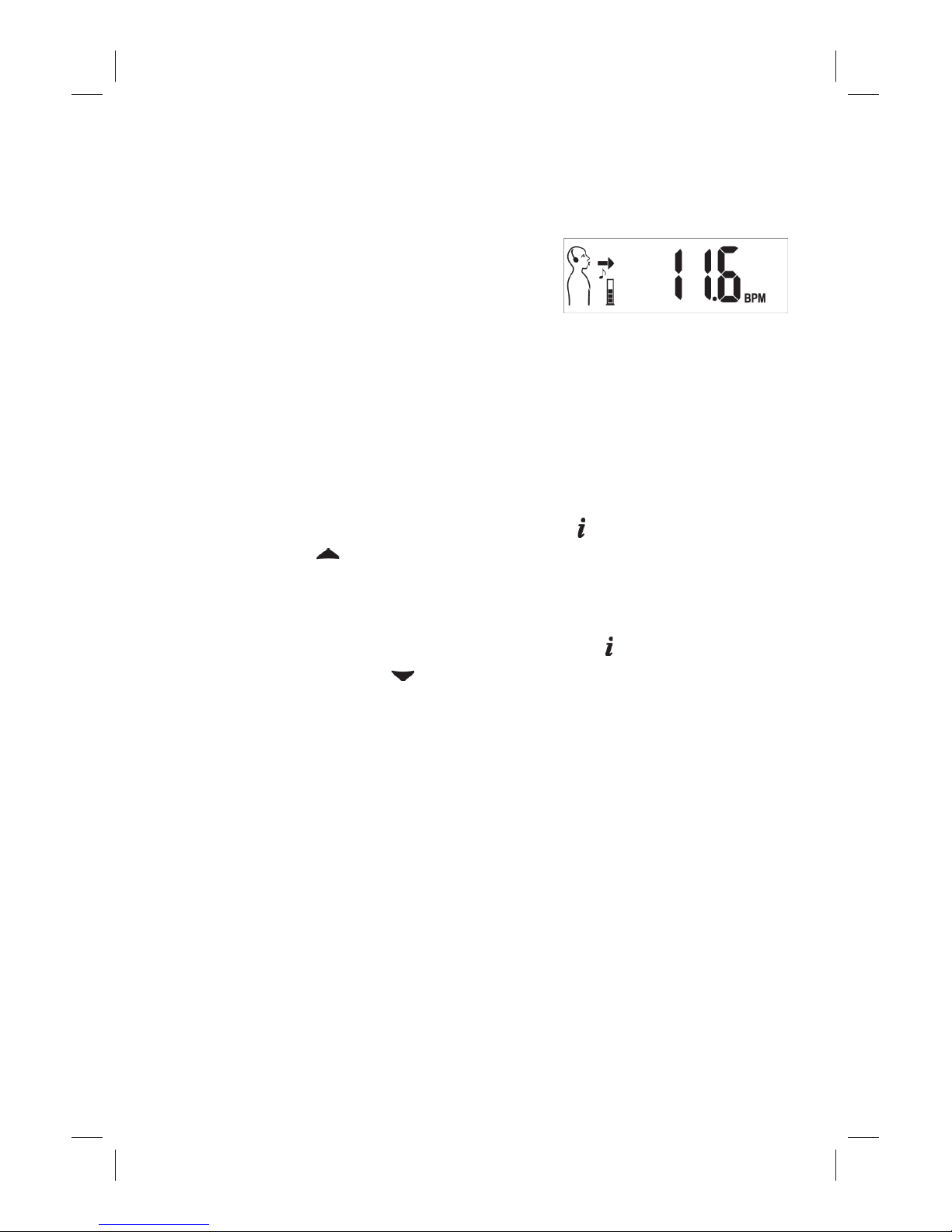
The Breathing Gauge shows in
real time how the device senses
your breathing movements via the
stretching of the belt with each
breath in and out. The Breathing
Gauge appears by default
only
during the Recognition Phase, but you can activate it throughout
the session as follows:
To turn the Breathing Gauge on:
Press and hold the Info button ( ) and press the Up
button ( ) at the same time.
To turn the Breathing Gauge off:
Press and hold the Info button ( ) and press the
Down
button ( ) at the same time.
The Breathing Gauge can also be helpful in troubleshooting
problems related to sensor positioning (For more details see
the Sensor Position Help Mode on page 39).
Activated Breathing
Gauge display
Page 28
26
Assessment of Your Performance
The two simplest ways to assess your performance are the
10–Therapeutic Minutes Clock icon and the Weekly Therapeutic
Breathing Time (displayed momentarily when you turn on
RESPeRATE).
To allow more advanced assessment, RESPeRATE’s built–in
memory stores the following six statistics related to your
performance: Number of Sessions, Therapeutic Minutes, Initial
Breathing Rate, Final Breathing Rate, Synchronization, and
Breath Detection.
Furthermore, each of these
Performance Statistics is
provided for three different
time periods: Last Session,
Last 7 days, and Last 60 days.
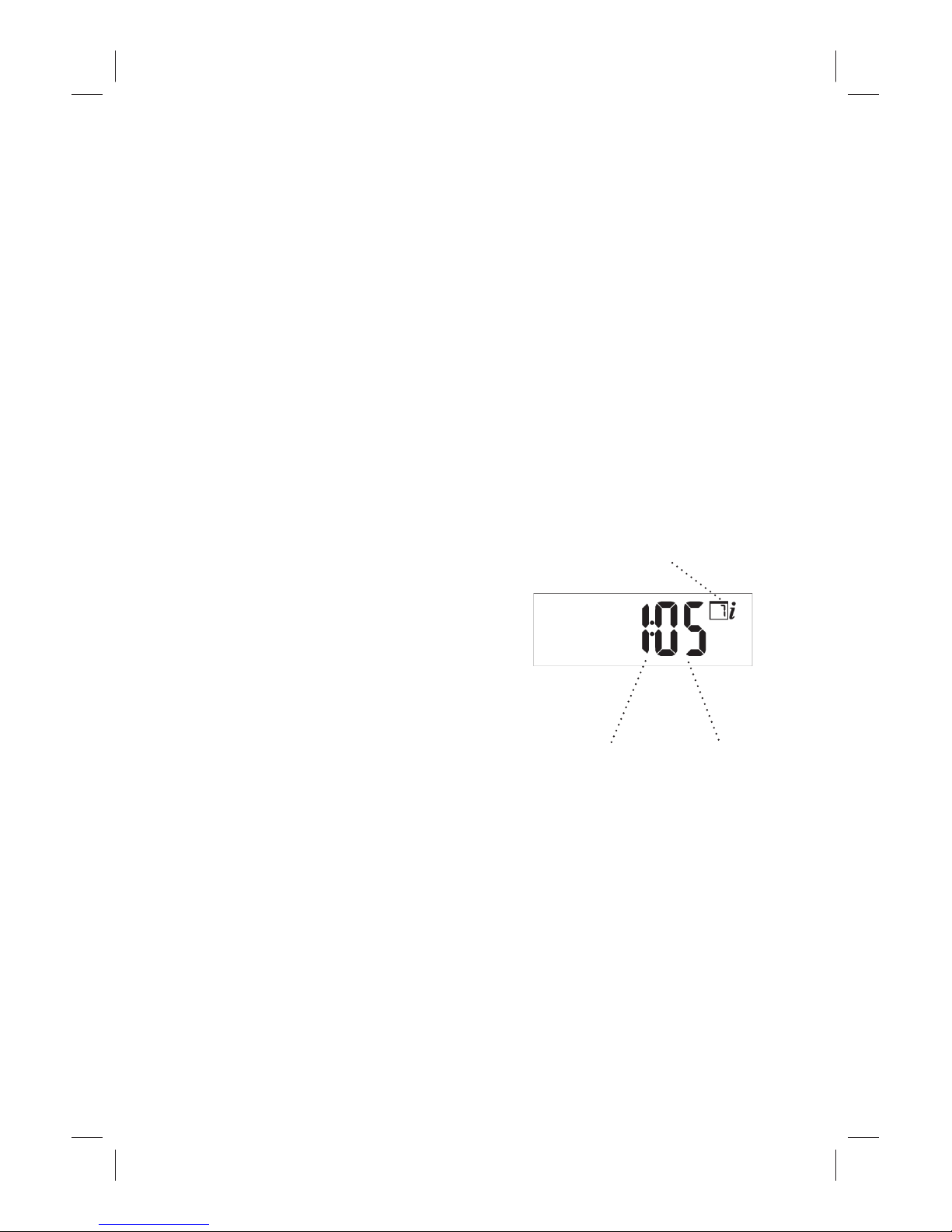
The Performance Statistics
are expressed as shown in
the example: a number and
a value together with the
Report Period.
Report Period
(Last 7 days)
Statistic
Number
Performance Statistics
display
Value
Page 29

27
To view Performance Statistics:
1. Verify that your RESPeRATE device is turned off.
Then,
press and hold the Info button ( ) until the
display is turned on.
RESPeRATE Duo model users need to choose User #1 or
User #2 to see the parameters associated with the user of
interest.
2. Choose a Performance Statistic:
Press the Up ( ) or Down button ( ) repeatedly
to scroll from statistic #1 to #6.
3. Choose a time period:
By default, you are viewing the data for the last
session with RESPeRATE.
Press the info ( ) button once more, to view data for
the last 7 days of sessions.
Press the info ( ) button once more, to view data for
the last 60 days of sessions.
Page 30
28
Performance Statistics:*
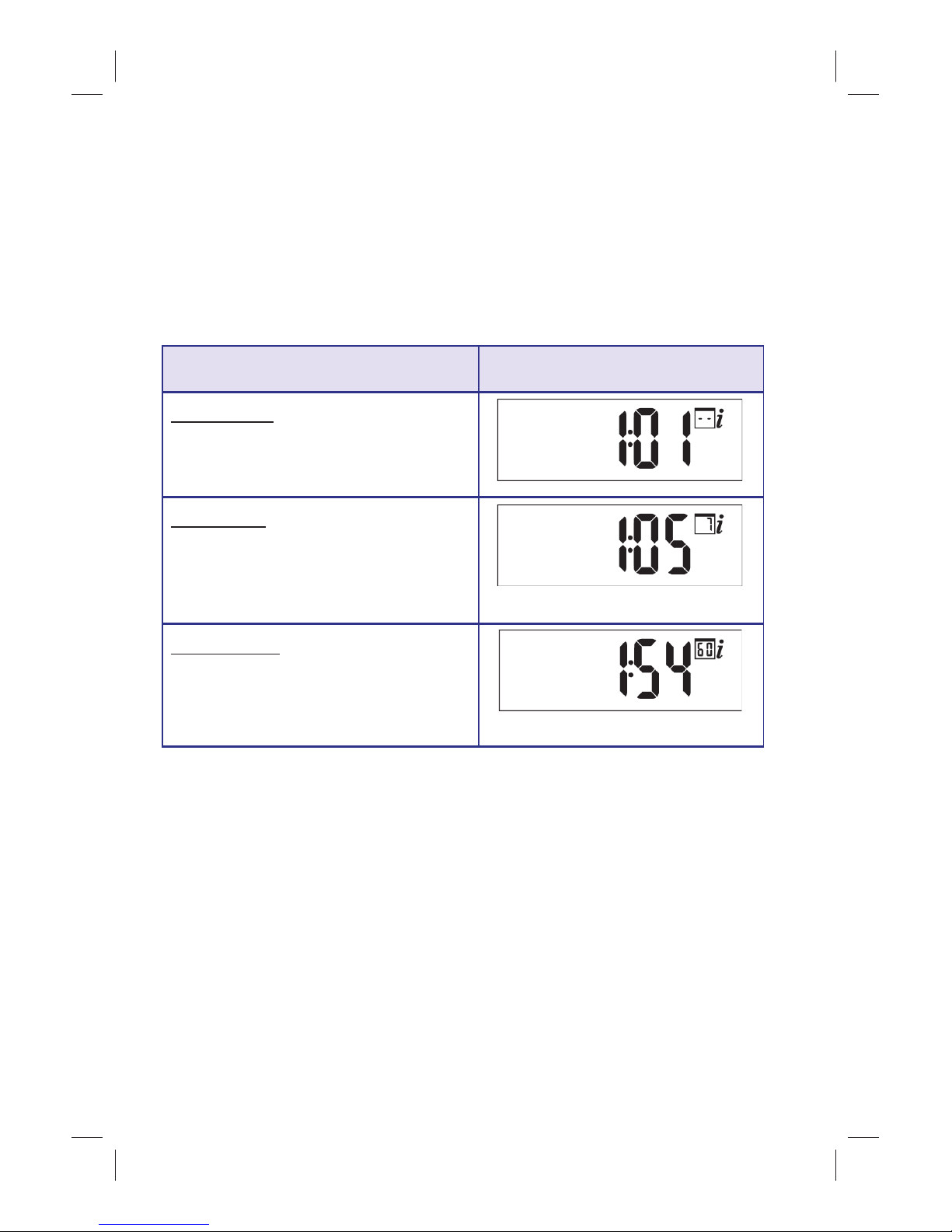
Statistic #1: Sessions
The number of sessions that have reached the Breathing
Exercise Phase.
* RESPeRATE Duo™ model enables two users to keep
separate performance statistics for User 1 and User 2.
ExampleDescription
Last session report 1:01
After your
first RESPeRATE
session, this value
will always be “1.”
Last 7 days report reads 1:05
means that in the past 7 days, 5
sessions reached the
Breathing Exercise Phase.
Last 60 days report reads 1:54
means that in the past 60 days,
54 sessions reached
the Breathing
Exercise Phase.
Page 31
29
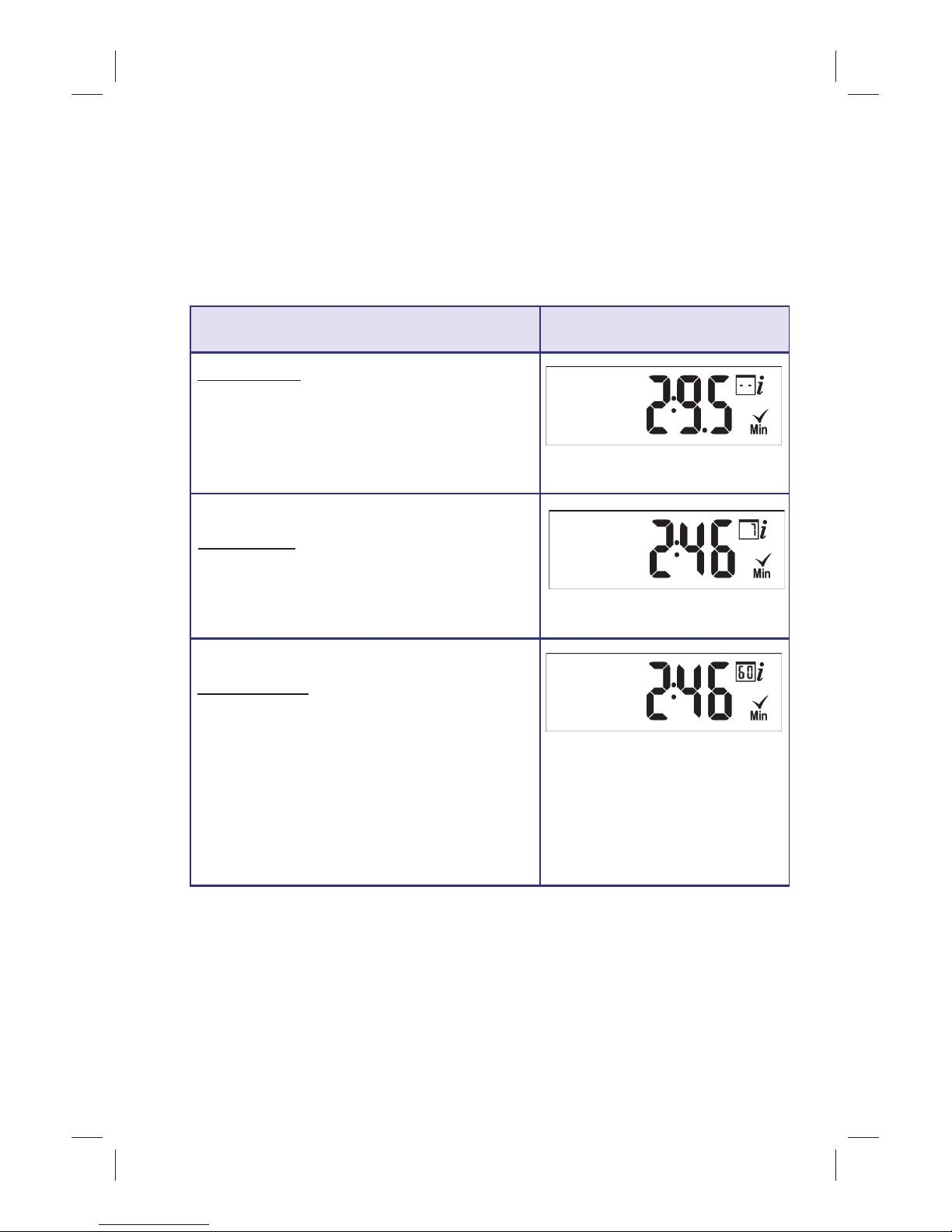
Statistic #2: Therapeutic Minutes
Amount of time (minutes) spent in the Therapeutic Breathing
Zone (less than 10 breaths per minute).
Description Example and Goal
Last session report reads 2:9.5 means
that 9.5 minutes were spent in the
Therapeutic Zone during the last
session.
Goal >10 Min
Accumulated value
Last 7 days report reads 2:46 means
that a total of 46 minutes were spent
in the Therapeutic Zone over the last
7 days.
Goal > 40 Min
Average value
Last 60 days report reads 2:46 means
that on average, 46 minutes per week
of use were spent in the Therapeutic
Zone.
Note: If value is 100 or greater
(Therapeutic Minutes), a blinking
“99” appears.
Goal > 40 Min
Page 32
30
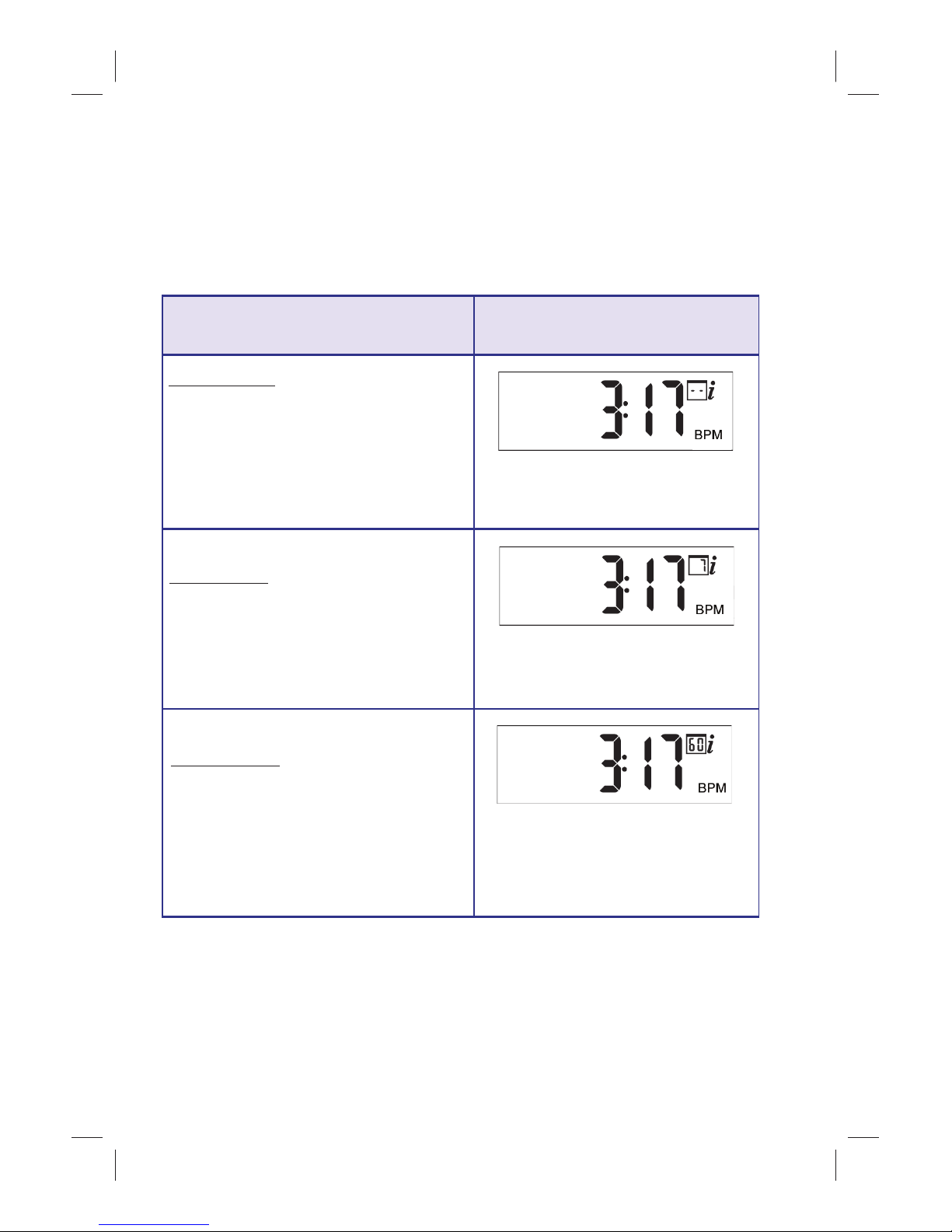
Statistic #3: Initial Breathing Rate
Breaths per minute (BPM) at the start of the Breathing Exercise
Phase (at the end of the Recognition Phase).
Description
Example and
Acceptable Range
Last session report reads
3:17
means that the initial
breathing
rate was 17 breaths per minute
(BPM). Initial breathing rates are
“normal” levels and typically vary
from 12 to18 BPM.
Acceptable Range:
6–30 BPM
Average value
Last 7 days report reads 3:17
means that the average initial
breathing rate was 17 breaths
per minute (BPM).
Acceptable Range:
6–30 BPM
Average value
Last 60 days report reads 3:17
means that the average initial
breathing rate was 17 breaths
per minute (BPM).
Acceptable Range:
6–30 BPM
Page 33
31
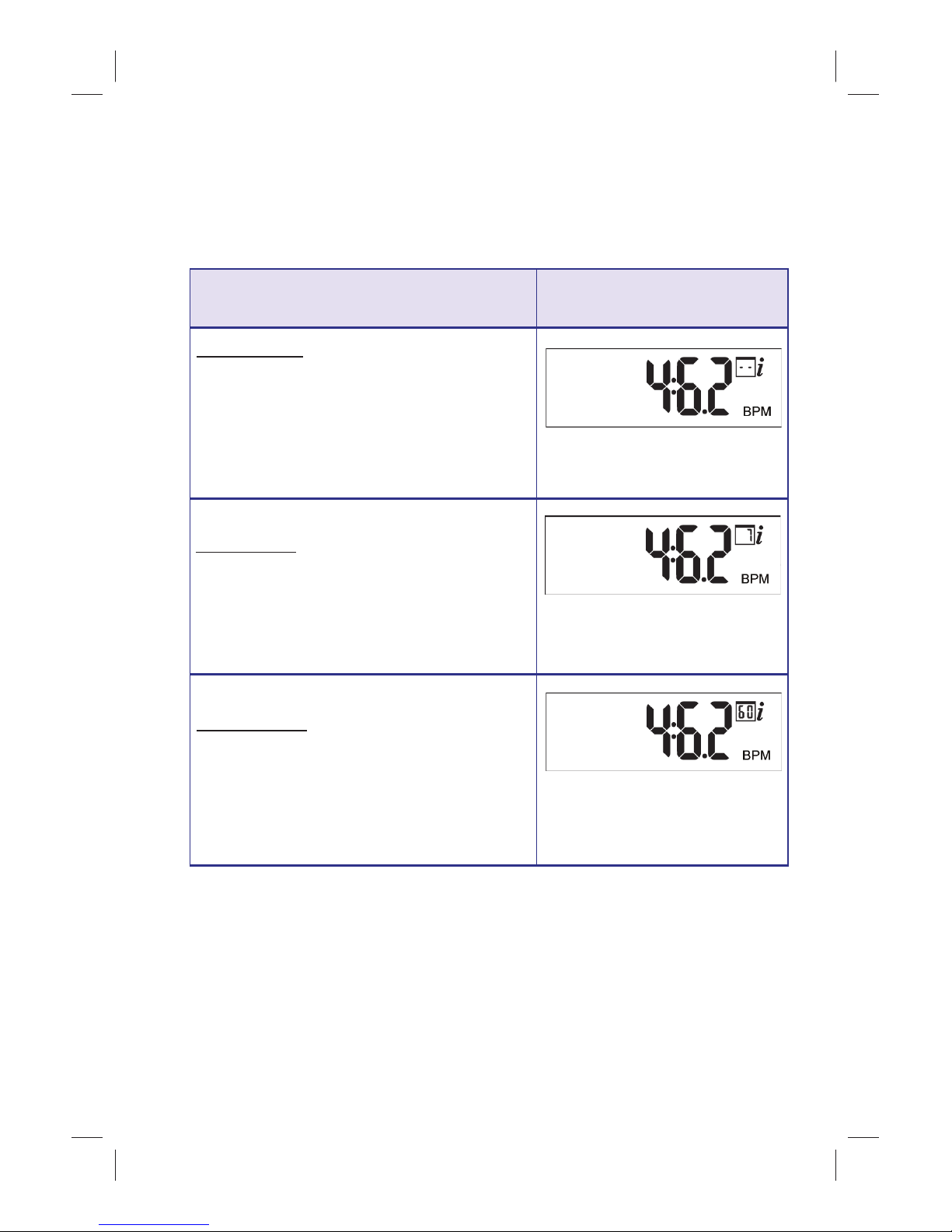
Statistic #4: Final Breathing Rate
Breaths per minute at the end of the RESPeRATE session.
Description
Example and
Recommended Range
Last session report reads 4:6.2 means
that the final breathing rate was
6.2 breaths per minute (BPM). Final
breathing rates vary and can typically
reach 6–8 BPM within a few weeks
of use.
Recommended Range:
5–10 BPM
Average value
Last 7 days report reads 4:6.2 means
that the average final breathing rate
was 6.2 breaths per minute (BPM).
Recommended Range:
5–10 BPM
Average value
Last 60 days report reads 4:6.2
means that the average final
breathing rate was 6.2 breaths per
minute (BPM).
Recommended Range:
5–10 BPM
Page 34
32
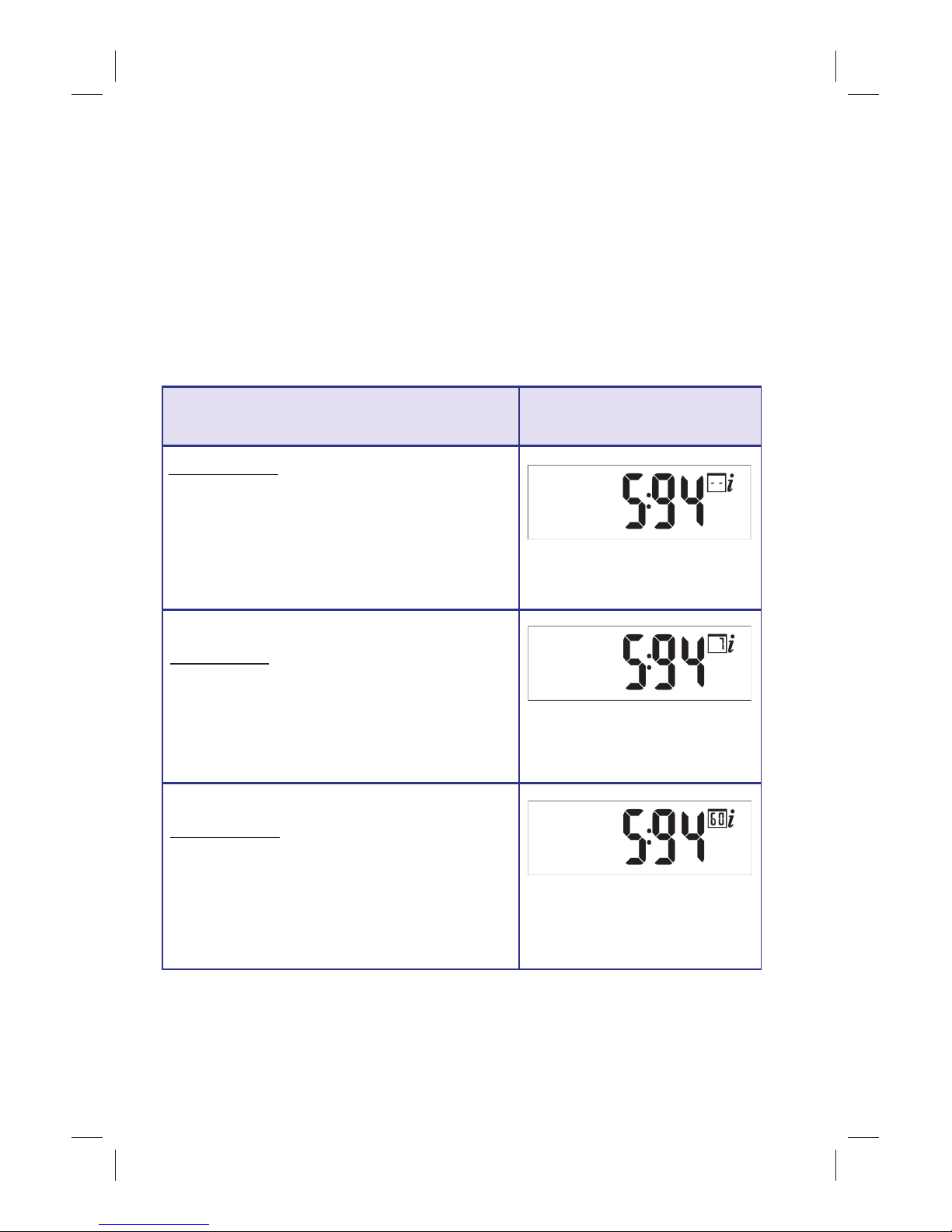
Statistic #5: Synchronization
Indicates how well you are following the guiding tones.
Specifically, it is the percentage of time in which breathing
was
synchronized with the guiding tones. If this rate is lower than
60%, please refer to the Troubleshooting section, page 34.
Description
Example and
Acceptable Range
Last session report reads 5:94 means
that 94% of the time, breathing was
synchronized with the guiding tones.
Acceptable Range:
60–99%
Average value
Last 7 days report reads 5:94 means
that on average, 94% of the time,
breathing was synchronized with the
guiding tones.
Acceptable Range:
60–99%
Average value
Last 60 days report reads 5:94 means
that on average, 94% of the time,
breathing was synchronized with the
guiding tones.
Acceptable Range:
60–99%
Page 35
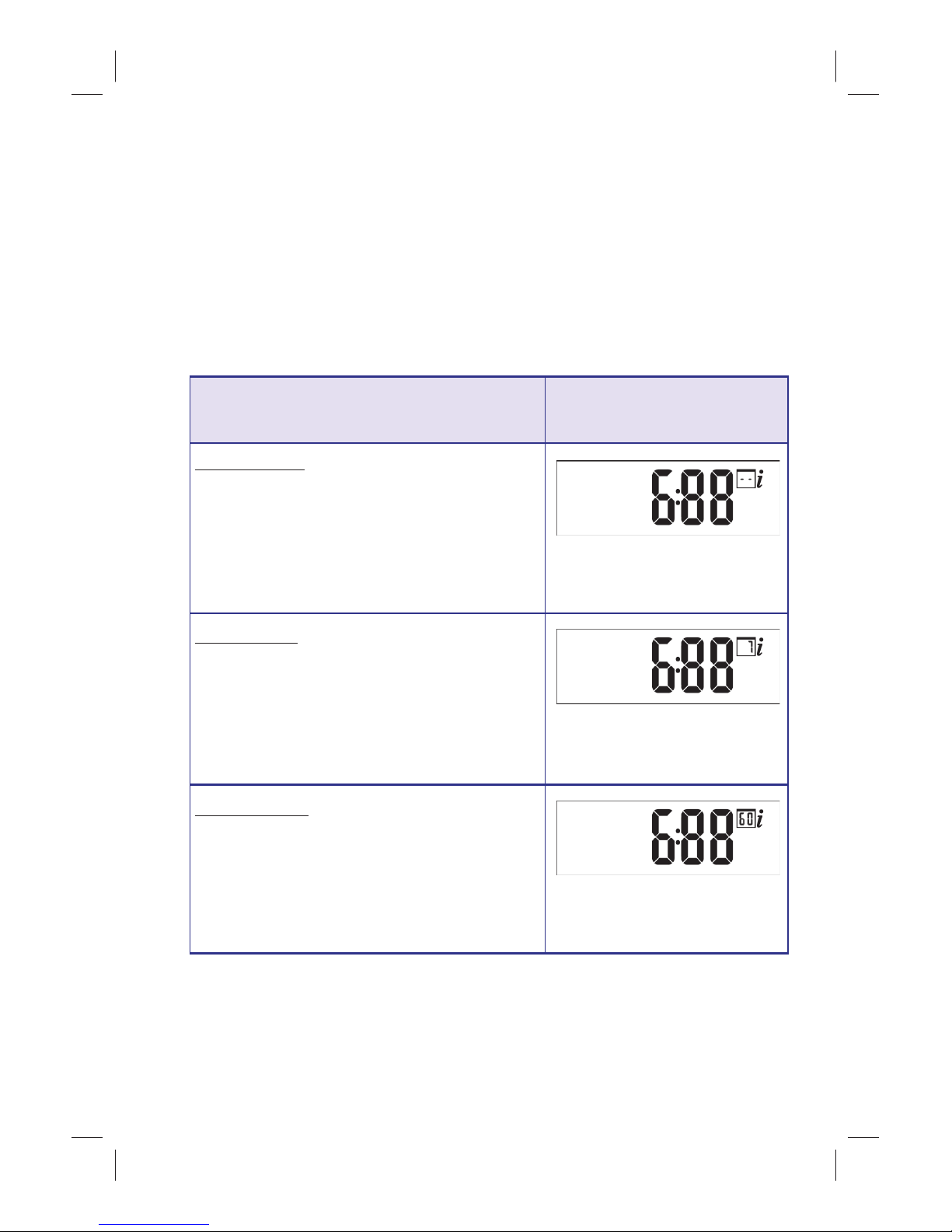
33
Statistic #6: Breath Detection
Indicates how well the sensor is able to recognize inhalation
and exhalation, as a result of the placement of the sensor.
Specifically, it is the percentage of session time that the breathing
sensor could identify the respiration data. If this rate is lower
than 80%, please refer to the Troubleshooting section, page 34.
Description
Example and
Recommended Range
Last session report reads 6:88 means
that 88% of the time, sensor was able
to identify respiration data.
Acceptable Range:
80–99%
Last 7 days report reads 6:88 means
that on average 88% of the time the
sensor was able to identify the
respiration data.
Acceptable Range:
80–99%
Last 60 days report reads 6:88 means
that on average 88% of the time the
sensor was able to identify the
respiration data.
Acceptable Range:
80–99%
Page 36
34
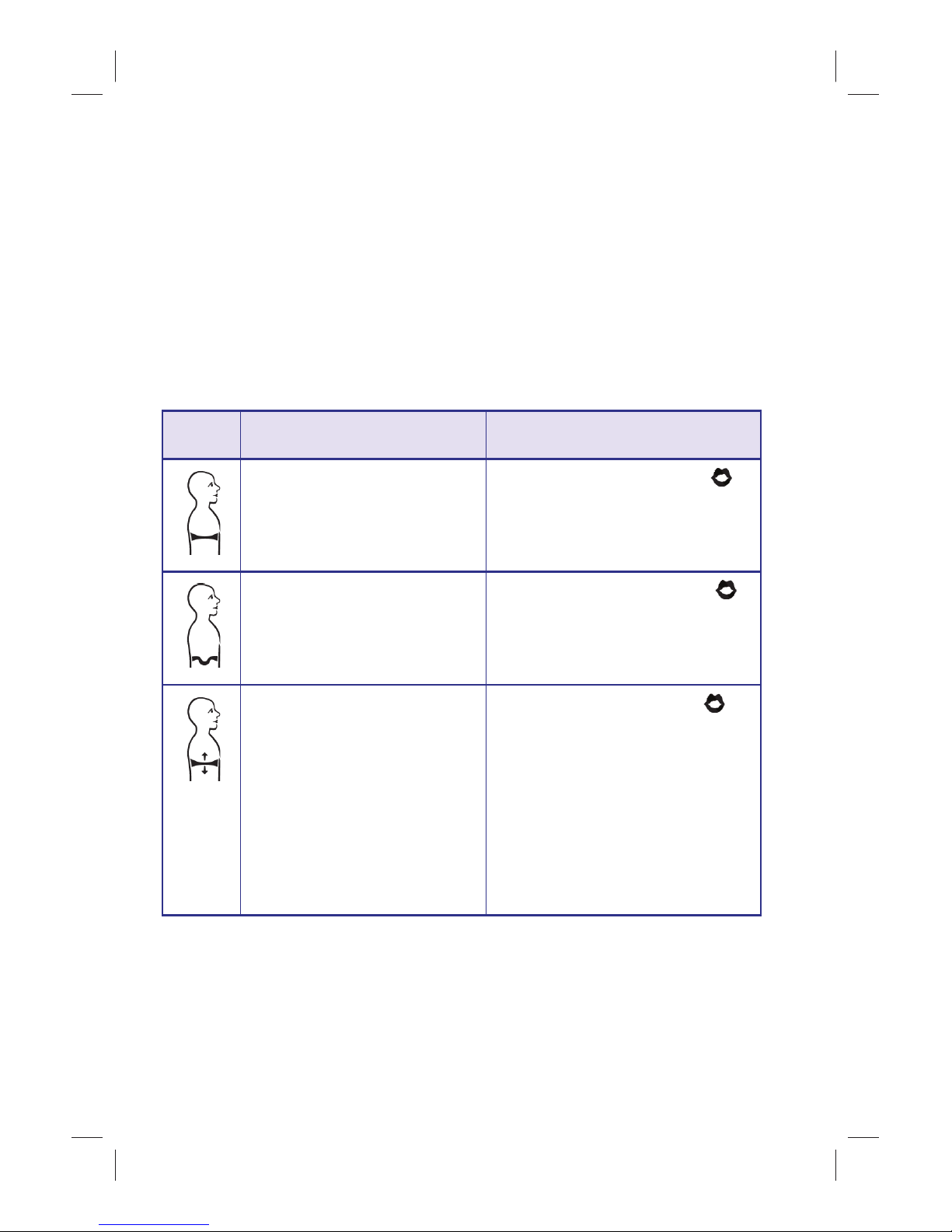
Errors and Troubleshooting
Error Messages
RESPeRATE automatically diagnoses the following problems
and notifies you either by voice instruction and/or an error icon
that appears on the display. The notification disappears once
the problem is corrected.
Icon Explanation Solution
Sensor belt is too tight.
Loosen the sensor belt ( ).
Sensor belt is too loose.
Tighten the sensor belt ( ).
The elastic belt or the
sensor unit itself is
improperly positioned.
Check sensor position ( ).
Reposition the elastic belt
according to Sensor
Position Help Mode, page
39. Also verify that the
sensor unit slides freely on
the belt by moving it slightly
to the left and to the right.
Page 37
35
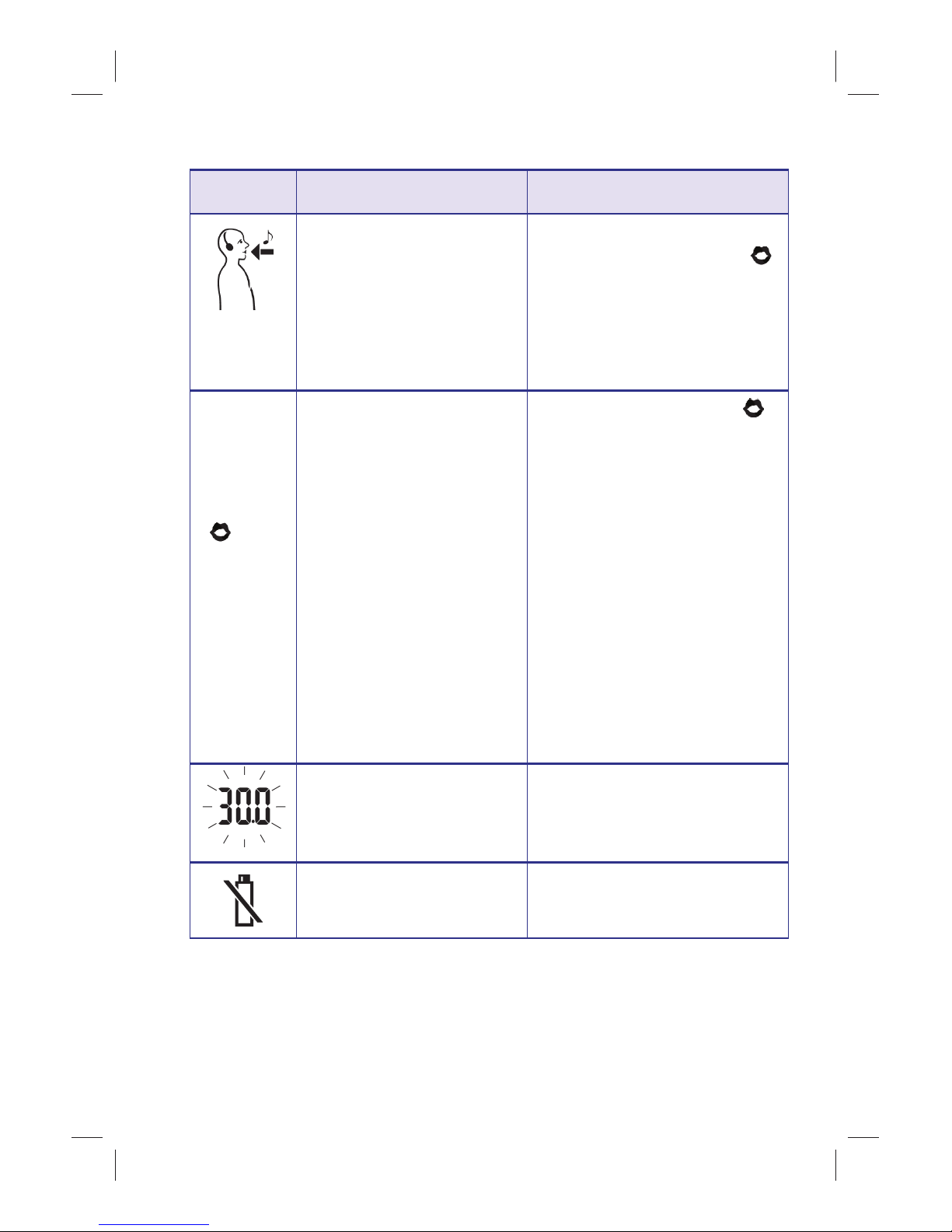
Icon Explanation Solution
Breathing is not
synchronized with the
guiding tones.
“Breathe in”
with the high
tone and
“breath out”
( )
with the low tone. If this
problem persists, try using
melody #4 as it is a very
easy to follow melody.
“Do not
hold your
breath.
Breathe in
gradually”
( ).
You are holding your
breath, either on the
inhale or exhale phase.
“Breathe in gradually”
( ).
For a tip on how to breathe
gradually, see page 20.
Remember, breath holding
is counterproductive. If the
guiding tones are too slow
for you, simply breathe
normally and RESPeRATE
will adapt itself to guide
you according to your
comfortable breathing
pattern. It may be helpful
to take off the headphones
for a short period.
You are breathing faster
than 30 or slower than
3 breaths per minute.
Breathe according to the
guiding tones.
Batteries are weak. Replace the batteries.
Page 38

36
Problem Explanation Solution
The display does
not turn on
when the device
is switched on.
Batteries need to be
replaced.
Install new batteries.
The +/– poles of the
batteries are
positioned incorrectly.
Reinstall the batteries
with the
+/–
poles
positioned correctly.
Music is not
heard through
the headphones.
The headphones are
not properly
connected.
Reconnect the
headphones to
RESPeRATE. Listen for
a “click” sound when
they are properly
inserted.
RESPeRATE has
automatically
switched off because
the session is over.
Restart RESPeRATE to
begin a new session.
One or both
of the guiding
tones are too
fast or too slow
for my current
breathing.
Your breathing rate
has changed abruptly.
Breathe normally.
RESPeRATE will adapt
within a few breaths to
guide you according to
your natural breathing
rate.
Troubleshooting
Page 39

37
Problem Explanation Solution
The Recogntion
Phase takes
longer than two
minutes.
The sensor is
improperly
positioned.
Breathing Sensor needs
to be repositioned. See
Sensor Position Help
Mode, page 39.
Breathing is too
unstable.
Relax, and breathe
normally.
I repeatedly hear
a voice
instruction,
“breathe in”
“breathe out”
while I’m quite
sure I’m
synchronized
with the tones.
I
t is possible that the
breathing movement
detected by the
Breathing Sensor
does not reflect the
actual movement of
inhalation and
exhalation as you
perceive it.
Breathing sensor needs
to be re-positioned.
See Sensor Position
Help Mode, page 39.
Page 40

38
Problem Explanation Solution
I repeatedly hear
a voice message,
“breathe in
gradually.”
You might be
holding your breath
after inhaling.
Activate and check the
Breathing Gauge. If
you are holding your
breath, the bar will
appear “stuck” at
times. See the Sensor
Position Help Mode,
page 39.
Breathe more gradually.
Breathe in and out over
the entire duration of
eachtone. If this is difficult, breathe
effortlessly while
ignoring the tones.
RESPeRATE will readjust
itself to your breathing.
Static noise is
heard through
the headphones
.
Headphones are not
fully plugged into
the headphones jack.
Electronic
communication
device (cell phone,
beeper, or other
wireless
communication
device) is operating
with in 5 feet of
RESPeRATE.
Plug headphones
connection fully into
device. Listen for a
clicking sound.
Do not use such
communication devices
within 5 feet of
RESPeRATE while
conducting your
exercise sessions.
Page 41
39
Sensor Position Help Mode
The Sensor Position Help Mode is useful for troubleshooting any
issues related to the positioning of the sensor. For some users,
the breathing movement detected by the Breathing Sensor
does not reflect the actual movement of inhalation and
exhalation as they perceive it. As a result, RESPeRATE is unable
to guide breathing appropriately. This help mode will assist in
determining the best position for the sensor for your particular
breathing pattern.
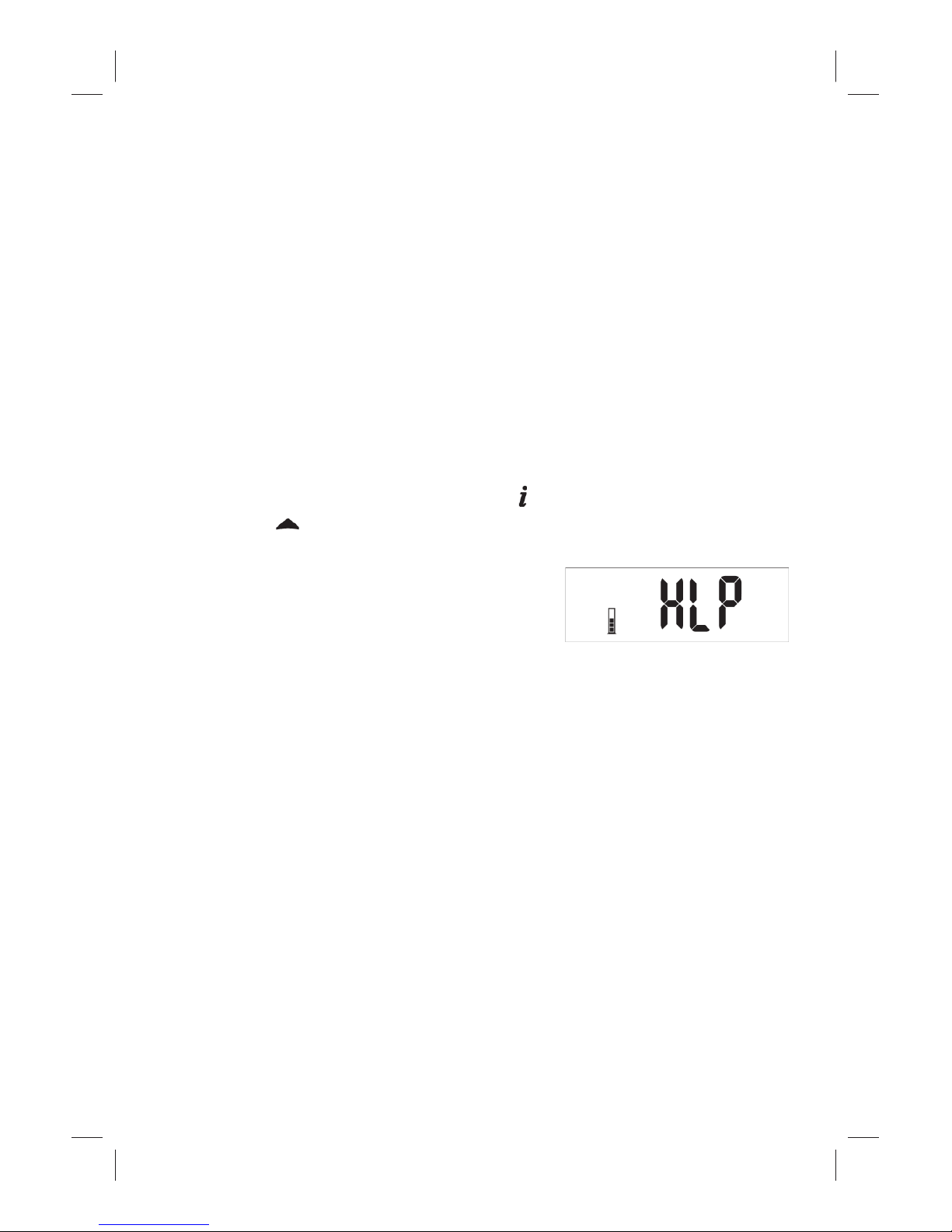
To enter the Sensor Position Help Mode:
Press and hold the Info button ( ) and Press the Up
button ( )
at the same time.
The Breathing Gauge appears on the
display. You can enter this help mode
at any time during the Recognition
Phase (after turning RESPeRATE on).
The Breathing Gauge shows in real time how the device senses
your breathing movements with each breath in and
out. As
you breathe in, the Breathing Gauge should gradually
fill. As you
breathe out, the gauge should gradually empty.
Watch the gauge. The aim is to find the position where the
gauge and the “recognition tones” follow your inhalation and
exhalation.
Help Sensor Position mode
display
Page 42
40
Breathe normally, and experiment with different sensor
positions.
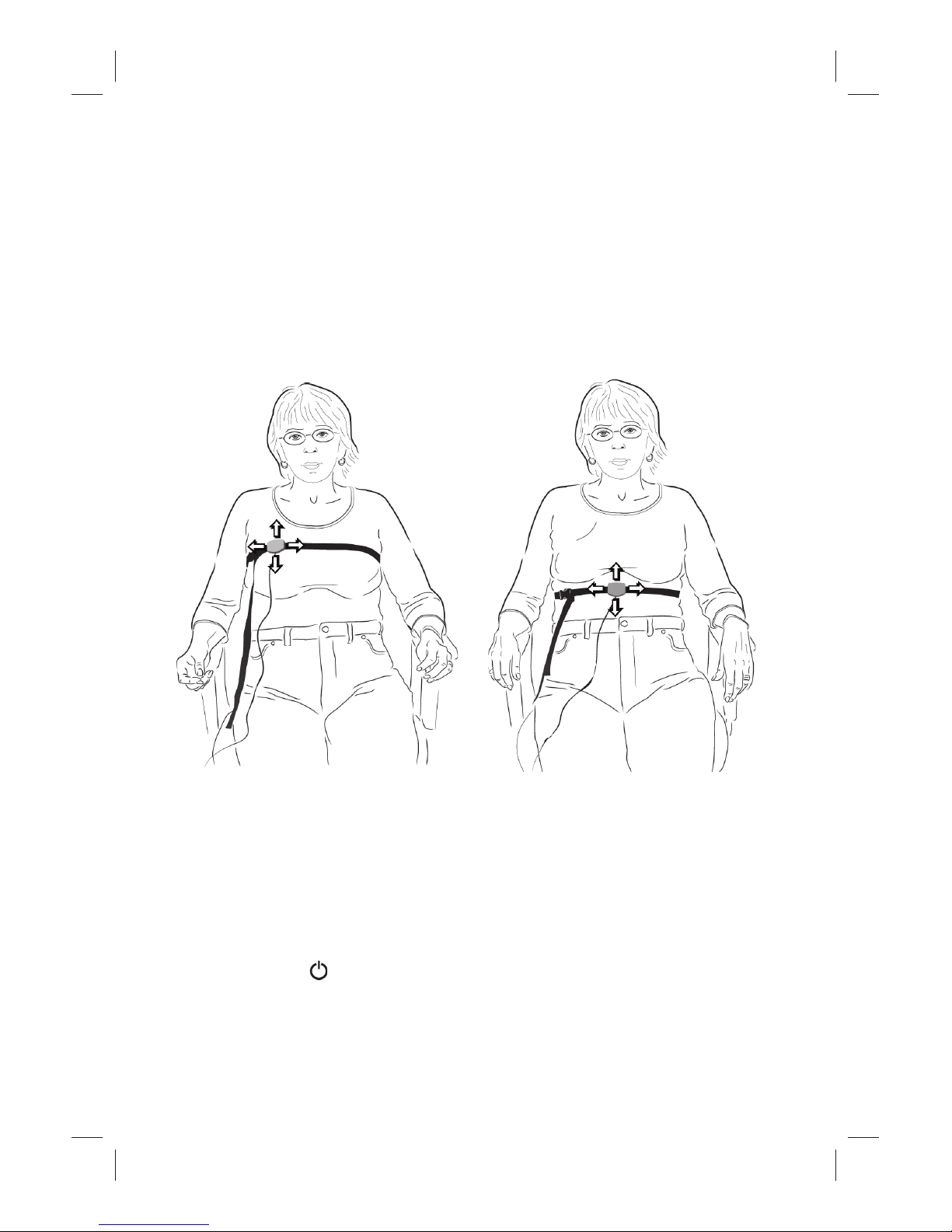
Try placing the sensor on your chest or upper abdomen. Move
it up and down, right or left. You can even try positioning the
sensor unit under the arm.
Once you have positioned the sensor where the Breathing
Gauge
and your inhalation and exhalation are synchronized,
use it in
this position for all RESPeRATE sessions.
To exit the Sensor Position Help Mode:
Press On/Off ( ) orange button to turn RESPeRATE off
To start a new RESPeRATE session, turn the device on again.
Page 43

41
Warranty and Additional Product
Information
Cleaning and Maintenance
To clean RESPeRATE, use a soft, slightly damp cloth. Do not wash
the sensor or the RESPeRATE device. Do not use petroleum products,
thinners, or cleaning solvents!
Store the sensor in its compartment, to protect it from dust and
moisture.
Protect your RESPeRATE against excessive vibrations.
Do not leave your RESPeRATE in a place where temperatures are
below -14°F (-10°C) or above 158°F (70°C), or in conditions of very
high humidity (>85%).
Do not attempt to make repairs of any kind on RESPeRATE. Contact
Customer Service if repairs are necessary.
Please use only Alkaline batteries.
If you do not plan to use RESPeRATE for a period of more than two
months, remove batteries from the battery compartment to avoid
damaging the device.
Page 44

42
Technical Information and
Approvals
Technical Information
Model: RESPeRATE, RESPeRATE Duo; display type: LCD; power source:
four alkaline batteries, 1.5V (type AA); battery life: two months,
with regular use of 15 minutes per day; maximum audio output:
20mW RMS @ each ear with 32 Ohm headphones; device display
respiration rate range of 2-42 BPM but guides between 5-20 BPM;
operating temperature: 10˚C - 40˚C (50˚F - 104˚F); operation humidity:
30 - 75%; storage temperature: -10˚C - 70˚C (14˚F - 158˚F); storage
humidity: 30 - 85%; weight: 480 grams; outer dimensions:
17cm (L) x 13cm(W) x 8cm(H).
Country Specific Market Clearance
United States: 510(k) number K020399 (OTC) and K000405 (Rx)
European Union: CE certified
Israel: Ministry of Health number 237-0000
South Korea: Korean KFDA 04-259
Canada: Canadian Medical device license: 63948
Australia: TGA ARTG ID 116226
Thailand: ISR 4700595
China: SFDA 2260351
0473
Manufacturer Authorized Representative in
Europe:
MEDES Ltd.
9, Beaumont Gate, P.O.Box 231
Shenley Hill, Radlett, Hearts
London WD78BX, UK
tel/fax: +44 (0) 192 385 9810
email: [email protected]
Page 45

43
Indication for Use
Device Name: RESPeRATE
Indications for Use: RESPeRATE is intended for use as a relaxation
treatment for the reduction of stress by leading the user through
interactively guided and monitored breathing exercises. The device
is indicated for use only as an adjunctive treatment for high blood
pressure together with other pharmacological and/ornonpharmacological interventions. Over-the-counter use.
Contraindication: None known.
Precautions:
Do not use this device without consulting your
physician if you suffer or have suffered in the past from: active
ischemic heart disease/unstable angina, bradycardia, severe congestive
heart failure, chronic atrial fibrillation, stroke resulting in permanent
impairment, chronic renal failure, severe asthma, chronic obstructive
pulmonary disease (COPD), like chronic bronchitis and emphysema,
major organ failure, sleep paralysis, have a pacemaker or if you are
pregnant. InterCure strongly recommends that you do not modify
your hypertension treatments without the advice and consent of your
physician
.
Do not use your RESPeRATE when you need to be alert or to
concentrate, or when using heavy equipment. Do not use
RESPeRATE while driving. If you experience any side effects or if
you feel any change in your general health or mood, immediately
discontinue use of your RESPeRATE, and contact your physician.
Breathe effortlessly throughout the exercise. Excessive deep breathing may cause dizziness and palpitations
.
Please note: RESPeRATE should only be used as part of your overall health program for
achieving goal blood pressure, as recommended by your doctor. RESPeRATE can be safely
used in conjunction with medication and lifestyle modifications such as diet and exercise.
Page 46

44
RESPeRATE Limited Warranty
RESPeRATE is warranted to be free from manufacturing
defects for a period of one year from date of purchase
under normal use. This warranty extends only to the original
purchaser. Should repair be needed within the warranty
period, please call RESPeRATE Customer
Support.
We will
either repair or replace (at our discretion) free of charge
any parts necessary to correct defects in the materials or
workmanship. If it is necessary to replace the entire product,
it may be replaced with a remanufactured product. The above
warranty is complete and exclusive. The warrantor expressly
disclaims liability for incidental, special, or consequential
damages of any nature.*
To ensure activation of your warranty, please complete
the registration form online at: www.resperate.com/register.
* Some counties and/or states do not allow the exclusion or
limitation of incidental or consequential damages, so the above
warranty may not apply to you. Any implied warranties arising
by the operation of law shall be limited in duration to the term
of this warranty. This warranty gives you specific legal rights,
and you may have other rights which vary from state to state.
Page 47

45
Customer Support
We are committed to lowering
your blood pressure.
RESPeRATE Product Specialists are available for guidance and
support. If you have any questions or feedback, call Customer
Support
to speak to a Product Specialist or schedule a call.
You can also post your questions or feedback on the RESPeRATE
User Forum at www.resperate.com/forum
USA: 1-877-988-9388 (Toll Free)
United Kingdom: 0800-177-7778 (Toll Free)
Other Countries: +1-646-652-5800 (USA)
E-mail: [email protected]
Page 48

For more information or customer service:
www.resperate.com
USA & Canada: 1-877-988-9388 (Toll Free)
UK: 0800-177-7778 (Toll Free)
Other Countries: +1-646-652-5800 (USA)
InterCure, Inc.
589 8
th
Avenue
New York, NY 10018, USA
InterCure, Ltd.
6 Haba’al Shem-Tov Street
Lod 71289, Israel
+972-73-2207000
www.intercure.com
Manufactured by:
721E 0041 F0473
 Loading...