

Page 1
®
K
APPASERIES
Page 2
POWER-HANDLING LIMITATIONS
The power-handling capability of any woofer is
related to both its ability to dissipate heat and the
maximum excursion limits of its cone. Once the
speaker’s voice coil moves outside the magnetic
gap, power can no longer be converted into
motion and all the amplifier’s power is converted
into heat in the voice coil. This voice-coil heating
is the largest detriment to speaker longevity,
so overexcursion should be avoided. Since
speaker-cone excursion is different or each type
of enclosure, power handling is different for each
enclosure.
Sealed enclosures exert the most control over
the motion of a subwoofer because the air inside
the box acts like a spring against the motion of
the woofer cone. Larger boxes allow for more
excursion, thus providing more low-frequency
output for the amount of power used. When
placed in a sealed box larger than the compliance
(Vas) of the subwoofer, it will perform as if it were
in an infinite-baffle installation.
Vented and bandpass enclosures have the
lowest amount of excursion for the amount of
sound output. This is a result of port output reinforcing the sound output from the woofer. The
mass of the air contained in the port provides an
acoustic load on the woofer’s cone at the tuning
frequency, and this added mass decreases
woofer-cone excursion. Vented boxes do not provide adequate woofer control when driven below
the port-tuning range, so proper design and a
subsonic filter are important. A vented bandpass
box will have the lowest overall cone excursion,
provided a subsonic filter is used.
4. Use PVC or ABS pipe for ports. Keep in mind
that the openings at either end of the port must
be at least one port diameter away from any
obstructions, including filling material inside the
box. Rectangular vents can be used as long as
the cross-section surface area matches the
recommended port-area values in the enclosed
data sheet.
5. When using vented boxes, we recommend
using a subsonic filter (like the DBO feature found
on Kappa power amplifiers) to limit the power
sent to the speaker at frequencies below the
enclosure’s port-tuning frequency, thus limiting
the speaker’s excursion.
Page 3
8
9
)
!
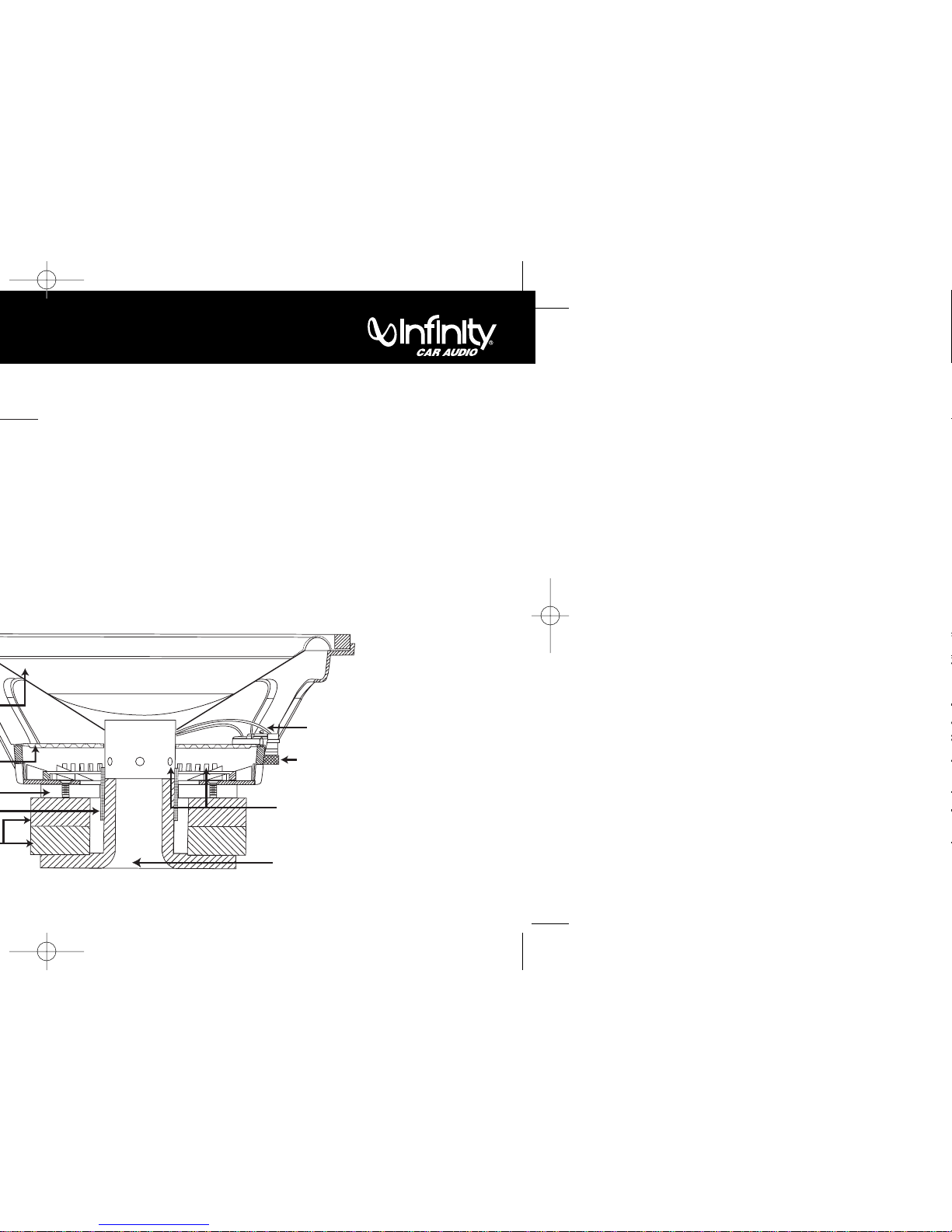
2 Curvilinear™ aluminum cone and dustcap –
low mass for good transient response, rigid for
reduced distortion caused by cone flexing.
3 High-roll butyl surround – damps cone resonance, ensures longevity.
4 Flat uniform-roll spider – ensures maximum
control over cone motion at the limits of the
speaker’s excursion, and reduces even-order
harmonic distortion compared to cupped spiders.
5 Thick top-plate – reduces the ability of musical
transients to push the coil past the magnetic gap
at high power levels.
6 1-1/2-inch-long four-layer voice coil – when
combined with stacked magnets (#7), provides
high motor force (BL) and ultralong excursion.
7 Stacked magnets – provide high motor force
(BL) and room for ultralong excursion
8 Vented voice-coil former and basket – provide
cooling for voice coil.
9 Extended pole piece and bottom plate –
large, radiused and polished pole-piece vent
reduces mechanical losses (Qms) and turbulence
at the vent’s mouth for improved low-frequency
extension free of mechanical noise. Extended pole
piece (above top plate) provides uniform flux
lines above and below the magnetic gap.
) Insulated tinsel leads – protect against short
circuits at excursion limits.
! Gold 5-way binding posts with standard
banana-plug spacing – accept high-end dual
banana plugs.
Page 4
DECLARATION OF CONFORMITY
We, Infinity Systems A/S
Kongevejen 194B
DK-3460 Birkerød
DENMARK
Steen Michaelsen
Infinity Systems A/S
Birkerød. DENMARK. 5/98
declare in own responsibility, that the products described in this owner’s manual are in compliance with technical standards:
EN 50081-1/1991
EN 50082-1/1.1992
 Loading...