

Page 1
Operating instructions
Vibration sensor
VNB001
80270675/00 12/2017
UK
Page 2

2
Contents
1 Preliminary note ��������������������������������������������������������������������������������������������������� 4
1�1 Notes on this document ��������������������������������������������������������������������������������� 4
1�2 Symbols used ������������������������������������������������������������������������������������������������4
2 Safety instructions �����������������������������������������������������������������������������������������������4
2�1 General ���������������������������������������������������������������������������������������������������������� 4
2�2 Installation and connection ����������������������������������������������������������������������������4
2�3 Tampering with the device �����������������������������������������������������������������������������5
3 Functions and features ����������������������������������������������������������������������������������������5
4 Installation������������������������������������������������������������������������������������������������������������6
5 Electrical connection �������������������������������������������������������������������������������������������� 6
5�1 M8/USB interface ������������������������������������������������������������������������������������������7
5�2 History values ������������������������������������������������������������������������������������������������7
5�3 Real-time clock ����������������������������������������������������������������������������������������������7
6 Functions �������������������������������������������������������������������������������������������������������������8
6�1 Input function �������������������������������������������������������������������������������������������������8
6�2 Output function ����������������������������������������������������������������������������������������������8
6�2�1 Switching output and analogue output �������������������������������������������������8
6�2�2 Lower limit monitor �������������������������������������������������������������������������������8
6�2�3 Output logic ������������������������������������������������������������������������������������������9
6�3 Measuring function ����������������������������������������������������������������������������������������9
7 Operating and display elements ������������������������������������������������������������������������10
7�1 LED display �������������������������������������������������������������������������������������������������10
7�2 7-segment display ��������������������������������������������������������������������������������������� 11
7�3 Operating mode ������������������������������������������������������������������������������������������� 11
7�3�1 Examples in the operating mode �������������������������������������������������������� 11
7�4 Operating mode external process value ������������������������������������������������������ 12
7�4�1 Example display option (v
rms
- external process value) �����������������������12
8 Parameter setting ����������������������������������������������������������������������������������������������13
8�1 Vibration velocity ������������������������������������������������������������������������������������������13
8�2 External process value ��������������������������������������������������������������������������������13
8�3 Self-test��������������������������������������������������������������������������������������������������������13
8�4 Averaging ����������������������������������������������������������������������������������������������������� 14
8�4�1 Calculation ������������������������������������������������������������������������������������������ 14
Page 3

3
UK
8�4�2 Settings �����������������������������������������������������������������������������������������������14
8�4�3 Diagram averaging �����������������������������������������������������������������������������14
9 Menu ������������������������������������������������������������������������������������������������������������������ 15
9�1 Explanation of the menu ������������������������������������������������������������������������������ 15
9�2 Parameter setting in general �����������������������������������������������������������������������17
9�2�1 Change from menu level 1 to the submenu ����������������������������������������18
9�2�2 Locking / unlocking �����������������������������������������������������������������������������18
9�3 Menu structure ��������������������������������������������������������������������������������������������� 19
9�3�1 Menu level 1 ���������������������������������������������������������������������������������������19
9�3�2 Submenu extended functions �������������������������������������������������������������20
9�3�3 Submenu external sensor �������������������������������������������������������������������21
10 Maintenance, repair and disposal �������������������������������������������������������������������� 22
11 Scale drawing ��������������������������������������������������������������������������������������������������22
12 Time diagrams �������������������������������������������������������������������������������������������������23
12�1 Switch-on delay for the upper limit monitor �����������������������������������������������23
12�2 Switching delay for the lower limit monitor ������������������������������������������������24
12�3 Averaging for the lower limit monitor ����������������������������������������������������������25
13 Factory setting �������������������������������������������������������������������������������������������������26
Page 4

4
1 Preliminary note
Technical data, approvals, accessories and further information at www�ifm�com�
1.1 Notes on this document
This document applies to devices of the type "vibration sensor" (art� no�: VNB001)�
It is part of the device and contains information about the correct handling of the
product�
This document is intended for qualified electricians� These specialists are people
who are qualified by their training and their experience to recognise and to avoid
possible hazards that may be caused during operation of the device�
► Read this document before using the device�
► Keep this document during the service life of the device�
1.2 Symbols used
► Instruction
> Reaction, result
→ Cross-reference
LED on
LED flashes
Important note
Non-compliance can result in malfunction or interference�
Information
Supplementary note�
2 Safety instructions
2.1 General
► Observe these operating instructions�
► Observe the warning notes in these instructions�
Non-observance of the instructions, operation which is not in accordance with use
as prescribed below, wrong installation or incorrect handling can affect the safety
of operators and machinery�
2.2 Installation and connection
The unit must only be installed, connected and put into operation by a qualified
electrician as the safe function of the device and machinery is only guaranteed
Page 5

5
UK
when installation is correctly carried out� The installation and connection must
comply with the applicable national and international standards� Responsibility lies
with the person installing the device�
This is a class A product which is intended for use in industrial applications�
The unit may cause radio interference in domestic areas� In this case it can
be necessary for the user to take appropriate measures�
2.3 Tampering with the device
Tampering with the device is not allowed and will lead to an exclusion of liability
and warranty� Tampering with the device can affect the safety of operators and
machinery�
3 Functions and features
Monitoring of
• vibration velocity v
rms
or v
peak
• process value above or below the permissible value
Visualisation of
• process values
• switching states
Page 6
6
4 Installation
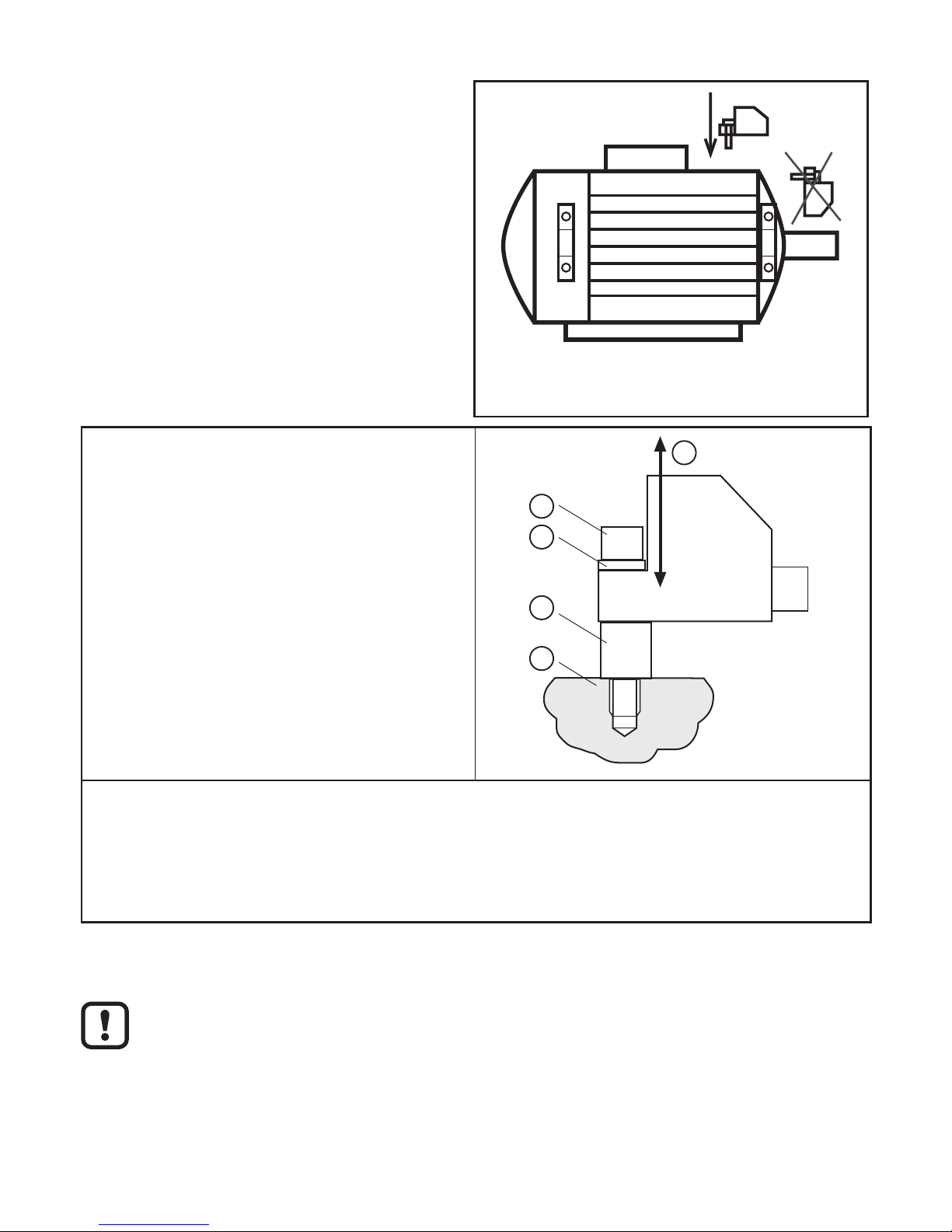
Please note the following points
when installing the unit:
• Mount only in a thick housing wall
(e�g� crane hook thread)�
• Mount vertically to the machine
surface using the spacer adapter
in the direction of the strongest
vibrations� This is usually the
radial direction�
• Tighten the M5 screw with a
tightening torque of 7 Nm�
► Ensure a reliable vibration
transmission� Avoid any elastic
intermediate layers�
1
2
3
4
5
1: measurement axis
2: M5 screw
3: spring washer
4: M8 x M5 adapter
5: machine surface
5 Electrical connection
The unit must be connected by a qualified electrician�
The national and international regulations for the installation of electrical equipment
must be adhered to�
Voltage supply to EN 50178, SELV, PELV�
Disconnect power before connecting the unit�
Page 7
7
UK
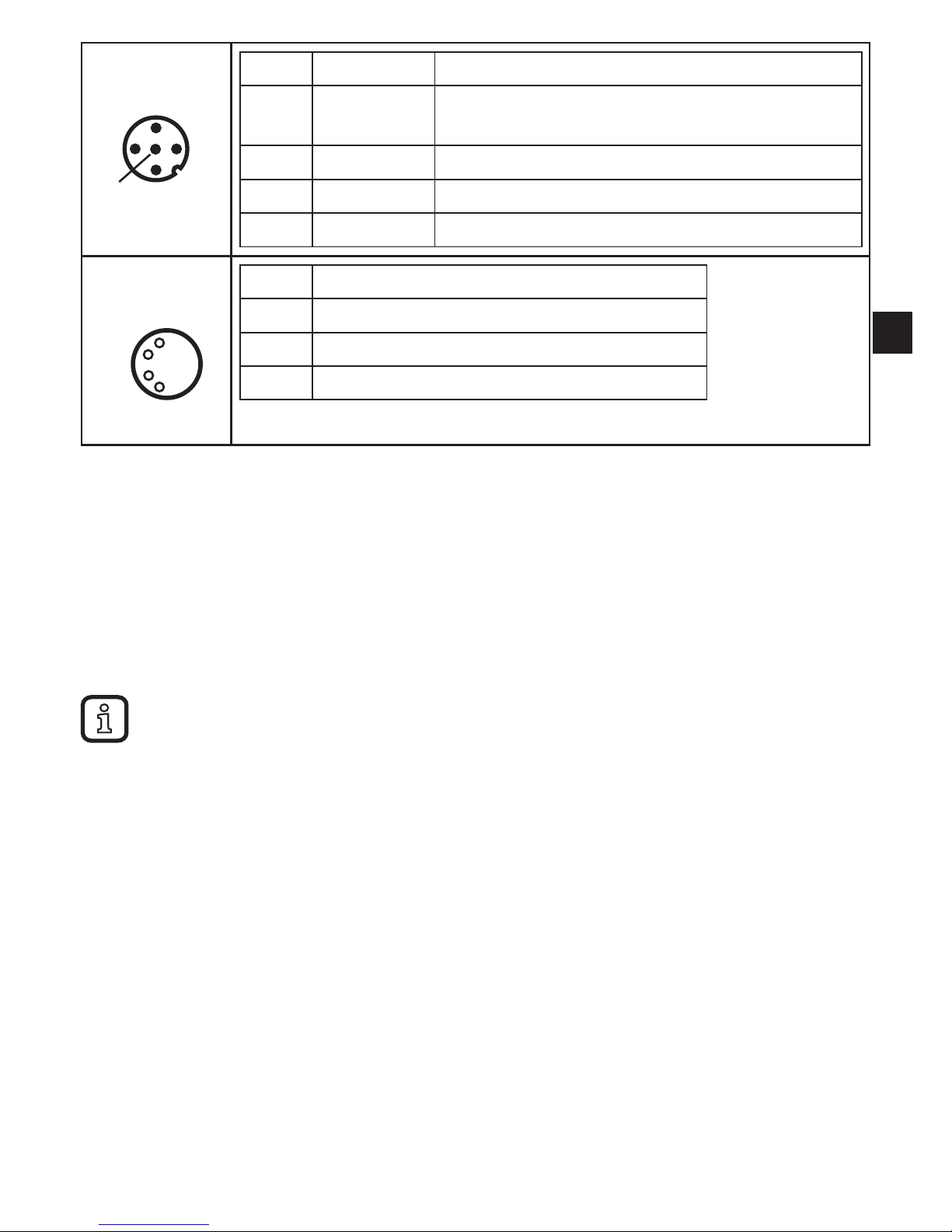
M12
Pin 1: L+ 9�6���30 V DC
Pin 2: Out 1 switching output or current output 4���20 mA
(configurable)
Pin 3: L Pin 4: Out 2 switching output
Pin 5: IN current input 4���20 mA
M8
Pin 1: VCC (5 V)
Pin 2: USB DPin 3: LPin 4: USB D+
5.1 M8/USB interface
► First connect the interface cable to the device and then to the USB interface of
the computer�
• The units have a serial number which can be read out using the PC software�
• The sensor can also be supplied via the USB interface�
• Read out and reset the history values�
Switching and analogue outputs are not supported if an USB power supply is used�
5.2 History values
The unit records history values� The memory interval is 5 min,� the maximum V
rms
value in this time range is recorded with a time stamp�
Recording period about 3 years, the oldest values will then be overwritten (ring
memory)�
The history can be read out and reset using the software VES004�
5.3 Real-time clock
The unit has an integrated real-time clock including a buffer battery for the time
stamp in the history memory� The time is synchronised with the system clock via
the PC software when the history is reset�
Page 8

8
6 Functions
6.1 Input function
Parameter setting via the Mode/Enter and Set buttons�
• External sensor for any process value (typically temperature (°C, °F))
• Scaleable input (4���20 mA)
Evaluation of the measurement results as for vibration objects
- Switch points early warning and main alarm adjustable
- For main alarm < early warning → lower limit monitor
- Adjustable hysteresis
6.2 Output function
6.2.1 Switching output and analogue output
Parameter setting via the Mode/Enter and Set buttons�
OU1 Analogue
output
- 4���20 mA scaleable measuring range of the vibration velocity
- averaging adjustable
- 22 mA in case of a system error
Switching
output
- early warning
- SP 1
- NO / NC adjustable
- switch-on and switch-off delays adjustable
- 1 Hz pulsing in case of a system error
OU2 Switching
output
- main alarm
- SP 2
- NO / NC adjustable
- switch-on and switch-off delays adjustable
6.2.2 Lower limit monitor
If the SP1 switch point early warning has a higher value than the SP2 switch point
main alarm, these are set as lower limit monitor�
If a lower limit monitor is set, early warning OU1 and main alarm OU2 are
influenced as follows:
- If the value is greater than SP1, OU1 and OU2 are not active�
- If the value is between SP1 and SP2, only OU1 is active�
- If the value is below SP2, OU1 and OU2 are active�
The same applies to the external sensor�
Page 9

9
UK
6.2.3 Output logic
The process values "vibration velocity" and "external sensor" are combined via a
logic OR and provided at the switching output�
2
1
example: 1
3
process value
vibration velocity
process value
external sensor
OR
OU
example: 0
example: 1
1: process value vibration velocity
2: process value external sensor
3: switching output
6.3 Measuring function
The device can be set to the measurement mode via the VES004 software� In this
mode, you have access to the raw data (time signal) of the acceleration or of the
external input (4���20 mA)� The data can be visualised, recorded, analysed and
processed in the software�
If the device remains connected to the software, the user has to actively (manual
ly) finish the time signal monitoring� If the device is separated from the software, it
automatically returns to the monitoring function�
If the unit is in the measurement mode, there is no monitoring� "rSc3" is displayed
on the unit�
Page 10

10
7 Operating and display elements
7.1 LED display
10
11
Mode/Enter Set
12
1...8: LED display / bar graph
1: LED green a = not used
2: LED green v = vibration velocity v [mm/s] or [in/s]
3: LED green d = not used
4: LED green RMS = average value
5: LED green Pk = peak value
6: LED green Ext = process value of the external sensor
7: LED yellow OU1 = early warning active *)
8: LED red OU2 = main alarm active *)
*) The LED indicates the current alarm state (warning alarm, damage alarm)� The
configuration of the corresponding output (OU1, OU2) as "normally closed" or "normally
open" is ignored�
9: 7-segment display green, yellow and red, 4 digits
- Display of the measured values
10: Points
- Lower points as decimal separators
11: Set button
Parameter setting mode
- Setting of the parameter values
- Display option "external process value" or "vibration velocity"
12: Mode/Enter button
- Selection of the parameters and acknowledgement of the parameter values
Page 11

11
UK
7.2 7-segment display
• Displays the damage level (green, yellow, red)
If the segment display changes the colour, the switch-on and switch-off delays or
the hysteresis are not considered�
• Displays the current vibration velocity or the current external process value
7.3 Operating mode
The user must be familiar with the units used in the vibration sensor ([mm/s] or [in/s])
and in the external sensor (°C, °F, mBar)�
7.3.1 Examples in the operating mode
Colour segment display: yellow
a
v
d
RMSPk
Ext
OU1
OU2
Current measured value of the vibration velocity
v
rms
= 17�35 mm/s�
Parameters
- Early warning SP1 = 10 mm/s
- Main alarm SP2 = 20 mm/s
> Output OU1 is active
If the segment display changes the colour, the switchon and switch-off delays are not considered�
For OU1 and OU2 the switch-on and switch-off delays
are considered�
Colour segment display: red
a
v
d
RMSPk
Ext
OU1
OU2
Current measured value imbalance (v
peak
) has reached
1�252 in/s�
Parameters
- Unit uni = in/s
- Early warning SP1 = 0�5 in/s
- Main alarm SP2 = 1 in/s
> Outputs OU1 and OU2 are active
Page 12

12
Colour segment display: red
a
v
d
RMSPk
Ext
OU1
OU2
The external sensor has reached 95 °C�
Parameters
- Early warning ESP1 = 50 °C
- Main alarm ESP2 = 90 °C
> Outputs OU1 and OU2 are active
If the segment display changes the colour, the
hysteresis is not considered�
For OU1 and OU2 the hysteresis is considered�
The LEDs OU1 and OU2 indicate the alarm condition, not the voltage level (high,
low) at the output�
The level can be inverted via the parameters OU1 and OU2 (NC, NO)�
7.4 Operating mode external process value
In the operating mode "External process value" measured values are displayed,
e�g� pressure values (mBar, hPa���), temperatures (°C, °F)�
The detected values are transferred via the measured value input (pin 5)�
> LED "Ext" lights�
7.4.1 Example display option (v
rms
- external process value)
a
v
d
RMSPk
Ext
OU1OU
2
a
v
d
RMS
Pk
Ext
OU1
OU2
Set
Operating mode vibration velocity
17�35 mm/s v
rms
[Set]
Operating mode external process value
e�g� temperature 42�61 °C
[Set]
Operating mode vibration velocity
17�35 mm/s v
rms
In the event of an alarm the display changes automatically to the value last
exceeded�
Page 13

13
UK
8 Parameter setting
Vibration velocity, external process value and self-test parameters can be set via
the Mode/Enter and Set buttons�
8.1 Vibration velocity
For the operating mode vibration velocity the following parameters can be set:
- Measurement method (rms or peak)
- Display in mm/s or in/s
- Switch points
- Lower limit frequency (2 Hz or 10 Hz) configurable
- Averaging
- Switch-on and switch-off delays
- Switching outputs (NO, NC or analogue for OU1)
If OU1 is selected as analogue:
► Scale current output�
8.2 External process value
For the operating mode external process value the following parameters can be
set:
- Scaling 4 mA (EASP), 20 mA (EAEP)
- Switch points
- Hysteresis
- Switching outputs (NO or NC)
8.3 Self-test
Trigger and carry out a self-test�
The self-test is carried out when the sensor is switched on and can also be
triggered manually → [tESt].
Self-test passed → [PASS], self-test failed → [FAIL]
> LED OU1 pulsing (flashes)
> Output OU1
- pulsing if digital (NC, NO)
- supplies 22 mA if analogue
Page 14

14
8.4 Averaging
8.4.1 Calculation
Formula to determine the new diagnostic value:
("previous diagnostic value" x (1 - averaging)) + ("new measurement" x averaging)
= new diagnostic value
Example
Averaging 0�25; "previous diagnostic value" 17�3 mm/s;
"new measurement" 14�7 mm/s
(17�3 mm/s x (1 - 0�25)) + (14�7 mm/s x 0�25) = 16�65 mm/s
For the VNB001 the measured time between "previous diagnostic value" and "new
measurement" is 0�25 s�
8.4.2 Settings
Averaging = 1: averaging deactivated
Averaging = 0�01: strong averaging
8.4.3 Diagram averaging
1
1
0
10
15
20
25
30
35
5
4710 13 16 19 22 25 28 31 34 37 40 43 46 49 52 55 58 61 64 67 70 73 76 79 82 85 88 91 94 97
2
1: Diagnosis
2: AVE (1/8)
Page 15

15
UK
9 Menu
9.1 Explanation of the menu
Menu level 1
EUAL Evaluation - selection of the measurement method rms "r" or peak "P"
uni Unit - in/s or mm/s
SP1 Switch point early warning
If the switch point is exceeded,
- OU1 switches if it is digital "no", "nc",
- the yellow LED "OU1" lights
- the measured value display changes to yellow
SP2 Switch point main alarm
If the switch point is exceeded,
- OU2 switches
- the red LED "OU2" lights
- the measured value display changes to red
The displayed values for the switch points SP1 and SP2 change if the unit or the measure
-
ment method is changed subsequently�
EF_i Submenu extended functions
EHt_i Submenu external sensor
tESt Self-test (PASS or FAIL)
is automatically carried out when the sensor is switched on
Submenu extended functions EF_i
LFCO Setting of the lower limit frequency (2 Hz or 10 Hz)
AUER Averaging → chapter 8.4
dS1 Switch-on delay for OU1 (0���60 s)
dr1 Switch-off delay for OU1 (0���60 s)
dS2 Switch-on delay for OU2 (0���60 s)
dr2 Switch-off delay for OU2 (0���60 s)
ou1 Output logic OU1 no, nc, I (normally open, normally closed, current output)
ASP Scaling of the current output with respective parameter setting (mm/s or
in/s) at 4 mA� rms or peak is considered� Only relevant for OU1 = "I"
AEP Scaling of the current output with respective parameter setting (mm/s or
in/s) at 20 mA� rms or peak is considered� Only relevant for OU1 = "I"
Page 16

16
ou2 Output logic OU2 no, nc (normally open, normally closed)
Submenu external sensor EHt_i
EASP Scaling of the external sensor,
initial value of the measuring range at 4 mA
EAEP Scaling of the external sensor,
final value of the measuring range at 20 mA
ESP1 Switch point early warning
If the switch point is exceeded,
- OU1 switches if it is digital "no", "nc
- the yellow LED "OU1" lights
- the measured value display changes to yellow
Eh1 Hysteresis early warning
Absolute distance between set and reset point
ESP2 Switch point main alarm
If the switch point is exceeded,
- OU2 switches
- the red LED "OU2" lights
- the measured value display changes to red
Eh2 Hysteresis main alarm
Absolute distance between set and reset point
Error message
Err1 The value to be displayed is less than -999 or greater than 9999�
► Check the scaling of the current output (ASP, AEP) and set again�
Page 17

17
UK
9.2 Parameter setting in general
During the parameter setting process the monitoring function of the unit is
maintained� It continues to monitor with the existing parameters until the
parameter setting has been completed�
3 steps must be taken for each parameter setting:
1
Select the parameter
► Press [Mode/Enter] until the reque-
sted parameter is displayed.
Mode/Enter Set
2
Set the parameter value
► Press [Set]�
> The current setting value of the
parameter is displayed�
► Press [Set] for 3 s�
► Setting of the decimal point (cc�
cc) and the sign by pressing [Set]
several times�
► Press [Mode/Enter] to confirm�
► Set an individual digit with [Set] and
confirm with [Mode/Enter]�
► Repeat with all digits�
Mode/Enter Set
3
Confirm the parameter value
► Press [Mode/Enter]�
> The parameter is displayed again�
The new setting value is saved�
Mode/Enter Set
Set other parameters
► Start again with step 1�
Change the operating mode
► Press [Mode/Enter] several times until the current measured value is displayed�
> The unit returns to the operating mode�
If no button is pressed within 30 s, the unit automatically returns to the operating mode�
Page 18

18
9.2.1 Change from menu level 1 to the submenu
► Press [Mode/Enter] until [EF
┘
] is
displayed�
Mode/Enter Set
► Press [Set] briefly�
> The first parameter of the submenu is
displayed (here: [LFCO])�
Mode/Enter Set
9.2.2 Locking / unlocking
The unit can be locked electronically to prevent unintentional settings�
► Make sure that the unit is in the
normal operating mode�
► Press [Mode/Enter] + [Set] for 10 s�
> [Loc] is displayed�
Mode/Enter Set
During operation: [LOC] is briefly displayed if you try to change parameter values�
For unlocking:
► Press [Mode/Enter] + [Set] for 10 s�
> [uLoc] is displayed�
Mode/Enter Set
Factory setting: not locked�
Page 19

19
UK
9.3 Menu structure
9.3.1 Menu level 1
Ext. input
Vibration
Operating
mode
Page 20

20
9.3.2 Submenu extended functions
Page 21

21
UK
9.3.3 Submenu external sensor
Page 22

22
10 Maintenance, repair and disposal
► Dispose of the device in accordance with the national environmental
regulations�
11 Scale drawing
M12x1
51
62,4
14
6
5,3
36
20
M5
37,6
5
10
4
5,3
M8x1
Page 23

23
UK
12 Time diagrams
12.1 Switch-on delay for the upper limit monitor
The time diagram shows the effect of the switching delay on the analogue input
for an upper limit monitor (ESP1 < ESP2)� The outputs are set as normally closed
(OU1 and OU2 → nc).
2
t [s]
10
20
Analogue In
[°C]
Eh2
{
t [s]
10
20
OU 1 (n.c.)
ds1, ds2, dr1, dr2 = 0 s
24 V
0 V
on
off
off
on
t [s]
10
20
OU 2 (n.c.)
24 V
0 V
on
off
off
on
t [s]
10
20
OU 1 (n.c.)
ds1, ds2 = 2 s / dr1, dr2 = 3 s
24 V
0 V
on
off
2 s
3 s
t [s]
10
20
OU 2 (n.c.)
ds1, ds2 = 2 s / dr1, dr2 = 3 s
24 V
0 V
off
2 s
3 s
1
on
ESP2
Eh1
{
ESP1
1: Not switched off because the selected switching delay is too short (< 3 s)�
2: Not switched on because the selected switching delay is too short (< 2 s)�
If the switching delays of early warning and main alarm are set differently:
- main alarm already switched on, early warning not yet switched on
- early warning already switched off, main alarm not yet switched off
Page 24

24
12.2 Switching delay for the lower limit monitor
The time diagram shows the effect of the switching delay on the analogue input for
a lower limit monitor (ESP1 > ESP2)� The outputs are set as normally closed (OU1
and OU2 → nc).
t [s]
10
20
Analogue In
[°C]
Eh1
{
Eh2{
t [s]
10
20
OU 1 (n.c.)
ds1, ds2, dr1, dr2 = 0 s
24 V
0 V
on
off
off
on
t [s]
10
20
OU 2 (n.c.)
24 V
0 V
on
off
off
on
t [s]
10
20
OU 1 (n.c.)
ds1, ds2 = 2 s / dr1, dr2 = 3 s
24 V
0 V
on
off
2 s
3 s
t [s]
10
20
OU 2 (n.c.)
ds1, ds2 = 2 s / dr1, dr2 = 3 s
24 V
0 V
off
2 s
3 s
1
on
2 s
off
3 s
ESP2
ESP1
1: Not switched on because the selected switching delay is too short�
Page 25

25
UK
12.3 Averaging for the lower limit monitor
The time diagram shows the effect of averaging for a lower limit monitor (SP1 >
SP2). The outputs are set as normally closed (OU1 and OU2 → nc), AUER = 0.25
averaging
2
1
t [s]
10
20
v
rms [mm/s]
SP1
SP2
t [s]
10
20
OU 1 (n.c.)
ds1, ds2, dr1, dr2 = 0 s
24 V
0 V
on
off
off
on
t [s]
10
20
OU 2 (n.c.)
24 V
0 V
on
off
off
on
1: raw signal
2: averaged signal
Page 26

26
13 Factory setting
Factory setting User setting
EUAL rms
uni mm/s
SP1 2�8 [mm/s]
rms
[mm/s or in/s]
SP2 4�5 [mm/s]
rms
[mm/s or in/s]
LFCO 10 [Hz] [Hz]
AUER 0,125
dS1 0 [s] [s]
dr1 0 [s] [s]
dS2 0 [s] [s]
dr2 0 [s] [s]
ou1 nc
ASP 0 [mm/s]
rms
[mm/s or in/s]
AEP 25 [mm/s]
rms
[mm/s or in/s]
ou2 nc
EASP 0 example: [°C] [ ]
EAEP 100 example: [°C] [ ]
ESP1 10 example: [°C] [ ]
Eh1 1 example: [°C] [ ]
ESP2 20 example: [°C] [ ]
Eh2 1 example: [°C] [ ]
Page 27

27
UK
 Loading...