

Page 1
HUGH CRANE
Cleaning Equipment Limited
SOUTH WALSHAM ROAD, ACLE, NORWICH, NORFOLK, NR13 3ES
TEL: 01493 750072 - FAX: 01493 751854 - www.hughcrane.co.uk
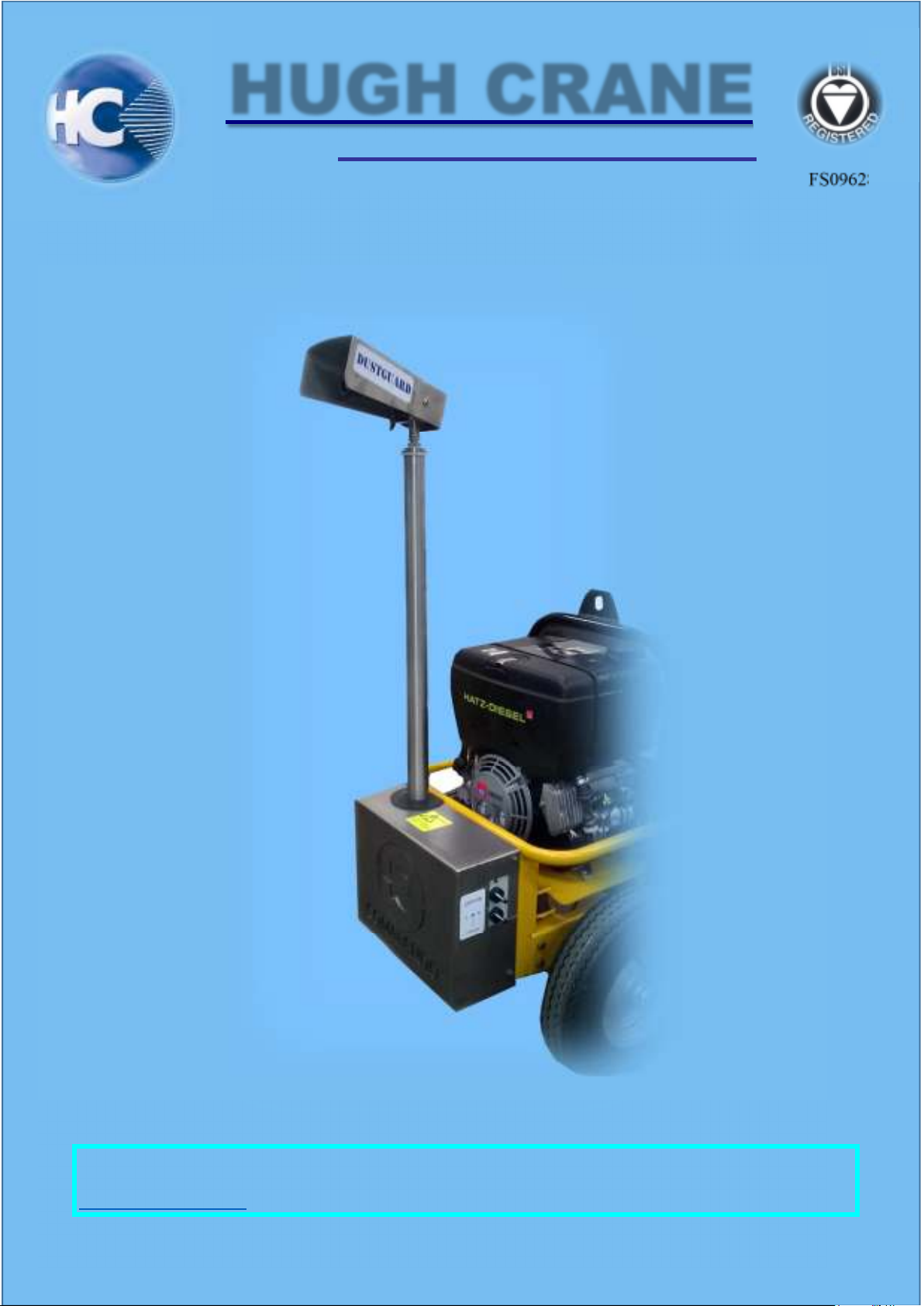
COMMANDO DUSTGUARD
COMMANDO DUSTGUARD
COMMANDO DUSTGUARDCOMMANDO DUSTGUARD
FS09628
DUST SUPPRESSION OPERATING & MAINTENANCE MANUAL
No part of this document may be reproduced or transmitted in any form or by any means, electronic or
mechanical for any purpose other than to assist in the safe operation and maintenance of the Dustguard Water
Spray Unit without the express permission of Hugh Crane (Cleaning Equipment ) Ltd.
For Sales, Service and Spare Parts contact: HUGH CRANE (Cleaning Equipment) Ltd.
www.hughcrane.co.uk TEL: 01493 750072 FAX: 01493 751854 Email:[email protected]
ManP0882_Dustguard_Feb17 February 2017
Page 2

DUSTGUARD Page 2 of 13
IMPORTANT
This handbook should be read and understood by the operator before using the
equipment, and should be kept with the equipment and made available to anybody
who is intending to use it.
INDEX
1. Design & Manufacture
2. Machinery Designation
3. General Description
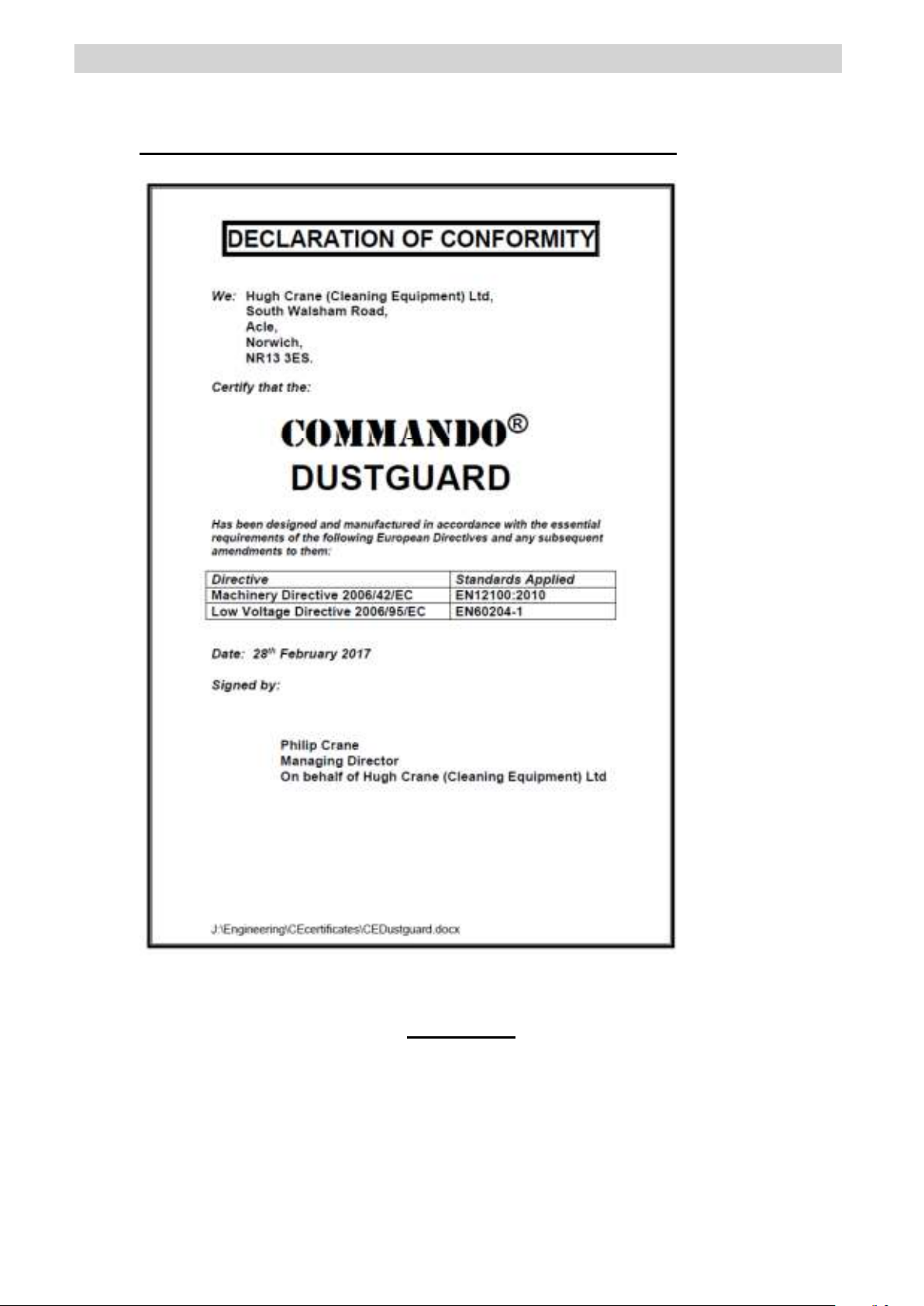
4. EC Declaration of Conformity and Warranty
5. Health & Safety
5.1 Operation & maintenance
5.2 Inspection & testing – before use
6. Legionella/Legionnaire’s Disease
7. Noise
8. Operating Instructions
8.1 General
8.2 Machine Operation
8.3 Operator Controls
8.4 Locating & Starting the unit
8.5 Frost protection
9. Maintenance & Servicing
9.1 General & Safety
9.2 Maintenance
10. Spare Parts & Ordering
2
Page 3

DUSTGUARD Page 3 of 13
1. DESIGNED AND MANUFACTURED BY:
Hugh Crane Cleaning Equipment Ltd,
South Walsham Road,
Acle,
Norwich,
NR13 3ES
Telephone: 01493 750072
Email: [email protected].
2 MACHINERY DESIGNATION:
“Dustguard” oscillating water spray attachment for Commando 500D Electric Start pressure
washer.
3. GENERAL DESCRIPTION & INTENDED USE:
Hugh Crane Ltd high pressure cleaning equipment is manufactured to rigorous quality
standards. The basic design concept is to use quality materials and proven designs to attain
reliability and safe functional operation.
This manual is provided to assist the operator to obtain the best from the equipment via
correct operating and maintenance procedures, together with basic safety points.
The Dustguard unit is designed to easily bolt on to a standard Hugh Crane 500D Electric
Start pressure washer and can be supplied either as an attachment for the customer to fit or
as a complete unit already attached to the 500D washer.
To power the oscillation device, electrical connections have to be made to the 12 volt
positive supply at the terminal block on the side of the engine and a negative/ground
connection made to the washer metalwork.
Should you require further information or technical assistance regarding the unit or any
aspect of jetting or pressure cleaning, do not hesitate to contact Hugh Crane (Cleaning
Equipment) Ltd or their approved distributor.
3
Page 4
DUSTGUARD Page 4 of 13
EC DECLARATION OF CONFORMITY & WARRANTY
4.
GUARANTEE
COMMANDO products are guaranteed for one year for parts and labour from the date of
purchase (guarantees are not transferable) subject to good use and adherence to
recommended service procedures. Major components are subject to individual
manufacturer’s warranty conditions. Wearing parts, including tyres, pump seals, valves,
hoses, filters, jets and tooling are excluded from warranty cover unless subject to faulty
materials or manufacture.
4
Page 5

DUSTGUARD Page 5 of 13
o
o
5. HEALTH & SAFETY
5.1 OPERATION & MAINTENANCE
General
This equipment/machinery is designed and constructed for industrial use only for the suppression of
dust and similar in controlled environments with limited access, for example fenced
construction/demolition sites.
It should only be used by persons trained and competent in its operation in accordance with the
instructions within this manual, and should only be maintained / repaired by persons trained and
competent to do so, following the isolation and making safe of the equipment as detailed within this
manual.
The machine must not be misused in any way, nor any hazardous areas accessed, for example
inside the oscillating mechanism during operation.
The machine should only be used in a safe location away from other persons not involved in the
demolition activity and a safe working area should be established with other persons kept away.
The machine should not be left unattended where there is the possibility of access or operation by
unauthorised persons.
Safety in Operation
• This equipment/machinery is designed and constructed for industrial use only for the
suppression of dust and similar in controlled environments with limited access, for example
fenced construction/demolition sites.
• It should only be used by persons trained and competent in its operation in accordance with
the instructions within this manual, and should only be maintained / repaired by persons
trained and competent to do so, following the isolation and making safe of the equipment as
detailed within this manual.
• The machine must not be misused in any way, nor any hazardous areas accessed, for
example inside the oscillating mechanism during operation.
• The spray head must never be directed at any person or animal.
• The machine should only be used in a safe location away from other persons not involved in
the demolition activity and a safe working area should be established with other persons kept
away, and monitored on a continuous basis.
• The machine should not be left unattended where there is the possibility of access or
operation by unauthorised persons. No guards or other safety features may be disabled or
bypassed, nor may they be removed unless for authorised maintenance or repair, again
following the correct isolation procedures.
• The operator must not access, or allow access by others to any hazard area during operation,
and all other persons must be kept away from these areas, notably:
o From around the machine
From the area in which the spray is directed
Safety features and regular checking
Safety features are provided for the protection of all and their effectiveness must be verified and
recorded on a daily basis as follows:
• Oscillating mechanism enclosure/guard be in place, undamaged and effective.
• Correct operation of oscillation Off/On selector and HP water isolation valve.
• Safety signage in place and legible.
Isolation for intervention, maintenance and repair
• Before accessing any parts of the machine/equipment for purposes of maintenance or repair,
make safe and isolate energy sources as follows (and in accordance with the user’s
procedures):
o Ensure the Commando unit is stopped and take precautions to prevent it from being
started.
Ensure that the HP water is depressurised.
5
Page 6
DUSTGUARD Page 6 of 13
Slipping, tripping and falling
• The equipment is designed to spray water which will inevitably create wet and potentially
slippery areas
• Such areas should be avoided when wet.
• Be aware of and take additional precautions in adverse weather, notably ice and snow.
• Protective (slip resistant) safety footwear with crush protection should be worn.
Electricity and Electrical Hazards – shock, fire, burns etc.
• Only trained and competent persons, as authorised by the user, are permitted to access
electrical panels or equipment or carry out electrical work.
• Electrical panels and equipment must always be secured closed and only accessible/
openable using a tool or key which is not available to untrained personnel.
• The electrical supply must be isolated by disconnection of the battery before carrying out any
work on the panel or equipment, and “proven dead” before contacting any potentially live
parts. Live working should be avoided.
• The electrics and electrical installation must be periodically inspected and tested to maintain
safety.
Hot surfaces– scalds and burns
• The engine exhaust gets hot in operation, but is thermally insulated within the engine
enclosure.
• Avoid all unlagged exhaust parts and allow to cool before making contact with any hot parts
Noise
• The equipment is engine powered and can generate noise levels of typically 116dB
depending on use.
• Hearing protection should be worn
• When in operation a noise survey should be carried out to determine and areas which may
exceed the relevant hearing action limits 80/85dB with appropriate precautions being put in
place by the user.
Legionellosis
• Legionella bacteria can be present and breed in water at temperatures between 20 and 45C,
and can thrive in the presence of nutrients such as rust, sludge, scale, algae, organic material
or other bacteria.
• The equipment should therefore be operated outside these temperatures and regularly
cleaned, flushed and maintained to prevent the development and existence of conditions
where nutrients can exist.
• The system should also be included by the user within his overall legionella assessment and
management programme which will determine any further actions/precautions/monitoring
which may be necessary.
Moving vehicles – potential hazards to O&M staff (pedestrians/on foot)
• The unit is mobile and therefore can be used in a variety of locations including those where
moving vehicles can be present.
• It is recommended that the user carries out his own assessment to ensure the safety of
pedestrians/those on foot from any moving vehicles in the area/associated with the wider
operation of this equipment/machinery.
• Health and Safety Executive publication HSG 136 is one document that covers these matters.
Adequacy of lighting in the area.
• It is recommended that the user carries out his own assessment to ensure the adequacy of
lighting in each area the machine is to be used to allow safe operation and maintenance of
the equipment.
Access to items installed above ground level/prevention of falls from height
• Machine operation and access to operating controls is intended to take place at ground level.
• For any use above ground level the operator should assess the task and provide the
necessary access equipment, ensuring that the equipment (Commando unit & sprayer) are
prevented from falling
6
Page 7

DUSTGUARD Page 7 of 13
High pressure water (from the spray)
• The machine must be used in a controlled and managed environment by trained operators
only, ensuring that persons are not present in the spray zone.
• Before use, the machine must be set up and started by a competent operator to ensure basic
safety criteria are met.
• The machine should never be moved nor any adjustments made unless the Commando unit
is shut down and HP water valved off.
• Persons must be made aware of and instructed to keep themselves and others away from
hazard areas, notably within 20m of the spray head.
• The spray head should never be directed at any individual
• The HP water system should be visually checked daily for any leaks which should be rectified
before continuing to use the equipment.
• Appropriate face/eye protection should be worn when using the machine.
Starting up of the machine and spray should be carried out in the following sequence:
• With the engine stopped, locate the machine in the required position on site.
• Ensure the valve controlling the HP water to the spray unit is OFF; the oscillation is OFF; and
the oscillation stroke set to minimum.
• Set the spray elevation and stroke to meet anticipated requirements.
• Ensuring yourself and others are well clear of the spray zone, start the Commando unit.
• Once up to pressure and ensuring the spray zone remains clear of people, gently open the
HP water valve and when fully open, check that the spray is going where required.
• Any further adjustment of the spray elevation angle or stroke should only take place with the
HP water valve isolated/ Commando engine stopped.
Lifting and moving of unit
• The Commando washer and spray unit may be fitted with larger wheels and/or a lifting frame
to facilitiate movement around site.
• All such lifting/movement should only be carried out by trained and competent persons using
approved and tested equipment.
• The lifting frame, if fitted, should be periodically inspected and tested as required under the
Lifting Operations and Lifting Equipment Regulations to ensure continuing integrity.
7
Page 8

DUSTGUARD Page 8 of 13
5.2 INSPECTION & TESTING - BEFORE USE:
5.2.1 Routine Maintenance:
The Dustguard unit is designed to need minimal maintenance by the user.
All repairs to this equipment must be carried out by qualified personnel. No modifications
or changes to the specification of this machine should be made without consultation and
approval of the manufacturer.
5.2.2 Hose Assemblies:
Hose assemblies are of paramount importance with respect to water jetting equipment.
Before using any hose assembly, it is essential to check the following points.
No hose should be used where there is any evidence of external damage. Particular
attention should be paid to exposed or broken wires which are not only likely to be a
source of rupture but may also cause severe cuts.
Of particular relevance are the end fittings of hoses, which can be subjected to stress
caused by pulling at sharp angles or stretching. Hoses must be inspected regularly.
Where quick release couplings are employed they should be inspected regularly for wear,
damage and for condition of any sealing rings.
5.2.3 Guarding:
The machine is provided with guarding in compliance with current legislation. The
machine should not be operated with any of the guards, covers or any other safety
equipment removed or damaged.
5.2.4 Controls:
Control functionality, principally the HP water shut off valve and oscillation controls should
be checked.
All throttle couplings and engine stop devices on the associated pressure washer shall be
checked to ensure that they are functioning properly before high pressure jetting work
commences.
8
Page 9

DUSTGUARD Page 9 of 13
6. LEGIONELLA/LEGIONNAIRE’S DISEASE:
All pressurised water jetting, spraying and cleaning equipment has the potential to produce
aerosols and if the water supply to the machine contains legionella bacteria, these bacteria
can become airborne within the jetting aerosol.
The attention of users is thus also drawn to the UK Health & Safety Executive “Approved
Code of Practice” L8 which details the precautions that employers are required to take in
respect of legionnaire’s disease including the needs to carry out a risk assessment; have an
appointed competent person; have in place a legionella control scheme; and review of
control measures.
7. NOISE:
In normal operation the Commando washer powering the Dustguard unit generates noise
levels of typically 116dB.
Customers are advised that they should carry out their own noise survey with the machine in
place in its normal work environment to determine actual noise levels to which operators are
exposed and any precautions necessary.
8. OPERATING INSTRUCTIONS.
8.1 GENERAL
8.1.1 Before putting the Dustguard unit into operation it is vital to risk assess the
task and environment and formulate a plan/”Safe System of Work” which
ensures protection of all persons who could potentially enter the area of
operation including operators.
Any persons or properties directly affected by the spraying should be
notified prior to work commencing and measures taken to keep them clear
of hazard areas, for example using signage, barriers, and supervision/
monitoring.
High pressure jets are dangerous if subjected to misuse.
Care should be taken to ensure that animals and children are well away
from the working area. The jet/spray must not be directed at people,
animals, the machine itself, non-waterproof, fragile or electrical equipment,
or overhead electric cables.
8.1.2 It is essential that any person who is required to operate or use high
pressure water jetting equipment is trained and totally competent to use that
equipment. By the very nature of the equipment and the purposes for which
it is used, it is essential that only physically capable people use the
equipment.
9
Page 10

DUSTGUARD Page 10 of 13
8.2 MACHINE OPERATION
IMPORTANT
This handbook should be read and understood by the operator before
using this equipment. It should be kept with the equipment and made
available to anybody who is intending to use the equipment.
8.2.1 BEFORE USING THE EQUIPMENT
a) Before using this equipment, operators should have undergone basic training in
its safe use. Training courses are available from Hugh Crane (Cleaning
Equipment) Ltd. if required.
b) Suitable protective clothing should be provided and worn, as a minimum eye
protection and safety footwear.
c) High pressure jets are dangerous if subjected to misuse.
Care should be taken to ensure that all other persons, especially animals and
children, are well clear of the working/hazard areas.
d) All repairs to this equipment must be carried out by qualified personnel. No
modifications or changes to the specification of this machine should be made
without consultation with and approval of the manufacturer.
e) The machine is supplied with guarding in compliance with current legislation.
The machine should not be operated with any of the guards, covers or any
other safety equipment removed or damaged.
f) Chemicals may be used in conjunction with this equipment. Only chemicals
supplied or recommended by the manufacturer should be used, as other
products may affect the safe use of the equipment. Consideration should also
be given to environmental and COSHH regulations.
g) Never attempt to adjust or clean any part of the machine with the engine
running. Always stop the engine before carrying out adjustments, especially
to the high pressure pipework etc.
h) Daily and before each use, check the following:
o Oscillating mechanism enclosure/guard in place, undamaged and
effective.
o Correct operation of oscillation Off/On selector and HP water isolation
valve.
o
Safety signage in place and legible.
o All fixings secure.
10
Page 11
DUSTGUARD Page 11 of 13
8.3 OPERATOR CONTROLS
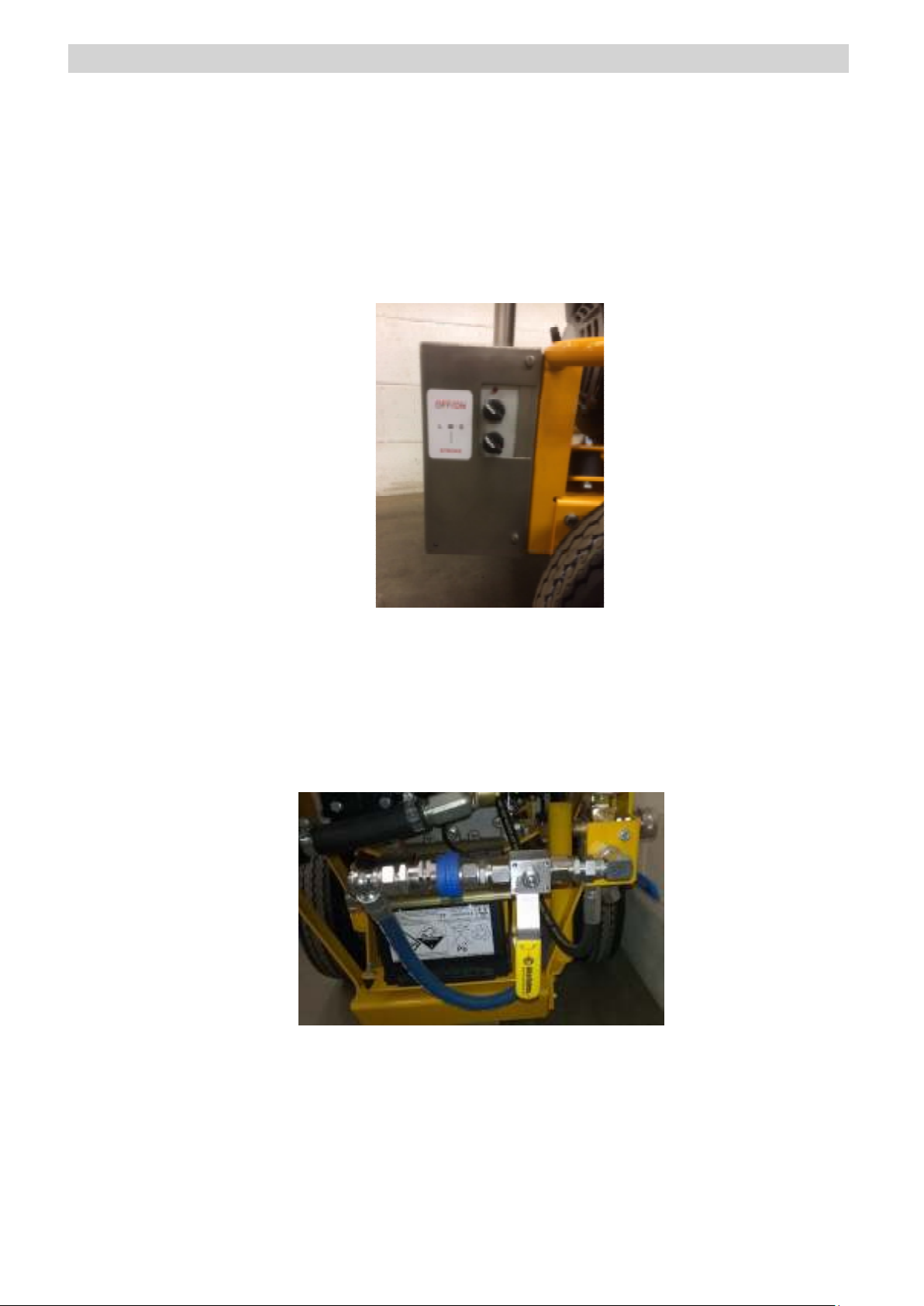
The vertical (up/down) angle of the spray can be manually adjusted at the spray head,
using the black knob to tighten the spray head in the required position.
The oscillation controls are located on the side of the oscillation unit, comprising an
Off/On switch and “stroke” selector.
The former Stops/Starts the oscillation action.
The latter determines the length/ angle of the stroke and thus the extent of the spray
area – either a Long (L), Medium (M) or Short (S) stroke.
In addition, a valve is provided where the oscillation water supply is connected to the
HP pressure washer outlet which allows the water supply to the oscillation unit to be
turned on and off.
Adjustments should only be made to the oscillation unit and/or spray angle with
the water isolated and/or engine of the washer stopped.
Refer to the 500D operators manual for details of the pressure washer itself.
11
Page 12

DUSTGUARD Page 12 of 13
8.4 LOCATING & STARTING THE UNIT
Starting up of the machine and spray should be carried out in the following
sequence:
• With the engine stopped, locate the machine in the required position on site.
• Ensure the valve controlling the HP water to the spray unit is OFF; the oscillation is
OFF; and the oscillation stroke OFF.
• Set the spray elevation and oscillation stroke to meet anticipated requirements.
Ensure the black knob securing the elevation angle is tight.
• Ensuring yourself and others are well clear of the spray zone, start the Commando
unit.
• Once up to pressure and ensuring the spray zone remains clear of people, gently
open the HP water valve and when fully open, check that the spray is going where
required.
Any further adjustment of the spray elevation angle or stroke should only take place
with the HP water valve isolated/ Commando engine stopped.
8.5 FROST PROTECTION
• It is essential to protect the unit from damage by frost. When frost is
anticipated therefore, either drain the unit or store it inside where temperatures are
above 0oC
12
Page 13

DUSTGUARD Page 13 of 13
9. MAINTENANCE & SERVICING
9.1 GENERAL AND SAFETY
When maintaining or assembling pressure washing hoses and attachments, it is
essential to use the correct size of tools. Tools such as Stillson wrenches should be
avoided wherever possible and correctly fitting spanners employed instead. Serrated
gripping jaws damage equipment and leave sharp edges, which can easily cut the
operator.
Cleanliness of all equipment is of paramount importance to ensure reliability and
ultimately the safety of equipment employed. After use it is essential that all
equipment is clean and prepared for the next usage. Particular attention should be
paid to clean hoses and assemblies, jets, couplings exposed threads and any such
associated tooling.
WARNING
NEVER ATTEMPT TO ADJUST OR CLEAN ANY PART OF THE MACHINE WITH
THE ENGINE RUNNING. .
9.2 MAINTENANCE
The unit is designed to require minimal maintenance and there are no userserviceable parts.
10. SPARE PARTS & ORDERING
Should any spare parts be required, please contact Hugh Crane Ltd, quoting the
following information
a) Your Company Name and Address
b) Model Type and Serial Number of unit
c) Full description of parts required
d) Your contact name and telephone number
e) Your order number
13
 Loading...