

Page 1

1
HP MSR 4G SIC Module USIM Card and
Antenna Installation Guide
SIC-4G-LTE-V
SIC-4G-LTE-A
SIC-4G-LTE-G
Part number: 5998-5199
Page 2
2
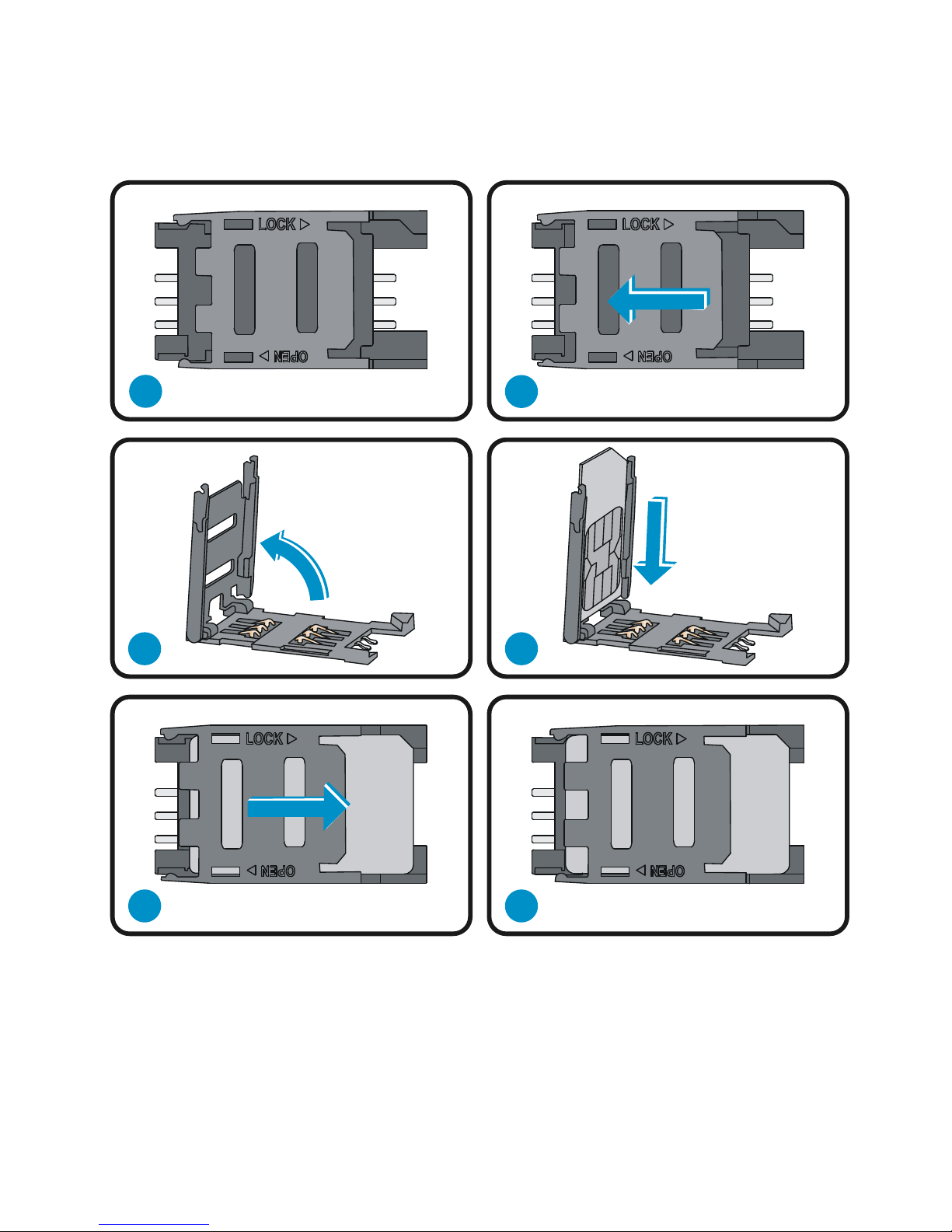
Installing a USIM card
Correct installation
1 2
3 4
5 6
Page 3
3
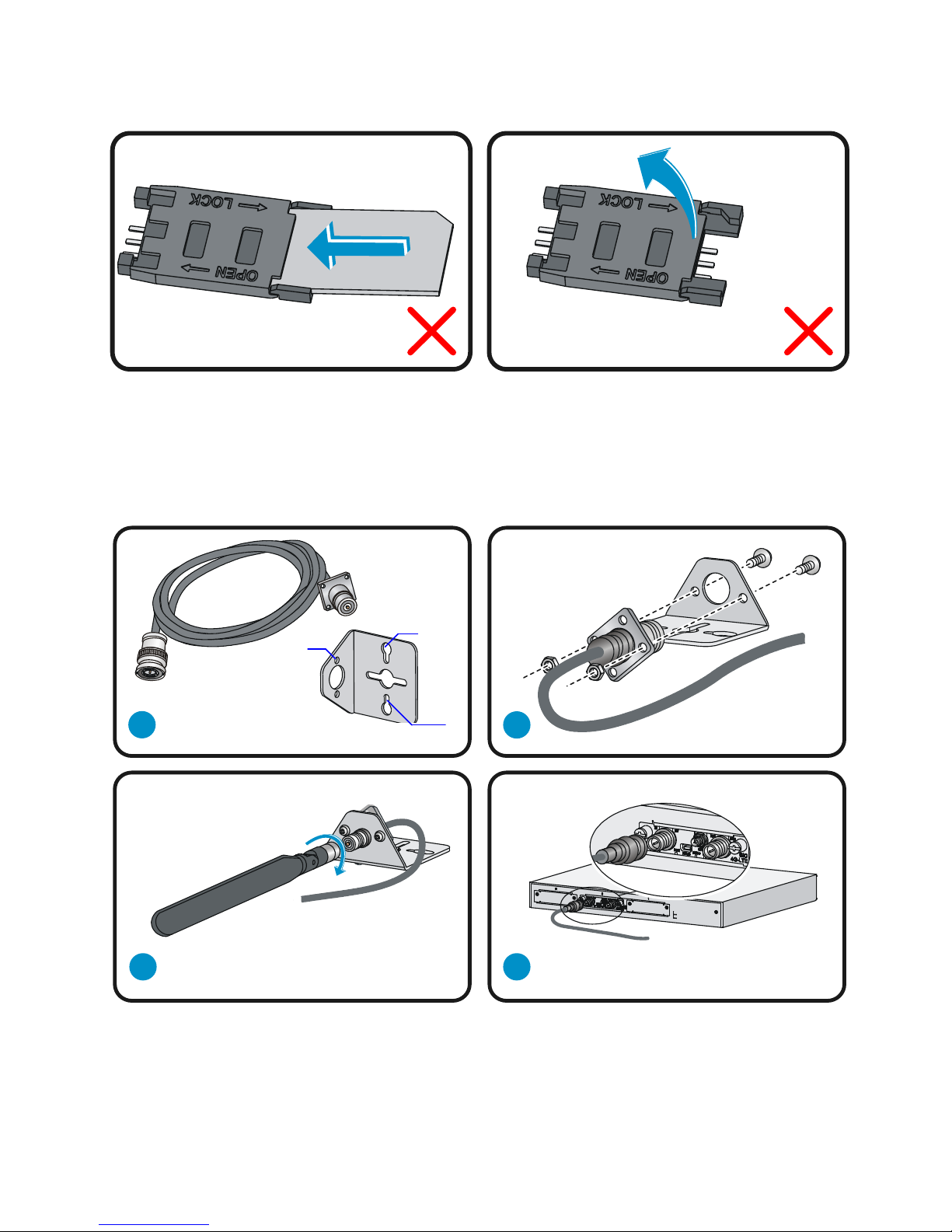
Incorrect installation
Installing a 4G extender cable
Correct installation
1
3
2
4
M3
M6
M2.9
Page 4
4
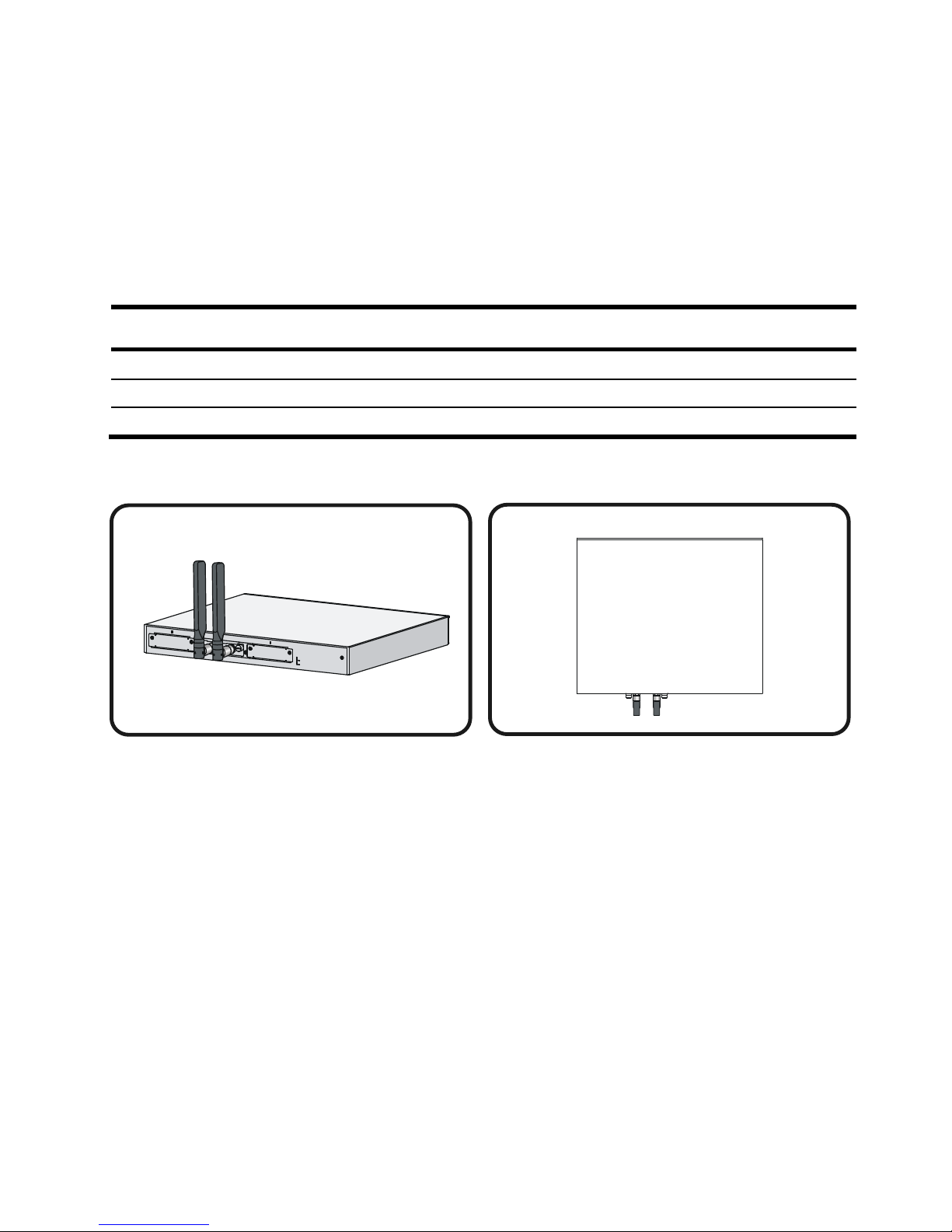
Installing a 4G antenna
One 4G extender cable is provided with the interface module. Purchase 4G extender
cables as required. Table 1 lists 4G extender cables provided by HP. You can also use
4G extender cables from other vendors, for any consequences resulting from which HP
assumes no liabilities.
Table 1 HP 4G extender cables
J number
4G extender cable
JG522A
HP MSR 4G 2.8m Extender Cable
JG666A
HP MSR 4G 6m Extender Cable
JG667A
HP MSR 4G 15m Extender Cable
Installing 4G antennas on a router (JG742A/JG744A)
Installing a 4G antenna on a router (JG743A)
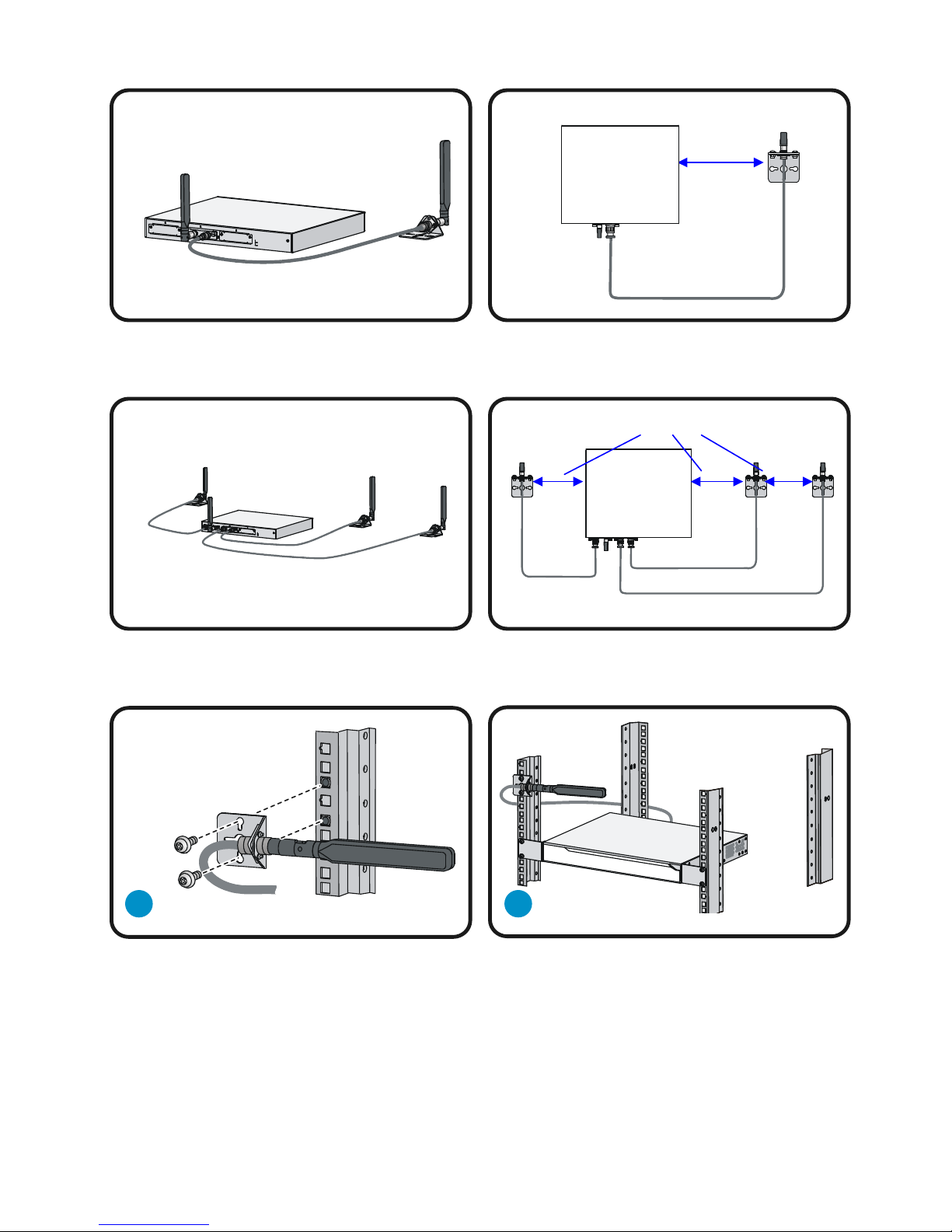
When you connect a 4G antenna to a JG743A interface module, ensure a minimum
distance of 25 cm (9.84 in) between the 4G antenna and any other antenna on the
router. If an extender cable is used, ensure a minimum distance of 25 cm (9.84 in)
between the 4G antenna and the router.
One 4G Module on the router
Page 5
5
Two 4G Module on the router
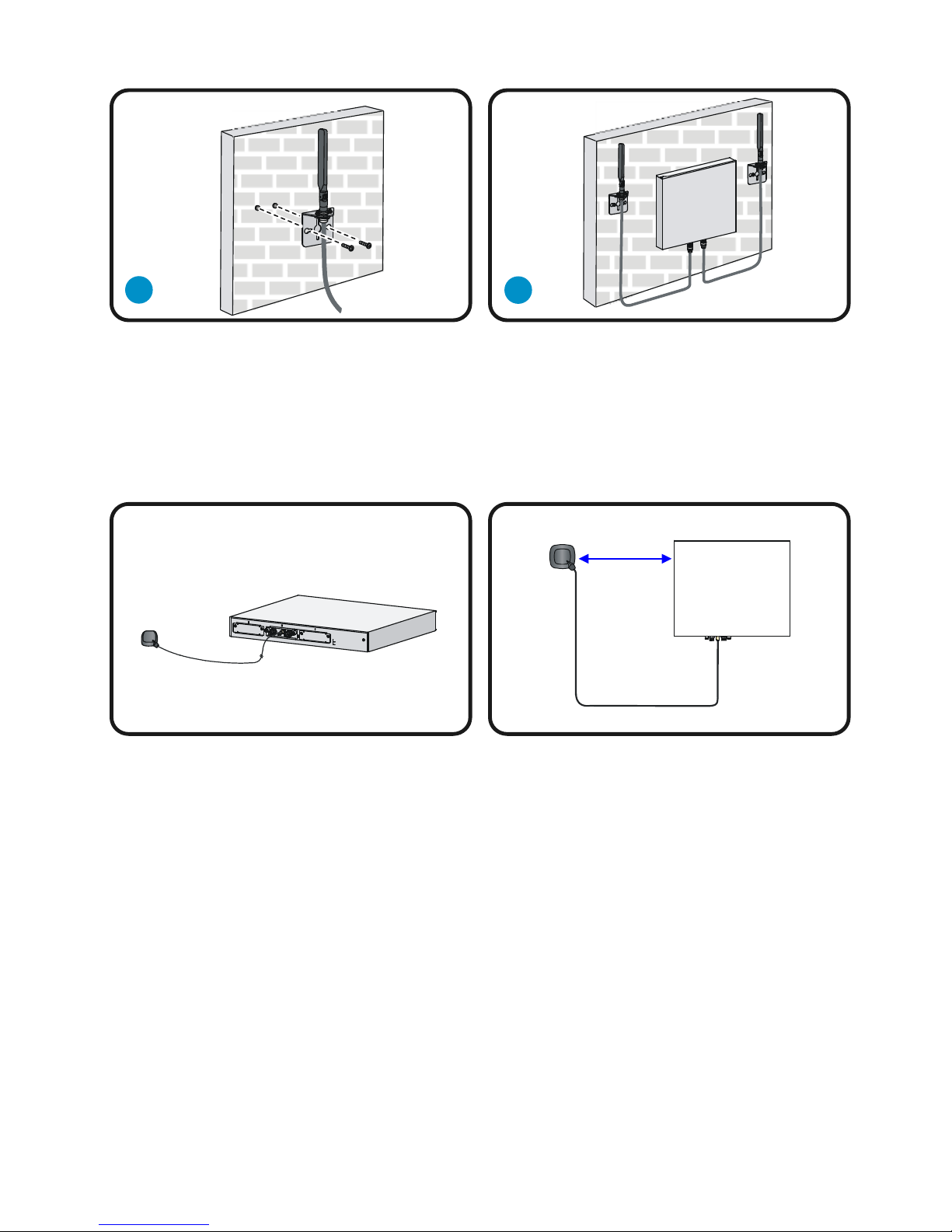
Installing a 4G antenna on a rack
Installing a 4G antenna on a wall
Prepare M2.9 self-tapping screws yourself.
>25cm(9.84in)
>25cm(9.84in)
2
1
Page 6
6
Installing a GPS antenna
When you connect a GPS antenna to a JG743A interface module, ensure a minimum
distance of 25 cm (9.84 in) between the GPS antenna and any other antenna on the
router, and between the GPS antenna and the router.
1 2
>25cm(9.84in)
Page 7
7
Regulatory Compliance Information
The module must be installed and used in strict accordance with the manufacturer’s
instruction as described in the user documentation that comes with this product.
Regulatory compliance standards
Table 2 Regulatory compliance standards
Discipline
Standards
EMC
FCC Part 15 Subpart B (SIC-4G-LTE-A and SIC-4G-LTE-V)
ICES-003 (SIC-4G-LTE-A and SIC-4G-LTE-V)
EN 55022 (SIC-4G-LTE-G)
EN 55024 (SIC-4G-LTE-G)
EN 301 489-1 (SIC-4G-LTE-G)
EN 301 489-7 (SIC-4G-LTE-G)
EN 301 489-24 (SIC-4G-LTE-G)
EN 300386 (SIC-4G-LTE-G)
EN 61000-3-2 (SIC-4G-LTE-G)
EN 61000-3-3 (SIC-4G-LTE-G)
RF
FCC part22 (SIC-4G-LTE-A and SIC-4G-LTE-V)
FCC part24 (SIC-4G-LTE-A and SIC-4G-LTE-V)
FCC part27 (SIC-4G-LTE-A and SIC-4G-LTE-V)
FCC OET 65 MPE(SIC-4G-LTE-A and SIC-4G-LTE-V)
RSS-132 (SIC-4G-LTE-A and SIC-4G-LTE-V)
RSS-133 (SIC-4G-LTE-A and SIC-4G-LTE-V)
RSS-102 (SIC-4G-LTE-A and SIC-4G-LTE-V)
EN 301 511 (SIC-4G-LTE-G)
EN 301 908 (SIC-4G-LTE-G)
EN 62311 (SIC-4G-LTE-G)
Safety
UL 60950-1
CSA 22.2 No. 60950-1
EN 60950-1
IEC 60950-1
AS/NZS 60950-1
Page 8
8
European Directives compliance
R&TTE Directive
The most up to date copy of the signed EU Declaration of Conformity can be
downloaded from:
http://www.hp.eu/certificates
WEEE Directive–2002/96/EC
The products this manual refers to are covered by the Waste Electrical & Electronic
Equipment (WEEE) Directive and must be disposed of in a responsible manner.
USA regulatory compliance
FCC Part 15
US Federal Communications Commission (FCC) EMC Compliance
This equipment has been tested and found to comply with the limits for a Class A digital
device, pursuant to part 15 of the FCC Rules. These limits are designed to provide
reasonable protection against harmful interference when the equipment is operated in
a commercial environment. This equipment generates, uses, and can radiate radio
frequency energy and, if not installed and used in accordance with the instruction
manual, may cause harmful interference to radio communications. Operation of this
equipment in a residential area is likely to cause harmful interference in which case the
user will be required to correct the interference at his own expense.
Page 9

9
This product complies with Part 15 of the FCC Rules. Operation is subject to the following
two conditions:
1. This device may not cause harmful interference.
2. This device must accept any interference received, including interference that
may cause undesired operation.
If the customer modifies the equipment without the authorization of HP, which directly
or indirectly contribute to the equipment incompliance with FCC requirements for Class
A digital devices, HP is not liable for such interference problem and the expenses
incurred there from shall be covered by the customers.
RF Requirements
RF exposure Hazard Warning
This device generates and radiates radio-frequency energy. To ensure compliance with
the requirements of FCC radio-frequency exposure, a minimum body to antenna
distance of 20cm (8 inch) must be maintained when the device is installed and operated,
and a minimum distance of 25 cm between the 3G antennas and between the 3G
antenna and the WiFi antenna is required to maintain compliance and receiver
reliability.
Antennas
Only use the supplied antenna. Unauthorized antennas, modifications or change to the
antennas could violate FCC regulations and void the user’s authority to operate the
equipment.
Canada regulatory compliance
ICES-003
This Class A digital apparatus complies with Canadian Standard ICES-003.
Cet appareil numérique de la classe A est conforme à la norme NMB-003 du Canada.
RF Compliance
Operation is subject to the following three conditions: (1) this device may not cause
interference, and (2) this device must accept any interference, including interference
that may cause undesired operation of this device, and (3) a minimum distance of 25
cm between the 3G antennas and between the 3G antenna and the WiFi antenna is
required to maintain compliance and receiver reliability.
L ‘ utilisation de ce dispositif est autorisée seulement aux conditions suivantes: (1) il ne
doit pas produire de brouillage et (2) l’ utilisateur du dispositif doit étre prêt à accepter
tout brouillage radioélectrique reçu, même si ce brouillage est susceptible de
compromettre le fonctionnement du dispositif.
Page 10

10
The term "IC" before the equipment certification number only signifies that the Industry
Canada technical specifications were met.
To reduce potential radio interference to other users, the antenna type and its gain
should be so chosen that the equivalent isotropically radiated power (EIRP) is not more
than that required for successful communication. To prevent radio interference to the
licensed service, this device is intended to be operated indoors and away from windows
to provide maximum shielding. Equipment (or its transmit antenna) that is installed
outdoors is subject to licensing.
Pour empecher que cet appareil cause du brouillage au service faisant l'objet d'une
licence, il doit etre utilize a l'interieur et devrait etre place loin des fenetres afin de
Fournier un ecram de blindage maximal. Si le matriel (ou son antenne d'emission) est
installe a l'exterieur, il doit faire l'objet d'une licence.
This device must not be co-located or operated in conjunction with any other
unauthorized antenna or transmitter.
Brazil regulatory compliance
Este produto está homologado pela ANATEL, de acordo com os procedimentos
regulamentados pela Resolução 242/2000 e atende aos requisitos técnicos aplicados.
Para maiores informações, consulte o site da ANATEL – www.anatel.gov.br
Documentation
To find related documents, browse to the Manuals page of the HP Business Support Center
website:
http://www.hp.com/support/manuals
Page 11

11
© Copyright 2014 Hewlett-Packard Development Company, L.P.
The information in this document is subject to change without notice.
BOM: 3104A0DN
Version: 6P102-20140321
5998-5199
 Loading...