

Page 1

VeriShield™ 100 series
Solutions they will want to wear
Page 2
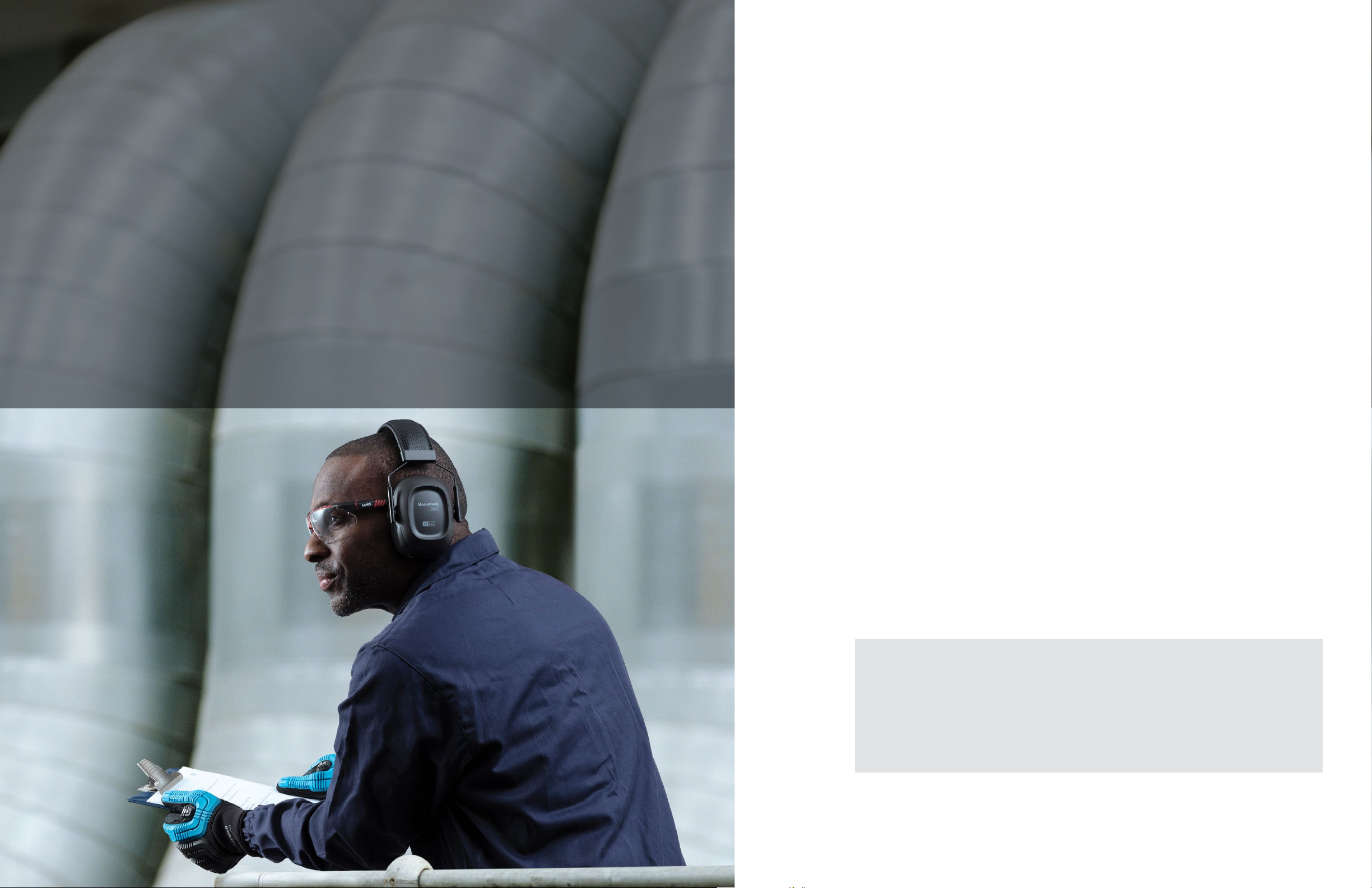
Noise-Induced Hearing Loss –
Prevention and Protection
Occupational noise-induced hearing loss (NIHL) has long been a serious
risk for workers and a major challenge for safety professionals. To improve
safety metrics, understanding the importance of NIHL is greater than ever,
as is the awareness for protection to be personalized if it is to be truly effective.
Unlike most other occupational health and safety injuries, NIHL is pain-free,
invisible, usually gradual, and therefore often goes unnoticed until the damage
is done. However, many public institutions recognize it as the most prevalent
occupational disease in the world.
The good news is, NIHL is also easily preventable.
Even so, prevention demands a clear understanding of the challenges before
you can design a hearing conservation program and issue hearing protection.
Prevention Problems
Working conditions can be dynamic and unpredictable. So noise risks can arise suddenly
and in unforeseen ways.
In addition, every worker is unique, with different susceptibilities to NIHL. In the past it has been
considered acceptable to make general assessments of groups of workers carrying out similar tasks
in certain environments. However, there is a growing understanding that this approach ignores
individuals’ job risk profiles, personal susceptibilit y to hearing loss, and changes to the noise
environment which were not assessed during any initial noise-mapping activity.
It is increasingly clear that one type of hearing conser vation does not fit everyone in every scenario.
Therefore, the best way to protect individuals exposed to the risk of NIHL is a personalized solution.
Protection Problems
The simplest solution may seem to be protective equipment that blocks all noise –
but this brings its own risks:
• The wearer feels isolated
• The wearer is less aware of their surroundings and situation
• These risks may lead them to remove the protection to avoid short-term dangers -
risking long-term permanent hearing loss
Even when hearing protection devices are provided and worn, the actual protection achieved for each
individual may not be the same as the level stated by the manufacturer. Proper fit and protection can
be compromised by a number of factors including:
• Eyewear – if it has thick temples, eyewear can break the seal of the ear cushion
• Hats – if worn under an earmuff will affect the seal around the ear
• Hairstyles – long hair or facial hair will interfere with an earmuff’s fit
• User Error – an improper seal after putting on a hearing protection device
Whatever the issue that results in a failure of prevention or protection, the ultimate difficulty
is that the resulting hearing loss will not be detected until af ter it’s happened.
And then it’s too late.
Prevention and Protection Solutions
One of the most effective ways to reduce the risk of NIHL is to change worker behavior.
This can mean:
• Identifying individuals most likely at risk of NIHL
• Sharing insight with them about their behavior
• Designing personalized hearing conservation programs to meet their needs
Page 3

VeriShield 100 Series
Passive Earmuffs: Making Comfort Personal
Hearing protection devices are only effective when they
are worn, so comfort is essential. The Honeywell Howard
Leight VeriShield 100 Series Passive Earmuffs are designed
to provide optimum comfort over long periods of use. They
fit a wide range of head sizes, have a wide cup opening with
memory foam ear cushions, and a lightweight cushioned
headband, making them solutions users will want to wear.
Wherever there is noise, VeriShield 100 Series is the answer
Potentially harmful levels of industrial noise can arise for hundreds of different reasons in
a thousand dif ferent working environments. From indoors in a factory to outdoors working
with machinery, from the tools being operated to the processes taking place, all can be sources
of noise and all require workers to have ef fective protection. The range of options offered by
the VeriShield 100 Series ensures comfort and protection against any noise level, in every
industry, for ever y worker.
• Large dimension range – Comfortably fits a wide range of head sizes. 17% more adjustable
than earlier versions
• Wide cup opening – Ideal for workers with larger ears, or who wear hearing aids.
Opening area of the cup increased by 16% over earlier versions
• Lightweight cushioned headband – Steel-wire construction with padded headband
and precision micro adjustments designed for just the right fit around the ear
• Memory foam ear cushions – New unique memory foam that combines denser and softer
foam than previous models, for greater comfort and attenuation. Reduces squeezing pressure
on the head and enhances comfort
• Robust construction – An oil-resistant cup surface to withstand oily, heavy-work
environments and frequent cleaning. ABS molded with internal baffle design for lighter
weight, patent pending
• Air Flow Control Technology – Honeywell ’s Air Flow Control technology, for optimum
attenuation across all frequencies
• Designed for use with other PPE – Easy to use and integrate with Honeywell hard hats
and face shields. Can be assembled to a hard hat in approximately 7 seconds
Who should use them?
Honey well makes hearing conservation personal. VeriShield earmuffs may be chosen as a hearing
protection option by a variety of different workers, for a range of dif ferent reasons:
• They are suitable for environments with noise levels ranging from low to high
• They are ideal for wearing with other PPE which may be required in particular environments
• They offer a choice of styles and attenuation (NRR) levels makes it easy to find the perfect
earmuffs for an appropriate level of protection, and comfort
• Unlike earplugs, VeriShield earmuffs
- are easier to fit
- are suitable for wearers with sensitive ear canals
- are suitable for wearing with hearing aids
- help to keep ears warm
Page 4
Choose your protection
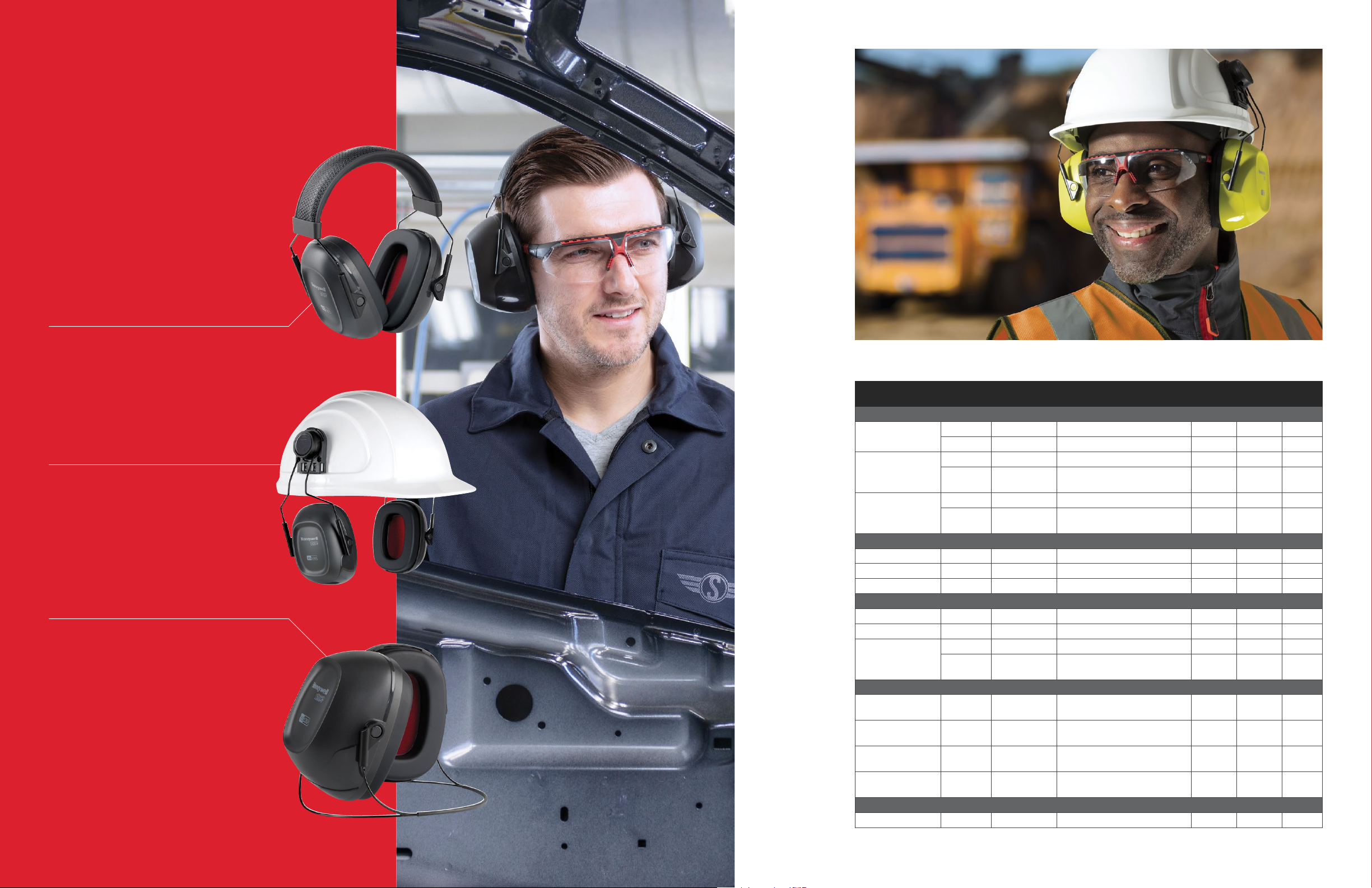
There are 3 different designs of the VeriShield
passive earmuffs, so each worker can choose
the solutions they will want to wear: for optimum
comfort, for optimum protection, or for the
greatest compatibility with any other PPE
or equipment they may be wearing or using.
Over-theHead
Traditional-st yle earmuf fs with an adjustable
cushioned headband. Available in Low, Mid
and High attenuation (NRR) levels and folding
and high visibility options.
Part# 103510 0-VS
Hard Hat
Designed to be worn when also wearing a
hard hat. Can be attached to a Honey well
hard hat in just 7 minutes. Available in Low,
Mid and High attenuation (NRR) levels and
a high visibility version.
Part# 1035121-VS
Neckband
Fitting around the neck from behind. Available
in Low, Mid and High attenuation (NRR) levels.
Par t# 103 5116-VS
VERISHIELD MODEL # PART # DESCRIPTION
Over-theHead
Low Level/Flat
Mid Level
High Level
Behind-theNeck
Low Level/Flat VS110N 1035112VS VS110N VeriShield earmuff neckband 10 22 B
Mid Level VS120N 1035114VS VS120N VeriShield earmuff neckband 10 25 AL
High Level VS130N 1035116VS VS130N VeriShield earmuff neckband 10 28 AL
Hard Hat
Low Level/Flat VS110H 1035118VS VS110H VeriShield helmet earmuff 10 21 B
Mid Level VS120H 1035121VS VS120H VeriShield helmet earmuff 10 24 A
High Level
Hygiene Kits
Hard Hat Adapters
* Level refers to attenuation rating
VS110 1035100VS VS110 VeriShield earmuff 10 24 A
VS110F 1035102VS VS110F Verishield folding earmuff 10 24 A
VS120 1035104VS VS120 VeriShield earmuff 10 26 A
VS120FHV 1035106VS
VS130 1035108VS VS130 VeriShield earmuff 10 30 AL
VS130HV 1035110VS
VS130H 1035124VS VS130H VeriShield helmet earmuff 10 27 AL
VS130HHV 1035127VS
VS11HK 1035136VS
VS10HK 1035143VS
VS12HK 1035137VS
VS13HK 1035138VS
3796VS1 1035144VS VeriShield hard hat adapter 3796VS1 10 NA NA
VS120FHV VeriShield folding earmuff,
high visibility
VS130HV VeriShield earmuff,
high visibility
VS130HHV VeriShield helmet
earmuff, high visibility
Hygiene kit for VS110,
VS110F, VS120H
Hygiene kit thin cup for
VS110N, VS110H
Hygiene kit for VS120,
VS120F, VS120N
Hygiene kit for VS130, VS130HV,
VS130N, VS130H, VS130HHV
CASE
QUANTITY
10 27 AL
10 30 AL
10 27 AL
10 NA NA
10 NA NA
10 NA NA
10 NA NA
NRR
CANADA
CLASS
Page 5
For more information
www.honeywellsafety.com
Honeywell Industrial Safety
9680 Old Bailes Rd, Fort Mill, SC 29707
(803) 8358000
Contact us
US:
Tel. 800.430.5490
Fax. 800.322.1330
Canada:
Tel. 888.212.7233
Fax. 888.667.8477
HIS_HEAR_VS100_BR_EN_US_0219
© 2019 Honeywell International Inc.
 Loading...