

Page 1
Operating Instructions
2-DOOR FRIDGE
GB
English, 1
MTM 1601 V
ES
Espanol, 11
Contents
GB
Installation, 2
Positioning and connection
Reversible doors
Description of the appliance, 3
Overall view
Start-up and use, 4-5
Starting the appliance
Setting the temperature
Using the refrigerator to its full potential
Using the freezer to its full potential
Maintenance and care, 6
Switching the appliance off
Cleaning the appliance
Avoiding mould and unpleasant odours
Defrosting the appliance
Replacing the light bulb
Precautions and tips, 7
General safety
Disposal
Respecting and conserving the environment
Troubleshooting, 8
Assistance, 9
Page 2
Installation
GB
! Before placing your new appliance into operation
please read these operating instructions carefully. They
contain important information for safe use, for
installation and for care of the appliance.
! Please keep these operating instructions for future
reference. Pass them on to possible new owners of the
appliance.
Positioning and connection
Positioning
1. Place the appliance in a well-ventilated humidity-free
room.
2. Do not obstruct the rear fan grills. The compressor
and condenser give off heat and require good
ventilation to operate correctly and save energy.
3. Leave a space of at least 10 cm between the top part
of the appliance and any furniture above it, and at least
5 cm between the sides and any furniture/side walls.
4. Ensure the appliance is away from any sources of
heat (direct sunlight, electric stove, etc.).
5. In order to maintain the correct distance between the
appliance and the wall behind it, fit the spacers
supplied in the installation kit, following the
instructions provided.
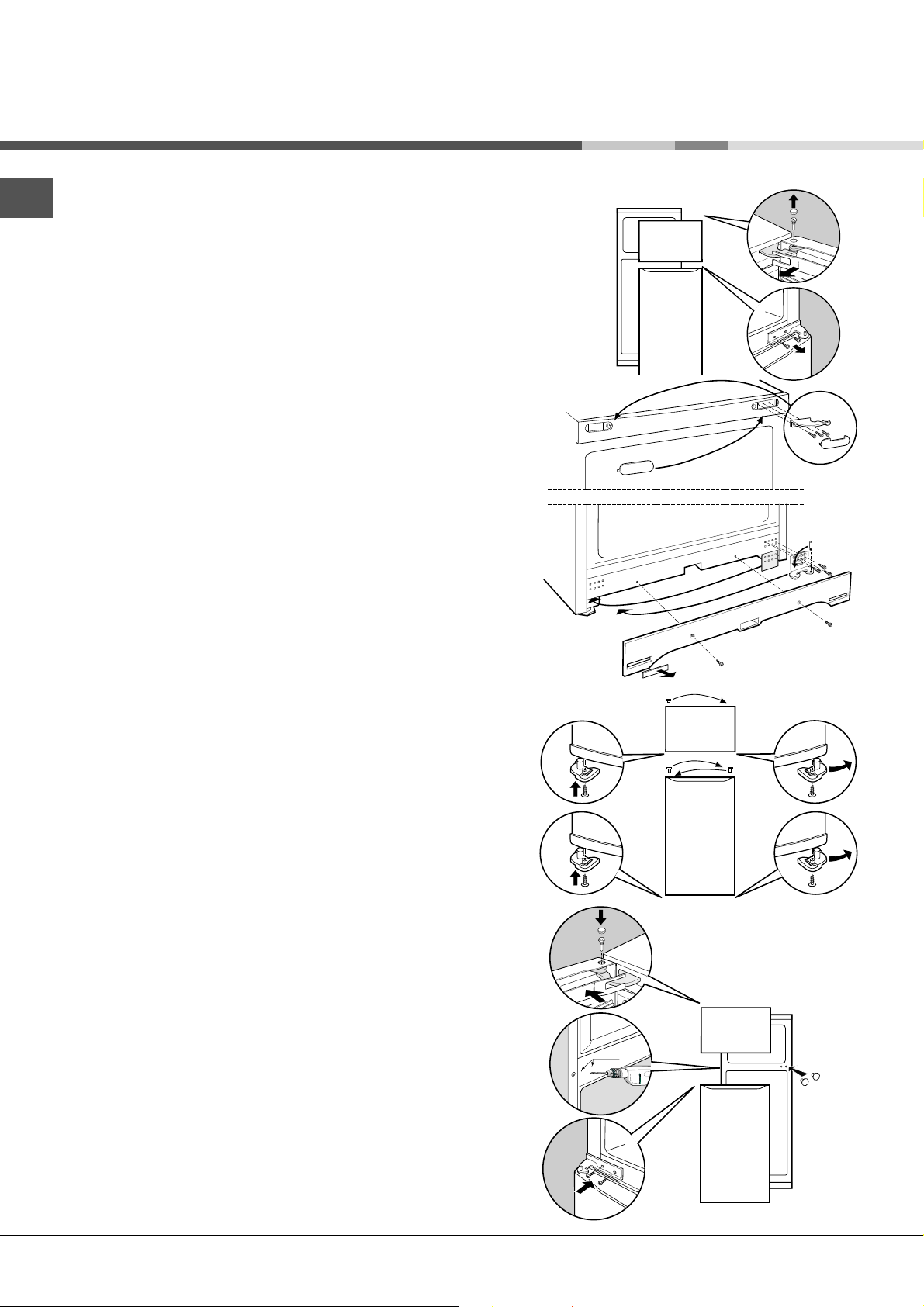
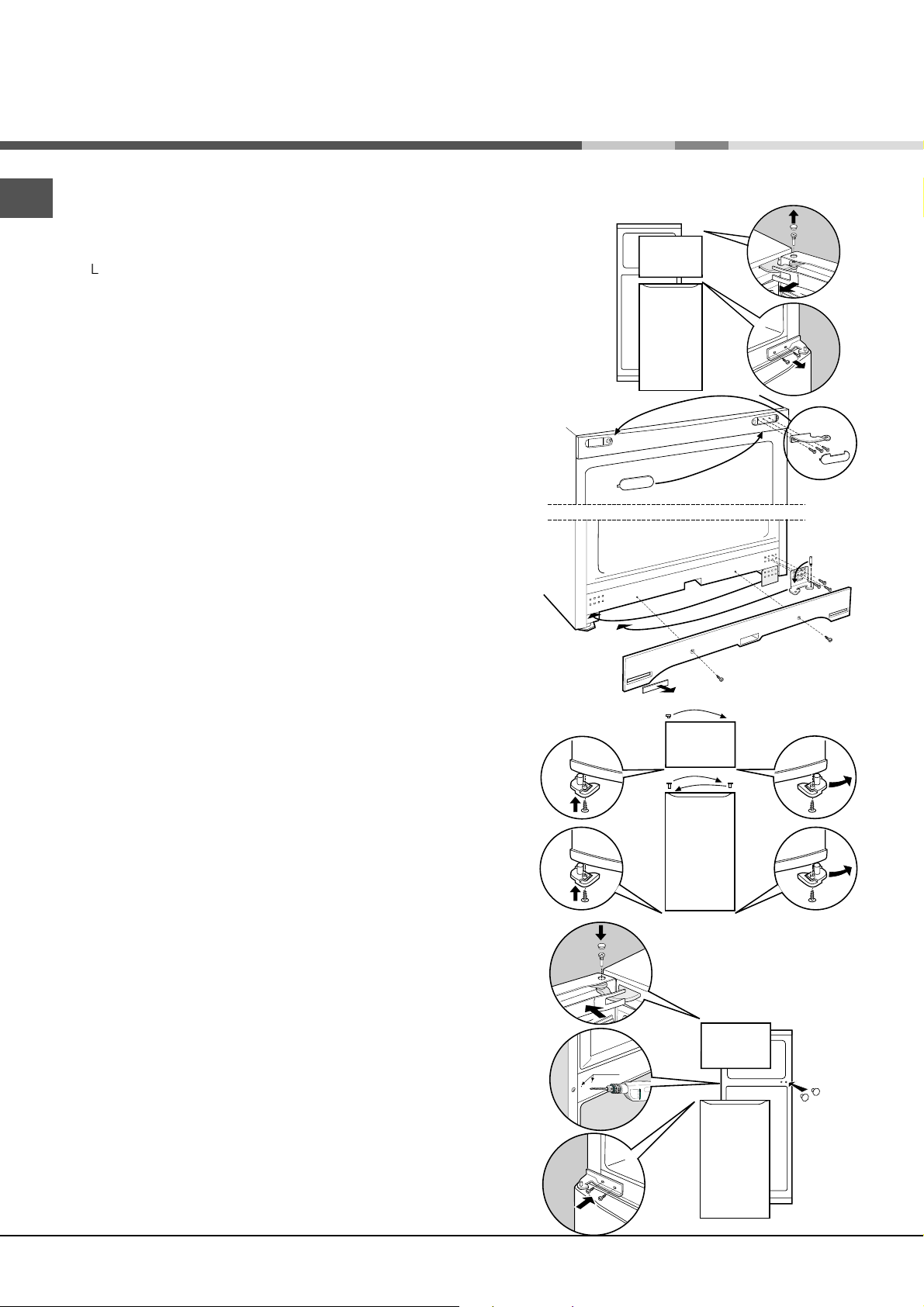
Reversible doors
1
2
3
Levelling
1. Install the appliance on a level and rigid floor.
2. If the floor is not perfectly horizontal, adjust the
refrigerator by tightening or loosening the front feet.
Electrical connections
After the appliance has been transported, carefully
place it vertically and wait at least 3 hours before
connecting it to the electricity mains. Before inserting
the plug into the electrical socket ensure the following:
• The appliance is earthed and the plug is compliant
with the law.
• The socket can withstand the maximum power of the
appliance, which is indicated on the data plate
located on the bottom left side of the fridge (e.g. 150
W).
• The voltage must be in the range between the values
indicated on the data plate located on the bottom left
side (e.g. 220-240V).
• The socket is compatible with the plug of the
appliance.
If the socket is incompatible with the plug, ask an
authorised technician to replace it (
Do not use extension cords or multiple sockets.
! Once the appliance has been installed, the power
supply cable and the electrical socket must be easily
accessible.
! The cable must not be bent or compressed.
! The cable must be checked regularly and replaced by
authorised technicians only (see Assistance).
! The manufacturer declines any liability should
these safety measures not be observed.
see Assistance
).
4
∅ 3
5
mm
2
Page 3
Description of the
appliance
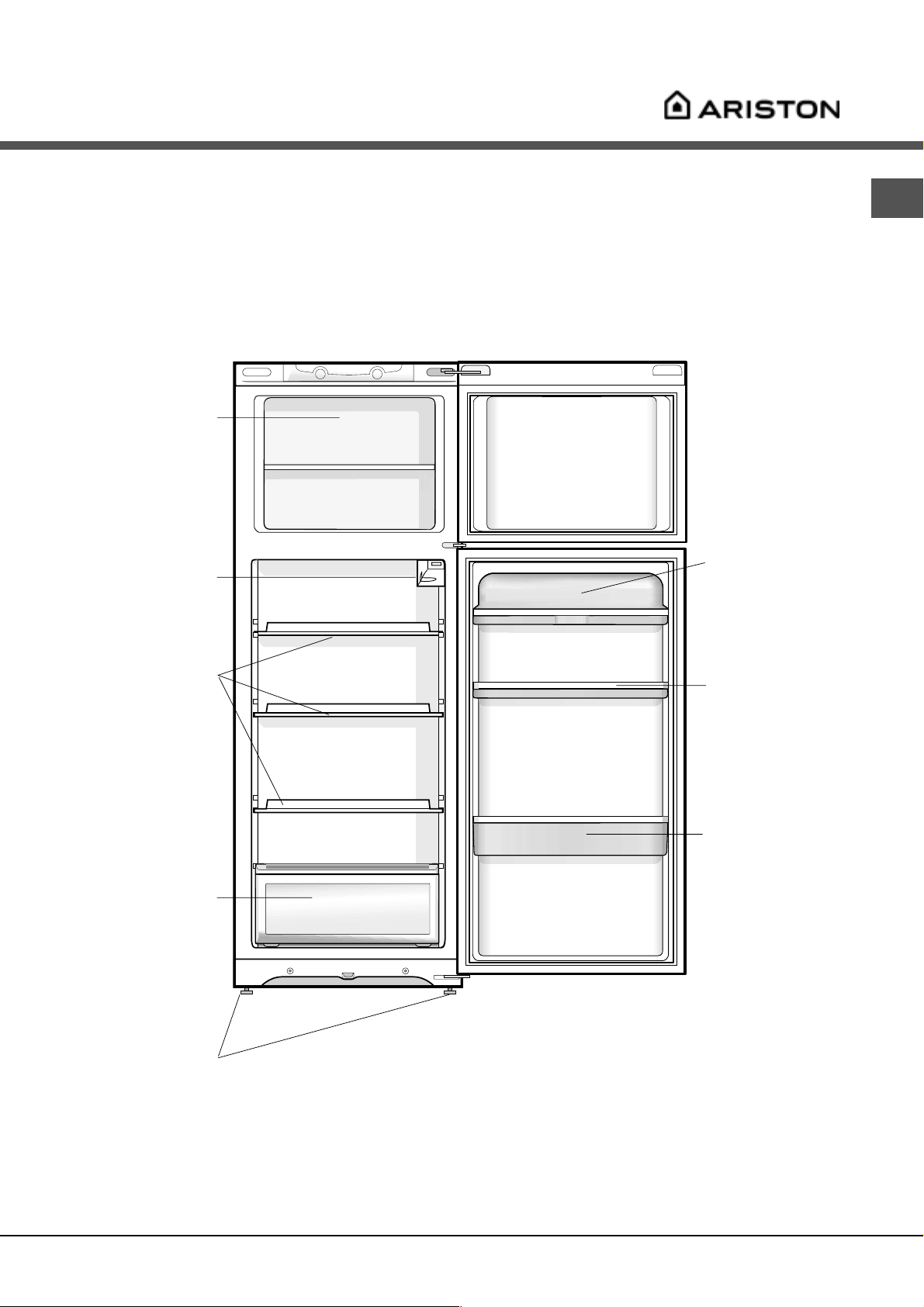
Overall view
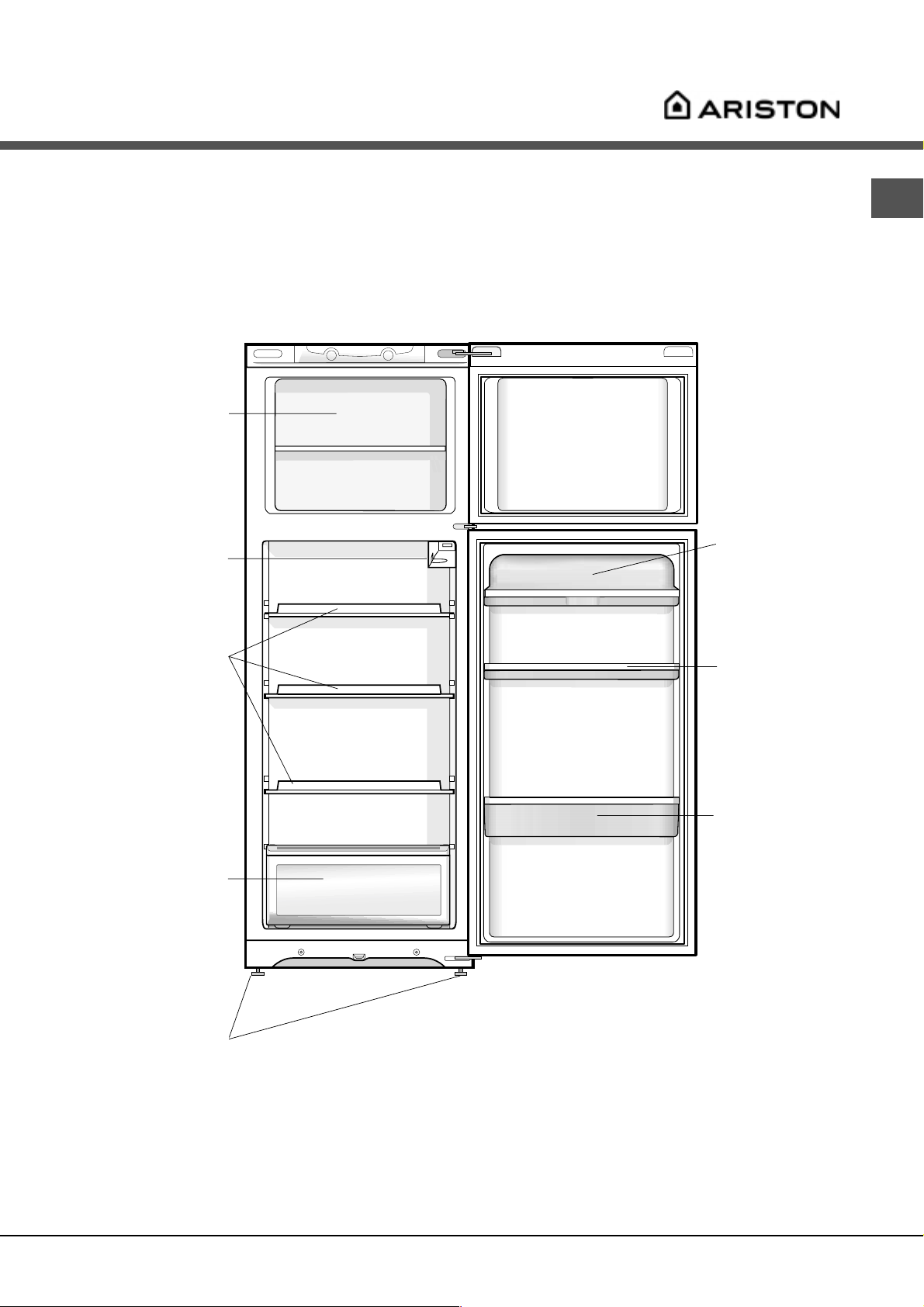
The instructions contained in this manual are applicable to different model refrigerators. The diagrams may not
directly represent the appliance purchased. For more complex features, consult the following pages.
FREEZER and
STORAGE
compartment
TEMPERATURE
CONTROL
Removable lidded
shelf with EGG TRAY
GB
SHELVES
FRUIT and
VEGETABLE bin
Levelling FEET
Removable
multipurpose
SHELVES
BOTTLE shelf
Varies by number and/or position.
3
Page 4
Start-up and use
Starting the appliance
GB
! Before starting the appliance, follow the
installation instructions (
! Before connecting the appliance, clean the
compartments and accessories well with lukewarm
water and bicarbonate.
1. Insert the plug into the socket and ensure that the
internal light illuminates.
2. Turn the TEMPERATURE ADJUSTMENT knob to an
average value. After a few hours you will be able to
put food in the refrigerator.
see Installation
Setting the temperature
The temperature inside the refrigerator compartment
automatically adjusts itself according to the position of
the thermostat knob.
1 = warmest
5 = coldest
We recommend, however, a medium position.
The cooling section of the refrigerator is located inside
the back wall of the refrigerator compartment for
increased space and improved aesthetics. During
operation, the back wall will be covered in frost or water
droplets depending on whether the compressor is
operating or paused. Do not worry, the refrigerator is
functioning normally.
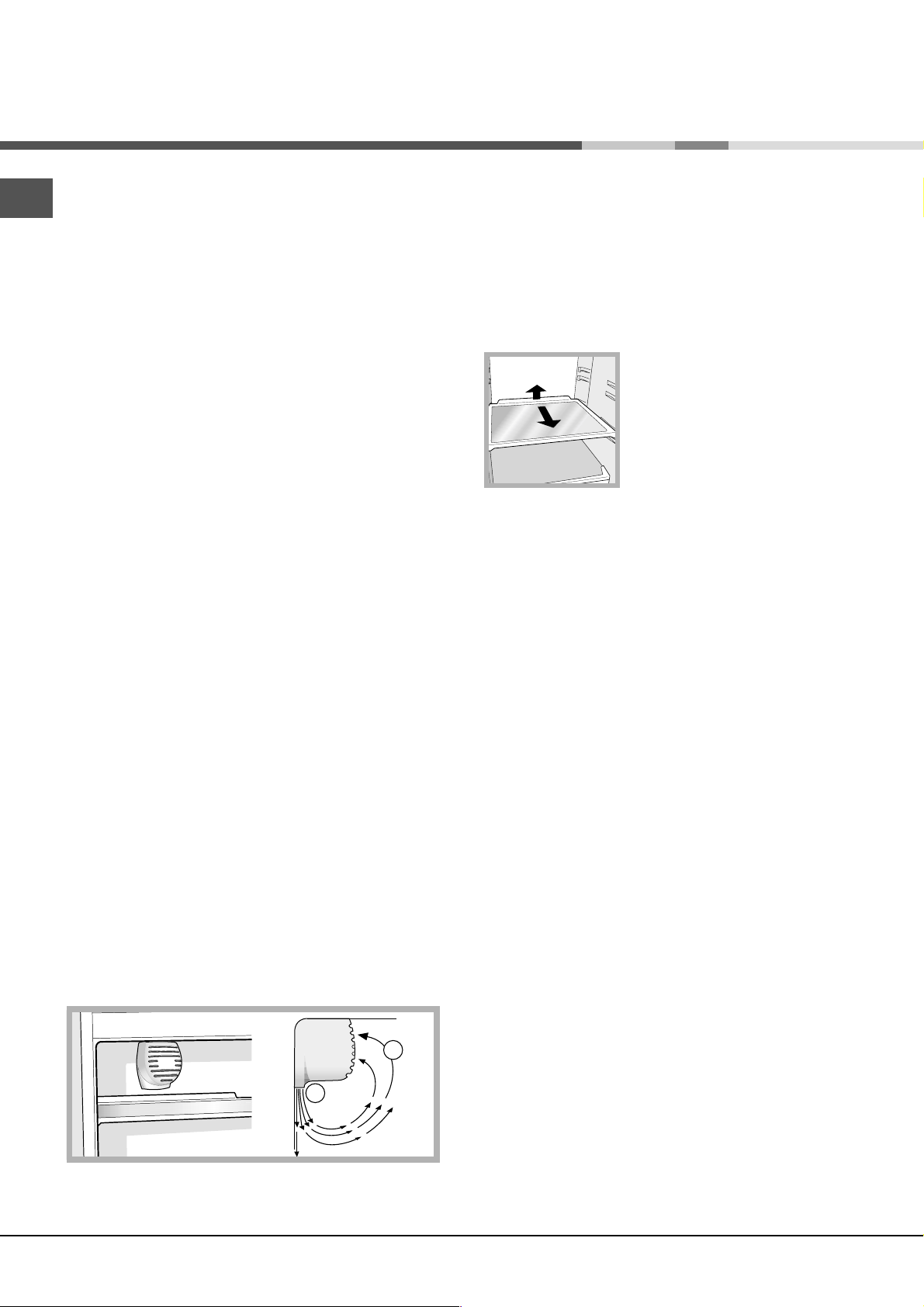
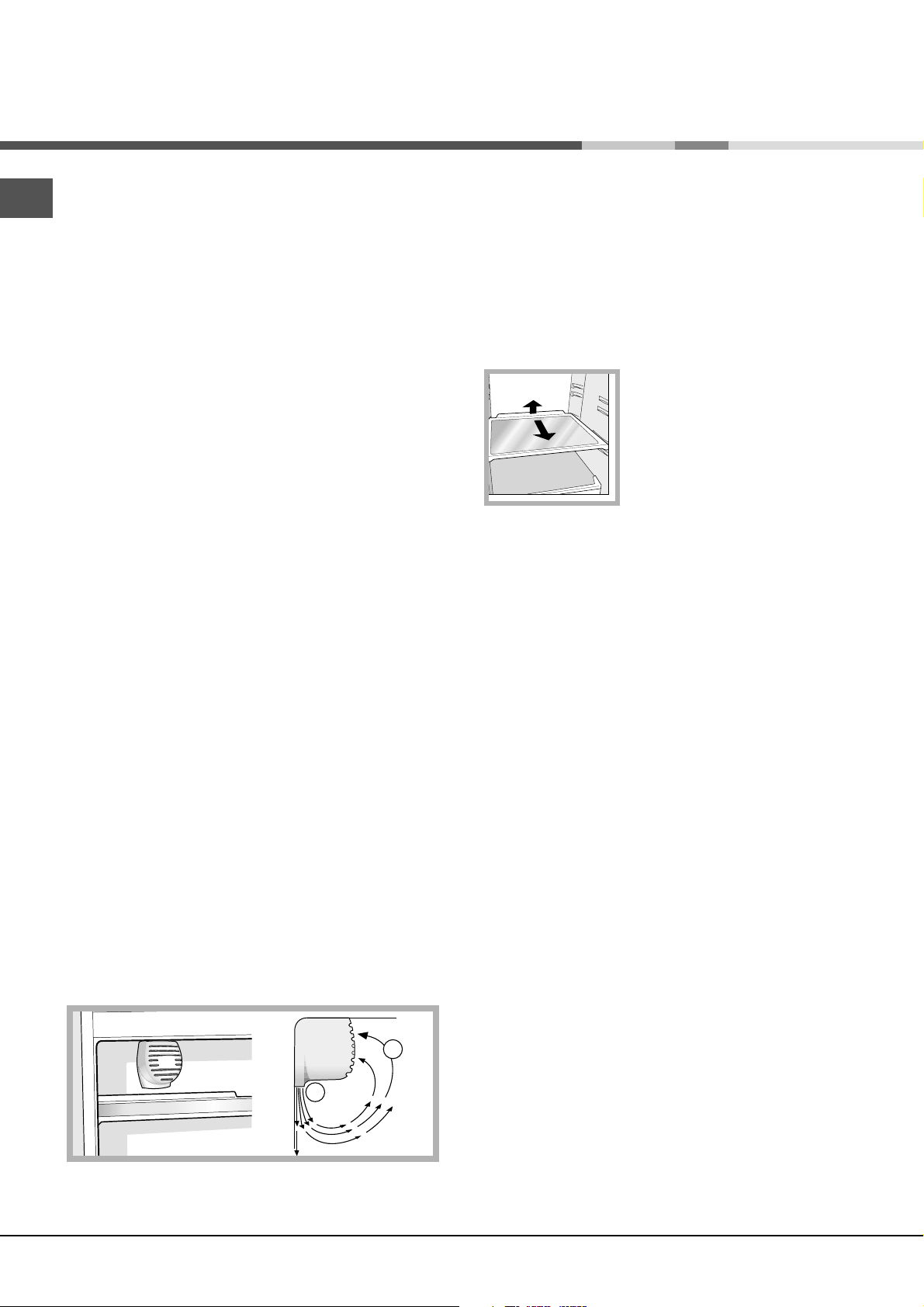
A.I.R. SYSTEM (Ariston Integrated Refrigeration)
The A.I.R. System maintains a constant fridge
temperature to keep food fresher for longer and will
quickly restore the temperature to the correct level,
even if the door is opened frequently: the blown air (A)
is cooled when it comes into contact with the cold wall,
whereas the hotter air (B) is sucked up (
The back wall may be covered in frost or droplets of
water, depending on whether the compressor is in
operation or whether it is paused.
see diagram
If the TEMPERATURE ADJUSTMENT knob has been
set on high values with large quantities of food and with
a high ambient temperature, the appliance can operate
).
continuously, resulting in excessive frost formation and
excessive energy consumption: compensate for this by
shifting the knob towards lower values (defrosting will
occur automatically).
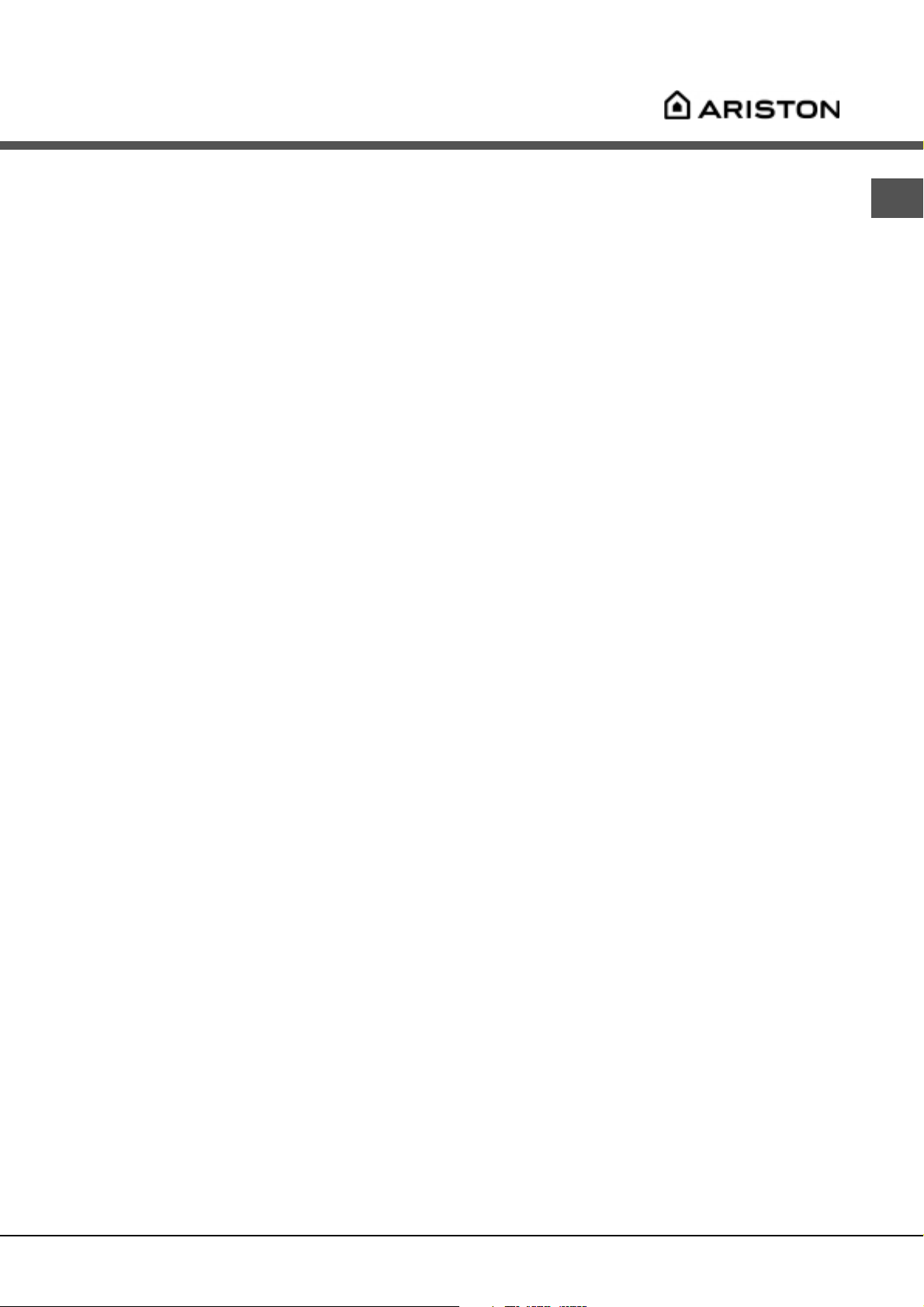
SHELVES: with or without grill.
1
2
Due to the special guides the
shelves are removable and the
height is adjustable (
diagram
of large containers and food.
Height can be adjusted without
complete removal of the shelf.
), allowing easy storage
see
Using the refrigerator to its full potential
• Use the TEMPERATURE ADJUSTMENT knob to
adjust the temperature (
• Place only cold or lukewarm foods in the
compartment, not hot foods (
).
tips
• Remember that cooked foods do not last longer than
raw foods.
• Do not store liquids in open containers. They will
increase humidity in the refrigerator and cause
condensation to form.
).
see Description
see Precautions and
).
B
A
4
Page 5
Using the freezer to its full potential
• Do not re-freeze food that is defrosting or that has
already been defrosted. These foods must be
cooked and eaten (within 24 hours).
• Fresh food that needs to be frozen must not come
into contact with food that has already been
defrosted. Fresh food must be stored above the grill
in the freezer compartment and if possible be in
direct contact with the walls (side and rear), where
the temperature drops below -18°C and guarantees
rapid freezing.
• Do not place glass bottles which contain liquids, and
which are corked or hermetically sealed in the
freezer because they could break.
• The maximum quantity of food that may be frozen
daily is indicated on the plate containing the technical
properties located on the bottom left side of the
refrigerator compartment (for example: Kg/24h: 4)
! Do not open the door during freezing.
GB
! If there is a power cut or malfunction, do not open the
freezer door. This will help maintain the temperature
inside the freezer, ensuring that foods are conserved for
at least 9 -14 hours.
! If the room temperature drops below 14°C for an
extended period of time, the ideal temperature will not
be reached in the freezer compartment and food
preservation will be reduced.
5
Page 6

Maintenance and care
1
2
Switching the appliance off
GB
During cleaning and maintenance it is necessary to
disconnect the appliance from the electricity supply:
It is not sufficient to set the temperature adjustment
knobs on
contact.
(appliance off) to eliminate all electrical
Cleaning the appliance
• The external and internal parts, as well as the rubber
seals may be cleaned using a sponge that has been
soaked in lukewarm water and bicarbonate of soda
or neutral soap. Do not use solvents, abrasive
products, bleach or ammonia.
• The removable accessories may be soaked in warm
water and soap or dishwashing liquid. Rinse and dry
them carefully.
• The back of the appliance may collect dust which
can be removed by delicately using the hose of a
vacuum cleaner set on medium power. The
appliance must be switched off and the plug must be
pulled out before cleaning the appliance.
Avoiding mould and unpleasant odours
• The appliance is manufactured with hygienic
materials which are odour free. In order to maintain
an odour free refrigerator and to prevent the
formation of stains, food must always be covered or
sealed properly.
• If you want to switch the appliance off for an
extended period of time, clean the inside and leave
the doors open.
Defrosting the refrigerator compartment
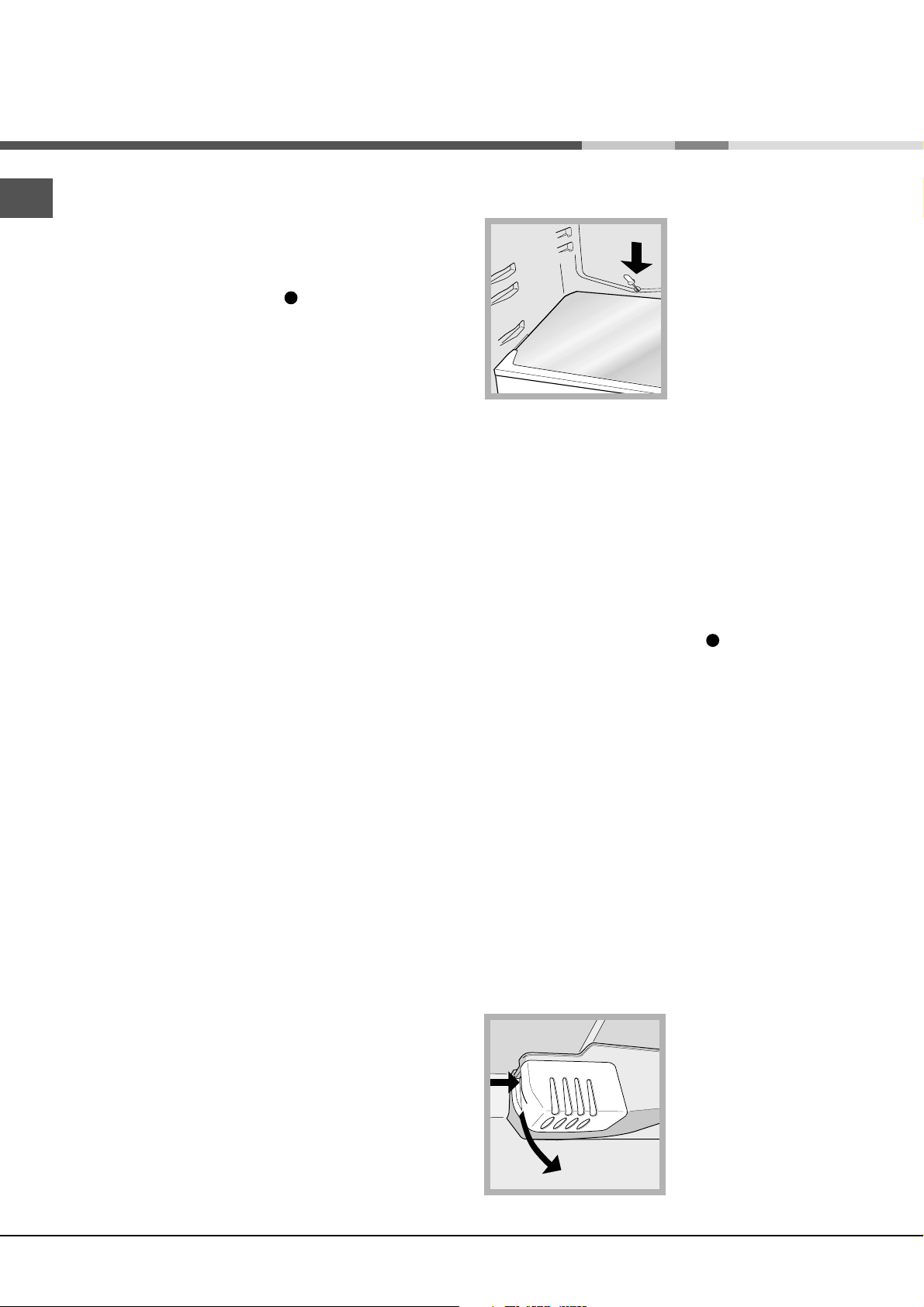
The refrigerator has an
automatic defrosting
function: water is ducted
to the back of the
appliance by a special
discharge outlet (
diagram
produced by the
compressor causes it to
evaporate. It is
necessary to clean the
discharge hole regularly so that the water can flow out
easily.
Defrosting the freezer compartment
Remove frost regularly using the special scraper
provided. If the frost layer is greater than 5 mm, it is
necessary to defrost manually:
1. Set the TEMPERATURE ADJUSTMENT knob to the
position
2. Wrap frozen foods in newspaper and place them in
another freezer or in a cool place.
3. Leave the door open until the frost has melted
completely. This can be made easier by placing
containers with lukewarm water in the freezer
compartment.
4. Clean and dry the freezer compartment carefully
before switching the appliance on again.
5. Wait for approximately 2 hours, i.e. until the ideal
storage conditions have been restored, before
placing food in the freezer compartment.
Replacing the light bulb
.
) where the heat
see
To replace the light bulb in the refrigerator
compartment, pull out the plug from the electrical
socket. Follow the instructions below.
Access the light bulb by
Defrosting the appliance
! Follow the instructions below.
Do not speed up the defrosting process by using any
devices or tools other than the scraper provided, you
may damage the refrigeration circuit.
removing the cover as
indicated in the diagram.
Replace it with a similar
light bulb within the
power range indicated on
the cover (15W or 25W).
6
Page 7
Precautions and tips
! The appliance was designed and manufactured in
compliance with international safety standards. The
following warnings are provided for safety reasons
and must be read carefully.
This appliance complies with the following
Community Directives:
- 73/23/EEC of 19/02/73 (Low Voltage) and
subsequent amendments;
-89/336/EEC of 03.05.89 (Electromagnetic
Compatibility) and subsequent amendments;
- 2002/96/CE.
General safety
• The appliance was designed for domestic use inside
the home and is not intended for commercial or
industrial use.
• The appliance must be used to store and freeze food
products by adults only and according to the
instructions in this manual.
• The appliance must not be installed outdoors, even in
covered areas. It is extremely dangerous to leave the
appliance exposed to rain and storms.
• Do not touch the appliance with bare feet or with wet
or moist hands and feet.
• Do not touch the internal cooling elements: this
could cause skin abrasions or frost/freezer burns.
• When unplugging the appliance always pull the plug
from the mains socket, do not pull on the cable.
• Before cleaning and maintenance, always switch off
the appliance and disconnect it from the electrical
supply. It is not sufficient to set the temperature
adjustment knobs on
electrical contact.
• In the case of a malfunction, under no circumstances
should you attempt to repair the appliance yourself.
Repairs carried out by inexperienced persons may
cause injury or further malfunctioning of the appliance.
• Do not use devices or tools other than the special
scraper provided inside the compartments.
(appliance off) to eliminate all
Disposal
• Observe local environmental standards when
disposing packaging material for recycling
purposes.
• The European Directive 2002/96/EC on Waste
Electrical and Electronic Equipment (WEEE), requires
that old household electrical appliances must not be
disposed of in the normal unsorted municipal waste
stream. Old appliances must be collected separately
in order to optimise the recovery and recycling of the
materials they contain and reduce the impact on
human health and the environment. The crossed out
“wheeled bin” symbol on the product reminds you of
your obligation, that when you dispose of the
appliance it must be separately collected.
Consumers should contact their local authority or
retailer for information concerning the correct
disposal of their old appliance.
Respecting and conserving the
environment
• Install the appliance in a fresh and well-ventilated
room. Ensure that it is protected from direct sunlight
and do not place it near heat sources.
• Try to avoid keeping the door open for long periods
or opening the door too frequently in order to
conserve energy.
• Do not fill the appliance with too much food:
cold air must circulate freely for food to be preserved
properly. If circulation is impeded, the compressor
will work continuously.
• Do not place hot food directly into the refrigerator.
The internal temperature will increase and force the
compressor to work harder and will consume more
energy.
• Defrost the appliance if ice forms (
A thick layer of ice makes cold transference to food
products more difficult and results in increased
energy consumption.
see Maintenance
GB
).
• Do not put ice cubes taken directly from the freezer
into your mouth.
• Do not allow children to tamper with the controls or
play with the appliance. Under no circumstance
should they be allowed to sit on the bins or to hang
from the door.
• Keep packaging material out of the reach of children! It
can become a choking or suffocation hazard.
• Regularly check the door seals and wipe clean to
ensure they are free of debris and to prevent cold air
from escaping (
see Maintenance
).
7
Page 8
Troubleshooting
If the appliance does not work, before calling for Assistance (
GB
Malfunctions:
The internal light does not
illuminate.
The refrigerator and the freezer do
not cool well.
The food inside the refrigerator is
beginning to freeze.
The AIR fan does not rotate.
The motor runs continuously.
Possible causes / Solutions:
• The plug has not been inserted into the electrical socket, or not far
• The doors do not close properly or the seals are damaged.
• The doors are opened too frequently.
• The TEMPERATURE ADJUSTMENT knob is not in the correct position
• The refrigerator or the freezer have been over-filled.
• The atmospheric temperature of the area surrounding the appliance is
• The TEMPERATURE ADJUSTMENT knob is not in the correct position.
• The food is in contact with the back inside wall of the refrigerator.
• The refrigerator door is open.
• The AIR system is only activated automatically when it becomes
• The door is not closed properly or is continuously opened.
• The outside ambient temperature is very high.
• The thickness of the frost exceeds 2-3 mm (
see Assistance
enough to make contact, or there is no power in the house.
lower than 14°C.
necessary to restore perfect operational conditions inside the
refrigerator compartment.
), check for a solution from the following list.
see Maintenance
).
The appliance makes a lot of noise.
Some of the external parts of the
refrigerator become hot.
The back wall of the refrigerator unit
is covered in frost or droplets of
water.
There is water at the bottom of the
refrigerator.
• The appliance has not been installed on a level surface (
)
Installation
• The appliance has been installed between cabinets that vibrate and
make noise.
• The internal refrigerant makes a slight noise even when the compressor
is off. This is not a defect, it is normal.
• These raised temperatures are necessary in order to avoid the
formation of condensation on certain parts of the product.
• This shows the appliance is operating normally.
• The water discharge hole is blocked (
.
see Maintenance
see
).
8
Page 9
Assistance
Before calling for Assistance:
•
Check if the malfunction can be solved on your own (
see Troubleshooting
).
• If after all the checks, the appliance still does not operate or the problem persists, call the nearest Service
Centre
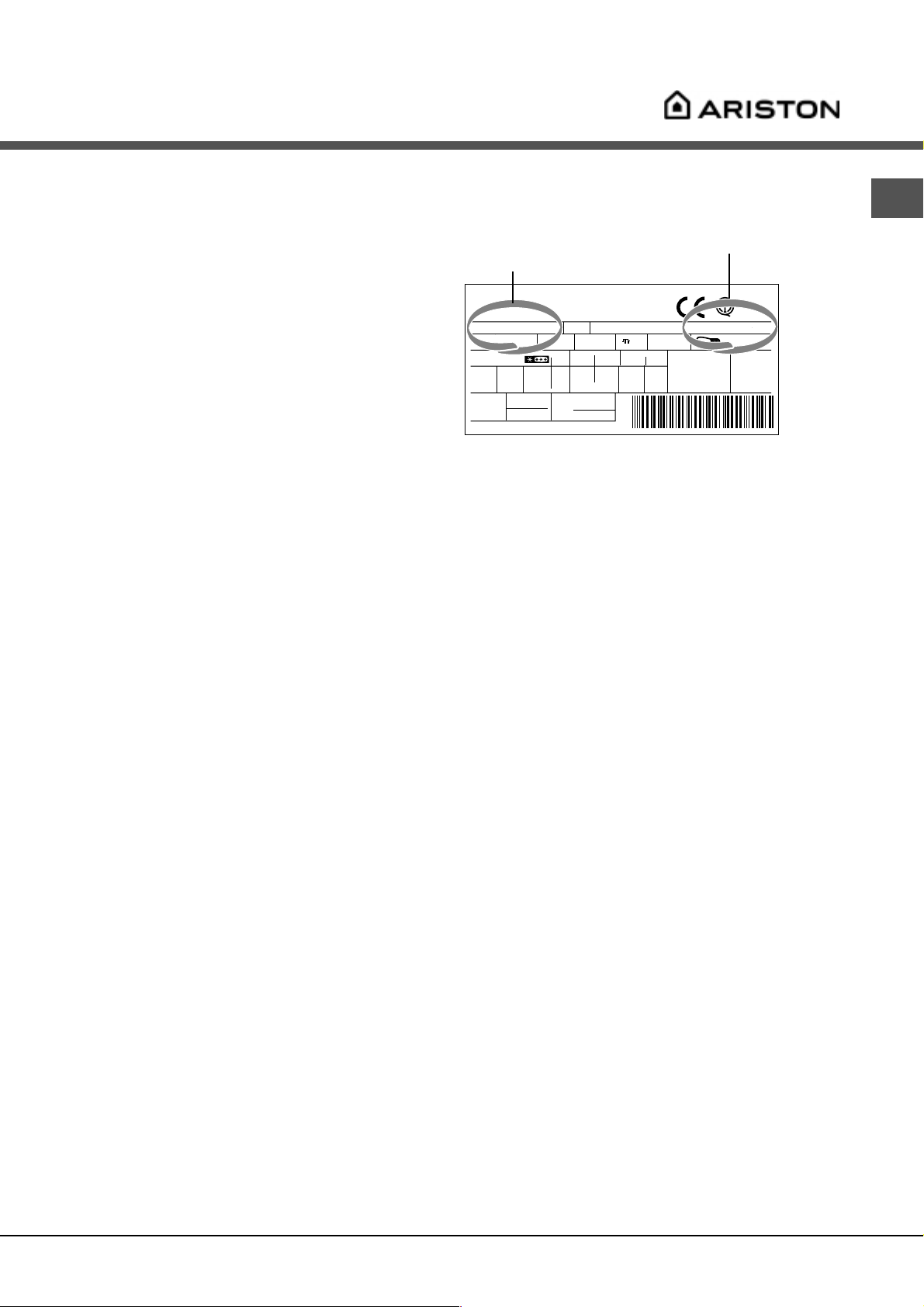
model serial number
Communicating:
• type of malfunction
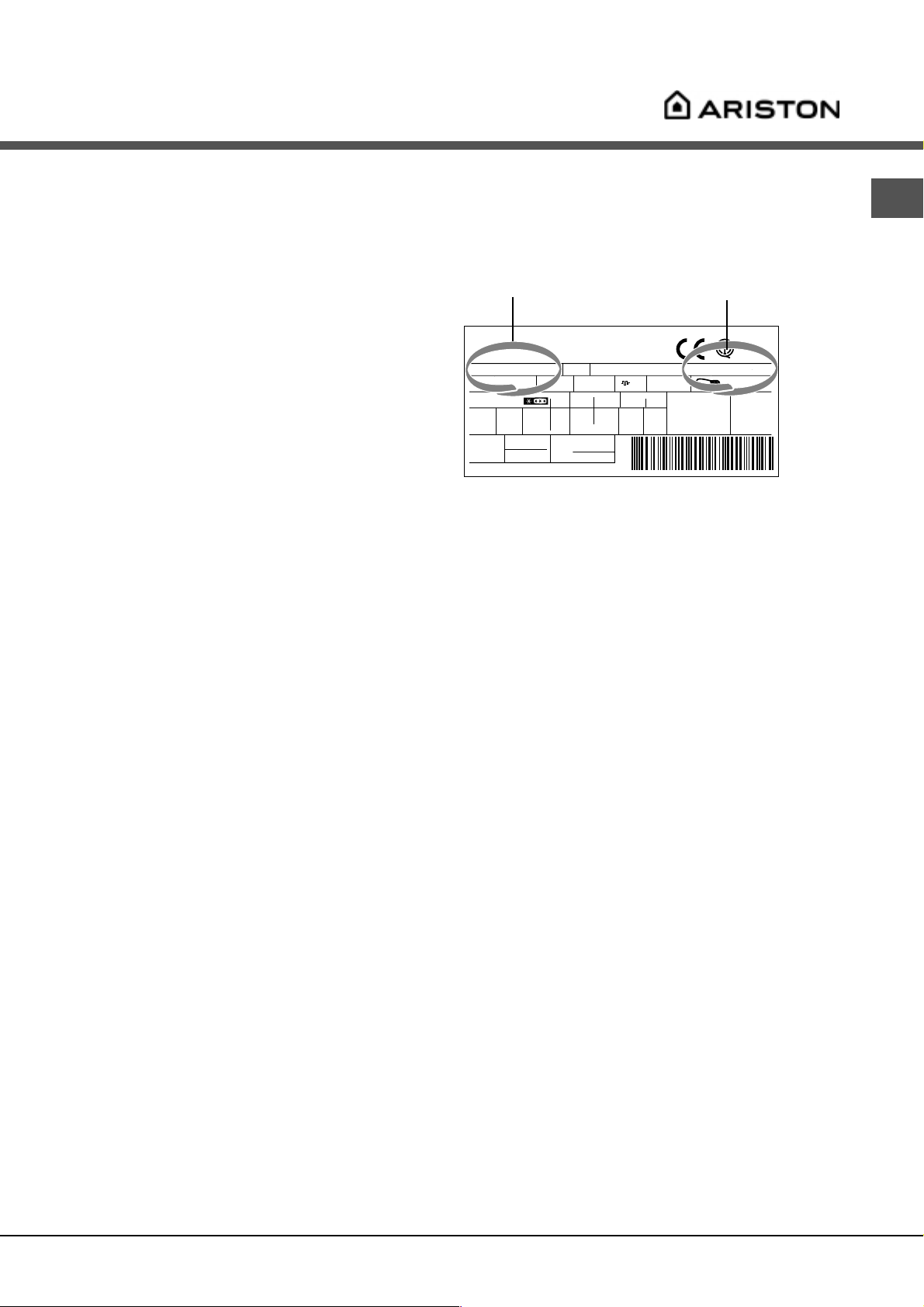
• appliance model (Mod.)
• serial number (S/N)
This information can be found on the data
plate located on the bottom left side of the
refrigerator compartment.
Gross
Bruto
Brut
TI
75
Test
P.S-I.
RG 2330
Mod.
220 - 240 V- 50 Hz 150 W
340
Total
Gross
Bruto
Brut
Compr.
R 134 a
Syst.
kg 0,090
Kompr.
Made in Italy 13918
93139180000 S/N 704211801
Net
Util
Utile
Pressure
HIGH-235
LOW 140
Cod.
Gross
Bruto
Brut
Fuse
W
A
Freez. Capac
Poder de Cong
4,0
kg/24 h
Max 15 w
Class
Clase
Classe
N
Never call on unauthorized technicians and always refuse spare parts which are not originals.
GB
9
Page 10
GB
195058213.00
07/2006 - Xerox Business Services
10
Page 11
Manual de instrucciones
FRIGORÍFICO DE 2 PUERTAS
GB
English, 1
MTM 1601 V
ES
Espanol, 11
Sumario
ES
Instalación, 12
Colocación y conexión
Reversibilidad de la apertura de las puertas
Descripción del aparato, 13
Vista en conjunto
Puesta en funcionamiento y uso, 14-15
Poner en marcha el aparato
Regulación de la temperatura
Uso óptimo del frigorífico
Uso óptimo del congelador
Mantenimiento y cuidados, 16
Cortar la corriente eléctrica
Limpiar el aparato
Evitar la formación de moho y malos olores
Descongelar el aparato
Sustituir la bombilla
Precauciones y consejos, 17
Seguridad general
Eliminación
Ahorrar y respetar el medio ambiente
Anomalías y soluciones, 18
Asistencia, 19
Page 12
Instalación
ES
! Es importante conservar este manual para poder
consultarlo cuando sea necesario. En caso de venta,
cesión o traslado, verifique que permanezca junto al
aparato para informar al nuevo propietario sobre su
funcionamiento y sobre las precauciones durante su uso
! Lea atentamente las instrucciones: contienen
información importante sobre la instalación, sobre el uso
y sobre la seguridad.
Colocación y conexión
Colocación
1. Coloque el aparato en un ambiente bien aireado y seco.
2. No obstruya las rejillas posteriores de ventilación: el
compresor y el condensador emiten calor y requieren
una buena aireación para funcionar bien y limitar el
consumo eléctrico.
3. Deje una distancia mínima de 10 cm. entre la parte
superior del aparato y los muebles situados encima y
de 5 cm., como mínimo, entre los costados y los
muebles o paredes laterales.
4. Mantenga el aparato lejos de fuentes de calor (por ej.
la luz solar directa o una cocina eléctrica).
5. Para mantener una distancia óptima entre el producto
y la pared posterior, coloque los distanciadores que
se encuentran en la caja de instalación siguiendo las
instrucciones presentes en la hoja correspondiente
Reversibilidad de la apertura de las
puertas
1
2
3
Nivelación
1. Instale el aparato sobre un piso plano y rígido.
2. Si el piso no fuera perfectamente horizontal, compense los
desniveles atornillando o desatornillando las patas
delanteras.
Conexión eléctrica
Después de su transporte, coloque el aparato
verticalmente y espere 3 horas como mínimo antes de
conectarlo a la red eléctrica. Antes de enchufarlo a la
toma de corriente, controle que:
• la toma posea la conexión a tierra y que sea
conforme a la ley;
• el enchufe sea capaz de soportar la carga máxima
de potencia de la máquina indicada en la placa de
características ubicada en la parte inferior izquierda
del frigorífico (ej. 150 W);
• la tensión de alimentación esté comprendida entre los
valores indicados en la placa de características
ubicada abajo a la izquierda (ej. 220-240V);
• la toma sea compatible con el enchufe del aparato.
Si no fuera así, solicite la sustitución del enchufe a un
técnico autorizado (
prolongaciones ni conexiones múltiples.
! Una vez instalado el aparato, el cable eléctrico y la
toma de corriente deben ser fácilmente accesibles.
! El cable no debe sufrir pliegues ni compresiones.
! El cable debe ser revisado periódicamente y sustituido
sólo por técnicos autorizados (ver Asistencia).
! La empresa declina toda responsabilidad en los
casos en que no hayan sido respetadas estas normas.
ver Asistencia
); no utilice
4
5
∅ 3
mm
12
Page 13
Descripción del
aparato
Vista de conjunto
Las instrucciones sobre el uso son válidas para distintos modelos y por lo tanto es posible que la figura presente
detalles diferentes a los del aparato que Ud. ha adquirido. La descripción de las piezas más complejas se
encuentra en las páginas sucesivas.
Compartimento
congelador
CONGELACIÓN y
CONSERVACIÓN
Mando REGULACIÓN
DE LA
TEMPERATURA
Balconcito extraíble
con tapa, con
HUEVERA
ES
BANDEJAS•
Recipiente FRUTA y
VERDURA
PATAS de
regulación
Balconcito extraíble
PORTAOBJETOS•
Balconcito
BOTELLAS
La cantidad y/o su ubicación pueden variar.
13
Page 14
Puesta en
funcionamiento y uso
Poner en marcha el aparato
ES
! Antes de poner en funcionamiento el aparato, siga
las instrucciones sobre la instalación (
! Antes de conectar el aparato limpie bien los
compartimentos y los accesorios con agua tibia y
bicarbonato.
1. Enchufe el aparato en la toma de corriente y verifique
que se encienda la lámpara de iluminación interna.
2. Gire el mando de REGULACIÓN DE LA TEMPERATURA
hasta un valor medio. Después de algunas horas será
posible introducir alimentos en el frigorífico.
ver Instalación
Regulación de la temperatura
La temperatura interna del compartimento frigorífico se
regula automáticamente en base a la posición del
mando del termostato.
1 = menos frío
5 = más frío
Se aconseja, en todo caso, poner una posición media.
Para aumentar el espacio disponible y mejorar el
aspecto estético, este aparato posee la “parte
refrigerante” ubicada en el interior de la pared posterior
del compartimento frigorífico. Durante el funcionamiento,
dicha pared se presentará cubierta de escarcha o de
gotitas de agua según si el compresor está en
funcionamiento o en pausa. ¡No se preocupe por ello! El
frigorífico está trabajando de forma normal.
Si se coloca el mando de REGULACIÓN DE LA
TEMPERATURA en valores altos, con grandes
cantidades de alimentos y con una temperatura
).
ambiente elevada, el aparato puede funcionar
continuamente, produciendo una excesiva formación
de escarcha y aumentando el consumo de electricidad.
evítelo desplazando el mando hacia valores más bajos
(se efectuará una descongelación automática).
BANDEJAS: enteras o tipo rejilla.
1
2
Son extraíbles y su altura es
regulable gracias a las guías
especiales (
utilizan para introducir
recipientes o alimentos de gran
tamaño. Para regular la altura no
es necesario extraer las
bandejas completamentes.
ver la figura
), se
Uso óptimo del frigorífico
• Para regular la temperatura utilice el mando de
REGULACIÓN DE LA TEMPERATURA (
Descripción
• Introduzca sólo alimentos fríos o apenas tibios,
nunca calientes (
• Recuerde que los alimentos cocidos no se
mantienen durante más tiempo que los crudos.
).
ver Precauciones y consejos
ver
).
A.I.R. SYSTEM (Ariston Integrated Refrigeration)
El A.I.R. System permite una óptima conservación de
los alimentos debido a que restablece rápidamente la
temperatura después de la apertura de la puerta y la
distribuye de forma homogénea: el aire ventilado (A) se
enfría en contacto con la pared fría, mientras que el
aire más caliente (B) se aspira (
La pared posterior se encuentra cubierta de escarcha
o de gotitas de agua según si el compresor está en
funcionamiento o en pausa.
ver la figura
A
).
B
• No introduzca recipientes destapados con líquidos:
produciría un aumento de humedad con la
consiguiente formación de condensación.
14
Page 15
Uso óptimo del congelador
• No vuelva a congelar alimentos que están por
descongelar o descongelados; dichos alimentos
deben ser previamente cocinados para ser
consumidos (dentro de las 24 horas).
• Los alimentos frescos por congelar no deben
colocarse en contacto con los ya congelados; se
deben colocar sobre la rejilla del compartimento
congelador, si es posible, en contacto con las
paredes (laterales y posterior) donde la temperatura
desciende por debajo de los –18ºC y garantiza una
mayor velocidad de congelación.
• No coloque en el congelador botellas de vidrio que
contengan líquidos, tapadas o cerradas
herméticamente porque podrían romperse.
• La cantidad máxima diaria de alimentos a congelar
está indicada en la placa de características ubicada
en el compartimento frigorífico abajo a la izquierda
(por ejemplo: 4 Kg/24h).
ES
! Evite abrir la puerta durante la congelación.
! Cuando se produzca una interrupción de corriente o
una avería, no abra la puerta del congelador: de este
modo, los alimentos congelados se conservarán sin
alteración durante aproximadamente 9-14 horas.
! Si durante un largo período de tiempo la temperatura
ambiente permanece por debajo de los 14ºC, no se
alcanzan las temperaturas necesarias para una larga
conservación en el compartimento congelador y, por lo
tanto, el período de conservación resultará menor.
15
Page 16
Mantenimiento y cuidados
1
2
Cortar la corriente eléctrica
ES
Durante los trabajos de limpieza y mantenimiento, es
necesario aislar el aparato de la red de alimentación
eléctrica, desenchufándolo:
No es suficiente llevar el mando para la regulación de
la temperatura hasta la posición
para eliminar todo contacto eléctrico.
(aparato apagado)
Limpiar el aparato
• Las partes externas, las partes internas y las juntas
de goma se pueden limpiar con una esponja
empapada en agua tibia y bicarbonato sódico o
jabón neutro. No utilice disolventes, productos
abrasivos, lejía o amoníaco.
• Los accesorios extraíbles se pueden colocar en
remojo en agua caliente y jabón o detergente para
platos. Enjuáguelos y séquelos con cuidado.
• La parte posterior del aparato tiende a cubrirse de
polvo que se puede eliminar, después de haber
apagado y desenchufado el aparato, utilizando con
delicadeza la boca de la aspiradora y trabajando
con una potencia media.
Evitar la formación de moho y malos
olores
• El aparato está fabricado con materiales higiénicos
que no transmiten olores. Para mantener esta
característica es necesario que los alimentos estén
siempre protegidos y bien cerrados. Esto evitará
también
la formación de manchas.
Descongelar el compartimento frigorífico
El frigorífico posee
descongelación
automático: el agua se
envía hacia la parte
posterior por un orificio
de descarga (
) donde el calor
figura
producido por el
compresor la hace
evaporar. La única
intervención que se debe
realizar periódicamente consiste en limpiar el orificio de
descarga para que el agua pueda fluir libremente.
Descongelar el compartimento congelador
Elimine periódicamente la escarcha utilizando la
raedera que se suministra con el aparato. Si la capa de
escarcha es superior a los 5 mm es necesario realizar
una descongelación manual:
1. Coloque el mando de REGULACIÓN DE LA
TEMPERATURA en la posición
2. Envuelva los alimentos congelados en papel de
periódico y colóquelos en otro congelador o en un
lugar fresco.
3. Deje la puerta abierta hasta que la escarcha se haya
derretido completamente; facilite la operación
colocando en el compartimento congelador
recipientes con agua tibia.
4. Limpie y seque con cuidado el compartimento
congelador antes de volver a encender el aparato.
5. Antes de introducir los alimentos en el
compartimento congelador, espere
aproximadamente 2 horas para restablecer las
condiciones ideales de conservación.
.
ver la
• Si se debe apagar el aparato por un largo período,
limpie su interior y deje las puertas abiertas.
Descongelar el aparato
! Respete las instrucciones que se dan a continuación.
No acelere el proceso con dispositivos o utensilios
diferentes de la rasqueta que se suministra con el
aparato porque se podría dañar el circuito refrigerante.
Sustituir la bombilla
Para sustituir la bombilla de iluminación del compartimento
frigorífico, desenchufe el aparato. Siga las instrucciones
que se dan a continuación.
Acceda a la lámpara
quitando la protección
como se indica en la
figura. Sustitúyala con otra
bombilla con una potencia
igual a la indicada en la
protección (15 W o 25 W).
16
Page 17
Precauciones y consejos
! El aparato ha sido proyectado y fabricado en
conformidad con las normas internacionales sobre
seguridad. Estas advertencias se suministran por
razones de seguridad y deben ser leídas atentamente.
Este equipamiento es conforme con las
siguientes Directivas Comunitarias:
- 73/23/CEE del 19/02/73 (Baja Tensión) y
sucesivas modificaciones;
-89/336/CEE del 03/05/89 (Compatibilidad
Electromagnética) y sucesivas
modificaciones;
- 2002/96/CE.
Seguridad general
• El aparato ha sido pensado para un uso de tipo no
profesional en el interior de una vivienda.
• El aparato debe ser utilizado para conservar y
congelar alimentos sólo por personas adultas y
según las indicaciones contenidas en este manual.
• El aparato no se debe instalar al aire libre ni siquiera
si el lugar está protegido debido a que es muy
peligroso dejarlo expuesto a la lluvia y tormentas.
• No toque el aparato estando descalzo o con las
manos o pies mojados o húmedos.
• No toque las piezas refrigerantes internas: podría
quemarse o herirse.
• No desenchufe el aparato tirando del cable sino
sujetando el enchufe.
• Es necesario desenchufar el aparato antes de
realizar operaciones de limpieza y de
mantenimiento. No es suficiente llevar el mando
para LA REGULACIÓN DE LA TEMPERATURA hasta
la posición
contacto eléctrico.
• En caso de avería, nunca acceda a los mecanismos
internos para intentar una reparación.
• En el interior de los compartimentos no utilice
dispositivos o utensilios diferentes de la rasqueta
suministrada con el equipo.
• No introduzca en su boca cubitos apenas extraídos
del congelador.
• No permita a los niños que jueguen con el aparato.
No se deben sentar en los cajones o colgarse de la
puerta.
(aparato apagado) para eliminar todo
Eliminación
• Eliminación del material de embalaje: respete las
normas locales, de esta manera los embalajes
podrán ser reutilizados.
• En base a la Norma europea 2002/96/CE de
Residuos de aparatos Eléctricos y Electrónicos
(RAEE), los electrodomésticos viejos no pueden ser
arrojados en los contenedores municipales
habituales; tienen que ser recogidos selectivamente
para optimizar la recuperación y reciclado de los
componentes y materiales que los constituyen, y
reducir el impacto en la salud humana y el
medioambiente. El símbolo del cubo de basura
tachado se marca sobre todos los productos para
recordar al consumidor la obligación de separarlos
para la recogida selectiva.
El consumidor debe contactar con la autoridad local
o con el vendedor para informarse en relación a la
correcta eleminación de su electrodoméstico viejo.
Ahorrar y respetar el medio ambiente
• Instale el aparato en una ambiente fresco y bien
aireado, protéjalo de la exposición directa a los
solares y no lo coloque cerca de fuentes de
rayos
calor.
• Para introducir o extraer los alimentos, abra las
puertas del aparato el menor tiempo posible.
Cada apertura de las puertas produce un notable
gasto de energía.
• No llene con demasiados alimentos el aparato:
para una buena conservación, el frío debe poder
circular libremente. Si se impide la circulación, el
compresor trabajará continuamente.
• No introduzca alimentos calientes: elevarían la
temperatura interior obligando al compresor a un
mayor trabajo con un gran gasto de energía
eléctrica.
• Descongele el aparato si se formara hielo (
Mantenimiento
más difícil la cesión de frío a los alimentos y hace
que aumente el consumo de energía.
• Mantenga eficientes y limpias las juntas para que se
adhieran bien a las puertas y no dejen salir el frío
ver Mantenimiento
(
); una espesa capa de hielo vuelve
).
ver
ES
• Los embalajes no son juguetes para los niños.
17
Page 18
Anomalías y soluciones
Puede suceder que el aparato no funcione. Antes de llamar al Servicio de Asistencia Técnica (
ES
que no se trate de un problema fácilmente solucionable con la ayuda de la siguiente lista.
Anomalías:
La lámpara de iluminación interna
no se enciende.
El frigorífico y el congelador enfrían
poco.
En el frigorífico los alimentos se
congelan.
El ventilador AIR no gira.
Posibles causas / Solución:
• El enchufe no está introducido en la toma de corriente o no está lo
suficiente como para hacer contacto o bien en la casa no hay corriente.
• Las puertas no cierran bien o las juntas están dañadas.
• Las puertas se abren demasiado frecuentemente.
• El mando de REGULACIÓN DE LA TEMPERATURA no está en la posición
correcta.
• El frigorífico o el congelador se han llenado excesivamente.
• La temperatura ambiente de trabajo del producto es menor que 14ºC.
• El mando de REGULACIÓN DE LA TEMPERATURA no está en la posición
correcta.
• Los alimentos están en contacto con la pared posterior.
• La puerta del frigorífico está abierta
• El sistema AIR se activa automáticamente sólo cuando es necesario
restablecer las condiciones óptimas en el interior del compartimento
frigorífico.
ver Asistencia
), controle
El motor funciona continuamente.
El aparato hace mucho ruido.
La temperatura de algunas partes
externas del frigorífico es elevada.
En la pared del fondo de la cámara
de refrigeración se ha formado
escarcha o gotitas de agua:
En el fondo del frigorífico hay agua.
• La puerta no está bien cerrada o se abre continuamente.
• La temperatura del ambiente externo es muy alta.
• El espesor de la escarcha supera los 2-3 mm (
• El aparato no fue instalado en un lugar plano (
• El aparato ha sido instalado entre muebles u objetos que vibran y
producen ruidos.
• El gas refrigerante interior produce un ligero ruido aún cuando el
compresor está detenido: no es un defecto, es normal.
• Las temperaturas elevadas son necesarias para evitar la formación de
condensación en zonas particulares del producto.
• Se trata del funcionamiento normal del producto.
• El orificio de descarga del agua está obstruído (
ver Mantenimiento
ver Instalación).
ver Mantenimiento
).
).
18
Page 19
Asistencia
195051508.02
12/2005 - Xerox Business Services
Antes de llamar al Servicio de Asistencia Técnica:
•
Verifique si la anomalía puede ser resuelta por ud. mismo (
ver Anomalías y Soluciones
).
• Se, apesar de todos os controlos, o aparelho não funcionar e a anomalia que notou continuar a verificarse, chamar o Centro de Assistência Técnica mais próximo.
modelo
número de serie
Comunique:
• el tipo de anomalía
• el modelo de la máquina (Mod.)
• el número de serie (S/N)
Esta información se encuentra en la placa
de características ubicada en el
compartimento frigorífico abajo a la
izquierda.
RG 2330
Mod.
220 - 240 V- 50 Hz 150 W
340
Total
Gross
Bruto
Brut
Compr.
R 134 a
Syst.
kg 0,090
Kompr.
Made in Italy 13918
Gross
Bruto
Brut
75
Test
P.S-I.
TI
93139180000 S/N 704211801
Net
Util
Utile
Pressure
HIGH-235
LOW 140
Cod.
Gross
Bruto
Brut
Fuse
W
A
Freez. Capac
Poder de Cong
kg/24 h
4,0
Max 15 w
Class
Clase
Classe
N
No recurrir nunca a técnicos no autorizados y rechazar siempre la instalación de repuestos no
originales.
ES
19
Page 20
ES
195058213.00
07/2006 - Xerox Business Services
20
 Loading...