

Page 1

Installation/User Manual
Page 2

2
For your own attention:
For your own attention:For your own attention:
For your own attention:
Please read through this Manual carefully, noting the safety information in particular.
You are advised to keep it in a safe place for future reference.
Manufacturer
ManufacturerManufacturer
Manufacturer
HOPPE Holding AG
CH-7537 Müstair
Switzerland
Contacts
ContactsContacts
Contacts
HOPPE AG
Via Friedrich Hoppe
CH-7537 Müstair
Switzerland
+41 (0)81 851 66 00
+41 (0)81 851 66 66
info.ch@hoppe.com
www.hoppe.com
HOPPE AG
Am Plausdorfer Tor 13
D-35260 Stadtallendorf
Germany
+49 (0)6428 932-0
+49 (0)6428 932-220
info.de@hoppe.com
www.hoppe.com
HOPPE S.p.A.
Jaufenstrasse, 16
I-39010 S. Martin i. P. (BZ)
Italy
+39 0473 640 111
+39 0473 641 359
info.it@hoppe.com
www.hoppe.com
Page 3

3
Contents
ContentsContents
Contents
1111
General
GeneralGeneral
General ................................
................................................................
................................................................
................................................................
................................................................
................................................................
....................................4444
1.1 The SecuSignal
®
System .................................................................... 4
1.2 Guide to this Manual .......................................................................... 4
1.3 Safety regulations............................................................................... 5
1.4 Correct use as intended..................................................................... 6
1.5 Scope of delivery................................................................................ 6
2222 Device and function overview
Device and function overviewDevice and function overview
Device and function overview ................................
................................................................
................................................................
................................................................
................................7777
2.1 Installation components and operating controls ................................ 7
2.2 Mode of operation of the SecuSignal
®
System................................... 9
2.3 State indicators on the receiver........................................................ 11
3333 Preparing
Preparing Preparing
Preparing the radio transmitters
the radio transmittersthe radio transmitters
the radio transmitters................................
................................................................
...........................................................
......................................................
...........................13
1313
13
4444 Programming
ProgrammingProgramming
Programming ................................
................................................................
................................................................
................................................................
.......................................................
..............................................
.......................15
1515
15
4.1 Programming mode.......................................................................... 16
4.2 Programming the radio transmitters................................................. 17
4.3 Updating radio transmitters after power failure................................ 20
4.4 Delete functions................................................................................ 21
5555 Installation
InstallationInstallation
Installation ................................
................................................................
................................................................
................................................................
...........................................................
......................................................
...........................25
2525
25
5.1 Removing old window handles ........................................................ 25
5.2 Fitting the SecuSignal
®
window handle on the window.................... 26
5.3 Installing the SecuSignal
®
receiver................................................... 28
6666 Operation
OperationOperation
Operation ................................
................................................................
................................................................
................................................................
............................................................
........................................................
............................30
3030
30
7777 Troubleshooting
TroubleshootingTroubleshooting
Troubleshooting................................
................................................................
................................................................
................................................................
...................................................
......................................
...................31
3131
31
8888 Technical data
Technical dataTechnical data
Technical data ................................
................................................................
................................................................
................................................................
.....................................................
..........................................
.....................33
3333
33
9999 Maintenance and cleaning
Maintenance and cleaningMaintenance and cleaning
Maintenance and cleaning................................
................................................................
................................................................
................................................................
...................................
......
...34
3434
34
10
1010
10
Disposal
DisposalDisposal
Disposal ................................
................................................................
................................................................
................................................................
..............................................................
............................................................
..............................34
3434
34
11
1111
11 CE conformity
CE conformityCE conformity
CE conformity ................................
................................................................
................................................................
................................................................
......................................................
............................................
......................34
3434
34
12
1212
12 Servicing
ServicingServicing
Servicing ................................
................................................................
................................................................
................................................................
.............................................................
..........................................................
.............................34
3434
34
13
1313
13 Guarantee
GuaranteeGuarantee
Guarantee ................................
................................................................
................................................................
................................................................
...........................................................
......................................................
...........................35
3535
35
14
1414
14 Index
IndexIndex
Index ................................
................................................................
................................................................
................................................................
................................................................
................................................................
................................37
3737
37
Annex
AnnexAnnex
Annex
................................
................................................................
................................................................
................................................................
................................................................
................................................................
.....................................
..........
.....38
3838
38
A1
A1A1
A1 Secustik
SecustikSecustik
Secustik
®®®®
window handles
window handleswindow handles
window handles ................................
................................................................
................................................................
................................................................
....................................
........
....38
3838
38
Page 4
4
1111 General
GeneralGeneral
General
This Manual provides you with all important information you need about installing,
programming and operating your SecuSignal
®
System. It also provides you with in-
formation and important advice about your safety.
Please note: the SecuSignal
®
system provides you with a quick overview of the opening states of the windows programmed. It is not however a security system or alarm
system!
1.1
1.11.1
1.1 The SecuSignal
The SecuSignalThe SecuSignal
The SecuSignal
®®®®
System
System System
System
SecuSignal® is a radio system consisting of at least one SecuSignal® window handle
and a central receiver. The receiver stores the three states for each programmed
window:
• Window closed
•
Window tilted
• Window open
The following critical states are shown separately on the receiver by LEDs for each
window
•
Window tilted
• Window open.
1.2
1.21.2
1.2 Guide
GuideGuide
Guide to this Manual
to this Manual to this Manual
to this Manual
Symbols and words used
Symbols and words usedSymbols and words used
Symbols and words used
Symbol
SymbolSymbol
Symbol
Signal word
Signal word Signal word
Signal word Significance
SignificanceSignificance
Significance
Danger
DangerDanger
Danger
Warning of possible serious or lethal injury to
person
Lightning symbol indicating explicit danger as a result
of electrical power
Warning
WarningWarning
Warning
Warning of possible slight injury to person or possible
damage to property
Caution
CautionCaution
Caution
Warning of possible defects or of total damage to the
device
Important
Important Important
Important
infor
inforinfor
information
mationmation
mation
Important
Important Important
Important
advice
adviceadvice
advice
This indicates important advice about operation
Page 5

5
1.3
1.31.3
1.3 Safety regulations
Safety regulationsSafety regulations
Safety regulations
Caution
CautionCaution
Caution: The safety information below is intended to protect you, third parties
and the device. It is essential therefore that this information is followed.
Operating environment
Operating environmentOperating environment
Operating environment
• The transmitters must not come into direct contact with moisture or water.
The SecuSignal
®
System is suitable for dry interiors only.
• If moving the devices from a cold to warm environment, please allow the devices
to adjust to the temperature before operating, otherwise, condensation damage
could occur.
• Do not install the SecuSignal
®
receiver near to devices generating strong electromagnetic fields. This could impair proper operation. Please avoid an environment subject to direct sunlight, high temperature, low temperature, moisture or
wet conditions.
Electrical power supply
Electrical power supplyElectrical power supply
Electrical power supply
• Connect the power supply unit to an earthed mains socket outlet only with a
mains voltage of 230 V AC/50 Hz.
• Please use the original power supply unit only. If another power supply unit is
used, this will render any guarantee claims null and void. In addition, this could
involve risks and dangers as a result of electrical power, such as electric shock,
fire or short-circuiting!
•
Please disconnect the power supply unit from the mains socket outlet if you notice signs of malfunction. If the power supply unit is damaged, do not use. Have
the device inspected and, if appropriate, repaired by a qualified electrician.
Children
ChildrenChildren
Children
• Install the SecuSignal
®
receiver out of children’s reach.
•
Tell children how to operate the SecuSignal
®
System and the window handles
correctly. Pay particular importance to telling them about the correct state of the
window handles and in all cases (see "Operation" below).
De
DeDe
Devices
vices vices
vices
• For reasons relating to safety and approval (CE mark), conversions and/or modifications to the devices without authorisation are not permitted. Please do not
open the devices since this would impair safety and render claims under warranty null and void.
• The receiver must not be covered by textiles etc. (e.g. near coat stands)
during operation since the ensuing heat build-up could result in fire.
Operation
Operation Operation
Operation
• The SecuSignal
®
System only indicates the critical states of your windows if correctly fitted and operated. Please check your windows for malfunction or unclear
operating conditions and put this right (see Chapter 7 "Troubleshooting") or call a
technician.
Page 6

6
•
Always open and close the window handles fully so as to ensure correct functioning. The window handles must always be turned to an exact vertical (tilted or
closed) or horizontal position (open).
• Leave your house only if all windows are closed so as to minimise the risks of
damage as the result of intrusion or weather.
•
Never leave children or other persons at risk alone if windows are open so as to
avoid the risk of injury falling out of the window.
1.4
1.41.4
1.4 Correct use as intended
Correct use as intendedCorrect use as intended
Correct use as intended
SecuSignal® serves to indicate the states of commercially available turn-and-tilt windows. The system indicates the "critical" states "Window tilted" and "Window open" by
a amber or red LED in conjunction with the number assigned to each window programmed.
The product is not intended for security surveillance.
Any use other than that described above constitutes use not as intended and may
lead to injury or damage to property (see Chapter 1.3 "Safety regulations").
1.5
1.51.5
1.5 Scope of delivery
Scope of deliveryScope of delivery
Scope of delivery
SecuSignal® receiver
• Receiver with power supply unit
• Installation and User Manual
•
Labelling stickers
• Assignment diagram
•
Mounting hardware fixing means
SecuSignal
®
window handle
• Window handle with radio transmitter
•
2 slip-on rings
• Mounting hardware fixing means
Page 7
7
2222 Device and function ove
Device and function oveDevice and function ove
Device and function overrrrview
viewview
view
This provides you with an initial overview of the operating controls, displays and indicators of the SecuSignal
®
System and a brief description of the system's instructions
for use.
2.1
2.12.1
2.1 Installation components and operating controls
Installation components and operating controlsInstallation components and operating controls
Installation components and operating controls
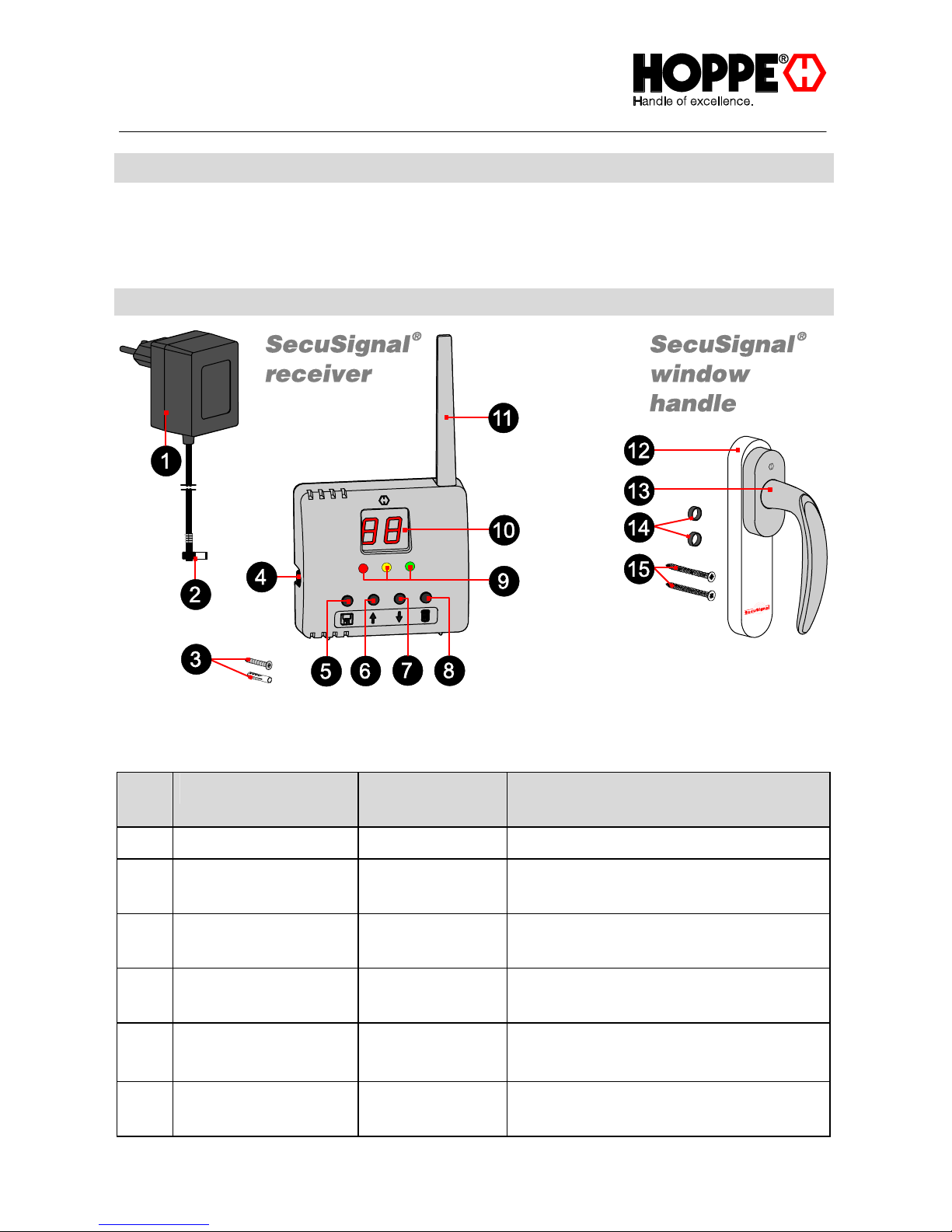
Figure 1: Overview of the SecuSignal® System device: operating controls
SecuSignal
SecuSignalSecuSignal
SecuSignal
®®®®
receiver
receiver receiver
receiver
Item
ItemItem
Item Designation
DesignationDesignation
Designation
Control / di
Control / diControl / di
Control / dis-
s-s-
s-
play / indicator
play / indicatorplay / indicator
play / indicator
Function
FunctionFunction
Function
1111 Power supply unit Power supply
2222 Connector Elbow plug Connection of the power supply unit
to the receiver
3333 Screw with dowel (Ø
6 mm)
For wall mounting of the SecuSignal
®
receiver
4444 Connection socket Socket Connection of the power supply unit
to the receiver
5555 Memory button Short-stroke
button
- Programming window handles
- De-activating Programming mode
6666 "Arrow Up" button Short-stroke
button
Raising group number
Page 8
8
Item
ItemItem
Item Designation
DesignationDesignation
Designation
Control / di
Control / diControl / di
Control / dis-
s-s-
s-
play / indicator
play / indicatorplay / indicator
play / indicator
Function
FunctionFunction
Function
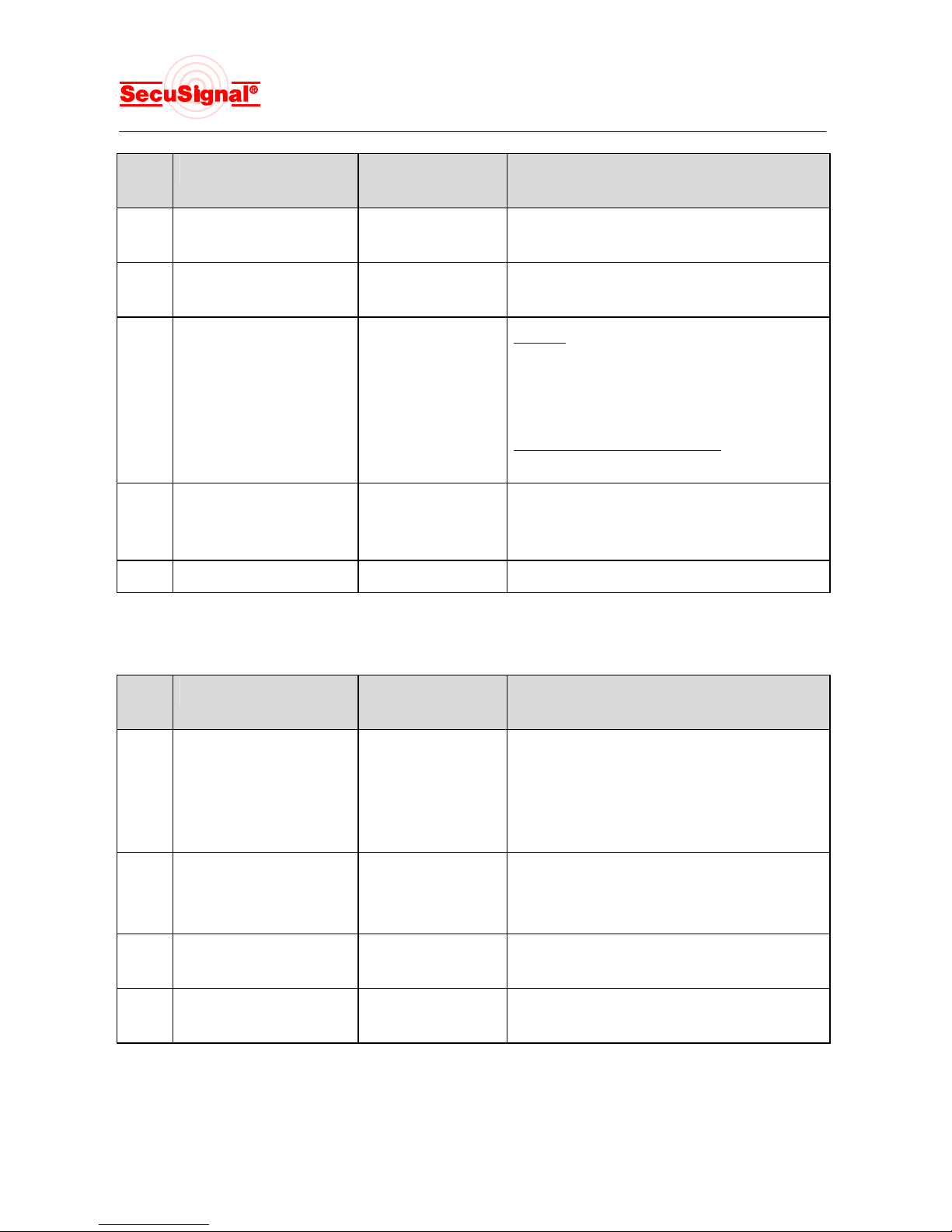
7777 "Arrow Down" button Short-stroke
button
Lowering group number
8888 Delete button Short-stroke
button
Deleting program
9999 Opening and pro-
gramming indicators
LEDs States
Green LED lights: all windows closed
Amber LED lights: window tilted
Red LED lights: window open
Programming indications
See Chapter 2.3 "State indications"
10
1010
10 Display Two-digit
display
Display of window and group numbers and programming display (see
Chapter 2.3)
11
1111
11 Antenna Reception of the transmitter signals
Table 1: Installation components and operating controls of the SecuSignal® receiver
SecuSignal
SecuSignalSecuSignal
SecuSignal
®®®®
window handle
window handle window handle
window handle
Item
ItemItem
Item Designation
DesignationDesignation
Designation
Control / di
Control / diControl / di
Control / dis-
s-s-
s-
play / indicator
play / indicatorplay / indicator
play / indicator
Function
FunctionFunction
Function
12
1212
12 Radio transmitter Detects the state of the window on
the basis of the position of the window handle’s solid spindle and
sends this information to the
SecuSignal
®
receiver
13
1313
13 Window handle Open/close window
Rotation generates the energy for the
radio signals
14
1414
14 2 slip-on rings Plastic sleeves Reduces excessively large drillings
in window profile (12 to 10 mm)
15
1515
15 2 M5 screws For mounting the SecuSignal® win-
dow handle
Table 2: Installation components and operating controls of the SecuSignal® window handle
Page 9
9
2.2
2.22.2
2.2 Mode of operation
Mode of operationMode of operation
Mode of operation of the S
of the S of the S
of the SeeeecuSi
cuSicuSi
cuSiggggnnnnal
alal
al
®®®®
System
System System
System
If the SecuSignal® receiver is on standby (230 V mains connection) and at least one
window handle is programmed, the radio transmitter transmits the information of the
relevant position of the window handle to the receiver when the window handle is
operated. The receiver then signals the states by coloured LEDs.
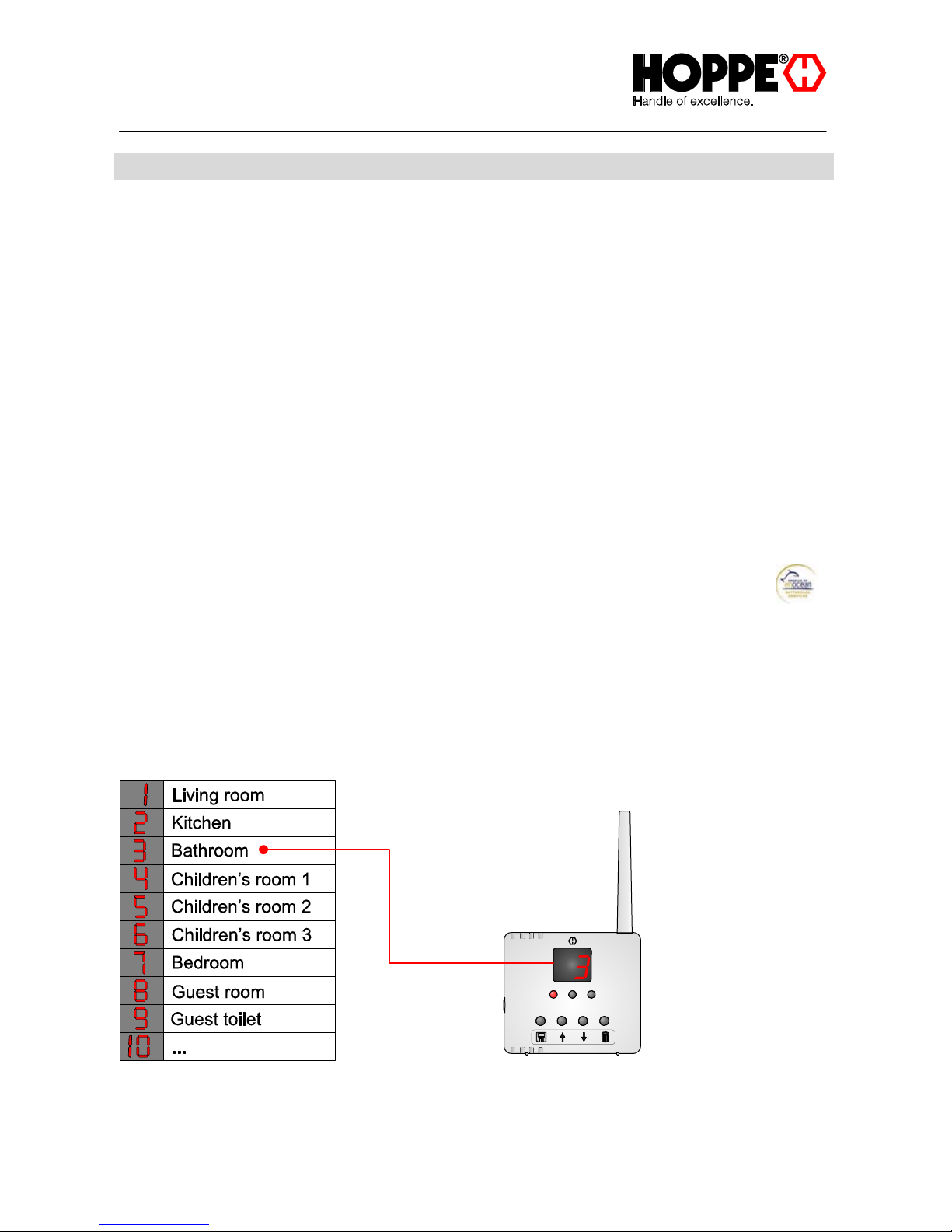
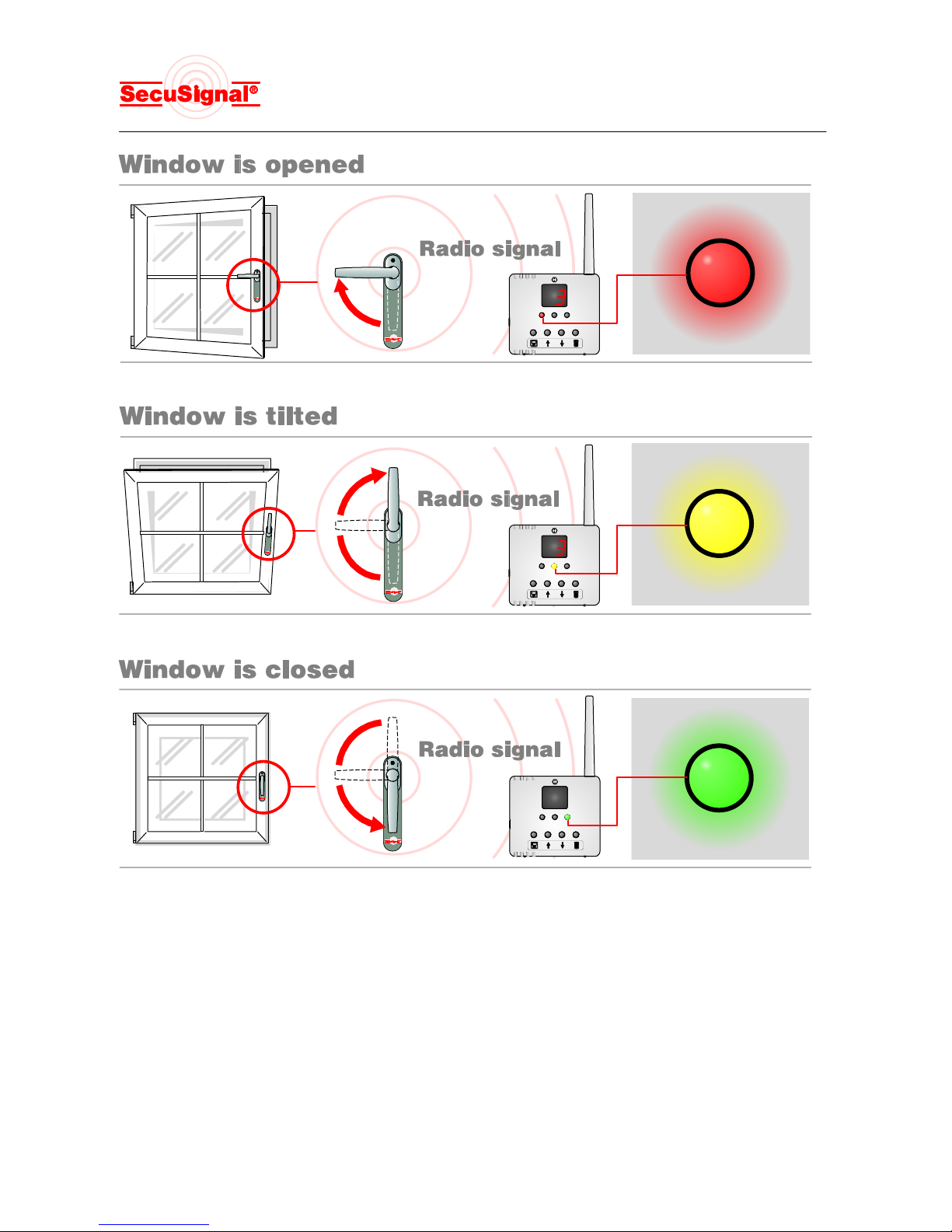
The related window and group number are displayed with one or two digits on the
display (see Figure 1, Item 10). This means that you always have the states of your
windows centrally in view (see Figures 2 und 3). Individual closed windows are not
indicated since this state is non-critical. The green LED lights up if all windows are
closed.
The SecuSignal
The SecuSignalThe SecuSignal
The SecuSignal
®®®®
window handle functions without wires or batteries
window handle functions without wires or batteries window handle functions without wires or batteries
window handle functions without wires or batteries ---- unlike other
unlike other unlike other
unlike other
systems.
systems.systems.
systems.
So there’s no need to check or change a battery. The power supply and the radio
signal are generated using a patented system* as the SecuSignal
®
window
handle is turned.
*EnOcean Technology
The radio signal is transmitted several times, in quick succession, as a window handle is operated, in order to enhance transmission reliability. The range in a building is
approximately 30 metres. Thanks to state-of-the-art technology, SecuSignal
®
operates
with low transmission power, which renders the system safe in respect of electromagnetic pollution.
Figure 2: Example table showing assignment and identification of rooms
Page 10
10
Figure 3: Mode of operation of SecuSignal
®
Page 11
11
2.3
2.32.3
2.3 State indicators
State indicatorsState indicators
State indicators on the receiver
on the receiver on the receiver
on the receiver
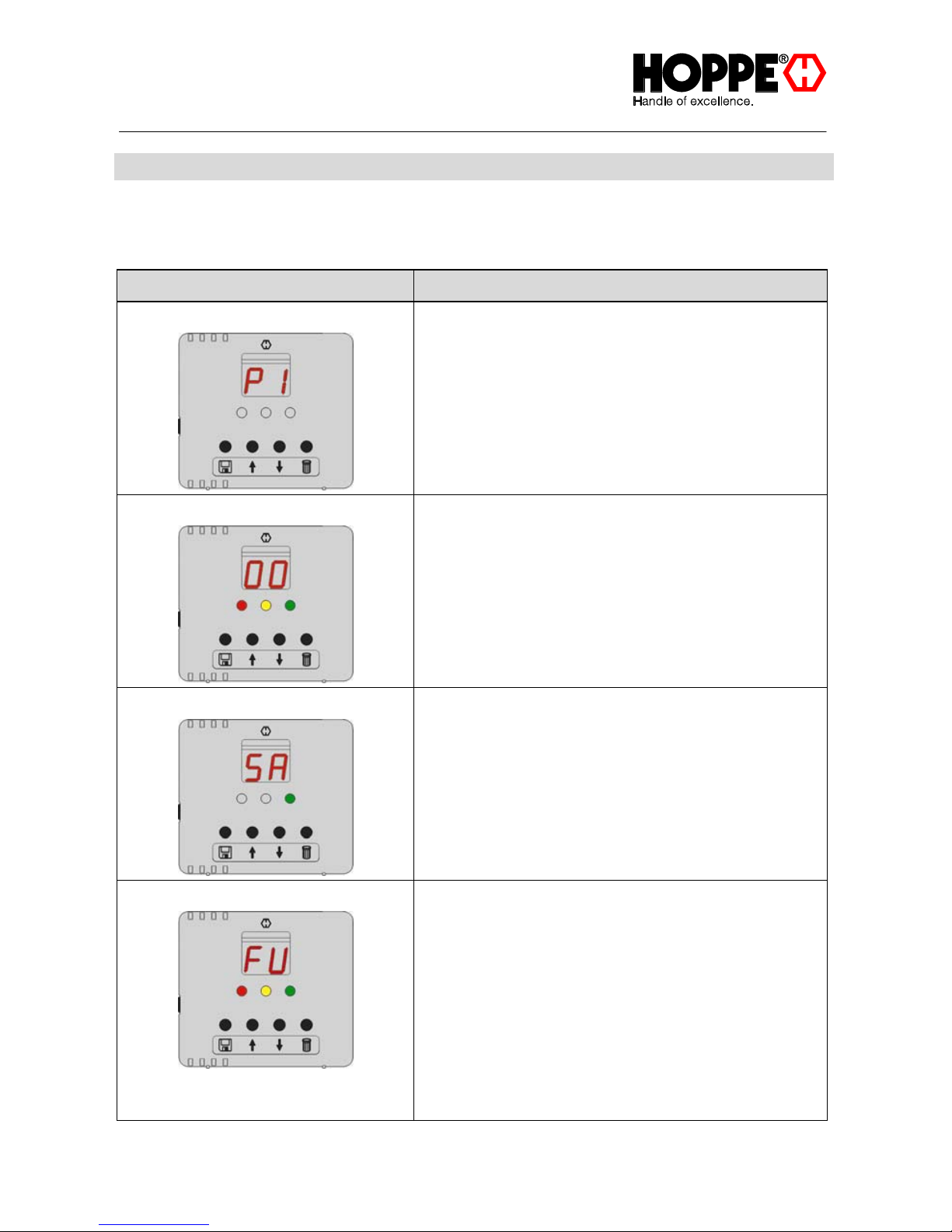
This Chapter provides you with an overview of the possible state indications and their
significance. The states are no longer shown at this point (states c.f. Figure 3).
State indication
State indicationState indication
State indication
Significance
Significance Significance
Significance
Program version
Program version Program version
Program version
The program version of the system (e.g. P1) is
displayed on initial operation and each time the
power is restored after a power failure.
Memory blank/Reset
Memory blank/Reset Memory blank/Reset
Memory blank/Reset
After all programmed radio transmitters have
been deleted
• "00" is displayed
and
• all 3 LEDs flash.
Programming OK
Programming OKProgramming OK
Programming OK
The device responds as follows if programming
has been successful:
•
"SA" (= "safe") is displayed.
• The green LED lights up
for 4 seconds.
Memory full
Memory fullMemory full
Memory full
Up to 128 radio transmitters in up to
99 groups can be programmed.
If you attempt to program more,
•
message "FU"
(= memory "full") is displayed and
•
all 3 LEDs light up.
Page 12
12
State indication
State indicationState indication
State indication
Significance
Significance Significance
Significance
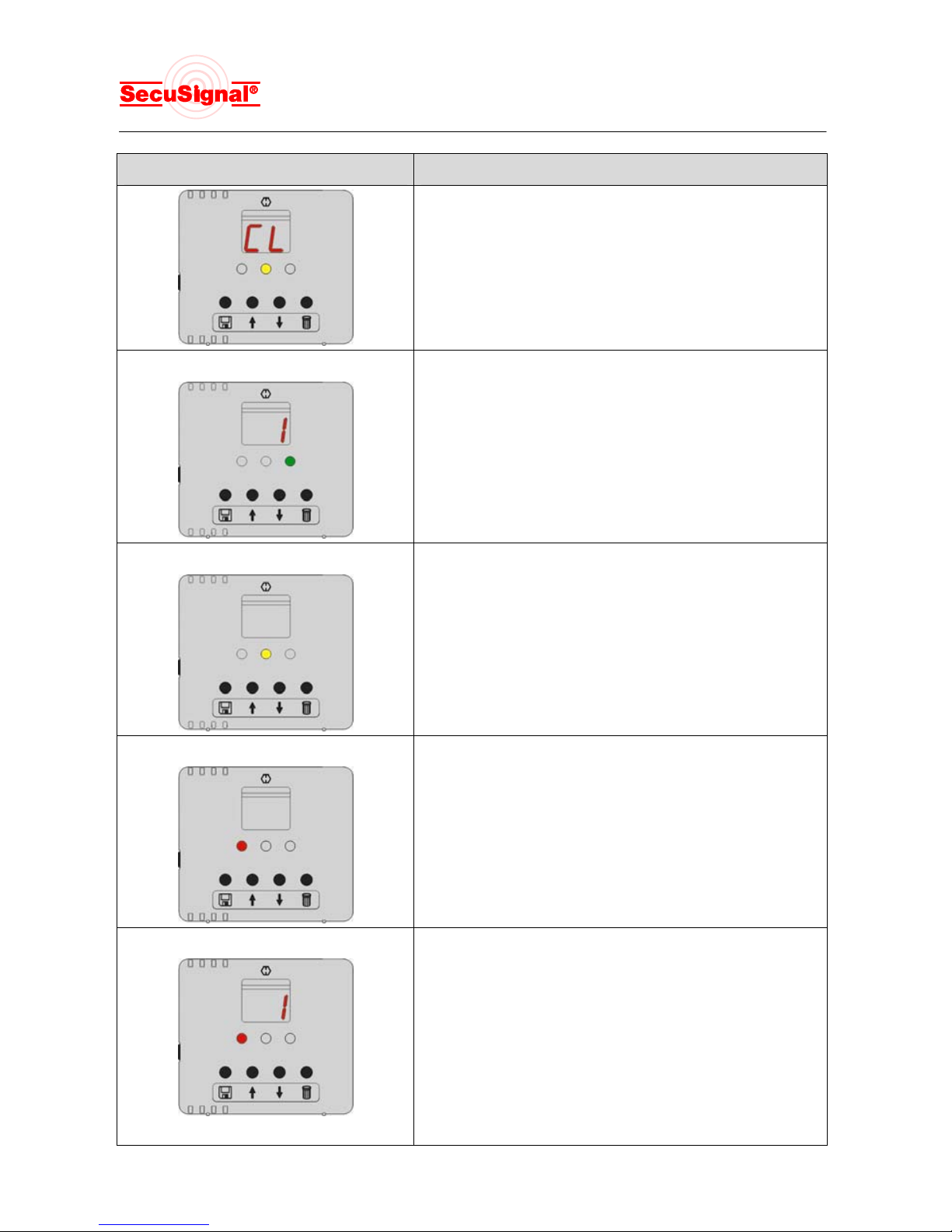
Deletion OK
Deletion OKDeletion OK
Deletion OK
If deletion has been performed correctly, the
device responds as follows:
•
Display "CL" (="clear") is shown.
• The amber LED lights
for 4 seconds.
Programming mode active
Programming mode activeProgramming mode active
Programming mode active
The device responds as follows when Pro-
gramming mode has been activated:
•
"1" indicating the first memory location is
displayed.
• The green LED flashes.
Delete function active
Delete function activeDelete function active
Delete function active
The device responds as follows after the Delete
function has been activated:
• No indication is visible.
•
The amber LED flashes.
Delete operation
Delete operationDelete operation
Delete operation
During the Delete operation,
•
the red LED lights up
for 4 seconds.
Display of non
Display of nonDisplay of non
Display of non----updated radio transmi
updated radio transmiupdated radio transmi
updated radio transmittttters
tersters
ters
After a power failure or after the power supply
has been cut off for longer than 30 seconds
and the power has then been restored, the
device responds as follows:
• Radio transmitters to which no connection
is currently established are shown on the
display every 2 seconds.
•
The red LED flashes.
Page 13

13
3333 Preparing the radio transmitters
Preparing the radio transmittersPreparing the radio transmitters
Preparing the radio transmitters
It is easier to program the radio transmitters when they have not yet been mounted on
the windows. This is why you are advised to carry out installation after programming.
To prepare the radio transmitters and window lever handles for programming:
• Remove all SecuSignal
®
window handles from the packaging.
• Now take a look at the enclosed assignment diagram (see also Figure 2).
•
Check the windows you want to equip with a SecuSignal
®
radio transmitter:
The overall width of the radio transmitter is 36 mm. If your window profiles have
trim strips or cover strips, check whether there is a level surface with a width of
18 mm from the centre of the square hole to the strip (see Figure 4).
If so, you can easily mount the SecuSignal
®
window handles on your windows.
Figure 4 Checking the window profile
• Define a numbering scheme or sequence for the windows you want to fit with
SecuSignal
®
window handles. The following options are available:
a) Consecutive numbering for each individual window
b) Some of the windows or all windows can be programmed as groups
You can program several windows of one room under the same number. You can
also program radio transmitters of different rooms under the same group number.
Important:
Important: Important:
Important: Note however that the states will then be shown only for the entire
group and not separately for each window of this group.
• Now enter the complete numbering in the assignment diagram.
•
Transfer the group numbers noted in the assignment diagram onto the labelling
stickers supplied. If you are storing several radio transmitters under the same
group number, note where they are on the assignment diagram.
Page 14

14
•
Now stick the labelling stickers onto the backs of the radio transmitters so that no
confusion occurs and place all window handles in order you want to program
them on an adequately large work surface.
• Check the turning position of the square hole in each radio transmitter: detach
each window handle from the radio transmitter and compare the rotary position of
the square hole with the illustration in Figure 5. If necessary, correct the rotary
position and carefully connect the window handle, with the handle position
pointing down, back to the radio transmitter (see Figure 5).
Figure 5: Checking the rotary position of the square hole
•
Danger
DangerDanger
Danger:::: If the square hole in the radio transmitter is wrongly positioned,
the states will be indicated wrongly, which could be dangerous, as outlined in
Chapter 1.3!
Page 15

15
4444 Programming
ProgrammingProgramming
Programming
This Chapter describes the programming and deletion functions of the SecuSignal
®
receiver. The radio transmitters are programmed individually on the receiver and can
be deleted again either individually or all together.
First put the receiver into operation to allow you to start programming:
Step
StepStep
Step Activity
ActivityActivity
Activity
Explanation/illustration
Explanation/illustrationExplanation/illustration
Explanation/illustration
1111 Putting receiver into operation
Putting receiver into operationPutting receiver into operation
Putting receiver into operation
Connect the receiver to a 230 V
socket outlet. Connect the elbow plug
(see Figure 1, Item 2) to the connec-
tion socket on the receiver (see Figure
1, Item 4).
2222 Display
Display Display
Display
The program version is shown for
2 seconds.
3333 State indication
State indicationState indication
State indication
"00" is shown on the display and all
three LEDs flash if the memory is
blank.
Page 16

16
4.1
4.14.1
4.1 Programming mode
Programming modeProgramming mode
Programming mode
Programming can be carried out only in Programming mode.
Proceed as follows in order to activate and de-activate Programming mode:
Step
StepStep
Step Activity
ActivityActivity
Activity
Explanation/illustration
Explanation/illustrationExplanation/illustration
Explanation/illustration
1111 Activating Programming mode
Activating Programming mode Activating Programming mode
Activating Programming mode
Press the button (see Figure 1, Item
5) and keep it pressed until the green
LED flashes. "1", indicating the first
memory location, is now shown on the
display.
2222 De
DeDe
De----activating Programming mode
activating Programming mode activating Programming mode
activating Programming mode
Press the button.
This quits Programming mode and the
device reverts to normal operating
state:
The green LED lights up if programming has been successful and all
windows are closed. The amber or
red LED lights up, depending on the
state of the windows.
Important
ImportantImportant
Important:
: :
: The Programming mode remains active for 30 seconds if you do not
press a button during this time. You must start programming during this time. If no
entry is made for 30 seconds (if you do not press a button), Programming mode deactivates automatically.
Page 17

17
4.2
4.24.2
4.2 Programming the radio transmitters
Programming the radio transmittersProgramming the radio transmitters
Programming the radio transmitters
Important
ImportantImportant
Important:
: :
: Please note the points below to prevent malfunctions when programming.
• Ensure the relevant radio transmitter and the receiver are at least 50 cm apart
when programming.
•
Always turn the window handles fully to 90°, i.e. the handles must always be
exactly vertical or exactly horizontal:
•
You can program a maximum of 128 radio transmitters in up to 99 groups.
Figure 6: Always turn and align the window handles precisely
• The SecuSignal® window handles to be programmed must be firmly in contact
with the appropriate radio transmitter in closed position:
Figure 7: Window handle in firm contact with the radio transmitter during programming
Page 18

18
Step
StepStep
Step Activity
ActivityActivity
Activity
Explanation/illustration
Explanation/illustrationExplanation/illustration
Explanation/illustration
1111 Activating Programming mode
Activating Programming mode Activating Programming mode
Activating Programming mode
C.f. Chapter 4.1.
2222 Selecting group number
Selecting group numberSelecting group number
Selecting group number
By pressing one of the arrow buttons
(see Figure 1, Item 6 and 7), set the
number of the group under which you
want to program the first available
radio transmitter.
Tip:
Tip: Tip:
Tip: Pressing one of the arrow
buttons for longer allows you to raise
or lower the numbers quickly.
3333 Programming radio transmitter
Programming radio transmitter Programming radio transmitter
Programming radio transmitter
Turn the window handle of the radio
transmitter to be programmed from
the closed to the open position and
back again within 5 seconds.
4444 Programming com
Programming comProgramming com
Programming complete?
plete?plete?
plete?
The device responds as follows if
programming has been successful:
• "SA" (="safe") is shown on the
display
•
The green LED lights up for
4 seconds. The radio transmitter
has then been registered and
stored.
Important:
Important: Important:
Important: Do not program any
others during this time.
Page 19

19
Step
StepStep
Step Activity
ActivityActivity
Activity
Explanation/illustration
Explanation/illustrationExplanation/illustration
Explanation/illustration
5555 Further programming?
Further programming?Further programming?
Further programming?
Repeat steps 2 to 4 for each further
radio transmitter you want to program.
Note that Programming mode remains
active only if you make a further entry
within 30 seconds (c.f. Chapter 4.1).
Note:
Note: Note:
Note: You can program
several radio transmitters under
the same group number.
6666 De
DeDe
De----activating Programming mode
activating Programming mode activating Programming mode
activating Programming mode
Press the button or wait 30 seconds
until the Programming mode de-activates automatically.
7777 Check programming
Check programmingCheck programming
Check programming
Test all three positions of the pro-
grammed window handles separately:
•
closed
• open and
•
tilted
one after the other.
Check that the LEDs light up correctly
(c.f. Chapter 2.2) and check the
group numbers.
Page 20

20
4.3
4.34.3
4.3 Updating radio transmitters after power failure
Updating radio transmitters after power failureUpdating radio transmitters after power failure
Updating radio transmitters after power failure
Radio transmitters must be updated (but not reprogrammed) after a power failure or
after the power supply has been cut off for longer than 30 seconds.
Step
StepStep
Step Activity
ActivityActivity
Activity
Explanation/illustration
Explanation/illustrationExplanation/illustration
Explanation/illustration
Display of non
Display of nonDisplay of non
Display of non----updated radio
updated radio updated radio
updated radio
transmi
transmitransmi
transmittttters
tersters
ters
The red LED flashes and the radio
transmitters to which there is no connection are shown every 2 seconds
on the display.
1111 Upda
UpdaUpda
Updating radio transmitters
ting radio transmittersting radio transmitters
ting radio transmitters
Turn all SecuSignal
®
window handles
whose radio transmitters are to be
updated from the closed to the open
position and back again.
2222 Checking updating
Checking updatingChecking updating
Checking updating
Checking the update on the display is
complete.
Tip:
Tip: Tip:
Tip: ask someone to help you by
turning the handles as described
above and observe whether this has
been shown on the display.
Update complete?
Update complete?Update complete?
Update complete?
When update is complete, the
display shows the current state of
your windows (see Chapter 2.2).
Page 21

21
4.4
4.44.4
4.4 Delete functions
Delete functionsDelete functions
Delete functions
The following Delete functions are possible:
• Deleting the programming of an individual radio transmitter
•
Deleting the programming of a radio transmitters no longer required
• Deleting the programming of all radio transmitters (Reset - fully deleting the content of the memory)
Note:
Note: Note:
Note: When you delete, the programming of a radio transmitter is removed from
all assigned group numbers!
A) Deleting programming of individual radio transmitters
A) Deleting programming of individual radio transmittersA) Deleting programming of individual radio transmitters
A) Deleting programming of individual radio transmitters
Step
StepStep
Step Activity
ActivityActivity
Activity
Explanation/illustration
Explanation/illustrationExplanation/illustration
Explanation/illustration
1111 Activating the Deleting function
Activating the Deleting function Activating the Deleting function
Activating the Deleting function
Press the button (see Figure 1, Item
8) and keep it pressed until the amber
LED flashes. No indication is shown
on the display.
2222 Delet
DeletDelet
Deleting a radio transmitte
ing a radio transmitteing a radio transmitte
ing a radio transmitterrrr
Turn the window handle of the radio
transmitter you want to delete from the
closed to the open position and back
again within 5 seconds.
3333 Deletion complete?
Deletion complete?Deletion complete?
Deletion complete?
If the delete operation has been
successful:
• "CL" (= "clear") is shown on the
display
• The amber LED lights up
Page 22

22
Step
StepStep
Step Activity
ActivityActivity
Activity
Explanation/illustration
Explanation/illustrationExplanation/illustration
Explanation/illustration
4444 Deleting further radio transmitte
Deleting further radio transmitteDeleting further radio transmitte
Deleting further radio transmitterrrr
You need to
de
dede
de----activate the Delete function
activate the Delete function activate the Delete function
activate the Delete function
so as to delete further radio transmitters.
Press the button and keep it
pressed until the device switches to
normal operating state.
Then repeat steps 1 to 4 for each
further radio transmitter to be deleted.
Note:
Note: Note:
Note: It is not possible to
delete programming of several
radio transmitters one after the
other.
This is to prevent you from inadvertently deleting data by operating other window handles if the
Delete function is active.
B) Deleting setting of radio transmitters no longer required
B) Deleting setting of radio transmitters no longer required B) Deleting setting of radio transmitters no longer required
B) Deleting setting of radio transmitters no longer required
Step
StepStep
Step Activity
ActivityActivity
Activity
Explanation/illustration
Explanation/illustrationExplanation/illustration
Explanation/illustration
1111 Interrupting power supply
Interrupting power supply Interrupting power supply
Interrupting power supply
Unplug the power supply unit from the
mains socket outlet and wait 1 minute
before plugging in again.
2222 Activating radio transmitters
Activating radio transmittersActivating radio transmitters
Activating radio transmitters
Turn all window handles the settings
of which are to remain stored from the
closed to the open position and back
again.
3333 Activating the Delete function
Activating the Delete function Activating the Delete function
Activating the Delete function
Press the button (see Figure 1, Item
8) and keep it pressed until the amber
LED flashes. Nothing is shown on the
display.
Page 23

23
Step
StepStep
Step Activity
ActivityActivity
Activity
Explanation/illustration
Explanation/illustrationExplanation/illustration
Explanation/illustration
4444 Deleting
Deleting Deleting
Deleting setting of radio transmitters
setting of radio transmitters setting of radio transmitters
setting of radio transmitters
no longer r
no longer rno longer r
no longer reeeequired
quiredquired
quired
Press the v button (see Figure 1, Item
7) and keep it pressed until the red
LED lights up for 4 seconds.
All settings not updated as described
in Step 2 have now been deleted.
C) Deleting settings of
C) Deleting settings ofC) Deleting settings of
C) Deleting settings of all radio transmitters
all radio transmitters all radio transmitters
all radio transmitters
Step
StepStep
Step Activity
ActivityActivity
Activity
Explanation/illustration
Explanation/illustrationExplanation/illustration
Explanation/illustration
1111 Interrupting power supply
Interrupting power supply Interrupting power supply
Interrupting power supply
Unplug the power supply unit from
the mains socket and wait 10 seconds
before plugging in again.
2222 Activati
ActivatiActivati
Activating Delete function
ng Delete function ng Delete function
ng Delete function
Press the button (see Figure 1, Item
8) and keep it pressed until the amber
LED flashes. Nothing is shown on the
display.
3333 Deleting all settings
Deleting all settings Deleting all settings
Deleting all settings
Press the v button (see Figure 1, Item
7) and keep it pressed until the red
LED lights up for 4 seconds.
Page 24

24
Step
StepStep
Step Activity
ActivityActivity
Activity
Explanation/illustration
Explanation/illustrationExplanation/illustration
Explanation/illustration
4444 Deletion completed?
Deletion completed?Deletion completed?
Deletion completed?
The device switches to Programming
mode after 4 seconds:
•
The green LED and group number "1" flash.
5555 De
DeDe
De----activating delete functio
activating delete functioactivating delete functio
activating delete functionnnn:
: : :
Press the button and keep it
pressed until the device switches to
normal operating mode.
All three LEDs and "00" on the display
flash if the memory has been deleted
entirely.
Reprogramming?
Reprogramming?Reprogramming?
Reprogramming?
Reprogram the radio transmitter as described in Chapter 4.2
Page 25

25
5555 Installation
InstallationInstallation
Installation
You need to remove your old window handles before fitting your new SecuSignal
®
ones.
5.1
5.15.1
5.1 Removing old window handles
Removing old window handlesRemoving old window handles
Removing old window handles
Step
StepStep
Step Activity
ActivityActivity
Activity
Explanation/illustration
Explanation/illustrationExplanation/illustration
Explanation/illustration
1111 Turn the old window handle to the 90°
position (open).
2222 Turn the cover plate also 90°.
3333 Use a screwdriver to undo the fixing
screws.
4444 Detach your old window handle from
the window profile.
Important:
Important: Important:
Important: Please ensure you
dispose of the window handle in line
with local waste disposal regulations
(see also Chapter 10 "Disposal").
Page 26

26
5.2
5.25.2
5.2 Fitting the SecuSignal
Fitting the SecuSignalFitting the SecuSignal
Fitting the SecuSignal
®®®®
window handle on the window
window handle on the window window handle on the window
window handle on the window
Step
StepStep
Step Activity
ActivityActivity
Activity
Explanation/illustration
Explanation/illustrationExplanation/illustration
Explanation/illustration
1111 Turn the SecuSignal® window handle
90° to the open position.
Important:
Important: Important:
Important: The window handle
must be in firm contact with the radio
transmitter (c.f. Chapter 4.2)!
2222 Turn the cover plate also 90°.
3333 Turn-and-tilt windows feature 10 mm
drillings as standard.
However, your window profile may
have drillings with a diameter of
12 mm. So check the drillings for the
lugs in the window profile.
If the holes have a 12 mm diameter,
please use the supplied slip-on rings
(see Figure 1, Item 14) to adapt the
drillings accordingly.
Page 27

27
Step
StepStep
Step Activity
ActivityActivity
Activity
Explanation/illustration
Explanation/illustrationExplanation/illustration
Explanation/illustration
4444 Now fit the SecuSignal® window han-
dle, including radio transmitter,
onto the window profile.
5555 Firmly screw the SecuSignal® window
handle and the radio transmitter
onto the window profile with the
screws provided.
6666 Turn the cover plate 90° back to the
locked position. Turn the window
handle to the tilt position and the
closed position as a check.
Page 28

28
5.3
5.35.3
5.3 Installing the SecuSignal
Installing the SecuSignalInstalling the SecuSignal
Installing the SecuSignal
®®®®
receiver
receiver receiver
receiver
We recommend you position the SecuSignal® receiver in your hall. This will allow you
to see at a glance quickly and easily whether all windows are closed or not.
Pleas
PleasPleas
Please note the following points before installation:
e note the following points before installation: e note the following points before installation:
e note the following points before installation:
• There must be a 230 V socket in the direct vicinity. This socket should be used
for the receiver only, since connection to the radio transmitters will be lost (see
Chapter 4.3) if the power supply is cut off.
• Install the receiver out of children’s reach.
•
Installation at eye level is recommended so the display can be easily read.
Tip:
Tip: Tip:
Tip: Test the connection to the radio transmitters before installing the receiver by
simply placing it on the floor of the installation location as a check. Ask someone to
watch the display and then operate all window handles. If transmission from distant
radio transmitters is not perfect, try out another installation location and/or note the
information in Chapter 7 "Troubleshooting" (you may need to install a signal amplifier
(repeater) if transmission conditions are poor).
There are two installation options:
A) Installing the receiver free
A) Installing the receiver freeA) Installing the receiver free
A) Installing the receiver free----standing
standingstanding
standing
You can place the receiver anywhere you like.
Caution
CautionCaution
Caution: Choose the installation location carefully to prevent the receiver of
being knocked over or the cable being tugged.
B) Wall mounting
B) Wall mountingB) Wall mounting
B) Wall mounting
Use the enclosed fixing screw with the dowel (see Figure 1, Item 3). If you are using
the dowel, drill a 6mm-diameter hole.
Screw in and hang the receiver by the eyelet over the screw head (see Figure 8).
Press the receiver gently down so as to fix it in position and then check if it is firm.
Figure 8: Wall mounting of the SecuSignal® receiver
Page 29

29
Connect the elbow plug of the power supply unit (see Figure 1, Item 4) on the
receiver and plug the power supply unit into the socket.
Check that the system is functioning correctly
•
The green LED will light up when all windows are closed.
• The amber or red LED will flash and the relevant group number will be shown on
the display if windows are tilted or open.
Danger
DangerDanger
Danger: The SecuSignal® receiver must not be covered by textiles (e.g. coat
stands) during operation since this could cause heat build-up and lead to a fire!
Page 30

30
6666 Operation
OperationOperation
Operation
In normal operation, the state of each programmed window is shown, as signalled
by the radio transmitter to the receiver (c.f. Chapter 2.3 "State indications on the
receiver").
You will see the group numbers of the windows or window groups that are tilted or
open on the display. This display goes up automatically (number 1 to 99), each number being displayed for approx. 2 seconds.
Simply press one of the arrow buttons to poll the group numbers manually.
This allows you to "scroll" through the list of group numbers. This is especially helpful
if you have programmed a large number of radio transmitters.
Checking group numbers manually
Checking group numbers manuallyChecking group numbers manually
Checking group numbers manually
Step
StepStep
Step Activity
ActivityActivity
Activity
Explanation/illustration
Explanation/illustrationExplanation/illustration
Explanation/illustration
1111 Selecting group numb
Selecting group numbSelecting group numb
Selecting group number
erer
er
Press one of the arrow buttons repeatedly (see Figure 1, Item 6 and 7)
to set the group number of the radio
transmitter for which you want to have
the state of the window checked.
Page 31

31
7777 Troubleshooting
TroubleshootingTroubleshooting
Troubleshooting
Danger
DangerDanger
Danger: Ensure that repairs to the 230 V mains are performed only by a quali-
fied electrician. Otherwise, there will be a risk of lethal electric shock!
Problem/fault
Problem/faultProblem/fault
Problem/fault
Possible cause(s)
Possible cause(s)Possible cause(s)
Possible cause(s)
Remedy
RemedyRemedy
Remedy
Nothing shown on the
display and no LED
lights.
Power failure or defective fuse
The 230 V mains socket
is defective.
The power supply unit
or the receiver is defective.
¾ Check the fuses in your
fuse box.
¾ Have a qualified electrician repair the mains socket.
¾ Have a qualified electrician inspect the device.
Radio signals are received only sporadically
at the receiver or not at
all.
The distance between
transmitter(s) and receiver is too distant or too
close.
Ceilings and walls may
be preventing transmission (see Figure 9).
Window handles and
radio transmitters are not
mounted correctly.
¾
Reduce or extend the
distance(s) and/or try out
another location for the receiver.
¾ If large distances need to
be covered, install a signal
amplifier (repeater; ask
HOPPE AG for stockists).
¾ Check installation
Figure 9: Signal attenuation as the result of ceilings and room walls
Error code on display,
e.g. "E1"
Internal error ¾ Cut off power supply for
1 minute. Repeat this procedure twice if necessary.
The display does not
correspond to the current state of window.
The window handle is
not absolutely vertical or
horizontal.
¾ Always turn the window
handles fully through 90°
(see Chapter 4.2).
Page 32

32
Problem/fault
Problem/faultProblem/fault
Problem/fault
Possible cause(s)
Possible cause(s)Possible cause(s)
Possible cause(s)
Remedy
RemedyRemedy
Remedy
¾ Contact your window
manufacturer to have the
side/bottom hung sash fitting
(=window gears) serviced.
Important:
Important: Important:
Important: Radio transmission may be adversely affected by an unfavourable
electromagnetic field.
Caution
CautionCaution
Caution: Do not tamper with the unit!
Page 33

33
8888 Technical data
Technical dataTechnical data
Technical data
"SecuS
"SecuS"SecuS
"SecuSignal
ignalignal
ignal
®®®®
System"
System" System"
System"
Radio transmitter
Radio transmitterRadio transmitter
Radio transmitter
Frequency 868.3 MHz
Bandwidth 280 kHz
Modulation ASK (Amplitude Shift Keying)
Transfer rate 120 kbps +/- 5 %
Transmit power max. 10 mW EIRP
Temperature range -20 °C to 65 °C
Storage in dry interiors
Rec
RecRec
Receiver
eivereiver
eiver
Power supply unit, input 230 V~/30 mA/50 Hz
UK power supply unit, input 230-240 V~/28 mA/50 Hz
Power supply unit, output 9.5 V/400 mA
Temperature range 0 °C to 35 °C
Storage in dry interiors
Page 34

34
9999 Maintenance and cleaning
Maintenance and cleaningMaintenance and cleaning
Maintenance and cleaning
The SecuSignal® radio transmitter is a wireless device requiring no batteries. So, it is
maintenance-free.
Clean the housings of the devices with a slightly damp cloth. Do not use aggressive
cleaning agents or abrasives.
10
1010
10 Disposal
DisposalDisposal
Disposal
The symbol on the product and its packaging indicates that the product
must not be disposed of as normal domestic waste. Users are obliged
to dispose of old devices at a collection point for old electrical and electronic appliances. Waste sorting and proper disposal of your old equipment will make a contribution towards maintaining natural resources and will ensure
recycling, thereby protecting human health and being considerate towards the
environment. Please contact your local council, local waste disposal plant or the shop
where you purchased the device for information on local collection points for used
equipment.
11
1111
11 CE conformity
CE conformityCE conformity
CE conformity
The SecuSignal® System bears the CE mark and consequently complies with the
applicable European Directives.
HOPPE AG hereby confirms that this product
complies with the following directives:
•
EC Directive 1999/5/EC "Radio and Telecommunications
Terminal Equipment (R&TTE) Directive"
• EC Directive 89/336/EEC "Electromagnetic Compatibility"
The Declaration of Conformity is available for inspection at the manufacturer’s
premises.
12
1212
12 Servicing
ServicingServicing
Servicing
Please contact our German Hotline on should you have any questions or problems:
Phone 00800 6428 932-0
Or simply refer to your HOPPE contact (see also page 2).
Page 35

35
13
1313
13 Guarantee
GuaranteeGuarantee
Guarantee
HOPPE operational guarantee for door and window hardware
Guarantee:
Guarantee:Guarantee:
Guarantee:
As manufacturer, we guarantee, under the conditions set forth below, the durability of
properly-used HOPPE hardware, over and above the seller's legal liability for material
defects. The guarantee applies to the function of HOPPE door and window hardware
and includes all defects which can be proved to have been caused through fault in
manufacturing or material.
The operational guarantee includes the following features:
• transfer of the rotary motion to the door lock or the window turn-/tilt-hardware
• locking mechanism (in the case of window handles with special functions: lock-
able, push-to-open, Secustik
®
)
Guarantee Exclusions:
Guarantee Exclusions:Guarantee Exclusions:
Guarantee Exclusions:
All interchangeable parts, such as screws, connecting spindles etc, are excluded
from this guarantee. Furthermore, no liability will be assumed for any damage caused
through:
•
unsuitable and improper use,
• incorrect or negligent treatment,
•
the disregard of instructions for fitting or care, alterations and repair
by the enduser or a third party,
•
chemical or physical agents, where the surface has been improperly
treated, for example by sharp instruments,
•
elements (door, window) and/or hardware parts (e.g. locks, hinges etc.)
which do not work perfectly.
Guarantee Conditions:
Guarantee Conditions: Guarantee Conditions:
Guarantee Conditions:
This guarantee relates, within the guarantee period, solely to either replacing the
handle free of charge or to repairing same free of charge, on behalf of the original
enduser, this decision being at HOPPE's discretion. Costs and expenses, postage
and packaging and similar, as incurred by the complainant, shall not be reimbursed.
Page 36

36
Claim to guarantee shall only occur on presentation of the product itself and the receipt and shall not exceed the original purchase price.
Guarantee period:
Guarantee period:Guarantee period:
Guarantee period:
The guarantee period shall be for 10 years and shall begin on the day of purchase by
the original enduser. In the event of any claim, complainants should address themselves directly to the seller or manufacturer presenting both the product and the receipt.
HOPPE Holding AG
Via Friedrich Hoppe
CH-7537 Müstair
Switzerland
+41 (0)81 851 66 00
+41 (0)81 851 66 66
info.ch@hoppe.com
www.hoppe.com
Page 37

37
14
1414
14 Index
IndexIndex
Index
Annex....................................................... 38
CE conformity .......................................... 34
Checking the square hole........................ 14
Checking the window profile.................... 13
Cleaning................................................... 34
Correct use ................................................ 6
Delete functions ....................................... 21
All radio transmitters...........................23
Individual radio transmitters ............... 21
Radio transmitters no longer required 22
Disposal ...................................................34
Function overview......................................7
Guarantee................................................35
Guide ......................................................... 4
Installation................................................ 25
Installing radio transmitters ................ 26
Wall mounting..................................... 28
Mode of operation ..................................... 9
Operating controls ..................................... 7
Operation................................................. 30
Power failure............................................ 20
Preparing radio transmitters .................... 13
Product information ................................... 4
Programming........................................... 15
Programming mode................................. 16
Programming the radio transmitters ........ 17
Removing old window handles................ 25
Safety information ..................................... 5
Scope of delivery....................................... 6
Signal reduction....................................... 31
State indicators........................................ 11
Technical data ......................................... 33
Troubleshooting....................................... 31
Updating radio transmitters ..................... 20
Page 38

38
Annex
AnnexAnnex
Annex
A1
A1A1
A1 Secustik
SecustikSecustik
Secustik
®®®®
window
window window
window handles
handleshandles
handles
Secusti
SecustiSecusti
Secustikkkk
®®®®
---
- the window lever handle with extra security that you can hear
the window lever handle with extra security that you can hear the window lever handle with extra security that you can hear
the window lever handle with extra security that you can hear
The window handles of the SecuSignal® System all feature Secustik® function.
The Secustik
®
window handles incorporate a patented latching mechanism for inte-
grated basic security.
This function prevents the window fitting being moved by unauthorised persons on
the outside. A coupling element between window handle and square pin acts as a
"mechanical diode" in this case. Admittedly, it allows the window handle to be operated normally from the inside but locks the window handle if someone attempts to turn
the window handle from the outside using the fitting.
This means that the window handles comply with the requirements of AhS RALRG607/13. If the Secustik
®
window handles are turned through 180° from locked position to tilt position, the self-latching locking mechanism engages with a precision click
in various handle positions. This typical Secustik
®
sound means greater wind
greater windgreater wind
greater windoooow
w w
w
security that you can hear
security that you can hearsecurity that you can hear
security that you can hear.
You can find more information on the patented Secustik
®
system on the Internet at
www.hoppe.com.
German institute for
quality assurance and
labelling
Page 39

39
Installation and User Manual IDNo.: SecuV100EN/11-2006
Page 40

 Loading...