

Page 1
NOTICE
3DANGER
3WARNING
3CAUTION
18 FIT JAZZ-32T5A6100.book 0 ページ 2017年8月23日 水曜日 午前11時24分
As you read this manual, you will find Information that is preceded
by a symbol. This information is intended to help you avoid
damage to your vehicle, other property, or the environment.
Symbols on labels attached to your vehicle are to
remind you to read this owner’s manual for proper and safe
operation of your vehicle.
is colour-coded to indicate “danger” (red), “warning”
(orange), or “caution” (amber).
2 Safety Labels P. 83
A Few Words About Safety
Your safety, and the safety of others, is very important. And
operating this vehicle safely is an important responsibility.
To help you make informed decisions about safety, we have
provided operating procedures and other information on labels and
in this manual. This information alerts you to potential hazards that
could hurt you or others.
Of course, it is not practical or possible to warn you about all the
hazards associated with operating or maintaining your vehicle. You
must use your own good judgement.
You will find this important safety information in a variety of forms,
including:
● Safety Labels - on the vehicle.
● Safety Messages - preceded by a safety alert symbol
one of three signal words: DANGER, WARNING, or CAUTION.
These signal words mean:
You WILL be KILLED or SERIOUSLY HURT if
you don't follow instructions.
You CAN be KILLED or SERIOUSLY HURT if
you don't follow instructions.
You CAN be KILLED or SERIOUSLY HURT if
you don' t follow instructions.
You CAN be HURT if you don't follow
instructions.
● Safety Headings - such as Important Safety Precautions.
● Safety Section - such as Safe Driving.
● Instructions - how to use this vehicle correctly and safely.
This entire book is filled with important safety information - please
read it carefully.
3 and
Page 2
18 FIT JAZZ-32T5A6100.book 1 ページ 2017年8月23日 水曜日 午前11時24分
Event Data Recorders
Your vehicle is equipped with several devices commonly referred to
as Event Data Recorders. They record various types of real time
vehicle data such as SRS airbag deployment and SRS system
components failure.
This data belongs to the vehicle owner and may not be accessed by
anyone else except as legally required or with the permission of the
vehicle owner.
However this data may be accessed by Honda, its authorised
dealers and authorised repairers, employees, representatives and
contractors only for the purpose of the technical diagnosis,
research and development of the vehicle.
Service Diagnostic Recorders
Your vehicle is equipped with service-related devices that record
information about powertrain performance and driving conditions.
The data can be used to help technicians diagnose, repair and
maintain the vehicle. This data may not be accessed by anyone else
except as legally required or with the permission of the vehicle
owner.
However this data may be accessed by Honda, its authorised
dealers and authorised repairers, employees, representatives and
contractors only for the purpose of the technical diagnosis,
research and development of the vehicle.
Page 3
18 FIT JAZZ-32T5A6100.book 2 ページ 2017年8月23日 水曜日 午前11時24分
Contents
This owner’s manual should be considered a permanent part of the
vehicle and should remain with the vehicle when it is sold.
This owner’s manual covers all models of your vehicle. You may find
descriptions of equipment and features that are not on your
particular model.
Images throughout this owner’s manual represent features and
equipment that are available on some, but not all, models. Your
particular model may not have some of these features.
The information and specifications included in this publication were
in effect at the time of approval for printing. Honda Motor Co., Ltd.
reserves the right, however, to discontinue or change specifications
or design at any time without notice and without incurring any
obligation.
Although this manual is applicable to both right-hand and left-hand
drive models, the illustrations contained in this manual mainly refer
to the left-hand drive models.
2 Safe Driving P. 31
For Safe Driving P. 32 Seat Belts P. 36 Airbags P. 49
2 Instrument Panel P. 85
Indicators P. 86 Gauges and Multi-Information Display P. 123
2 Controls P. 139
Clock P. 140 Locking and Unlocking the Doors P. 142
Opening and Closing the Windows P. 162
Adjusting the Seats P. 187
Climate Control System
*
P. 213
2 Features P. 219
Audio System P. 220 Audio System Basic Operation P. 227, 257
Customized Features P. 313 Hands-Free Telephone System P. 339, 362
2 Driving P. 381
Before Driving P. 382 Towing a Trailer P. 386 When Driving P. 392
Multi-View Rear Camera
*
P. 469 Refueling P. 471
2 Maintenance P. 475
Before Performing Maintenance P. 476 Service Reminder System P. 479
Checking and Maintaining Wiper Blades P. 511
Heating and Cooling System
*
/Climate Control System* Maintenance P. 529
2 Handling the Unexpected P. 539
Tools P. 540 If a Tyre Goes Flat P. 541
Overheating P. 566 Indicator, Coming On/Blinking P. 568
2 Information P. 589
Specifications P. 590 Identification Numbers P. 594
Page 4
18 FIT JAZZ-32T5A6100.book 3 ページ 2017年8月23日 水曜日 午前11時24分
Contents
Child Safety P. 62 Exhaust Gas Hazard P. 82 Safety Labels P. 83
Opening and Closing the Tailgate P. 156 Security System P. 159
Operating the Switches Around the Steering Wheel P. 164 Adjusting the Mirrors P. 185
Interior Lights/Interior Convenience Items P. 199 Heating and Cooling System
Audio Error Messages P. 305 General Information on the Audio System P. 308
Braking P. 453 Parking Your Vehicle P. 463
Fuel Economy and CO
Maintenance Schedule* P. 484 Maintenance Under the Bonnet P. 488 Replacing Light Bulbs P. 499
Checking and Maintaining Tyres P. 515 Battery P. 522 Remote Transmitter Care P. 527
Cleaning P. 532 Accessories and Modifications P. 537
Engine Does Not Start P. 559 Jump Starting P. 562 Shift Lever Does Not Move P. 565
Fuses P. 573 Emergency Towing P. 584 When You Cannot Open the Tailgate P. 587
Emissions P. 473
2
*
P. 209
Quick Reference Guide
Safe Driving
Instrument Panel
Controls
Features
Driving
Maintenance
Handling the Unexpected
Information
Index
P. 4
P. 31
P. 85
P. 139
P. 219
P. 381
P. 475
P. 539
P. 589
P. 609
Devices that Emit Radio Waves* P. 595 EC Declaration of Conformity Content Outline* P. 607
Page 5
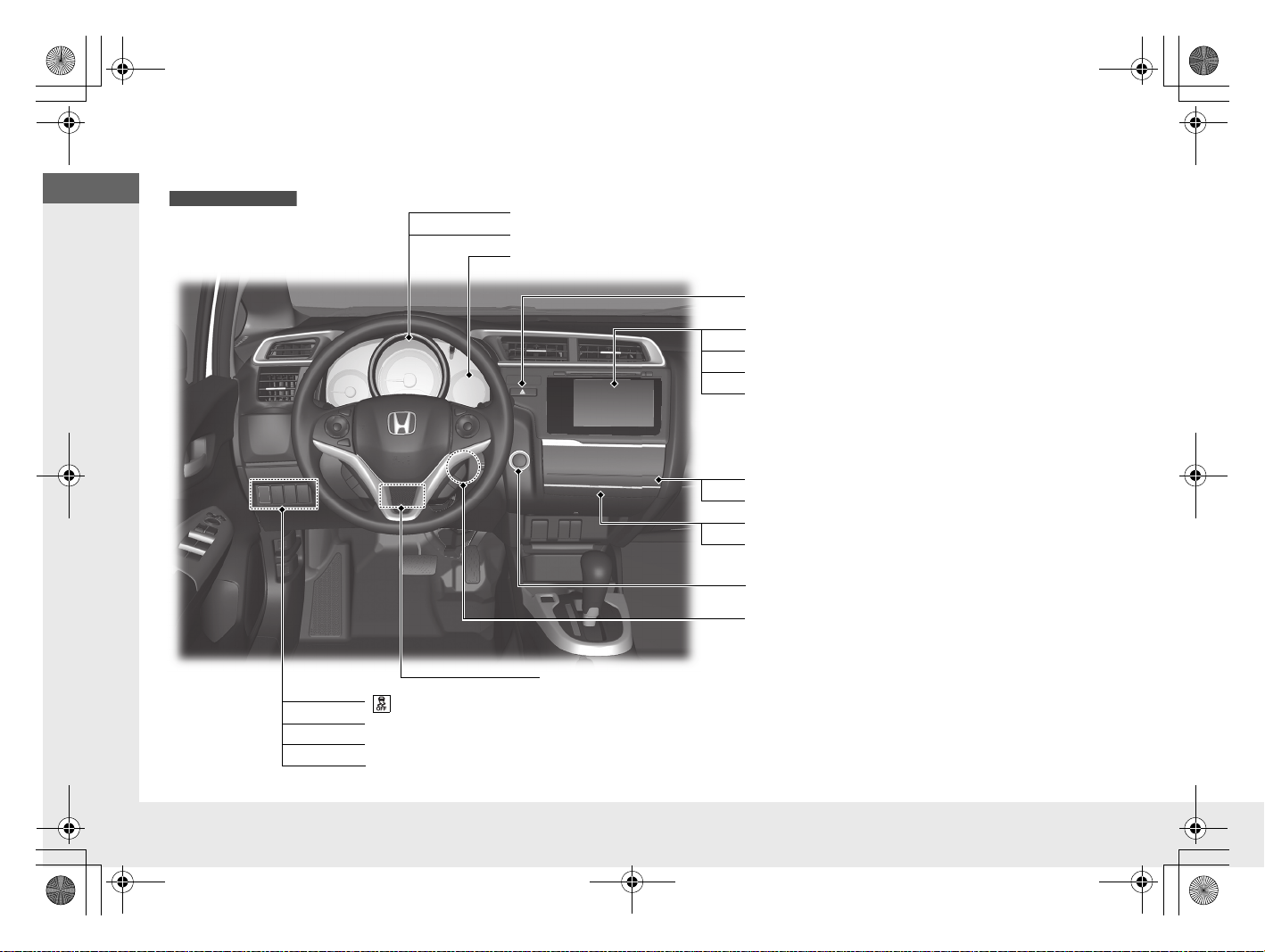
Quick Reference Guide
*1: Models with the keyless access system have an ENGINE START/STOP button instead of an ignition switch.
Left-hand drive type
❙ (Vehicle Stability Assist (VSA) System OFF) Button (P447)
❙ Parking Sensor System Button
*
(P465)
❙ Headlight Adjuster
*
(P174)
❙ Lane Departure Warning Button
*
(P439)
❙ Steering Wheel Adjustments (P184)
❙ ENGINE START/STOP Button
*1
(P165)
❙ Ignition Switch
*
(P164)
❙ Rear Window Demister (P183)
❙ Heated Door Mirror
*
(P183)
❙ Heating and Cooling System
*
(P209)
❙ Climate Control System
*
(P213)
❙ Clock (P140)
❙ Audio/Information Screen (P258)
❙ Audio System (P227, 257)
❙ Navigation System
*
() See the Navigation System Manual
❙ Hazard Warning Button
❙ System Indicators (P86)
❙ Gauges (P123)
❙ Multi-Information Display (P124)
18 FIT JAZZ-32T5A6100.book 4 ページ 2017年8月23日 水曜日 午前11時24分
Quick Reference Guide
Visual Index
4
Page 6
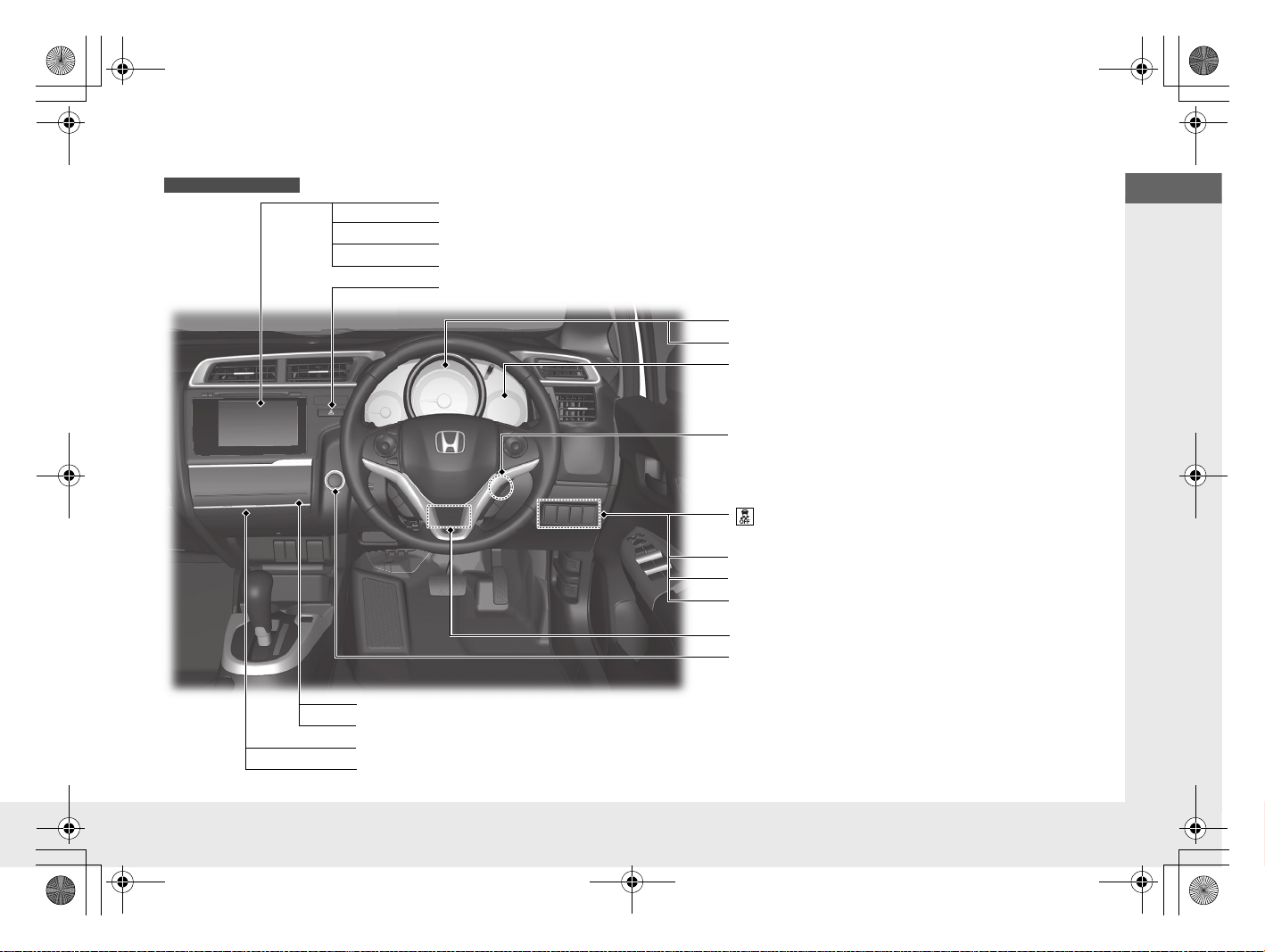
Quick Reference Guide
*1: Models with the keyless access system have an ENGINE START/STOP button instead of an ignition switch.
Right-hand drive type
❙ Rear Window Demister (P183)
❙ Heated Door Mirror
*
(P183)
❙ Climate Control System
*
(P213)
❙ Heating and Cooling System
*
(P209)
❙ Steering Wheel Adjustments (P184)
❙ ENGINE START/STOP Button
*1
(P165)
❙ (Vehicle Stability Assist (VSA) System
OFF) Button
(P447)
❙ Parking Sensor System Button
*
(P465)
❙ Headlight Adjuster
*
(P174)
❙ Lane Departure Warning Button
*
(P439)
❙ Ignition Switch
*
(P164)
❙ System Indicators (P86)
❙ Gauges (P123)
❙ Multi-Information Display (P124)
❙ Clock (P140)
❙ Audio/Information Screen (P258)
❙ Audio System (P 227, 257)
❙ Navigation System
*
() See the Navigation System Manual
❙ Hazard Warning Button
* Not available on all models
18 FIT JAZZ-32T5A6100.book 5 ページ 2017年8月23日 水曜日 午前11時24分
5
Page 7
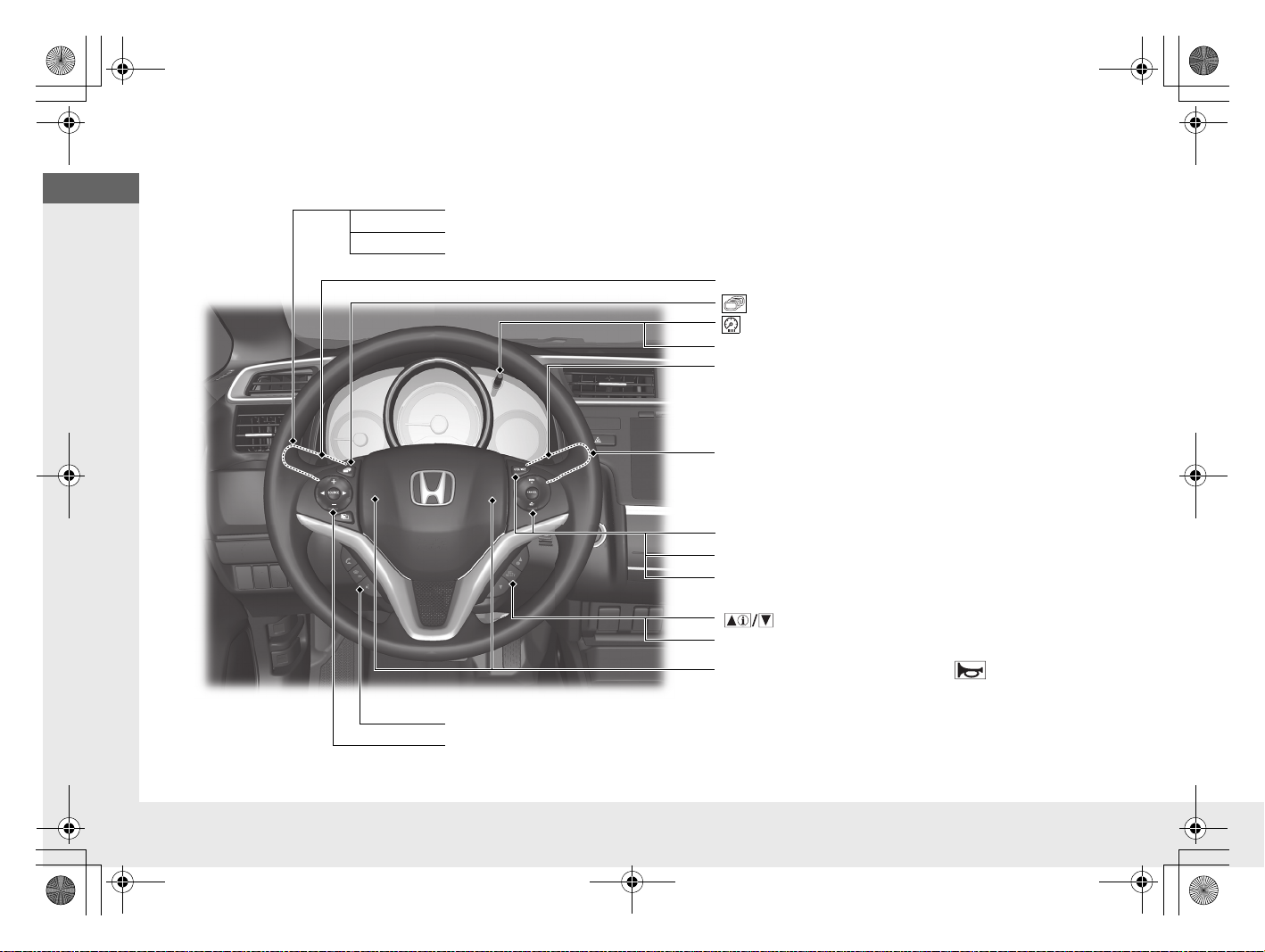
Quick Reference Guide
❙ Headlights/Turn Signals (P169, 170)
❙ Front Fog Lights
*
(P172)
❙ Rear Fog Light (P172)
❙ Paddle Shifter (Shift down)
*
(P405)
❙ (Display) Button
*
(P258)
❙ (Select/Reset) Knob (P125)
❙ Brightness Control (P182)
❙ Paddle Shifter (Shift up)
*
(P405)
❙ Wipers/Washers (P179)
❙ Hands-Free Telephone System Buttons (P339, 362)
❙ Audio Remote Controls (P225)
❙ Horn (Press an area around .)
❙ (information) Buttons (P124)
❙ SEL/RESET Button (P125)
❙ Cruise Control Buttons (P420)
❙ Adjustable Speed Limiter Buttons (P423)
❙ Intelligent Speed Limiter Buttons
*
(P427)
18 FIT JAZZ-32T5A6100.book 6 ページ 2017年8月23日 水曜日 午前11時24分
Visual Index
6
Page 8
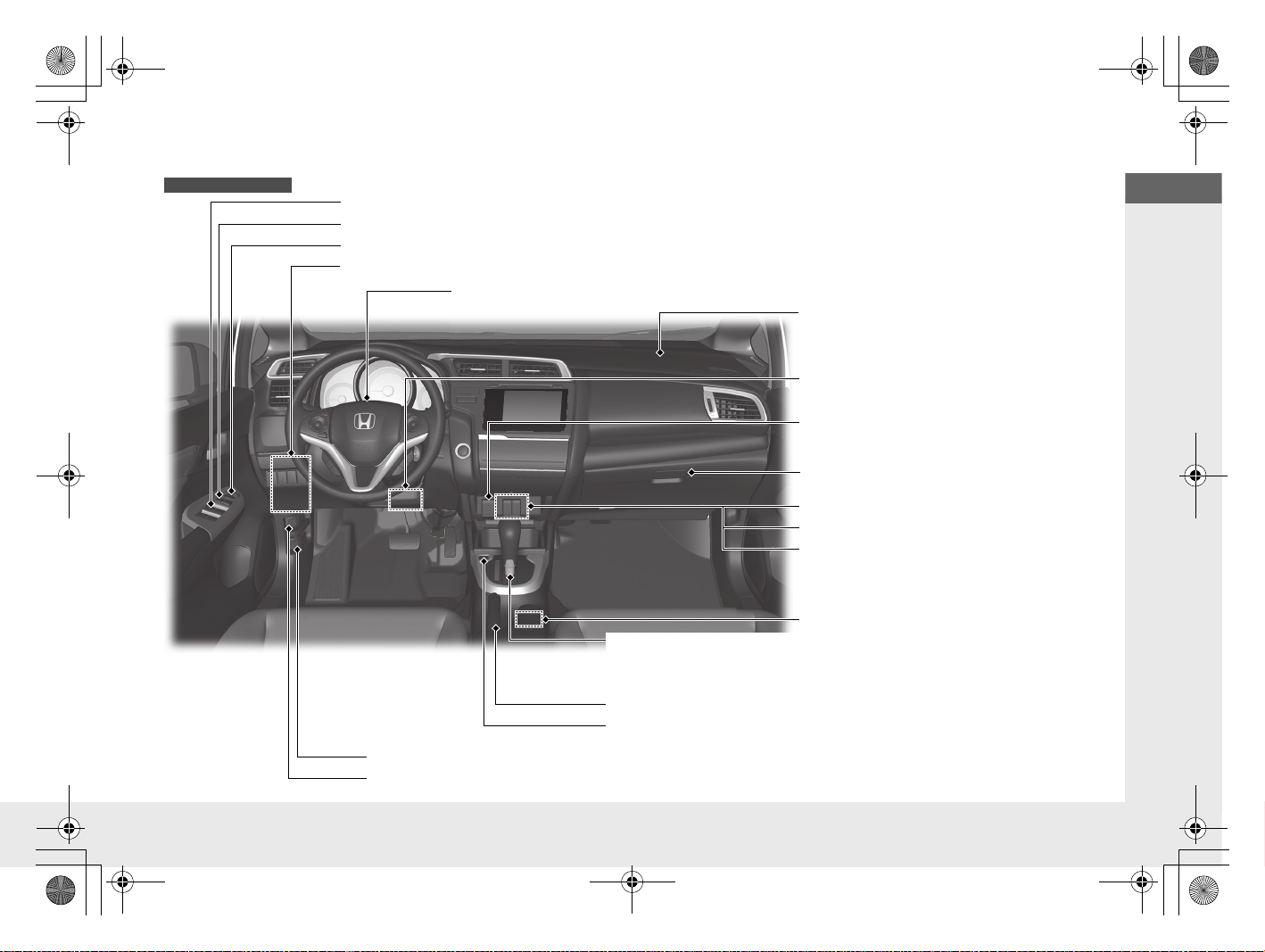
Quick Reference Guide
Left-hand drive type
❙ Driver's Front Airbag (P51)
❙ Power Window Switches (P162)
❙ Power Door Lock Master Switch (P154)
❙ Door Mirror Controls (P186)
❙ Driver Side Interior Fuse Box (P576, 578)
❙ Passenger's Front Airbag
(P51)
❙ USB Port (P221)
❙ HDMI
TM
Port* (P222)
❙ Auxiliary Input Jack
*
(P222)
❙ Shift Lever
Continuously Variable Transmission
*
(P402)
Manual Transmission* (P407)
❙ Parking Brake (P453)
❙ Auto Idle Stop OFF Button (P411, 416)
❙ Seat Heater Switches (P208)
❙ Bonnet Release Handle (P489)
❙ Fuel Fill Door Release Handle (P472)
❙ Driver Side Interior Fuse Box
(P580)
❙ Accessory Power Socket (P205)
❙ Glove Box (P202)
* Not available on all models
18 FIT JAZZ-32T5A6100.book 7 ページ 2017年8月23日 水曜日 午前11時24分
7
Page 9
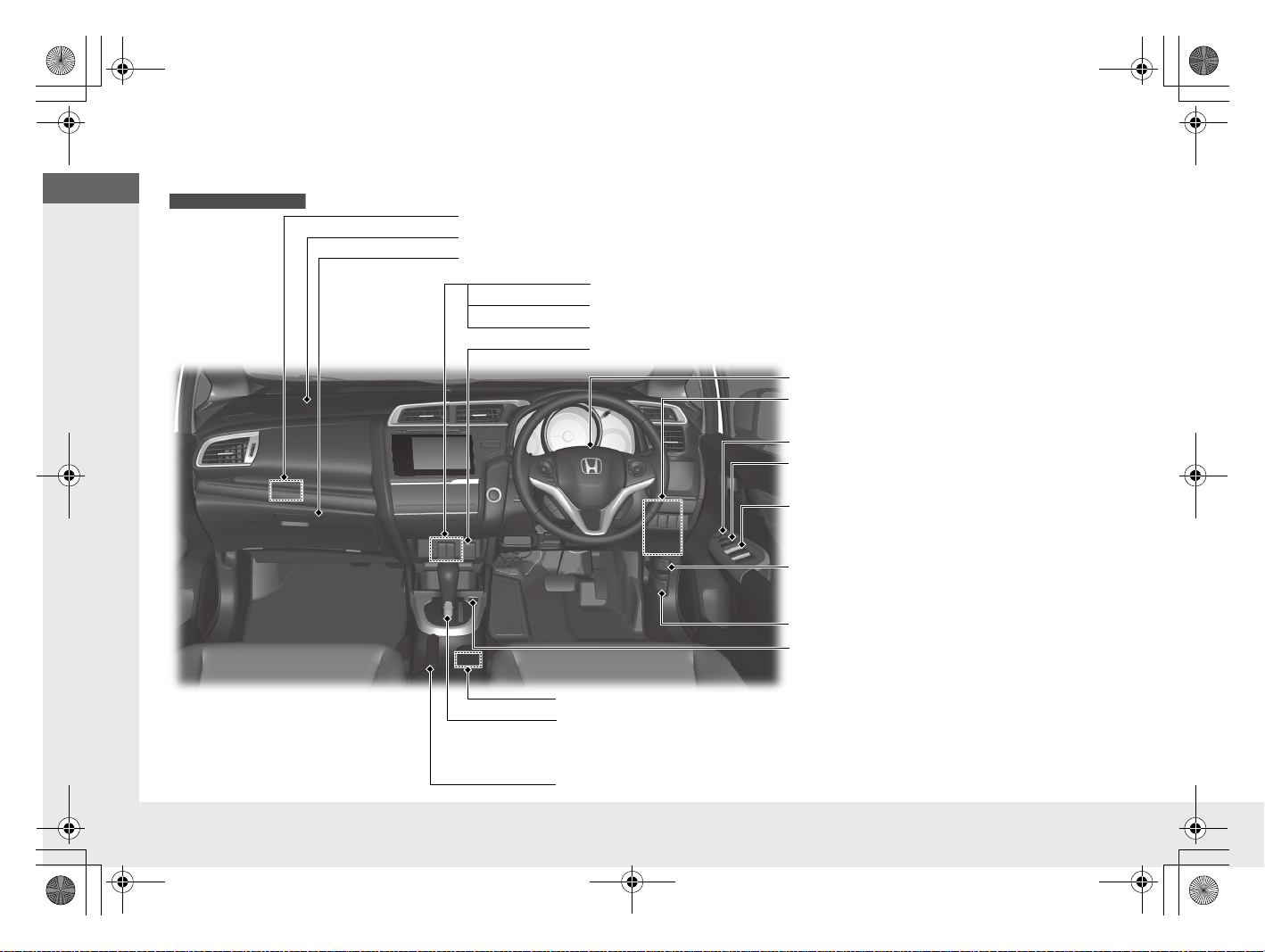
Quick Reference Guide
Right-hand drive type
❙ Driver's Front Airbag (P51)
❙ Driver Side Interior Fuse Box
(P576)
❙ Door Mirror Controls (P186)
❙ Power Door Lock Master Switch
(P154)
❙ Power Window Switches (P162)
❙ Fuel Fill Door Release Handle
(P472)
❙ USB Port (P221)
❙ HDMI
TM
Port* (P222)
❙ Auxiliary Input Jack
*
(P222)
❙ Accessory Power Socket (P205)
❙ Passenger Side Interior Fuse Box (P581)
❙ Passenger's Front Airbag (P51)
❙ Glove Box (P202)
❙ Seat Heater Switches
*
(P208)
❙ Shift Lever
Continuously Variable Transmission
*
(P402)
Manual Transmission* (P407)
❙ Parking Brake (P453)
❙ Auto Idle Stop OFF Button
(P411, 416)
❙ Bonnet Release Handle (P489)
18 FIT JAZZ-32T5A6100.book 8 ページ 2017年8月23日 水曜日 午前11時24分
Visual Index
8
Page 10
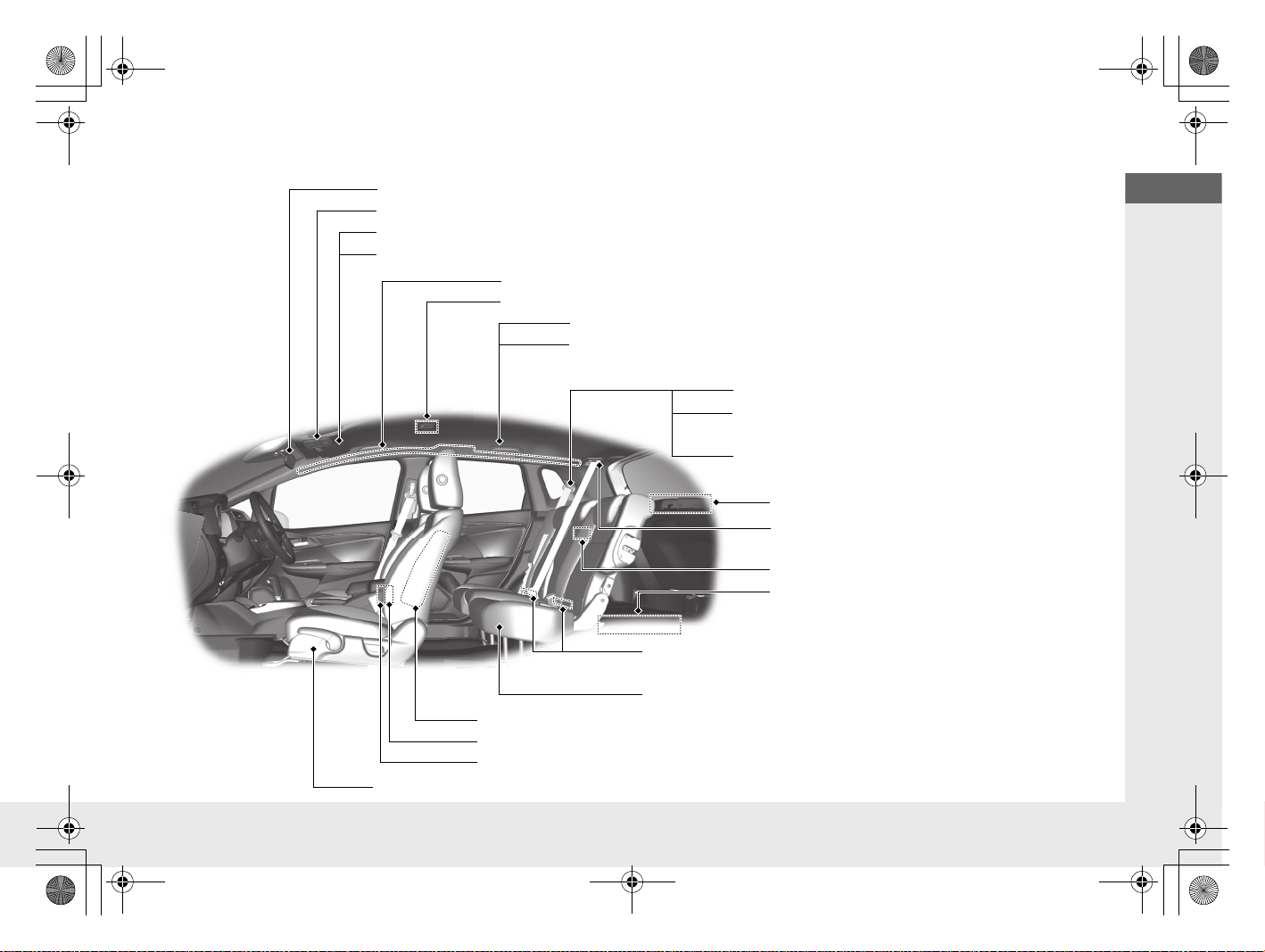
Quick Reference Guide
❙ Seat Belts (P36)
❙ Seat Belt (Installing a Child Restraint
System)
(P62)
❙ Seat Belt to Secure a Child Restraint
System
(P75)
❙ Grab Handle
❙ Coat Hook (P206)
(Only on the rear driver’s side)
❙ Lower Anchorage Points to Secure a Child Restraint
System
(P72)
❙ Rear Seat (P190)
❙ Seat Belt with Detachable Anchor
(P45)
❙ Luggage Area Light (P201)
❙ Luggage Floor Box (P204)
❙ Side Airbags (P56)
❙ Accessory Power Socket
*
(P205)
❙ USB Port
*
(P221)
❙ Front Seat (P187)
❙ Side Curtain Airbags (P58)
❙ Ceiling Light (P199)
❙ Luggage Area Cover (P207)
❙ Rearview Mirror (P185)
❙ Map Lights (P200)
❙ Sun Visors
❙ Vanity Mirrors
* Not available on all models
18 FIT JAZZ-32T5A6100.book 9 ページ 2017年8月23日 水曜日 午前11時24分
9
Page 11
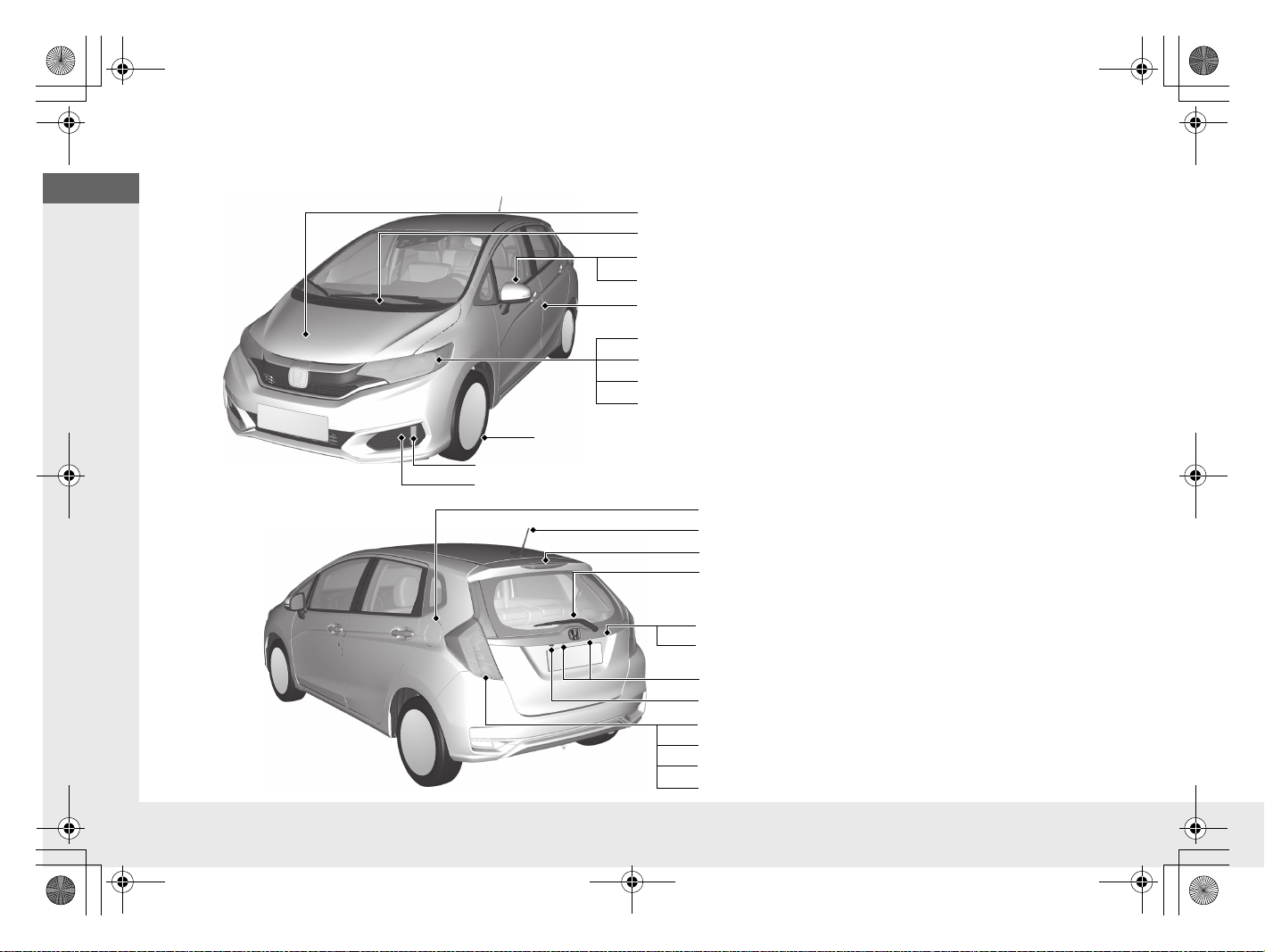
Quick Reference Guide
❙ Maintenance Under the Bonnet (P488)
❙ Windscreen Wipers (P179, 511)
❙ Door Lock/Unlock Control (P142)
❙ Tyres (P515, 541)
❙ Brake/Taillights (P507)
❙ Back-Up Lights (P506)
❙ Rear Turn Signal Lights (P506)
❙ Rear Fog Light (P172, 506)
❙ Power Door Mirrors (P186)
❙ Side Turn Signal Lights (P169, 505)
❙ Daytime Running Lights
*
(P178, 505)
❙ Front Fog Lights
*
(P172, 501)
❙ Opening/Closing the Tailgate (P156)
❙ Tailgate Outer Handle/Release Button (P157)
❙ Rear Licence Plate Lights (P508)
❙ Multi-View Rear Camera
*
(P469)
❙ Headlights (P170, 499)
❙ Front Turn Signal Lights (P169, 503)
❙ Position Lights (P170, 504)
❙ Daytime Running Lights
*
(P178, 505)
❙ How to Refuel (P472)
❙ Audio Antenna (P224)
❙ High-Mount Brake Light (P508)
❙ Rear Wiper (P181, 513)
18 FIT JAZZ-32T5A6100.book 10 ページ 2017年8月23日 水曜日 午前11時24分
Visual Index
10
Page 12
Quick Reference Guide
On
Off
Restarting
* Not available on all models
18 FIT JAZZ-32T5A6100.book 11 ページ 2017年8月23日 水曜日 午前11時24分
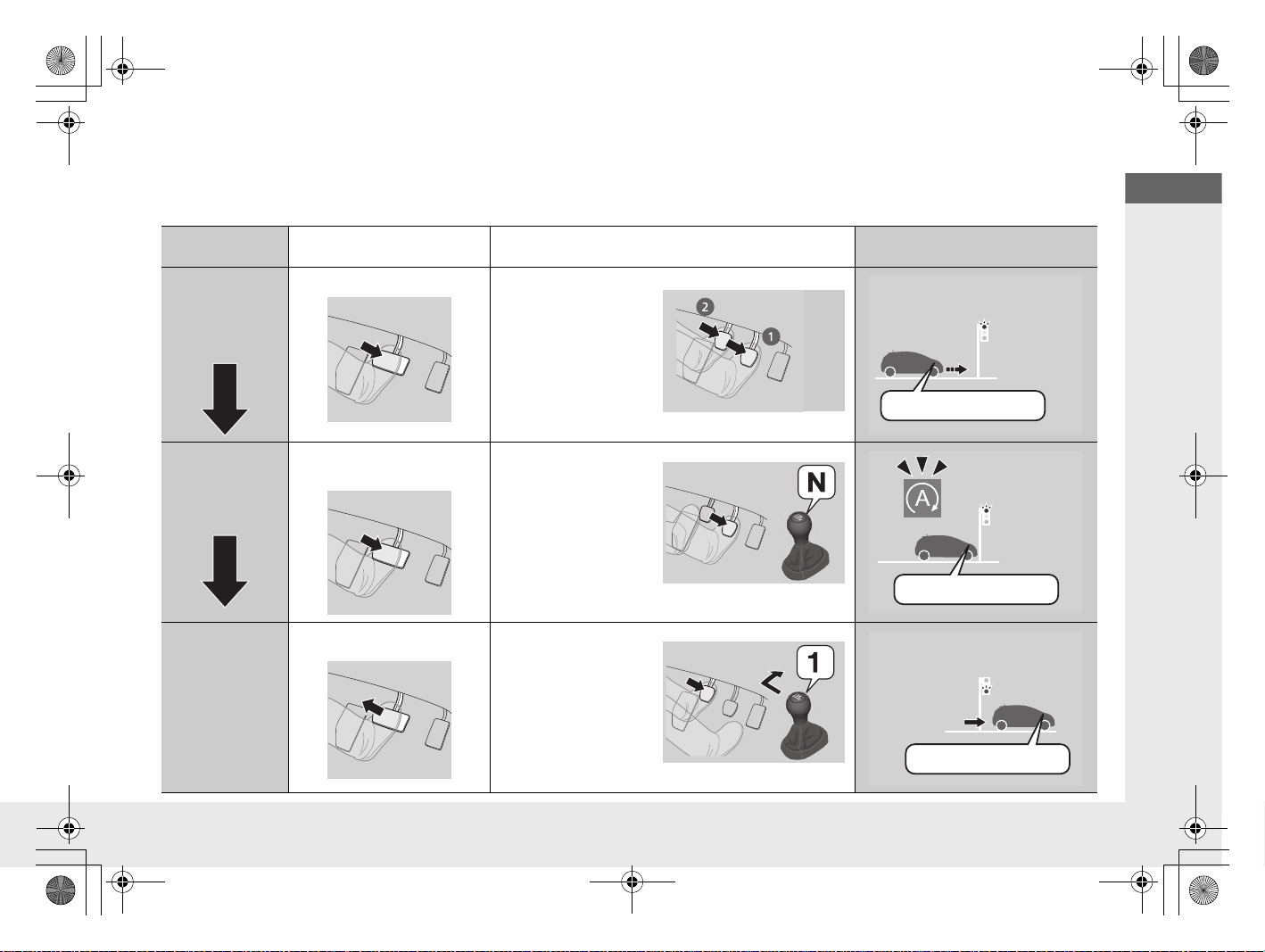
Auto Idle Stop Function
To improve fuel economy, the engine stops and then restarts as detailed below. When Auto Idle Stop is on, the Auto Idle Stop indicator
(green) comes on. (P410, 415)
At
Deceleration
Continuously variable
transmission
Depress the brake pedal.
Manual transmission Engine status
1. Depress the brake
pedal.
2. Fully depress the
clutch pedal.
Stop
Keep the brake pedal
depressed.
Start-up
Release the brake pedal.
●
Continue to
depress the brake
pedal.
●
Move the shift
lever to (N.
●
Release the clutch
pedal.
1. Depress the clutch
pedal again.
2. Move the shift lever
(1.
to
3. Depress the
accelerator pedal to
resume driving.
11
Page 13
Quick Reference Guide
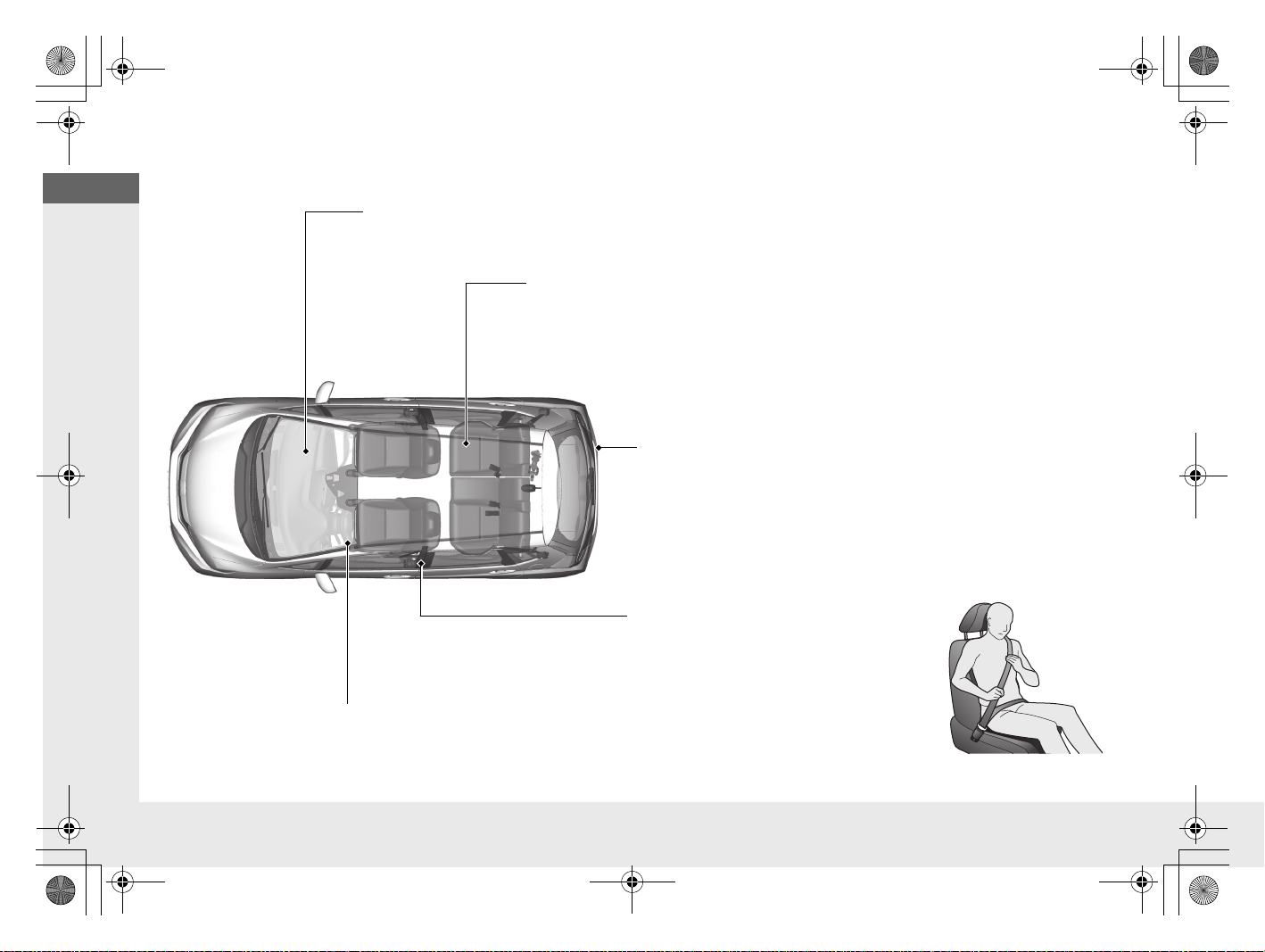
Airbags (P49)
● Your vehicle is fitted with airbags to help to protect you and
your passengers during a moderate-to-severe collision.
Child Safety (P62)
● All children 12 and younger should be seated in the rear seat.
● Small children should be properly restrained in a front facing child restraint
system.
● Infants must be properly restrained in a rear-facing child restraint system on a
rear seat.
Exhaust Gas Hazard (P82)
● Your vehicle emits dangerous exhaust gases that contain
carbon monoxide. Do not run the engine in confined spaces
where carbon monoxide gas can accumulate.
Before Driving Checklist (P35)
● Before driving, check that the front seats, head restraints,
steering wheel, and mirrors have been properly adjusted.
Seat Belts (P36)
● Fasten your seat belt and sit upright well
back in the seat.
● Check that your passengers are wearing
their seat belts correctly.
Fasten your lap belt as
low as possible.
18 FIT JAZZ-32T5A6100.book 12 ページ 2017年8月23日 水曜日 午前11時24分
Safe Driving (P31)
12
Page 14
Quick Reference Guide
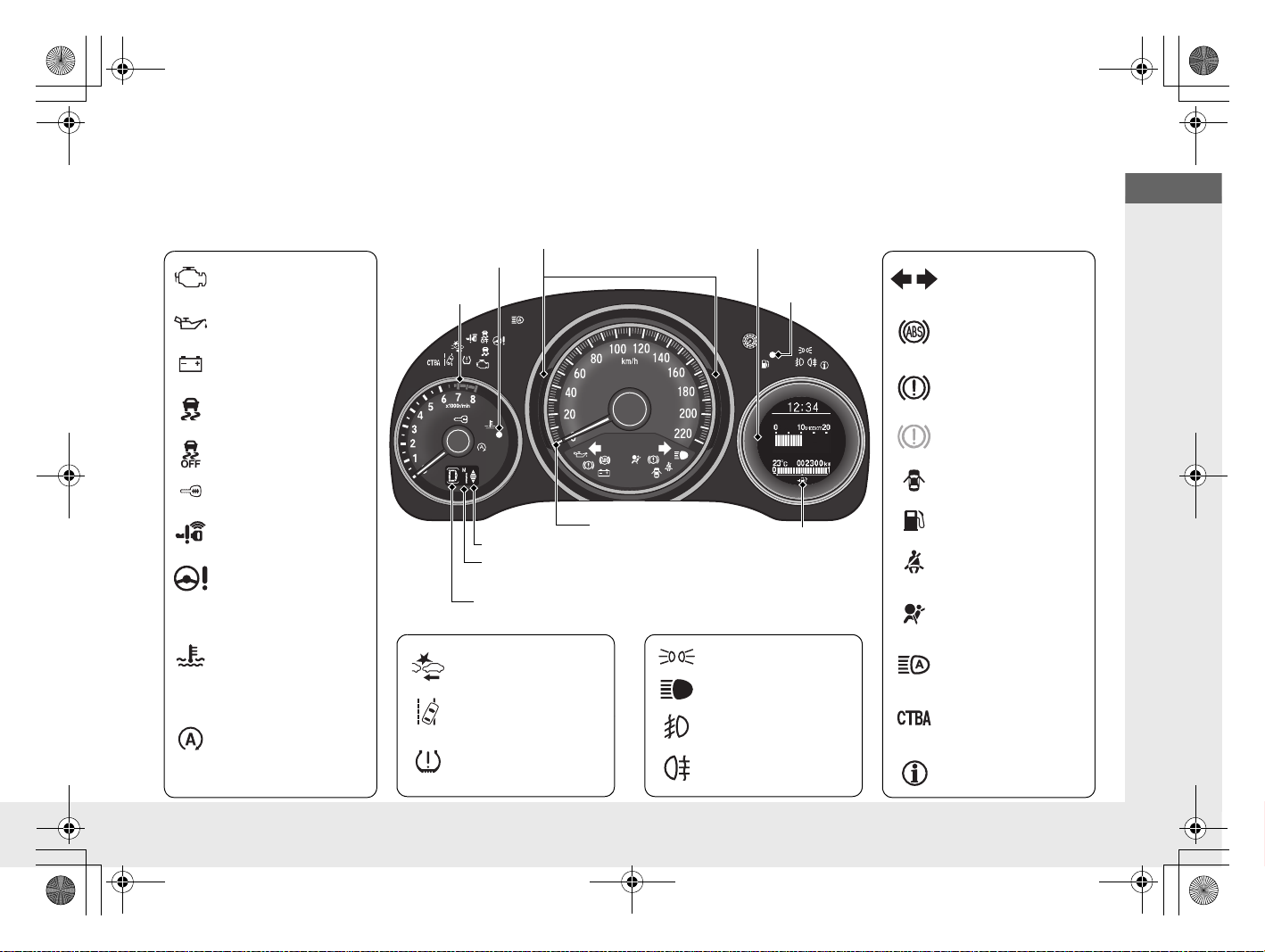
Rear Fog Light
Indicator
Low Fuel Indicator
Anti-lock Brake
System (ABS)
Indicator
Parking Brake
and Brake System
Indicator (Red)
System Indicators
Malfunction
Indicator Lamp
Low Oil Pressure
Indicator
Charging System
Indicator
Vehicle Stability
Assist (VSA) System
Indicator
VSA OFF Indicator
Electric Power
Steering (EPS) System
Indicator
System Indicators
Lights On Indicator
High Beam Indicator
Front Fog Light
Indicator
*
Immobilizer System
Indicator
Seat Belt Reminder
Indicator
System Indicators
Tachometer
Ambient Meter
Fuel Gauge
Gauges (P123)/Multi-Information Display (P124)/System Indicators (P86)
Turn Signal and
Hazard Warning
Indicators
Shift Up/Down* Indicator
Low Temperature
Indicator (Blue)
Keyless Access
System Indicator
*
Auto Idle Stop System
Indicator (Amber)
High Temperature
Indicator (Red)
Door and Tailgate
Open Indicator
Brake System
Indicator (Amber)
Supplemental
Restraint System
Indicator
System Message
Indicator
Auto Idle Stop
Indicator (Green)
Shift Lever Position Indicator
*
M (7-speed manual shift mode)
Indicator/Shift Indicator
*
Forward Collision
Warning Indicator
*
Security System
Alarm Indicator
*1
Low Tyre Pressure/
Deflation Warning
System Indicator
Speedometer
High Beam Support
System Indicator
*
Lane Departure
Warning Indicator
*
Lights Indicators
City-Brake Active
System (CTBA)
Indicator
Multi-Information Display
Security System
Alarm Indicator
*2
*1: Left-hand drive type with
security system
*2: Right-hand drive type with
security system
* Not available on all models
18 FIT JAZZ-32T5A6100.book 13 ページ 2017年8月23日 水曜日 午前11時24分
Instrument Panel (P85)
13
Page 15
Quick Reference Guide
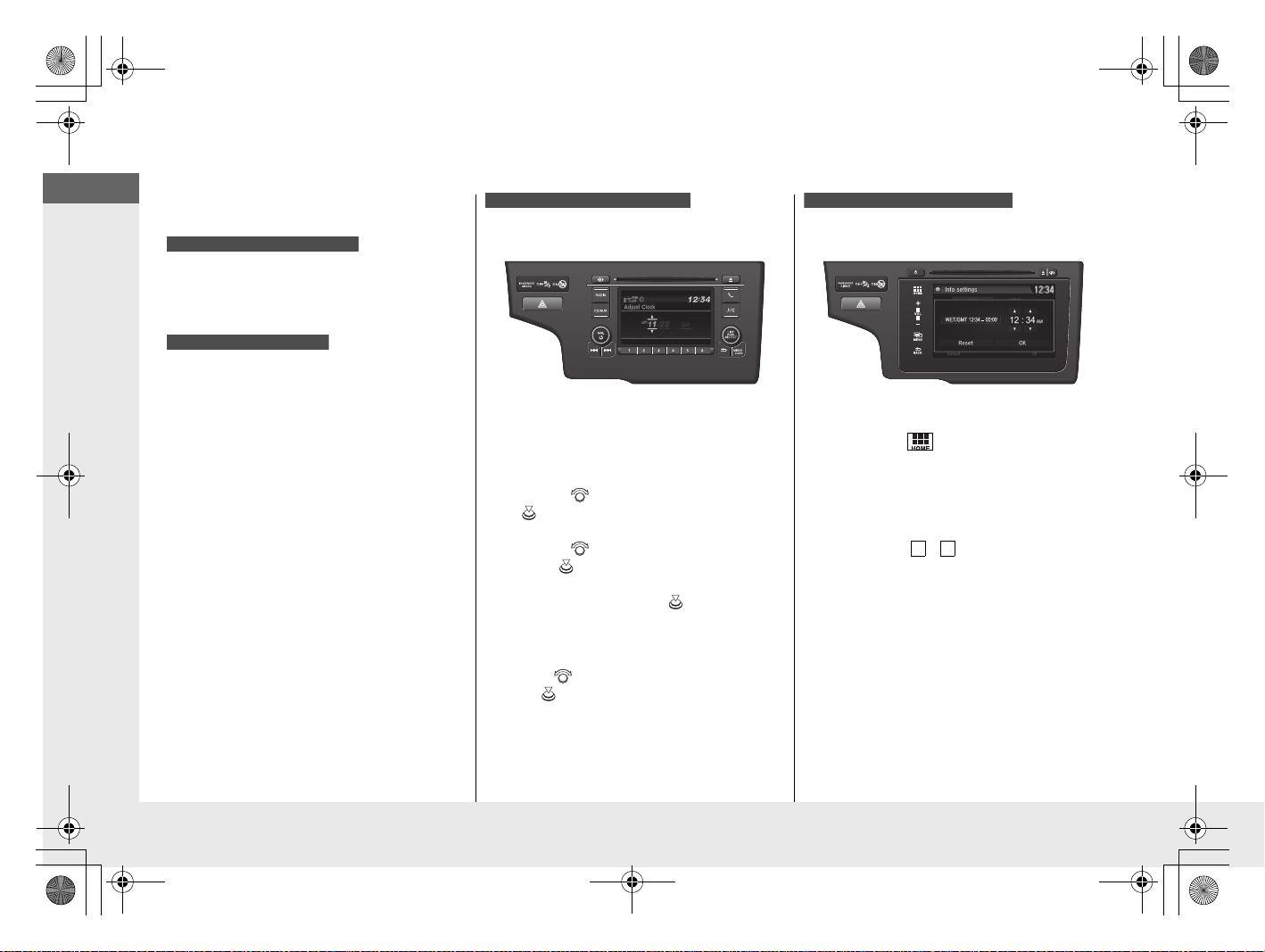
Models with navigation system
Models with audio system
Models with colour audio system
Models with display audio system
3
4
18 FIT JAZZ-32T5A6100.book 14 ページ 2017年8月23日 水曜日 午前11時24分
Controls (P139)
Clock (P140)
The navigation system receives signals from
GPS satellites, updating the clock
automatically.
The clock in the multi-information display is
automatically updated along with the audio
system’s clock display.
14
a Press and hold the MENU/CLOCK
button.
b Rotate to change hour, then press
.
c Rotate to change minute, then
press .
d Select SET, then press .
These indications are used to show how to
operate the LIST/SELECT (Selector) knob.
• Rotate to select.
• Press to enter.
a Select the (HOME) icon, then select
Settings.
b Select Info, Clock, then Clock
Adjustment.
c Touch the / icon to adjust the
numbers up or down.
d Select OK.
Page 16
Quick Reference Guide
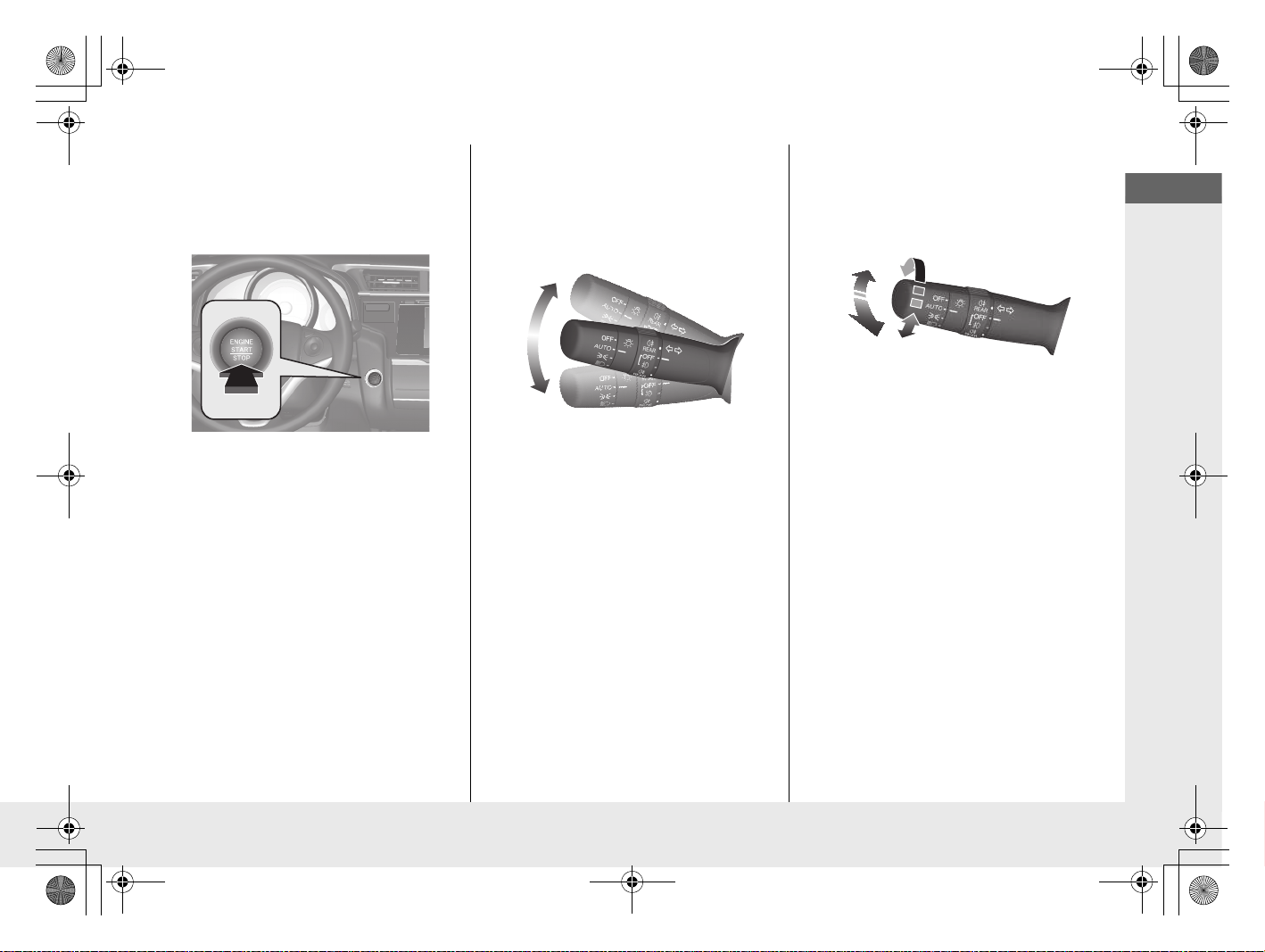
Turn Signal Control Lever
Right
Left
Light Control Switches
Low
Beam
High Beam
Flashing
* Not available on all models
18 FIT JAZZ-32T5A6100.book 15 ページ 2017年8月23日 水曜日 午前11時24分
ENGINE START/STOP
*
Button
Press the button to change the vehicle’s
power mode.
(P165)
Turn Signals (P169)
Lights (P170)
15
Page 17

Quick Reference Guide
Wiper/Washer Control Lever
MIST
OFF
AUTO: Wiper speed varies
automatically
LO: Low speed wipe
HI: High speed wipe
Pull toward you to
spray washer fluid.
Adjustment Ring
: Low Sensitivity
: High Sensitivity
To adjust
To lock
18 FIT JAZZ-32T5A6100.book 16 ページ 2017年8月23日 水曜日 午前11時24分
Wipers and Washers
(P179)
Steering Wheel (P184)
● To adjust, pull the adjustment lever
towards you, adjust to the desired
position, then lock the lever back in place.
Unlocking the Front
Doors from the Inside
(P153)
● Pull either front door inner handle to
unlock and open it in one motion.
● Unlocking and opening the driver’s door
from the inner handle unlocks all the
other doors.
The front passenger’s door also unlocks and
opens in one motion.
16
Page 18
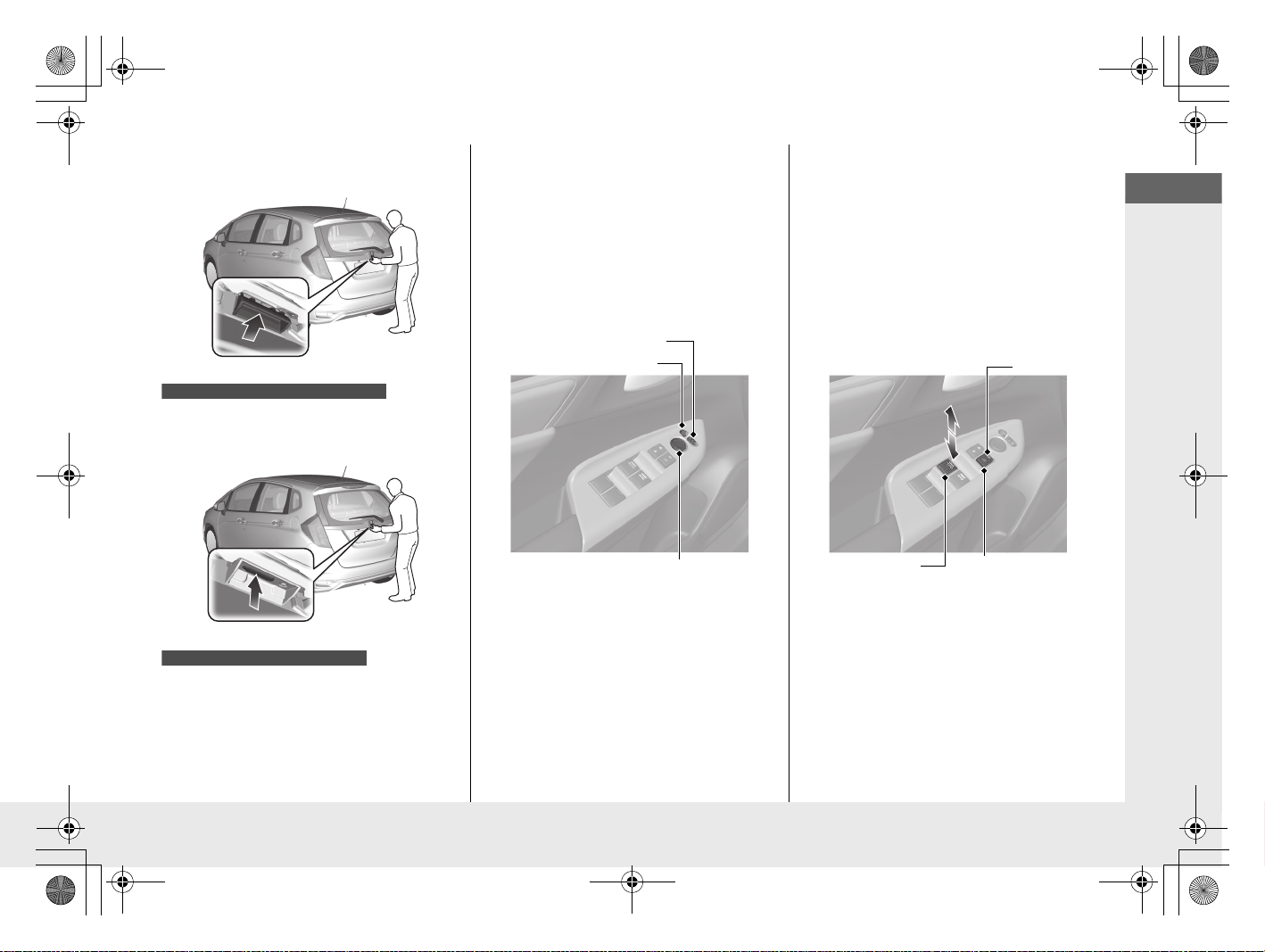
Quick Reference Guide
Models without keyless access system
Models with keyless access system
Selector Switch
Adjustment Switch
Folding Button
*
Power Window
Lock Button
Window Switch
Indicator
* Not available on all models
18 FIT JAZZ-32T5A6100.book 17 ページ 2017年8月23日 水曜日 午前11時24分
Tailgate (P156)
● With all the doors unlocked, pull the
tailgate outer handle, and lift up to open it.
Power Door Mirrors
(P186)
● With the ignition switch in ON
the selector switch to L or R.
● Push the appropriate edge of the
adjustment switch to adjust the mirror.
● Press the folding button
out the door mirrors.
(w
*
to fold in and
*1
, move
Power Windows (P162)
● With the ignition switch in ON
and close the power windows.
● If the power window lock button is in the
off position, each passenger's window
can be opened and closed with its own
switch.
● If the power window lock button is in the
on position (indicator on), each
passenger's window switch is disabled.
(w
*1
, open
● With all the doors unlocked, push the
tailgate release button on the tailgate to
open it.
● Press the tailgate release button to
unlock and open the tailgate when you
carry the keyless access remote.
*1: Models with the keyless access system have an
ENGINE START/STOP button instead of an ignition
switch.
17
Page 19
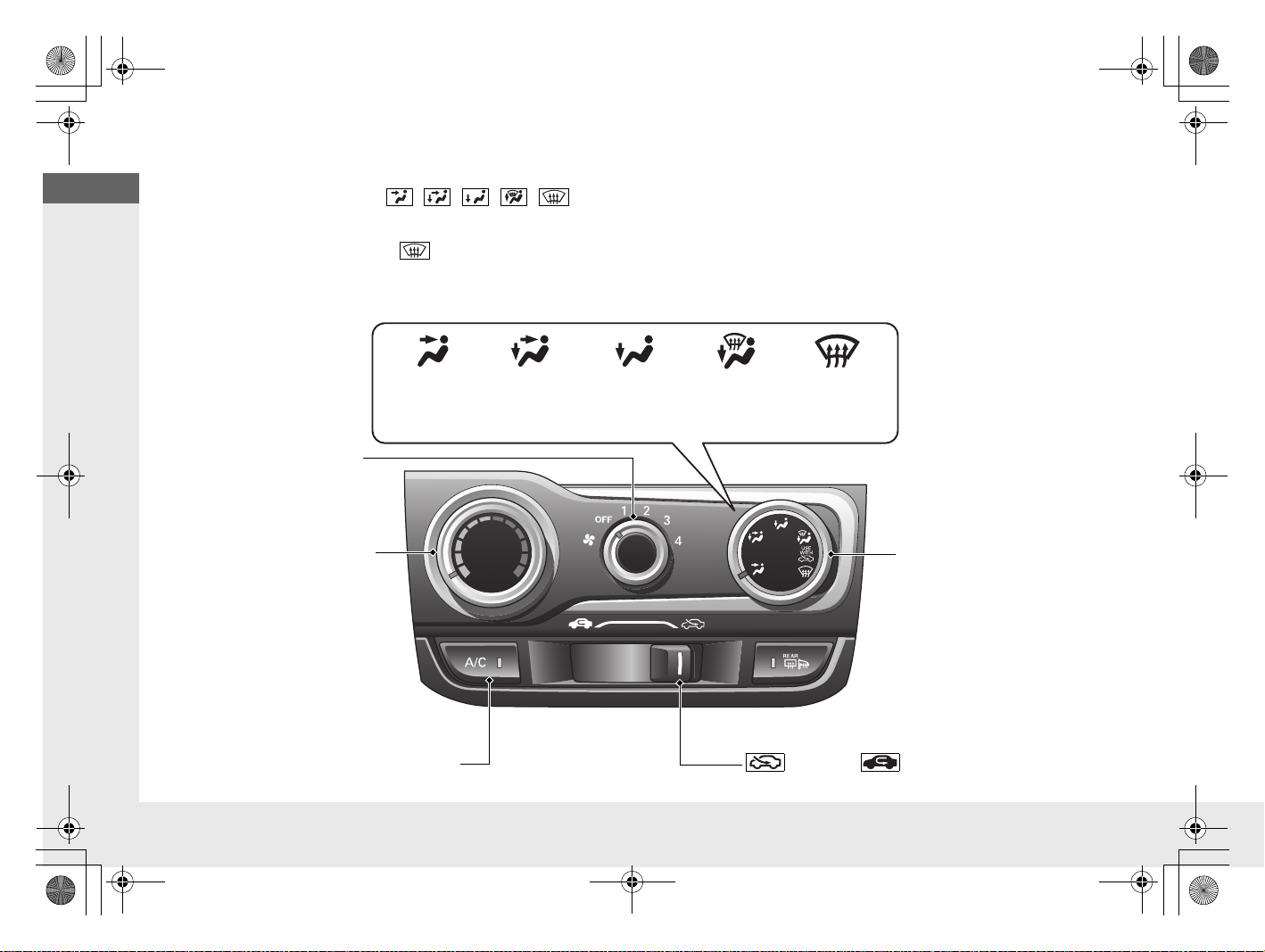
Quick Reference Guide
(Fresh Air)/ (Recirculation) Lever
Air flows from
floor and
windscreen
demister vents.
Air flows
from floor
vents.
Air flows from
floor and
dashboard
vents.
Air flows
from
dashboard
vents.
Mode Control Dial
Fan Control Dial
A/C (Air Conditioning) Button
Temperature Control Dial
Air flows from
windscreen
demister
vents.
18 FIT JAZZ-32T5A6100.book 18 ページ 2017年8月23日 水曜日 午前11時24分
Heating and Cooling System* (P209)
● Rotate the fan control dial to adjust the fan speed.
● Rotate the mode control dial ( / / / / ) to select the vents air flows from.
● Rotate the temperature control dial to adjust the temperature.
● Rotate the fan control dial to OFF to turn the system off.
● Rotate the mode control dial to to defrost the windscreen.
18
Page 20
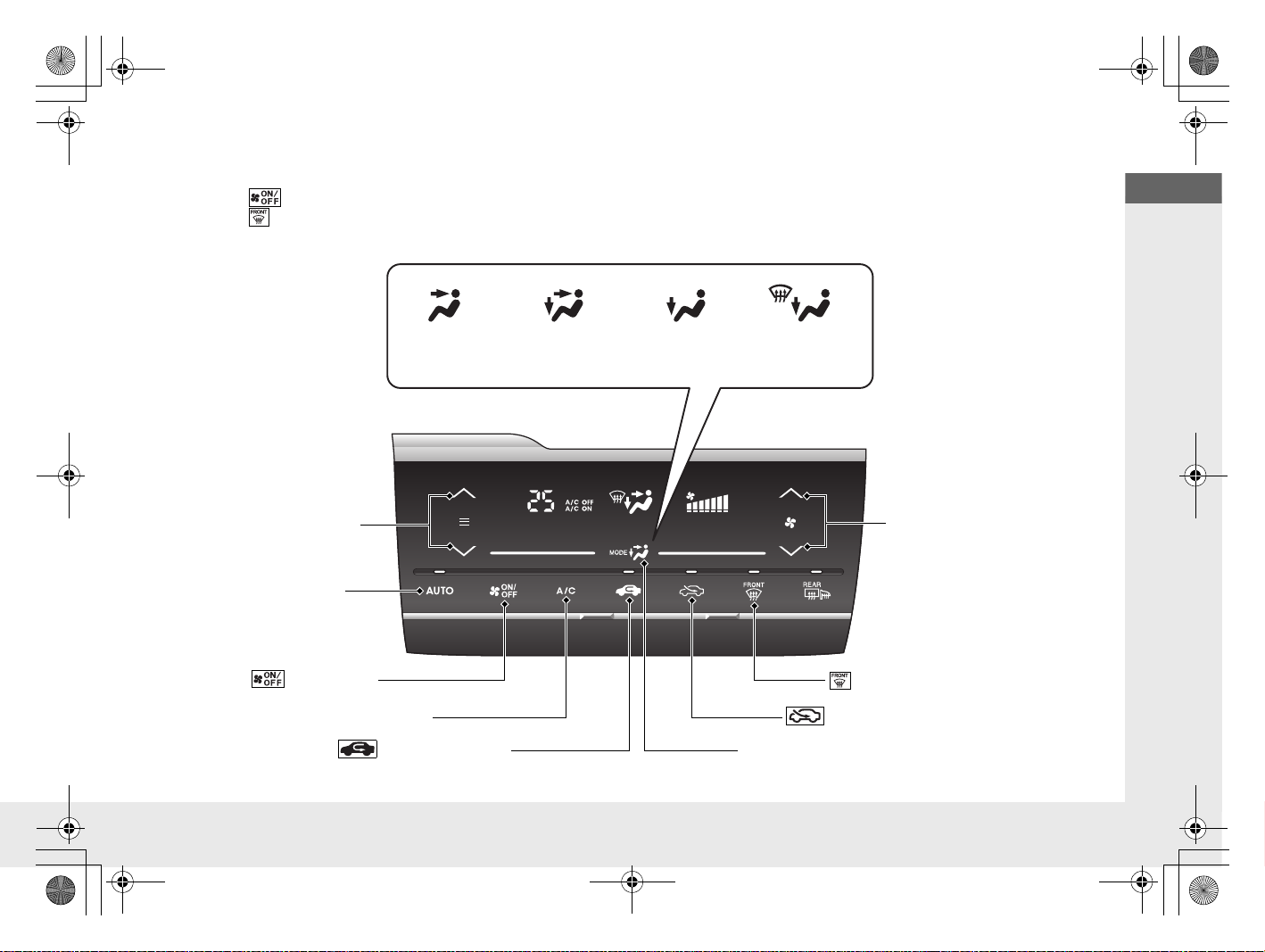
Quick Reference Guide
Temperature Control Icons
(Windscreen Demister) Icon
Air flows from
floor and
windscreen
demister vents.
Air flows
from floor
vents.
Air flows from
floor and
dashboard vents.
Air flows from
dashboard
vents.
AUTO Icon
(On/Off) Icon
(Recirculation) Icon Mode Control Icon
A/C (Air Conditioning) Icon
Fan Control Icons
(Fresh Air) Icon
* Not available on all models
18 FIT JAZZ-32T5A6100.book 19 ページ 2017年8月23日 水曜日 午前11時24分
Climate Control System* (P213)
● Select the AUTO icon to activate the climate control system.
● Select the icon to turn the system on or off.
● Select the icon to defrost the windscreen.
19
Page 21
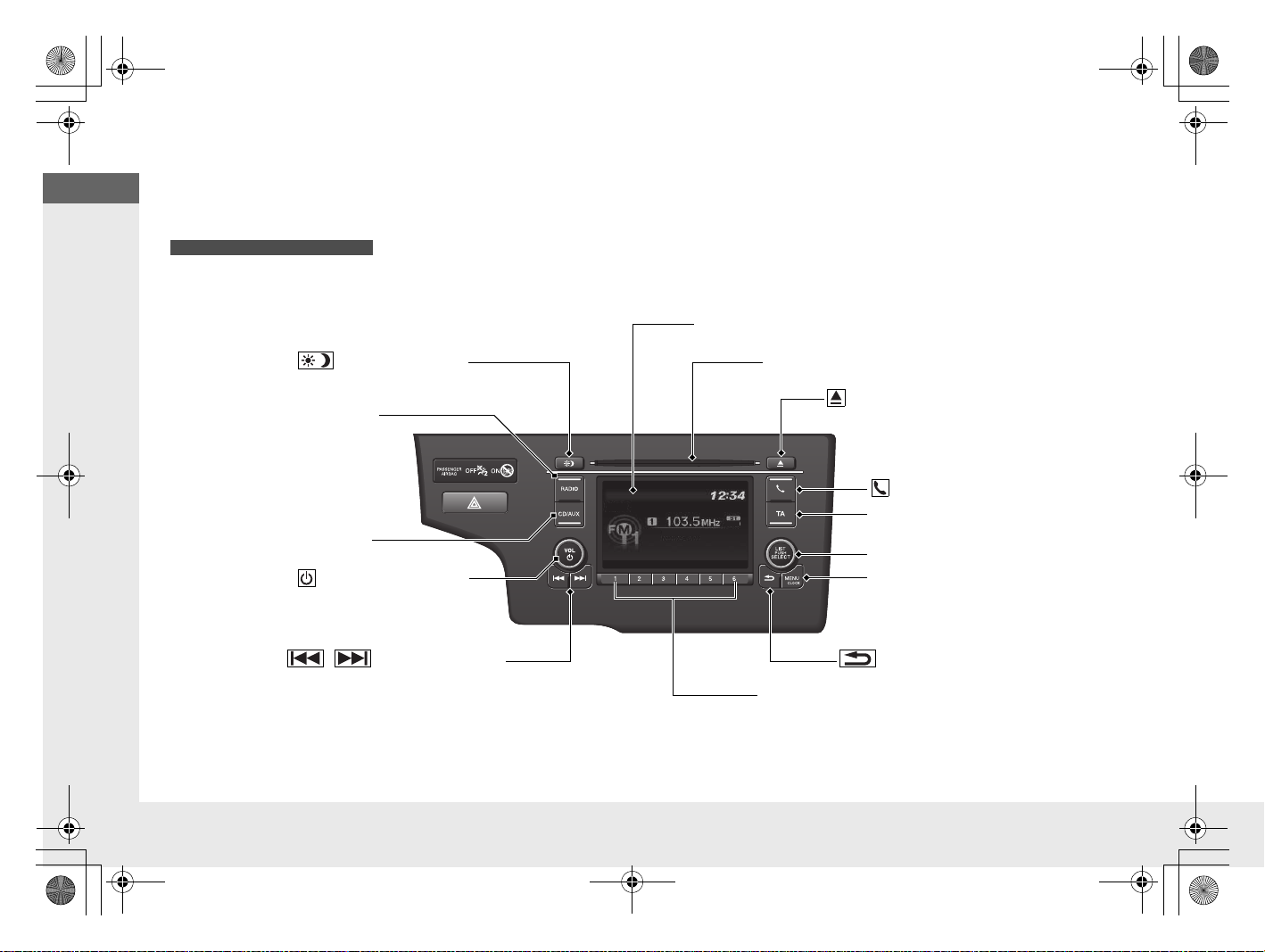
Quick Reference Guide
CD Slot
(CD Eject) Button
TA Button
(P 227)
Models with colour audio system
Audio/Information Screen
VOL/ (Volume/Power) Knob
/ (Skip/Seek) Buttons
LIST/SELECT (Selector) Knob
CD/AUX Button
MENU/CLOCK Button
(Back) Button
(Phone) Button
Preset Buttons (1-6)
(Day/Night) Button
RADIO Button
18 FIT JAZZ-32T5A6100.book 20 ページ 2017年8月23日 水曜日 午前11時24分
Features (P219)
Audio System (P227, 257)
20
Page 22
Quick Reference Guide
(P257)
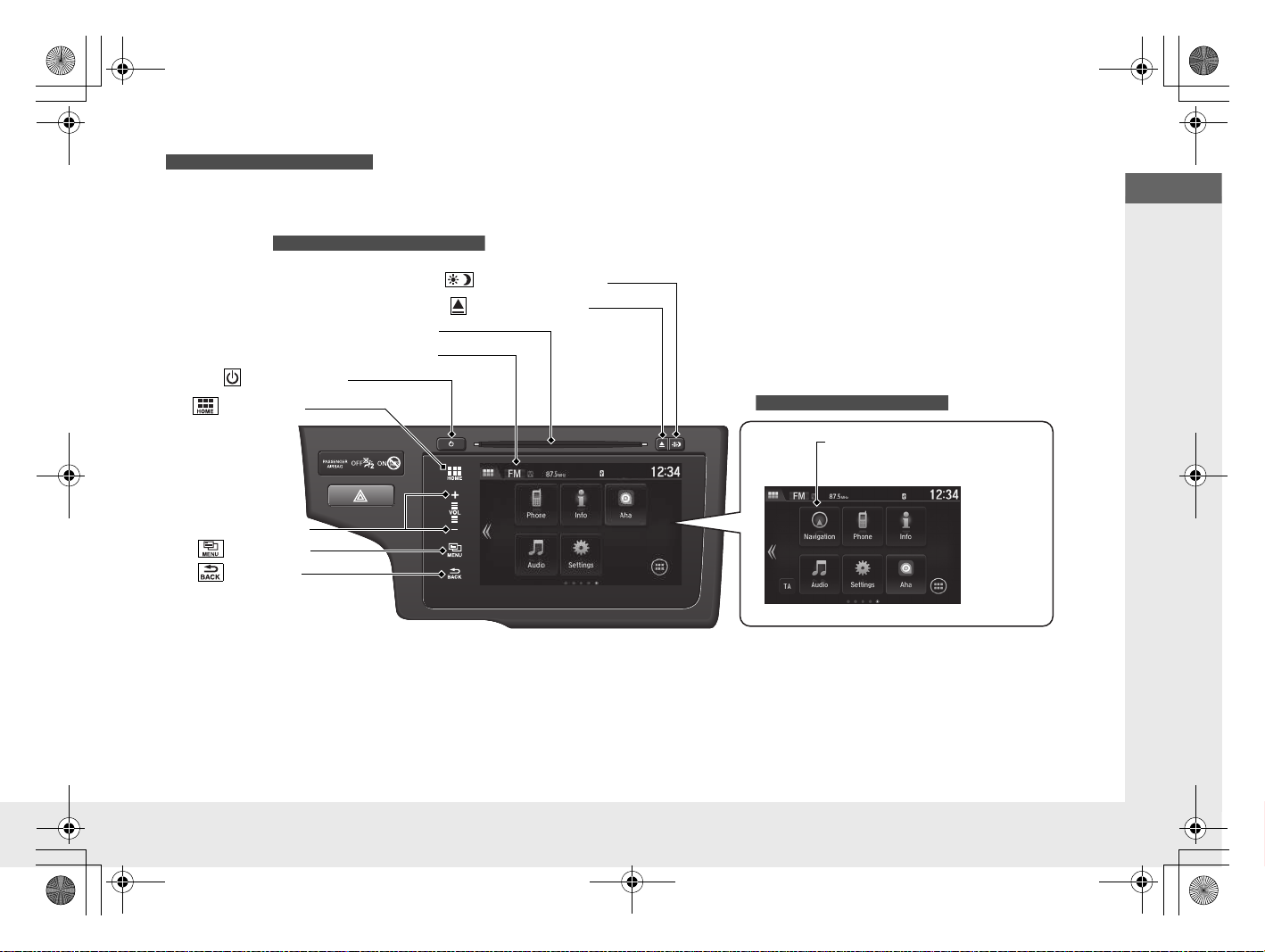
Models with display audio system
Audio/Information Screen
(Day/Night) Button
(CD Eject) Button
(Power) Button
CD Slot
(Home) Icon
VOL (Volume) Icons
(Menu) Icon
(Back) Icon
Models without navigation system
For navigation system operation
()
See the Navigation System Manual
Models with navigation system
18 FIT JAZZ-32T5A6100.book 21 ページ 2017年8月23日 水曜日 午前11時24分
21
Page 23
Quick Reference Guide
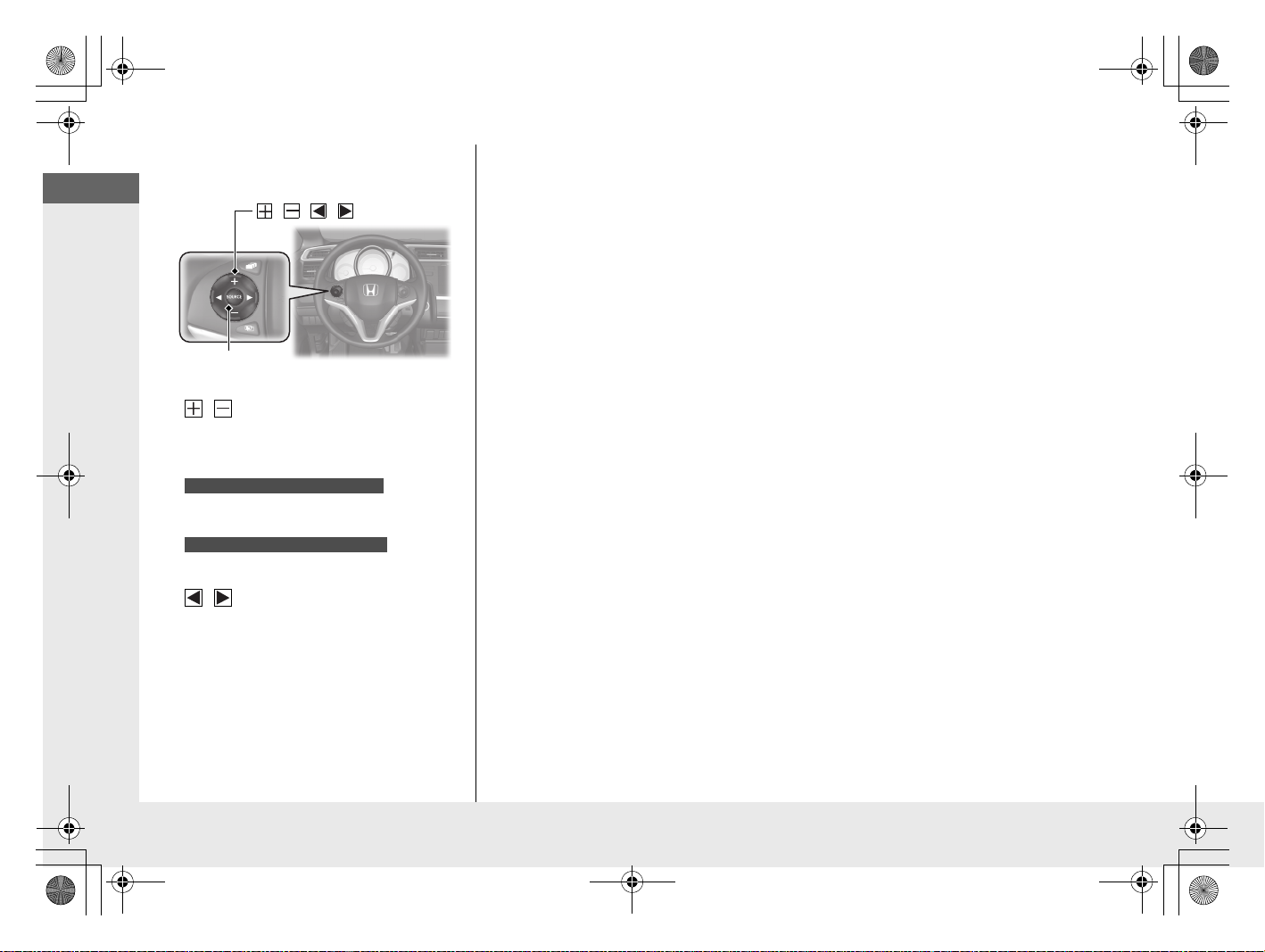
/ / / Button
SOURCE
Button
Models with colour audio system
Models with display audio system
18 FIT JAZZ-32T5A6100.book 22 ページ 2017年8月23日 水曜日 午前11時24分
Audio Remote Controls
(P225)
● / Button
Press to adjust the volume up/down.
● SOURCE Button
Press to change the audio mode:
*
FM1/FM2/DAB1
iPod/Bluetooth®Audio/AUX.
FM/LW/MW/DAB
Bluetooth®Audio/AUX HDMI
● / Button
Radio:Press to change the preset station.
Press and hold to select the next or
previous strong station.
CD/USB device:
Press to skip to the beginning of
the next song or return to the
beginning of the current song.
Press and hold to change a folder.
/DAB2*/LW/MW/CD/USB/
*
/CD/USB/iPod/Apps/
TM
.
22
Page 24
Manual Transmission*
* Not available on all models
18 FIT JAZZ-32T5A6100.book 23 ページ 2017年8月23日 水曜日 午前11時24分
Driving (P381)
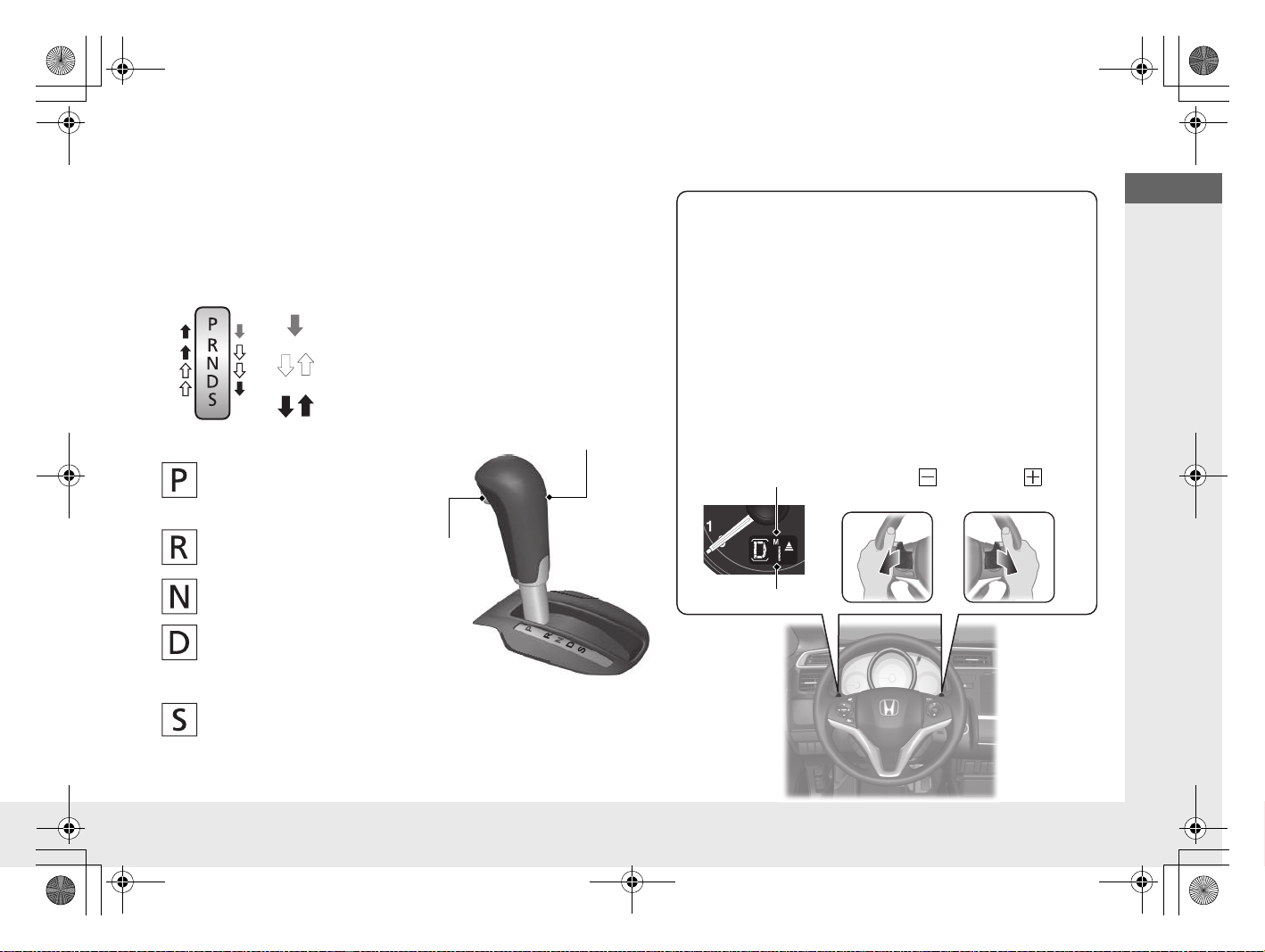
Continuously Variable Transmission*
● Shift to
Shifting
(P and depress the brake pedal when starting the engine.
Park
Turn off or start the engine.
Transmission is locked.
Reverse
Used when reversing.
Neutral
Transmission is not locked.
Drive
●
Normal driving.
●
7-speed manual shift mode can be used
temporarily.
S Position
●
Better acceleration.
●
Increased engine braking.
●
Going up or down hills.
●
7-speed manual shift mode can be used.
(P407)
(P402)
Depress the brake pedal and press the release
button to move out of
Move the shift lever without pressing the
release button.
Press the release button to move the shift lever.
Release
Button
(P.
Shift Lever
7-Speed Manual Shift Mode* (P404)
● Allows you to manually shift the transmission up or down
without removing your hands from the steering wheel.
When the shift lever is in (S
● Pulling a paddle shifter changes the mode from
continuously variable transmission to 7-speed manual
shift mode.
● The M indicator and the selected speed number are
displayed in the shift indicator.
When the shift lever is in (D
● Pulling a paddle shifter temporarily changes the mode
from continuously variable transmission to 7-speed
manual shift mode. The selected speed number is
displayed in the shift indicator.
M Indicator
Shift Indicator
Shift Down
Paddle Shifter
Shift Up
Paddle Shifter
Quick Reference Guide
23
Page 25
Quick Reference Guide
18 FIT JAZZ-32T5A6100.book 24 ページ 2017年8月23日 水曜日 午前11時24分
VSA On and OFF (P447)
● The vehicle stability assist (VSA) system
helps to stabilise the vehicle during
cornering, and helps to maintain traction
while accelerating on loose or slippery
road surfaces.
● VSA comes on automatically every time
you start the engine.
● To partially disable VSA functionality/
features, press and hold the button until
you hear a beep.
Cruise Control (P420)
● Cruise control allows you to maintain a
set speed without keeping your foot on
the accelerator pedal.
● To use cruise control, press the MAIN
button. Select cruise control by pressing
the LIM button, then press the –/SET
button once you have achieved the
desired speed (above 30 km/h or 18 mph).
Adjustable Speed Limiter
(P423)
● This system enables you to set a maximum
speed that cannot be exceeded even if
you are depressing the accelerator pedal.
● To use the adjustable speed limiter, press
the MAIN button. Select the adjustable
speed limiter by pressing the LIM button,
then press the -/SET when your vehicle
reaches the desired speed.
● The vehicle speed limit can be set from 30
km/h (18 mph) to 250 km/h (156 mph).
Deflation Warning
System
● Detects a change in tyre conditions and
overall dimensions due to decrease in tyre
pressures.
● The Deflation warning system is turned
on automatically every time you start the
engine.
● A calibration procedure must be
performed when certain conditions arise.
(P449)
24
Page 26
Quick Reference Guide
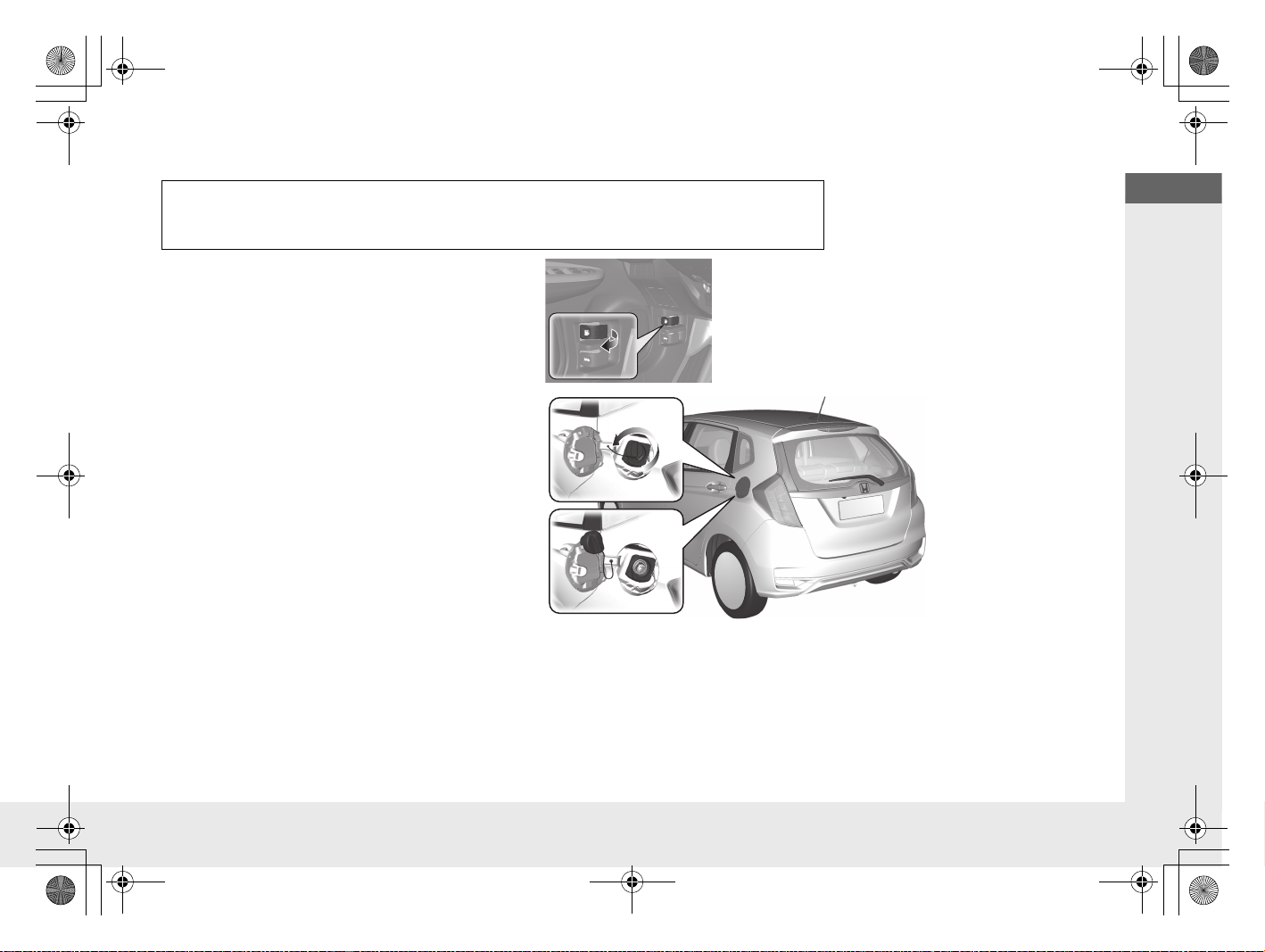
a Pull the fuel fill door release handle.
b Turn the fuel fill cap slowly to remove the cap.
c Place the cap in the holder on the fuel fill door.
d After refueling, screw the cap back on until it
clicks at least once.
18 FIT JAZZ-32T5A6100.book 25 ページ 2017年8月23日 水曜日 午前11時24分
Refueling (P471)
Unleaded premium petrol/gasohol up to E10 (90% petrol and 10% ethanol), research
octane number 95 or higher
Fuel tank capacity: 40 L (8.8 Imp gal)
25
Page 27
Quick Reference Guide
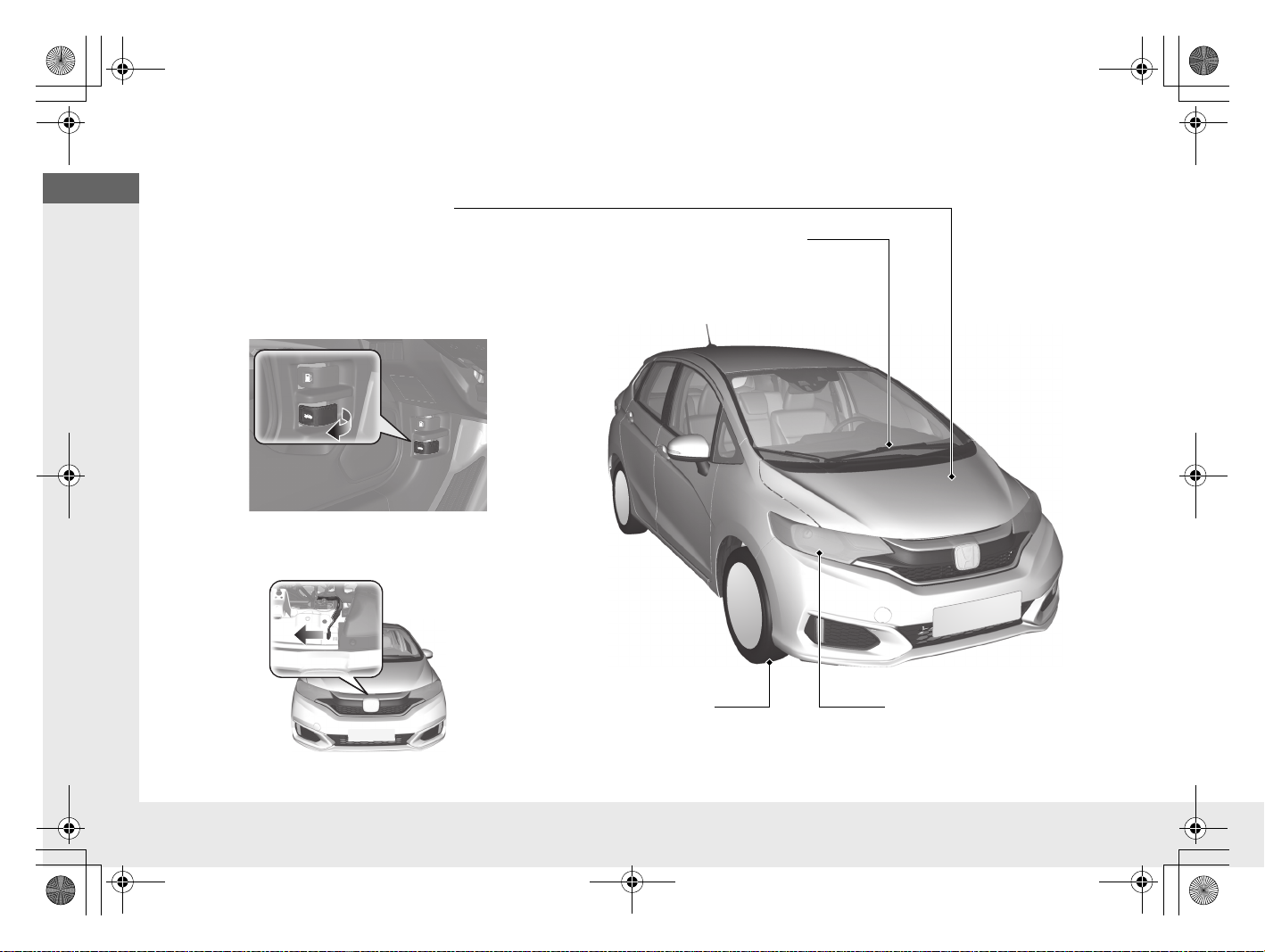
Under the Bonnet (P488)
● Check engine oil, engine coolant, and windscreen washer
fluid. Add when necessary.
● Check brake/clutch
*
fluid.
● Check the battery condition monthly.
a Pull the bonnet release handle under the corner of the
dashboard.
b Locate the bonnet latch lever, push it to the side, and
then raise the bonnet. Once you have raised the
bonnet slightly, you can release the lever.
c When finished, close the bonnet and make sure it is
firmly locked in place.
Lights (P499)
● Inspect all lights regularly.
Wiper Blades (P511)
● Replace blades if they leave streaks
across the windscreen.
Tyres (P515)
● Inspect tyres and wheels regularly.
● Check tyre pressures regularly.
● Install winter tyres for winter
driving.
18 FIT JAZZ-32T5A6100.book 26 ページ 2017年8月23日 水曜日 午前11時24分
Maintenance (P475)
26
Page 28
Quick Reference Guide
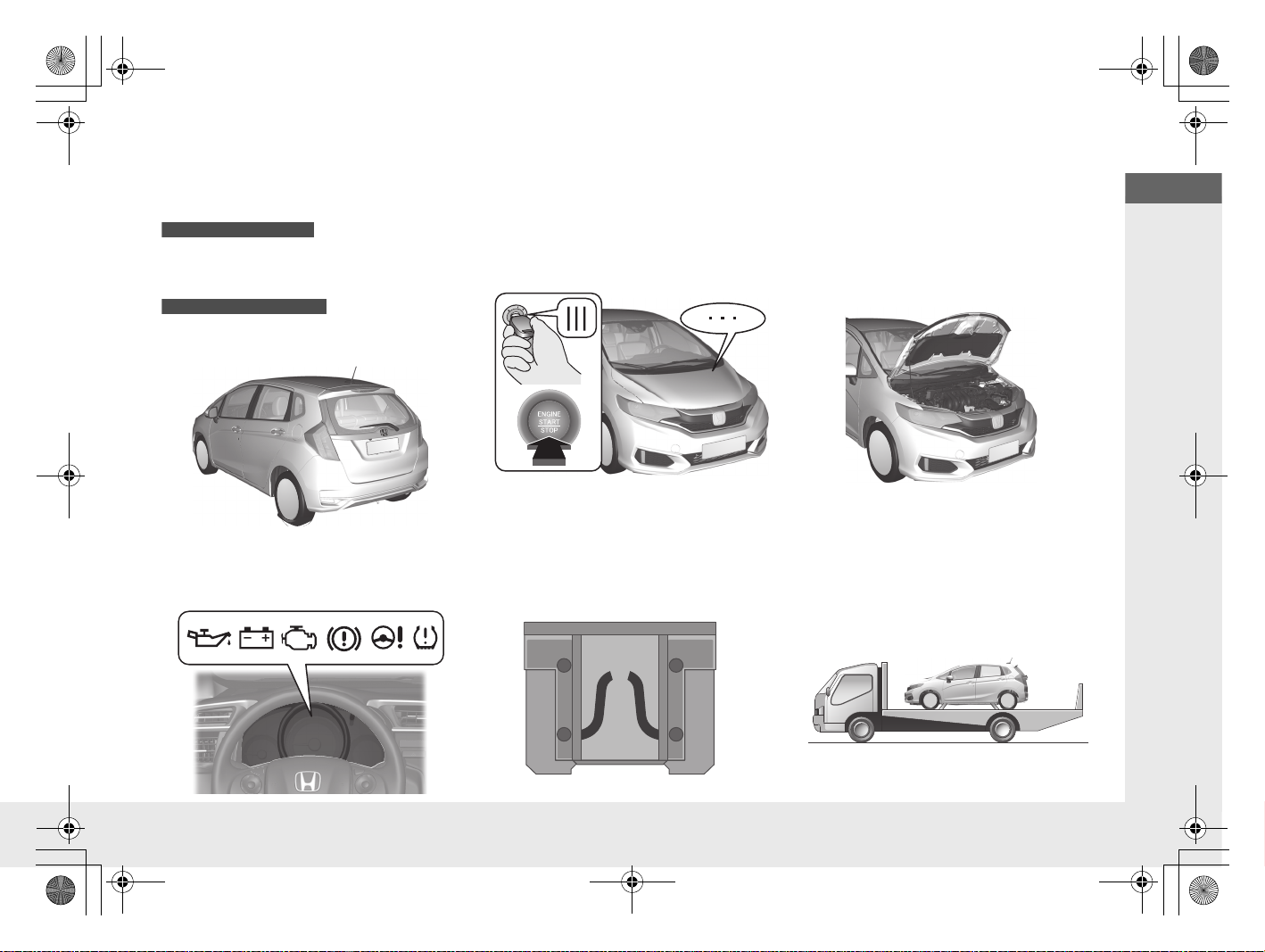
Models with a spare tyre
Models with tyre repair kit
* Not available on all models
18 FIT JAZZ-32T5A6100.book 27 ページ 2017年8月23日 水曜日 午前11時24分
Handling the Unexpected (P539)
Flat Tyre (P541)
● Park in a safe location and replace the
flat tyre with the compact spare tyre in
the luggage area.
● Park in a safe location and repair the flat
tyre using the tyre repair kit.
Indicators Come On (P568)
● Identify the indicator and consult the
owner's manual.
Engine Won't Start (P559)
● If the battery is dead, jump start using a
booster battery.
Blown Fuse (P573)
● Check for a blown fuse if an electrical
device does not operate.
Overheating (P566)
● Park in a safe location. If you do not see
steam under the bonnet, open the
bonnet, and let the engine cool down.
Emergency Towing (P584)
● Call a professional towing service if you
need to tow your vehicle.
27
Page 29
Quick Reference Guide
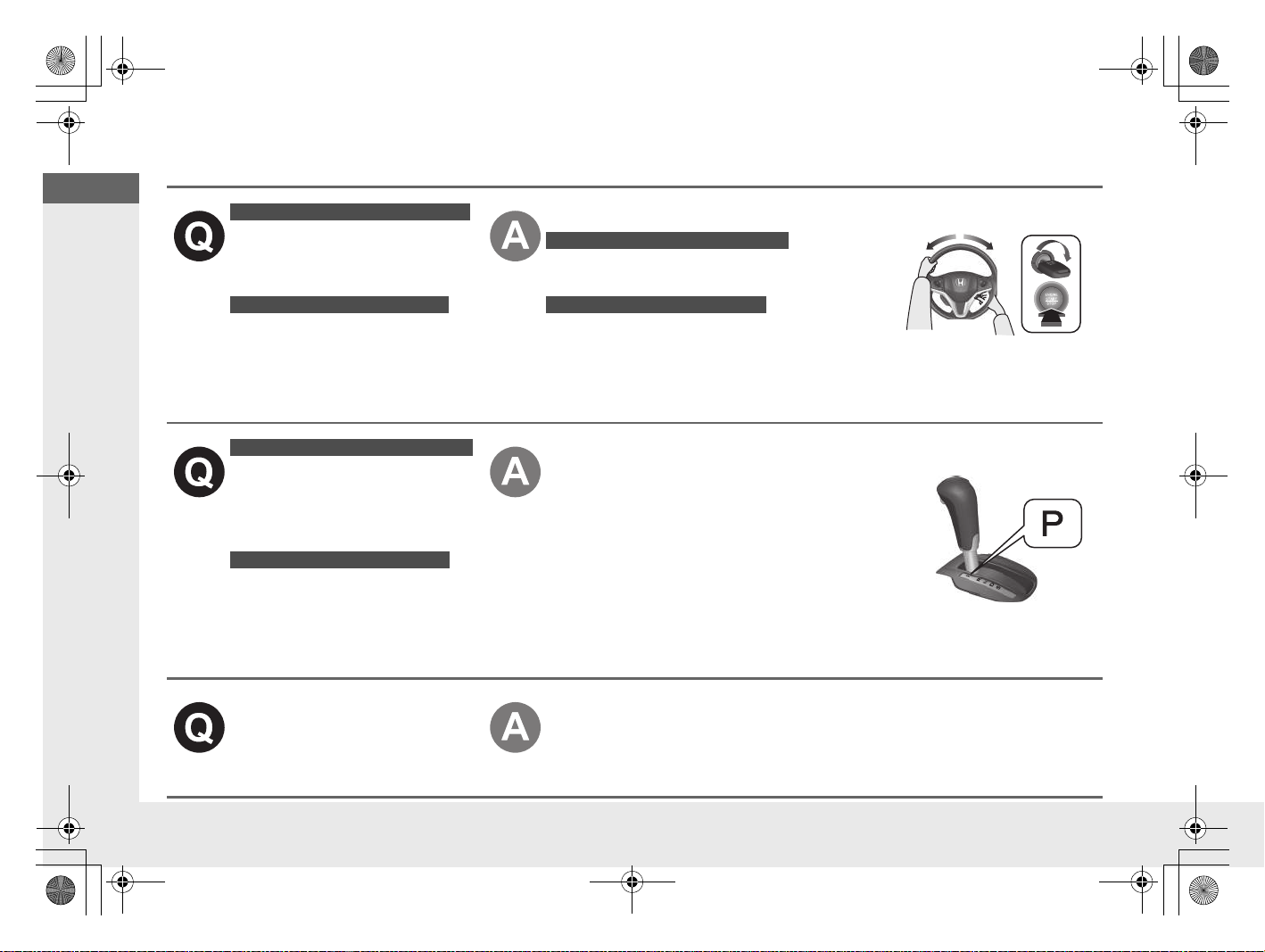
Models without keyless access system
Models with keyless access system
Models without keyless access system
Models with keyless access system
Models without keyless access system
Models with keyless access system
18 FIT JAZZ-32T5A6100.book 28 ページ 2017年8月23日 水曜日 午前11時24分
What to Do If
●
The ignition switch does
not turn from
(0 to (q.
Why?
The steering wheel may be locked.
●
Try to turn the steering wheel left and
right while turning the ignition key.
28
The power mode does not
change from VEHICLE OFF
(LOCK) to ACCESSORY.
Why?
The ignition switch does
not turn from
(q to (0 and
I cannot remove the key.
Why?
The power mode does not
change from ACCESSORY
to VEHICLE OFF (LOCK).
Why?
Why does the brake pedal
pulsate slightly when
applying the brakes?
●
Move the steering wheel left and right
after pressing the ENGINE START/STOP
button.
The shift lever should be moved to (P.
This can occur when the ABS activates and does not indicate a
problem. Apply firm, steady pressure on the brake pedal. Never
pump the brake pedal.
2 Anti-lock Brake System (ABS) (P455)
Page 30
Quick Reference Guide
Models without keyless access system
Models with keyless access system
18 FIT JAZZ-32T5A6100.book 29 ページ 2017年8月23日 水曜日 午前11時24分
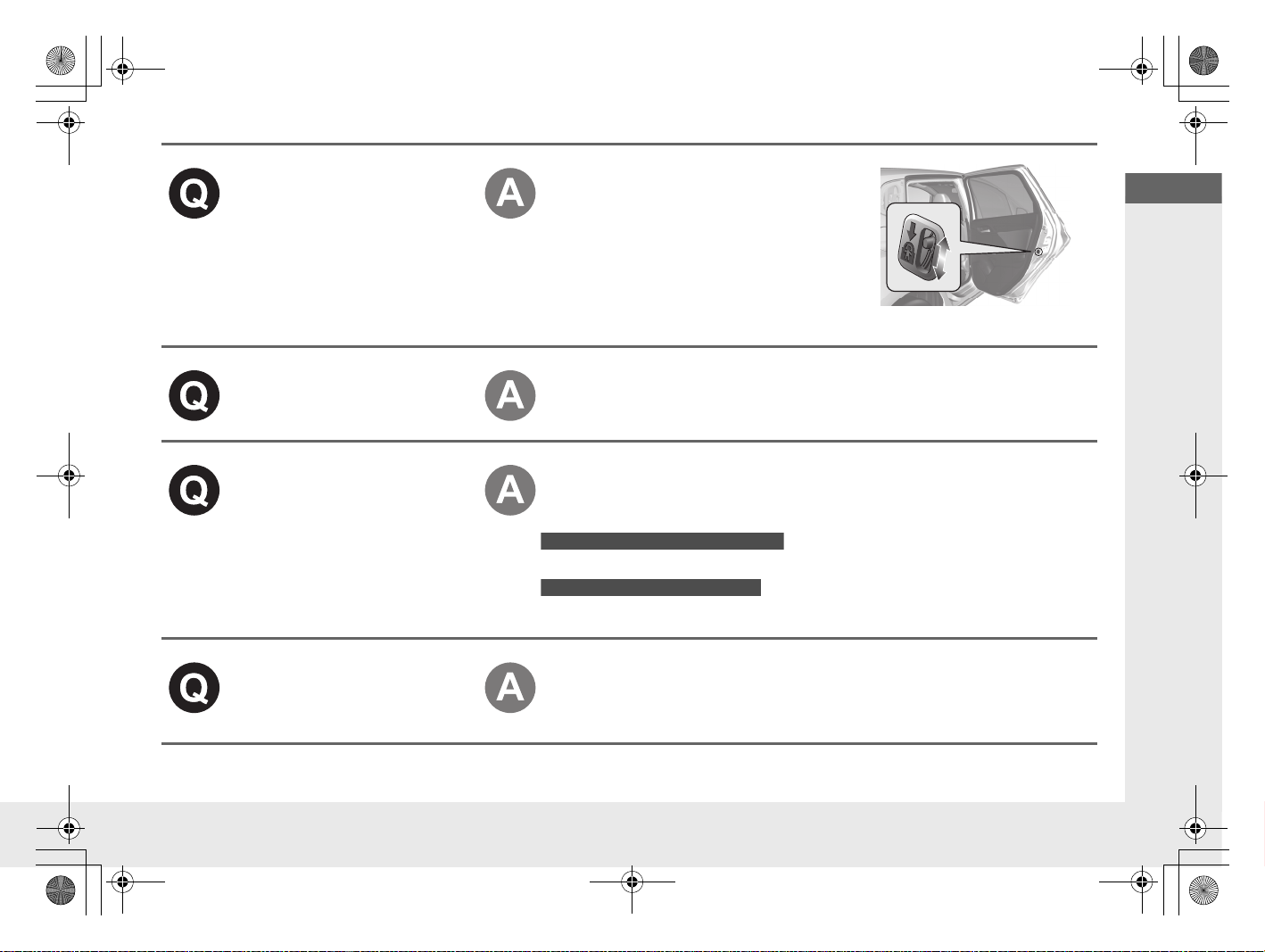
The rear door cannot be
opened from inside the
vehicle. Why?
Why do the doors lock
after I unlocked the doors?
Why does the beeper
sound when I open the
driver's door?
Why does the beeper
sound when I start driving?
Check if the childproof lock is in the
lock position. If so, open the rear door
with the outside door handle.
To cancel this function, push the lever
to the unlock position.
If you do not open the doors within 30 seconds, the doors are
relocked automatically for security.
The beeper sounds when:
●
The exterior lights are left on.
●
Auto Idle Stop is in operation.
●
The key is left in the ignition switch.
●
The power mode is in ACCESSORY.
The beeper sounds when:
●
Driver and/or front passenger are not wearing their seat belts.
●
The parking brake lever is not fully released.
29
Page 31
Quick Reference Guide
18 FIT JAZZ-32T5A6100.book 30 ページ 2017年8月23日 水曜日 午前11時24分
I’m seeing an amber
indicator of a tyre with an
exclamation point. What is
that?
Why do I hear a screeching
sound when I apply the
brake pedal?
Is it possible to use
unleaded petrol with a
Research Octane Number
(RON) of 91 or higher on
this vehicle?
The Deflation Warning System needs attention. If you recently
inflated or changed a tyre, you have to recalibrate the system.
2 Deflation Warning System (P449)
The brake pads may need to be replaced. Have your vehicle
inspected by a dealer.
Your vehicle is designed to operate on premium unleaded
petrol with a research octane of 95 or higher. If this octane
grade is unavailable, regular unleaded petrol with a research
octane of 91 or higher may be used temporarily.
The use of regular unleaded petrol can cause metallic knocking
noises in the engine and will result in decreased engine
performance. The long-term use of regular-grade petrol can
lead to engine damage.
30
Page 32
18 FIT JAZZ-32T5A6100.book 31 ページ 2017年8月23日 水曜日 午前11時24分
You can find many safety recommendations throughout this chapter, and throughout this manual.
Safe Driving
For Safe Driving
Important Safety Precautions ............. 32
Your Vehicle’s Safety Features............ 34
Seat Belts
About Your Seat Belts........................ 36
Fastening a Seat Belt.......................... 42
Seat Belt Inspection............................ 47
Airbags
Airbag System Components............... 49
Types of Airbags ................................ 51
Front Airbags (SRS) ............................ 51
Side Airbags....................................... 56
Side Curtain Airbags .......................... 58
Airbag System Indicators.................... 59
Airbag Care ....................................... 61
Child Safety
Protecting Child Passengers ............... 62
Safety of Infants and Small Children.... 66
Safety of Larger Children ................... 79
Exhaust Gas Hazard
Carbon Monoxide Gas....................... 82
Safety Labels
Label Locations .................................. 83
31
Page 33
Safe Driving
1Important Safety Precautions
Some countries prohibit the use of mobile phones
other than hands-free devices by the driver while
driving.
18 FIT JAZZ-32T5A6100.book 32 ページ 2017年8月23日 水曜日 午前11時24分
For Safe Driving
The following pages explain your vehicle's safety features and how to use them
properly. The safety precautions below are ones that we consider to be among the
most important.
Important Safety Precautions
■ Always wear your seat belt
A seat belt is your best protection in all types of collisions. Airbags are designed to
supplement seat belts, not replace them. So even though your vehicle is equipped
with airbags, make sure you and your passengers always wear your seat belts, and
wear them properly.
■ Restrain all children
Children aged 12 and under should ride properly restrained in a back seat, not the
front seat. Infants and small children should be restrained in a child restraint system.
Larger children should use a booster seat and a lap/shoulder seat belt until they can
use the belt properly without a booster seat.
■ Be aware of airbag hazards
While airbags can save lives, they can cause serious or fatal injuries to occupants
who sit too close to them, or are not properly restrained. Infants, young children,
and short adults are at the greatest risk. Be sure to follow all instructions and
warnings in this manual.
■ Don't drink and drive
Alcohol and driving don't mix. Even one drink can reduce your ability to respond to
changing conditions, and your reaction time gets worse with every additional drink.
So don't drink and drive, and don't let your friends drink and drive, either.
32
Page 34
Safe Driving
18 FIT JAZZ-32T5A6100.book 33 ページ 2017年8月23日 水曜日 午前11時24分
uuFor Safe DrivinguImportant Safety Precautions
■ Pay appropriate attention to the task of driving safely
Engaging in mobile phone conversation or other activities that keep you from paying
close attention to the road, other vehicles, and pedestrians could lead to a crash.
Remember, situations can change quickly, and only you can decide when it is safe to
divert some attention away from driving.
■ Control your speed
Excessive speed is a major factor in crash injuries and deaths. Generally, the higher
the speed, the greater the risk, but serious injuries can also occur at lower speeds.
Never drive faster than is safe for current conditions, regardless of the maximum
speed posted.
■ Keep your vehicle in safe condition
Having a tyre blowout or a mechanical failure can be extremely hazardous.
To reduce the possibility of such problems, check your tyre pressures and condition
frequently, and perform all regularly scheduled maintenance.
■ Do not leave children unattended in the vehicle
Children left unattended in the vehicle may be injured if they activate one or more
of the vehicle controls. They may also cause the vehicle to move, resulting in a crash
in which the children and/or another person(s) can be injured or killed. Also,
depending on the ambient temperature, the temperature of the interior may reach
extreme levels, which can result in injury or death.
Even if the climate control system is on, never leave children in the vehicle
unattended as the climate control system can shut off at any time.
33
Page 35
Safe Driving
1Your Vehicle’s Safety Features
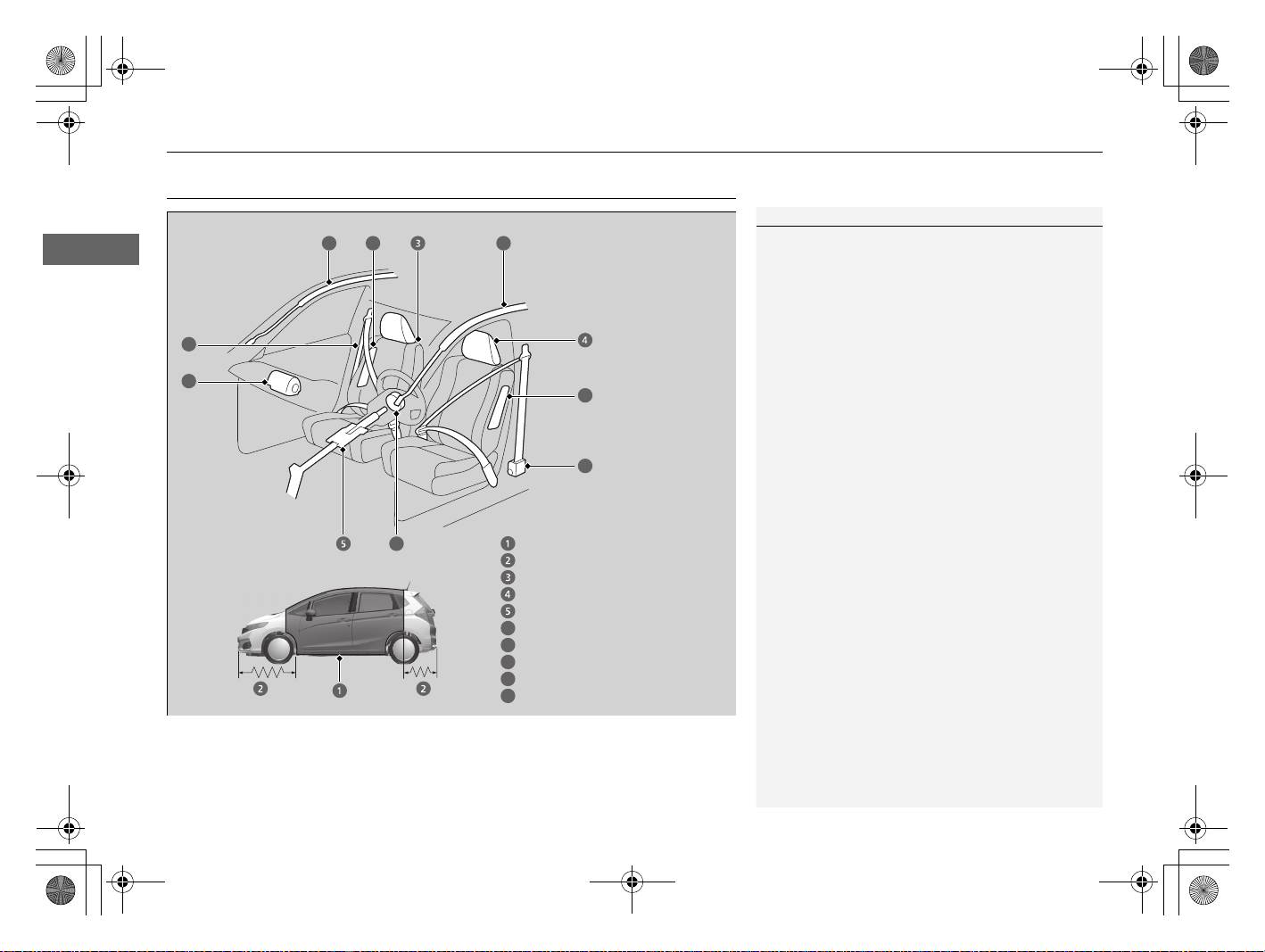
Your vehicle is equipped with many features that
work together to help to protect you and your
passengers during a crash.
Some features do not require any action on your part.
These include a strong steel framework that forms a
safety cage around the passenger compartment,
front and rear crush zones, a collapsible steering
column, and tensioners that tighten the front and
rear outer seat belts in a sufficient crash.
However, you and your passengers cannot take full
advantage of these features unless you remain seated
in the correct position and always wear your seat
belts. In fact, some safety features can contribute to
injuries if they are not used properly.
6
Safety Cage
Crush Zones
Seats and Seat-Backs
Head Restraints
Collapsible Steering Column
Seat Belts
Front Airbags
Side Curtain Airbags
Automatic Seat Belt Tensioners
Side Airbags
9
988
6
18 FIT JAZZ-32T5A6100.book 34 ページ 2017年8月23日 水曜日 午前11時24分
uuFor Safe Driving uYour Vehicle’s Safety Features
Your Vehicle’s Safety Features
7
The following checklist will help you take an active role in protecting yourself and
your passengers.
34
10
7
7
8
9
10
Page 36
Safe Driving
1Safety Checklist
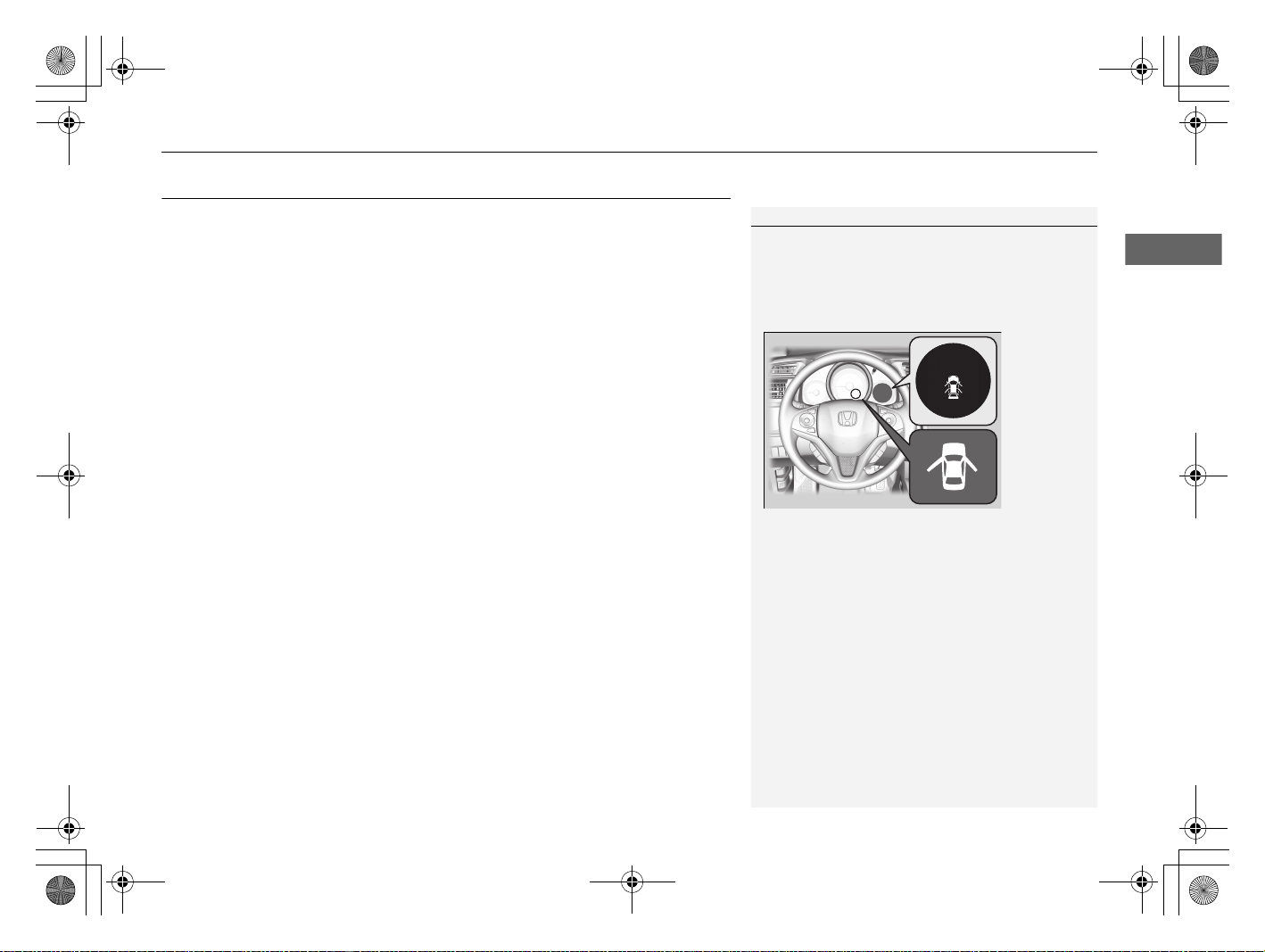
If the door and tailgate open indicator is on, a door
and/or the tailgate is not completely closed. Close all
doors and the tailgate tightly until the indicator goes
off.
2 Door and Tailgate Open Indicator P. 95
18 FIT JAZZ-32T5A6100.book 35 ページ 2017年8月23日 水曜日 午前11時24分
Safety Checklist
For the safety of you and your passengers, make a habit of checking these items
each time before you drive.
• Adjust your seat to a position suitable for driving. Be sure the front seats are
adjusted as far to the rear as possible while allowing the driver to control the
vehicle. Sitting too close to a front airbag can result in serious or fatal injury in a
crash.
2 Adjusting the Seats P. 187
• Adjust head restraints to the proper position. Head restraints are most effective
when the centre of the head restraint aligns with the centre of your head. Taller
persons should adjust their head restraint to the highest position.
2 Adjusting the front head restraint positions P. 193
• Always wear your seat belt, and make sure you wear it properly. Confirm that any
passengers are properly belted as well.
2 Fastening a Seat Belt P. 42
• Protect children by using seat belts or child restraint systems according to a child's
age, height and weight.
2 Child Safety P. 62
uuFor Safe DrivinguSafety Checklist
35
Page 37
Safe Driving
1About Your Seat Belts
WARNING: Seat belts are designed to bear upon the
bony structure of the body, and should be worn low
across the front of the pelvis or the pelvis, chest and
shoulders, as applicable; wearing the lap section of
the belt across the abdominal area must be avoided.
WARNING: Seat belts should be adjusted as firmly as
possible, consistent with comfort, to provide the
protection for which they have been designed. A
slack belt will greatly reduce the protection afforded
to the wearer.
WARNING: Belts should not be worn with straps
twisted.
WARNING: Each belt assembly must only be used by
one occupant; it is dangerous to put a belt around a
child being carried on the occupant’s lap.
3
WARNING
Not wearing a seat belt properly increases
the chance of serious injury or death in a
crash, even though your vehicle has
airbags.
Be sure you and your passengers always
wear seat belts and wear them properly.
18 FIT JAZZ-32T5A6100.book 36 ページ 2017年8月23日 水曜日 午前11時24分
Seat Belts
About Your Seat Belts
Seat belts are the single most effective safety device because they keep you
connected to the vehicle so that you can take advantage of many built-in safety
features. They also help to keep you from being thrown against the inside of the
vehicle, against any passengers, or out of the vehicle. When worn properly, seat
belts also keep your body properly positioned in a crash so that you can take full
advantage of the additional protection provided by the airbags.
In addition, seat belts help to protect you in almost every type of crash, including:
- frontal impacts
- side impacts
- rear impacts
- rollovers
36
Page 38
Safe Driving
1About Your Seat Belts
Seat belts cannot completely protect you in every
crash. But in most cases, seat belts can reduce your
risk of serious injury.
Most countries require you to wear seat belts. Take
time to familiarise with the legal requirements of the
countries in which you will drive.
If you extend the seat belt too quickly, it will lock in
place. If this happens, slightly retract the seat belt,
then extend it slowly.
18 FIT JAZZ-32T5A6100.book 37 ページ 2017年8月23日 水曜日 午前11時24分
■ Lap/shoulder seat belts
All five seating positions are equipped with lap/shoulder seat belts with emergency
locking retractors. In normal driving the retractor lets you move freely while keeping
some tension on the belt. During a collision or sudden stop the retractor locks to
restrain your body.
The seat belt must be properly secured when using a front facing child restraint
system.
2 Child Safety P. 62
uuSeat BeltsuAbout Your Seat Belts
Continued
37
Page 39
Safe Driving
18 FIT JAZZ-32T5A6100.book 38 ページ 2017年8月23日 水曜日 午前11時24分
uuSeat BeltsuAbout Your Seat Belts
■ Proper use of seat belts
Follow these guidelines for proper use:
• All occupants should sit upright, well back in the seat, and remain in that position
for the duration of the trip. Slouching and leaning reduce the effectiveness of the
belt and can increase the chance of serious injury in a crash.
• Never place the shoulder part of a lap/shoulder seat belt under your arm or
behind your back. This could cause very serious injuries in a crash.
• Two people should never use the same seat belt. If they do, they could be very
seriously injured in a crash.
• Do not put any accessories on the seat belts. Devices intended to improve comfort
or reposition the shoulder part of a seat belt can reduce the protective capability
and increase the chance of serious injury in a crash.
38
Page 40
Safe Driving
1Seat Belt Reminder
The indicator will also come on if a front passenger
does not fasten their seat belt within six seconds after
the ignition switch is turned to ON
(w
*1
.
When no one is sitting in the front passenger’s seat,
the indicator will not come on and the beeper will not
sound.
If the indicator comes on or the beeper sounds with
no one sitting in the front passenger’s seat. Check if:
• There is nothing heavy placed on the front
passenger seat.
• The driver’s seat belt is fastened.
If the indicator does not light when the passenger is
seated and is not fastened, something may be
interfering with the occupant detection sensor.
Check if:
• A cushion is placed on the seat.
• The front passenger is not sitting properly.
If none of these conditions exist, have your vehicle
checked by a dealer.
18 FIT JAZZ-32T5A6100.book 39 ページ 2017年8月23日 水曜日 午前11時24分
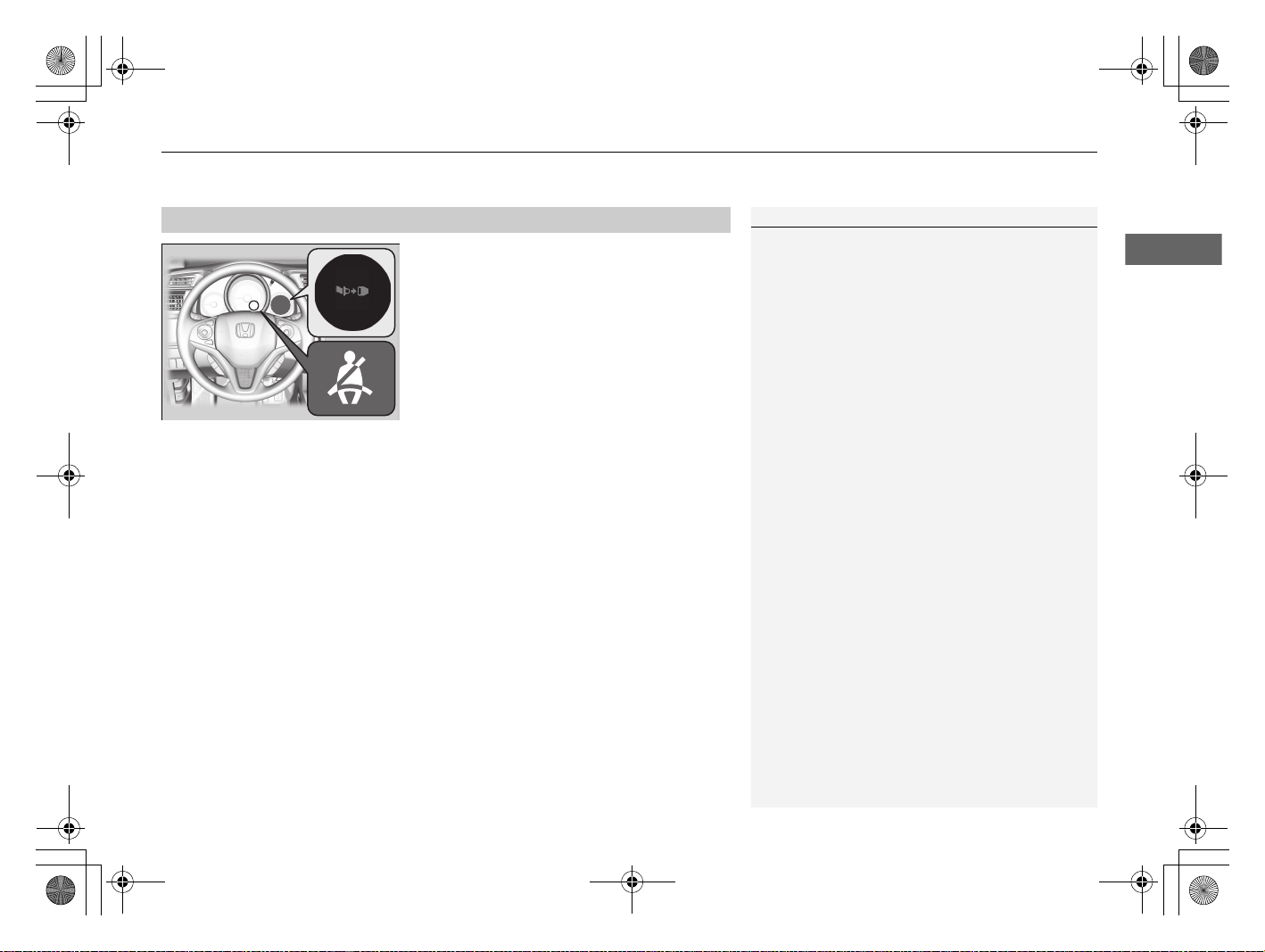
Seat Belt Reminder
■
■ Front seats
The seat belt system includes an indicator on
the instrument panel to remind the driver or a
front passenger or both to fasten their seat
belts.
If the ignition switch is turned to ON
a seat belt is not fastened, a beeper will sound
and the indicator will blink. After a few
seconds, the beeper will stop and the
indicator will come on and remain illuminated
until the seat belt is fastened.
The beeper will also periodically sound and
the indicator will blink while the vehicle is
moving until the seat belt is fastened.
(w
*1
and
uuSeat BeltsuAbout Your Seat Belts
*1: Models with the keyless access system have an ENGINE START/STOP button instead of an ignition
switch.
Continued
39
Page 41
Safe Driving
: Latched
: Unlatched
18 FIT JAZZ-32T5A6100.book 40 ページ 2017年8月23日 水曜日 午前11時24分
uuSeat BeltsuAbout Your Seat Belts
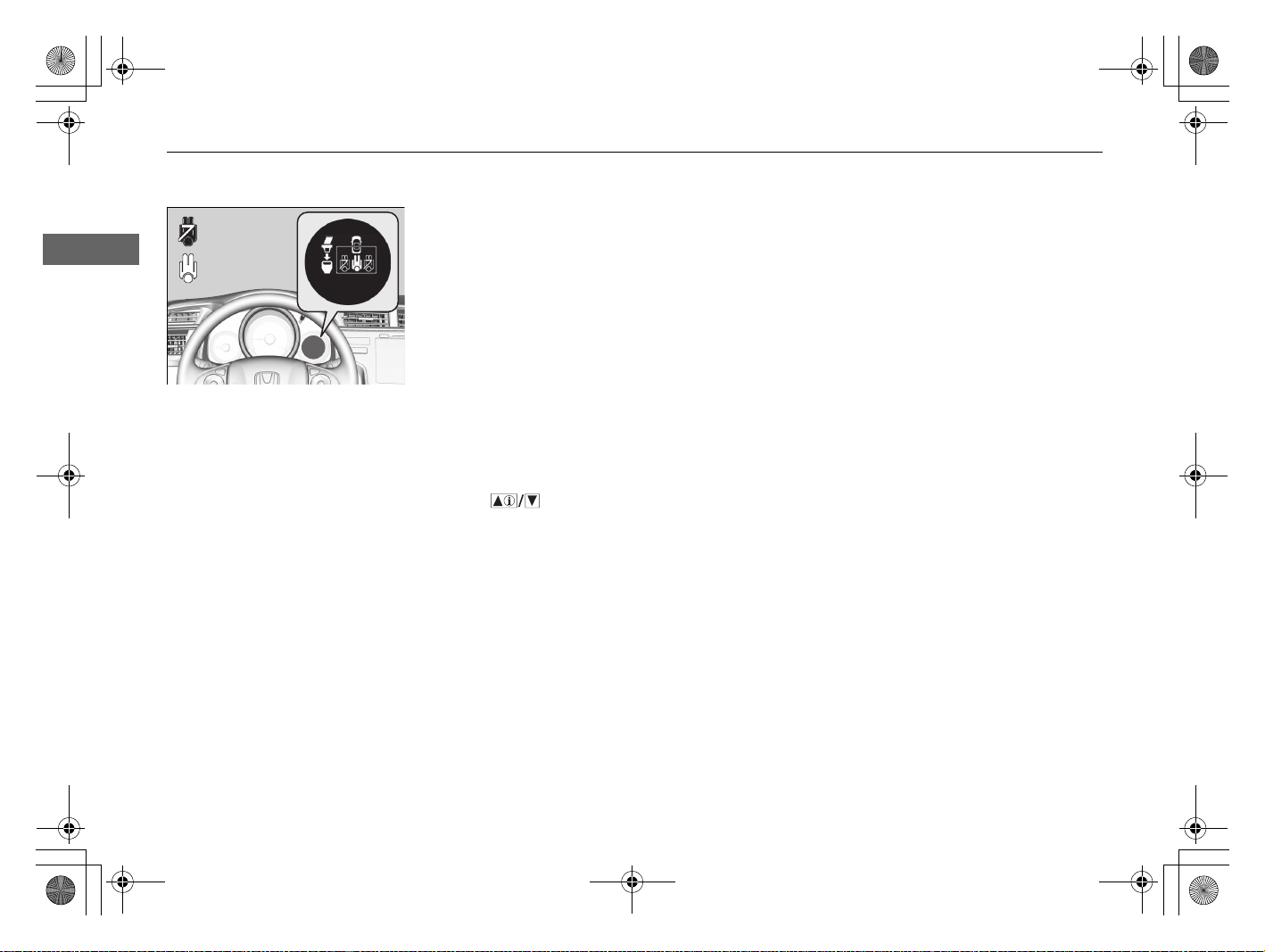
■ Rear seats
Your vehicle monitors rear seat belt use. A
multi-information display notifies you if any of
the rear seat belts are used.
The display appears when:
• A rear door is opened and closed.
• Any of the rear passengers latches or
unlatches their seat belt.
The beeper sounds if any rear passenger’s seat
belt is unlatched while driving.
To see the display:
press the button repeatedly.
*1: Models with the keyless access system have an ENGINE START/STOP button instead of an ignition
switch.
40
Page 42
Safe Driving
1Automatic Seat Belt Tensioners
The seat belt tensioners can only operate once.
If a tensioner is activated, the SRS indicator will come
on. Have a dealer replace the tensioner and
thoroughly inspect the seat belt system as it may not
offer protection in a subsequent crash.
During a moderate-to-severe side impact, the
tensioner on that side of the vehicle also activates.
18 FIT JAZZ-32T5A6100.book 41 ページ 2017年8月23日 水曜日 午前11時24分
Automatic Seat Belt Tensioners
■
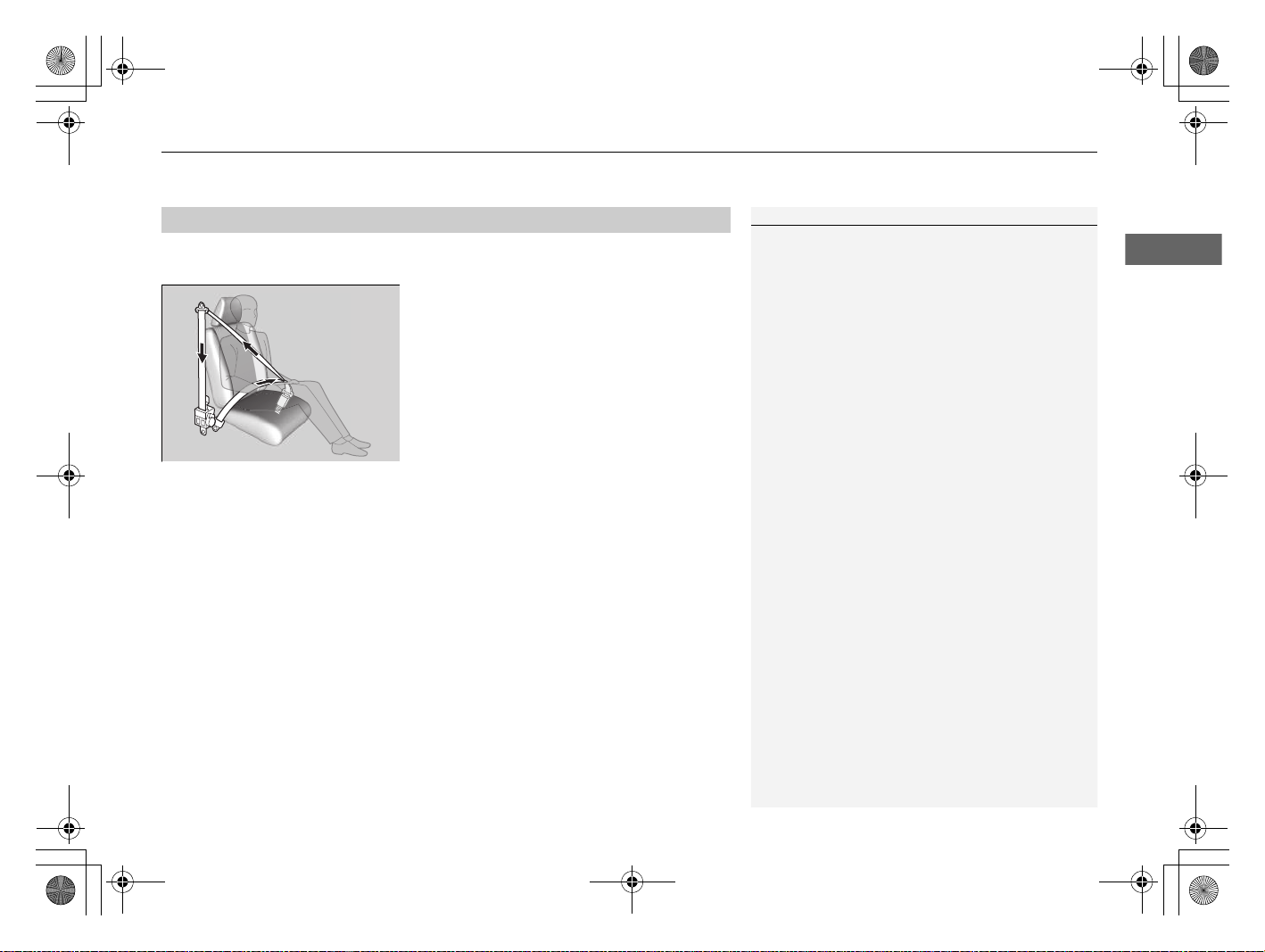
The front seats and the outer rear seats are equipped with automatic seat belt
tensioners to enhance safety.
The tensioners automatically tighten the front
seat belts and the outer rear seat belts during
a moderate-to-severe frontal collision,
sometimes even if the collision is not severe
enough to inflate the front airbags.
uuSeat BeltsuAbout Your Seat Belts
41
Page 43
Safe Driving
1Fastening a Seat Belt
No one should sit in a seat with an inoperative seat
belt or one that does not appear to be working
correctly. Using a seat belt that is not working
properly may not protect the occupant in a crash.
Have a dealer check the belt as soon as possible.
Pull out slowly.
Correct
Seated
Posture.
Latch Plate
Buckle
18 FIT JAZZ-32T5A6100.book 42 ページ 2017年8月23日 水曜日 午前11時24分
uuSeat BeltsuFastening a Seat Belt
Fastening a Seat Belt
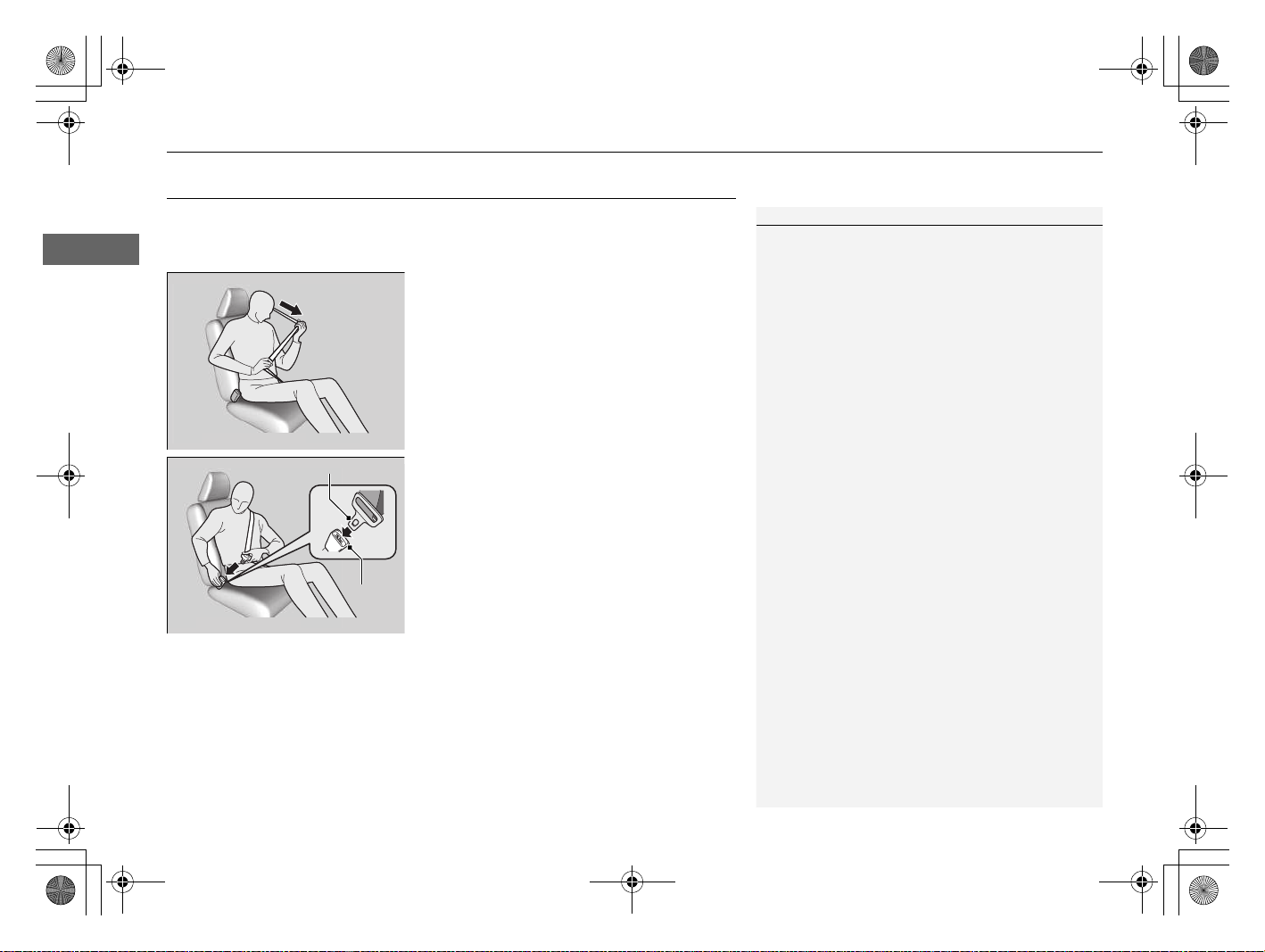
After adjusting a front seat to the proper position, and while sitting upright and well
back in the seat:
2 Adjusting the Seats P. 187
1. Pull the seat belt out slowly.
2. Insert the latch plate into the buckle, then
tug on the belt to make sure the buckle is
secure.
u Make sure that the belt is not twisted or
caught on anything.
42
Page 44
Safe Driving
1Fastening a Seat Belt
To release the belt, push the red PRESS button and
then guide the belt by hand until it has retracted
completely.
When exiting the vehicle, be sure the belt is properly
stowed so that it will not get caught in the closing
door.
Never insert any foreign objects into the buckle or
retractor mechanism.
3
WARNING
Improperly positioning the seat belts can
cause serious injury or death in a crash.
Make sure all seat belts are properly
positioned before driving.
Lap belt
as low as
possible
18 FIT JAZZ-32T5A6100.book 43 ページ 2017年8月23日 水曜日 午前11時24分
uuSeat BeltsuFastening a Seat Belt
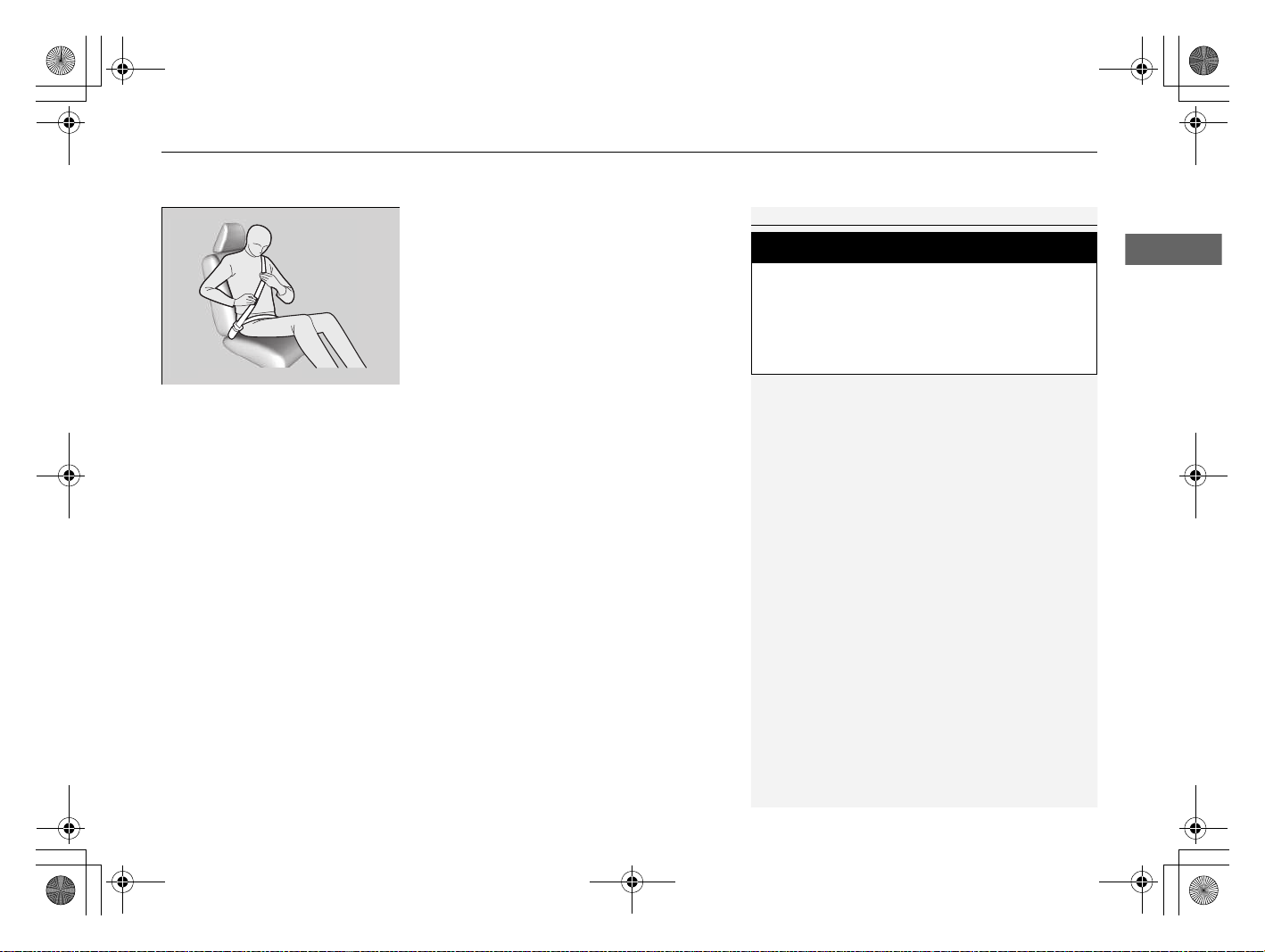
3. Position the lap part of the belt as low as
possible across your hips, then pull up on
the shoulder part of the belt so the lap part
fits snugly. This lets your strong pelvic
bones take the force of a crash and reduces
the chance of internal injuries.
4. If necessary, pull up on the belt again to
remove any slack, then check that the belt
rests across the centre of your chest and
over your shoulder. This spreads the forces
of a crash over the strongest bones in your
upper body.
Continued
43
Page 45
Safe Driving
1Adjusting the Shoulder Anchor
The shoulder anchor height can be adjusted to four
levels. If the belt contacts your neck, lower the height
one level at a time.
After an adjustment, make sure that the shoulder
anchor position is secure.
Pull outward
18 FIT JAZZ-32T5A6100.book 44 ページ 2017年8月23日 水曜日 午前11時24分
uuSeat BeltsuFastening a Seat Belt
Adjusting the Shoulder Anchor
■
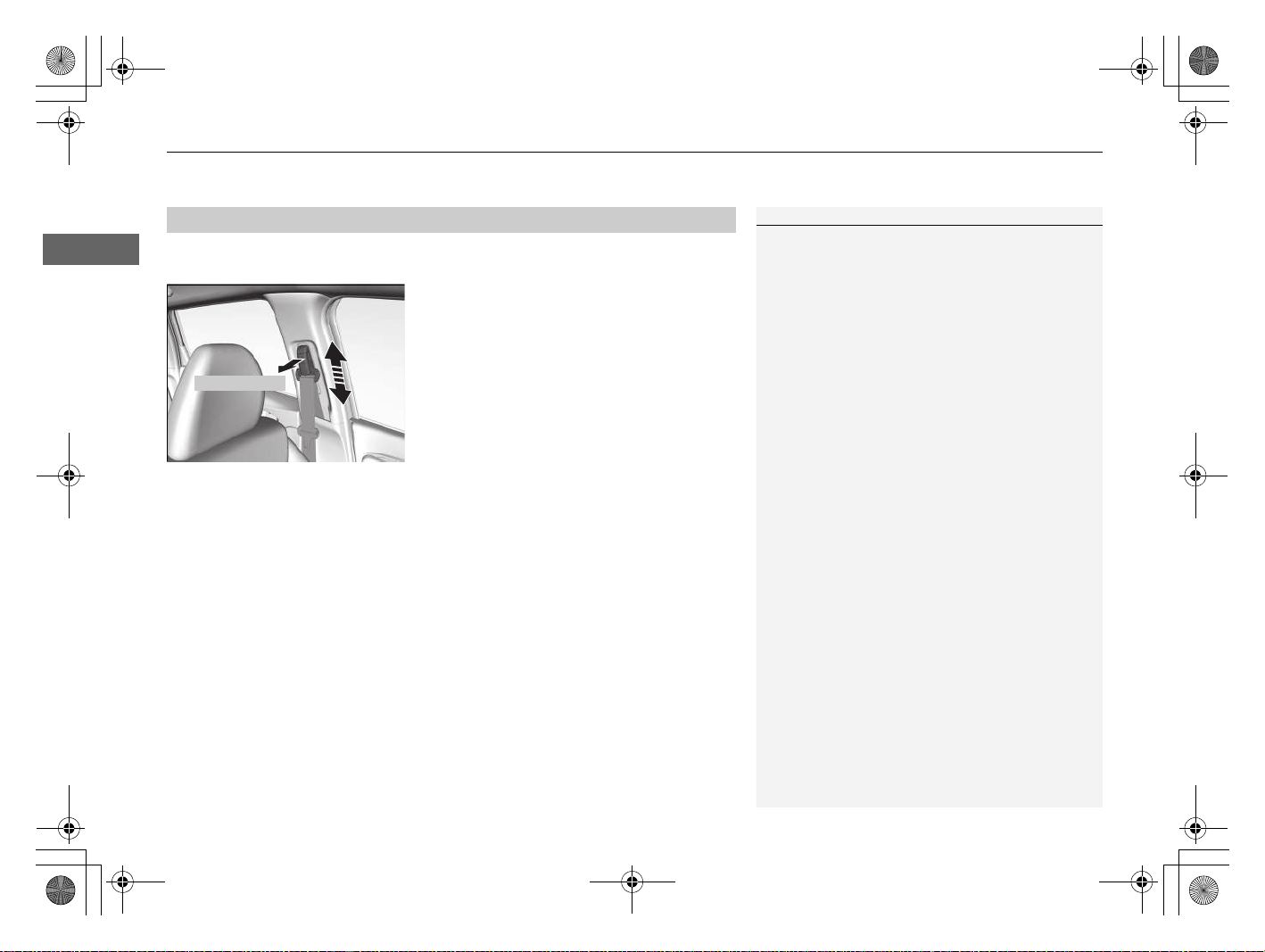
The front seats have adjustable shoulder anchors to accommodate taller and shorter
occupants.
1. Move the anchor up and down while
pulling the release outward.
2. Position the anchor so that the belt rests
across the centre of your chest and over
your shoulder.
44
Page 46
Safe Driving
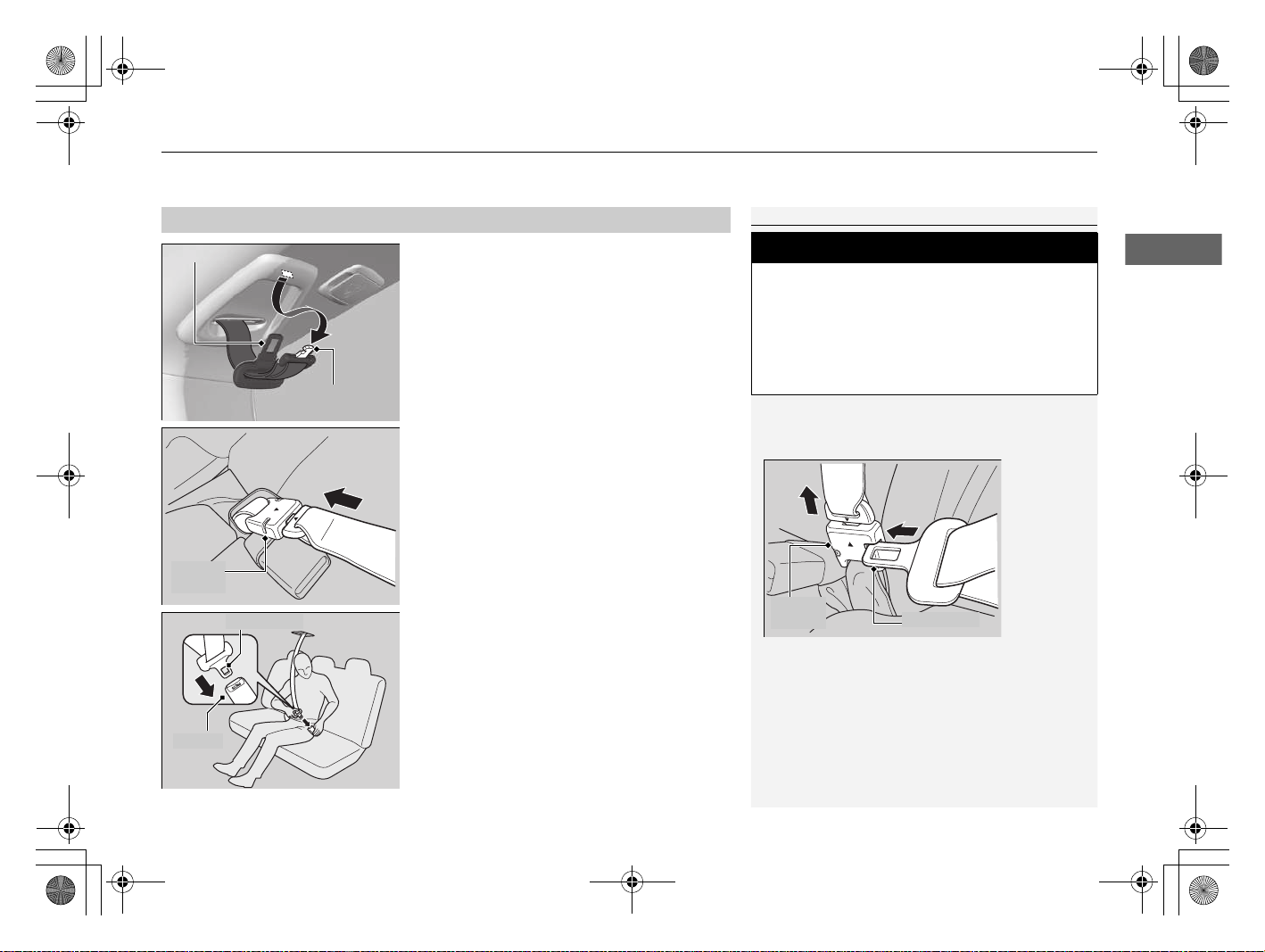
1Seat Belt with Detachable Anchor
To unlatch the detachable anchor, insert the latch
plate into the slot on the side of the anchor buckle.
3
WARNING
Using the seat belt with the detachable
anchor unlatched increases the chance of
serious injury or death in a crash.
Before using the seat belt, make sure the
detachable anchor is correctly latched.
Anchor
Buckle
Latch Plate
Latch Plate
Small Latch
Plate
Anchor
Buckle
Buckle
Latch Plate
18 FIT JAZZ-32T5A6100.book 45 ページ 2017年8月23日 水曜日 午前11時24分
■
uuSeat BeltsuFastening a Seat Belt
Seat Belt with Detachable Anchor
1. Pull out the seat belt’s small latch plate and
the latch plate from each holding slot in the
ceiling.
2. Line up the triangle marks on the small
latch plate and anchor buckle. Make sure
the seat belt is not twisted. Attach the belt
to the anchor buckle.
3. Insert the latch plate into the buckle.
Properly fasten the seat belt the same way
you fasten the lap/shoulder seat belt.
Continued
45
Page 47
Safe Driving
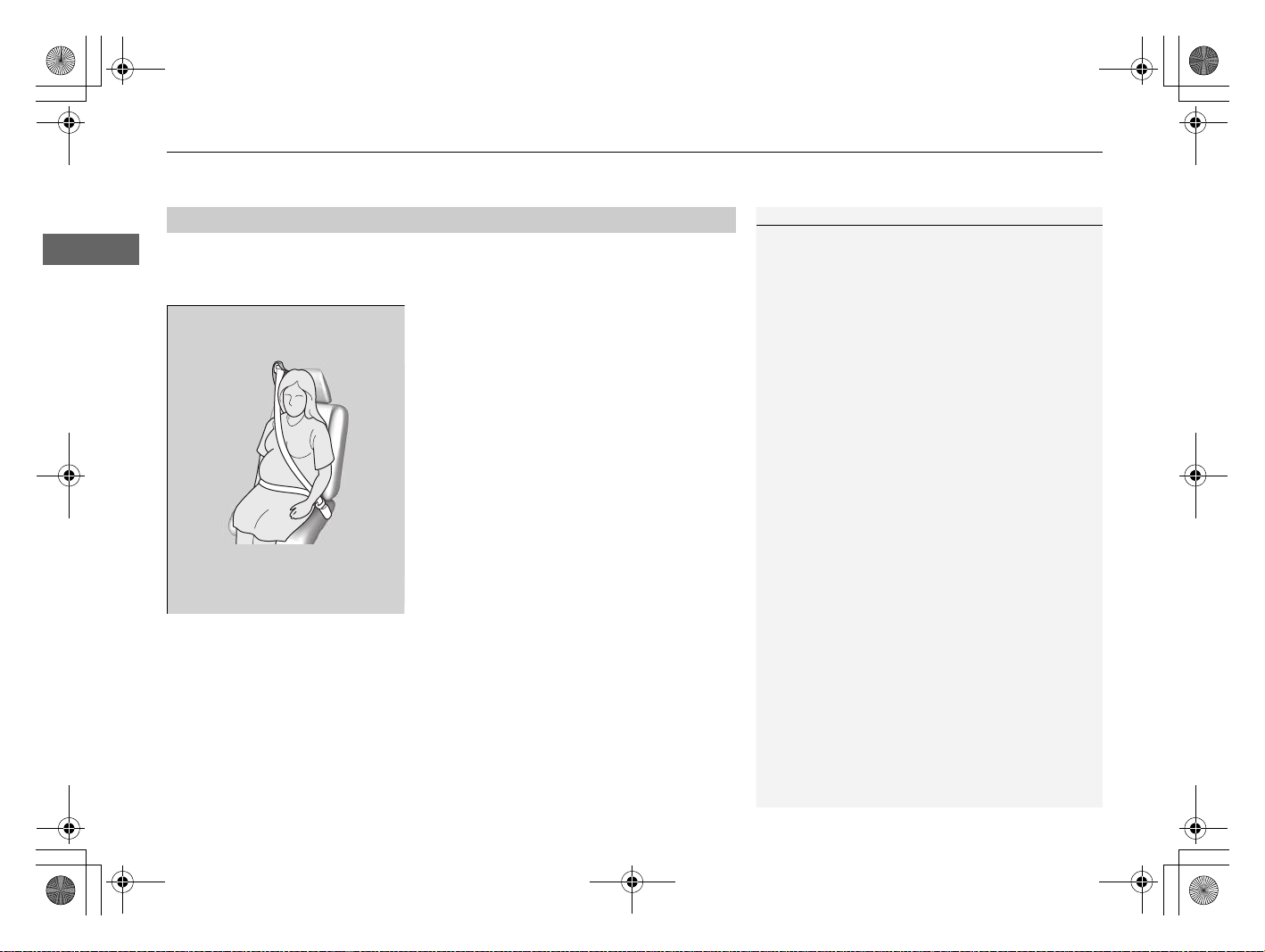
1Advice for Pregnant Women
Each time you have a checkup, ask your doctor if it is
okay for you to drive.
To reduce the risk of injuries to both you and your
unborn child that can be caused by an inflating front
airbag:
• When driving, sit upright and adjust the seat as far
back as possible while allowing full control of the
vehicle.
• When sitting in the front passenger's seat, adjust
the seat as far back as possible.
Wear the shoulder belt
across the chest avoiding
the abdomen.
Wear the lap part of the
belt as low as possible
across the hips.
18 FIT JAZZ-32T5A6100.book 46 ページ 2017年8月23日 水曜日 午前11時24分
uuSeat BeltsuFastening a Seat Belt
Advice for Pregnant Women
■
If you are pregnant, the best way to protect yourself and your unborn child when
driving or riding in a vehicle is to always wear a seat belt and keep the lap part of the
belt as low as possible across the hips.
46
Page 48
Safe Driving
1Seat Belt Inspection
WARNING: No modifications or additions should be
made by the user which will either prevent the seat
belt adjusting devices from operating to remove
slack, or prevent the seat belt assembly from being
adjusted to remove slack.
WARNING: It is essential to replace the entire
assembly after it has been worn in a severe impact
even if damage to the assembly is not obvious.
WARNING: Care should be taken to avoid
contamination of the webbing with polishes, oils and
chemicals, and particularly battery acid. Cleaning
may safely be carried out using mild soap and water.
The belt should be replaced if webbing becomes
frayed, contaminated or damaged.
3
WARNING
Not checking or maintaining seat belts can
result in serious injury or death if the seat
belts do not work properly when needed.
Check your seat belts regularly and have
any problem corrected as soon as possible.
18 FIT JAZZ-32T5A6100.book 47 ページ 2017年8月23日 水曜日 午前11時24分
Seat Belt Inspection
Regularly check the condition of your seat belts as follows:
• Pull each belt out fully, and look for frays, cuts, burns, and wear.
• Check that the latch plates and buckles work smoothly and the belts retract
easily.
u If a belt does not retract easily, cleaning the belt may correct the problem. Only
use a mild soap and warm water. Do not use bleach or cleaning solvents. Make
sure the belt is completely dry before allowing it to retract.
Any belt that is not in good condition or working properly will not provide proper
protection and should be replaced as soon as possible.
A belt that has been worn during a crash may not provide the same level of
protection in a subsequent crash. Have your seat belts inspected by a dealer after
any collision.
uuSeat Beltsu Seat Belt Inspection
47
Page 49
Safe Driving
Front Seat
Rear Seat
18 FIT JAZZ-32T5A6100.book 48 ページ 2017年8月23日 水曜日 午前11時24分
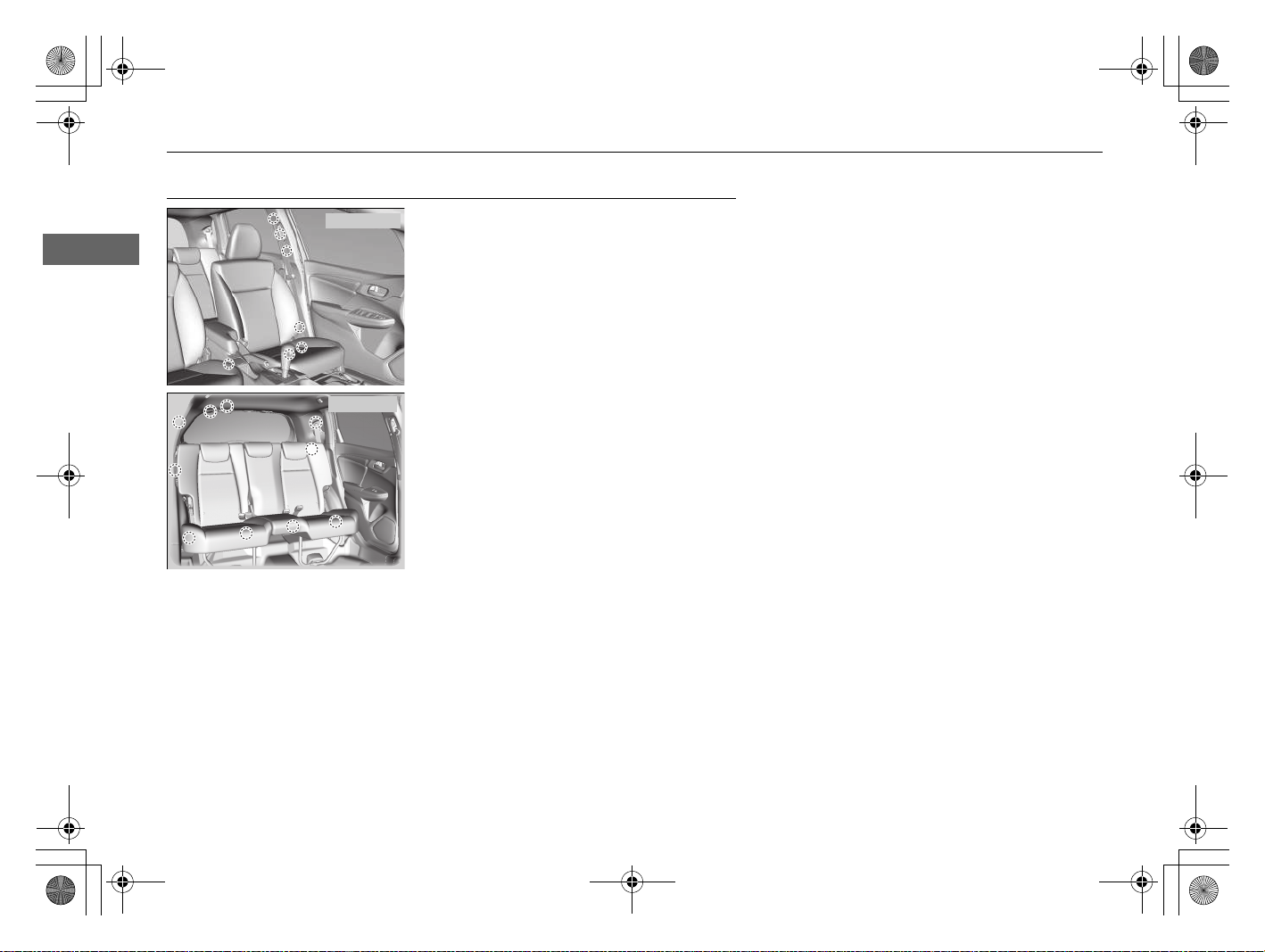
uuSeat BeltsuAnchorage points
Anchorage points
When replacing the seat belts, use the
anchorage points shown in the images.
The front seat has a lap/shoulder belt.
The rear seat has three lap/shoulder belts.
48
Page 50
Safe Driving
18 FIT JAZZ-32T5A6100.book 49 ページ 2017年8月23日 水曜日 午前11時24分
Airbags
Airbag System Components
The front, front side, and side curtain
airbags are deployed according to the
direction and severity of impact. The airbag
system includes:
• Two SRS (Supplemental Restraint System)
front airbags. The driver's airbag is stored
in the centre of the steering wheel; the
front passenger's airbag is stored in the
dashboard. Both are marked SRS
AIRBAG.
• Two side airbags, one for the driver and
one for a front passenger. The airbags are
stored in the outer edges of the seatbacks. Both are marked SIDE AIRBAG.
• Two side curtain airbags, one for each
side of the vehicle. The airbags are stored
in the ceiling, above the side windows.
The front and rear pillars are marked
SIDE CURTAIN AIRBAG.
• An electronic control unit that, when the
ignition switch is ON
(w
monitors information about the various
impact sensors, seat and buckle sensors,
airbag activators, seat belt tensioners,
and other vehicle information. During a
crash event the unit can record such
information.
• Automatic front seat belt tensioners.
• Impact sensors that can detect a
moderate-to-severe front or side impact.
• An indicator on the instrument panel that
alerts you to a possible problem with your
airbag system or seat belt tensioners.
• An indicator on the dashboard that alerts
you that the front passenger’s front
airbag has been turned off.
*1
, continually
*1: Models with the keyless access system have an
ENGINE START/STOP button instead of an ignition
switch.
Continued
49
Page 51
Safe Driving
1Important facts about your airbags
Do not attempt to deactivate your airbags. Together,
airbags and seat belts provide the best protection.
When driving, keep hands and arms out of the
deployment path of the front airbag by holding each
side of the steering wheel. Do not cross an arm over
the airbag cover.
18 FIT JAZZ-32T5A6100.book 50 ページ 2017年8月23日 水曜日 午前11時24分
uuAirbagsu Airbag System Components
Important facts about your airbags
■
Airbags can pose serious hazards. To do their job, airbags must inflate with
tremendous force. So, while airbags help to save lives, they can cause burns, bruises,
and other minor injuries, sometimes even fatal ones if occupants are not wearing
their seat belts properly and sitting correctly.
What you should do: Always wear your seat belt properly, and sit upright and as
far back from the steering wheel as possible while allowing full control of the
vehicle. A front passenger should move their seat as far back from the dashboard as
possible.
Remember, however, that no safety system can prevent all injuries or deaths that
can occur in a severe crash, even when seat belts are properly worn and the airbags
deploy.
Do not place hard or sharp objects between yourself and a front airbag.
Carrying hard or sharp objects on your lap, or driving with a pipe or other sharp
object in your mouth, can result in injuries if your front airbag inflates.
Do not attach or place objects on the front airbag covers. Objects on the
covers marked SRS AIRBAG could interfere with the proper operation of the airbags
or be propelled inside the vehicle and hurt someone if the airbags inflate.
50
Page 52
Safe Driving
1Types of Airbags
The airbags can inflate whenever the ignition switch
is in ON
(w
*1
.
After an airbag inflates in a crash, you may see a
small amount of smoke. This is from the combustion
process of the inflator material and is not harmful.
People with respiratory problems may experience
some temporary discomfort. If this occurs, get out of
the vehicle as soon as it is safe to do so.
18 FIT JAZZ-32T5A6100.book 51 ページ 2017年8月23日 水曜日 午前11時24分
uuAirbagsu Types of Airbags
Types of Airbags
Your vehicle is equipped with three types of airbags:
• Front airbags: Airbags in front of the driver's and front passenger's seats.
• Side airbags: Airbags in the driver's and front passenger's seat-backs.
• Side curtain airbags: Airbags above the side windows.
Each is discussed in the following pages.
Front Airbags (SRS)
The front SRS airbags inflate in a moderate-to-severe frontal collision to help to
protect the head and chest of the driver and/or front passenger.
SRS (Supplemental Restraint System) indicates that the airbags are designed to
supplement seat belts, not replace them. Seat belts are the occupant's primary
restraint system.
Housing Locations
■
The front airbags are housed in the centre of the steering wheel for the driver, and
in the dashboard for the front passenger. Both airbags are marked SRS AIRBAG.
*1: Models with the keyless access system have an ENGINE START/STOP button instead of an ignition
switch.
Continued
51
Page 53
Safe Driving
18 FIT JAZZ-32T5A6100.book 52 ページ 2017年8月23日 水曜日 午前11時24分
uuAirbagsu Front Airbags (SRS)
Operation
■
Front airbags are designed to inflate during moderate-to-severe frontal collisions.
When the vehicle decelerates suddenly, the sensors send information to the control
unit which signals one or both front airbags to inflate.
A frontal collision can be either head-on or angled between two vehicles, or when a
vehicle crashes into a stationary object, such as a concrete wall.
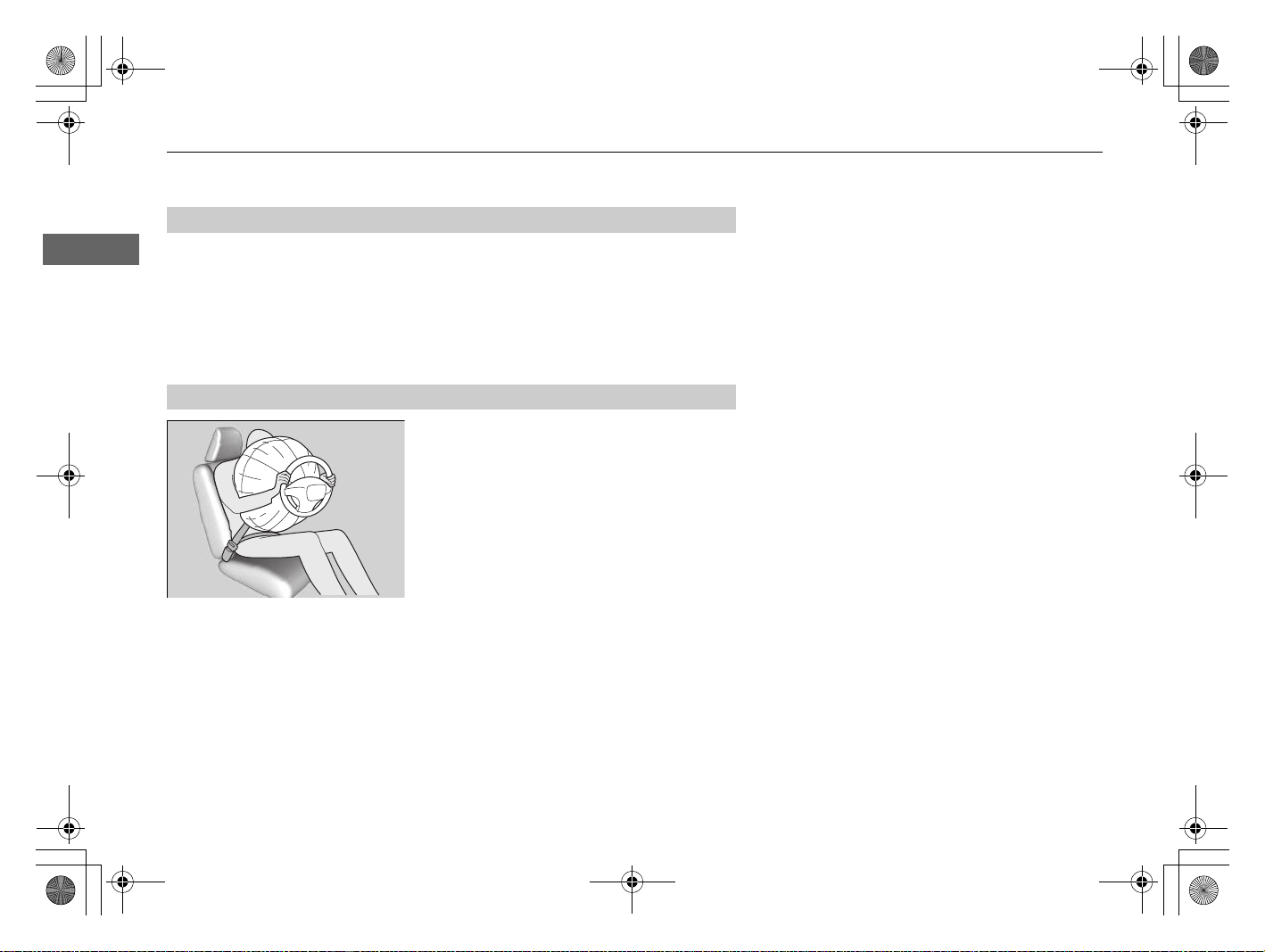
How the Front Airbags Work
■
While your seat belt restrains your torso, the
front airbag provides supplemental protection
for your head and chest.
The front airbags deflate immediately so that
they won't interfere with the driver's visibility
or the ability to steer or operate other
controls.
The total time for inflation and deflation is so fast that most occupants are not
aware that the airbags deployed until they see them lying in front of them.
52
Page 54
Safe Driving
18 FIT JAZZ-32T5A6100.book 53 ページ 2017年8月23日 水曜日 午前11時24分
uuAirbags u Front Airbags (SRS)
■ When front airbags should not deploy
Minor frontal crashes: Front airbags were designed to supplement seat belts and
help to save lives, not to prevent minor scrapes, or even broken bones that might
occur during a less than moderate-to-severe frontal crash.
Side impacts: Front airbags can provide protection when a sudden deceleration
causes a driver or front passenger to move towards the front of the vehicle. Side
airbags and side curtain airbags have been specifically designed to help to reduce
the severity of injuries that can occur during a moderate-to-severe side impact which
can cause the driver or passenger to move towards the side of the vehicle.
Rear impacts: Head restraints and seat belts are your best protection during a rear
impact. Front airbags cannot provide any significant protection and are not designed
to deploy in such collisions.
Rollovers: Seat belts and side curtain airbags offer the best protection in a rollover.
Because front airbags could provide little if any protection, they are not designed to
deploy during a rollover.
■ When front airbags deploy with little or no visible damage
Because the airbag system senses sudden deceleration, a strong impact to the
vehicle framework or suspension might cause one or more of the airbags to deploy.
Examples include running into a curb, the edge of a hole, or other low fixed object
that causes a sudden deceleration in the vehicle chassis. Since the impact is
underneath the vehicle, damage may not be readily apparent.
■ When front airbags may not deploy, even though exterior damage
appears severe
Since crushable body parts absorb crash energy during an impact, the amount of
visible damage does not always indicate proper airbag operation. In fact, some
collisions can result in severe damage but no airbag deployment because the airbags
would not have been needed or would not have provided protection even if they
had deployed.
Continued
53
Page 55
Safe Driving
1Passenger Front Airbag Off System
3
WARNING
The passenger front airbag system must be
turned off, if it is not avoidable to put a
rear-facing child restraint system in the
front passenger seat.
If the front passenger airbag inflates, it can
hit the rear-facing child restraint system
with enough force to kill or cause a very
serious injury to the infant.
3
WARNING
Make sure to turn on the passenger front
airbag system when a rear-facing child
restraint system is not used on the front
passenger seat.
Leaving the passenger front airbag system
deactivated can result in serious injury or
death in a crash.
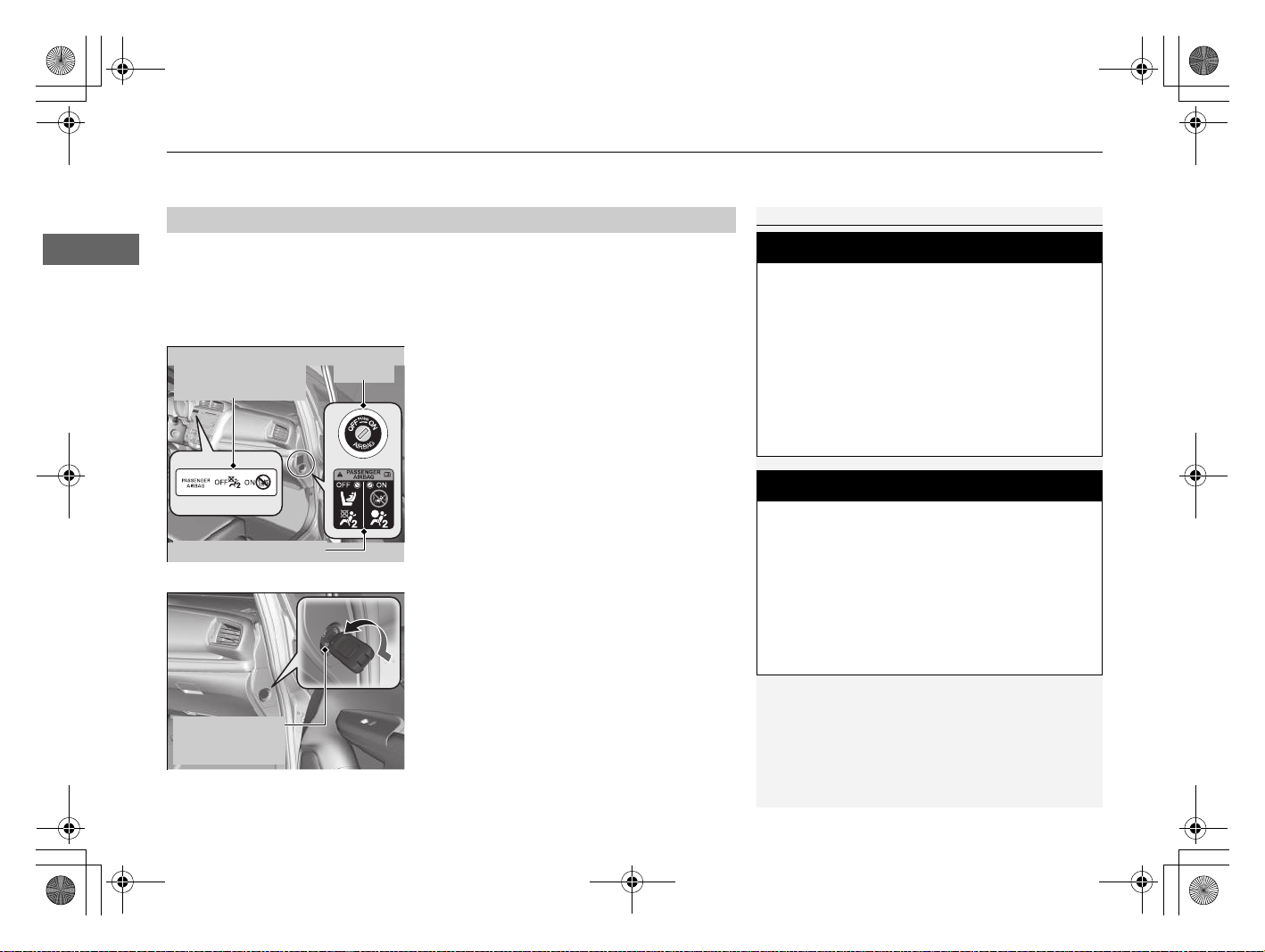
Passenger Front
Airbag ON/OFF
Indicator
System Warning Label
ON/OFF
Switch
Passenger Front
Airbag ON/OFF
Switch
18 FIT JAZZ-32T5A6100.book 54 ページ 2017年8月23日 水曜日 午前11時24分
uuAirbagsu Front Airbags (SRS)
Passenger Front Airbag Off System
■
If it is unavoidable to install a rear-facing child restraint system in the front passenger
seat, you must manually deactivate the passenger front airbag system, using the
ignition key or the built-in key.
■ Passenger front airbag ON/OFF switch
54
■ To deactivate the passenger front airbag system
*1: Models with the keyless access system have an ENGINE START/STOP button instead of an ignition
switch.
When the passenger front airbag ON/OFF
switch is in:
OFF: The passenger front airbag is
deactivated. The passenger front airbag does
not inflate during a frontal crash that inflates
driver’s front airbag.
The passenger front airbag off indicator stays
on as a reminder.
ON: The passenger front airbag is activated.
The passenger front airbag on indicator comes
on and remains on for about 60 seconds.
1. Set the parking brake, and turn the ignition
switch to LOCK (0*1. Remove the key.
2. Open the front passenger’s door.
3. Insert the key to the passenger front airbag
ON/OFF switch.
u The switch is located at the side panel of
the front passenger side instrument panel.
4. Turn the key to OFF, and remove it from
the switch.
Page 56
Safe Driving
1To deactivate the passenger front airbag system
NOTICE
• Use your vehicle’s ignition key/built-in key to turn
the passenger front airbag ON/OFF switch. If you
use a different key, the switch can be damaged, or
the passenger front airbag system may not work
properly.
• Do not close the door or apply excessive load on
the ignition key/built-in key while the key is in the
passenger front airbag ON/OFF switch. The switch
or the key can be damaged.
We strongly recommend that you do not install a
rear-facing child restraint system in the front
passenger seat.
2 Protecting Infants P. 66
It is your responsibility to change the setting of the
passenger front airbag system to OFF when you put
a rear-facing child restraint system on the front
passenger seat.
When a rear-facing child restraint system is not in use
in the front passenger seat, turn the system back on.
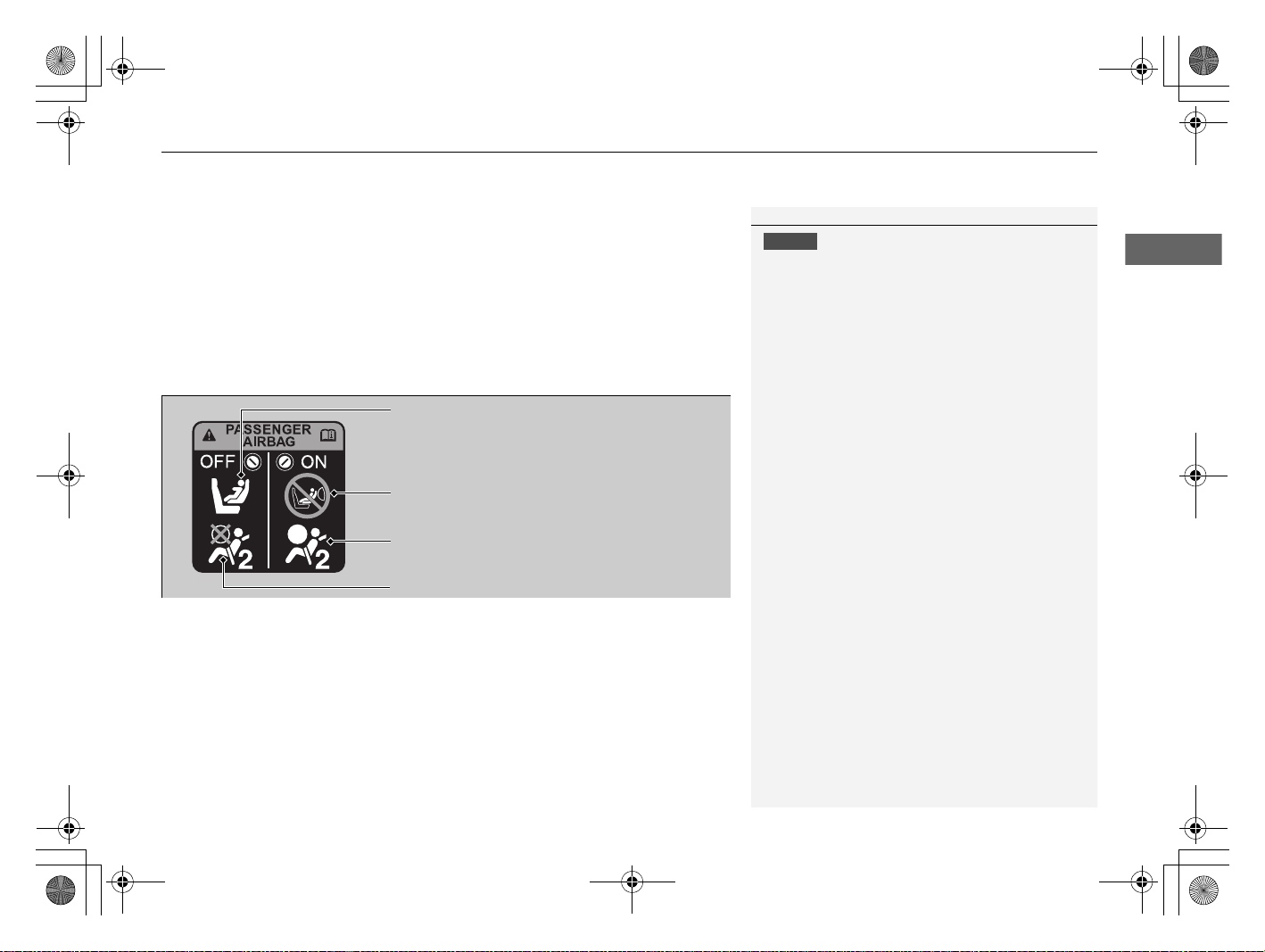
Infant in a rear-facing child restraint system: May
ride in front if it is unavoidable
Cannot ride in the front
Front passenger front airbag is: Active
Inactive
18 FIT JAZZ-32T5A6100.book 55 ページ 2017年8月23日 水曜日 午前11時24分
■ Passenger front airbag off indicator
When the passenger front airbag system is activated, the indicator goes off after a
few seconds when you turn the ignition switch to ON
When the passenger front airbag system is deactivated, the indicator stays on, or
goes off momentarily and comes back on.
■ Passenger front airbag off system label
The label is located at the side panel of the front passenger side instrument panel.
(w
uuAirbags u Front Airbags (SRS)
*1
.
*1: Models with the keyless access system have an ENGINE START/STOP button instead of an ignition
switch.
55
Page 57
Safe Driving
1Side Airbags
Do not attach accessories on or near the side airbags.
They can interfere with the proper operation of the
airbags, or hurt someone if an airbag inflates.
Housing
Location
18 FIT JAZZ-32T5A6100.book 56 ページ 2017年8月23日 水曜日 午前11時24分
uuAirbagsu Side Airbags
Side Airbags
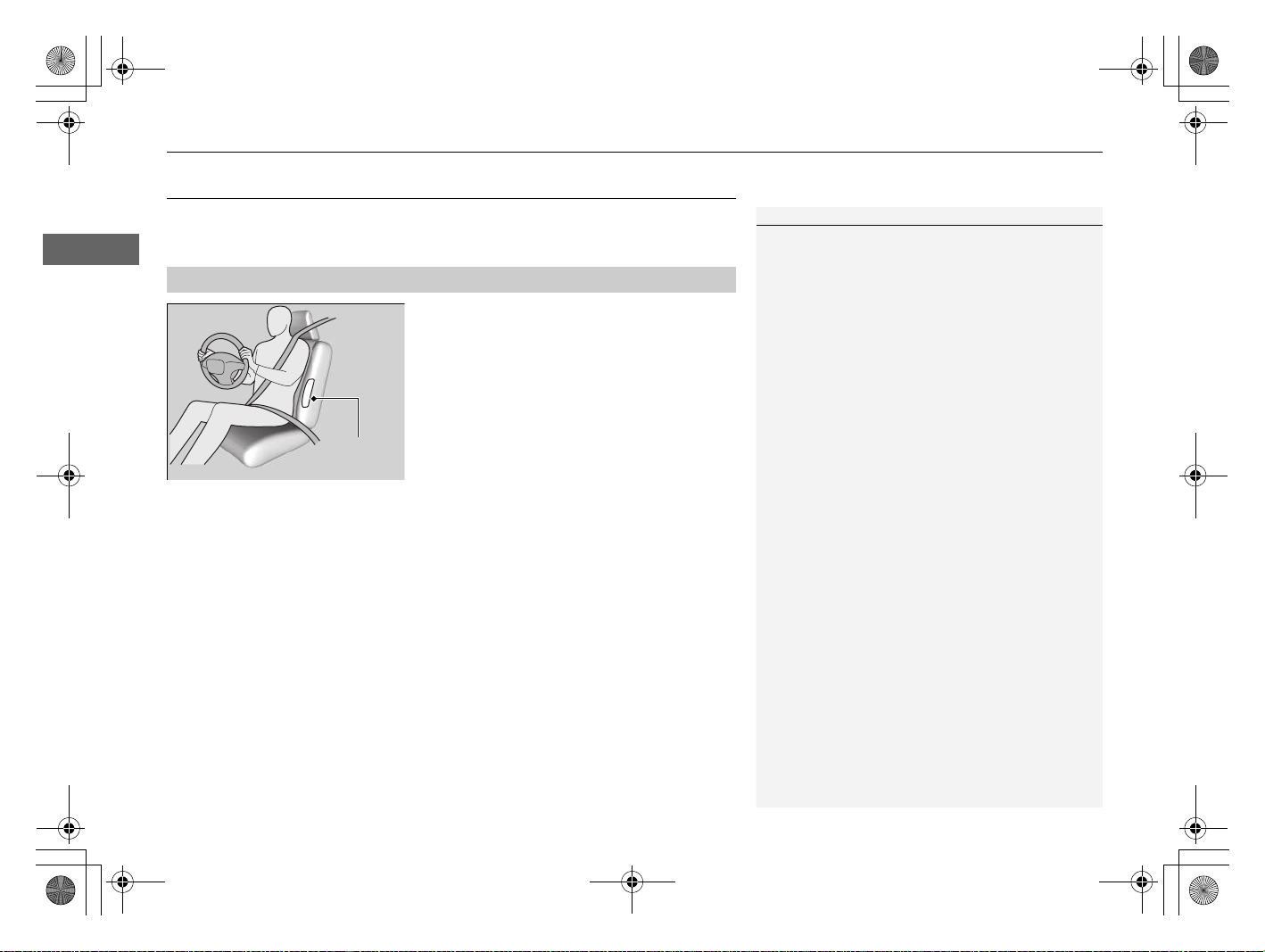
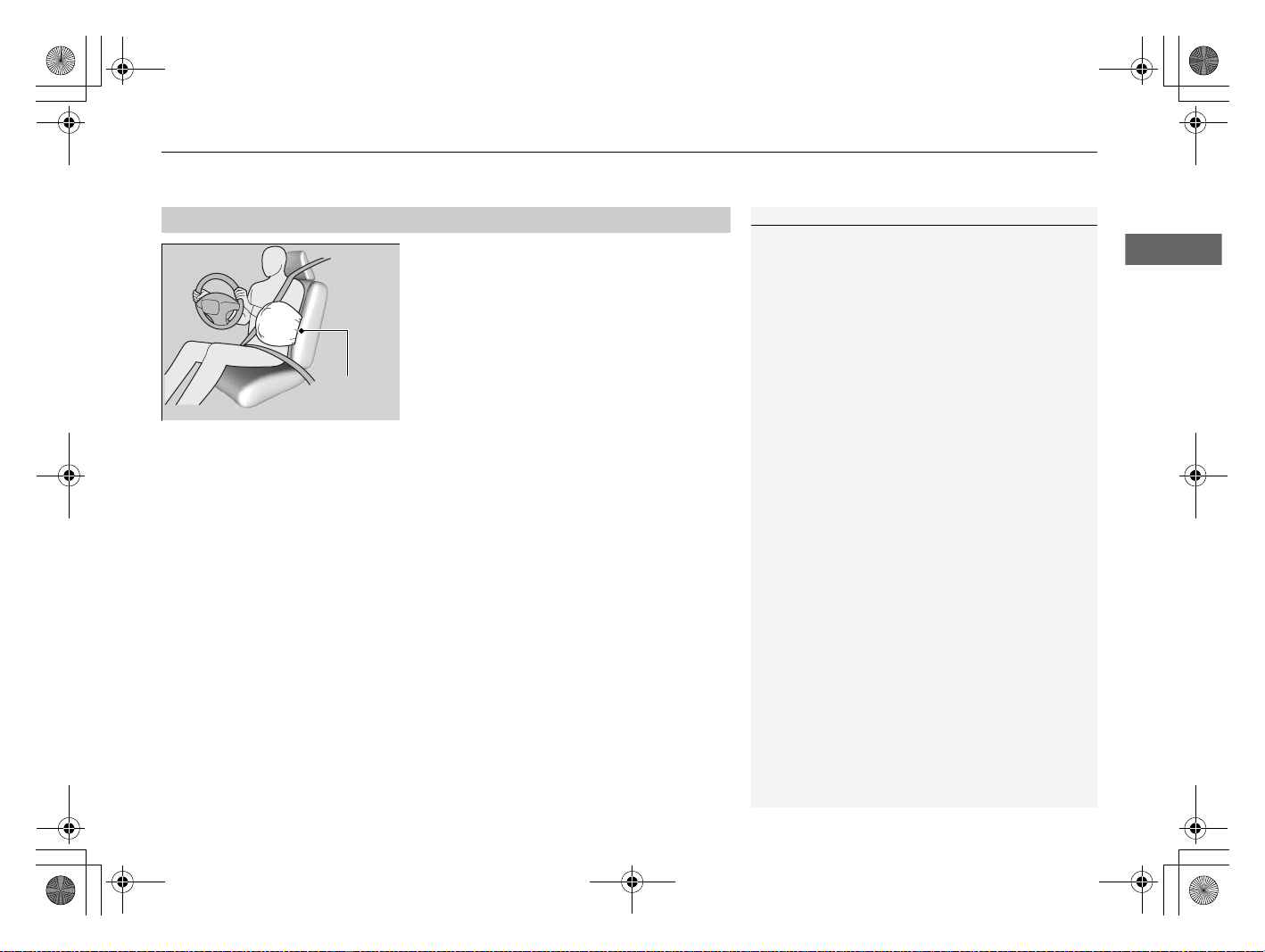
The side airbags help to protect the upper torso and pelvis of the driver or a front
passenger during a moderate-to-severe side impact.
Housing Locations
■
The side airbags are housed in the outside edge
of the driver's and passenger's seat-backs.
56
Both are marked SRS AIRBAG.
Page 58
Safe Driving
1Side Airbags
Do not cover or replace the front seat-back covers
without consulting a dealer.
Improperly replacing or covering front seat-back
covers can prevent your side airbags from properly
deploying during a side impact.
Do not let the front passenger lean sideways with
their head in the deployment path of the side airbag.
An inflating side airbag can strike with strong force
and seriously injure the passenger.
When
inflated
Side
Airbag
18 FIT JAZZ-32T5A6100.book 57 ページ 2017年8月23日 水曜日 午前11時24分
Operation
■
■ When a side airbag deploys with little or no visible damage
Because the airbag systems senses sudden acceleration, a strong impact to the side
of the vehicle's framework can cause a side airbag to deploy. In such cases, there
may be little or no damage, but the side impact sensors detected a severe enough
impact to deploy the airbag.
■ When a side airbag may not deploy, even though visible damage appears
severe
It is possible for a side airbag to not deploy during an impact that results in
apparently severe damage. This can occur when the point of impact was towards
the far front or rear of the vehicle, or when the vehicle's crushable body parts
absorbed most of the crash energy. In either case, the side airbag would not have
been needed nor provided protection even if it had deployed.
uuAirbags u Side Airbags
When the sensors detect a moderate-tosevere side impact, the control unit signals the
side airbag on the impact side to immediately
inflate.
57
Page 59
Safe Driving
1Side Curtain Airbags
The side curtain airbags are most effective when an
occupant is wearing their seat belt properly and
sitting upright, well back in their seat.
Do not attach any objects to the side windows or roof
pillars as they can interfere with the proper operation
of the side curtain airbags.
Do not put a coat hanger or hard objects on a coat
hook. This could result in injuries if your side curtain
airbag inflates.
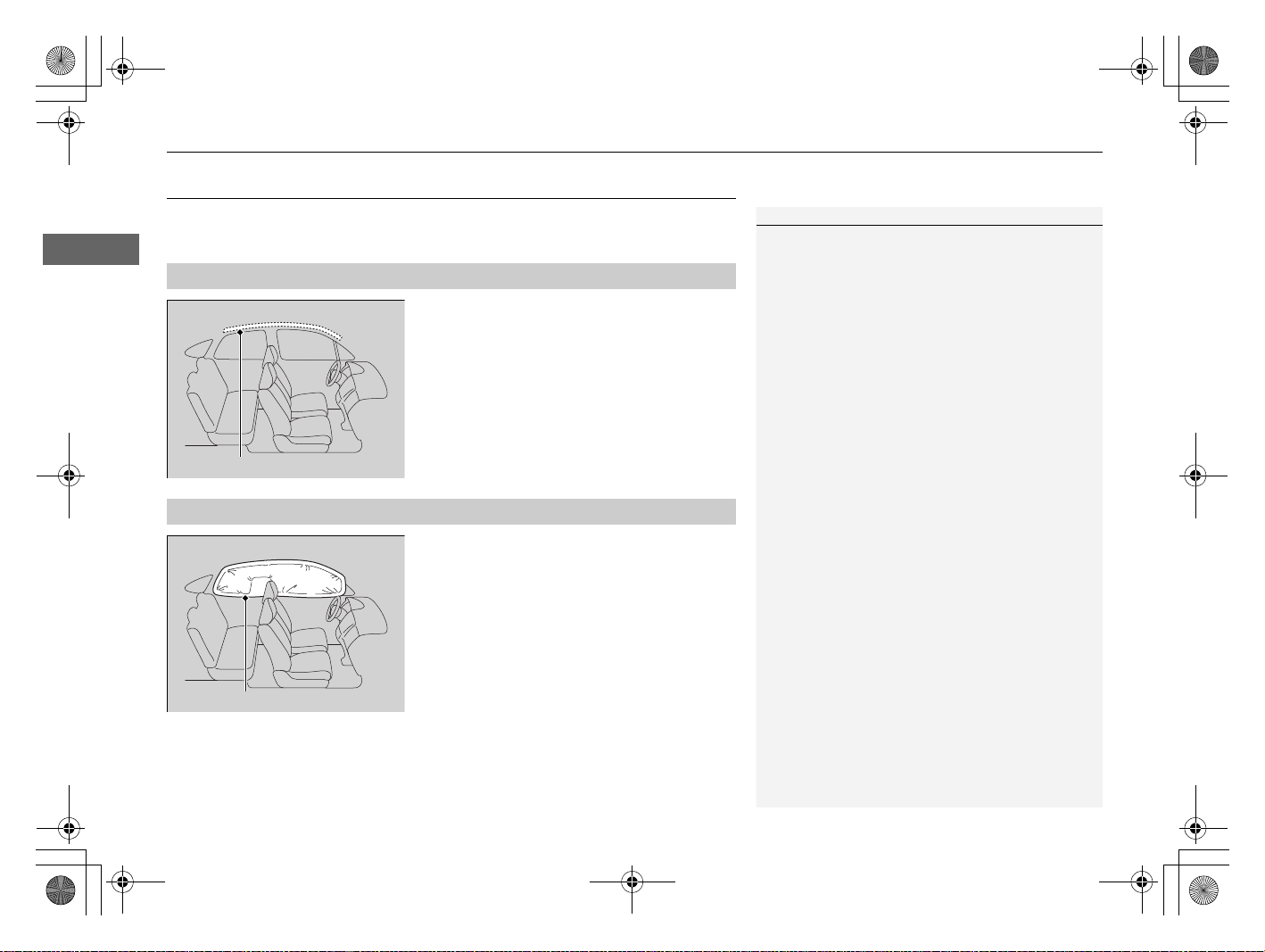
Side Curtain Airbag Storage
Deployed Side Curtain Airbag
18 FIT JAZZ-32T5A6100.book 58 ページ 2017年8月23日 水曜日 午前11時24分
uuAirbagsu Side Curtain Airbags
Side Curtain Airbags
The side curtain airbags help to protect the heads of the driver and passengers in
outer seating positions during a moderate-to-severe side impact.
Housing Locations
■
The side curtain airbags are located in the
ceiling above the side windows on both sides
of the vehicle.
Operation
■
The side curtain airbag is designed to deploy
in a moderate-to-severe side impact.
■ When side curtain airbags deploy in a frontal collision
One or both side curtain airbags may inflate in a moderate-to-severe angled frontal
collision.
58
Page 60
Safe Driving
1Supplemental Restraint System (SRS) Indicator
3
WARNING
Ignoring the SRS indicator can result in
serious injury or death if the airbag systems
or tensioners do not work properly.
Have your vehicle checked by a dealer as
soon as possible if the SRS indicator alerts
you to a possible problem.
18 FIT JAZZ-32T5A6100.book 59 ページ 2017年8月23日 水曜日 午前11時24分
Airbag System Indicators
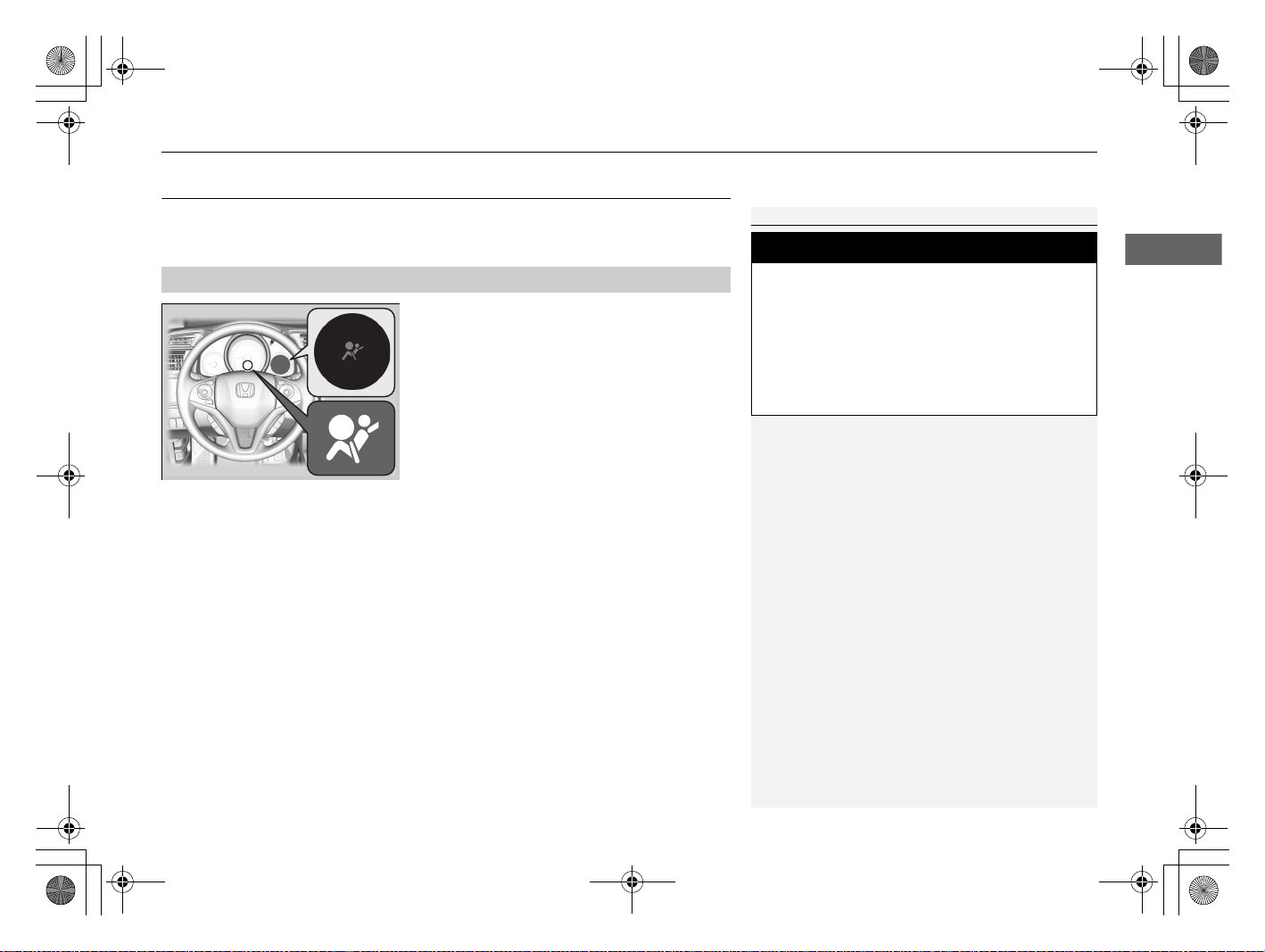
If a problem occurs in the airbag system, the SRS indicator comes on and a message
appears on the multi-information display.
Supplemental Restraint System (SRS) Indicator
■
■ When the ignition switch is turned to
*1
ON (w
The indicator comes on for a few seconds,
then goes off. This tells you the system is
working properly.
uuAirbagsu Airbag System Indicators
*1: Models with the keyless access system have an ENGINE START/STOP button instead of an ignition
switch.
If the indicator comes on at any other time, or
does not come on at all, have the system
checked by a dealer as soon as possible. If you
don't, your airbags and seat belt tensioners
may not work properly when they are needed.
Continued
59
Page 61
Safe Driving
1Supplemental Restraint System (SRS) Indicator
3
WARNING
Remove the rear-facing child restraint
system immediately from the front
passenger seat if the SRS indicator comes
on. Even if the passenger front airbag has
been deactivated, do not ignore the SRS
indicator.
The SRS system may have a fault which
could cause the passenger front airbag to
be activated, causing serious injury or
death.
18 FIT JAZZ-32T5A6100.book 60 ページ 2017年8月23日 水曜日 午前11時24分
uuAirbagsu Airbag System Indicators
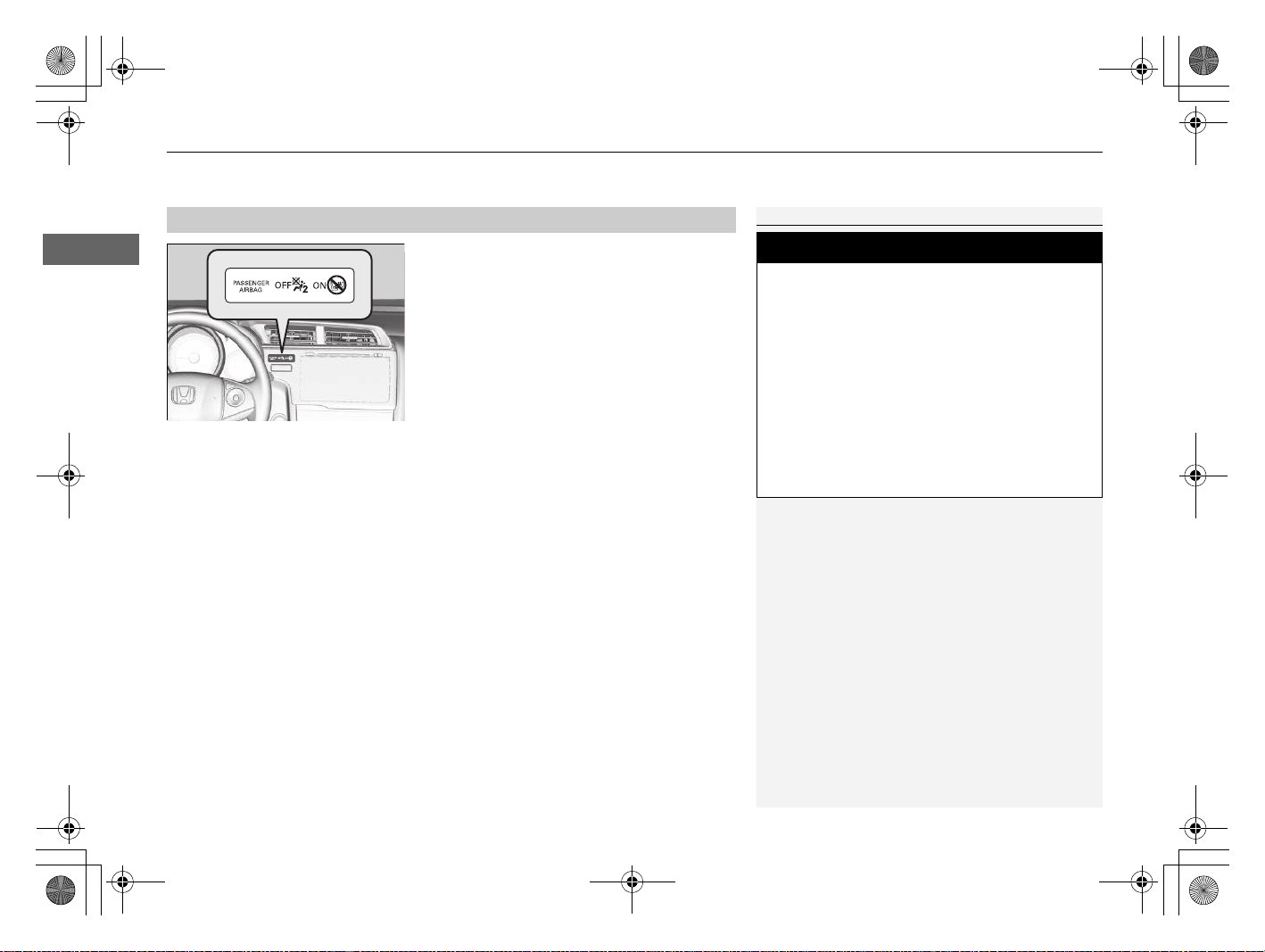
Passenger Front Airbag Off Indicator
■
■ When the passenger airbag off
indicator comes on
The indicator stays on while the passenger’s
front airbag system is deactivated.
When a rear-facing child restraint system is
not in use in the front passenger seat,
manually turn the system back on. The
indicator should go off.
60
Page 62
Safe Driving
1Airbag Care
The removal of airbag components from the vehicle is
prohibited.
In case of malfunction, or shutdown, or after the
airbag inflation/seat belt tensioner operation, ask a
qualified personnel for handling.
We recommend against the use of salvaged airbag
system components, including the airbag, tensioners,
sensors, and control unit.
18 FIT JAZZ-32T5A6100.book 61 ページ 2017年8月23日 水曜日 午前11時24分
Airbag Care
You do not need to, and should not, perform any maintenance on or replace any
airbag system components yourself. However, you should have your vehicle
inspected by a dealer in the following situations:
■ When the airbags have deployed
If an airbag has inflated, the control unit and other related parts must be replaced.
Similarly, once an automatic seat belt tensioner has been activated, it must be
replaced.
■ When the vehicle has been in a moderate-to-severe collision
Even if the airbags did not inflate, have your dealer inspect the following: front seat
belt tensioners, and each seat belt that was worn during the crash.
uuAirbags u Airbag Care
61
Page 63
Safe Driving
1Protecting Child Passengers
In many countries, the law requires all children aged 12
and under, and whose height are shorter than 150 cm
(60 inches) be properly restrained in a rear seat.
In many countries, it is required to use an officially
approved and suitable child restraint system for
transporting a child on any passenger seat. Check
your local legal requirement.
Child restraint systems must meet UN Regulation No. 44
or No. 129 or the regulations of the subject countries.
2 Selecting a Child Restraint System P. 69
We recommend that child restraint systems meet UN
Regulation No. 44 or No. 129, or the regulations of
the subject countries.
3
WARNING
Children who are unrestrained or
improperly restrained can be seriously
injured or killed in a crash.
Any child too small for a seat belt should be
properly restrained in an approved child
restraint system. A larger child should be
properly restrained with a seat belt, using a
booster seat if necessary.
European models
Except European models
18 FIT JAZZ-32T5A6100.book 62 ページ 2017年8月23日 水曜日 午前11時24分
Child Safety
Protecting Child Passengers
Each year, many children are injured or killed in vehicle crashes because they are
either unrestrained or not properly restrained. In fact, vehicle crashes are the
number one cause of death of children aged 12 and under.
To reduce the number of child deaths and injuries, infants and children should be
properly restrained when they ride in a vehicle.
62
Page 64
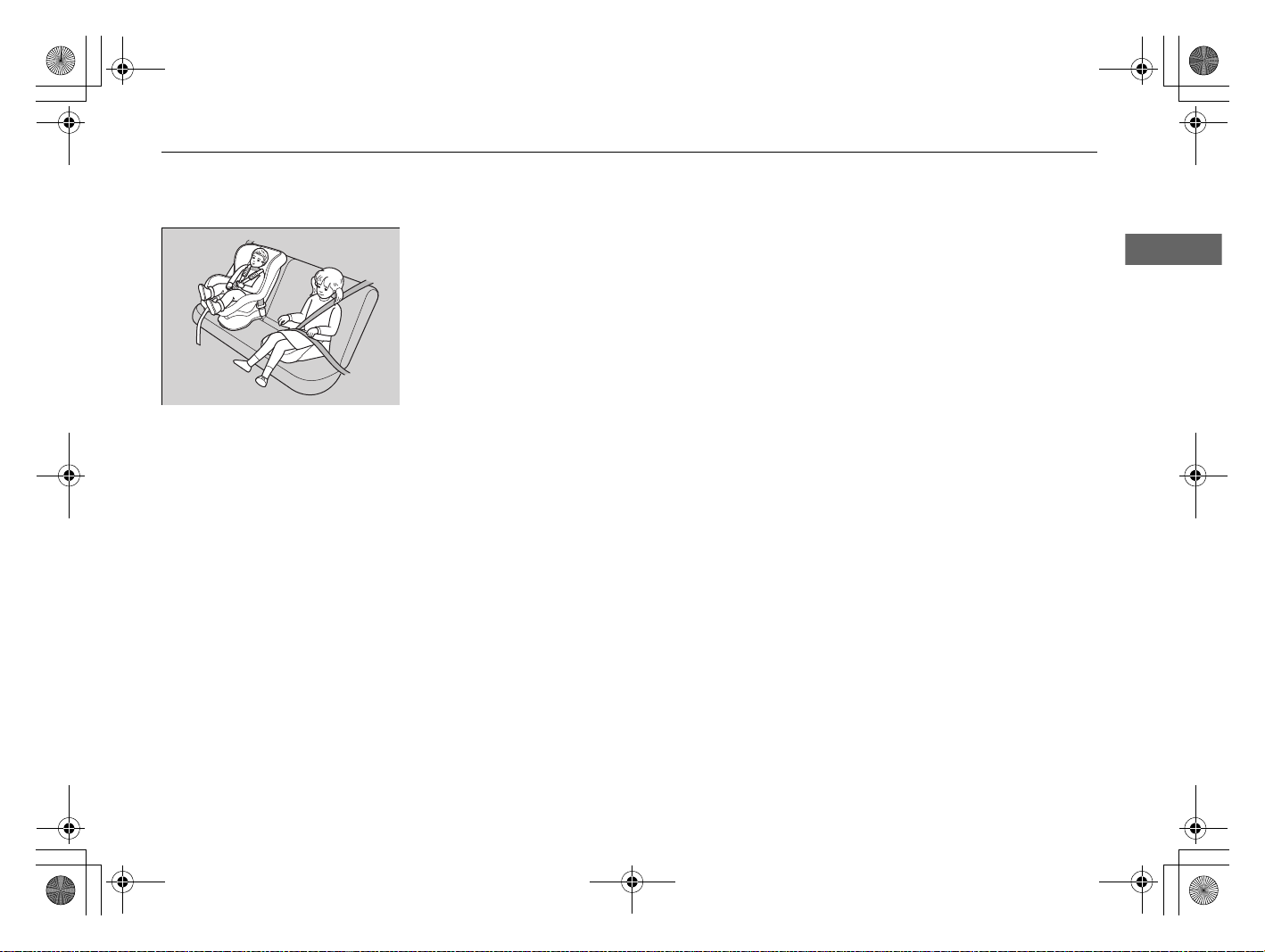
Safe Driving
18 FIT JAZZ-32T5A6100.book 63 ページ 2017年8月23日 水曜日 午前11時24分
Children should sit properly restrained in a rear seat. This is because:
• An inflating front or side airbag can injure
or kill a child sitting in the front seat.
• A child in the front seat is more likely to
interfere with the driver's ability to safely
control the vehicle.
uuChild SafetyuProtecting Child Passengers
• Statistics show that children of all sizes and
ages are safer when they are properly
restrained in a rear seat.
Continued
63
Page 65
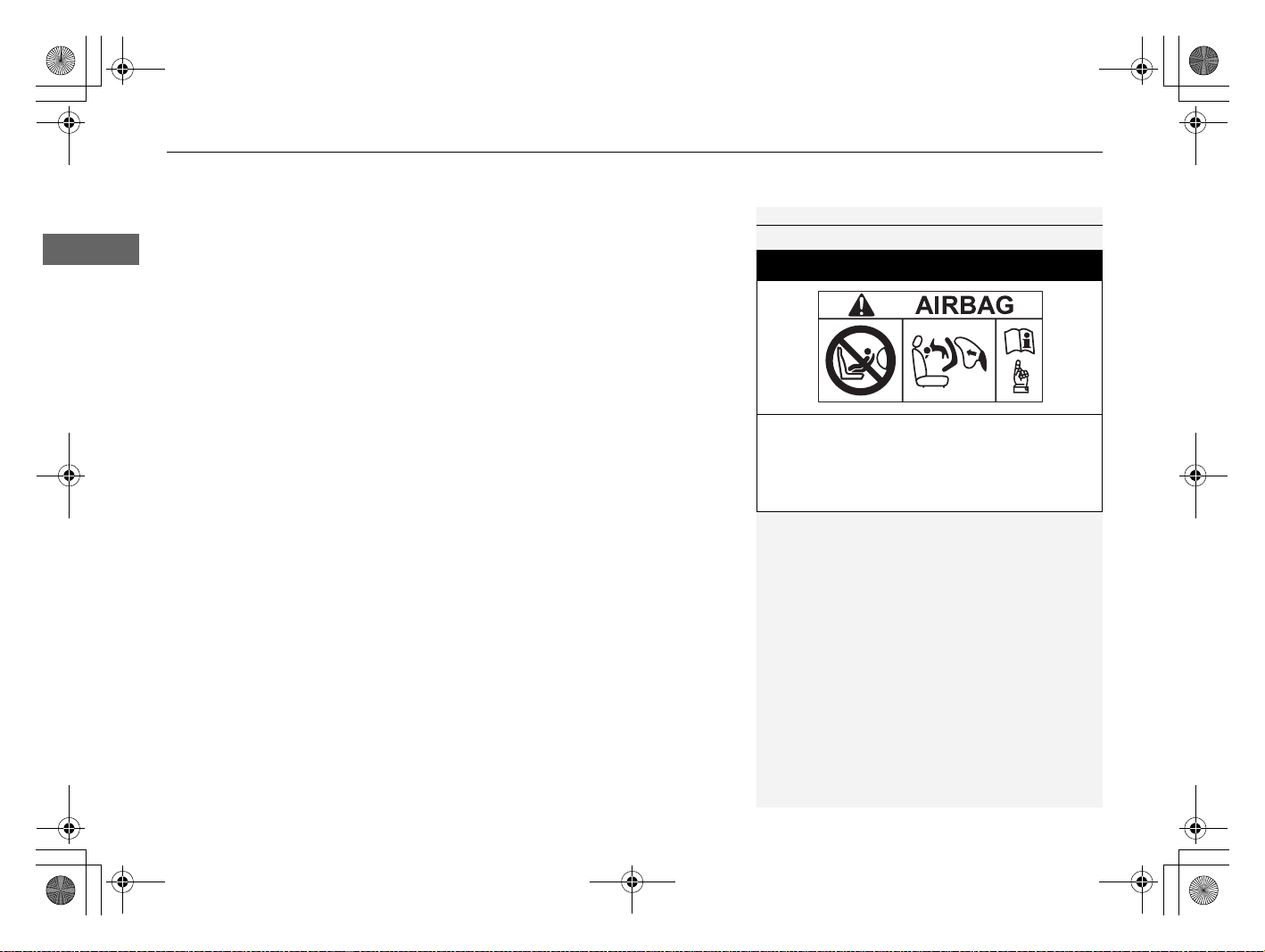
Safe Driving
1Protecting Child Passengers
Front Passenger’s Sunvisor
3
WARNING
NEVER use a rearward facing child restraint
on a seat protected by an ACTIVE AIRBAG
in front of it, DEATH or SERIOUS INJURY to
the CHILD can occur.
18 FIT JAZZ-32T5A6100.book 64 ページ 2017年8月23日 水曜日 午前11時24分
uuChild Safety u Protecting Child Passengers
• Any child who is too small to wear a seat belt must be properly restrained in an
approved child restraint system that is properly secured to the vehicle using the
seat belt or the child restraint anchorage system.
• Never hold a child on your lap because it is impossible to protect them in the
event of a collision.
• Never put a seat belt over yourself and a child. During a crash, the belt would
likely press deep into the child and cause serious or fatal injuries.
• Never let two children use the same seat belt. Both children could be very
seriously injured in a crash.
64
Page 66
Safe Driving
1Protecting Child Passengers
WARNING: Use the power window lock button to
prevent children from opening the windows. Using
this feature will prevent children from playing with
the windows, which could expose them to hazards or
distract the driver.
2 Opening/Closing the Power Windows
P. 162
WARNING: Always take the ignition key with you
whenever you leave the vehicle alone (with other
occupants).
To remind you of the passenger’s front airbag
hazards and child safety, your vehicle has the
warning label on the sun visor.
Please read and follow the instructions on the label.
2 Safety Labels P. 83
18 FIT JAZZ-32T5A6100.book 65 ページ 2017年8月23日 水曜日 午前11時24分
• Do not allow children to operate the doors, windows or seat adjustments.
• Do not leave children in the vehicle unattended, especially in hot weather when
the inside of the vehicle can get hot enough to kill them. They could also activate
vehicle controls causing it to move unexpectedly.
uuChild SafetyuProtecting Child Passengers
65
Page 67
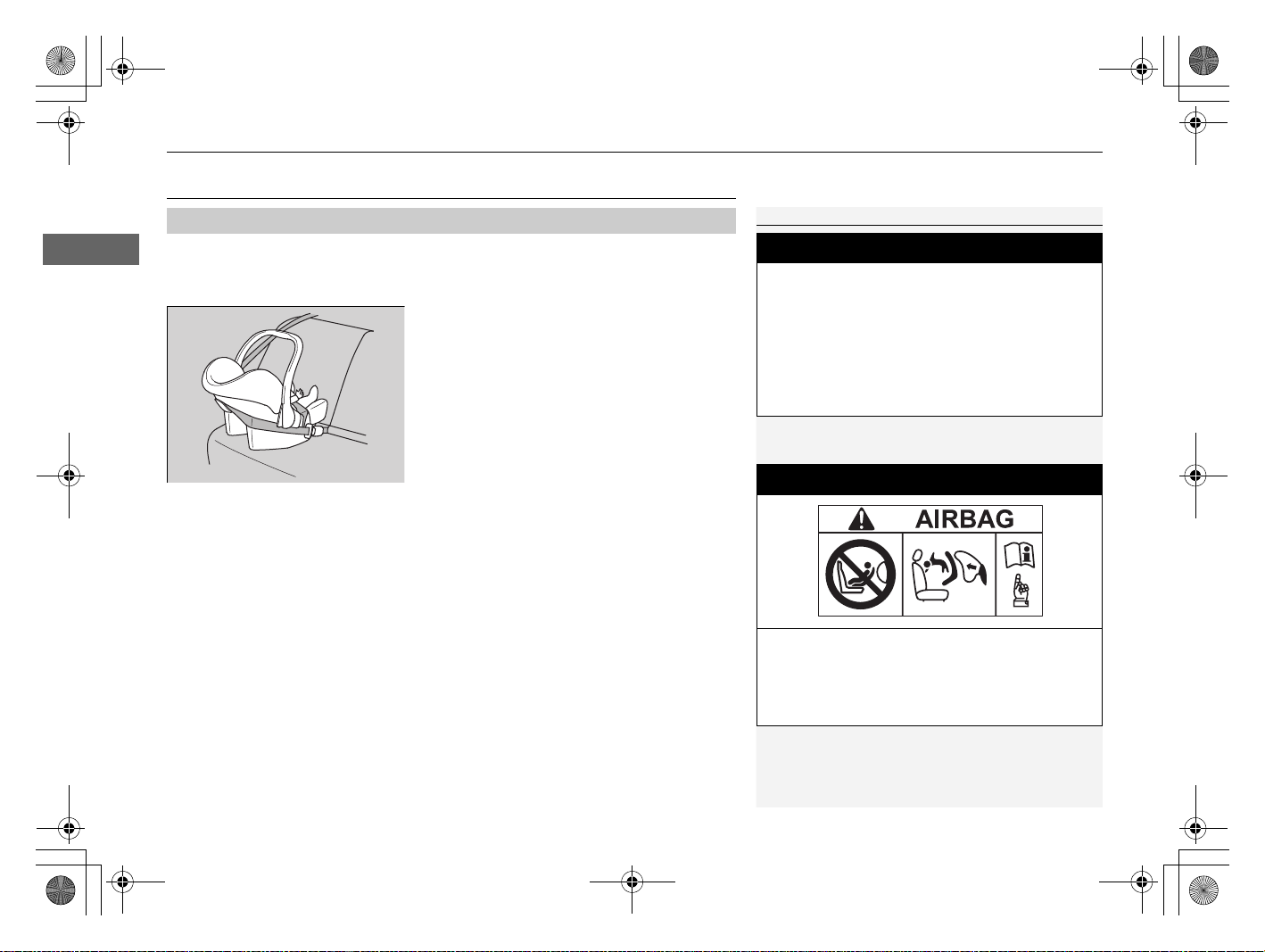
Safe Driving
1Protecting Infants
As required by UN Regulation No. 94:
3
WARNING
Placing a rear-facing child restraint system
in the front seat can result in serious injury
or death if the passenger’s front airbag
inflates.
Always place a rear-facing child restraint
system in the back seat, not the front.
3
WARNING
NEVER use a rearward facing child restraint
on a seat protected by an ACTIVE AIRBAG
in front of it, DEATH or SERIOUS INJURY to
the CHILD can occur.
18 FIT JAZZ-32T5A6100.book 66 ページ 2017年8月23日 水曜日 午前11時24分
uuChild Safety u Safety of Infants and Small Children
Safety of Infants and Small Children
Protecting Infants
■
An infant must be properly restrained in a rear-facing, reclining child restraint system
until the infant reaches the restraint system manufacturer's weight or height limit
for the seat, and the infant is at least one year old.
■ Positioning a rear-facing child restraint
system
Child restraint system must be placed and
secured in a rear seating position.
66
Page 68
Safe Driving
1Protecting Infants
Many experts recommend use of a rear-facing child
restraint system for a child up to two years old if the
child’s height and weight are appropriate for a rearfacing child restraint system.
If the passenger’s front airbag inflates, it can hit the
rear-facing child restraint system with great force,
which can dislodge or strike the system, and seriously
injure the child.
Rear-facing child restraint systems should never be
installed in a front facing position.
Always refer to the child restraint system
manufacturer’s instructions before installation.
If it is absolutely unavoidable to install a rear-facing
child restraint system in the front passenger seat,
manually turn off the passenger front airbag system.
2 Passenger Front Airbag Off System P. 54
18 FIT JAZZ-32T5A6100.book 67 ページ 2017年8月23日 水曜日 午前11時24分
When properly installed, a rear-facing child restraint system may prevent the driver
or a front passenger from moving their seat all the way back, or from locking their
seat-back in the desired position.
uuChild Safetyu Safety of Infants and Small Children
Continued
67
Page 69
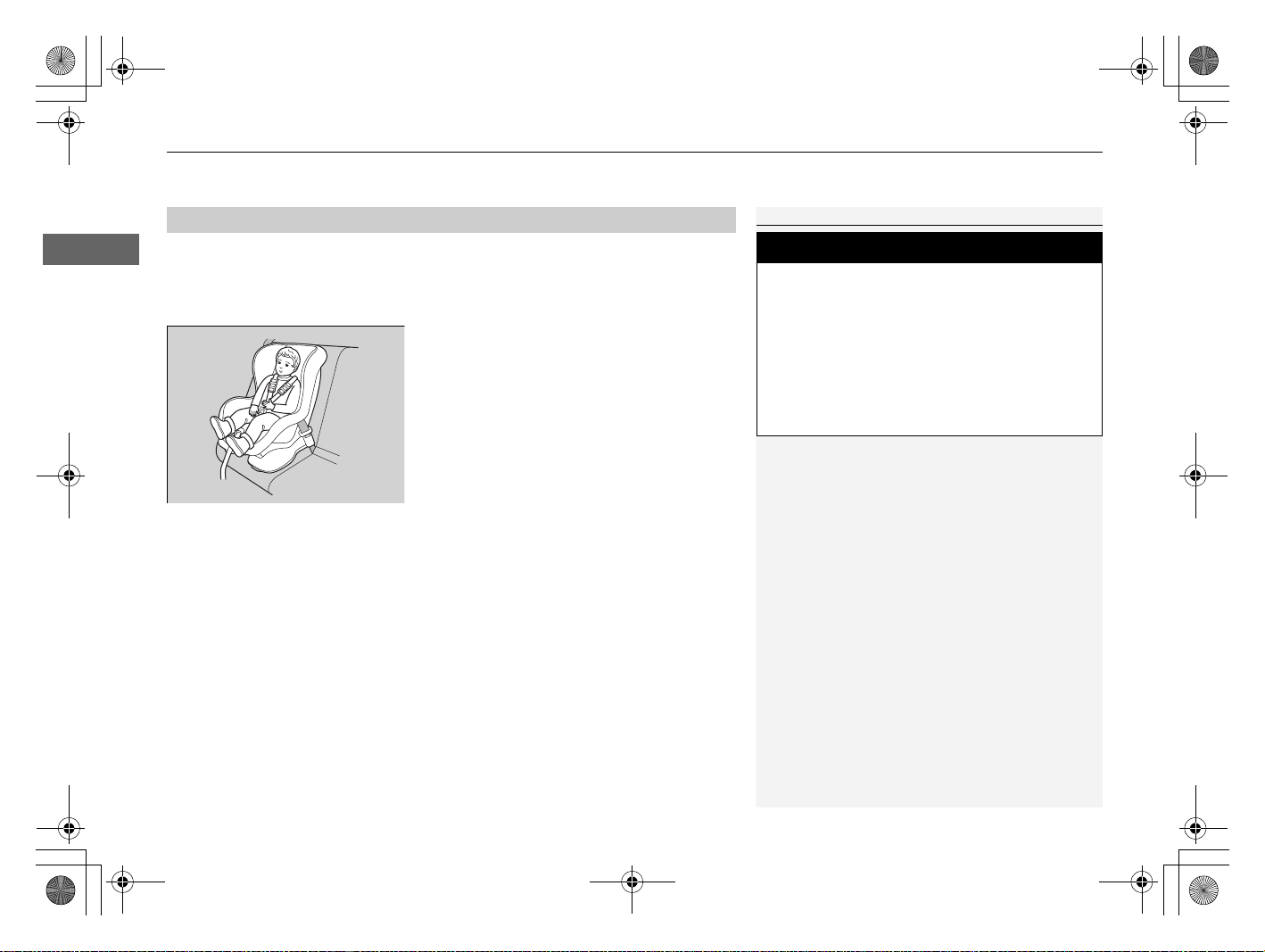
Safe Driving
1Protecting Smaller Children
Educate yourself about the laws and regulations
regarding child restraint system use where you are
driving, and follow the child restraint system
manufacturer's instructions.
3
WARNING
Placing a front facing child restraint system
in the front seat can result in serious injury
or death if the front airbag inflates.
If you must place a front facing child
restraint system in front, move the vehicle
seat as far back as possible, and properly
restrain the child.
18 FIT JAZZ-32T5A6100.book 68 ページ 2017年8月23日 水曜日 午前11時24分
uuChild Safety u Safety of Infants and Small Children
Protecting Smaller Children
■
If a child is at least one year old and has exceeded the weight and height limitations
of a rear-facing child restraint system, the child should be properly restrained in a
firmly secured front facing child restraint system until they exceed the weight and
height limitations for the front facing child restraint system.
■ Front facing child restraint system
placement
We strongly recommend placing a front
facing child restraint system in a rear seating
position.
Placing a front facing child restraint system in the front seat can be hazardous. A
rear seat is the safest place for a child.
68
Page 70
Safe Driving
1Selecting a Child Restraint System
Installation of a lower anchorage-compatible child
restraint system is simple.
Lower anchorage-compatible child restraint systems
have been developed to simplify the installation
process and reduce the likelihood of injuries caused
by incorrect installation.
We recommend a rear-facing or a front facing Honda
genuine ISOFIX child restraint system for infants or
small children, respectively. Ask your dealer.
18 FIT JAZZ-32T5A6100.book 69 ページ 2017年8月23日 水曜日 午前11時24分
Selecting a Child Restraint System
■
Some child restraint systems are lower anchorage compatible. Some have a rigidtype connector, while others have a flexible-type connector. Both are equally easy to
use. Some existing and previously owned child restraint systems can only be installed
using the seat belt. Whichever type you choose, follow the child restraint system
manufacturer’s use and care instructions including recommended expiration dates
as well as the instructions in this manual. Proper installation is key to maximizing
your child’s safety.
The flexible type may not be available in your country.
In seating positions and vehicles not equipped with lower anchorages, install a child
restraint system using the seat belt and a top tether for added security. This is
because all child restraint systems must be secured with the seat belt when the
lower anchorage system is not in use. In addition, the child restraint system
manufacturer may advise that a seat belt be used to attach an ISO FIX restraint
system once a child reaches a specified weight. Please read the child restraint system
owner’s manual for proper installation instructions.
uuChild Safetyu Safety of Infants and Small Children
■ Important consideration when selecting a child restraint system
Make sure the child restraint system meets the following three requirements:
• The child restraint system is the correct type and size for the child.
• The child restraint system is the correct type for the seating position.
• The child restraint system is compliant with safety standards. We recommend a
child restraint system compliant with UN Regulation No. 44 or No. 129, or the
regulations of the subject countries. Look for the approval mark on the system
and the manufacturer’s statement of compliance on the box.
Continued
69
Page 71
Safe Driving
18 FIT JAZZ-32T5A6100.book 70 ページ 2017年8月23日 水曜日 午前11時24分
uuChild Safety u Safety of Infants and Small Children
The Recommended Child Restraint Systems for EU Countries
■
Various types of child restraint systems are available. Not all types are suitable for your vehicle. Please refer to the table below to select
which category of child restraint system can be used on each seating position.
Seating position
Front passenger Rear passenger
Mass group
Passenger front airbag ON/OFF
switch position
OFF ON Rear outboard Rear centre
group 0 Up to 10 kg U
group 0+ Up to 13 kg U
group I 9 kg to 18 kg U
group II 15 kg to 25 kg U
group III 22 kg to 36 kg U
*1,*2,*4,*5
*1,*2,*4,*5
*1,*2,*4,*5
*1,*2,*4,*5
*1,*2,*4,*5
X U
X IL (Honda BABY-SAFE ISOFIX), or U
*1,*2,*4,*5
UF
*1,*2,*4,*5
UF
*1,*2,*4,*5
UF
IUF (Size class A, B1, B) or U
L (Honda KID FIX XP SICT) or U
L (Honda KID FIX XP SICT) or U
*3,*4
*3,*4
*3,*4
*3,*4
*3,*4
*3,*4
U
*3,*4
U
*3,*4
U
*3,*4
U
*3,*4
U
IL: Suitable for particular ISO FIX child restraint systems (CRS) given in this list.
IUF: Suitable for front facing ISOFIX child restraints system of universal category approved for use in this mass group.
L: Suitable for particular child restraint systems given in this table. These restraints may be of the “specific vehicle,” “restricted,” or
“semi-universal” category.
U: Suitable for “universal” category restraints approved for use in this mass group.
UF: Suitable for front facing “universal” category restraints approved for use in this mass group.
X: Seat position not suitable for children in this mass group.
70
Page 72
Safe Driving
Models with front seat height adjustment
Models without front seat height adjustment
18 FIT JAZZ-32T5A6100.book 71 ページ 2017年8月23日 水曜日 午前11時24分
uuChild Safetyu Safety of Infants and Small Children
*1: Move the front seat to its slide rail rearmost position.
*2: Adjust seat height to the most upper end position.
*3: Adjust seat-back angle to the upright position (Front most lock position).
*4: Adjust seat-back angle to the upright position (Front most lock position).
*5: Move the front seat to its slide rail rearmost position.
Seating position in the vehicle
Front seat Rear outer seat Rear centre seat
i-Size child restraint systems X i-U X
i-U: Suitable for i-Size “universal” Child Restraint Systems for forward and rearward facing.
X: Seating position not suitable for i-Size “universal” Child Restraint systems.
A size class is specified for some child restraint systems. Make sure to check the size class as indicated on the manufacturer’s instructions,
package, and labels of the child restraint.
The particular child restraints in the table are Honda Genuine Parts. They are available from your dealer.
For a correct installation, please refer to the Child Restraint Instruction Manual.
Continued
71
Page 73
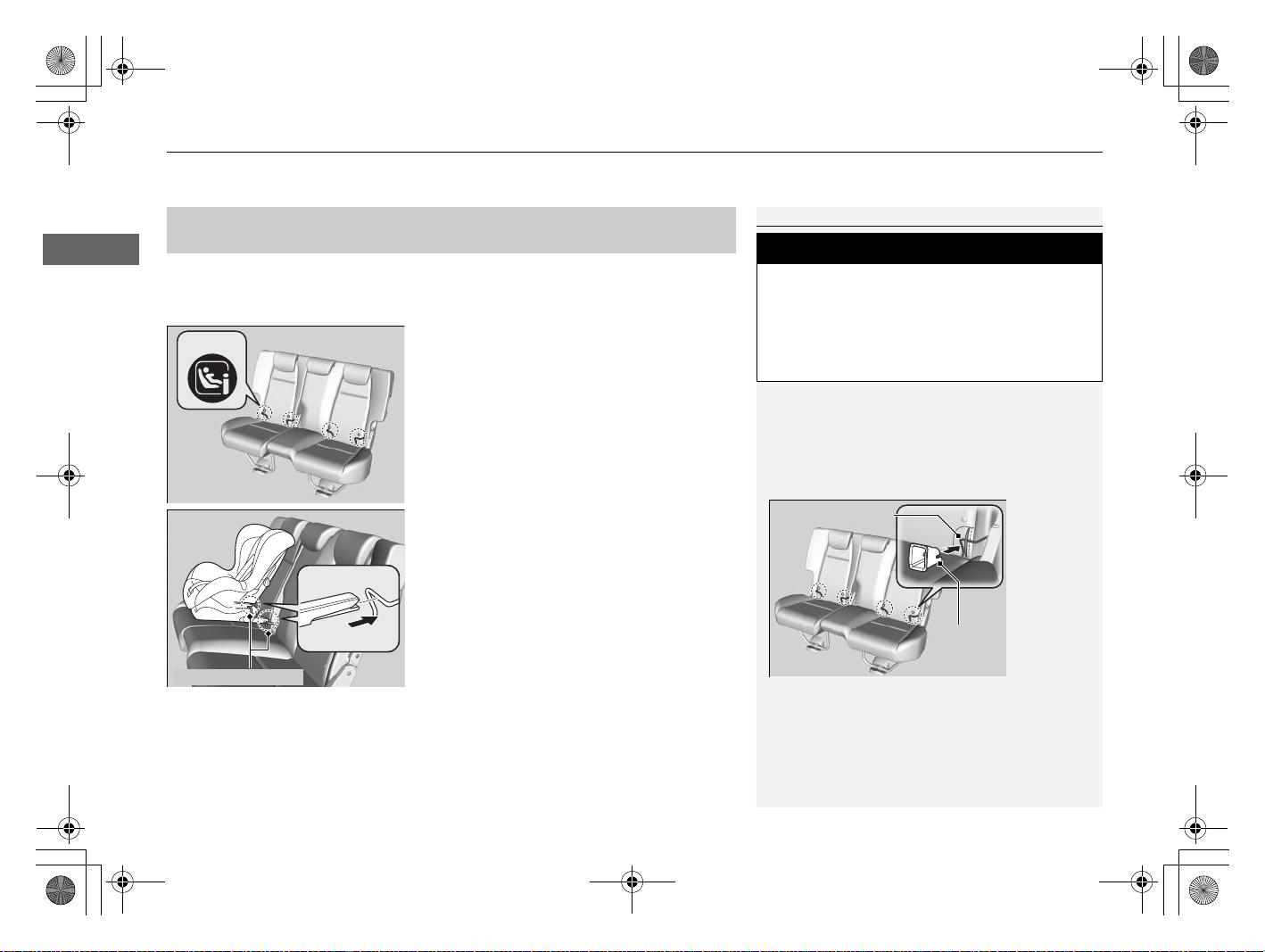
Safe Driving
1Installing a Lower Anchorage-Compatible Child Restraint System
Some child restraint systems come with optional
guide-cups, which avoid possible damage to the seat
surface. Follow the manufacturer’s instructions when
using the guide-cups, and attach them to the lower
anchorages as shown in the image.
3
WARNING
Never attach two child restraint system to
the same anchor. In a collision, one anchor
may not be strong enough to hold two
child restraint system attachments and may
break, causing serious injury or death.
Lower Anchorage
Guide-cup
Marks
Rigid Type
Lower Anchorages
18 FIT JAZZ-32T5A6100.book 72 ページ 2017年8月23日 水曜日 午前11時24分
uuChild Safety u Safety of Infants and Small Children
Installing a Lower Anchorage-Compatible Child Restraint
■
System
A lower anchorage-compatible child restraint system can be installed in either of the
two outer rear seats. A child restraint system is attached to the lower anchorages
with either the rigid or flexible type of connectors.
1. Locate the lower anchorages under the
marks.
2. Make sure to lock the seat-back in the
upright position.
3. Lower the head restraint to its lowest
position.
4. Place the child restraint system on the
vehicle seat then attach the child restraint
system to the lower anchorages according
to the instructions that came with the
child restraint system.
u When installing the child restraint
system, make sure that the lower
anchorages are not obstructed by the
seat belt or any other object.
72
Page 74
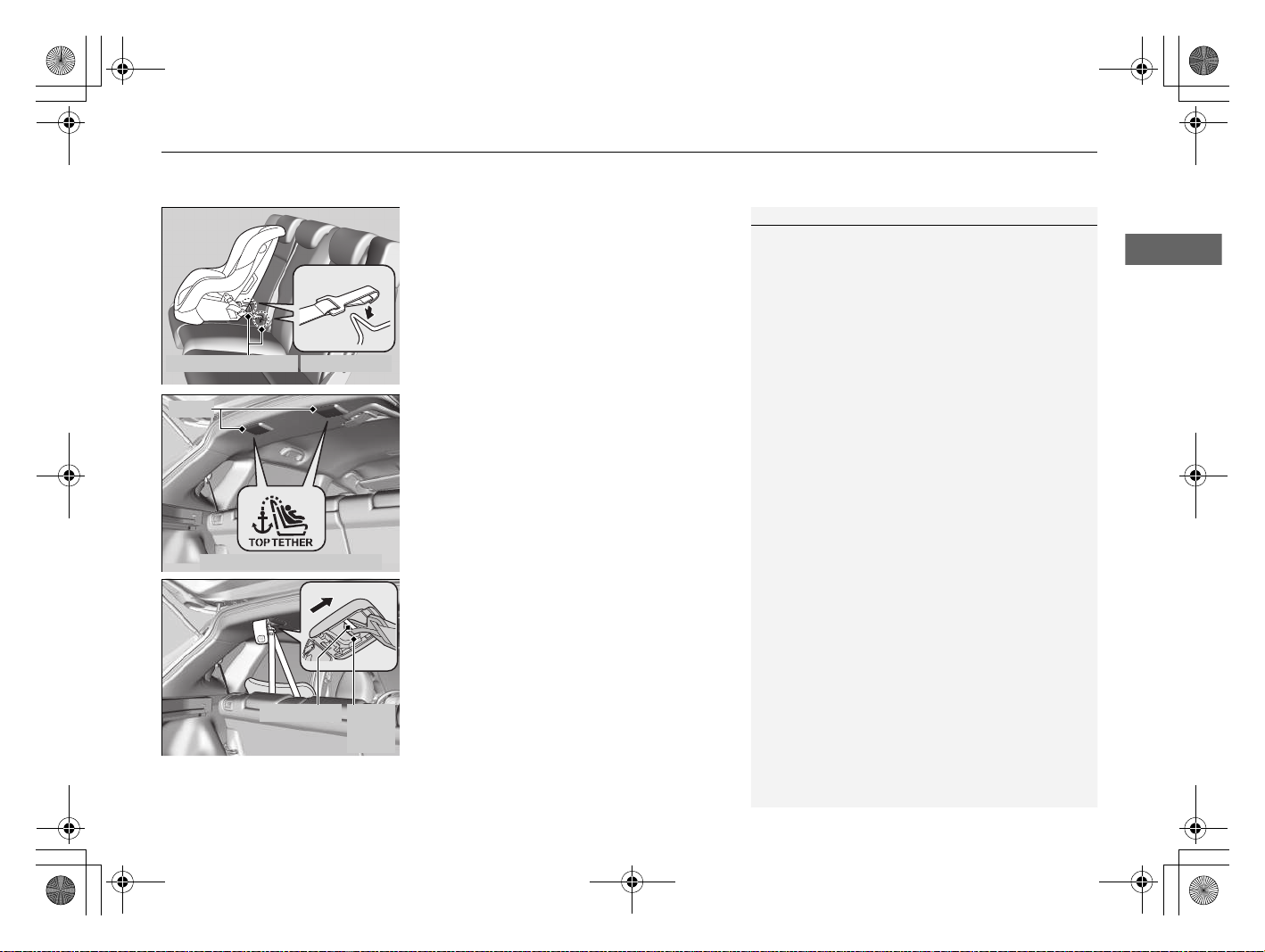
Safe Driving
Flexible TypeLower Anchorages
1Installing a Lower Anchorage-Compatible Child Restraint System
For your child's safety, when using a child restraint
system installed using the lower anchorage system,
make sure that the child restraint system is properly
secured to the vehicle. A child restraint system that is
not properly secured will not adequately protect a
child in a crash and may cause injury to the child or
other vehicle occupants.
The flexible type may not be available in your country.
WARNING: Never use a hook that does not come
with a Top Tether anchor symbol when securing an
installed child restraint system.
Cover
Top Tether Anchor Symbol
Tether
Strap
Hook
Anchorage
FR
18 FIT JAZZ-32T5A6100.book 73 ページ 2017年8月23日 水曜日 午前11時24分
uuChild Safetyu Safety of Infants and Small Children
5. Open the tether anchorage cover.
6. Route the tether strap over the seat-back.
Make sure the strap is not twisted.
7. Secure the tether strap hook to the
anchorage.
8. Tighten the tether strap as instructed by
the child restraint system manufacturer.
9. Make sure the child restraint system is
firmly secured by rocking it forward and
back, and side to side; little movement
should be felt.
10. Make sure any unused seat belt that a
child can reach is buckled.
Continued
73
Page 75
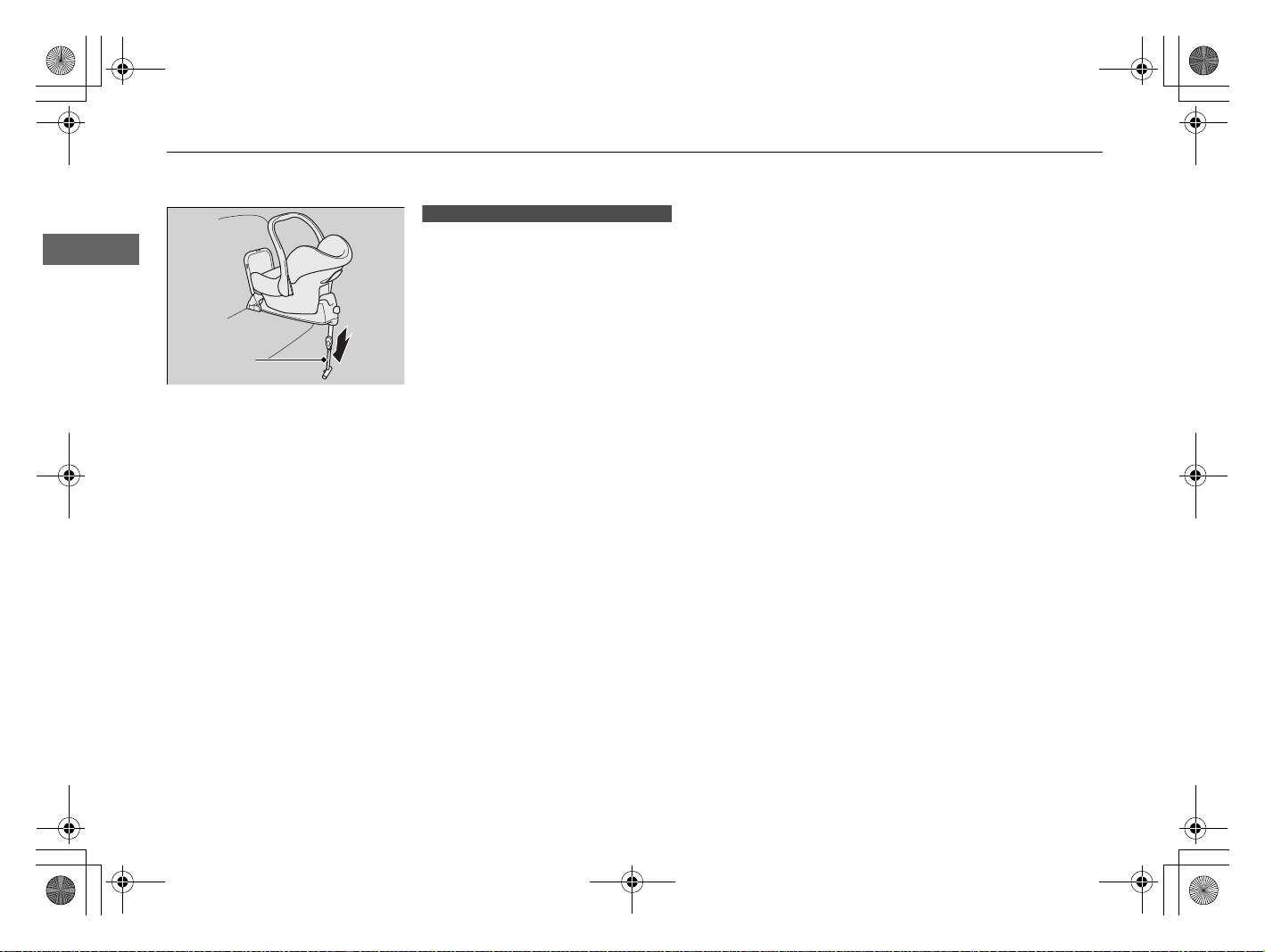
Safe Driving
Support Leg
Child restraint system with support leg
18 FIT JAZZ-32T5A6100.book 74 ページ 2017年8月23日 水曜日 午前11時24分
uuChild Safety u Safety of Infants and Small Children
5. Stretch the support leg until it touches the
floor as instructed by the child restraint
system manufacturer.
u Confirm that the section of the floor on
which the support leg rests is level. If the
section is not level, the support leg will
not provide adequate support. If this is
the case, move the seat forward or back
so that the support leg is resting on a
level section.
74
Page 76
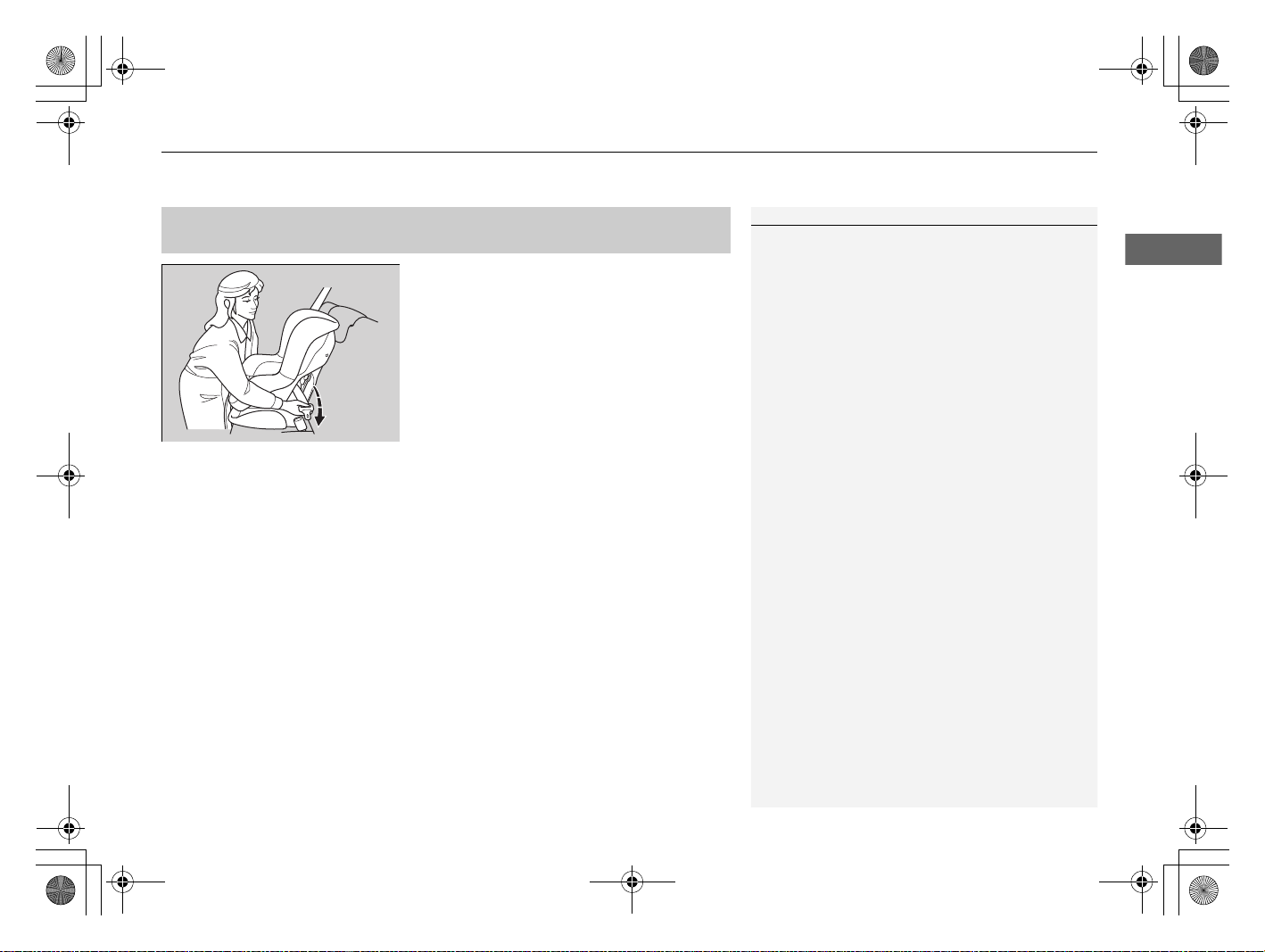
Safe Driving
1Installing a Child Restraint System with a Lap/Shoulder Seat Belt
A child restraint system that is not properly secured
will not adequately protect a child in a crash and may
cause injury to the child or other vehicle occupants.
18 FIT JAZZ-32T5A6100.book 75 ページ 2017年8月23日 水曜日 午前11時24分
Installing a Child Restraint System with a Lap/Shoulder Seat
■
Belt
uuChild Safetyu Safety of Infants and Small Children
1. Make sure to lock the seat-back in the
upright position.
2. Lower the head restraint to its lowest
position.
3. Place the child restraint system on the
vehicle seat.
4. Route the seat belt through the child
restraint system according to the child
restraint system manufacturer's
instructions, and insert the latch plate into
the buckle.
u Insert the latch plate fully until it clicks.
Continued
75
Page 77
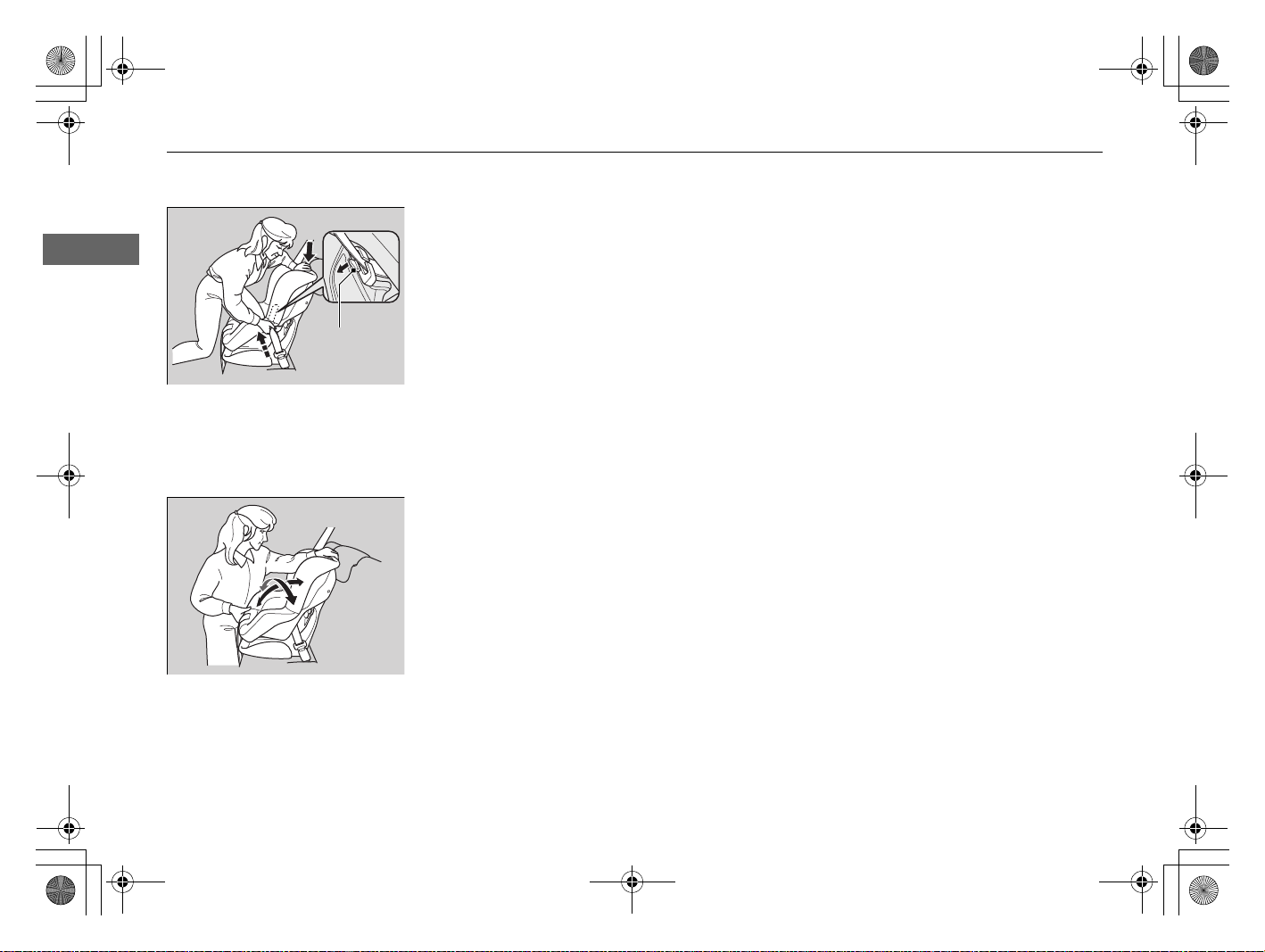
Safe Driving
Tab
18 FIT JAZZ-32T5A6100.book 76 ページ 2017年8月23日 水曜日 午前11時24分
uuChild Safety u Safety of Infants and Small Children
5. Push down the tab. Route the shoulder
part of the belt into the slit at the side of
the restraint.
6. Grab the shoulder part of the belt near the
buckle, and pull up to remove any slack
from the lap part of the belt.
u When doing this, place your weight on
child restraint system and push it into
the vehicle seat.
7. Position the belt properly and push up the
tab. Make sure the belt is not twisted.
u When pushing up the tab, pull up the
upper shoulder part of the belt to
remove any slack from the belt.
8. Make sure the child restraint system is
firmly secured by rocking it forward and
back, and side to side; little movement
should be felt.
9. Make sure any unused seat belt that a
child can reach is buckled.
76
Page 78
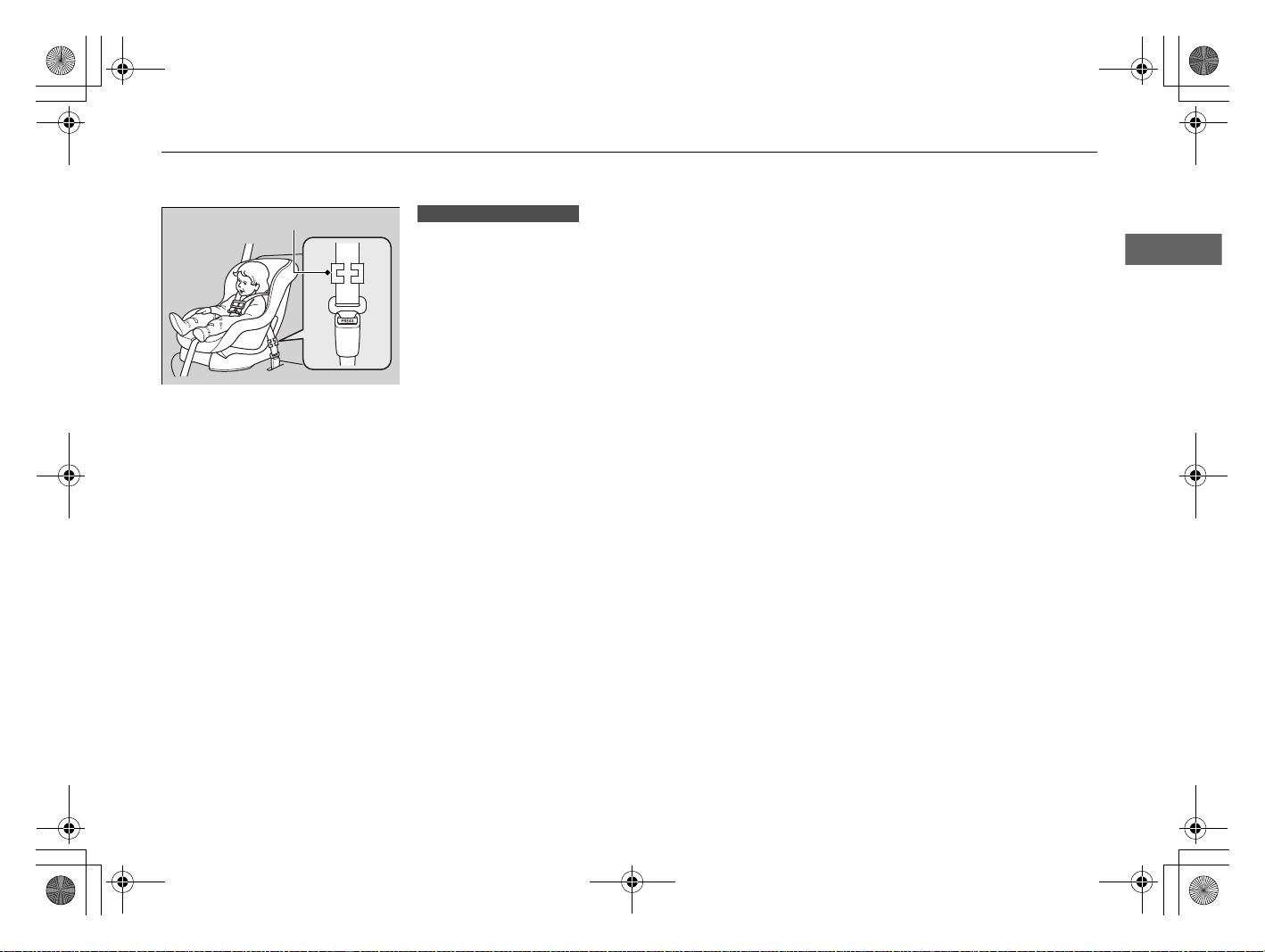
Safe Driving
Locking Clip
Except European models
18 FIT JAZZ-32T5A6100.book 77 ページ 2017年8月23日 水曜日 午前11時24分
uuChild Safetyu Safety of Infants and Small Children
If your child restraint system does not come
with a mechanism that secures the belt, install
a locking clip on the seat belt.
After going through the step 1 and 4, pull up
the shoulder part of the belt and make sure
there is no slack in the lap portion.
5. Tightly grasp the belt near the latch plate.
Pinch both parts of the belt together so
they do not slip through the latch plate.
Unbuckle the seat belt.
6. Install the locking clip as shown in the
image. Position the clip as close as possible
to the latch plate.
7. Insert the latch plate into the buckle. Go to
step 8 and 9.
Continued
77
Page 79
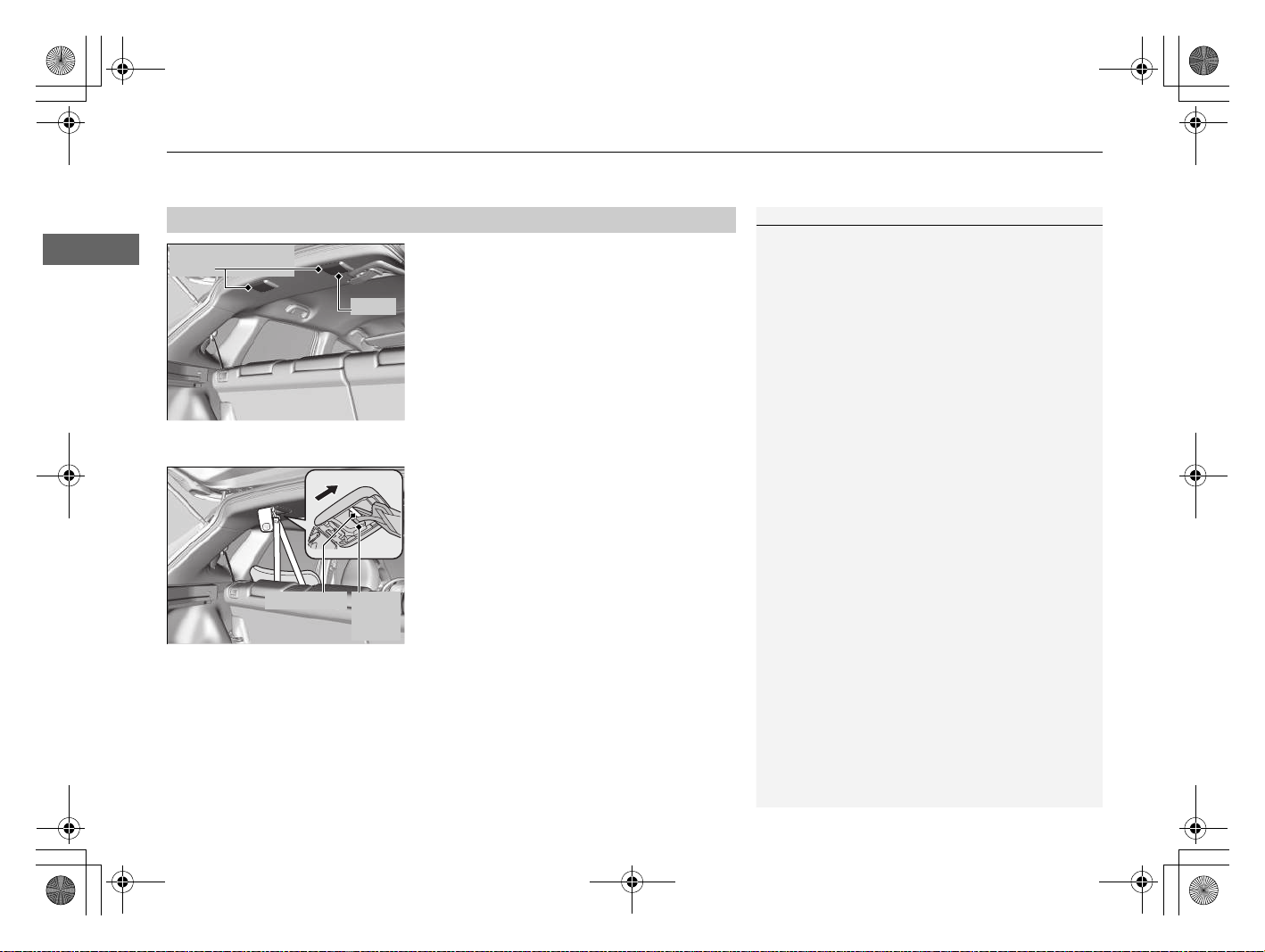
Safe Driving
1Adding Security with a Tether
WARNING: Child restraint anchorages are designed
to withstand only those loads imposed by correctly
fitted child restraints. Under no circumstances are
they to be used for adult seat belts, harnesses or for
attaching other items or equipment to the vehicle.
Always use a tether for forward facing child seats
when using the seat belt or lower anchors.
Cover
Tether Anchorage
Points
Tether
Strap
Hook
Anchorage
FR
18 FIT JAZZ-32T5A6100.book 78 ページ 2017年8月23日 水曜日 午前11時24分
uuChild Safety u Safety of Infants and Small Children
Adding Security with a Tether
■
Two tether anchorage points are provided on
the ceiling for rear outer seating positions. If
you have a child restraint system that comes
with a tether but can be installed with a seat
belt, the tether may be used for additional
security.
1. Locate the appropriate tether anchorage
point.
2. Lower the head restraint to its lowest
position.
3. Open the anchorage cover.
4. Route the tether strap over the seat-back.
Make sure the strap is not twisted.
5. Secure the tether strap hook onto the
anchorage.
6. Tighten the tether strap as instructed by the
child restraint system manufacturer.
78
Page 80
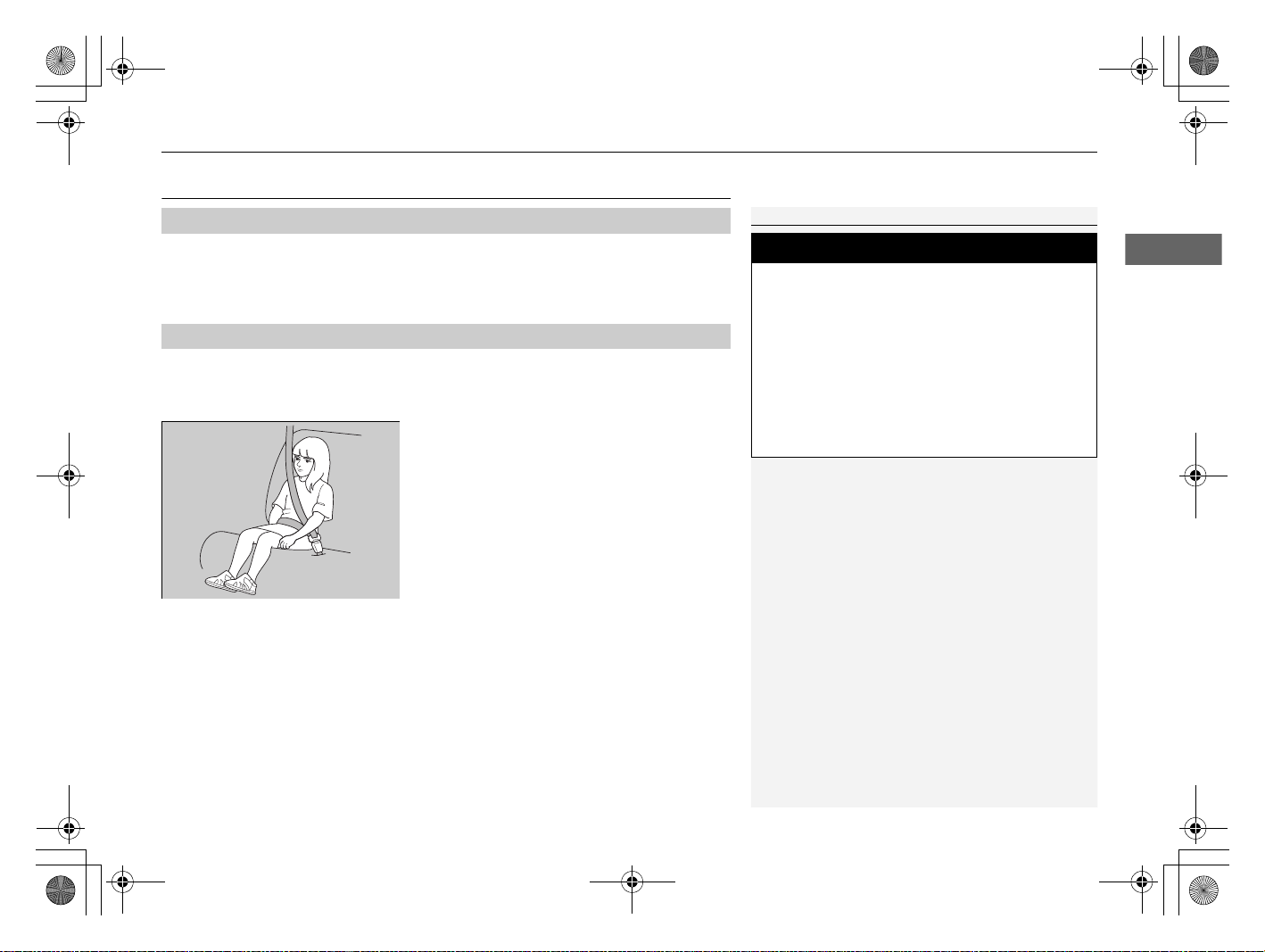
Safe Driving
1Safety of Larger Children
3
WARNING
Allowing a child aged 12 or under to sit in
front can result in injury or death if the
passenger's front airbag inflates.
If a larger child must ride in front, move the
vehicle seat as far to the rear as possible,
have the child sit up properly and wear the
seat belt properly, using a booster seat if
needed.
18 FIT JAZZ-32T5A6100.book 79 ページ 2017年8月23日 水曜日 午前11時24分
Safety of Larger Children
Protecting Larger Children
■
The following pages give instructions on how to check proper seat belt fit, what kind
of booster seat to use if one is needed, and important precautions for a child who
must sit in front.
Checking Seat Belt Fit
■
When a child is too big for a child restraint system, secure the child in a rear seat
using the lap/shoulder seat belt. Have the child sit upright and all the way back, then
answer the following questions.
■ Checklist
• Do the child's knees bend comfortably over
the edge of the seat?
• Does the shoulder belt cross between the
child's neck and arm?
• Is the lap part of the seat belt as low as
possible, touching the child's thighs?
• Will the child be able to stay seated like this
for the whole trip?
If you answer yes to all these questions, the child is ready to wear the lap/shoulder
seat belt correctly. If you answer no to any question, the child needs to ride on a
booster seat until the seat belt fits properly without a booster seat.
uuChild SafetyuSafety of Larger Children
Continued
79
Page 81
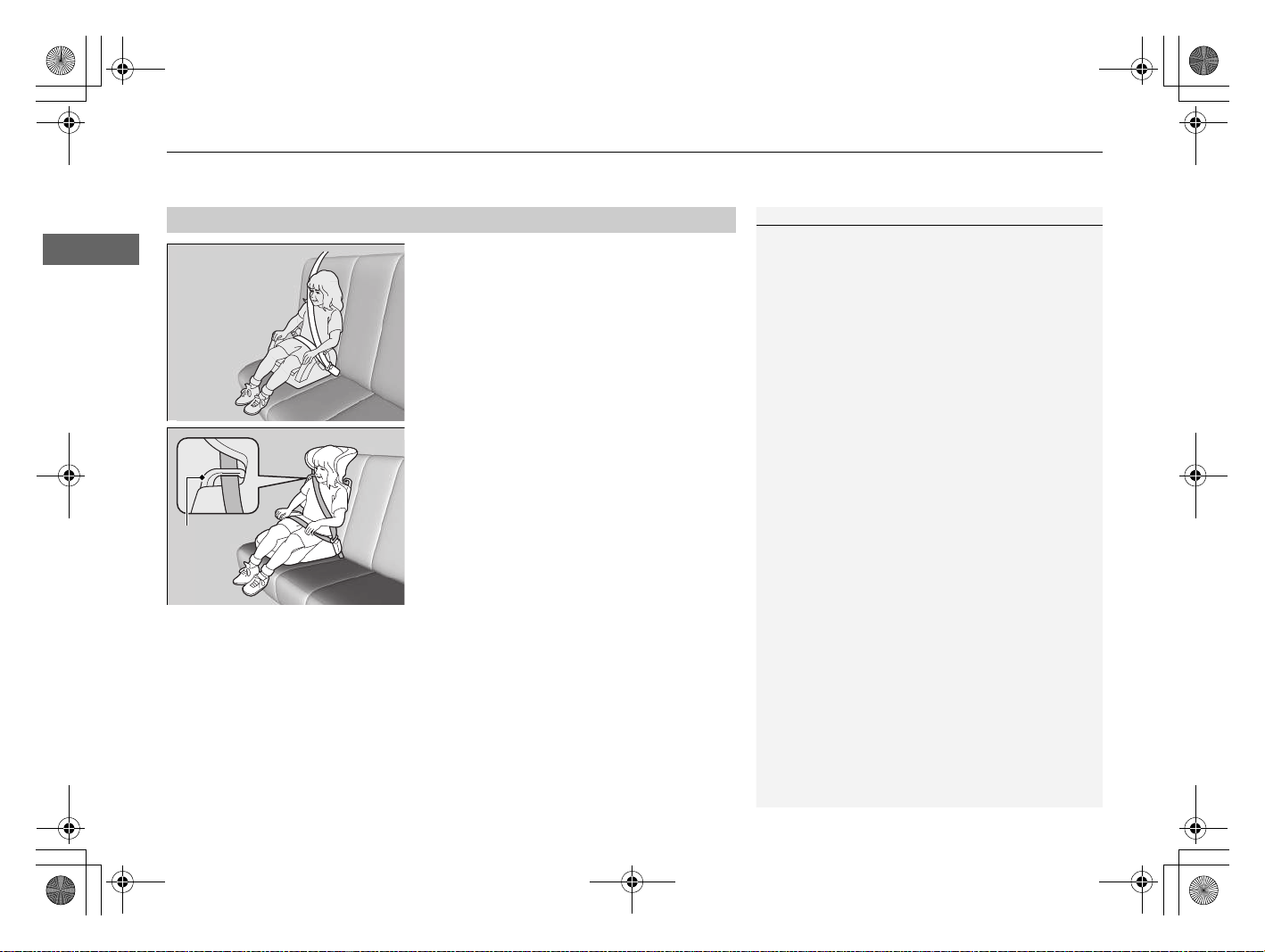
Safe Driving
1Booster Seats
When installing a booster seat, make sure to read the
instructions that came with it, and install the seat
accordingly.
There are high- and low-type booster seats. Choose a
booster seat that allows the child to wear the seat
belt correctly.
We recommend a booster seat with a backrest as it is
easier to adjust the shoulder belt.
Guide
18 FIT JAZZ-32T5A6100.book 80 ページ 2017年8月23日 水曜日 午前11時24分
uuChild Safety u Safety of Larger Children
Booster Seats
■
If a lap/shoulder seat belt cannot be used
properly, position the child in a booster seat in
the rear seat. For the child's safety, check that
the child meets the booster seat
manufacturer's recommendations.
A backrest is available for a specific booster
seat. Install the backrest to the booster seat
and adjust it to the vehicle seat according to
the booster seat manufacturer's instructions.
Make sure the seat belt is properly routed
through the guide at the shoulder of the
backrest and the belt does not touch and
cross the child’s neck.
80
Page 82
Safe Driving
18 FIT JAZZ-32T5A6100.book 81 ページ 2017年8月23日 水曜日 午前11時24分
Protecting Larger Children - Final Checks
■
Your vehicle has a rear seat where children can be properly restrained. If you ever
have to carry a group of children, and a child must ride in front:
• Make sure you read and fully understand the instructions and safety information
in this manual.
• Move the front passenger seat as far back as possible.
• Have the child sit upright and well back in the seat.
• Check that the seat belt is properly positioned so that the child is secure in the
seat.
■ Monitoring child passengers
We strongly recommend that you keep an eye on child passengers. Even older, more
mature children sometimes need to be reminded to fasten their seat belts and sit up
properly.
uuChild SafetyuSafety of Larger Children
81
Page 83
Safe Driving
1Carbon Monoxide Gas
An enclosed area such as a garage can quickly fill up
with carbon monoxide gas.
Do not run the engine with the garage door closed.
Even when the garage door is open, drive out of the
garage immediately after starting the engine.
3
WARNING
Carbon monoxide gas is toxic. Breathing it
can cause unconsciousness and even kill
you.
Avoid any enclosed areas or activities that
expose you to carbon monoxide.
* Not available on all models
18 FIT JAZZ-32T5A6100.book 82 ページ 2017年8月23日 水曜日 午前11時24分
Exhaust Gas Hazard
Carbon Monoxide Gas
The engine exhaust from this vehicle contains carbon monoxide, a colourless,
odourless, and highly toxic gas. As long as you properly maintain your vehicle,
carbon monoxide gas will not get into the interior.
■ Have the exhaust system inspected for leaks whenever
• The exhaust system is making an unusual noise.
• The exhaust system may have been damaged.
• The vehicle is raised for an oil change.
When you operate a vehicle with the tailgate open, airflow can pull exhaust gas into
the interior and create a hazardous condition. If you must drive with the tailgate
open, open all the windows and set the heating and cooling system
system* as shown below.
1. Select the fresh air mode.
2. Select the mode.
3. Set the fan speed to high.
4. Set the temperature control to a comfortable setting.
*
/climate control
Adjust the heating and cooling system
if you sit in your parked vehicle with the engine running.
82
*
/climate control system* in the same manner
Page 84
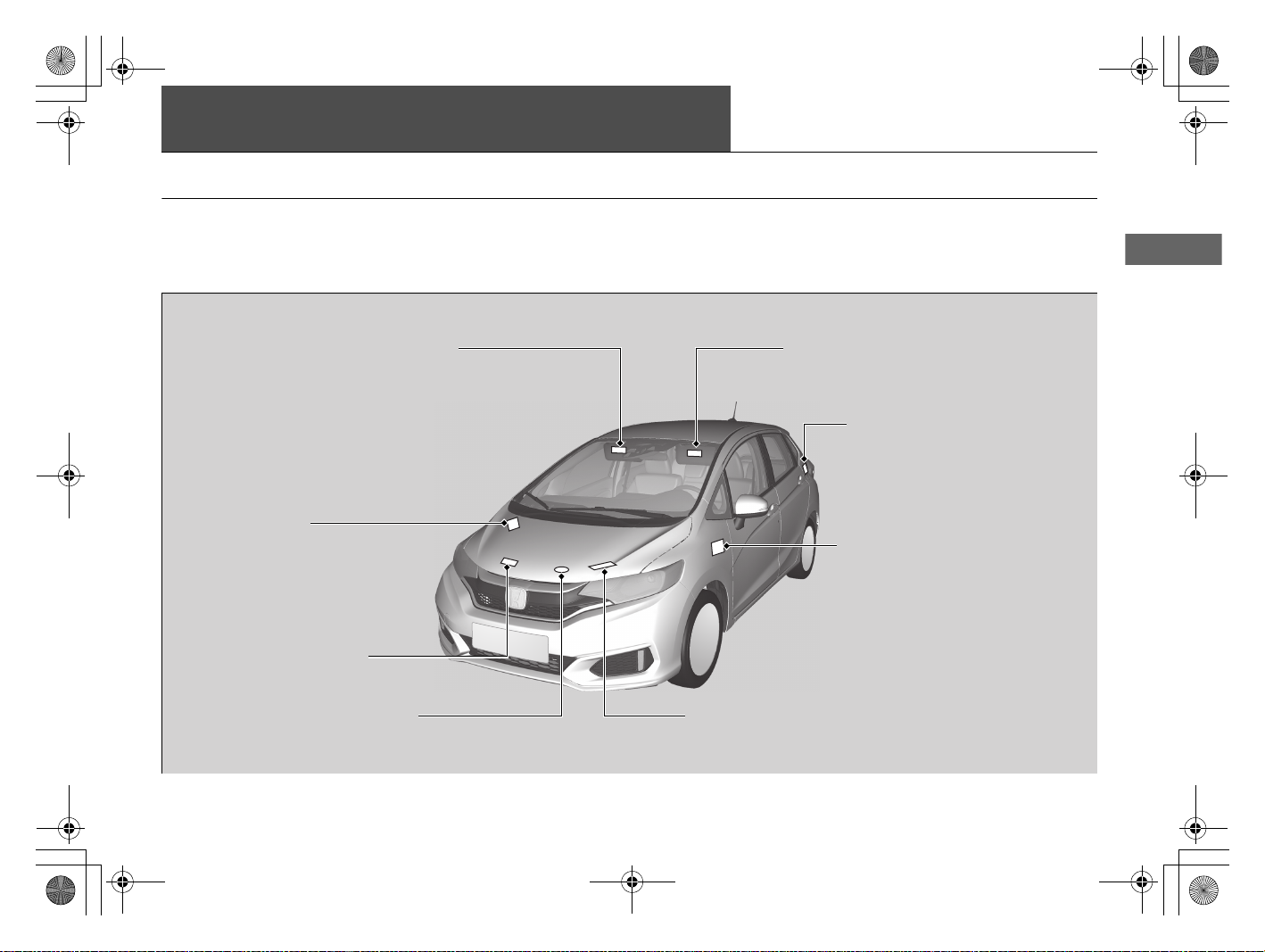
Safe Driving
Radiator Cap
Radiator Cap Danger Label
Sun Visor
Child Safety/SRS Airbag
(Left-hand drive type)
P. 62
Passenger Front Airbag Off
System Label
(Right-hand drive type)
P. 54
Battery Danger Label
P. 526
Sun Visor
Child Safety/SRS Airbag
(Right-hand drive type)
P. 62
Passenger Front Airbag Off
System Label
(Left-hand drive type)
P. 54
Air Conditioner Label
P. 529
Fuel Filler Caution Label
P. 471
18 FIT JAZZ-32T5A6100.book 83 ページ 2017年8月23日 水曜日 午前11時24分
Safety Labels
Label Locations
These labels are in the locations shown. They warn you of potential hazards that can cause serious injury or death. Read these labels
carefully.
If a label comes off or becomes hard to read, contact a dealer for a replacement.
83
Page 85
18 FIT JAZZ-32T5A6100.book 84 ページ 2017年8月23日 水曜日 午前11時24分
84
Page 86
18 FIT JAZZ-32T5A6100.book 85 ページ 2017年8月23日 水曜日 午前11時24分
This chapter describes the buttons, indicators, and gauges that are used while driving.
Instrument Panel
Indicators ............................................ 86
Multi-Information Display Warning and
Information Messages.................... 108
Gauges and Multi-Information Display
Gauges............................................ 123
Multi-Information Display ................ 124
85
Page 87
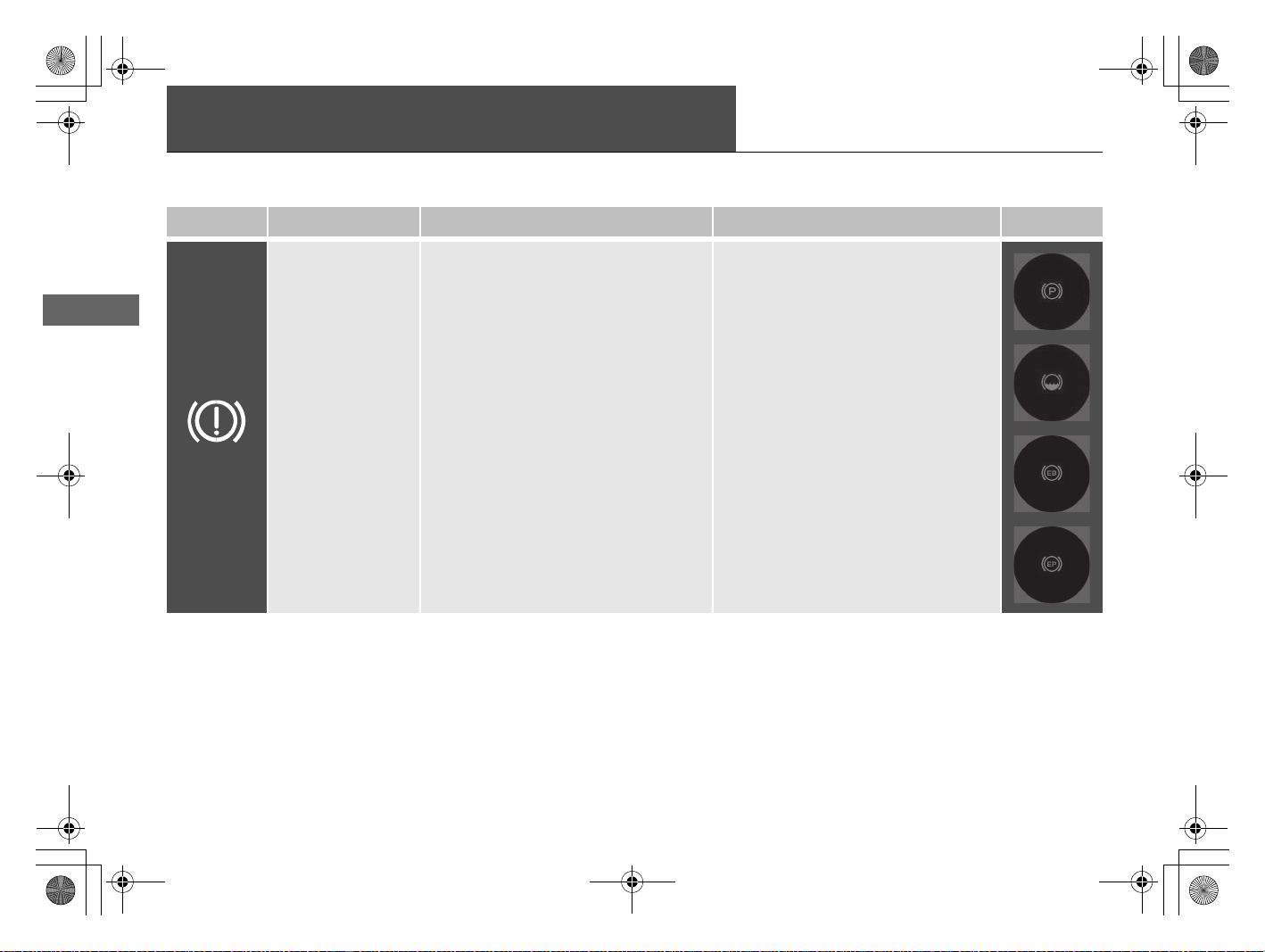
Instrument Panel
18 FIT JAZZ-32T5A6100.book 86 ページ 2017年8月23日 水曜日 午前11時24分
Indicators
Indicator Name On/Blinking Explanation Message
Parking Brake and
Brake System
Indicator (Red)
●
Comes on for a few seconds when you
turn the ignition switch to ON (w*1,
then goes off if the parking brake has
been released.
●
Comes on when the parking brake is
applied, and goes off when it is
released.
●
The beeper sounds and the indicator
comes on if you drive with the parking
brake not fully released.
●
Comes on when the brake fluid level is
low.
●
Comes on if there is a problem with the
brake system.
●
Comes on while driving - Make sure
the parking brake is released. Check
the brake fluid level.
2 What to do when the indicator
●
comes on while driving P. 569
Comes on along with the ABS
indicator - Have your vehicle checked
by a dealer.
2 If the Brake System Indicator
(Red) Comes On P. 569
*1: Models with the keyless access system have an ENGINE START/STOP button instead of an ignition switch.
86
Page 88
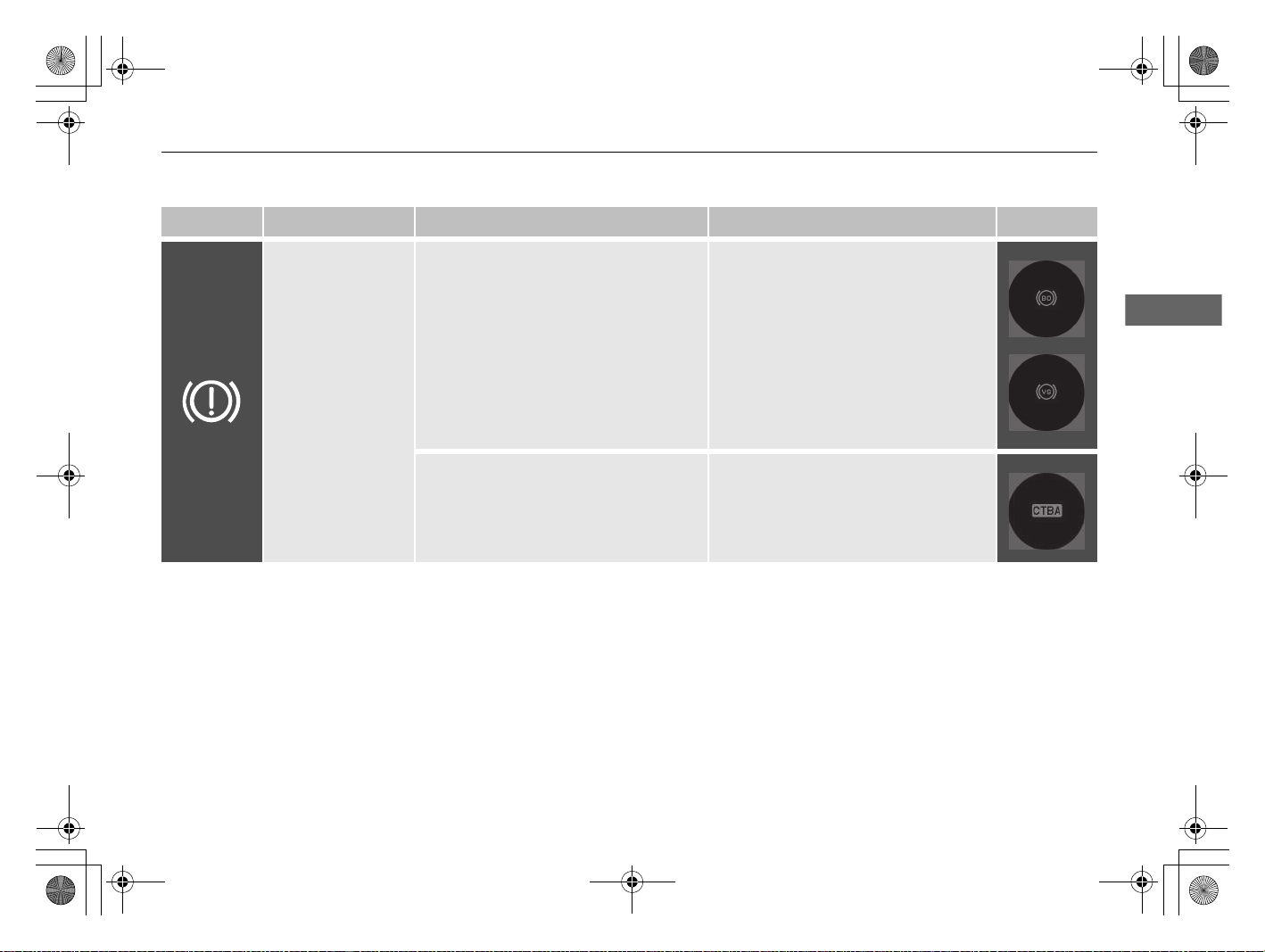
Instrument Panel
18 FIT JAZZ-32T5A6100.book 87 ページ 2017年8月23日 水曜日 午前11時24分
uuIndicatorsu
Indicator Name On/Blinking Explanation Message
●
Comes on for a few seconds when you
turn the ignition switch to ON (w*1,
●
Stays on constantly - Have your
vehicle checked by a dealer.
then goes off.
●
Comes on if there is a problem with a
system related to braking other than
the conventional brake system.
Brake System
Indicator (Amber)
●
Comes on if there is a problem with the
City-Brake Active system.
●
Comes on along with the CTBA
indicator - The City-Brake Active
system does not activate. Have your
vehicle checked by a dealer.
2 City-Brake Active system P. 457
*1: Models with the keyless access system have an ENGINE START/STOP button instead of an ignition switch.
Continued
87
Page 89
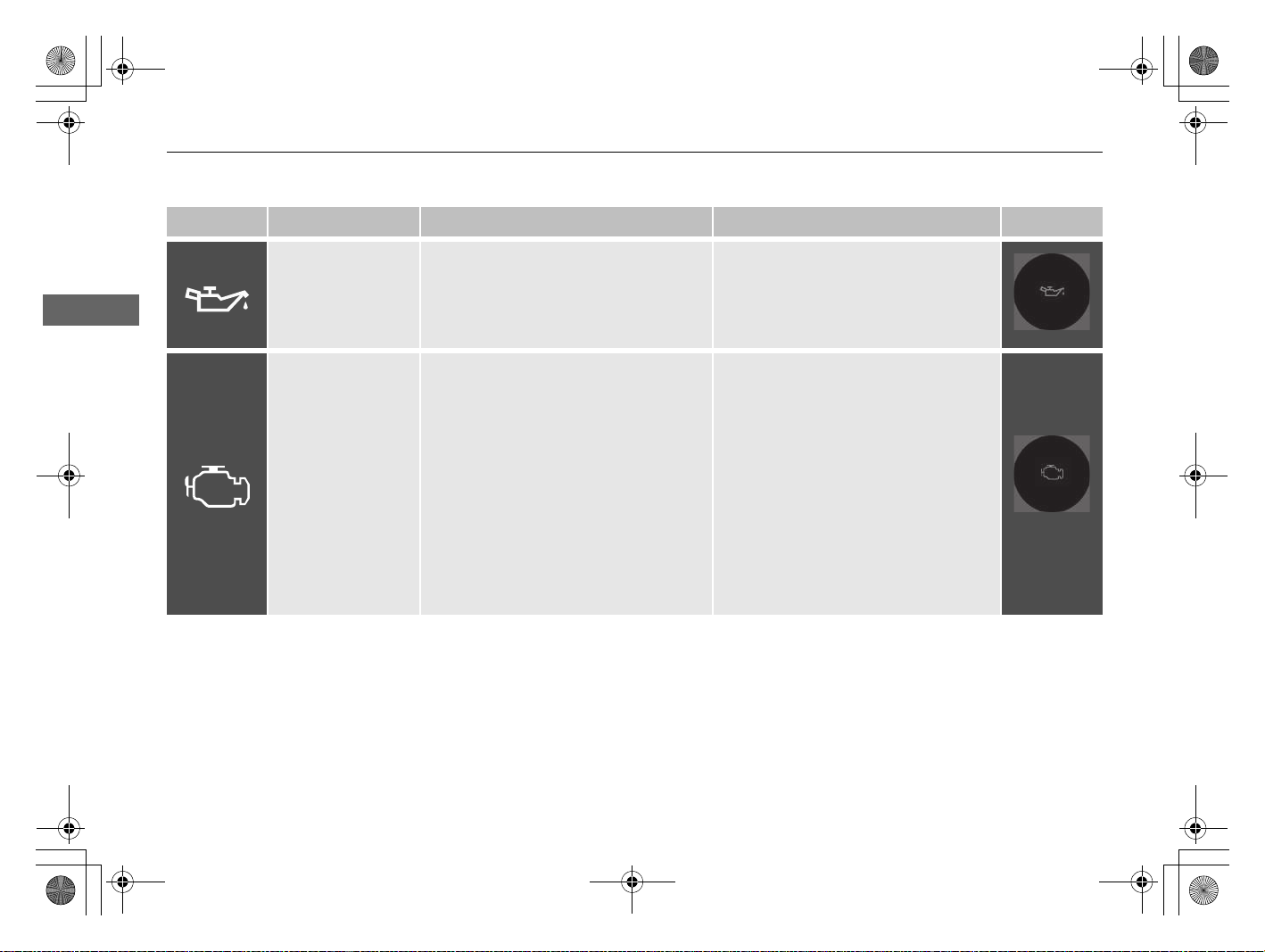
Instrument Panel
18 FIT JAZZ-32T5A6100.book 88 ページ 2017年8月23日 水曜日 午前11時24分
uuIndicatorsu
Indicator Name On/Blinking Explanation Message
Low Oil Pressure
Indicator
●
Comes on when you turn the ignition
switch to ON (w*1, and goes off when
the engine starts.
●
Comes on when the engine oil pressure
●
Comes on while driving Immediately stop in a safe place.
2 If the Low Oil Pressure Indicator
Comes On P. 568
is low.
Malfunction
Indicator Lamp
●
Comes on when you turn the ignition
switch to ON (w*1, and goes off when
the engine starts.
●
Comes on if there is a problem with the
emissions control system.
●
Blinks when a misfire in the engine's
cylinders is detected.
●
Comes on while driving - Have your
vehicle checked by a dealer.
●
Blinks while driving - Stop in a safe
place where there are no flammable
objects. Stop the engine for 10
minutes or more, and wait for it to
cool down. Then, take your vehicle to
a dealer.
2 If the Malfunction Indicator Lamp
●
Comes On or Blinks P. 569
Shows the self-testing condition of the
diagnostics of the emission control
system.
*1: Models with the keyless access system have an ENGINE START/STOP button instead of an ignition switch.
88
Page 90
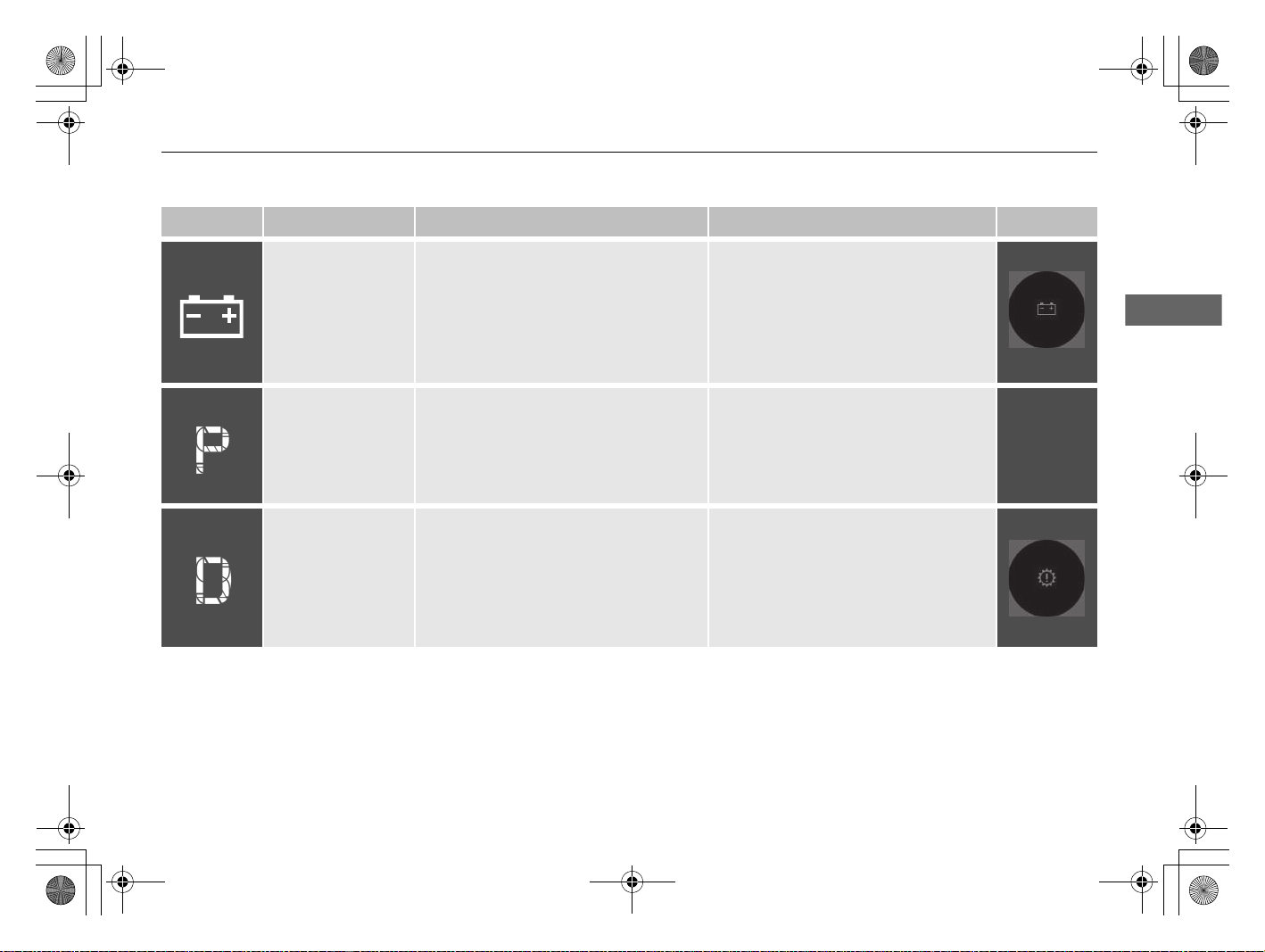
Instrument Panel
* Not available on all models
18 FIT JAZZ-32T5A6100.book 89 ページ 2017年8月23日 水曜日 午前11時24分
uuIndicatorsu
Indicator Name On/Blinking Explanation Message
Charging System
Indicator
●
Comes on when you turn the ignition
switch to ON (w*1, and goes off when
the engine starts.
●
Comes on when the battery is not
charging.
●
Indicates the current shift lever
●
Comes on while driving - Turn off
the heating and cooling system*/
*
climate control system
and rear
demister in order to reduce electricity
consumption.
2 If the Charging System Indicator
Comes On P. 568
position.
Shift Lever Position
Indicator
*
2 Shifting P. 402
—
*1: Models with the keyless access system have an ENGINE START/STOP button instead of an ignition switch.
Transmission
Indicator
*
●
Blinks if the transmission system has a
problem.
●
Blinks while driving - Avoid sudden
starts and acceleration and have your
vehicle checked by a dealer
immediately.
Continued
89
Page 91
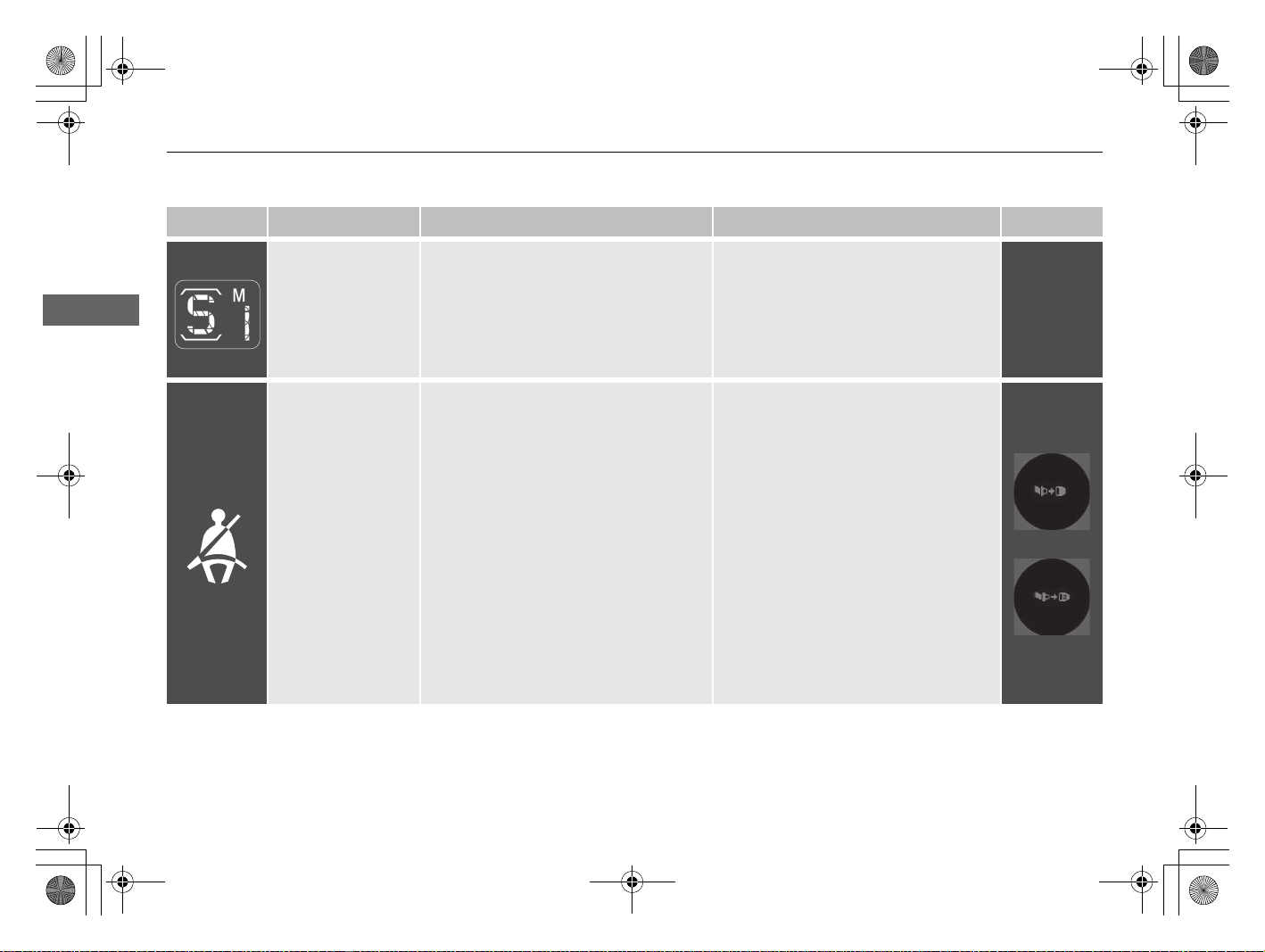
Instrument Panel
* Not available on all models
18 FIT JAZZ-32T5A6100.book 90 ページ 2017年8月23日 水曜日 午前11時24分
uuIndicatorsu
Indicator Name On/Blinking Explanation Message
●
Comes on when 7-speed manual shift
M (7-speed manual
shift mode)
Indicator/Shift
Indicator
*
mode is applied.
2 7-Speed Manual Shift Mode
P. 404
—
●
Comes on if you are not wearing a seat
belt when you turn the ignition switch
*1
(w
to ON
●
If the front passenger is not wearing a
.
seat belt, the indicator comes on about
a few seconds later.
●
Blinks while driving if either you or the
Seat Belt Reminder
Indicator
front passenger has not fastened a seat
belt. The beeper sounds and the
indicator blinks at regular intervals.
*1: Models with the keyless access system have an ENGINE START/STOP button instead of an ignition switch.
90
●
The beeper stops and the indicator
goes off when you and the front
passenger fasten their seat belts.
●
Stays on after you or the front
passenger has fastened the seat
belt - A detection error may have
occurred in the sensor. Have your
vehicle checked by a dealer.
2 Seat Belt Reminder P. 39
Page 92
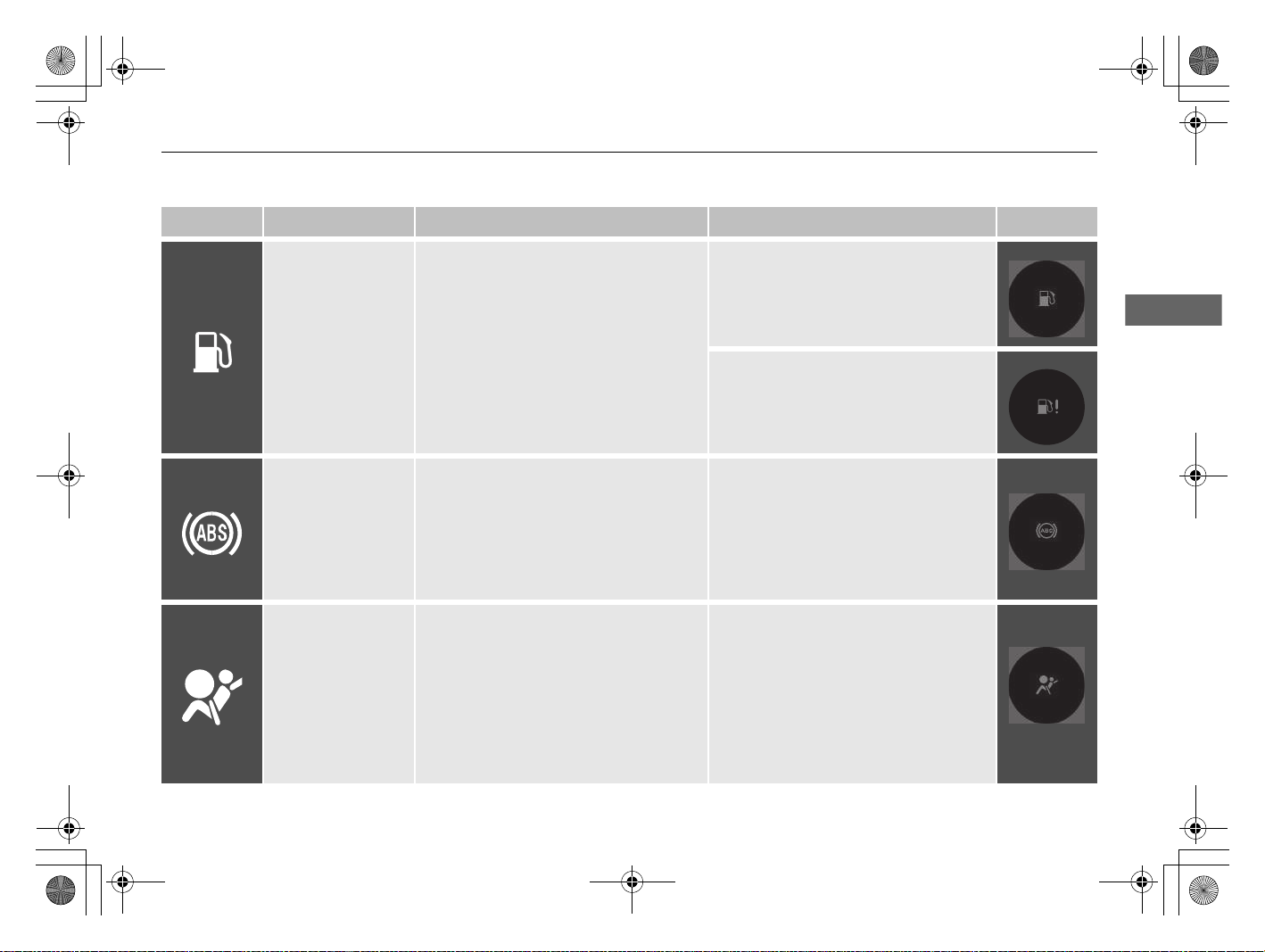
Instrument Panel
18 FIT JAZZ-32T5A6100.book 91 ページ 2017年8月23日 水曜日 午前11時24分
uuIndicatorsu
Indicator Name On/Blinking Explanation Message
●
Comes on when the fuel reserve is
running low (approximately 5.3 Litres/
●
Comes on - Refuel your vehicle as
soon as possible.
1.17 Imp gal left).
●
Blinks if there is a problem with the fuel
Low Fuel Indicator
gauge.
●
Blinks - Have your vehicle checked by
a dealer.
Anti-lock Brake
System (ABS)
Indicator
Supplemental
Restraint System
Indicator
●
Comes on for a few seconds when you
turn the ignition switch to ON
(w
then goes off.
●
If it comes on at any other time, there is
a problem with the ABS.
●
Comes on for a few seconds when you
turn the ignition switch to ON (w*1,
then goes off.
●
Comes on if a problem with any of the
following is detected:
- Supplemental restraint system
●
*1
Stays on constantly - Have your
,
vehicle checked by a dealer. With this
indicator on, your vehicle still has
normal braking ability but no anti-lock
function.
●
Stays on constantly or does not
come on at all - Have your vehicle
checked by a dealer.
- Side airbag system
- Side curtain airbag system
- Seat belt tensioner
*1: Models with the keyless access system have an ENGINE START/STOP button instead of an ignition switch.
2 Anti-lock Brake System (ABS)
P. 455
Continued
91
Page 93
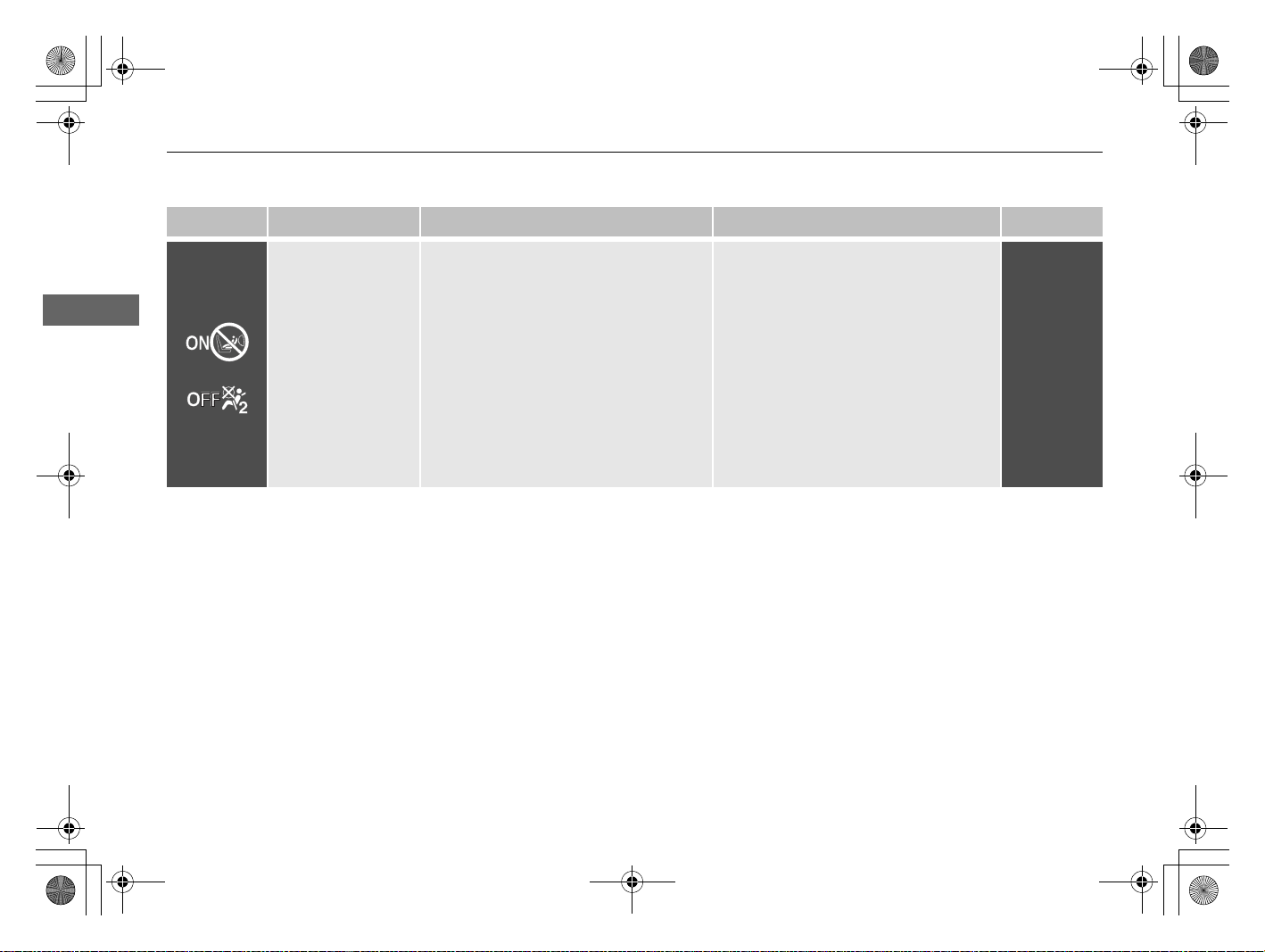
Instrument Panel
18 FIT JAZZ-32T5A6100.book 92 ページ 2017年8月23日 水曜日 午前11時24分
uuIndicatorsu
Indicator Name On/Blinking Explanation Message
●
Both indicators come on for a few
seconds when you turn the ignition
*1
(w
switch to ON
, then goes off after
a system check up.
Passenger Front
Airbag On/Off
Indicators
When the passenger front airbag is
active: The on indicator comes back on
and remains on for about 60 seconds.
When the passenger front airbag is
2 Passenger Front Airbag Off
System P. 54
inactive: The off indicator comes back
on and stays on. This is a reminder that
the passenger front airbag is
deactivated.
*1: Models with the keyless access system have an ENGINE START/STOP button instead of an ignition switch.
—
92
Page 94
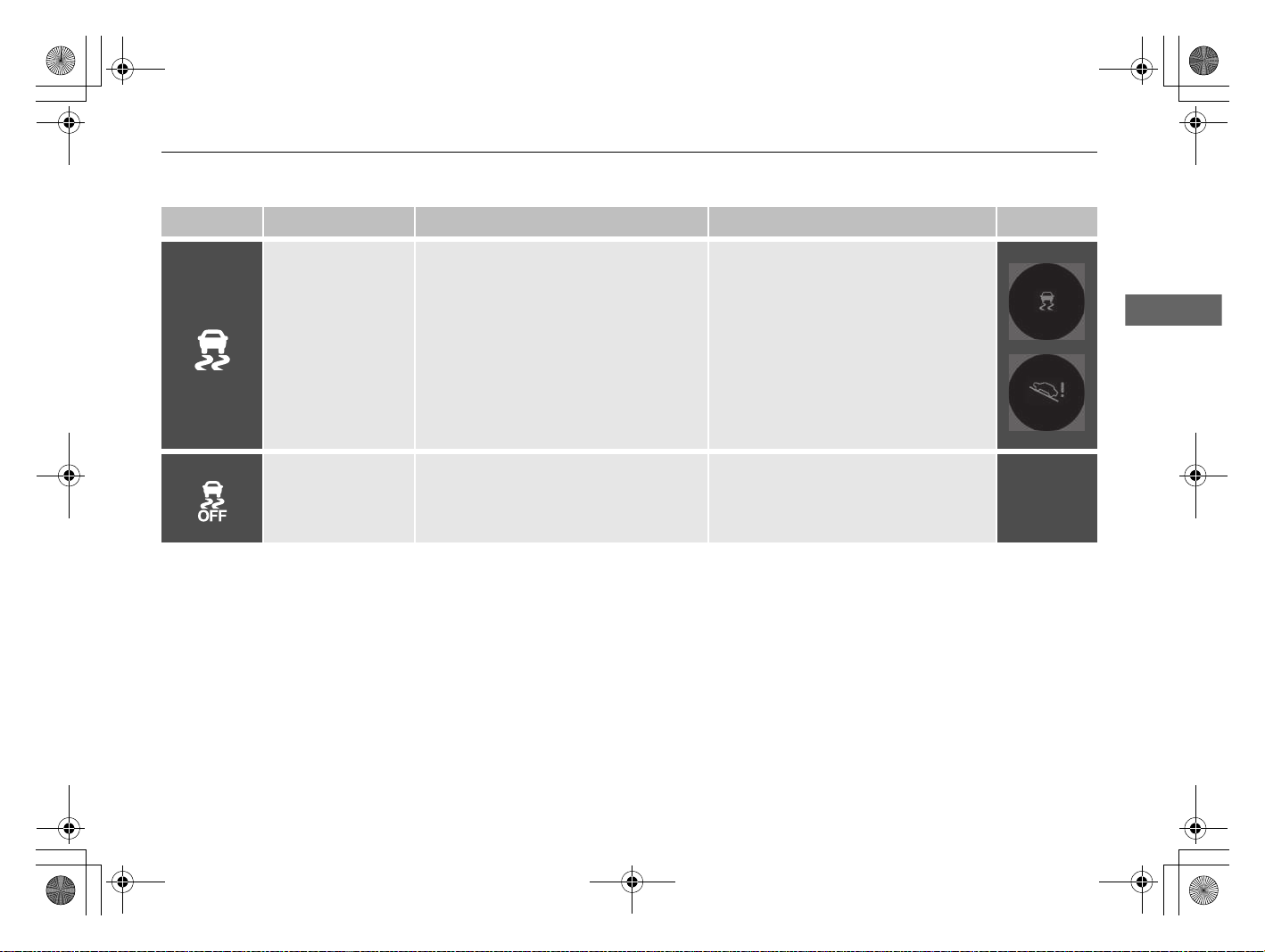
Instrument Panel
18 FIT JAZZ-32T5A6100.book 93 ページ 2017年8月23日 水曜日 午前11時24分
uuIndicatorsu
Indicator Name On/Blinking Explanation Message
●
Comes on for a few seconds when you
turn the ignition switch to ON (w*1,
then goes off.
●
Vehicle Stability
Assist (VSA) System
Indicator
Vehicle Stability
Assist (VSA) OFF
Indicator
*1: Models with the keyless access system have an ENGINE START/STOP button instead of an ignition switch.
Blinks when VSA is active.
●
Comes on if there is a problem with the
VSA or hill start assist system.
●
Comes on for a few seconds when you
turn the ignition switch to ON (w*1,
then goes off.
●
Comes on when you deactivate VSA.
●
Stays on constantly - Have your
vehicle checked by a dealer.
2 Vehicle Stability Assist (VSA)
System P. 446
2 Hill start assist system P. 394, 398
2 VSA On and Off P. 447
—
Continued
93
Page 95
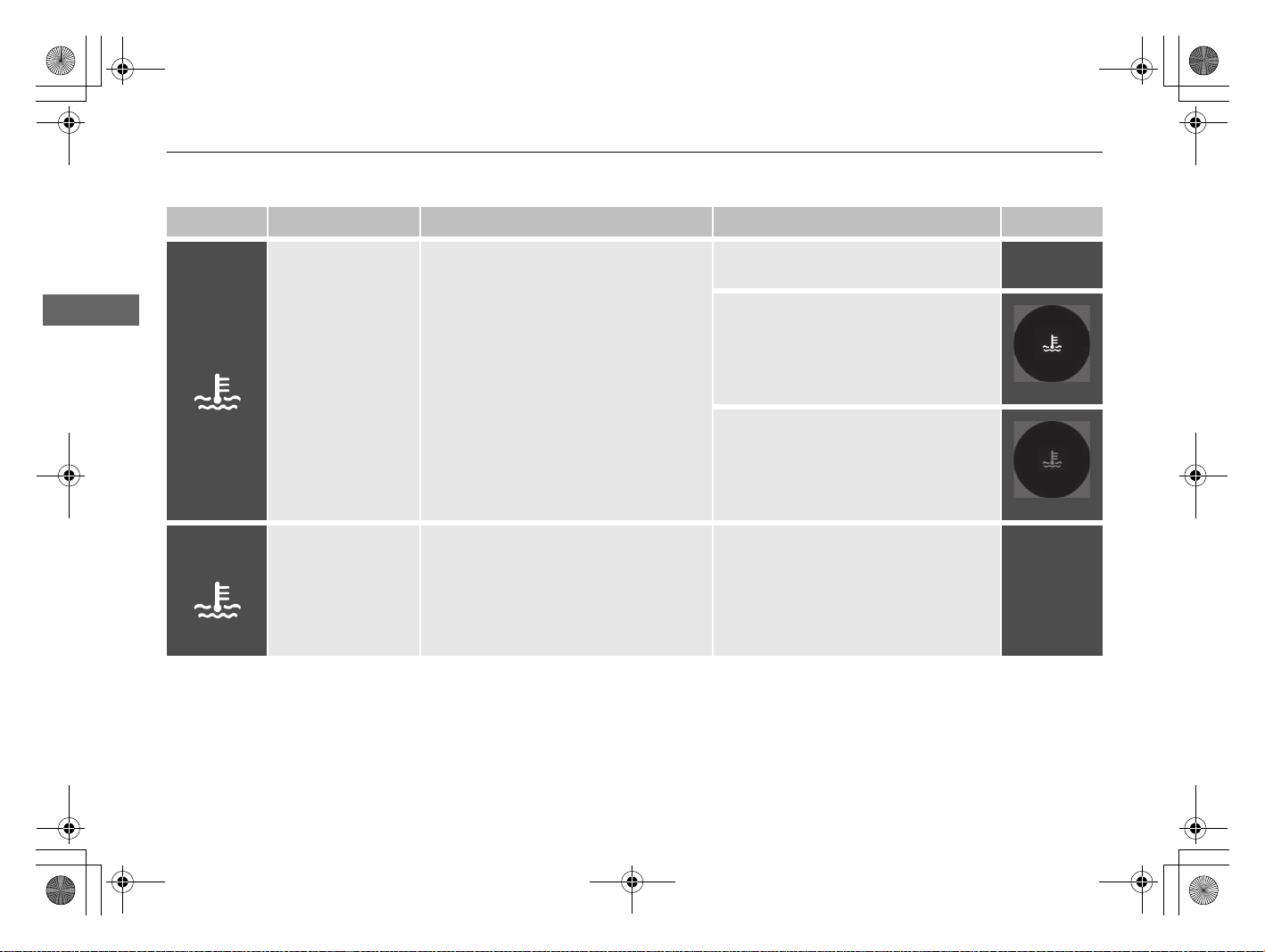
Instrument Panel
(White)
(Amber)
18 FIT JAZZ-32T5A6100.book 94 ページ 2017年8月23日 水曜日 午前11時24分
uuIndicatorsu
Indicator Name On/Blinking Explanation Message
●
Comes on for a few seconds when you
turn the ignition switch to ON (w*1,
then goes off.
●
Blinks when the engine coolant
temperature goes up, and stays on if
●
Goes off, then comes on blue when
the engine coolant temperature is low.
●
Blinks while driving - Drive slowly to
prevent overheating.
the temperature continues to rise.
High Temperature
Indicator (Red)
●
Stays on while driving Immediately stop in a safe place and
allow the engine to cool.
2 Overheating P. 566
—
●
Comes on when the engine coolant
temperature is low.
Low Temperature
Indicator (Blue)
*1: Models with the keyless access system have an ENGINE START/STOP button instead of an ignition switch.
94
●
If the indicator stays on after the
engine has reached normal operating
temperature, there may be a problem
with the temperature sensors. Have
your vehicle inspected by a dealer.
—
Page 96
Instrument Panel
18 FIT JAZZ-32T5A6100.book 95 ページ 2017年8月23日 水曜日 午前11時24分
uuIndicatorsu
Indicator Name On/Blinking Explanation Message
●
Comes on for a few seconds when you
turn the ignition switch to ON (w*1,
●
Goes off when all doors and the
tailgate are closed.
then goes off.
Door and Tailgate
Open Indicator
●
Comes on if any door or the tailgate is
not completely closed.
●
The beeper sounds and the indicator
comes on if any door or the tailgate is
opened while driving.
*1: Models with the keyless access system have an ENGINE START/STOP button instead of an ignition switch.
Continued
95
Page 97
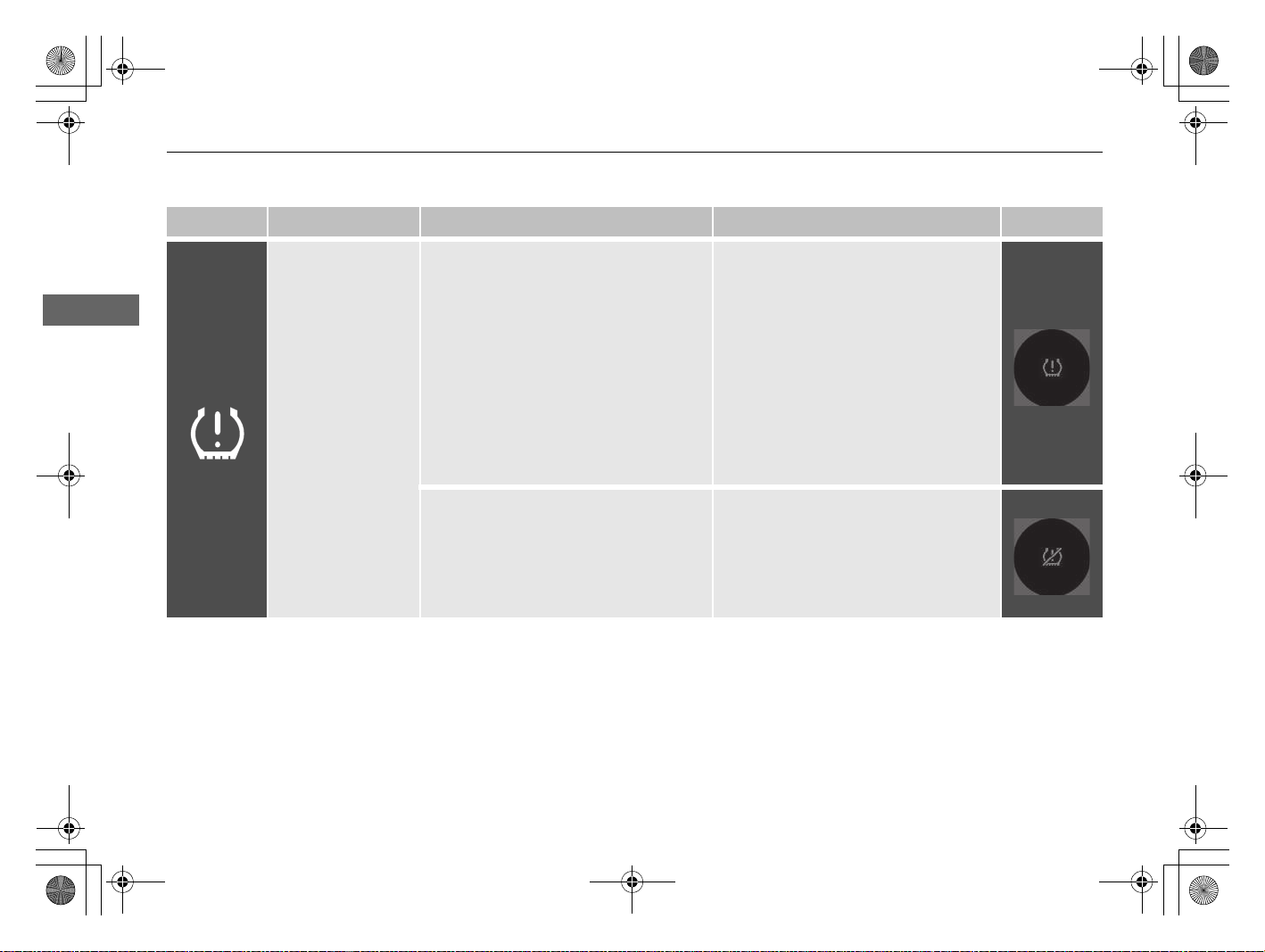
Instrument Panel
* Not available on all models
18 FIT JAZZ-32T5A6100.book 96 ページ 2017年8月23日 水曜日 午前11時24分
uuIndicatorsu
Indicator Name On/Blinking Explanation Message
Low Tyre Pressure/
Deflation Warning
System Indicator
●
Comes on for a few seconds when you
turn the ignition switch to ON (w*1,
then goes off.
●
May come on briefly if the ignition
switch is turned to ON (w*1 and the
vehicle is not moved within 45 seconds,
to indicate the calibration process is not
yet complete.
●
Comes on and stays on when:
- One or more tyres’ pressures are
determined to be significantly low.
●
Comes on while driving - Stop in a
safe place, check tyre pressures, and
inflate the tyre(s) if necessary.
●
Stays on after the tyres are inflated
to the recommended pressures -
The system needs to be calibrated.
2 Deflation Warning System
Calibration P. 449
- The system has not been calibrated.
●
Blinks for about one minute, and then
stays on if there is a problem with the
deflation warning system, or when a
*
compact spare tyre
is temporarily
installed.
●
Blinks and remains on - Have your
vehicle checked by a dealer. If the
vehicle is fitted with a compact spare,
get your regular tyre repaired or
replaced and put back on your vehicle
as soon as you can.
*1: Models with the keyless access system have an ENGINE START/STOP button instead of an ignition switch.
96
Page 98
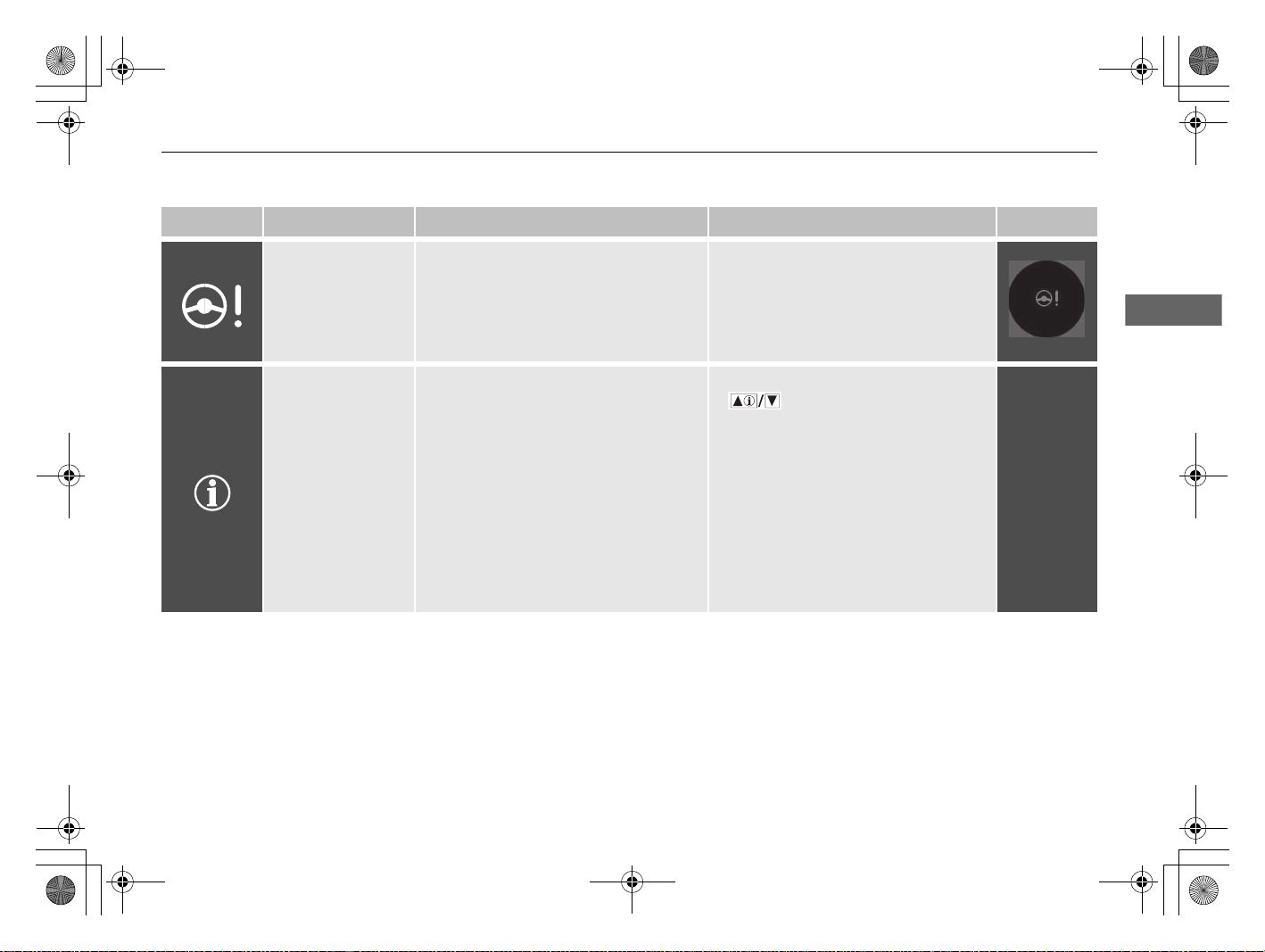
Instrument Panel
18 FIT JAZZ-32T5A6100.book 97 ページ 2017年8月23日 水曜日 午前11時24分
uuIndicatorsu
Indicator Name On/Blinking Explanation Message
Electric Power
Steering (EPS)
System Indicator
System Message
Indicator
●
Comes on when you turn the ignition
switch to ON (w*1, and goes off when
the engine starts.
●
Comes on if there is a problem with the
EPS system.
●
Comes on for a few seconds when you
turn the ignition switch to ON (w*1,
then goes off.
●
Comes on along with a beep when a
problem is detected. A system message
on the multi-information display
appears at the same time.
●
Stays on constantly or does not
come on at all - Have your vehicle
checked by a dealer.
2 If the Electric Power Steering
(EPS) System Indicator Comes On
P. 570
●
While the indicator is on, press the
(information) button to see
the message again.
●
Refer to the Indicators information in
this chapter when a system message
appears on the multi-information
display. Take appropriate action for
the message.
●
The multi-information display does not
return to the normal screen unless the
warning is cancelled, or the button is
pressed.
*1: Models with the keyless access system have an ENGINE START/STOP button instead of an ignition switch.
—
Continued
97
Page 99
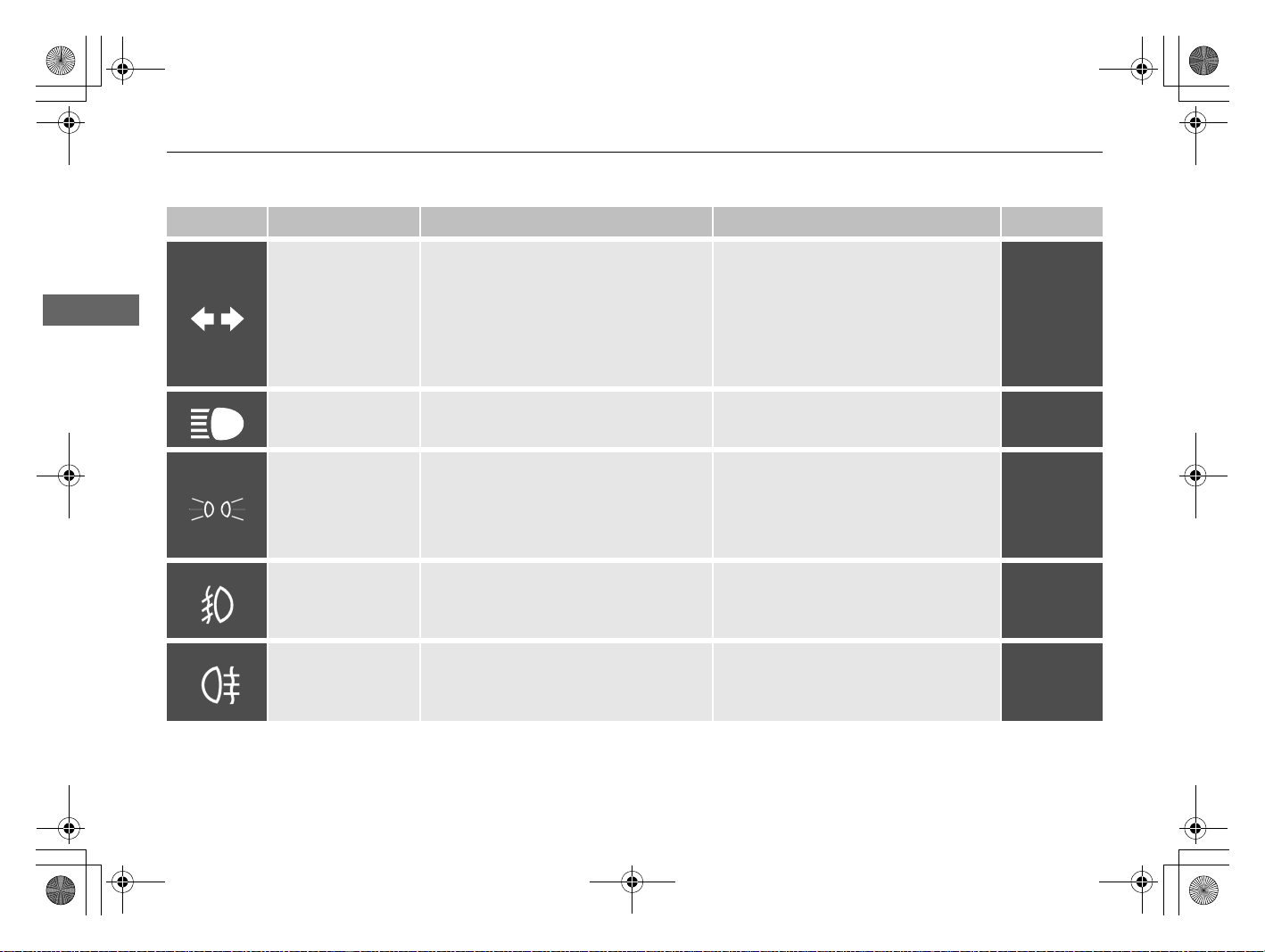
Instrument Panel
* Not available on all models
18 FIT JAZZ-32T5A6100.book 98 ページ 2017年8月23日 水曜日 午前11時24分
uuIndicatorsu
Indicator Name On/Blinking Explanation Message
Turn Signal and
Hazard Warning
Indicators
●
Blinks when you operate the turn signal
lever.
●
Blink along with all turn signals if you
press the hazard warning button.
●
Blinks along with all turn signals when
●
Does not blink or blinks rapidly - A
turn signal light bulb has blown.
Change the bulb immediately.
2 Replacing Light Bulbs P. 503, 505
2 Emergency Stop Signal P. 462
you depress the brake pedal during
high speed driving.
●
High Beam Indicator
Lights On Indicator
Comes on when the high beam
headlights are on.
●
Comes on whenever the light switch is
on, or in AUTO when the exterior lights
are on.
— —
●
If you remove the key from the ignition
*
, or set the power mode* to
switch
VEHICLE OFF (LOCK) while the exterior
lights are on, a chime sounds when the
driver's door is opened.
●
Front Fog Light
Indicator
*
Comes on when the front fog lights are
on.
— —
—
—
98
Rear Fog Light
Indicator
●
Comes on when the rear fog light is on.
— —
Page 100
Instrument Panel
Models without keyless access system
Models with keyless access system
18 FIT JAZZ-32T5A6100.book 99 ページ 2017年8月23日 水曜日 午前11時24分
uuIndicatorsu
Indicator Name On/Blinking Explanation Message
●
Comes on briefly when you turn the
●
Blinks -
ignition switch to ON (w*1, then goes
off.
●
Comes on if the immobilizer system
cannot recognize the key information.
You cannot start the engine. Turn the
ignition switch to LOCK
(0, pull the
key out, and then insert the key and
turn it to ON
(w again.
Immobilizer System
Indicator
You cannot start the engine. Set the
power mode to VEHICLE OFF (LOCK),
then select the ON mode again.
●
Repeatedly blinks - The system may
be malfunctioning. Have your vehicle
checked by a dealer.
●
Do not try to alter this system or add
other devices to it. Electrical problems
can occur.
*1: Models with the keyless access system have an ENGINE START/STOP button instead of an ignition switch.
—
Continued
99
 Loading...