

Page 1
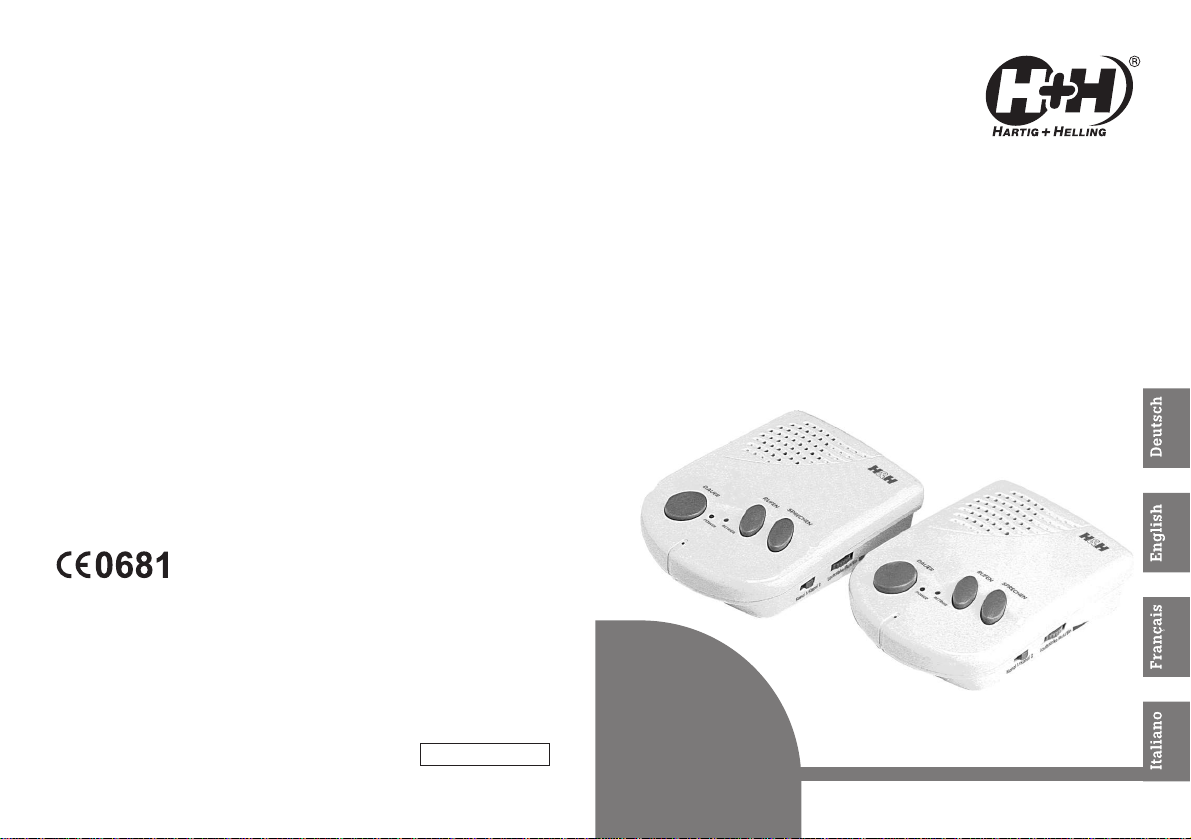
Wir erklären hiermit, dass unsere Wechselsprechanlage DWA 293
den R&TTE-Direktiven über EMV, Radio und Sicherheit entspricht.
To use in: Germany
Hartig+Helling GmbH+Co. KG
Wilhelm-Leithe-Weg 81
44867 Bochum, Germany
http://www.hartig-helling.de
Service-Hotline
(0,12 Euro pro Minute aus dem deutschen Festnetz):
WECHSELSPRECHANL AGE
Bedienungsanleitung
Operating instructions
Mode d’emploi
Istruzioni per l’uso
Telefon 01805 8855600
Telefax 01805 8855609
92HH0506
DWA 293
Page 2
Diese Wechselsprechanlage
DWA 293 ist für den Anschluss an
ein Stromnetz mit 220-240V AC, 50
Hz (Wechselspannung) geeignet
und verfügt über zwei Kanäle. Die
Geräte sind als Tischgeräte sowie
zur Wandmontage geeignet.
Inbetriebnahme
1. Stellen Sie die Wechselsprechgeräte
in den von Ihnen gewünschten Räumen auf.
2. Schließen Sie die Geräte an eine
Steckdose (220-240V AC, 50 Hz) an.
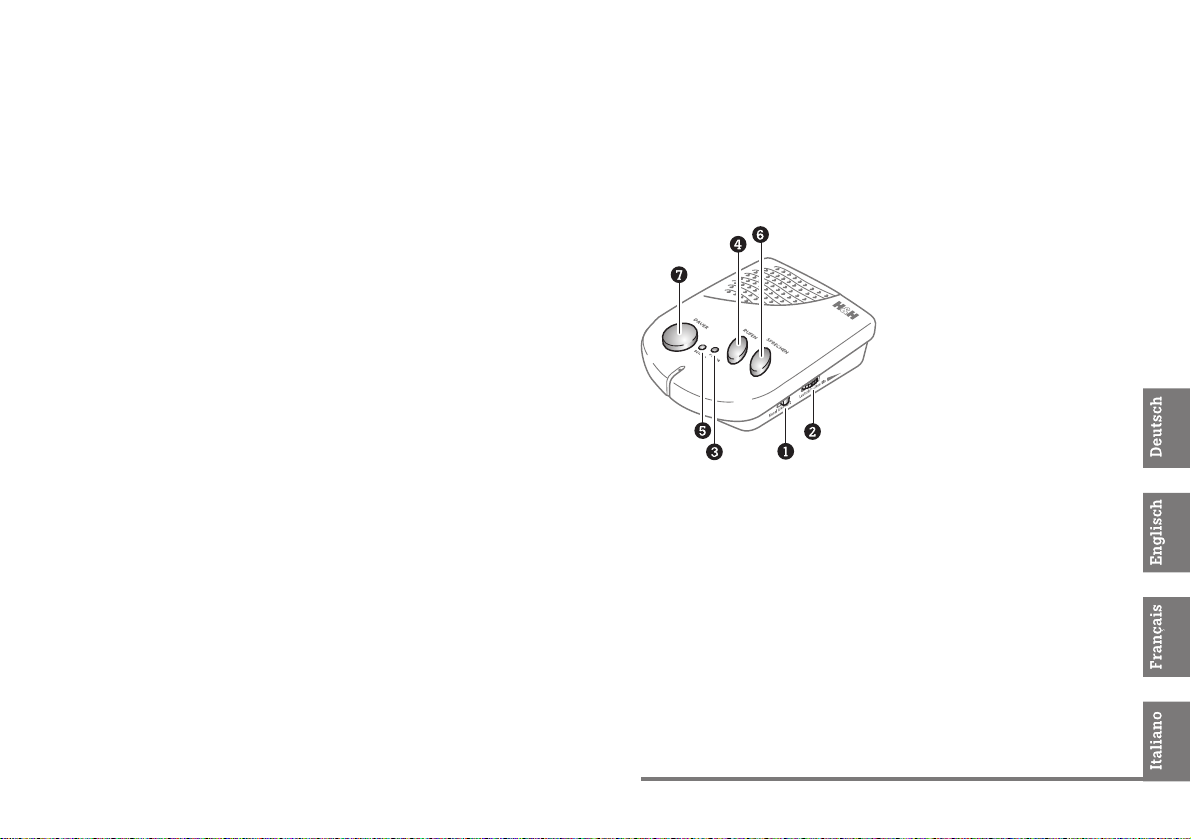
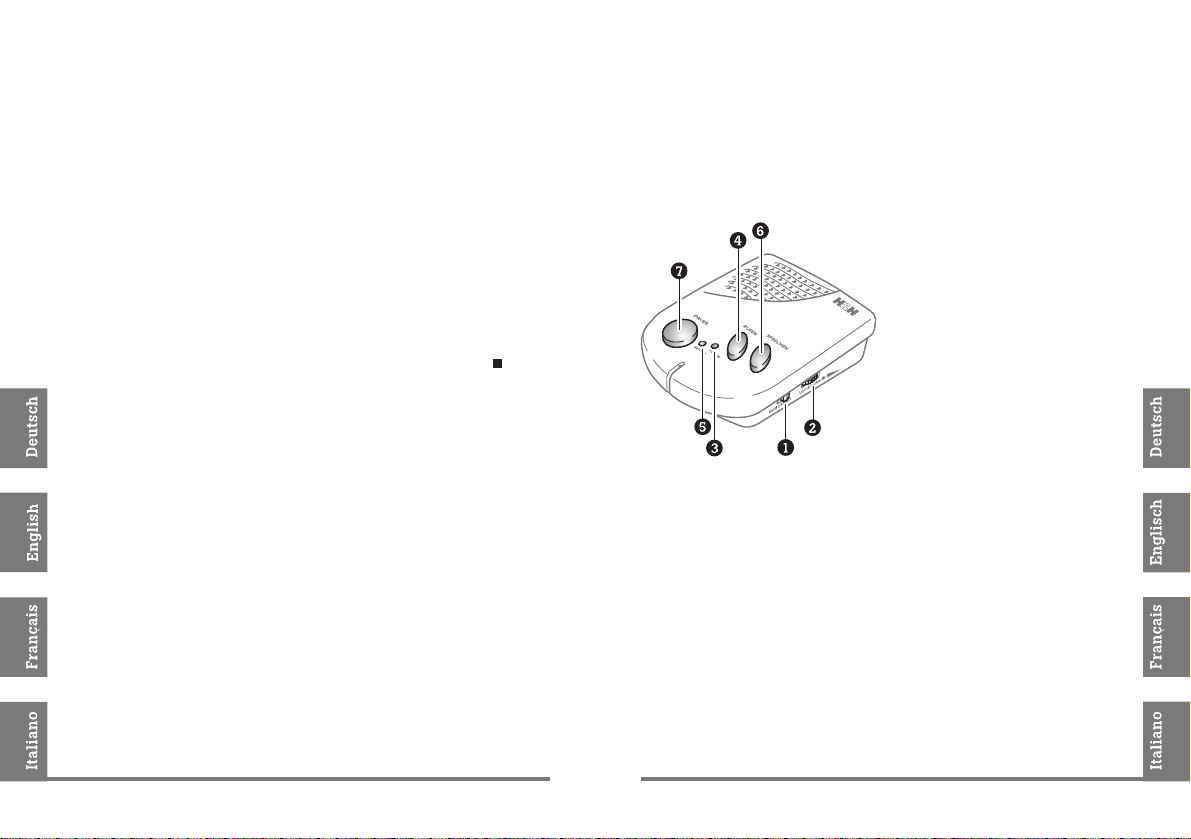
3. Wählen Sie einen der beiden Übertragungskanäle mit dem Schalter (1)
aus. Beachten Sie dabei, dass alle
Geräte, die gegenseitig senden und
empfangen sollen, auf den gleichen
Kanal eingestellt sind.
4. Schalten Sie durch Drehen des Kombischalters (2) nach unten die Geräte
ein. Die LED (3) leuchtet auf und
signalisiert Ihnen die Betriebsbereitschaft.
5. Durch Drehen des Kombischalters (2)
stellen Sie Ihre gewünschte Empfangslautstärke ein. Je weiter der Regler
nach unten gedreht wird, desto lauter
wird das zu empfangende Signal oder
Geräusch.
Rufton
Die Anlage ist mit einem separaten Rufton ausgestattet. Durch Betätigen
der Taste (4) übermitteln Sie einen Ton
an alle Geräte, die den gleichen Kanal
eingestellt haben. Die LED (5) leuchtet
auf, um Ihnen zu signalisieren, dass der
Rufton an alle anderen Teilnehmer
weitergeleitet wurde.
Sprechen
Zur Sprachübertragung betätigen Sie
die Taste (6). Sprechen Sie in einem
Abstand von ca. 20-30 cm zum Gerät.
Die LED (5) leuchtet auf.
Während der Übertragung können Sie
nicht empfangen. Um Ihren Gesprächspartner wieder empfangen zu können,
müssen Sie die Taste (6) wieder freigeben.
Freisprechfunktion
Die Freisprecheinrichtung ist dazu gedacht, Mitteilungen oder Ansagen zu
tätigen, ohne dass ständig die Sprechtaste gedrückt werden muss.
Um die Freisprechfunktion zu aktivieren,
3
Page 3
drücken Sie bitte die „DAUER”-Taste
(7) bis sie hörbar eingerastet ist. Die
LED (5) leuchtet auf.
Diese Funktion eignet sich z.B. ideal zur
Überwachung eines Kinderzimmers oder
als Signalgeber einer Tür- bzw. Telefonklingel.
Wichtiger Hinweis!
Im Freisprechmodus werden alle angeschlossenen Wechselsprechgeräte zu
Empfangsgeräten, außer dem Gerät, das
die Freisprecheinrichtung aktiviert hat.
Dieses Gerät wird zu einem Sendegerät
und zwar solange, bis die Freisprechfunktion deaktiviert wird. In diesem
Modus ist ein Wechsel-sprechen nicht
möglich.
Denken Sie bitte daran, die „DAUE R”Taste (7) wieder freizugeben, damit die
anderen Teilnehmer wieder in der Lage
sind, mit Ihnen zu kommunizieren, nachdem Sie Ihre Ansagen getätigt haben.
Anmerkungen
Die Reichweite einer drahtlosen Wechselsprechanlage ist begrenzt. Nach den
Vorschriften der Regulierungsbehörde
für Telekommunikation und Post (Reg
TP) darf die Sendeleistung 5mW nicht
überschreiten.
Ferner dürfen die Geräte nicht über den
Stromkreis einer Wohnung oder eines
Einfamilienhauses hinaus betrieben
werden. Die Wechselsprechanlage
DWA 293 entspricht den Bestimmungen
der Regulierungsbehörde für Telekommunikation und Post.
Hinweise für den Störungsfall
Wenn die Anlage gemäß den Anweisungen betrieben wird, werden keine Probleme auftreten. Sollten Sie dennoch
Unregelmäßigkeiten während des Betriebes feststellen, überprüfen Sie bitte
folgende Punkte:
• Rückkopplungsgeräusche
Wenn die Wechselsprechgeräte zu nahe
zusammen stehen, kann ein Pfeifton
entstehen (Feedback).
Um das zu vermeiden, muss die Distanz
zwischen den Gerätenvergrößert oder
die Lautstärke verringert werden.
• keine Verbindung zwischen den
Wechselsprechgeräten
Wenn nach dem Anschluss der Geräte
keine Verbindung aufgebaut werden
kann, liegt das höchstwahrscheinlich
daran, dass die Geräte an unterschiedlichen Phasen in Ihrer Wohnung angeschlossen wurden.
Wichtig: Die Wechselsprechgeräte funktionieren nur, wenn Sie an den gleichen
Stromkreis (Phase) angeschlossen sind.
Um einen Defekt der Geräte auszuschließen, schließen Sie bitte die Geräte nebeneinander an eine Steckdosenleiste
an. Wenn die Geräte an der Steckdosenleiste funktionieren, liegt das Problem
an Ihrem Stromnetz. In diesem Fall ist
der Einbau eines Phasenkopplers in die
Schalttafel durch einen Fachmann erforderlich.
• externe Störgeräusche der
Wechselsprechgeräte
Diese Störsignale dringen von Außen
aus der Nachbarschaft in Ihren Stromkreis (z.B. andere Kinderstimmen usw.).
Bei dieser Art der Störung hilft nur der
Einbau einer Trägerfrequenzsperre, die
das Einwirken fremder Sender verhindert.
Diese Sperre muss von einem Elektrofachmann im Sicherungskasten auf der
entsprechenden Phase angeschlossen
werden.
• interne Störgeräusche der
Wechselsprechgeräte
Fehlerhafte Verbindungen in der Hausverkabelung, „geräuschstarke” Thermostate von Zentralheizungen oder
Kühlgeräten, Computer, Farbfernseher,
Waschmaschinen, Haartrockner usw.
können Störungen verursachen.
Als Erstes müssen Sie das störende
Gerät ausfindig machen, indem Sie ein
Gerät (Verbraucher) nach dem anderen
aus der Steckdose ziehen. Sobald Sie
eine deutliche Verbesserung der Übertragungsqualität Ihrer Wechselsprechanlage feststellen, haben Sie das
störende Gerät lokalisiert.
Nun müssen Sie nur noch einen Entstör oder TV-Zwischenstecker (max. ca. 400
Watt Anschlussleistung) zwischen das störende Gerät
und die Steckdose, indem das Gerät
angeschlossen ist, stecken.
Bitte beachten Sie, dass Einbauten in
die Unterverteilung (Sicherungstafel)
nur von Fachpersonal vorgenommen
werden dürfen!
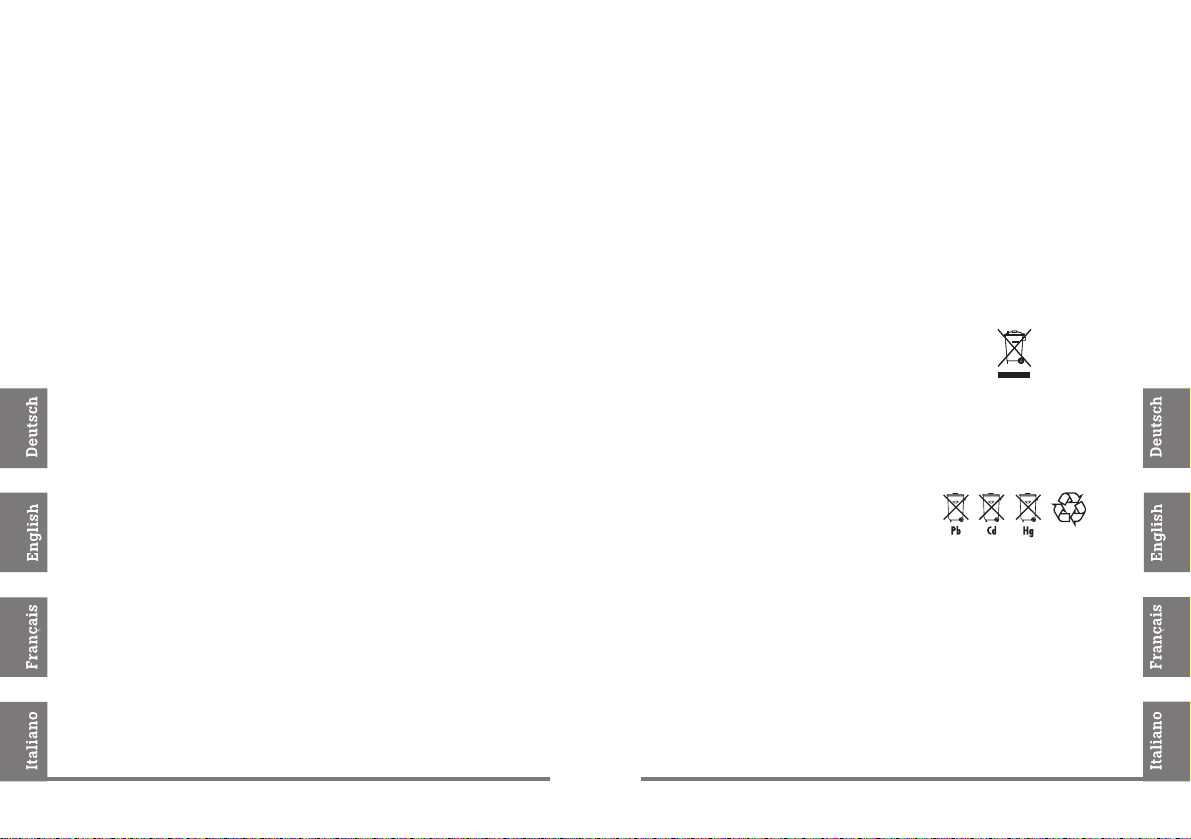
Entsorgungshinweis
Altgeräte, die mit dem abgebildeten
Symbol gekennzeichnet sind, dürfen
nicht mit dem Hausmüll entsorgt werden.
Verbrauchte Batterien und
Akkumulatoren (Akkus), die mit einem
der abgebildeten Symbole
gekennzeichnet sind, dürfen nicht mit
dem Hausmüll entsorgt werden.
Sie müssen sie bei einer Sammelstelle
für Altgeräte, Altbatterien bzw.
Sondermüll (informieren Sie sich bitte
bei Ihrer Gemeinde) oder bei Ihrem
Händler, bei dem Sie sie gekauft haben,
abgeben. Diese sorgen für eine
umweltfreundliche Entsorgung.
Pflege und Gewährleistung
Trennen Sie die Geräte vor dem Reinigen gegebenenfalls von anderen Komponenten und verwenden Sie bitte
keine aggressiven Reiniger.
Die Geräte wurden einer sorgfältigen
Endkontrolle unterzogen.
4
5
Page 4
Sollten Sie trotzdem Grund zu einer
Beanstandung haben, senden Sie uns
die Geräte mit der Kaufquittung ein. Wir
bieten eine Gewährleistung von 3
Jahren ab Kaufdatum.
Für Schäden, die durch falsche
Handhabung, unsachgemäße Nutzung
oder Verschleiß verursacht wurden,
übernehmen wir keine Haftung.
Technische Änderungen sind
vorbehalten.
Diese Wechselsprechanlage ist kein
Spielzeug. Bitte für Kinder nicht erreichbar aufstellen.
Technische Daten
Typ: DWA 293
Modulationsart: FM
Anzahl der Kanäle: 2
Trägerfrequenz
Kanal 1: 100 KHz FM
Kanal 2: 115 KHz FM
Ausgangsleistung: max. 5 mW
Verbrauch: max. 2W
Anschluss: 220-240V AC
50/60 Hz, 3W
Aktuelle Produktinformationen finden
Sie auf unserer Internet-Seite
http://www.hartig-helling.de.
This DWA 293 intercom system is
suitable to be connected to a
220–240V AC, 50 Hz mains
(AC voltage) and is provided with
two channels.
The appliance can be mounted both
at the table or the wall.
Start-up
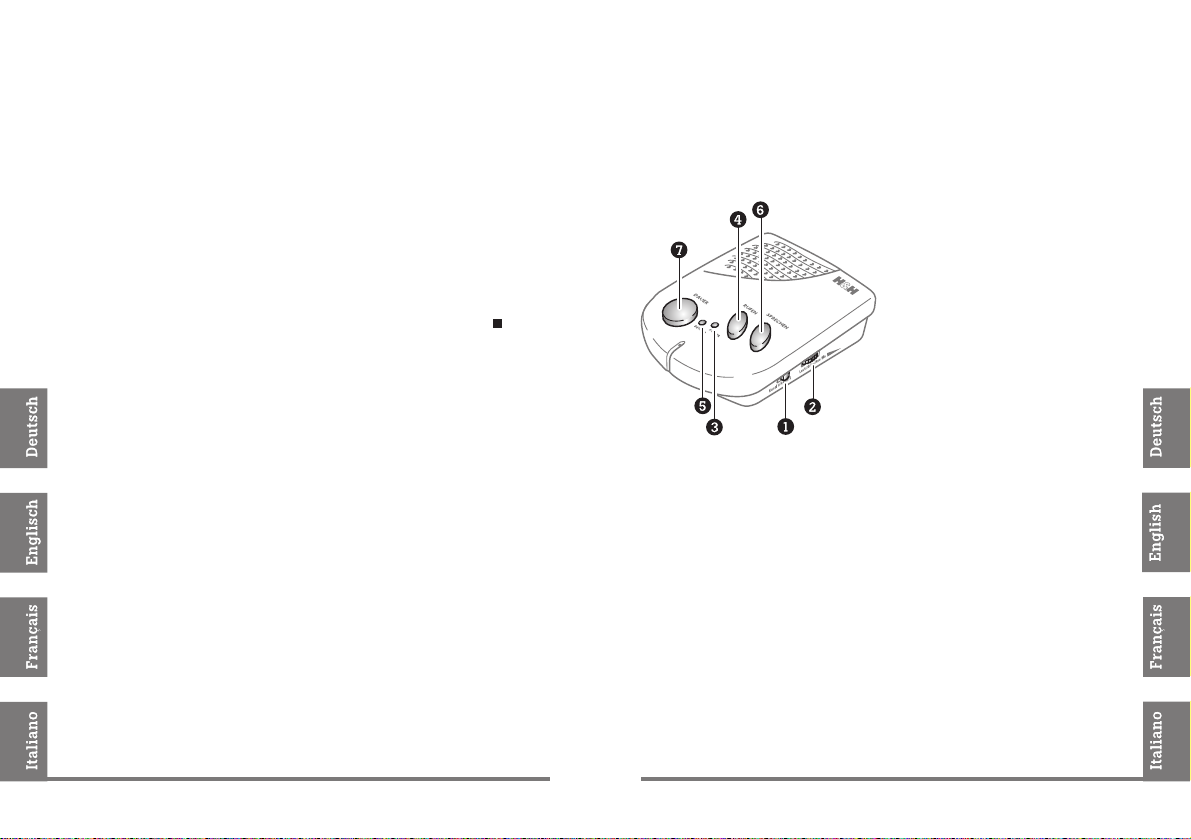
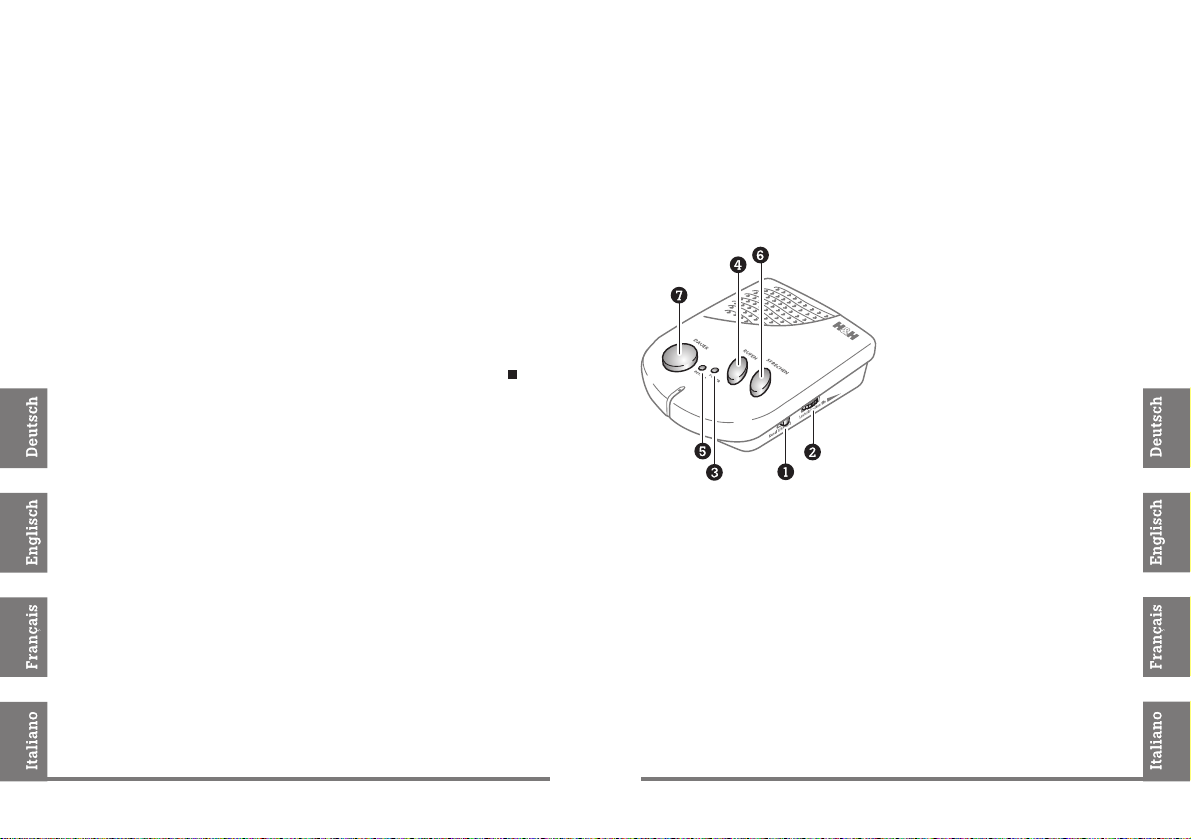
1. Place the intercom appliances in the
desired rooms.
2. Connect the appliance with a socket
(220–240V AC, 50 Hz).
3. Select one of the two transmission
channels using switch (1). Please note
that all appliances which shall
transmit and receive mutually are set
to the same channel.
4. Switch on the appliances by turning
the combination switch (2). The LED
(3) lights up and signals readiness
for service.
5. Set the desired volume by turning
the combination switch (2). The
further you turn the controller the
louder becomes the signal or noise
to be received.
Call tone
The system is provided with a separate
call tone. A tone is transferred to all
appliances with the same channel when
actuating the button (4). The LED (5)
lights up and signals that the call tone
has been transferred to all other
subscribers.
Speaking
Actuate button (6) for this function.
Speak to the appliance at a distance of
approx. 20–30 cm.
The LED (5) lights up.
No receipt is possible when transmitting.
To receive your partner again, release
the button (6).
6
7
Page 5
Hands-free
conversation function
This function is intended to make send
messages or announcements without
pressing the speak button.
To activate the hands-free function,
press the „DAUER” button (7) until it
engages, which can be heard. The LED
(5) lights up.
This function is for instance ideally
suited to monitor a children’s room or
as a signal transmitter of a door or
phone bell.
Important note!
In hands-free conversation mode all
connected intercom appliance become
receivers, except that appliance which
has activated the hands-free function.
This appliance becomes a transmitter
as long as the hands-free conversation
function is deactivated. No intercom
function is possible in this mode.
Please make sure to release the „DAUER”
button (7) to enable the other
subscribers to communicate with you
again after your announcement.
Remarks
The reach of a wireless intercom system
is limited. In accordance with the
regulations of the Telecommunications
and Post Regulation authority (Reg TP)
the transmission capacity must not
exceed 5 mW.
Furthermore, the appliance must be
operated via the same circuit of a flat
or a single-family house. The DWA 293
intercom system is in compliance with
the provisions of the
Telecommunications and Post Regulation
authority.
Notes for malfunction
No problems will arise as far as the
system is operated in accordance with
the instructions. However, in case of
malfunction please check the following:
• Feedback noise
If the intercom appliances are too close
to each other this may result in a
whistling tone (feedback). To avoid this
increase the distance between the
appliances or reduce the volume.
• no connection between the intercom
appliances
If it is not possible to establish a
connection after having connected the
appliances, the cause may be that the
appliances have been connected to
different phases in your flat.
Important: The intercom appliances
will function properly only if connected
to the same circuit (phase).
To exclude a defect of the appliances
please connect the appliances at a multioutlet assembly one beside the other. If
the appliances function properly here,
the problem is probably your mains. In
this case, a phase coupler must be
installed in the switch board by a
specialist.
• external interfering noise of the
intercom appliances
These interfering signals come into your
circuit from outside from the
neighbourhood (e.g. voices of other
children etc.). To avoid this type of
malfunction it is necessary to install a
carrier-current line trap which prevents
effects by external transmitters.
This trap must be installed at the
relevant phase in the fuse box by a
qualified electrician.
• internal interfering noise of the
intercom appliances
Faulty connections in the house wiring,
“loud” thermostats of central heating
systems or refrigerators, computers,
colour TV sets, washing machines, hair
dryers, etc. may cause malfunction.
First of all look for the interfering
appliance by disconnecting one
appliance (consumer) after the other
from the socket. As soon as a clear
improvement of the transfer quality of
the intercom system is noticed, you
have localised the interfering appliance.
Now simply plug a suppression plug or
intermediate TV plug (max. connected
load approx. 400W) between the
interfering appliance and the socket
where the appliance is connected.
Please note that installation work at
the sub-distribution (fuse panel) must
be carried out by qualified persons
only.
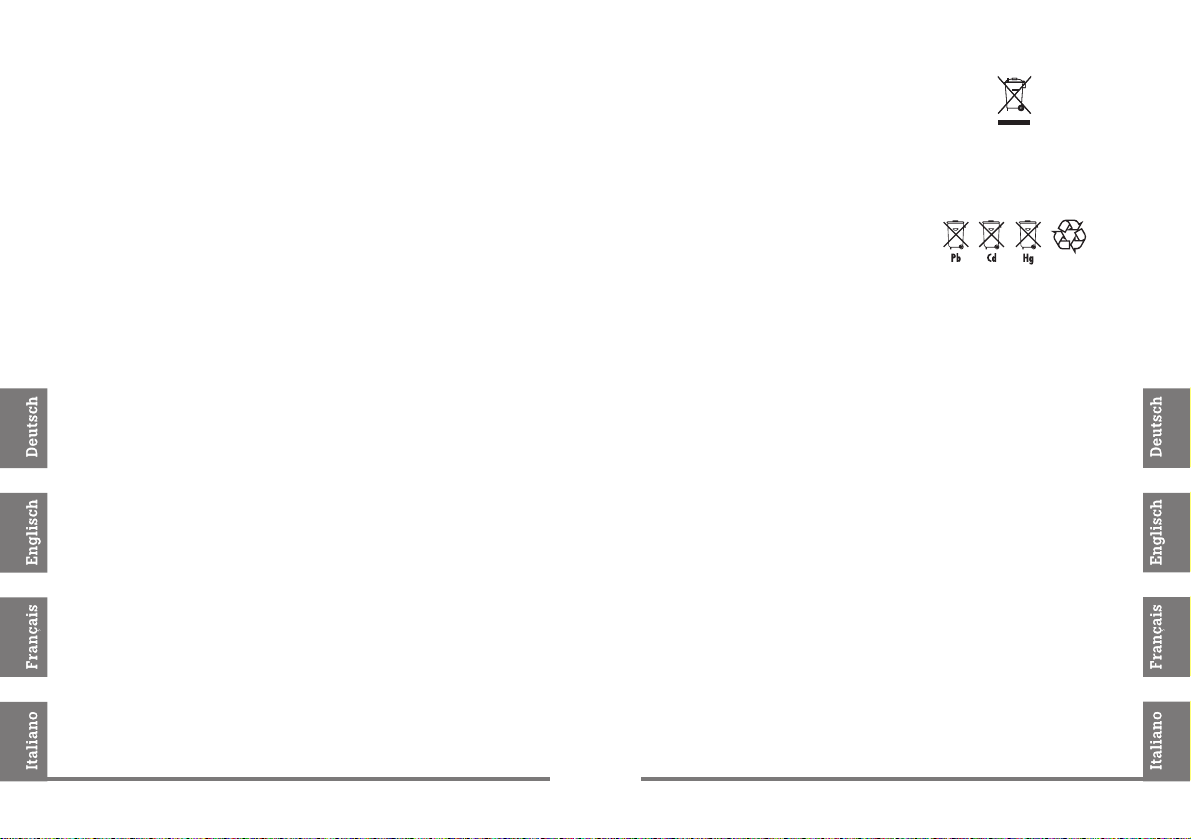
Notes on Disposal
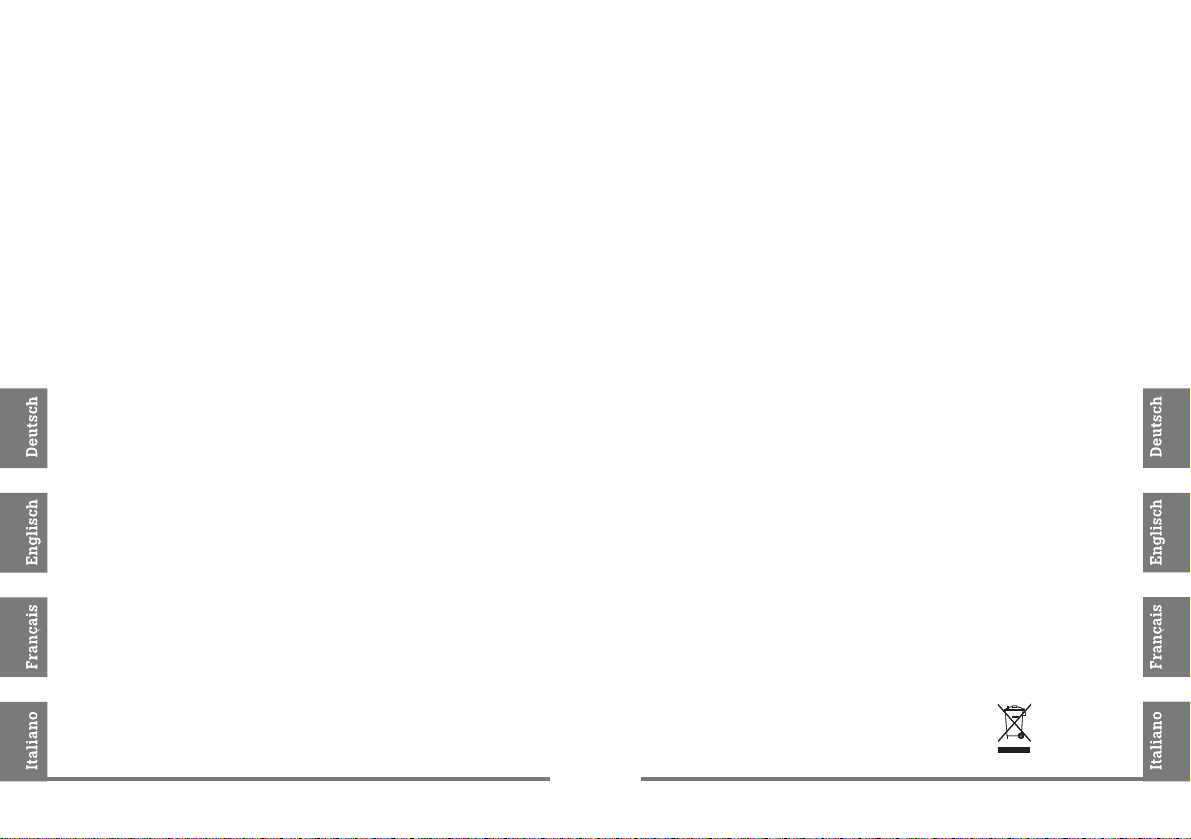
Old units, marked with the symbol as
illustrated, may not be disposed of in
the household rubbish.
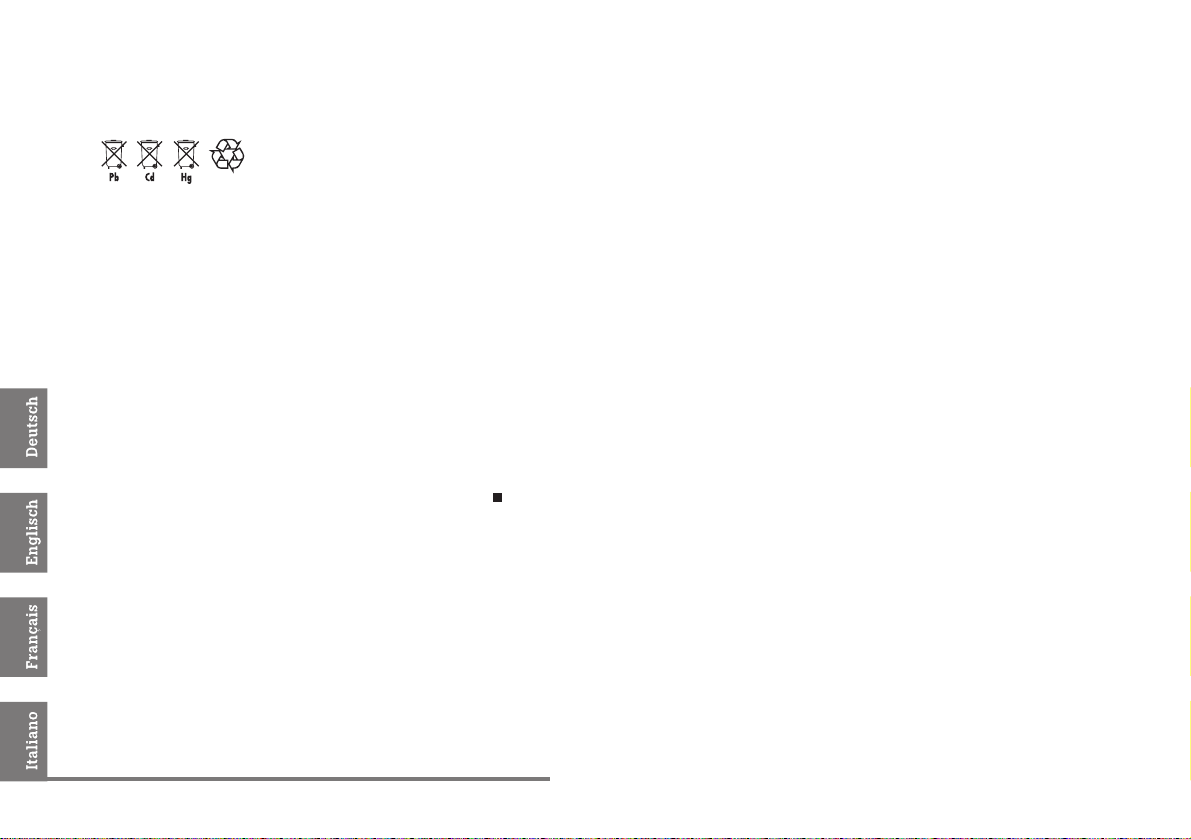
Used rechargeable and nonrechargeable batteries which are
marked with one of the symbols
illustrated may not be disposed of in
the household rubbish.
You must take them to a collection point
for old units, old batteries or special
waste (enquire at your local authority)
or the dealer from whom you bought
them. These agencies will ensure
environmentally friendly disposal.
Care and warranty
Separate the devices from other
components prior to cleaning, if
necessary, do not use aggressive
cleansing agents.
8
9
Page 6
The devices has been subjected to a
careful final inspection. In case of
complaints, however, please return the
device together with the receipt. We
grant a guarantee period of 3 years
from the date of purchase.
No claims will be accepted for damage
due to wrong handling, improper use
or wear.
We reserve the right for technical
modifications.
DWA 293 is not a toy. Please install
inaccessible for children.
Technical data
Type: DWA 293
Type of
modulation: FM
Number of
channels: 2
Carrier frequency
Channel 1: 100 KHz FM
Channel 2: 115 KHz FM
Output capacity: max. 5 mW
Consumption: max. 2W
Connection: 220–240V AC,
50/60 Hz, 3W
For current product information
please refer to our Internet Site
http://www.hartig-helling.de.
Cet interphone DWA 293 est conçu
pour le raccordement à un réseau
électrique de 220–240V c.a., 50 Hz
(courant alternatif) et dispose de
deux canaux. Les appareils peuvent
être posés sur une table ou fixés au
mur.
Mise en service
1. Placer les interphones dans les pièces
désirées.
2. Brancher les appareils à une prise
de courant (220–240V c.a., 50 Hz).
3. Sélectionner l'un des canaux de
transmission avec l'interrupteur (1).
Veiller à ce que tous les appareils qui
émettent et reçoivent entre eux soient
réglés sur le même canal.
4. Mettre les appareils en tournant
l'interrupteur combiné (2) vers le bas.
La DEL passe au et indique que
l'appareil est en veille.
5. En tournant l'interrupteur combiné
(2), il est possible de régler la
puissance de réception. Plus le
régulateur est tourné vers le bas plus
le niveau sonore du signal ou bruit à
recevoir est élevé.
Sonorité d'appel
L'appareil est équipé d'une sonorité
d'appel séparée. L'actionnement de la
touche (4) permet de transmettre une
sonorité à tous les appareils réglés sur
le même canal. La DEL (5) passe au
pour indiquer que la sonorité d'appel a
été transmise à tous les autres appareils.
Communication
Pour transmettre la voix, actionner la
touche (6). Parler à une distance d'env.
20-30 cm. La DEL passe au. Pendant
la transmission, il n'est pas possible de
recevoir de signaux. Pour pouvoir
entendre l'interlocuteur, libérer la touche
(6).
Fonction mains libres
Le dispositif mains libres est conçu pour
envoyer des informations ou
déclarations sans devoir appuyer
constamment sur la touche vocale.
Pour activer la fonction mains libres,
appuyer sur la touche «DAUER » (7)
jusqu'à ce qu'un clic d'enclenchement
se fasse entendre. La DEL passe au (5).
Cette fonction est idéale par exemple
pour surveiller une chambre d'enfant
ou en tant qu'émetteur de signaux d'une
10
11
Page 7
sonnette de porte ou de téléphone.
Consigne importante
En mode mains libres, tous les
interphones branchés deviennent des
appareils récepteurs sauf l'appareil qui
a activé le dispositif mains libres. Cet
appareil est un appareil émetteur et ce,
tant que la fonction mains libres n'a pas
été désactivée. Dans ce mode, il n'est
pas possible de mener une conversation.
Ne pas oublier de libérer la touche
«DAUER » (7) afin que les autres
interlocuteurs puissent recommuniquer
une fois votre annonce faite.
Remarques
La portée d'un interphone sans fil est
limitée. D'après les prescriptions des
autorités de régulation en matière de
télécommunication et de poste (Reg TP),
la puissance maximale d'émission ne
doit pas dépasser 5 mW.
De plus, les appareils doivent être
utilisés par l’intermédiaire d'un circuit
électrique également d'un logement ou
d'une maison individuelle. L'interphone
DWA 293 répond aux prescriptions des
autorités de régulation en matière de
télécommunication et de poste.
Consignes en cas de
mauvais fonctionnement
Si l'installation est utilisée conformément
aux instructions, il n'existe aucun
problème. En cas de mauvais
fonctionnement lors de l'utilisation,
contrôler les points suivants:
• Bruits de rétroaction
Si les interphones sont trop proches les
uns des autres, il peut en résulter un
sifflement (feedback). Pour éviter ce
phénomène, augmenter la distance
entre les appareils ou diminuer le
volume.
• pas de connexion entre les
interphones
Si après le raccordement, les
interphones ne peuvent pas être
connectés, il est très probable que les
appareils sont raccordés sur différentes
phases dans la maison.
Important: Les interphones ne
fonctionnent que s'ils sont raccordés au
même circuit électrique (phase).
Pour exclure toute défaillance des
appareils, brancher les appareils les
uns à côtés des autres à un bloc
multiprises. Si les appareils fonctionnent
sur ce bloc, le problème provient du
réseau électrique. Dans ce cas, il est
nécessaire de faire installer par un
spécialiste un coupleur de phase dans
le tableau de distribution.
• Bruits parasites externes des
interphones
Ces signaux parasites viennent de
l'extérieur, du voisinage, dans le circuit
électrique (p.ex. des voix d'enfants).
Dans ce cas, seule l'installation d'un
dispositif de blocage de fréquence
porteuse empêchant l'influence
d'émetteurs externes peut apporter un
remède.Ce dispositif de blocage doit
être installé par un spécialiste dans
l'armoire à fusibles sur la phase
correspondante.
• Bruits parasites externes des
interphones
De mauvais contacts dans le câblage
de la maison, des thermostats "bruyants"
du chauffage central ou des appareils
de réfrigération, des ordinateurs, des
téléviseurs couleur, des machines à
laver, des sèche-cheveux etc. peuvent
provoquer des dérangements.
Tout d'abord, détecter l'appareil
concerné en débranchant de la prise
de courant un appareil (consommateur)
après l'autre. Lorsqu'une amélioration
notoire est constatée, l'appareil concerné
est localisé.
Il suffit d'installer une fiche intermédiaire
de déparasitage ou de téléviseur (jusqu'à
max. 400W env.) entre l'appareil
concerné et la prise de courant à
laquelle l'appareil est branché.
Veiller à ce que les éléments soient
installés par un spécialiste dans la
distribution secondaire (tableau de
cisaillement).
Conseils pour l’élimination
Les vieux appareils marqués du symbole
représenté sur la figure ne doivent pas
être éliminés avec les ordures
ménagères.
Les piles et accumulateurs usés qui sont
marqués de l’un des symboles
représentés ne doivent pas être éliminés
avec les ordures ménagères.
Vous devez les apporter à un point de
collecte pour vieux appareils, piles usées
ou déchets spéciaux (renseignez-vous
auprès de votre mairie) ou les rapporter
chez le commerçant où vous les avez
achetés. De cette manière, ils seront
éliminés en respectant l’environnement.
12
13
Page 8
Entretien et garantie
Avant le nettoyage, coupez si nécessaire
les appareils d'autres composants et
n'utilisez pas de produits de nettoyage
agressifs.
Les appareils a été soumis à un contrôle
final minutieux. Si vous deviez toutefois
avoir une réclamation, envoyez-nous
les appareils avec le bon d'achat. Nous
proposons une garantie de 3 ans à
compter de la date d'achat.
Nous ne nous portons pas garants pour
les dommages occasionnés par une
manipulation incorrecte, une utilisation
non conforme ou l'usure.
Sous toutes réserves de modifications
techniques.
DWA 293 n'est pas un jouet. Ne pas
placer à portée des enfants.
Spécifications techniques
Type: DWA 293
Modulation: FM
Nombre de
canaux: 2
Fréquence porteuse
Canal 1: 100 KHz FM
Canal 2: 115 KHz FM
Puissance
de sortie: max. 5mW
Consommation: max. 2W
Raccordement : 220–240V c.a.
50/60 Hz, 3W
Notre site Internet
http://www.hartig-helling.de vous
informe sur les produits actuels.
Questo citofono DWA 293 è adatto
al collegamento ad una rete di
alimentazione elettrica da 220240V c.a., 50 Hz (corrente alternata)
e dispone di due canali. Gli
apparecchi possono essere utilizzati
come apparecchi da tavola oppure
per il montaggio a parete.
Messa in funzione
1. Collocare le postazioni del citofono
nei locali desiderati.
2. Collegare gli apparecchi ad una presa
di corrente (220-240V c.a., 50 Hz).
3. Selezionare uno dei due canali di
trasmissione azionando l'interruttore
(1). Nel far ciò, si tenga presente che
tutti gli apparecchi trasmittenti e
riceventi reciprocamente devono
essere impostati sullo stesso canale.
4. Gli apparecchi si accendono
azionando verso il basso l'interruttore
combinato (2). La spia luminosa (3)
si illumina in segnalando che
l'apparecchio è pronto al
funzionamento.
5. Girando l'interruttore combinato (2)
si regola il volume di ricezione
desiderato. Quanto più si gira verso
il basso la manopola di regolazione,
tanto più forte è il segnale o il rumore
dir ricezione.
Suono di chiamata
Il dispositivo è dotato di un suono di
chiamata separato. Azionando il tasto
(4) si trasmette un suono a tutti gli
apparecchi nei quali è stato impostato
lo stesso canale. La spia luminosa (5)
si illumina in per segnalare che il suono
di chiamata è stato trasmesso a tutti gli
altri utenti.
Trasmissione vocale
Per la trasmissione della voce si aziona
il tasto (6). Si deve parlare ad una
distanza di circa 20-30 cm
dall'apparecchio. La spia luminosa (5)
si illumina.
14
15
Page 9
Durante la trasmissione, la ricezione
non è possibile. Per sentire ciò che dice
il proprio interlocutore, si deve premere
nuovamente il tasto (6).
Funzione viva-voce
La funzione viva-voce permette di fare
delle comunicazioni senza che si debba
premere continuamente il tasto d'ascolto.
Per attivare la funzione viva-voce si
deve premere il tasto “DAU ER” (7) fino
a che se ne senta lo scatto d'innesto.
La spia luminosa (5) si illumina.
Questa funzione è ideale come
dispositivo di sorveglianza acustica delle
camere dei bambini oppure come
trasmettitore di segnali per il campanello
della porta o per la suoneria del telefono.
Avvertimento importante!
Nella modalità viva-voce tutte le
postazioni del citofono collegate
diventano apparecchi ricevitori, ad
eccezione dell'apparecchio che ha
attivato la funzione viva-voce. Questo
apparecchio diventa un apparecchio
trasmittente fino a che non si disattivi
la funzione viva-voce. In tale modalità
non è possibile parlare alternativamente.
Non si dimentichi di rilasciare
nuovamente il tasto “DAU E R” (7), in
modo che gli altri utenti possano di
nuovo comunicare con voi, dopo che
avete effettuato i vostri annunci.
Note
La portata radio di un citofono senza
fili è limitata. Secondo le norme
dell'autorità normativa per le
telecomunicazioni e le poste (Reg TP),
la potenza di trasmissione non deve
essere superiore a 5 mW.
Inoltre, gli apparecchi devono essere
messi in funzione attraverso il circuito
uguale elettrico di un appartamento o
di una casa unifamiliare. Il citofono DWA
293 è conforme alle norme dell'autorità
normativa per le telecomunicazioni e le
poste.
Istruzioni in caso
di anomalie
Se l'impianto viene utilizzato secondo
le istruzioni per l'uso non sorgerà nessun
problema. Se tuttavia dovessero
verificarsi delle anomalie durante il
funzionamento, si prega di procedere
alle seguenti verifiche:• accoppiamento
controreazionato
Se le postazioni del citofono sono troppo
vicine l'una all'altra, può formarsi un
suono a sibilo (feedback) Ciò può essere
evitato aumentando la distanza tra le
postazioni oppure riducendo il volume.
• nessun collegamento tra le
postazioni del citofono
Se dopo l’allacciamento degli apparecchi
non si ottiene nessun collegamento tra
di essi, ciò dipenderà probabilmente
dal fatto che, nel vostro appartamento,
gli apparecchi sono stati collegati a fasi
diverse.
Importante: le postazioni del citofono
funzionano soltanto se sono collegate
allo stesso circuito elettrico (fase).
Per evitare un difetto degli apparecchi,
collegate gli apparecchi, l’uno accanto
all’altro, ad una presa di corrente
multipla. Se gli apparecchi collegati alla
presa di corrente multipla funzionano,
ciò vuol dire che il problema risiede
nella vostra rete di alimentazione
elettrica. In tal caso è necessario far
montare da un elettricista un dispositivo
di accoppiamento di fasi nel quadro
elettrico.
• interferenze esterne nelle postazioni
del citofono
Tali interferenze nel vostro circuito
elettrico provengono dai vicini (per es. :
voci di altri bambini ecc.). L’unica
soluzione per evitare tale tipo di
interferenze è di montare un dispositivo
di bloccaggio della frequenza portante,
mediante il quale si impedisce l’azione
di trasmettitori estranei.
Tale dispositivo di bloccaggio deve
essere collegato da un elettricista
qualificato alla fase corrispondente della
cassetta dei fusibili.
• interferenze interne nelle postazioni
del citofono
Se nell’appartamento vi sono dei cavi
elettrici difettosi, termostati “molto
rumorosi” dell’impianto di riscaldamento
centrale o di frigoriferi, computer,
televisori a colori, lavatrici,
asciugacapelli e altro, ciò può provocare
delle interferenze.
In tal caso, dovete innanzitutto scoprire
l’origine dei disturbi staccando uno dopo
l’altro gli apparecchi (utilizzatori) dalla
presa di alimentazione elettrica. Non
appena noterete un chiaro
miglioramento della qualità di
trasmissione del vostro citofono,
avrete localizzato l’apparecchio che
causa le interferenze.
Dopo di ciò dovrete solo inserire un
soppressore d’interferenze oppure una
presa intermedia per TV (potenza di
connessione massima: 400 watt circa)
tra l’apparecchio causante le
interferenze e la presa di alimentazione
elettrica alla quale l’apparecchio è
collegato.
Si prega di tener presente che gli
interventi nella sottodistribuzione
(cassetta dei fusibili) devono essere
eseguiti soltanto da persone
qualificate.
Instrucciones de eliminación
Los aparatos usados y marcados por el
símbolo que muestra la ilustración no
deberán eliminarse junto con la basura
doméstica.
16
17
Page 10
Las pilas y acumuladores usados
marcados con el símbolo que muestra
la ilustaración no deberán eliminarse
junto con la basura doméstica.
Deberá entregarlos en un centro de
reciclaje adecuado para aparatos usados,
pilas o baterías usadas o residuos
especiales (infórmese en su comunidad)
o diríjase a su distribuidor o al punto
de venta donde adquirió el aparato, en
pro de una eliminación del aparato
respetuosa con el medio ambiente.
Manutenzione e garanzia
Prima di procedere alla pulizia
dell’apparecchio lo si deve
eventualmente scollegare dagli altri
componenti e non si deve fare uso di
detersivi corrosivi.
L’apparecchio è stato sottoposto ad un
accurato controllo finale. Se
ciononostante avete motivi di reclamo,
spediteci l’apparecchio unitamente alla
ricevuta d’acquisto. La nostra azienda
offre una garanzia di 3 anni a partire
dalla data di acquisto.
Si declina ogni responsabilità per danni
dovuti a manipolazione errata, uso
inappropriato o usura.
Con riserva di modifiche tecniche.
Questo impianto di sorveglianza acustica
non è un giocattolo. Tenetelo lontano
dalla portata dei bambini.
Dati tecnici
Tipo: DWA 293
Tipo di
modulazione: FM
Numero dei canali: 2
Frequenza portante
Canale 1: 100 KHz FM
Canale 2: 115 KHz FM
Potenza di uscita: max. 5 mW
Consumo: max. 2W
Collegamento: 220-240V c.a.,
50/60 Hz, 3W
Per informazioni aggiornate sui nostri
prodotti consultate il nostro sito Internet :
http://www.hartig-helling.de.
18
 Loading...