

Page 1
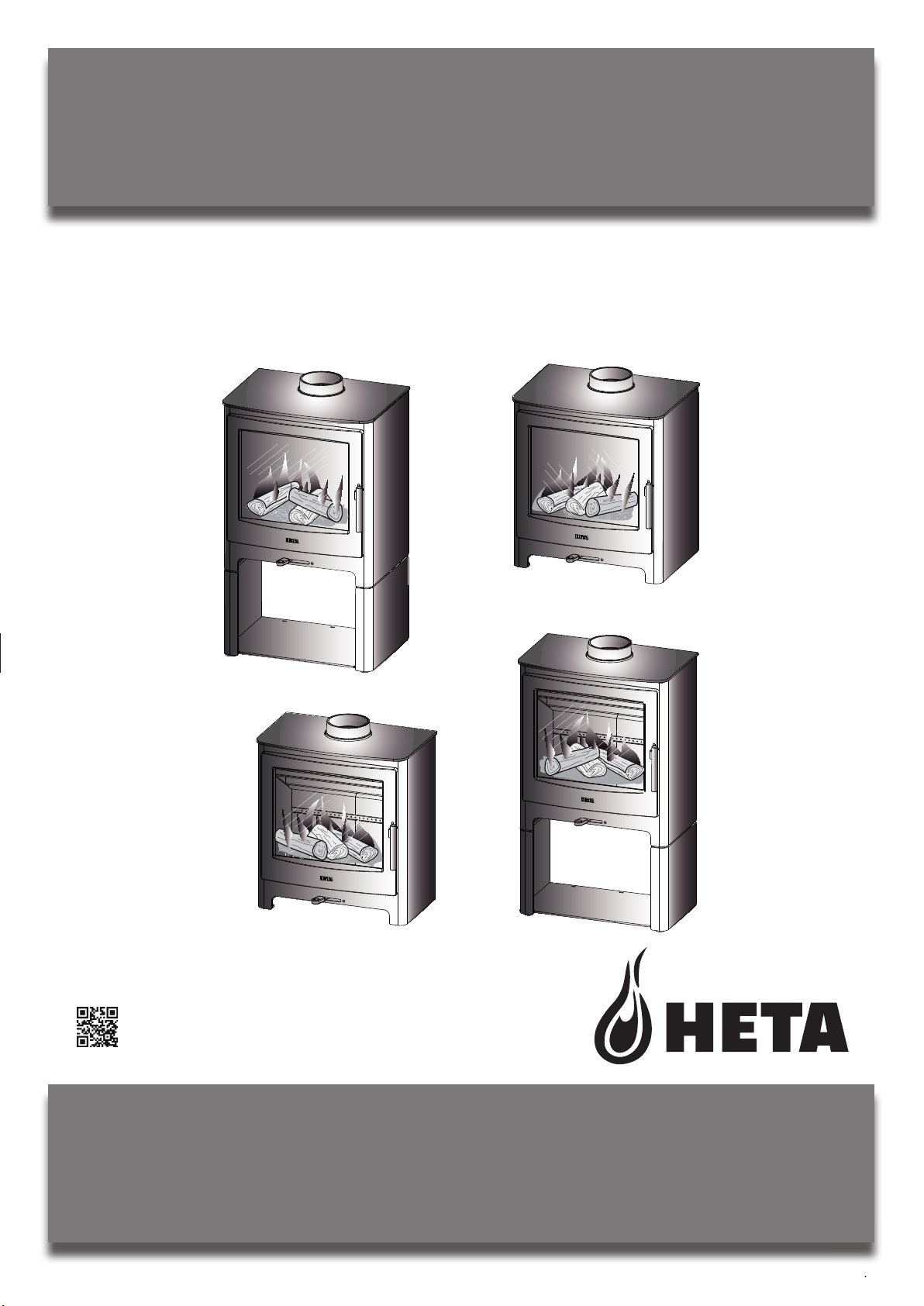
OPERATING AND INSTALLATION
INSTRUCTIONS
AMBITION STOVE
is exemt for use in smoke control areas when burning dry wood.
Pending
www.heta.dk
DANISH DESIGN . DANISH QUALITY . DANISH PRODUCTION
EN
1
Page 2
Certifikat no. 2334
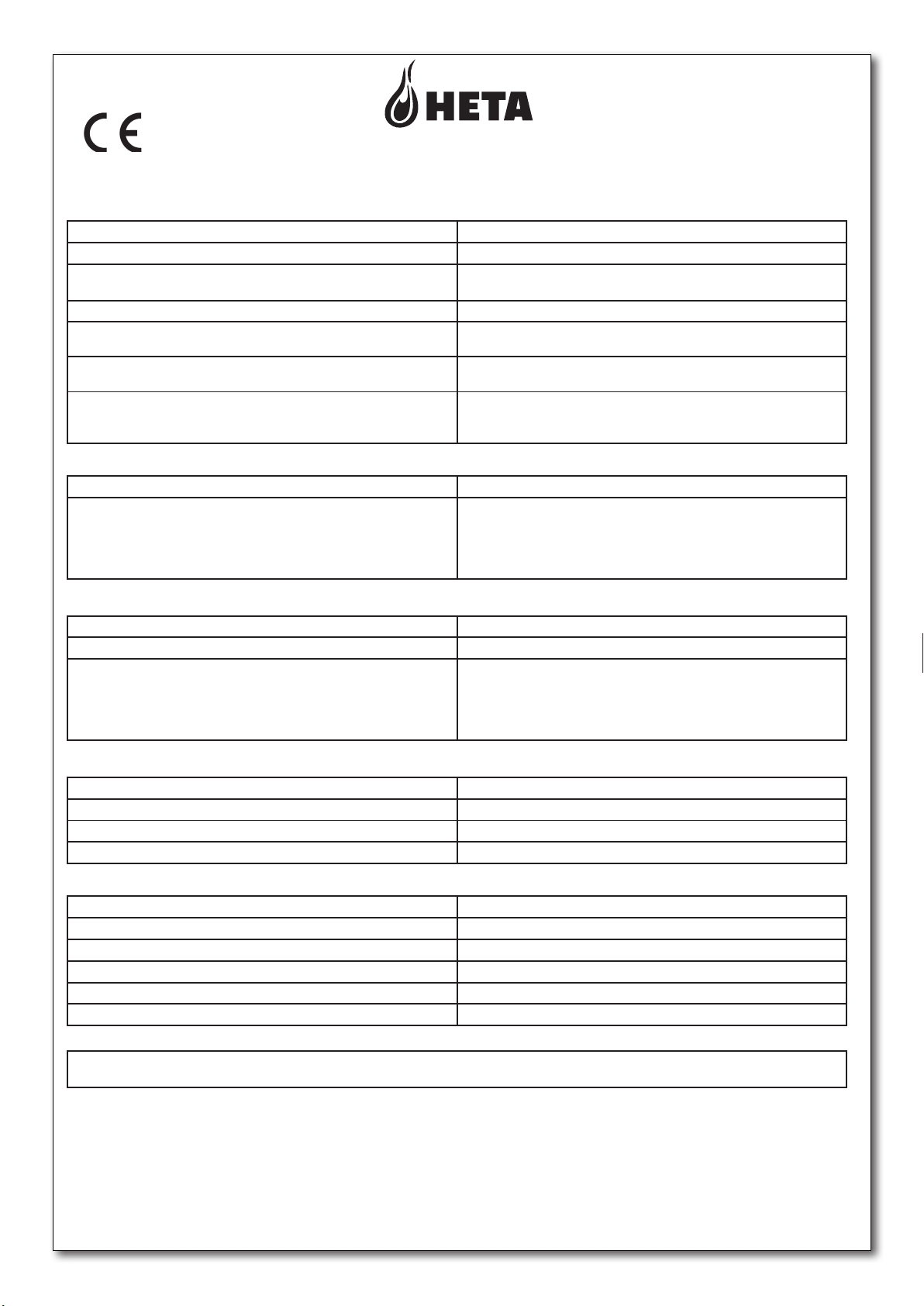
Declaration of Performance EN
__________________________________________________________________________________________________________________________________
Regulation No. 305/2011
DOP-Ambition 5 2334-2018
1. Unique identification code of product-type Stove
2. Product name Ambition 5
3. Intended use or uses of the construction product, in
accordance with the applicable technical specification
4. Name and contact address of the manufacturer Heta A/S, Jupitervej 22, DK-7620 Lemvig. heta@heta.dk
5. Where applicable, name and contact address of
authorized representative. E-mail.
6. System of assessment and verification of constancy of
performance of the construction product
7. Notified body relevant to the assessment and
verification of constancy of performance
8. Declared Performance
Harmonized technical specification EN 13240:2001/A2:2004
Emission CO 0,089%
Fire safety
Reaction to fire A1
Test of fire safety in connection with the burning of wood Approved
Distance to combustible materials
Rear - whit insulation/whitout insulation
Sides distance to combustible materials
Distance to floor from lower edge of the door
Furniture distance
Safety
Mechanical resistance (to carry a chimney / flue) Not tested (NPD)
Electrical safety NA
Surface temperature Approved
Cleanability No specification
Room heater burning solid fuel without hot water supply
Factory Manager Martin Bach, E-mail: martin.bach@heta.dk
System 3
Teknologisk Institut, DK-8000 Aarhus
Notified body No. 1235
Rapport no. 300-ELAB-2334-EN
Nox 93 mg/Nm
Dust 22 mg/Nm
Dust (NS3058/3059) 0,78 g/kg
OGC (CEN/TS 15883) 62 mgC/Nm
3
3
3
ved 13% O
2
Minimum distances in mm
150/200
400
---1100
Thermal output
Nominal heat output 4,9 kW
Room heat output 4,9 kW
Energy efficiency
Fluegas temperature at nominal heat output T 200
Ƞ 85%
o
C
Water heating output NA
Maximum water operating pressure NA
9.
The performance of the product identified in points1 and 2 is in conformity with the declared performance in point 8. This
declaration of performance is issued under the sole responsibility of the manufacturer.
Signed on behalf the manufacturer of
_____________________________________
Lemvig 13.06.2018 Martin Bach
____________________________________________________________________________________________________________________
In case of any change of the above-mentioned production type this Declaration of Performance becomes invalid.
Heta A/S, Jupitervej 22, DK-7620 Lemvig, Tlf. +45 9663 0600, www.heta.dk
Page 1 of 1
2
Page 3
Certifikat no. 2335
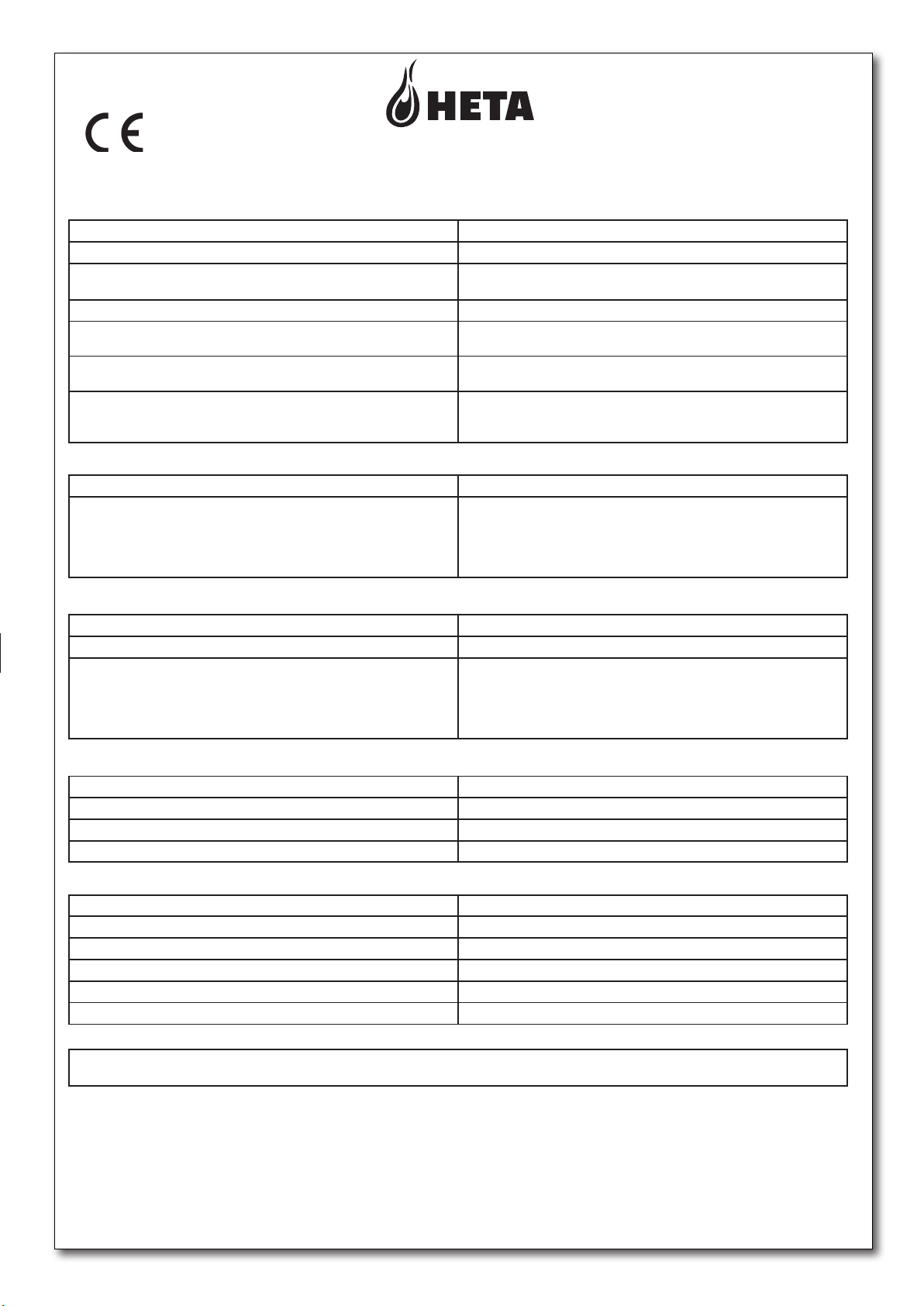
Declaration of Performance EN
__________________________________________________________________________________________________________________________________
Regulation No. 305/2011
DOP-Ambition 8 2335-2018
1. Unique identification code of product-type Stove
2. Product name Ambition 8
3. Intended use or uses of the construction product, in
accordance with the applicable technical specification
4. Name and contact address of the manufacturer Heta A/S, Jupitervej 22, DK-7620 Lemvig. heta@heta.dk
5. Where applicable, name and contact address of
authorized representative. E-mail.
6. System of assessment and verification of constancy of
performance of the construction product
7. Notified body relevant to the assessment and
verification of constancy of performance
8. Declared Performance
Harmonized technical specification EN 13240:2001/A2:2004
Emission CO 0,077%
Fire safety
Reaction to fire A1
Test of fire safety in connection with the burning of wood Approved
Distance to combustible materials
Rear - whit insulation/whitout insulation
Sides distance to combustible materials
Distance to floor from lower edge of the door
Furniture distance
Safety
Mechanical resistance (to carry a chimney / flue) Not tested (NPD)
Electrical safety NA
Surface temperature Approved
Cleanability No specification
Room heater burning solid fuel without hot water supply
Factory Manager Martin Bach, E-mail: martin.bach@heta.dk
System 3
Teknologisk Institut, DK-8000 Aarhus
Notified body No. 1235
Rapport no. 300-ELAB-2335-EN
Nox 99 mg/Nm
Dust 27 mg/Nm
Dust (NS3058/3059) 0,6 g/kg
OGC (CEN/TS 15883) 92 mgC/Nm
3
3
3
ved 13% O
2
Minimum distances in mm
175/225
400
---1100
Thermal output
Nominal heat output 6,5 kW
Room heat output 6,5 kW
Energy efficiency
Fluegas temperature at nominal heat output T 250
Ƞ 80%
o
C
Water heating output NA
Maximum water operating pressure NA
9.
The performance of the product identified in points1 and 2 is in conformity with the declared performance in point 8. This
declaration of performance is issued under the sole responsibility of the manufacturer.
Signed on behalf the manufacturer of
_____________________________________
Lemvig 13.06.2018 Martin Bach
____________________________________________________________________________________________________________________
In case of any change of the above-mentioned production type this Declaration of Performance becomes invalid.
Heta A/S, Jupitervej 22, DK-7620 Lemvig, Tlf. +45 9663 0600, www.heta.dk
Page 1 of 1
3
Page 4

Congratulations on your new stove. We confident that you will be more than satisfied
with your new Heta stove, especially if you follow the advice and instructions we have
put together in these operating instructions.
Ambition series have been approved per the EN 13240, NS 3058/3059 and 15a B-VG.
These approvals, means that the wood stove meets a variety of specifications and
requirements, ensuring it is made of quality materials, minimum environmental impact and that it has an optimum fuel economy.
The Ambitions are recommended as exempt for use within smoke control areas (SCA)
throughout the UK (see clean air act Appendix A). of the air supply regulation so that
it can`t be closed completely.
Operating Instructions Contents
Declaration of Performance Ambition 5 ............................................. 2
Declaration of Performance Ambition 8 ............................................. 3
Before installation ........................................................................... 5-6
1. Operating instructions ........................................................................ 7
1.1 Before using ....................................................................................... 7
1.2 First firing ........................................................................................... 7
1.3 Regulating the airflow ......................................................................... 7
1.4 Lighting the stove ............................................................................... 7
1.5 Refueling ............................................................................................ 7
1.6 Emptying the ash ............................................................................... 8
1.7 Reduced burning ................................................................................ 8
1.8 Risk of explosion ................................................................................ 8
1.9 Draft conditions in the chimney ......................................................... 8
1.10 Fuel ..................................................................................................... 9
1.11 Operating problems ......................................................................... 10
1.12 Chimney fire ..................................................................................... 10
1.13 Maintenance ..................................................................................... 10
1.14 Cleaning the glass ............................................................................ 10
1.15 Troubleshooting ............................................................................... 11
1.16 Diagram for maintenance ................................................................. 12
1.17 Cleaning/Replacing bicks after chimney sweeping ......................... 13
1.18 Stove data table EN 13240 .............................................................. 14
1.19 Garantee ........................................................................................... 14
1.20 Parts ............................................................................................ 15-15
2. Installation Instructions .................................................................... 16
Heta A/S
Jupitervej 22,
DK-7620 Lemvig
Phone: +45 9663 0600
E-mail: [email protected]
4
Copyright © 2014
Heta is a registered
trademark of Heta A/S
Printed in Denmark
Subject to printing errors
and changes.
13.06.2018
0037-1526 Version 1,0
Page 5
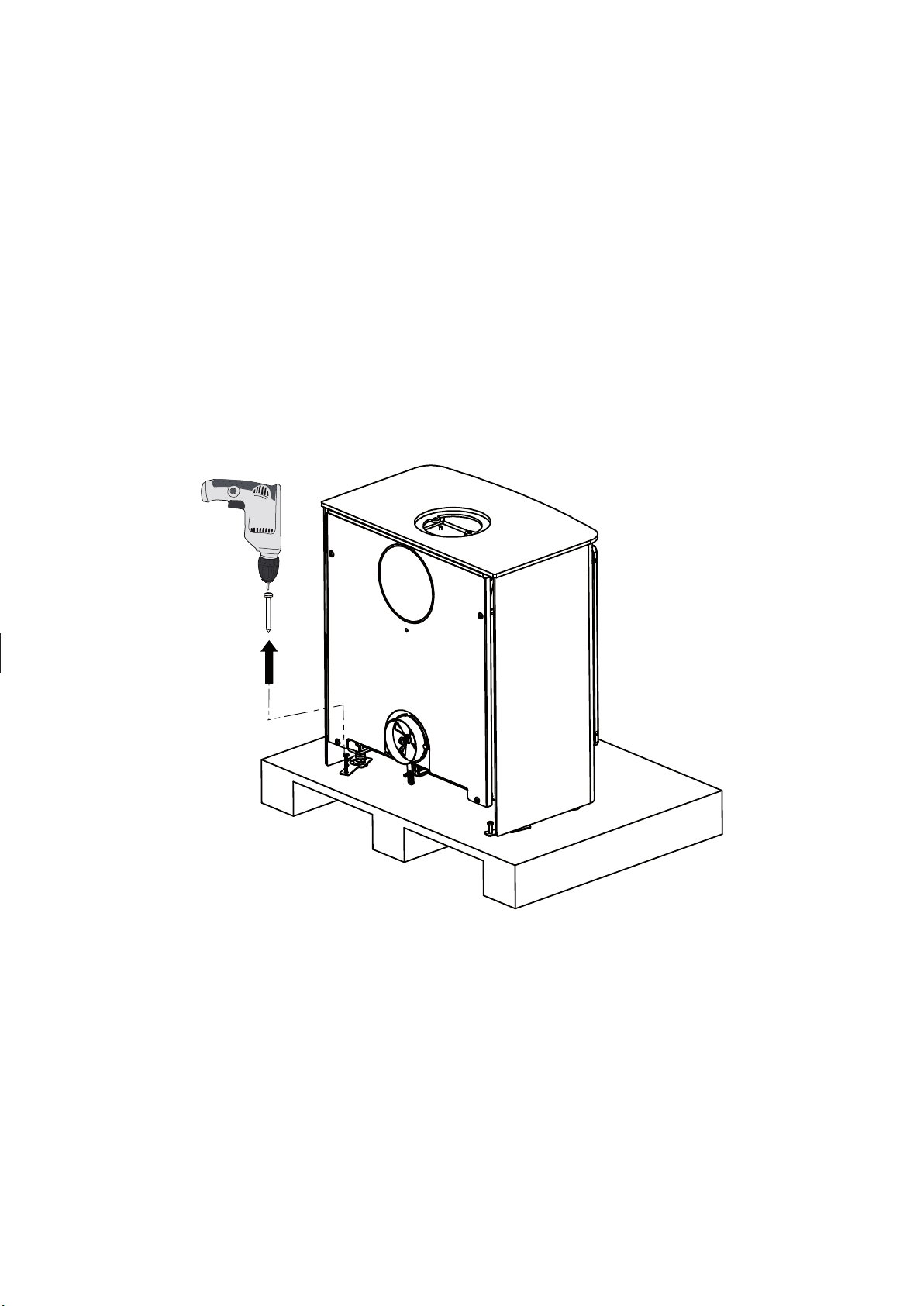
BEFORE INSTALLATION
Heta wood stoves are quality products, therefore, your first impression is very important! We have
a good logistics network, which transports Heta products with great care for our dealers. Nevertheless, when in transport or handling, damage of the often-heavy stoves can occur. It is important that
upon receipt check your Heta product completely and report any damage or defects to your dealer.
The packaging must be disposed of as follows:
Wood is untreated and able to burn in the stove.
Plastic and cardboard you can drop off at your local recycling center.
Unpacking the stove
5
Page 6
1
BETJENI NGS- OG
OPSTILL INGSVEJLEDN ING
DANSK DESIGN . DANSK KVALI TET . DAN SK PRODUKTI ON
www.heta.dk
DK
AMBITIO N BRÆNDEOVN
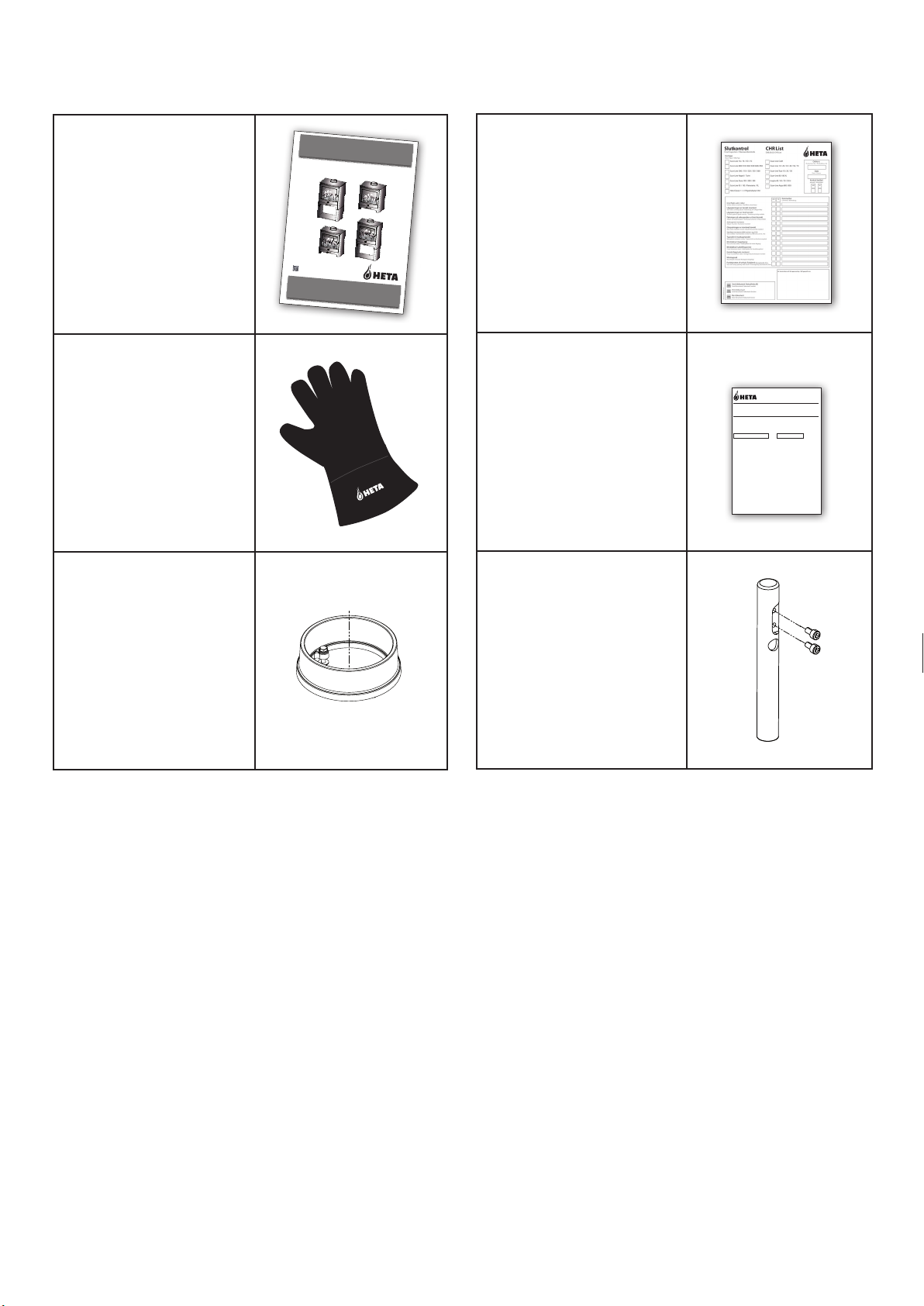
With your new wood stove you should find the following:
8056-0000-D
K
w
t
Operating /
Instruction manual
Heta glove
Flue collar
4025-0007
Q.C. check
Data plate
Stove door handle
CE
DOP-Scan-line 1000 -XXXX-2016
Heta A/S Jupitervej 22
7620 Lemvig Denmark
Produk�ons år: 2016
DS/EN 13240, AEA, NS 3058/3059, Aus §15A
Produkt beskrivelse Produk�onsnummer
Scan-Line 1000 brændeovn
Afstand �l brændbart materiale - bag ovn
Afstand �l brændbart materiale - side af ovn
Afstand �l møbel
Middel CO emission nominel last ved 13% O2
Middel CO emission I Mg/Nm3 ved 13% O2 656 Mg.
Røggas Temp. Nominel last 261 C°
Støv > 3 Mg/Nm3
OGC 32 Mg/Nm3
Ydelse nominel last 4,5 k
Virkningsgrad nominel last 81%
Støv (NS 3058/3059) samlet vægtet par�kelemission 0,63 g/kg
Brændsel Træ
ovnen er egnet �l intermiterrende drif
Anvend kun godkendt brændsel
Følg fabrikantens brugervejledning
120 mm
350 mm
850 mm
0,05%
Required tools are not supplied.
6
Page 7
1. OPERATING INSTRUCTIONS
1.1 Before using
Before the wood stove is used make sure required installation conditions, are met. See page
16.
1
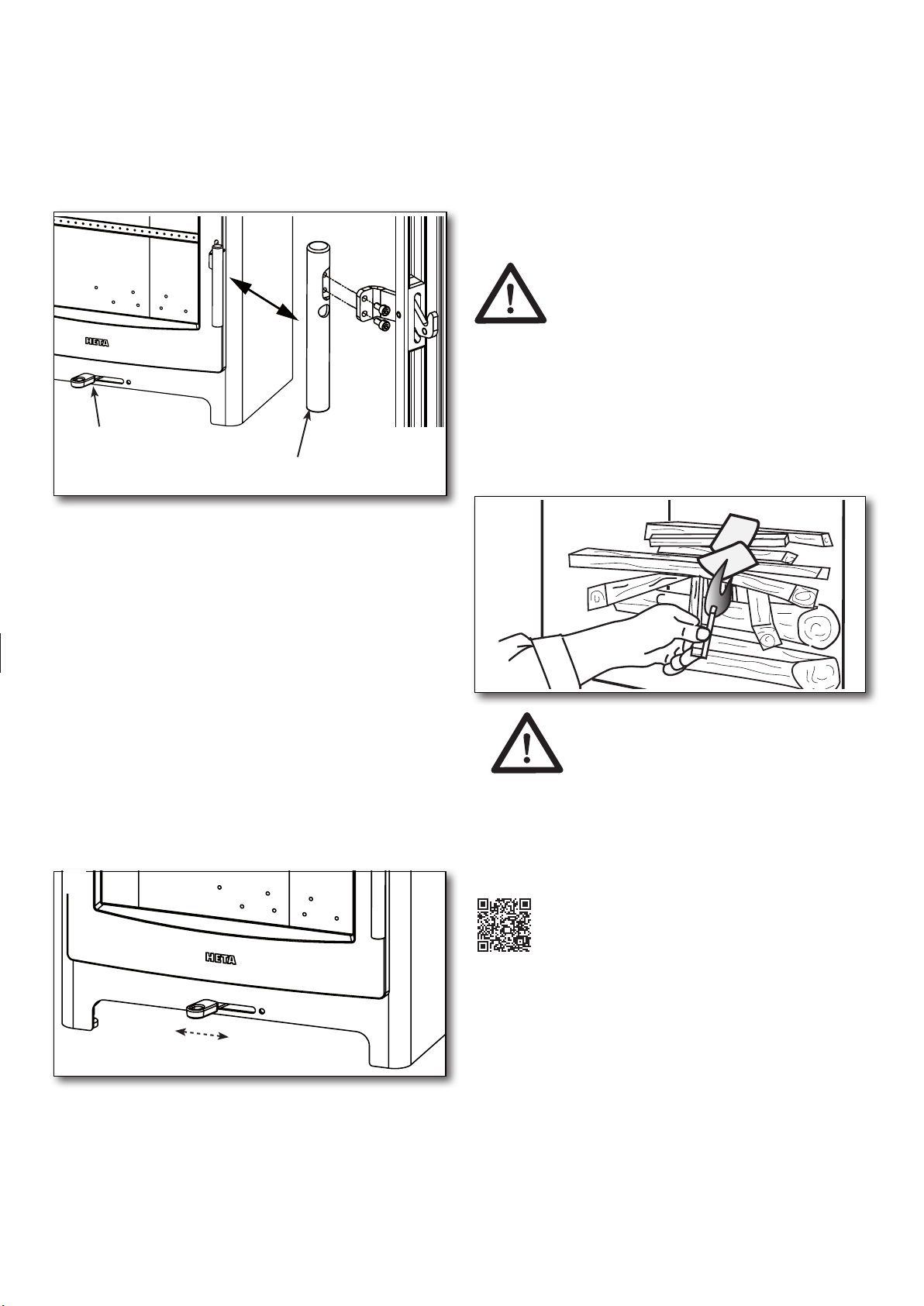
Air control
Stove door handle
1.2 First firing
42% for Ambition 8 of its fully open position.
A permanent amount of air will therefore enter
the firebox to feed the fire producing negligible
amounts of smoke and unburnt hydrocarbons.
The appliances will only be considered as an
exempt appliance if this stop is in place.
Use the glove when regulating the
conbustion air. The handle will be
hot.
1.4 Lighting the stove
Place two pieces of wood on the bottom. Stack
kindling on top in layers with air between. Set
ting fire starter (bag, brick, paraffin) on the top,
now you are ready to light the fuel. The flames
must work from the top down.
3
Heta wood stoves are, treated with a heat-resistant coating, which hardens at a temperature
of about 250° C.
This curing process will cause some smoke and
odor, so there should be sufficient ventilation in order to avoid the door seal sticking to the stove during this curing process, open the door every ten
minutes during the first two hours of the first firing.
1.3 Regulating the air flow
The stoves combustion air is regulated by means
of a handle below the firing door.
2
See fig. 2.
from use in a wood stove.
We recommend, all of the first fuel is burned
with the combustion air fully open in the operating position. This ensures the stove and chimney are thoroughly heated.
Startup/Lighting
Scan the code and select a language.
The use of lighter fluid, oils or any
liquid fuels is strictly forbidden
1.5 Refueling
Closed Open
The Ambition stoves are designed and tested
to burn extremely cleanly with very little smoke discharge and are exempt for use in smoke
control areas throughout the UK when burning
dry wood logs. To comply, a permanent stop is
fitted to ensure that the air control slider cannot be closed beyond 33% for Ambition 5 and
Refueling of your stove should be done while
there is still a good layer of embers. Distributethe embers with the majority of them to the
front. Place pieces of wood equivalent to about
1,2 kg for Ambition 5 and 1.8 kg for Ambition 8
on top of the embers perpendicular to the door.
See fig. 4.
Now open the combustion air completely. If the
stove and/or chimney cools down too much, itmay be necessary to have the door ajar.
7
Page 8
4
1.6 Emptying the ash
It is advantageous to leave a layer of ash in the
bottom of the combustion chamber on top of
the grate as insulation.
Be careful when emptying the
ashes out. There can be hot
embers left for a long time.
Never empty ash into a combustible container.
The wood will then ignite within a very short time
(Typically 1 to 3 minutes). Once the fuel is Ignited. Close the door and regulate the air back to
operating air. When the fire is well established,
you can now regulate the operating air to the
desired combustion level.
The nominal output Ambition 5 / Ambition 8:
4.9/6.5 kW is equivalent to a firing interval of
approx. 45/55 minutes at 61/69% open combustion air and 1.2/1.8 kg of wood.
Ensure when refueling that the wood is not too
close, it will cause poorer combustion, less heat
out-put and lower efficiency.
5
Vermiculite
(stone)
The door must be closed
during operation.
Maximum
wood filling
1.7 Reduced burning
The stove is, approved for intermittent use.
Never turn down the air down so much that there
does not come any flames from the tree. Wait to
close the air until the flames haveburnt out and
the tree is transformed into glowing charcoal.
If you are looking for less heat out-put, achieve
this by fueling with smaller volumes of wood and
a lower operating air. You may not completely
close the operating air during firing.
Be aware that the stove will naturally soot if the
operating air is too low. This is not good for the
environment. There is also a risk for the glass,
t
he chimney and other parts will become sooted.
By a combination of the above and possibly
burning damp wood. Can lead to high levels of
soot that it becomes sticky. Causing the sealing
of the door to tear off when opening the door
the next day.
seals are loose.
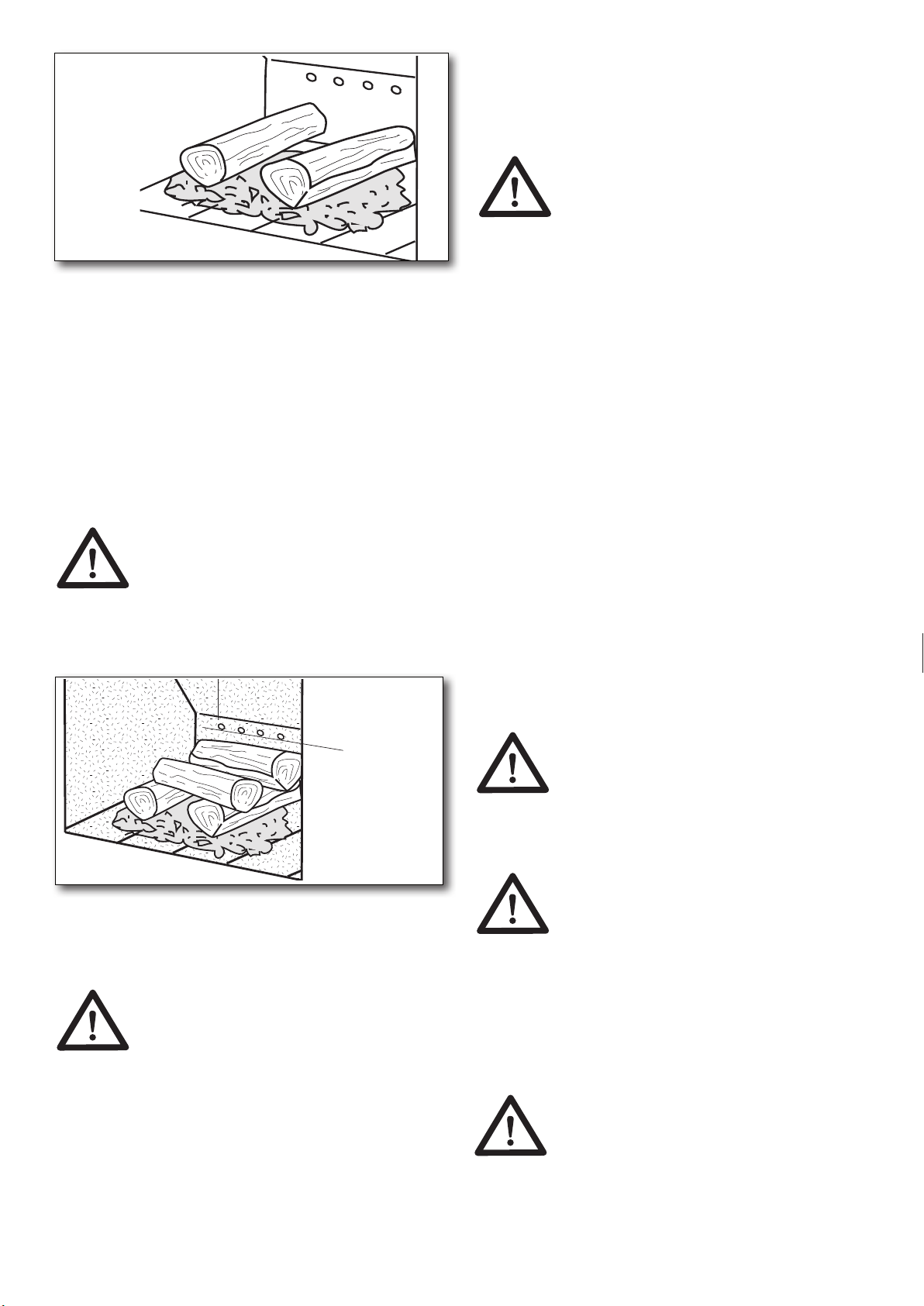
Never use the stove if the
The fuel load, must be maintained below the top
series of air holes and within the outer vent in
each side. Fig. 5.
W
hen refueling be careful to place
the fuel into the combustion chamber gently, (use the provided glove).
By not doing so you risk cracking or
breaking the vermiculite.
If there is reduced draft in the chimney, we recommend opening a window at stoking. This will
give better ventilation to the room and more oxygen for combustion.
8
1.8 Explosion!!!
It is very important never to leave
The stove after start up or refueling,
before the fire is established.
(Typically
Explosion hazard may be possible, if filled with
too much wood on the stove and the air supply
is to low. As large amounts of gas are being developed and this may cause a flue gas explosion.
1/2 -1
minutes)
Warning!
One must always use cation around
the stove seen, as it gets very warm
during use. (In excess of 90° C).
Children should avoid contact with the stove.
Setting up a fence if you have small children may
be necessary.
Page 9
Do not place flammable objects like drying racks,
furniture, curtains too close to the stove.
1.9 Draft conditions
and the chimney
Poor draft will not allow the stove to burn, as it
should. The glass can soot, requires cleaning of
the chimney more often, smoke can escape out
when the door is open and it gives poor fuel efficiency. Leading to unnecessary polluting of the
environment.
Good draft will allow the stove to achieve optimal combustion and the highest possible ef-
The chimney height and diameter, as well as
the temperature difference between the flue gas
and outside temperature generates the chimney
draft. Chimney insulation is therefore important
as new efficient stoves create lower flue temperatures. Wind and weather conditions also influence draft, in some cases it may be disadvantageous wind direction, combined with the
position of the chimney can cause negative draft
(it blows through the chimney), causing smoke
escape from the stove.
Before using after a long period of inactivity,
check that the chimney is free for any blockages. (soot build-up, bird nests, leaves etc.).
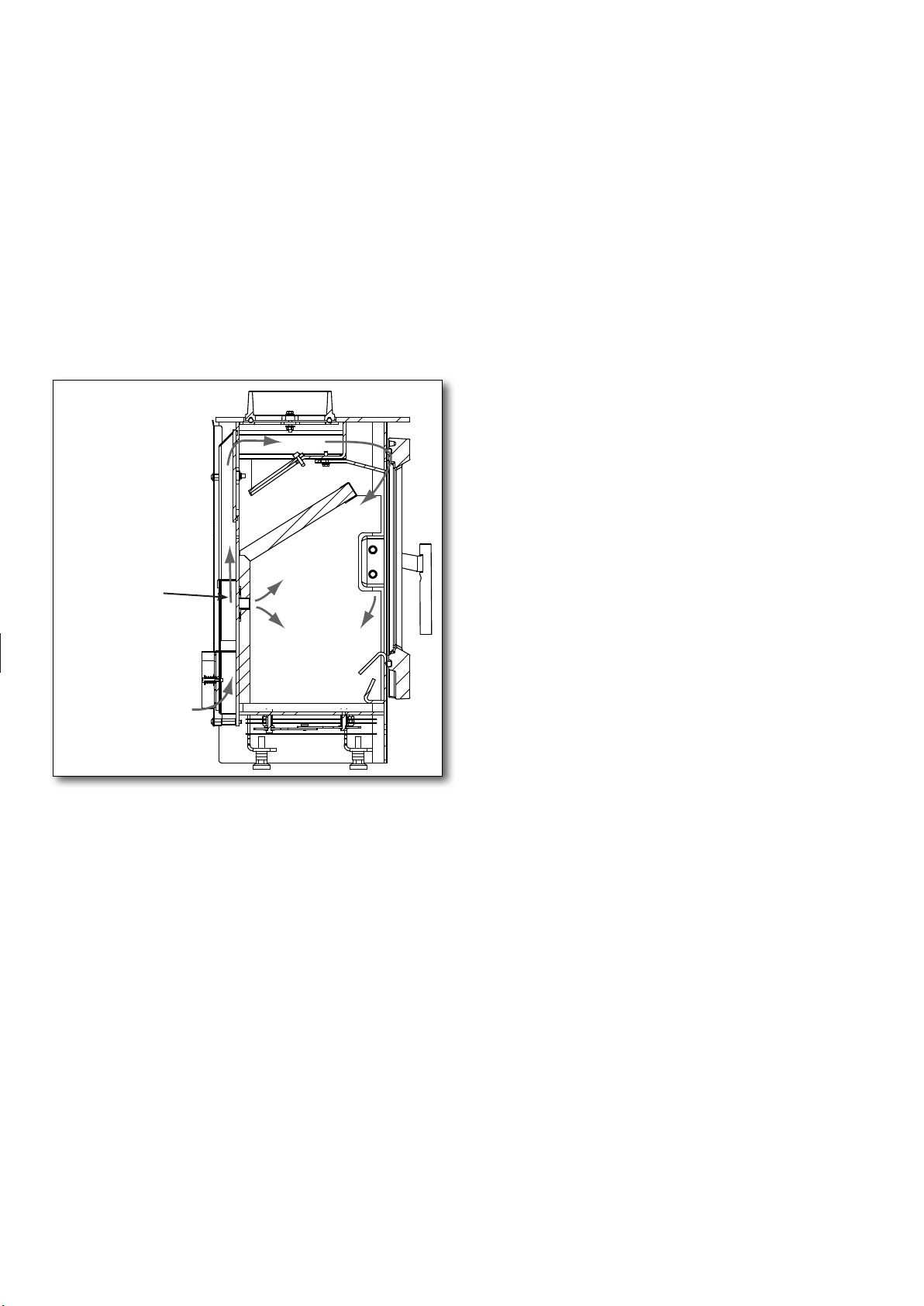
6
combustion
air
ficiency. Heta wood stoves are constructed so
that it itself provides an optimal blend of combustion air. This provides a high efficiency/heat,
clean glass and low environmental impact.
Reduced draft can occur when:
• The temperature difference is too small
between smoke gasses and outdoor
temperature, for eg. poorly insulated chimney
• To short of a chimney
• The outside temperature is high, and indoor
temperature is low for eg. in summer
• False air in the chimney
• Chimney is blocked
• Air tight house (lack of combustion air supply)
• Poorly placed chimney for the surroundings,
for ex. the ridge and trees may cause
turbulence
Good draft occurs when:
• The difference in temperature in the chimney
(warmer) and outside temperature (colder)
• It is clear weather
• The chimney has the right height min 4 meters
above the stove, and clear of the roof ridge.
Minimum chimney draft
It is the draft that the stove has been tested and
approved on. The minimum draft is necessary to
provide clean burning, beautiful flame picture,
as well as achieving the rated efficiency.
There is a risk of smoke escaping into the room
if the door is opened during vigorous firing, or if
there is a lack of air supply to the room, for ex. if
an extraction fan is in use.
Ambition 5: 200°C, relative to
250
°C relative to
Flue gas flow is: Ambition 5: 4,5 g/sek. Ambition
8: 5,9 g/sek. Corresponding to 17 m3/hr of combustion air by burning 1,2 kg of wood.
20°C.
: 12
pascal
.
20°C. Ambition 8:
1.10 Fuel
Your new stove is EN approved for firing with
wood fuel. You must therefore only burn clean,
dry wood in your stove. Never use your stove
to burn driftwood, as this may contain a lot of
salt which can damage both the stove and the
chimney. Similarly, you must not fire your stove
with refuse, painted wood, pressure-impregnated wood or chipboard, as these materials can
emit poisonous fumes and smoke.
Correct firing using well seasoned wood provides optimal heat output and maximum efficiency. At the same time, correct firing prevents
environmental damage in the form of smoke
emissions and reduces the risk of chimney fires.
9
Page 10
If the wood is damp and inadequately seasoned,
a large proportion of the energy in the fuel will be
used to vaporize the water and this will all disappear up the chimney. Thus, it is important to use
dry, well seasoned wood, for eg. wood with a
moisture content of less than 20 %. Achieve this
by storing the wood for 1–2 years before use.
Pieces of firewood with a diameter of more than
10 cm should be split before before storing. The
pieces of firewood should be of an appropriate
length (approx. 35-40 cm) so that they can lie
flat on the bed of embers.
If you store your wood outdoors, it is best to
cover it.
Examples of fuel values
for different woods and their typical densities
per cubic meter, specified for 100% wood with
a moisture content of 18%.
Wood kg/m3Wood kg/m
Beech 710 Willow 560
Oak 700 Alder 540
Ash 700 Scotch pine 520
Elm 690 Larch 520
Maple 660 Lime 510
Birch 620 Spruce 450
Mountain pine 600 Poplar 450
It is advised not to use oil-containing woods
like teak tree and mahogany, as this can cause damage to the glass.
3
nal association of chimney sweeps) registered
chimney sweep.
In the event of smoke or malodorous fumes are
being produced, you must first check to see
whether the chimney is blocked.
T
he chimney must, of course, always provide the
minimum draft necessary to ensure that it is possible to regulate the fire. Please note, how-ever,
that chimney draft is dependent on the weather
conditions. In high winds, the draft can become
so powerful that it may be necessary to fit a
damper in the flue gas pipe to regulate the draft.
When cleaning the chimney, soot and other
deposits may come to fall on the baffle plate,
remove and clean it. In cases where the wood
burns too quickly, this may be due to excessive
chimney draft. You should also check to make
sure that the door seal and ash pan seal is intact
and correctly fitting.
If the stove it generating too little heat, this may
be because you are firing with wet wood. In this
case, much of the heating energy is used to dry
the wood, resulting in poor efficiency, potentially damaging the vermiculite and an increased
risk of soot deposits in the chimney.
1.12 Chimney fire
In case of a chimney fire, which often results from
incorrect operation/maintenance or prolonged
use of damp wood, close the door and the air
supply completely, to help slow/smother the fire.
Heating value in wood
You have to use about 2.4 kg normal wood to
replace one litre of heating oil. All woods have
almost the same heating value per kg, which is
about 5.27 kW/hour for absolute dry wood.
Wood with a moistness of 18% has a efficiency
of about 4.18 kW / hour per kg, and one litre
heating oil contains about 10 kW / hour.
CO2 release
At combustion 1000 litres of heating oil forms 3.171
tons CO2. As wood is a CO2 neutral heat/energy
source, you save the environment about 1.3 kg CO2
every time you have used 1 kg normal wood.
1.11 Operational problems
The chimney must be swept at least once a
year, we recommend the use of a NACS (natio-
Call the fire department. The stove and chiminey must be inspected before use again.
1.13 Maintenance
The surface of the stove is treated with a heatresistant paint. The stove should be cleaned
with a damp cloth.
Any damage to the surface in the form of chips
or scratches can be repaired using touch-up
paint, which is available in spray cans.
1.14 Cleaning the glass
Incorrect firing, for example using wet wood,
can result in the viewing window becoming
covered in soot. This soot can be easily and
effectively removed by using proprietary stove
glass cleaner.
10
Page 11
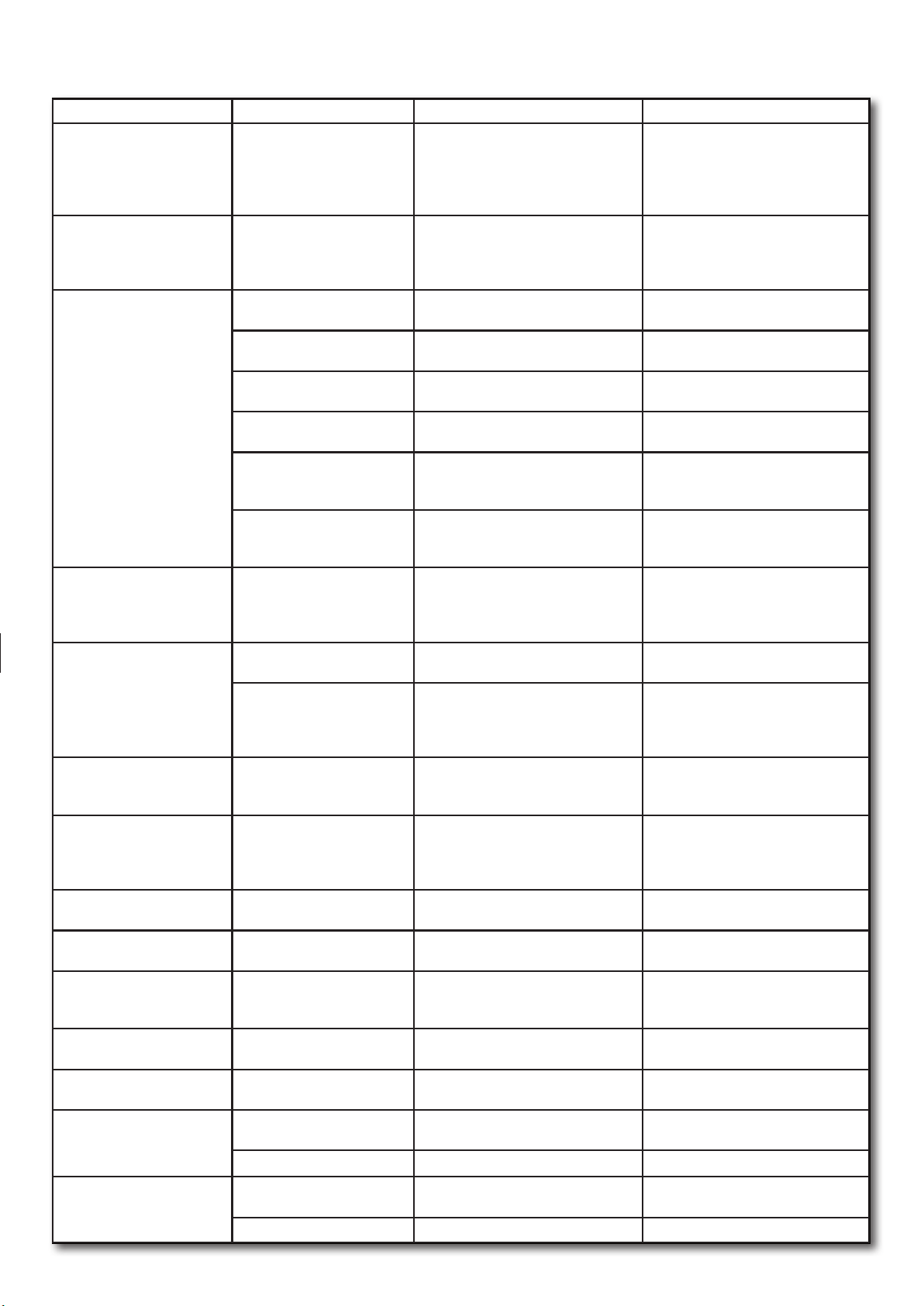
1.15 Troubleshooting table - applies to all stove types
Fault Cause Troubleshooting Solution
Lighting problems. When the
stove is cold, smoke seeps
into the room. Once the combustion chamber has heated
up, the stove burns well.
The stove burns poorly after
the warm-up phase,
glass slowly soots up.
If the stove burns poorly
after start-up, and the
glass slowly soots up.
The vermiculite in the
combustion chamber is
becoming very worn.
Too rapid combustion. Too much chimney draft. T
The vermiculite in the
combustion chamber is
cracked.
Steel surfaces in the
combustion chamber
have oxidised.
The stove whistles Too much chimney draft To test, you can open the cleaning
The stove 'clunks' Usually due to tension in the
The stove ticks Normal expansion and
The stove creaks. The temperature in the com-
The stove smells.
The surface is steaming.
Condensation in the
combustionchamber.
Condensation from the flue
pipe.
and the
Inadequate chimney draft.
The chimney only has
sufficient draft when it is hot.
Soot in the flue pipe. Check the flue pipe regularly, as the
Inadequate chimney draft.
Insufficient air supply. Check the air supply. Read the operating instructions and
Damp wood. Use clean, dry wood with a maximum
Firewood pieces too large. The optimum size is a length of 25 cm
Insufficient air supply to the
room. Range hoods, airtight
windows, etc.
Insufficient air supply to the
room. Range hoods, airtight
windows, etc
Wood and flue gases wear
down the vermiculite.
The door or ash pan/drawer
seal is defective.
Shocks or impacts while
adding firewood.
The temperature in the
combustion chamber is
too high.
metal plates.
contraction due to
temperature changes.
bustion chamber is too high.
The paint on the stove surace is not yet fully hardened.
Moisture in the vermiculite. C
Damp wood. Measure the moisture content. Use dry firewood.
The pipe is too long or the
chimney is too cold.
Damp wood Measure the moisture content. Use dry firewood.
You can test using a lighter whether
flame is drawn into the combustion
chamber.
problem arises slowly.
The fault usually already occurs during
lighting. Measure the chimney draft
moisture content of 20%.
and max. diameter of 10 cm.
Ensure there is sufficient fresh air
supply, open a window, check the
outdoor air supply.
Ensure there is sufficient fresh air
supply, open a window, check the
outdoor air supply.
Investigate whether the wear is
normal.
o test, you can open the cleaning
hatch, but remember to close it again.
While cold, close a piece of paper in
the door – the seal should hold the
paper gently in place so it does not
fall out by itself. Normal wear.
Normal wear Cracks only have cosmetic signifi-
Unsuitable fuel is being used (such as
coal). Check the quantity of firewood
being used, read the operating
instructions.
hatch, but remember to close it again.
Generally only occurs while heating
up and cooling down.
A normal sound. Ensure that the temperature in the
Use less firewood. Also check the seal
in the ash pan/drawer.
See the operating instructions
regarding the first firing.
heck the condition of the vermiculite.
Check the flue pipe's length and heat
loss.
Improve the chimney.
Clean regularly, and limit the use
of horizontal flue pipes. Do not use
firewood which generates large
quantities of ash.
Improve the chimney draft.
.
instruct all users.
Firewood should ideally be dried for
at least one year after splitting.
Use smaller pieces of firewood.
Depending on the cause, windows
must be opened or the outdoor air
connection cleaned.
Depending on the cause, windows
must be opened or the outdoor air
connection cleaned.
Normal wear and minor cracks are of
no significance. It should be replaced
when the steel of the combustion
chamber is visible.
Measure the chimney draft and install
a damper in the flue pipe if necessary.
Replace the seal.
cance. Replace when the steel of the
combustion chamber is visible.
If there are clear cracks or weaknesses in the stove body, it must be
replaced.
Install a damper.
Adjust the metal plates.
combustion chamber is as constant
as possible.
See the operating instructions.
Ensure there is sufficient ventilation.
Evaporates by itself after the stove has
been lit a few times.
Improve the flue pipe, insulate the
chimney.
11
Page 12
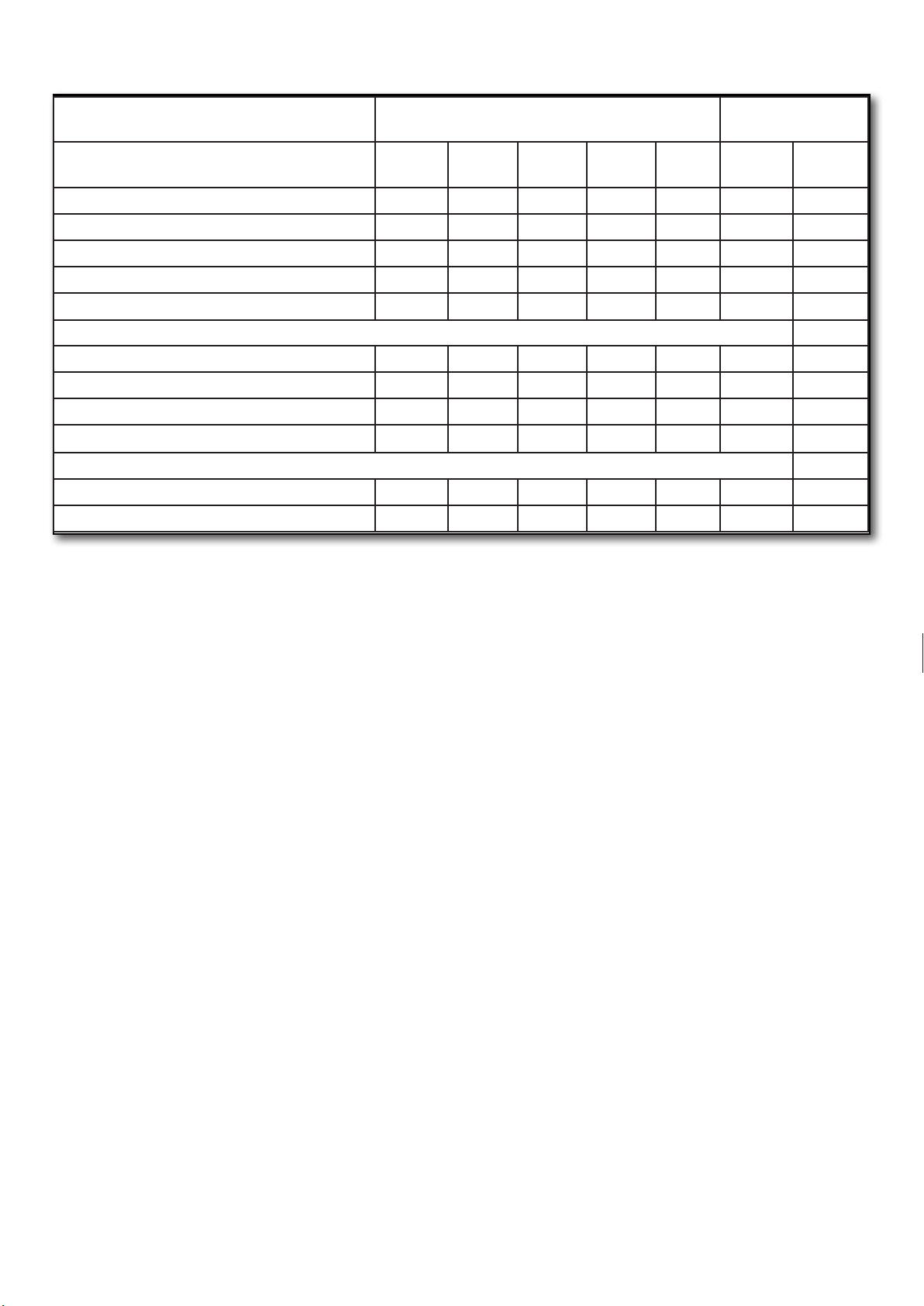
1.16 Diagram for the maintenance
Maintenance / Period
Cleaning the chimney (see. Chimney)
Cleaning the chimney and stove
Cleaning the stoves firebox
Cleaning combustion air intake
Cleaning of the firebox
Checking / switch, gasket for door
Checking / changing, gasket for glass
Checking / changing gasket for flue pipe
Checking / changing vermiculite
Lubricate hinges
Lubricate lock
Stove Owner
Before
Autum
Daily
1
week
30
days
60-90
days
Qualified
Technicia
1st Year 2st Year
C
C C
C VI C
C C
C VI C
C/S VI C/S
C/S VI C/S
C/S VI C/S
C/S VI C/S
L VI L
L VI L
For the lubricant used a heat-resistant product. (300c)
C = Cleaning
C/S = Checking /Switch
L = Lubricate
VI = Visual Inspection, pos. cleaning/replacing/adjusting
12
Page 13
1
2
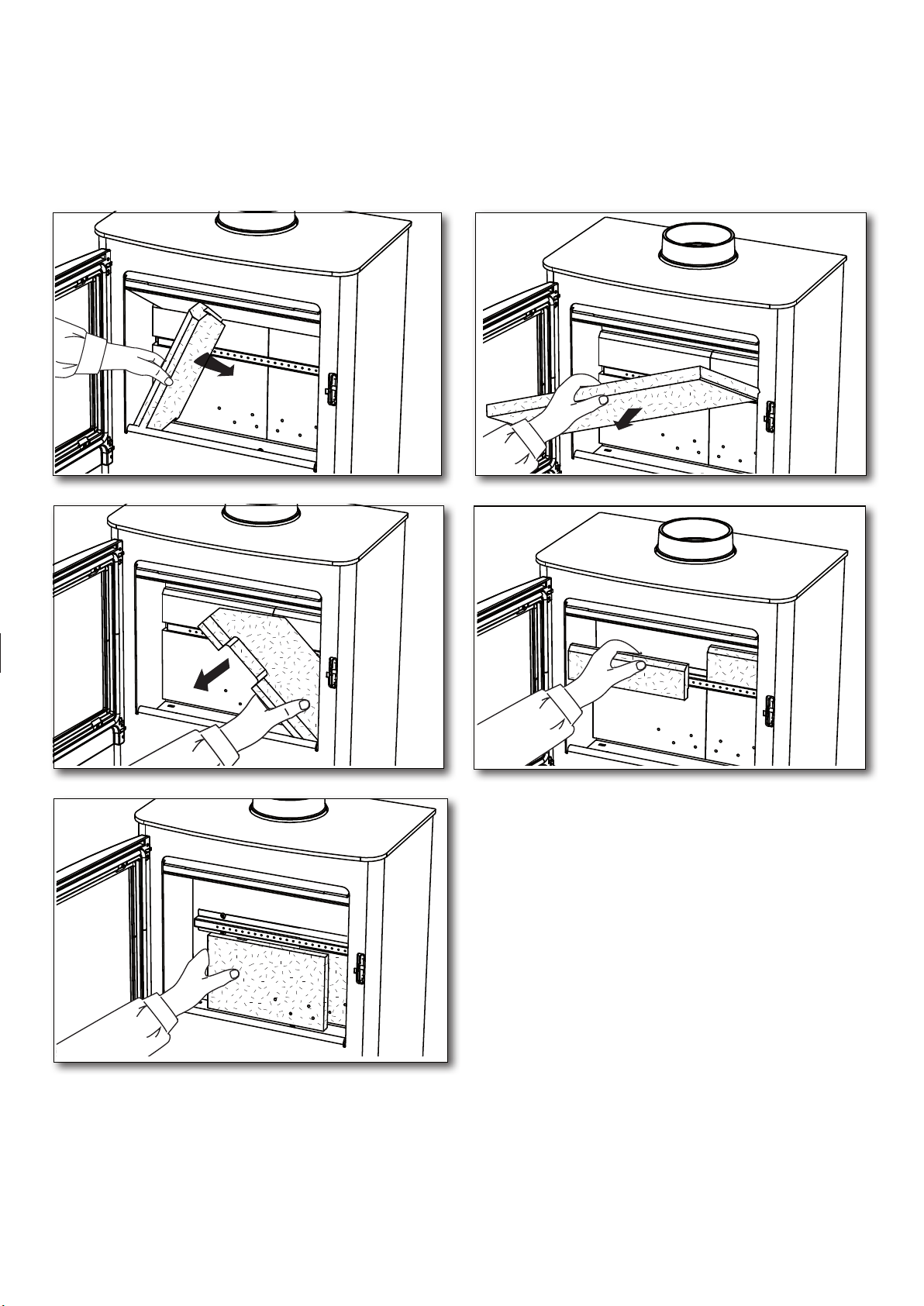
1.17 Cleaning after sweeping
or before replacing vermiculite stones
Note: it may be necessary to clean/vaccum the holes and air ducts behind the rear stone.
Order of removing Fire bricks.
1
3
2
4
4
5
5
1
2
Replace in reverse order. Starting with Fig. 5.
13
Page 14
1.18 Stove data table in accordance with en 13240 testing
Tested as a freestanding oven and with uninsulated flue
Stove type Nominal
fluegas
temperature
C°
Ambition 5
Ambition 8
200 ø125 1,2
250 ø125 1,8
Flue
mm
Fuel
volume
kg
Draft
min.
mbar
0.12
0.12
Nominal
output
tested
kW
Actual
efficiency
%
4,9 85 400 200 1100 98
6,5 80 400 225 1100 110
Distance to flamable materials
at the
sides
mm
rear the
stove
mm
to
furnitures
mm
Stove
weight
kg
The nominal output is the output to which the stove has been tested.
Testing is conducted with the combustion air around 61% open for Ambition 5 and 69% open for Ambition 8.
1.19 Guarantee
Heta wood stoves, subjected to a strict quality
control during production and before delivery to
the dealer.
Therefore, the stoves guarantee is
FOR FIVE YEARS
Against defects in manufacturing
- Damage caused by improper use.
- Transportation costs for warranty repair.
- Assembly / disassembly of warranty repair.
Should you have cause to make a complaint,
please quote our invoice no.
The guarantee does not cover:
Wearing parts / fragile parts such as:
- Vermiculite stones in the combustion
chamber, glass, seals and the casted bottom
or shaking grate.
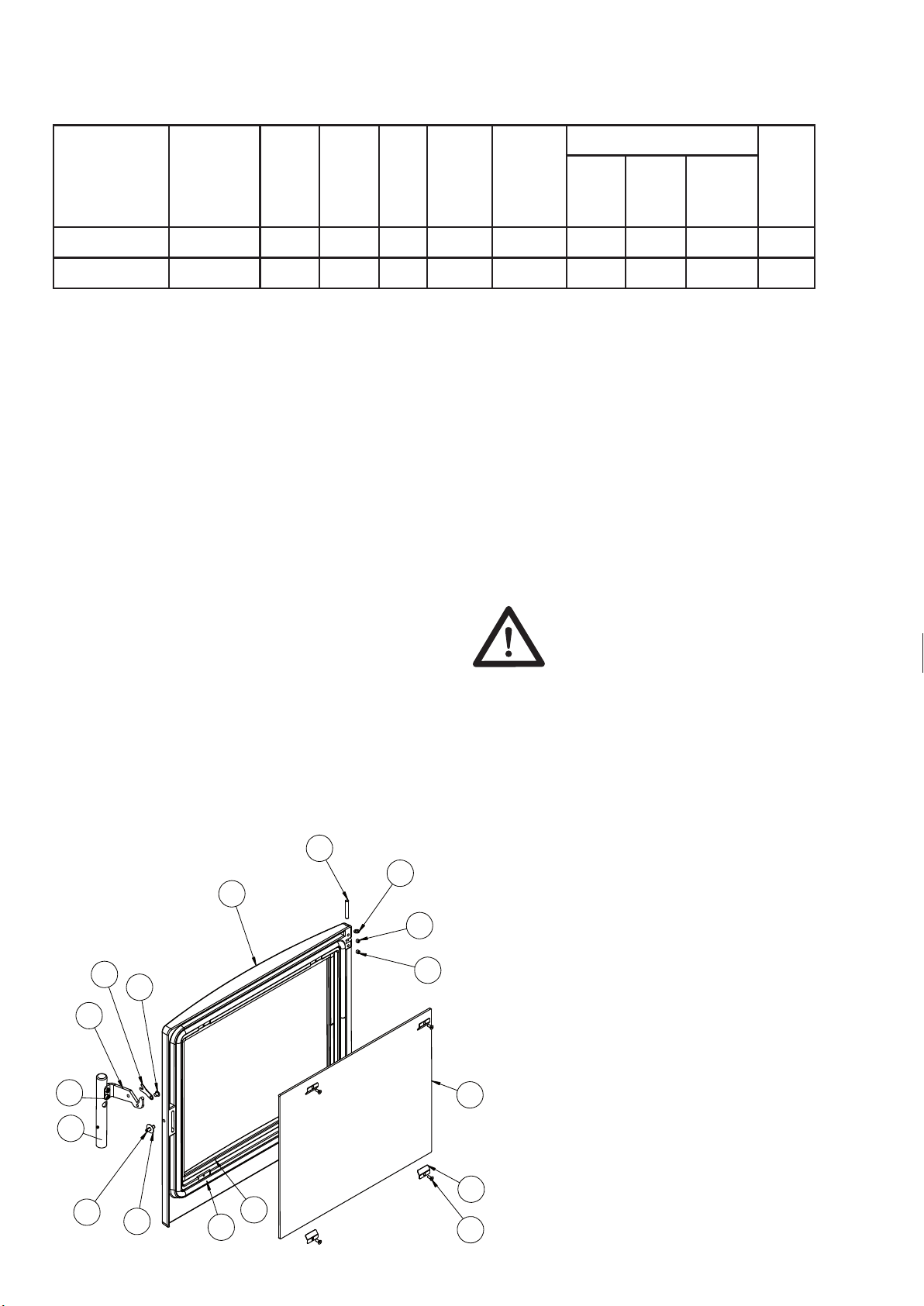
1.20 Parts - Doors
5
11
1
8
12
14
7
9
6
10
13
4
3
8
Warning
Any unauthorized alterations to the
stove and the use of non-original
parts will void the warranty.
Pos. No. Name Qty.
1 0030-000034 Stove door
2 0021-000170 Glass 1
3 0023-000356 Door gasket L=1.7 m 1
4 0023-000358 Glass gasket L=1.6 m 1
5 0008-9086 Hinge pin ø6x40 SS 2
6 0016-0031 Handle 1
7 1013-0732 Door hock 1
8 0008-1007 Flat screw M6x6 4
9 0008-0040 M5x10 Ch 2
10 0008-9015 Pin ø5x26 1
11 0008-3503 Brass disc M6/6,4/11/1,6 1
12 1013-0733 ABracket by hook 1
2
13 0008-9042 Disc spring ø18/ø6.2x0.4 1
14 0008-0014 M6x6 with flat head 1
15 1013-0529 Glass clips 4
16 0008-2004 UH M4x10 indv. 6kt 4
15
16
14
Page 15
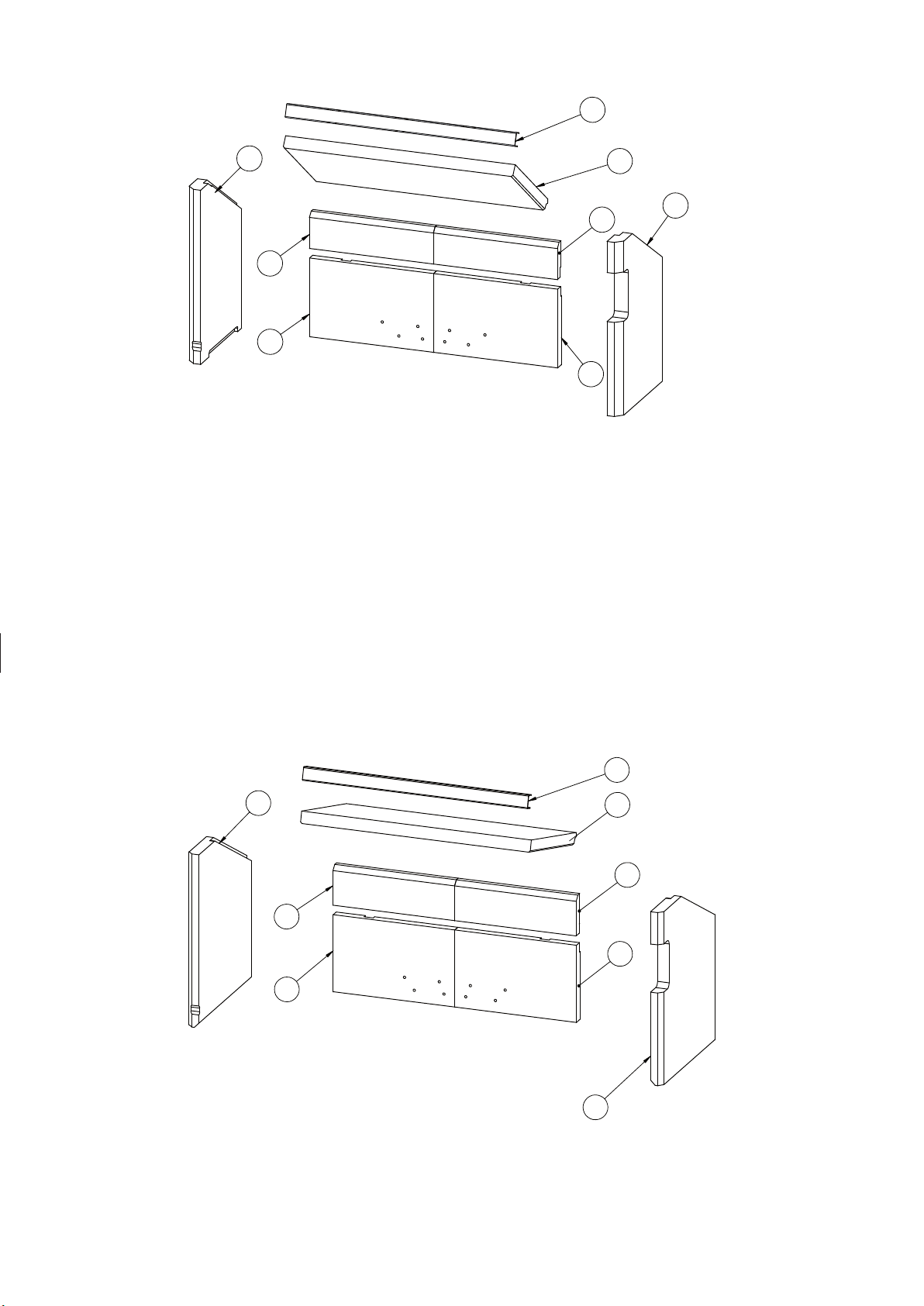
Ambition 5 Parts - Inside fire chamber
6
2
1
5
Pos. No. Name Qty.
1 0023-000103 Back stone top, left 1
2 0023-002740 Side stone, left 1
3 0023-002742 Baffle 1
4 0023-002741 Side stone, right 1
5 0023-000387 Back stone bottom, left 1
6 1013-004304 Stiffener 1
7 0023-004882 Back stone top, right 1
8 0023-004879 Back stone bottom, right 1
3
4
7
8
Ambition 8 Parts - Inside fire chamber
3
1
2
Pos. No. Name Qty.
1 0023-005003 Back stone top, left 1
2 0023-004994 Back stone bottom, left 1
3 0023-000105 Side stone, left 1
4 0023-000106 Baffle 1
5 0023-000108 Side stone, right 1
6 1013-004304 Stiffener 1
7 0023-005004 Back stone top, right 1
8 0023-004995 Back stone bottom, right 1
6
4
7
8
5
15
Page 16

Installation Instructions
Contents
2. Installation instructions ..................................................................... 17
2.1 Distance requirements ...................................................................... 17
2.2 Floor .................................................................................................. 17
2.3 Chimney connection ......................................................................... 17
2.4 Combustion air and ventilation ......................................................... 18
2.5 Stovedrawings/measurments ..................................................... 18-20
2.6 Connecting direct air - nehind ........................................................... 20
2.7 Clearances for installation EN 13 240 ............................................... 21
2.8 Changing to back outlet .................................................................... 22
3. Data plate .......................................................................................... 23
Appendix A ........................................................................................ 23
16
Remember
The stove and chimney installation, must comply with
local regulations, including those referring to national
and European standards.
Page 17
2. Installation instructions
The stove installation must be in accordance
with national, European and possibly local regulations. You must follow local regulations with
regard to installation of chimney and connection
to the chimney. We recommend that you let a
professional Heta dealer install the stove. Alternatively, you can ask the local chimney sweep
before installation. Be aware that it is always the
owner himself who has responsibility for ensuring that applicable rules are complied with.
A modern stove places heavy demands on the
chimney due to the high efficiency. It may be
necessary to enhance or even replace an old
chimney.
Remember
1. Always ensure free access to any cleaning
doors in a chimney.
2. Always ensure ample fresh air to the room.
3. Exhaust/extraction fans in the house can reduce or create negative draft in the chimney.
Reduced draft can lead to the stove having
a
dverse combustion properties. It may result
in smoke coming out of the stove when the
door is open. A negative draft due to an
exhaust/extraction fan can cause the chimney to work in reverse, drawing smoke into
the house because of the fan.
4. Any air vents must not be covered.
applicable national and local regulations. Protecting your floor from embers that may fall out
of the oven.
Distances see data table page 21.
2.3 The chimney connection
The chimney opening must follow national and
local regulations. However, the area of the opening should never be less than 115 cm2, which
corresponds to a diameter of 121 mm. If a damper
is fitted in the flue gas pipe, there must always
be at least 20 cm2 of free passage, even when
the damper is in its “closed” position.
If local regulations permit, two contained stoves
can be connected to the same chimney. However, you must abide by local regulations regarding the distance between the two connections.
The stove must never be connected to a
chimney that is linked to a gas fire stove.
An efficient stove makes high
demand on chimney
– so always have your local
chimney sweep evaluate
your chimney.
properties
Connection to a brick chimney
2.1 Distance Provisions
There is a difference between installation next
flammable wall or non-flammable wall. If the wall
is made of non-flammable material, the stove
principle may be placed flush against it.
We recommend a minimum of 5 cm to facilitate
air circulation around the stove.
The minimum distance to combustibles can be
found on the model plate provided with the stove or on page 21 of this manual.
to
in
2.2 Floor
You must ensure that the floor can support the
weight of the stove and a top-mounted steel
chimney.
In front of the fireplace stove, the substrate
must consist of non-combustible material, for
ex. Steel/glass plate, stone or tile floor. The size
of the non-combustible surface must follow the
Brick a thimble into the chimney and seat the
flue gas pipe in this.
The thimble and flue gas pipe must not penetrate the chimney opening itself, but must be flush
with the inside of the chimney duct. Joins between brickwork, the thimble and flue gas pipe
m
ust be sealed with fireproof material and / or
beading
im
portance that this is done correctly with very
tight joints
that setup and installation be left to a professional Heta dealer.
. Heta A/S stresses that it is of utmost
. As mentioned earlier, we recommend
Connection to a steel chimney
When fitting a connection from a top outlet stove
directly to a steel chimney, we recommend fitting the chimney tube inside the flue gas spigot
so that any soot and condensation drops into
the stove itself rather than collecting on the exterior surface of the stove.
17
Page 18
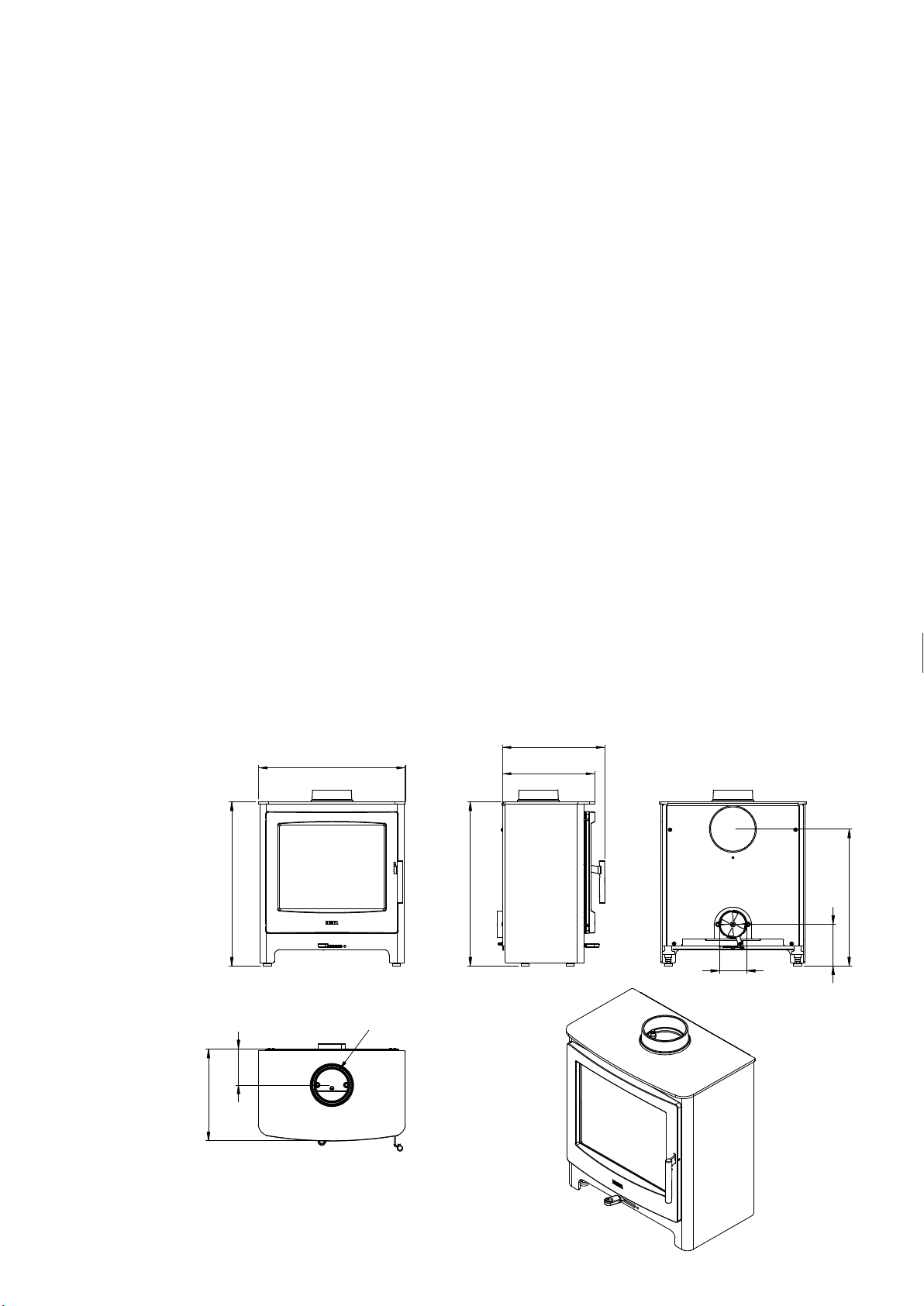
345
100
Ø125
137
550
619
516
157
619
345
383
For connections to chimneys that are run through
ceilings, all national and local regulations regarding distance to flammable material must be followed. It is important that the chimney is fitted
with roof support so that the top panel of the
stove is not required to bear the entire weight
of the chimney (excessive weight may damage
the stove).
• If the vent leads out into the open air, please
note that the grille must be fitted with suitable
wind protection. There must be no risk that
the grille can get clogged by leaves, etc.
• The stove has been tested with 3 m of 100
mm pipe, with 3 90 degree bends.
Ventilation
2.4
Combustion air and Ventilation
The stove is approved as a room air depen
stove in accordance with EN 13240. All the
combustion air in the inset stove comes from
the room in which it is fitted. However, by connecting a sealed air inlet to the stove’s air intake
connector, the stove can be supplied with external combustion air. In this respect, the following
requirements must be met:
• Only approved materials may be used from
the ventilation unit to the air inlet vent.
• The air inlet vent must be fitted correctly and
insulated to prevent formation of condensate.
The cross section of the vent and grille must
be at least 78 cm².
dent
2.5 Stovedrawings/measurments
Adequate ventilation must be provided in accordance with building regulations (Doc J Oct
2010) especially when installing in newer build
properties when the stove is not going to be installed to an outside air supply.
The Ambition has a nominal output of less than
Ambition 5: 4,9 kW and Ambition 8: 6,5 kW and
does not need additional ventilation in older
properties where it will be ventilated by natural
leakage.
Houses built after 2008 where the air leakage
rate is less than than 5 m3 / hour / m2 then a ventilator equivalent to 550 mm2 per kW output will
be required (4.5 kW x 550 mm = 2475 mm2) unless the stove is connected to an outside fresh
air supply.
Ambition 5
18
Page 19
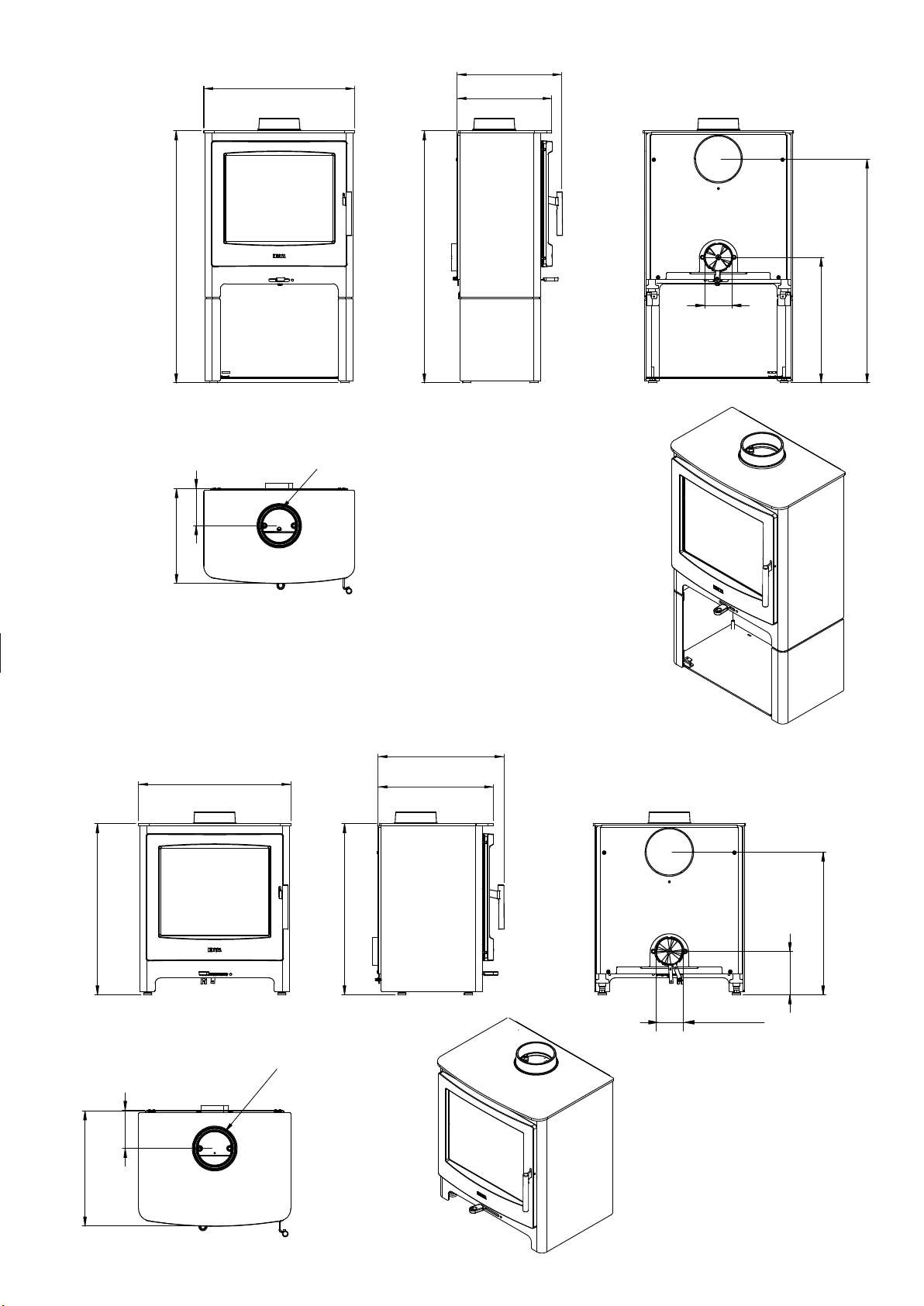
Ambition 5
416
ø100
ø125 mm
138
454
416
619
619
550
516
156
550
381
345
920
345
Ambition 8
920
100
Ø125
137
817
458
19
Page 20
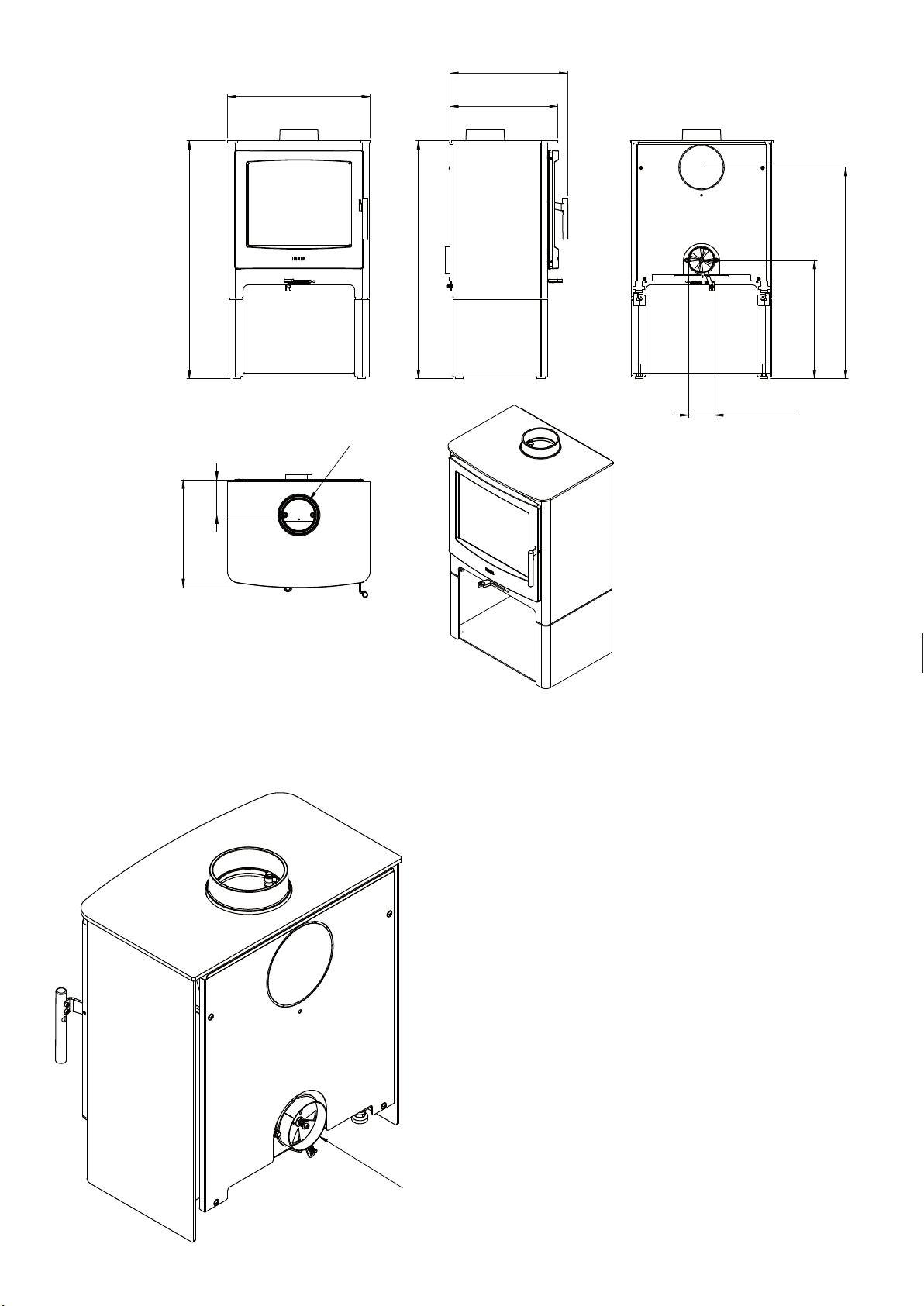
Ambition 8
416
457
817
550
920
Ø125
135
454
416
920
Ø125
2.6 Connecting direct air - behind
When installing external air supply, connect the
air intake to the direct air pipe using flexi-pipe,
Flexi-pipe not included.
Ø 100
20
Page 21
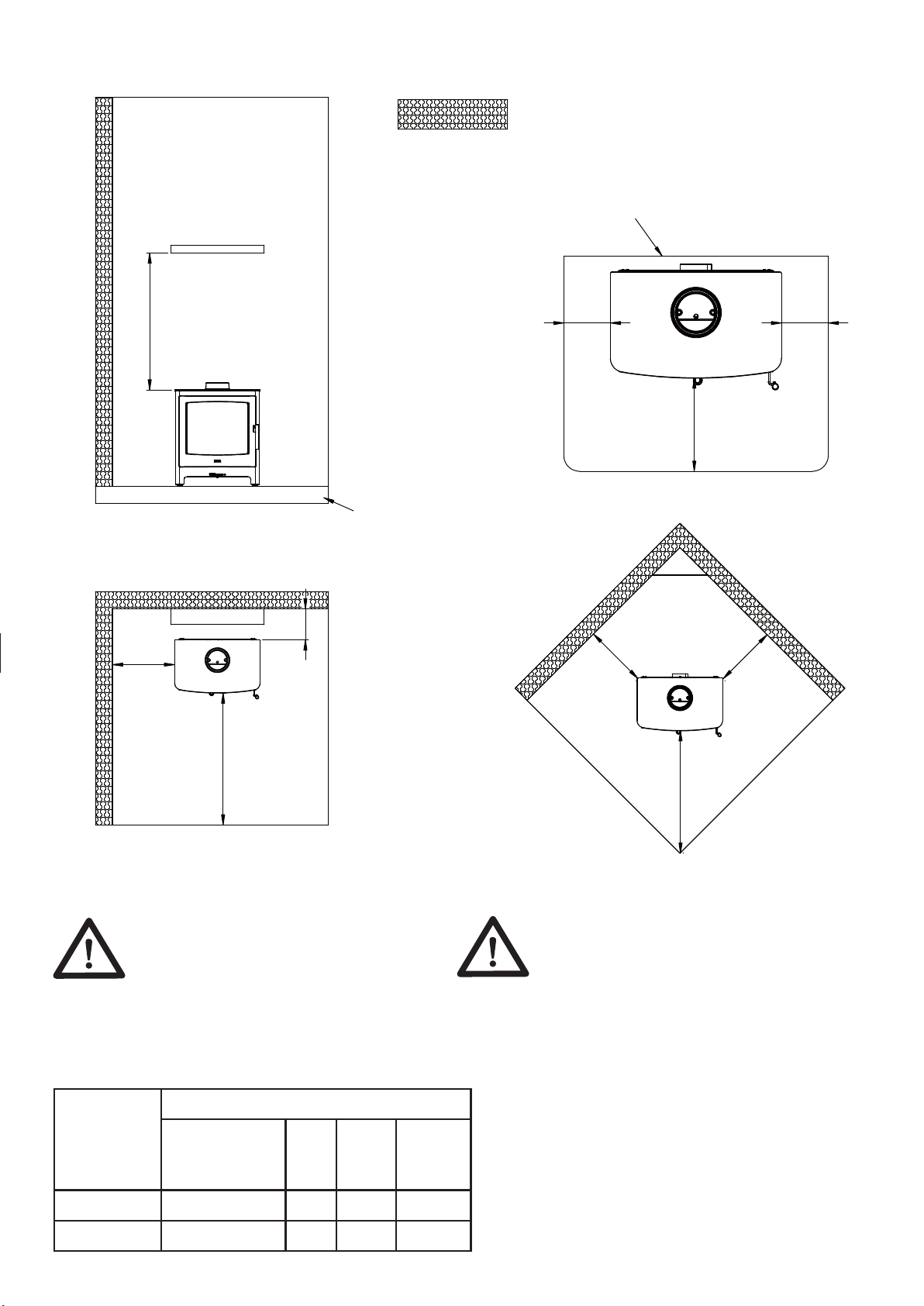
2.7 Clearances for installation EN 13 240
Combustible material
Non-flammable substrate
Ambition
B
C
150 150
300
- Non-flammable
substrate
A
B
B
D
Furnitures
The dimensions are the
minimum dimensions,
unless otherwise stated.
Clearances for installation EN 13 240
Stove
Minimum
dimensions in
mm
Ambition 5
Ambition 8
Distance to flamable materials
A
rear the stove
with insulation /
without insulation
150/200 400
175/225 400 385 1100
B
at the
sides
C
over
the
stove
385
D
By flammable floor material the
stove must be mounted on the log
store base and a non-flammable
substrate.
D
to
furniture
1100
21
Page 22
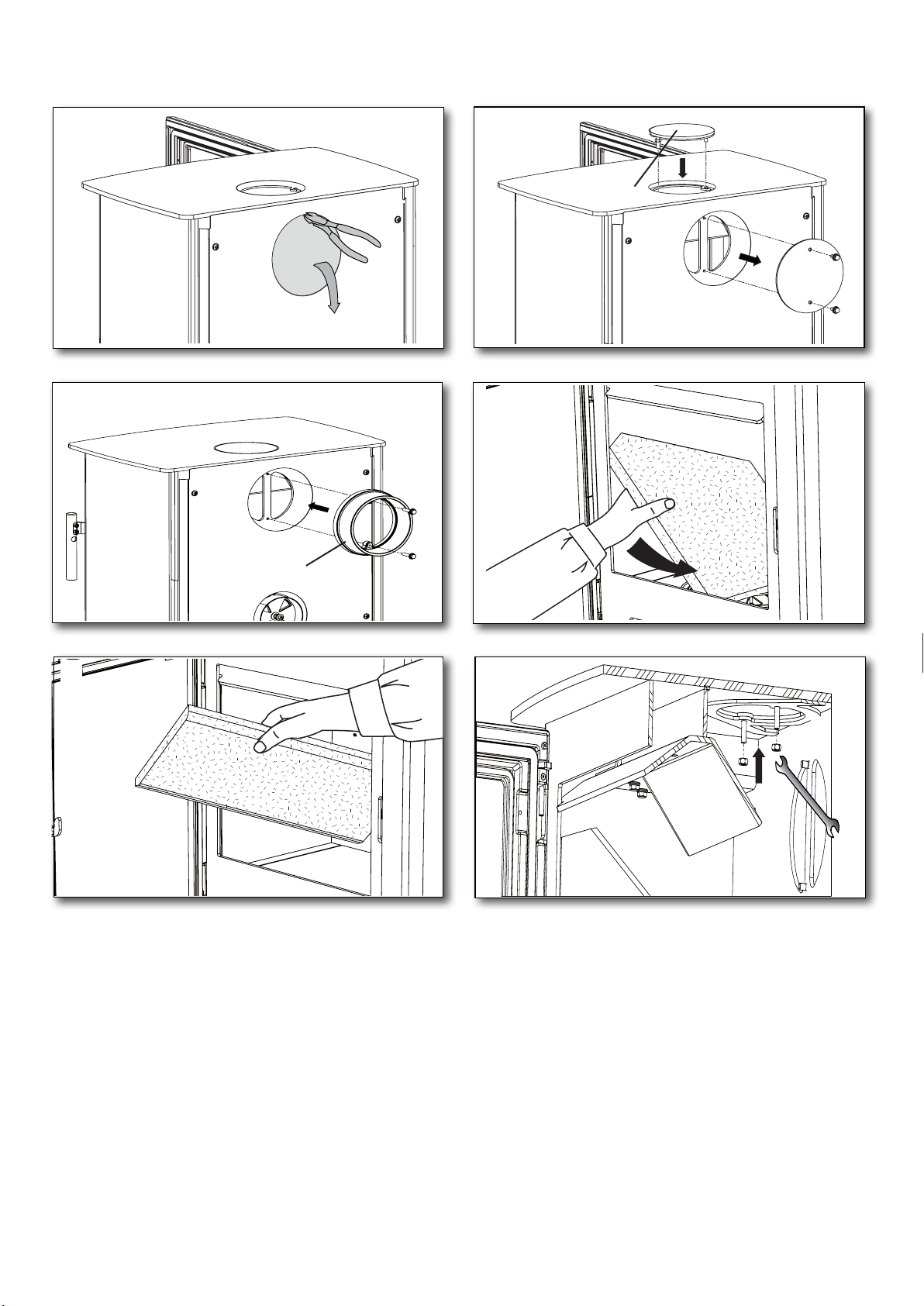
2.8 Changing to back outlet
1
3
4025-0007-
2
1500-001146-
4
5
6
22
Page 23
3. Data plate
Note your own number here _______________________
8058 002597-EN
Jupitervej 22 . DK-7620 Lemvig . Denmark
EN 13240:2001/A2:2004 - AEA - NS 3058/3059
Testrapport: 300-ELAB-2334-EN
SN No. 150835 06-2018
Ambition 5
Distance to combustible back wall: 200/150 mm
Distance to combustible at the side wall: 400 mm
Distance to furniture: 1100 mm
Average CO emission at 13% O2 0,089%
Emission of CO in combustion products: 1110 mg/Nm
Average flue outlet temperatur: 200
Dust: 22 mg/Nm
Heat output: 4,9 kW
Engery efficiency: 85%
NOx 93 mg/Nm
OGC 62 mgC/Nm
Fuel Wood
The stove is approved for intermittent use.
Read the instructions carefully.
Heta A/S
o
C
3
3
8058 000081-EN
Jupitervej 22 . DK-7620 Lemvig . Denmark
EN 13240:2001/A2:2004 - AEA - NS 3058/3059
Testrapport: 300-ELAB-2335-EN
SN No. 150836 06-2018
Ambition 8
Distance to combustible back wall: 200/150 mm
Distance to combustible at the side wall: 400 mm
Distance to furniture: 1100 mm
3
3
Average CO emission at 13% O2 0,077%
Emission of CO in combustion products: 968 mg/Nm
Average flue outlet temperatur: 250
Dust: 27 mg/Nm
Heat output: 4,9 kW
Engery efficiency: 80%
NOx 98 mg/Nm
OGC 22 mgC/Nm
Fuel Wood
The stove is approved for intermittent use.
Read the instructions carefully.
Heta A/S
3
o
C
3
3
3
DOP Ambition 5 2334-2018
Appendix A
The Clean Air Act 1993 and Smoke Control
Areas
Under the Clean Air Act local authorities may
declare the whole or part of the district of the
authority to be a smoke control area. It is an offence to emit smoke from a chimney of a building, from a furnace or from any fixed boiler if
located in a designated smoke control area. It
is also an offence to acquire an” unauthorized
fuel” for use within a smoke control area unless
it is used in an” exempt” appliance (” exempted”
from the controls which generally apply in the
smoke control area).
In England appliances are exempted by publication on a list by the Secretary of State in accordance with changes made to sections 20
and 21 of the Clean Air Act 1993 by section 15
of the Deregulation Act 2015. Similarly, in Scotland appliances are exempted by publication
on a list by Scottish Ministers under section 50
DOP Ambition 8 2335-2018
of the Regulatory Reform (Scotland) Act 2014.
In Wales and Northern Ireland these are authorized by regulations made by Welsh Ministers
and by the Department of the Environment respectively.
Further information on the requirements of the
Clean Air Act can be found here:
https://www.gov.uk/smoke-control-area-rules
Your local authority is responsible for implementing the Clean Air Act 1993 including designation and supervision of smoke control areas and
you can contact them for details of Clean Air Act
requirements
The Ambition 5 and 8 have been recommended
as suitable for use in smoke control areas when
burning dry wood logs.
23
Page 24

24
 Loading...