

Page 1
© HEROS technology Limited 2002. All rights reserved
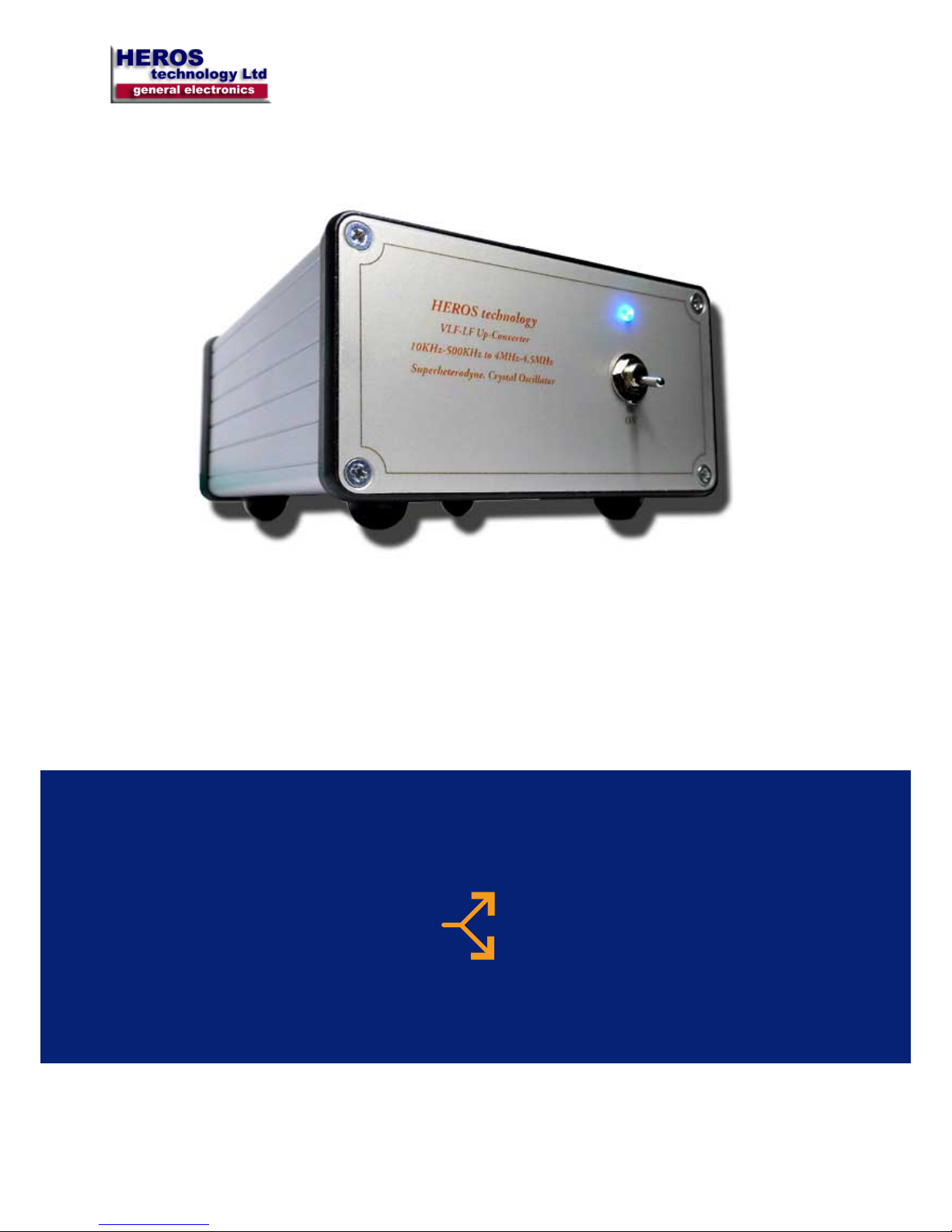
VLF-LF-MF Up Converter
User manual. Rev 2018-01
5kHz-500kHz
3.5MHz-4MHz model 350
4MHz-4.5MHz model 400
Page 2

VLF LF <5KHz - 500KHz Up Converter
© HEROS technology Limited 2002. All rights reserved
Specifications:
- Type: Superheterodyne converter. Double balanced mixer; Quartz crystal oscillator.
- Frequency range: <5kHz to 500kHz.
- IF output: 3.5MHz-4MHz, model 350; 4MHz-4.5MHz; model 400.
- Input/Output impedance: 50 Ω
- Gain: 5 dB
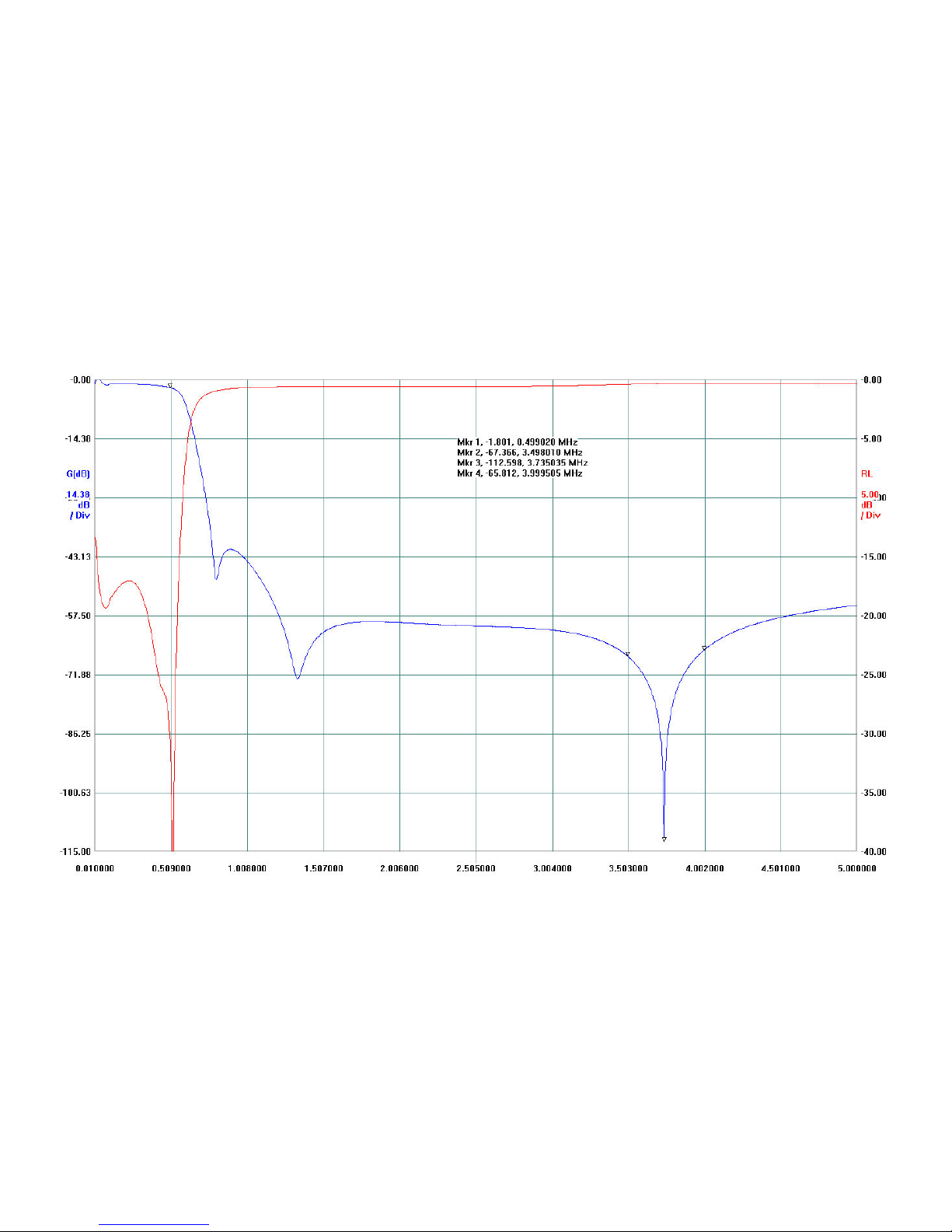
- IF rejection: 110dB typical.
- MW band rejection: 80dB
- Crystal oscillator: Low phase noise; quartz crystal; 3.5MHz or 4MHz, fundamental.
- Power: 12volts/40mA
- Enclosure: Aluminium
- Size: 125mmx105mx55mm ( 4.921x4.133x2.165in)
Since many countries are allocating the 472 kHz to 479kHZ band for experimental use by Radio Amateurs, a growing
number of them as well as listeners have become interested on VLF and LF bands.
The fact that few radios are available on the market covering properly frequencies from below 5kHz to 500kHz,
convinced us to provide radio amateurs and listeners with the high-performance receiving VLF-LF Converter
that we introduce here.
The VLF-LF Up-Converter extents the range of any shortwave receiver to below 5 kHz to 500 kHz.
It is connected between the antenna and a shortwave radio receiver. When it is power-on the 5kHz to 500 kHz
band segment is translate to 3.500MHz to 4.000MHz, Model-350 or 4.000MHz to 4.500MHz, Model 400,
allowing the reception of VLF and LF bands.
For example, if a conversion frequency of 4.000MHz - 4.500MHz, Model 400, is used, and the receiver tuned on
4.135.500MHz, you are receiving on 135.500kHz, just ignoring the digit “4” on the dial.
Alternatively most SDR radio control software lets customise by the user the dial, in this regard see below PowerSDR
configuration.
The VLF-LF Up-Converter enables reception of VLF mobile maritime communications, aviation and marine navigational aids such as LORAN, NDB and DGPS beacons, DGPS reference stations, NAVTEX, Standard Time &
Frequency stations, LF Amateur bands, European LW broadcast stations, monitoring the sounds of nature created by
planet Earth (Natural Radio) such as sferics, hiss, tweaks, whistlers, Dawn Chorus, other not well known VLF radio
atmospheric sounds, and many more.
It is advisable to use a variable attenuator in front of the converter in order to improve signal to noise ratio. Its use have
more or less noticeable effects depending on local band conditions. If you are living in the country side far away from
noise sources probably you do not need one.
In urban areas in presence of strong signals or noise a variable attenuator avoids saturating the IF receiver. Adjusting
the attenuation to a proper value weak signals buried in the noise can be seen emerging.
In addition better energy transfer is achieved between antenna and converter due the broad impedance matching
effect.
WARNING!
If the VLF-LF up-Converter is connected in line to a HF transceiver acting as IF receiver,
take precautions to prevent transmitting any signal into the converter.
Page 3
A
B
C
D
1
2
3
4
1
2
3
4
A
B
C
D
Date
Sheet
FCSM No
DWG No
REV
Size
Drawn
Checked
Issued
Approvals
Drawing
Scale
A4
JJ de Oñate
I I MMXV
5kHz-500kHz VLF LF Up- Converter
1/12016-02
© HEROS technology Limited 2002. All rights reserved
5kHz 500kHz
Antenna Input
(50Ω)
J1
Gas Discharge Tube
LO
RF
IF
Crystal Oscillator
3,5MHz or 4MHz
Front End section
Amplifier
Local oscillator section
Bandpass Diplexer
Output section
IF BPF
Double Balanced Mixer
Buffer
Mini-Circuits SRA-8
+7dBm
Power Reg
3.5MHz or 4MHz, 7 poles Elliptic LPF
Post-Mixer
LNA amplifier
LNA
IF Output frequency models:
Model 350: 3.5MHz - 4MHz
Model 400: 4MHz - 4.5MHz
500kHz 7 poles Elliptic LPF
-100dB IF notch filter
Converter
IF Output
(50Ω)
Page 4
Page 5
© HEROS technology Limited 2002. All rights reserved
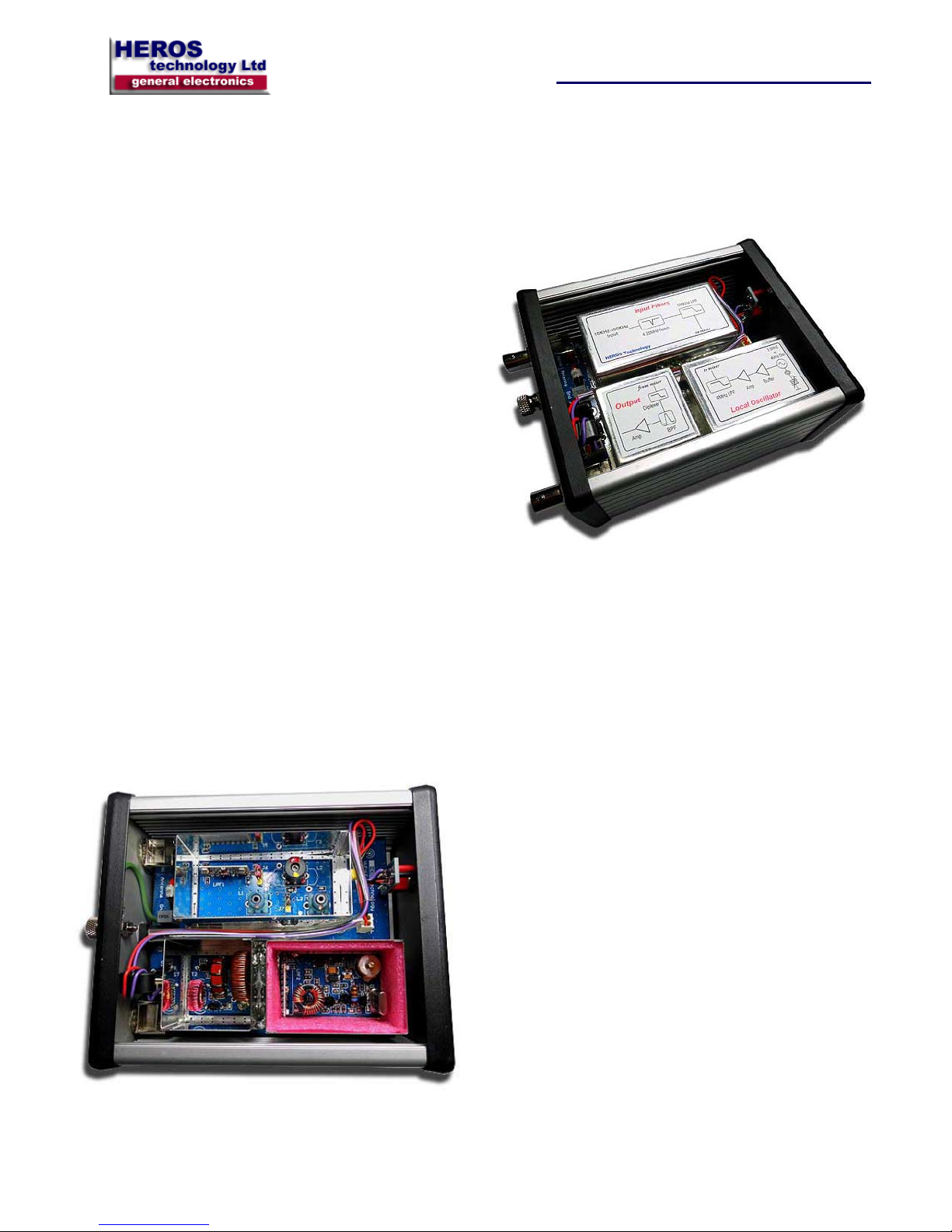
Input Filters
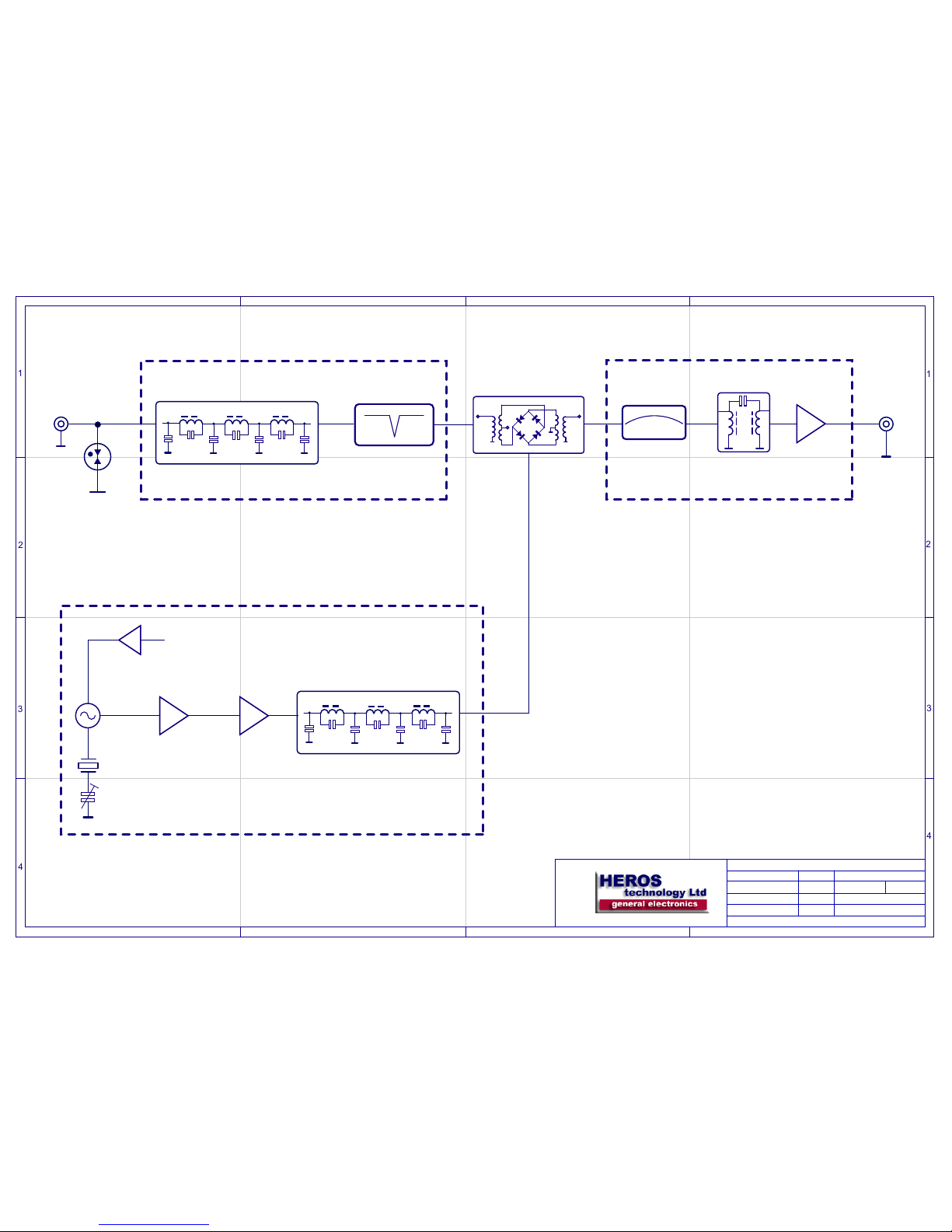
Referring to the functional block diagram, the 50 Ω antenna is connected to J1 ,BNC type connector; a Gas Discharge Tube
protects the converter from transients that may come from the
antenna.
Next the input filters section is a combination of a 110dB IF trap
and a 7th order, 0.3dB insertion loss, Elliptic
Low Pass Filter with a cut-off frequency of 500 kHz.
This section provides good performance right up to the start of
the AM broadcast band with a sharp roll-off, giving
a good rejection to MW broadcast signals avoiding introducing
overload or intermodulation products in the receiver.
Local Oscillator
Low phase noise, crystal controlled oscillator provides +7dBm
signal level to the mixer.
A good quality quartz crystal of 3.5MHz or 4MHz, according to
the model of converter, is used.
A trimmer capacitor is accessible by the user if fine adjust of
frequency is required in times.
A linear fixed voltage IC regulates the voltage applied to the oscillator to enhance stability and avoid drift.
The oscillator is followed by a buffer stage to improve its stability. Next, an amplifier accommodates the signal to the
required level. It connects to a 4 MHz, 7th order, Elliptic Low Pass Filter which cleans up any harmonics and assures
that a pure signal applies to the mixer to minimize spurious responses.
Mixer
The mixer stage is designed around a Mini-Circuits SRA-8+ double balanced mixer. It is rated to operate from 500Hz,
giving and excellent frequency coverage. Designed for +7 dBm of LO power, it have a conversion loss of less than
5 dB at VLF LF bands, which is compensate by the
post-mixer amplifier. A double balanced mixer has the
advantage
of high port-to-port isolation, which keeps the strong LO
signal from degrading the dynamic range of the IF
receiver.
Every effort has been made to terminate the ports of the
mixer in a proper 50 Ω impedance to maximize its
performance.
The mixer IF port is most critical in terms of proper
termination, for so, a diplexer circuit provides a 50 Ω
resistive load
to the mixer while passing the desired signal to the IF
amplifier, with minimum loss.
Next, a Band Pass filter at IF frequency connects to a
Low Noise Amplifier to compensate losses, delivering
around
5dB of gain to the output, necessary to overcome losses
from external cable tails, relays and connectors.
VLF LF <5KHz - 500KHz Up Converter
Page 6
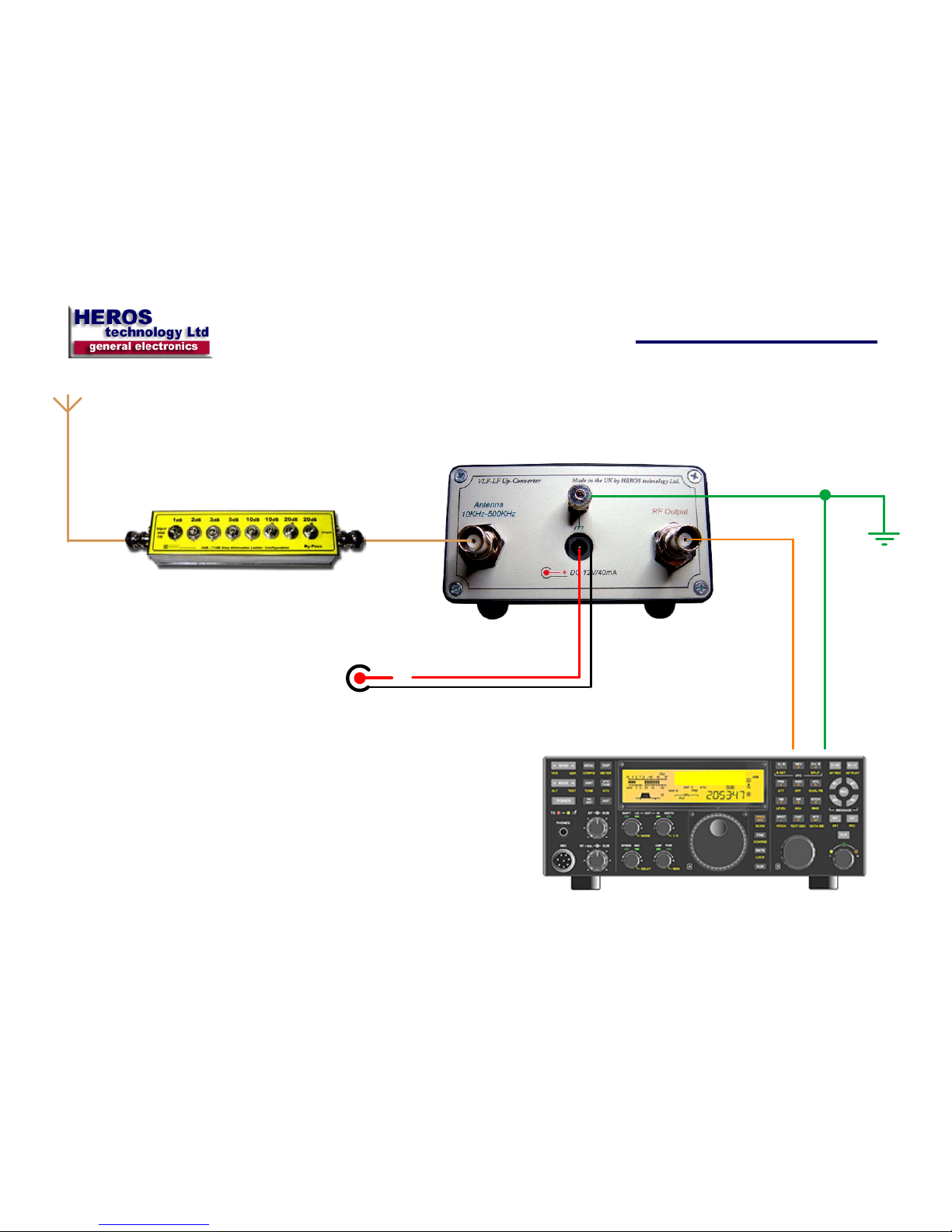
Earth
RX antenna input
RF IF Output
Antenna Input
50Ω Antenna
DC 12V/40mA
+
Generic SW receiver
Optional step attenuator
4.100MHz
VLF LF <5KHz - 500KHz Up Converter
© HEROS technology Limited 2002. All rights reserved
Basic connection to a SW receiver
Page 7
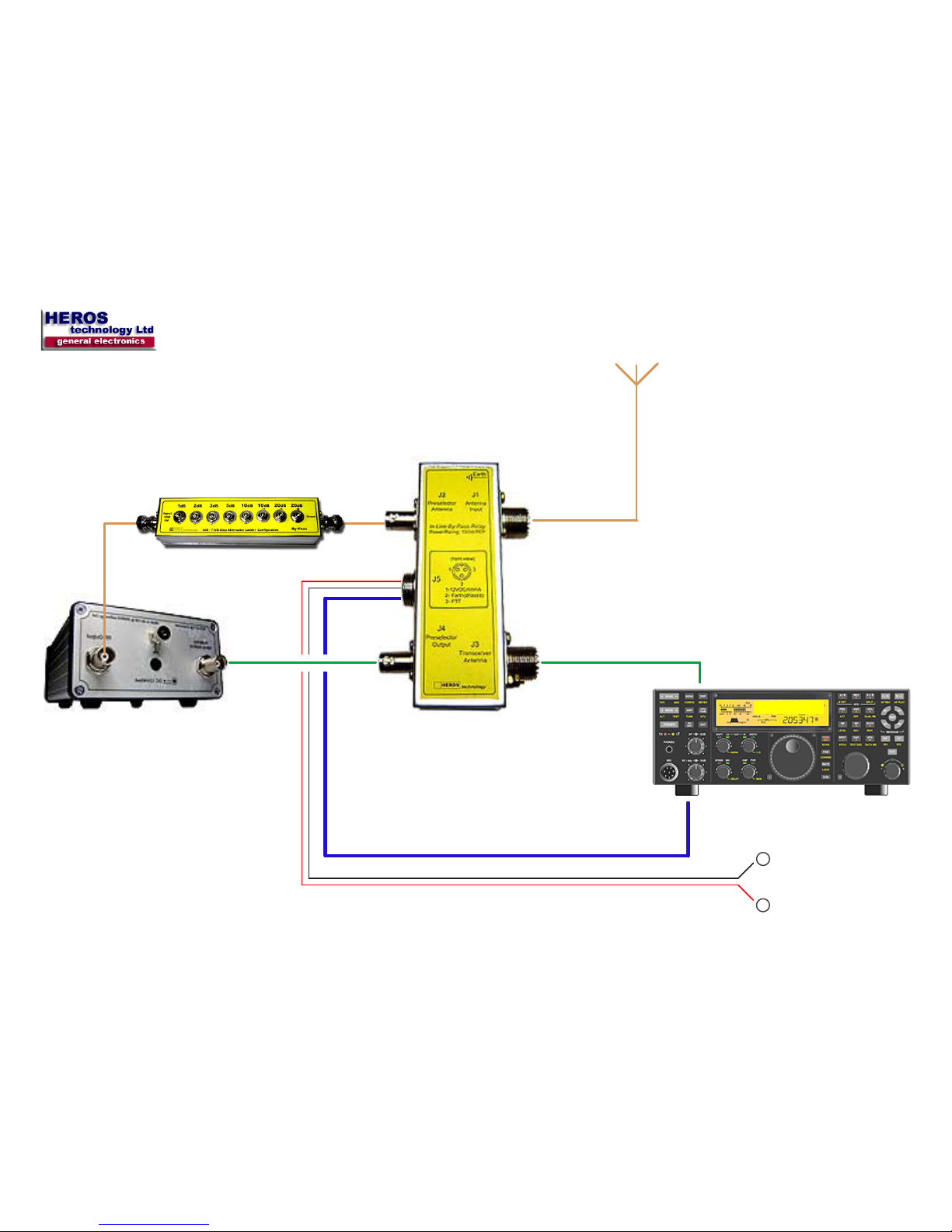
<5KHz to 500KHz Up-Converter
By-passing the Converter on transmission switch-over
Connection diagram.
Antenna
Generic SDR or Analogue Transceiver
(100W PP max.)
Delayed Transmission/Reception switch over command line.
(68mA active state)
12V DC/ 60mA(Active)
+
-
Port A
Port R
Port B
Port C
* Reception state (relay no activated)
- Ports A-B connected
- Ports C-R connected
* Transmission state (relay activated)
- Port A connected to Port R
- Ports B and C are shortcut to ground.
Input
RF Output
Heros Technology
HF Dual By-Pass relay.
Receiver antenna
Optional step attenuator
IMPORTANT!
In order to avoid damage assure that your
transceiver provides delayed transmission switch over command.
i.e. derived from the linear amplifier control output connector.
4.100MHz
Page 8
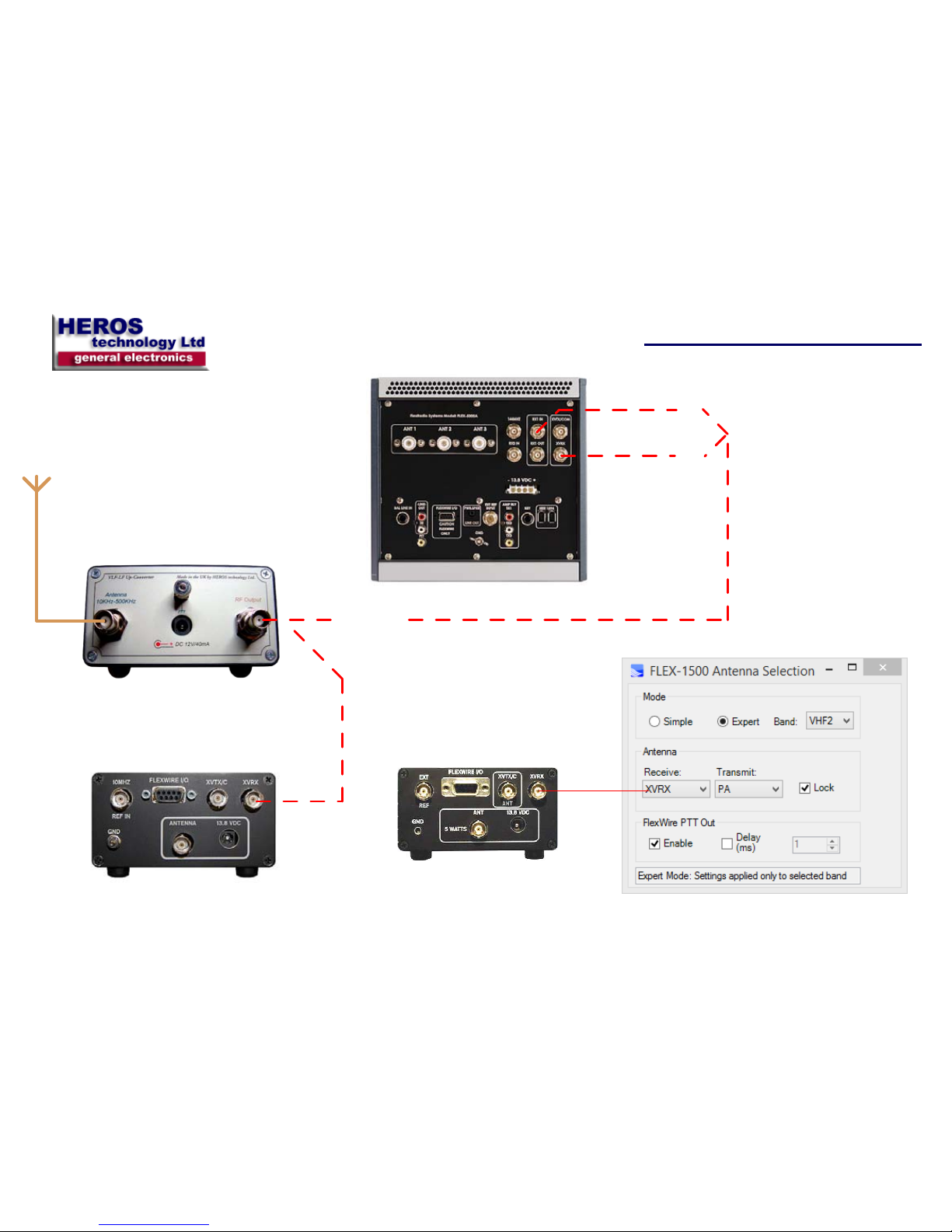
© HEROS technology Limited 2002. All rights reserved
XVRX
RX1 IN
XVRX
XVRX
Flex 1500
VLF LF <5KHz - 500KHz Up Converter
Connection to FlexRadios
Flex 5000
Flex 15000
IF output
Antenna input
Configure Antenna Selection form
according with your cabling.
PowerSDR Antenna Selection form
Page 9
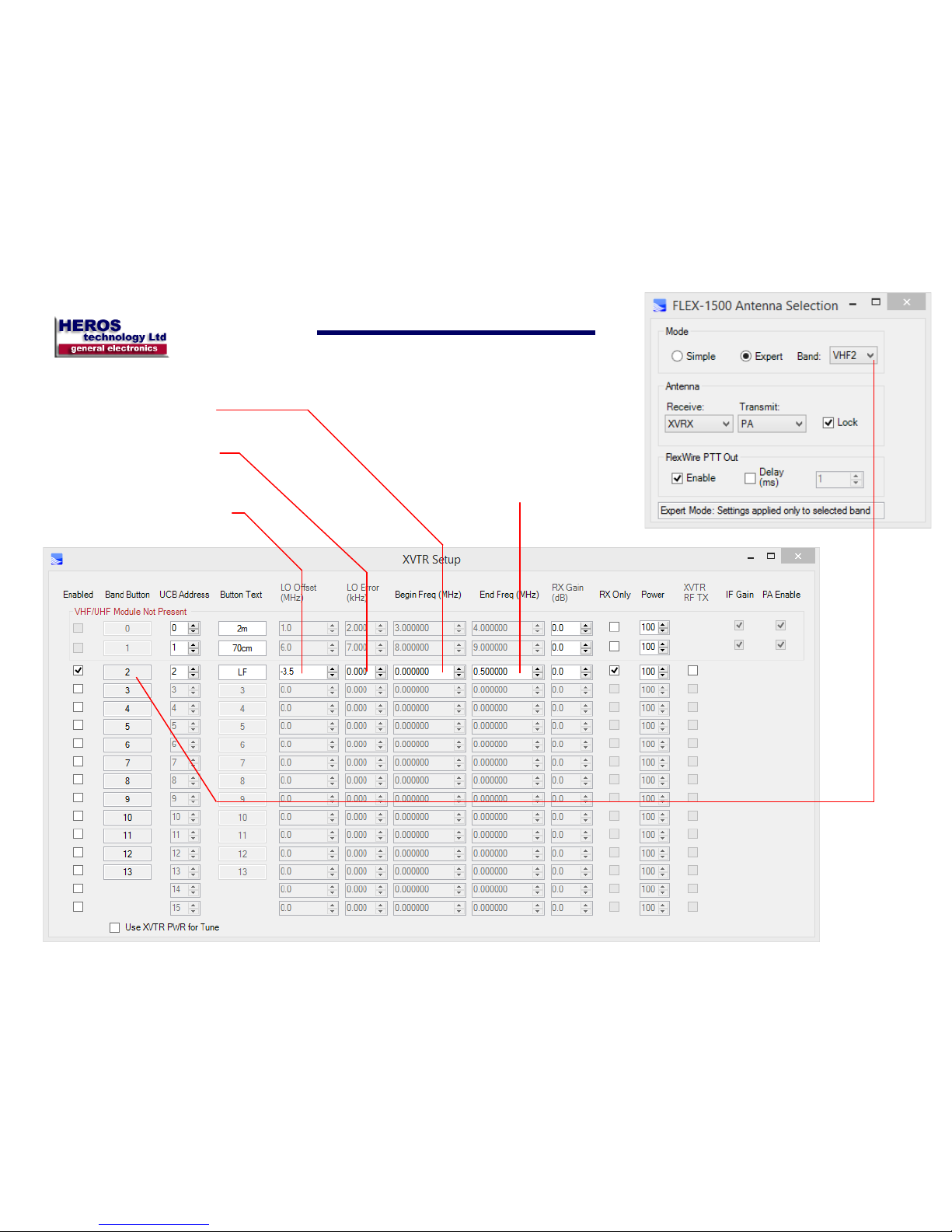
Local oscillator offset:
Negative value (-)
- 3.5 for Converter model 350
- 4 for Converter model 400
Local oscillator correction
(if any)
Dial lower frequency
(0 KHz in the picture)
Dial upper frequency
(500 KHz in the picture)
VLF LF <5KHz - 500KHz Up Converter
PowerSDR Configuration
© HEROS technology Limited 2002. All rights reserved
Page 10
© HEROS technology Limited 2002. All rights reserved
Oscillator calibration
The VLF-LF Up-converter comes calibrated from factory after a burn test of 24 hours. If for any reason you need to
recalibrate the local oscillator proceed as follows:
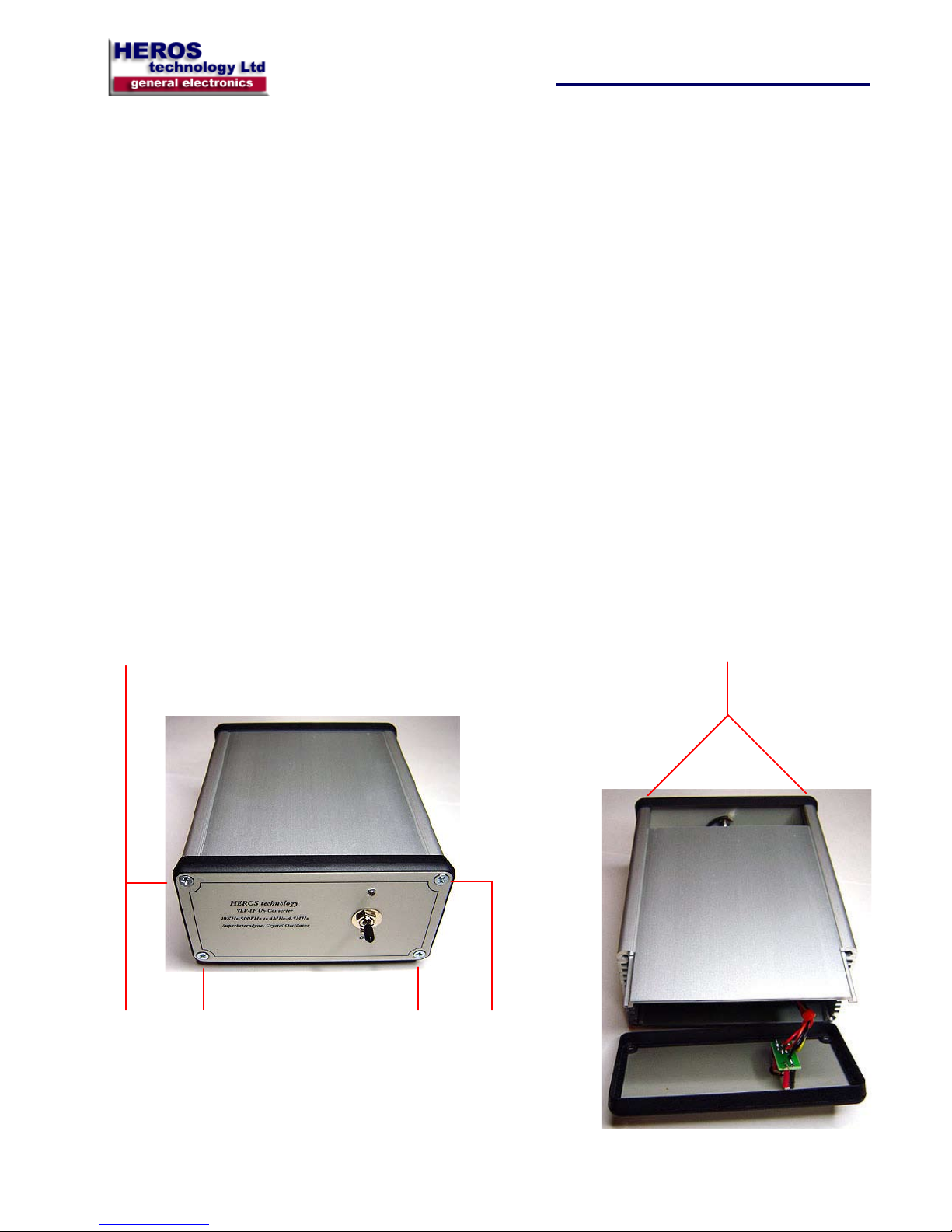
Remove the four front panel screws and slide gently the lid. You may untie the two upper screws on rear panel.
WARNING!
If the VLF-LF up-Converter is connected in line to a HF transceiver acting as IF receiver,
take precautions to prevent transmitting any signal into the converter.
Design
A carefully PCB and shielding design keep feed through signals down to a very low level.
The HF receiver used as IF should have strong rejection of HF signals through paths other than the antenna connector.
Most HF transceivers and receivers have good performance in this respect, but some SWL receivers do not and may
be used with the addition of filters and shielding.
Operating
The VLF-LF Up Converter is suitable to work with SDR or Analogue radios.
It can works together active antennas, loop antennas and preamplifiers providing an output impedance of 50 Ω.
Beverage antennas, 450Ω characteristic impedance need a matching device.
Using an active antenna, a DC block device must be used in order to asure that the antenna power coupler does not
VLF LF <5KHz - 500KHz Up Converter
Page 11
© HEROS technology Limited 2002. All rights reserved
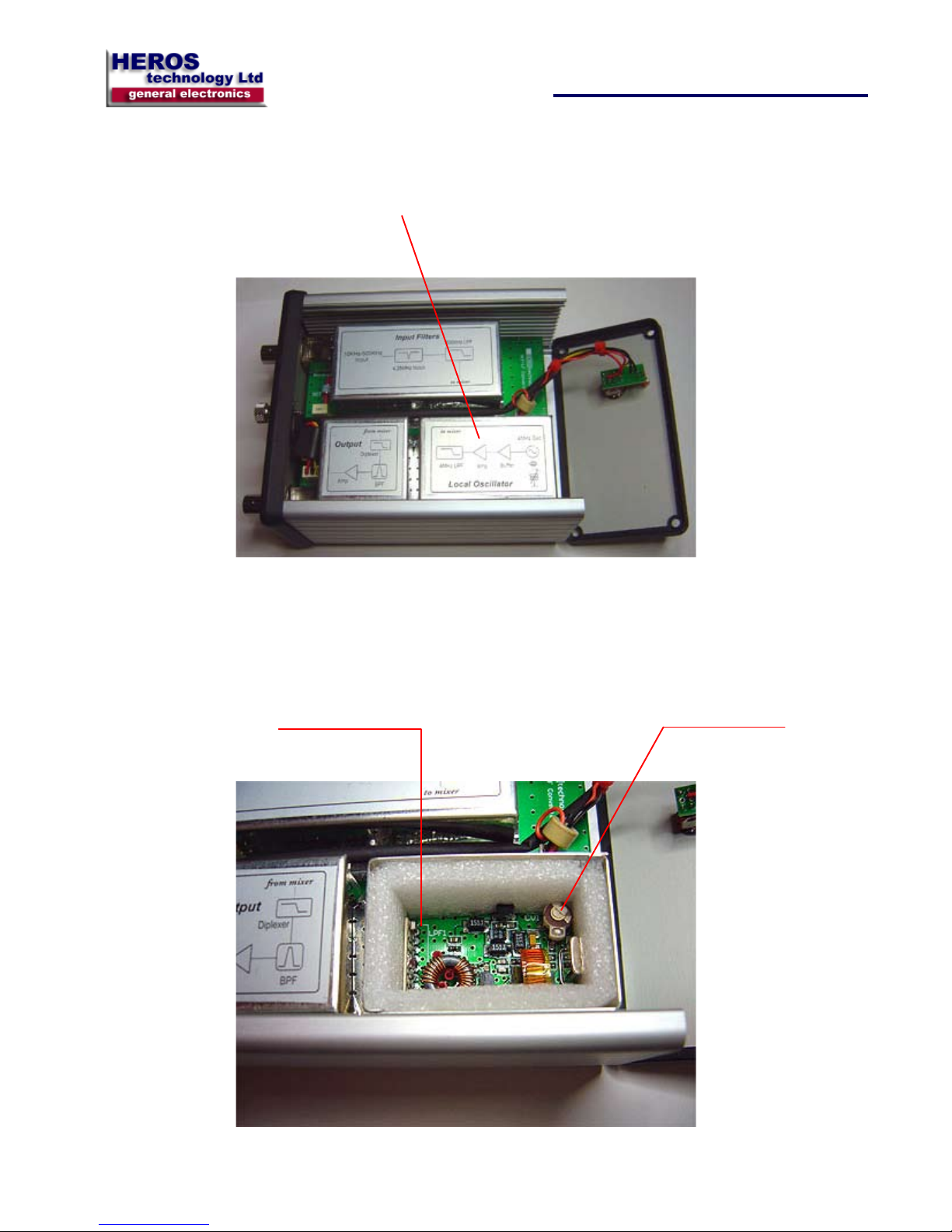
Remove the lid from the local oscillator section.
Switch ON the converter. Allow at least 30 minutes of warming time before adjusting
at room temperature.
Adjusting trimmer
Measuremet point
VLF LF <5KHz - 500KHz Up Converter
Page 12
A
B
C
D
1
2
3
4
1
2
3
4
A
B
C
D
Date
Sheet
FCSM No
DWG No
REV
Size
Drawn
Checked
Issued
Approvals
Drawing
Scale
A4
JJ de Oñate
I I MMXV
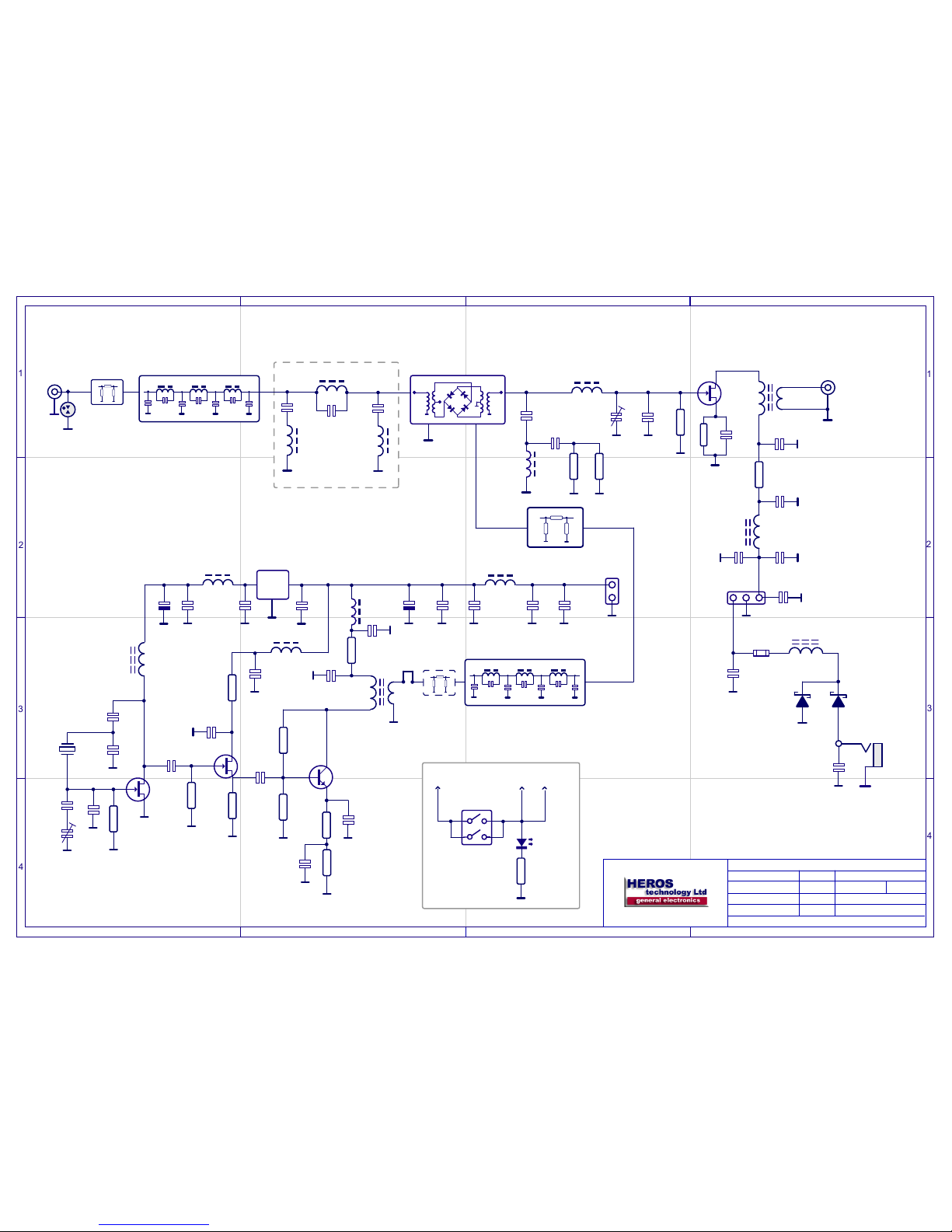
5kHz-500kHz VLF LF Up- Converter
1/12018-01
© HEROS technology Limited 2002. All rights reserved
5kHz to 500kHz
Antenna Input
(50Ω)
J1
Gas Discharge Tube
GDT
LO
RF
IF
L10
L6
L8
L11
L10
F1
L5
T1
T2
Q1
Q2
Q3
IC1
JP1
Q4
100Ω
100Ω
L9
IF Output
3.5MHz to 4MHz
or
4MHz to 4.5MHz
50Ω
J2
J5
J3
J4
L4
SRA-8+
LPF1
50pF
100n100n
100n
100n
10uF
100n
100n
100n
100n
100n
100n
100n
100n
100n
1uF
250V
100n
100n
100n
1N5817
12.5V/40mA
2K2
100Ω
2N44416
22uF
22uF
78L09
10n
10n
10pF
MPF102
MPF102
2N4401
68pF
XT
Xtal 3,5MHz
or
4MHz
100pF
56pF
100K
100K
470Ω
100Ω
100Ω
100Ω
2K2
680Ω
100Ω
1K
500kHz 7 poles Elliptic LPF module
DC-10MHz
Dual Balanced Mixer
220pF
220pF
82pF
15pF
4MHz 7 poles Elliptic LPF module
3dB Pi attenuator
3dB Pi attenuator
Jumper
3dB Pi attenuator
L7
Resettable fuse
10uF chip
22uF/16V
10uF
D1
1N5817
D2
a
a
c
LPF1
LP2
LP2
+7dBm
C1
CV1
C2
C3
C4
R1
R2
R3
R4
R5
R6
R7
R8
R9
R10
R11
R12
R13
R14
CV2
C5
C6
C7
C8
C9
C10
C11
C16
C15
Att 1
Att 2
Att 3
C14
C13
C12
C17
C18
C19
C20
C21
C23
C22
C24
C25
C26
C27
C28
C29
C30
C31
C32
L1
L2
L3
100dB IF trap
C33
C34
C35
Mixer
IF Amplifier
SW1
3K3
to J4 a
to J4 c to J5 a
R15
LED
Switch ON
Font panel module
Page 13

© HEROS technology Limited 2002. All rights reserved
Heros technology Limited disclaims all liability arising from this information and its use.
It is your responsibility to ensure that your application meets with your specifications.
Information contained in this publication regarding device applications and the like is provided only for your convenience
and may be superseded by updates.
Heros technology Limited makes no representations or warranties of any kind whether express or implied, written or oral,
statutory or otherwise, related to the information, including but not limited to its condition, quality, performance,
merchantability or fitness for purpose.
NOTES:
VLF LF <5KHz - 500KHz Up Converter
 Loading...