

Page 1
SAFETY DATA SHEET
This safety data sheet complies with the requirements of:
Regulation (EC) No. 1907/2006 and Regulation (EC) No. 1272/2008
Issue Date 04-May-2015
Revision Date 26-Dec-2017
Version 1
_____________________________________________________________________________________________
Page 1 / 9
Section 1: IDENTIFICATION OF THE SUBSTANCE/MIXTURE AND OF THE
COMPANY/UNDERTAKING
1.1. Product identifier
Product Code
MS-746
Product Name
Dissipator 746
Contains Cumene Hydroperoxide, TETRAHYDROFURFURYL METHACRYLATE, Hydroxypropyl Methacrylate
1.2. Relevant identified uses of the substance or mixture and uses advised against
Recommended Use
Adhesives
Uses advised against
None known
1.3. Details of the supplier of the safety data sheet
Manufacturer
Hernon Manufacturing Inc.
121 Tech Drive
Sanford, FL 32771
800-527-0004
For further information, please contact
Contact Point
1.4. Emergency telephone number
Emergency Telephone
Chemtel 800-255-3924
Emergency Telephone - §45 - (EC)1272/2008
Europe
112
Section 2: HAZARDS IDENTIFICATION
2.1. Classification of the substance or mixture
Regulation (EC) No 1272/2008
Acute toxicity - Inhalation (Dusts/Mists)
Category 3 - (H331)
Serious eye damage/eye irritation
Category 2 - (H319)
Skin sensitization
Category 1 - (H317)
Reproductive Toxicity
Category 1B - (H360D)
Specific target organ toxicity (single exposure)
Category 3 - (H335)
Chronic aquatic toxicity
Category 3 - (H412)
2.2. Label elements
Product identifier
Contains Cumene Hydroperoxide, TETRAHYDROFURFURYL METHACRYLATE, Hydroxypropyl Methacrylate
Page 2
MS-746 - Dissipator 746 Revision Date 26-Dec-2017
_____________________________________________________________________________________________
_____________________________________________________________________________________________
Page 2 / 9
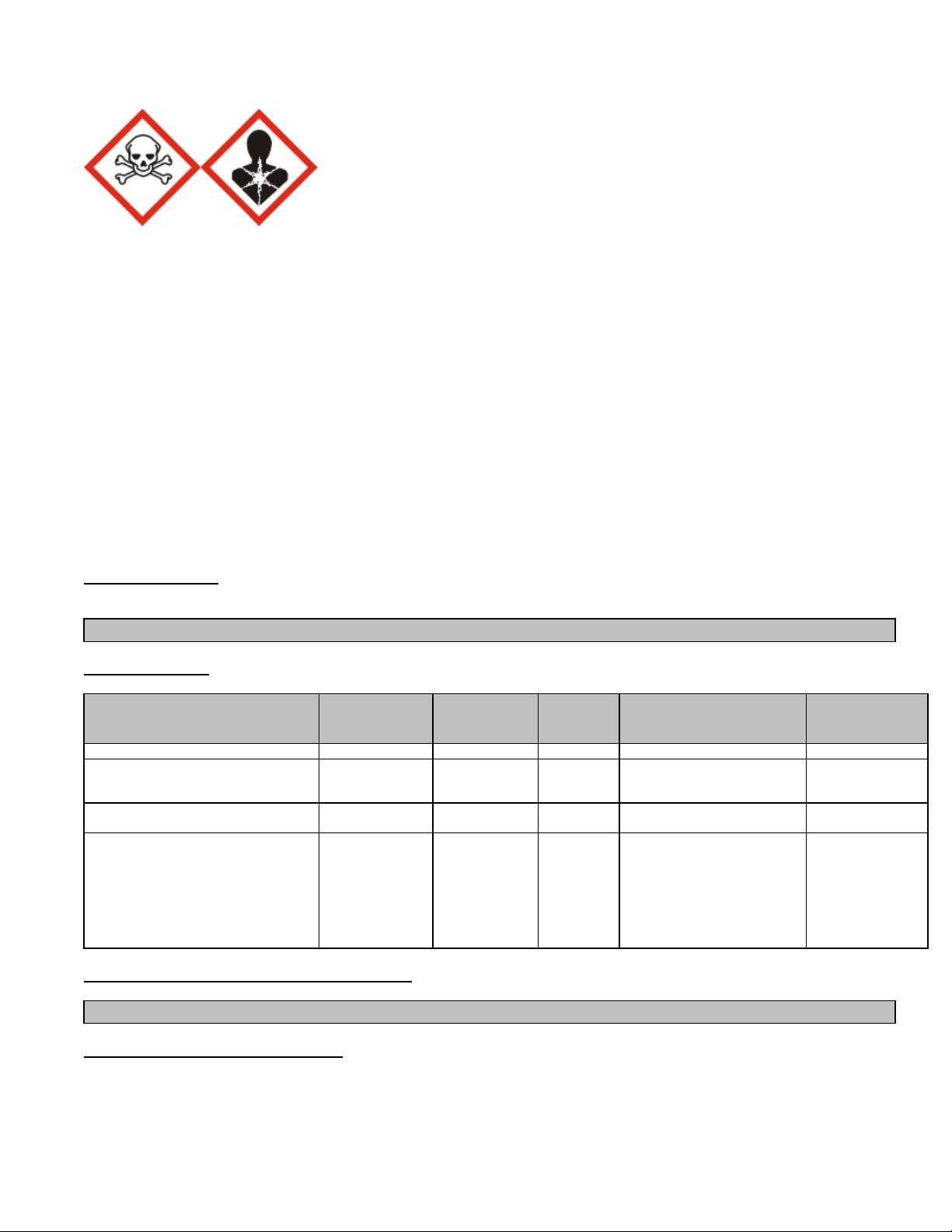
Signal word
Danger
Hazard statements
H317 - May cause an allergic skin reaction
H319 - Causes serious eye irritation
H331 - Toxic if inhaled
H335 - May cause respiratory irritation
H412 - Harmful to aquatic life with long lasting effects
H360D - May damage the unborn child
Precautionary Statements - EU (§28, 1272/2008)
P201 - Obtain special instructions before use
P261 - Avoid breathing dust/fume/gas/mist/vapors/spray
P273 - Avoid release to the environment
P280 - Wear protective gloves and eye/face protection
P312 - Call a POISON CENTER or doctor/physician if you feel unwell
P362 - Take off contaminated clothing and wash before reuse
P403 + P233 - Store in a well-ventilated place. Keep container tightly closed
P501 - Dispose of contents/ container to an approved waste disposal plant
2.3. Other hazards
No information available
Section 3: COMPOSITION/INFORMATION ON INGREDIENTS
3.1 Substances
Chemical Name
EC No.
CAS No.
Weight-%
Classification according to
Regulation (EC) No.
1272/2008 [CLP]
REACH
Registration
Number
OFF-WHITE HYDRATED ALUMINA
244-492-7
21645-51-2
40 - 70
No data available
No data available
TETRAHYDROFURFURYL
METHACRYLATE
219-529-5
2455-24-5
10 - 30
Skin Sens. 1 (H317)
Repr. 1B(H360D)
Aquatic Chronic 3 (H412)
No data available
Hydroxypropyl Methacrylate
248-666-3
27813-02-1
3 - 7
Eye Irrit. 2 (H319)
Skin Sens. 1 (H317)
No data available
Cumene Hydroperoxide
201-254-7
80-15-9
1 - 5
Acute Tox. 4 (H302)
Acute Tox. 4 (H312)
Acute Tox. 3 (H331)
Skin Corr. 1B (H314)
STOT SE 3 (H335)
STOT RE 2 (H373)
Aquatic Chronic 2 (H411)
Org. Perox. E (H242)
No data available
Full text of H- and EUH-phrases: see section 16
Section 4: FIRST AID MEASURES
4.1. Description of first aid measures
Inhalation
Remove to fresh air. If breathing is difficult, give oxygen. If breathing has stopped, give
artificial respiration. Get medical attention immediately.
Page 3

MS-746 - Dissipator 746 Revision Date 26-Dec-2017
_____________________________________________________________________________________________
_____________________________________________________________________________________________
Page 3 / 9
Skin contact
Wash with soap and water. Flush skin with water for several minutes. Remove
contaminated clothing and shoes. If irritation develops, seek medical attention. Wash
clothing before reuse.
Eye contact
Rinse thoroughly with plenty of water for at least 15 minutes, lifting lower and upper eyelids.
Consult a physician.
Ingestion
Do NOT induce vomiting. Never give anything by mouth to an unconscious person. Call a
POISON CENTER or doctor/physician if you feel unwell.
4.2. Most important symptoms and effects, both acute and delayed
Symptoms
Avoid prolonged contact with eyes, skin, and clothing.
4.3. Indication of any immediate medical attention and special treatment needed
Note to physicians
Treat symptomatically.
Section 5: FIRE FIGHTING MEASURES
5.1. Extinguishing media
Suitable extinguishing media
Use CO2, dry chemical, or foam.
Unsuitable extinguishing media
None
5.2. Special hazards arising from the substance or mixture
No information available
Hazardous combustion products
Carbon oxides. Nitrogen oxides (NOx). Irritating organic vapors.
5.3. Advice for firefighters
Wear self-contained breathing apparatus and protective suit. Use personal protective equipment as required.
Section 6: ACCIDENTAL RELEASE MEASURES
6.1. Personal precautions, protective equipment and emergency procedures
Personal precautions
Use personal protective equipment as required. Ensure adequate ventilation, especially in confined areas.
For emergency responders
Use personal protection recommended in Section 8.
6.2. Environmental precautions
Do not allow into any sewer, on the ground or into any body of water. See Section 12 for additional ecological information.
6.3. Methods and material for containment and cleaning up
Methods for containment
Absorb with earth, sand or other non-combustible material and transfer to containers for
later disposal.
Methods for cleaning up
Soak up with inert absorbent material. Take up mechanically, placing in appropriate
Page 4

MS-746 - Dissipator 746 Revision Date 26-Dec-2017
_____________________________________________________________________________________________
_____________________________________________________________________________________________
Page 4 / 9
containers for disposal.
6.4. Reference to other sections
See section 8 for more information. See section 13 for more information.
Section 7: HANDLING AND STORAGE
7.1. Precautions for safe handling
Advice on safe handling
Avoid contact with skin, eyes or clothing. Avoid breathing vapors or mists. Wash thoroughly after handling. Ensure adequate
ventilation, especially in confined areas.
General Hygiene Considerations
Handle in accordance with good industrial hygiene and safety practice.
7.2. Conditions for safe storage, including any incompatibilities
Storage Conditions
Keep at temperatures between 7 and 29 °C.
Incompatible materials
Strong oxidizers.
7.3. Specific end use(s)
Specific use(s)
Adhesives and/or sealants.
Risk Management Methods (RMM)
The information required is contained in this Material Safety Data Sheet.
Section 8: EXPOSURE CONTROLS/PERSONAL PROTECTION
8.1. Control parameters
Chemical Name
European Union
United Kingdom
France
Spain
Germany
OFF-WHITE HYDRATED
ALUMINA
21645-51-2
-
TWA: 10 mg/m3
TWA: 4 mg/m3
-
-
-
Chemical Name
Austria
Switzerland
Poland
Norway
Ireland
OFF-WHITE HYDRATED
ALUMINA
21645-51-2
TWA: 5 mg/m3
STEL 10 mg/m3
-
TWA: 2.5 mg/m3
TWA: 1.2 mg/m3
-
TWA: 10 mg/m3
TWA: 4 mg/m3
STEL: 30 mg/m3
STEL: 12 mg/m3
Derived No Effect Level (DNEL)
No information available.
Predicted No Effect Concentration
(PNEC)
No information available.
8.2. Exposure controls
Engineering Controls
Ensure adequate ventilation, especially in confined areas.
Personal protective equipment
Eye/face protection
Wear safety glasses with side shields (or goggles).
Hand Protection
Wear protective gloves. Wear protective nitrile rubber gloves.
Skin and body protection
Suitable protective clothing.
Respiratory protection
In case of insufficient ventilation, wear suitable respiratory equipment.
Page 5

MS-746 - Dissipator 746 Revision Date 26-Dec-2017
_____________________________________________________________________________________________
_____________________________________________________________________________________________
Page 5 / 9
Environmental exposure controls
No information available.
Section 9: PHYSICAL AND CHEMICAL PROPERTIES
9.1. Information on basic physical and chemical properties
Physical state
Paste
Appearance
No information available
Odor
Mild
Color
White
Odor threshold
No information available
Property
Values
Remarks • Method
pH
Does not apply
Melting point / freezing point
No information available
Boiling point / boiling range
> 149 °C / 300 °F
Flash point
> 93 °C / 200 °F
Evaporation rate
No information available
Flammability (solid, gas)
No information available
Flammability Limit in Air
Upper flammability limit:
No information available
Lower flammability limit:
No information available
Vapor pressure
< 5mm @ 80° F
Vapor density
No information available
Relative density
1.62
Water solubility
Slightly soluble
Solubility(ies)
No information available
Partition coefficient
No information available
Autoignition temperature
No information available
Decomposition temperature
No information available
Kinematic viscosity
No information available
Dynamic viscosity
No information available
Explosive properties
No information available
Oxidizing properties
No information available
9.2. Other information
Softening point
No information available
Molecular weight
No information available
VOC Content (%)
No information available
Density
No information available
Bulk density
No information available
Section 10: STABILITY AND REACTIVITY
10.1. Reactivity
No data available.
10.2. Chemical stability
Stable under normal conditions.
Explosion data
Sensitivity to Mechanical Impact
None.
Sensitivity to Static Discharge
None.
10.3. Possibility of hazardous reactions
Possibility of Hazardous Reactions
None under normal processing.
Page 6
MS-746 - Dissipator 746 Revision Date 26-Dec-2017
_____________________________________________________________________________________________
_____________________________________________________________________________________________
Page 6 / 9
10.4. Conditions to avoid
Incompatible materials.
10.5. Incompatible materials
Strong oxidizers.
10.6. Hazardous decomposition products
Carbon oxides. Nitrogen oxides (NOx). Irritating organic vapors.
Section 11: TOXICOLOGICAL INFORMATION
11.1. Information on toxicological effects
Acute toxicity
Product Information
Inhalation
No data available.
Eye contact
No data available.
Skin contact
No data available.
Ingestion
No data available.
The following values are calculated based on chapter 3.1 of the GHS document
ATEmix (oral)
3,984.00 mg/kg
ATEmix (dermal)
2,254.00 mg/kg
ATEmix (inhalation-dust/mist)
0.79 mg/l
Chemical Name
Oral LD50
Dermal LD50
Inhalation LC50
OFF-WHITE HYDRATED ALUMINA
> 5000 mg/kg ( Rat )
Hydroxypropyl Methacrylate
= 11200 mg/kg ( Rat )
> 3000 mg/kg ( Rabbit )
Cumene Hydroperoxide
= 382 mg/kg ( Rat )
= 0.126 mL/kg ( Rabbit )
= 220 ppm ( Rat ) 4 h
METHANOL
= 6200 mg/kg ( Rat )
= 15800 mg/kg ( Rabbit )
= 22500 ppm ( Rat ) 8 h = 64000
ppm ( Rat ) 4 h
Skin corrosion/irritation
No information available.
Serious eye damage/eye irritation
No information available.
Sensitization
No information available.
Germ cell mutagenicity
No information available.
Carcinogenicity
No information available.
Reproductive toxicity
No information available.
STOT - single exposure
No information available.
STOT - repeated exposure
No information available.
Aspiration hazard
No information available.
Page 7
MS-746 - Dissipator 746 Revision Date 26-Dec-2017
_____________________________________________________________________________________________
_____________________________________________________________________________________________
Page 7 / 9
Section 12: ECOLOGICAL INFORMATION
12.1. Toxicity
Chemical Name
Algae/aquatic plants
Fish
Crustacea
TETRAHYDROFURFURYL
METHACRYLATE
-
31.1 - 38.8: 96 h Pimephales
promelas mg/L LC50 flow-through
-
Hydroxypropyl Methacrylate
-
493: 48 h Leuciscus idus melanotus
mg/L LC50 static
-
Cumene Hydroperoxide
-
3.9: 96 h Oncorhynchus mykiss
mg/L LC50 static
7: 24 h Daphnia magna mg/L EC50
12.2. Persistence and degradability
No information available.
12.3. Bioaccumulative potential
No information available.
12.4. Mobility in soil
Mobility in soil
No information available.
12.5. Results of PBT and vPvB assessment
No information available.
12.6. Other adverse effects
No information available
Section 13: DISPOSAL CONSIDERATIONS
13.1. Waste treatment methods
Waste from residues/unused
products
Dispose of in accordance with federal, state and local regulations.
Contaminated packaging
Improper disposal or reuse of this container may be dangerous and illegal.
Section 14: TRANSPORT INFORMATION
IMDG
14.1 UN/ID no.
None
14.2 Proper shipping name
Not regulated
14.3 Hazard Class
None
14.4 Packing Group
None
14.5 Marine pollutant
Not applicable
14.6 Special Provisions
None
14.7 Transport in bulk according to Annex II of
MARPOL 73/78 and the IBC Code
No information available
IATA
14.1 UN/ID no.
None
14.2 Proper shipping name
Not regulated
14.3 Hazard Class
None
14.4 Packing Group
None
14.5 Environmental hazard
Not applicable
14.6 Special Provisions
None
MS-746 - Dissipator 746 Revision Date 26-Dec-2017
Page 8
_____________________________________________________________________________________________
_____________________________________________________________________________________________
Page 8 / 9
DOT
Not regulated
UN/ID no.
None
Proper shipping name
Not regulated
Hazard Class
None
Packing Group
None
Special Provisions
None
Section 15: REGULATORY INFORMATION
15.1. Safety, health and environmental regulations/legislation specific for the substance or mixture
France
Occupational Illnesses (R-463-3, France)
Chemical Name
French RG number
Title
Hydroxypropyl Methacrylate
27813-02-1
RG 65
-
European Union
Take note of Directive 98/24/EC on the protection of the health and safety of workers from the risks related to chemical agents
at work
Authorizations and/or restrictions on use:
This product does not contain substances subject to authorization (Regulation (EC) No. 1907/2006 (REACH), Annex XIV) This
product does not contain substances subject to restriction (Regulation (EC) No. 1907/2006 (REACH), Annex XVII)
Persistent Organic Pollutants
Not applicable
Named dangerous substances per Seveso Directive (2012/18/EU)
Ozone-depleting substances (ODS) regulation (EC) 1005/2009 Not applicable
International Inventories
TSCA
Complies
DSL/NDSL
Complies
EINECS/ELINCS
Complies
ENCS
Complies
IECSC
Complies
KECL
Complies
PICCS
Complies
AICS
Complies
All ingredients are on the inventory or are exempt from listing.
Legend:
TSCA - United States Toxic Substances Control Act Section 8(b) Inventory
DSL/NDSL - Canadian Domestic Substances List/Non-Domestic Substances List
EINECS/ELINCS - European Inventory of Existing Chemical Substances/European List of Notified Chemical Substances
ENCS - Japan Existing and New Chemical Substances
IECSC - China Inventory of Existing Chemical Substances
KECL - Korean Existing and Evaluated Chemical Substances
PICCS - Philippines Inventory of Chemicals and Chemical Substances
AICS - Australian Inventory of Chemical Substances
Page 9

MS-746 - Dissipator 746 Revision Date 26-Dec-2017
_____________________________________________________________________________________________
_____________________________________________________________________________________________
Page 9 / 9
US State Regulations
California Proposition 65
This product contains the following Proposition 65 chemicals
Chemical Name
California Proposition 65
METHANOL - 67-56-1 (<1%)
Developmental
15.2. Chemical safety assessment
No information available
Section 16: OTHER INFORMATION
Key or legend to abbreviations and acronyms used in the safety data sheet
Full text of H-Statements referred to under section 3
H335 - May cause respiratory irritation
H319 - Causes serious eye irritation
H317 - May cause an allergic skin reaction
H360D - May damage the unborn child
H412 - Harmful to aquatic life with long lasting effects
H302 - Harmful if swallowed
H312 - Harmful in contact with skin
H331 - Toxic if inhaled
H314 - Causes severe skin burns and eye damage
H373 - May cause damage to organs through prolonged or repeated exposure if inhaled
H411 - Toxic to aquatic life with long lasting effects
H242 - Heating may cause a fire
Legend
SVHC: Substances of Very High Concern for Authorization:
Legend Section 8: EXPOSURE CONTROLS/PERSONAL PROTECTION
TWA
TWA (time-weighted average)
STEL
STEL (Short Term Exposure Limit)
Ceiling
Maximum limit value
*
Skin designation
Prepared By
SDS coordinator
Issue Date
04-May-2015
Revision Date
26-Dec-2017
Revision Note
Not applicable.
This material safety data sheet complies with the requirements of Regulation (EC) No. 1907/2006
Disclaimer
The information provided in this Material Safety Data Sheet is correct to the best of our knowledge, information and belief
at the date of its publication. The information given is designed only as a guidance for safe handling, use, processing,
storage, transportation, disposal and release and is not to be considered a warranty or quality specification. The
information relates only to the specific material designated and may not be valid for such material used in combination
with any other materials or in any process, unless specified in the text.
End of Safety Data Sheet
 Loading...