

Page 1
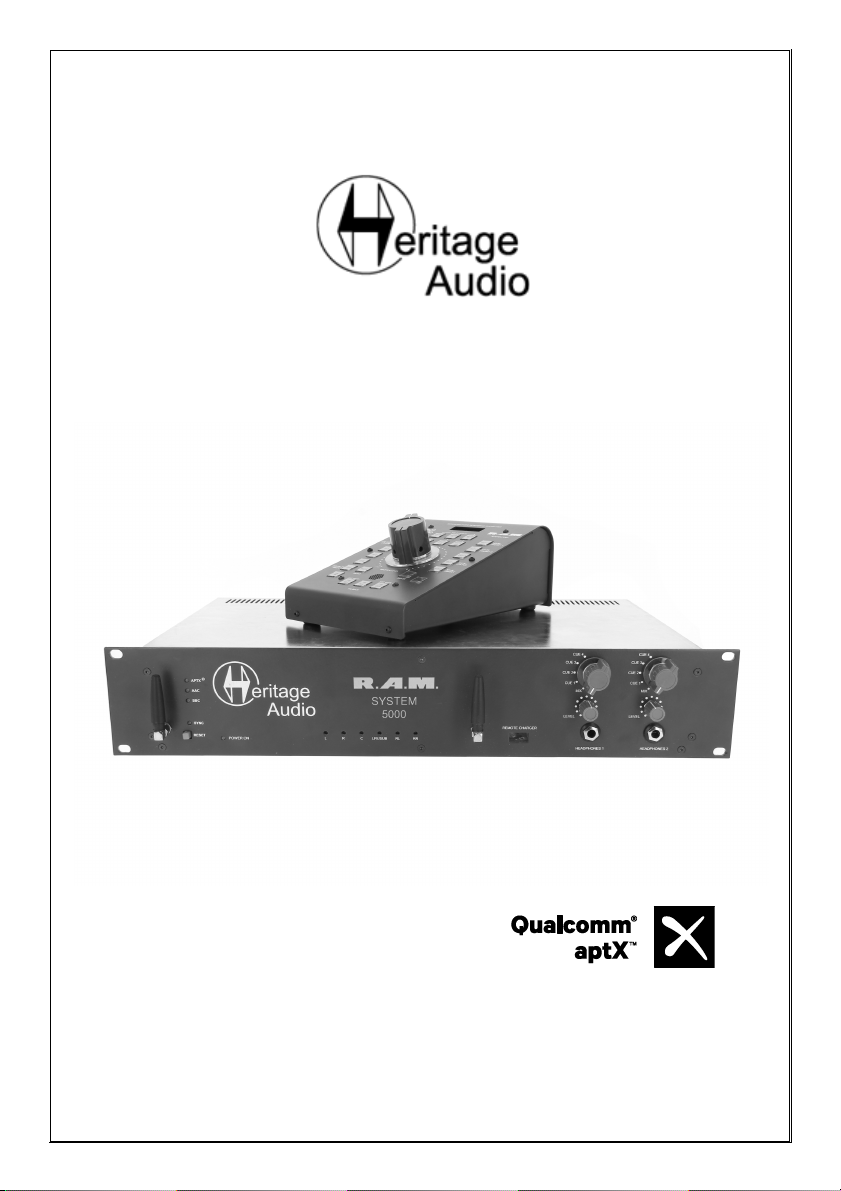
RAM SYSTEM 5000 USER MANUAL
1
Sept. 11th, 2018
Rev. 2.0, Firmware version V2.0
Page 2

INSTALLING THE RAM SYSTEM 5000
Thanks for purchasing the RAM System 5000. Please make sure the following
items are in the box when you open it.
• This manual.
• RAM System 5000 main unit.
• RAM System 5000 remote unit.
• Power Supply labelled HA-PSU02.
• 3x Bluetooth antenna.
• IEC Cable.
• USB cable.
Depending on your system requirements, you will need several XLR, RCA,
DSUB snakes and digital cables to hook up your system. Please check your
input sources and output destinations and get yourself the correct cables.
Additionally, please insert the wireless antennas in their threaded connectors
in case they come unplugged from the factory.
2
The power supply is of the auto switching universal type so it works
worldwide without adjusting anything. In case your country uses a different
mains cable other than the one provided in the box, just get the correct one
and you are done.
The remote unit is operated by means of an internal rechargeable battery,
similar to that found in your mobile phone. A charging dock comes included
in the main unit, as is the USB cable. A red LED on the back of the remote unit
will light when being charged and the unit can be fully operated while in
charge mode. It is recommended to completely charge the battery on its first
use.
Please turn on the main unit and the remote unit thereafter. A “Connecting”
message will display and, if connection is successful, a message will display
shortly thereafter.
Page 3

Plugging the unit will display a welcome message and firmware unit´s
version. Please note that after turning on the unit, MUTE will always be
engaged regardless of the level shown on the red knob. This is to prevent
damage of your speakers due to excessive level on startup.
Any connection problems, the remote will show the message “NO CONSOLE”
and will try to reconnect again. It is normal to have this message for a few
seconds when turning on, no worries.
Any time you plug the unit on, the status of the RAM System will be that of
the last time it was stored, so there is no need to reset preset levels or
talkback gain. Last input and output chosen is also stored.
In order to save your preferred status, press SHIFT + OUT4 (SAVE STATUS)
GENERAL DESCRIPTION
The Heritage Audio RAM SYSTEM 5000 is a professional 5.1 ready monitor
controller in a convenient split format. With its matrix of inputs and outputs,
covering balanced and unbalanced analog, all common digital formats on a
state of the art Wolfson DAC, and the innovative professional quality HA
Bluetooth technology, the System 5000 will cover all the monitoring needs of
the most demanding professional facilities at a price never heard before.
3
The level control is taken care of by means of microprocessor controlled gold
plated relays, giving an exceptional resolution of 64dB of attenuation in 1dB
steps. Keeping active electronics to a minimum, the attenuator is buffered
using premium Burr Brown circuitry for negligible coloration and no noise.
Headphone monitoring is as critical as main speaker is. Usually a weak part
even in the most expensive units, the RAM System 5000 employs very high
current drivers in a diamond buffer configuration which are able to drive any
headphones to very high levels without coloration or noise. It has 2 amplifiers
Page 4

individually configurable to follow any of the CUE sends or the active input
(MIX).
CONFIGURING YOUR RAM SYSTEM 5000
The RAM System 5000 is an extremely flexible unit that covers an array of
inputs and outputs rarely seen on products at its price range. Contrary to the
usual “optional” 5.1 facilities on products in this category, the System 5000 is
5.1 ready out of the box.
This does not mean that, if your studio does not need 5.1 at present, you are
paying for features you don’t need, as it has some smart configuration
parameters that take all the juice of your 5000 no matter your application.
So, mainly based on your 5.1 and subwoofer needs, there are 2 main user
configuration options that should be set on installation:
• MODE 5.1/ST ( 5.1 or Full Stereo operation)
• LFE MODE CONFIGURATION
4
MODE 5.1/ST CONFIGURATION
In case 5.1 mode is going to be used in your facility, please activate it by
pressing SHIFT + INPUT 1 and confirm as requested. Repeating the same
operation will turn the unit back into Stereo mode. Save status as explained
before.
The implications of setting the unit in 5.1 mode are as follows: Inputs 1, 2 and
3 get linked (all 3 lights work at the same time), as do Outputs 1, 2 and 3.
These 3 pairs will become your 5.1 system following the protocol below:
• INPUT 1 L-R/OUTPUT 1 L-R: FRONT L-R
• INPUT 2 L/OUTPUT 2 L: CENTER
• INPUT 2 R/OUTPUT 2 R: LFE
• INPUT 3 L-R/OUTPUT 3 L-R: REAR L-R
Page 5

Additional stereo inputs and outputs should be wired to the additional
inputs/outputs.
LFE MODE CONFIGURATION
The RAM System 5000 allows your 5.1 LFE speaker to act as the subwoofer in
the additional stereo pair of speakers, a feature missing in most competing
products.
In case the same LFE speaker in your 5.1 system is to be used with your
additional stereo pairs of monitors, the unit can be configured so a mono
signal following the stereo inputs is always present at OUTPUT 2R (LFE).
In order to do so, please press SHIFT + INPUT 2 and confirm. Pressing again
and confirming reverts the configuration. Again, save the status so your
configuration is stored.
In case Stereo mode is selected (no 5.1) a discrete Sub channel is configured,
and OUT 2 is disabled (as it is dedicated for sub purposes!!).
5
INPUT FEATURES
The RAM System 5000 has the following stereo inputs:
• INPUT 1 to 4: Balanced, accessible on a DSUB 25 connector which
follows the Tascam protocol. Input 1 is also duplicated on a pair of
XLR connectors for ease of use. Nominal level is +4 dBu. Depending
on 5.1/ST and LFE mode configurations, Inputs 1 to 3 represent the
5.1 system or are individual stereo inputs.
• UNBALANCED INPUT: Accessible on a pair of RCA connectors, its
nominal level is -10dBV.
• DIGITAL INPUT: Based on the Wolfson WM8741 DAC (still the best to
our ears!!), it features AES/EBU, TOS Link and Spdif connectors.
Inputs are transformer isolated and read the word clock from the
digital incoming signal. A maximum of 24 bit/192 Khz is allowed and
Page 6

further advanced digital filtering options are available via internal
jumpers. The different digital formats are selectable by pressing
SHIFT + DIG in cycle mode.
• BLUETOOTH: This input features the same architecture found in the
acclaimed Heritage Audio BT-500. If you are not familiar with it, the
BT-500 is an Audio Streaming device in a convenient 500 Series
format. It streams audio from your Bluetooth-equipped device and
delivers a fully balanced, +22dBu stereo output. Integration of mobile
devices intro a professional studio environment has never been
easier. More info on the Bluetooth features later.
MONITORING OUTPUT FEATURES
The RAM System 5000 features 5 pairs of balanced outputs labelled OUT1,
OUT2, OUT3, OUT4 and OUT5 available via discrete XLR connectors on the
back of the unit. Depending on 5.1/ST and LFE mode configurations, Outputs
1 to 3 represent the 5.1 system or are simply individual stereo outputs.
As has been said previously, OUT 2 R can be a permanent subwoofer output
depending on configuration. In case OUT 2 seems to not be working properly,
please check this configuration first.
6
ADDITIONAL OUTPUTS
In addition to the monitoring outputs, the RAM System 5000 features the
following outputs:
• MIX OUTPUT: It follows the input signal and is taken PRE FADER,
meaning its level is unaffected by the monitoring attenuation. It is
therefore ideal for recording the mix at the same time, or as an
additional cue send. It is unity gain.
• CUE OUTPUTS 1-4: Working in tandem with the CUE INPUTS 1-4, they
work as traditional CUE sends, where the CUE Output follows the
CUE input plus the Talkback signal when this is in use.
Page 7

SIGNAL MONITORING FACILITIES
As previously explained, the heart of the RAM System 5000 is its
microprocessor controlled, ladder type attenuator. This can be accessed in 2
ways:
• Using the Red Level Knob: As in any traditional monitoring system.
Fully clockwise it performs at unity gain (maximum level) whilst
reducing it in 1dB steps up to 64. After this the unit turns Mute on.
• Using the LEVEL PRESET OPTIONS: The RAM System 5000 has the
ability to store 2 different level presets, which override the Red Level
knob position. Pressing SHIFT + OUT5 (Level Preset) will ask for which
of the 2 presets wants to be stored (1 or 2). Confirmation is given by
pressing the corresponding key, OUT1 (Level Preset 1) or OUT2
(Level Preset2).Pressing SHIFT + OUT1 (Level Preset1) will make the
monitoring level that of the stored preset, same for preset 2.
ADDITIONAL MONITORING FEATURES
The RAM System has the usual MUTE, DIM, MONO and PHASE reverse
functions often found in this type of units with expanded flexibility as follows:
7
• MUTE: Global Mute, equivalent to rotary knob all fully counter
clockwise.
• MUTE L, C, R, RL, SUB and RR: Individual Mute functions per speaker.
Pressing SHIFT + any individual MUTE will function as a SOLO for that
given speaker.
• DIM: Attenuates further 20 dB from the attenuation marked by
either the red knob or the level preset.
• MONO: Accessible as SHIFT + MUTE, it outputs a mono signal to the
selected output.
• PHASE: Accessible as SHIFT + DIM, left and right outputs are flipped
180 degrees.
Page 8

TALKBACK FACILITIES
The RAM System 5000 features talkback facilities in a similar fashion to the
large format consoles. Talkback signal can be assigned to the Mix signal
(following Input selected), by pressing TB MIX. It can also be assigned to the
dedicated CUE inputs by pressing TB CUE, or at both at the same time,
pressing TB ALL. All 3 buttons are momentary (they do not engage), so need
to be kept pressed for the talkback to function. This avoids sending
embarrassing comments to the talents by mistake.
The talkback signal is taken from the Electret microphone found in the front
panel and further amplified. Controls for talkback mic gain are SHIFT + TBMIX
for lowering the gain and SHIFT + TBCUE for raising it.
Pressing any of the talkback keys will activate the DIM function in order to
avoid feedback from the mic to the speakers.
8
HEADPHONE MONITORING
Your RAM System 5000 provides with 2 different headphone amplifiers,
placed at the left and right front panel ends. They are capable of extremely
loud levels without distortion, noise or coloration of any kind so, before
plugging your headphones in, make sure the headphone level is at its
minimum setting, and adjust accordingly.
Each headphone amplifier can have 5 different sources. MIX (following the
selected input source), or any of the 4 CUE inputs (following the related CUE
input on the back panel DSUB 25 connectors).
This allows for different monitoring mixes for the different talents and the
recording engineer.
Page 9

Selection is possible by means of the double bar rotary switches located in
the front panel of the main unit.
UNDERSTANDING THE BLUETOOTH INPUT
There is still a popular misconception that Bluetooth is detrimental to the
audio quality. Although this has been true in the past, it is no longer the case.
Bluetooth is just a “wireless serial port” and, as so, has no ability to interact
with your sound quality. However, in order to fit the heavy data traffic that
digital audio needs, digital audio compression is applied. This is the real
source for audio degradation in Bluetooth connections.
This being said, modern Bluetooth technology allows for very high quality
codecs taking care of the audio data and, which is more important, pre coded
data (such as that in iTunes) is kept unmolested.
NO MORE MINI JACKS
Employing last generation audio specific Bluetooth technology, the best
Codecs your devices can support and a state of the Art, Burr Brown based
analog signal path, it solves the already classic, irritating problem of
connecting your iOS or Android device to your Studio setup.
9
To this day this has been solved using mini jack to XLRs adaptor cables, but
the limitations of mobile devices’ analog audio paths have become clearly
apparent.
Listening to references on the iTunes Store, recordings sent by email, Spotify,
You Tube, you name it. You do it every day, all the time. Nevertheless
integration has been non convenient to say the least, until now.
SOUND QUALITY OVER BLUETOOTH
The RAM System 2000 Bluetooth device automatically recognizes your
device´s best Codec option and uses it for streaming.
Page 10

10
Apple´s iTunes Store and You Tube use AAC* as native so streaming from an
iPhone or iPad will result in a lossless transmission, much better than an
analog wired connection!!
Vast majority of Android devices have already adopted the amazing sounding
“Qualcomm® aptX™ audio” Codec **, which is nearly lossless and the
standard that wireless high quality headsets and sound bars are adopting.
For a complete list of devices currently supporting aptX please visit:
http://www.aptx.com/products/browse/categories
In case your device can´t support neither AAC nor aptX, the BT-500 will
stream audio using the classic SBC codec.
(*) Heritage Audio is an official AAC licensee.
(**) Heritage Audio is an official aptX licensee.
BURR BROWN´S PEDIGREE IN THE ANALOG PATH
The RAM System 5000 Bluetooth device substitutes your mobile device´s
analog circuitry with a state of the art, fully differential Burr Brown balanced
output stage which delivers a full 0dBfs = +22dBu output able to drive a load
of 600 ohms. This allows direct level comparisons while mastering or mixing
with Apple´s iTunes Store or mobile stored reference mixes.
SYNCHRONIZING YOUR DEVICE WITH THE RAM SYSTEM
5000
Synchronizing your mobile device with the RAM System 2000 is as simple as
pairing any other Bluetooth device. It will appear as “HA RAM 5000” on your
Bluetooth devices´ list.
Page 11

11
You Tube hosts nice tutorials about how to do so in both Android and iOS if
you need help.
The System 2000 automatically selects the best Codec supported by your
mobile device, so no configuration is needed.
OPERATION
Whenever a device is paired with the RAM System 5000, the “SYNC” LED will
light. From then on, your mobile device takes over the transmission, including
Transport control (PLAY, STOP, etc.) and Level (Volume).
Active streaming is confirmed by corresponding Codec LED being turned on.
Please note Codec IS NOT configurable. It is automatically chosen from the
best available option on your mobile device.
Devices can only be paired one at a time. Whenever a different device needs
to be paired, Bluetooth needs to be reset, so RESET button must be pressed
down.
SUMMARY OF SOFT FUNCTIONS
While main functions in the RAM System 5000 are simply accessible by
pressing the corresponding key, several others are accessible as a
combination, employing the SHIFT key for this purpose. These have been
described all along this manual, however for easy recall, they are listed
below:
• SHIFT + IN 1: Configures the 5.1/ST mode of operation.
• SHIFT + IN 2: Configures the SUB output behavior.
• SHIFT + MUTE L, C, R, RL, SUB, RR: Solos the related speaker.
• SHIFT + DIG: Switches the digital input in between AES/EBU, Spdif or
Toslink.
• SHIFT + OUT 1: Sets the Level Preset 1.
Page 12
• SHIFT + OUT 2: Sets the Level Preset 2.
• SHIFT + OUT 4: Saves the status of the RAM 5000, so the unit returns
to the last configuration saved when turning off and on.
• SHIFT + OUT 5: Saves level preset (confirmation of preset 1 or 2
needs to follow).
• SHIFT + MUTE: Activates MONO listening.
• SHIFT + DIM: Reverses phase.
• SHIFT + TB MIX: Lowers the talkback mic gain.
• SHIFT + TB CUE: Raises the talkback mic gain.
SUMMARY OF CONNECTIONS
12
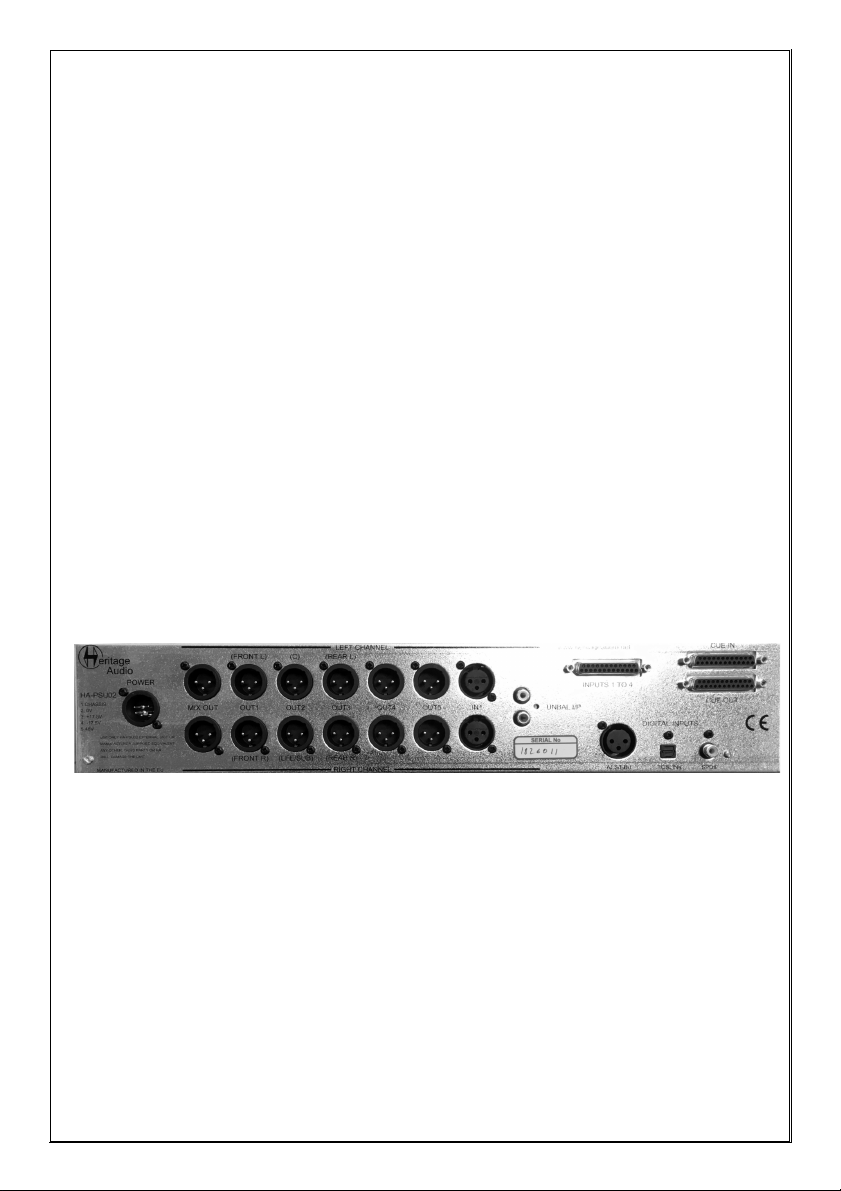
The RAM 5000 has all the permanent connections on the back of the main
unit as per the picture above.
All 3 DSUB 25 connectors follow the TASCAM protocol, and INPUT 1 is
duplicated on a pair of XLR connectors for ease of use.
Page 13
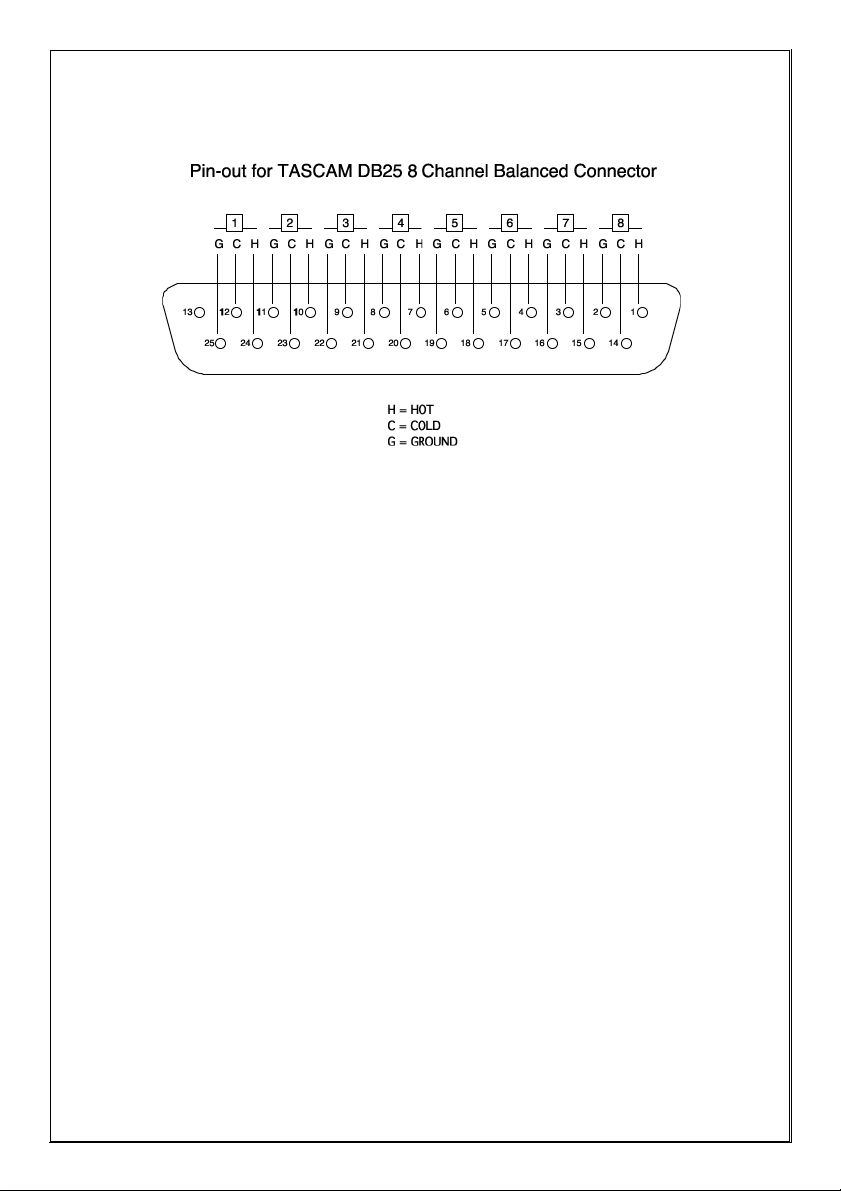
INPUTS 1-4/CUE1-4 IN/OUT:
13
1- Input / Cue IN/OUT 1L
2- Input / Cue IN/OUT R
3- Input / Cue IN/OUT 2L
4- Input / Cue IN/OUT 2R
All speaker outputs are on individual XLR connectors to avoid the need of
DSUB to XLR adaptors as in similar competing products.
The unbalanced input relies on RCA connectors, as it is specially designed to
integrate CD players or similar consumer level devices.
Integration of laptops, tablets, iPads and mobile devices are strongly
recommended via Bluetooth input. No more mini jacks!
5- Input / Cue IN/OUT 3L
6- Input / Cue IN/OUT 3R
7- Input / Cue IN/OUT 4L
8- Input / Cue IN/OUT 4R
Page 14

14
CALLIBRATION OF THE RAM SYSTEM 5000
The Heritage Audio RAM SYSTEM 5000 is calibrated to be unity gain from
input to output straight from the factory and therefore it does not require
further calibration. However, some 5.1 installers may suggest you to trim
some outputs (specially LFE) from the monitor controller. We strongly
suggest doing so on the power amps, but individual output trimmers are
accessible at the front panel of the unit via a small flat screwdriver. WE
STRONGLY SUGGEST LEAVING THEM ALONE AND RECALIBRATION IS NOT
COVERED BY WARRANTY.
PAIRING OF THE MAIN AND REMOTE UNITS
Both the main and remote units are programmed with unique ID codes
straight from the factory, so the form a unique pair. No other remote units
will pair with your main unit (or vice versa).
In case you are getting pairing (connecting) issues, please RESET both units as
follows:
- Main Unit Reset: Turn power off on both remote and main units.
Please power the main unit again, keeping the red RESET button
pressed for at least 3 seconds. Power off and on again.
- Remote Reset: Turn power off and power on again while pressing
SHIFT + OUT3. Confirm that you would like to reset by pressing OUT 3
again when asked. Turn off and on.
This simple process should restore the communication between main and
remote unit.
Page 15

DISCLAIMER
- Qualcomm is a trademark of Qualcomm Incorporated, registered in
the United States and other countries, used with permission.
- aptX is a trademark of Qualcomm Technologies International, Ltd.,
registered in the United States and other countries, used with
permission.
- AAC and Bluetooth® trademarks are the property of their respective
owners.
- Heritage Audio is a non-exclusive licensee of Qualcomm® aptX™
audio.
- Heritage Audio is a non-exclusive licensee of AAC.
15
Page 16

16
LIMITED 2 YEAR WARRANTY
Heritage Audio RAM SYSTEM 5000 is warranted by Heritage Audio SL to be
free from defects in materials and workmanship for the period of 2 years to
the original purchaser. In the event of such defects, the product will be
repaired without charge or, at our option, replaced with a new one if
delivered to Heritage Audio prepaid, together with a copy of the sales slip or
other proof of purchase date. The warranty excludes problems due to normal
wear, abuse, shipping damage or failure to use the product in accordance
with the specifications.
Heritage Audio shall not be liable for damages based upon inconvenience,
loss of use of the product, loss of time, interrupted operation or commercial
loss or any other damages, whether incidental, consequential or otherwise.
This warranty is not transferable.
www.heritageaudio.net
Alfonso Gomez 38. 3C.
28037 Madrid
Spain
 Loading...