

Page 1
Heinz Electrodynamic Designs
Type 20
Near- / Midfield Studio Monitor
Operation Manual
EN
Page 2
Heinz Electrodynamic Designs
Safety Instructions
Please read the following safety instructions carefully before setting up your system. Keep the instructions for subsequent reference. Please read the warnings and follow the instructions.
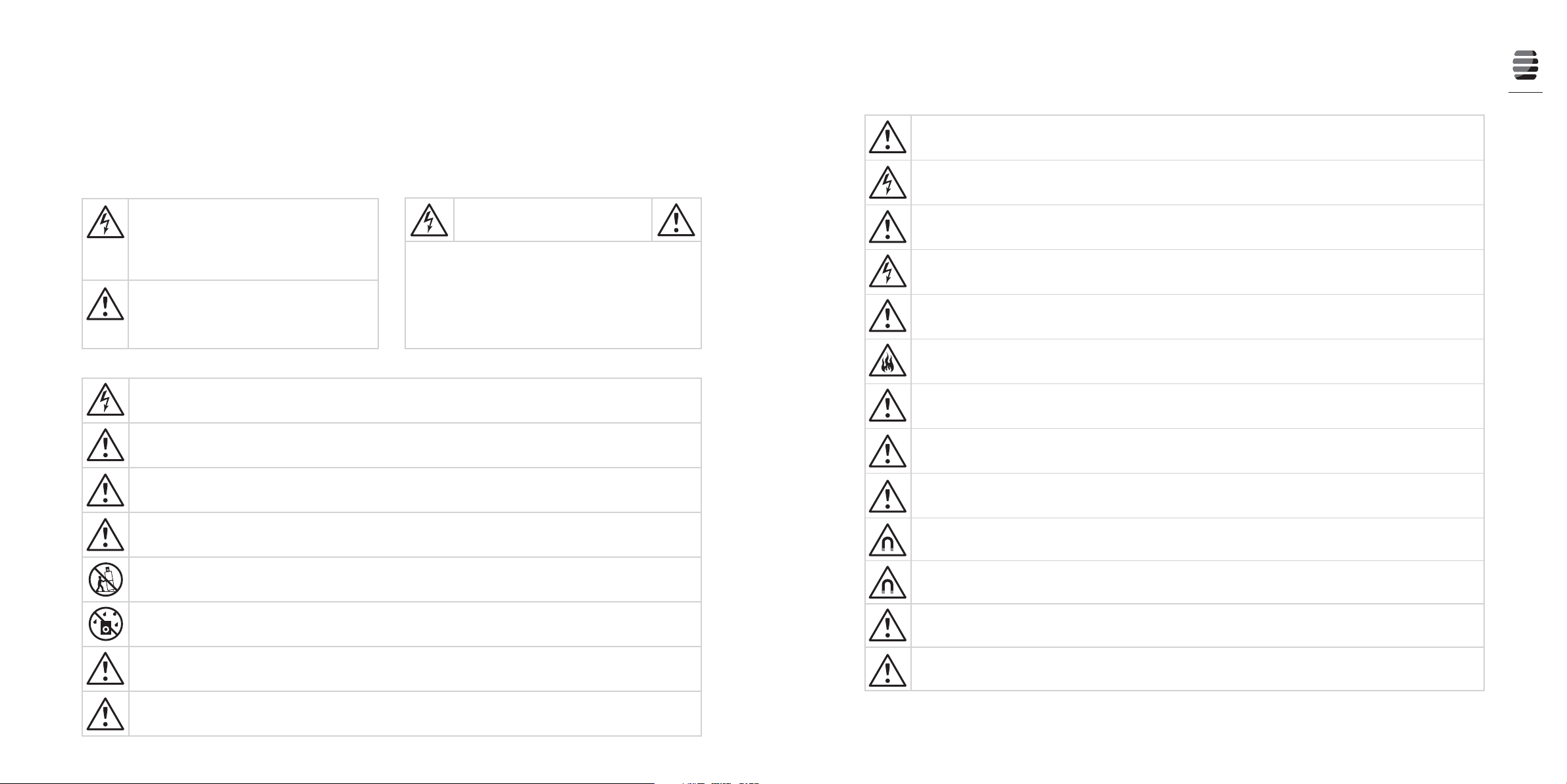
EXPLANATION OF GRAPHICAL SYMBOLS
The lightning flash with arrowhead symbol, within
an equilateral triangle, is intended to alert the user
to the presence of uninsulated “dangerous voltage” within the product’s enclosure that may be of
sucient magnitude to constitute a risk of electric
shock to persons.
The exclamation point within an equilateral triangle
is intended to alert the user to the presence of
important operating and maintenance (servicing)
instructions in the literature accompanying the
appliance.
To reduce the risk of an electric shock, do not open the loudspeaker yourself. Always refer to qualified service personnel.
This product must be connected with an IEC 60320 AC mains power cord (like the one we supplied).
TO REDUCE THE RISK OF FIRE OR ELECTRIC SHOCK, DO
NOT REMOVE THE BACK COVER OR ANY OTHER PART. NO
DO NOT EXPOSE THOS EQUIPMENT TO RAIN OR MOISTU-
RE. REFER SERVICING TO QUALIFIED PERSONNEL.
RISK OF ELECTRIC SHOCK!
USER-SERVICEABLE PARTS INSIDE.
CAUTION
DO NOT OPEN!
CAUTION
EN
Always keep electric equipment out of the reach of children.
Always unplug sensitive electronic equipment during lightning storms.
The monitor should be installed near the socket outlet and quick disconnection of the device should be easily possible.
To completely disconnect the speaker from the AC mains, physically disconnect the powercord.
Please try to avoid touching the speaker diaphragms. Always keep the woofer’s ventilation ports open.
Don't use the speaker at very high or low temperatures. The speakers back panel should not be exposed to direct sunlight.
Never operate this product in an explosive atmosphere.
High SPLs can irreparably damage your ears! Please take good care when running the speakers at high levels.
Make sure that the air can circulate behind the speaker as it needs sucient cooling.
Please switch o your audio system before connecting or disconnecting any cables to the speaker – also, if you intend to
clean the surface or single components. Never use flammable or combustible chemicals for cleaning audio components.
HEDD studio monitors are equipped with universal mains, meaning that the speakers work within a voltage range from
85–264V. This makes voltage switches unnecessary.
Do not place this unit on an unstable cart, stand or tripod, bracket or table. The unit may fall, causing serious injury and / or
serious damage.
This product should never be used outside. Avoid exposing it to rain or any sort of moisture.
Powercords and audio cables connected to this product should never be stepped on.
Please note that defective cables can harm your speakers and / or create humming, crackling, etc.
Always carry the speaker with the back panel facing to your body. Otherwise, the diaphragm of the woofer can be damaged,
which is not covered by the warranty.
The drivers of the speaker are NOT magnetically shielded! Keep away all items that are sensitive to magnetic fields, like magnetic tapes, credit cards, CRT monitors and so on.
Keep away Ferro-magnetic (steel, iron, etc.) objects from the tweeter like small screws, swarf and so on. The strong magnetic field of the tweeter can pull objects to the folded diaphragm. This can lead to permanent damage of the tweeter, which is
not covered by the warranty.
For cleaning the surface of the cabinet, we recommend to use a microfiber cloth and simply warm water. Don’t use any
aggressive detergent, as it will damage the finish. Always switch o the speaker before cleaning! For cleaning dust out of the
loudspeaker diaphragms, use a very soft brush.
If you need to send the speakers via a postal service, use the original packaging. It is the safest way to get them from A to B.
Page 3
Heinz Electrodynamic Designs
Introduction Controls
Heinz Electrodynamic Designs
Dear Customer,
UNPACKING AND CONNECTING
many thanks for choosing the HEDD Type 20 active nearto midfi eld studio monitor. You got yourself a powerful,
dynamic and ultra-transparent 3-way system, especially
suitable for
• in-depth stereo- and multichannel-mixing
• high-end recording
• broadcast applications and
• mastering
Whether as a full range audio monitor in an elegant
studio spaceor in a broadcast context, the Type 20 is an
ideal player in the most diverse fi elds of application. The
impressive technological facts alone speak for themselves: One 7” bass woofer, a dedicated 4”-midrange
woofer made of very sti Honeycomb-sandwich material,
Klaus Heinz’ latest version of the handmade Air Motion
Transformer tweeter, and nothing less than 3×300W of
ICEpower® amplifi cation create an ultra-wide frequency
range from 32Hz all the way up to 50kHz.
In addition to being super solid and having an extremely
high fi delity in the bass and mid range reproduction, the
HEDD AMT produces vivid and uncolored high frequency
material.
• Unpack the monitor carefully and give it an hour to acclimate to the temperature of your room
• Connect it to the power-socket
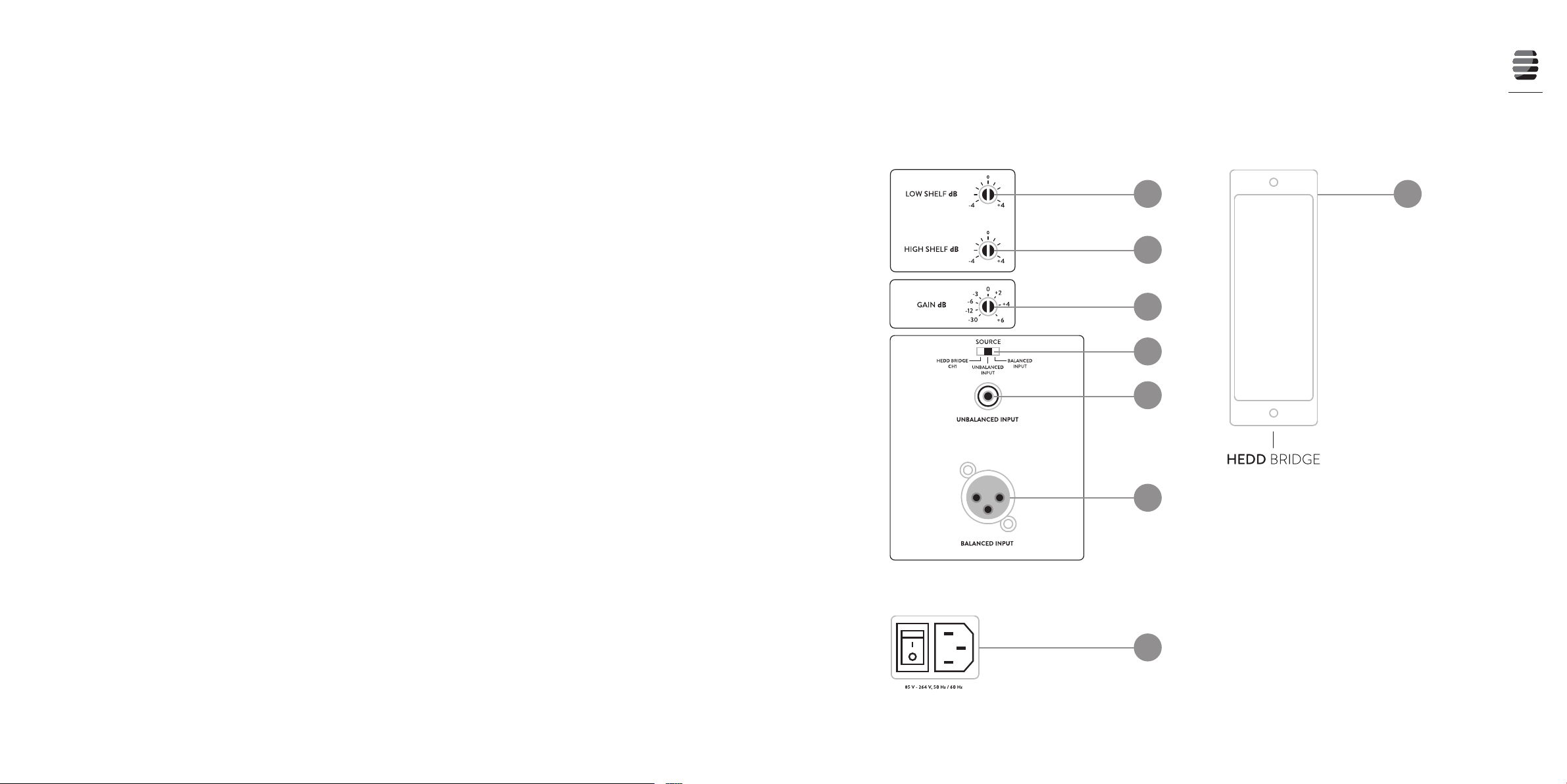
• Connect your audio source via the balanced XLR (6),
unbalanced RCA (5), or HEDD Bridge inputs (8), then
select the chosen input with the INPUT SOURCE
SWITCH on the back panel (4).
Every HEDD studio monitor is equipped with regulated
Universal Mains, working from 85V-264V. This means that
the amps will work at their full capacity under any voltage
condition. Plug and play – whereever you are.
GAIN (3)
The Gain control lets you adjust the overall volume of the
speaker in a range from -30dB to +6dB. You can use this
control to make the speaker work fl awlessly with your
other equipment or to compensate for any level di erences between the speakers, may they be caused by your
listening position, the room acoustics, or slight variations
of the control knob’s tolerance.
1 8
2
3
4
5
6
EN
EN
On the following pages, we would like to share with you
some tips and advice regarding the operation of this fi ne
product.
Thanks again, and enjoy your new speakers!
Klaus Heinz and the HEDD Team
SHELVING FILTERS (1 & 2)
Listening to these monitors can be a real joy, but depending on the acoustical properties of the room you are
working in, it might at times be di cult for the speakers
to unfold their rich sound quality. It is precisely for this
reason that we included two highly e cient shelvingfi lters (Low Shelf < 200Hz / High Shelf > 2kHz) that are
designed to overcome defi cient acoustics, typically found
in rooms with uneven geometries, hard (glass, stone) or
overly mu ed (carpets, curtains) surfaces.
7
Page 4
Heinz Electrodynamic Designs
Introduction
Heinz Electrodynamic Designs
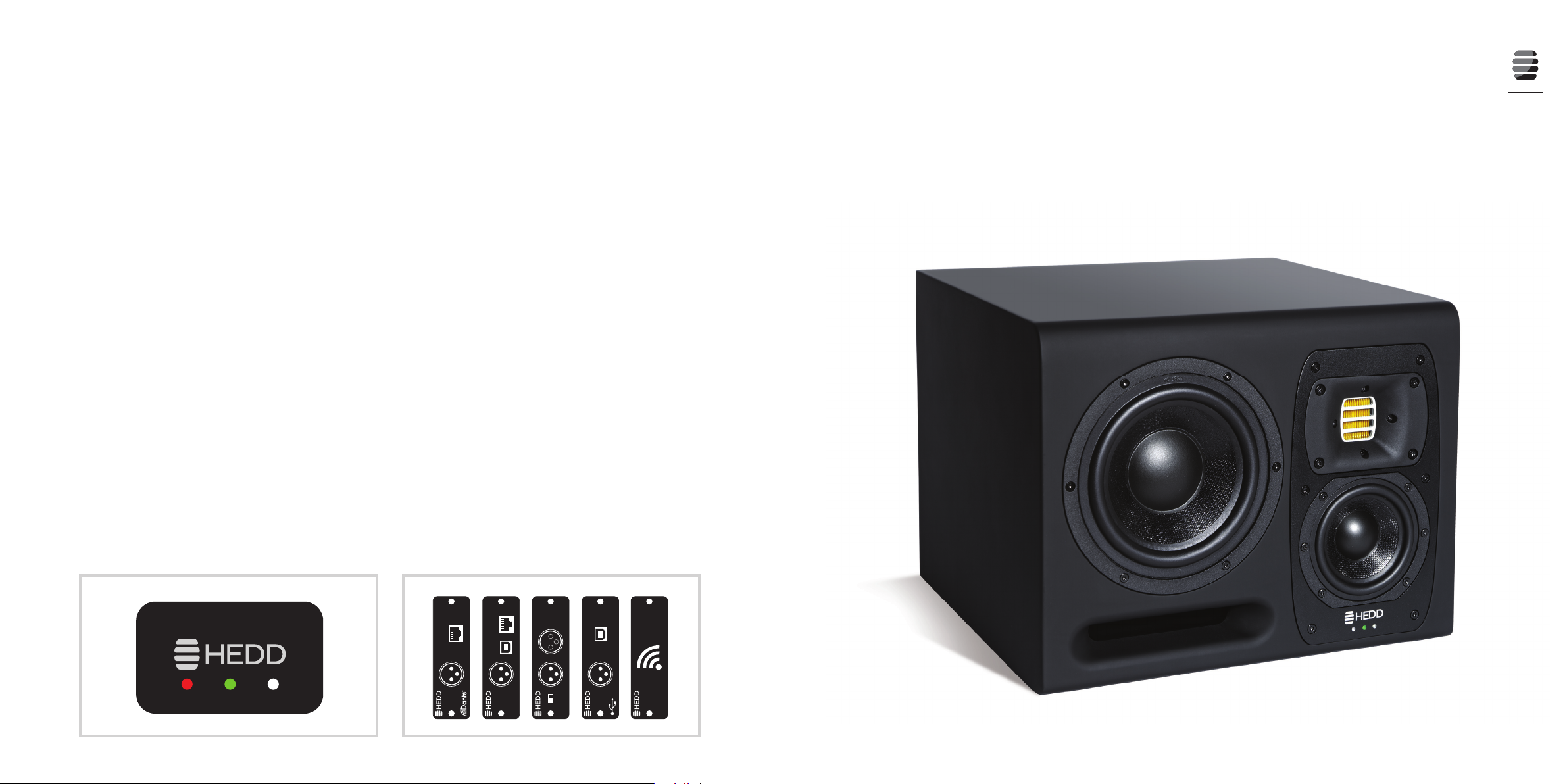
STATUS LEDs
On the front of your speaker, you can see a front LED
panel which will indicate its operational status in the following way:
• Red “OL”: lights up if the limiter circuit of the speaker
kicks in and protects the drivers from overloading
• Green “PWR / STBY”: normal operational power-on
status
• White “SYNC”: lights up if the speaker is synchronized
with a digital source (HEDD Bridge card)
The HEDD Bridge brings versatile digital input connectivity including two AoIP options to the world of professional
monitoring. For the fi rst time, it becomes possible for
studio monitors to be integrated into today’s most established audio network protocols: Audinate’s Dante and
Ravenna Network / AES67.
Here are a few examples of how loudspeakers can be used
in an AoIP environment:
• Directly connect a computer to the loudspeakers via a
CAT.6 Ethernet cable and stream high resolution audio
EN
EN
HEDD BRIDGE
The HEDD Bridge was inspired by the rather simple and
yet absolutely vital idea that our analog speakers should
feature a freely confi gurable system that, being located
on the back panel of each monitor, allows for the optional
integration of specifi c digital audio protocols. The HEDD
Bridge is nothing less than a modular system of input
cards that enables all HEDD monitors to fully handle
digital protocols such as USB2, AES3, Wireless and even
AES67 / Dante, that is Audio-over-IP. As a customer you
can either stay completely in the analog domain or can
choose the HEDD input module that fi ts your workfl ow
and audio environment in the best possible way.
• In complex multi-channel setups (like Dolby Atmos,
Auro 3D), multiple separate loudspeakers can be fed
with a single high-resolution audio stream and each one
of these speaker channels can be controlled individually
by software control applications
• Audio devices in di erent rooms or facilities (e.g. movie
theaters, conference rooms, live concerts and music
festivals) can be controlled from one or multiple workspaces connected to the Ethernet network
• AoIP will enable broadcast engineers to simplify the inhouse signal distribution in broadcast stations
B1-DANTE
BRIDGE
AES67
USB 2.0
CH2 OUT
7
AES6
B3-AES3
BRIDGE
B2-AES67
Dante
CH2 OUT
BRIDGE
B4-USB
DIG. THRU AES IN
L/R
BRIDGE
AES3/EBU
B5-WIRELESS
USB 2.0
CH2 OUT
BRIDGE
Page 5
Heinz Electrodynamic Designs
Speaker Placement
Heinz Electrodynamic Designs
HEDD Air Motion Transformer
- Design and Principle -
N
S
Pole plate
(back)
Pole plate
(front)
Neodyme
magnet
Magnetical
yoke
Aluminum
conductor
Diaphragm
Heinz Electrodynamic Designs
HEDD Air Motion Transformer
- Design and Principle -
HEDD Air Motion Transformer
EN
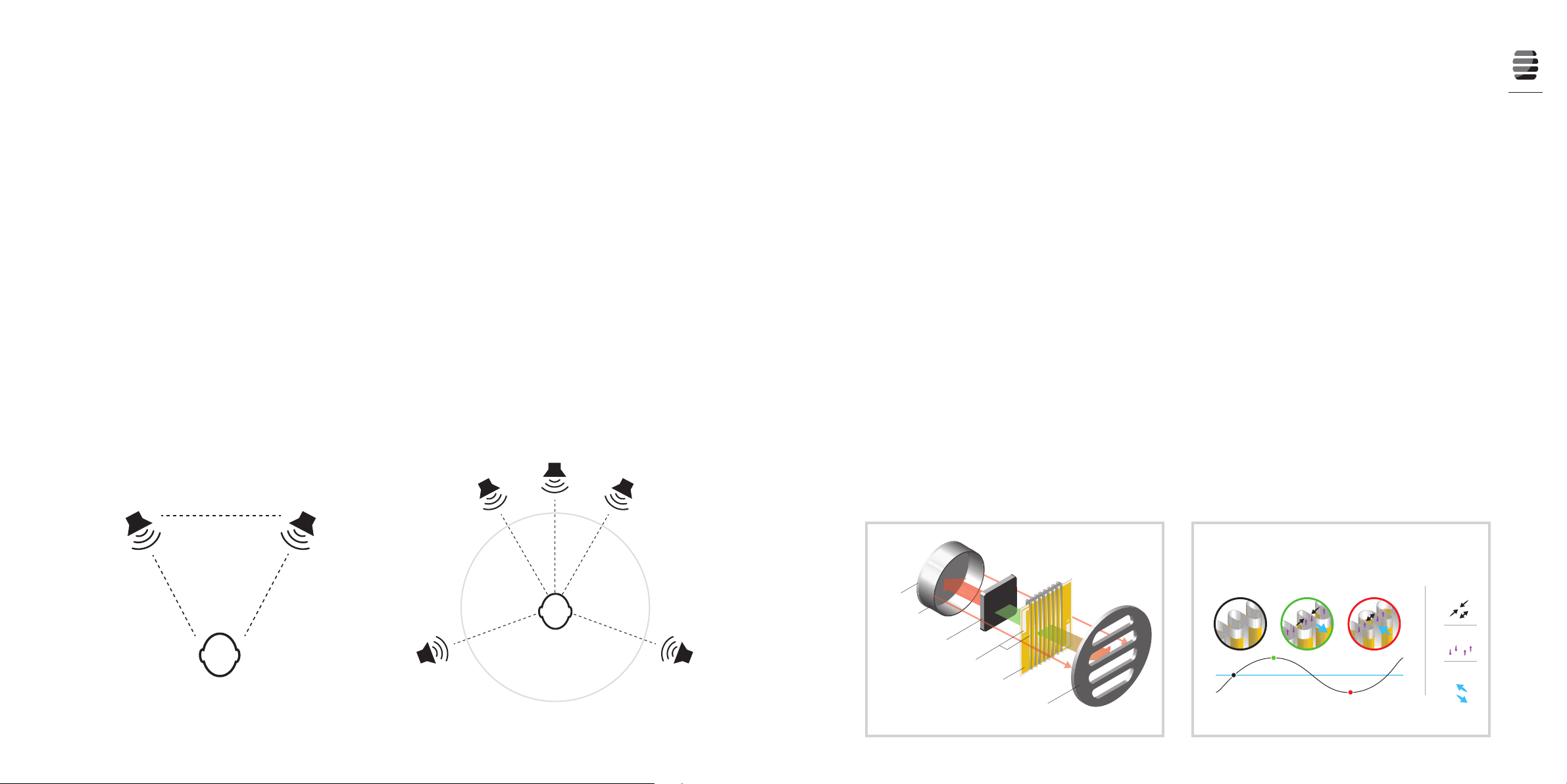
STEREO POSITIONING
In a stereo setup the speakers should be placed horizontally and facing towards you. The tweeters should match
the height of your ears. This is the best way to perceive
the intended character of the monitor. For optimizing
your listening position, place the two speakers so that
they form an equilateral triangle with your listening
position (see fi gure below). This position should be an
imaginary center point between the two speakers. Play
a recording that you are familiar with and try playing
around with adjusting the distance of the speakers and the
distance of your listening position accordingly. Stop when
you think that you hear an authentic stereo panorama.
Trust your ears, they are your best friend.
SURROUND POSITIONING
Place the speakers in a circle around your listening position and work with the following angles: Center 0°, Front/
Right 30°, Rear/Right 110°, Rear/Left 250° and Front/
Left 330°. The surrounding walls should be at least 40cm
away from every speaker to avoid early refl ections. We
recommend that you use the same type of speaker for
every channel (except the subwoofer, of course), because
otherwise you can run into negative frequency and/or
phase coloration. Check out the ITU recommendation
BS.2159-4 for a detailed explanation.
CENTER
30°
30°
110°
110°
HEDD studio monitors are equipped with a special tweeter
design that - based on a brilliant idea by the GermanAmerican physicist Oskar Heil - was introduced to the
professional audio world by HEDD founder Klaus Heinz. It
is called the Air Motion Transformer (AMT).
Unlike the vast majority of tweeters (electro- and magnetostatic designs, cones, domes), which move the air in a
1 : 1 ratio (diaphragm velocity equals the air velocity),
the Air Motion Transformer is based on a folded elastic
diaphragm, where the single folds open and close in an
alternating pattern and thus breathe the air in and out. The
air driven through the folds is accelerated to a 4 : 1 ratio,
meaning that the air fl ow is four times as fast as the single
moving fold (see fi gure). This is a huge advantage when it
comes to reproducing musical signals with fast transients
/ short attacks such as cymbals, voices or plugged guitar
strings.
Pole plate
(back)
Magnetical
yoke
Neodyme
magnet
Aluminum
conductor
N
Diaphragm
S
Another aspect of this fascinating design has to do with
the actual diaphragm area and its importance for the
dynamic range of the transducer. In a cone-like design,
the cone itself is the acoustically active area – and this is
true for pretty much all other drive units. The diaphragm
of the HEDD Air Motion Transformer, however, is folded
into the 3rd dimension, meaning that a signifi cantly larger
foil can be used. That way, the acoustically e ective area
of the diaphragm is increased by a factor of more than 2.5,
resulting in an increased dynamic output and a much wider
disperson.
In their new monitor designs, HEDD introduces an even
further improved version of the AMT. A strong magnetic
fi eld lowers distortion and intermodulation while a special
waveguide is used to reach lower crossover frequencies,
which is crucial for shaping the midrange of 2- and 3-way
studio monitors.
Zero crossing Positive halfwave Negative halfwave
t
Lorentz
force
Direction
of current
Accelerated
air flow
Pole plate
(front)
Page 6
Heinz Electrodynamic Designs
Frequency Response
Troubleshooting
EN
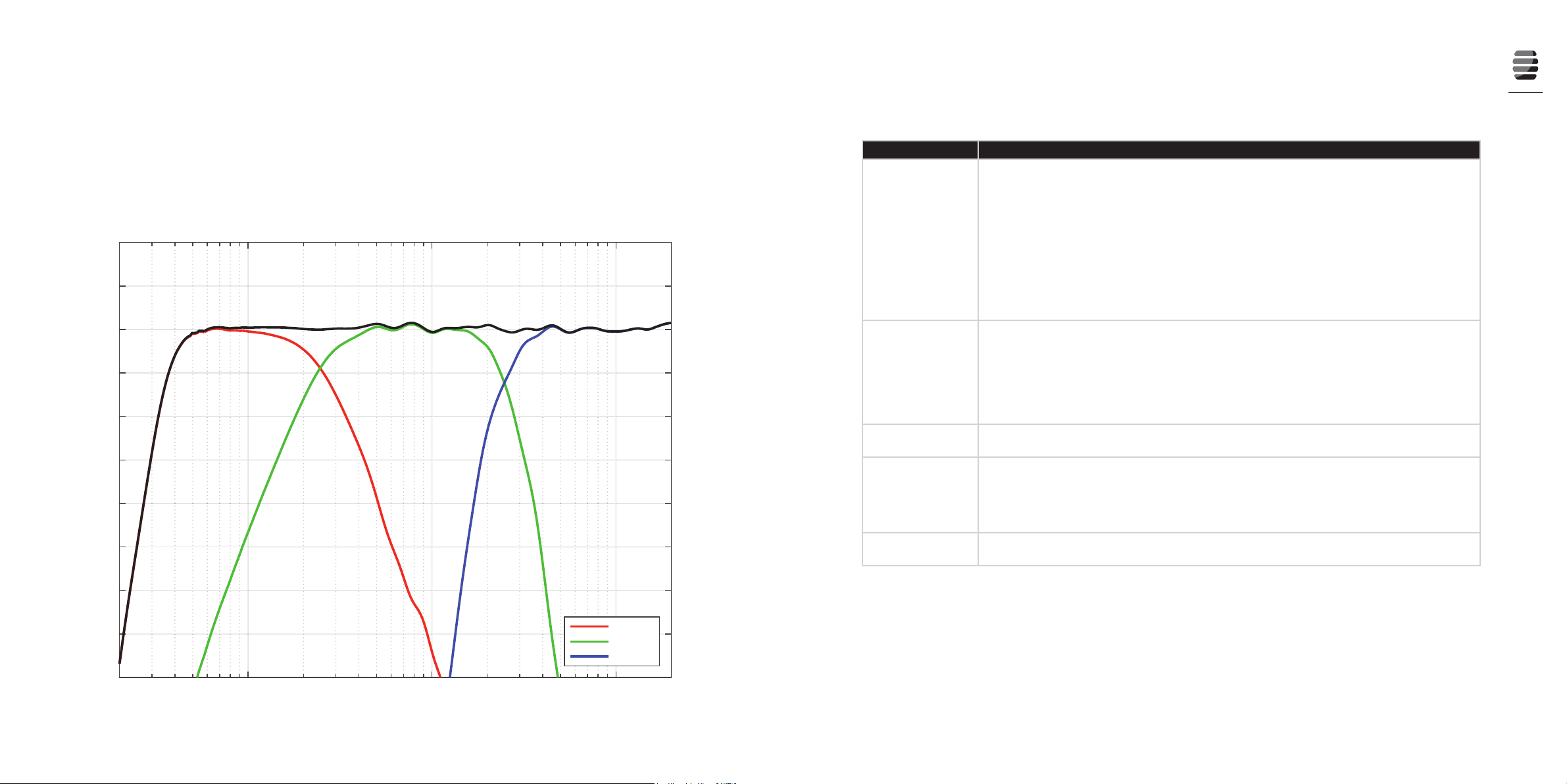
The individual responses of the woofers, midrange and tweeter drivers as well as the overall frequency response of the loudspeaker is depicted here.
Type 20 On-Axis Free Field Frequency Response
100
95
SP L
90
85
80
75
70
65
Problem Solution
“ON” LED lights
green but no audio
output
Hum, buzz and noise Disconnect all signal cables. If the noise is gone, check your audio cables and the equipment in
“OL” LED lights up
constantly
“SYNC” LED lights
up but no audio
Speakers vary in
volume
Check the wiring and make sure that all cables are working and connected correctly.
Check if you have selected the correct input via the SOURCE switch on the back panel of the
speaker.
Connect an audio source directly to the speaker. If you do hear audio now, the malfunction is in
your signal path.
If the back panel of the speaker is very hot, it may be that the internal thermal protection of the
amplifi ers has shut down the audio output to prevent electrical damage. Turn the unit o , let it
cool down and repower.
your signal path.
Check if you have any electrical devices that potentially produce high amounts of RFI (cellphones, switching power supplies, radio equipment) sitting next to your speakers.
Try to connect the speakers to a di erent power socket.
Reduce the input audio level either on the source or with the help of the GAIN control.
Check if you have selected the HEDD BRIDGE input via the SOURCE switch on the back panel
of the speaker.
Check if you have routed the audio source correctly to the HEDD BRIDGE output of your
HEDD Bridge extension card.
Use the GAIN control to compensate for any level di erences.
Sensitivity @ -11 dBu and "0 dB" GAIN @ 1m in dB
60
55
50
Woofer
Midrange
Tweeter
100 1k 10k
Frequency in Hz
All our products comply with RoHS and WEEE.
This product has a 2-year-warranty. Contact us or visit our
website for warranty information.
hedd.audio
Page 7
Technical Data
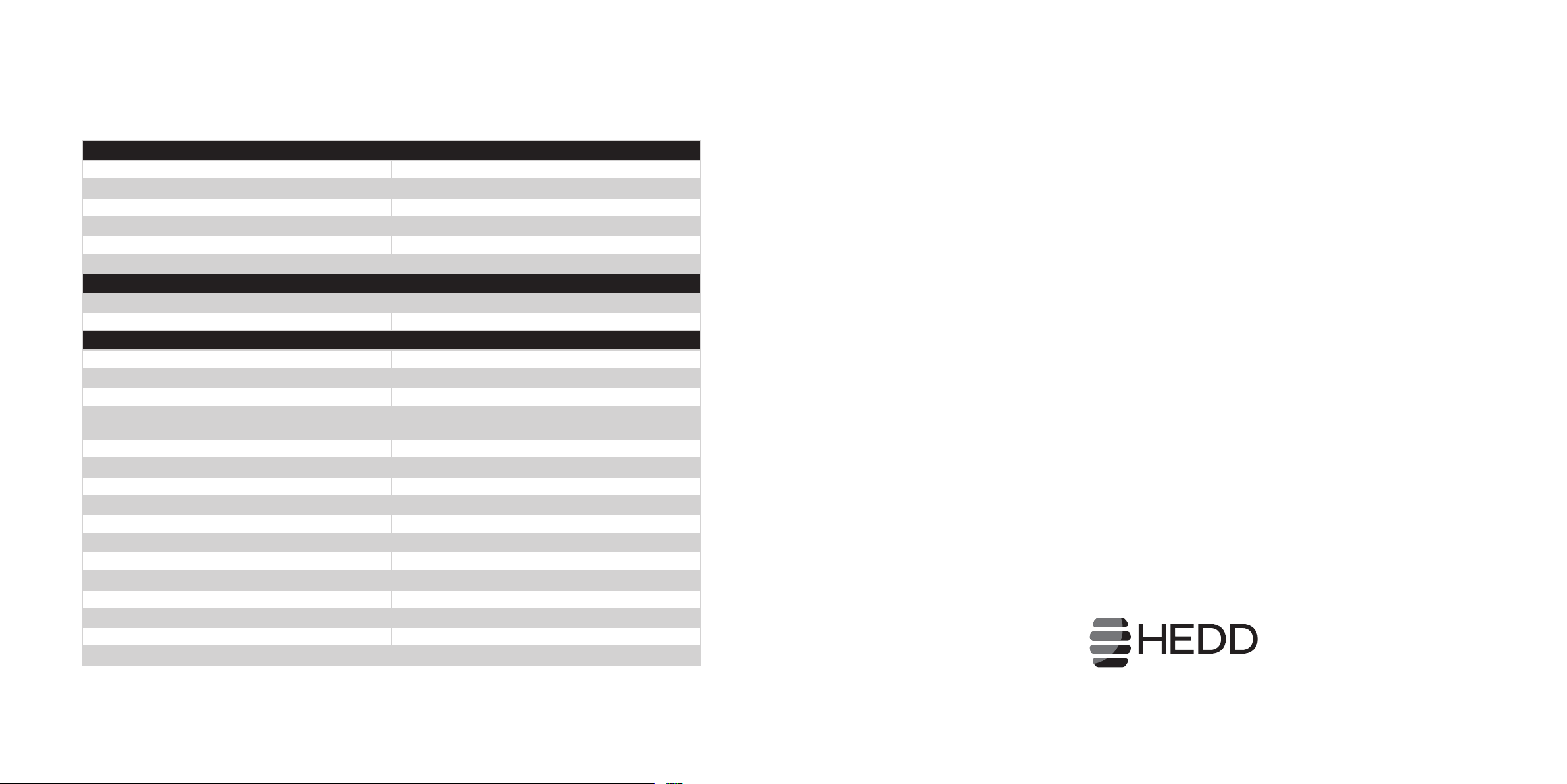
Drivers
Woofer 7” (182mm) Ultra Honeycomb Composite
Voice coil Ø 2” (50mm)
Midrange 1 x 4“ (120mm) Ultra Honeycomb Composite
Voice coil Ø 1.25“ (32mm)
Tweeter 1x HEDD AMT (HEDD Air Motion Transformer)
Equiv. Diaphragm Ø 2.2” (56mm)
Input connectors
Analog balanced/ unbalanced XLR / RCA
Digital/HEDD Bridge Options AES67 Ravenna, Dante, AES3/EBU
General data
Amplification (ICEpower®) 3 x 300W
Sensitivity 218 mVrms (-11 dBu) / 90 dB SPL / 1m at 0 dB GAIN
Input gain -30dB … +6dB
Maximum input level (balanced / unbalanced) 6Vrms (+17.8dBu, +17.6dBV) / 4.5Vrms (+15.3dBu,
+13.0dBV)
High Shelf EQ > 2kHz ±4dB at 20kHz
Low Shelf EQ < 200Hz ±4dB at 50Hz
Frequency response 32Hz–50kHz
Frequency response ± 1.5dB 40Hz - 20kHz
THD 90dB/1m > 100Hz ≤0.5 %
Max SPL sine wave 100Hz - 3kHz /1m ≥110dB
Max SPL peak per pair at 1m ≥120dB
Crossover frequency 250Hz / 2.5kHz
Input impedance (balanced / unbalanced) 10kΩ / 47kΩ
Weight 15kg
Height x Width x Depth 280mm x 358mm x 338mm
Warranty 2 years
Heinz Electrodynamic Designs
The information and data contained in this manual is subject to change without prior notice.
HEDD Audio GmbH | Ringbahnstr. 32–34 | 12099 Berlin | GERMANY
[email protected] | www.hedd.audio | +49(0)30 720 134 70
 Loading...