

Page 1
INSTALLATION AND OPERATION
INSTRUCTIONS
Í
AUSTRALIAN GAS ASSOCIATION APPROVED
MODEL: SL-350TRSI-AUE
Approval Number 5666
THIS MANUAL MUST BE USED FOR INST ALLATION AND RET AINED
BY HOMEOWNER FOR OPERA TION AND MAINTENANCE.
HEAT & GLO, a brand of Hearth & Home Technologies Inc.
20802 Kensington Boulevard, Lakeville, MN 55044 USA
www.heatnglo.com
THIS PRODUCT MAY BE COVERED BY ONE OR MORE OF THE FOLLOWING P ATENTS:
(United States) 4593510, 4686807, 4766876, 4793322, 481 1534, 5000162, 5016609, 5076254, 51 13843, 5191877, 5218953, 5263471, 5328356, 5341794, 5347983, 5429495, 5452708, 5542407,
5601073, 5613487, 5647340, 5688568, 5762062, 5775408, 5890485, 5931661, 5941237, 5947112, 5996575, 6006743, 6019099, 6048195, 6053165, 6145502, 6170481, 6237588, 6296474,
6374822, 6413079, 6439226, 6484712, 6543698, 6550687, 6601579, 6672860, 6688302B2, 6715724B2, 6729551, 6736133, 6748940, 6748942, D320652, D445174, D462436; (Canada) 1297749,
2195264, 2225408;
(Australia) 543790;586383; (Mexico) 97-0457; (New Zealand) 200265;
or other U.S. and foreign patents pending.
Heat & Glo • SL-350TRSI-AUE • 2089-902 Rev. B • 6/06
1
Page 2

PLEASE READ THIS MANUAL BEFORE INSTALLING
AND USING THIS APPLIANCE.
MODEL SL-350TRSI-AUE
IS AUSTRALIAN GAS ASSOCIATION
APPROVED FOR NATURAL GAS OR
PROP ANE AS A BALANCED FLUE
HEATER.
Refer to the appliance data plates for gas
consumptions and pressures.
Í
Installation of this appliance should only be
carried out by an authorized person in accordance with the manufacturer's instructions. Appliance is to be inst alled in full compliance with the National Gas Installation
Standard AS5601, the manufacturer's instructions, and any local authorities' requirements for gas, electrical and building regulations.
This appliance and its components are
tested and safe when installed in accordance with this Installation Manual. Report
to your dealer any parts damaged in shipment, specifically check glass condition. The
gas logs and flue system components are
in separate packages. Read all instructions
before starting installation and follow these
instructions carefully during installation to
ensure maximum benefit and safety. Failure to follow them will void your warranty and
may present a fire hazard.
The Heat & Glo, a brand of Hearth & Home
T echnologies Inc. warranty will be voided by ,
and Heat & Glo, a brand of Hearth & Home
T echnologies Inc. disclaims any responsibility for the following actions:
• Installation of any damaged heater or
flue system component
• Modification of the heater or balanced
flue system installation other than as
instructed by Heat & Glo, a brand of
Hearth & Home T echnologies Inc.
• Improper positioning of the gas logs or
the glass door
• Installation and/or use of any component
part not manufactured or approved by
Heat & Glo, brand of Hearth & Home
T echnologies Inc., not withstanding any
independent testing laboratory or other
party approval of such component part
or accessory .
IMPORTANT: Read all instructions carefully before starting installation.
Failure to follow these installation instructions may result in a possible fire
hazard and will void the warranty. Save this Manual for future reference.
Heat & Glo, a brand of Hearth & Home Technologies, Inc.
20802 Kensington Blvd., Lakeville, MN 55044, USA
Copyright 2006 • Printed in U.S.A.
2
Heat & Glo • SL-350TRSI-AUE • 2089-902 Rev. B • 6/06
Heat & Glo Quality Systems
registered by SGS ICS
Page 3

TABLE OF CONTENTS
1.0 Installation Instructions.........................................................................................5
1.1 Introduction................................................................................................... 6
Í
1.2 Flue System Approvals and Installation .........................................................8
1.3 Connecting the Gas Supply ........................................................................22
1.4 Ignition System Wiring................................................................................ 23
1.5 Blower Fan.................................................................................................24
1.6 Finishing .................................................................................................... 25
1.7 Installer T esting ........................................................................................... 26
Í
1.8 Log Placement...........................................................................................27
2.0 Operating Instructions ....................................................................................... 30
2.1 Safety and Lighting Information................................................................... 31
2.2 Fan Operation ............................................................................................32
3.0 Servicing and Maintenance...............................................................................32
3.1 Removal of Covers for Servicing ................................................................33
3.2 Removal of Components for Service ..........................................................33
3.3 Parts Replacement.....................................................................................3 3
3.4 Adjustments and Replacement Parts ..........................................................33
3.5 Troubleshooting.......................................................................................... 34
Í
4.0 Replacement Parts ........................................................................................... 35
Limited Warranty...............................................................................................37
Heat & Glo • SL-350TRSI-AUE • 2089-902 Rev. B • 6/06
3
Page 4

11-3/8 in.
(289mm)
22-3/4 in.
(577mm)
41-3/4 in.
(1060mm)
21-3/8 in.
(542mm)
5-5/8 in.
(144mm)
FLUE COLLAR
COVER PLATE
GAS LINE
ACCESS
2-1/8 in.
(55mm)
15-7/8 in.
(402 mm)
30 in.
(764mm)
24 in.
(610mm)
28-1/8 in.
(714mm)
33 in.
(837mm)
TOP STAND OFFS
Ø6-5/8 in.
(167mm)
15-1/8 in.
(384mm)
8-3/4 in.
(223mm)
16-3/8 in.
(414mm)
ELECTRICAL
ACCESS
3-1/ 2 in.
(90mm)
Ø8 in.
(203mm)
30-5/8 in.
(777mm)
6-7/8 in.
(175mm)
GAS
ACCESS
Í
Figure 1. Diagram of SL-350TRSI-AUE
4
CONTROLS
( BEHIND DOOR)
Heat & Glo • SL-350TRSI-AUE • 2089-902 Rev. B • 6/06
GAS
HOOD
RATING PLATE/LABELS
( BEHIND DOOR)
BOTTOM
ACCESS DOOR
ELECTRICAL
ACCESS
Page 5
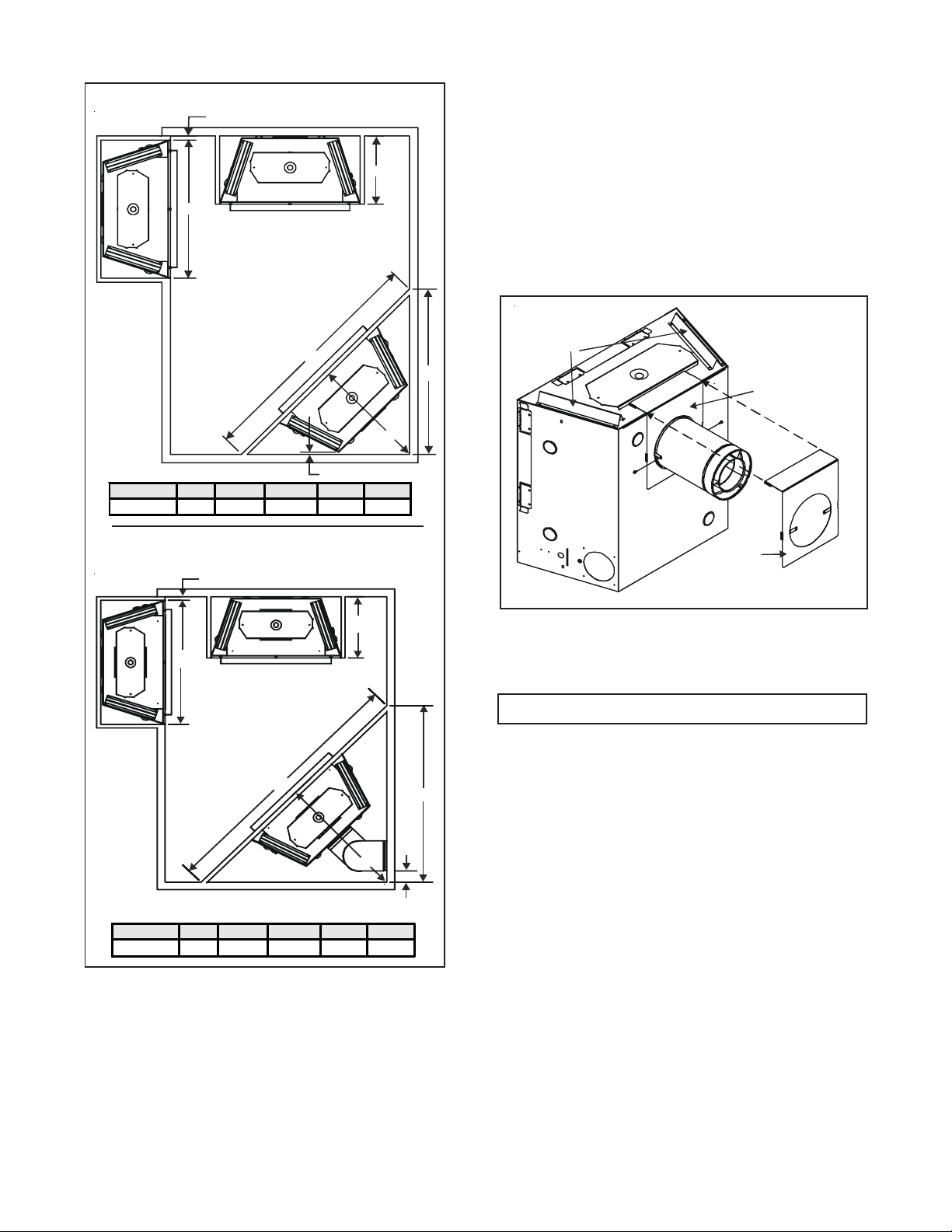
Top Flue
1in. Min. (25mm)
Clearance Requirements
The top and back of fireplace are defined by stand-offs.
The heat shield must be attached as shown if combus-
B
tible materials are placed directly on top standoffs (Figure 3).
Millimeter
Rear Flue
A
E
½ in. Min (13mm)
A B C D E
837 413 728 1001 1416
1 in. MIN. (25mm)
B
The minimum clearance to a perpendicular wall extending past the face of the fireplace is 25mm.
The back of the fireplaces may be recessed into combustible construction, as shown above.
TOP
STANDOFFS
D
C
HEAT SHIELD
INSTALLED
HEAT SHIELD
Figure 3. Heat Shield
A
Millimeter
E
C
1 in. MIN. (25mm)
A B C D E
837 413 843 1192 1686
D
Figure 2. Fireplace Dimensions, Locations, and
Space Requirements
1.0 INSTALLATION INSTRUCTIONS
NOTE: Not intended for fireplace insert.
In planning the installation for the heater it is necessary
to determine where the unit is to be installed, the type
of flue system to be used (straight out, corner, or elevated), and whether optional accessories (wall switch
or remote control) are desired. Gas supply piping should
also be planned. Refer to the appliance data plate on
the base pan of the heater for all gas pressures and
input rate information.
The heater can be mounted on any of the following surface:
1. A flat surface (minimum 6mm base).
2. Four (4) corner supports.
(Example: Four (4) concrete masonry blocks). These
supports must be positioned so they contact all four (4)
perimeter edges on the bottom of the unit.
Heater framing can be built before or after the heater is
set in place. Framing should be positioned to accommodate wall covering and heater facing material. The
heater framing should be constructed of 2" X 4" (51 x
102mm) lumber or heavier. The framing headers may
rest on the heater standoffs. Refer to Figure 2 and Figure 4 for heater and framing reference dimensions.
Heat & Glo • SL-350TRSI-AUE • 2089-902 Rev. B • 6/06
5
Page 6
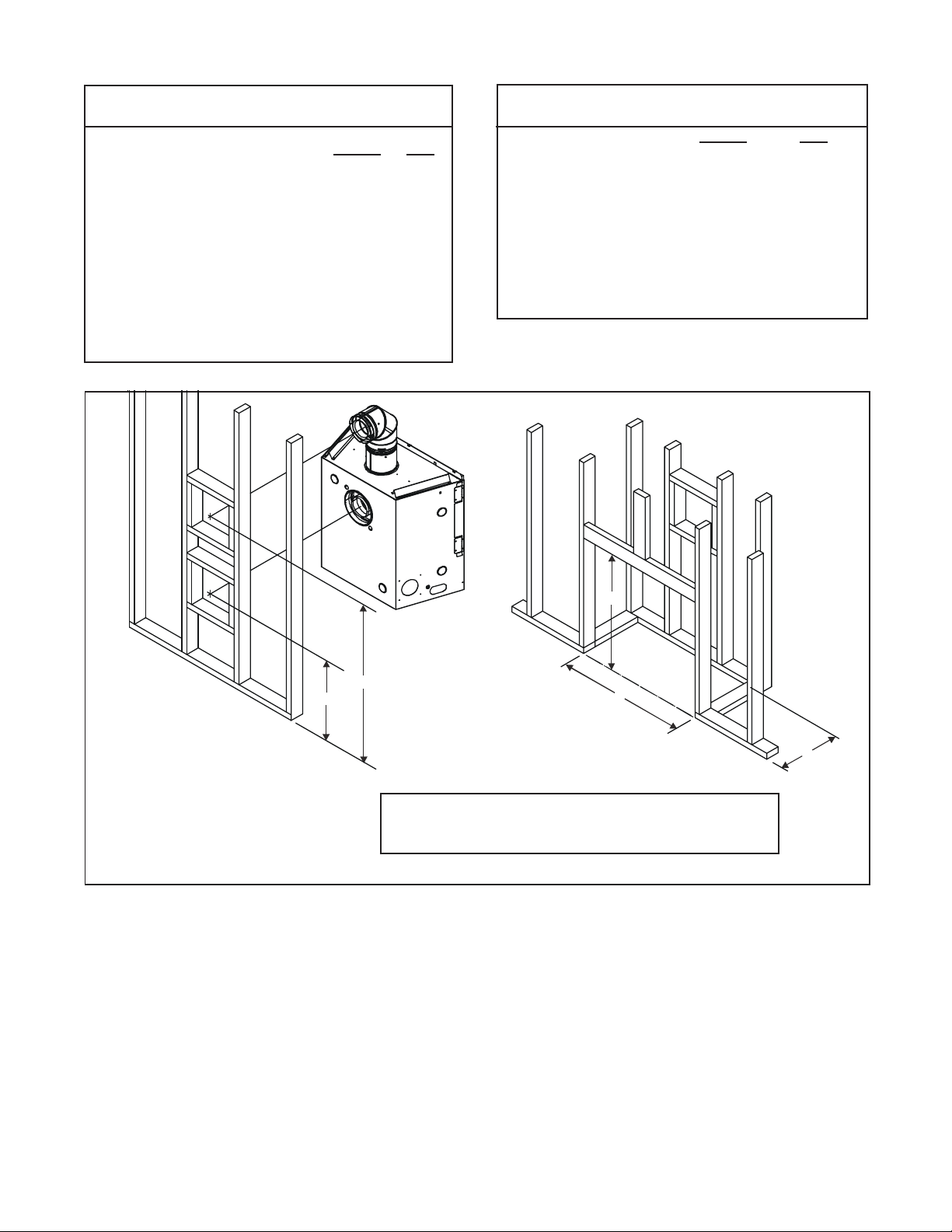
Minimum Clearances
from the Fireplace to Combustible Materials
Inches mm
Glass Front...................................... 36........ 914
Floor .................................................0........... 0
Rear ................................................ 1/2 ........ 13
Sides .............................................. 1/2 ..... .. . 13
To p ................................................1 1/2....... 38
Ceiling* ............................................31........ 787
*The clearance to ceiling is measured from the top
of the unit, excluding the standoffs (see Figure 34).
Minimum Clearances
from the Vent Pipe to Combustible Materials
Inches mm
Vertical Sections. ............. 1 ................ 25
Horizontal Sections
Top ..................................... 3 ................ 75
Bottom ............................... 1 ................ 25
Sides ................................. 1 ................ 25
At Wall Firestops
Top ..................................... 3 ................ 75
Bottom ............................... 1 ................ 25
Sides ................................. 1 ................ 25
For minimum clearances, see the direct vent termination clearance in Figure 5.
D
E
Framing should be constructed
of 2 X 4 lumber or heavier.
*NOTE: The center of the framing hole
is one inch (254mm) above the
center of the horizontal flue pipe.
The framing headers
fireplace stand-offs.
ABCD*E*
34" 30-5/8" 16 1/2" 41-3/4" 21-1/4"
(864mm) ( 778mm) (419mm) (1060mm) (540mm)
Figure 4. Framing Dimensions
CAUTION: Measure heater dimensions, and verify
framing methods and wall covering details before framing construction begins.
1.1 INTRODUCTION
This model is designed to operate with all combustion air being siphoned from the outside of the building and all exhaust gases expelled to the outside of
the building.
WARNING: THIS UNIT IS NOT FOR USE WITH
SOLID FUEL.
These units MUST use the flue termination described
in the flueing section of the manual.
may rest on the
The control system for this model is an electronic ignition type. It consists of a gas control valve/variable regulator, a pilot/sensor/electrode and an ON/OFF switch.
The controls are located behind the access door. Rotate the door down to open. See Figure 1.
Minimum inlet gas supply pressure for purpose of input adjustment is 4.5 inches w.c. (1.13kPa) for natural
gas and 11 inches w.c. (2.75kPa) for propane. Manifold (outlet) pressures should be set at 3.5 inches w.c.
(.8kPa) for natural gas models and 9.5 inches w.c.
(2.36kPa) for propane models.
B
A
C
6
Heat & Glo • SL-350TRSI-AUE • 2089-902 Rev. B • 6/06
Page 7
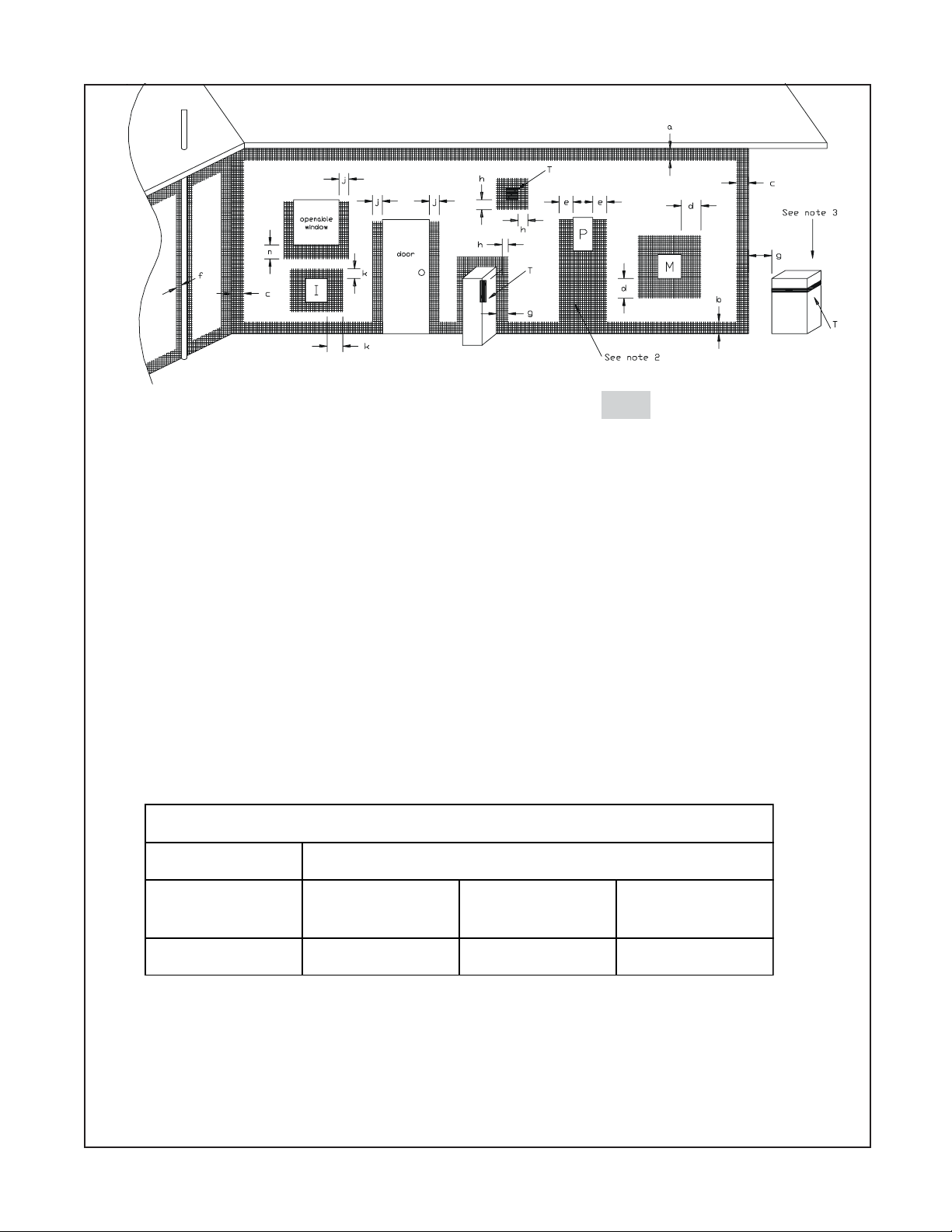
T = Flue terminal M = Gas meter Shading indicates prohibited
I = Mechanical air inlet P = Electricity meter or fuse box areas for flue terminals
a - Below eaves, balconies or other projections: MIN. CLEARANCE (mm)
Appliances to 50 MJ/h inpu t ................................................................................................ 30 0
Appliances over 50 MJ/h input ............................................................................................ 500
b - From the ground or above a balcony...................................................................................... 300
c - From a return wall or external corner ..................................................................................... 500
d - From a gas meter (M) ...........................................................................................................1000
e - From an electricity meter or fuse box (P) ............................................................................... 500
f - From a drain or soil pipe......................................................................................................... 150
g - Horizontally from any building structure (unless appliance approved
for closer installation) or obstruction facing a terminal......................................................... 500
h - From any other flue terminal, cowl, or combustion air intake ............................................... 500
j - Horizontally from an openable window, door, non-mechanical air
inlet, or any other opening into a building, with the exception of
sub-floor ventilation:
Appliances up to 150 MJ/h input ......................................................................................... 500
Appliances over 150 MJ/h input ........................................................................................ 1500
k - From a mechanical air inlet, including a spa blower ......................................................... 1500
n - Vertically below an openable window, non-mechanical air
inlet or any other opening into a building, with the exception of ................................. See table
sub-floor ventilation ............................................................................................................. below
CLEARANCES 'n' (mm)
Space heaters All other appliances
Up to 50 MJ/h
input
150 500 1000 1500
UP to 50 MJ/h
input
Over 50 MJ/h &
up
to 150 MJ/h
NOTES: 1. All distances are measured vertically or horizontally along the wall to a point
in line with the nearest part of the terminal.
2. Prohibited area below electricity meter or fuse box extends to ground level.
3. See clause 5.13.6.6 for restrictions on a flue terminal under a roofed area.
4. See Appendix J, Figure J1(a) and J2(a) for clearances required from a flue
terminal to a LP Gas cylinder. A flue terminal is considered to be a source of ignition.
MINIMUM CLEARANCES REQUIRED FOR BALANCED FLUE TERMINALS
OR THE FLUE TERMINALS OF OUTDOOR APPLIANCES
Figure 5.
Heat & Glo • SL-350TRSI-AUE • 2089-902 Rev. B • 6/06
Over 150 MJ/h
input
7
Page 8
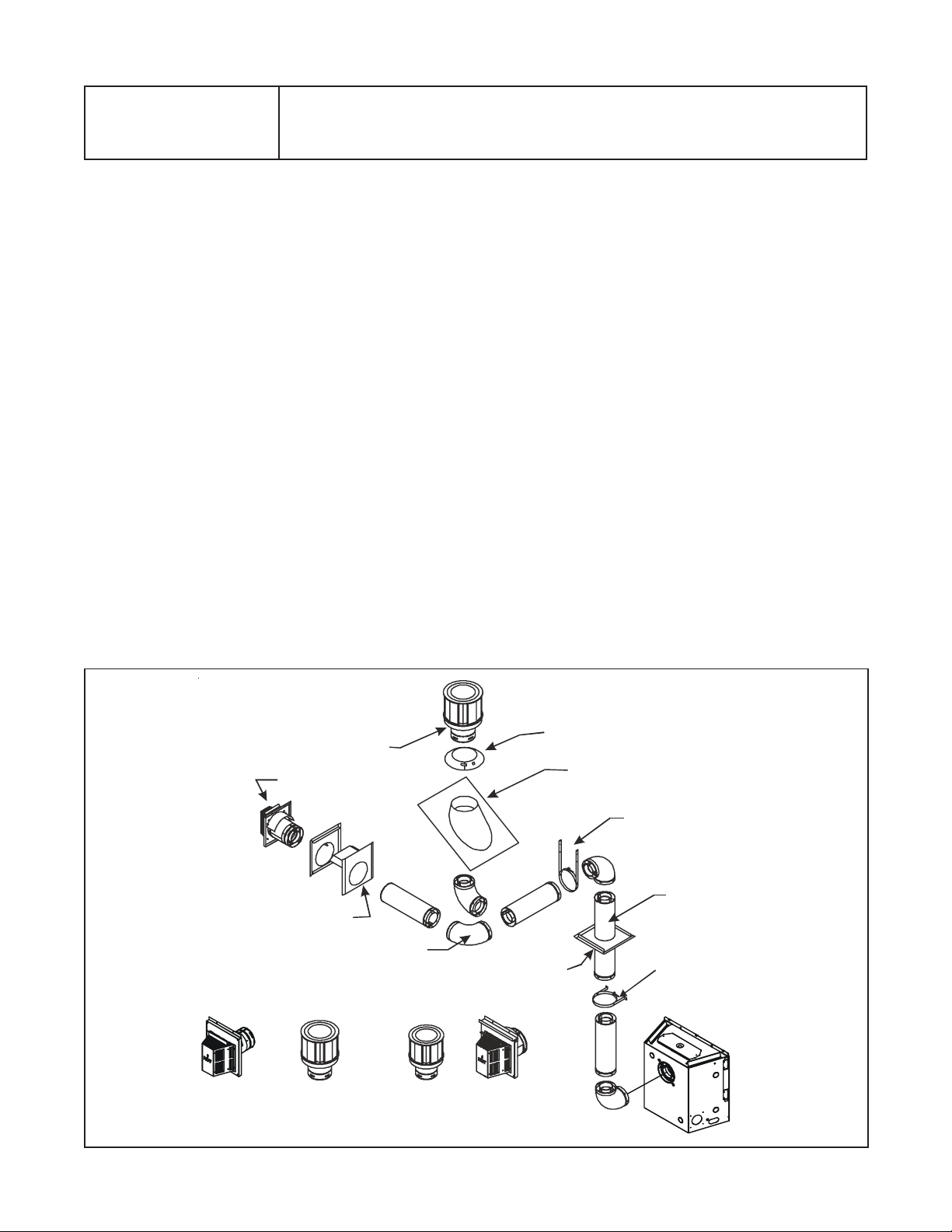
TABLE 1
V
MODEL
SL-350TRSI-AUE
DVP-TRAP2 & SLK-01TRD HORIZONT AL TERMINA TION CAP
DVP-TVHW & SLK-991DA VERTICAL TERMINATION CAP
1.2 FLUE SYSTEM APPROVALS
These models have flue starting collars on both the top
and the back of the unit. Depending upon the installation, decide which ONE set of starting collars will be
used to attach the flue system. The starting collar sealing
cap must remain on the starting collar NOT used.
These models use SL-D-series direct flue components
when using the TOP flue collars and DVP-series direct
flue components when using the REAR flue collars.
WARNING: YOU MUST NOT MIX DVP-SERIES
AND SL D-SERIES COMPONENTS IN ANY FLUE
SYSTEM CONFIGURA TION.
Approved flue system components are labeled for
identification. NO OTHER FLUEING SYSTEMS OR
COMPONENTS MAY BE USED. Detailed installation
instructions are included with each flue termination kit
and should be used in conjunction with this manual. Figure
5 below shows flue system components and terminations.
Identifying Flue Components
The flue systems installed on this gas fireplace may
include one, two, or three 90°
relationships of vertical rise to horizontal run in flue
configurations using 90° elbows MUST BE strictly
elbow assemblies. The
FLUE TERMINATION APPROV ALS
adhered to. The rise to run relationships are shown in
the flueing drawings and tables on the next few pages.
If a 90° elbow is first attached to the unit, the maximum
horizontal run is 2 feet (610mm).
W ARNING: THIS GAS APPLIANCE AND FLUE AS-
SEMBL Y MUST FLUE DIRECTL Y TO THE OUTSIDE
AND MUST NEVER BE ATTACHED T O A CHIMNEY
SERVING A SEP ARA TE SOLID FUEL BURNING APPLIANCE. EACH GAS APPLIANCE MUST USE A
SEPARATE FLUE SYSTEM-COMMON FLUE SYSTEMS ARE PROHIBITED.
CAUTION: UNDER NO CONDITION SHOULD
COMBUSTIBLE MATERIAL BE CLOSER THAN 3
INCHES (2 1/2 INCHES (64MM) AT WALL FIRESTOPS) FROM THE TOP OF THE PIPE OR 1-INCH
TO THE SIDES AND THE BOTT OM FOR HORIZONTAL
SECTIONS OF THIS FLUE SYSTEM. VERTICAL
SECTIONS OF THIS SYSTEM REQUIRE A MINIMUM OF 1-INCH (25MM) CLEARANCE TO COMBUSTIBLE MA TERIALS ALL AROUND THE PIPE.
For alternative installations, other than depicted, contact your dealer for further information.
Refer to Figure 5 for required clearances to flue terminals.
ERTICAL
TERMINATION
HORZONTAL
TERMINATION
WALL
FIRESTOP
90 DEGREE
ELBOW
Flue system termination kits
DVP-SERIESSL D-SERIES
SLK-01TRD SLK-991DA
DVP-TVHW
Figure 6. Flue Components and Terminations
DVP-TRAP2
Flue system components
STORM
COLLAR
ROOF FLASHI NG
HORIZONTAL PI PE
SUPPORT
CEILING
FIRESTOP
PIPE LENGTH
WALL BRACKET
8
Heat & Glo • SL-350TRSI-AUE • 2089-902 Rev. B • 6/06
Page 9

DVP12
152mm
102mm
305mm
DVP4
DVP6
310mm
MAX.
251mm
DVP12A
260mm
DVP45
51mm
MIN.
362mm
45.0
610mm
914mm
1219mm
O
DVP24
DVP36
286mm
184mm
32mm TYP
13mm TYP
319mm
V
D
P
217mm
9
0
S
T
NOTE: PIPES OVERLAP 32mm A T EACH JOINT.
Figure 7. DVP-Series Balanced Flue Component Specifications
(127mm inner pipe / 203mm outer pipe)
Heat & Glo • SL-350TRSI-AUE • 2089-902 Rev. B • 6/06
DVP48
9
Page 10
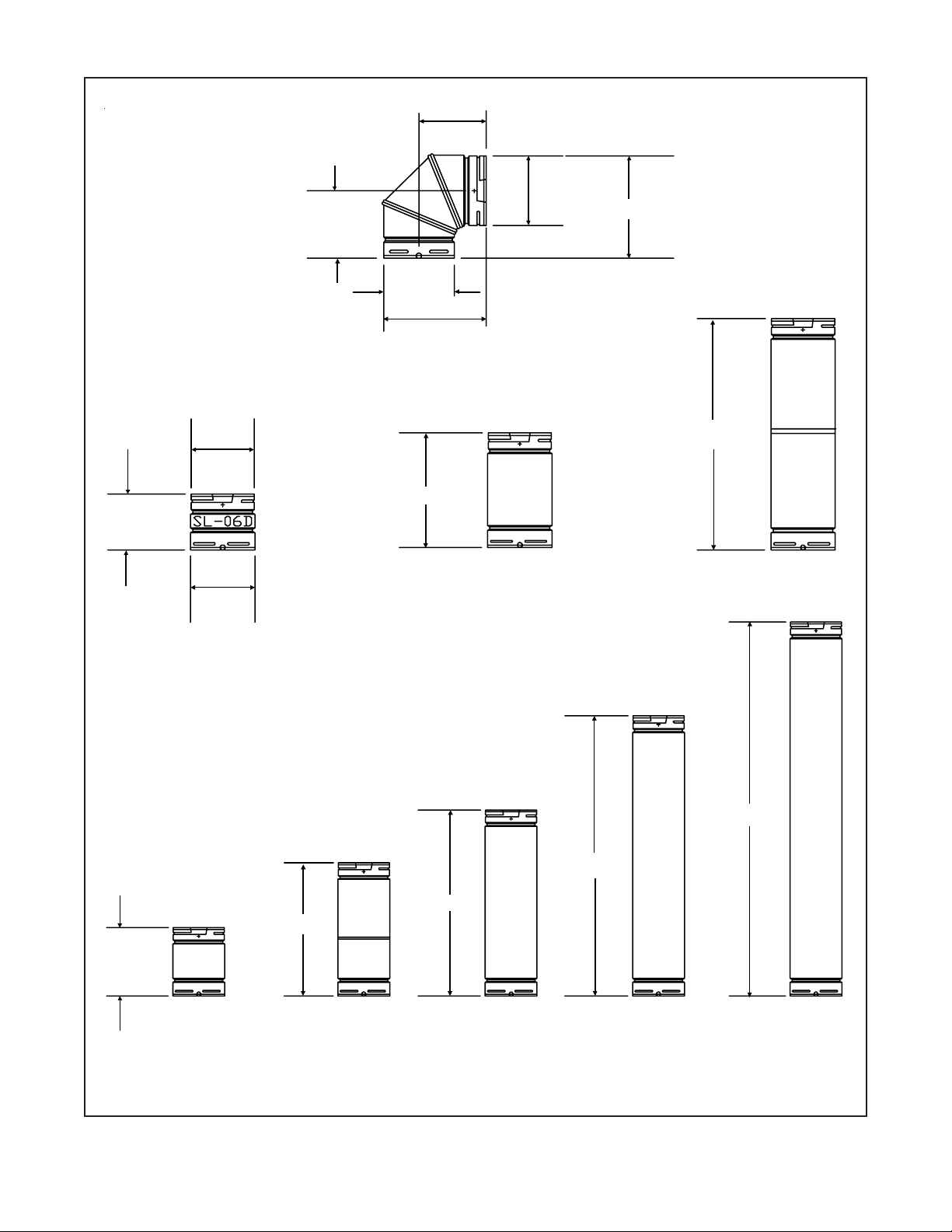
162mm
162mm
165mm
244mm
168mm
244mm
SL-90D
146mm
165mm
168mm
SL-06D
432-610mm
298mm
SL-12D SL-17/24D
1213mm
908mm
603mm
305-432mm
222mm
SL-09D
SL-12/17D
SL-24D SL-36D SL-48D
NOTE: PIPES OVERLAP 35mm AT EACH JOINT .
Figure 8. SL D-Series Balanced Flue Component S pecifications (102mm inner pipe / 168mm outer pipe)
10
Heat & Glo • SL-350TRSI-AUE • 2089-902 Rev. B • 6/06
Page 11
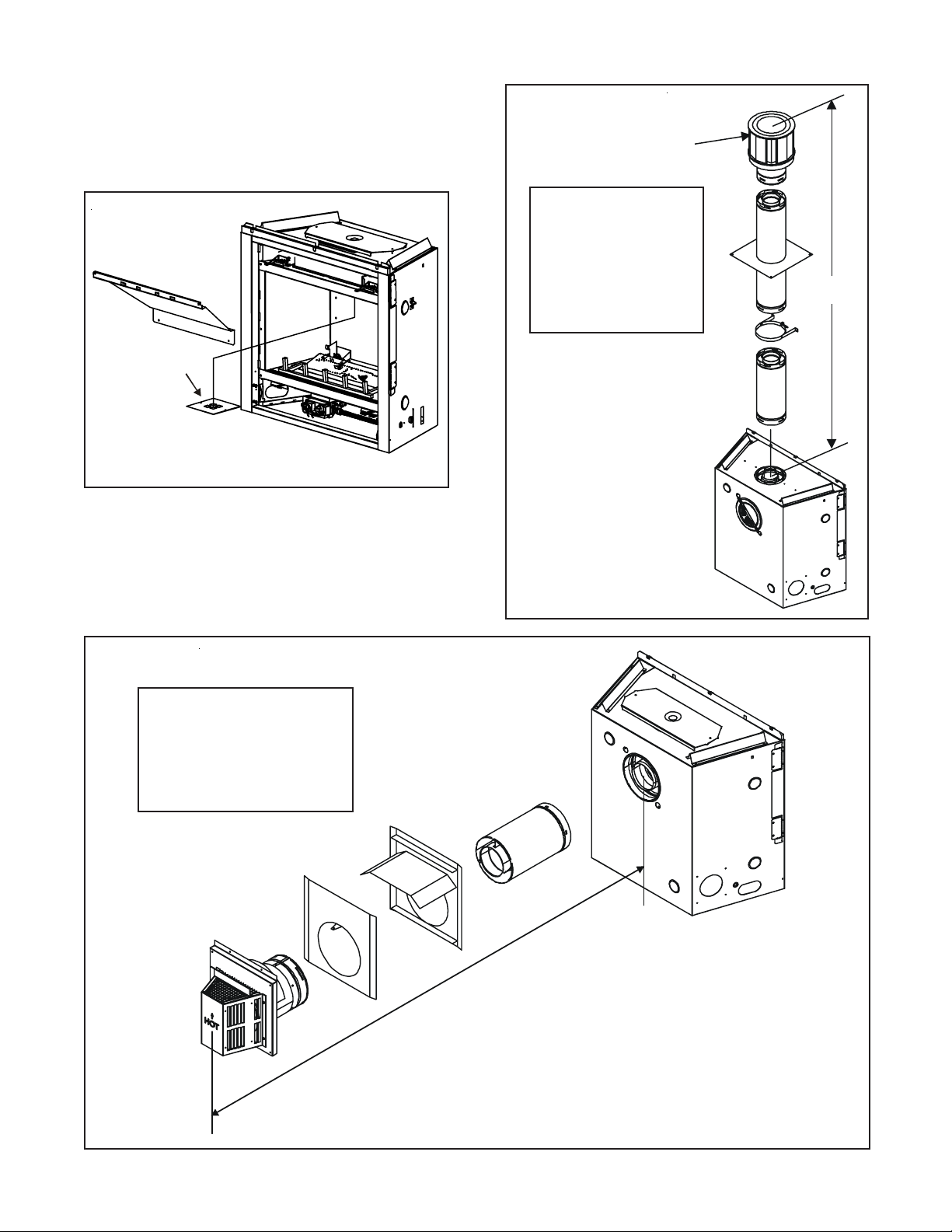
Vertical Flue Restrictor
V
If the heater installation requires a vertical flue exceeding 4.5m above the unit with no horizontal
flue or elbows, a vertical flue restrictor must be
installed (see Figure 9).
RESTRICTOR
PLATE
Figure 9.
CAP
VERTICAL FLUEING
V
FT. (M)
36' MAXIMUM (10.97M)
USE SL D-SERIES
COMPONENTS ONL Y .
STRAIGHT OUT HORIZONTAL
FLUEING
H
Max. Run
24" (610mm)
Figure 10.
H
USE DVP-SERIES COMPONENTS ONL Y .
Figure 11.
Heat & Glo • SL-350TRSI-AUE • 2089-902 Rev. B • 6/06
11
Page 12
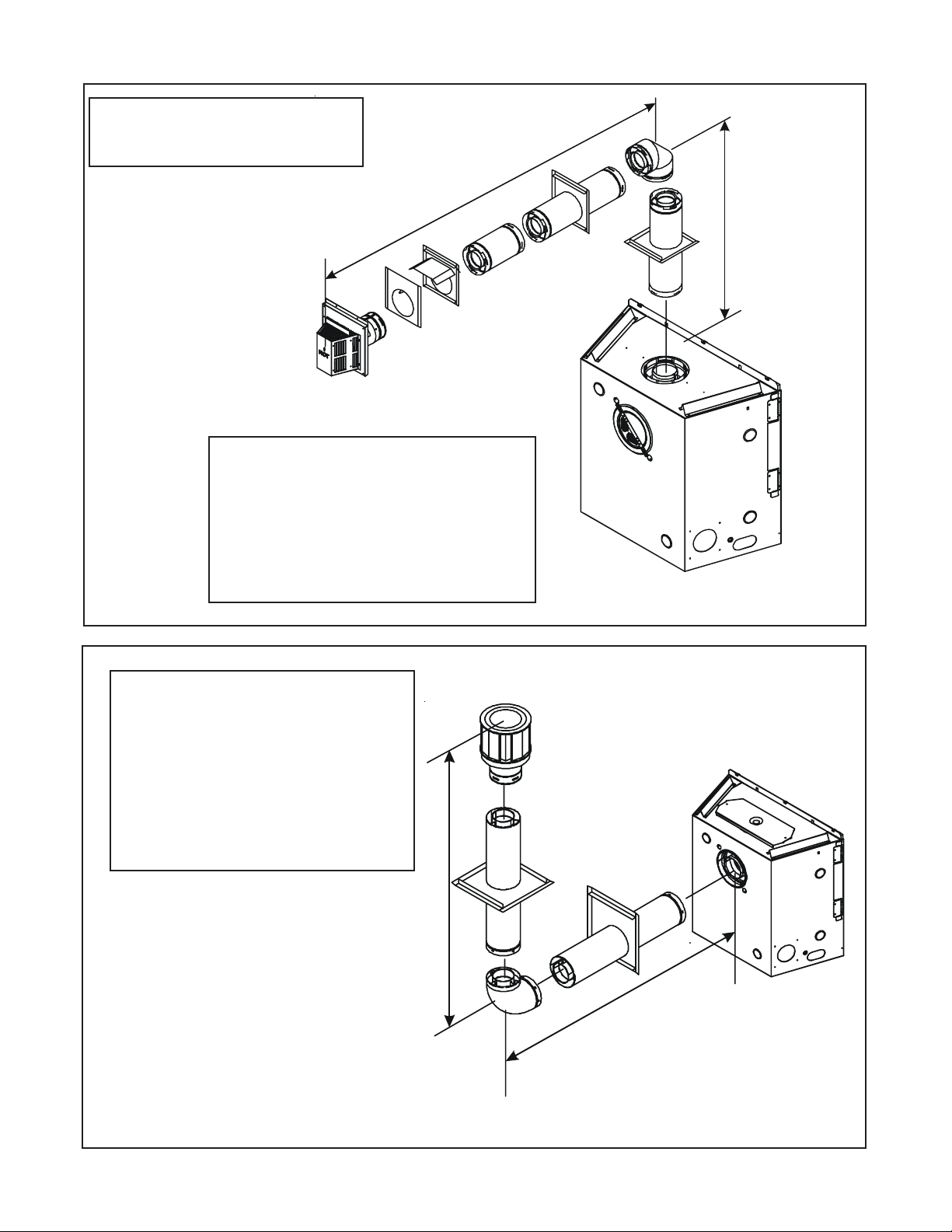
V
NOTE: A six inch (146mm) section of
straight flue must be attached to the
heater before a 900 elbow.
USE SL D-SERIES
COMPONENTS
ONL Y.
FLUEING WITH ONE (1) 90° ELBOW
V H
FT. (M) FT. (M)
1' MIN.(0.30M) 2' MAX.(0.61M)
2' MIN.(0.61M) 4' MAX.(1.22M)
3' MIN.(0.91M) 8' MAX.(2.44M)
4' MIN.(1.22M) 10' MAX.(3.05M)
V + H = 30' (9.14M)
Figure 12.
H
FLUEING WITH ONE (1) 90o ELBOW
V (FT .) H (FT.)
1' MIN. (0.30M) 3' MAX. (0.91M)
2' MIN. (0.61M) 6' MAX. (1.83M)
3' MIN. (0.91M) 9' MAX. (2.74M)
4' MIN. (1.22M) 12' MAX. (3.66M)
V+H =36' MAX.(10.97M) H= 12' MAX. (3.66M)
USE DVP-SERIES
COMPONENTS
ONL Y.
Figure 13.
V
H
12
Heat & Glo • SL-350TRSI-AUE • 2089-902 Rev. B • 6/06
Page 13

FLUEING WITH TWO (2) 90° ELBOWS
V
V
V H + H
1
FT. (M) FT. (M)
1' MIN.(0.30M) 2' MAX.(0.61M)
2' MIN.(0.61M) 4' MAX.(1.22M)
3' MIN.(0.91M) 6' MAX.(1.83M)
4' MIN.(1.22M) 8' MAX.(2.44M)
5' MIN.(1.52M) 10' MAX. (3.05M)
30' MAX.(9.14M) 10' MAX. (3.05M)
H
1
USE SL D-SERIES COMPONENTS ONL Y .
H
H
V
1
FLUEING WITH TWO (2) 90° ELBOWS
V H
FT. (M) FT. (M)
1' MIN.(0.30M) 2' MAX.(0.61M)
2' MIN.(0.61M) 4' MAX. (1.22M)
3' MIN.(0.91M) 6' MAX. (1.83M)
4' MIN.(1.22M) 8' MAX. (2.44M)
5' MIN.(1.52M) 12' MAX. (3.66M)
12' MAX.(3.66M)
NOTE: V + V1 MAX 33' (10.06M)
Figure 14.
Heat & Glo • SL-350TRSI-AUE • 2089-902 Rev. B • 6/06
13
Page 14

FLUEING WITH TWO (2) 90° ELBOWS
V
V H H + H
1
1´ MIN. (0.30M) 1´ MAX. (0.30M) 2´ MAX. (0.61M)
2´ MIN. (0.61M) 2´ MAX. (0.61M) 4´ MAX. (1.22M)
3´ MIN. (0.91M) 3´ MAX. (0.91M) 8´ MAX. (2.44M)
4´ MIN. (1.22M) 4´ MAX. (1.22M) 10´ MAX. (3.05M)
H = 8´ MAX.(2.44M)
V + H + H1 = 30’ (9.14M) MAX.
H
1
USE DVP-SERIES
COMPONENTS ONL Y .
H + H1= 10´ MAX. (3.05M)
H
Figure 15.
14
V (FT) H + H1 (FT)
1' MIN. (0.30 M) 3' MAX. (0.91 M)
2' MIN. (0.61 M) 5' MAX. (1.52 M)
3' MIN. (0.91 M) 8' MAX. (2.44 M)
V
4' MIN. (1.22 M) 10' MAX. (3.05 M)
H + H1= 10' MAX. (3.05 M)
V + H + H1= 33' (10.06m) MAX.
1
Heat & Glo • SL-350TRSI-AUE • 2089-902 Rev. B • 6/06
HH
Page 15

FLUEING WITH THREE (3) 90° ELBOWS
V
V
V H H + H
1
FT. (M) FT. (M) FT. (M)
2' MIN.(0.61M) 2' MAX.(0.61M) 4' MAX.(1.22M)
3' MIN.(0.91M) 3' MAX.(0.91M) 6' MAX (1.83M)
4' MIN.(1.22M) 4' MAX .(1.22M) 8' MAX.(2.44M)
V+V1 = 30' MAX (9.14M) 6' MAX (1.83M) 8' MAX.(2.44M)
H
1
H
1
USE SL D-SERIES COMPONENTS ONL Y.
V1
H1
FLUEING WITH THREE (3) 90° ELBOWS
V H + H1
FT. (M) FT. (M)
1'MIN.(0.30M) 2' MAX.(0.61M)
2'MIN.(0.61M) 4' MAX.(1.22M)
3'MIN.(0.91M) 6' MAX.(1.83M)
4'MIN.(1.22M) 8' MAX.(2.44M)
5'MIN.(1.52M) 12' MAX.(3.66M)
12' MAX.(3.66M)
NOTE: V + V1 MAX. 33' (10.06M)
V
H
Figure 16.
Heat & Glo • SL-350TRSI-AUE • 2089-902 Rev. B • 6/06
15
Page 16

FLUEING WITH THREE (3) 90° ELBOWS
V
V
V (FT.) H (FT.) H + H
1´ MIN. (0.30M) 1´ MAX. (0.30M) 3´ MAX. (0.91M)
2´ MIN. (0.61M) 2´ MAX. (0.61M) 5´ MAX. (1.52M)
3´ MIN. (0.91M) 4´ MAX. (1.22M) 8´ MAX. (2.44M)
4´ MIN. (1.22M) 6´ MAX. (1.83M) 10´ MAX. (3.05M)
H = 6´ MAX. (1.83M) H+H
NOTE: V + V , + H + H
V
1
= 33’ (10.06M) MAX.
1
= 10´ MAX. (3.05M)
1
(FT.)
1
H
1
COMPONENTS ONL Y .
H
2
FLUEING WITH THREE (3) 90° ELBOWS
V (FT.) H (FT.) H + H
1´ MIN. (0.30M) 1´ MAX. (0.30M) 2´ MAX. (0.61M)
2´ MIN. (0.61M) 2´ MAX. (0.61M) 4´ MAX. (1.22M)
3´ MIN. (0.91M) 3´ MAX. (0.91M) 8´ MAX. (2.44M)
4´ MIN. (1.22M) 4´ MAX. (1.22M) 10´ MAX. (3.05M)
V+H+H1+H2=30´ MAX.(9.14M) H =
4´MAX.(1.22M)
H+H1+H2 =
+ H2 (FT.)
1
10´MAX.(3.05M)
H
USE DVP-SERIES
H
1
H
Figure 17.
16
Heat & Glo • SL-350TRSI-AUE • 2089-902 Rev. B • 6/06
Page 17

Installing Flue Components
After determining which set of starting collars will be
used (top or rear), follow flueing instructions
accordingly .
Flueing Out the Rear Flue
Remove the rear collar seal cap by cutting the
strap at each end (see Figure 18).
Next, remove the insulation from the rear flue, pull
the heat shield out from outside of the heater.
WARNING: THE TOP FLUE COLLAR
!
SEAL CAP MUST REMAIN ATT ACHED
TO THE TOP FLUE COLLAR IF THE FLUE
SYSTEM IS ATTACHED TO THE REAR
STARTING COLLARS. SEE FIGURE 18.
Flueing Out the Top Flue
Í
Remove the top flue collar cover plate. Remove
the seal cap and both pieces of insulation in the
top collars (see Figure 18). Remove the heat
shield inside the top collars from the outside of
the heater.
WARNING: THE REAR FLUE COL-
!
LAR SEAL CAP MUST REMAIN ATTACHED TO THE REAR FLUE COLLARS IF THE FLUE SYSTEM IS ATTACHED TO THE TOP STARTING
COLLARS. SEE FIGURE 17.
WARNING: FAILURE TO REMOVE
!
INSULATION IN THE SET OF COLLARS YOU
ARE USING COULD
CAUSE A FIRE.
WARNING: YOU MUST LEAVE
!
THE INSULATION IN PLACE IN
THE SET OF COLLARS YOU
NOT USING.
ARE
Insert screwdriver
or similar object
here to remove cap.
Figure 18.
CUT
HERE
FLUEING OUT REAR FLUEING OUT TOP
SEAL
CAP
HEAT
SHIELD
DISCARD
INSULATION
and
HEAT SHIELD
SEAL
CAP
HEAT
SHIEL D
INSULATION,
DISCARD
BOTH
PIECES and
HEAT SHIELD
Heat & Glo • SL-350TRSI-AUE • 2089-902 Rev. B • 6/06
17
Page 18

Installing Flue Components
A. On the REAR of the heater
1. Attaching the First Flue Component to the Starting Collars:
T o attach the first flue component to the starting collars
on the rear of the heater:
• Make sure that the flue gasket supplied with the
heater seals between the first flue component and
the outer heater wrap.
• Slide the male end of the inner flue of the pipe section over the inner collar on the heater. At the same
time, slide the outer flue over the outer collar on the
heater. Push the flue section into the appliance collar until all the lances (see Figure 19) have snapped
in place. Tug slightly on the flue to confirm that it
has completely locked into place.
W ARNING
Fire Risk
Exhaust Fumes Risk
Impaired Performance of Appliance
• Overlap pipe slip sections at least
38 mm.
• Screws must not exceed one inch long.
• Pipe may separate if not properly
joined.
2. Assembling Flue Components
Insert the inner flue of section A into the flared inner flue
of section B.
Start the outer flue of section A over the outer flue of
section B (see Figure 20). Note: The end of the pipe
sections with the lances/tabs on it will face towards
the appliance.
Once both inner and outer flues are started, press section A onto section B firmly until all lances have snapped
into place. Check to make sure they have snapped
together (see Figure 21) and the seams are not aligned
(see Figure 22). Tug slightly on section A to confirm it
has completely locked into place.
Figure 19.
Í
• Any 900 elbow installed directly onto the rear flue of
the heater MUST BE in a vertical position.
WARNING: ENSURE THA T THE HEA TER
!
GASKET SUPPLIED WITH THE HEA TER
SEALS BETWEEN THE FIRST FLUE COMPONENT AND THE OUTER HEA TER WRAP.
Figure 20.
A
B
Figure 21.
18
Heat & Glo • SL-350TRSI-AUE • 2089-902 Rev. B • 6/06
Page 19

CORRECT
B. On the TOP of the heater
1. Attaching the First Flue Component to the Starting Collars:
T o attach the first flue component to the st arting collars
on the top of the heater:
• Lock the flue components into place by sliding the
concentric pipe sections with four (4) equally spaced
interior beads into the heater collar or previously installed component end with four (4) equally spaced
indented sections.
Figure 23. Adding Venting Components
• When the internal beads of each outer pipe line up,
rotate the pipe section clockwise about one quarter
(1/4) turn. The flue pipe is now locked together .
• Slide the ceramic fiber pad over the first flue section
and place it flush to the fireplace. Continue to add
vent components.
INCORRECT
Note:
Make sure that the seams are not aligned to
prevent unintentional disconnection.
Figure 22. Seams
NOTE: Make sure that seams are NOT aligned to prevent
unintentional disconnection.
For elbows that are changing the flue direction, two
screws minimum should be put in the outer flue at the
joint to prevent the elbow from rotating.
PROCEED TO STEP 3
(Install Support Brackets)
WARNING: ENSURE THA T THE HEA TER
!
GASKET SUPPLIED WITH THE HEA TER
SEALS BETWEEN THE FIRST FLUE COMPONENT AND THE OUTER HEA TER WRAP.
2. Continue Adding Flue Components
T o continue adding flue components in accordance with
the pre-planned flue system configuration:
• Ensure that each succeeding flue component is securely fitted and locked into the preceding component in the flue system.
For elbows that are changing the flue direction, two
screws minimum should be put in the outer flue at the
joint to prevent the elbow from rotating.
3. Install Support Brackets
For Horizontal Runs - The flue system must be
supported every five (5) feet (1.5m) of horizontal run by
a horizontal pipe support.
T o inst all support brackets for horizontal runs:
• Place the pipe supports around the flue pipe.
• Nail the pipe supports to the framing members.
Heat & Glo • SL-350TRSI-AUE • 2089-902 Rev. B • 6/06
19
Page 20

For V ertical Runs
The flue system must be supported every eight (8) feet
(2.4 M) above the heater flue outlet by wall brackets.
T o inst all support brackets for vertical runs:
• Attach wall brackets to the flue pipe and secure the
wall bracket to the framing members with nails or
screws.
WALL BRACKET
10" (254mm)
INTERIOR
WALL SHIE LD
Figure 25. Flue Pipe & Firestop
12" (305mm)
WALL STUD
8 FT.
(2.4m)
FLUE
OUTLET
1 INCH MIN.
(25mm)
Figure 24. Installing Support Brackets
4. Install Firestops
For Vertical Runs - One firestop is REQUIRED at the
hole in each ceiling through which the flue passes.
To install firestops for vertical runs that pass through
ceilings:
• Position a plumb bob directly over the center of the
vertical flue component.
• Mark the ceiling to establish the centerpoint of the
flue.
• Drill a hole or drive a nail through this center point.
• Check the floor above for any obstructions, such as
wiring or plumbing runs.
• Reposition the heater and flue system, if necessary , to accommodate the ceiling joists and/or obstructions.
• Cut a 10-inch X 10-inch (254mm X 305mm) hole
through the ceiling, using the firestop pipe opening
as a guide.
• Frame the hole with framing lumber the same size
as the ceiling joists.
For Horizontal Runs - Firestops are REQUIRED on
both sides of a combustible wall through which the flue
passes.
T o install firestop s (heat shield) for horizontal runs that
pass through either interior or exterior walls:
• Cut a 10-inch by 12-inch (254 mm X 305 mm) hole
through the wall.
• Position the firestops on both sides of the hole previously cut and secure the firestops with nails or
screws.
• The pipe opening of the firestops MUST BE placed
towards the bottom of the firestop.
• Continue the flue run through the firestop.
20
Heat & Glo • SL-350TRSI-AUE • 2089-902 Rev. B • 6/06
10" (254mm)
10” (254mm)
CHIMNEY
HOLE
EXISTING CEILING
JOISTS
CEILING
NEW
FRAMING
MEMBERS
Figure 26. Hole and New Framing Members
Page 21

If the area above the ceiling is NOT an attic, position
and secure the ceiling firestop on the ceiling side of
the previously cut and framed hole.
JOIST
CEILING
NAILS (4 REQUIRED)
Figure 27. Ceiling Firestop (Ceiling Side)
CEILING FIRESTOP
If the area above the ceiling IS an attic, position and
secure the firestop on top of the previously framed hole.
• The heat shield sections will overlap to match the
wall thickness (depth).
• If the wall thickness does not allow the required 1-1/2
inch heat shield overlap, an extended heat shield
must be used. The extended heat shield will need
to be cut to the thickness of the wall and be attached to the wall shield.
• The small leg in the shield rests on top of the flue to
properly space it from the pipe section (see Figure
29).
Interior
Wall Shield
Rear Vent
Heat Shield
38mm min.
overlap
NAILS (4 REQUIRED)
RAFTER
CEILING
CEILING FIRESTOP
Figure 28. Attic Firestop
C. Flue T ermination
For Horizontal T erminations using the DVP-TRAP
T o attach and secure the termination to the last section
of horizontal flue:
• The rear flue heat shield MUST be placed one inch
above the top of the flue between the wall shield and
the base of the termination cap.
• One section of the heat shield is attached to the
wall shield. The other is attached to the termination
cap in the same manner (see Figure 29).
Outer Flue
Inner Flue
38mm min.
Overla p
INTERIOR
EXTERIOR
Figure 29. Venting through the Wall
• The termination kit should pass through the wall
firestops from the exterior of the building.
• Adjust the termination cap to its final exterior position on the building and interlock the flue sections.
WARNING: THE TERMINATION CAP
!
MUST BE POSITIONED SO THAT THE
ARROW IS POINTING UP .
• Use a high-temperature sealant gasket to seal between the pipe and exterior firestop.
Heat & Glo • SL-350TRSI-AUE • 2089-902 Rev. B • 6/06
21
Page 22

For Vertical Terminations - To locate the flue and
install the flue sections:
• Locate and mark the flue centerpoint on the underside of the roof, and drive a nail through the
centerpoint.
• Make the outline of the roof hole around the
centerpoint nail.
• The size of the roof hole framing dimensions depend
on the pitch of the roof. There MUST BE a 1-inch
(25mm) clearance from the vertical flue pipe to combustible materials.
• Mark the roof hole accordingly.
GAS ACCESS
• Cover the opening of the installed flue pipes.
• Cut and frame the roof hole.
• Use framing lumber the same size as the roof rafters
and install the frame securely . Flashing anchored to
the frame must withstand heavy winds.
• Continue to install concentric flue sections up through
the roof hole and up past the roof line until you reach
the appropriate distance above the roof.
CAUTION: FOLLOW THE REQUIREMENTS OF THE
AGA GAS INSTALLATION CODE FOR MINIMUM
HEIGHT REQUIREMENTS ABOVE THE ROOF .
To seal the roof hole, and to divert rain and snow from
the flue system:
• Attach a flashing to the roof using nails, and use a
non-hardening mastic around the edges of the flashing base where it meets the roof.
• Attach a storm collar over the flashing joint to form a
water-tight seal. Place non-hardening mastic around
the joint, between the storm collar and the vertical
pipe.
Figure 30. Gas Supply Line
1.3 CONNECTING THE GAS SUPPLY
The gas is introduced to the appliance on the left hand
side (see Figure 30). After the gas pipe installation is
complete, check carefully all gas connections for leaks
with a commercially-available, non-corrosive leak check
solution. Be sure to rinse off all leak check solution
following testing. DO NOT USE AN OPEN FLAME.
NOTE: THE GAS SUPPL Y LINE SHOULD BE PURGED
OF ANY TRAPPED AIR PRIOR TO THE FIRST FIRING OF THE UNIT .
• Slide the termination cap over the end of the flue
pipe and rotate the pipe clockwise 1/4 turn.
22
Heat & Glo • SL-350TRSI-AUE • 2089-902 Rev. B • 6/06
Page 23

1.4 IGNITION SYSTEM WIRING
• This gas heater is equipped with an electronic igni-
tion system which operates on a 6 volt system.
• This appliance requires 240 VAC to be wired to the
factory installed junction box. Check factory installed
power cord for damage before use.
WARNING
Shock Risk
• Replace damaged wire with type 105°C
rated wire.
• Wire must have high temperature insulation.
PILOT
IGNITION MODULE
6VDC
CAUTION
Label all wires prior to disconnection when servicing
controls. Wiring errors can cause improper and dangerous operation. Verify proper operation af ter servicing.
FLAME SPARKER/
SENSOR
REMOTE
CONTROL
ANT.
WALL SWITCH
GROUND
VALVE
ON/OFF
IGNITION
MODULE
(6V)
HOTNEUTRAL
BATTERY PORT
ON/OFF
SWITCH
GAS LINE
CONNECTED TO
BACK OF VALVE
Figure 31. Electronic Ignition Wiring Diagram
THERMOCOUPLE
BLOCK
(CONNECTED TO
BACK OF VALVE)
VALVE
PLUG IN
Heat & Glo • SL-350TRSI-AUE • 2089-902 Rev. B • 6/06
23
Page 24

NOTE: IF ANY OF THE ORIGINAL
WIRE AS SUPPLIED WITH THE
APPLIANCE MUST BE REPLACED, IT MUST BE REPLACED
WITH TYPE 105
•
C RA TED WIRE.
BLACK
BROWN
BLUE
BROWN
BLUE
GREEN/YELLOWSTRIPE
Figure 32.
1.5 BLOWER FAN
These heaters have a factory installed Fan, Electrical Junction Box, Variable Speed Rheostat
Control Switch and T emperature Sensor Switch
for the fan. These components are located behind the lower door.
Use of the fan requires that the Junction Box
(factory installed) be connected to 240 VAC
service before permanently enclosing the heater.
The access hole for connecting the service wires
is found on the right exterior side of the unit.
See Figure 33 for wire connection detail.
BLACK
BROWN
BLUE
GREEN/YELLOW
STRIPE
Figure 33.
TEMPERATURE
SENSOR SWITCH
BLOWER
BLACK
(HOT) BROWN
BROWN
(NEUTRAL) BLUE
BLUE
VARIABLE
SPEED
CONTROL
BLACK
BLACK
240VAC JUNCTION BOX
BLUE
BROWN
GREEN/YELLOW
BROWN
BLACK
BLUE
24
Heat & Glo • SL-350TRSI-AUE • 2089-902 Rev. B • 6/06
Page 25

1.6 FINISHING
The minimum clearance to combustibles are 0 from
the sides, floor, back and top (these clearances are
defined by the standoffs). The minimum distance to the
perpendicular side wall extending past the appliance
front is 2-inches (51mm). Clearance to a mantelpiece
is shown in Figure 34.
TOP SEAL
SIDE SEAL
IF JOINTS BETWEEN THE FINISHED WALLS AND
THE FIREPLACE SURROUND (TOP AND SIDES)
ARE SEALED, A 300° F (149°C). MINIMUM SEALANT MA TERIAL MUST BE USED. THESE JOINTS
ARE NOT REQUIRED TO BE SEALED. ONL Y NONCOMBUSTIBLE MA TERIAL (USING 300° F. (149°C)
MINIMUM ADHESIVE, IF NEEDED) CAN BE APPLIED AS FACING TO THE FIREPLACE SURROUND. SEE FIGURE 34.
JOINT
JOINT
0
3(76)
2(51)
Note: Dimensions in
inches (mm).
10(254)
9(229)
8(203)
7(178)
6(152)
5(127)
4(102)
4
3
(76)
(102)
2
(51)
11(279)
5
(127)
12(305)
(178)
6
(152)
7
8
(203)
9
(229)
½ in.
(12.7mm)
CEILING
(279)
10
(254)
31
(787)
11
12
(305)
Figure 34.
TOP FRONT EDGE
OF FIREPLACE
NON-COMBUSTIBLE
STRIP
Heat & Glo • SL-350TRSI-AUE • 2089-902 Rev. B • 6/06
25
Page 26

Installing the Trim
Combustible materials may be brought up to the
specified clearances on the side and top front edges of
the fireplace, but MUST NEVER overlap onto the front
face. The joints between the finished wall and the
fireplace top and sides can only be sealed with a 300°
F . (149° C) minimum sealant.
WARNING: WHEN FINISHING THE FIRE-
!
PLACE, NEVER OBSTRUCT OR MODIFY
THE AIR INLET/OUTLET GRILLES IN ANY
MANNER.
Follow the Safety Information and Lighting Instructions
pages of this manual to light the appliance.
T o obt ain proper operation, it is imperative that the pilot and main burner flame characteristics are steady ,
not lifting or floating. T ypically , the top 3/8-inch (10mm)
of the thermocouple should be engulfed in the pilot flame
(see Figure 35).
Burner flame patterns are shown in Figure 36.
Proper gas log positioning is shown in Section 1.8.
Install optional marble and brass trim surround kits as
desired. Marble, brass, brick, tile, or other noncombustible materials can be used to cover up the gap
between the sheet rock and the fireplace.
Do not obstruct or modify the air inlet/outlet grilles. When
overlapping on both sides, leave enough space so that
the bottom grille can be opened and the trim door
removed.
1.7 INSTALLER TESTING
The space heater must be tested and be operating according to manufacturer's specifications prior to the installer leaving the site. Note: the tips of the flames
should never hit the top of the firebox after the unit has
warmed up. Please contact your dealer or a qualified
service person to replace injector or adjust valve.
Upon completing the gas line connection, a small
amount of air will be in the lines. When first lighting the
pilot light, it will take a few minutes for the lines to
purge themselves of this air. Once the purging is complete, the pilot and burner will light and operate as indicated in the Lighting Instructions.
Follow Section 3.5 TROUBLESHOOTING for adjusting
the appliance to operate properly .
Pilot Assembly
Figure 35.
Subsequent lightings of the appliance will not require
such purging.
26
Heat & Glo • SL-350TRSI-AUE • 2089-902 Rev. B • 6/06
MAKE SURE THE FLAMES
ARE STEADY—NOT
LIFTING OR FLOATING.
Figure 36.
Page 27

1.8 LOG PLACEMENT INSTRUCTIONS
Log Set Assembly: LOGS-350CE-D
PILOT
BRACKET TAB
SUPPORT
BRACKET
1
4
2
3
5
6
Carefully remove the logs from the packaging. CAUTION: Logs are fragile!
1
BURNER TAB S
1
LOG #1 (SRV327-701): Place log #1 at the rear of the unit, with the left edge behind the tab on the pilot
bracket. The right side sits behind the tab on the support bracket.
2
LOG #2 (SRV2033-701): Locate the bottom groove of log #2 over the left most grate bar and align over
the burner by placing the log slot over the burner tab as shown.
Heat & Glo • SL-350TRSI-AUE • 2089-902 Rev. B • 6/06
2
27
Page 28

3
LOG #3 (SRV705-703): Rest log #3 against the right front grate corner and place its slot over the right
burner tab.
3
4
1
4
1
2
LOG #4 (SRV530-716): Place the left end of log #4 in the groove on log #2 and the right end on log #1
as shown.
2
5
1
5
1
Î
LOG #5 (SRV438-724): Locate the top of log #5 onto log #1 and log #3, and place the bottom on the
right side of the fourth log grate.
28
Heat & Glo • SL-350TRSI-AUE • 2089-902 Rev. B • 6/06
Page 29

6
LOG #6 (SRV540-704): Place log #6 against the second and third grate bars.
If sooting occurs, the logs might need to be repositioned slightly to avoid excessive flame impingement.
6
Heat & Glo • SL-350TRSI-AUE • 2089-902 Rev. B • 6/06
29
Page 30

2.0 OPERATING INSTRUCTIONS
This appliance is a balanced flue heater and is designed
to operate with all combustion air being siphoned from
the outside of the building and all exhaust gases expelled to the outside of the building.
WARNING: THIS UNIT IS NOT FOR USE
!
WITH SOLID FUEL.
The control system for this model is an electronic system which includes a gas control valve, pilot, thermocouple, ignitor and electronic ignition module. The controls are located in the lower compartment behind the
lower door, and access is gained by lifting the door
up. See Figure 1.
W ARNING: DO NOT CONNECT 240 V AC
!
TO THE GAS CONTROL VALVE OR CONTROL WIRING SYSTEM OF THIS UNIT.
When lit for the first time, the appliance will emit a slight
odor for an hour or two. This is due to paint and lubricants used in the manufacturing process. Additionally,
for the first few minutes after each lighting, vapor may
condense and fog the glass and the flames may be blue.
After a few minutes this moisture will disappear and within
15-30 minutes the flames should become yellow.
The heater may produce a noise, caused from metal
expansion and contraction as it heats up and cools down.
This noise is similar to one that a furnace or heat duct
may produce and does not affect the operation or longevity of the heater.
OPERATING CAUTIONS
• This appliance may exhibit a slight carbon deposition.
• Do not place articles on or against this appliance.
• Do not use or store flammable materials near this
appliance.
• Do not spray aerosols in the vicinity of this appliance while it is in operation.
• The DRESS GUARD IS fitted to this appliance to
reduce the risk of fire or injury from burns and no
part of it should be permanently removed. For protection of young children or the infirm, a secondary
guard is required.
• The glass door assembly must be in place and sealed
and the fixed mesh DRESS GUARD must be in place
on the fireplace before the unit can be placed into
safe operation.
• Do not use this appliance if any part has been under
water. Immediately call a qualified service technician to inspect the unit and to replace any part of
the control system and any gas control which has
been underwater.
• Do not operate this appliance with the glass door
removed, cracked, or broken. Replacement of the
glass door should be done by a licensed or qualified
person. Do not strike or slam the glass door.
• The glass door assembly shall only be replaced as
a complete unit as supplied by the gas fireplace
manufacturer. No substitute materials may be used.
Figure 37.
PILOT
IGNITION MODULE
6VDC
BATTERY PORT
ON/OFF
SWITCH
FLAME SPARKER/
SENSOR
GAS LINE
CONNECTED TO
BACK OF VALVE
THERMOCOUPLE
(CONNECTED TO
BACK OF VALVE)
REMOTE
CONTROL
ANT.
BLOCK
VALVE
VALV E
ON/OFF
WALL SWITCH
IGNITION
MODULE
(6V)
GROUND
HOTNEUTRAL
PLUG IN
30
Heat & Glo • SL-350TRSI-AUE • 2089-902 Rev. B • 6/06
Page 31

2.1 SAFETY & LIGHTING INFORMATION
Follow SAFETY INFORMATION and LIGHTING INSTRUCTIONS to light the appliance.
By design, the flame pattern will not be identical from
unit to unit. Additionally , flame p attern may vary depending on installation type and weather conditions.
After the unit has warmed up (i.e. approximately 15 minutes) flame height should be slightly (about 2" (51mm)
below the top of the mesh trim assembly. If the flame
height is higher than this, adjustments must be made to
prevent overheating the gasket and glass. Please con
tact your dealer or a qualified service person to replace the injector or adjust the valve.
NOTE: THE TIPS OF THE FLAMES SHOULD NEVER
HIT THE TOP OF THE FIREBOX.
These gas models have remote control valve which allow you to increase or decrease the height of the main
burner flames. Push the
button to increase the
flame height and the button to decrease the flame
height.
FOR YOUR SAFETY
READ BEFORE LIGHTING
WARNING: If you do not follow these instructions
exactly, a fire or explosion may result causing prop-
erty damage, personal injury or loss of life.
A. This appliance is equipped with
an electronic ignition device
which automatically lights the
burner. Do
burner by hand.
B. BEFORE LIGHTING, smell all
around the appliance area for
gas. Be sure to smell next to the
floor because some gas is
heavier than air and will settle on
the floor.
WHAT T O DO IF YOU SMELL GAS
• Do not try to light any appliance.
not try to light the
WARNING:
DO NOT CONNECT 220/240
V AC TO THE CONTROL V AL VE.
Improper installation, adjustment,
alteration, service or maintenance
can cause injury or property damage. Refer to the owner's information manual provided with this appliance.
This appliance needs fresh air for
safe operation and must be installed so there are provisions for
adequate combustion and ventilation air.
If not installed, operated, and maintained in accordance with the
manufacturer's instructions, this
product could expose you to substances in fuel or fuel combustion.
Keep burner and control compartment clean. See installation and
operating instructions accompanying appliance.
• Do not touch any electric switch;
do not use any phone in your building.
• Immediately call your gas supplier
from a neighbor's phone. Follow
the gas supplier's instructions.
• If you cannot reach your gas supplier, call the fire department.
C. Do not use this appliance if any
part has been under water. Immediately call a qualified service technician to inspect the appliance and
to replace any part of the control
system and any gas control which
has been under water.
CAUTION:
Hot while in operation. Do not
touch. Keep children, clothing, furniture, gasoline and other liquids
having flammable vapors away.
Do not operate the appliance with
panel(s) removed, cracked or broken. Replacement of the panel(s)
should be done by a licensed or
qualified service person.
NOT FOR USE
WITH SOLID FUEL
For additional information on operating your
Hearth & Home Technologies fireplace,
please refer to www.fireplaces.com.
LIGHTING
INSTRUCTIONS
1. This appliance is equipped with an
ignition device which automatically
lights the burner. Do not try to light
the burner by hand.
GAS
VALVE
2. Wait five (5) minutes to clear out any
gas. Then smell for gas, including
near the floor. If you smell gas, ST OP!
Follow "B" in the Safety Information
located on the left side of this label. If
you don't smell gas, go to next step.
3. To light the burner, simultaneously
press the star and up
tons on the remote control until a
short acoustic signal confirms the
start sequence has begun.
4. If the appliance will not operate,
check the batteries then follow the
instructions “To Turn Off Gas to Appliance” and call your service technician or gas supplier.
arrow but-
TO TURN OFF
GAS TO APPLIANCE
1. Push the ‘OFF’ button on remote.
2. Remove power from receiver.
Heat & Glo • SL-350TRSI-AUE • 2089-902 Rev. B • 6/06
31
Page 32

2.2 FAN OPERATION
The accessory fan is wired in series with a speed control switch and a temperature sensor switch. Set the
speed control to an "ON" position and light the heater.
The temperature sensor switch will automatically start
the fan when the switch warms up—and stop the fan
when it cools down. You can manually stop the fan by
turning the speed control switch to "OFF". See Figure
32 for fan wiring diagram.
3.0 SERVICING AND MAINTENANCE
A. HEA TER SERVICING: Frequency of heater servic-
ing will depend upon use and type of installation.
B. IMPORTANT: TURN OFF GAS AND ELECTRICAL
POWER BEFORE SERVICING APPLIANCE. IT IS
RECOMMENDED THA T A COMPETENT SERVICE
TECHNICIAN PERFORM SERVICE CHECK-UPS AT
THE BEGINNING OF EACH HEA TING SEASON.
When the appliance is put back in service check burner
flame patterns with Figure 38.
T o obt ain proper operation, it is imperative that the pilot and main burner flame characteristics are steady ,
not lifting or floating. T ypically, the top 3/8-inch (10m)
of the thermocouple should be engulfed in the pilot flame
(Figure 39).
C. The appliance and flue system should be inspected
before initial use and at least annually by a qualified
field service person.
D. Inspect the external flue cap on a regular basis to
make sure that no debris is interfering with the air
flow.
E. Keep the control compartment, logs, and burner area
surround the logs clean by vacuuming or brushing at
least twice a year.
CAUTION: THE LOGS GET VERY HOT - HANDLE
ONL Y WHEN COOL.
WARNING: DO NOT USE ABRASIVE
!
CLEANERS ON THE GLASS DOOR ASSEMBLY. DO NOT ATTEMPT TO CLEAN THE
GLASS DOOR WHEN IT IS HOT .
F . The glass door should be cleaned using a house-
hold glass cleaner. DO NOT handle or attempt to
clean the glass when it is HOT.
G. Visually inspect the flexible power supply cord; if
damaged, contact the service agent for a special
replacement cord assembly .
MAKE SURE THE FLAMES
ARE STEADY—NOT
LIFTING OR FLOATING.
Figure 38.
Pilot Assembly
Figure 39.
H. In order to properly clean the burner and pilot as-
sembly , turn off the gas to the unit and remove the
logs exposing the burner and pilot assembly . Clean
all foreign materials from top of burner. Check to
make sure that the burner orifice is clean.
Visually inspect the pilot periodically. Brush or blow
away any dust or linen accumulations. If the pilot orifice is plugged, disassembly may be required to remove any foreign materials from the orifice or tubing.
32
Heat & Glo • SL-350TRSI-AUE • 2089-902 Rev. B • 6/06
Page 33

3.1 REMOV AL OF COVERS
FOR SERVICING
A. Control Compartment Door
2. PILOT ASSEMBLY/IGNITION SYSTEM
• Remove the log set, log grate, metal base pan and
burner.
• Rotate the lower door down to access the gas controls.
B. Dress Guard and Glass Door
• Lift the front dress guard up and out away from the
appliance side surrounds. Replace the dress guard
when servicing is complete.
• Release the four glass clip s around the glass door.
Carefully lift the glass up and out away from the appliance (see Figure 40).
LATCHES
(BOTH TOP
AND BOTTOM)
GLASS
ASSEMBLY
Figure 40. Glass Assembly
3.2 REMOVAL OF COMPONENTS
FOR SERVICE
1. BURNER
• Remove the screws holding the log grate. Carefully
lift up and remove the log set, log grate, and metal
base pan.
• Unscrew the brackets at both ends of the burner and
the retaining screws at the pilot bracket (see Figure
41). Slide the burner towards the right away from the
burner orifice.
• Disconnect the gas supply tube from the underside
of the gas valve and the thermocouple from the
interruptor (black).
• Disconnect and remove the pilot assembly from the
bracket.
NOTE: When removing the pilot assembly, carefully
pull the electrode wire, detach from the assembly and
leave in place for reconnection.
3.3 PARTS REPLACEMENT
1. FAN/SWITCHES
• Disconnect the fan wires from the junction box wires
by pulling the male and female connectors apart and
slide the fan out the front of the lower controls compartment.
• Disconnect the wires from the fan speed control
switch, pull off the knob, and remove the nut holding
the speed control to the bracket.
• Disconnect the wires from the fan temperature sensor switch and remove the nut holding the switch
bracket onto the side of the firebox.
2. GLASS PANEL
• T o replace the glass door , place the bottom edge on
top of the bottom mounting brackets. Push glass
against unit and latch the two fasteners at the top of
the glass door and the two fasteners at the bottom
(see Figure 40).
PILOT BRACKET
RETAINING SCREWS
Figure 41.
CAUTION: ALL SCREWS WHICH WERE
REMOVED MUST BE REPLACED.
Heat & Glo • SL-350TRSI-AUE • 2089-902 Rev. B • 6/06
3.4 ADJUSTMENTS AND
REPLACEMENT PARTS
Adjustments and replacement parts for this appliance
should only be done by a qualified service person. A
wiring diagram for the appliance is shown in SECTION
2.0 OPERA TING INSTRUCTIONS. A replacement part
table is shown in SECTION 4.0 of this manual.
33
Page 34

3.5 TROUBLESHOOTING SL-350TRSI-AUE
With proper installation and maintenance, your new Gas Heater should provide years of trouble-free service. If you do experience
a problem, refer to the Trouble Shooting Guide below. This guide will assist a qualified service person in the diagnosis of
problems and the corrective action to be taken.
Electronic Ignition System
Symptom
1. No transmi ssion, mo tor does
not t u r n.
2. No ig nition. No tone. A. Receive r Replace receiver and reprogram code.
3. No ig nition; one 5 seconds
continuous t one (7 shor ts
beeps might be heard prior
to the 5 seconds tone).
4. No pilot flame and control
continues to spark.
5. Pilot is lit and control
continues t o s pa rk . V alve
shuts off after 10...30
seconds. Valve operates
manually.
6. Pilot is lit, sparking stops i f
a flame i s present. Valve
shuts off after 10...60
seconds. Valve does not
wo rk manuall y.
7. 3 short beeps while the
motor turns.
8. P ilot flame lights but there is
no main ga s flow.
9. Pilot s par ks, but pi lot will not
light.
10. Glass soots. A. Flame impingement on logs. Adjust the log set so that the flame does not impinge on it.
11. Flame burns blue and lifts off
burner.
Possible Causes Corrective Actions
A. Receiver must learn new
code.
ON/OFF switch is in OFF
A.
position.
B. Loose wire. Secure wire.
Receiver. Replace receiver and reprogram.
C.
Bent pins on 8 wire
D.
connector.
E. Valve. Replace va lve.
A. Air i n the pi lot supply line. Purge the line or start ignition severa l times.
B. Ther mo couple circuit wi re d
incorrectly.
C. No spark at pilot burner. Check spark gap, & wiring connection. Check for spark in location a long
D. Valve. Replace valve. Do not over tighten.
E. Over tightened thermocouple
interrupter.
F. Receiver. Replace receiver and reprogram code.
A. Receiver. Replace receiver and reprogram code.
A. Thermocouple. Replace thermocouple.
B. Low inlet pressure to valve. Confirm suffici ent inlet pressure to the valve. Adjust or replace inlet regulator
C. Valve. Replace valve and thermocouple interrupter.
A. B atteries are low. Replace batteries - quali ty alkaline recommended. WARNING: Creating an
A. Manual override know (if
equipped) is in MAN
position.
B. Valve turne d don to pilot flow. Turn flame to high fi re by pressing up button on remote handset.
C. Low inlet pressure to valve. C onfirm suffici ent inlet pressure to the valve. Adjust or replace inlet regulator
D. Valve. Replace valve.
A. Correct gas supply. Verify that incomi ng gas line ball valve i s “open”. Verify that inlet pressure
B. Igni tor gap is too large. Verify that spark gap from ignitor to pi lot hood is .43 cm.
C. Module is not grounded. Verify module is securely grounded to metal chassis of fireplace.
B. Improper venturi setting. Adjust the air shutter at the base of the burner.
C. Debris around venturi. Inspect the opening at the base of the burner. It is imperative that NO
A. Insufficient oxygen b ei ng
supplied.
Press and ho ld the receiver’s reset button unti l you hear 2 acousti c signals.
After the second longe r acousti c signal, release the reset button and within
the subsequent 20 secon ds, pr ess th e dow n ar row on t h e rem ote h an dset u n t il
you hear an additional long acoustic signal confirming the new code is set.
Push switch to ON position.
Straighten pins on 8 wire connector.
Check polarity of the thermocouple wires.
cable.
Replace valve and thermocouple interrupter.
if necessary.
electrical short between the batte ries/battery b ox and metal parts of the
appliance may render the receiver inoperable.
Turn Manual override know to ON position.
if necessary.
reading is withi n acceptable limits, inlet pressure must not exceed 50 mbar.
material be place d in this opening.
1. Check to make sure flue cap i s i nstalled properly and free of debris.
Make sure that flue system poi nts are tight and have no leaks.
2. Check to make sure that no material has been placed in the opening at
the burner base or in the area of the air holes in the center of the base pan
beneath the burner.
3. Be sure glass i s tighened properly on unit, particularly on top corners.
34
Heat & Glo • SL-350TRSI-AUE • 2089-902 Rev. B • 6/06
Page 35

4.0 REPLACEMENT PARTS
31
35
30
Service Parts
(NG , LP) Exploded Parts Diagram
SL-350TRSI-AUE
Beginning Manufacturing Date: 6/06
Ending Manufacturing Date: ______
16
32
5
33
20
3
2
34
17
18
9
Í
29
1
19
12
11
4
6
14
15
13
21
22 Log set assembly
7
8
10
26
23
27
24
Heat & Glo • SL-350TRSI-AUE • 2089-902 Rev. B • 6/06
25
28
35
Page 36

SL-350TRSI-AUE Service Parts List
IMPORTANT: When ordering, supply serial and model numbers to ensure correct service parts.
ITEM PARTS PART N UMBER
Valve NG 2098-134
1
Valve LP 2098-135
Ori fice NG 582-844
2
Ori fice LP 582-055
3 18 Iin Flex Tube Assembly 530-302A
Burner Assembly NG 2089-010
4
Burner Assembly LP 2089-012
5 Ignition Cable 2098-147
6Hood SRV540-174
7 Glass Door Assembly GLA-350TRS
8 Dress Guard 2033-020
9 Module, Maxitrol 2098-142
10 Lower Door 2033-021
11 Grate 2033-013
12 Base Pan 2033-105
13 B lower Ass e mbly 240V 100-505A
14 Junction Box, 240V 2078-025
15 Power Cord, 240V 546-251A
Pilot Assembly NG 2098-050
16
Pilot Assembly LP 2098-051
17 Switch Assembly 2098-145
18 Interi or Top Heat S hield 2089-109
19 12 inch Flex 2078-022
20 Rheostat 491-510A
21 Switch Sensor 046-530
22 Log Set Assembly LOGS-350CE-D
23 Log #1 SRV327-701
24 Log #2 SRV2033-701
25 Log #3 SRV705-703
26 Log #4 SRV530-716
27 Log #5 SRV438-724
28 Log #6 SRV540-704
29 6 Volt Transformer 2098-145
30 Burner Neck Gasket 2045-407
31 Valve Plate Gasket 530-431
32 Pi lot Bracket 2089-104
33 Valve Bracket 2098-120
34 Contro l Cable 2098-143
35 Rheosta t Knob 100-512
Mesh Assembly 540-301A
Exhaust Resistor 2089-299
Accesssories
WSK-DLX-CE WSK-21
Conversion Kit NG NGK-350I-AUE
Conversion Kit LP LPK-350I-AUE
36
Heat & Glo • SL-350TRSI-AUE • 2089-902 Rev. B • 6/06
Page 37

LIMITED 10 YEAR WARRANTY
HEAT & GLO, a brand of Hearth & Home Technologies Inc.
In order to presumptively establish the dates to which your HEAT & GLO Limited 10 Year Warranty runs, you must
mail the completed warranty card to HEAT & GLO, a brand of Hearth & Home Technologies Inc., 20802 Kensington
Boulevard, Lakeville, MN 55044, within 60 days of the date of fireplace installation. If you fail to do so, you may be
required to prove the date of installation before warranty work can be performed.
The warranty exclusions and limitations of liability are effective upon installation of the fireplace.
Subject to the conditions set forth herein, HEAT & GLO, a brand of Hearth & Home Technologies Inc. ("HEAT &
GLO") extends the following warranty with respect to HEAT & GLO, a brand of Hearth & Home Technologies Inc..
If HEAT & GLO is reasonably satisfied that any part or portion of the fireplace covered by this Limited Warranty is
defective in material or workmanship under normal use and service as described in the Operating Instructions,
HEAT & GLO will take the following actions:
1. If the defect is reported during the first year from the date of installation (stainless steel burners and fiber logs
are covered for 3 years), HEAT & GLO will replace or repair the defective components at its sole expense. The
decision whether to replace a component shall be made at HEAT & GLO's sole discretion. This Limited Warranty
does
not cover components broken during shipping, misuse or careless handling. HEAT & GLO shall be not
responsible for any indirect, incidental, or consequential damages or for any costs other than those incurred by
HEAT & GLO to repair or replace the defective component. If components (including venting) other than factory
approved components are used, all warranty and liability on the fireplace is voided. Defects reported after the
first year will not be covered by warranty unless they fall within the purview of paragraph 2 or 3 below.
2. If the following defects are reported during the second year after the date of installation, HEAT & GLO will supply
replacement parts at the current wholesale price: defective electrical or manual components, optional
components or accessories, and glass panels (not including glass panels broken during misuse or careless
handling). HEAT & GLO shall not be responsible for any labor, transportation or other costs. Furthermore, it
shall not be liable for any indirect, incidental or consequential damages.
3. HEAT & GLO will replace or repair a defective firebox or heat exchanger, at any time during the 10 years from
the date of installation. The decision whether to replace the defective component shall be made at HEAT & GLO's
sole discretion. HEAT & GLO shall not be responsible for any indirect, incidental or consequential damages or
for any costs other than those incurred by HEAT & GLO to repair or replace the defective component.
This Limited Warranty is the exclusive remedy available to you. If HEAT & GLO cannot effectively resolve a warranty
problem in an expedient and cost-effective manner, it can discharge its entire warranty liability by refunding the price
of the product to you.
Products made by other manufacturers, whether sold with the fireplace or added thereafter, are NOT covered by this
Limited Warranty. The use of other unauthorized components will make this warranty null and void. This Limited
Warranty will also be void if the appliance is not installed by a qualified installer in accordance with the Installation
Instructions. Furthermore, the Limited Warranty will be void if the fireplace is not operated, at all times, according
to the Operating Instructions furnished with the fireplace. Any service work must be performed by authorized service
representatives.
EXCEPT TO THE EXTENT PROVIDED BY LAW, NO OTHER EXPRESS OR IMPLIED WARRANTIES, INCLUDING
WARRANTIES OF MERCHANTABILITY OR FITNESS FOR A PARTICULAR PURPOSE, SHALL APPLY TO THE
FIREPLACE PRODUCT. In States that do not allow limitations on how long an implied warranty lasts, or do not
allow exclusion of indirect damages, those limitations or exclusions may not apply to you. You may also have
additional rights not covered in this Limited Warranty.
HEAT & GLO reserves the right to make changes at any time, without notice, in design, material, specifications
and prices. It also reserves the right to discontinue styles and products.
Heat & Glo • SL-350TRSI-AUE • 2089-902 Rev. B • 6/06
37
Page 38

For Service or Replacement Parts Contact:
Melbourne
Jetmaster
444 Swan Street
Richmond 3121
(03) 9429-5573
Perth
Fireplace Corner
277 Lord Street
East Perth 6000
(08) 9228-2600
Sydney
Jetmaster
10 Martin Avenue
Arncliff 2205
(02) 9597-7222
38
Heat & Glo • SL-350TRSI-AUE • 2089-902 Rev. B • 6/06
 Loading...