

Page 1
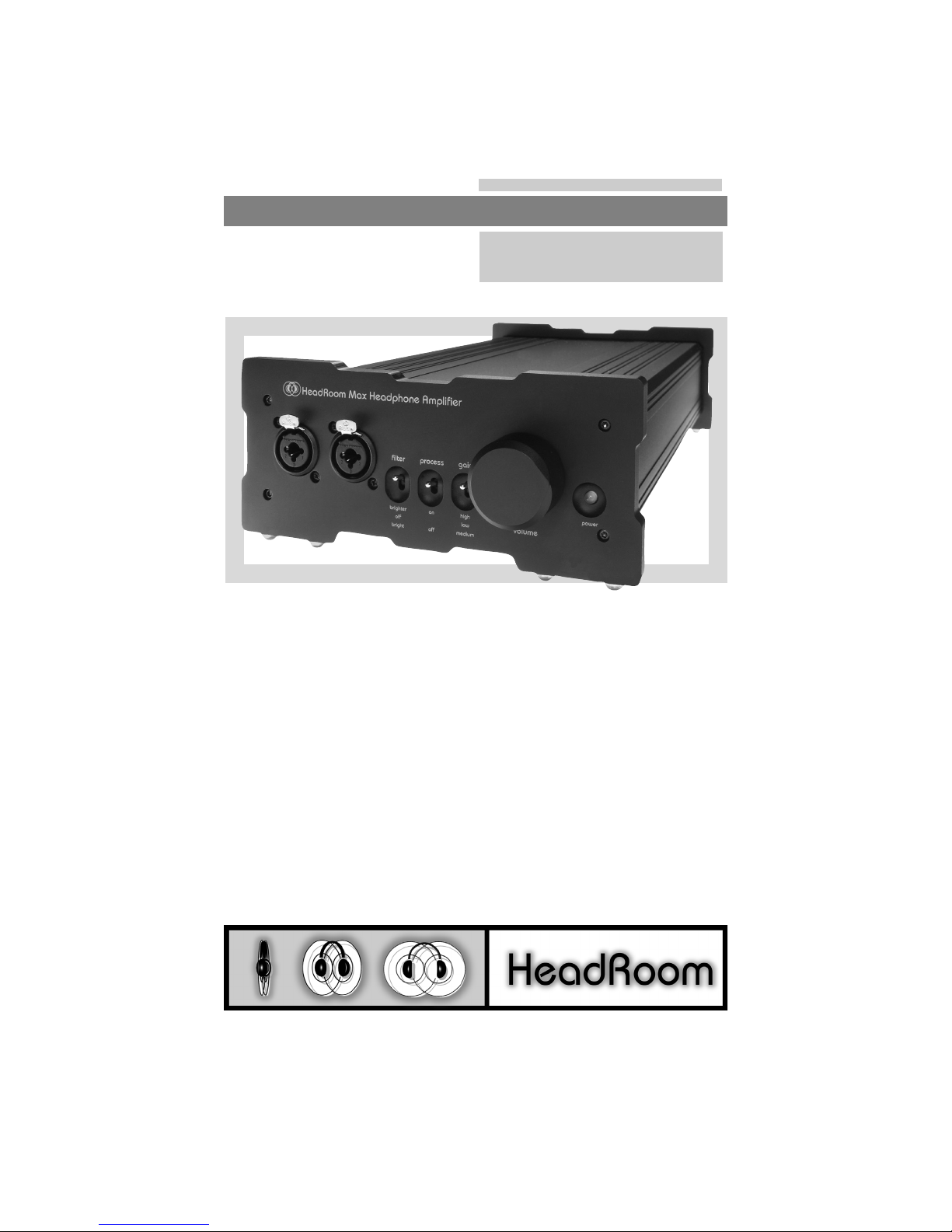
The Max Owner’s Manual
Headphone Amplifier
HeadRoom Corporation
Congratulations on your purchase of the magnificent
HeadRoom Max headphone amplifier and processor.
it
, the world’s most highly regarded headphone amp. You
have
arrived
! Feels good, huh? The Max is guaranteed to
This is
provide a truly remarkable musical experience. You will hear
a wonderful improvement in the ability of a high-quality
headphone to resolve musical detail, deliver deep, tight bass,
present a more natural stereo image, and most importantly,
to express the emotion of the music. All of our amps are hand-
built in Bozeman, Montana with high-quality components and
plenty of TLC.
obsessed headphone geeks at your service.
The Max Owner’s Manual
1
Page 2
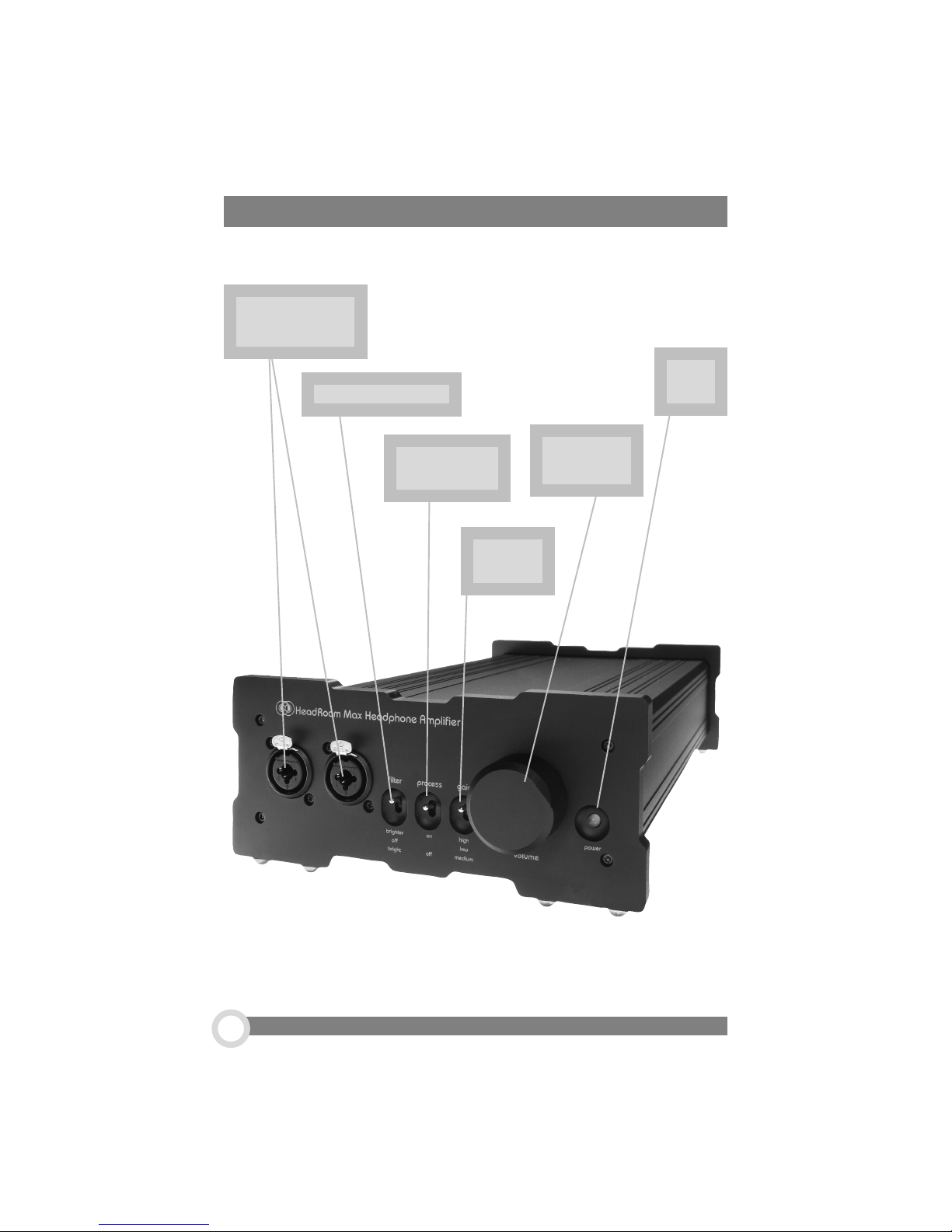
A Tour of Your Max HeadRoom Amp
1. Headphone
Jacks
2. Filter Switch
6.
LED
3. Processor
Switch
4. Gain
Switch
5. Volume
Control
800.828.8184
2
www.headphone.com
Page 3

The Max Headphone Amp
1. The Headphone Jacks. The Neutrik headphone jacks on The Max clamp
down tightly for optimum signal transfer. They will accomodate both a 1/4 and
well as XLR connectors, and both are controlled by the same volume control.
2. The Filter Switch. The filter switch is used to compensate for the warming
action of the processor. In the center position there is no filter in the circuit;
generally this is preferred. But if the processor is causing too much bass or
blurring of the central image, a mild high frequence boost filter can be turned
on. The “bright” setting accentuates the highs at about 3 kHz; with the “brighter”
setting the filter starts an octave earlier and catches some of the upper mids.
Basically, set it to what ever sounds best to you.
3. The Processor Switch. When switched toward PROCESS, the Audio Image
Processor is engaged for normal stereo headphone listening. In the OFF position,
the Processor is bypassed for listening to mono or binaural recordings. (This
switch should be in the OFF position when using the headphone amp as a
preamp. This is further explained later in the manual.)
4. The Gain Switch. A new feature on our Max, the 3-position Gain Switch
accomodates various headphones’ power needs. For instance, the Low Gain
setting would be used for Grado headphones, allowing a larger range on the
volume control pot. Experiementing with your headphones and the gain switch
may help you to determine which setting you prefer. If have any questions
regarding your headphones, feel free to call and ask us.
5. The Volume Control Big, beautiful, anodized, and aluminum. It feels and
sounds as good as it looks. Go ahead…give it a twist. Oh, but there are a
couple of important details about its use that we should point out. First, we
recommend turning the amp OFF or ALL THE WAY DOWN before plugging in
or unplugging your headphones to avoid short-circuiting the amp. Also, if
you’re switching between two or three pairs of headphones with different input
impedance ratings, the volume setting will most likely need to be adjusted to
achieve similar sound levels. When two pairs of headphones are plugged into
the amp at the same time, we recommend using headphones with the same
input impedance ratings. Otherwise, a dispute over volume level may ensue.
6. The LED. The LED simply indicates if your unit is on or off.
The Max Owner’s Manual
3
Page 4
1.
Power
Switch
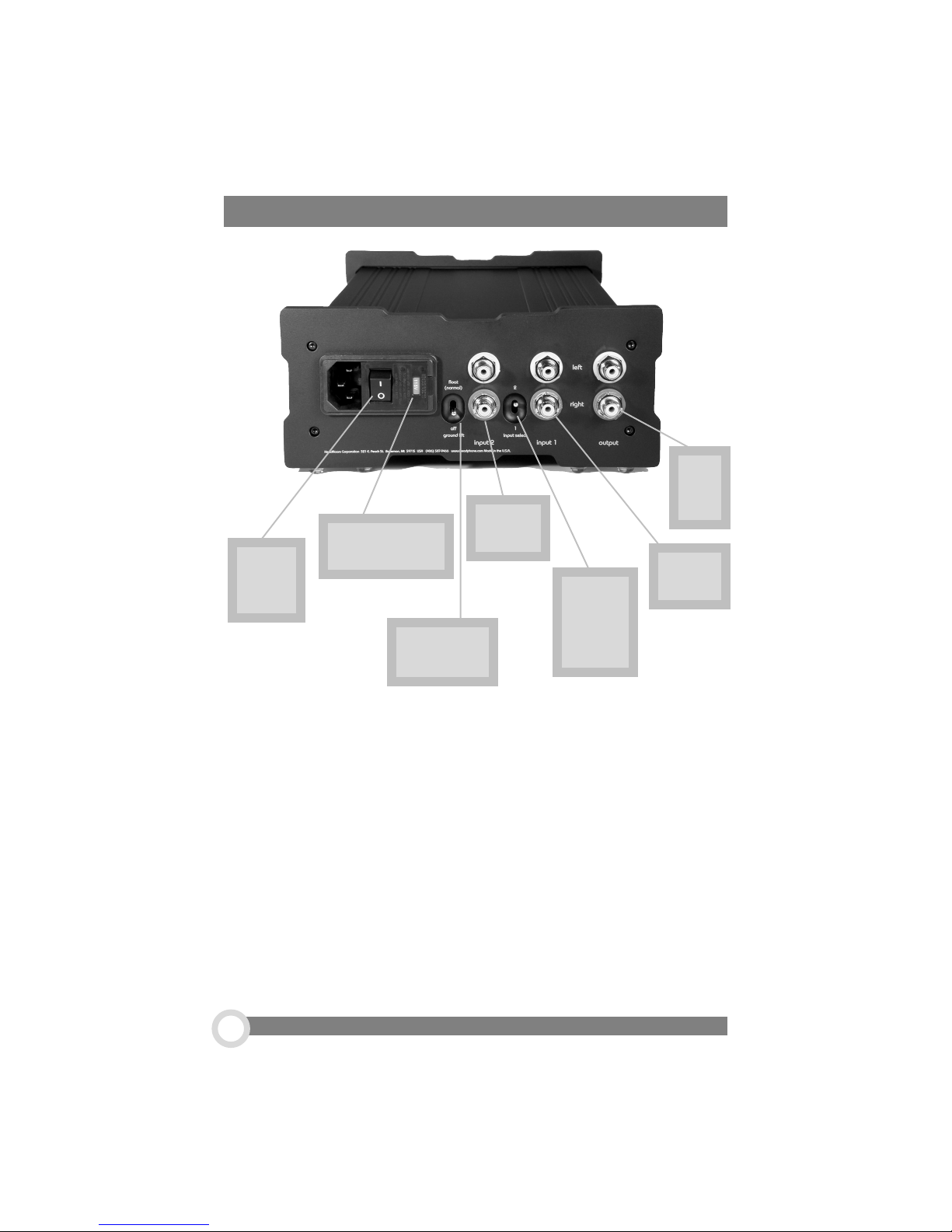
Rear Panel- Dual Input Option
4.
2. Input
Voltage Select
3. Ground
Lift Switch
Input 2
5.
Input
Selector
Switch
7.
Line
Out
6.
Input 1
1. The Power Switch. 1 is on, 0 is off... what more can we say?
2. Input Voltage Select. In most cases, the voltage indicator should read
‘115 volts’ for use in the U.S. However, your voltage can be easily adjusted to suit
your needs; call us for details on how to do this yourself.
3. The Ground Lift Switch. For normal use, the Ground Lift Switch should
be on‘float’. For use as a pre-amp, the Ground Lift should be off.
4. Input Two. This is where you would plug in a second source.
5. Input Selector Switch. This switch chooses Input One or Input Two.
6. Input One. Your primary source gets hooked up here.
7. Line Out. If you are using The Max as a pre-amplifier, plug your outputs in
here.
4
800.828.8184
www.headphone.com
Page 5
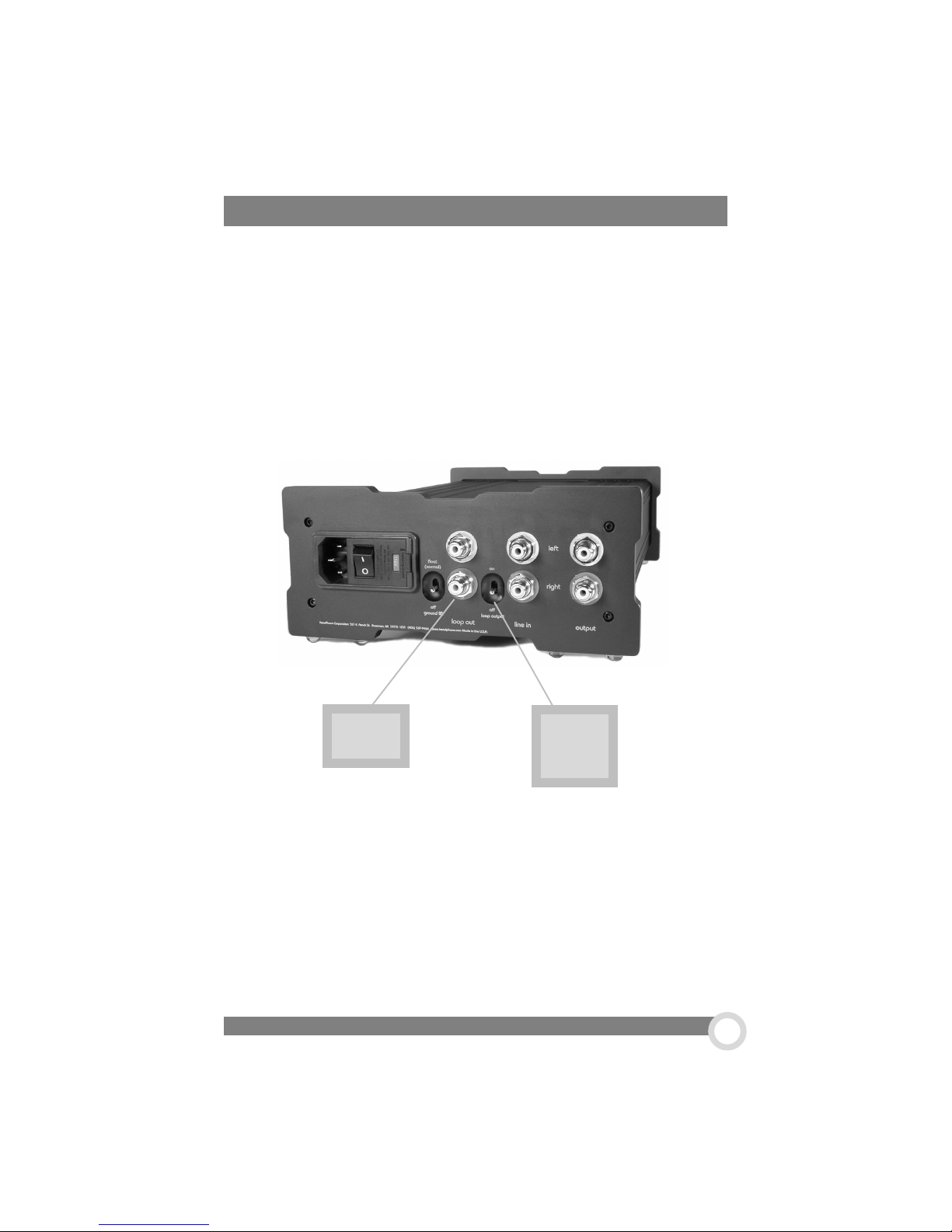
Rear Panel- Loop Out Option
Connect the cables from your audio source to the RCA inputs on the back of the amp.
This connection can be made to any line-level audio source, like a CD player, tape
deck, phono section or the tape loop of a preamp. Audio cables are usually color
coded with the red connector representing the right channel. The left channel connector
is usually either black or white.
When purchasing The Max HeadRoom, you are given a choice of having a loop out
put or a second line out on the back of the amp. Most people will prefer to have a
2nd output, but if you have chosen to go with the ‘Loop Out’ option read on here.
1. Loop
Outs
2. Loop
Output
Switch
1. Loop Outs. The Loop Outs pass a signal directly in and out without any
interference.
2. Loop Output Switch. With the loop output switch in the “on” position the
line inputs are connected to the loop output. This feature allows you to use the
record output of a preamp as the source for the headphone amp (which is really
the best way to do it), and use the loop output as the source for a tape recorder.
When not using the tape recorder, you can turn the loop output off to disconnect
any performance degrading reactance of the tape deck input.
The Max Owner’s Manual
5
Page 6
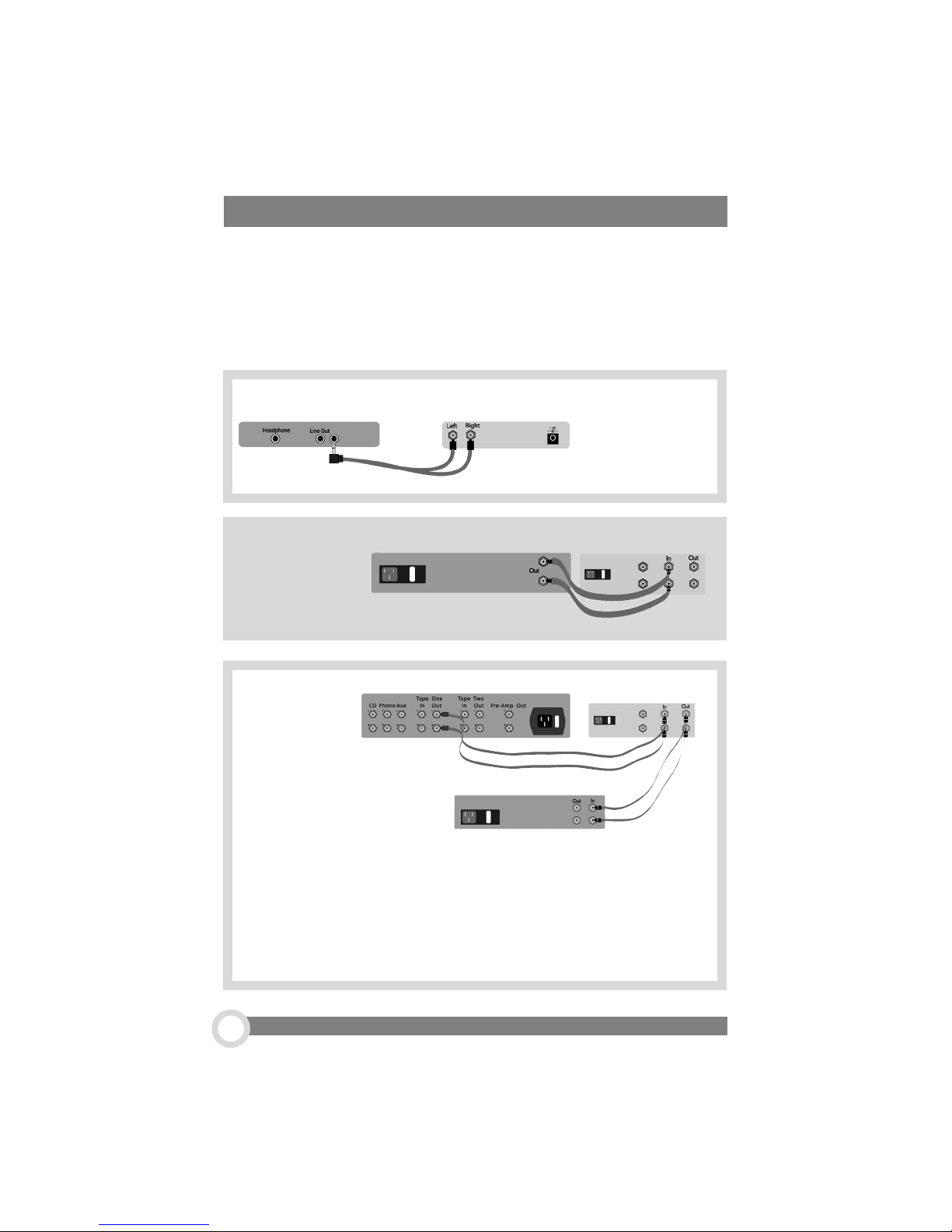
How to Hook Up Your Max Amplifier
Connect the cables from your audio source to the RCA inputs on the back of the amp.
This connection can be made to any line-level audio source, like a CD player, tape
deck, phono section or the tape loop of a preamp. Audio cables are usually color
coded with the red connector representing the right channel. The left channel connector
is usually either black or white.
Portable Player
HeadRoom Amp
...To a Portable
Player
Player
HeadRoom Amp
...To a Player
PreAmplifier
...As a PreAmp
How about another helpful feature: The Max can double as a very good
sounding, dual-source, active preamp. Make sure the Processor, Filter,
and Ground Lift switches are in the OFF position when listening through
speakers to avoid goofing up your imaging and frequency response.
To hook it up, all you have to do is run a pair of interconnects from the linelevel RCA output jacks on the back of The Max to a power amplifier.
Player
HeadRoom Amp
800.828.8184
6
www.headphone.com
Page 7
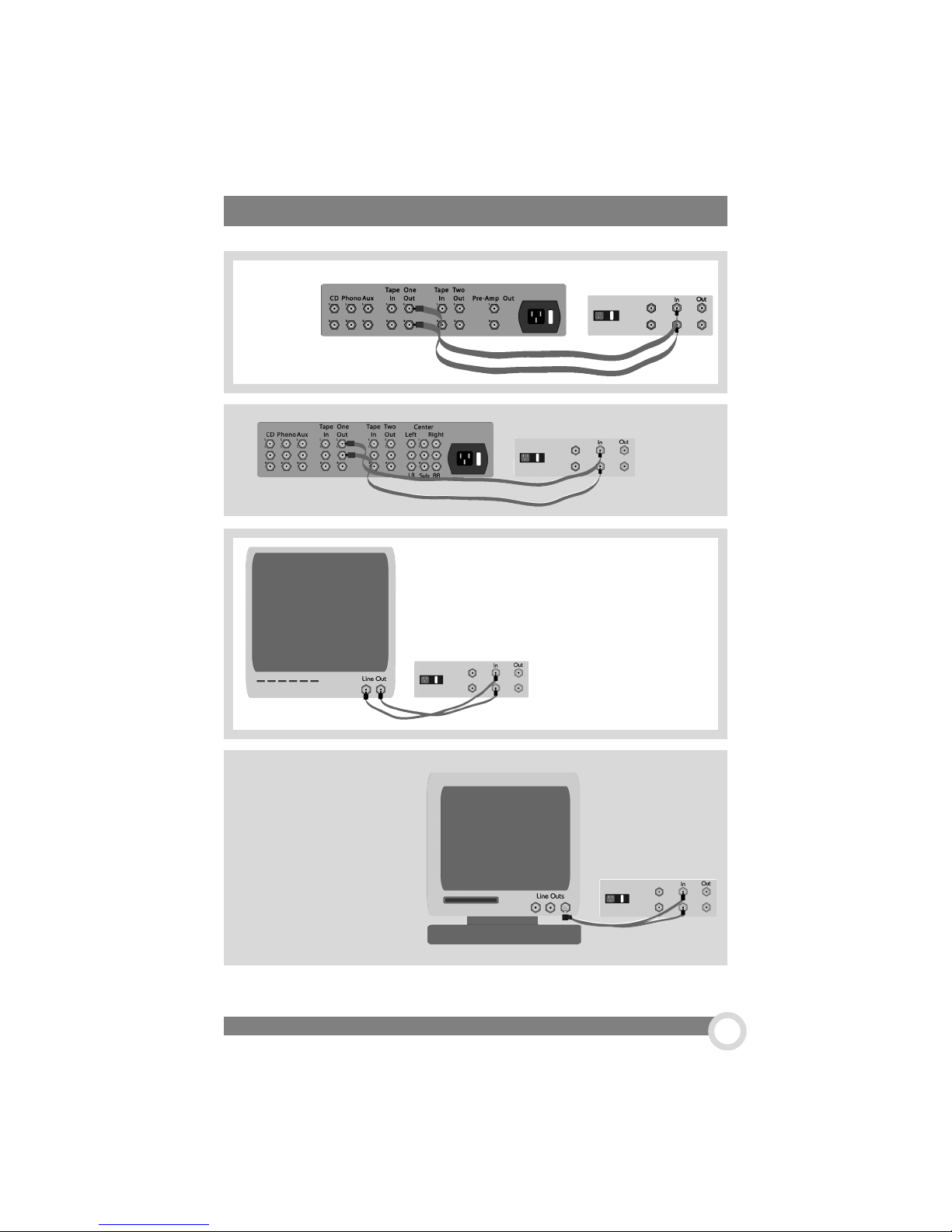
Hooking up Your Max
...To a
PreAmp
Audio
Video
Television
Source
PreAmplifier
HeadRoom Amp
HeadRoom Amp
HeadRoom Amp
Theater
...To a Television
...To a
Home
...To a Computer
Computer
The Max Owner’s Manual
HeadRoom Amp
7
Page 8
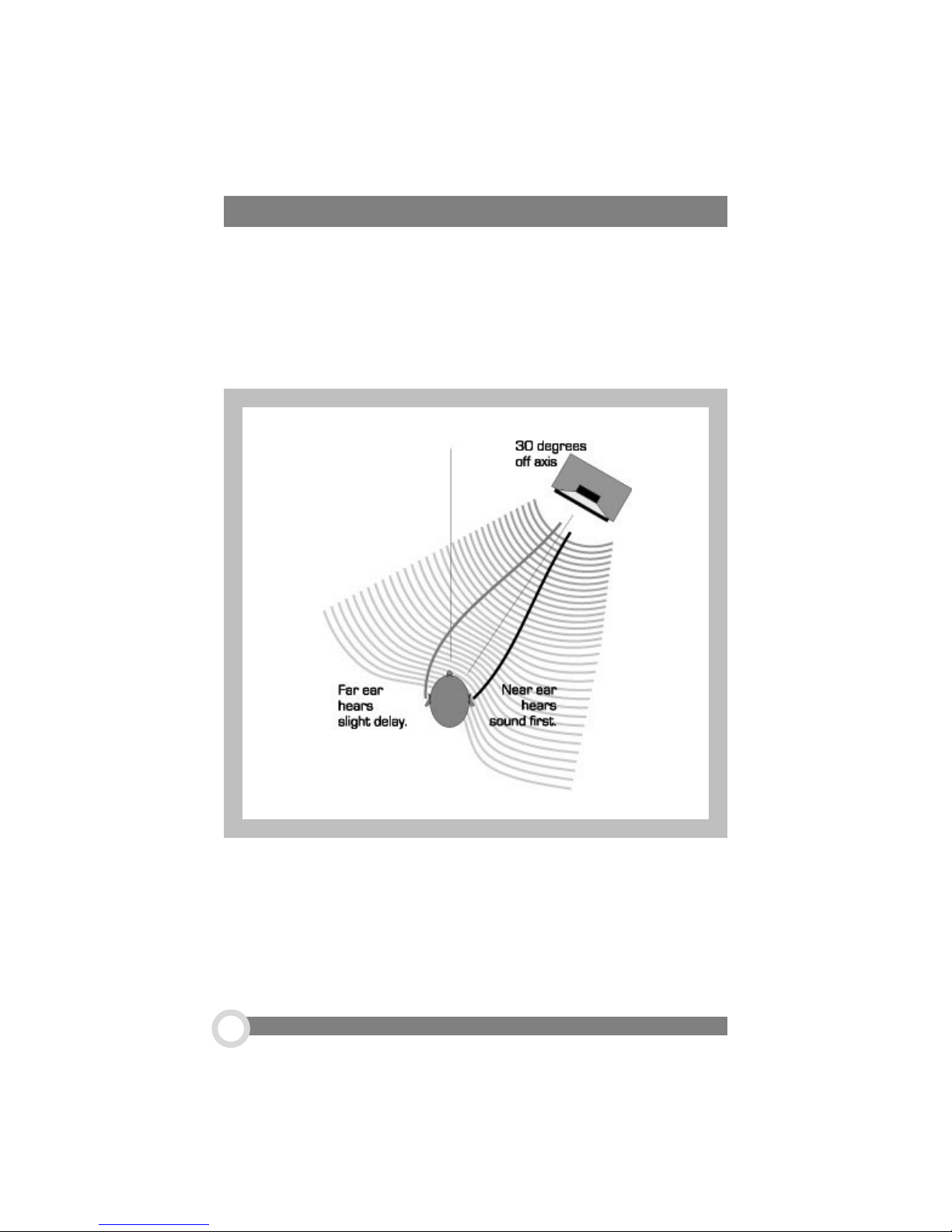
Why does your HeadRoom amp have a processor?
The Processor switch engages and disengages the headphone audio image
processing circuit. Headphone audio imaging is not very good; typically the image is
a blob on the left, a blob on the right, and a blob in the middle. The HeadRoom audio
image processor provides the natural acoustic cross-feed normally heard from the
left speaker to the right ear, and from the right speaker to the left ear. Adding the
cross-feed signal gives your brain enough information to build up the stable and
natural audio image needed to have a quality listening experience.
The end result is a subtle but important change in the sound. If you want you hear it
more dramatically, remove either the left or right input, then as you switch the
processor in and out you can hear the sound move from one ear only to a slightly
forward and up position that synthesizes the sound of a speaker. Most people
should just switch it on and not worry about it.
800.828.8184
8
www.headphone.com
Page 9

About the Processor
Without HeadRoom
The image processor itself is a two-stage active filter with all-pass delay and
frequency response characteristics that model those normally heard when listening
to speakers. It amounts to about a 300 uSec delay and a relatively flat frequency
response out to about 2 kHz. The interactions between mono and difference
components of the stereo signal and the chaotic nature of the music signal cause the
actual frequency response changes added by the processor to be unpredictable.
However, in general turning the processor on “warms” the sound. The more mono
component in the signal the warmer it gets. (See filter switch.)
With HeadRoom
How can the processor be tested?
If you have already tried out the Processor, you have probably noticed that there
isn’t a huge difference in the sound when switching the Processor on and off. If you
would like a more obvious demonstration of the effect of the Processor, just unplug
one of the RCA inputs to The Max and listen for a few moments with the Processor
off. Now switch the Processor on and hear the difference. [
tion
] See, it really is doing something dramatic!
pause for experimenta-
The Max Owner’s Manual
9
Page 10

And Now a Word About Your Hearing
People have a natural tendency to listen to music on headphones at much louder levels than
they would on speakers. If you hope to avoid permanent hearing damage, it’s important to
be careful not to listen at extremely loud levels or to listen for too long at moderately loud
levels. Because HeadRoom amps must be capable of driving even the most inefficient dynamic headphones to satisfactory listening levels, the amps are able to drive headphones of
average and high efficiencies to
safe level even though the volume control on the amp is less than half way up. Generally
speaking, when listening to headphones, you should only turn up the volume to the point at
which the sound isn’t too quiet.
The most common hearing damage caused by prolonged or excessively loud sound is called
tinnitus. It manifests itself as a sustained ringing in the ears and can become a permanent
condition. If you find that your ears are ringing or that there is a sensation of pressure or
fatigue, give them a rest for a couple of days (or until they feel fresh). These symptoms are
your body telling you that your ears need a break. Should you choose to ignore these
symptoms, you are risking permanent hearing damage. As a general rule, sound pressure
levels under 80 decibels will not damage hearing, even if listened to continually. On the other
hand, anything over 100 decibels may cause permanent damage fast. Sound pressure levels
anywhere in between can also be damaging. The louder the sound, the shorter the exposure
time required to cause permanent damage.
Now, don’t fool yourself into thinking that you either have full-blown tinnitus or you don’t
have it at all—you can get a slight case. For example, you might only notice your ears ringing
in bed at night. Once you have a slight case of tinnitus, your ears are much more susceptible
to further damage. So, if you get tinnitus, it’s important to be much more careful about
exposure to loud sounds. Now that we’ve told you to be careful, don’t blame us if you blow
it. If you have any more questions about hearing damage, call a doctor. Sorry to sound so
sobering, but a lifetime of musical enjoyment requires ears in tiptop shape.
very
high levels. As a result, you may not be listening at a
Five-Year Product Warranty
The Max amplifier carries a five-year parts and labor product warranty. If you have any
problems with your headphone listening system, please first call us at 1-800-828-8184. We
will try to diagnose the problem over the phone, which can save both of us considerable time,
effort and money. If the equipment must be returned for repair, we will authorize a return
for you. HeadRoom is the only authorized service center for HeadRoom products, either in or
out of warranty. If a unit is under warranty, there is no cost for the repair labor, parts, or
shipping from HeadRoom back to you (i.e., You’re responsible for paying the shipping
charges to get the product to us). For units out of warranty, repairs are billed on a time and
parts basis, plus shipping costs. When we receive the equipment, we will initiate repairs
quickly (usually within three working days) and return the unit to you, or call you with an
assessment of the problem.
10
800.828.8184
www.headphone.com
Page 11

30-day Satisfaction Guaranty
Unless specifically stated, all HeadRoom purchases come with a 30-day satisfaction guaranty.
We do this because we want to give you the opportunity to change your mind after you get
to hear the products you bought. We’re very glad to give you this option, and we want you
to use it if you aren’t happy with your purchase, but we also want you to be aware of the
conditions under which we can provide you this guaranty:
· Please return all packages to 2020 Gilkerson Drive, Bozeman, MT 59715
· Assuming all conditions are met, we are willing to refund the entire purchased
amount for products returned. We do not refund shipping charges.
· If you are experiencing trouble with a headphone amp or a headphone system,
please email Sales at [email protected] to troubleshoot the problem. This can save all
of us considerable time, effort, and money.
· If you are doing a partial return, you will be refunded the cost to you of the
products returned. If you purchased a package system at a discount and are keeping some
of the items in the package, your refund will be adjusted based on the retail price of the
equipment you are keeping. In other words, we don’t give full-price refunds on products
purchased at a discount.
· If you are doing a partial return and exchange for other product, you will be eligible
for all discounts that would apply to the set of products that you end up keeping.
· Products must be returned to us within 30 days of the date you receive the
product. SO if you think you might want to return something to us, listen right away; it’s
amazing how many people say the went out of the country and didn’t have a chance to listen
before they left.
· Products must be in as new condition. This means that they are not only in
pristine cosmetic condition and functioning perfectly, but that they are repacked with ALL
materials (plastic bags, warranty cards, tie wraps, and ANY other little bit or piece that came
with the product) just as you received it. Please use the original box it was received in (or
another that is comparable); and please don’t send your headphones back in JUST the
headphone box!
· If a product is returned within 30-days, but is not in as new condition, we will
charge you a 15% restocking fee PLUS any labor and materials required to return the product
to as new condition.
· Return packages shipped to us must be sent “signature required” and insured,
otherwise they are sent back at your own risk!
· Products returned to us after the 30-day period, or which require more cost to
repair than the wholesale value of the product will simply be returned to the customer.
We want you to know that we’re not hard cases about this; the vast majority of returns are
refunded.
The Max Owner’s Manual
11
Page 12
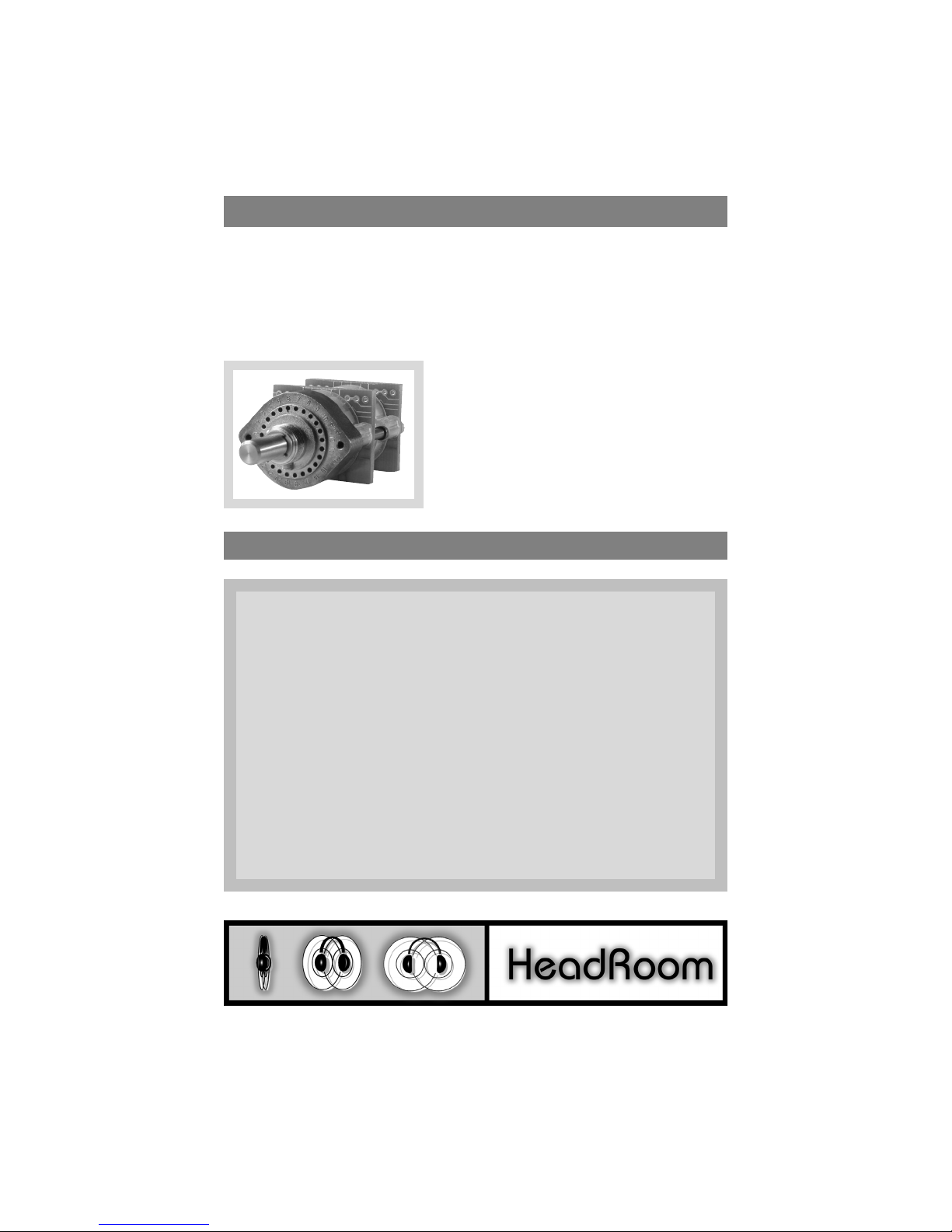
Upgrading Your Max
The stepped attenuator is an available upgrade for the Max. The Max comes
equipped with the Nobel potientiometer, and its performance is very good—but not
perfect. In order to elevate performance to as near perfection as possible, we offer
a stepped attenuator. The stepped attenuator uses a range of discrete resistors
switched into the circuit to attenuate the signal. We start with a Swiss made Elma
24-position switch. Then we disassemble it and remove the stock circuit boards and
replace them with our custom made boards which
allows us to mount the precision thin film resistor
right on the contact boards. The gold plating on
the contacts on these boards is about 4 times
thicker than on normal contact boards. The result
is, what we believe to be, the finest stepped
attenuator in the audio world today. Please
call us for details if you think you may be
interested in this upgrade!
Contacting HeadRoom
HeadRoom Corporation
2020 Gilkerson Drive Bozeman, MT 59715
toll free 800-828-8184 or 1+ 406-587-9466
fax: 406-587-9484
drop us an email at
www.headphone.com
obsessed headphone geeks at your service.
800.828.8184
12
www.headphone.com
 Loading...