

Page 1
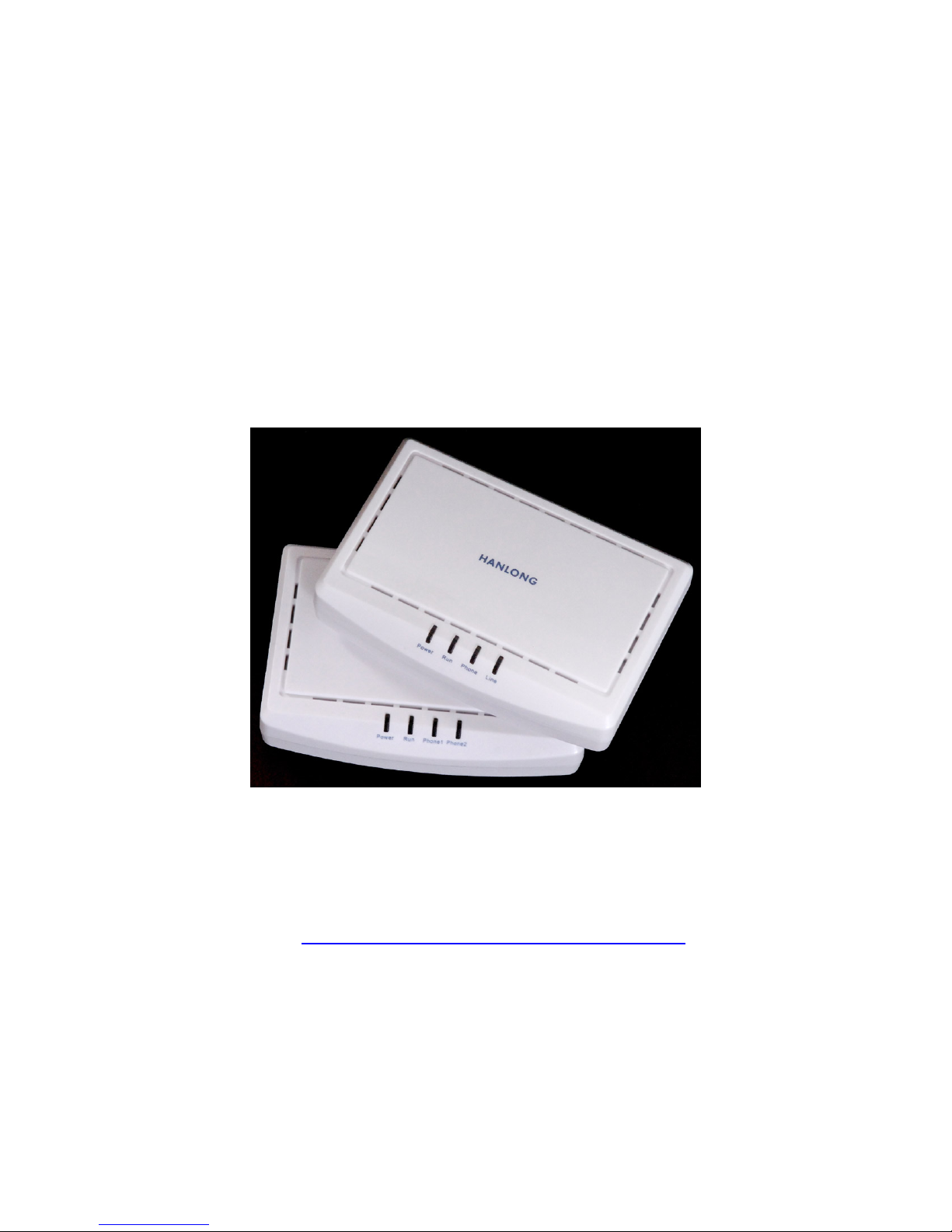
User Manual
Unicorn 3112
Analog Telephone Adaptor
Hanlong Technology Co., Ltd
http://www.hanlongtek.com
Table of Content
Page 2

Unicorn 3112 User Manual
Copyright © 2008 Hanlong Technology Co., Ltd Page 2 of 42
1. WELCOME ................................................................................................................... 3
2. WHAT IS IN THE PACKAGE ....................................................................................... 3
3. PRODUCT OVERVIEW ............................................................................................... 3
3.1. Key Features .................................................................................................. 3
3.2. Hardware specification ................................................................................... 4
4. INSTALLATIONS ......................................................................................................... 5
4.1. Safety ............................................................................................................. 6
5. BASIC OPERATIONS .................................................................................................. 6
5.1. Get Familiar with Voice .................................................................................. 6
5.2. Make Phone call............................................................................................. 8
5.2.1. Calling Phone or Extension Numbers .................................................... 8
5.2.2. Call Hold ................................................................................................. 8
5.2.3. Call Wait ing ............................................................................................. 8
5.2.4. 3-way Conferencing ................................................................................ 9
Star Code Style 3-way Conference ....................................................................... 9
Bellcore Style 3-way Conference .......................................................................... 9
5.2.5. Direct IP-to-IP Calls ................................................................................ 9
5.2.6. Blind Transfer ........................................................................................ 10
5.2.7. Attended Transfer ................................................................................. 11
5.2.8. Send and Receive PSTN Calls............................................................. 11
5.2.9. VoIP-to-PSTN Calls .............................................................................. 11
5.2.10. PSTN-to-VoIP Calls .............................................................................. 11
5.2.11. Route Calls to PSTN............................................................................. 12
5.3. Call Features ................................................................................................ 12
5.3.1. Call Features Tables ............................................................................. 12
5.3.2. PSTN Pass Through ............................................................................. 13
5.4. FAX............................................................................................................... 13
5.5. Status Light Indicator ................................................................................... 13
6. CONFIGURATION GUIDE ......................................................................................... 14
6.1. Configuring Unicorn 3112 using Web Browser (Recommended) ................ 14
6.1.1. Accessing the Web Configuration ........................................................ 15
6.1.2. Programming Unicorn 3112 via the LAN Port ...................................... 15
6.1.3. Programming Unicorn 3112 via the WAN Port ..................................... 15
6.1.4. User Programming and Configuration .................................................. 16
6.1.5. Passwords ............................................................................................ 16
6.1.6. End User Settings: ................................................................................ 17
6.1.6.1 Device Status: ............................................................................... 17
6.1.6.2 Basic Options: ............................................................................... 18
6.1.6.3 Super Option ................................................................................. 21
6.1.6.4 FXS Port Settings: ......................................................................... 24
6.1.6.5 FXO Port Settings: ........................................................................ 33
6.1.7. Saving the Configuration Changes ....................................................... 39
6.1.8. Rebooting the Unicorn 3112 ................................................................. 40
6.2. Configuring Unicorn 3112 via Voice Prompt ................................................ 41
Page 3

Unicorn 3112 User Manual
Copyright © 2008 Hanlong Technology Co., Ltd Page 3 of 42
6.2.1. DHCP Mode .......................................................................................... 41
6.2.2. Static IP Mode ....................................................................................... 41
6.2.3. Configuration through a Central Server ................................................ 41
7. SOFTWARE UPGRADE ............................................................................................ 41
8. RESTORE FACTORY DEFAULT SETTINGS............................................................ 42
9. TECHNICA L SUPPORT CONTACT .......................................................................... 42
1. WELCOME
Unicorn 3112 is an all-in-one VoIP integrated access device that features superb
audio quality, rich functionalities, high level of integration, compactness and
ultra-affordability. The Unicorn 3112 is fully compatible with SIP industry standard and can
interoperate with many other SIP compliant devices and software on the market.
Special compatibility features include:
Nortel MCS
Standard SIP
Broadsoft
Howdy
2. WHAT IS IN THE PACKAGE
The Unicorn 3112 package contains:
One Unicorn 3112 VoIP adapter
One universal power supply
One Ethernet cable
One phone cable
3. PRODUCT OVERVIEW
3.1. Key Features
Supports SIP 2.0(RFC 3261), TCP/UDP/IP, RTP/RTCP, HTTP, ICMP, ARP/RARP, DNS,
DHCP (both client and server), NTP, PPPoE, STUN, TFTP, etc.
Built-in router, NAT, Gateway and DMZ port forwarding
Page 4

Unicorn 3112 User Manual
Copyright © 2008 Hanlong Technology Co., Ltd Page 4 of 42
Supports call origination and termination from/to the PSTN network(via FXO Port)
Powerful digital signal processing (DSP) to ensure superb audio quality;
advanced adaptive jitter control and packet loss concealment technology
Support various vocoders including G.711 (a-law and u-law), G.723.1 (5.3K/6.3K),
G.726 (40K/32K/24K/16K), as well as G.728, G.729A/B, and iLBC(Pending).
Support Caller ID/Name display or block, Hold, Call Waiting/Flash, Call Transfer, Call
Forward, in-band and out-of-band DTMF, Dial Plans, etc.
Support fax pass through T.30 and T.38.
Support Silence Suppression, VAD (Voice Activity Detection), CNG (Comfort Noise
Generation), Line Echo Cancellation (G.168), and AGC (Automatic Gain Control)
Support standard encryption and authentication (DIGEST using MD5 and MD5-sess)
Support for Layer 2 (802.1Q VLAN, 802.1p) and Layer 3 QoS (ToS, DiffServ, MPLS)
Support automated NAT traversal without manual manipulation of firewall/NAT
Support device configuration via built-in IVR, Web browser or central configuration file
through TFTP or HTTP
Support firmware upgrade via TFTP or HTTP with encrypted configuration files. Ultra
compact (wallet size) and lightweight design, great companion for travelers
Compact, lightweight Universal Power adapter.
3.2. Hardware specification
Model Unicorn 3112
LAN interface
1 x RJ45 100MBase-T
WAN interface
1 x RJ45 100MBase-T
FXS telephone port
1 x FXS
FXO port
1 x FXO
LED light
Green and red color
Universal switching power supply
Input: 100-240VAC 50-60 Hz
Output: +5VDC, 1200mA,
UL certified
Dimension
70mm (W) ×130mm (D)×27mm (H)
Weight
0.30kg
Temperature
40 – 130 F
5 – 45 C
Humidity
10 - 90%
Page 5
Unicorn 3112 User Manual
Copyright © 2008 Hanlong Technology Co., Ltd Page 5 of 42
4. INSTALLATIONS
The Unicorn 3112 is an all-in-one VoIP integrated device designed to be a total solution for
networks providing VoIP services. The Unicorn 3112 VoIP features are available when
you connect any regular analog telephone to it.
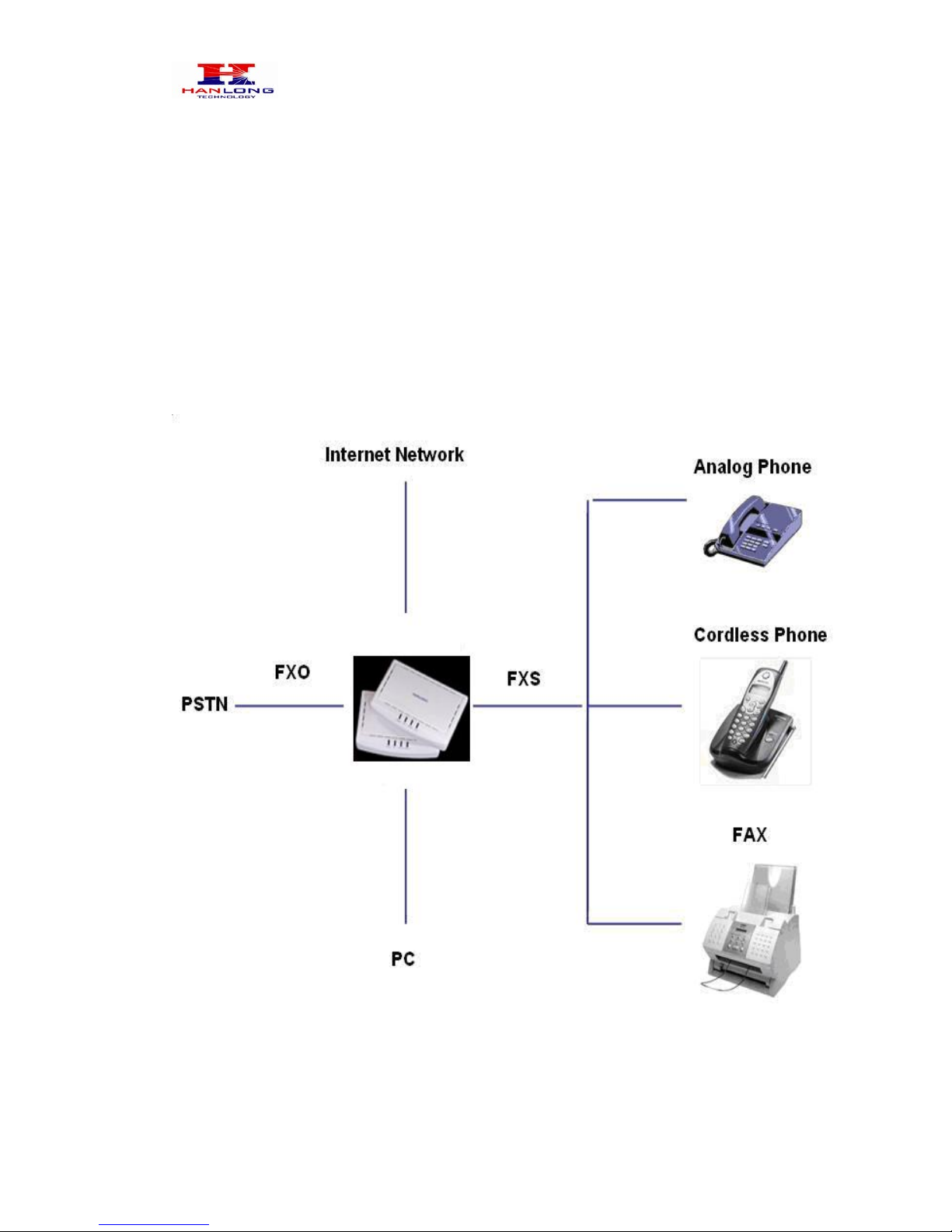
Unicorn 3112 has one FXS port (labeled “Phone”) and one PSTN pass through port
(labeled “Line”). After setting up the Unicorn 3112, you can make PSTN calls by pressing
*00. Without pressing *00, all your calls will be VoIP. You can also receive PSTN calls
and VoIP calls.
The following photo illustrates the Interconnection Diagram of the of a Unicorn 3112:
Following are the steps to install a Unicorn 3112:
Connect a standard touch-tone analog telephone to the “Phone” port.
Page 6

Unicorn 3112 User Manual
Copyright © 2008 Hanlong Technology Co., Ltd Page 6 of 42
Insert a standard RJ11 telephone cable (included with package) into the “Line” port and
connect the other end of the telephone cable to a wall jack.
Connect a PC to the LAN port of Unicorn 3112 (Ethernet cable is included with
package).
Insert another Ethernet cable into the WAN port of Unicorn 3112 and connect the other
end of the Ethernet cable to an uplink port (a router, switch, hub, modem, etc)
Insert the powers supply (included with package) into the Unicorn 3112 and connect it to
a power outlet.
4.1. Safety
The Unicorn 3112 is compliant with various safety standards including FCC/CE and
C-Tick. Its power adaptor is compliant with UL standard. The Unicorn 3112 s houl d only
operate with the universal power adaptor provided in the package.
Warning: Please do not use a different power adapter. Using other power
adapter may damage the Unicorn 3112 and will void the manufacturer warranty!
Caution: Changes or modifications to this product not expressly approved by Hanlong
Technology, or operation of this product in any way other than as detailed by this User
Manual, could void your manufacturer warranty.
Information in this document is subject to change without notice. No part of this document
may be reproduced or transmitted in any form or by any means, electronic or mechanical,
for any purpose without the express written permission of Hanlong Technology.
5. BASIC OPERATIONS
5.1. Get Familiar with Voice
Unicorn 3112 has stored a voice prompt menu for quick access to settings and simple
configuration. You can enter this voice prompt menu as follows:
Pick up the receiver (or press the Handsfree button) of the analog telephone and press
“***”
A voice will say, “Enter the new option.” At this point, you can select from the following
menu voice prompt options to begin using the Unicorn 3112:
Menu
Voice Will Say the Following:
Main
Menu
“Enter a Menu Option” Enter “*” for the next menu option
Enter “#” to return to the main menu
Page 7

Unicorn 3112 User Manual
Copyright © 2008 Hanlong Technology Co., Ltd Page 7 of 42
Enter 01 – 07,12 - 17, 47, 86 or 99 Menu
option
01
“DHCP Mode”, “Static IP Mode”
Enter ‘9’ to toggle the selection
If user selects “Static IP Mode”, user need
configure all the IP address information
through menu 02 to 05.
If user selects “Dynamic IP Mode”, the
device will retrieve all IP address
information from DHCP server
automatically when user reboots the
device.
02
“IP Address “ + IP address The current WAN IP address is
announced Enter 12-digit new IP address
if in Static IP Mode.
03
“Subnet “ + IP address Same as Menu option 02
04
“Gateway “ + IP address Same as Menu option 02
05
“DNS Server “ + IP address Same as Menu option 02
06
“MAC Address” Announces the Mac address of the unit.
07
Preferred Vocoder Enter “9” to go to the next selection in the
list:
PCM U
PCM A
G-726
G-723
G-729
12
WAN Port Web Access Enter “9” to toggle between enable and
disable
13
Firmware Server IP
Address
Announces current Firmware Server IP
address. Enter 12 digit new IP address.
14
Configuration Server IP
Address
Announces current Config Server Path IP
address. Enter 12 digit new IP address.
15
Upgrade Protocol Upgrade protocol for firmware and
configuration update.
Enter “9” to toggle between TFTP and
HTTP
16
Firmware Version Firmware version information.
17
Firmware Upgrade Firmware upgrade mode. Enter “9” to
rotate among the following three options:
1. always check
2. check when pre/suffix changes
3. never upgrade
47
“Direct IP Calling”
Enter the target IP address to make a
direct IP call, after dial tone. (See “Make
Page 8

Unicorn 3112 User Manual
Copyright © 2008 Hanlong Technology Co., Ltd Page 8 of 42
a Direct IP Call”.)
99
“RESET” Enter “9” to reboot the device; or
Enter MAC address to restore factory
default setting (See Restore Factory
Default Setting section)
“Invalid Entry” Automatically returns to Main Menu
Other Menu Prompt Features:
“*” shifts down to the next menu option
“#” returns to the main menu
“9” functions as the ENTER key in many cases to confirm an option
All entered digit sequences have known lengths - 2 digits for menu option and 12 digits
for IP address. Once all of the digits are collected, the input will be processed.
Incorrect keyed entry cannot be deleted or undone. The Unicorn 3112 will prompt you
to start over by telling you that you made an error.
5.2. Make Phone call
5.2.1. Ca lling Phone or Extensi on Numbers
Dial the number directly and wait for 4 seconds (Default is 4 seconds. To change the
default, change the settings via the web configuration page under “No Key Entry
Timeout”). Or
Dial the number directly, and press # (assuming that “Use # as Dial Key” is set to “YES”
during web configuration of your Unicorn 3112).
Other functions available during the call are call-waiting/flash, call-transfer, and
call-forward. Your SIP gatekeeper/proxy server needs to support these features in order
for them to work.
5.2.2. Call Hold
While in conversation, pressing the “FLASH” button on the attached phone will put the
remote end on hold. Pressing the “FLASH” button again will release the previously Hold
party and the bi-directional media will resume.
5.2.3. Call Waiting
If call waiting feature is enabled, while the user is in a conversation, he will hear a special
Page 9

Unicorn 3112 User Manual
Copyright © 2008 Hanlong Technology Co., Ltd Page 9 of 42
stutter tone if there is another incoming call. User can press the flash button to put the
current call party on hold and switch to the other call. Pressing flash button toggles
between two active calls.
5.2.4. 3-w a y Confer e nci ng
Unicorn3112 supports 3-way conference in two styles: star code style or Bellcore style.
Star Code Style 3-way Conference
Assuming that call party A and B are in conversation. A wants to bring C in a conference:
1. A presses FLASH (on the analog phone, or Hook Flash for old model phones) to get a
dial tone.
2. A dials *23 then C’s number then # (or wait for 4 seconds).
3. If C answers the call, then A press “flash” to bring B, C in the conference.
4. If C does not answer the call, A can press “flash” back to talk to B.
Bellcore Style 3-way Conference
Bellcore style 3-way conference is also supported. To do this, user needs to enable “Use
Bell-style 3-way Conference” in FXS web configuration.
Assuming that call party A and B are in conversation. A wants to bring C in a conference:
1. A presses FLASH (on the analog phone, or Hook Flash for old model phones) to get a
dial tone.
2. A dials C’s number then # (or wait for 4 seconds).
3. If C answers the call, then A press “flash” to bring B, C in the conference.
4. If C does not answer the call, A can press “flash” back to talk to B.
5.2.5. Direct IP-to-IP Calls
Direct IP calling allows two parties, that is, a FXS Port with an analog phone and another
VoIP Device, to talk to each other in an ad hoc fashion without a SIP proxy.
Elements necessary to completing a Direct IP Call:
1. Both Unicorn3112 and other VoIP Device, have public IP addresses, or
2. Both Unicorn3112 and other VoIP Device are on the same LAN using private IP
addresses, or
3. Both Unicorn3112 and other VoIP Device can be connected through a router using
public or private IP addresses (with necessary port forwarding or DMZ).
Unicorn3112 supports two ways to make Direct IP Calling:
Using IVR
1. Pick up the analog phone then access the voice menu prompt by dial “***”
2. Dial “47” to access the direct IP call menu
Page 10

Unicorn 3112 User Manual
Copyright © 2008 Hanlong Technology Co., Ltd Page 10 of 42
3. Enter the IP address using format ex. 192*168*0*160 after the dial tone.
Using Star Code
1. Pick up the analog phone then dial “*47”
2. Enter the target IP address using same format as above.
Note: NO dial tone will be played between step 1 and 2.
Destination ports can be specified by using “*” (encoding for “:”) followed by the port
number.
Examples:
a) If the target IP address is 192.168.0.160, the dialing convention is
*47 or Voice Prompt with option 47, then 192*168*0*160.
followed by pressing the “#” key if it is configured as a send key or wait 4 seconds. In this
case,the default destination port 5060 is used if no port is specified.
b) If the target IP address/port is 192.168.1.20:5062, then the dialing convention would be:
*47 or Voice Prompt with option 47, then 192*168*0*160*5062 followed by pressing the
“#” key, if it is configured as a send key or wait for 4 seconds.
NOTE: When completing direct IP call, the “Use Random Port” should set to “NO”.
5.2.6. Blind Transfer
Assuming that call party A and party B are talking to each other on the phone. Party A
wants to transfer party B to party C:
Party A presses FLASH (on the analog phone, or Hook Flash for old model phones) to
get a dial tone.
Then party A dials *87 then dials party C’s number, and then # (or wait for 4 seconds)
Party A can hangs up the phone.
Note: Call features have to be activated during web configuration by selecting YES to
“Enable Call Features”. These features need to be supported by your
SIP gatekeeper/proxy server in order to work.
Party A can hold on to the phone and wait for one of the three following events:
1. A quick confirmation tone (temporarily using the call waiting indication
tone) followed by a dial tone. This indicates the transfer is successful (transferee
has received a 200 OK signal from transfer target). At this point, party A can either
hang up or make another call.
2. A quick busy tone followed by a restored call (on supported SIP
gatekeeper platforms only). This means the transferee has received a 4xx
response signal for the INVITE and will try to recover the call. The busy tone is just to
indicate to the transferor that the transfer has failed.
3. Busy tone keeps playing. This means the Unicorn 3112 has failed to receive the
Page 11

Unicorn 3112 User Manual
Copyright © 2008 Hanlong Technology Co., Ltd Page 11 of 42
second NOTIFY signal from the transferee and decided to time out.
Note: this does not indicate the transfer has been successful, nor does it indicate the
transfer has failed. When transferee uses a device that does not support the second
NOTIFY signal, this will be the case. In poor or unstable network scenarios, this could also
happen, although the transfer may have been completed successfully.
5.2.7. Attended Transfer
Assuming that call party A and party B are in conversation. Party A wants to Attend
Transfer party B to party C:
Party A presses FLASH (on the analog phone, or Hook Flash for old model phones) to
get a dial tone.
Party A then dials party C’s number then # (or wait for 4 seconds). Party A and party C
now are in conversation.
Party A can hang
Note: When Attended Transfer failed and if party A hangs up, the Unicorn 3112 will ring
party A again to remind party A that party B is still on the call, by pressing FLASH or Hook
again will restore the conversation between party A and party B.
5.2.8. S e nd a nd Recei v e PS TN Call s
Users can send and receive calls from PSTN. To receive PSTN calls, simply take the
phone off hook when the analog phone rings. To make a PSTN call, first press *00 (or
your own PSTN Access Code) to get the PSTN line dial tone and dial the PSTN number.
5.2.9. VoIP-to-PSTN Calls
To make a VoIP-to-PSTN call, users need to dial the FXO SIP account phone number first.
A ring tone is played once followed by a dial tone. At this time, users can dial a PSTN
telephone number or a mobile telephone number then # (or wait for 4 seconds). The call
will be established afterwards. If no PSTN number is entered after the dial tone, Unicorn
3112 will hang up automatically in 10 seconds.
In the web configuration page, if the Route to PSTN field is configured, the second stage
dialing is eliminated. That is, after users dial the FXO SIP account number, the PSTN
number will be called automatically.
5.2.10. PSTN-to-VoIP Calls
To make a PSTN-to-VoIP call, PSTN callers need to originate a call to the FXO port
Page 12

Unicorn 3112 User Manual
Copyright © 2008 Hanlong Technology Co., Ltd Page 12 of 42
telephone number first. If no one answers the FXS phone after 4 (default value, can be
configured) ring tones, a dial tone is played. At this time, users can dial a VoIP telephone
number then # (or wait for 4 seconds). The call will be established afterwards. If no VoIP
number is entered after the dial tone, Unicorn 3112 will hang up automatically in 10
seconds.
In the web configuration page, if the Route to VoIP field is configured, the second stage
dialing is eliminated. That is, after users dial the FXO port telephone number, the VoIP
number will be called automatically.
5.2.11. Route Calls to PSTN
If configured, certain calls will be routed to PSTN line automatically. This call feature is
especially useful for emergency calls or local telephone calls. To use this feature, users
need to specify a prefix or a telephone number in the Route to PSTN field in the web
configuration page. If the dialed digits match one of the specified prefix, outbound calls will
be routed to PSTN port.
5.3. Call Features
5.3.1. Ca ll Features Tables
Following table shows the call features of Unicorn 3112:
Key Call Features
*23
3-way conference
*87
Blind Transfer
*30
Block Caller ID (for all subsequent calls)
*31
Send Caller ID (for all subsequent calls)
*67
Block Calle r ID (per call)
*82
Send Caller ID (per call)
*50
Disable Call Waiting (for all subsequent calls)
*51
Enable Call Waiting (for all subsequent calls)
*70
Disable Cal l Waiting. (Per Call)
*71
Enable Call Waiting (Pe r Call)
*72
Unconditional Call Forward.
To use this feature, dial “*72” and get the dial tone. Then dial the forward
number and “#” for a dial tone, then hang up.
*73
Cancel Unconditional Call Forward.
To cancel “Unconditional Call Forward”, dial “*73” and get the dial tone,
then hang up.
*90
Busy Call Forward.
To use this feature, dial “*90” and get the dial tone. Then dial the forward
Page 13

Unicorn 3112 User Manual
Copyright © 2008 Hanlong Technology Co., Ltd Page 13 of 42
number and “#” for a dial tone, then hang up.
*91
Cancel Busy Call Forward.
To cancel “Busy Call Forward”, dial “*91” and get the dial tone, then hang
up.
*92
Delayed Call Forward.
To use this feature, dial “*92” and get the dial tone. Dial the forward
number and “#” for a dial tone and then hang up.
*93
Cancel Delayed Call Forward.
To cancel this feature, dial “*93”, get the dial tone, and then hang up.
Flash/Hook
call waiting indication.
When in conversation without an incoming call, this action will switch to a
new channel to make a new call.
5.3.2. P S TN Pas s Through
When Unicorn 3112 is out of power or loses registration or if the network connection is
down, the RJ 11 line jack on the side of Unicorn 3112 will function as a pass through
connection for PSTN calls. Users will be able to use the same analog phone for PSTN
calls.
5.4. FAX
Unicorn3112 supports FAX in two modes: T.38 (Fax over IP) and fax pass through. T.38 is
the preferred method because it is more reliable and works well in most network
conditions. If the service provider supports T.38, please use this method by selecting Fax
mode to be T.38. If the service provider does not support T.38, pass-through mode may
be used. To send or receive faxes in fax pass through mode, users will need to select all
the Preferred Codecs to be PCMU/PCMA.
5.5. Status Light Indicator
Following tables show the Unicorn 3112 button light pattern indication.
Light Indicator Signal Pattern Status Meaning
Red Light
Red light flashes every 2
seconds
(if internet connection is
configured for DHCP)
DHCP failed or WAN port
has no
Ethernet connection.
Red Light
Red light flashes every 2
Unicorn 3112 is not able to register
Page 14
Unicorn 3112 User Manual
Copyright © 2008 Hanlong Technology Co., Ltd Page 14 of 42
6. CONFIGURATION GUIDE
6.1. Configuring Unicorn 3112 using Web Browser
(Recommended)
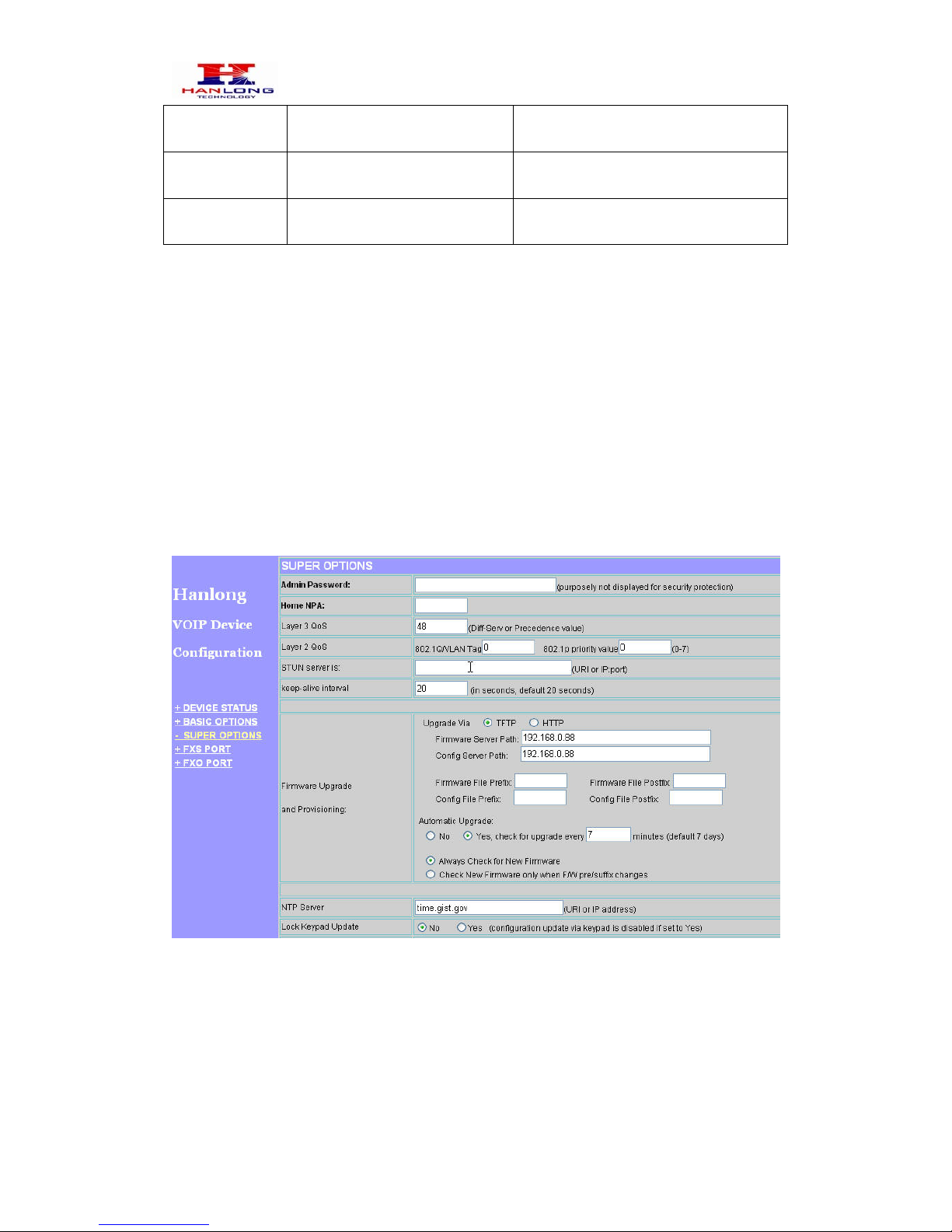
Unicorn 3112 has embedded Web server and HTML pages that allow users to configure
the Unicorn 3112 through an easy-to-use Web browser interface such as Microsoft’s
Internet Explorer or Netscape browser. Below is a screen shot of the Unicorn 3112
configuration page:
seconds
(if SIP server is configured)
with SIP gatekeeper/proxy server
Green Light
Button flashes every 2 seconds
Message waiting
(if feature is available)
Green Light
Button flashes at 1/10 second
Phone is ringing. Incoming call in
progress.
Page 15
Unicorn 3112 User Manual
Copyright © 2008 Hanlong Technology Co., Ltd Page 15 of 42
6.1.1. Ac c e s si ng t he Web Confi gura t ion
The Unicorn 3112 configuration page can be accessed via the LAN or WAN port.
6.1.2. Programming Unicorn 3112 via the LAN Port
To program Unicorn 3112 via the LAN port, directly connect an Ethernet cable from your
PC to the LAN port of the Unicorn 3112. After connecting the cable, confirm that the
green light of the LAN port is on. If the green light is not on, this means that your PC is not
yet properly connected to the Unicorn 3112 via the LAN port.
For LAN port configuration, use the following default IP address to access the device:
http://192.168.22.1
6.1.3. Programming Unicorn 3112 via the WAN Port
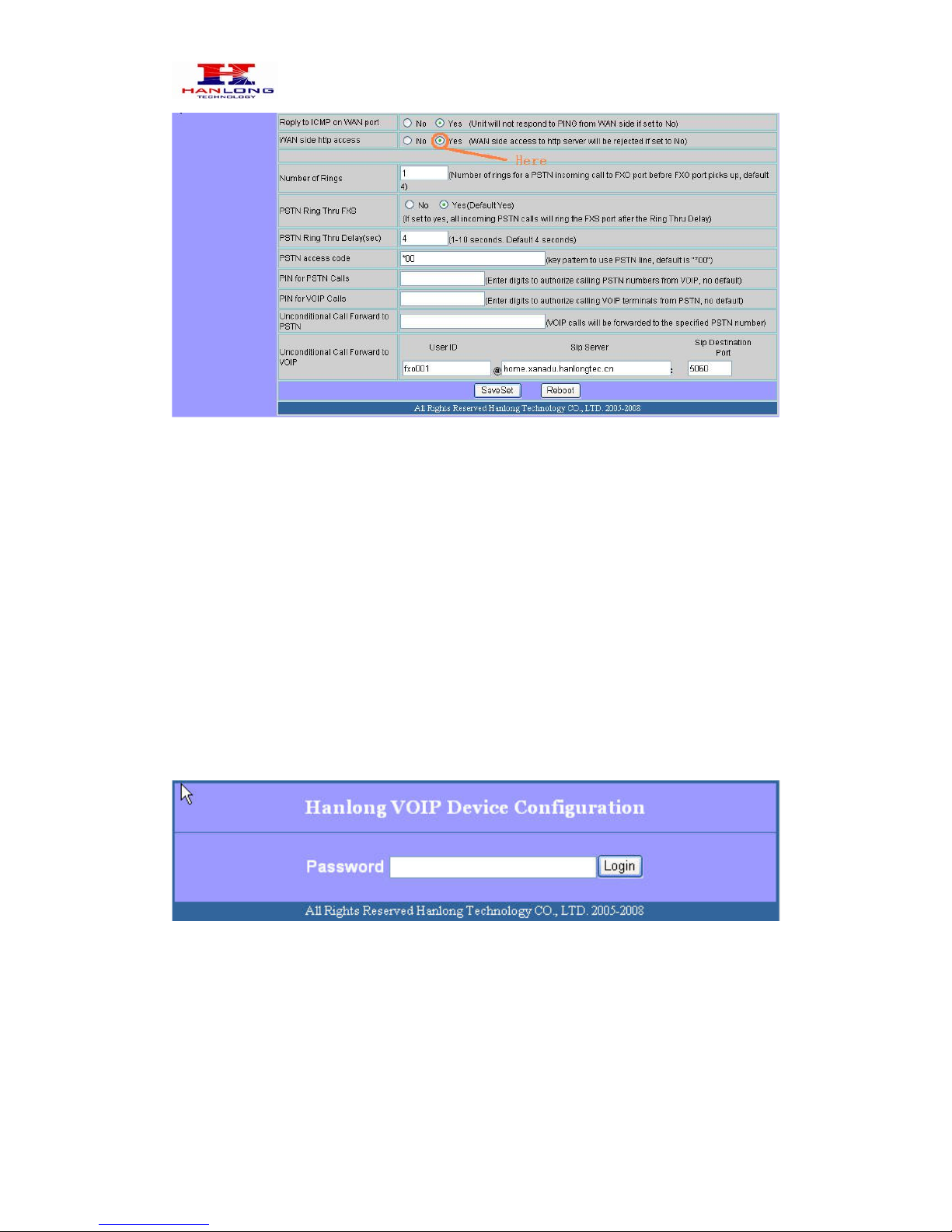
The WAN port access for web configuration is disabled by default from the factory. To
access the web configuration menu from the WAN port, you must first access the device
via the device LAN port (see instructions above “Programming Unicorn 3112 via the LAN
port”) and enable the “Enable WAN Web Access” option.
Please see the following screen shot of the Unicorn 3112 basic option page:
Page 16
Unicorn 3112 User Manual
Copyright © 2008 Hanlong Technology Co., Ltd Page 16 of 42
After enab l i ng W AN ac ces s, b e s ur e tha t th e WAN por t of t he Unicorn 3112 i s c on nec ted
to an
up link (i .e. router , hub, swi tch, etc) . Then, g et the W AN IP addr ess of t he Unicorn
3112 and selecting menu option 02. Then, access the Unicorn 3112 via your web
browser by entering the WAN IP address:
http://Unicorn 3112’s IP Address
Be sure that your PC is connected to the router/hub/switch directly or via the LAN port
(which also serves as a pass-through connection for internet/network access for your PC)
of the Unicorn 3112.
6.1.4. Us e r Pr ogramming and Configuration
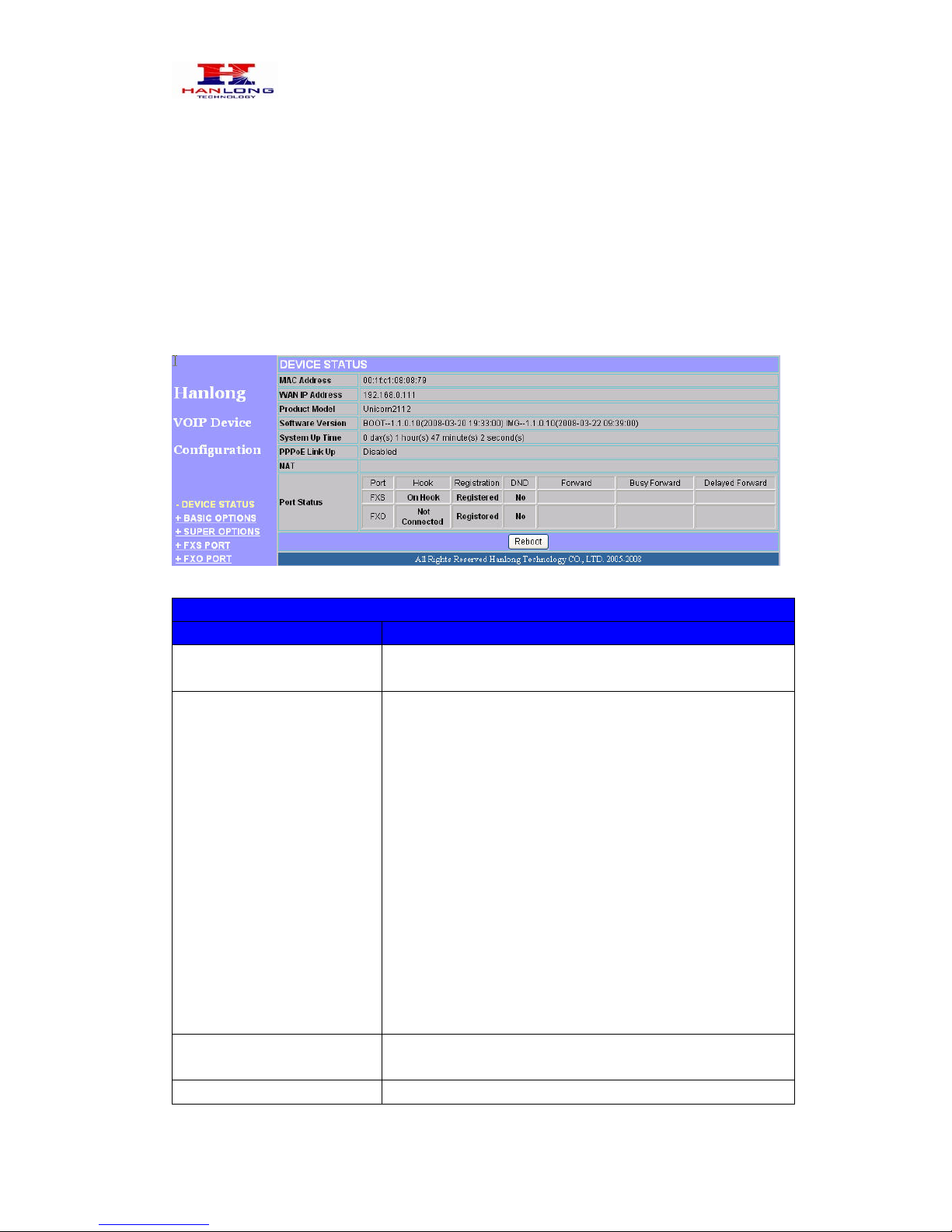
From your web browser, the Unicorn 3112 will show the following login screen:
Enter the password and click on the “Login” button
6.1.5. Passwords
Passwords are case sensitive and all Unicorn devices come with factory default
passwords as indicated below:
Advanced User Password for access to Super User Options: admin
Page 17
Unicorn 3112 User Manual
Copyright © 2008 Hanlong Technology Co., Ltd Page 17 of 42
End User Password for access to Basic User Options: 1234
6.1.6. End User Settings:
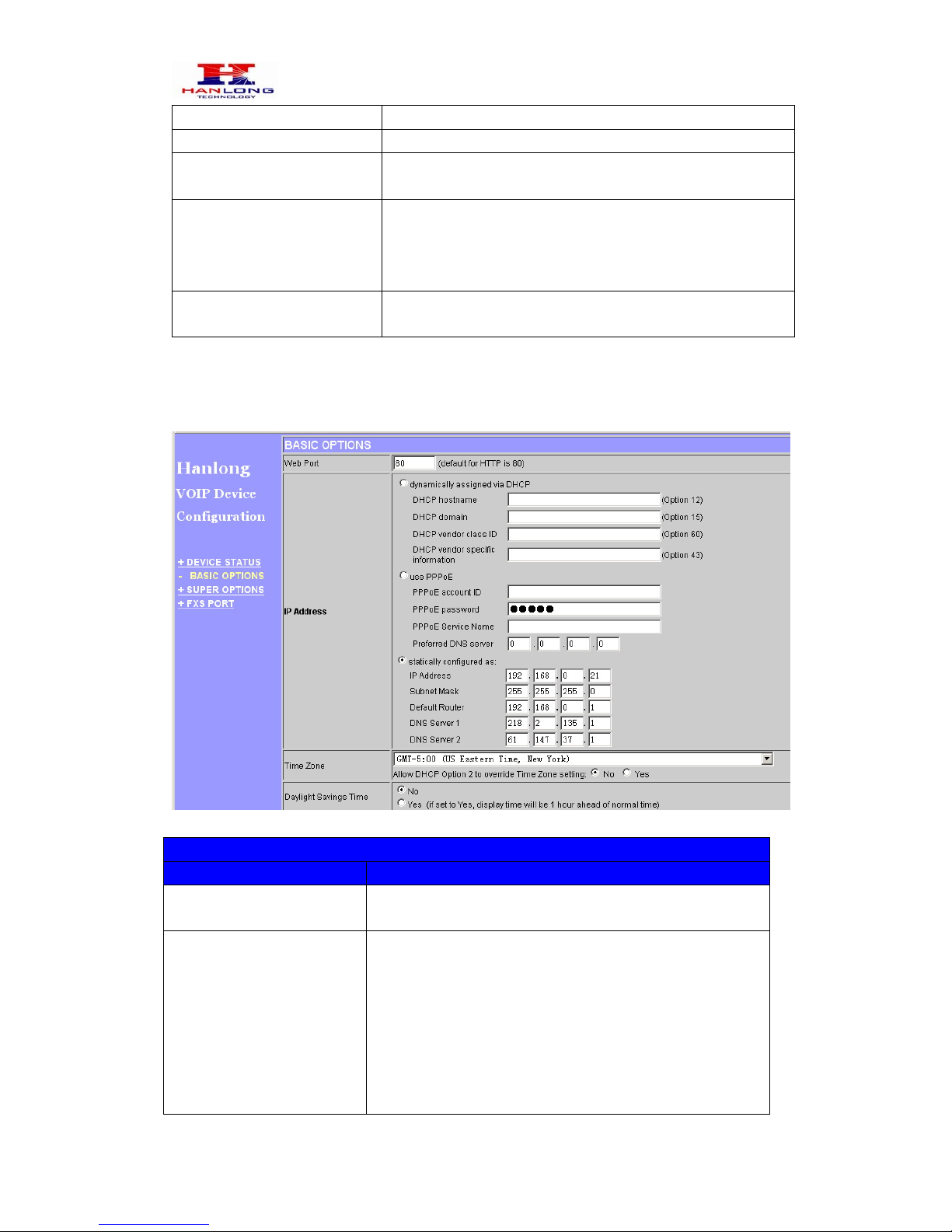
After a correct password is entered in the login screen, the embedded web server inside
the Unicorn 3112 will show the configuration page, which is explained in details below:
6.1.6.1 Device Status:
DEVICE STATUS SETTING
Setting Options Meaning
MAC Ad dre s s
The devic e ID, in H EX form at. This i s a v ery im portant ID
for ISP troubleshooting.
WAN I P Addr e s s
There are 2 modes under which the Unicorn 3112 can
operate:
- If DHCP m ode i s enab l ed, t hen all t h e f i el d v al ues for the
Static IP mode are not used (even though they are still
saved in the chipset's memory). The Unicorn 3112 will
acquire its IP address from the first DHCP server it
discovers from the office/home network it is connected to.
To use the PPPoE f eature, the PPPoE account settings
need to be se t. The U nicor n 3112 w ill attem pt t o estab lis h
a PPPoE session if any of the PPPoE fields have been
entered with data.
- If Stat i c I P m ode i s enab l ed, then the IP addr ess , S ub net
Mask, Default Router I P a ddr es s, DN S S er v er 1 (pr imary),
DNS Server 2 (secondary) fields will need to be configured
by the user. These fields are reset to zero by default.
Product Model
This field contains the product model info, such as Unicorn
3112
Software Version
Program: This is the main software release. Boot and
Page 18
Unicorn 3112 User Manual
Copyright © 2008 Hanlong Technology Co., Ltd Page 18 of 42
Loader are not changed often.
System Up Time
This shows system up time since last reboot.
PPPoE Link Up
This show s w hether t he PP PoE is up if connect ed to D SL
modem.
NAT
This show s what k ind NAT the U nicor n 3 112 is con necte d
to. It is based on STUN protocol. If the detected NAT is
symmetri c NAT, STUN wil l not work and Outbound Proxy
needed to make Unicorn 3112 functioning correctly.
Port Status
Shows several information regarding the FXS and FXO
ports.
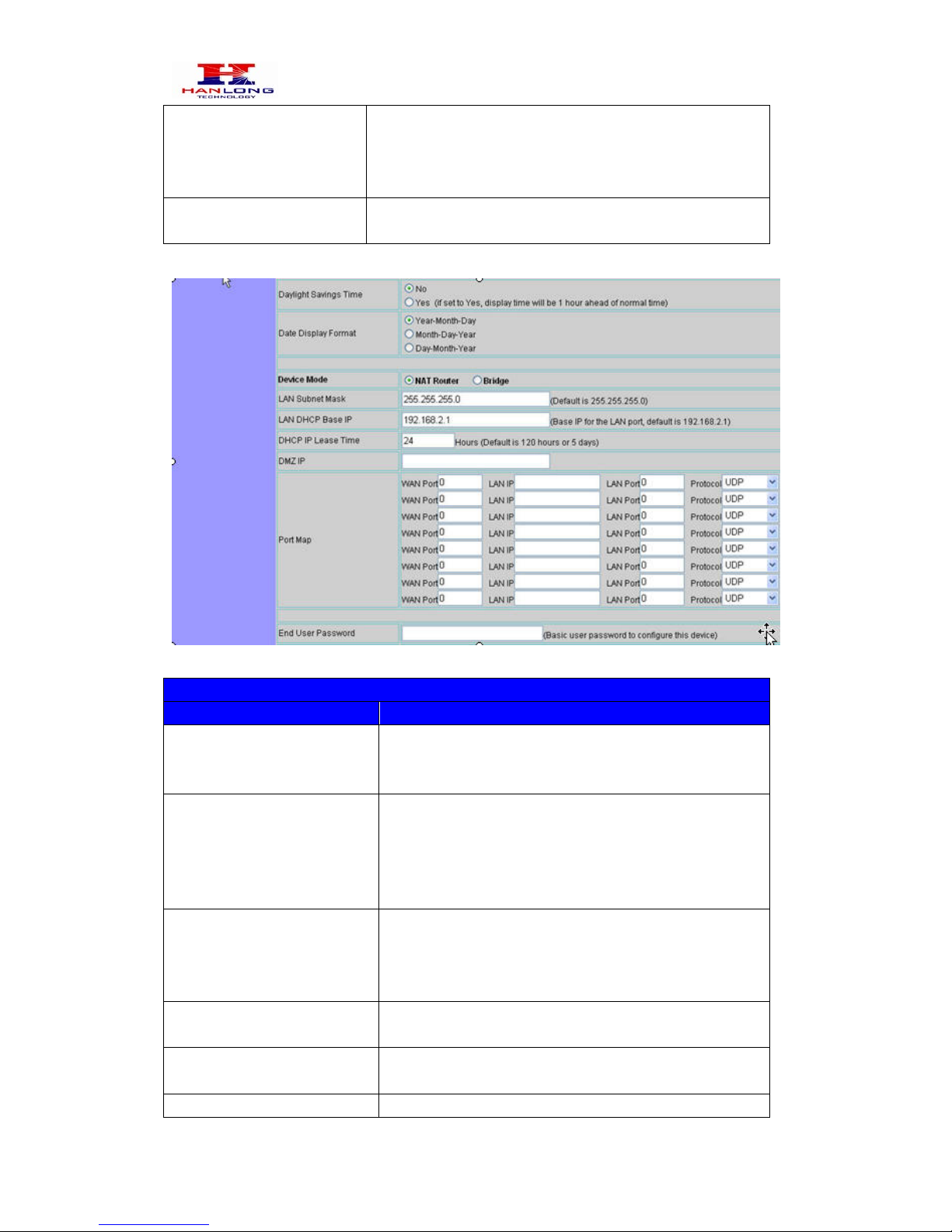
6.1.6.2 Basic Options:
BASIC OPTIONS SETTING
Setting Options Meaning
Web Port
This is the device’s internal HTTP server port.
Default is 80.
IP Address
- If DHCP mode is enab led, then all the field v alues for
the S tatic IP mode ar e not used ( even though the y are
still s aved in the F lash memory.) The Unic orn 3112 will
acquir e it s I P addr ess fr om DH C P in the network. PPPoE
settings is usually for DSL/ADSL modem users. The
Unicorn will attempt to establish a PPPoE ses
sion if
PPPoE account is set.
Page 19
Unicorn 3112 User Manual
Copyright © 2008 Hanlong Technology Co., Ltd Page 19 of 42
- If Static IP mode is selected, the IP address, Subnet
Mask, Default Router IP
address, DNS Server 1
(mandatory), DNS Serv er 2 (optional) fields need to be
configured.
Time Zone
This param eter c ontrols how the displ ayed date/time will
be adjusted according to the specified time zone.
BASIC OPTIONS SETTING
Setting Options Meaning
Daylight Savings Time
This parameter cont r ol s w hether the dis p l ayed t ime wi ll
be daylight saving s time or not. If set to Yes, then t he
displayed time will be 1 hour ahead of normal time.
Date Display Format
Allow user to choose among the following three
formats:
Year-Month-Day
Month-Day-Year
Day-Month-Year
Device Mode
This param eter contr ols whether the dev ice is w orking
in NAT router mode or Bridge mode.
Need save the s ett ing and reb oot the devic e b efore the
setting start to work
LAN Subnet Mask
Sets the LAN subnet mask.
Default value is 255.255.255.0
LAN DHCP Base IP
Base IP for the LAN p or t w hi c h f unc ti ons as a G ate way
for the subnet. Default value is 192.168.22.1
DHCP IP Lease Time
Value is s et in uni ts of hours . Defaul t val ue is 120 h rs
Page 20
Unicorn 3112 User Manual
Copyright © 2008 Hanlong Technology Co., Ltd Page 20 of 42
(5 Days.)
The time IP address is assigned to the LAN clients.
DMZ IP
Forwar d all W AN IP tr affic to a sp ec if i c IP addr es s i f no
matchi ng port is used b y Unicorn 3112 i tself or in the
defined port forwarding
Port Map
Forwards a matching (TCP/UDP) port to a specific LAN
IP address with a specific (TCP/UDP ) port
End User Password
This contains the password to access the Web
Configuration Menu. This field is case sensitive.
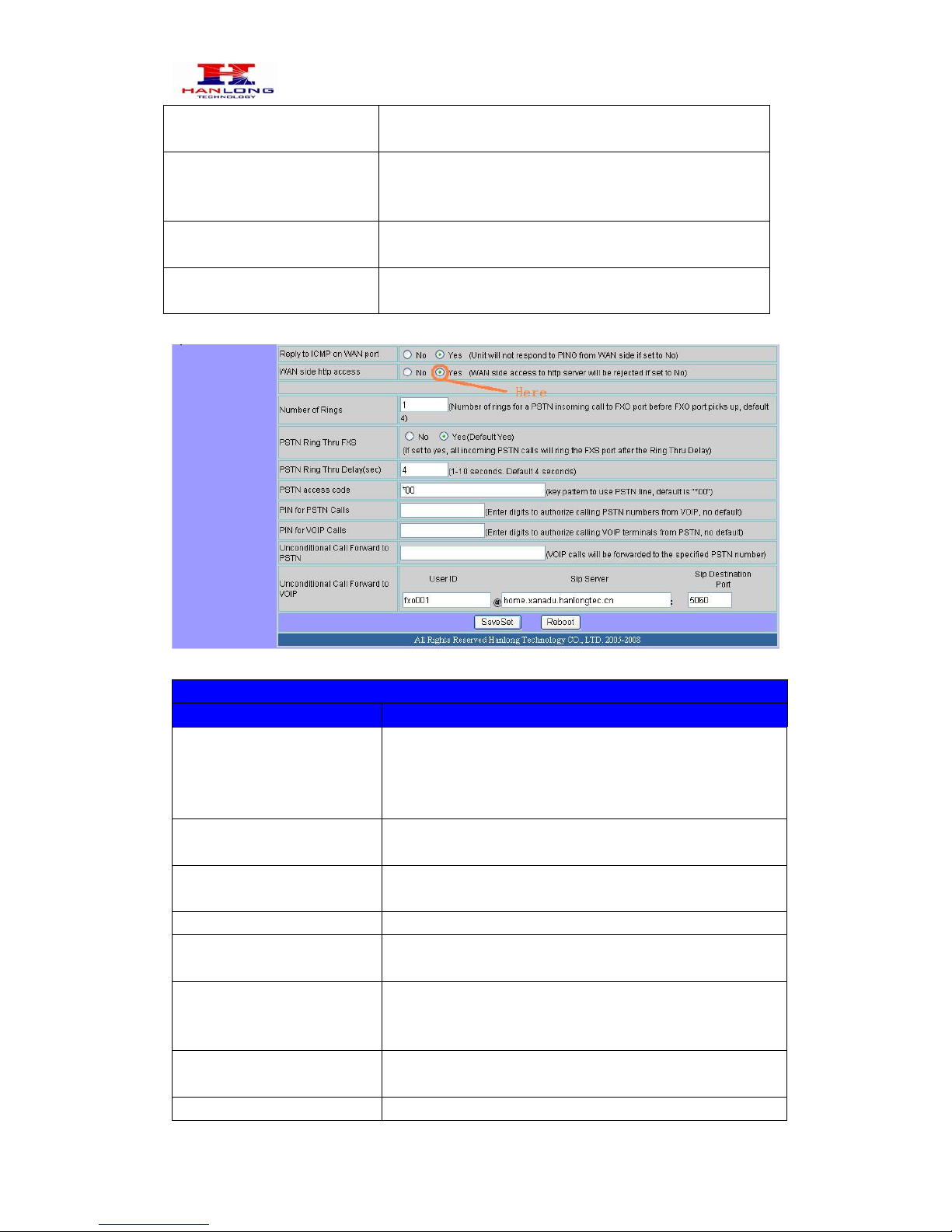
BASIC OPTIONS SETTING
Setting Options Meaning
Reply to ICMP on WAN
port
If set to “ Yes ” , the U nic orn 3112 wi l l resp ond t o the P IN G
command f rom other computers , but it also is v ulnerab le
to the DOS attack.
Default is No.
WAN side http access
If this p arameter is set to “No”, the H TML config uration
update via WAN port is disabled.
Number of Rings
This param et er sp ecifies the num b er of FXS phone ri ngs
for incoming PSTN calls to FXO port. Default is 4
PSTN Ring Thru FXS
Default is Yes
PSTN Ring Thru
Delay(sec)
Default is 4 sec
PSTN access code
This field allows users to customize their own code to
access the PSTN line.
Default is “*00”.
PIN for PSTN Calls
Enter digits to authorize calling PSTN numbers from
VOIP, no default
PIN for VOIP Calls
Enter digits to authorize calling VOIP terminals from
Page 21
Unicorn 3112 User Manual
Copyright © 2008 Hanlong Technology Co., Ltd Page 21 of 42
PSTN, no default
Unconditional Call
Forward to PSTN
Calls are unconditionally forwarded to the specified PSTN
phone number once users dial the FXO port VoIP
number.
Unconditional Call
Forward to VOIP
Calls ar e unconditional ly for warded t o the speci fied VoIP
phone number
once users dial the FXO port PSTN
number.
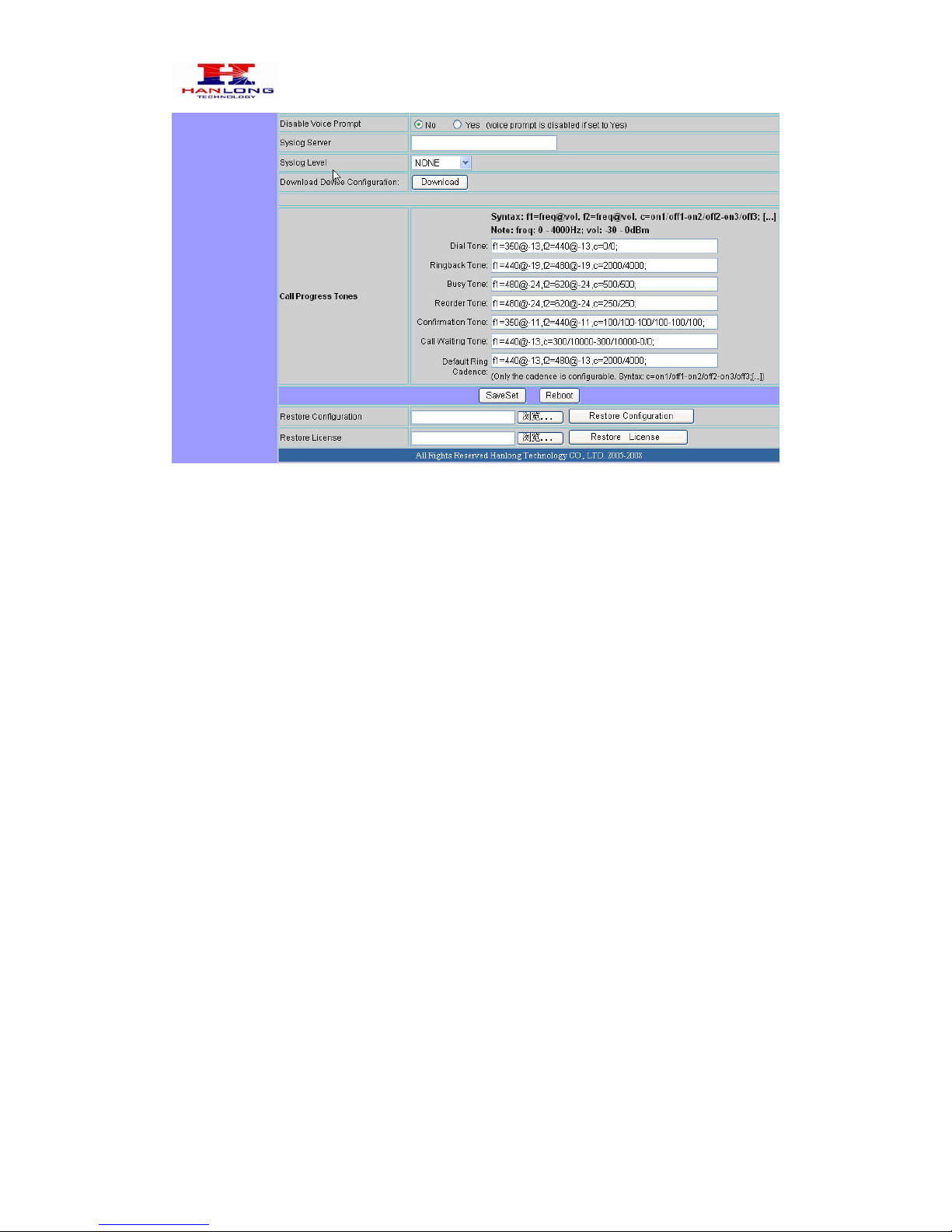
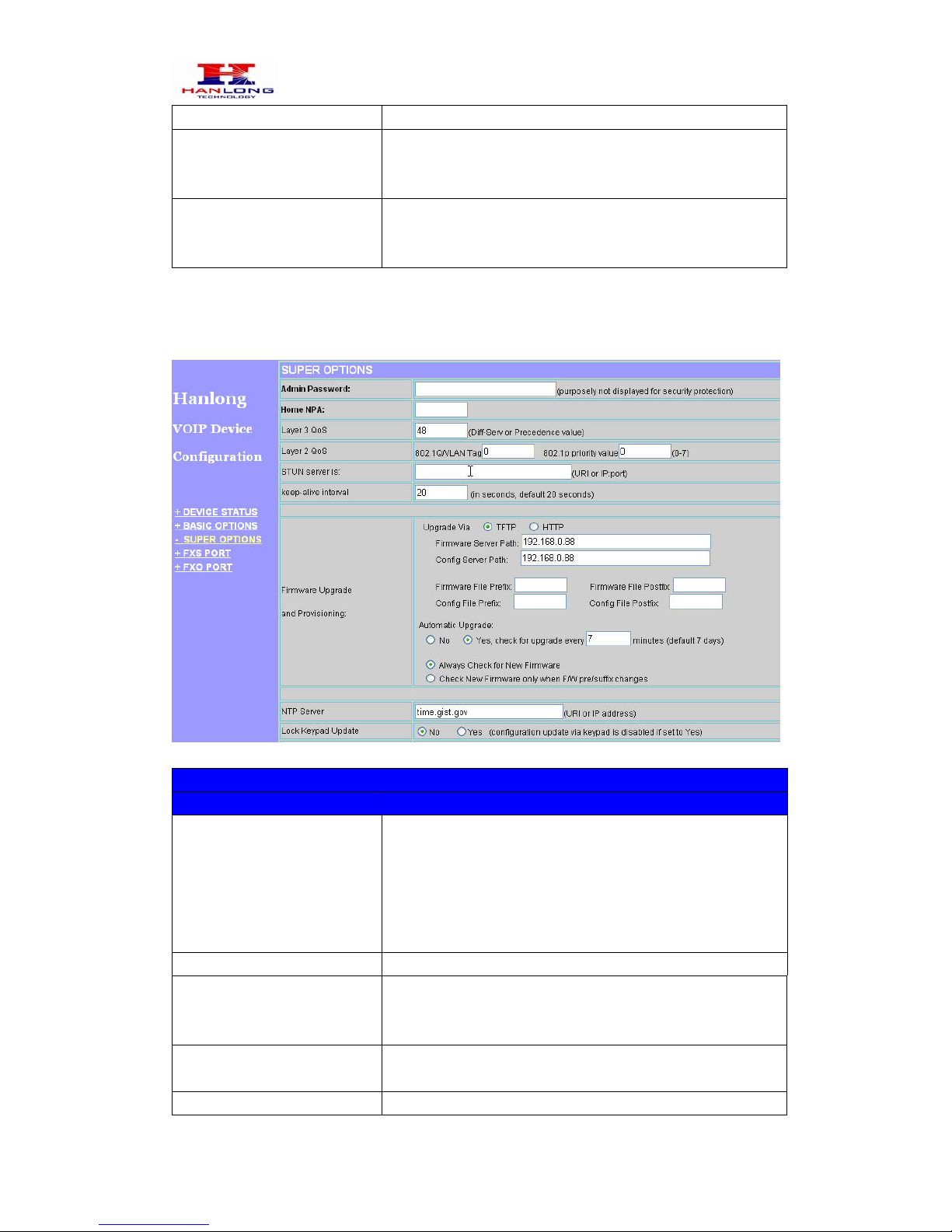
6.1.6.3 Super Option
SUPER OPTIONS SETTING
Setting Options Meaning
Admin Password:
This contains the password to acc ess the Advanced Web
Configur ation pag e. This f ield i s case sensiti ve. Onl y the
administrator can configure the “Advanced Settings”
page. Pass word field is purposely left b lank for security
reasons af ter click ing update and saved. T he maximum
password length is 26 characters,only digit or letter.
Home NPA:
Local area code for North American Dial Plan.
Layer 3 QoS
This field defines the layer 3 QoS parameter which can be
the value us ed for IP Precede nce or Di ff-Serv or MPLS.
Default value is 48.
Layer 2 QoS
This contains the value used for layer 2 VLAN tag.
Default setting is blank.
STUN server is:
IP address or domain name of stun server
Page 22
Unicorn 3112 User Manual
Copyright © 2008 Hanlong Technology Co., Ltd Page 22 of 42
keep-alive interval
This parameter specifies how often the Unicorn 3112
sends a blank UDP packet t o the SIP server in or der to
keep the “hole” on the NAT open.
Firmware Upgrade
and Provisioning:
Default m ethod is HT TP. Fir mw are up grade m ay ta ke up
to 10 minutes depending on network environment.
Do not interrupt the firmware upgrading process.
NTP Server
This parameter def i nes the U R I or IP addr es s of the N TP
server which is used by the U nicorn 3112 to di splay th e
current date/time.
Lock Keypad Update
If this par ameter is set to “Yes”, t he config uration up date
via keypad is disabled.
SUPER OPTIONS SETTING
Setting Options Meaning
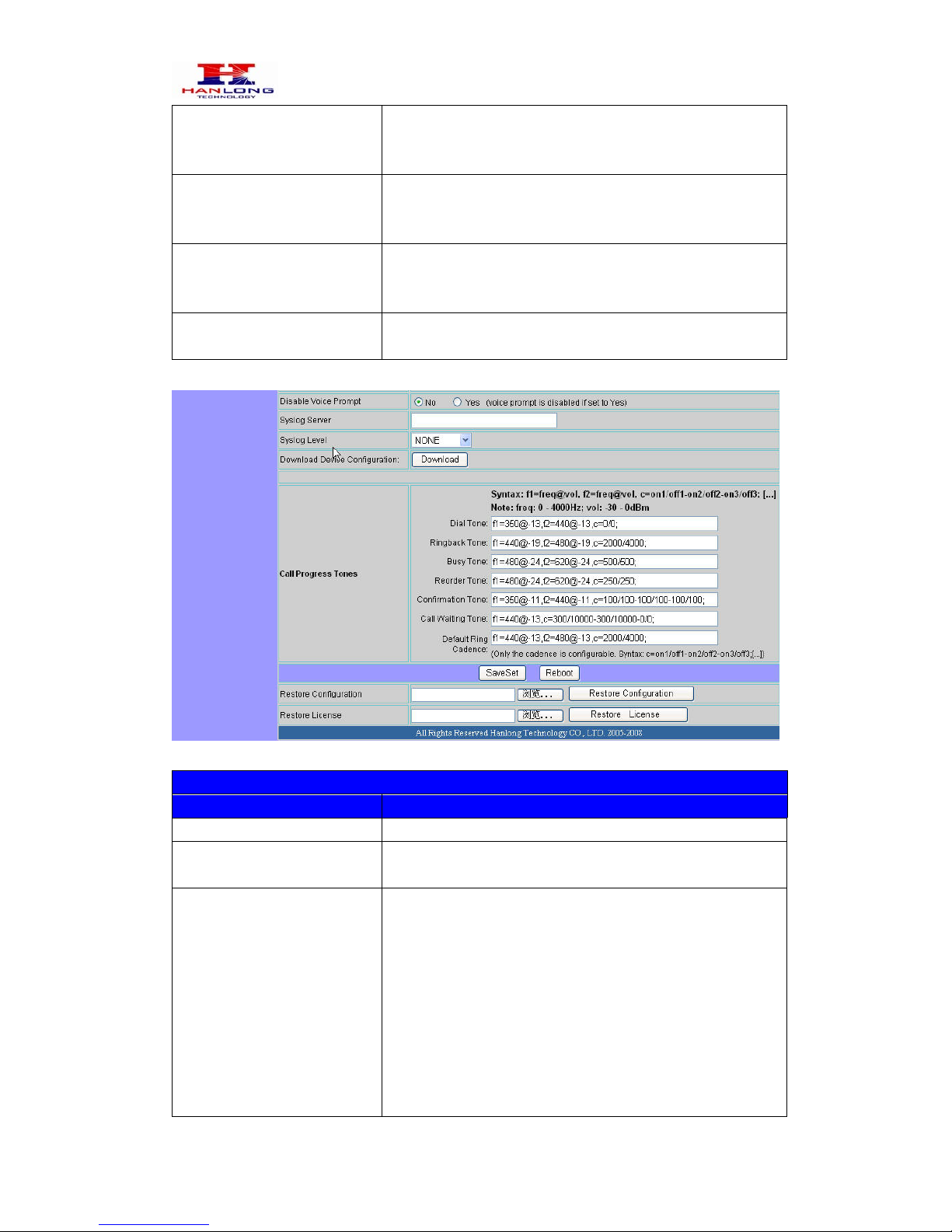
Disable Voice Prompt
Default is NO.
Syslog Server
The IP address or URL of syslog server, especially useful
for ITSP (Internet Telephone Service Provider)
Syslog Level
Select the A TA to report the log lev el. Default i s NONE.
The level is either one of DEBUG, INF O, WARNING or
ERROR. Syslog messages are sent based on the
following events:
• product model/version on boot up (INFO level)
• NAT related info (INFO level)
• sent or received SIP message (DEBUG level)
• SIP message summary (INFO level)
• inbound and outbound calls (INFO level)
• registration status change (INFO level)
Page 23

Unicorn 3112 User Manual
Copyright © 2008 Hanlong Technology Co., Ltd Page 23 of 42
• negotiated codec (INFO level)
• Ethernet link up (INFO level)
• SLIC chip exception (WARNING and ERROR levels)
• memory exception (ERROR level)
The Syslog uses USER facility. In addition to standard
Syslog payload, it contains the following components:
GS_LOG: [device MAC address][error code] error
message
Here is an example: May 19 02:40:38 192.168.1.14
GS_LOG: [00:0b:82:00:a1:be][000]
Ethernet link is up
Download Device
Configuration:
User can download configuration from the web page and
save to configuration file.
Unregister On Reboot
Default is No. If set to yes, the SIP user will be
unregistered on reboot.
Call Progress Tones
Using these settings, user can configure tone frequencies
according to their pr eference. By def ault the y are set to
North American frequencies.
Frequencies should be
configured with known values to avoid uncomfortable high
pitch sounds.
ON is the period of ringing (“On time” in ‘ms’) while OFF is
the period of silence. In order t o set a conti nuous tone,
OFF should b e zero. Otherw ise it w ill ring ON ms and a
pause of OFF ms and then repeat the pattern.
Restore Configuration
User can restore the before configuration from the
configuration file saved at local pc
Page 24
Unicorn 3112 User Manual
Copyright © 2008 Hanlong Technology Co., Ltd Page 24 of 42
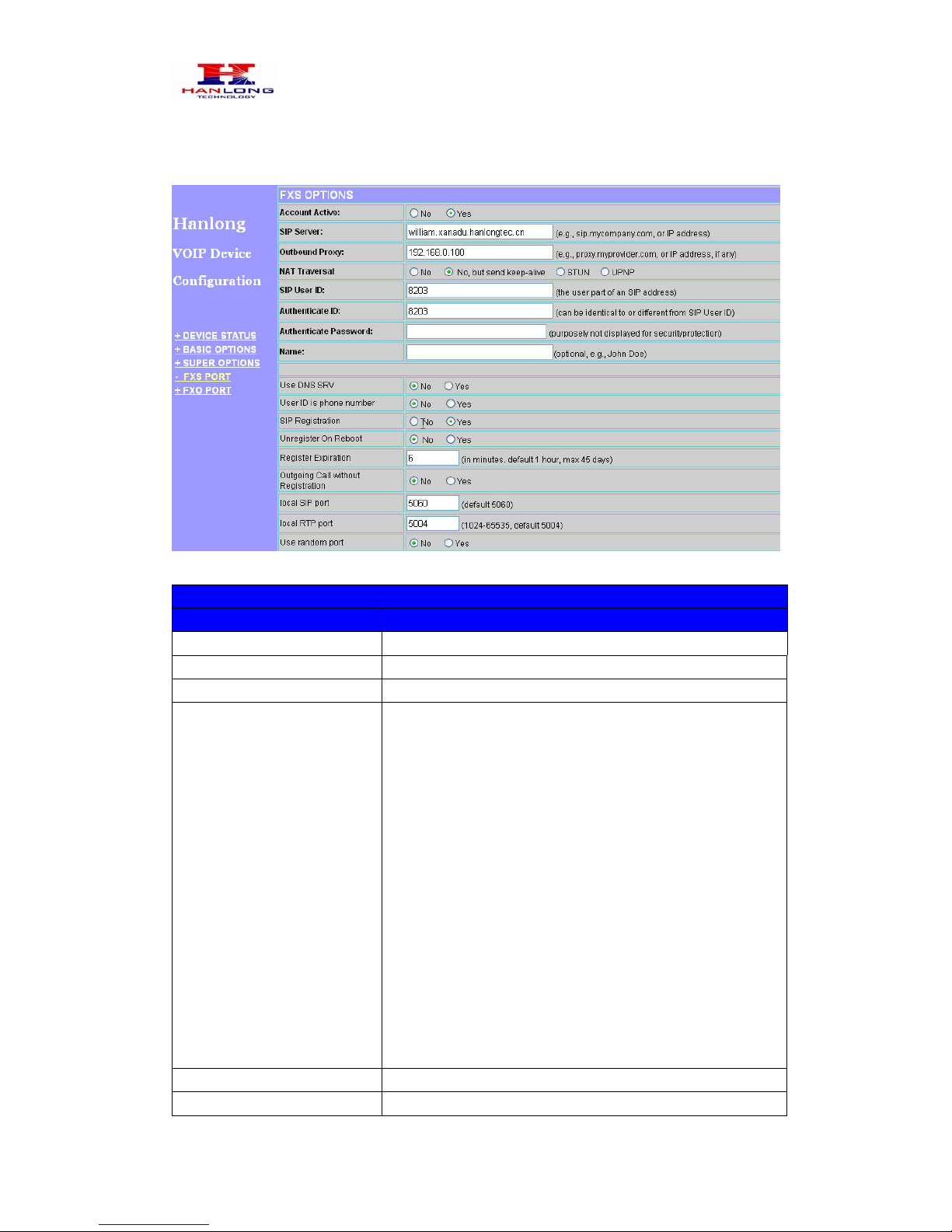
6.1.6.4 FXS Port Settings:
FXS PORT SETTING
Setting Options Meaning
Account Act ive:
Set to the YES, the account can be available
SIP Server
SIP Server’s URI or IP address
Outbound Proxy
SIP Outbound Proxy Server’s URI or IP address
NAT Traversal
This p arameter defines whether the Unicorn 3112 NAT
traversal mechani sm will be activ ated or not. If ac tivated
(by choosi ng “ Yes”) and a STUN s erver is als o specif ied,
then the Unicorn 3112 will behave according to the STUN
client specification. Under this mod
e, the embedded
STUN client inside the Unicorn 3112 will attempt to detect
if and what type of firewall/NAT it is sitting behind through
communication with the specified STUN server. If the
detected NAT is a Full Cone, Restricted Cone, or a
Port-Restricted Cone, the Unicorn 3112
will attempt to
use its m apped public I P address and p ort in all it s SIP
and SDP m essages. If the NAT Trav ersal fi eld is set t o
“Yes” w ith no specified STU N server, the Unicorn 3112
will periodically (every 20 seconds or so) send a blank
UDP pac ket (with no p ayload data) to t he SIP server to
keep the “hole” on the NAT open.
SIP User ID
SIP service subscriber’s User ID
Authenticate ID
SIP service subscriber’s Authenticate ID. Can be identical
Page 25

Unicorn 3112 User Manual
Copyright © 2008 Hanlong Technology Co., Ltd Page 25 of 42
to or different from SIP User ID
Authenticate Password
SIP service subscriber’s account password
Name
SIP service subscriber’s name which will be used for
Caller ID display
Use DNS SRV
Default is No.
If set to Yes the client will use DNS SRV for server lookup
User ID is phone
number
If the Unicorn 3112 has an assigned PSTN telephone
number, this field should be set to “Yes”. Otherwise, set it
to “No”. I f “Yes” i s set, a “user= phone” p aram eter will be
attached to the “From” header in SIP request
SIP Registration
This parameter cont r ol s whether the U nic or n 3112 needs
to send REGISTER messages to the proxy server.
The default setting is “Yes”
Unregister On Reboot
Default is No.
If set to yes, the SIP user will be unregistered on reboot.
Register Expiration
This parameter allows the user to
specify the time
frequency (in minutes) the Unicorn 3112 refreshes its
registration with the specified registrar. The default
interval is 60 minutes (or 1 hour).
The maximum interval is 65535 minutes (about 45 days).
Outgoing Call without
Registration
Default is No. If set to “Yes,” user can place outgoing
calls even when not registered (if allowed by ITSP) ,
but is unable to receive incoming calls.
Local SIP port
This parameter defines the local SIP port the Unicorn
3112 will listen an d transmit.
The default value for FXS port is 5060.
The default value for FXO port is 5062.
Local RTP port
This parameter def i nes th e l oc al RTP-
RTCP port pair the
Unicorn 3112 will li sten and transm it. It is the base RTP
port f or channel 0. W hen configur ed, channel 0 will use
this port _value for RTP and the port_value+1 for its
RTCP; channel 1 will use port_value+2 for RTP and
port_value+3 for its RTCP. The default value for FXS port
is 5004.
The default value for FXO port is 5008.
Use random port
This parameter, when set to Yes, will force random
generation of both the local SIP and RTP ports.
This is usually necessary when multiple Unicorn 3112 are
behind the same NAT.
Page 26
Unicorn 3112 User Manual
Copyright © 2008 Hanlong Technology Co., Ltd Page 26 of 42
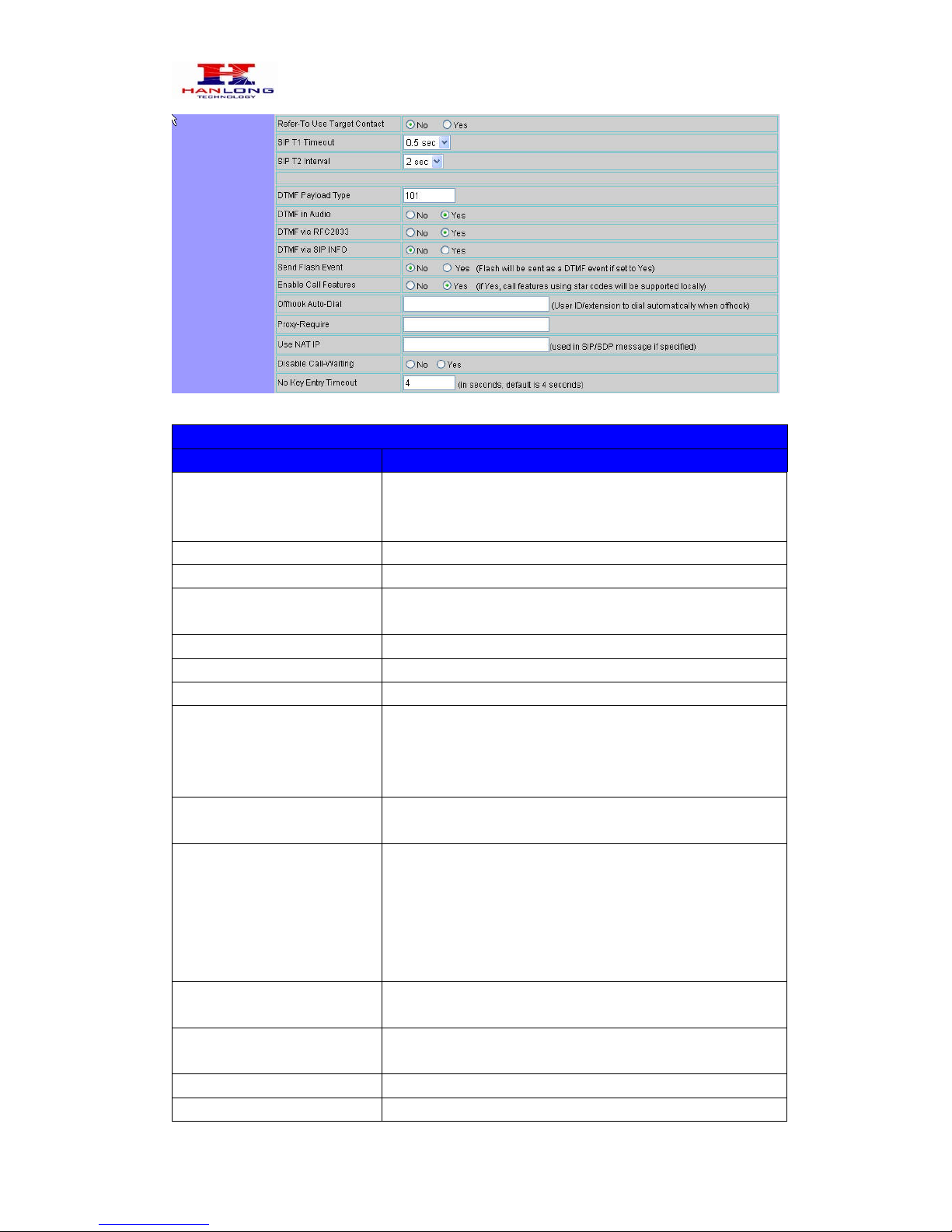
FXS PORT SETTING
Setting Options Meaning
Refer-
To Use Target
Contact
Used for Attended transfer Feature. Def ault is N O. If set
to YES, the “Refer-To” header
uses the transferred
target’s “Contact” header information.
SIP T1 Timeout
Default is 0.5 sec
SIP T2 Interval
Default is 2 sec
DTMF Payload Type
This parameter sets the payload type for DTMF using
RFC2833
DTMF in Audio
Default is YES
DTMF via RFC2833
Default is YES
DTMF via SIP INFO
Default is NO
Send Flash Event
This parameter allows users to control whether to send an
SIP NOTIFY mess age indicating the Flash event, or just
to switch to the voice channel when users press the Flash
key.
Enable Call Features
Default is No. If set to Yes, Call Forwarding &
Do-Not-Disturb are supported locally
Offhook Auto-Dial
This parameter allows users to configure a User ID or
extension number to be aut
omatically dialed upon
offhook. Please note that only the user part of a SIP
address needs to be ent ered here. Th e Unicorn 3112 will
automatically append th e “@ ” and the hos t p ort ion of the
corresponding SIP address.
Proxy-Require
SIP Extensio n to noti fy SIP serv er that t he unit i s behind
the NAT/Firewall.
Use NAT IP
NAT IP address used in SIP/SDP message.
Default is blank.
Disable Call-Waiting
Default is No.
No Key Entry Timeout
Default is 4 seconds.
Page 27
Unicorn 3112 User Manual
Copyright © 2008 Hanlong Technology Co., Ltd Page 27 of 42
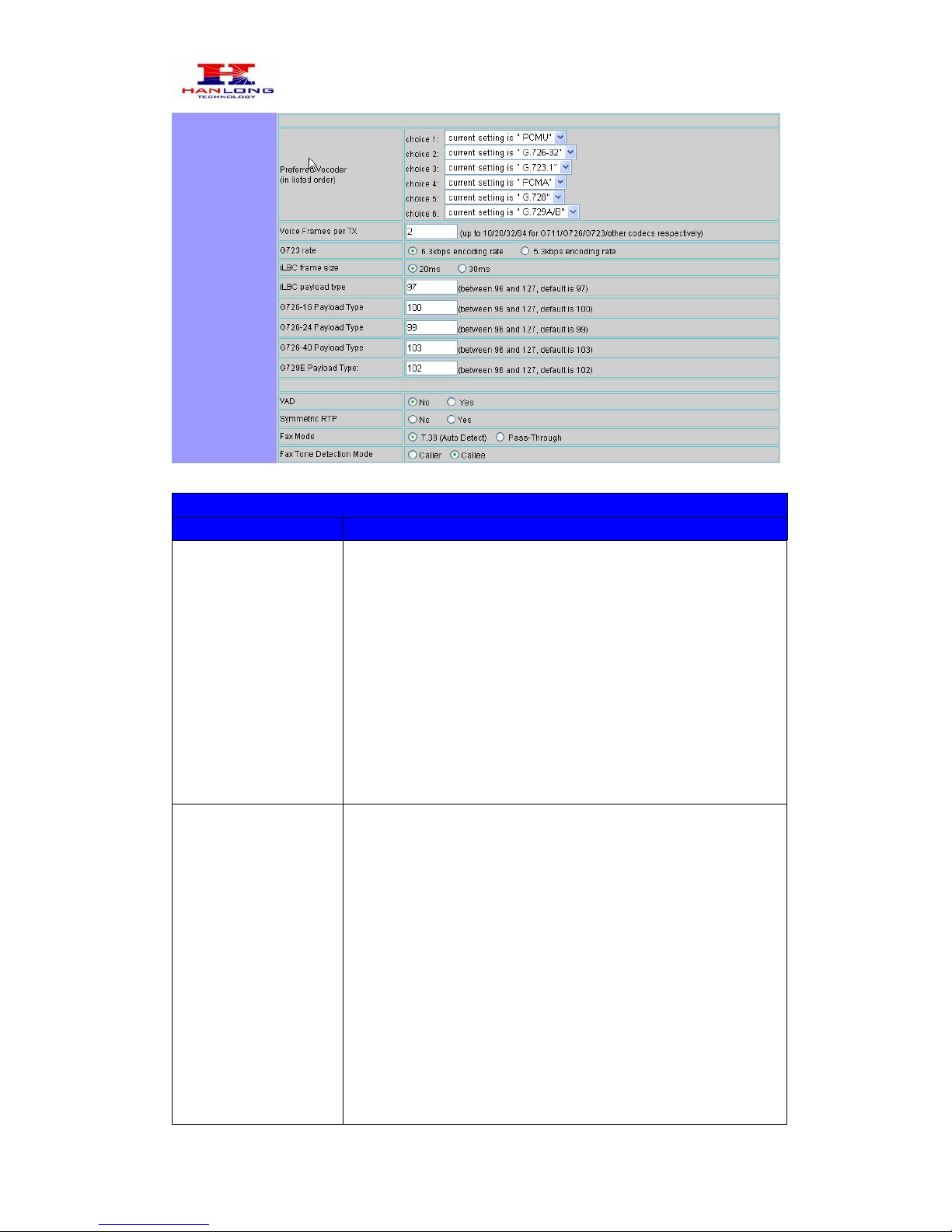
FXS PORT SETTING
Setting Options Meaning
Preferred Vocoder
(in listed order)
The Unicorn 3112 supports up to 7 different Vocoder types
including G.711 A-/U-law,G.723.1, G.726, G.728, G.729A/B,
iLBC(Pending). Depending on the product model, some of
these Vocoders may not be provided in standard release.
Users can c onfigure Vocoder s in a pref erence list that w ill be
included w i th t he same pref erenc e or der i n SD P message. The
first Vocoder in this list can be entered by choosing the
appropri ate option in “ Choice 1”. Si milarl y, the last Vocoder in
this lis t can be entered by choosi ng the appropri ate option in
“Choice 7”.
Voice Frames per
TX
This field contains the number of voice frames to be transmitted
in a singl e pac ket. W hen sett ing t hi s v alue, th e user s hould be
aware of t he r eq ues ted p ac ket ti me (used i n SD P mess ag e) as
a result of configuring this parameter. This parameter is
associated with the first vocoder in the above vocoder
Preference List or the actual used payload type negotiated
between the 2 conv ersat ion part ies at run tim e. e.g ., if the fi rst
vocoder i s conf igur ed as G723 a nd t he “Voi ce Fr ames p er TX”
is set to b e 2, then the “ ptime” v al ue in t he SD P m essag e of an
INVITE req uest w ill be 60m s because eac h G723 v oice f rame
contains 30ms of audio. Similarly, if this field is set to be 2 and if
the first vocoder chosen is G729 or G711 or G726, then the
“ptim e” v al ue i n the SD P m es sage of an INVITE reques t will be
20ms. If the configured voice frames per TX exceeds the
Page 28

Unicorn 3112 User Manual
Copyright © 2008 Hanlong Technology Co., Ltd Page 28 of 42
maximum al lowed value, the Uni corn 3112 will use and save
the maximum all ow ed value for the c or r es p ondi ng fi rs t vocoder
choice. The m axim um value f or PCM is 10(x 10ms) fram es; for
G726, it is 20 (x10ms) frames; for G723, it is 32 (x30ms)
frames; for G729/G728, 64 (x10ms) and 64 (x2.5ms) frames
respectively.
G723 Rate
This defines the encoding rate for G723 vocoder.
By default, 6.3kbps rate is chosen.
iLBC frame size
This sets the iLBC size in 20ms or 30ms
iLBC payload type
This defines payload time for iLBC. Default value is 98.
The valid range is between 96 and 127.
G726-
16 Payload
Type
default is 100
G726-
24 Payload
Type
Default is 99
G726-
40 Payload
Type
Default value is103, range is from 96 to 123
G729E Payload
Type:
Default value is102, range is from 96 to 127
VAD
Default i s No. VAD allow s detecting the ab sence of audio a nd
conserve bandwidth by preventing the transmission of "silent
packets" over the network
Symmetric RTP
Default is No. When set to Yes the device will change the
destinatio n to s end RTP pac kets to th e so urce IP a ddress and
port of the inbound RTP packet last received by the device.
Fax Mode
T.38 (Auto Detect) FoIP by default, or fax Pass-Through.
Fax Tone
Detection Mode
Default i s Call ee. This decides whether Caller or Cal lee sends
out the re INVITE for T.38 or Fax Pass Through.
Page 29
Unicorn 3112 User Manual
Copyright © 2008 Hanlong Technology Co., Ltd Page 29 of 42
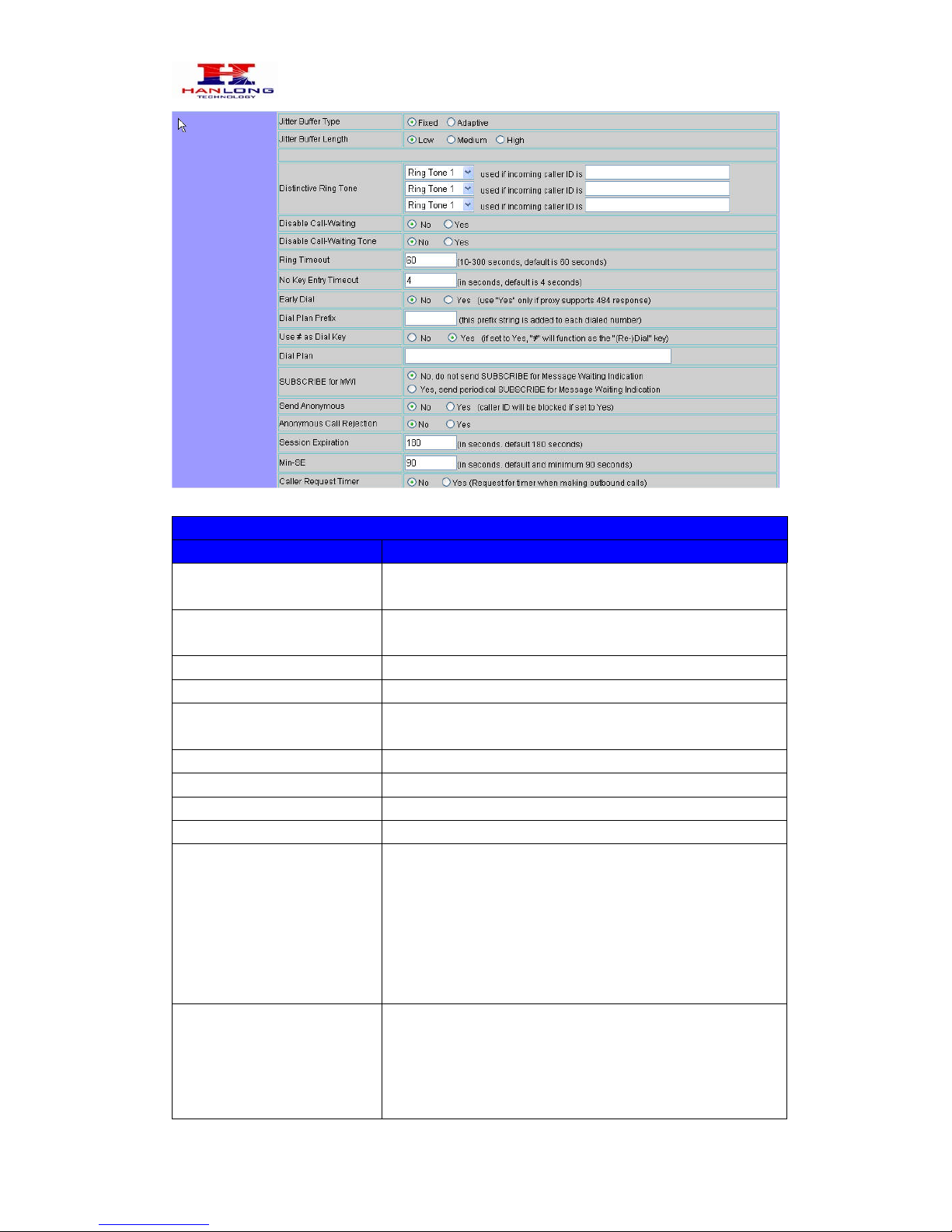
FXS PORT SETTING
Setting Options Meaning
Jitter Buffer Type
S
elect either Fixed or Adaptive based on network
conditions.
Jitter Buffer L ength
Select Low, Medium or High based on network
conditions.
Distinctive Ring Tone
Default is NO.
Disable Call-Waiting
Default is NO.
Disable Call-Waiting
Tone
Default is NO. This is to disable the stutter call waiting
tone when a call waiting call arrived
Ring Timeout
Incoming ca ll will stop rin ging
No Key Entry Timeout
Default is 4 seconds.
Early Dial
Default is No. Use only if proxy supports 484 response
Dial Plan Prefix
Sets the prefix added to each dialed number
Use # as Dial Key
This parameter allows users to configure the “#” key to be
used as the “Send” (or “Dial”) key. If set to “Yes”, pressing
this key will immediately trigger the sending of dialed
string coll ected so far . In thi s cas e, thi s ke y is ess enti ally
equiv al ent to t he “ ( R e)Di al” key. If set to “N o” , this “ #” key
will then be included as part of t he dial str ing to be s ent
out.
Dial Plan
Dial Plan Rules:
1. Accept Digits: 1,2,3,4,5,6,7,8,9,0 , *, #, A,a,B,b,C,c,D,d
2. Grammar: x - any digit from 0-9;
a. xx+ - at least 2 digits number;
b. xx. ?at least 2 digits number;
Page 30

Unicorn 3112 User Manual
Copyright © 2008 Hanlong Technology Co., Ltd Page 30 of 42
c. ^ - exclude;
d. [3-5] - any digit of 3, 4, or 5;
e. [147] - any digit 1, 4, or 7;
f. <2=011> - replace digit 2 with 011 when dialing
Example 1: {[369]11 | 1617xxxxxxx} Allow 311, 611, 911,
and any 10 digit numbers of leading digits 1617
Example 2: {^1900x+ | <=1617>xxxxxxx} Block any
number of leading digits 1900 and add prefix 1617 for any
dialed 7 digit numbers
Example 3: {1xxx[2-9]xxxxxx | <2=011>x+} Allow any
length of number with leading digit 2 and 10 digit-numbers
of leading digit 1 and leading exchange number between
2 and 9; if leading digit is 2, replace leading digit 2 with
011 before dialing.
3. Default: Outgoing - {x+}
Example of a simple dial plan used in a Home/Office in
the US:
{ ^1900x. | <=1617>[2-9]xxxxxx | 1[2-9]xx[2-9]xxxxxx |
011[2-9]x. | [3469]11 }
Explanation of example rule (reading from left to right):
^1900x. - prevents dialing any number started with 1900
<=1617>[2-9]xxxxxx - allows dialing to local area code
(617) numbers by dialing 7 numbers and 1617 area code
will be added automatically
1[2-9]xx[2-9]xxxxxx |- allows dialing to any US/Canada
Number with 11 digits length
011[2-9]x. - allows international calls starting with 011
[3469]11 - allow dialing special and emergency numbers
311, 411, 611 and 911
Note: In some cases user wishes to dial strings such as
*123 to activate voice mail or other application provided
by service provider. In this case * should be predefined
inside dial plan feature and the Dial Plan should be:
{ [x*]+ }.
SUBSCRIBE for MWI
Default is No. When set to “Yes” a SUBSCRIBE for
Message Waiting Indication will be sent periodically.
Send
Anonymous
If this parameter is set to “Yes”, the “From” header in
outgoing INVITE message will be set to anonymous,
essentially blocking the Caller ID from displaying.
Anonymous Call
Default i s NO, if set to YES, the an onymous call will be
Page 31
Unicorn 3112 User Manual
Copyright © 2008 Hanlong Technology Co., Ltd Page 31 of 42
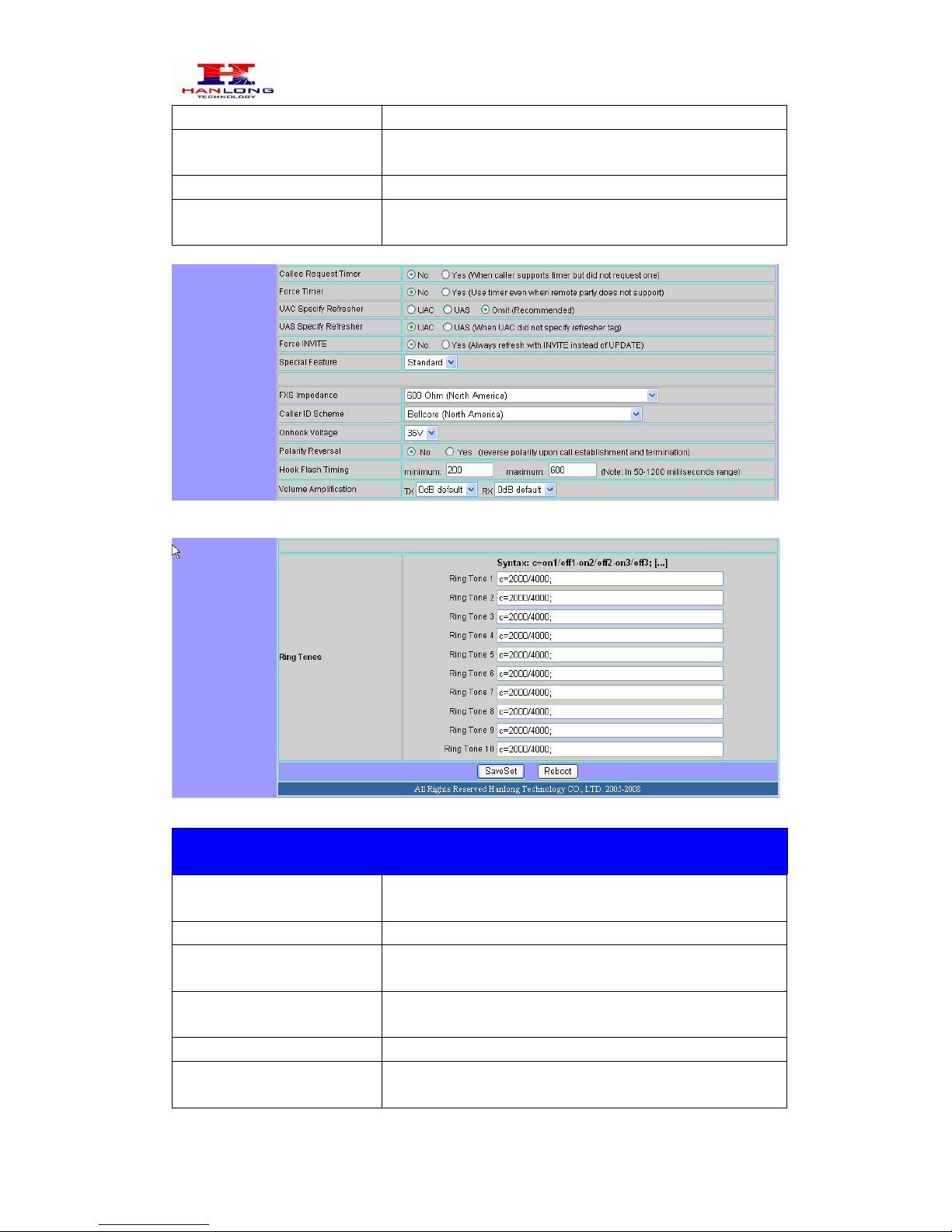
Rejection
rejected with busy message.
Session
Expiration
Default is 180 seconds.
Min-SE
Default is 90 seconds
Caller Request
Timer
Default is NO
FXS PORT SETTING
Setting Options Meaning
Callee Request
Timer
Default is NO
Force Timer
Default is NO
UAC Specify
Refresher
Default is Omit
UAS Specify
Refresher
Default is UAC
Force IN VITE
Default is NO
Special Feature
Default i s Standard. Choos e the selec tion to meet some
special requirements from Soft Switch vendors like Nortel,
Page 32

Unicorn 3112 User Manual
Copyright © 2008 Hanlong Technology Co., Ltd Page 32 of 42
Broadsoft, etc.
FXS Impedance
Selects the impedance of the analog telephone
connected to the Phone port.
Caller ID Scheme
Select the Caller ID Scheme to suit the standard of
different area.
• Bellcore (North America)
• ETSI-
FSK (France, Germany, Norway, Taiwan,
UK-CCA)
• ETSI-DTMF (Finland, Sweden)
• DTMF (Denmark)
Onhook Voltage
Select the onhook voltage to suit different area or PBX
Polarity Reversal
Select Polar ity Rev er sal to adap t som e cal l charg e/b illi ng
system. Default is No.
Hook Flash Timing
Time period when the cradle is pressed (Hook Flash) to
simulate FLASH. To prevent unwanted activation of the
Flash/Hold and automatic phone ring-back, adjust this
time value.
Volume Amplification
Handset vol ume adjustm ent. RX is f or receiving volum e,
TX is for transmi s si on v ol um e. D ef aul t val ues ar e 0d B for
both parameters. +6dB generates the highest volume and
-6dB generates the lowest volume.
Ring Tones
This function lets you configure ring tone cadence
preferences. User has 10 choices.
The configuration, completed in Distinctive Ring Tones
block in the same page, applies to ring tones cadences
configured here.
Page 33
Unicorn 3112 User Manual
Copyright © 2008 Hanlong Technology Co., Ltd Page 33 of 42
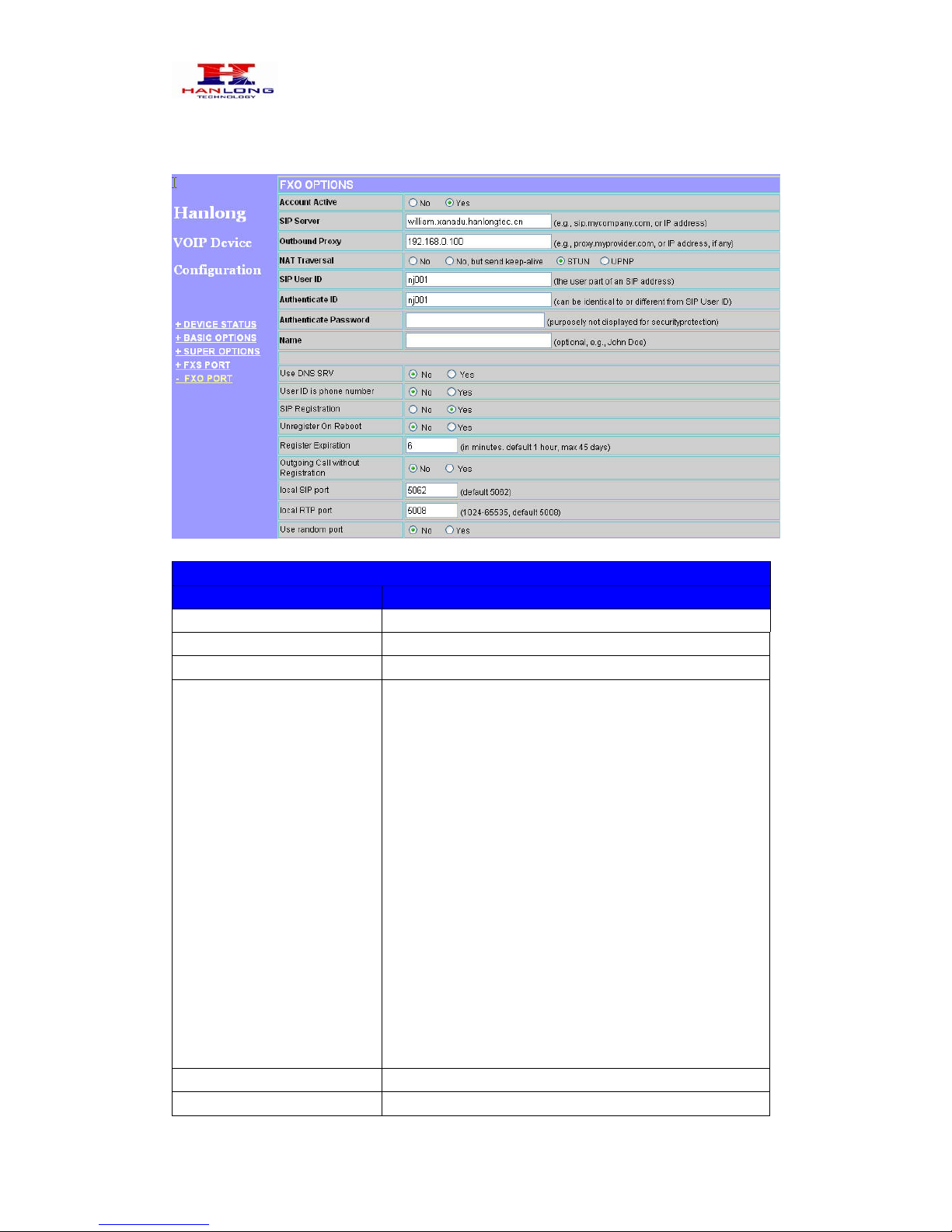
6.1.6.5 FXO Port Settings:
FXO PORT SETTING
Setting Options Meaning
Account Act ive:
Set to the YES, the account can be available
SIP Server
SIP Server’s URI or IP address
Outbound Proxy
SIP Outbound Proxy Server’s URI or IP address
NAT Traversal
This param eter defines whet her the U ni c or n 3112 NAT
traversal
mechanism will be activated or not. If
activated (by choosing “Yes”) and a
STUN server is
also specified, then the Unicorn 3112
will behave
according to the STUN cl ient speci fication. Under this
mode, the em bedded STUN cli ent inside the Unicorn
3112 will attempt to detect if and what type of
firewal l/N AT it is sit ting behi nd thr ough c omm uni cation
with the sp ecif i ed STUN serv er . If the detecte d NAT is
a Full Cone, Restricted Cone, or a Port-Restricted
Cone, the Unic orn 3112 w ill attempt to use it s mapped
public IP address and port in all its SIP and SDP
messages. If the NAT Traversal field is
set to “Yes”
with no sp ecified STUN server , the Unicorn 3112 will
periodically (every 20 seconds or so) send a blank
UDP packet (with no payload data) to the SIP server to
keep the “hole” on the NAT open.
SIP User ID
SIP service subscriber’s User ID
Authenticate ID
SIP service subscriber’s Authenticate ID.
Page 34

Unicorn 3112 User Manual
Copyright © 2008 Hanlong Technology Co., Ltd Page 34 of 42
Can be identical to or different from SIP User ID
Authenticate Password
SIP service subscriber’s account password
Name
SIP serv ice subscriber’ s name which will b e used for
Caller ID display
Use DNS SRV
Default i s N o. If set t o Yes t he cl i ent will us e DNS SRV
for server lookup
User ID i
s phone
number
If the Uni corn 3112 has an assigned P STN telepho ne
number, this field should be set to “Yes”. Otherwise, set
it to “No”. If “Yes” is s et, a “user=phone” parameter will
be attached to the “From” header in SIP request
SIP Registration
This parameter controls whether the Unicorn 3112
needs to send REGISTER messages to the proxy
server. The default setting is “Yes”.
Unregister On Reboot
Default is No. If set to yes, the SIP user will be
unregistered on reboot.
Register Expiration
This parameter allows the user to specify the time
frequency (i n minutes) t he Unicorn 3112 r efreshes its
registration with the specified registrar. The default
interval is 60 minutes (or 1 hour). The maximum
interval is 65535 minutes (about 45 days).
Outgoing Call without
Registration
Default is No. If set to “Yes,” user can place outgoing
calls even when not reg i s ter ed ( i f al l ow ed b y IT SP) b ut
is unable to receive incoming calls.
Local SIP port
This param eter def ines the loc al SIP p ort the Unicorn
3112 will listen an d transmit.
The default value for FXS port is 5060.
The default value for FXO port is 5062.
Local RTP port
This param eter defines the local RTP-
RTCP port pair
the Uni cor n 3112 will l is ten and trans m it. It is the b ase
RTP port for channel 0. W hen configured, channel 0
will us e this port _value for RTP and the por t_val ue+1
for its RTCP; channel 1 w ill use p ort_v alue+2 f or RTP
and port _value+3 for i ts RTCP. The def ault value for
FXS port is 5004.
The default value for FXO port is 5008.
Use random port
This parameter, when set to Yes, will force random
generation of both the l oc al SIP a nd RTP p or t s. This is
usually necessary when multiple Unicorn 3112 are
behind the same NAT.
Page 35
Unicorn 3112 User Manual
Copyright © 2008 Hanlong Technology Co., Ltd Page 35 of 42
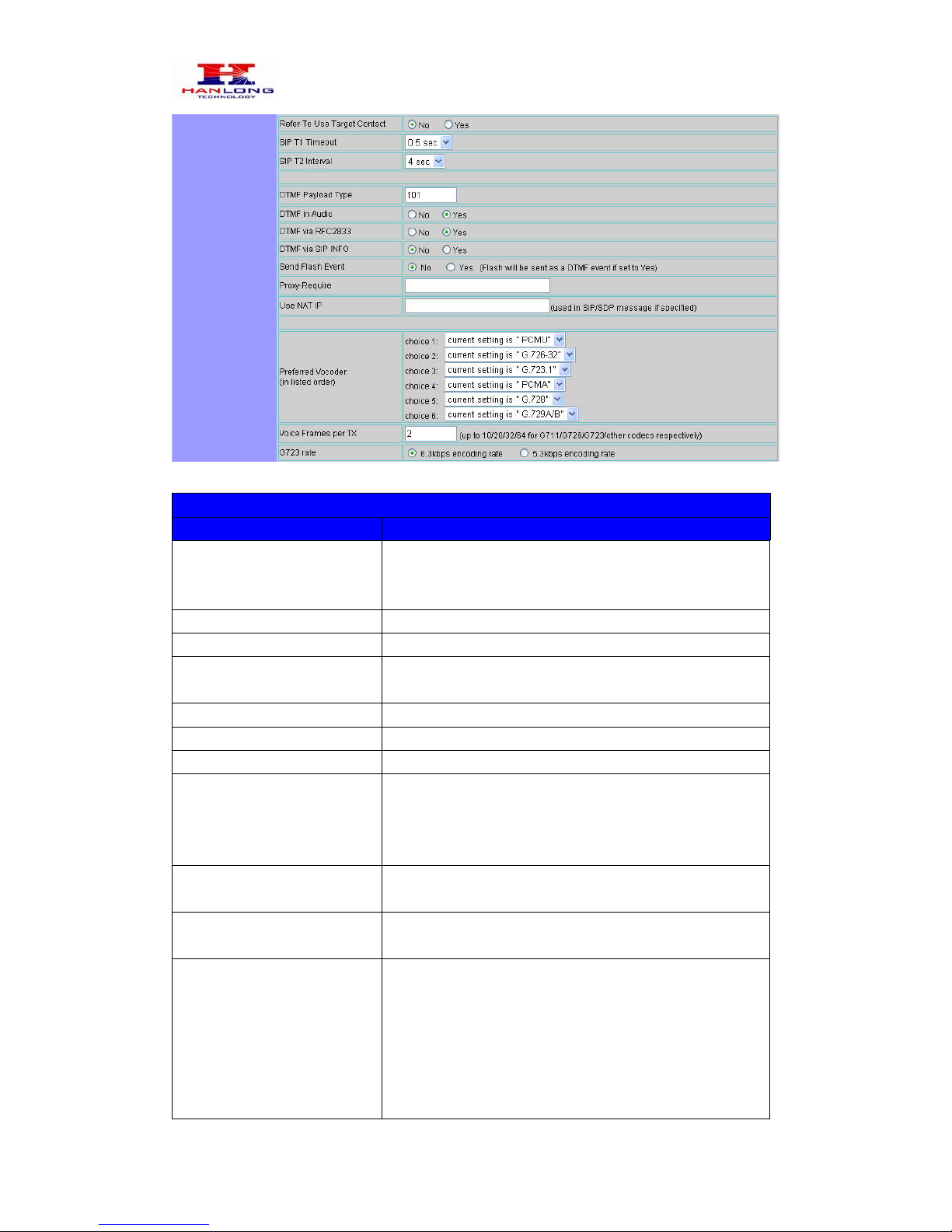
FXO PORT SETTING
Setting Options Meaning
Refer-
To Use Target
Contact
Default
is NO. If set to YES, then for Attended
Transfer, the “Refer-To” headeruses the transferred
target’s Contact header information.
SIP T1 Timeout
Default is 0.5 sec
SIP T2 Interval
Default is 4 sec
DTMF Payload Type
This param eter sets the payload type f or DTMF us ing
RFC2833
DTMF in Audio
Default is YES
DTMF via RFC2833
Default is YES
DTMF via SIP INFO
Default is NO
Send Flash Event
This parameter allows users to control whether to send
an SIP NOTIFY message indicating the Flash event, or
just to swi tch to the voice cha nnel when users press
the Flash key.
Proxy-Require
SIP Extension to notify SIP server that the unit is
behind the NAT/Firewall.
Use NAT IP
NAT IP address used in SIP/SDP message.
Default is blank.
Preferred Vocoder
(in listed order)
The Unicorn 31 12 supports up to 7 di fferent Vocoder
types including G.711 A-/U-law ,
G.723.1, G.726,
G.728, G.729A/B, iLBC(Pending). Dep ending on the
product model, some of these Vocoders may not be
provided in standard release.
Users c an config ure Vocoder s in a pr eferenc e list that
will be included with the same preference order in SDP
Page 36

Unicorn 3112 User Manual
Copyright © 2008 Hanlong Technology Co., Ltd Page 36 of 42
message. The first Voc oder in this l ist can be enter ed
by choosing the appropriate option in “Choice 1”.
Similarly, the last Vocoder in this list can be entered by
choosing the appropriate option in “Choice 7”.
This field contains the number of voice frames to be
transmi tted i n a s i ng l e p ac ket . When setti ng thi s value,
the user sh ould be awar e of t he r eq ues ted p ac k et ti me
(used in SDP message) as a result of conf iguring this
parameter . This param eter is associat ed with the fi rst
vocoder in the above vocoder Pref erence List or t he
actual used payload type negotiated between the 2
conversation parties at run time. e.g., if the first
vocoder i s conf igur ed as G723 an d the “ Voice F r ames
per TX” is set to be 2, then the “ptime” value in the SDP
message of an INVITE request will b e 60ms bec ause
each G723 voice frame contains 30ms of audio.
Similarly, if this field is set to be 2 and if the first
vocoder chosen is G729 or G711 or G726, then the
“ptime” value in the SDP message of an INVITE
request will be 20ms. If the configured voice frames per
TX exceeds the m aximum al lowed value, the Unic orn
3112 will use and s ave the maximum allowed value for
the corresp onding f irst vocoder choice. The m aximum
value f or PCM is 10(x10m s) fr ames; f or G726, it is 20
(x10ms) frames; f or G723, it is 32 (x30ms ) frames; for
G729/G728, 64 (x10ms) and 64 (x2.5ms) frames
respectively.
This defines the encoding rate for G723 vocoder.
By default, 6.3kbps rate is chosen.
Voice Frames per TX
This sets the iLBC size in 20ms or 30ms
G723 Rate
This defines payload time for iLBC. Default value is 98.
The valid range is between 96 and 127.
Page 37
Unicorn 3112 User Manual
Copyright © 2008 Hanlong Technology Co., Ltd Page 37 of 42
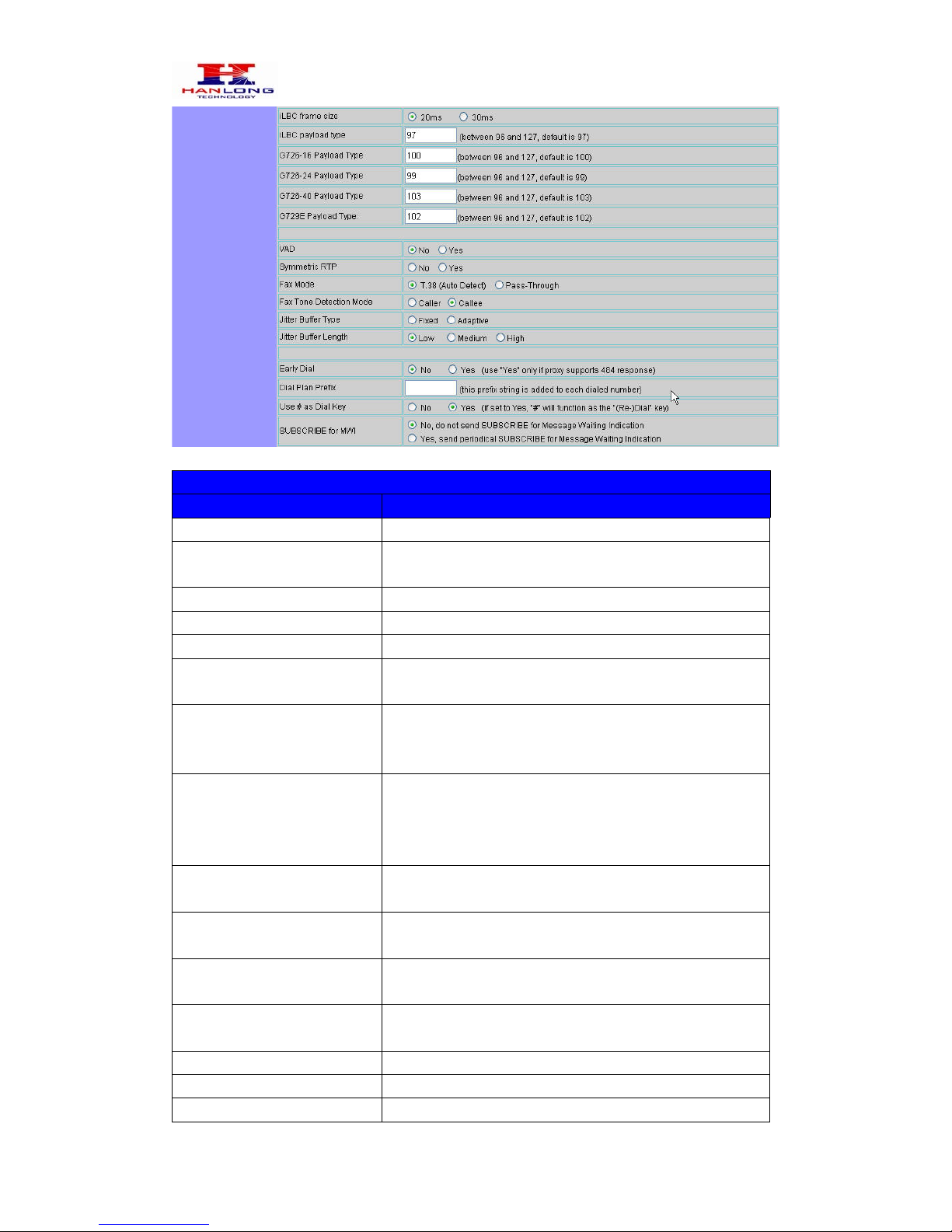
FXO PORT SETTING
Setting Options Meaning
iLBC frame size
This sets the iLBC size in 20ms or 30ms
iLBC payload type
This defines payload time for iLBC. Default value is 98.
The valid range is between 96 and 127.
G726-16 Payload Type
default is 100
G726-24 Payload Type
Default is 99
G726-40 Payload Type
Default value is103, range is from 96 to 123
G729E Payload
Type:
Default value is102, range is from 96 to 127
VAD
Default is No. VAD allows detecting the absence of
audio and conserve
bandwidth by preventing the
transmission of "silent packets" over the network
Symmetric RTP
Default i s No. W hen set to Yes t he d evi ce w ill chang e
the destinati on to se nd RTP p ackets to t he source IP
address and port of the inbound RTP packet last
received by the device.
Fax Mode
T.38(Auto Detect) FoIP by default, or fax
Pass-Through.
Fax Tone Detection
Mode
Default is Callee. This decides whether Caller or Callee
sends out the re INVITE for T.38 or Fax Pass Through.
Jitter Buffer Type
Select either Fixed or Adaptive based on network
conditions.
Jitter Buffer L ength
Select Low, Medium or High b
ased on network
conditions.
Early Dial
Default is No. Use only if proxy supports 484 response
Dial Plan Prefix
Sets the prefix added to each dialed number
Use # as Dial Key
This parameter al l ows us er s t o configure the “ #” k e y t o
Page 38
Unicorn 3112 User Manual
Copyright © 2008 Hanlong Technology Co., Ltd Page 38 of 42
be used as the “Send” (o
r “Dial”) key. If set to “Yes”,
pressing this key will immediately trigger the sending of
dialed str ing collected so f ar. In this case, t his key is
essentially equivalent to the “(Re)Dial” key. If set to
“No”, this “#” key will then be included as part of the dial
string to be sent out.
SUBSCRIBE for MWI
Default is No. When set to “Yes” a SUBSCRIBE for
Message Waiting Indication will be sent periodically.
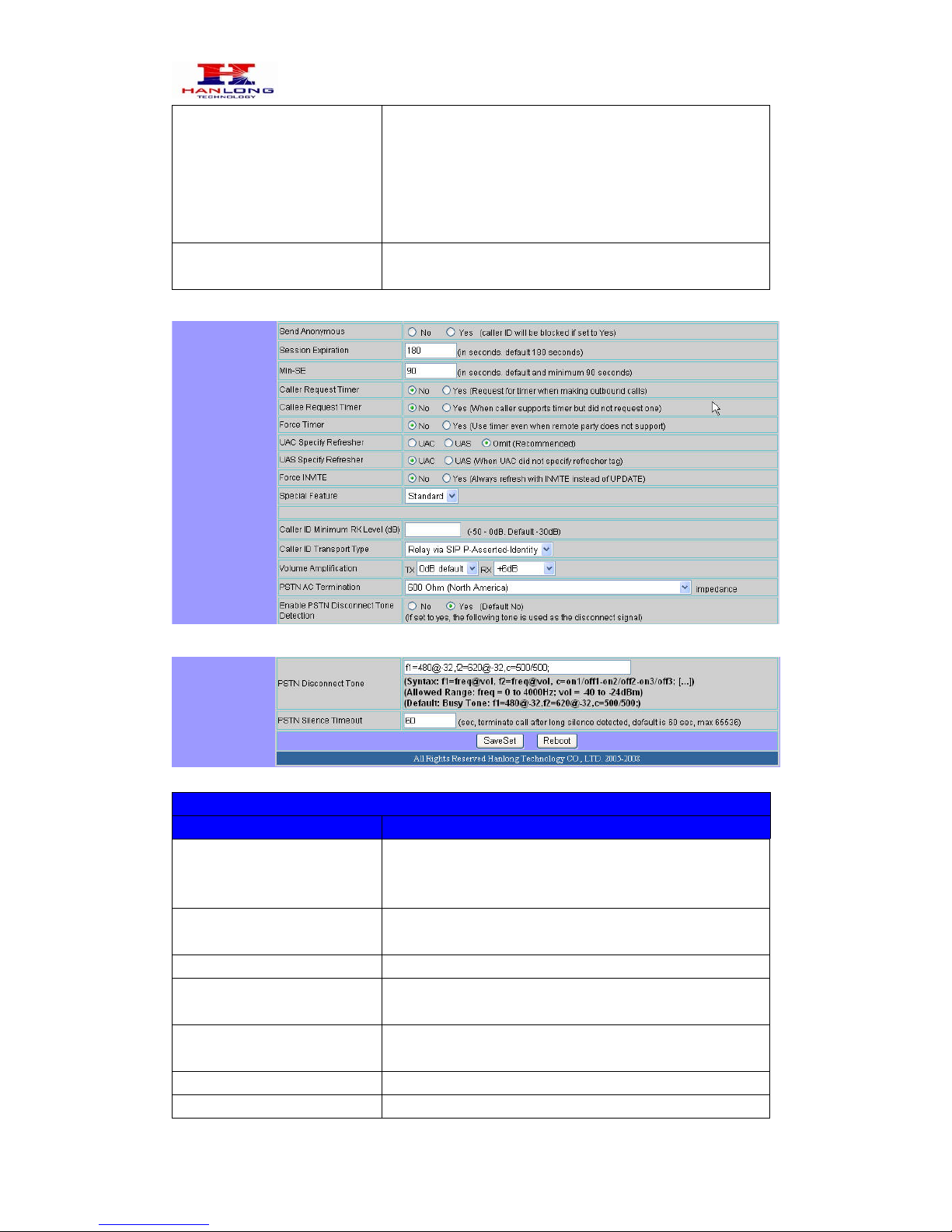
FXO PORT SETTING
Setting Options Meaning
Send Anonymous
If this par ameter is set to “Yes” , the “From” header i n
outgoing INVITE message w ill be set to anonym ous,
essentially blocking the Caller ID from displaying.
Session
Expiration
Default is 180 seconds.
Min-SE
Default is 90 seconds
Caller Request
Timer
Default is NO
Callee Request
Timer
Default is NO
Force Timer
Default is NO
UAC Specify
Default is Omit
Page 39

Unicorn 3112 User Manual
Copyright © 2008 Hanlong Technology Co., Ltd Page 39 of 42
Refresher
UAS Specify
Refresher
Default is UAC
Force INVITE
Default is NO
Special Feature
Default is standard
Caller ID Minimum RX
Level (dB)
Default is -30dB
Caller ID Transport Type
Default is Relay via SIP P-Asserted-Identity
Volume Amplification
Voice path volume adjustment.
Rx is a gain level for signals transmitted by FXS
Tx is a gain level for signals received by FXS.
Default = 0dB for both parameters. Loudest volume:
+6dB Lowes t volume: -6dB. User can a dj ust volum e of
call on either end using the Rx
Gain Level parameter and the Tx Gain Level parameter
located on the FXS Port Configuration page.
If call vol ume is too low when usi ng the FXS port (ie.
The ATA i s at user site) , adjust v olume using the Rx
Gain
Level parameter under the FXS Port
Configuration page.
If voice volume is too low at the other end, user may
increase the far end volume using the Tx Gain Level
parameter under the FXS Port Configuration page.
PSTN AC Termination
Selects the impedance of the analog PSTN line
connected to the Line port.
Enable PSTN
Disconnect Tone
Detection
If set to Yes, arrived Busy Tone is used as the
disconnect signal.
PSTN Disconnect Tone
This configuration should be configured by the VoIP
service provider. Some country use single frequency
tone to signal PSTN disconnec tion, som e country use
double frequency tone.
PSTN Silence
Timeout
Terminate call after long silence detected.
Default setting is 60 sec, max 65536
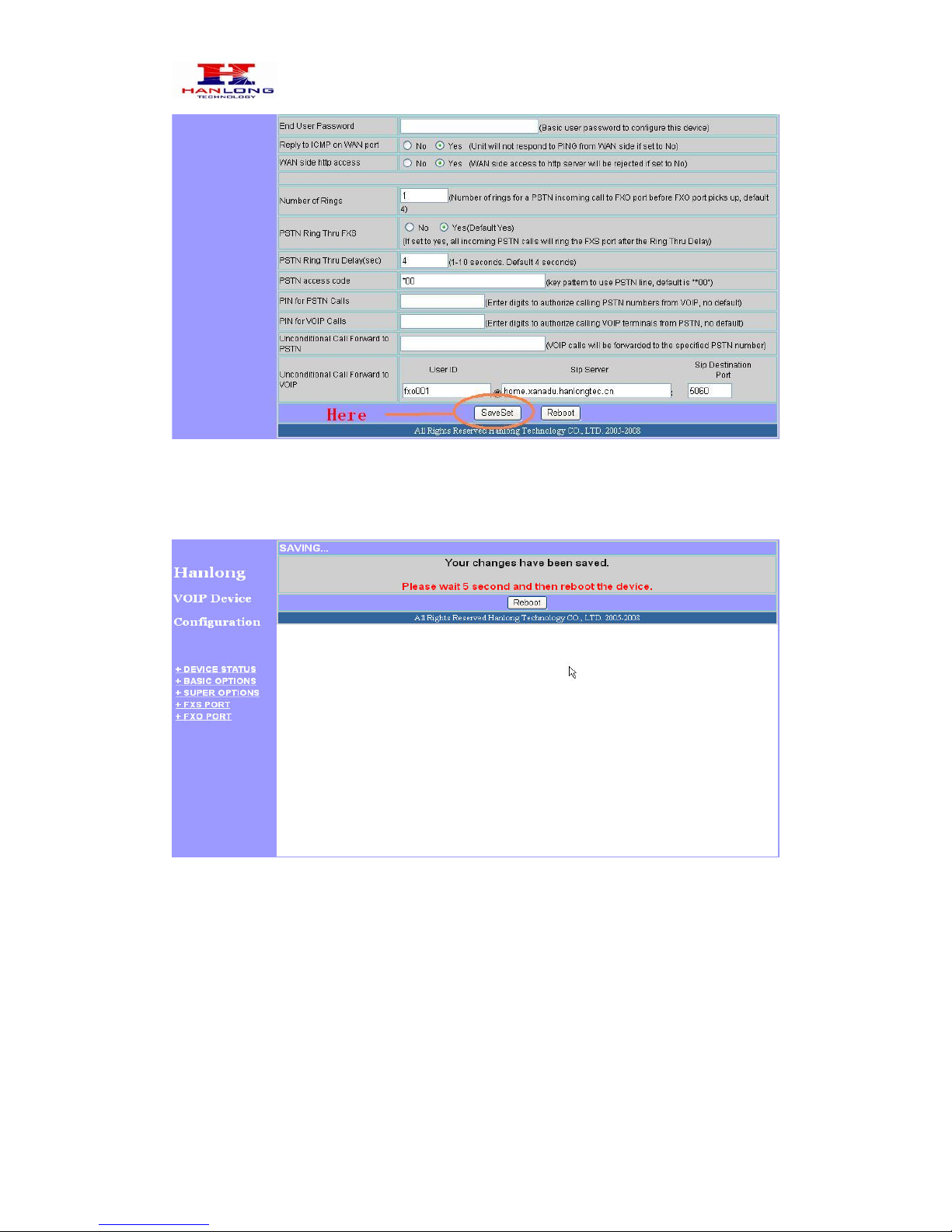
6.1.7. S a v ing the Configurati on Changes
Once a change is made, users should click on the “SaveSet” button in the Configuration
page, as follow:
Page 40
Unicorn 3112 User Manual
Copyright © 2008 Hanlong Technology Co., Ltd Page 40 of 42
The Unicorn 3112 will then display the following screen to confirm that the changes have
been saved. Please allow 5 to 10 seconds before rebooting the device.
6.1.8. Re boot ing the Unicorn 3112
You can reboot the Unicorn 3112 by clicking on the “Reboot” button after each update to
the configuration page. Alternatively, you can reboot by unplugging the power supply of
the Unicorn 3112 and then powering it on again. If your Unicorn 3112 ever becomes
“stuck” or un-responsive, you can unplug the power supply to reboot it. Frequent
rebooting by unplugging the power supply is not recommended and should not be
necessary.
Page 41

Unicorn 3112 User Manual
Copyright © 2008 Hanlong Technology Co., Ltd Page 41 of 42
6.2. Configuring Unicorn 3112 via Voice Prompt
6.2.1. DHCP Mode
Follow section 5.1 with voice menu option 01 to enable Unicorn 3112 to use DHCP
6.2.2. Static IP Mode
Follow section 5.1 with voice menu option 01 to enable Unicorn 3112 to use STATIC IP
mode, then use option 02, 03, 04 to set up Unicorn 3112’s IP, Subnet Mask, Gateway
respectively.
6.2.3. Conf iguration t hrough a Cent ra l Server
Unicorn 3112 devices can be automatically configured from a central provisioning system.
When Unicorn 3112 boots up, it will send TFTP or HTTP request to download
configuration files. There are two configuration files, one is “cfg.txt” and the other
is“cfg001fc1xxxxxx”, where “001fc1xxxxxx” is the MAC address of the Unicorn 3112.
For more information regarding configuration file format, please refer to the
related
technical documentation.
The configuration file can be downloaded via TFTP or HTTP from the central server. A
service provider or an enterprise with large deployment of Unicorn 3112s can easily
manage the configuration and service provisioning of individual devices remotely and
automatically from a central server. The central provisioning system uses enhanced (NAT
friendly) TFTP or HTTP (thus no NAT issues) and other communication protocols to
communicate with each individual Unicorn 3112 for firmware upgrade, etc.
7. SOFTWARE UPGRADE
To upgrade software, Unicorn 3112 can be configured with a TFTP server where the new
code image is located. The TFTP upgrade can work in either static IP or DHCP mode
using private or public IP address. It is recommended to set the TFTP server address in
either a public IP address or on the same LAN with the Unicorn 3112.
There are two ways to set up the TFTP server to upgrade the firmware, namely through
voice menu prompt or via the Unicorn 3112’s Web configuration interface. To configure
the TFTP server via voice prompt, follow section 5.1 with option 06, once set up the TFTP
IP address, power cycle the ATA, the firmware will be fetched once the ATA boots up.
To configure the TFTP server via the Web configuration interface, open up your browser to
Page 42

Unicorn 3112 User Manual
Copyright © 2008 Hanlong Technology Co., Ltd Page 42 of 42
point at the IP address of the Unicorn 3112. Input the admin password to enter the
configuration screen. From there, enter the TFTP server address in the designated field
towards the bottom of the configuration screen.
Once the TFTP server is configured, please power cycle the Unicorn 3112.
TFTP process may take as long as 1 to 2 minutes over the Internet, or just 20+ seconds if
it is performed on a LAN. Users are recommended to conduct TFTP upgrade in a
controlled LAN environment if possible. For those who do not have a local TFTP server,
Hanlong technology provides a NAT-friendly TFTP server on the public Internet for
firmware upgrade. Please check the Service section of Hanlong’s Web site to obtain this
TFTP server’s IP address.
NOTES:
When Hanlong ATA boot up, it will send TFTP or HTTP request to download configuration
files, there are two configuration files, one is “cfg.txt” and the other is “cfg001fc1xxxxxx”,
where “001fc1xxxxxx” is the MAC address of the Unicorn 3112. These two files are for
initial automatically provisioning purpose only, for normal TFTP or HTTP firmware upgrade,
the following error messages in a TFTP or HTTP server log can be ignored.
8. RESTORE FACTORY DEFAULT SETTINGS
Warning:
Restoring to the factory default settings will delete all configuration information of the
device.
Steps to follow in restoring to factory default settings:
a) Press “***” or fo r voice prompt.
b) Enter “99” and then you will hear the voice prompt “Reset”.
c) Enter the number “862584658050”. A "click" sound will be heard.
d) Wait for 15 seconds.
The device is now restored to the factory default setting.
9. TECHNICAL SUPPORT CONTACT
Email: [email protected]
 Loading...