

Page 1

Date Purchased
Store Purchased
Model No.
Serial No.
Vendor No.
UPC
120-231
445993
718212341292
Hampton Bay Lifetime Motor Warranty
The retailer warrants the fan motor to be free from defects in workmanship and material
present at time of shipment from the factory for a lifetime after the date of purchase by the
original purchaser. The retailer also warrants that all other fan parts, excluding any glass or
plexiglass parts, to be free from defects in workmanship and material at the time of shipment
from the factory for a period of one year after the date of purchase by the original purchaser.
We agree to correct such defects without charge or at our option replace with a comparable or
superior model if the product is returned to the retailer. To obtain warranty service, you must
present a copy of the receipt as proof of purchase. All costs of removing and reinstalling the
product are your responsibility. Damage to any part such as by accident or misuse or
improper installation or by affixing any accessories, is not covered by this warranty.
Because of varying climatic conditions in the United States this warranty does not cover any
changes in brass finish, including rusting, pitting, corroding, tarnishing or peeling. Brass
finishes of this type give their longest useful life when protected from varying weather
conditions. A certain amount of wobble is normal and should not be considered a defect.
Servicing performed by unauthorized persons shall render the warranty invalid. There is no
other express warranty. The retailer hereby disclaims any and all warranties,
including but not limited to. Those of merchantability and fitness for a particular
purpose to the extent permitted by law. The duration of any implied warranty which
cannot be disclaimed is limited to the time period as specified in the express warranty. Some
states do not allow limitation on how long an implied warranty lasts, so the above limitation
may not apply to you. The retailer shall not be liable for incidental, consequential, or
special damages arising out of or in connection with product use or performance except
as may otherwise be accorded by law. Some states do not allow the exclusion of incidental
or consequential damages, so the above exclusion or limitation may not apply to you. This
warranty gives specific legal rights, and you may also have other rights which vary from
state to state. This warranty supersedes all prior warranties.
Lifetime Motor Warranty
Page 2

Table of Contents
SAFETY RULES.........................................................................................................
PACKAGE CONTENTS .............................................................................................
INSTALLING YOUR FAN..........................................................................................
HANGING THE FAN..................................................................................................
ELECTRICAL CONNECTIONS ................................................................................
FINISHING THE INSTALLATION............................................................................
............................................................
BLADE INSTALLATION ..........................................................................................
.................................................................
INSTALLING THE LIGHT KIT................................................................................
INSTALLING THE LIGHT BULBS & GLASS SHADE..............................................
OPERATING THE TRANSMITTER.........................................................................
CARE OF YOUR FAN...............................................................................................
TROUBLESHOOTING.............................................................................................
SPECIFICATIONS...................................................................................................
INSTALLING THE DECORATIVE SCROLL
INSTALLING THE MOUNTING PLATE
1
2
3
4
5
6
7
8
9
10
11
12
13
14
15
Page 3

1. Before you begin installing the fan, shut power off at the
circuit breaker or the fuse box.
2. Be cautious! Read all instructions and safety information
before installing your new fan. Review accompanying
assembly diagrams.
3. Make sure that all electrical connections comply with local
codes, ordinances, or National Electrical Codes. Hire a
qualified electrician or consult a do-it-yourself wiring
handbook if you are unfamiliar with installing electrical
wiring.
4. Make sure the installation site you choose allows the fan
blades to rotate without any obstructions. Allow a minimum
clearance of 7 feet from the floor and 18 inches from the tip
of the blades to the wall.
5. If you are mounting the fan to a ceiling outlet box, use
U.L. Listed metal octagonal outlet box marked
"Acceptable for fan support". Secure the box directly
to the building structure. The outlet box and its support
must be able to support the moving weight of the fan (at
least 50 lbs.) Do not use a plastic box.
6. Caution: To reduce the risk of personal injury use only the
screws provided with the outlet box.
7. If you are mounting the fan to a joist, make sure it is able to
support the moving weight of the fan (at least 50 lbs.).
8. After you install the fan, make sure that all mountings are
secured to prevent the fan from falling.
1. Safety Rules
9. Do not insert anything into the fan blades while the fan is operating.
10. Turn the fan off and wait for it to stop completely before changing the
fan direction.
ATTENTION: The Energy Policy Act of 2005 requires this fan to be
equipped with a 190 watt limiting device. If lamping exceeds 190
watts, the ceiling fan's light kit will shut off automatically.
NOTE: The important safeguards and instructions appearing in this
manual are not meant to cover all possible conditions and situations that
may occur. It must be understood that common sense, caution and care are
factors which can not be built into this product. These factors must be
supplied by the person(s) installing, caring for and operating the unit.
TO REDUCE THE RISK OF FIRE, ELECTRIC SHOCK OR OTHER PERSONAL
INJURY. MOUNT FAN DIRECTLY TO THE BUILDING JOIST USING THE WOOD
SCREWS AND WASHERS PROVIDED WITH THE FAN. THE WOOD SCREWS
MUST GO THROUGH THE OUTLET BOX VIA THE KNOCK OUTS. CONSULT A
QUALIFIED ELECTRICIAN IF IN DOUBT.
TO REDUCE THE RISK OF PERSONAL INJURY, DO NOT BEND THE BLADE
HOLDERS WHILE INSTALLING, BALANCING THE BLADES, OR CLEANING
THE FAN. DO NOT INSERT FOREIGN OBJECTS BETWEEN ROTATING FAN
BLADES.
TO REDUCE THE RISK OF FIRE OR ELECTRIC SHOCK, DO NOT USE THIS FAN
WITH ANY SOLID-STATE SPEED CONTROL DEVICE
WARNING
NOTE
READ AND SAVE ALL INSTRUCTIONS!
Page 4

Unpack your fan and check the contents. You should have the following items:
.
1 Fan blades (5)
2a. Hanger bracket plate
2b. Hanger bracket
3. Canopy
4. Canopy cover
5. Downrod assembly
6. Decorative scroll ring
7. Decorative scrolls (3)
8. Coupling cover
9. Fan motor assembly
10. Blade holders (5)
11. Mounting plate
12. Light kit
13. Glass shade assembly
14. Receiver with 6 wire nuts
15.
16. 50W Halogen bulbs
17. Balancing kit
Transmitter+holder+2 mounting screws
(2)
a. Mounting hardware:
Wood screws (2). Lock washers (2)
Wire nuts (3). Flat washers (2)
Star washers (2)
b. Blade attachment hardware:
Screws (16)
c. 4 mm Allen wrench
Package Contents 2.
3
1
2a
2b
5
6
9
7
8
10
4
15
14
11
12
13
16
17
a
b
c
Page 5

Phillips screw driver; slotted screw driver; stepladder; wire cutters; electrical tape.
If there isn't an existing mounting box, then read the
following instructions. Disconnect the power by
removing fuses or turning off circuit breakers.
Secure the outlet box directly to the building
structure. Use appropriate fasteners and building
materials. The outlet box and its support must be
able to fully support the moving weight of the fan
(at least 50 lbs.). Use a UL Listed metal outlet box.
Do not use a plastic outlet box.
Figure 1, 2 and 3 are examples of different ways to
mount the outlet box.
Note: You may need a longer downrod to maintain
proper blade clearance when installing on a steep,
sloped ceiling. Longer downrods are available from
your Hampton Bay dealer.
To hang your fan where there is an existing fixture
but no ceiling joist, you may need to install a hanger
bar as shown in Fig. 4 (available at your Hampton
Bay dealer).
Tools Required
Mounting Options
3. Installing Your Fan
Outlet box
Figure 1
Ceiling
joist
Ceiling
joist
Cross brace
Outlet box
Figure 2
Ceiling joist
or cross brace
Parallel
wood brace
Provide strong
support
Recessed
outlet box
Hanger bracket
opening must
be facing uphill
Figure 3
Angled ceiling
maximum
17 angle
O
utl
e
t b
o
x
Figure 4
Ceiling
joist
Hanger bar
(optional)
Hanger
bracket
Page 6

Hanging the Fan 4.
REMEMBER to turn off the power.
Follow the steps below to hang your fan
properly:
Step 1. Remove two knock-outs from the
outlet box to expose the joist. (Fig. 5)
Step 2. Use the two wood screws and
washers to secure the hanger bracket plate
directly to the building joist via the
knockout holes from the outlet box. (Fig. 6)
CAUTION! THE HANGER BRACKET
PLATE MUST BE INSTALLED
DIRECTLY TO THE BUILDING JOIST
USING THE TWO WOOD SCREWS AND
WASHERS PROVIDED.
Step 3. Secure hanger bracket to hanger
bracket plate using the two hex nuts and
washers provided, make sure nuts are
securely tighten. (Fig. 7)
Step 4. Loosen the two set screws and
in the top
coupling of the motor assembly. (Fig. 8)
remove the hitch pin and lock pin
Step 5. Remove hanger ball from downrod
assembly by loosening set screw, removing
the cross pin, and sliding ball off rod. (Fig.9)
Step 6. Carefully feed fan wires up through
the downrod. (Fig. 10) Thread the rod into
the coupling, next line up holes and replace
lock pin and hitch pin. Tighten set screws.
Step 7. Slip coupling cover, decorative scroll
ring, canopy cover and canopy onto downrod.
(Fig. 11) Carefully reinstall hanger ball onto
rod being sure that cross pin is in correct
position, set screws are tighten and wires are
not twisted.
Step 8. Now lift motor assembly into
position and place hanger ball into hanger
bracket. Rotate until the check groove has
dropped into the registration slot and seats
firmly. (Fig. 12) Rod should not rotate if this
is done correctly.
Cross pin
Hanger
ball
Downrod
Outlet box
Outlet box
Hanger
bracket
plate
Flat washers
Flat
washers
Spring
washers
Hex nuts
Wood screws
Knock out
Downrod
Supply
wires
Figure 7
Figure 5
Figure 9
Figure 10
Figure 8
Figure 6
Hitch
pin
Lock
pin
Set
screws
Page 7

WARNING: To avoid possible electrical
shock be sure electricity is turned off at the
main fuse or breaker box before wiring.
NOTE: The Hand Held Remote or Wall
Control units included with your ceiling fan
are equipped with 16 code combinations to
prevent possible interference from or to other
remote units. The dip switches on your
Receiver and Transmitter units have been
preset at the factory, please re-check to make
sure the switches on both units are set to the
same positions. The frequency settings should
be changed only in case of interference or if a
second or more remote controlled ceiling fans
are installed in the same structure. Any code
combination will operate the ceiling fan and
light as long as the Receiver and Transmitter
units are set to the same codes (Fig. 13)
Step 1. Insert Receiver into Hanger Bracket
with the flat side of the Receiver facing the
ceiling. (Fig. 14)
Step 2. Motor to Receiver Electrical
Connections: Connect the WHITE wire from
the fan to the WHITE wire marked "TO
MOTOR N" from the Receiver. Connect the
BLACK wire from the fan to the BLACK Wire
marked "TO MOTOR L" from the Receiver.
Connect the BLUE wire from the fan to the
BLUE wire marked "For Light" from the
Receiver. NOTE: If your ceiling fan features
an UP Light: Connect the ORANGE wire
from the fan to the ORANGE wire marked
"For Up Light" from the Receiver. Otherwise
disregard this step and proceed to secure all
wire connections with the plastic wire nuts
provided. (Fig. 15 )
connectors
Step 3. Receiver to House Supply Wires
Electrical Connections: Connect the WHITE
wire (Neutral) from the outlet box to the
WHITE wire marked "AC in N" from the
receiver. Connect the BLACK wire (Hot)
from the outlet box to the BLACK wire
marked "AC in L" from the receiver. Secure
all wire connections with the plastic wire
nuts provided. (Fig. 15)
Step 4. If your outlet box has a GROUND
wire (Green or Bare Copper) connect this
wire to the Hanger Ball and Hanger Bracket
Ground wires. If your outlet box does not
have a Ground Wire, then connect the
Hanger Ball and Hanger Bracket Ground
Wires together. Secure wire connection with
the plastic wire nut provided. (Fig. 15 )
After all are made, check to make
sure there are no loose strands. As an
additional precaution we suggest to secure
the plastic wire connectors to the wires with
electrical tape.
5. Electrical Connections
Figure 11
Figure 12
Registration
slot
Downrod
Coupling cover
Canopy
Canopy cover
Set screws
Decorative scroll
ring
Hitch pin
Lock pin
Hanger ball
Page 8

6. Finishing the
Installation
Step 1. Tuck connections neatly into
ceiling outlet box.
Step 2. Slide the canopy up to ceiling and
over the two crews on hanger bracket.
Rotate canopy clockwise. Next, while
holding the canopy with one hand, slide the
canopy cover over the screws and rotate
clockwise until tight. Note: adjust the
canopy screws as necessary until the
canopy and canopy cover are snug. (Fig. 16)
Figure 16
Outlet box
Hanger
bracket
Hanger
ball
Canopy
Canopy
cover
Figure 15
White (neutral)
White (neutral)
Green or bare
copper (ground)
White ("AC IN N")
White ("to motor N")
Ground
(green)
(Connect to
ground wire on
hanger bracket
if no house
ground wire
exists.)
Outlet box
Black (hot)
Black ("AC IN L")
Black ("to motor L")
Receiver
Blue ("for light")
Blue (light)
Black (motor)
Fan
Figure 13
Figure 14
Note: The transmitter only works within 40
feet from receiver.
Receiver
Hanger bracket
ON ON
Page 9

8. Blade Installation
Step 1. Attach fan blades to the blade
holder using the screws and rubber washers
provided. Tighten screws securely, repeat
procedure with remaining blades. (Fig. 18)
Step 2. Align motor holes to blade holders
and secure with screws provided, tighten
screws securely. (Fig. 18)
Figure 18
Blade
Blade holders
Screws
Screws
Rubber
washers
7. Installing the
Decorative Scroll
Install the decorative scroll to the
decorative scroll ring with the screws
provided. Be sure to tighten all screws.
Then tighten the set screw on the decorative
scroll ring. (Fig. 17)
Scroll ring
screws
Scroll
ring
Screws
Decorative
scroll arms
Allen wrench
Figure 17
Page 10

9. Installing the Mounting
Plate
Step 1. Remove 1 of the 3 screws from the
mounting ring and loosen the other 2 screws.
(Do not remove)
Step 2. Place the key holes on the mounting
plate over the 2 screws previously loosened from
the mounting ring, turn mounting plate until it
locks in place at the narrow section of the key
holes. Secure by tightening the 2 screws
previously loosened and the one previously
removed. (Fig. 19)
Figure 19
Mounting plate
Mounting ring
Screws
10. Installing the Light
Kit
REMEMBER: To disconnect the power.
The fan blades must be already attached to
the fan.
Step 1. Loosen the 3 screws from the
mounting plate. (Do not remove)
Step 2. Raise and hold the light kit close to
the mounting plate and proceed to do the
wire connections. Connect the white wire
connector from the light kit and fan, follow
the same procedure with the black wire
connectors. (Fig. 17)
Step 3. Place the key holes on the light kit
over the 3 screws previously loosened from the
mounting plate, turn light kit until it locks in
place at the narrow section of the key holes.
Secure by tightening the 3 screws previously
loosened. (Fig. 17).
Figure 20
Connector
plugs
Screws
Mounting plate
Light kit
Page 11

WARNING: Shut off the power supply before removing or replacing lamp. In
handling of halogen bulb, care should be taken not to touch it with your bare
hands. Oil residue will shorten the life of the halogen bulb. If you accidentally
come into contact, wipe thoroughly with a clean, lint-free, cotton cloth. Allow
the bulb to cool off for 10 minutes before changing the bulb. Use light bulb in
accordance with the fan's specification. TO REDUCE THE RISK OF FIRE
DO NOT EXCEED MAXIMUM WATTAGE RATING.
ATTENTION: The Energy Policy Act of 2005 requires this fan to be
equipped with a 190 watt limiting device. If lamping exceeds 190 watts, the
ceiling fan's light kit will shut off automatically.
Step 1. Install 2x50W halogen bulbs (included). (Fig. 21)
Step 2. Remove the decorative nut from the light kit. Place glass shade over the
light kit stem, secure with the decorative nut. Do not overtighten. (Fig. 21)
11. Installing the Light Bulbs & Glass Shade
Figure 21
Glass shade
Bulbs
Light kit stem
Decorative nut
Page 12

Operating the Transmitter 12.
Speed settings for warm or cool weather
depend on factors such as the room size,
ceiling height, number of fans, etc.
The Reverse switch is located on the top of
the motor housing. Slide the switch to the
Left for warm weather operation. Slide the
switch to the Right for cool weather
operation.
NOTE: Wait for fan to stop before changing
the setting of the slide switch.
Warm weather - (Forward) A downward air
flow creates a cooling effect as shown in
Figure 24. This allows you to set your air
conditioner on a higher setting without
affecting your comfort.
Cool weather - (Reverse) An upward airflow
moves warm air off the ceiling area as shown
in Figure 25. This allows you to set your
heating unit on a lower setting without
affecting your comfort.
Restore power to the ceiling fan and test
for proper operation.
1. "HI, MED, LOW" buttons:
These three buttons are used to set the fan
speed as follows:
LOW=Low speed MED= Medium speed
HI=High speed
2. "OFF" button:
This button turns the fan off.
3.The " " button turns the light ON or OFF
and also controls the brightness setting.
Press and release the button to turn the light
ON or OFF. Press and hold the button to set
the desired brightness. The light key has an
auto-resume, it will stay at the same
brightness as the last time it was turned off.
Figure 22
Installing the battery:
Install 12V MN21/A23 battery (not
included), to prevent damage to
transmitter, remove the battery if not used
for long periods.
Figure 23
Page 13

Figure 24
Figure 25
Figure 26
Holder
Screws
Plugs
Installing the
1. Remove the two plugs from the holder.
Note that the plugs have unique tabs that
allows them to fit only in one hole. (Fig. 26)
2.
3.
Attach the holder with the two screws
provided.
Transmitter Holder
Replace the two plugs each into its own
hole.
Page 14

Here are some suggestions to help you maintain
your fan
1.Because of the fan's natural movement, some
connections may become loose. Check the
support connections, brackets, and blade
attachments twice a year. Make sure they are
secure. (It is not necessary to remove fan from
ceiling.)
2. Clean your fan periodically to help maintain
its new appearance over the years. Use only a
soft brush or lint-free cloth to avoid scratching
the finish. The plating is sealed with a lacquer to
minimize discoloration or tarnishing. Do not use
water when cleaning. This could damage the
motor, or the wood, or possibly cause an
electrical shock.
3. Use only a soft brush or lint-free cloth to avoid
scratching the finish. The plating is sealed with a
lacquer to minimize discoloration or tarnishing.
4. You can apply a light coat of furniture polish to
the wood blades for additional protection and
enhanced beauty. Cover small scratches with a
light application of shoe polish.
13.Care of Your Fan
For any additional information on your
Hampton Bay Ceiling Fan, please write to:
THE HAMPTON BAY FAN & LIGHTING CO.
P. O. Box 395
Norco, CA 92860
Call toll free 1-800-527-0998
WARNING: Make sure the power
is off at the electrical panel box
Before you attempt any repairs.
Refer to the section, "Making
Electrical Connections".
5. There is no need to oil your fan. The
motor has permanently lubricated bearings.
6. All glass should be cleaned using
lukewarm soapy water and a soft cloth or
sponge.
DO NOT IMMERSE GLASS IN HOT
WATER. DO NOT PUT GLASS INTO AN
AUTOMATIC DISHWASHER.
Page 15

Troubleshooting 14.
Problem
Fan will not start.
Fan sounds noisy.
Remote control
malfunction.
Lights shut off and will
not come back on.
Fan Wobble.
Solution
1. Check circuit fuses or breakers.
2. Check line wire connections to the fan and switch wire connections in the switch housing.
CAUTION: Make sure main power is off.
1. Make sure all motor housing screws are snug.
2. Make sure the screws that attach the fan blade bracket to the motor hub is tight.
3. Make sure wire nut connections are not rubbing against each other or the interior wall of the switch housing.
CAUTION: Make sure main power is off.
4. Allow a 24-hour "breaking-in" period. Most noise associated with a new fan disappear during this time.
5. If using an optional light kit, make sure the screws securing the glassware are tight. Check that the light bulb
is also secure.
6. Do not connect the fan with a wall mounted variable speed control (s)
7. Make sure the upper canopy is a short distance from the ceiling. It should not touch the ceiling.
1. Do not connect the fan with a wall mounted variable speed control (s).
2. Check to make sure the dip switches from the transmitter and receiver are set to the same frequency.
1. This unit is equipped with a wattage limiting device. Lamping in excess of 190 watts will disable your ceiling
fan's light kit. To reset your light kit you must turn the power off and re lamp, keeping the wattage under 190
watts. Restore power to your ceiling fan and continue normal operation.
3. Check to make sure the dip switches from the transmitter and receiver are set to the same frequency.
NOTE: All blade sets are grouped by weight. Because wood and plastic blades vary in density, the fan
may wobble even though blades are matched.
1. Make sure all blade attachment screws are tight.
2. Make sure Outlet box is secured to building structure, if necessary use the wood screws provided to
further secure outlet box to joist.
3. Make sure Hanger Bracket is secure to the outlet box, screws are tight.
4. Use the balancing kit provided if the wobble is excessive (follow instructions included with balancing kit)
Page 16
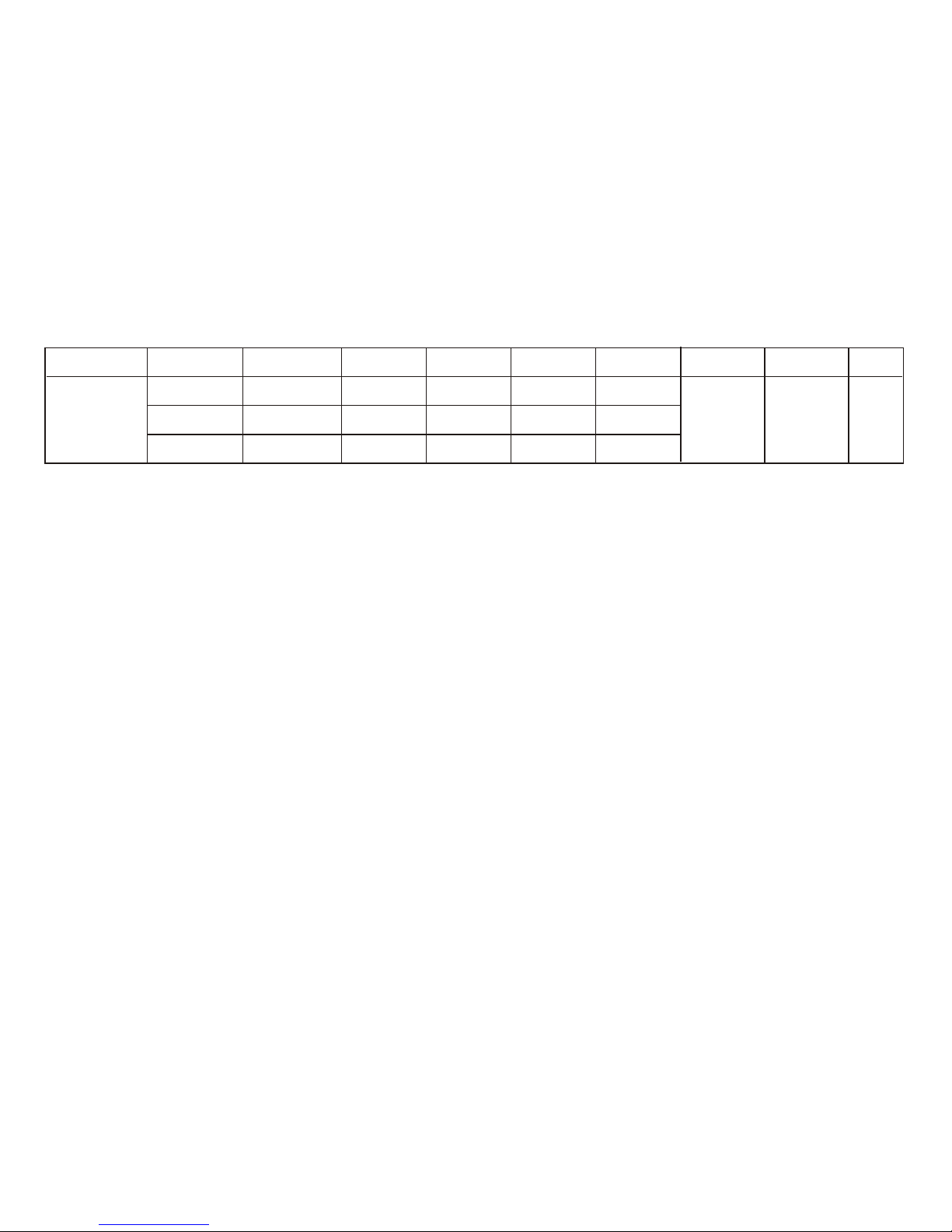
15. Specifications
These are typical readings. Your actual fan may vary. They do not include Amps and Wattage used by the light kit.
RPM
CFM
N.W. G.W.
C.F.
120 3055
4610
6512
22
47
82
70
113
148
0.42
0.58
0.68
120
120
Fan Size
Speed
Volts
Amps
Watts
Low
Medium
High
Distributed by
Home Depot U.S.A., Inc.
2455 Paces Ferry Rd., N.W.
Atlanta, GA 30339
2.64'14.32 kgs
(31.50 lbs)
15.72 kgs
(34.58 lbs)
52"
(132 cm)
 Loading...