

Page 1

FR
2-5 / 30-32
GYSFLASH 9.24
EN
DE
ES
RU
IT
NL
73502_V1_23/02/2017
6-9 / 30-32
10-13 / 30-32
14-17 / 30-32
18-21 / 30-32
22-25 / 30-32
26-29 / 30-32
www.gys.fr
Page 2
INSTRUCTIONS DE SÉCURITÉ
Ce manuel d’utilisation comprend des indications sur le fonctionnement de
votre appareil et les précautions à suivre pour votre sécurité.
Merci de le lire attentivement avant la première utilisation et de le conserver
soigneusement pour toute relecture future.
Cet appareil doit être utilisé uniquement pour faire de la recharge dans les
limites indiquées sur l’appareil et le manuel. Il faut respecter les instructions
relatives à la sécurité. En cas d’utilisation inadéquate ou dangereuse, le
fabricant ne pourra être tenu responsable.
Cet appareil peut être utilisé par des enfants âgés d’au moins 8 ans et par
des personnes ayant des capacités physiques, sensorielles ou mentales
réduites ou dénuées d’expérience ou de connaissance, s’ils (si elles) sont
correctement surveillé(e)s ou si des instructions relatives à l’utilisation de
l’appareil en toute sécurité leur ont été données et si les risques encourus
ont été appréhendés. Les enfants ne doivent pas jouer avec l’appareil. Le
nettoyage et l’entretien par l’usager ne doivent pas être effectués par des
enfants sans surveillance.
GYSFLASH 9.24
FR
A n’utiliser en aucun cas pour charger des piles ou des batteries nonrechargeables.
Le mode de fonctionnement automatique ainsi que les restrictions
applicables à l’utilisation sont expliqués ci-après dans ce mode d’emploi.
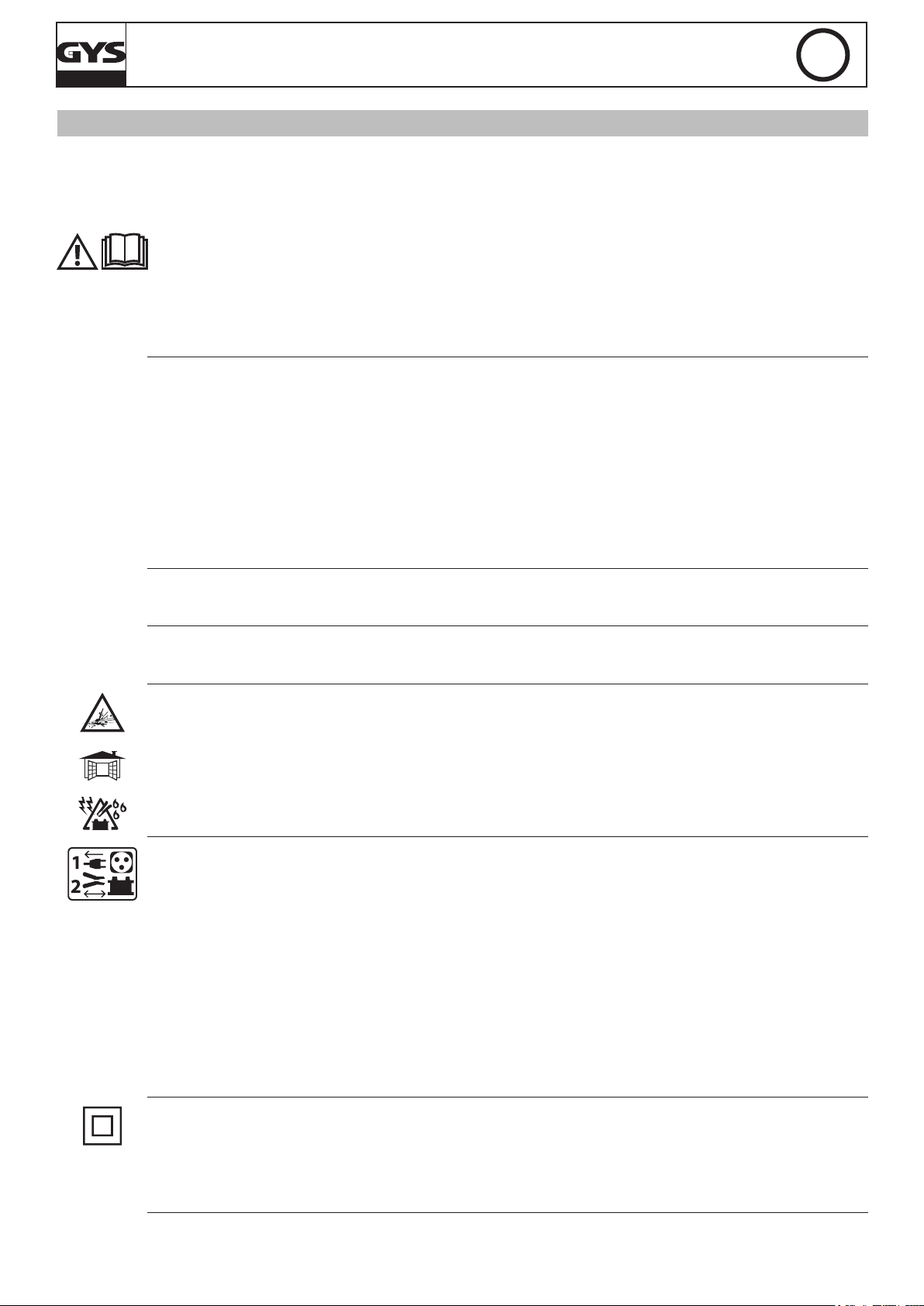
Risque d’explosion et d’incendie!
Une batterie en charge peut émettre des gaz explosif.
• Pendant la charge, la batterie doit être placée dans un emplacement bien
aéré.
• Éviter les flammes et les étincelles. Ne pas fumer.
Connexion / déconnexion :
• Déconnecter l’alimentation avant de brancher ou de débrancher les
connexions sur la batterie.
• La borne de la batterie non reliée au châssis doit être connectée la
première. L’autre connexion doit être effectuée sur le châssis loin de la
batterie et de la canalisation de combustible. Le chargeur de batterie doit
alors être raccordé au réseau.
• Après l’opération de charge, débrancher le chargeur de batterie du
réseau puis retirer la connexion du châssis et enfin la connexion de la
batterie, dans l’ordre indiqué.
Raccordement :
• Appareil de classe II
• Le raccordement au réseau d’alimentation doit être effectué conformément
aux règles d’installation nationales.
2
Page 3
GYSFLASH 9.24
FR
Entretien :
• Si le câble d’alimentation est endommagé, il doit être remplacé par
le fabricant, son service après-vente ou des personnes de qualification
similaire afin d’éviter un danger.
Réglementation :
• Appareil conforme aux directives européennes.
• La déclaration de conformité est disponible sur notre site internet.
• Marque de conformité EAC (Communauté économique Eurasienne)
Mise au rebut :
• Ce matériel fait l’objet d’une collecte sélective. Ne pas jeter dans une
poubelle domestique.
DESCRIPTION GÉNÉRALE
Votre Gysash a été spécialement conçu pour recharger la plupart des batteries au plomb avec ou sans entretien, couramment utilisées
pour les voitures et pour de nombreux autres véhicules. Ces batteries peuvent être de plusieurs types ex: GEL (électrolyte gélié), AGM
(électrolyte imprégné), WET, MF (Maintenance Free), CA (Calcium)...
Le Gysash 9.24 est parfaitement adapté à la charge de :
- batteries 6V (3 éléments de 2V) de 18Ah à 220Ah et jusqu’à 300Ah pour du maintien de charge,
- batteries 12V (6 éléments de 2V) de 18Ah à 220Ah et jusqu’à 300Ah pour du maintien de charge,
- batteries 24V (12 éléments de 2V) de 15Ah à 125Ah et jusqu’à 170Ah pour du maintien de charge.
Le Gysash 9.24 est équipé d’une fonction qui adapte automatiquement la tension de sortie en fonction de
la température de l’air ambiante. Cet ajustement permet d’avoir une recharge de batterie très précise adaptée à la température ambiante.
MISE EN ROUTE
1. Brancher le chargeur sur la batterie.
2. Brancher le chargeur sur la prise secteur (réseau monophasé 220-240Vac 50-60Hz).
3. Sélectionner le mode en appuyant sur le bouton . Après environ cinq secondes, la charge se lance automatiquement.
4. Durant la charge, l’appareil indique l’état d’avancement de la charge. Lorsque le voyant s’allume, la batterie est prête à
démarrer le moteur. Et lorsque le voyant reste allumé, la batterie est entièrement chargée.
5. La charge peut être interrompue à tout moment en débranchant la prise secteur ou en appuyant sur le bouton .
6. Après l’opération de charge, débrancher le chargeur du réseau puis retirer les connexions de la batterie.
MODES DE CHARGE
• Description des Modes et des Options :
Mode CHARGE 6V (7.3V/9A) :
Mode destiné à la charge et au maintien de charge des batteries au plomb 6V. Cycle de charge automatique en huit
étapes.
Mode CHARGE 12V (14.6V/9A) :
Mode destiné à la charge et au maintien de charge des batteries au plomb 12V. Cycle de charge automatique en
huit étapes.
Mode CHARGE 24V (29.2V/6A) :
Mode destiné à la charge et au maintien de charge des batteries au plomb 24V. Cycle de charge automatique en
huit étapes.
Option REFRESH :
Option permettant d’ajouter une étape supplémentaire (étape 7) au cycle de charge an de reconditionner les
batteries ayant été fortement déchargées.
: il est recommandé de ne pas activer cette option pour la charge de batteries scellées.
Conseil : Vérier et compléter, si nécessaire, le niveau d’eau de la batterie après une charge avec Refresh.
3
Page 4
GYSFLASH 9.24
indicator light
FR
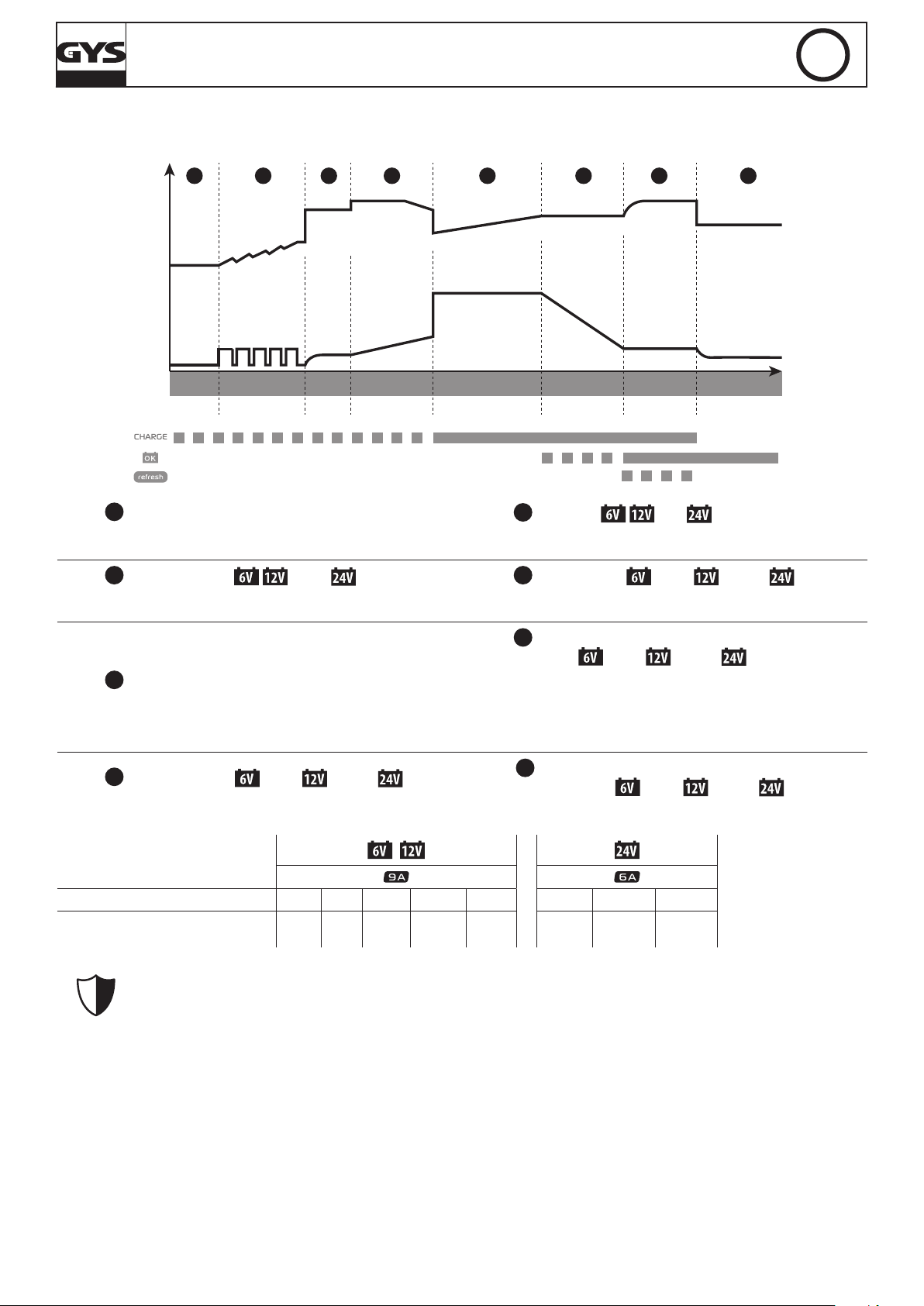
• Courbe de charge :
Le GYSFLASH 9.24 utilise une courbe de charge évoluée en huit étapes qui garantit les performances optimales de votre batterie.
1 2 3 4 5 6 7
U
I
Analyse Récupération Test Désulfatation Charge Absorption
< 1s Max 5h Max 12h Max 20h Max 8h no limit< 1s
Étape 1 : Analyse
Analyse de l’état de la batterie (niveau de charge, inversion de
polarité, mauvaise batterie connectée…)
Étape 2 : Récupération ( 4.5A / 3A)
Algorithme de récupération des éléments endommagés suite à une
décharge profonde.
8
Refresh
(si option active)
1h - 4h
Maintien de
charge
Étape 5 : Charge ( 9A / 6A)
Charge rapide à courant maximum permettant d’atteindre 80% du
niveau de charge.
Étape 6 : Absorption ( 7.3V / 14.6V / 29.2V)
Charge à tension constante pour amener le niveau de charge à
100%.
Étape 7 :
Étape 3 : Test
Test de batterie sulfatée
Refresh (option
Si l’option Refresh a été sélectionnée, le chargeur va alors
injecter un courant supplémentaire an de créer du gaz qui
va permettre de mélanger l’électrolyte et ainsi reconditionner
7.9V / 15.8V / 31.6V)
les cellules de la batterie. Durant cette phase, la batterie peut
perdre un peu d’eau.
Étape 4 : Désulfatation ( 7.9V / 15.8V / 31.6V)
Algorithme de désulfatation de la batterie.
• Temps de charge estimé
Capacité de la batterie 20Ah 60Ah 120Ah 180Ah 220Ah 20Ah 50Ah 125Ah
Temps de charge 20% >>> 80%
1h30 4h 8h 12h 15h 2h 5h 13h
Étape 8 :
Maintien de charge
( 6.7V / 13.6V / 27.2V)
Maintien du niveau de charge de la batterie à son maximum.
• Protections :
Le GYSFLASH 9.24 possède un ensemble de dispositifs le protégeant contre les courts circuits et inversion de polarité. Il dispose d’un système qui évite toute étincelle lors du branchement du chargeur sur la batterie. Ce chargeur
est à double isolation et est compatible avec l’électronique des véhicules.
Le GYSFLASH 9.24 est équipé d’un capteur de température intégré qui lui permet d’adapter son courant de charge en fonction de
la température ambiante an d’éviter toute surchauffe de l’électronique interne.
4
Page 5
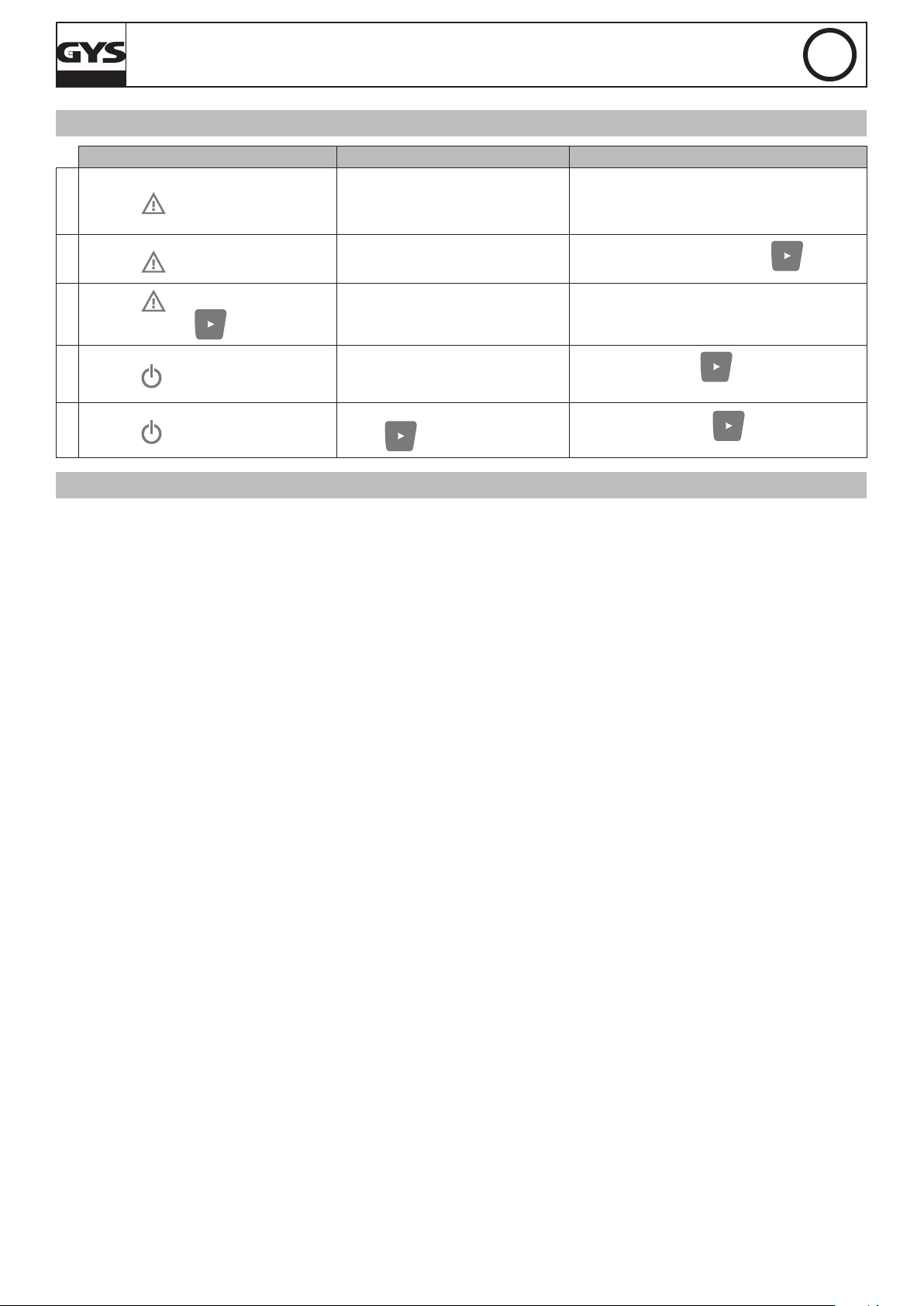
ANOMALIES, CAUSES, REMÈDES
Anomalies Causes Remèdes
1
Le voyant clignote.
GYSFLASH 9.24
• Inversion de polarité
• Tension batterie trop élevée
• Pinces en court-circuit
FR
• Vérier que les pinces sont correctement connectées.
• Vérier que le mode sélectionné correspond bien
à la tension nominale de la batterie.
2
Le voyant est allumé.
Le voyant reste allumé même après un
3
appui sur le bouton .
4
Le voyant clignote.
5
Le voyant reste allumé.
Echec lors de la charge, batterie non
récupérable.
Défaut thermique.
Chargeur en veille.
Charge interrompue en appuyant sur le
bouton .
Changer de batterie et appuyer sur pour
relancer une charge.
Température environnante trop élevée (>50°C),
aérer le local et laisser le chargeur se refroidir.
Appuyer sur le bouton ou connecter une
batterie au chargeur pour sortir de la veille.
Appuyer de nouveau sur pour relancer la
charge.
CONDITIONS DE GARANTIE
La garantie couvre tous défauts ou vices de fabrication pendant 2 ans, à compter de la date d’achat (pièces et main d’œuvre).
La garantie ne couvre pas :
• Toutes autres avaries dues au transport.
• L’usure normale des pièces (Ex. : câbles, pinces, etc.).
• Les incidents dus à un mauvais usage (erreur d’alimentation, chute, démontage).
• Les pannes liées à l’environnement (pollution, rouille, poussière).
En cas de panne, retourner l’appareil à votre distributeur, en y joignant :
- un justicatif d’achat daté (ticket de sortie de caisse, facture….)
- une note explicative de la panne.
5
Page 6
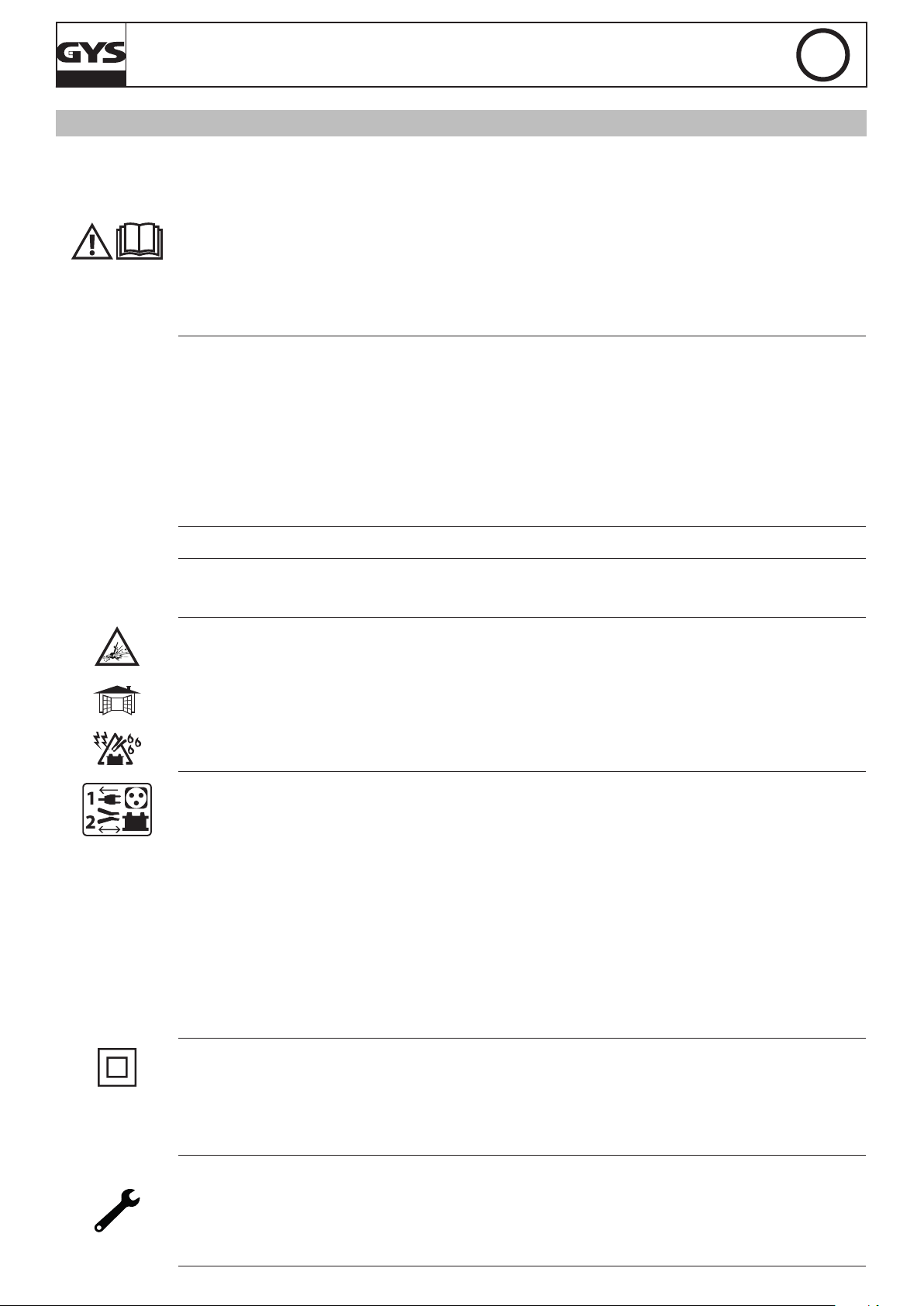
SAFETY INSTRUCTIONS
This manual contains safety and operating instructions.
Read it carefully before using the device for the first time and keep
it in a safe place for future reference.
This machine should only be used for charging operations comprised
within the limits indicated on the machine and in the instruction
manual. The operator must respect the safety precautions. In case of
inedaquate or unsafe use, the manufacturer cannot be held liable.
This unit can be used by children aged of at least 8 years and by
people with reduced physical, sensory or mental capabilities or
lack of experience or knowledge, if they are properly monitored
or if instructions for using the equipment safely was given to them
and if they have been made aware of the risks. Children must no
play with the product. Cleaning and maintenance should not be
performed by unsupervised children.
GYSFLASH 9.24
EN
Do not use to charge small batteries or non rechargeable batteries.
The operating mode of the automatic charger and the restrictions
applicable to its use are explained below in this manual.
Fire and explosion risks!
A charging battery can emit explosive gases.
• During the charge, the battery must be placed in a well ventilated
area.
• Avoid flames and sparks. Do not smoke.
Connection / disconnection:
• Ensure that the charger’s power supply is disconnected before
plugging or unplugging the connections on the battery.
• Always ensure the Red clamp is connected to the «+» battery
terminal first. If it is necessary to connect the black clamp to the
vehicle chassis, make sure it is a safe distance from the battery and
the fuel/exhaust pipe. The charger must be connected to the mains.
• After charging, disconnect the charger from the mains, then
disconnect the clamp from the car body and then disconnect the
clamp from the battery, in the indicated order.
Connection:
• Class II device
• The connection to the power supply must be carried out in
compliance with national standards.
Maintenance:
• If the power cable is damaged, it must be replaced by the
manufacturer, its after sales service or an equally qualified person
to prevent danger.
6
Page 7
GYSFLASH 9.24
EN
Regulations:
• Machine compliant with European directives.
• The certificate of compliance is available on our website.
• EAC Conformity marking (Eurasian Economic Community)
Waste management:
• This product should be disposed of at an appropriate recycling
facility. Do not throw away in a domestic bin.
GENERAL DESCRIPTION
Your Gysash is ideal to charge most lead-acid batteries, often used for cars and many other vehicles. The GYSFLASH can be used safely
for : GEL (gel electrolyte), AGM (Absorbant Glass Mat), EFB ( Enhanced Flooded Battery)WET, MF (Maintenance Free), CA (Calcium)...
The Gysash 9.24 is designed to charge :
- 6V batteries (3*2V elements) from 18Ah to 220Ah and yo to 300Ah for maintenance charge,
- 12V batteries (6*2V elements) from 18Ah to 220Ah and up to 300Ah for maintenance charge,
- 24V batteries (12*2V elements) from 15Ah to 125Ah and up to 170Ah for maintenance charge.
The GYSFLASH 9.24 is tted with an integrated temperature probe that ensures that the voltage output
is adapted to the ambient temperature, for an optimal charging performance. This adjustment ensures a
highly precise charge, relative to the ambient temperature.
START UP
1. Connect the charger to the battery.
2. Plug the charger to the mains (single phase 220-240Vac 50-60Hz).
3. Select the mode by pressing the button. After roughly 5 seconds, the charge starts automatically.
4. During the charge, the device indicates the charge progress. When indicator blinks, the battery is ready to start the vehicle.
Once indicator stays on, the battery is fully charged.
5. The charge can be interrupted at any time by unplugging the mains plug or pressing the button.
6. After charging, disconnect the charger from the mains, then disconnect the charger’s connections from the battery.
CHARGE MODES
• Modes and Options description :
CHARGE Mode 6V (7.3V/9A) :
Mode designed to charge and maintain (oating charge) 6V batteries. 8 step automatic maintenance charge cycle.
CHARGE Mode 12V (14.6V/9A) :
Mode designed to charge and maintain (oating charge) 12V batteries. 8 step automatic maintenance charge cycle.
CHARGE Mode 24V (29.2V/6A) :
Mode designed to charge and maintain (oating charge) 24V batteries. 8 step automatic maintenance charge cycle.
REFRESH Option :
Option which add an extra step (step 7) to the charge cycle to restore deeply discharged batteries.
: this option is not recommended for charging sealed batteries.
Recommendation : Check the battery’s water level and if necessary, perform with a Refresh charge.
7
Page 8
GYSFLASH 9.24
indicator light
• Charging curve :
The GYSFLASH 9.24 uses an 8 step charging curve which guarantees optimal performance for your battery.
EN
1 2 3 4 5 6 7
U
I
Analysis Recovery Test Desulfation Charge Absorption
< 1s Max 5h Max 12h Max 20h Max 8h no limit< 1s
Step 1 : Analysis
Analyses the battery state (charge level, polarity inversion, wrong
battery…)
Step 2 : Recovery ( 4.5A / 3A)
Damaged elements recovery due to an extended deep discharge
algorithm.
8
Refresh
(If option activated)
1h - 4h
Floating
Step 5 : Charge ( 9A / 6A)
Fast charge with maximum current that can reach 80% charge
level.
Step 6 : Absorption ( 7.3V / 14.6V / 29.2V)
Constant voltage charge to reach a 100% charge level.
Step 7 :
Step 3 : Test
Sulfated battery test
Refresh (option
If the refresh option has been selected, the charger will inject an
additional current that will generate some gas, thus recondition-
7.9V / 15.8V / 31.6V)
ning the battery’s cells. During this phase, the battery may loose
a bit of water.
Step 8 :
Step 4 : Desulfation ( 7.9V / 15.8V / 31.6V)
Battery desulfation algorithm.
Maintenance/Floating charge
27.2V)
( 6.7V / 13.6V /
Maintains battery charge level at its maximum.
• Estimated charge time
Battery capacity 20Ah 60Ah 120Ah 180Ah 220Ah 20Ah 50Ah 125Ah
Charging time 20% >>> 80% 1h30 4h 8h 12h 15h 2h 5h 13h
• Protections :
The GYSFLASH 9.24 has comprehensive safety features to protect it against short-circuits and polarity reversals. It
has an anti-spark feature which prevents sparks whilst connecting the device to the battery. This charger has double
insulation and is safe to use with the battery in situ as it will protect the vehicle’s on-board electronics.
The GYSFLASH 9.24 is tted with an integrated temperature probe that ensures that the charging current is adapted to the
ambient temperature, for an optimal charging performance.
8
Page 9
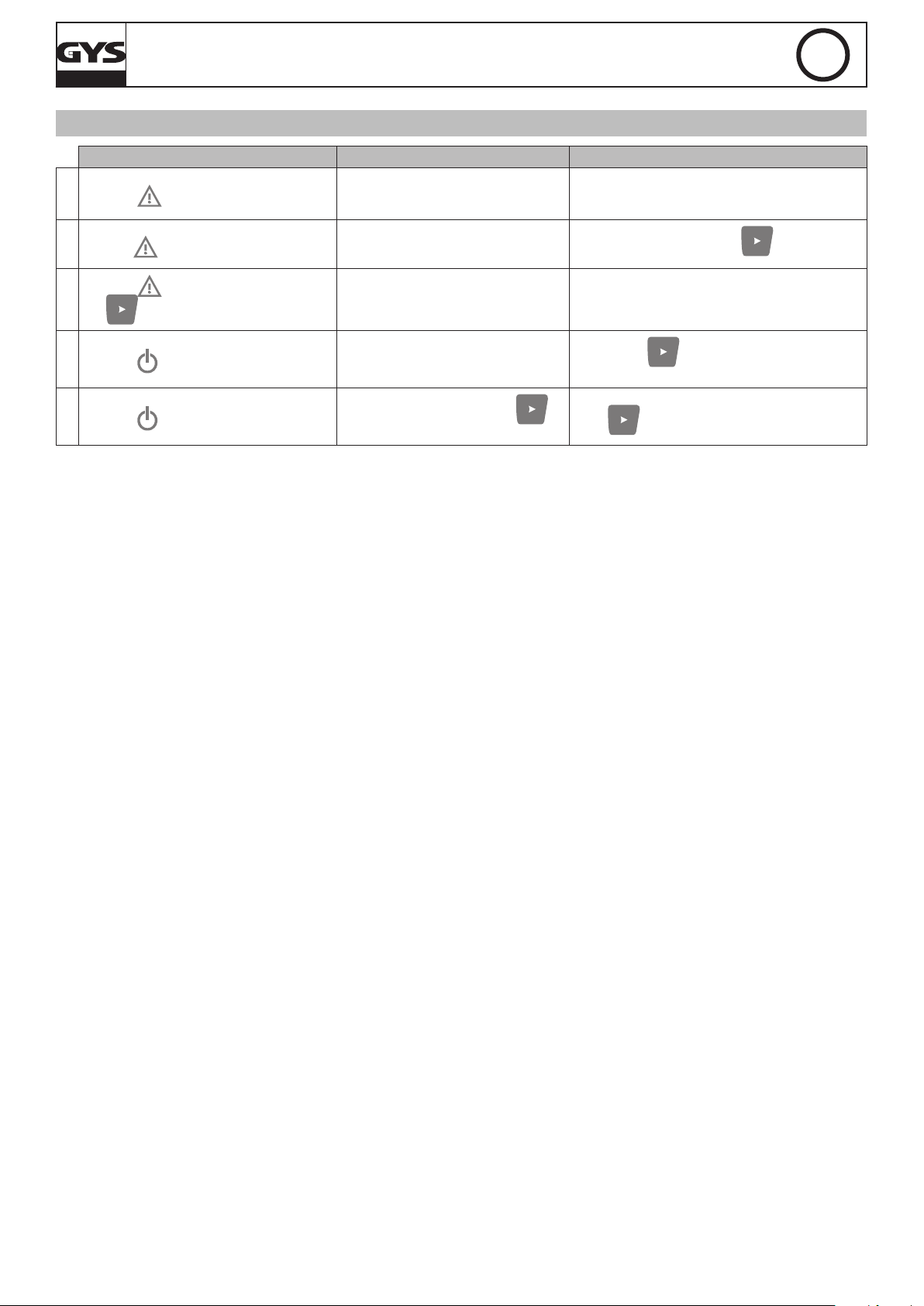
TROUBLESHOOTING
Symptoms Causes Solutions
1
Indicator blinks.
GYSFLASH 9.24
• Polarity reversal
• Battery voltage is too high
• Clamps in short-circuit
EN
• Check that the clamps are properly connected.
• Check that the selected voltage matches the
battery voltage (6, 12 or 24V).
2
Indicator is on.
Indicator stays on even after pressing
3
the button.
4
Indicator blinks.
5
Indicator stays on.
Charge failure, battery non recoverable.
Thermal protection.
Charger in sleep mode.
Charge interrupted by pressing
button.
Change the battery and press to restart a
charge.
Ambient temperature is too high (>50°C), cool the
room and let the charger cool down.
Press button or connect a battery to the charger to exit sleep mode.
Press again to restart the charge.
9
Page 10
SICHERHEITSHINWEISE
Diese Betriebsanleitung enthält Sicherheits- und Betriebshinweise. Bitte
lesen Sie diese Anleitung aufmerksam durch, bevor Sie das Gerät zum
ersten Mal benutzen und bewahren Sie diese sorgfältig auf.
Dieses Gerät darf ausschließlich zum Starten und/oder zur
Spannungsversorgung für die in der Anleitung oder auf dem Gerät
genannten Anforderungen genutzt werden. Die Sicherheitshinweise
müssen in jedem Fall beachtet werden. Im Fall einer unangemessenen
oder gefährlichen Verwendung kann der Hersteller nicht haftbar gemacht
werden.
Schützen Sie das Gerät vor unbefugtem Gebrauch. Dieses Gerät eignet
sich nicht für die Verwendung durch kleine Kinder oder Personen,
die die Bedienungsanleitung nicht lesen oder verstehen können, sorgen
Sie bitte für ausreichend Schutz und Kontrolle bei Benutzung des Gerätes.
GYSFLASH 9.24
DE
Laden Sie nie defekte oder nicht aufladbare Batterien.
Der Automatik-Modus sowie die Einschränkungen bei der Benutzung
werden nachfolgend in der Betriebsanleitung erklärt.
Explosions- und Brandgefahr!
Während des Ladevorgangs können explosive Gase entstehen.
• Während des Ladevorgangs muss die Batterie in einem gut belüfteten
Bereich plaziert werden.
• Vermeiden Sie Funken und Flammen. Rauchen Sie nicht!
Verbinden/Trennen:
• Trennen Sie das Gerät vom Spannungsnetz bevor Sie Kabel und Zangen
anschließen oder trennen.
• Versichern Sie sich immer, dass die rote Klemme zuerst mit dem «+» Pol
der Batterie verbunden wird. Falls es nötig ist die schwarze Klemme mit
der Fahrzeugkarosserie zu verbinden, versichern Sie sich, dass es einen
Sicherheitsabstand von der Batterie zum Benzintank/Aufspuff gibt. Achten
Sie während der Ladung auf einen frei zugänglichen Netzanschluss.
• Beachten Sie am Ende des Ladevorgangs folgendes: Trennen Sie erst
das Gerät vom Stromnetz und entfernen Sie dann erst die Klemmen von
der Batterie.
10
Anschluss:
• Klasse II-Gerät
• Der Anschluss an die Spannungsversorgung muss den nationalen
Vorschriften entsprechen.
Wartung:
• Ist das Ladegerät und/oder die Kabel defekt/beschädigt, geben Sie
das Ladegerät zur Reparatur zum Hersteller bzw. an einen geeigneten
Fachbetrieb.
Page 11
GYSFLASH 9.24
DE
Richtlinien:
• Das Gerät entspricht den europäischen Richtlinien und Normen.
• Die Konformitätserklärung finden Sie auf unsere Webseite.
• EAC-Konformitätszeichen (Eurasische Wirtschaftsgemeinschaft).
Entsorgung:
• Produkt für getrennte Entsorgung (Elektroschrott). Werfen Sie es
daher nicht in die Mülltonne!
BESCHREIBUNG
DAS GYSFLASH 9.24 eignet sich eignet sich zum Laden verschiedenster Blei-Säure-Batterien. Das Gysash 9.24 ist zum Laden folgender
Batterien geeignet:
- 6V-Batterien (3 2V-Teile) von 18Ah bis 220Ah und bis 300Ah zur Ladungserhaltung,
- 12V-Batterien (6 2V-Teile) von 18Ah bis 220Ah und bis 300Ah zur Ladungserhaltung,
- 24V-Batterien (12 2V-Teile) von 15Ah bis 125Ah und bis 170Ah zur Ladungserhaltung.
Das GYSFLASH 9.24 passt die Ladespannung der Umgebungstemperatur an. Diese Funktion ermöglicht
eine Anpassung des Ladevorgangs an die Umgebungstemperatur.
START
1. Das Ladegerät an die Batterie mit dem gewünschten Zubehör (Klemmen) anschließen.
2. Das Ladegerät an die Netzsteckdose anschließen ( 220-240VAC 50-60Hz, 1-phasig).
3. Den Modus mit der Taste auswählen. Nach ca. fünf Sekunden startet die Ladung automatisch.
4. Während der Ladung zeigt das Gerät den Stand der Auadung an. Blinkt die Kontrollleuchte , ist die Batterie so weit aufgeladen, dass der Motor gestartet werden kann, leuchtet die Kontrollleuchte konstant, ist die Batterie voll aufgeladen.
5. Die Ladung kann jederzeit mit Ziehen des Netzsteckers oder mit der Taste abgebrochen werden.
6. Nach dem Ende der Ladung das Ladegerät abschalten und die Polklemmen trennen.
LADEMODUS
• Beschreibung der Modi und Optionen :
Lademodus 6V (7.3V/9A) :
Lade- und Erhaltungsladung für 6V-Blei-Säure-Batterien. Automatischer Ladezyklus in acht Stufen.
Lademodus 12V (14.6V/9A) :
Lade- und Erhaltungsladung für 12V-Blei-Säure-Batterien. Automatischer Ladezyklus in acht Stufen.
Lademodus 24V (29.2V/6A) :
Lade- und Erhaltungsladung für 24V-Blei-Säure-Batterien. Automatischer Ladezyklus in acht Stufen.
REFRESH Option:
Option, die eine zusätzliche Stufe (7. Stufe) in den Ladezyklus einfügt, um stark entladene Batterien wieder aufzuladen.
: Diese Option sollte nicht bei wartungsfreien Batterien aktiviert werden.
Tipp: Den Wasserstand nach einer Ladung mit Refresh Option prüfen und wenn nötig nachfüllen.
11
Page 12
GYSFLASH 9.24
indicator light
DE
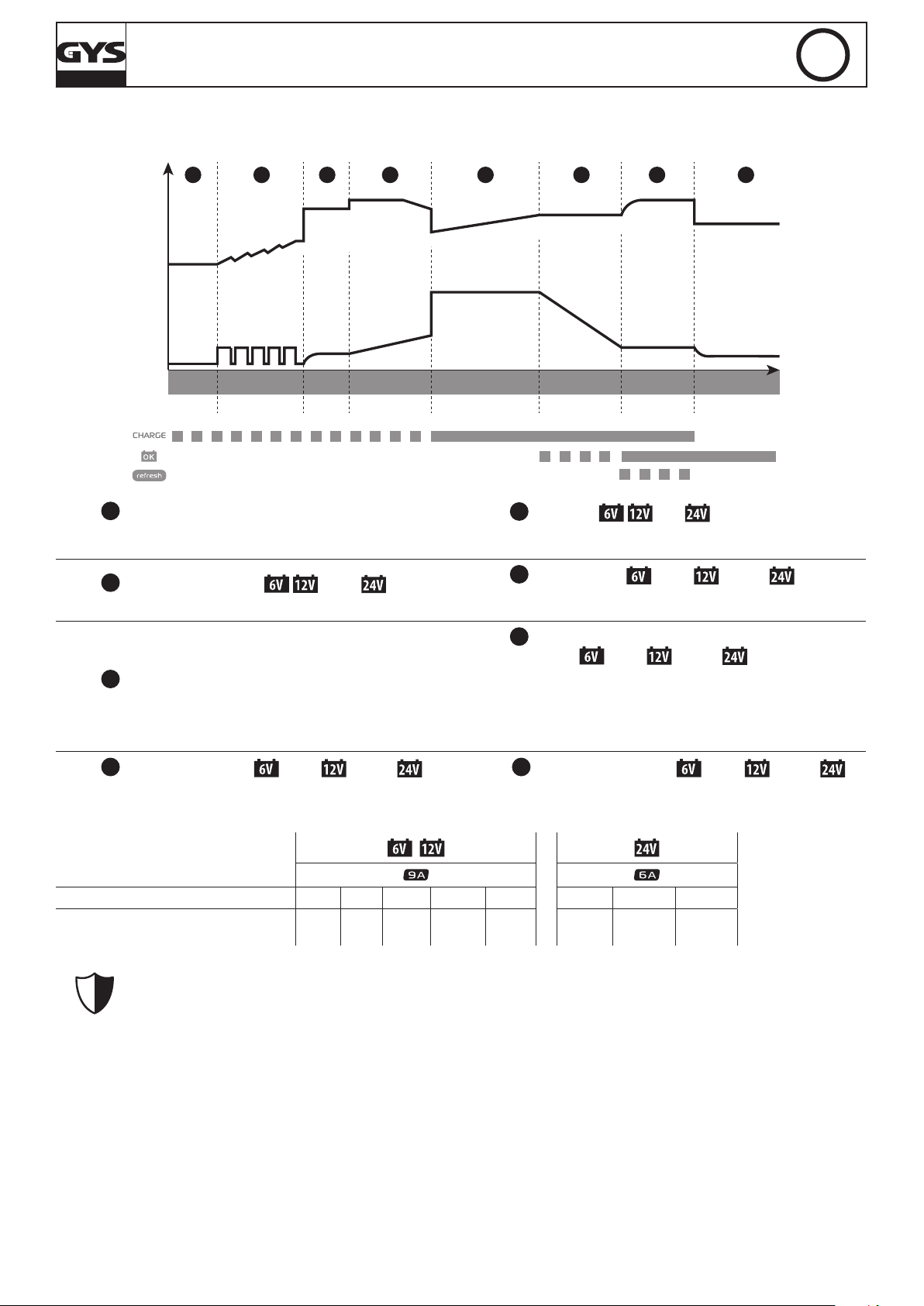
• Ladekurve:
Das GYSFLASH 9.24 nutzt eine achtstuge, weiterentwickelte Ladekurve, die die optimale Leistung Ihrer Batterie gewährleistet.
1 2 3 4 5 6 7
U
I
CC Test Recovery Test Desulfatierung Charge Absorption
< 1s Max 5h Max 12h Max 20h Max 8h no limit< 1s
Stufe 1 : Análisis
Analyse des Batteriezustands (Ladezustand, Verpolung, falsch
verbundene Batterie...)
Stufe 2 : Wiederherstellung ( 4.5A / 3A)
Wiederherstellungsfunktion für eine tiefenentladene Batterie.
8
Refresh
(option aktiviert)
1h - 4h
Erhaltungsladung
Stufe 5 : Ladung ( 9A / 6A)
Schnelle Ladung mit Maximalstrom bis die Batterie zu 80% aufgeladen ist.
Stufe 6 : Absorption ( 7.3V / 14.6V / 29.2V)
Ladung mit konstanter Spannung bis die Batterie auf 100%
aufgeladen ist.
Stufe 7 :
Stufe 3 : Test
Test auf sulfatierte Batterie.
Refresh (Option
Ist die Refresh Option ausgewählt, erzeugt das Ladegerät einen
zusätzlichen Strom, um in der Batterie Gas zu erzeugen, das die
Elektrolytmischung und die Wiederaufbereitung der Zellen der
7.9V / 15.8V / 31.6V)
Batterie ermöglicht. In dieser Phase kann die Batterie ein wenig
Wasser verlieren.
Stufe 4 : Desulfutarierung ( 7.9V / 15.8V /
31.6V)
Desulfatierung der Batterie.
• Geschätzte Ladezeit
Batteriekapazität 20Ah 60Ah 120Ah 180Ah 220Ah 20Ah 50Ah 125Ah
Ladezeit 20% >>> 80% 1h30 4h 8h 12h 15h 2h 5h 13h
Stufe 8 : Erhaltungsladung
27.2V)
Maximale Ladungserhaltung.
( 6.7V / 13.6V /
• Schutz:
Das GYSFLASH 9.24 ist gegen Kurzschlüsse und Verpolung geschützt. Das Gerät ist gegen die Entstehung elektrische
Funken beim Anschluss des Geräts geschützt. Es besitzt eine doppelte Isolierung und beinußt die Fahrzeugelektronik nicht.
Das GYSFLASH 6.24 besitz einen Temperatursensor, der die Überhitzung der internen Elektronik vermeidet.
12
Page 13
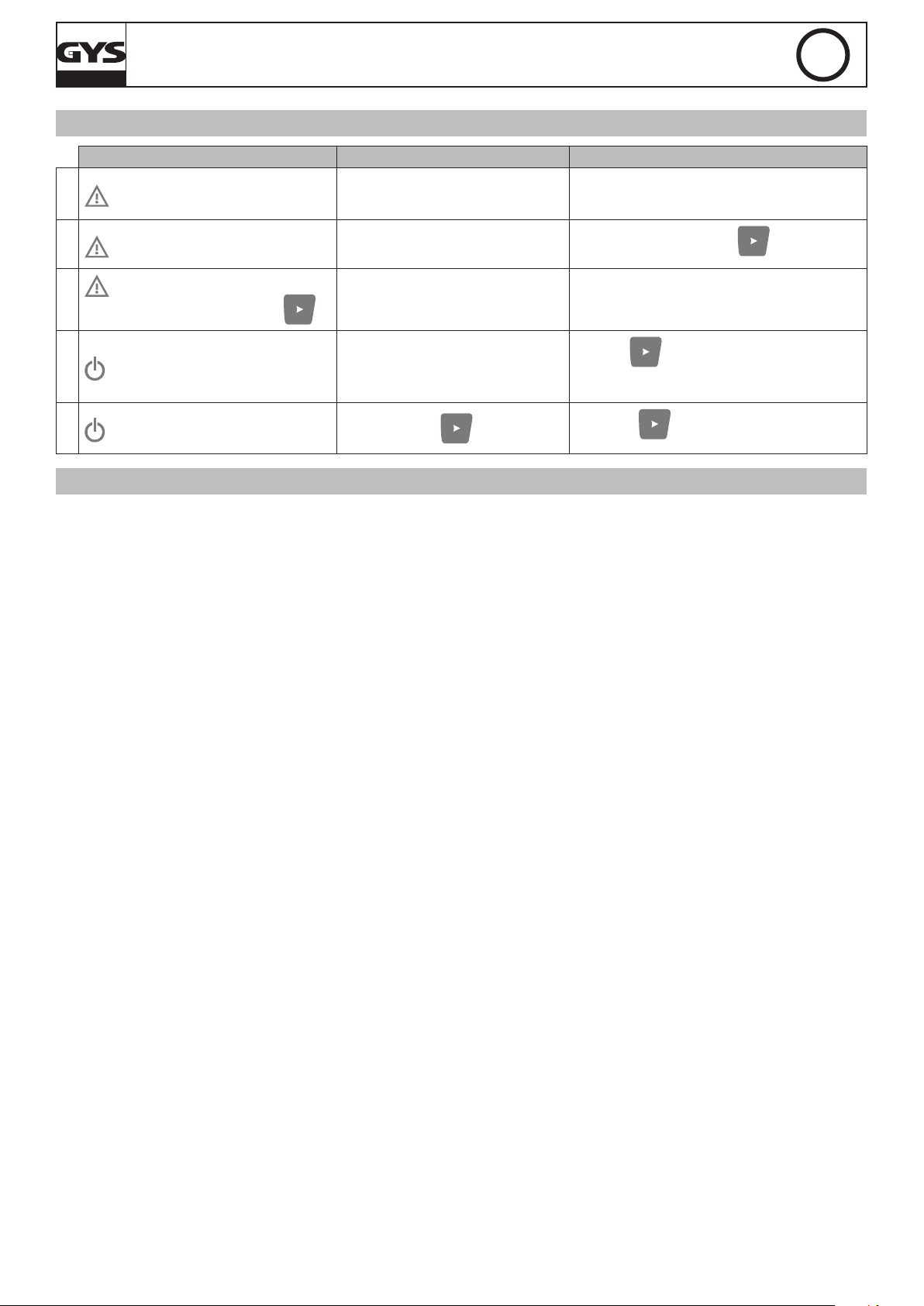
FEHLER, URSACHEN, LÖSUNGEN
Fehler Ursachen LÖSUNG
1
Kontrollleuchte blinkt
GYSFLASH 9.24
• Verpolung
• Batteriespannung zu hoch
• Kurzschluss in Klemmen
DE
• Richtigen Anschluss der Klemmen prüfen.
• Prüfen, ob der ausgewählte Modus der Nennspannung der Batterie entspricht.
2
Kontrollleuchte leuchtet dauerhaft.
Kontrollleuchte bleibt an auch nach
3
einem Druck auf die Kontrollleuchte .
4
Kontrollleuchte blinkt.
5
Kontrollleuchte leuchtet dauerhaft.
Ladefehler, Batterie defekt.
Überhitzung.
Ladegerät im Standby-Modus.
Ladung mit Taste unterbrochen.
Wechsel der Batterie und auf drücken, um
neu zu laden.
Umgebungstemperatur zu hoch (>50°C), den
Raum belüften und das Ladegerät sich abkühlen zu
lassen.
Auf Taste drücken oder eine Batterie an
das Ladegerät anschließen, um Standy-Modus zu
verlassen.
Wieder auf drücken, um die Ladung fortzusetzen.
HERSTELLERGARANTIE
Die Garantieleistung des Herstellers erfolgt ausschließlich bei Fabrikations- oder Materialfehlern, die binnen 12 Monate nach Kauf
angezeigt werden (Nachweis Kaufbeleg). Nach Anerkennung des Garantieanspruchs durch den Hersteller bzw. seines Beauftragten erfolgen eine für den Käufer kostenlose Reparatur und ein kostenloser Ersatz von Ersatzteilen. Der Garantiezeitraum bleibt
aufgrund erfolgter Garantieleistungen unverändert. Die Garantie erfolgt nicht bei Defekten, die durch unsachgemäßen Gebrauch,
Sturz oder harte Stöße sowie durch nicht autorisierte Reparaturen oder durch Transportschäden, die in Folge des Einsendens zur
Reparatur, hervorgerufen worden sind. Keine Garantie wird für Verschleißteile (z.B. Kabel, Klemmen, Vorsatzscheiben usw.) sowie
bei Gebrauchsspuren übernommen. Das betreffende Gerät bitte immer mit Kaufbeleg und kurzer Fehlerbeschreibung ausschließlich
über den Fachhandel einschicken. Die Reparatur erfolgt erst nach Erhalt einer schriftlichen Akzeptanz (unterschrift) des zuvor
vorgelegten Kostenvoranschlags durch den Besteller. Im Fall einer Garantieleistung trägt GYS ausschließlich die Kosten für den
Rückversand an den Fachhändler.
13
Page 14
INSTRUCCIONES DE SEGURIDAD
Este manual de uso incluye indicaciones sobre el funcionamiento
de su aparato y las precauciones a seguir para su seguridad.
Lea atentamente este documento antes del primer uso y consérvelo
para una futura lectura.
Este aparato se debe utilizar solamente para realizar la recarga
dentro de los límites indicados en el aparato y el manual. Se deben
respetar las instrucciones relativas a la seguridad: En caso de uso
inadecuado o peligroso, el fabricante no podrá considerarse
responsable.
Este aparato se puede utilizar por niños de al menos 8 años y
por personas con capacidades físicas, sensoriales o mentales
reducidas o sin experiencia o conocimiento, siempre y cuando estén
correctamente vigilados o si han recibido instrucciones respecto al
uso del aparato con toda seguridad y si los riesgos que conllevan
se hayan comprendido. Los niños no deben jugar con el aparato.
Los niños sin vigilancia no deben limpiar ni efectuar mantenimiento
alguno del aparato.
GYSFLASH 9.24
ES
En ningún caso se debe usar este aparato para cargar pilas o
baterías no recargables.
El modo de funcionamiento automático y las restricciones de uso
están explicadas en este manual.
Riesgo de explosión y de incendio!
• Una batería en carga puede emitir gases explosivos.
• Durante la carga, la batería debe ponerse en un lugar aireado.
• Evite las llamas y las chispas. No fume.
Conexión / desconexión :
• Desconecte la alimentación eléctrica antes de conectar o
desconectar las conexiones sobre la batería.
• El borne de la batería no conectado al chasis debe conectarse
primero. La otra conexión se debe efectuar en el chasis, lejos de
la batería y de la canalización de combustible. El cargador de
baterías debe conectarse después a la red eléctrica.
• Tras la operación de carga, desconecte el cargador de la red
eléctrica, retire la conexión del chasis y la conexión de la batería,
en este orden.
14
Conexión eléctrica :
• Aparato de clase II
• La conexión a la red eléctrica se debe efectuar conforme a las
reglas de instalación nacionales.
Page 15
GYSFLASH 9.24
ES
Mantenimiento:
• Si se daña el cable de alimentación, deberá ser reemplazado
por el fabricante, su servicio post-venta o una persona cualificada,
para evitar todo peligro.
Normativa:
• Aparato conforme a las directivas europeas.
• La declaración de conformidad está disponible en nuestra
página Web.
• Marca de conformidad EAC (Comunidad económica
Euroasiática)
Desecho :
• Este material es objeto de una recogida selectiva. No lo deposite
en un contenedor doméstico.
DESCRIPCIÓN GENERAL
Su GYSFLASH ha sido especialmente diseñado para recargar la mayoría de baterías al plomo con o sin mantenimiento, utilizadas de forma
corriente en los automóviles y otros vehículos. Estas baterías pueden ser de varios tipos, por ejemplo: GEL (electrolito gelicado), AGM
(electrolito impregnado), WET, MF (Maintenance Free), CA (Calcio)...
El Gysash 9.24 se adapta perfectamente a la carga de:
- baterías de 6V (3 elementos de 2V) de 18Ah a 220Ah y hasta 300Ah para el mantenimiento de carga,
- baterías de 12V (6 elementos de 2V) de 18Ah a 220Ah y hasta 300Ah para el mantenimiento de carga,
- baterías de 24V (12 elementos de 2V) de 15Ah a 125Ah y hasta 300Ah para el mantenimiento de carga.
El GYSFLASH 9.24 posee una función especíca que adapta automáticamente la tensión de salida en
función de la temperatura ambiente. Este ajuste permite tener una recarga muy precisa adaptada a la
temperatura ambiente.
PUESTA EN MARCHA
1. Conecte el cargador a la batería.
2. Conecte el cargador sobre la toma de corriente (red monofásica 220-240Vac 50-60Hz).
3. Seleccione el modo presionando sobre el botón . Tras aproximadamente cinco segundos, la carga se inicia automáticamente.
4. Durante la carga, el aparato indica el estado de avance de esta. Cuando el indicador parpadea, la batería está lista para
arrancar el motor. Y cuando el indicador sigue encendido, la batería está completamente cargada.
5. La carga se puede interrumpir en todo momento desconectando el aparato de la red eléctrica o presionando el botón .
6. Tras la operación de carga, desconecte el cargador de la red eléctrica y luego retire la conexión de la batería.
MODOS DE CARGA
• Descripción de los modos y de las opciones:
Modo Carga 6V (7.3V/9A) :
Modo destinado a la carga y al mantenimiento de carga de baterías al plomo de 6V. Ciclo de carga automático en
ocho etapas.
Modo Carga 12V (14.6V/9A) :
Modo destinado a la carga y al mantenimiento de carga de baterías al plomo de 12V. Ciclo de carga automático en
ocho etapas.
Modo Carga 24V (29.2V/6A) :
Modo destinado a la carga y al mantenimiento de carga de baterías al plomo de 24V. Ciclo de carga automático en
ocho etapas.
Opción REFRESH :
Opción que permite añadir una etapa adicional (etapa 7) al ciclo de carga para reacondicionar baterías que se han
descargado mucho.
: Se recomienda no activar esta opción para la carga de baterías selladas.
Consejo: Compruebe y complete, si es necesario, el nivel de agua de la batería tras una carga con Refresh.
15
Page 16
GYSFLASH 9.24
indicator light
ES
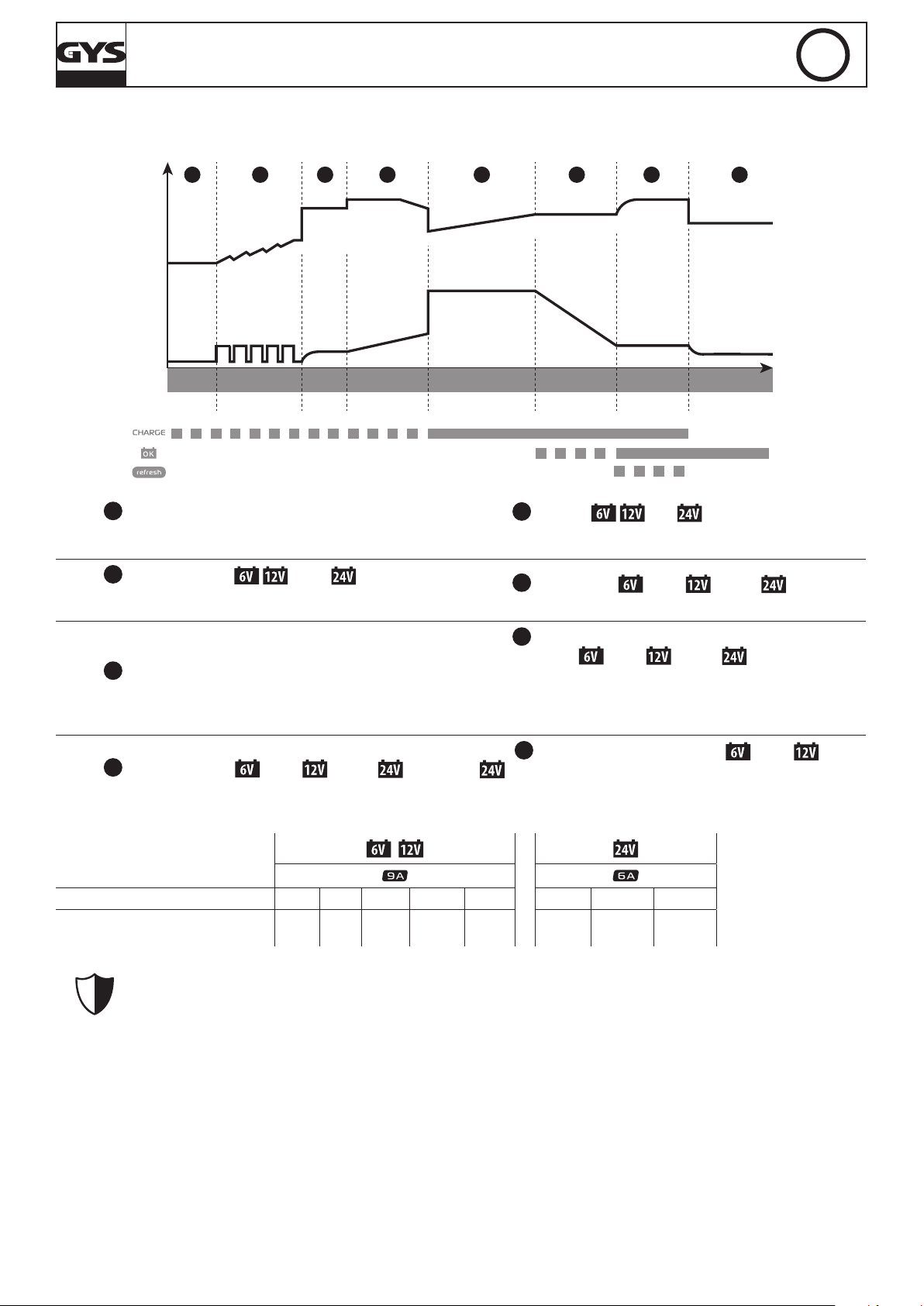
• Curva de carga :
El GYSFLASH 9.24 utiliza una curva de carga evolucionada de ocho etapas que garantiza el rendimiento óptimo de su batería.
1 2 3 4 5 6 7
U
I
Análisis Recuperación Test Desulfatación Carga Absorción
< 1s Max 5h Max 12h Max 20h Max 8h no limit< 1s
Etapa 1 : Análisis
Análisis del estado de la batería (nivel de carga, inversión de polaridad, batería conectada incorrecta…)
Etapa 2 : Recuperación ( 4.5A / 3A)
Algoritmo de recuperación de los elementos dañados tras una
descarga profunda y prolongada.
8
Refresh
(Si opción activada)
1h - 4h
Mantenimiento
de carga
Etapa 5 : Carga ( 9A / 6A)
Carga rápida con corriente máxima que permite llegar al 80% del
nivel de carga.
Etapa 6 : Absorción ( 7.3V / 14.6V / 29.2V)
Carga con voltaje constante para llevar el nivel de carga a 100%.
Etapa 7 :
Etapa 3 : Test
Test de batería sulfatada
Refresh (opción
Si la opción Refresh se selecciona, el cargador inyectará una corriente suplementaria para crear gas, lo cual permitirá mezclar el
7.9V / 15.8V / 31.6V)
electrolito y reacondicionar las celdas de la batería. Durante esta
fase, la batería puede perder un poco de agua.
Etapa 4 : Desulfatación ( 7.9V / 15.8V / 31.6V)
Algoritmo de desulfatación de la batería.
Etapa 8 : Mantenimiento de carga
/ 27.2V)
Mantenimiento del nivel de carga de la batería a su máximo
( 6.7V / 13.6V
nivel.
• Tiempo de carga estimada
Capacidad de la batería 20Ah 60Ah 120Ah 180Ah 220Ah 20Ah 50Ah 125Ah
Tiempo de carga 20% >>> 80% 1h30 4h 8h 12h 15h 2h 5h 13h
• Protecciones:
El GYSFLASH 9.24 posee un conjunto de dispositivos que le protegen contra los cortocircuitos y la inversión de
polaridad. Dispone de un sistema anti chispas que evita las chispas cuando se conectar el cargador a la batería. Este
cargador es de doble aislamiento y es compatible con la electrónica de los vehículos.
El GYSFLASH 9.24 está equipado con un sensor de temperatura integrado que le permite adaptar su corriente de carga en función
de la temperatura ambiente para evitar cualquier sobrecalentamiento de la electrónica interna.
16
Page 17
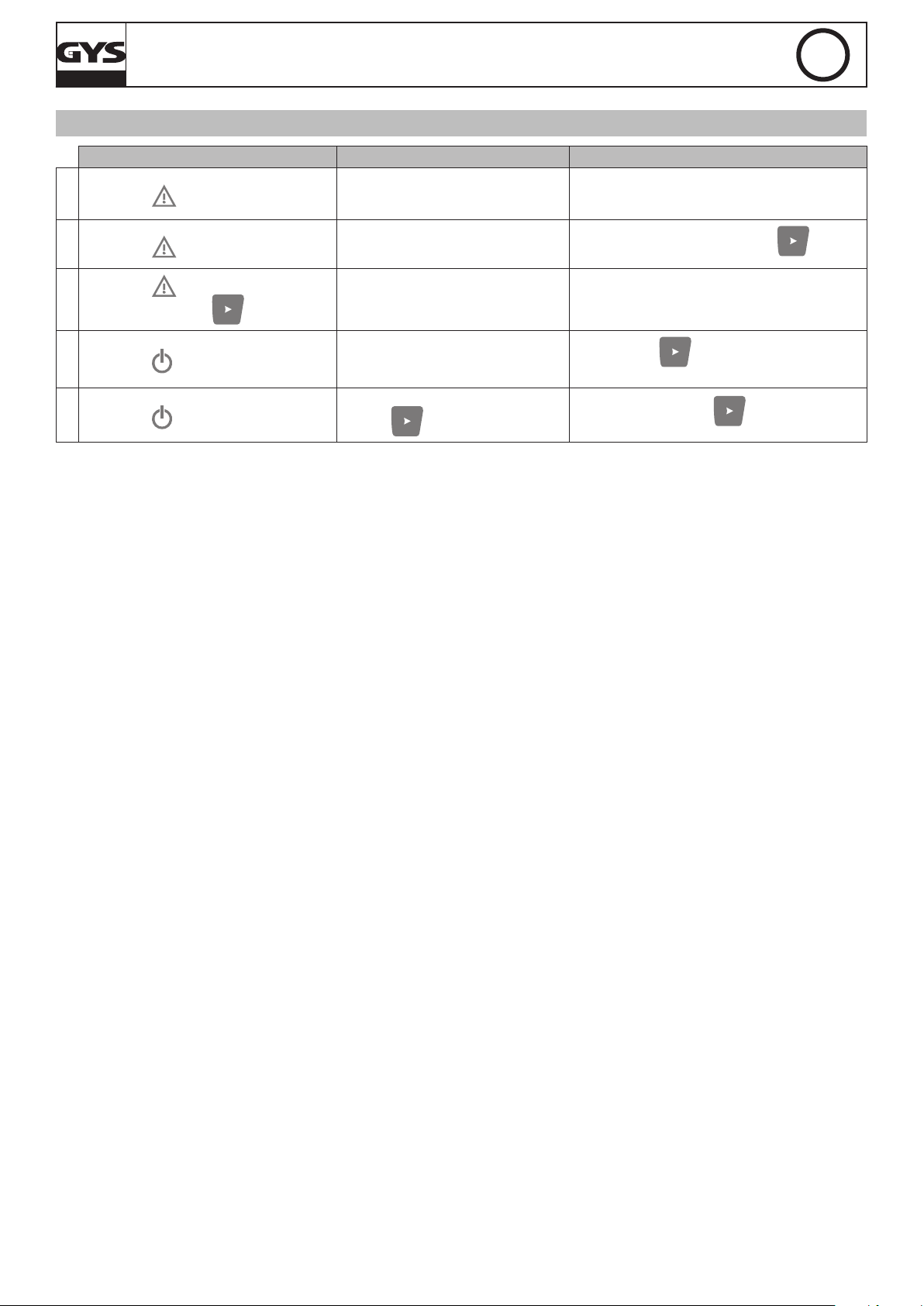
ANOMALÍAS, CAUSAS Y SOLUCIONES
Anomalías Causas Soluciones
1
El indicador parpadea.
GYSFLASH 9.24
• Inversión de polaridad
• Voltaje de batería demasiado elevado
• Pinzas en cortocircuito
ES
• Compruebe que las pinzas estén bien conectadas.
• Compruebe que el modo seleccionado corresponde a la tensión nominal de la batería.
2
El indicador está encendido.
El indicador sigue encendido incluso
3
tras presionar el botón .
4
El indicador parpadea.
5
El indicador sigue encendido.
Fallo en la carga, batería no recuperable.
Fallo térmico
Cargador en espera (standby)
Carga interrumpida presionando sobre
el botón .
Cambiar de batería y presione sobre para
reiniciar una carga.
Temperatura ambiente demasiado elevada (>50°C),
airear el local y dejar que el cargador se enfríe.
Presione sobre ou conecte una batería al cargador para salir del modo de espera (standby).
Presione de nuevo sobre para reiniciar la
carga.
17
Page 18
ПРАВИЛА БЕЗОПАСНОСТИ
Данная инструкция описывает функционирование вашего
устройства и меры предосторожности в целях обеспечения
вашей безопасности.
Пожалуйста, прочтите ее перед первым использованием и
сохраните, чтобы при надобности перечитать.
Этот аппарат должен быть использован исключительно для
зарядки в рамках, указанных на аппарате и в инструкции.
Соблюдайте правила безопасности. В случае неадекватного или
опасного использования производитель не несет ответственности.
Этот аппарат может быть использован детьми старше 8 лет, а
также лицами с ограниченными физическими, умственными
возможностями или ограниченным сенсорным восприятием, а
также не обладающими опытом и знаниями, при условии, что
за ними надлежащим образом следят или если с ними провели
инструктаж по безопасному использованию аппарата и если все
возможные риски были предусмотрены. Дети не должны играть
с устройством. Чистка и уход не должны производится детьми
без надлежащего присмотра.
GYSFLASH 9.24
RU
Ни в коем случае не используйте это устройство для зарядки
батареек или незаряжаемых батарей.
Автоматический режим, а также ограничения при его
использовании, описаны далее в этой инструкции.
Риск пожара и взрыва!
При заряде батарея может выпустить взрывоопасный газ.
• Во время зарядки АКБ должна быть помещена в хорошо
проветриваемом месте.
• Избегайте пламени и искр. Не курить.
Подключение / отключение :
• Отключите подачу питания перед тем, как подключить или
отключить соединения к батарее.
• Сначала подключите клемму АКБ, не соединенную с шасси.
Второе подсоединение должно быть осуществлено на шасси как
можно дальше от АКБ и от трубопроводов топливной системы.
Затем, подключите зарядное устройство к сети.
• После зарядки отключите зарядное устройство от сети, затем
отсоедините зажим от шасси и, наконец, зажим от аккумулятора.
Действуйте в указанном порядке.
18
Подключение :
• Аппарат класса II
• Подключение к электросети должно быть произведено в
соответствии с нормами страны.
Page 19
GYSFLASH 9.24
RU
Обслуживание :
• Если шнур питания поврежден, он должен быть заменен
производителем, его сервисной службой или квалифицированным
специалистом во избежание опасности.
Регламентация :
• Аппарат соответствует директивам Евросоюза.
• Декларация соответствия есть на нашем сайте.
• Знак соответствия EAC (Евразийское экономическое сообщество)
Утилизация:
• Этот аппарат подлежит переработке. Не выбрасывать в общий
мусоросборник.
ОПИСАНИЕ
GYSFLASH разработан для для зарядки большинства свинцово-кислотных батарей с или без обслуживания, используемых
для автомобилей и многих других транспортных средств. Эти аккумуляторы могут быть разного типа, например: GEL
(электролит-гель), AGM (электролит-пропитка), WET, MF (без обслуживания), CA (Кальций)...
Gysash 9.24 прекрасно подходит для зарядки следующих АКБ:
- аккумуляторы 6В (3 элемента по 2В) ёмкостью от 18Aч до 220Aч и до 300Aч для подпитки,
- аккумуляторы 12В (6 элементов по 2В) ёмкостью от 18Aч до 220Aч и до 300Aч для подпитки,
- аккумуляторы 24В (12 элементов по 2В) ёмкостью от 15Aч до 125Aч и до 170Aч для подпитки.
Gysash 9.24 оснащен специальной функцией, которая автоматически подстраивает выходное
напряжение в зависимости от температуры воздуха окружающей среды. Эта настройка позволяет
перезарядить аккумулятор с большой точностью в соответствии с температурой окружающей среды.
ВКЛЮЧЕНИЕ
1. Подключите зарядное устройство к АКБ.
2. Подключите зарядное устройство к сети (однофазное питание 220-240Vac 50-60Hz).
3. Выберите режим с помощью кнопки . По истечении около пяти секунд зарядка начнется автоматически.
4. Во время заряда аппарат показывает состояние повышения уровня заряда. Когда индикатор мигает, АКБ готова к
запуску двигателя. Когда индикатор горит, АКБ полностью зарядилась.
5. Зарядку можно в любой момент прервать, отключив сетевой шнур или нажав на кнопку .
6. После зарядки отключите зарядное устройство от сети, затем отсоедините зажимы от АКБ.
РЕЖИМЫ ЗАРЯДКИ
• Описание Режимов и Опций:
Режим ЗАРЯДКИ 6В (7.3B/9A) :
Этот режим предназначен для зарядки и подпитки свинцовых АКБ 6В. Автоматический цикл зарядки в 8
этапов.
Режим ЗАРЯДКИ 12В (14.6B/9A) :
Этот режим предназначен для зарядки и подпитки свинцовых АКБ на 12В. Автоматический цикл зарядки в 8
этапов.
Режим ЗАРЯДКИ 24В (29.2B/6A) :
Этот режим предназначен для зарядки и подпитки свинцовых АКБ на 24В. Автоматический цикл зарядки в 8
этапов.
Опция REFRESH:
Опция, позволяющая добавить дополнительный этап (этап 7) к циклу зарядки для восстановления сильно
разряженных АКБ.
: Рекомендуется НЕ активировать эту опцию для зарядки герметичных АКБ.
Совет : Проверьте и при надобности дополните уровень воды АКБ после зарядки с опцией Refresh.
19
Page 20
GYSFLASH 9.24
indicator light
RU
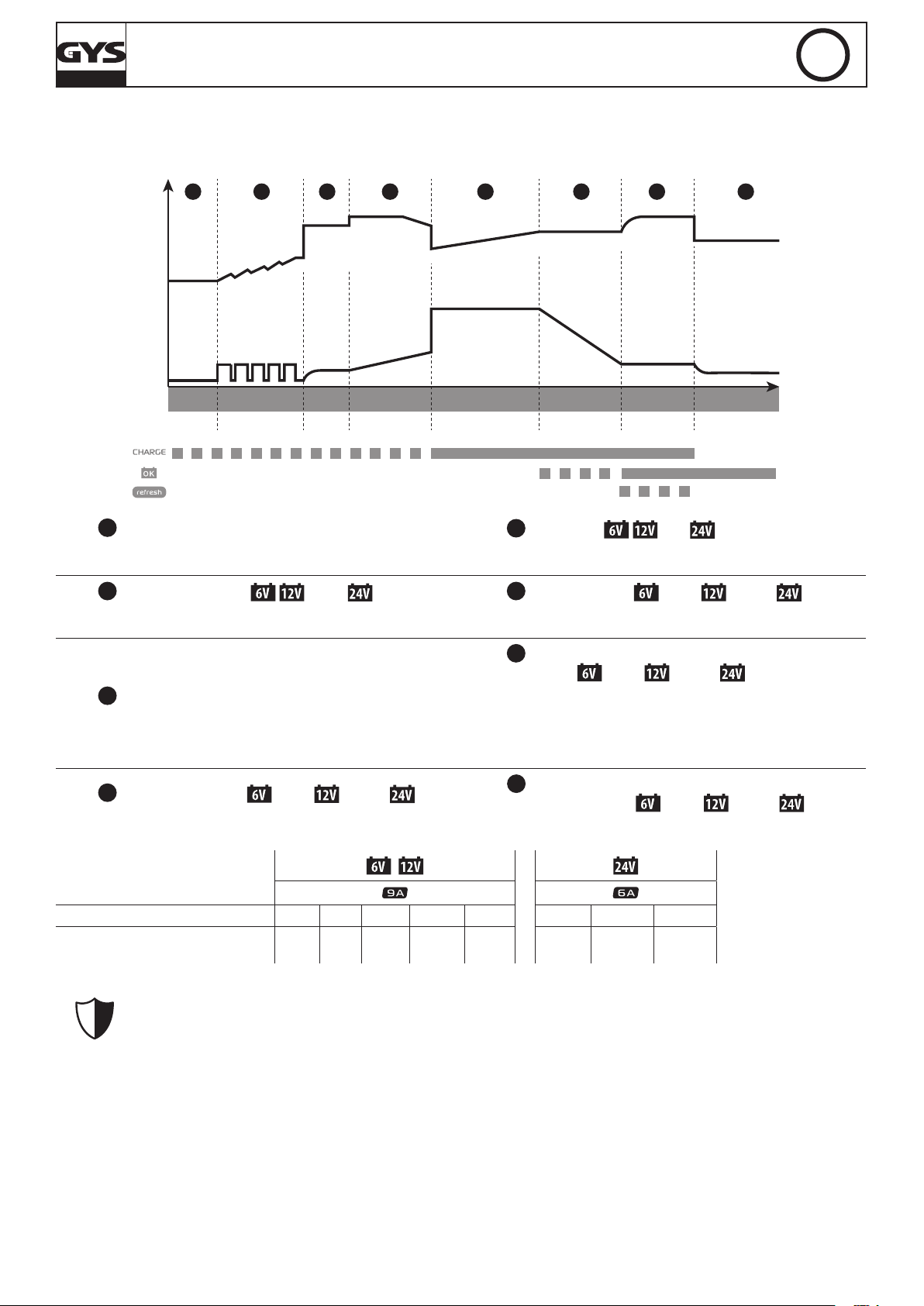
• Кривая зарядки :
GYSFLASH 9.24 заряжает по развернутой кривой, состоящей из восьми этапов, гарантирующей оптимальные рабочие
характеристики вашей АКБ.
1 2 3 4 5 6 7
U
I
Анализ Восстановление Те ст Десульфатация Зарядка Поглощение
< 1s Max 5h Max 12h Max 20h Max 8h no limit< 1s
Этап 1 : Анализ
Анализ состояния АКБ (уровень заряда, инверсия полярностей,
подключение неправильной АКБ…)
Этап 2 : Восстановление ( 4.5A / 3A)
Алгоритм восстановления элементов, поврежденных
вследствие глубокой разрядки.
8
Refresh
(если опция включена)
1h - 4h
Поддержание
заряда
Этап 5 : Зарядка ( 9A / 6A)
Быстрая зарядка на максимальном токе, позволяющая достичь
80% уровня зарядки.
Этап 6 : Поглощение ( 7.3B / 14.6B / 29.2B)
Зарядка при постоянном напряжении, чтобы довести уровень
заряда до 100%.
Этап 7 :
Этап 3 : Тест
Тестирование сульфатированной АКБ
Refresh (опция
Если выбрана опция Refresh, то зарядное устройство подаст
дополнительный ток, способствующий образованию газа,
который позволит перемешать электролит и восстановить
7.9B / 15.8B / 31.6B)
элементы АКБ. На этом этапе из АКБ может испариться
немного воды.
Этап
Этап 4 : Десульфатация ( 7.9B / 15.8B / 31.6B)
Алгоритм десульфатации АКБ.
• Предполагаемое время
8 :
Поддержание заряда
( 6.7B / 13.6B / 27.2B)
Поддержание уровня заряда АКБ на максимальном уровне.
зарядки
Емкость АКБ 20Ah 60Ah 120Ah 180Ah 220Ah 20Ah 50Ah 125Ah
Время зарядки 20% >>> 80%
1h30 4h 8h 12h 15h 2h 5h 13h
• Защиты:
GYSFLASH 9.24 имеет целый ряд защитных механизмов против коротких замыканий и инверсии полярности.
Он оснащен противоискровой защитой, предотвращающей искрение при подсоединении зарядного
устройства к АКБ. Это зарядное устройство имеет двойную изоляцию и совместим с бортовой электроникой
автомобилей.
GYSFLASH 9.24 имеет встроенный температурный датчик, позволяющий изменять ток зарядки в зависимости от
температуры окружающей среды во избежание перегрева внутренней электроники.
20
Page 21
GYSFLASH 9.24
НЕИСПРАВНОСТИ, ИХ ПРИЧИНЫ И УСТРАНЕНИЕ
Неисправности Причины Устранение
1
Мигает индикатор .
• Инверсия полярности
• Напряжение АКБ слишком высокое
• Закорочены зажимы
RU
• Проверьте, что зажимы правильно
подсоединены.
• Проверьте, что выбранный режим
соответствует номинальному напряжению АКБ.
2
Горит индикатор .
Индикатор продолжает гореть,
несмотря на то, что вы нажали кнопку
3
.
4
Мигает индикатор .
5
Индикатор продолжает гореть.
Ошибка при зарядке, АКБ
восстановлению не подлежит.
Проблема с температурой.
Зарядное устройство в режиме
ожидания.
Зарядку можно прервать нажатием
на кнопку .
Замените АКБ и нажмите на , чтобы снова
запустить цикл зарядки.
Слишком высокая температура окружающей
среды (>50°C). Проветрите помещение и дайте
зарядному устройству остыть.
Нажмите на кнопку или подсоедините АКБ
к зарядному устройству, чтобы выйти из режима
ожидания.
Снова нажмите на , чтобы снова запустить
зарядку.
21
Page 22
ISTRUZIONI DI SICUREZZA
Questo manuale contiene le istruzioni di sicurezza e d’uso.
Leggerle attentamente prima di usare il dispositivo per la prima
volta e conservarle in un posto sicuro per consultazioni future.
Questa dispositiva deve essere utilizzata solo per le operazioni
di carica entro i limiti indicati sulla macchina e nel manuale di
istruzioni. L’operatore deve rispettare le precauzioni di sicurezza.
Nel caso di uso inadeguato o insicuro, il produttore non può essere
ritenuto responsabile.
Questa unità può essere usata da bambini di almeno 8 anni e
da persone con capacità fisiche, sensoriali o mentali ridotte o
mancanza d’esperienza o di conoscenza, se sono adeguatamente
monitorate o se le istruzioni per usare l’equipaggiamento in modo
sicuro gli è stato dato e se sono stati informati dei rischi. I bambini
non devono giocare con il prodotto. La manutenzione e la pulizia
non deve essere eseguita da bambini non supervisionati.
GYSFLASH 9.24
IT
Non usare per ricaricare piccole batterie o batterie non ricaricabili.
La modalità operativa del caricabatterie automatico e le restizioni
applicate per il suo uso sono spiegate qui sotto in questo manuale.
Rischi di incendio e esplosioni!
Un batteria carica può emettere gas esplosivo.
• Durante la carica, la batteria va posizionata in un area ben
ventilata.
• Evitare fiamme e scintille. Non fumare.
Connessione / disconnessione :
• Assicurarsi che il caricabatterie sia disconnesso dalla rete elettrica
prima di connettere o disconnettere la batteria.
• Assicurarsi sempre che il morsetto rosso sia connesso per primo al
polo «+» della batteria. ▪ Se necessario connettere il morsetto nero
al telaio del veicolo, assicurarsi che sia a distanza di sicurezza dalla
batteria e da carburante/tubo di scappamento. Il caricabatterie
deve essere connesso alla rete elettrica.
• Dopo la carica, disconnettere il caricabatterie dalla rete
elettrica, poi disconnettere il morsetto dal telaio del veicolo e infine
disconnettere il morsetto dalla batteria, in questo indicato ordine.
22
Connessione :
• Dispositivo di classe II
• Il collegamento alla rete elettrica deve essere effettuato in
conformità con gli standard nazionali.
Page 23
Manutenzione :
• Se il cavo di alimentazione è danneggiato, deve essere sostituito
dal produttore, è compito del servizio post-vendita o di personale
equivalentemente qualificato prevenire pericoli.
Regolamenti :
• Macchina conforme con le direttive Europee.
• La dichiarazione di conformità è disponibile sul nostro sito internet.
• EAC Conformity marking (Eurasian Economic Community)
Gestione dei rifiuti:
• Questo prodotto dovrebbe essere smaltito in un impianto di
riciclaggio adeguato. Non buttare in un bidone della spazzatura
ad uso domestico.
DESCRIZIONE GENERALE
GYSFLASH 9.24
IT
Il Gysash è stato specialmente progettato per ricaricare la maggior parte delle batterie al piombo con o senza manutenzione,
correntemente usate per le macchine e per diversi altri veicoli Queste batterie possono essere di diversi tipi es. : GEL (elettrolito
gelicato), AGM (elettrolito impregnato), WET, MF (Manutenzione Free), CA (Calcio)...
Lo Gysash 9.24 è perfettamente adatto alla carica di :
- batterie 6V (3 elementi da 2V) da 18Ah a 220Ah e no a 300Ah per il mantenimento di carica,
- batterie 12V (6 elemeti da 2V) da 18Ah a 220Ah e no a 300Ah per il mantenimento di carica,
- batterie 24V (12 elementi da 2V) da 15Ah a 125Ah e no a 170Ah per il mantenimento di carica.
Lo Gysash 9.24 è provvisto di una funzione che adatta automaticamente la tensione di uscita a seconda
della temperatura ambiente. Questo adattamento permette di avere una ricarica precisa e adatta alla temperatura ambiente.
AVVIAMENTO
1. Collegare il caricabatterie alla batteria.
2. Collegare il caricabatterie alla presa (rete monofase 220-240Vac 50-60Hz).
3. Scegliere la modalità premendo sul tasto . Dopo circa cinque secondi, la carica si avvia automaticamente.
4. Durante la carica, il dispositivo indica lo stato di avanzamento della carica. Quando la spia lampeggia, la batteria è pronta
ad avviare il motore. E quando la spia rimane accesa, la batteria è completamente carica.
5. La carica può essere interrotta ad ogni momento scollegando la spina dalla presa oppure premendo sul tasto .
6. Dopo l’operazione di carica, scollegare il caricabatterie dalla rete, in seguito ritirare le connessioni dalla batteria.
MODI DI CARICA
• Descrizione dei Modi di carica e delle opzioni:
Modo CARICA 6V (7.3V/9A) :
Modalità destinata alla carica e al mantenimento di carica delle batterie al piombo 6V. Ciclo di carica automatico in
otto tappe.
Modo CARICA 12V (14.6V/9A) :
Modalità destinata alla carica e al mantenimento della carica delle batterie al piombo 12V. Ciclo di carica automatico
in otto tappe.
Modo CARICA 24V (29.2V/6A) :
Modalità destinata alla carica e al mantenimento di batterie al piombo 24V. Ciclo di carica automatico in otto tappe.
Opzione REFRESH :
Opzione che permette di aggiungere una tappa supplementare (tappa 7) al ciclo di carica per ricondizionare le
batterie fortemente scariche.
: si raccomanda di non attivare questa opzione per le batterie sigillate.
Suggerimento : Vericare e ripristinare, se necessario, il livello d’acqua della batteria dopo una carica con Refresh.
23
Page 24
GYSFLASH 9.24
indicator light
IT
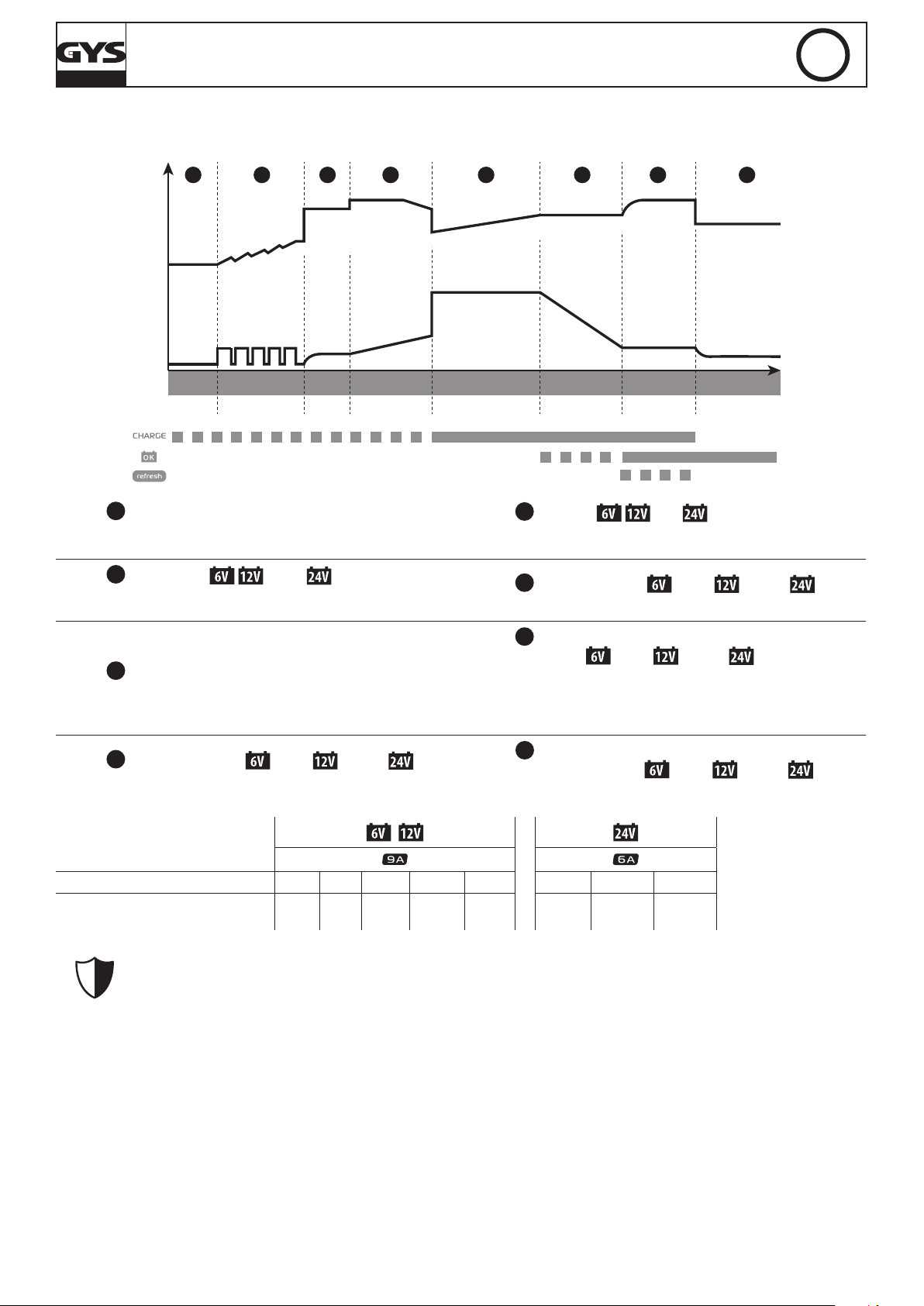
• Curva di carica :
Lo GYSFLASH 9.24 utilizza una curva di carica evoluta in otto tappe che garantisce le prestazioni ottimali della vostra batteria.
1 2 3 4 5 6 7
U
I
Analisi Ricupero Test Desolfatazione Carrica Assorbimento
< 1s Max 5h Max 12h Max 20h Max 8h no limit< 1s
Tappa 1 : Analisi
Analisi dello stato della batteria (livello di carica, inversione di polarità, batteria sbagliata collegata…)
Tappa 2 : Recupero ( 4.5A / 3A)
Algoritmo di recupero degli elementi danneggiati in seguito ad una
scarica profonda.
8
Refresh
(se opzione attiva)
1h - 4h
Carica oating
Tappa 5 : Carica ( 9A / 6A)
Carica veloce a corrente massima che permette di arrivare a 80%
del livello di carica.
Tappa 6 : Assorbimento ( 7.3V / 14.6V / 29.2V)
Carica a tensione costante per portare il livello di carica a 100%.
Tappa 7 :
Tappa 3 : Test
Test di batteria solfatata
Refresh (opzione
Se l’opzione Refresh è stata selezionata, il carica-batterie fornirà
una corrente supplementare che creerà un gas che vi permetterà
7.9V / 15.8V / 31.6V)
di mescolare l’elettrolito e così ricondizionare le cellule della batteria. Durante questa fase, la batteria può perdere un po’ d’acqua.
Tappa
Tappa 4 : Desolfatazione ( 7.9V / 15.8V / 31.6V)
Algoritmo di desolfatazione della batteria.
• Tempo di carica stimato
Capacità della batteria 20Ah 60Ah 120Ah 180Ah 220Ah 20Ah 50Ah 125Ah
Tempo di carica 20% >>> 80% 1h30 4h 8h 12h 15h 2h 5h 13h
8 :
Mantenimento di carica
( 6.7V / 13.6V / 27.2V)
Mantiene il livello di carica della batteria al massimo.
• Protezioni:
Lo GYSFLASH 9.24 possiede un insieme di dispositivi che lo proteggono contro i corto-circuiti e le inversioni di polarità. Dispone di un sistema che evita ogni scintilla durante il collegamento del caricabatterie alla batteria. Il caricabatterie è a doppio isolamento ed è compatibile con l’elettronica dei veicoli.
Lo GYSFLASH 9.24 è provvisto di sensore di temperatura integrato che permette di adattare la sua corrente di carica in funzione
della temperatura dell’ambiente per evitare surriscaldamento all’elettronica interna.
24
Page 25
ANOMALIE, CAUSE, RIMEDI
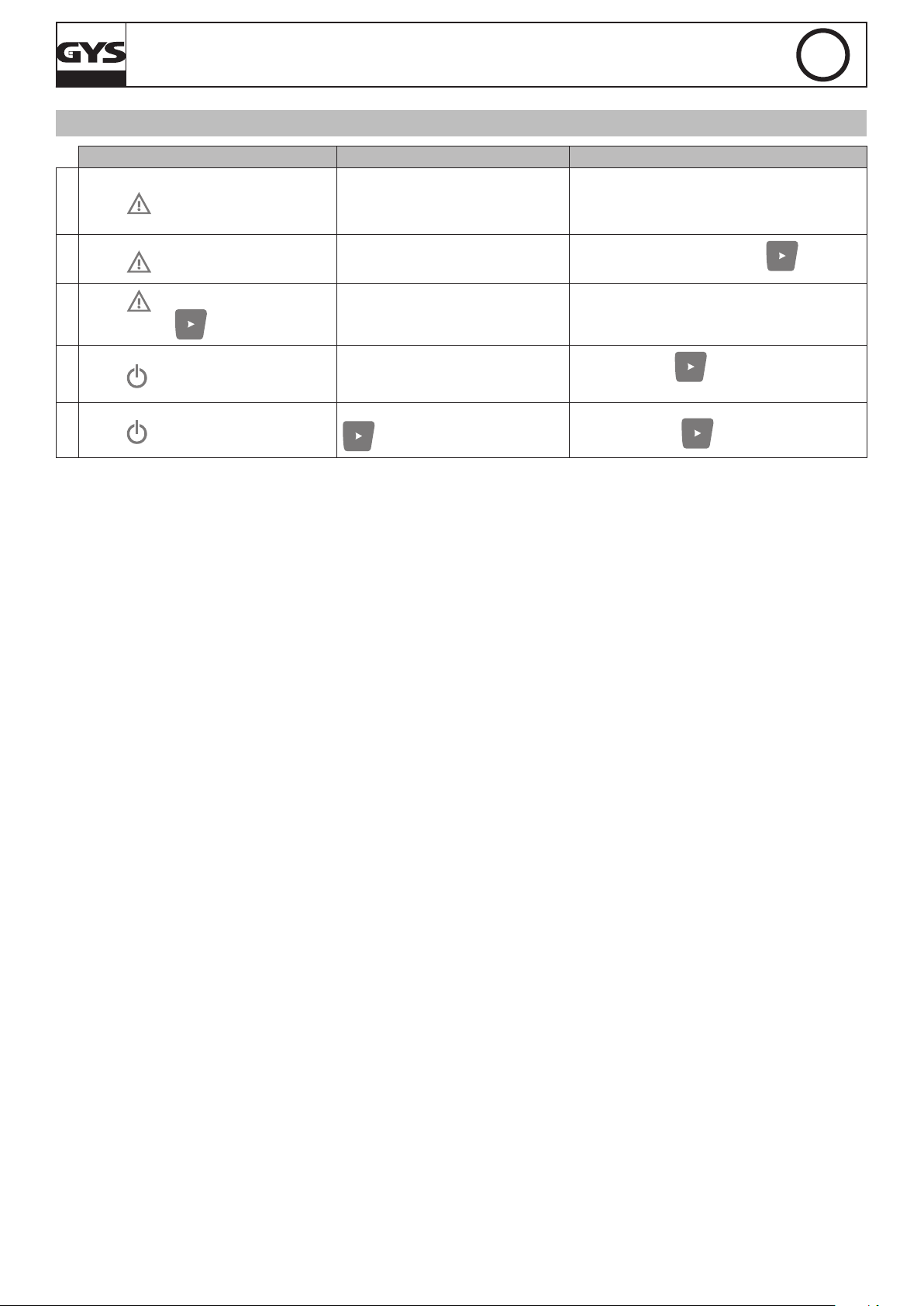
Anomalie Cause Rimedi
1
La spia lampeggia.
GYSFLASH 9.24
• Inversione di polarità
• Tensione batteria troppo elevata
• Morsetti in corto circuito
IT
• Vericare che i morsetti siano correttamente
collegati.
• Vericare che la modalità selezionata corrisponda
alla tensione nominale della batteria.
2
La spia è accesa.
La spia rimane accesa anche dopo aver
3
premuto il tasto .
4
La spia lampeggia.
5
La spia rimane accesa.
Fallimento durante la carica, batteria
irrecuperabile.
Difetto termico.
Caricabatteria in veglia.
Carica interrotta premendo sul tasto
.
Cambiare di batteria e premere su per riavviare una carica.
Temperatura ambiente troppo elevata (>50°C),
aerare il locale e lasciare il caricabatteria raffreddarsi.
Premere sul tasto o collegare una batteria al
caricabatterie per uscire dalla veglia.
Premere ancora su per rilanciare la carica.
25
Page 26
GYSFLASH 9.24
BELANGRIJKE VEILIGHEIDSINSTRUCTIES
In deze handleiding vindt u aanwijzingen voor het functioneren
van uw toestel en de veiligheids- en voorzorgsmaatregelen.
Leest u dit document aandachtig door voor u het apparaat in
gebruik neemt. Bewaar dit document als naslagwerk.
Dit apparaat kan alleen gebruikt worden als oplader, en uitsluitend
volgens de instructies vermeld op het apparaat en in de handleiding.
Volg altijd nauwkeurig de veiligheidsinstructies op. Bij onjuist of
gevaarlijk gebruik kan de fabrikant van dit product niet aansprakelijk
gesteld worden.
Dit apparaat kan worden gebruikt door kinderen vanaf 8 jaar
en door personen met lagere lichamelijke, zintuiglijke of mentale
vaardigheden of met gebrek aan ervaring of kennis, enkel en alleen
als ze goed begeleid worden, of als hen de noodzakelijke instructies
voor een absoluut veilig gebruik van het apparaat gegeven zijn, en
als de eventuele risico’s goed begrepen worden. Kinderen mogen
niet met het apparaat spelen. Schoonmaak en onderhoud mogen
niet gedaan worden door kinderen zonder toezicht.
NL
Niet geschikt voor het opladen van niet-oplaadbare batterijen of
accu's.
De automatische modus en de gebruiksbeperkingen van het
apparaat worden in deze handleiding beschreven.
Ontploffings- en brandgevaarlijk!
Een opladende accu kan explosief gas uitstoten.
• Plaats de accu tijdens het opladen in een goed geventileerde
ruimte.
• Voorkom vlammen en vonken. Niet roken.
Aansluiten / Afsluiten :
• Sluit de stroomvoorziening af alvorens de accu aan te sluiten of
los te koppelen.
• De aansluitklem van de accu die niet is aangesloten op een
chassis moet als eerst aangekoppeld worden. De andere verbinding
moet plaats vinden op de chassis, ver van de accu en van de
brandstofkanalisering. De acculader moet vervolgens op het net
aangesloten worden.
• Koppel na het laden eerst de acculader van de netspanning los.
Koppel daarna de connectie van het chassis los, en pas daarna de
connectie met de accu. Respecteer de juiste volgorde.
26
Aansluiten :
• Apparaat klasse II
• De aansluiting op de netspanning moet conform de nationale
regelgeving gebeuren.
Page 27
GYSFLASH 9.24
NL
Onderhoud :
• Als de voedingskabel beschadigd is moet deze vervangen worden
door de fabrikant, diens reparatie-dienst of een gelijkwaardig
gekwalificeerde technicus, om ieder gevaar te vermijden.
Richtlijnen :
• Apparaat voldoet aan de Europese richtlijnen.
• De conformiteitsverklaring is te vinden op onze internetsite.
• EAC merk (Euraziatische Economische Gemeenschap).
Afvalverwerking :
• Afzonderlijke inzameling vereist. Niet met het huishoudelijke
afval wegwerpen.
ALGEMENE BESCHRIJVING
Uw Gysash is speciaal ontworpen voor het opladen van de meeste loodaccu’s, met onderhoud of onderhoudsvrij, die gebruikt worden in
auto’s en in veel andere voertuigen. Dit kunnen verschillende soorten accu’s zijn, bijvoorbeeld GEL (gegeleerd elektrolyt), AGM (geïmpregneerde elektrolyt), WET, MF (Maintenance Free), CA (Calcium)...
De GYSFLASH 9.24 is uitermate geschikt voor het laden van :
- 6V accu’s (3 elementen van 2V) van 18 Ah tot 220 Ah en tot 300 Ah voor het druppel-laden,
- 12V accu’s (6 elementen van 2V) van 18 Ah tot 220 Ah en tot 300 Ah voor het druppel-laden,
- 24V accu’s (12 elementen van 2V) van 15 Ah tot 125 Ah en tot 170 Ah voor het druppel-laden.:
De GYSFLASH 9.24 is uitgerust met een functie die automatisch de uitgangsspanning aanpast aan de
omgevingstemperatuur. Deze instelling maakt het mogelijk de accu heel precies op te laden, afgestemd op
de omgevingstemperatuur.
OPSTARTEN
1. Sluit de acculader aan op de accu.
2. Sluit de acculader aan op een stopcontact (enkel fase netwerk, 220-240Vac 50-60 Hz).
3. Selecteer de modus door op knop te drukken. Het opladen start automatisch, na ongeveer vijf seconden.
4. Tijdens het opladen geeft het apparaat het laadniveau aan. Als het lampje knippert is de accu klaar om de motor op te
starten. En wanneer het lampje blijft branden is de accu volledig opgeladen.
5. Het opladen kan op ieder gewenst moment onderbroken worden, door de stekker uit het stopcontact te halen of door op knop te
drukken.
6. Koppel, na aoop van het laadproces, eerst de acculader van de netspanning af. Koppel daarna de aansluitingen van de accu los.
LAAD MODUS
• Beschrijving Modes en Opties :
Modus LADEN 6V (7.3V/9A) :
Modus bestemd voor het laden en druppel-laden van 6V lood-accu’s. Automatische laadcyclus in acht stappen.
Modus LADEN 12V (14.6V/9A) :
Modus bestemd voor het laden en druppel-laden van 12V lood accu’s. Automatische laadcyclus in acht stappen.
Modus LADEN 24V (29.2V/6A) :
Modus bestemd voor het laden en druppel-laden van 24V loodaccu’s. Automatische laadcyclus in acht stappen.
Optie REFRESH :
Optie waarmee een extra stap (stap 7) aan de laadcyclus kan worden toegevoegd om diep ontladen accu’s weer te
herstellen.
: het wordt aanbevolen om deze functie niet te gebruiken voor het opladen van verzegelde accu’s.
Advies : Controleer en vul zo nodig het waterniveau van de accu bij na het opladen met de Refresh optie.
27
Page 28
GYSFLASH 9.24
indicator light
NL
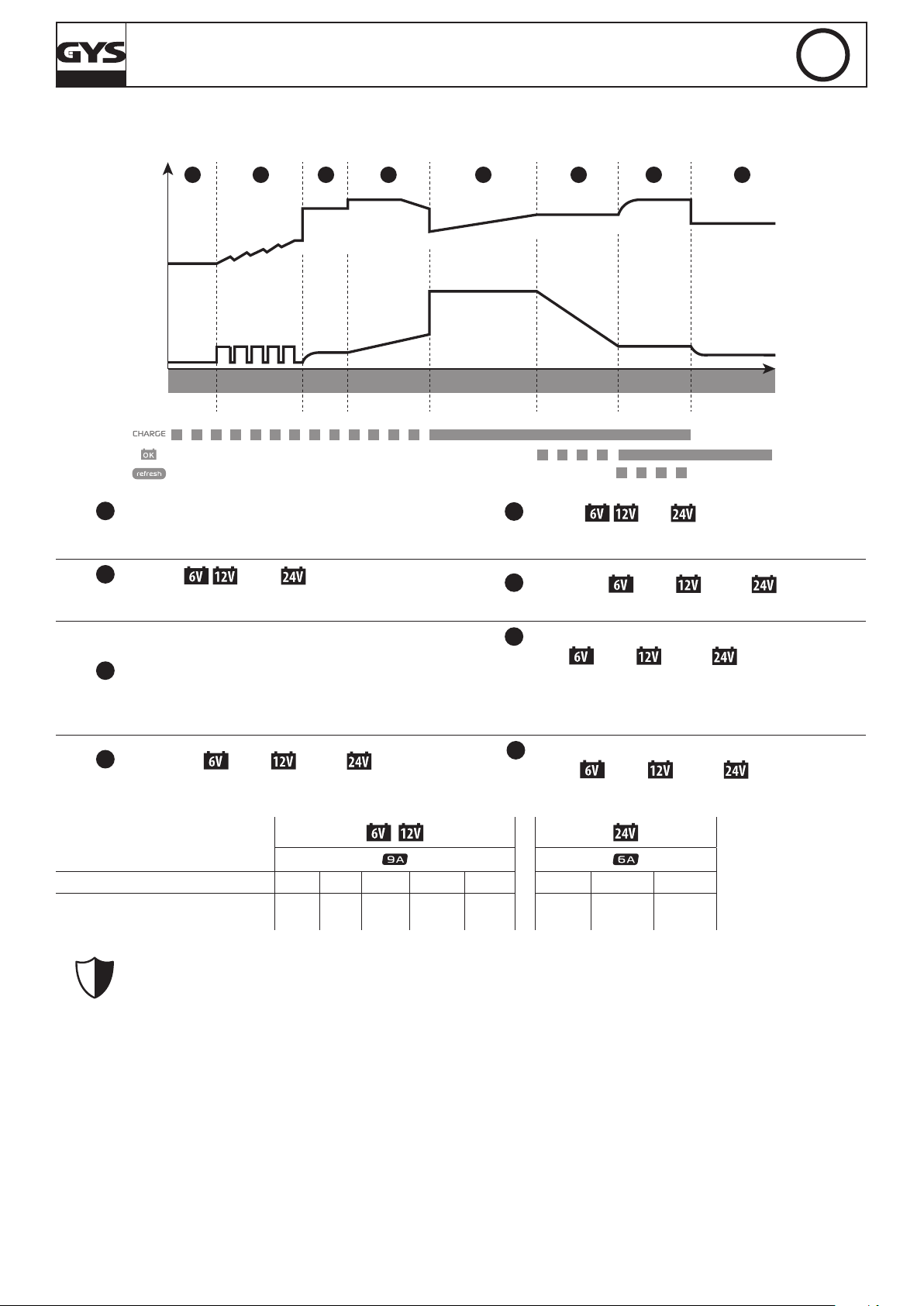
• Laadcurve :
De GYSFLASH 9.24 gebruikt een geëvolueerde laadcurve in acht stappen, die de maximale prestaties van uw accu garandeert.
1 2 3 4 5 6 7
U
I
Analyse Herstel Test Desulfatie Opladen Absorptie
< 1s Max 5h Max 12h Max 20h Max 8h no limit< 1s
Stap 1 : Analyse
Analyse van de staat van de accu (laadniveau, ompoling, verkeerde
accu aangesloten...)
Stap 2 : Herstel ( 4.5A / 3A)
Algoritme van het herstel van de beschadigde elementen als gevolg
van een diepe ontlading.
8
Refresh
(si option active)
1h - 4h
Druppellaadfunc-
tie
Stap 5 : Laden ( 9A / 6A)
Snel opladen met maximale stroom waarmee 80% van het laadniveau bereikt wordt.
Stap 6 : Absorptie ( 7.3V / 14.6V / 29.2V)
Laden met constante spanning, om de accu 100% op te laden.
Stap 7 :
Stap 3 : Test
Test gesulfateerde accu.
Refresh (optie
Als voor de Refresh optie is gekozen, zal de acculader extra
stroom afgeven en zo een gas creëren dat het mogelijk maakt
7.9V / 15.8V / 31.6V)
de elektrolyt te mengen en de cellen van de accu te herstellen.
Tijdens deze fase kan de accu een beetje water verliezen.
Stap 4 : Desulfatie ( 7.9V / 15.8V / 31.6V)
Algoritme desulfatie van de accu.
• Geschatte laadtijd
Capaciteit van de accu 20Ah 60Ah 120Ah 180Ah 220Ah 20Ah 50Ah 125Ah
Oplaadtijd 20% >>> 80% 1h30 4h 8h 12h 15h 2h 5h 13h
Stap 8 :
Druppel-laden
( 6.7V / 13.6V / 27.2V)
Handhaaft het maximale laadniveau van de accu.
• Beveiligingen :
De GYSFLASH 9.24 beschikt over een reeks beveiligingen die het apparaat beschermen tegen kortsluiting en polariteitsomwisseling. Het apparaat beschikt over een systeem dat vonkvorming tijdens het aankoppelen van de acculader op de accu voorkomt. De lader heeft een dubbele isolatie en is compatibel met de elektronica van auto’s.
De GYSFLASH 9.24 is uitgerust met een geïntegreerde temepratuursensor die het apparaat in staat stelt om de laadstroom aan te
passen aan de omgevingstemperatuur, om zodoende oververhitting van de interne elektronica te voorkomen.
28
Page 29
GYSFLASH 9.24
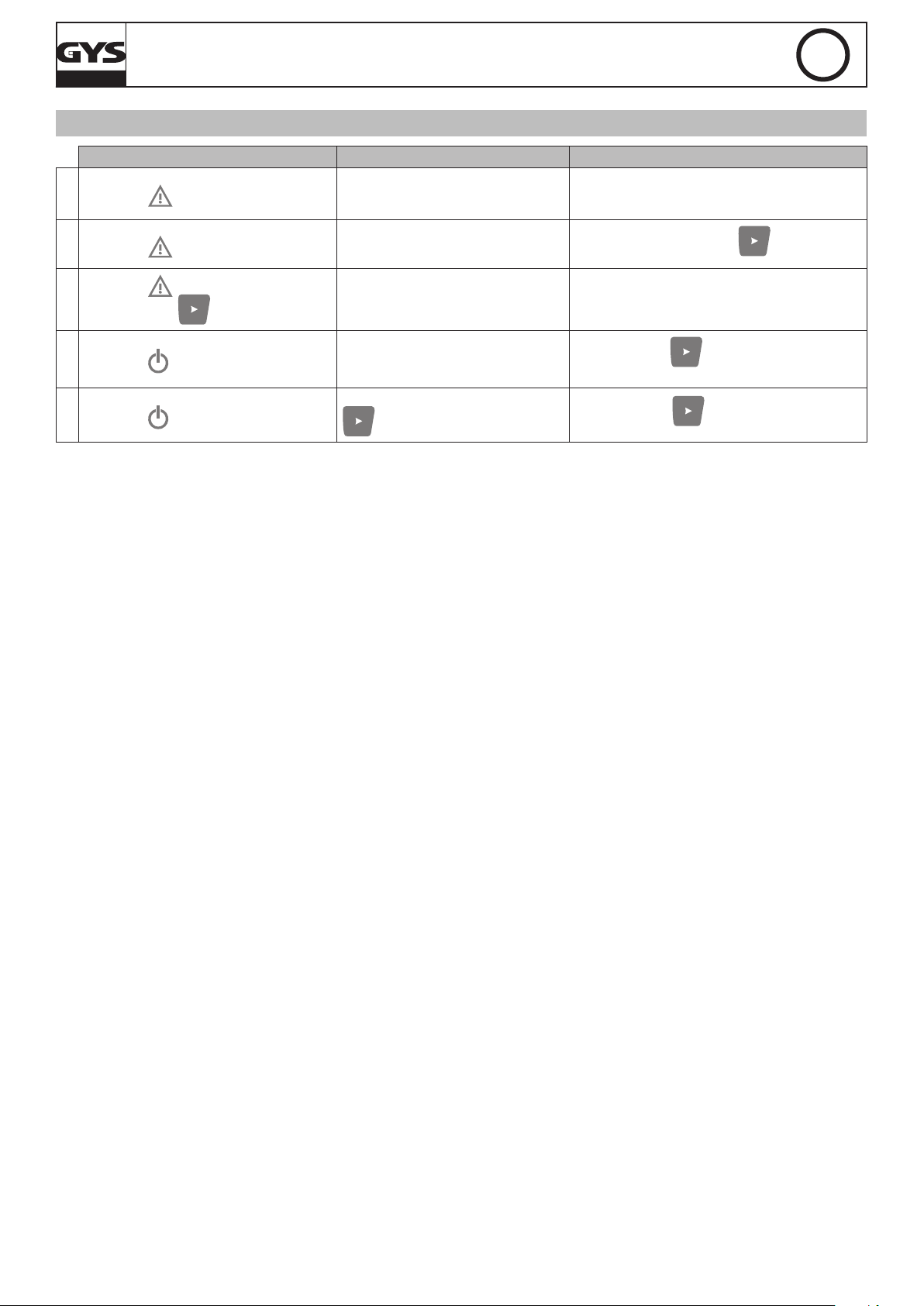
AFWIJKINGEN, OORZAKEN, OPLOSSINGEN
Afwijkingen Oorzaken Oplossingen
1
Het lampje knippert.
• Ompoling
• Te hoge accu-spanning
• Kortsluiting klemmen
NL
• Controleer of de klemmen goed aangesloten zijn.
• Controleer of de gekozen modus overeenkomt
met de nominale spanning van de accu.
2
Het lampje brandt.
Het lampje blijft branden zelfs na een
3
druk op de knop .
4
Het lampje knippert.
5
Het lampje blijft branden.
Opladen mislukt, accu beschadigd.
Thermische fout.
Acculader op stand by.
Opladen onderbroken door op de knop
te drukken.
Verwissel de accu en druk op om het opladen
weer te starten.
Te hoge omgevingstemperatuur (>50°C), ventileer
het vertrek en laat de oplader afkoelen.
Druk op de knop of sluit een accu op de
acculader aan om uit de standby modus te komen.
Druk opnieuw op , om het laden opnieuw te
starten.
29
Page 30
GYSFLASH 9.24
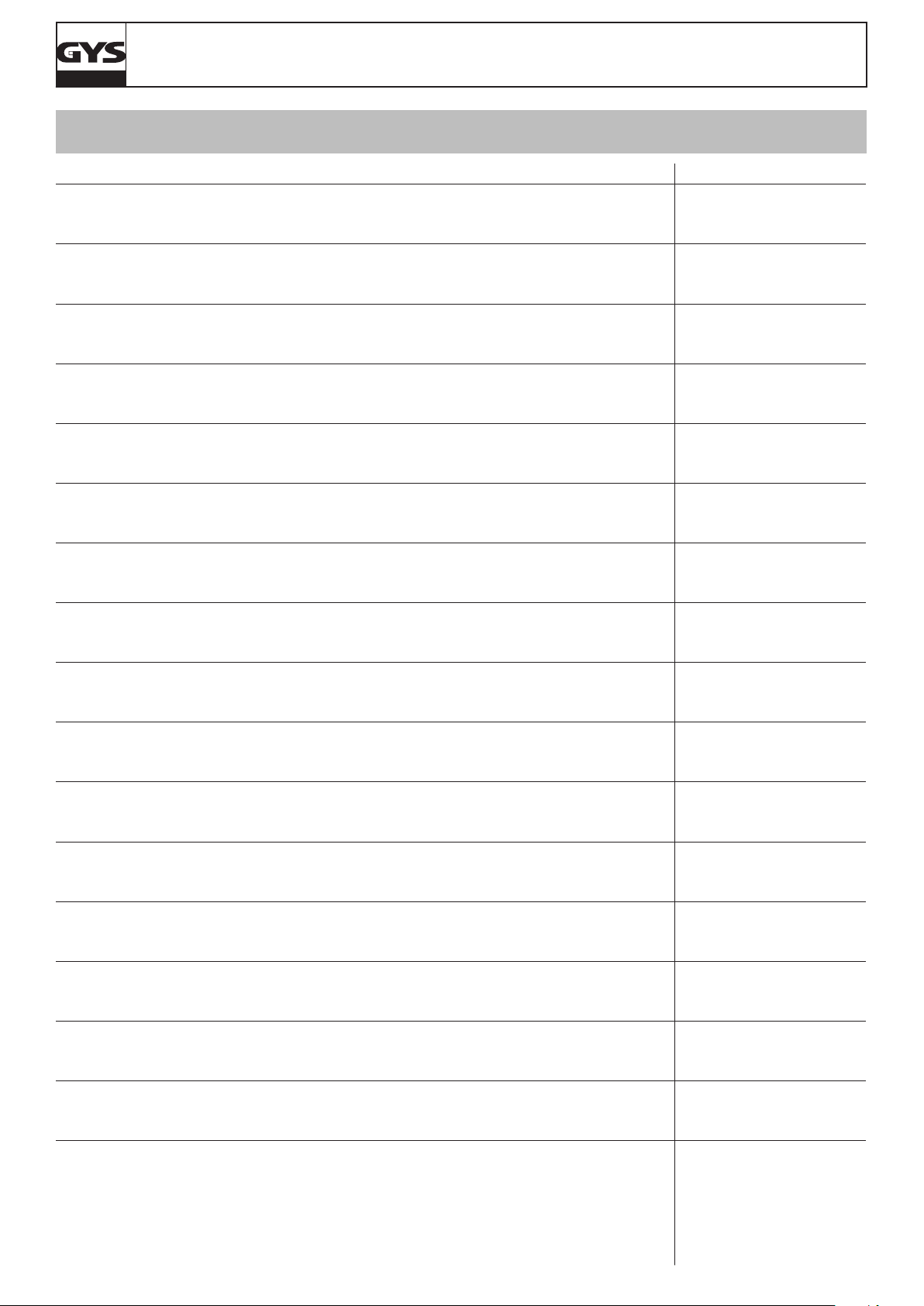
TABLEAU TECHNIQUE / TECHNICAL TABLE / TECHNISCHE DATEN / TABLA TÉCNICA / ТАБЛИЦА С
ТЕХНИЧЕСКИМИ ХАРАКТЕРИСТИКАМИ / TABELLA TECNICA / TECHNISCHE TABEL
Référence modèle
Reference
Art.-Nr. des Modells
Referencia del modelo
Tension d’alimentation assignée
Rated power supply voltage
Netzspannung
Tensión de red asignada
Puissance assignée
Rated power
Netzleistung
Potencia asignada
Tensions de sortie assignées
Rated output voltage
Ausgangsspannung
Tensiones de salida asignadas
Courant de sortie assignée
Rated output current
Ausgangsstrom
Corriente de salida asignada
Capacité assignée de batterie
Rated battery capacity
Batterie-Kapazität
Capacidad asignada de batería
Consommation batteries au repos
Battery consumption when idle
Verbrauch im Ruhezustand
Consumo de baterías en reposo
Ondulation
Ripple
Welligkeit
Ondulación
Courbe de charge
Charging curve
Ladekennlinie
Curva de carga
Température de fonctionnement
Operating temperature
Betriebstemperatur
Temperatura de funcionamiento
Température de stockage
Storage temperature
Lagertemperatur
Temperatura de almacenado
Indice de protection
Protection rating
Schutzart
Índice de protección
Classe de protection
Protection class
Schutzklasse
Clase de protección
Niveau de bruit
Noise level
Störpegel
Nivel de ruido
Poids
Weight
Gewicht
Peso
Dimensions (L x H x P)
Dimensions (L x H x D)
Abemssungen (L x H x T)
Dimensiones (L x A x A)
Normes
Standards
Normen
Normas
30
Артикул модели
Referentie model
Riferimento
Номинальное напряжение питания
Nominale voedingsspanning
Tensione di alimentazione nominale
Номинальная мощность
Nominale vermogen
Potenza nominale
Номинальные выходные напряжения
Uitgaande nominale spanning
Tensione nominale di uscita
Номинальный выходной ток
Uitgaande nominale spanning
Tensione nominale di uscita
Номинальная емкость батареи
Nominale accu capaciteit
Capacita nominale batteria
Потребление АКБ в нерабочем состоянии
Accu verbruik in ruststand
Consumo batteria quando inattivo
Колебание
Golving
Ondulazione
Кривая зарядки
Laadcurve
Urva di carica
Рабочая температура
Werktemperatuur
Temperatura di funzionamento
Температура хранения
Opslagtemperatuur
Temperatura di conservazione
Степень защиты
Beschermingsklasse
Grado di protezione
Класс защиты
Beschermingsklasse
Classe di protezione
Уровень шума
Geluidsniveau
Livello di rumore
Вес
Gewicht
Peso
Размеры (Д x В x Ш)
Afmetingen (L x H x B)
Dimensioni (L x H x D)
Нормы
Normen
Standard
18 - 220Ah
18 - 220Ah
15 - 125Ah
211 x 111 x 56.5 mm
GYSFLASH 9.24
029477
~ 220-240 VAC
50 / 60 Hz
190W
6 VDC
12 VDC
24 VDC
9A @ 6V DC
9A @ 12V DC
6A @ 24V DC
(max. 300Ah)
(max. 300Ah)
(max. 170Ah)
< 1.3mA
< 100mV rms
IUOU
-20°C – +50°C
-20°C – +80°C
IP65
Class II
< 50dB
1.1 Kg
EN 60335-1
EN 60335-2-29
EN 62233
CEI EN 60529
EN 50581
EN 55014-1
EN 55014-2
CEI 61000-3-2
CEI 61000-3-3
@ 6V DC
@ 12V DC
@ 24V DC
Page 31
GYSFLASH 9.24
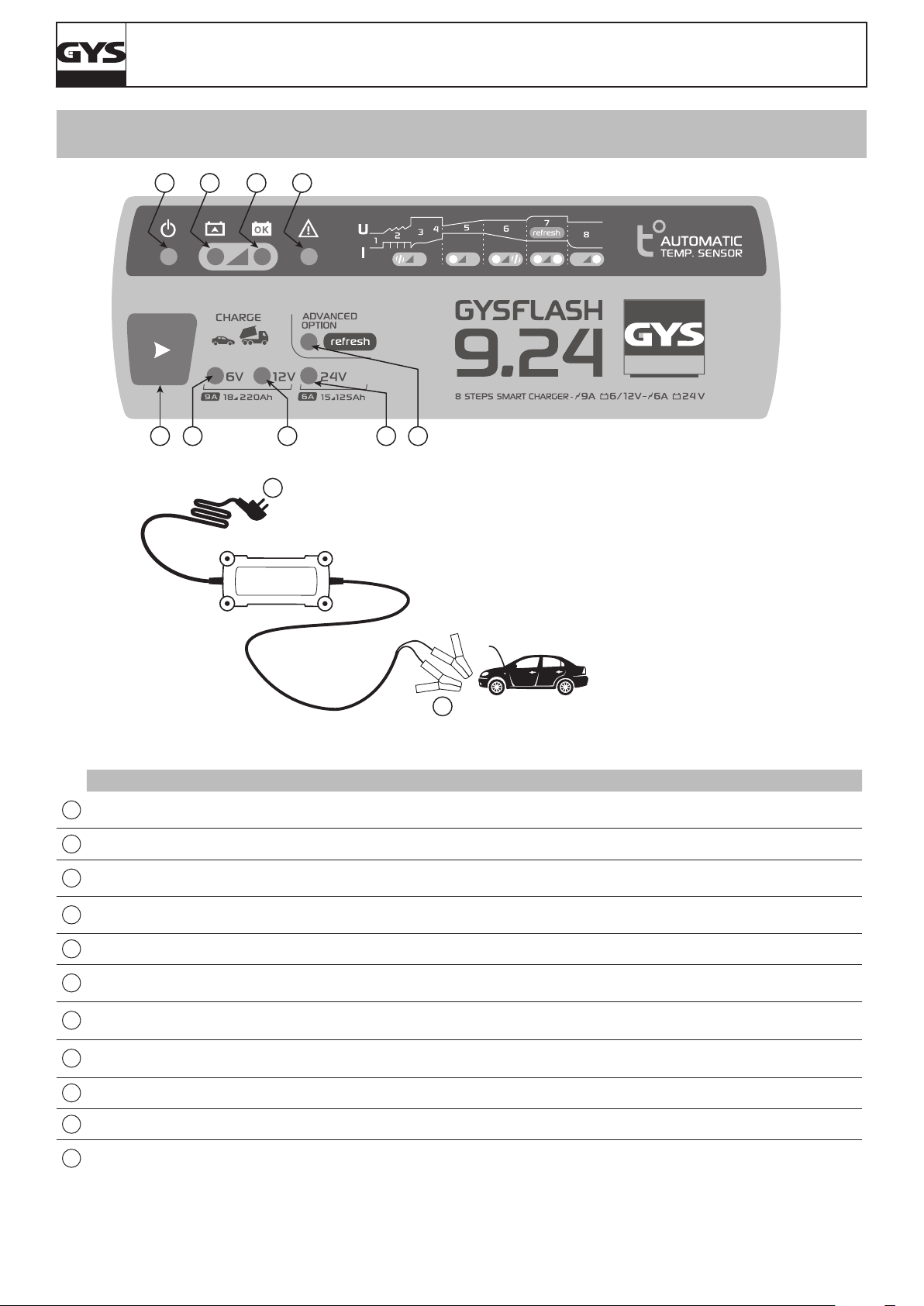
PLASTRON / CONTROL PANEL STICKER / FRONTSEITE / TECLADO / ПАНЕЛЬ УПРАВЛЕНИЯ /
TASTIERA DI COMMANDO / VOORSTUK
2 3 4 5
1 6 7 8 9
11
10
FR EN DE ES RU IT NL
1
2
3
4
5
6
7
8
9
10
11
Bouton
de sélection
Veille Sleep mode STAND BY En espera Режим ожидания Standby Stand by
Charge en cours Charging Ladefortschritt
Charge teminée Charge nished Auaden beendet Carga terminada
Défaut Fault Fehler Fallo Ошибка Predenito Fout
Mode Charge 6V
Mode Charge 12V
Mode Charge 24V
Option Refresh Refresh option Refresh-Option Opción Refresh Опция Refresh Opzione Refresh Optie Refresh
Pinces de charge Charge clamps Ladeklemme Pinzas de carga Зажимы зарядки Morsetti di carica Laad-klemmen
Prise secteur Mains plug Netzstecker
Selection button Auswahl-Taste
6V
Charge mode
12V
Charge mode
24V
Charge mode
6V
Charge-Modus
12V
Charge-Modus
24V
Charge-Modus
Botón de
selección
En proceso de
carga
Modo Carga
6V
Modo Carga
12V
Modo Carga
24V
Clavija de
corriente
Кнопка выбора
Идет зарядка Carica in corso
Зарядка
закончена
Режим Зарядки
6В
Режим Зарядки
12В
Режим Зарядки
24В
Сетевая вилка Spina Stopcontact
Pulsante di
selezione
Carica terminata
Modo Carica 6V Modus Laden 6V
Modo Carica 12V Modus Laden 12V
Modo Carica 24V Modus Laden 24V
Selectie knop
Bezig met
opladen
Opladen
beëindigd
31
 Loading...