

Page 1
FR
2-6 / 37-40
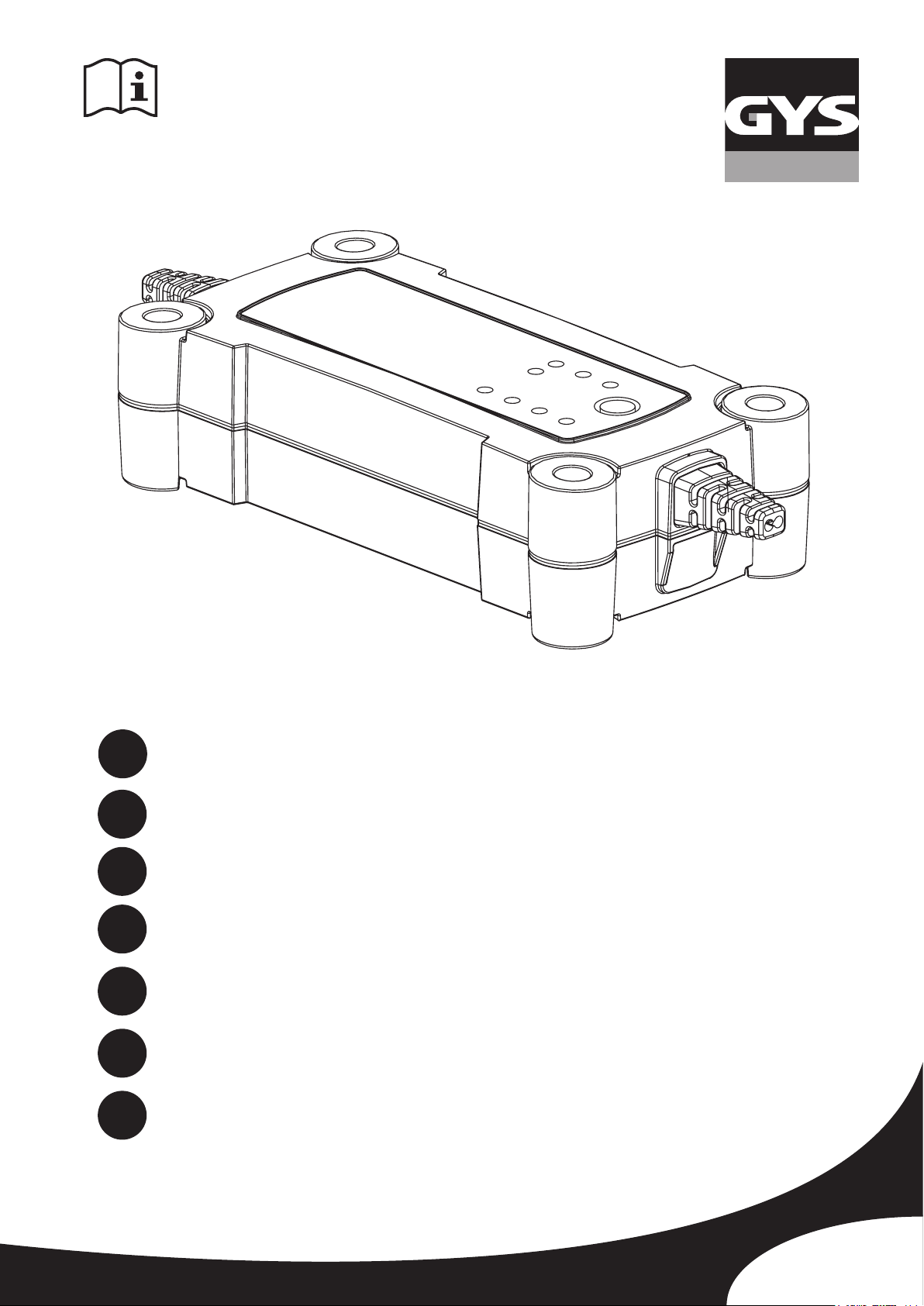
GYSFLASH 6.24 PL
EN
DE
ES
RU
NL
IT
7-11 / 37-40
12-16 / 37-40
17-21 / 37-40
22-26 / 37-40
27-31 / 37-40
32-36 / 37-40
Chargeur 6 A/24 V pour batteries Plomb/Lithium
Charger 6 A/24 V for Lead/Lithium batteries
6A/24A Batterieladegerät für Blei-Säure/Lithium Batterien
Chargador 6 A/24 V para baterías Plomo/Litio
Зарядное устройство 6A / 24В для АКБ Свинец / Литий
Lader 6 A/24 V voor Lood/Lithium accu’s
Caricabatterie 6A / 24V per batterie piombo/litio
C73523_V3_17/02/2021
Find more languages of user manuals on our website
www.gys.fr
Page 2
INSTRUCTIONS DE SÉCURITÉ
Ce manuel d’utilisation comprend des indications sur le
fonctionnement de l’appareil et les précautions à suivre pour la
sécurité de l’utilisateur. Merci de le lire attentivement avant la
première utilisation et de le conserver soigneusement pour toute
relecture future. Ces instructions doivent être lues et bien comprises
avant toute opération. Toute modication ou maintenance
non indiquée dans le manuel ne doit pas être entreprise.
Tout dommage corporel ou matériel dû à une utilisation nonconforme aux instructions de ce manuel ne pourra être retenu
à la charge du fabricant. En cas de problème ou d’incertitude,
consulter une personne qualiée pour manier correctement
l’appareil. Cet appareil doit être utilisé uniquement pour faire de
la recharge dans les limites indiquées sur l’appareil et le manuel.
Il faut respecter les instructions relatives à la sécurité. En cas
d’utilisation inadéquate ou dangereuse, le fabricant ne pourra
être tenu responsable.
GYSFLASH 6.24 PL
FR
Cet appareil peut être utilisé par des enfants âgés d’au moins
8 ans et par des personnes ayant des capacités physiques,
sensorielles ou mentales réduites ou dénuées d’expérience ou
de connaissance, s’ils (si elles) sont correctement surveillé(e)
s ou si des instructions relatives à l’utilisation de l’appareil en
toute sécurité leur ont été données et si les risques encourus
ont été appréhendés. Les enfants ne doivent pas jouer avec
l’appareil. Le nettoyage et l’entretien par l’usager ne doivent
pas être effectués par des enfants sans surveillance.
À n’utiliser en aucun cas pour charger des piles ou des batteries
non-rechargeables.
Ne pas utiliser l’appareil, si le cordon d’alimentation ou la che
de secteur sont endommagés.
Ne pas utiliser l’appareil, si le cordon de charge est endommagé
ou présente un défaut d’assemblage, an d’éviter tout risque
de court-circuit de la batterie.
Ne jamais charger une batterie gelée ou endommagée.
Ne pas couvrir l’appareil.
Ne pas placer l’appareil à proximité d’une source de chaleur et
à des températures durablement élevées (supérieurs à 60°C).
Le mode de fonctionnement automatique ainsi que les restrictions
applicables à l’utilisation sont expliqués ci-après dans ce mode
d’emploi.
Risque d’explosion et d’incendie!
Une batterie en charge peut émettre des gaz explosif.
2
Page 3
GYSFLASH 6.24 PL
FR
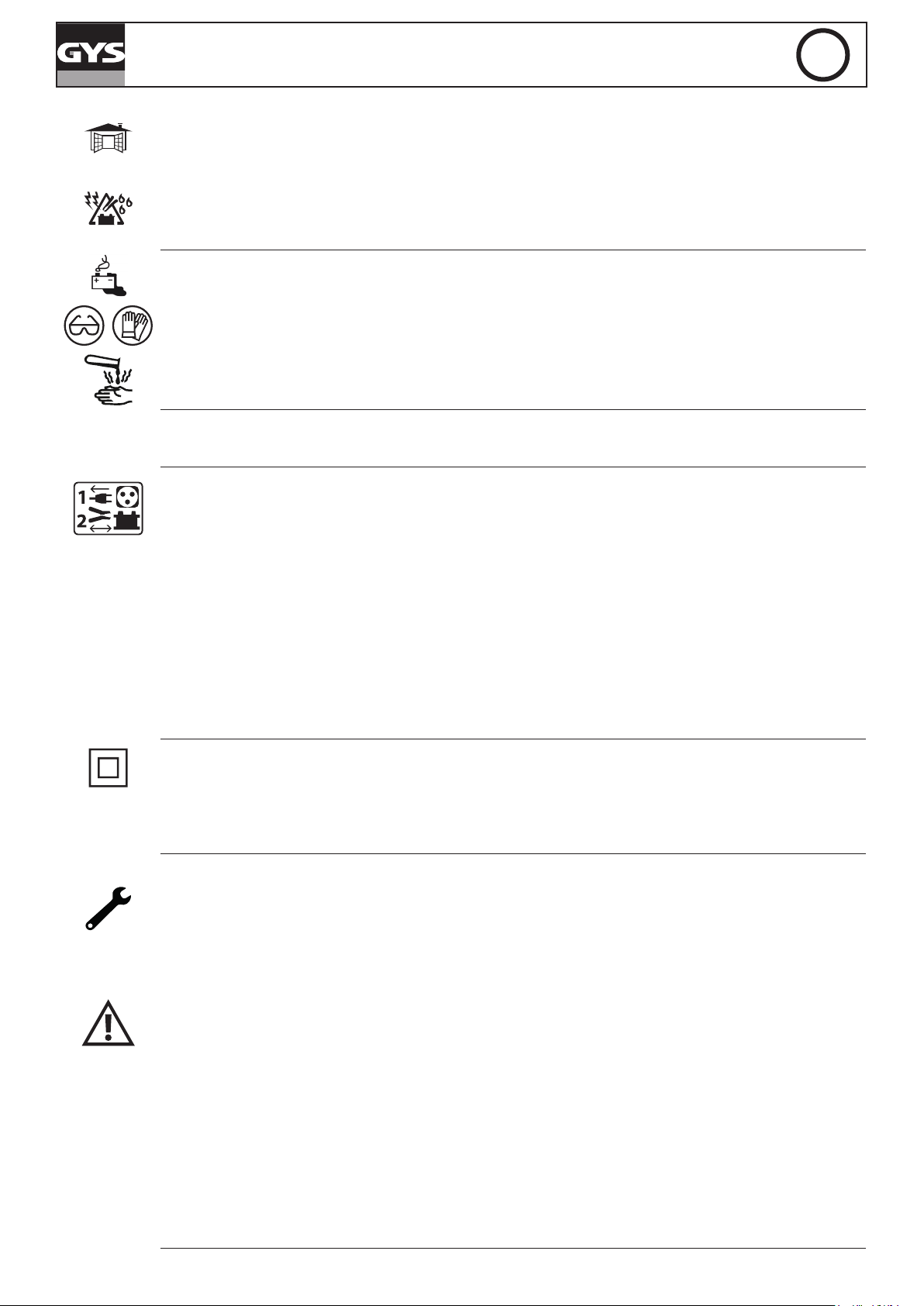
• Pendant la charge, la batterie doit être placée dans un
emplacement bien aéré.
• Éviter les ammes et les étincelles. Ne pas fumer.
• Protéger les surfaces de contacts électriques de la batterie
à l’encontre des courts-circuits.
Risque de projection d’acide !
• Porter des lunettes et des gants de protection
• En cas de contact avec les yeux ou la peau, rincer
immédiatement à l’eau et consulter un médecin sans tarder.
Ne pas laisser une batterie en cours de charge sans
surveillance sur une longue durée.
Connexion / déconnexion :
• Déconnecter l’alimentation avant de brancher ou de
débrancher les connexions sur la batterie.
• La borne de la batterie non reliée au châssis doit être connectée
la première. L’autre connexion doit être effectuée sur le châssis
loin de la batterie et de la canalisation de combustible. Le
chargeur de batterie doit alors être raccordé au réseau.
• Après l’opération de charge, débrancher le chargeur de
batterie du réseau puis retirer la connexion du châssis et enn
la connexion de la batterie, dans l’ordre indiqué.
Raccordement :
• Appareil de classe II
• Le raccordement au réseau d’alimentation doit être effectué
conformément aux règles d’installation nationales.
Entretien :
• Si le câble d’alimentation est endommagé, il doit être remplacé
par le fabricant, son service après-vente ou des personnes de
qualication similaire an d’éviter un danger.
• L’entretien doit être effectué que par une personne qualiée.
• Avertissement ! Débrancher toujours la che de la prise
secteur avant d’effectuer des travaux sur l’appareil.
• L’appareil ne nécessite aucune maintenance particulière.
• Si le fusible interne est fondu, il doit être remplacé par
le fabricant, son service après-vente ou des personnes de
qualication similaire an d’éviter un danger.
• N’utiliser en aucun cas des solvants ou autres produits
nettoyants agressifs.
• Nettoyer les surfaces de l’appareil à l’aide d’un chiffon sec.
3
Page 4
GYSFLASH 6.24 PL
FR
Règlementation :
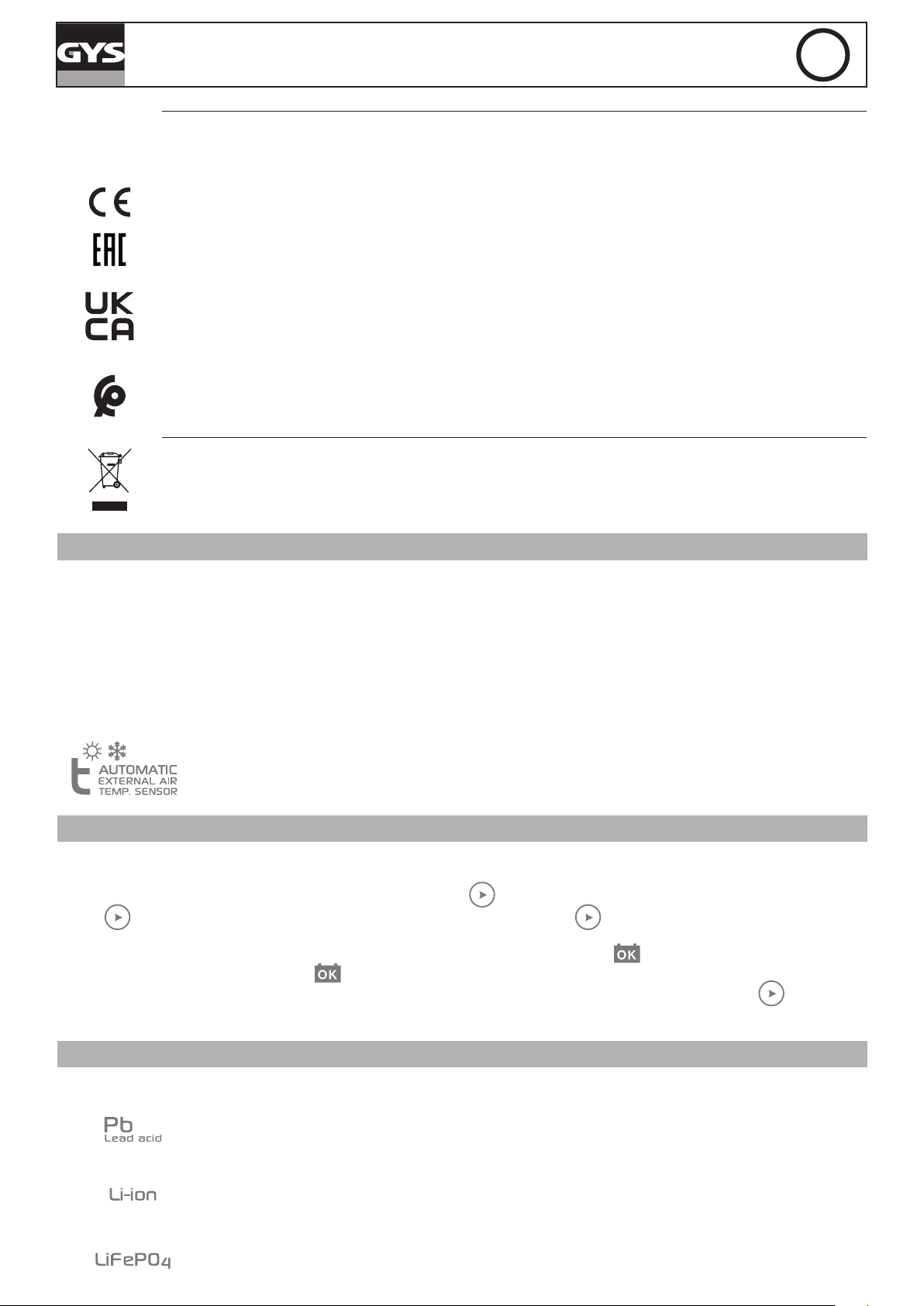
• Appareil conforme aux directives européennes.
• La déclaration de conformité est disponible sur notre site
internet.
• Marque de conformité EAC (Communauté économique
Eurasienne)
• Matériel conforme aux exigences britanniques. La
déclaration de conformité britannique est disponible sur notre
site (voir à la page de couverture).
• Matériel conforme aux normes Marocaines.
• La déclaration Cم (CMIM) de conformité est disponible sur
notre site (voir à la page de couverture).
Mise au rebut :
• Ce matériel fait l’objet d’une collecte sélective. Ne pas jeter
dans une poubelle domestique.
DESCRIPTION GÉNÉRALE
Le GYSFLASH 6.24 PL est idéal pour recharger la plupart des batteries au plomb (Gel, AGM, Liquide, …) et lithium de type Lithium Fer
Phosphate (LFP / LiFePO4) et de type lithium-ion « standard » tels que le Nickel Manganèse Cobalt (NMC), le Lithium nickel cobalt
aluminium oxyde (NCA), le Lithium Cobalt Oxyde (LCO), le Lithium Polymère (Li-Po), le Lithium Manganèse Cobalt Oxyde (MCO), etc.
Ce chargeur est parfaitement adapté pour :
- La recharge de batteries plomb 24 V (12 éléments en série de 2 V) de 15 Ah à 125 Ah, et jusqu’à 170 Ah pour du maintien de charge.
- La recharge de batteries LFP 24 V (8 éléments en série de 3.7 V) de 2 Ah à 125 Ah, et jusqu’à 170 Ah pour du maintien de charge.
- La recharge de batteries Lithium-ion 24 V (7 éléments en série de 4.2 V) de 2 Ah à 125 Ah, et jusqu’à 170 Ah pour du maintien de
charge.
Le GYSFLASH 6.24 PL est équipé d’une fonction qui, lors d’une charge de batterie au plomb, adapte
automatiquement la tension de sortie en fonction de la température de l’air ambiante. Cet ajustement
permet d’avoir une recharge de batterie au plomb très précise adaptée à la température ambiante.
MISE EN ROUTE
1. Brancher le chargeur sur la batterie avec l’accessoire souhaité (pinces, cosses, etc).
2. Brancher le chargeur sur la prise secteur (réseau monophasé 220-240 Vac 50-60Hz).
3. Déverrouiller le chargeur en appuyant 3 secondes sur le bouton
bouton
lance automatiquement.
4. Durant la charge, l’appareil indique l’état d’avancement de la charge. Lorsque le voyant
démarrer un moteur. Et lorsque le voyant
5. La charge peut être interrompue à tout moment en débranchant la prise secteur ou en appuyant sur le bouton
6. Après l’opération de charge, débrancher le chargeur du réseau puis retirer les connexions de la batterie.
. Verrouiller le mode en appuyant de nouveau 3 secondes sur le bouton . Après environ cinq secondes, la charge se
reste allumé, la batterie est entièrement chargée.
. Sélectionner le mode en appuyant de nouveau sur le
clignote, la batterie est prête à
.
MODES DE CHARGE
• Description des Modes et des Options :
Mode CHARGE Plomb (29.2 V/6 A) :
Mode destiné à la charge de batteries 24 V au plomb de 15 Ah à 125 Ah et jusqu’à 170 Ah pour du maintien
de charge. Cycle de charge automatique sept étapes.
Mode CHARGE Lithium-ion (NMC, NCA, Li-Po, LCO, MCO, …) (29.4 V/6 A) :
Mode destiné à la charge de batteries 24 V Li-ion standard de 2 Ah à 125 Ah et jusqu’à 170 Ah pour du
maintien de charge. Cycle de charge automatique en huit étapes.
Mode CHARGE Lithium Fer Phosphate (28.8 V/6 A) :
Mode destiné à la charge de batteries 24 V LiFePO4 de 2 Ah à 125 Ah et jusqu’à 170 Ah pour du maintien
4
de charge. Cycle de charge automatique en huit étapes.
Page 5
GYSFLASH 6.24 PL
Led
FR
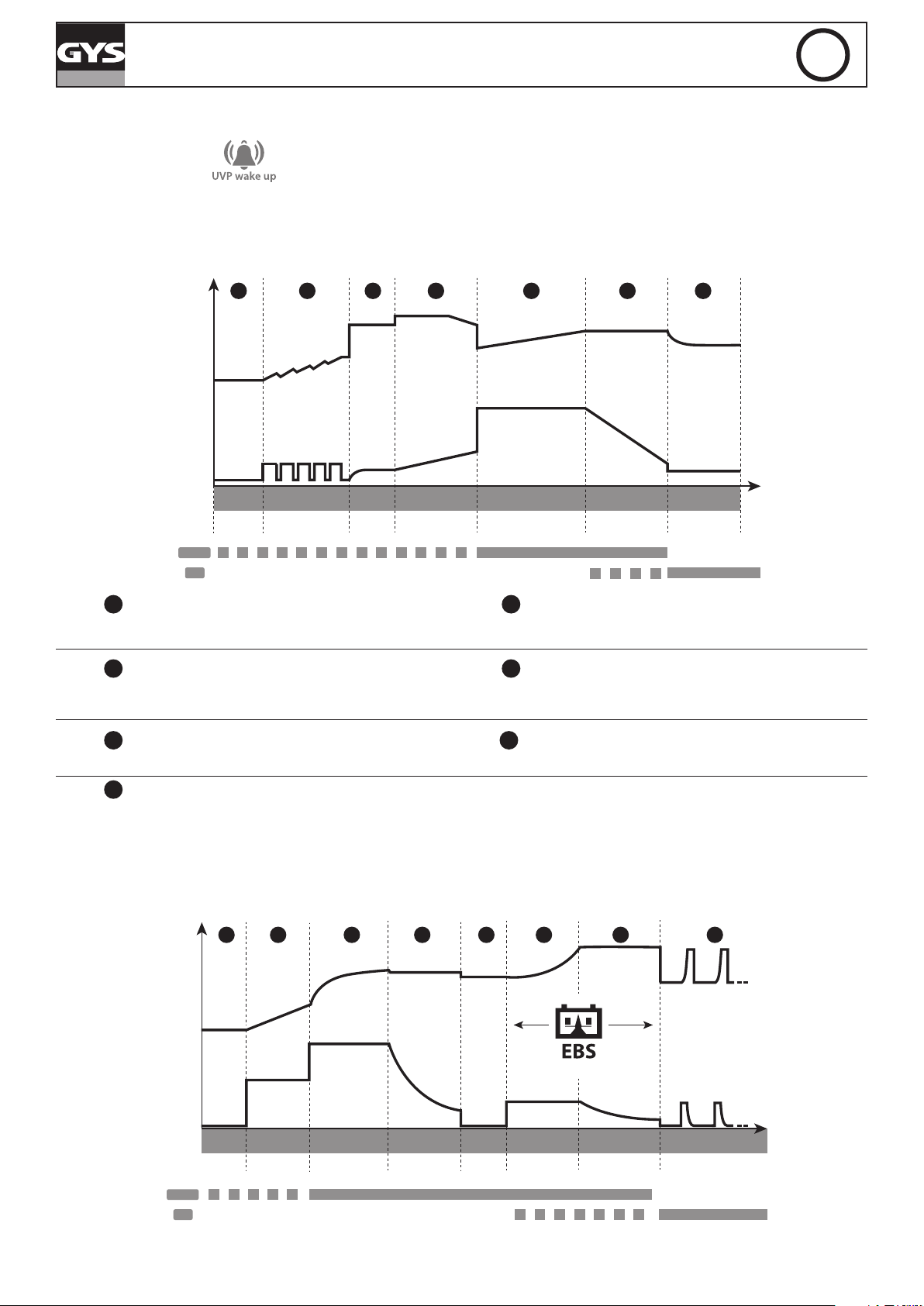
Option UVP Wake UP :
Certaines batteries lithium intègrent une protection UVP (Under Voltage Protection) qui déconnecte la batterie en cas de décharge profonde. Cette protection empêche le chargeur de
détecter la batterie. Pour que le GYSFLASH 6.24 PL puisse charger la batterie, selectionner
cette option pour désactiver la protection UVP de la batterie an de commencer la charge.
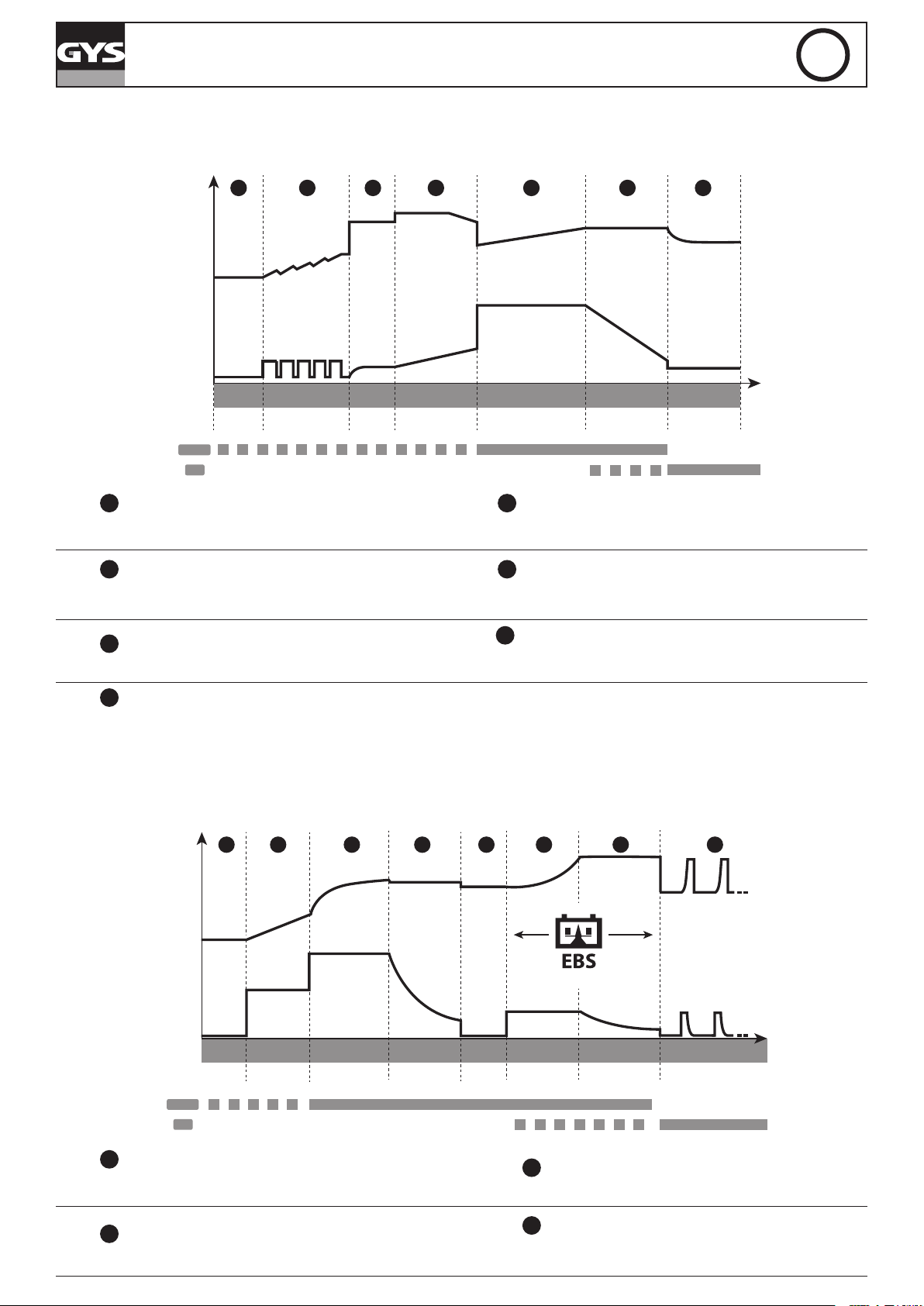
• Courbe de charge Plomb :
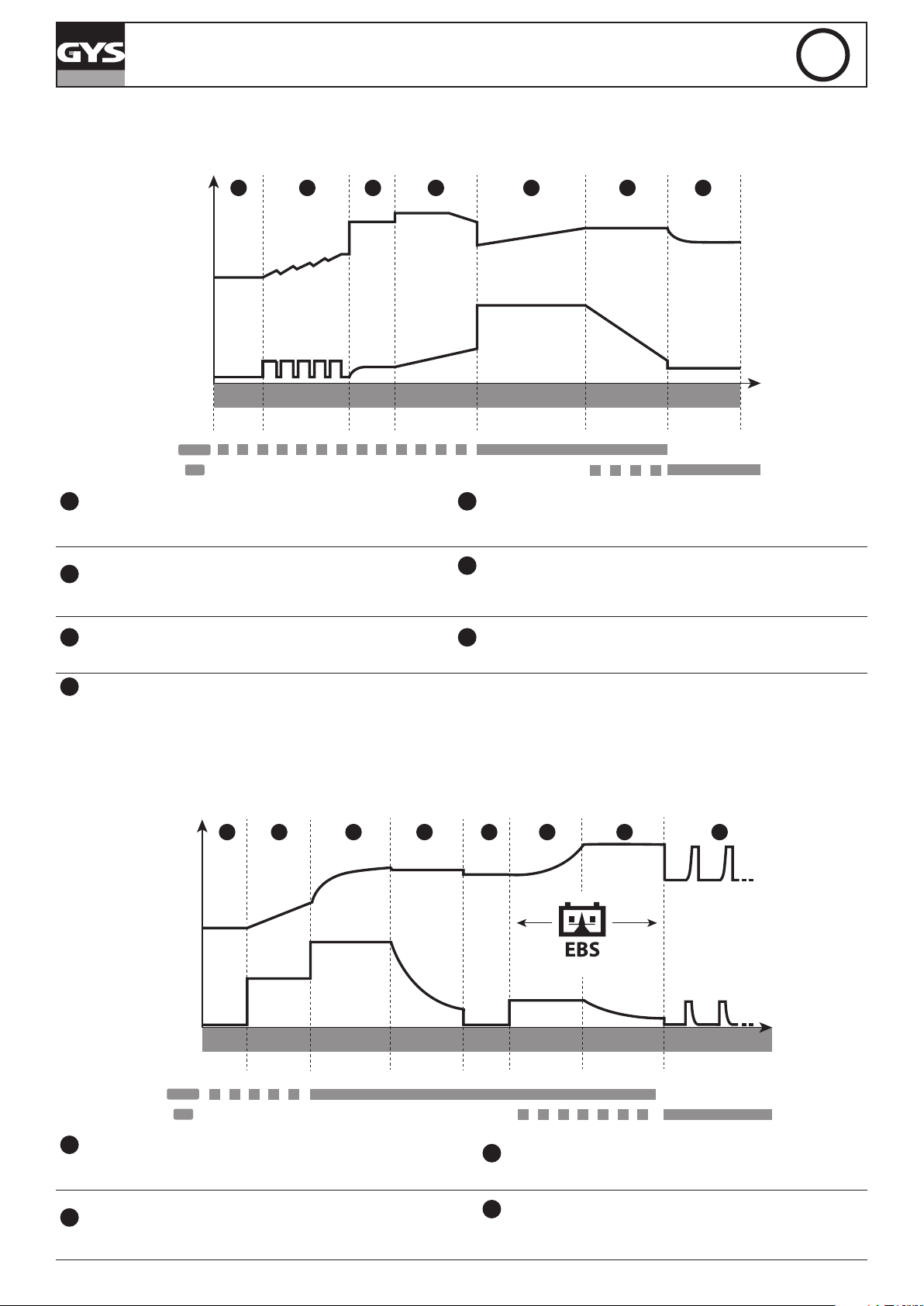
Le GYSFLASH 6.24 PL utilise une courbe de charge Plomb évoluée en 7 étapes qui garantit les performances optimales de votre
batterie au plomb.
1 2 3 4 5 6 7
U
I
Analyse Récupération Test Désulfatation Charge Absorption
<1s
CHARGE
OK
Voyan t
Étape
1
: Analyse
Analyse de l’état de la batterie (niveau de charge,
inversion de polarité, mauvaise batterie connectée…)
2
Étape
: Récupération (3 A)
Algorithme de récupération des éléments endommagés
suite à une décharge profonde.
3
Étape
: Test
Test de batterie sulfatée
Étape
4
: Désulfatation (31.6 V)
Max 12h<1s Max 8h
Max 20h
Max 8h No limit
Étape 5 : Charge (6 A)
Charge rapide à courant maximum permettant d’atteindre 80%
du niveau de charge.
Étape 6 : Absorption (29.2 V)
Charge à tension constante pour amener le niveau de charge à
100%.
Étape 7 : Maintien de charge (27.2 V)
Maintien du niveau de charge de la batterie à son maximum.
Maintien de
charge
Algorithme de désulfatation de la batterie.
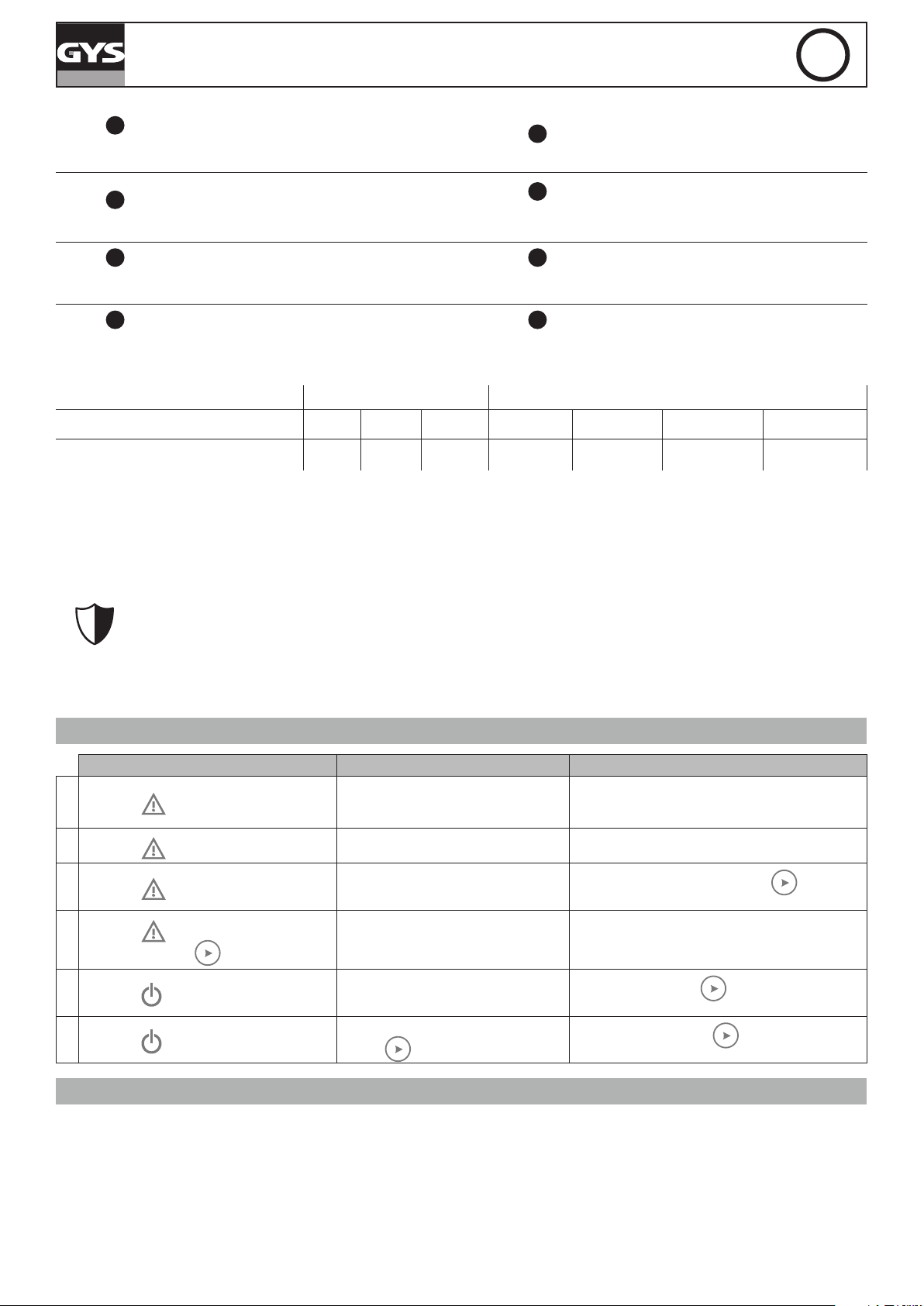
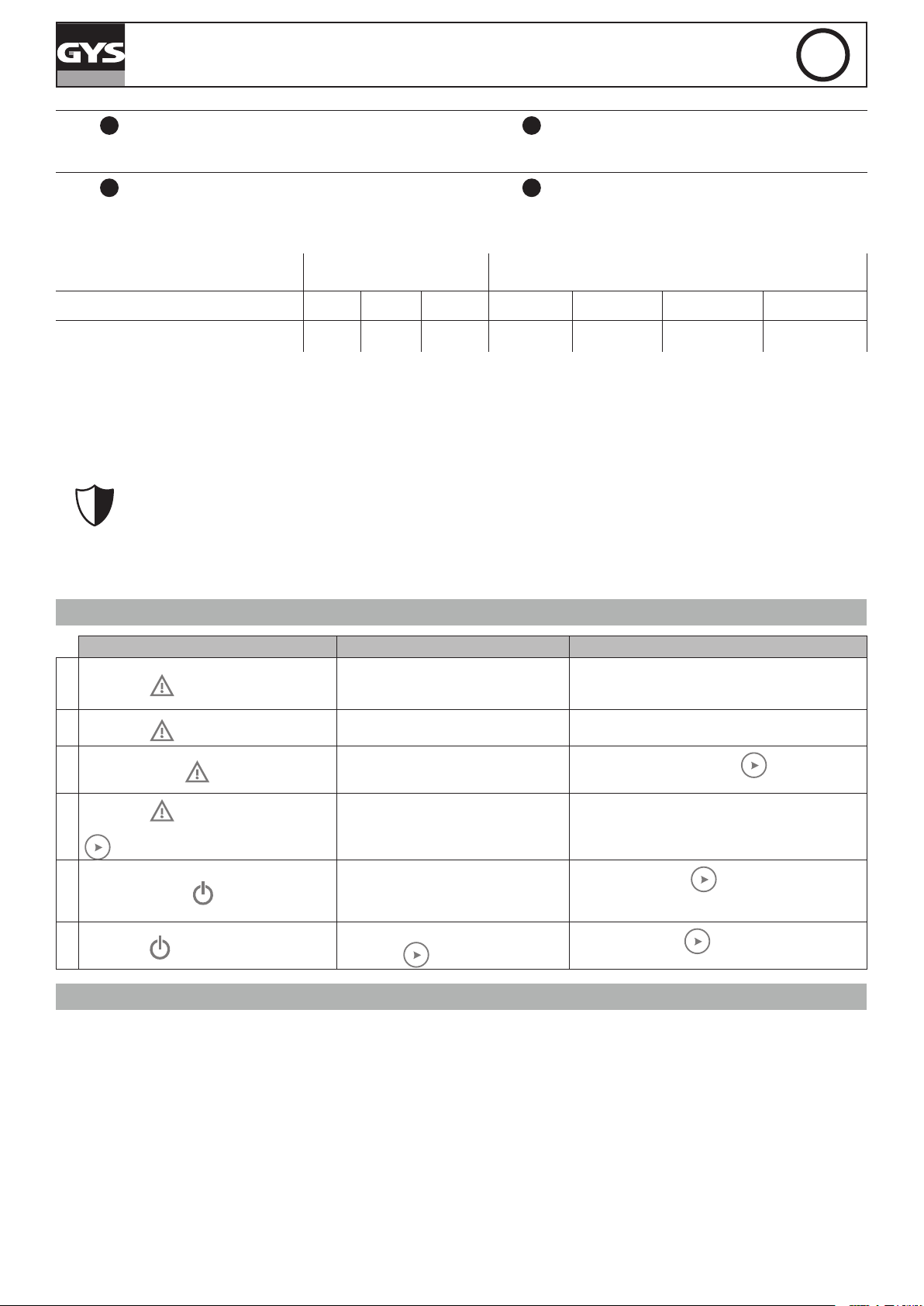
• Courbe de charge Lithium :
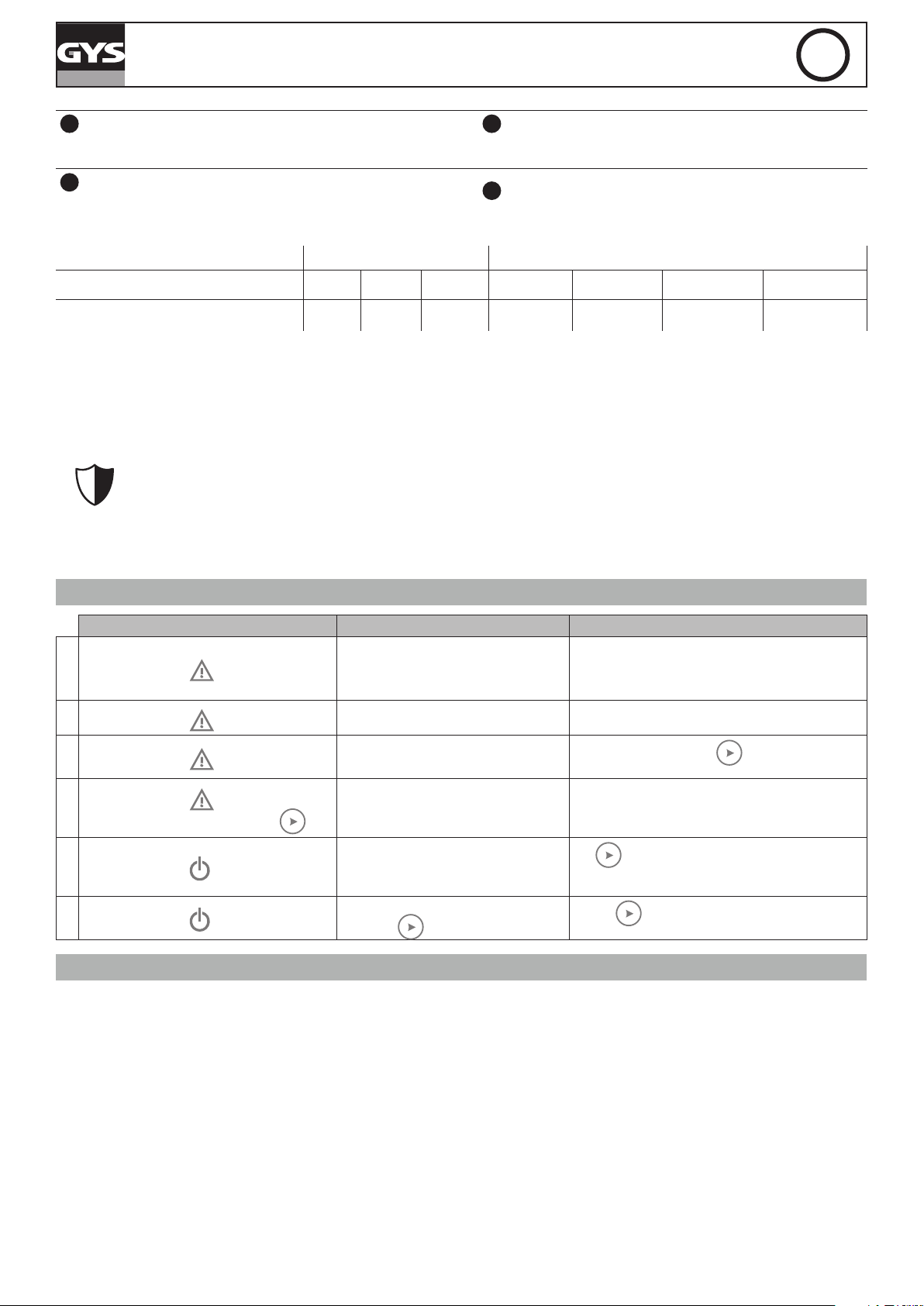
Le GYSFLASH 6.24 PL utilise une courbe de charge Lithium évoluée en 8 étapes qui garantit les performances optimales de votre
batterie lithium.
1 2 3 4 5 6 7
8
U
Equalizing Battery System
I
Analyse Récupération Charge Absorption Complément
< 1s Max 5 min Max 25 h Max 20 h 3 min Max 10 h Max 2 h No limit
CHARGE
OK
Test
Egalisation /
équilibrage
Maintien de
charge
(maintenance tous les 10 jours)
5
Page 6
GYSFLASH 6.24 PL
FR
Étape
Analyse de l’état de la batterie (niveau de charge, inversion de
polarité, mauvaise batterie connectée…)
Étape
Algorithme de récupération suite à une décharge profonde.
Étape
Charge rapide à courant maximum permettant d’atteindre 90%
1
: Analyse
2
: Récupération (0.5 A)
3
: Charge (6 A)
Étape 5 : Test
Test de conservation de charge.
Étape 6 : Complément
Charge à courant réduit permettant d’atteindre 100% du
niveau de charge.
Étape 7 : Égalisation / équilibrage (29.4 V ou 28.8 V)
Équilibrage des cellules de la batterie
du niveau de charge.
4
Étape
: Absorption (27.6 V ou 28.7 V)
Charge à tension constante pour amener le niveau de charge à
98%.
• Temps de charge estimé
Capacité de la batterie 20 Ah 50 Ah 125 Ah
Temps de charge
0% >> 90%
2 h 5 h 13 h 1 h 2 h 5 h 13 h
Plomb Lithium
Étape 8 : Maintien de charge (27.6 ou 28.7 V)
Maintien du niveau de charge de la batterie à son maximum
avec charge de maintenance tous les 10 jours.
6 Ah
(18 Ah EqPb*)
15 Ah
(45 Ah EqPb*)
50 Ah
(150 Ah EqPb*)
125 Ah
(350 Ah EqPb*)
*Équivalent batterie plomb : Une batterie lithium possède de meilleures performances de démarrage (CCA) qu’une batterie au
plomb. C’est pourquoi certains fabricants de batteries au lithium indiquent l’équivalent batterie plomb (EqPb) qui correspond à la
capacité qu’aurait une batterie au plomb ayant les mêmes performances de démarrage. Par exemple, une batterie LFP de 10 Ah
aura les mêmes performances de démarrage qu’une batterie au plomb d’environ 30 Ah.
• Protections :
Le GYSFLASH 6.24 PL possède un ensemble de dispositifs le protégeant contre les courts circuits et inversion de
polarité. Il dispose d’un système qui évite toute étincelle lors du branchement du chargeur sur la batterie. Ce chargeur est à double isolation et est compatible avec l’électronique des véhicules.
Le GYSFLASH 6.24 PL est équipé d’un capteur de température intégré qui lui permet d’adapter son courant de charge en
fonction de la température ambiante an d’éviter toute surchaue de l’électronique interne.
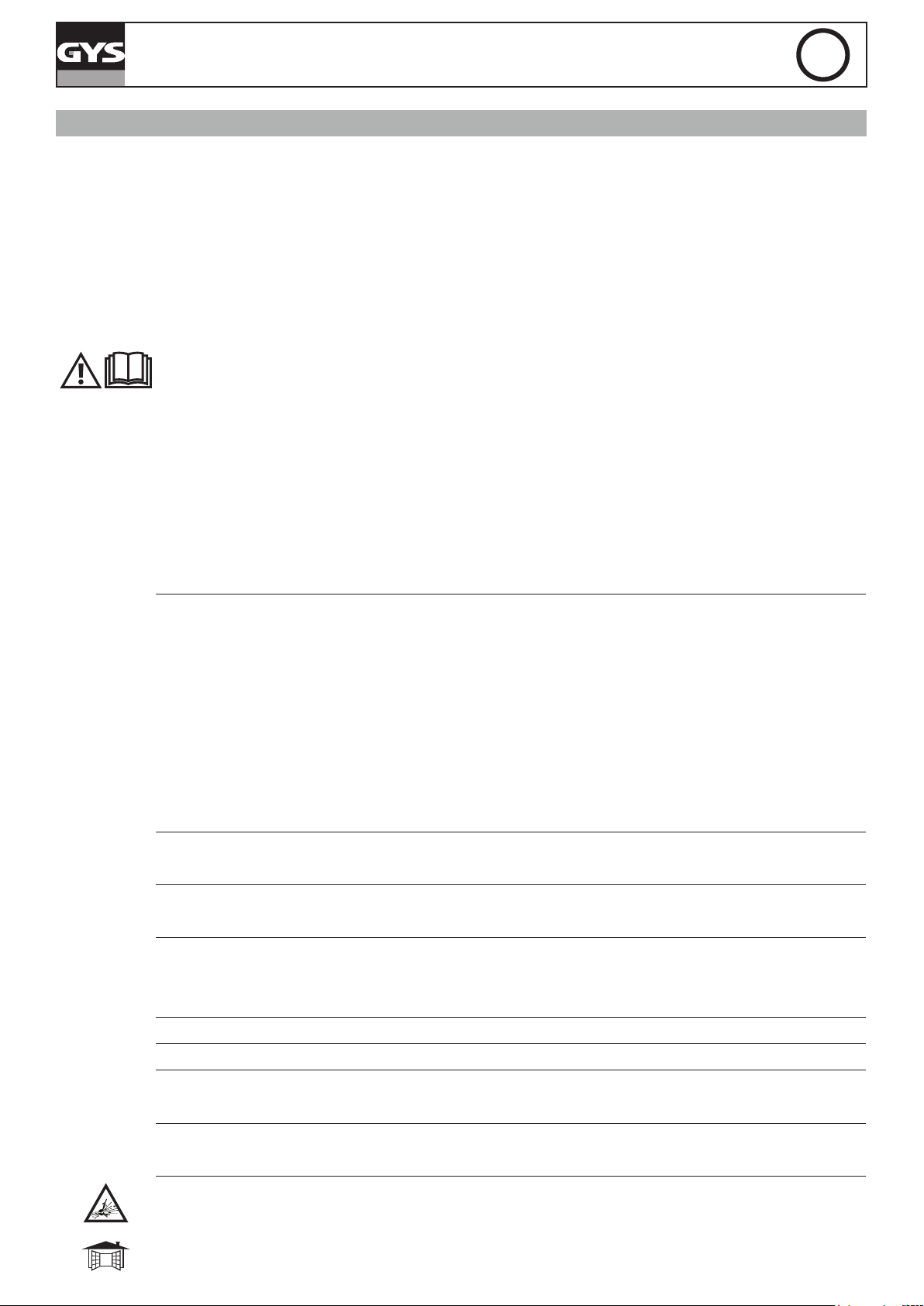
ANOMALIES, CAUSES, REMÈDES
Anomalies Causes Remèdes
1
Le voyant
2
Le voyant
3
Le voyant
Le voyant
4
appui sur le bouton
5
Le voyant
6
Le voyant
clignote rapidement.
clignote lentement.
est allumé.
reste allumé même après un
.
clignote.
reste allumé.
• Inversion de polarité
• Tension batterie trop élevée
• Pinces en court-circuit
Batterie HS ou de très faible tension. Changer la batterie.
Échec lors de la charge, batterie non
récupérable.
Défaut thermique
Chargeur en veille.
Charge interrompue en appuyant sur le
bouton
.
• Vérier que les pinces sont correctement connectées
• Vérier qu’il s’agit bien d’une batterie 24 V.
Changer de batterie et appuyer sur
relancer une charge.
Température environnante trop élevée (>60°C),
aérer le local et laisser le chargeur se refroidir
Appuyer sur le bouton
terie au chargeur pour sortir de la veille.
Appuyer de nouveau sur
charge.
ou connecter une bat-
pour relancer la
pour
CONDITIONS DE GARANTIE
La garantie couvre tous défauts ou vices de fabrication pendant 2 ans, à compter de la date d’achat (pièces et main d’œuvre).
La garantie ne couvre pas :
• Toutes autres avaries dues au transport.
• L’usure normale des pièces (Ex. : câbles, pinces, etc.).
• Les incidents dus à un mauvais usage (erreur d’alimentation, chute, démontage).
• Les pannes liées à l’environnement (pollution, rouille, poussière).
En cas de panne, retourner l’appareil à votre distributeur, en y joignant :
- un justicatif d’achat daté (ticket de sortie de caisse, facture….)
- une note explicative de la panne.
6
Page 7
SAFETY INSTRUCTIONS
This manual contains safety and operating instructions, to be
followed for your safety. Please read it carefully before using
the device for the rst time and keep it for future reference.
Read and understand the following safety instructions before
use. Any modication or update that is not specied in the
instructions manual should not be undertaken. The manufacturer
is not liable for any injury or damage due to non-compliance
with the instructions featured in this manual. If there is any issue
or uncertainty, please consult a qualied individual to operate
the equipment correctly. This machine should only be used for
charging operations specied within the limits indicated on
the machine and in the instruction manual. The operator must
follow the safety instructions. In case of improper or unsafe
use, the manufacturer cannot be held liable.
GYSFLASH 6.24 PL
EN
This unit can be used by children aged 8 or over and by people
with reduced physical, sensory or mental capabilities or lack
of experience or knowledge, if they are properly monitored or
if instructions for using the equipment have safely been read
and potential risks understood. Children must not play with the
product. Cleaning and maintenance should not be performed
by an unsupervised child.
Under no circumstances should it be used to charge domestic
batteries or non-rechargeable batteries.
Do not use the charger if the mains cable or plug is damaged.
Do not use the device if the charging cable appears to be
damaged or assembled incorrectly in order to avoid any risk
of short circuiting the battery.
Never use on a frozen or damaged battery.
Do not cover the device.
Do not place the unit near a heat source/direct sunlight and
durably high temperatures (above 50 ° C).
The operating mode of the automatic charger and the restrictions
applicable to its use are explained later in this manual.
Fire and explosion risks!
A battery can release explosive gases when on charge.
• During the charge, the battery must be placed in a well
ventilated area.
• Avoid ames and sparks. Do not smoke near the device.
• Protect the electrical contact surfaces of the battery against
short circuits.
Risk of acid dispersion!
7
Page 8
GYSFLASH 6.24 PL
EN
• Wear protective goggles and gloves.
• In case of contact with the eyes or the skin, rinse immediately
with water and see a medical doctor as soon as possible.
Do not leave a charging battery unattended for a long time.
Connection / disconnection :
• Ensure that the charger is not connected to the mains before
connecting or disconnecting clamps to the battery terminals.
• Always ensure the red clamp is connected to the «+» battery
terminal rst. If it is necessary to connect the black clamp to
the vehicle chassis, make sure it is a safe distance from the
battery and the fuel line. The charger must then be plugged
into the mains.
• After charging, disconnect the charger from the mains, then
disconnect the negative clamp from the body of the car and
then disconnect the positive clamp from the battery, in this
order.
Connection :
• Class II device
• The connection to the power supply must be carried out in
compliance with national standards.
Maintenance:
• If the power cable is damaged, it must be replaced by the
manufacturer, its after sales or by an equally qualied person
to prevent any accidents.
• Maintenance should only be carried out by a qualied
person.
• Warning ! Always disconnect from the mains before
performing maintenance on the device.
• The device does not require any specic maintenance.
• If the internal fuse is melted, it must be replaced by the
manufacturer (GYS dedicated after sales service) or by an
equally qualied person to prevent any accidents.
• Do not use solvents or any agressive cleaning products.
• Clean the device surfaces with a dry cloth.
Regulations :
• The Machine is compliant with European directives.
• The declaration of conformity is available on our website.
• EAEC Conformity marking (Eurasian Economic Community).
• Equipment in compliance with British requirements. The
British Declaration of Conformity is available on our website
8
(see home page).
Page 9
GYSFLASH 6.24 PL
EN
• Equipment in conformity with Moroccan standards.
• The declaration Cم (CMIM) of conformity is available on
our website (see cover page).
Waste management:
• This product should be disposed of at an appropriate
recycling facility. Do not throw away in a household bin.
GENERAL DESCRIPTION
GYSash 6.24 PL is ideal for charging most lead-acid (Gel, AGM, Liquid,...) and lithium batteries of the Lithium Iron Phosphate (LFP
/ LiFePO4) and «standard» lithium-ion types such as Nickel Manganese Cobalt (NMC), Lithium nickel cobalt aluminium oxide (NCA),
Lithium Cobalt Oxide (LCO), Lithium Polymer (Li-Po), Lithium Manganese Cobalt Oxide (MCO), etc.
This charger is suited for the charge of:
- Lead-acid batteries 24 V (12 elements in series of 2V) from 15 Ah to 125 Ah, and up to 170 Ah for charge support.
- The charge 24 V LFP batteries (8 cells in series of 3.7V) from 2 Ah to 125 Ah, and up to 170 Ah for charge support.
- The charge 24 V Lithium-ion batteries (7 cells in series of 4.2V) from 2 Ah to 125 Ah, and up to 170 Ah for charge support.
The GYSFLASH 6.24 PL is equipped with an integrated temperature sensor that ensures that the charging
current is adapted to the ambient temperature for an optimal charging performance. This adjustment
ensures a highly precise charge, relative to the temperature of the room.
START UP
1. Connect the charger to the battery using the proper accessory (clamps, lugs, etc...).
2. Plug the charger to the mains (single phase 220-240Vac 50-60Hz).
3. Unlock the charger by pressing button
pressing button
4. During the charge, the device indicates charge progress. When the indicator light
engine. When indicator
5. The charge can be interrupted at any time by unplugging the mains plug or pressing the
6. After the charge, disconnect the charger from the mains, then disconnect the clamps from the battery.
CHARGE MODES
• Modes and Options description :
again for 3 seconds. After roughly ve seconds, the charge starts automatically.
is steady, the battery is fully charged.
Lead CHARGE mode (29.2 V/6 A) :
Mode designed to charge 24 V lead-acid batteries from 15 Ah to 125 Ah and up to 170 Ah for charge
maintenance. Automatic seven step charge cycle.
Lithium-ion CHARGE mode (NMC, NCA, Li-Po, LCO, MCO, …) (29.4 V/6 A) :
Mode designed to charge standard 24 V Li-ion batteries from 2 Ah to 125 Ah and up to 170 Ah for maintenance charge. 8 step automatic maintenance charge cycle.
Lithium Iron Phosphate Charging Mode (28.8 V/6 A) :
Mode designed to charge 24 V LiFePO4 batteries from 2 Ah to 125 Ah and up to 170 Ah for charge maintenance. 8 step automatic maintenance charge cycle.
for 3 seconds. Select the mode by pressing button again. Lock the mode by
ashes, the battery is ready to start an
button.
UVP Wake UP option :
Some lithium batteries include an UVP (Under Voltage Protection) protection that disconnects
the battery in case of deep discharge. This protection prevents the charger from detecting
the battery. In order for the Gysash 6.24 PL to charge the battery, select this option to
disable the UVP protection of the battery in order to start charging.
9
Page 10
GYSFLASH 6.24 PL
Led
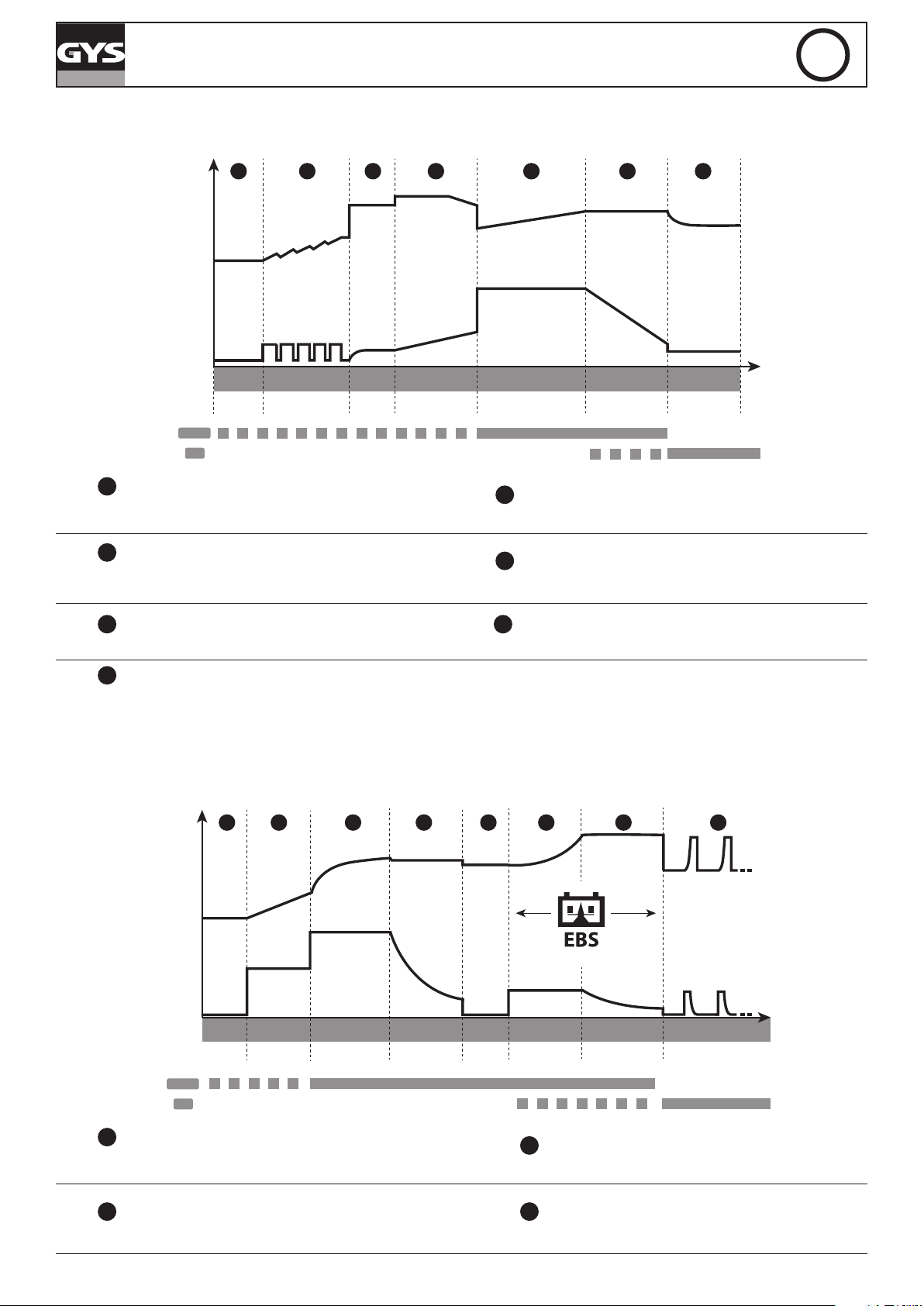
• Load curve Lead:
The GYSash 6.24 PL uses a 7-step lead charging curve that guarantees the optimal performance of your lead battery.
1 2 3 4 5 6 7
U
I
EN
Analysis Recovery Test Desulfation Charge Absorption
Max 12h<1s Max 8h
Step
1
: Analysis
CHARGE
Led
<1s
OK
Analysis of the battery condition (charge level,polarity reversal, incorrect battery connected...)
2
Step
: Recovery (3 A)
Recovering damaged elements due to a prolonged deep
discharge.
3
Step
: Test
Sulfated battery test
4
Step
: Desulfation (31.6 V)
Step
Max 20h
5
: Charge (6 A)
Max 8h No limit
Maximum current fast charge to reach an 80% charge level.
Step 6 : Absorption (29.2 V)
Constant voltage charge to reach 100% charge level.
Step 7 : Load retention (27.2 V)
Maintain the battery charge level at its maximum.
Load retention
Battery desulfation algorithm.
• Lithium charging curve :
The GYSash 6.24 PL uses an advanced 8-step Lithium charging curve that guarantees the optimal performance of your lithium
battery.
1 2 3 4 5 6 7
8
U
Equalizing Battery System
I
Analysis Recovery Charging Absorption Complement
< 1s Max 5 min Max 25 h Max 20 h 3 min M ax 10 h Max 2 h No limit
CHARGE
OK
1
Step
: Analysis
Analyses the state of the battery (charge level, polarity inversion,
wrong battery…)
2
Step
: Recovery (0.5 A)
Recovery algorithm following a deep discharge.
10
Test
Step 5 : Test
Charge hold test.
Step 6 : Complement
Reduce current charge to reach 100% charge level.
Equalization /
balancing
Charge retention
(maintenance every 10 days)
Page 11
GYSFLASH 6.24 PL
3
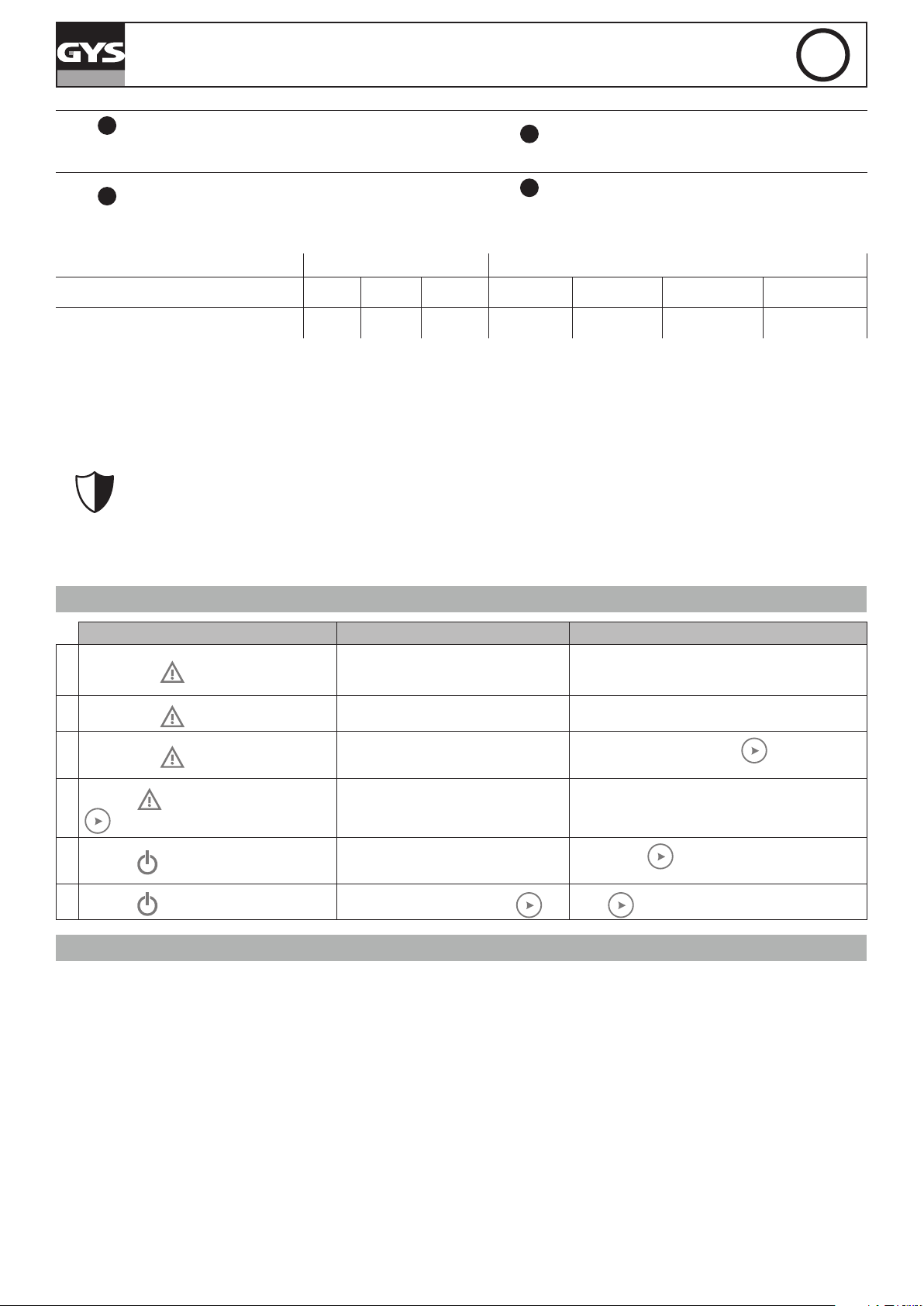
Step
Fast charging at maximum current allowing to reach 90% of the
charge level.
: Charging (6 A)
EN
Step 7 : Equalization / balancing (29.4 V or 28.8 V)
Balancing the battery cells
4
Step
: Absorption (27.6 V or 28.7 V)
Constant voltage charge to reach 98% charge level.
• Estimated charge time
Battery capacity 20 Ah 50 Ah 125 Ah
Charging time
0% >> 90%
Lead-acid Lithium
2 h 5 h 13 h 1 h 2 h 5 h 13 h
Step 8 : Charge retention (27.6 V or 28.7 V)
Maintain the battery charge level at its maximum with maintenance charging every 10 days.
6 Ah
(18 Ah EqPb*)
15 Ah
(45 Ah EqPb*)
50 Ah
(150 Ah EqPb*)
125 Ah
(350 Ah EqPb*)
*Lead battery equivalent: A lithium battery has better starting performance (CCA) than a lead battery. This is why some lithium
battery manufacturers indicate the battery lead-acid equivalent (EqPb) that indicates the capacity of a lead-acid battery with the
same starting performance. For instance, a LFP battery of 10 Ah will have the same starting performance as a lead-acid battery of
around 30 Ah.
• Protections :
The GYSFLASH 6.24 PL has comprehensive safety features to protect it against short-circuits and polarity reversals.
It has an anti-spark feature which prevents sparks whilst connecting the device to the battery. This charger has
double insulation and is safe to use with the battery in situ as it will protect the vehicle’s on-board electronics.
The GYSFLASH 6.24 PL is tted with an integrated temperature sensor that ensures that the charging current is adapted to the
ambient temperature to prevent internal the electronics from overheating.
TROUBLESHOOTING, CAUSES, SOLUTIONS
Troubleshooting Causes Solutions
1
The indicator
blinks rapidly.
• Polarity reversal
• Battery voltage is too high
• Clamps in short-circuit
• Check that the clamps are correctly connected
• Check that it is a 24 V battery.
2
The indicator
3
The indicator
Indicator
4
5
Indicator
6
Indicator
blinks slowly.
is on.
stays on even after pressing
button.
ashes.
stays on.
Battery out of order or very low voltage. Change the battery.
Failure during charging, battery not
recoverable.
Thermal protection
Charger in sleep mode.
Charge interrupted by pressing
Change the battery and press
charge.
Ambient temperature is too high (>60°C), cool the
room and let the charger cool down.
Press button
ger to exit sleep mode.
. Press again to restart the charge.
WARRANTY
The warranty covers faulty workmanship for 2 years from the date of purchase (parts and labour).
The warranty does not cover:
• Transit damage.
• Normal wear of parts (eg. : cables, clamps, etc..).
• Damages due to misuse (power supply error, dropping of equipment, disassembling).
• Environment related failures (pollution, rust, dust).
In case of failure, return the unit to your distributor together with:
- The proof of purchase (receipt etc ...)
- A description of the fault reported
to restart a
or connect a battery to the char-
11
Page 12
SICHERHEITSHINWEISE
Diese B etriebsanl eitung enth ält Sicherh eits- un d Betrie bshinweise.
Bitte lesen Sie diese Anleitung aufmerksam durch, bevor Sie
das Gerät zum ersten Mal benutzen und bewahren Sie diese
sorgfältig auf. Lesen Sie diese Anleitung vor Inbetriebnahme des
Gerätes sorgfältig durch. Nehmen Sie keine Wartungsarbeiten
oder Veränderungen am Gerät vor, die nicht in der Anleitung
erwähnt werden. Im Fall einer unangemessenen oder
gefährlichen Verwendung kann der Hersteller nicht haftbar
gemacht werden. Bei Problemen oder Fragen zum korrekten
Einsatz dieses Gerätes, wenden Sie sich bitte an entsprechend
qualiziertes und geschultes Fachpersonal. Dieses Gerät
darf nur zum Auaden innerhalb der auf dem Gerät und der
Anleitung angegebenen Grenzen verwendet werden. Die
Sicherheitshinweise müssen in jedem Fall beachtet werden.
Im Fall einer unangemessenen oder gefährlichen Verwendung
kann der Hersteller nicht haftbar gemacht werden.
GYSFLASH 6.24 PL
DE
Dieses Gerät kann von Personen ab 8 Jahren, und von
Personen mit eingeschränkten physischen, sensorischen oder
geistigen Fähigkeiten sowie von Personen ohne Erfahrungen
oder Kenntnissen benutzt werden, wenn sie durch eine für ihre
Sicherheit verantwortliche Person beaufsichtigt oder bezüglich
des Gebrauchs des Gerätes angeleitet werden. Das Gerät ist
kein Spielzeug! Die Reinigung und Wartung darf nicht von
unbeaufsichtigten Kindern durchgeführt werden.
Laden Sie nie defekte oder nicht auadbare Batterien.
Benutzen Sie das Gerät nicht, wenn der Stecker, die Klemmen
oder das Zubehör defekt ist.
Wenn das Ladekabel beschädigt ist oder ein Verbindungsfehler
auftritt, bitte das Gerät nicht benutzen, um jeglichen Kurzschluss
der Batterie zu vermeiden.
Laden Sie NIE eine eingefrorene oder beschädigte Batterie auf!
Decken Sie das Gerät während der Nutzung nicht ab.
Lagern Sie das Gerät nicht in der Nähe einer Wärmequelle
oder bei dauerhaft hohen Temperaturen (über 60°C).
12
Der Automatik-Modus sowie die Einschränkungen bei der
Benutzung werden nachfolgend in der Betriebsanleitung erklärt.
Explosions- und Brandgefahr!
Während des Ladevorgangs können explosive Gase entstehen.
• Während des Ladevorgangs muss die Batterie in einem gut
belüfteten Bereich plaziert werden.
• Vermeiden Sie Funken und Flammen. Rauchen Sie nicht!
• Schützen Sie die elektrischen Kontaktächen der Batterie
gegen Kurzschlüsse.
Page 13
GYSFLASH 6.24 PL
DE
Gefahr von Säurespritzern!
• Tragen Sie Schutzbrille und Handschuhe
• Bei Kontakt der Batteriesäure mit den Augen oder der Haut
sofort gründlich mit Wasser nachspülen und Arzt konsultieren.
Lassen Sie nicht den Akku während des Ladevorganges ohne
Überwachung für eine längere Zeitspanne.
Verbinden/Trennen:
• Trennen Sie das Gerät vom Spannungsnetz bevor Sie Kabel
und Klemmen anschließen oder trennen.
• Versichern Sie sich immer, dass die rote Klemme zuerst
mit dem «+» Pol der Batterie verbunden wird. Verbinden
Sie die schwarze Klemme mit einem Massepunkt an der
Fahrzeugkarosserie möglichst weit weg von Benzintank/
Auspuff. Achten Sie während der Ladung auf einen frei
zugänglichen Netzanschluss.
• Beachten Sie am Ende des Ladevorgangs folgendes: Trennen
Sie erst das Gerät vom Spannungsnetz und entfernen Sie dann
erst die Klemmen von der Batterie.
Anschluss:
• Klasse II-Gerät
• Der Anschluss an die Spannungsversorgung muss den
nationalen Vorschriften entsprechen.
Wartung:
• Ist das Ladegerät und/oder die Kabel defekt/beschädigt,
geben Sie das Ladegerät zur Reparatur zum Hersteller bzw.
an einen geeigneten Fachbetrieb.
• Die Wartung darf nur von einer qualizierten Person
vorgenommen werden.
• Achtung! Immer den Netstecker ziehen, bevor sie Arbeiten
am Gerät durchführen.
• Für das Gerät ist keine besondere Wartung erforderlich.
• Ist die interne Sicherung geschmolzen, dann muss sie
durch den Hersteller bzw. den Kundendienst oder einen
geeigneten Fachbetrieb ersetzt werden, um jegliche Gefahr
zu vermeiden.
• Benutzen Sie nie Lösungsmittel oder andere aggressive
Putzmittel.
• Wischen Sie das Geräte mit einem trockenen Tuch ab.
Richtlinien:
• Das Gerät entspricht den europäischen Richtlinien und
Normen.
• Die Konformitätserklärung nden Sie auf unsere Webseite.
13
Page 14
GYSFLASH 6.24 PL
DE
• EAC-Konformitätszeichen (Eurasische
Wirtschaftsgemeinschaft)
• Das Gerät entspricht den britischen Richtlinien und
Normen. Die Konformitätserklärung für Grossbritannien ist auf
unserer Internetseite verfügbar (siehe Titelseite).
• Das Gerät entspricht die marokkanischen Standards.
• Die Konformitätserklärung Cم (CMIM) ist auf unserer
Webseite verfügbar (siehe Titelseite).
Entsorgung:
• Produkt für getrennte Entsorgung (Elektroschrott). Werfen
Sie es daher nicht in die Mülltonne! Entsorgen Sie das Gerät
über Ihre kommunale Sammelstelle für Elektro-Altgeräte!
PRODUKTBESCHREIBUNG
Das GYSFLASH 6.24 PL ist zum Auaden der meisten Blei- (Gel, AGM, nass…) und Lithiumbatterien bzw. Lithium-Eisen-Phosphat-
Batterien (LFP / LiFePO4) und «standardmäßigen» Li-ion-Batterie bzw. Nickel-Mangan-Kobalt (NMC), Lithium-Nickel-Kobalt-Aluminium-Oxid (NCA), Lithium-Kobalt-Oxid (LCO), Lithium-Polymer (Li-Po), Lithium-Mangan-Kobalt-Oxid-Batterien (MCO), usw. geeignet.
Dieses Ladegerät eignet sich zum Laden folgender Batterien:
- 24V Blei-Säure-Batterien (12 2V Elemente in Reihe) von 15Ah bis 125Ah, und bis 170Ah zur Ladungserhaltung.
- 24V Lithium-Eisen-Phosphat-Batterien (8 3,7V Elemente in Reihe) von 2Ah bis 125Ah, und bis 170Ah zur Ladungserhaltung.
- 24V Lithium-Ion-Batterien (7 4,2V Elemente in Reihe) von 2Ah bis 125Ah, und bis 170Ah zur Ladungserhaltung.
Das Gysash 6.24 PL passt den Ladevorgang von Blei-Säuren-Batterien der Umgebungstemperatur an.
Diese Einstellung ermöglicht eine sehr genaue, temperaturangepasste Ladung.
INBETRIEBNAHME
1. Schließen Sie das Gerät mit dem geeigneten Zubehör (Klemme, Hülse, usw.) an die Batterie an.
2. Danach das Gerät an das Spannungsnetz anschließen (1-ph. 220-240Vac 50-60Hz).
3. Zum Ändern des Modus die Taste
drei Sekunden langem Druck auf die Taste
4. Das Gerät zeigt den Ladefortschritt an. Sobald die
gestartet werden kann. Leuchtet die
5. Der Ladevorgang kann jederzeit durch Ziehen des Netzsteckers oder durch Druck auf die
6. Nach dem Ladevorgang trennen Sie erst das Ladegerät vom Spannungsnetz und dann von der Batterie.
LADEMODI
• Beschreibung der Modi und Optionen:
LADEMODUS Blei-Säure-Batterie (29,2V / 6A):
Zum Laden von 24V Batterien von 15Ah bis 125Ah und zur Ladungserhaltung bis 170Ah. Automatischer
7-stuger Ladevorgang.
drei Sekunden lang drücken. Den Modus mit der Taste auswählen. Den Modus mit
speichern. Nach ca. fünf Sekunden startet der Ladevorgang automatisch.
Kontrollleuchte blinkt, ist die Batterie so weit aufgeladen, dass der Motor
Kontrollleuchte kontinuierlich, ist die Batterie voll aufgeladen.
-Taste unterbrochen werden.
14
LADEMODUS Lithium-Ion-Batterie (NMC, NCA, Li-Po, MCO...) (29,4V/6A):
Zum Laden von 24V Batterien von 2Ah bis 125Ah und zur Ladungserhaltung bis 170Ah. Automatischer
8-stuger Ladevorgang.
LADEMODUS Lithium-Eisen-Phosphat (28,8V/6A) :
Zum Laden von 24V Lithiumbatterien LiFePO4 von 2Ah bis 125Ah und zur Ladungserhaltung bis 170Ah.
Automatischer 8-stuger Ladevorgang.
UVP Wake UP Funktion:
Einige Lithiumbatterien haben einen UVP-Schutz (Under Voltage Protection), der die Batterie
abschaltet, wenn sie tief entladen ist. Dieser Schutz verhindert, dass die Batterie erkannt
wird. Der UVP-Schutz muss zum Auaden der Batterie deaktiviert werden.
Page 15
GYSFLASH 6.24 PL
Led
DE
• Ladekurve Blei-Säure:
Das GYSFLASH 6.24 PL benutzt eine fortgeschrittene 7-stuge Ladekurve, die die optimale Leistung Ihrer Blei-Säure-Batterie
gewährleistet.
1 2 3 4 5 6 7
U
I
Analyse Wiederherstellung Test Desulfatierung Ladung Absorption
Max 12h<1s Max 8h
1
Stufe: Analyse
CHARGE
Led
<1s
OK
Analyse des Batteriezustands (Ladezustand, Verpolung, falsch
angeschlossene Batterie...)
2
Stufe: Wiederherstellung (3A)
Wiederherstellungsfunktion für eine tiefentladene Batterie.
3
Stufe: Test
Test auf sulfatierte Batterie.
4
Stufe: Desulfatierung (31,6V)
Max 20h
5
Stufe: Ladung (6A)
Max 8h No limit
Schnelle Ladung mit Maximalstrom bis die Batterie zu 80%
aufgeladen ist.
6
Stufe: Absorption (29,2V)
Ladung mit konstanter Spannung bis die Batterie zu 100% aufgeladen ist.
7
Stufe: Erhaltungsladung (27,2V)
Maximale Ladungserhaltung.
Erhaltungsla-
dung
Desulfatierung der Batterie.
• Ladekurve-Lithium:
Das GYSFLASH 6.24 PL benutzt eine fortgeschrittene 8-stuge Ladekurve, die die optimale Leistung Ihrer Lithium-Batterie gewährleistet.
1 2 3 4 5 6 7
8
U
Equalizing Battery System
I
Analyse Wiederherstellung Ladung Absorption
< 1s Max 5 min Max 25 h Max 20 h 3 min Max 10 h Max 2 h No limit
CHARGE
OK
1
Stufe: Analyse
Analyse des Batteriezustands (Ladezustand, Verpolung, falsch
angeschlossene Batterie...)
2
Stufe: Wiederherstellung (0,5A)
Wiederherstellungsfunktion für eine tiefenentladene Batterie.
Test Vervollständigung
5
Stufe: Test
Test der Ladungserhaltung.
6
Stufe: Vervollständigung
Ladung mit Minimalstrom bis die Batterie zu 100% aufgeladen ist.
Egalisierung /
Ausgleich
Ladungserhaltung
(Wartung alle 10 Tage)
15
Page 16
GYSFLASH 6.24 PL
DE
3
Stufe: Ladung (6A)
Schnelle Ladung mit Maximalstrom bis die Batterie zu 90% aufge-
7
Stufe: Egalisierung / Ausgleich (29,4V / 28,8V)
Ausgleich der Batteriezellen
laden ist.
4
Stufe: Absorption (27,6V / 28,7V)
Ladung mit konstanter Spannung bis die Batterie zu 98% aufgeladen ist.
• Geschätzte Ladedauer
Batteriekapazität 20 Ah 50 Ah 125 Ah
Ladedauer
0% >> 90%
Blei-Säure Lithium
2 h 5 h 13 h 1 h 2 h 5 h 13 h
8
Stufe: Ladungserhaltung (27,6V / 28,8)
Maximale Ladungserhaltung (alle 10 Tage).
6 Ah
(18 Ah EqPb*)
15 Ah
(45 Ah EqPb*)
50 Ah
(150 Ah EqPb*)
125 Ah
(350 Ah EqPb*)
*Bleibatterie-Gegenstück: eine Lithiumbatterie hat eine höhere Startleistung (CCA) als eine Blei-Säure-Batterie. Aus diesem Grund
zeigen einige Lithiumbatterienhersteller das Bleibatterie-Gegenstück (EqPb) an, das der Kapazität einer Blei-Säure-Batterie mit
gleicher Startleistung entspricht. Zum Beispiel hat eine 10Ah LFP-Batterie die gleiche Startleistung wie eine ca. 30Ah Blei-Säure-
Batterie.
• Schutzfunktion:
GYSFLASH 6.24 PL ist gegen Kurzschlüsse und Verpolung geschützt. Das Gerät ist gegen die Entstehung elektrischer
Funken beim Anschluss des Geräts geschützt. Es besitzt eine doppelte Isolierung und beeinusst nicht die Fahrzeugelektronik.
Das GYSFLASH 6.24 PL besitzt einen integrierten Temperatursensor, der die Ladeleistung der Umgebungstemperatur anpasst und
somit die Überhitzung der internen Elektronik vermeidet.
FEHLER, URSACHE, LÖSUNG
Fehler Ursache Lösung
• Prüfen Sie, ob die Klemmen richtig angeschlossen
sind.
• Prüfen Sie, dass es tatsächlich um eine 24V-Batterie handelt.
Batterie austauschen und
laden.
Umgebungstemperatur zu hoch (>60°C), den Raum
lüften und das Ladegerät abkühlen lassen.
Auf
Ladegerät anschließen, um den Standby-Modus zu
verlassen.
Wieder
ten.
drücken oder eine Batterie an das
drücken, um die Ladung neu zu star-
drücken, um neu zu
1
Die Kontrollleuchte
2
Die Kontrollleuchte
3
Die Kontrollleuchte
Die Kontrollleuchte
4
bst nach einem Druck auf die Taste
5
Die Kontrollleuchte
6
Die Kontrollleuchte
blinkt.
blinkt langsam.
euchtet.
leuchtet weiter, sel-
blinkt.
leuchtet weiter.
• Verpolung
• Batteriespannung zu hoch
• Klemmen im Kurzschluss
Batterie defekt oder tiefentladen. Ersetzen Sie die Batterie.
Ladefehler, nicht mehr auadbare
Batterie.
Thermischer Fehler
.
Ladegerät im Standby-Modus.
Der Ladevorgang wurde durch einen
Druck auf
unterbrochen.
HERSTELLERGARANTIE
Die Garantieleistung des Herstellers erfolgt ausschließlich bei Fabrikations- oder Materialfehlern, die binnen 24 Monate nach Kauf
angezeigt werden (nachweis Kaufbeleg). Nach Anerkenntnis des Garantieanspruchs durch den Hersteller bzw. seines Beauftragten
erfolgen eine für den Käufer kostenlose Reparatur und ein kostenloser Ersatz von Ersatzteilen. Die Garantiezeitraum bleibt aufgrund
erfolgter Garantieleistungen unverändert.
Ausschluss:
Die Garantieleistung erfolgt nicht bei Defekten, die durch unsachgemäßen Gebruach, Sturz oder harte Stöße sowie durch nicht
autorisierte Reparaturen oder durch Transportschäden, die infolge des Einsendens zur Reparatur, hervorgerufen worden sind. Keine
Garantie wird für Verschleißteile (z. B. Kabel, Klemmen, Vorsatzscheiben usw.) sowie bei Gebruachsspuren übernommen.
Das betreende Gerät bitte immer mit Kaufbeleg und kurzer Fehlerbeschreibung ausschließlich über den Fachhandel einschicken.
Die Reparatur erfolgt erst nach Erhalt einer schriftlichen Akzeptanz (unterschrift) des zuvor Kostenvoranschlags durch den Besteller.
Im Fall einer Garantieleistung trägt der Hersteller ausschließlich die Kosten für den Rückversand an den Fachhändler.
16
Page 17
INSTRUCCIONES DE SEGURIDAD
Este manual de uso incluye indicaciones sobre el funcionamiento
de su aparato y las precauciones a seguir para su seguridad.
Léalo atentamente antes del primer uso y consérvelo con cuidado
para cualquier relectura en el futuro. Estas instrucciones se deben
leer y comprender antes de toda operación. Toda modicación
o mantenimiento no indicada en el manual no se debe llevar a
cabo. Todo daño físico o material debido a un uso no conforme
con las instrucciones de este manual no podrá atribuírsele al
fabricante. En caso de problema o de incertidumbre, consulte
con una persona cualicada para manejar correctamente el
aparato. Este aparato se debe utilizar solamente para realizar
la recarga dentro de los límites indicados en el aparato y el
manual. Se deben respetar las instrucciones relativas a la
seguridad. En caso de uso inadecuado o peligroso, el fabricante
no podrá considerarse responsable.
GYSFLASH 6.24 PL
ES
Este aparato se puede utilizar por niños de al menos 8 años y
por personas con capacidades físicas, sensoriales o mentales
reducidas o sin experiencia o conocimiento, siempre y cuando
estén correctamente vigilados y que se entreguen instrucciones
relativas al uso del aparato con toda seguridad y si se han
señalado los posibles riesgos. Los niños no deben jugar con
el aparato. La limpieza y mantenimiento por el usuario no se
debe efectuar por niños sin vigilancia.
En ningún caso se debe usar este aparato para cargar pilas o
baterías no recargables.
No utilice el aparato si el cable de corriente o la toma de
corriente están dañados.
No utilizar el aparto si el cordón de carga está dañado o
presenta un defecto de ensamblaje, para evitar cualquier riesgo
de corto-circuito de la batería.
No cargue nunca una batería helada o dañada.
No cubra el aparato.
No colocar el aparato cerca de una fuente de calor y a
temperaturas muy elevadas (superiores a 50ºC).
El modo de funcionamiento automático y las restricciones de
uso están explicadas en este manual.
Riesgo de explosión y de incendio.
Una batería en carga puede emitir gases explosivos.
• Durante la carga, la batería debe ponerse en un lugar aireado.
• Evite las llamas y las chispas. No fume.
• Proteja las supercies de contactos eléctricos de la batería
contra cortocircuitos.
17
Page 18
GYSFLASH 6.24 PL
ES
Riesgo de proyección de ácido.
• Lleve gafas y guantes de protección.
• En caso de contacto con los ojos o la piel, aclare
inmediatamente con agua abundantemente y consulte con un
médico sin demora.
No deje la batería en carga y sin vigilancia durante mucho
tiempo
Conexión / desconexión :
• Desconecte la alimentación eléctrica antes de conectar o
desconectar las conexiones sobre la batería.
• El borne de la batería no conectado al chasis debe conectarse
primero. La otra conexión se debe efectuar en el chasis, lejos
de la batería y de la canalización de combustible. El cargador
de batería debe conectarse después a la red eléctrica.
• Tras la operación de carga, desconecte el cargador de la
red eléctrica, retire la conexión del chasis y la conexión de la
batería, en este orden.
Conexión eléctrica :
• Aparato de clase II
• La conexión a la red eléctrica se debe efectuar conforme a
las reglas de instalación nacionales.
Mantenimiento:
• Si se daña el cable de alimentación, deberá ser reemplazado
por el fabricante, su servicio post-venta o una persona
cualicada, para evitar todo peligro.
• El mantenimiento solo debe realizarlo una persona cualicada.
• ¡Advertencia! Desconecte siempre la toma de corriente de la
red eléctrica antes de realizar trabajos sobre el aparato.
• El aparato no requiere ningún mantenimiento particular.
• Si el fusible interno se funde, deberá ser reemplazado por
el fabricante, su servicio post-venta o una persona cualicada,
para evitar todo peligro.
• No utilice en ningún caso disolventes u otros productos de
limpieza agresivos.
• Limpie las supercies del aparato con un trapo seco.
18
Normativa:
• Aparato conforme a las directivas europeas.
• La declaración de conformidad está disponible en nuestra
página web.
• Marca de conformidad EAC (Comunidad económica
Euroasiática)
Page 19
GYSFLASH 6.24 PL
ES
• Equipo conforme a los requisitos británicos. La Declaración
de Conformidad Británica está disponible en nuestra página
web (véase la portada).
• Equipamiento conforme a las normas marroquíes.
• La declaración de conformidad Cم (CMIM) está disponible
en nuestra página web (ver página de portada).
Desecho :
• Este material es objeto de una recogida selectiva. Ne lo tire
a la basura doméstica.
DESCRIPCIÓN GENERAL
GYSash 6.24 PL es ideal para cargar la mayoría de las baterías de plomo (Gel, AGM, Líquido,...) y de litio del Fosfato de Hierro de
Litio (LFP / LiFePO4) y de los tipos «estándar» de iones de litio como el Níquel Manganeso Cobalto (NMC), Óxido de litio níquel-cobalto aluminio (NCA), Óxido de litio-cobalto (LCO), Polímero de litio (Li-Po), Óxido de litio-manganeso-cobalto (MCO), etc.
Este caragador sera perfectamente adaptado para:
- La recarga de baterías de plomo 24 V (12 elementos serie de 2 V) de 15 Ah a 125 Ah, y hasta 170 Ah para el mantenimiento de carga.
- La recarga de baterías LFP 24V (8 elementos en serie 3.7 V) de 2 Ah a 125 Ah, y hasta 170 Ah para el mantenimiento de carga.
- La recarga de baterías LFP 24V (7 elementos en serie 4.2 V) de 2 Ah a 125 Ah, y hasta 170 Ah para el mantenimiento de carga.
El GYSFLASH 6.24 PL posee una función especíca que, cuando se carga una batería al plomo, adapta
automáticamente la tensión de salida en función de la temperatura ambiente. Este ajuste permite obtener
una recarga de batería de plomo muy precisa adaptada a la temperatura ambiente.
INICIO
1. Conecte el cargador a la batería con el accesorios de su preferencia (pinzas, terminales, etc).
2. Conectar el cargador sobre el toma corriente (red monofásica 220-240 Vac 50-60Hz).
3. Desbloquee el cargador pulsando el botón
Bloquee el modo pulsando de nuevo el botón
automáticamente.
4. Durante la carga, el aparato indica el estado de avance de la carga. Cuando el indicador
arrancar el motor. Y mientras que el indicador
5. La carga puede ser interrumpida en todo momento desconectando el aparato de la red eléctrica o presionando el botón
6. Tras la operación de carga, desconecte el cargador de la red eléctrica y luego retire la conexión de la batería.
MODOS DE CARGA
• Descripción de los modos y de las opciones:
Modo CARGA Plomo (29.2V/6A) :
Modo destinado a la carga de baterías al plomo de 24V de 15 Ah a 125 Ah y hasta 170 Ah para el
mantenimiento de carga. Ciclo de carga automática en siete etapas.
Modo CHARGE Lithium-ion (NMC, NCA, Li-Po, LCO, MCO, ....) (29.4 V/6 A) :
Modo de destino para la carga de baterías 24 V Li-ion estándar de 2 Ah a 125 Ah y hasta 170 Ah para el
mantenimiento de la carga. Ciclo de carga automática en ocho etapas.
durante 3 segundos. Seleccione el modo presionando sobre el botón .
durante 3 segundos. Tras aproximadamente cinco segundos, la carga inicia
parpadea, la batería está lista para
permanece encendido, la batería está completamente cargada.
.
Modo de carga de litio, litio y hierro fosfato (28,8 V/6 A):
Modo para cargar baterías LiFePO4 de 24 V de 2 Ah a 125 Ah y hasta 170 Ah para retener la carga. Ciclo
de carga automática en ocho etapas.
Opción UVP Wake UP:
Algunas baterías de litio tienen incorporada una protección de bajo voltaje (UVP) que desconecta la batería en caso de una descarga profunda. Esta protección impide que el cargador
detecte la batería. Para que el Gysash 6.24 PL cargue la batería, seleccione esta opción
para desactivar la protección UVP de la batería con el n de iniciar la carga.
19
Page 20
GYSFLASH 6.24 PL
Led
ES
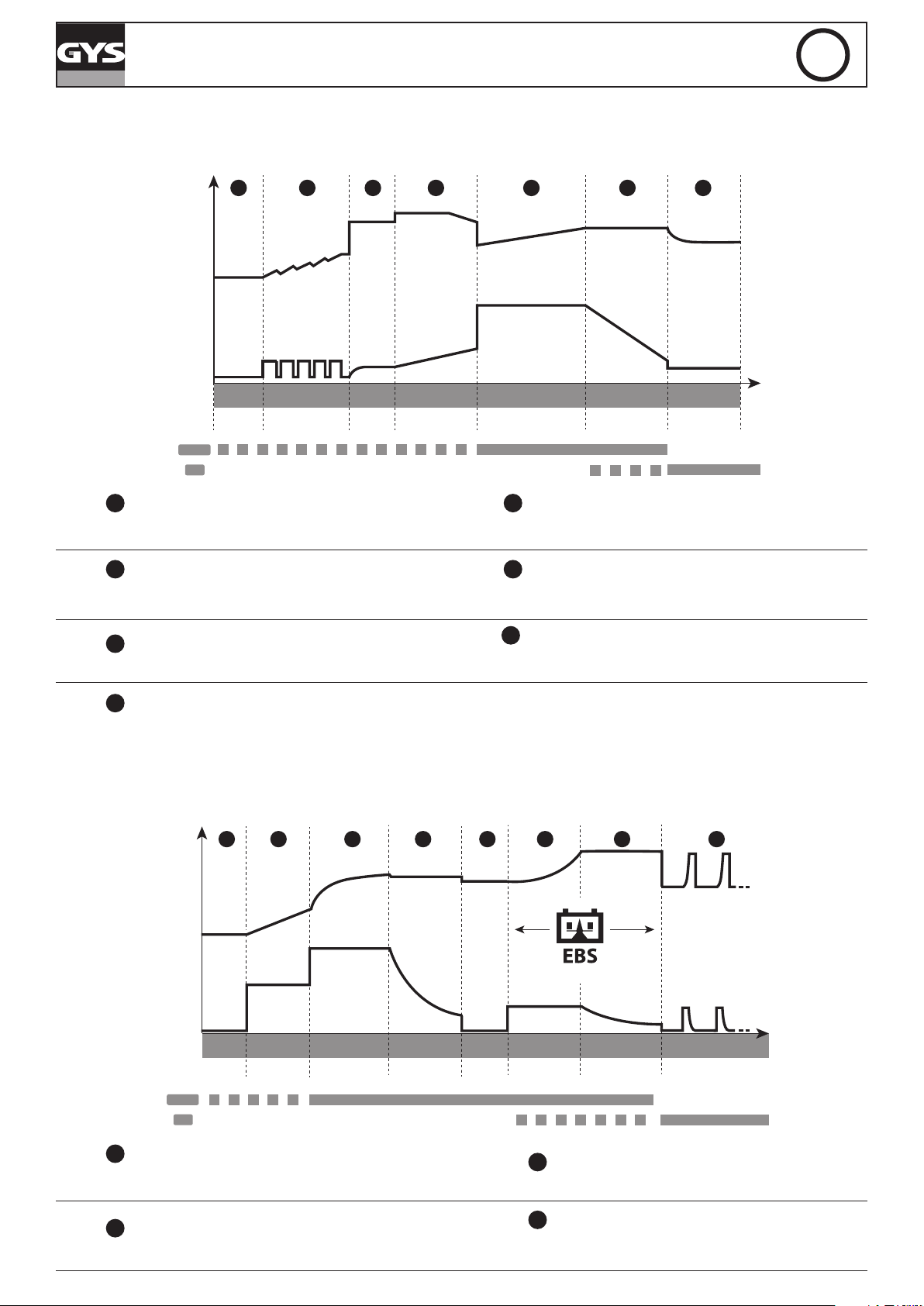
• Curva de carga Plomo:
El GYSash 6.24 PL utiliza una avanzada curva de carga de plomo de 7 pasos que garantiza el rendimiento óptimo de su batería de
plomo.
1 2 3 4 5 6 7
U
I
Análisis Recuperación Test Desulfatado Carga Absorción
<1s
CHARGE
Led
OK
Etapa
1
: Análisis
Análisis del estado de la batería (nivel de carga,
inversión de polaridad, batería conectada incorrecta…)
Etapa
2
: Recuperación (3 A)
Algoritmo de recuperación de los elementos dañados
tras una descarga profunda.
Etapa
3
: Test
Test de batería sulfatada
Etapa
4
: Desulfatado (31.6 V)
Max 12h<1s Max 8h
Max 20h
Max 8h No limit
Etapa 5 : Carga (6 A)
Carga rápida con corriente máxima que permite llegar al 80%
del nivel de carga.
Etapa
6
: Absorción (29.2 V)
Carga con voltaje constante para llevar el nivel de carga a
100%.
Etapa 7 : Mantenimiento de carga (27.2 V)
Mantenimiento del nivel de carga de la batería a su máximo
nivel.
Mantenimien-
to de carga
Algoritmo de desulfatación de la batería.
• Curva de carga Litio:
El Gysash 6.24 PL utiliza una curva de carga litio evolucionada en 8 etapas que garantizan el rendimiento optimo de la batería de
litio.
1 2 3 4 5 6 7
8
U
Equalizing Battery System
I
Análisis Recuperación Carga Absorción Complemento
< 1s Max 5 min Max 25 h Max 20 h 3 min Max 10 h Max 2 h No limit
CHARGE
OK
Etapa
1
: Análisis
Análisis del estado de la batería (nivel de carga, inversión de polaridad, batería conectada incorrecta…)
Etapa
2
: Recuperación (0.5 A)
Algoritmo de recuperación tras una descarga profunda.
20
Prueba
Etapa 5 : Prueba
Prueba de conservación de carga
Etapa 6 : Complemento
Carga con corriente reducida que permite llegar al 100% del
nivel de carga.
Igualización /
equilibrado
Mantenimiento
de carga
(mantenimiento cada 10 días)
Page 21
GYSFLASH 6.24 PL
ES
Etapa
Carga rápida con corriente máxima que permite llegar al 90%
del nivel de carga.
Etapa
Carga de tensión constante para llegar al 98% del nivel de carga.
• Tiempo de carga estimada
Capacidad de la batería 20 Ah 50 Ah 125 Ah
Tiempo de carga
0% >> 90%
3
: Carga (6 A)
4
: Absorción (27.6 V o 28.7 V)
Etapa 7 : Igualización / equilibrado (29.4 V o 28.8 V)
Equilibrado de las células de la batería.
Etapa 8 : Mantenimiento de carga (27.6 o 28.7 V)
Mantenimiento del nivel de carga de la batería a su máximo
nivel con carga de mantenimiento cada 10 días.
Plomo Litio
6 Ah
(18 Ah EqPb*)
2 h 5 h 13 h 1 h 2 h 5 h 13 h
15 Ah
(45 Ah EqPb*)
50 Ah
(150 Ah EqPb*)
125 Ah
(350 Ah EqPb*)
*Equivalente a la batería de plomo: una batería de litio posee mejores rendimientos de arranque (CCA) que una batería de plomo.
Es por ello que los fabricantes de baterías de litio indican el equivalente de la batería de plomo (EqPb) que corresponde a la capacidad que tendría una batería de plomo con los mismos rendimientos de arranque. Por ejemplo, una batería LFP de 10 Ah tendrá los
mismos rendimientos de arranque que una batería de plomo de alrededor de 30 Ah.
• Protecciones:
El GYSFLASH 6.24 PL posee un conjunto de dispositivos que le protegen contra los cortocircuitos y la inversión de
polaridad. Dispone de un sistema anti chispas que evita las chispas cuando se conecta el cargador a la batería. Este
cargador es de doble aislamiento y es compatible con la electrónica de los vehículos.
El GYSFLASH 6.24 PL está equipado con un sensor de temperatura integrado que le permite adaptar su corriente de carga en función de la temperatura ambiente para evitar cualquier sobrecalentamiento de la electrónica interna.
ANOMALÍAS, CAUSAS Y SOLUCIONES
Anomalías Causas Soluciones
1
El indicador
2
El indicador
3
El indicador
El indicador
4
tras presionar el botón
5
El indicador
6
El indicador
parpadea rápidamente.
parpadea lentamente.
está encendido.
sigue encendido incluso
.
parpadea.
sigue encendido.
• Inversión de polaridad
• Voltaje de batería demasiado elevado
• Pinzas en cortocircuito
Batería no funcional o con tensión muy
débil.
Fallo en la carga, batería no recuperable.
Fallo térmico
Cargador en espera (standby)
Carga interrumpida presionando sobre
el botón
.
• Compruebe que las pinzas estén bien conectadas.
• Compruebe que su batería sea de 24V.
Cambiar la batería.
Cambiar de batería y presione sobre
reiniciar una carga.
Temperatura ambiente demasiado elevada (>60°C),
airear el local y dejar que el cargador se enfríe.
Presione sobre
gador para salir del modo de espera (standby).
Presione de nuevo sobre
carga.
ou conecte una batería al car-
para reiniciar la
para
GARANTÍA
La garantía cubre todos los defectos o vicios de fabricación durante 2 años, a partir de la fecha de compra (piezas y mano de obra)
La garantía no cubre:
• Todas las otras averías resultando del transporte
• El desgaste normal de las piezas (cables, pinzas…)
• Los incidentes resultando de un mal uso (error de alimentación, caída, desmontaje)
• Los fallos relacionados con el entorno (polución, oxidación, polvo…)
En caso de fallo, regresen la maquina a su distribuidor, adjuntando:
• Un justicativo de compra con fecha (recibo, factura…)
• Una nota explicativa del fallo.
21
Page 22
ПРАВИЛА БЕЗОПАСНОСТИ
Данная инструкция описывает функционирование устройства
и меры предосторожности в целях обеспечения вашей
безопасности. Пожалуйста, прочтите ее перед первым
использованием и сохраните, чтобы при надобности
перечитать. Эти указания должны быть прочтены и поняты до
начала сварочных работ. Изменения и ремонт, не указанные в
этой инструкции, не должны быть предприняты. Производитель
не несет ответственности за травмы и материальные
повреждения связанные с несоответствующим данной
инструкции использованием аппарата. В случае проблемы
или сомнений обратитесь к квалифицированному специалисту
для правильного использования аппарата. Этот аппарат
должен быть использован исключительно для зарядки в
пределах, указанных на аппарате и в инструкции. Соблюдайте
правила безопасности. В случае ненадлежащего или опасного
использования производитель не несет ответственности.
Этот аппарат может быть использован детьми старше 8 лет,
а также лицами с ограниченными физическими, умственными
возможностями или ограниченным сенсорным восприятием, а
также не обладающими опытом и знаниями, при условии, что
за ними надлежащим образом следят или если с ними провели
инструктаж по безопасному использованию аппарата и если все
возможные риски были предусмотрены. Дети не должны играть
с устройством. Чистка и уход не должны производится детьми
без надлежащего присмотра.
Ни в коем случае не используйте это устройство для зарядки
батареек или незаряжаемых батарей.
Не используйте аппарат если сетевой шнур или вилка
повреждены.
Не используйте аппарат, если кабель заряда поврежден или
неправильно собран, во избежание риска короткого замыкания
аккумулятора.
Никогда не заряжайте поврежденный или замерзший аккумулятор.
Не накрывайте аппарат.
Не устанавливать аппарат рядом с источником тепла и не
подвергать высоким температурам (выше 60°C) в течении
длительного периода.
Автоматический режим и ограничения его использования
описаны далее в этой инструкции.
Риск пожара и взрыва!
При заряде батарея может выпускать взрывоопасный газ.
• Во время зарядки аккумулятор должен быть помещен в хорошо
проветриваемом месте.
22
GYSFLASH 6.24 PL
RU
Page 23
GYSFLASH 6.24 PL
RU
• Избегайте пламени и искр. Не курить.
• Защитите поверхности батареи от электрического контакта
во избежание короткого замыкания.
Риск кислотных брызг!
• Носите защитные очки и перчатки.
• В случае контакта с глазами или кожей обильно промойте
водой и без промедления обратитесь к врачу.
Не оставляйте заряженный аккумулятор на долгое время без
присмотра.
Подключение / отключение :
• Отключите подачу питания перед тем, как подключить или
отключить соединения к батарее.
• Сначала подключите клемму аккумулятора, не соединенную
с шасси. Второе подсоединение должно быть осуществлено на
шасси как можно дальше от аккумулятора и от трубопроводов
топливной системы. Затем, подключите зарядное устройство к
сети.
• После зарядки отключите зарядное устройство от сети, затем
отсоедините зажим от шасси и, наконец, зажим от аккумулятора.
Действуйте в указанном порядке.
Подключение :
• Аппарат класса II
• Подключение к электросети должно быть произведено в
соответствии с нормами страны.
Обслуживание :
• Если шнур питания поврежден, он должен быть заменен
производителем, его сервисной службой или квалифицированным
специалистом во избежание опасности.
• Техническое обслуживание должно производиться только
квалифицированным специалистом.
• Внимание! Отключите аппарат от розетки до начала ремонтных
работ.
• Аппарат не требует специфического обслуживания.
• Если предохранитель расплавился, он должен быть
заменен производителем, его сервисной службой или
квалифицированным специалистом во избежание опасности.
• Ни в коем случае не использовать растворители или другие
коррозийные моющие средства.
• Очистить поверхность аппарат с помощью сухой тряпки.
Регламентация :
• Аппарат соответствует директивам Евросоюза.
• Декларация о соответствии доступна для просмотра на нашем
сайте.
23
Page 24
GYSFLASH 6.24 PL
RU
• Знак соответствия EAC (Евразийское экономическое сообщество)
• Устройство соответствует директивам Евросоюза. Заявление о
соответствии для Великобритании доступно на нашем веб-сайте
(см. главную страницу).
• Товар соответствует нормам Марокко.
• Декларация Cم (CMIM) доступна для скачивания на нашем
сайте (см на титульной странице).
Утилизация:
• Этот аппарат подлежит переработке. Не выбрасывать в общий
мусоросборник.
ОПИСАНИЕ
GYSash 6.24 PL идеален для зарядки большинства свинцовых (AGM, с жидкостным или гелиевым электролитом и
т.д.) и литиевых аккумуляторов типа литий-железо-фосфатных аккумуляторов (LFP / LiFePO4), а также литий-ионного
«стандартого»типа, такого как Литий-никель-марганец-кобальт-оксидный АКБ (NMC и NCA), Литий-Кобальтовый АКБ(LCO),
Литий-полимерный АКБ (Li-Po), Литий-марганец-кобальт-оксидный АКБ (MCO), и т.д.
Это зарядное устройство идеально подходит:
- Для зарядки свинцовых аккумуляторов 24В (12 последовательных элементов по 2В) ёмкостью от 15Aч до 125Aч и до 170
Ач для функции подпитки.
- Для зарядки литий-железо-фосфатных аккумуляторов 24В (8 последовательных элементов по 3,7В) ёмкостью от 2 Aч до
125 Aч и до 170 Ач для функции подпитки.
- Для зарядки Ионно-литиевых аккумуляторов 24В (7 последовательных элементов по 4.2В) т 2 Aч до 125 Aч и до 170 Ач
для функции подпитки.
Gysash 6.24 PL имеет специальную функцию, которая при зарядке свинцового аккумулятора
автоматически подстраивает выходное напряжение в зависимости от температуры воздуха
окружающей среды. Эта настройка позволяет перезарядить свинцовый аккумулятор с большой
точностью в соответствии с температурой окружающей среды.
ВКЛЮЧЕНИЕ
1. Подключите зарядное устройство к АКБ с помощью желаемого аксессуара (зажимы, наконечники и прочее).
2. Подключите зарядное устройство к сети (однофазное питание 220-240 Vac 50-60Hz).
3. Разблокируйте устройство нажатием на кнопку
Зафиксируйте режим нажав заново на кнопку
автоматически.
4. Во время зарядки аппарат показывает продвижение уровня заряда. Когда индикатор
двигателя. Аккумулятор полностью заряжен, когда индикатор
5. Зарядку можно в любой момент прервать, отключив сетевой шнур или нажав на кнопку
6. После зарядки отключите зарядное устройство от сети, затем отсоедините зажимы от АКБ.
РЕЖИМЫ ЗАРЯДКИ
в течении 3х сек. Выберите режим нажав заново на кнопку .
в течении 3х сек. По истечении около пяти секунд зарядка начнется
мигает, АКБ готова к запуску
горит и не гаснет.
.
• Описание Режимов и Опций:
Режим ЗАРЯДКИ Свинцового аккумулятора (29.2В/6A) :
Режим для зарядки свинцовых аккумуляторов 24В емкостью от 15Aч до 125Aч и до 170Aч для
подпитки. 7-этапный автоматический цикл зарядки.
Режим ЗАРЯДКИ Ионно-литиевого аккумулятора (NMC, NCA, Li-Po, LCO, MCO, …)
(29.4ВV/6A) :
Режим для зарядки стандартных ионно-литиевых аккумуляторов 24В емкостью от 15Aч до 125Aч и
до 170Aч для подпитки. Автоматический цикл зарядки в 8 этапов.
Режим ЗАРЯДКИ Литий-железо-фосфат (28.8 B/6 A) :
Режим для зарядки аккумуляторов 24В LiFePO4 емкостью от 15Aч до 125Aч и до 170Aч для
подпитки. Автоматический цикл зарядки в 8 этапов.
24
Опция UVP Wake UP:
Некоторый литиевые аккумуляторы имеют защиту минимального напряжения (UVP),
которая отключает аккумулятор в случае глубокой разрядки. Эта защита мешает
зарядному устройству распознать подключенный аккумулятор. Для того, чтобы Gysash
6.24 PL мог зарядить аккумулятор, необходимо выбрать эту опцию чтобы отключить
защиту UVP.
Page 25
GYSFLASH 6.24 PL
Led
• Кривая зарядки свинцовых аккумуляторов:
GYSash 6.24 PL заряжает по развернутой кривой, состоящей из 7 этапов, гарантирующей оптимальные рабочие
характеристики вашего свинцового аккумулятора.
1 2 3 4 5 6 7
U
I
RU
Анализ Восстановление Те ст Десульфатация Зарядка Поглощение
<1s
CHARGE
Led
OK
1
Этап
: Анализ
Анализ состояния АКБ (уровень заряда, инверсия
полярностей, подключение неправильной АКБ…)
2
Этап
: Восстановление (3 A)
Алгоритм восстановления элементов, поврежденных
вследствие глубокой разрядки.
3
Этап
: Тест
Тестирование сульфатированной АКБ
4
Этап
: Десульфатация (31.6 B)
Max 12h<1s Max 8h
Max 20h
Max 8h No limit
Этап 5 : Зарядка (6 A)
Быстрая зарядка на максимальном токе, позволяющая
достичь 80% уровня зарядки.
6
Этап
: Поглощение (29.2 B)
Зарядка при постоянном напряжении, чтобы довести
уровень заряда до 100%.
Этап 7 : Поддержание заряда (27.2 B)
Поддержание уровня заряда аккумулятора на максимальном
уровне.
Поддержание
заряда
Алгоритм десульфатации АКБ.
• Кривая зарядки литиевых аккумуляторов:
GYSash 6.24 PL заряжает по развернутой кривой для литиевых АКБ, состоящей из 8 этапов, гарантирующей оптимальные
рабочие характеристики вашего литиевого аккумулятора.
1 2 3 4 5 6 7
8
U
Equalizing Battery System
I
Анализ Восстановление Зарядка Поглощение
< 1s Max 5 min Max 25 h Max 20 h 3 min Max 10 h Max 2 h No limit
CHARGE
OK
1
Этап
: Анализ
Анализ состояния АКБ (уровень заряда, инверсия
полярностей, подключение неправильной АКБ…)
2
Этап
: Восстановление (0.5 A)
Алгоритм восстановления вследствие глубокой разрядки.
Дополнительна
Тес т
я зарядка
Этап 5 : Тест
Тестирование сохранения заряда.
Этап 6 : Дополнительная зарядка
Зарядка пониженным током, позволяющая достичь 100%
уровня зарядки.
Выравнивание /
компенсация
Поддержание
заряда
(техническое обслуживание
каждые 10 дней)
25
Page 26
GYSFLASH 6.24 PL
3
Этап
Быстрая зарядка на максимальном токе, позволяющая достичь
90% уровня зарядки.
Этап
Зарядка при постоянном напряжении, чтобы довести уровень
заряда до 98%.
: Зарядка (6 A)
4
: Поглощение (27.6 B / 28.7 B)
RU
Этап 7 : Выравнивание / компенсация (29.4 B /
28.8 B)
Выравнивание ячеек аккумулятора
Этап 8 : Поддержание заряда (27.6 B / 28.7 B)
Поддержание уровня заряда аккумулятора на
максимальном уровне с подпиткой каждые 10 дней.
• Предполагаемое время
зарядки
Емкость аккумулятора 20 Ah 50 Ah 125 Ah
Продолжительность зарядки
0% >> 90%
2 h 5 h 13 h 1 h 2 h 5 h 13 h
Свинец Литий
6 Ah
(18 Ah EqPb*)
15 Ah
(45 Ah EqPb*)
(150 Ah EqPb*)
50 Ah
125 Ah
(350 Ah EqPb*)
*Аналог свинцового аккумулятора: литиевый аккумулятор имеет лучшие характеристики запуска (CCA), чем свинцовый. По
этой причине некоторые производителя литиевых аккумуляторов указывают на них аналог среди свинцовых аккумуляторов
(EqPb). Это емкость свинцового аккумулятора, имеющего одинаковые с литиевым характеристики запуска. Например,
аккумулятор LFP емкостью 10 Aч будет иметь те же характеристики запуска, что и свинцовый аккумулятор емкостью 30 Aч.
• Защиты :
GYSFLASH 6.24 PL оснащен противоискровой защитой, предотвращающей искрение при подсоединении
зарядного устройства к АКБ. Это зарядное устройство имеет двойную изоляцию и совместим с бортовой
электроникой автомобилей.
GYSFLASH 6.24 PL имеет встроенный температурный датчик, позволяющий изменять ток зарядки в зависимости от
температуры окружающей среды во избежание перегрева внутренней электроники.
НЕИСПРАВНОСТИ, ИХ ПРИЧИНЫ И УСТРАНЕНИЕ
Неисправности Причины Устранение
1
Индикатор
2
Индикатор
быстро мигает.
медленно мигает.
• Инверсия полярности
• Напряжение АКБ слишком высокое
• Закорочены зажимы
Аккумулятор вышел из строя или его
напряжение слишком низкое.
• Проверьте, что зажимы правильно
подсоединены
• Проверьте, что аккумулятор - 24В.
Замените аккумулятор.
3
Горит индикатор
Индикатор
4
несмотря на то, что вы нажали кнопку
.
5
Мигает индикатор
6
Индикатор
.
продолжает гореть,
.
продолжает гореть.
Ошибка при зарядке, АКБ
восстановлению не подлежит.
Проблема с температурой
Зарядное устройство в режиме
ожидания.
Зарядку можно прервать нажатием
на кнопку
.
Замените АКБ и нажмите на
запустить цикл зарядки.
Слишком высокая температура окружающей
среды (>60°C). Проветрите помещение и дайте
зарядному устройству остыть.
Нажмите на кнопку
к зарядному устройству, чтобы выйти из режима
ожидания.
Снова нажмите на
зарядку.
или подсоедините АКБ
, чтобы снова запустить
, чтобы снова
ГАРАНТИЯ
Гарантия распространяется на любой заводской дефект или брак в течение 2х лет с даты покупки изделия (запчасти и
рабочая сила).
Гарантия не распространяется на:
• Любые поломки, вызванные транспортировкой.
• Нормальный износ деталей (Например : кабели, зажимы и т.д.).
• Случаи неправильного использования (ошибка питания, падение, разборка).
• Случаи выхода из строя из-за окружающей среды (загрязнение воздуха, коррозия, пыль).
При выходе из строя, обратитесь в пункт покупки аппарата с предъявлением следующих документов:
- документ, подтверждающий покупку (с датой): кассовый чек, инвойс....
- описание поломки.
26
Page 27
GYSFLASH 6.24 PL
BELANGRIJKE VEILIGHEIDSINSTRUCTIES
In deze handleiding vindt u informatie over het functioneren van uw
apparaat, en de veiligheids- en voorzorgsmaatregelen die in acht
moeten worden genomen. Leest u dit document aandachtig door voor
u het apparaat in gebruik neemt. Bewaar dit document vervolgens
als naslagwerk. Deze instructies moeten eerst goed gelezen en
begrepen worden voor u het apparaat in gebruik neemt. Voer geen
enkele verandering en/of onderhoud uit die niet beschreven staat
in deze handleiding. Iedere vorm van lichamelijk letsel of materiële
schade veroorzaakt door het onjuist opvolgen van de instructies
in deze handleiding kan niet op de fabrikant verhaald worden.
Raadpleeg, in geval van problemen of vragen, een bekwame en
gekwaliceerde onderhoudsmonteur. Dit apparaat mag alleen
gebruikt worden als lader, en uitsluitend volgens de instructies
zoals die vermeld staan op het apparaat en in de handleiding. De
veiligheidsinstructies moeten altijd nauwkeurig opgevolgd worden.
Bij onjuist of gevaarlijk gebruik van dit apparaat kan de fabrikant
niet aansprakelijk gesteld worden.
NL
Dit apparaat kan alleen worden gebruikt door kinderen vanaf 8
jaar of personen met lagere lichamelijke, zintuiglijke of mentale
vaardigheden of met gebrek aan ervaring of kennis indien deze
personen goed begeleid worden, als hen de noodzakelijke instructies
voor een absoluut veilig gebruik van het apparaat uitgelegd zijn en
als de eventuele risico’s van het gebruik goed begrepen worden.
Kinderen mogen niet met het apparaat spelen. Reiniging en
onderhoud van het apparaat mogen niet uitgevoerd worden door
kinderen zonder toezicht.
Dit apparaat nooit gebruiken om niet-oplaadbare batterijen of
accu’s op te laden.
Gebruik het apparaat niet als de stroomkabel of de stekker defect
zijn.
Om kortsluiting van de accu te voorkomen mag het apparaat
niet gebruikt worden als de laadkabel beschadigd is, of als deze
foutief geassembleerd is.
Probeer nooit een bevroren of een defecte accu op te laden.
Het apparaat niet bedekken.
Het apparaat niet dichtbij een warmtebron plaatsen en niet
blootstellen aan blijvend hoge temperaturen (hoger dan 60°C).
De automatische gebruiksmodule en de gebruiksbeperkingen van
het apparaat worden in deze handleiding beschreven.
Ontplofngs- en brandgevaarlijk!
Een accu die wordt opgeladen kan explosief gas uitstoten.
• Plaats de accu tijdens het opladen in een goed geventileerde
ruimte.
27
Page 28
GYSFLASH 6.24 PL
NL
• Voorkom vlammen en vonken. Niet roken in de nabijheid van
dit apparaat.
• Om kortsluiting te voorkomen moeten de delen van de accu die
elektrisch contact kunnen geven afgeschermd worden.
Let op : zuur-projectie gevaar !
• Draag altijd een veiligheidsbril en veiligheidshandschoenen.
• In geval van oog- of huidcontact : meteen afspoelen met water
en onmiddellijk een arts raadplegen.
Laat nooit een accu langere tijd opladen zonder toezicht.
Aansluiten / Afkoppelen :
• Koppel het apparaat van de stroomvoorziening af voordat u de
accu aansluit of loskoppelt.
•
De accuklem die niet met het chassis is verbonden moet als eerste
aangesloten worden. De andere verbinding moet plaats vinden op het
chassis, ver van de accu en van de brandstoeidingen. De acculader
moet vervolgens op het stroomnet aangesloten worden.
• Koppel, na het beëindigen van de laadprocedure, eerst de
acculader van de netspanning af. Koppel daarna de aansluiting
die op het chassis is aangesloten af, en pas daarna de verbinding
met de accu. Respecteer altijd deze volgorde.
Aansluiten :
• Apparaat klasse II
• De aansluiting op de netspanning moet conform de nationale
regelgeving gebeuren.
Onderhoud :
• Als de voedingskabel beschadigd is moet deze vervangen
worden door de fabrikant, diens reparatie-dienst of een
gelijkwaardig gekwaliceerde technicus, om zo gevaarlijke
situaties te voorkomen.
• Het onderhoud dient uitsluitend door een gekwaliceerde
onderhoudsmonteur uitgevoerd te worden.
• Waarschuwing ! Haal altijd eerst de stekker uit het stopcontact
alvorens eventuele onderhoudswerkzaamheden te verrichten.
28
• Dit apparaat behoeft geen speciaal onderhoud.
• Als de interne zekering beschadigd is, dient deze vervangen te
worden door de fabrikant, zijn reparatie-dienst of een gelijkwaardig
gekwaliceerde technicus, om zo ieder gevaar of risico te vermijden.
• Gebruik nooit oplosmiddelen of andere agressieve
schoonmaakmiddelen.
• De oppervlaktes van het apparaat reinigen met een droge
doek.
Page 29
Richtlijnen :
• Apparaat voldoet aan de Europese richtlijnen.
• Het certicaat van overeenstemming is beschikbaar op onze
internet site.
• EAC certicering (Euraziatische Economische Gemeenschap)
• Materiaal conform aan de Britse eisen. De Britse verklaring van
overeenkomt is beschikbaar op onze website (zie omslagpagina).
• Dit materiaal voldoet aan de Marokkaanse normen.
• De verklaring Cم (CMIM) van overeenstemming is beschikbaar
op onze internet site (vermeld op de omslag).
Afvalverwerking :
• Afzonderlijke inzameling vereist. Niet met het huishoudelijke afval
wegwerpen.
ALGEMENE OMSCHRIJVING
GYSFLASH 6.24 PL
NL
De GYSash 6.24 PL is het ideale apparaat voor het opladen van de meeste lood-accu’s (Gel, AGM, vloeibaar...) en lithium accu’s type
LFP / LiFePO4, en van het type lithium-ion «standaard» zoals NMC (Nikkel Mangaan Kobalt) accu’s, NCA (Lithium Nikkel Kobalt Aluminium) accu’s, LCO (Lithium Kobalt Oxide) accu’s, Li-Po (Lithium Polymeer) accu’s, MCO (Lithium Mangaan Kobalt Oxide) accu’s enz..
Deze lader is perfect geschikt voor :
- Het opladen van 24 V (12 elementen van 2 V in serie) lood-accu’s van 15 Ah tot 125 Ah, en tot 170 Ah voor druppelladen.
- Het opladen van 24 V LFP accu’s (8 elementen van 3.7 V in serie) van 2 Ah tot 125 Ah, en tot 170 Ah voor druppelladen.
- Het opladen van 24 V Lithium-ion accu’s (7 elementen van 4.2 V in serie) van 2 Ah tot 125 Ah, en tot 170 Ah voor druppelladen.
De GYSash 6.24 PL is uitgerust met een functie die ervoor zorgt dat tijdens het opladen van een accu
automatisch de uitgaande spanning aangepast wordt aan de omgevingstemperatuur. Dit maakt het mogelijk
de accu heel precies op te laden, afgestemd op de omgevingstemperatuur.
OPSTARTEN
1. Sluit de accu-lader aan op de accu met behulp van de door u gekozen accessoires (klemmen, kabelschoenen enz.).
2. Koppel de lader aan op de netspanning (enkelfase netwerk 220-240 Vac 50-60 Hz).
3. Ontgrendel de lader door 3 seconden lang op knop
grendel de module door opnieuw 3 seconden lang op knop
4. Tijdens het opladen geeft het apparaat het laadniveau aan. Wanneer het lampje
te starten. En wanneer het lampje
5. Het opladen kan op ieder gewenst moment onderbroken worden, door de stekker uit het stopcontact te halen of door op knop
te drukken.
6. Koppel, na aoop van de laad-procedure, eerst de acculader van de netspanning af. Koppel daarna de aansluitingen op de accu los.
LAAD-MODULES
blijft branden is de accu volledig opgeladen.
te drukken. Kies de module door opnieuw op knop te drukken. Ver-
te drukken. Na ongeveer vijf seconden start het laden automatisch op.
knippert, is de accu gereed om een motor
• Beschrijving Modules en Opties :
Module LADEN Lood (29.2 V/6 A) :
Module bestemd voor het laden van 24 V lood-accu’s van 15 Ah tot 125 Ah en tot 170 Ah voor druppelladen. Automatische laadcyclus in zeven stappen.
Module LADEN Lithium-ion (NMC, NCA, Li-Po, LCO, MCO, …) (29.4 V/6 A) :
Module bestemd voor het laden van 24 V accu’s Li-ion standaard van 2 Ah tot 125 Ah en tot 170 Ah voor
druppelladen. Automatische laadcyclus in acht stappen.
Module LADEN Lithium Fer Phosphate (28.8 V/6 A) :
Module bestemd voor het laden van 24 V LiFePO4 accu’s van 2 Ah tot 125 Ah en tot 170 Ah voor druppelladen. Automatische laadcyclus in acht stappen.
Optie UVP Wake UP :
Bepaalde lithium accu’s hebben een geïntegreerde UVP (Under Voltage Protection), die de
accu in geval van diepe ontlading uitschakelt. Vanwege deze beveiliging kan de lader de accu
niet detecteren. Kies deze optie om de UVP bescherming uit te schakelen, zodat de GYSash
6.24 PL de accu kan opladen.
29
Page 30
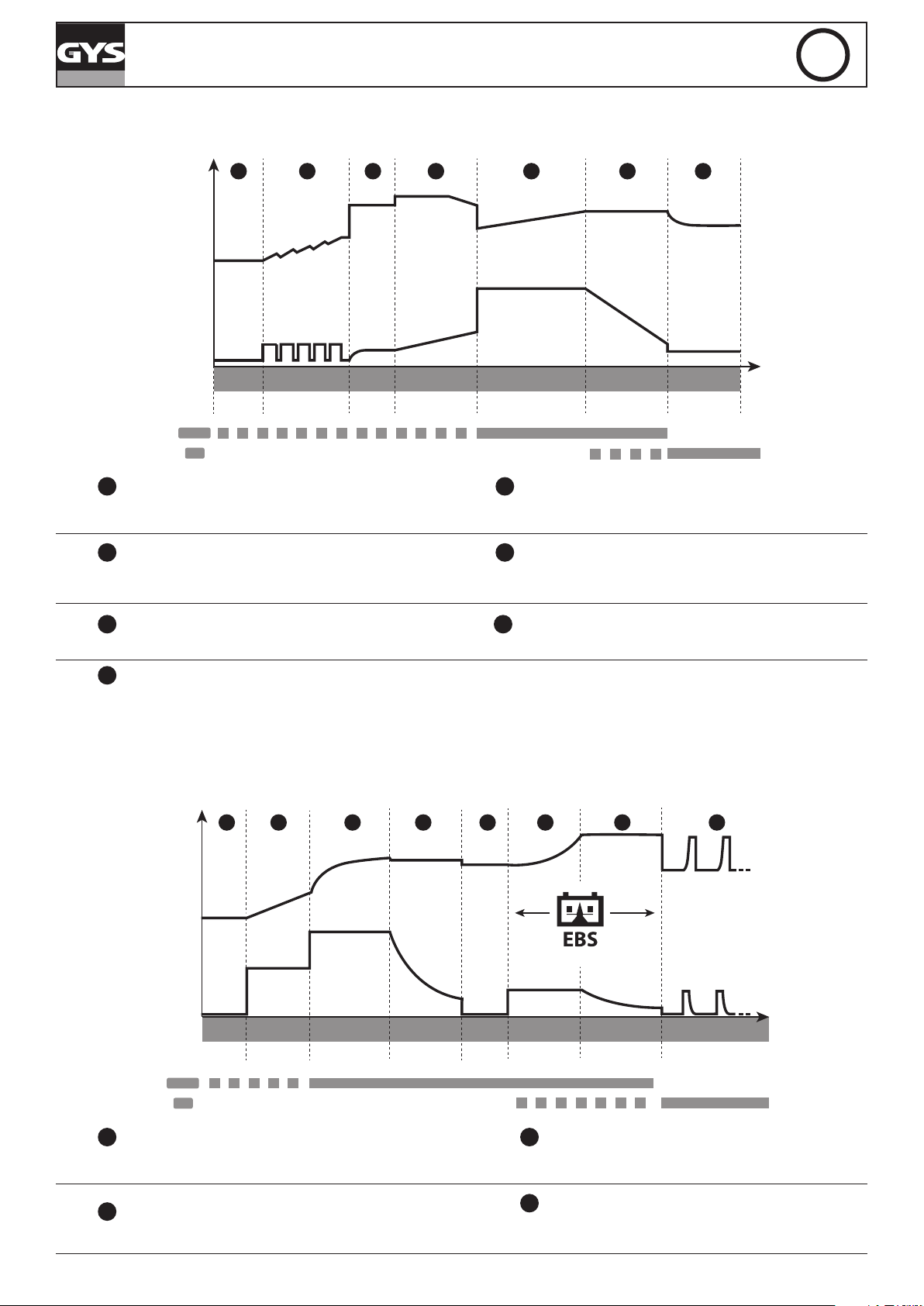
GYSFLASH 6.24 PL
Led
NL
• Laadcurve lood-accu :
De GYSash 6.24 PL gebruikt een geëvolueerde laadcurve in 7 stappen, die de optimale prestaties van uw lood-accu garandeert.
1 2 3 4 5 6 7
U
I
Analyse Herstel Test Desulfatie Laden Absorptie
<1s
CHARGE
Led
OK
1
Stap
: Analyse
Analyseert de staat van de accu (laadniveau,
ompoling, verkeerde accu aangesloten...)
2
Stap
: Herstel (3 A)
Algoritme van het herstel van de beschadigde elementen
als gevolg van een diepe ontlading.
3
Stap
: Test
Test gesulfateerde accu.
4
Stap
: Desulfatie (31.6 V)
Max 12h<1s Max 8h
Max 20h
Max 8h No limit
Stap 5 : Laden (6 A)
Snel laden met maximale stroom, voor het bereiken van 80%
van het laadniveau.
Stap 6 : Absorptie (29.2 V)
Laden met constante spanning, om het laadniveau naar 100% te
brengen.
Stap 7 : Druppellaadfunctie (27.2 V)
Handhaven van het maximale laadniveau van de accu.
Druppellaad-
functie
Algoritme van de desulfatie van de accu.
• Laadcurve lithium :
De GYSash 6.24 PL gebruikt een geëvolueerde Lithium laadcurve in 8 stappen, die de optimale prestaties van uw lithium accu
garandeert.
1 2 3 4 5 6 7
8
U
Equalizing Battery System
I
Analyse Herstel Laden Absorptie
< 1s Max 5 min Max 25 h Max 20 h 3 min Max 10 h Max 2 h No limit
CHARGE
OK
1
Stap
: Analyse
Analyse van de staat van de accu (laadniveau, ompoling, verkeerde accu aangesloten...)
2
Stap
: Herstel (0.5 A)
Algoritme herstel als gevolg van een diepe ontlading.
30
Aanvullende
Test
lading
Balanceren
Druppelladen
(onderhoud om de 10 dagen)
Stap 5 : Test
Test de capaciteit van de accu om het laadniveau te behouden.
Stap 6 : Aanvullende lading
Laden met beperkte stroom, om 100% van het laadniveau te
bereiken.
Page 31
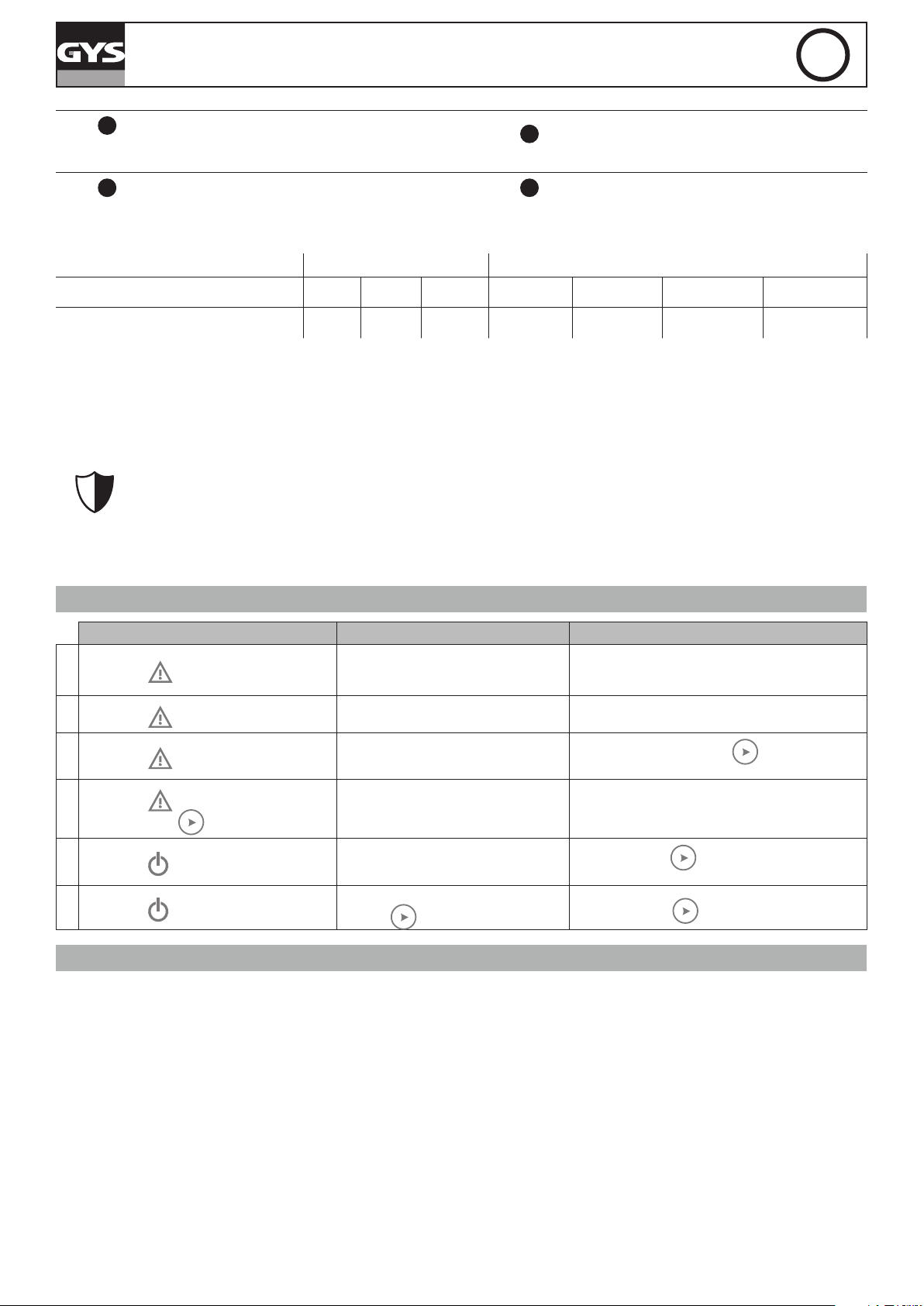
GYSFLASH 6.24 PL
3
Stap
Snel laden met maximale stroom om zo 90%
van het laadniveau te bereiken.
Stap
Laden met constante spanning om het laadniveau naar 98% te
brengen.
: Laden (6 A)
4
: Absorptie (27.6 V of 28.7 V)
NL
Stap 7 : Balanceren (29.4 V of 28.8 V)
Balanceren van de accu-cellen
Stap 8 : Druppelladen (27.6 V of 28.7 V)
Behoud van het maximale laadniveau van de accu, met om
de tien dagen druppelladen.
• Geschatte oplaadtijd
Capaciteit van de accu 20 Ah 50 Ah 125 Ah
Laadtijd
0% >> 90%
2 h 5 h 13 h 1 h 2 h 5 h 13 h
Lood Lithium
6 Ah
(18 Ah EqPb*)
15 Ah
(45 Ah EqPb*)
(150 Ah EqPb*)
50 Ah
125 Ah
(350 Ah EqPb*)
*Equivalent loodzuur accu : Een lithium accu beschikt over betere startcapaciteiten (CCA) dan een loodzuur accu. Daarom geven
sommige fabrikanten van lithium accu’s het equivalent van een loodzuur accu (EqPb) aan : de capaciteit die een loodzuur accu
zou hebben met een identieke startcapaciteit. Bijvoorbeeld : een LFP accu van 10Ah zal dezelfde start-capaciteit hebben als een
loodzuur accu van ongeveer 30 Ah.
• Beveiligingen :
De GYSFLASH 6.24 PL beschikt over een reeks beveiligingen tegen kortsluiting of ompoling. Het apparaat beschikt
over een systeem dat vonkvorming tijdens het aankoppelen van de acculader op de accu voorkomt. De lader heeft
een dubbele isolatie en is veilig tijdens gebruik met auto-elektronica.
De GYSFLASH 6.24 PL is uitgerust met een geïntegreerde temperatuur-sensor, die het apparaat in staat stelt om de laadstroom aan
te passen aan de omgevingstemperatuur, om zodoende oververhitting van de interne elektronica te voorkomen.
AFWIJKINGEN, OORZAKEN, OPLOSSINGEN
Afwijkingen Oorzaken Oplossingen
1
Het lampje
2
Het lampje
knippert snel.
knippert langzaam.
• Ompoling
• De accu-spanning is te hoog
• Kortsluiting klemmen
Accu buiten gebruik of zeer lage accu-
spanning.
• Controleer of de klemmen correct aangesloten
zijn
• Controleer of de accu een 12 V accu is
Vervang de accu.
3
Het lampje
Het lampje
4
druk op de knop
5
Het lampje
6
Het lampje
brandt.
blijft branden, zelfs na een
.
knippert.
blijft branden.
Opladen mislukt, accu onherstelbaar
beschadigd.
Thermisch defect
Acculader op stand-by.
Opladen onderbroken door een druk op
de knop
.
Vervang de accu en druk op
weer op te starten.
Omgevingstemperatuur te hoog (>60°C), ventileer
het vertrek en laat de lader afkoelen.
Druk op de knop
lader aan om de stand-by module te verlaten.
Druk opnieuw op
of sluit een accu op de accu-
, om het laden te hervatten.
om het laden
GARANTIE
De garantie dekt alle gebreken en fabricagefouten gedurende twee jaar vanaf de aankoopdatum (onderdelen en arbeidsloon).
De garantie dekt niet :
• Alle overige schade als gevolg van vervoer.
• De gebruikelijke slijtage van onderdelen (Bijvoorbeeld : kabels, klemmen, enz.).
• Incidenten als gevolg van verkeerd gebruik (verkeerde elektrische voeding, vallen, ontmanteling).
• Gebreken ten gevolge van de gebruiksomgeving (vervuiling, roest, stof).
In geval van storing moet het apparaat teruggestuurd worden naar uw distributeur, samen met:
- Een gedateerd aankoopbewijs (betaalbewijs, factuur ...).
- Een beschrijving van de storing.
31
Page 32
ISTRUZIONI DI SICUREZZA
Questo manuale descrive il funzionamento di questo apparecchio
e le precauzioni da seguire per la sicurezza dell’utilizzatore.
Leggerlo attentamente prima dell’uso e conservarlo con cura
per poterlo consultare successivamente. Queste istruzioni
devono essere lette e comprese prima dell’uso. Ogni modica
o manutenzione non indicata nel manuale non deve essere
effettuata. Ogni danno sico o materiale dovuto ad un uso
non conforme alle istruzioni presenti in questo manuale non
potrà essere considerato a carico del fabbricante. In caso di
problema o d’incertezza, si prega di consultare una persona
qualicata per manipolare correttamente il dispositivo. Questo
dispositivo deve essere usato solo per ricaricare o mantenere la
carica entro i limiti indicati sul dispositivo stesso e sul manuale.
Bisogna rispettare le istruzioni relative alla sicurezza. In caso
di uso inadeguato o pericoloso, il fabbricante non potrà essere
ritenuto responsabile.
GYSFLASH 6.24 PL
IT
Questo dispositivo può essere usato da bambini di età superiore
a 8 anni, da persone con capacità siche, sensoriali o mentali
ridotte e da persone senza esperienza o conoscenze, purchè
esse siano correttamente sorvegliate o se le istruzioni relative
all’uso del dispositivo in sicurezza siano state loro trasmesse e
qualora i rischi intrapresi siano stati presi in considerazione. I
bambini non devono giocare con il dispositivo. La pulizia e la
manutenzione non devono essere effettuate da bambini non
sorvegliati.
Non utilizzare in nessuna circostanza per caricare pile o batterie
non ricaricabili.
Non usare il dispositivo se il cavo di alimentazione o la presa
sono danneggiati.
Non utilizzare l’apparecchio, se il cavo di ricarica è danneggiato
o presenta un difetto di assemblaggio, per evitare qualsiasi
rischio di cortocircuito della batteria.
Non caricare mai una batteria ghiacciata o danneggiata.
Non coprire il dispositivo.
32
Non mettere il dispositivo in prossimità di una fonte di calore e
a temperature durevolmente elevate(superiori a 60°C).
Il modo di funzionamento automatico così come le restrizioni
applicabili all’uso sono spiegate in seguito su questo manuale.
Rischio di esplosione e d’incendio!
Una batteria in carica può emettere dei gas esplosivi.
• Durante la carica, la batteria deve essere messa in un luogo
ben ventilato.
• Evitare amme e scintille. Non fumare.
• Proteggere le supercie della batteria da corto-circuiti.
Page 33
GYSFLASH 6.24 PL
IT
Rischio di proiezioni acide!
• Indossare occhiali e guanti di protezione
• In caso di contatto con gli occhi o con la pelle, sciacquare
immediatamente con acqua e consultare un medico senza
tardare.
Non lasciare una batteria con carica in corso senza sorveglianza
per un lungo periodo di tempo.
Collegamento / scollegamento:
• Scollegare l’alimentazione prima di collegare o scollegare i
collegamenti alla batteria.
• Il terminale della batteria non collegato al telaio deve essere
collegato per primo. L’altro collegamento deve essere effettuato
sul telaio lontano dalla batteria, dalla canaletta del carburante
e dal serbatoio. Il caricabatterie deve essere collegato alla rete
elettrica.
• Dopo l’operazione di carica, scollegare il caricabatterie
dalla rete, in seguito ritirare la connessione dal telaio e inne la
connessione dalla batteria, nell’ordine indicato.
Collegamento:
• Apparecchio di classe II
• Il collegamento alla rete di alimentazione deve essere fatto in
conformità con le regole d’installazione nazionali.
Manutenzione:
• Se il cavo corrente è danneggiato, deve essere sostituito
dal fabbricante, dal suo servizio post vendita o da persone di
qualica simile per evitare ogni pericolo.
• La manutenzione deve essere effettuata da una persona
qualicata.
• Avvertenze ! Scollegare sempre la spina dalla presa
elettrica prima di effettuare qualsiasi manipolazione sul
dispositivo.
• Il dispositivo non ha bisogno di nessuna manutenzione
particolare.
• Se il fusibile interno è fuso, esso deve essere sostituito dal
fabbricante, dal suo servizio post-vendita o da persone di
qualica simile per evitare pericoli.
• Non usare in nessun caso solventi o altri prodotti pulenti
aggressivi.
• Pulire le superci del dispositivo con uno straccio secco.
Regolamentazione:
• Apparecchio conforme alle direttive europee.
• La dichiarazione di conformità è disponibile sul nostro sito
internet.
33
Page 34
GYSFLASH 6.24 PL
IT
• Marchio di conformità EAC (Comunità Economica Eurasiatica)
• Materiale conforme alla esigenze britanniche. La dichiarazione
di conformità britannica è disponibile sul nostro sito (vedere
pagina di copertina).
• Materiale conforme alle normative marocchine.
• La dichiarazione Cم (CMIM) di conformità è disponibile sul
nostro sito (vedi scheda del prodotto)
Smaltimento :
• Questo materiale è soggetto alla raccolta differenziata. Non
deve essere smaltito con i riuti domestici.
DESCRIZIONE GENERALE
Il GYSFLASH 6.24 PL è ideale per ricaricare la maggior parte delle batterie al piombo (Gel, AGM, Liquido..) e litio di tipo Litio Ferofosfato (LFP /Life PO4) e di tipo litio-ione <<standard>> come il Nichel Cobalto manganese (NMC), il litio nichel cobalto alluminio
ossido(NCA) , il litio cobalto ossido (LCO), il litio Polimero (Li-Po) e il litio Manganese Cobalto Ossido (MCO) etc.
Questo caricabatterie si adatta perfettamente alla carica di :
- Batterie piombo 24 V (12 elementi in serie da 2V) da 15 Ah a 125 Ah, e no a 170 Ah per il mantenimento della carica.
- La ricarica di batterie LFP 24 V (8 elementi in serie da 3.7 V) da 2 Ah a 125 Ah , e no a 170 Ah per il mantenimento della carica.
- La ricarica di batterie agli ioni di litio 24 V (7 elementi in serie da 4.2 V) da 2 a 125 Ah e no a 170 Ah per il mantenimento della carica.
Il Gysash 6.24 PL è dotato di una funzione dove, al momento della ricarica di batteria al piombo, adatta
automaticamente la tensione d’uscita in funzione alla temperatura dell’ambiente. Questa regolazione
permette di avere una ricarica precisa e adattata alla temperatura ambiente.
AVVIAMENTO
1. Collegare il caricabatterie alla batteria con l’accessorio scelto (morsetti, connettori a occhiello, ecc.).
2. Collegare il caricabatterie sulla presa settore (rete monofase 220-240 Vac 50-60 Hz).
3. Sbloccare il caricabatterie premendo per 3 secondi sul pulsante
. Bloccare la modalità premendo di nuovo per 3 secondi sul pulsante . Dopo circa cinque secondi, la carica si avvia automa-
ticamente.
4. Durante la carica, il dispositivo indica lo stato di avanzamento della carica. Quando la spia
ad avviare il motore. E quando la spia
5. La carica può essere interrotta ad ogni momento scollegando la spina dalla presa oppure premendo sul tasto
6. Dopo l’operazione di carica, scollegare il caricabatterie dalla rete, in seguito ritirare le connessioni dalla batteria.
MODALITA’ DI CARICA
• Descrizione dei Modi di carica e delle opzioni:
Modalità CARICA Piombo (29.2V/6A):
Modalità destinata alla ricarica di batterie 24V al piombo da 15 Ah a 125 Ah e no a 170 Ah per il mantenimento della carica. Ciclo di carica automatico sette tappe.
Modalità CARICA Litio-Ione (NMC, NCA, Li-Po, LCO, MCO, …) (29.4 V/6 A) :
Modalità destinata alla carica di batterie 24V Litio-Ione standard da 2 Ah a 125 Ah e no a 170 Ah per il
mantenimento della carica. Ciclo di carica automatico in otto tappe.
Modalità CARICA Litio Fero Fosfato (28.8 V/6 A) :
Modalità destinata alla ricarica di batterie 24V LifePo da 2 Ah a 125 Ah e no a 170 Ah per il mantenimento della carica. Ciclo di carica automatico in otto tappe.
rimane accesa, la batteria è completamente carica.
Opzione UVP Wake UP:
Certe batterie litio integrano una protezione UVP (Under Voltage Protection) che sconnette la
batteria in caso di scarica profonda. Questa protezione impedisce al caricabatterie di rile-
vare la batteria. Anchè il Gysash 6.24PL possa caricare la batteria, bisogna disattivare la
protezione UVP.
. Selezionare la modalità premendo nuovamente sul pulsante
lampeggia, la batteria è pronta
.
34
Page 35
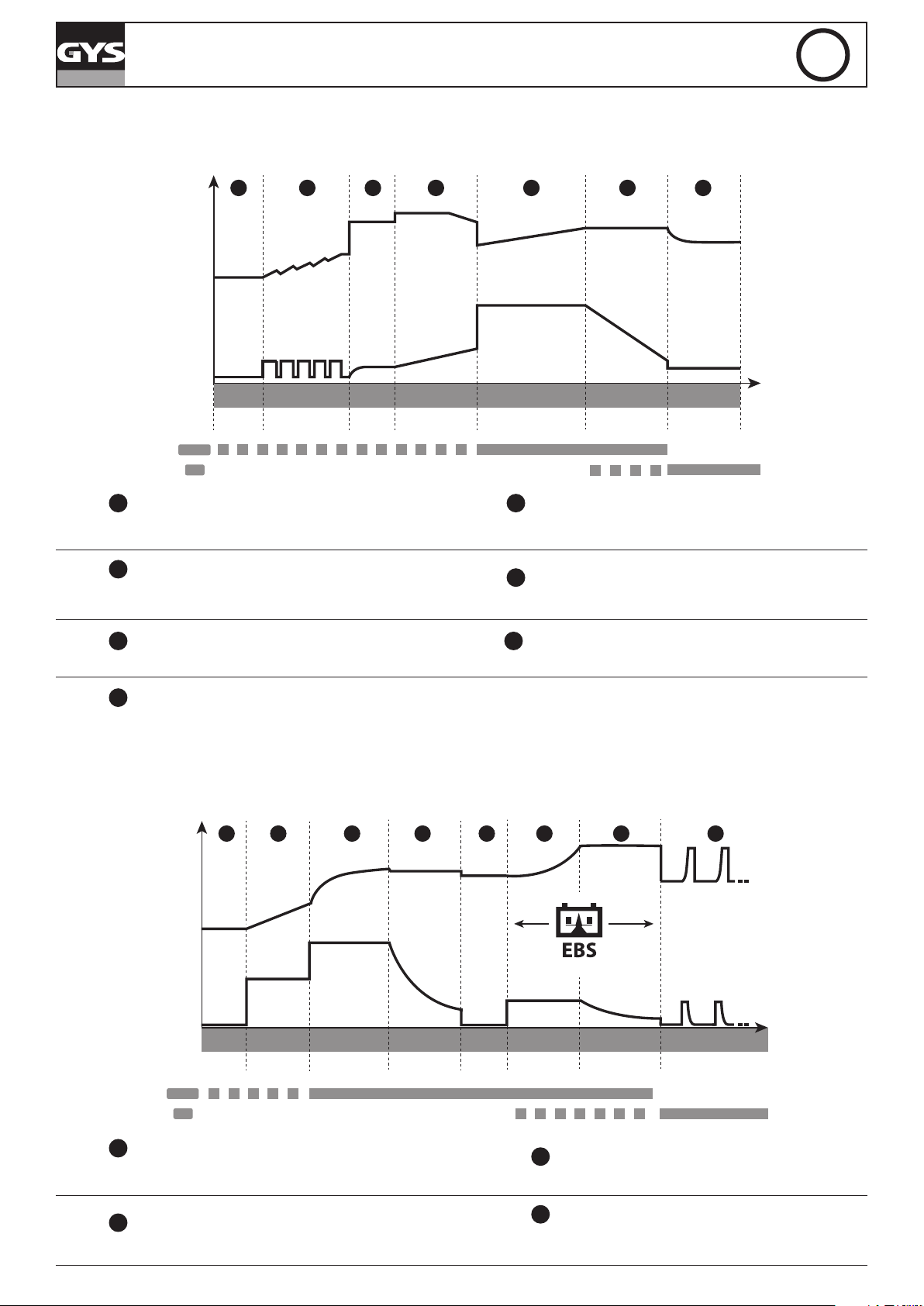
GYSFLASH 6.24 PL
Led
IT
• Curva di carica Piombo :
Il GYSash 6.24 PL utiliza una curva di carica Piombo evoluta in 7 tappe che garantisce le prestazioni ottimali della vostra batteria
al piombo.
1 2 3 4 5 6 7
U
I
Analisi Recupero Test Desolfatazione Carica Assorbimento
Max 12h<1s Max 8h
Tappa
1
: Analisi
CHARGE
Led
<1s
OK
Analisi dello stato della batteria (livello di carica, inversione di
polarità, batteria sbagliata collegata…)
Tappa
2
: Recupero (3 A)
Algoritmo di recupero degli elementi danneggiati in seguito ad
una scarica profonda.
3
Tappa
: Test
Test di batteria solfatata
Tappa
4
: Desolfatazione (31.6 V)
Max 20h
Max 8h No limit
Tappa 5 : Carica (6 A)
Carica rapida a corrente massima che permette di raggiungere
l’80% del livello di carica.
Tappa
6
: Assorbimento (29.2 V)
Carica a tensione costante per portare il livello di carica al 100%.
Tappa 7 : Mantenimento della carica (27.2 V)
Mantenimento del livello di carica della batteria al suo massimo.
Mantenimento
della carica
Algoritmo di desolfatazione della batteria.
• Curva di carica Litio :
Il GYSash 6.24 PL utilizza una curva di carica Litio evoluta in 8 tappe che garantisce le massime prestazioni della vostra batteria al
litio.
1 2 3 4 5 6 7
8
U
Equalizing Battery System
I
Analisi Recupero Carica Assorbimento Complemento
< 1s Max 5 min Max 25 h Max 20 h 3 min Max 10 h Max 2 h No limit
CHARGE
OK
Tappa
1
: Analisi
Analisi dello stato della batteria (livello di carica, inversione di
polarità, batteria sbagliata collegata…)
Tappa
2
: Recupero (0.5 A)
Algoritmo di ricupero in seguito ad una scarica profonda.
Test
Tappa 5 : Test
Test di conservazione della carica.
Tappa 6 : Complemento
Carica a corrente ridotta che permette di raggiungere il
100% del livello di carica.
Pareggiamento /
bilanciamento
Mantenimento
della carica
(manutenzione ogni 10 giorni)
35
Page 36
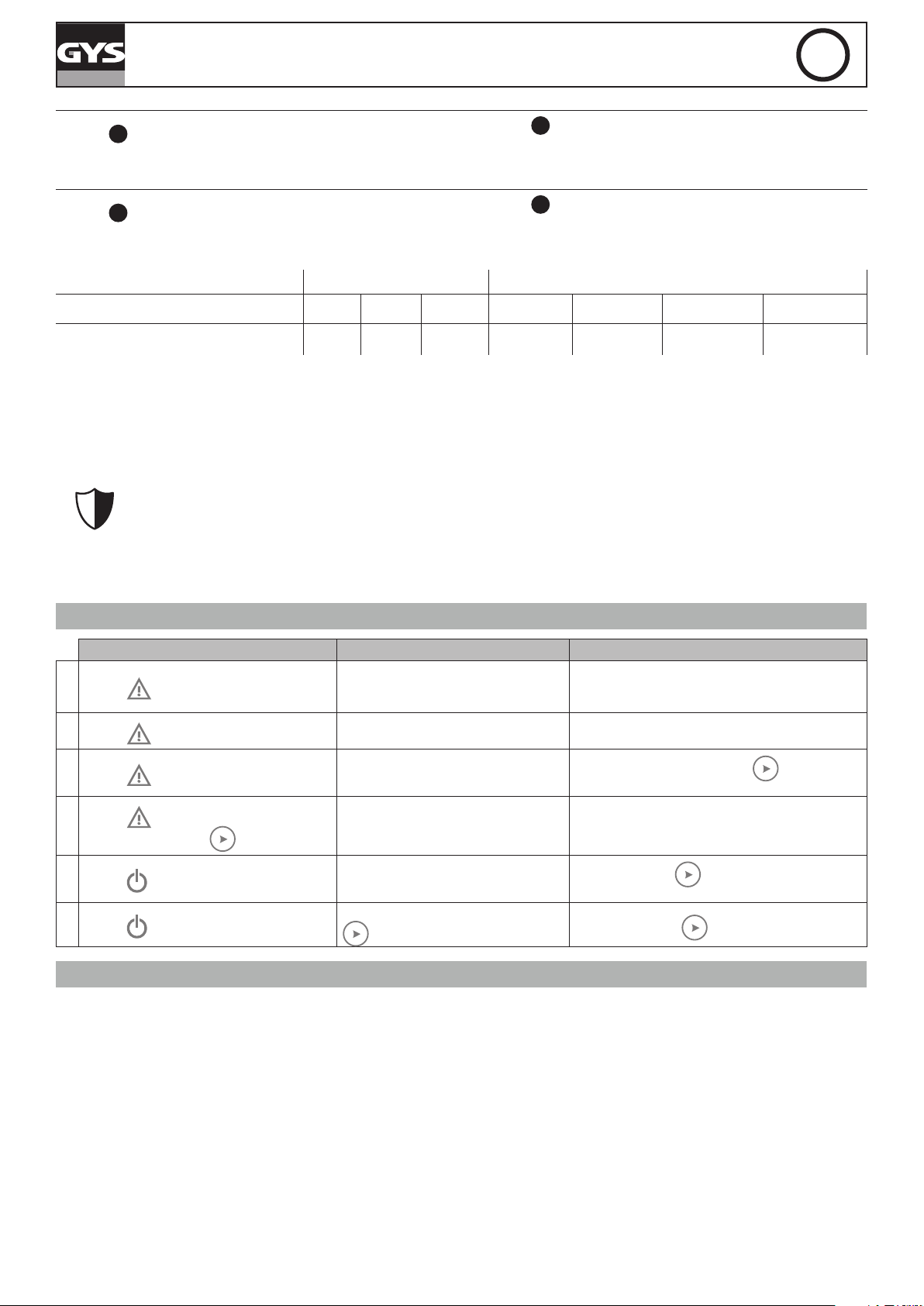
GYSFLASH 6.24 PL
IT
Tappa
3
: Carica (6 A)
Carica rapida a corrente massima che permette di raggiungere il
90% del livello di carica.
4
Tappa
: Assorbimento (27.6 V o 28.7 V)
Carica a tensione costante per portare il livello di carica al 98%.
• Tempo stimato di carica
Capacità della batteria 20 Ah 50 Ah 125 Ah
Tempo di carica
0% >> 90%
2 h 5 h 13 h 1 h 2 h 5 h 13 h
Piombo Litio
Tappa 7 : Pareggiamento / bilanciamento (29.4 V o
28.8 V)
Bilanciamento delle cellule della batteria.
Tappa 8 : Mantenimento della carica (27.6 V o 28.7 V)
Mantenimento del livello di carica della batteria al suo massimo con carica ogni 10 giorni.
6 Ah
(18 Ah EqPb*)
15 Ah
(45 Ah EqPb*)
50 Ah
(150 Ah EqPb*)
125 Ah
(350 Ah EqPb*)
*Equivalente batterie piombo: Una batteria litio possiede migliori prestazioni di avviamento (CCA) che una batteria al piombo. E’
per questo che certi fabbricanti di batterie al litio indicano l’equivalente batteria al piombo (EqPb) che corrisponde alla capacità
che avrebbe una batteria al piombo con le stesse prestazioni di avviamento. Per esempio, una batteria LFP da 10 Ah avrà le stesse
prestazioni di avviamento di una batteria al piombo da circa 30 Ah.
• Protezioni :
Il GYSFLASH 6.24 PL possiede un insieme di dispositivi che lo proteggono contro i corti circuiti e le inversioni di polarità. Dispone di un sistema che evita ogni scintilla durante il collegamento del caricabatterie alla batteria. Il caricabatterie è a doppio isolamento ed è compatibile con l’elettronica dei veicoli.
Il GYSFLASH 6.24 PL è dotato di un sensore di temperatura integrato che le permette di adattare la sua corrente di carica in funzione della temperatura dell’ambiente per evitare il surriscaldamento dell’elettronica interna.
ANOMALIE, CAUSE, RIMEDI
Anomalie Cause Rimedi
1
La spia
2
La spia
3
La spia
La spia
4
pressione sul pulsante
5
La spia
6
La spia
lampeggia velocemente.
lampeggia lentamente.
è accesa.
resta accesa anche dopo una
lampeggia.
rimane accesa.
• Inversione di polarità
• Tensione batteria troppo elevata
• Morsetti in corto circuito
Batteria fuori servizio o molto debole in
tensione.
Fallimento durante la carica, batteria
irrecuperabile.
Difetto termico
.
Caricabatteria in standby.
Carica interrotta premendo sul tasto
.
• Vericare che i morsetti sia connessi correttamente
• Vericare che si tratti di una batteria 24 V
Cambiare la batteria.
Cambiare batteria e premere su
una carica.
Temperatura circostante troppo elevata (>60°C),
aerare il locale e lasciare che il caricabatterie si
rareddi.
Premere sul tasto
caricabatterie per uscire dallo standby.
Premere ancora su
o collegare una batteria al
per rilanciare la carica.
GARANZIA
La garanzia copre qualsiasi difetto di fabbricazione per 2 anni, a partire dalla data d’acquisto (pezzi e mano d’opera).
La garanzia non copre:
• Danni dovuti al trasporto.
• La normale usura dei pezzi (Es. : cavi, morsetti, ecc.).
• Gli incidenti causati da uso improprio (errore di alimentazione, cadute, smontaggio).
• I guasti legati all’ambiente (inquinamento, ruggine, polvere).
per rilanciare
In caso di guasto, rinviare il dispositivo al distributore, allegando:
- la prova d’acquisto con data (scontrino, fattura...)
- una nota esplicativa del guasto.
36
Page 37
GYSFLASH 6.24 PL
TABLEAU TECHNIQUE / TECHNICAL TABLE / TECHNISCHE DATEN / TABLA TÉCNICA / ТАБЛИЦА С
ТЕХНИЧЕСКИМИ ХАРАКТЕРИСТИКАМИ / TABELLA TECNICA / TECHNISCHE TABEL
GYSFLASH 6.24 PL
Référence modèle
Reference
Art.-Nr. des Modells
Referencia del modelo
Tension d’alimentation assignée
Rated power supply voltage
Netzspannung
Tensión de red asignada
Puissance assignée
Rated power
Netzleistung
Potencia asignada
Tensions de sortie assignées
Rated output voltage
Ausgangsspannung
Tensiones de salida asignadas
Courants de sortie assignés
Rated output current
Ausgangsstrom
Corriente de salida asignada
Capacité assignée de batterie
Rated battery capacity
Batterie-Kapazität
Capacidad asignada de batería
Consommation batteries au repos
Battery consumption when idle
Verbrauch im Ruhezustand
Consumo de baterías en reposo
Ondulation
Ripple
Welligkeit
Ondulación
Courbe de charge
Charging curve
Ladekennlinie
Curva de carga
Température de fonctionnement
Operating temperature
Betriebstemperatur
Temperatura de funcionamiento
Température de stockage
Storage temperature
Lagertemperatur
Temperatura de almacenado
Indice de protection
Protection rating
Schutzart
Índice de protección
Classe de protection
Protection class
Schutzklasse
Clase de protección
Niveau de bruit
Noise level
Störpegel
Nivel de ruido
Poids
Weight
Gewicht
Peso
Dimensions (L x H x P)
Dimensions (L x H x D)
Abemssungen (L x H x T)
Dimensiones (L x A x A)
Normes
Standards
Normen
Normas
Артикул модели
Referentie model
Riferimento modello
Номинальное напряжение питания
Nominale voedingsspanning
Tensione di alimentazione nominale
Номинальная мощность
Nominale vermogen
Potenza nominale
Номинальные выходные напряжения
Uitgaande nominale spanning
Tensione di uscita nominale
Номинальный выходной ток
Uitgaande nominale spanning
Corrente di uscita nominale
Номинальная емкость батареи
Nominale accu capaciteit
Capacità nominale della batteria
Потребление АКБ в нерабочем состоянии
Accu verbruik in ruststand
Consumo batterie in riposo
Колебание
Golving
Ondulazione
Кривая зарядки
Laadcurve
Curva di carica
Рабочая температура
Werktemperatuur
Temperatura di funzionamento
Температура хранения
Opslagtemperatuur
Temperatura di stoccaggio
Степень защиты
Beschermingsklasse
Grado di protezione
Класс защиты
Beschermingsklasse
Classe di protezione
Уровень шума
Geluidsniveau
Livello di rumore
Вес
Gewicht
Peso
Размеры (Д x В x Ш)
Afmetingen (L x H x B)
Dimensioni (L x H x D)
Нормы
Normen
Norme
027398
~ 220-240 VAC
50 / 60 Hz
190 W
24 V DC
6 A
15 - 125 Ah (Pb)
2 - 125 Ah (Lithium)
< 1 mA
< 150 mV rms
U
IU
O
-20°C – +40°C
-20°C – +80°C
IP65
Class II
< 55 dB
1.1 Kg
221 x 111 x 58 mm
EN 60335-1
EN 60335-2-29
EN 62233
CEI EN 60529
EN 50581
EN 55014-1
EN 55014-2
CEI 61000-3-2
CEI 61000-3-3
37
Page 38
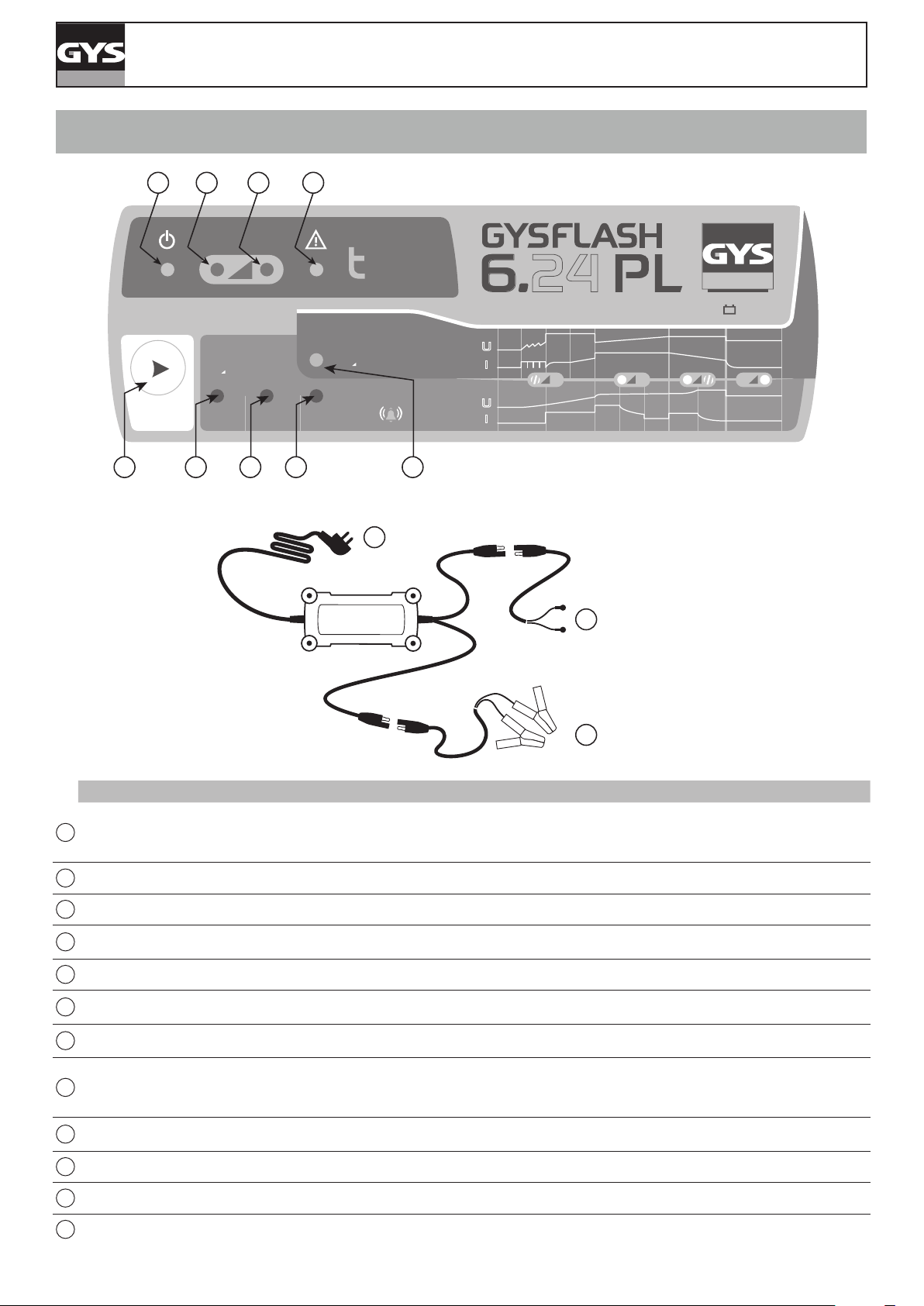
GYSFLASH 6.24 PL
PLASTRON / CONTROL PANEL STICKER / FRONTSEITE / TECLADO / ПАНЕЛЬ УПРАВЛЕНИЯ /
TASTIERA DI COMMANDO / VOORSTUK
2 3 4 5
1
/OK
Press 3s
Lithium
2 125 Ah
Li-ion LiFePO
7
OK
4
8 9
UVP
Pb
Lead acid
15 125 Ah
Option :
Wake Up
AUTOMATIC
EXTERNAL AIR
TEMP. SENSOR
6
12
6 24
Pb/Lithium
U
1
I
U
1
I
SMART CHARGER -
4
3
2
2
10
6A
24 V
5
3
4
6
6
5
7
7
8
11
FR EN DE ES RU IT NL
Bouton de sélection/
1
2 Veille Sleep mode Stand-by-Modus En espera Режим ожидания Standby Stand-by
3 Charge en cours Charge in progress Ladevorgang En proceso de carga Идет зарядка Carica in corso Bezig met opladen
4 Charge teminée Charge complete
5 Défaut Fault Defekt Fallo Ошибка Predenito Storing
6
7
8
9
10 Oeillets de charge Charging lugs Ladeösen Terminal de carga Ушки зарядки Occhiello di carica Contact ringetjes
verrouillage/
déverrouillage
Mode charge
Plomb
Mode charge lithium-
ion
Mode charge lithium
LiFePO4
Option
UVP Wake UP
Selection / lock /
unlock button
Lead-acid charge
mode
Lithium-ion charge
Mode
LiFePO4 lithium
charging mode
Option UVP Wake
UP
Auswahl-/Sperr-/
Sperr-Taste
freischalten
Abgeschlossener
Ladevorgang
Blei-Säure-Batterie-
lademodus
Lithium-Ion-Batte-
rielademodus
Lithium-LifePO4-
Batterielademodus
UVP Wake UP
Option
Botón de selección/
bloqueo/bloqueo
desbloqueo
Carga terminada Зарядка закончена Carica terminata Opladen beëindigd
Modo de carga
Plomo
Modo de carga Litio
Modo de carga Litio
Opción UVP Wake UPОпция UVP Wake UPOpzione UVP Wake
Кнопка выбора
Режим заряда
свинцовой АКБ
Режим заряда
литий-ионной АКБ
Режим заряда
литий-железо-
фосфатной АКБ
(LiFePO4)
Tasto di selezione/
blocco/sblocco
Modalità di carica
del piombo
Modalità di carica
Litio
Modalità di carica
Litio LiFePO4
UP
Knop selecteren/
vergrendelen/
vergrendelen
ontgrendeling
Laadmodule Lood
Laadmodule lithium-
ion
Laadmodule Lithium
LiFePO4
Optie UVP Wake Up
11 Pinces de charge Charge clamps Polklemmen Pinzas de carga Зажимы зарядки Morsetti di carica Laad-klemmen
12 Prise secteur Mains plug Netzsteckdose Clavija de corriente Сетевая вилка Spina Stopcontact
38
Page 39

Page 40

GYS SAS
1, rue de la Croix des Landes
CS 54159
53941 SAINT-BERTHEVIN Cedex
FRANCE
 Loading...