

Page 1

Guardian®Full-Length, Spring-Loaded Telescoping Rails
User Instructions
Model IC-6629
RISK OF SERIOUS INJURY. When using side rails, only use side rails that can be
positioned so that the gap between the side rails is large enough that the trunk
and hips can easily pass through it. Make sure when raising the bed, head section or foot section does not create any of the previously described gaps.
RISK OF SERIOUS INJURY OR DEATH. If side rail is used, follow guidelines in
rail User's Manual. Use of side rail can expose patient to risk of suffocation
if head becomes trapped between mattress and side rail.
POSSIBLE INJURY. Make sure side rails are secured properly before using bed.
RISK OF SERIOUS INJURY. Individuals with physical limitations who cannot
prevent themselves from rolling or climbing out of the bed may require other
means of safe positioning.
POSSIBLE DAMAGE OR INJURY. Do not use the side rails as handles when
moving the bed.
POSSIBLE DAMAGE OR INJURY. Side rails do not fall within any weight limitations and may be damaged if excessive pressure is placed on them. Side rails
are for the purpose of aiding in turning and repositioning within the bed and
are not intended to be used for restraint purposes.
Page 2

ASSEMBLY INSTRUCTIONS
1. Remove the mattress from the bed.
2. Place the bed in the flat position and position
one crossbrace between the second and third
springs on the head-end section of the bed
(Figure 1).
3. Ensure the bed hooks are on the bottom side of
the crossbrace and not the top
4. Secure one bed hook to the bedspring angle
iron and compress crossbrace until it is short
enough to attach to the opposite side of the
bed (Figure 2). Ensure the crossbrace attaches
to the bedspring angle iron (Figure 3).
5. Rotate the barrel so the long end faces the
ground.
6. Inspect the crossbraces to ensure proper and
secure attachment.
7. Position another crossbrace between the second
and third springs on the foot-end section of the
bed. Then repeat steps 3-6 on to ensure proper
installation.
8. Once crossbraces are securely attached, place
mattress on the bed frame.
9. Insert the rail into the slide tubes. Pull the
plunger knob to adjust the rail height.
RISK OF SERIOUS INJURY OR DEATH. When using side rails, use a mattress thick
enough and wide enough so that the gap between the top of the mattress and
the bottom of the side rails and the gap between the side of the mattress and
the side rails is small enough to prevent a patient from getting his or her head
or neck between the mattress and the side rail. Assure that articulating the
bed, head section or foot section does not create any hazardous gaps. Failure
to do so could result in injury or possible suffocation.
RISK OF SERIOUS INJURY OR DEATH. When using side rails, only use side rails
that can be positioned so that the gap between the headboard or foot board
and the side rails is small enough to prevent a patient from getting his or
her head or neck between the mattress and the side rail or large enough that
the trunk and hips can easily pass through it. Assure that articulating the
bed, head section or foot section does not create any hazardous gaps. Failure
to do so could result in injury or possible suffocation.
RISK OF SERIOUS INJURY OR DEATH. When using side rails, only use side rails
in which any gaps between the rail body members are small enough to prevent
a patient from getting his or her head or neck inside the rail body. Failure to
do so could result in injury or possible suffocation.
RISK OF SERIOUS INJURY. When using multiple side rails on one or both
sides of the bed, only use side rails that can be positioned so that the gap
between the side rails is large enough that the trunk and hips can easily
pass through it. Assure that articulating the bed head section or foot section
does not create any hazardous gaps.
Figure 1
Figure 2
Figure 3
Page 3
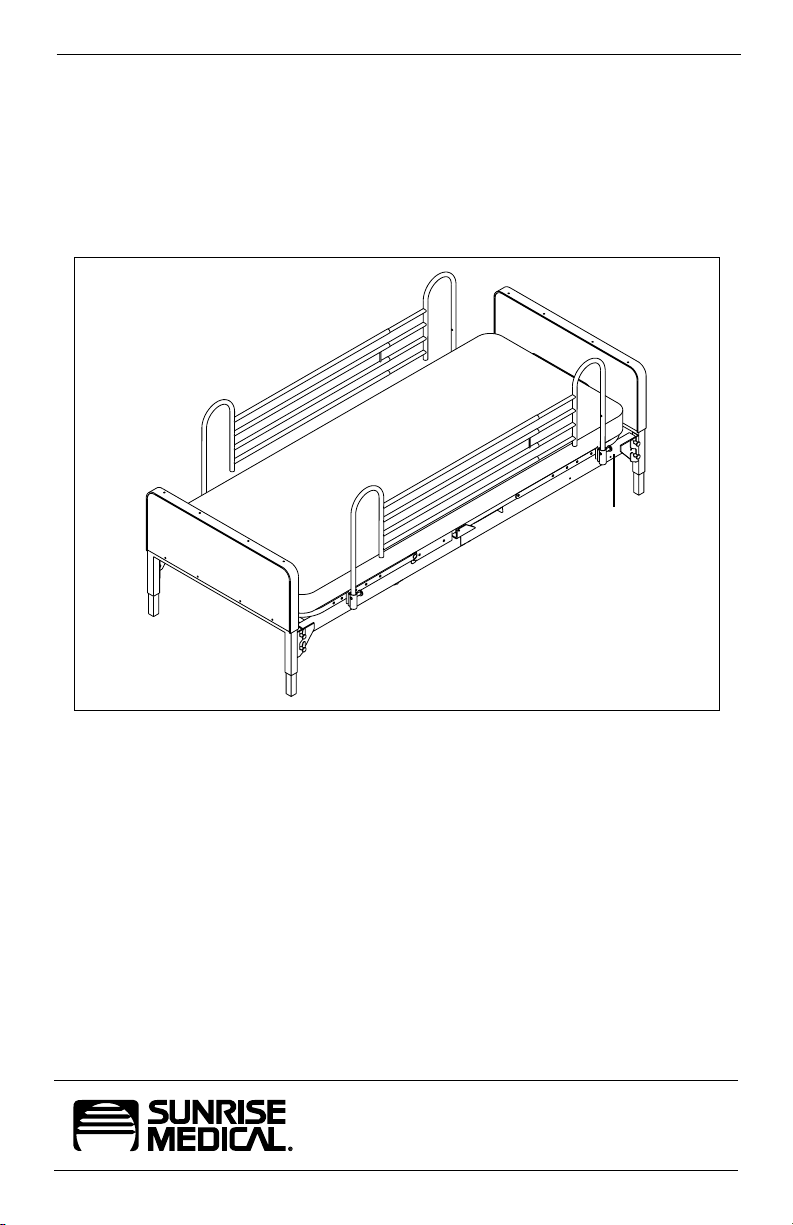
OPERATING INSTRUCTIONS
1. Hold the rail securely, then pull the plunger knob (Figure 4).
2. Lower or raise the rail to desired height, then release the knob until the rail
locks into the appropriate rail adjusting hole.
3. Ensure the head-end and foot-end of bed rails are adjusted to the same height
prior to use.
© 2002 Sunrise Medical 7.02
IM-429005 Rev. A
Manufactured for:
Sunrise Medical, Inc.
7477 East Dry Creek Parkway
Longmont, Colorado 80503
Printed in Taiwan
www.sunrisemedical.com
Phone: (303) 218-4500
Toll Free Phone: (800) 333-4000
In Canada: (800) 263-3390
Plunger Knob
Figure 4
 Loading...