

Page 1
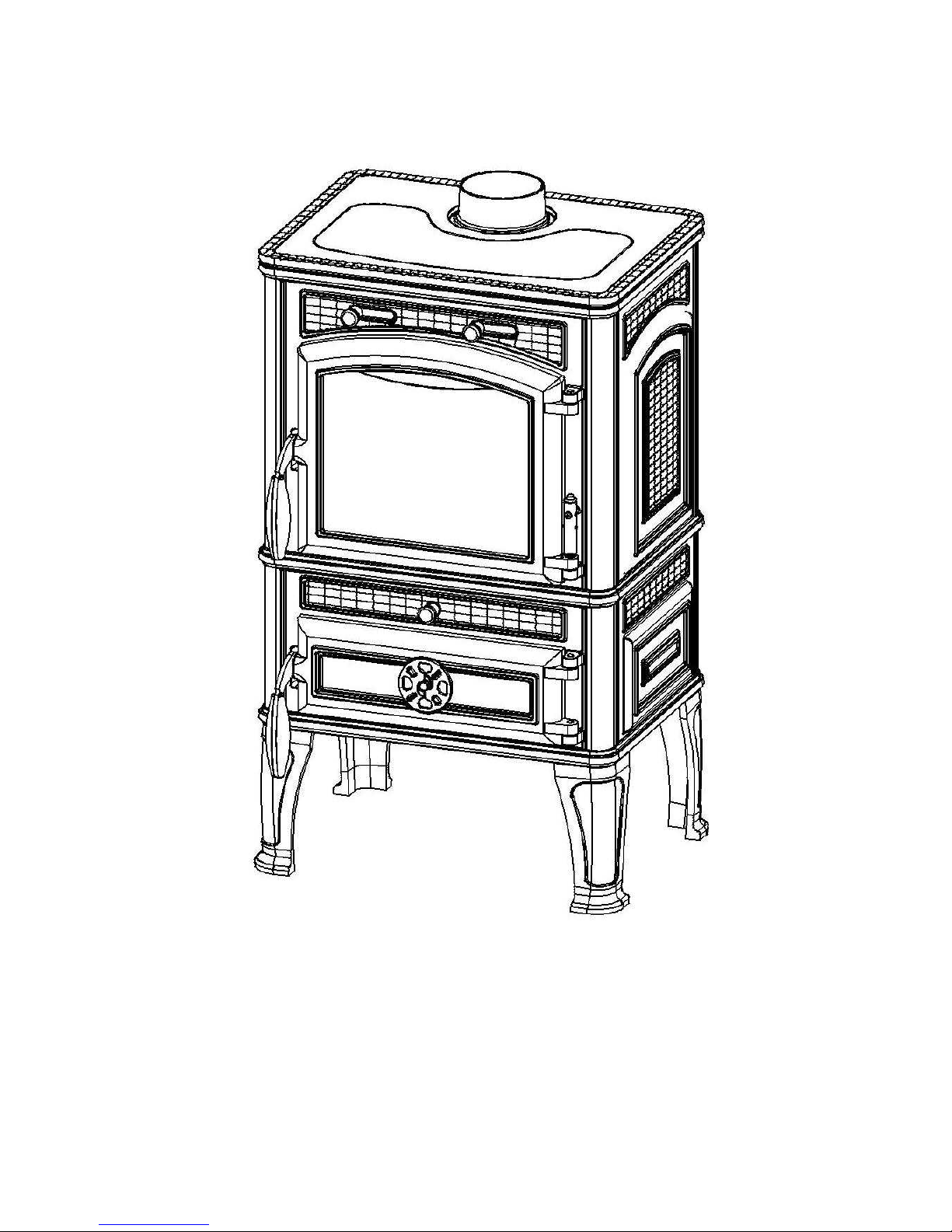
Concern“FARMAKOM M.B.“Šabac Industrijski kombinat“ GUČA“ AD Guča
Installation Manual
Model: LAVA
Page 2
Owners Manual
for
Lava
Imported by:
Sopka Inc
4181 Plymouth Road
Cleveland, OH 44109
USA
www.sopkainc.com
tested to UL 1482, ULC-S627
Solid Fuel Room Heater
PLEASE READ ALL INSTRUCTIONS BEFORE YOU INSTALL YOUR NEW STOVE.
FAILURE TO FOLLOW INSTRUCTIONS MAY RESULT IN PROPERTY DAMAGE,
BODILY INJURY, OR EVEN DEATH.
SAFETY NOTICE: FOR YOUR SAFETY, CONTACT LOCAL BUILDING OR FIRE
OFFICIAL ABOUT PERMITS, RESTRICTIONS, AND INSTALLATION REQUIREMENTS FOR YOUR AREA. PLEASE CHECK WITH YOUR INSURANCE BEFORE
USING IN YOUR HOME. USE PROFESSIONAL INSTALLER.
CAUTION
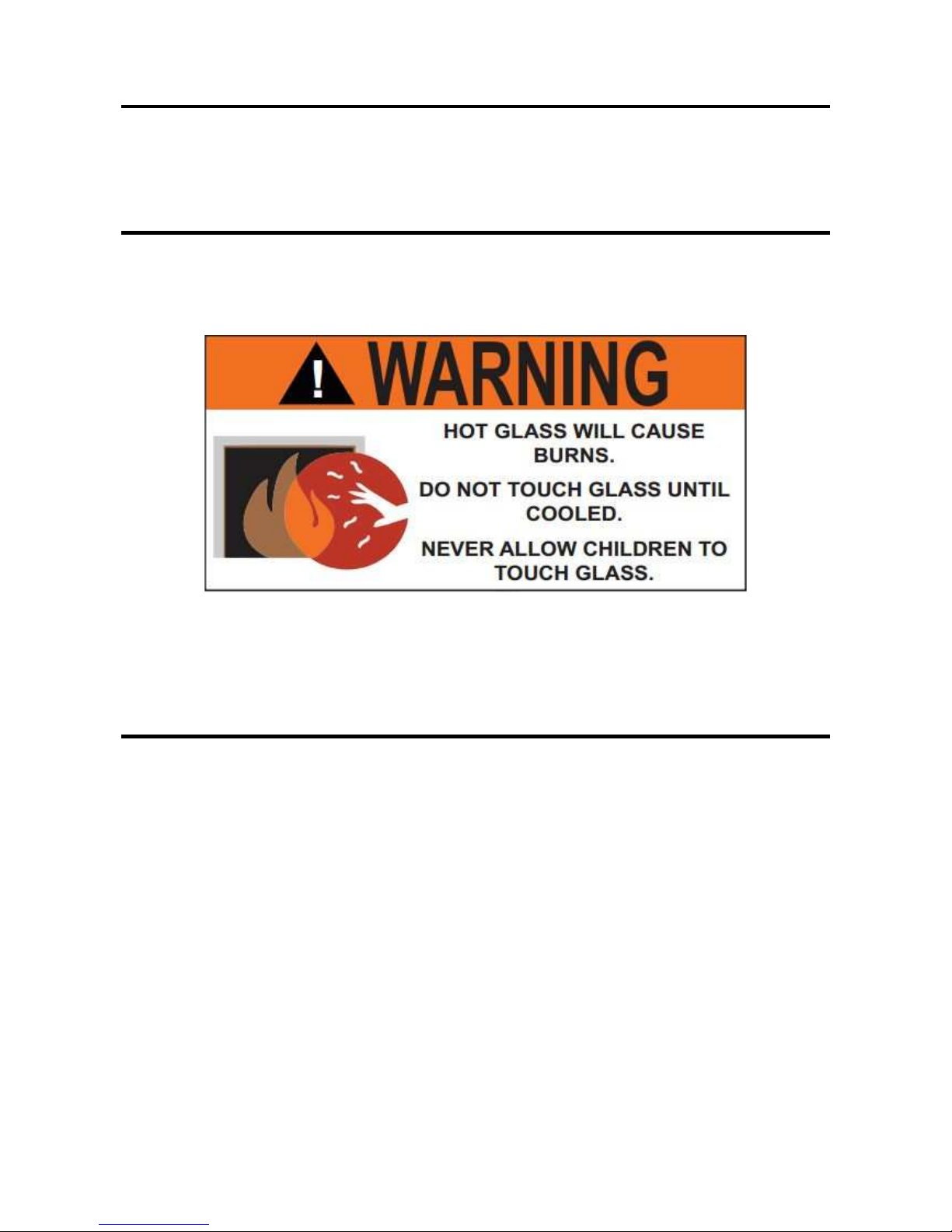
Hot while in operation- do not touch
Contact may cause skin burns
Keep children and clothing away
Keep furnishing and other combustible materials a
considerable distance away from stove.
Do not overfire. If stove or chimney connector glows, you are overfiring
DO NOT INSTALL IN MOBILE HOME OR TRAILER
1
Page 3
Dear customer,
First of all we would like to thank you for having chosen us and your trust in us will not be failed.
You will be satisfied with your choice, as our stove is in the leading category of the similar products
due to its features and design.
Yours sincerely,
GUČA
Page 4
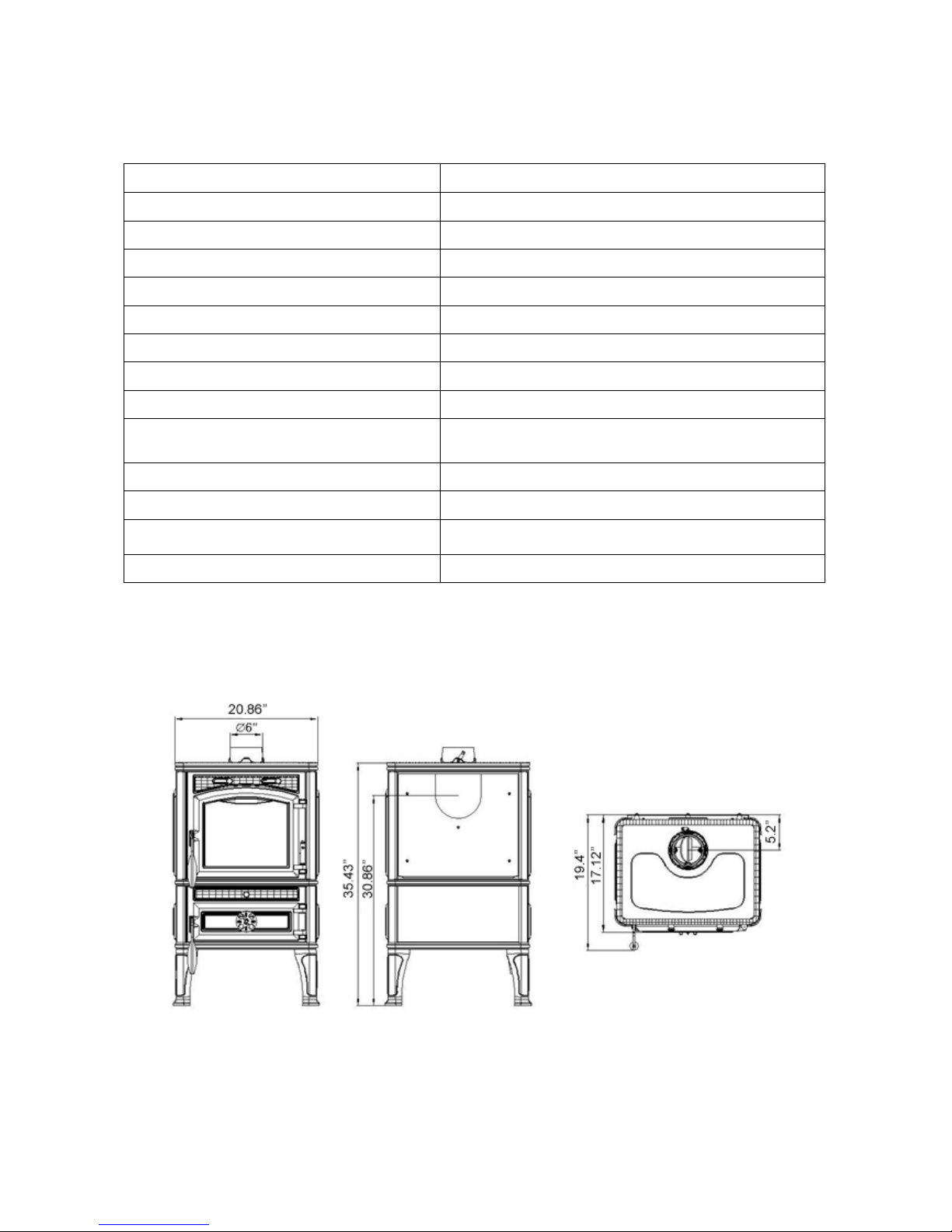
2. TECHNICAL FEATURES
Definition: solid fuel-burning stove tested according to: EN 13240
Constructive System
*
Rating power in kW 12.5 44,000 btu
Efficiency in % 78.1
Pipe diameter in mm 120 150……(6”)
Maximum quantity of fuel-wood in kg 3.3 7 lbs
Mean content of CO to 13% O2 in % 0.2667
Emission of exhaust gasses in C° - wood
283.3
Size of hearth opening in mm (W x H) 340x286………………(13.4”x11.25”)
Hearth body size (W x H x P) 450x230 x 334………..(17.7”x9”x13.15”)
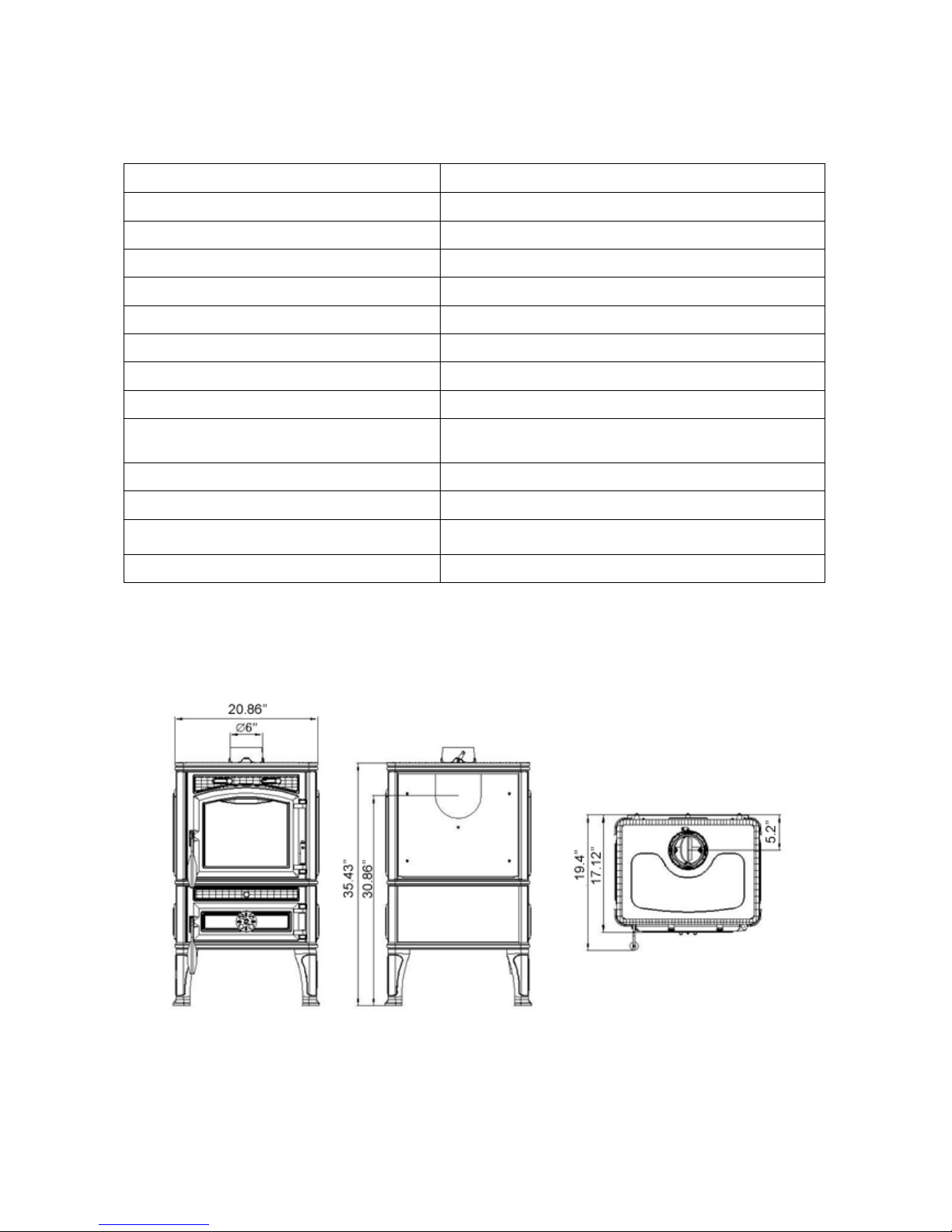
Stove height in mm 946…………………….(35.43”)
Stove width in mm 540……………………(21.25”)
Stove depth (with handles) in mm 493…………………….(19.4”)
Weight in kg 155…………………….(341lbs)
Outer smoke output in mm 900…………………….(37.24”)
Accessory: glove
* Hearth door is closed automatically (there is the system for automatic door closing with a spring)
□ *
Hearth door is closed automatically
□ *
Hearth door is not closed automatically
Page 5

SAFETY INSTRUCTIONS
Read all instructions carefully.
1. The installation of this stove must comply with your local building codes. Please observe
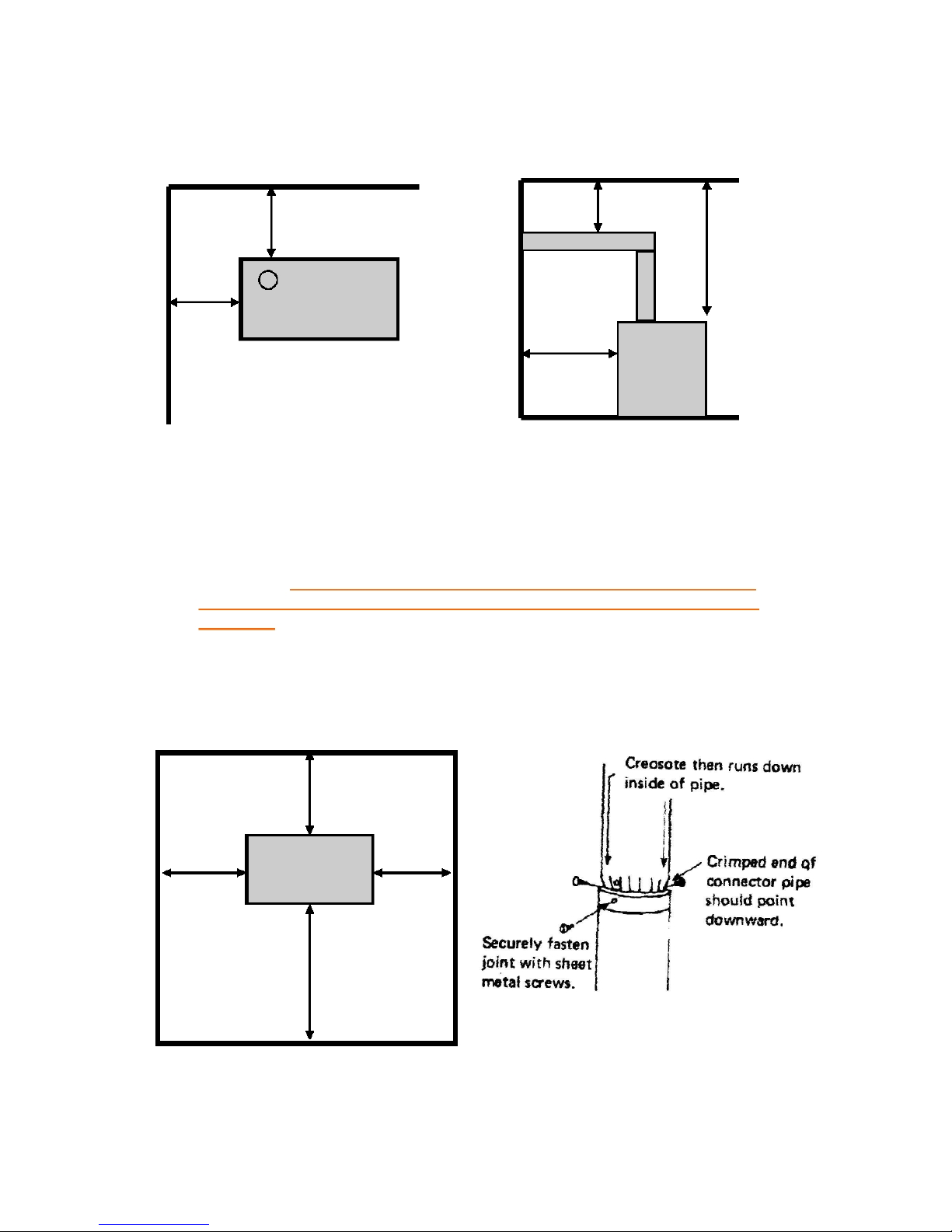
the clearance to combustible. Stove must be 27.6"(70 cm)-side, and 16" (40cm)-back, from
any combustible material, wall, wood, furniture, paper, etc. Note: Drywall faced with bricks
or stone should be consider a combustible surface.
2. Always connect this stove to a chimney and vent outside. This stove requires approved ma-
sonry or factory build 6" diameter UL 103 Type HT chimney, that is high enough to give
good draft.
3. Do NOT connect this stove to a chimney flue serving another appliance.
4. Be sure that your chimney is safely constructed and in good repair. Have chimney inspected
by the fire department or a qualified inspector.
5. Creosote or soot may build up in the chimney connector and chimney and may cause a
house or building fire. Inspect the chimney connector and chimney twice monthly during
the heating season and clean if necessary.
6. Burning any kind of fuel uses oxygen from the dwelling. Provide fresh air for proper com-
bustion from outside the house into the room where the stove is located.
7. To prevent injury, do NOT allow anyone to use this stove who is unfamiliar with the correct
operation of the stove. Do not operate stove while under the influence of drugs or alcohol.
8. Flue connector pipe should be 6" diameter, minimum single wall 24 msg black or 25 msg
blued steel. (Listed to UL 103, Type HT and evaluated to CAN/ULC-S629-M87)
9. Do Not overfire. The special paint used on stove may give off some smoke and an odor
while they are curing during first few fires. Open windows and doors as needed to clear
smoke and odor. Overfiring may cause some damage to the stove.
10. Use only dry, seasoned, natural untreated wood. Do not burn garbage or flammable fluids,
such as gasoline, naphtha, kerosene or engine oil.
11. Use the metal ash drawer only to dispose of ashes. Dispose of ashes in a metal container
with a tight fitting lid. Keep the closed container on a non-combustible floor, well away
from all combustible materials. Keep ashes in the closed container until all cinders have
thoroughly cooled. The ashes may be buried in the ground or picked up by a refuse collector.
12. CAUTION: Hot while in operation. All person, especially young children should be alerted
and trained to stay a safe distance from the stove. Small children should be all the time carefully supervised when they are in the same room with the stove.
13. This stove requires non-combustible floor protection.
14. Keep stove area clear and free from all combustible materials such as gasoline and/or other
flammable vapors and liquids at minimum 40".
15. Never leave an unattended woodstove burning on high.
16. It is highly recommended to install smoke and carbon monoxide detectors in the home when
installing a wood stove.
SAVE THESE INSTRUCTIONS
Page 6

INSTALLATION INSTRUCTION
NOTE: Floor-Ember protection is required for spark and ash shielding, not for limiting
floor temperatures from the radiant heat of the appliance.
1. Proper clearances must be maintained for adequate air circulation. Adequate ventilation
must be provided while operating this stove.
2. The stove must be placed on solid masonry, solid concrete, or when installing on combus-
tible floor, floor must be protected by insulating plate ( steel, brass, marble, stone, ceramic
tiles, etc.) or on UL1618 listed floor protector. The base must extend at least 18" (46 cm)
beyond the front of the stove and 8"(20 cm) to the sides, and MUST extend under the stove
pipe. (Check local building codes and fire protection ordinances.) Floor protector minimum
size; 37"W x 44"D
3. The stove must have its own flue. DO NOT CONNECT THIS UNIT TO A CHIMNEY
SERVING OTHER APPLIANCES.
4. Connect flue collar to the stove and adapter . The crimped end of the stove pipe must be in-
stalled facing down to fit inside the adapter. Figure 1, page
5. Use three (3) sheet metal screws at each joint of stove pipe and adapter to firmly hold stove
pipe together. Use 6" round black/blue stove pipe (Listed to UL 103, Type HT and evaluat-
ed to CAN/ULC-S629-M87) NOT galvanized pipe. DO NOT CONNECT THIS STOVE
TO ANY AIR DISTRIBUTUIN OR DUCT SYSTEM.
6. Slope any horizontal stove pipe upward toward the chimney at least 1/4 inch for each foot
of horizontal run.
7. You must have at least 18" of clearance between any horizontal pipe and ceiling. 8.
The stove pipe must NOT extend to far into the chimney flue.
9. It is recommended that no more than two (2) 90 degree bends be used in the stove pipe in-
stallation.
10. Connect to 6" inspected masonry chimney or 6" UL Type HT listed chimney.
A PROFESSIONAL, LICENSED HEATHING AND COOLING CONTRACTOR SHOULD
BE CONSULTED IF YOU HAVE QUESTIONS REGARDING THE INSTALLATION OF
THIS SOLID FUEL BURNING APPLIANCE.
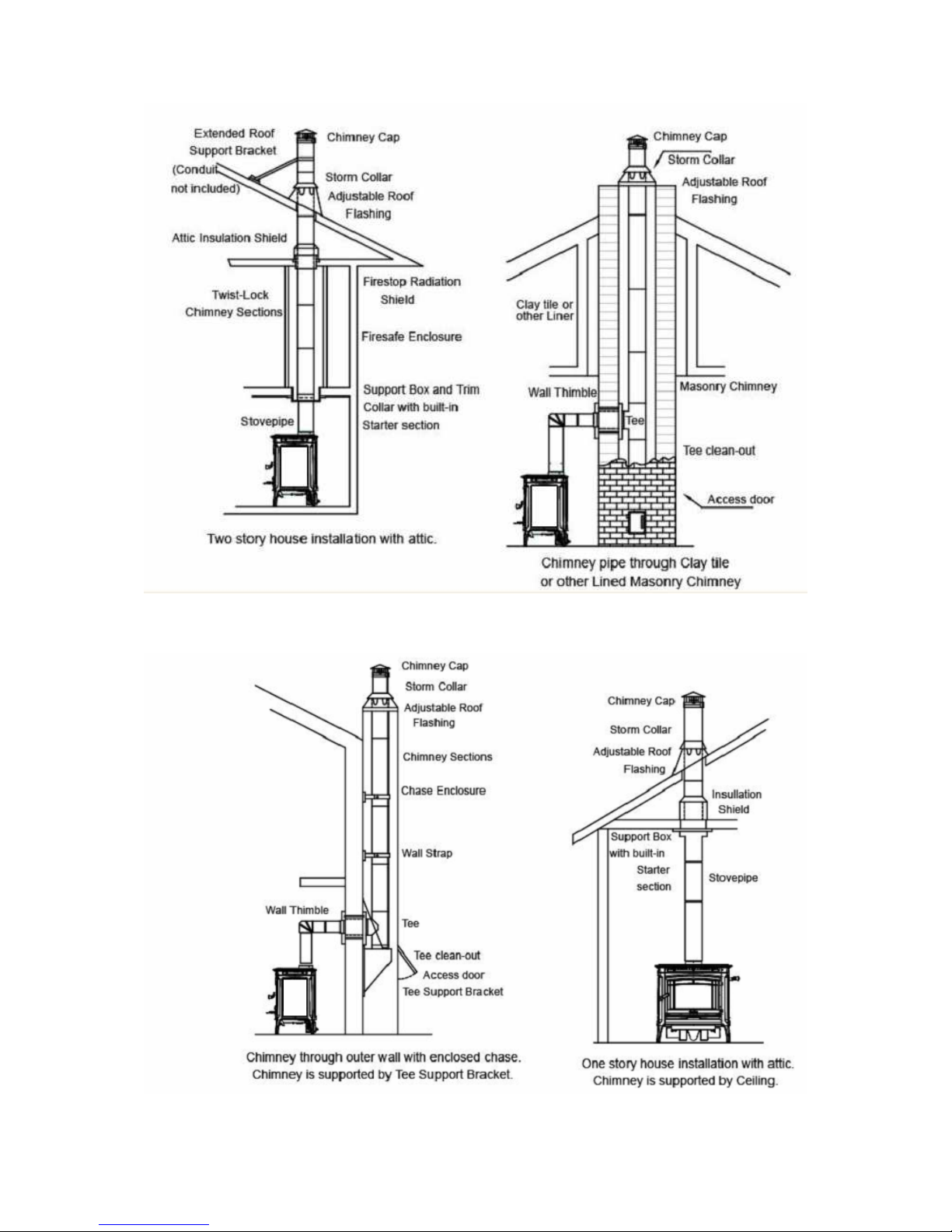
MASONRY CHIMNEY
Before using an existing masonry chimney, clean the chimney, inspect the flue liner and make
any repair needed to be sure it is safe to use.
If connector stove pipe must go through a combustible wall before entering the masonry chim-
ney, consult a qualified mason or chimney dealer. The installation must conform to local fire
codes, and NFPA 211.
Do NOT connect this stove into the same chimney flue as the fireplace or flue from another
stove. If there is a cleanout opening in the base of the chimney, close it tightly.
UL LISTED CHIMNEY
Carefully follow chimney manufacturer's instructions. Us only a UL 103 Type HT Listed Resi-
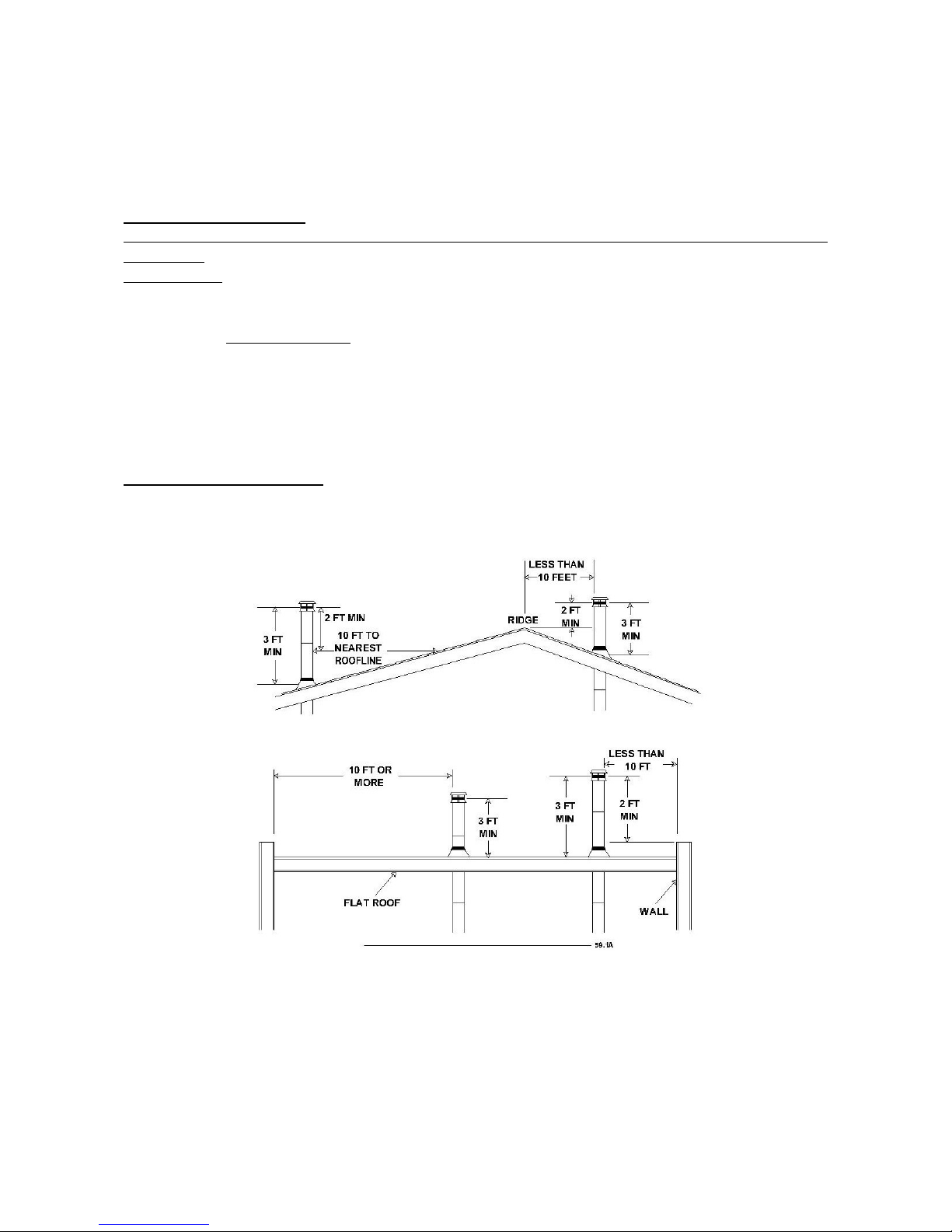
dential Type and Building Heating Appliance Chimney. The top of the chimney must be at least
three (3) feet above the roof and be at least two (2) feet higher than any point of the roof within
ten (10) feet.
Page 7
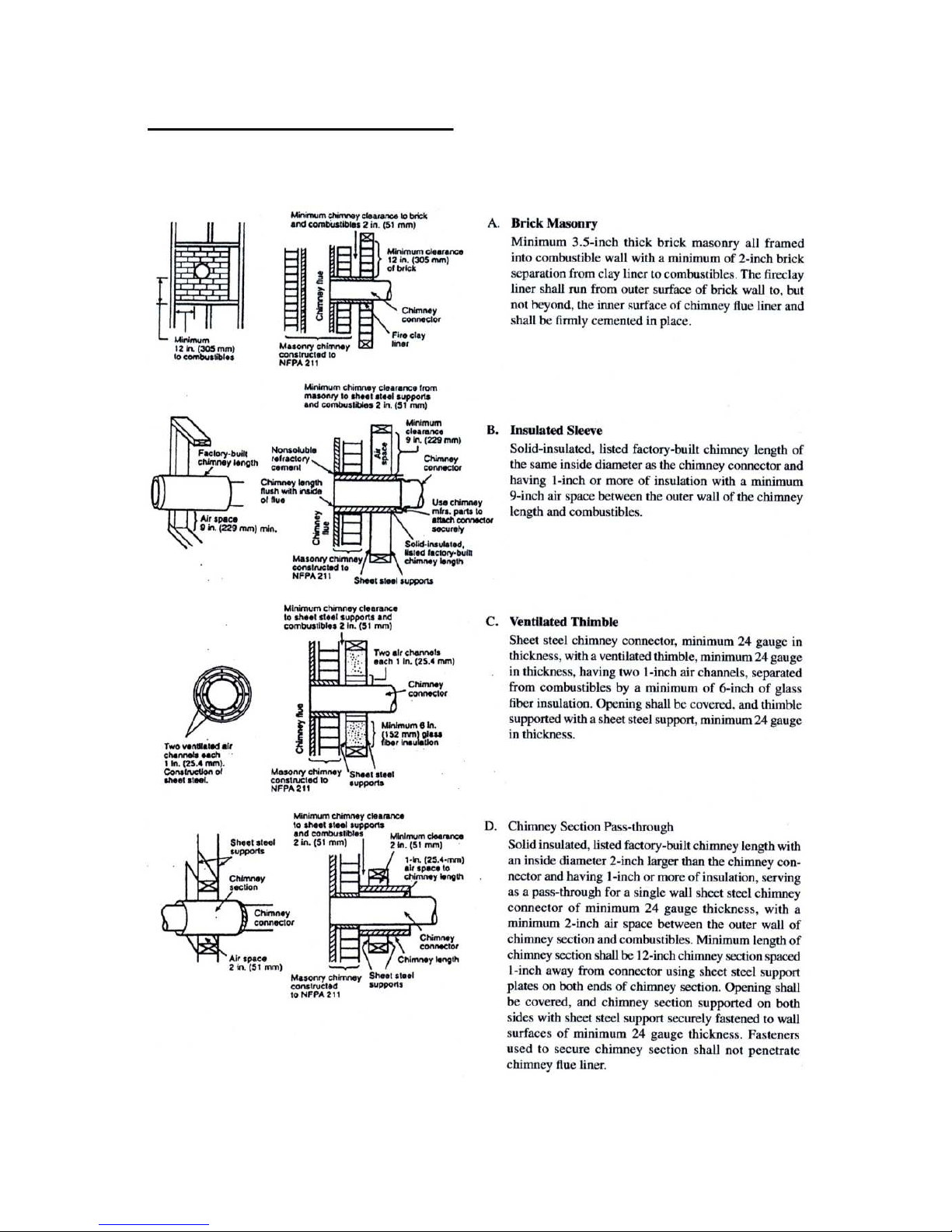
Chimney connector systems and clearances
Chimney connector shall not pass through attic or roof space, closet or similar concealed space, or a floor,
or ceiling. When passage through a wall, or partition of combustible is desired, the installation shall conform to CAN/CSA-B365, Installation Code for Solid-Fuel-Burning Appliances and Equipment:
Page 8
Page 9
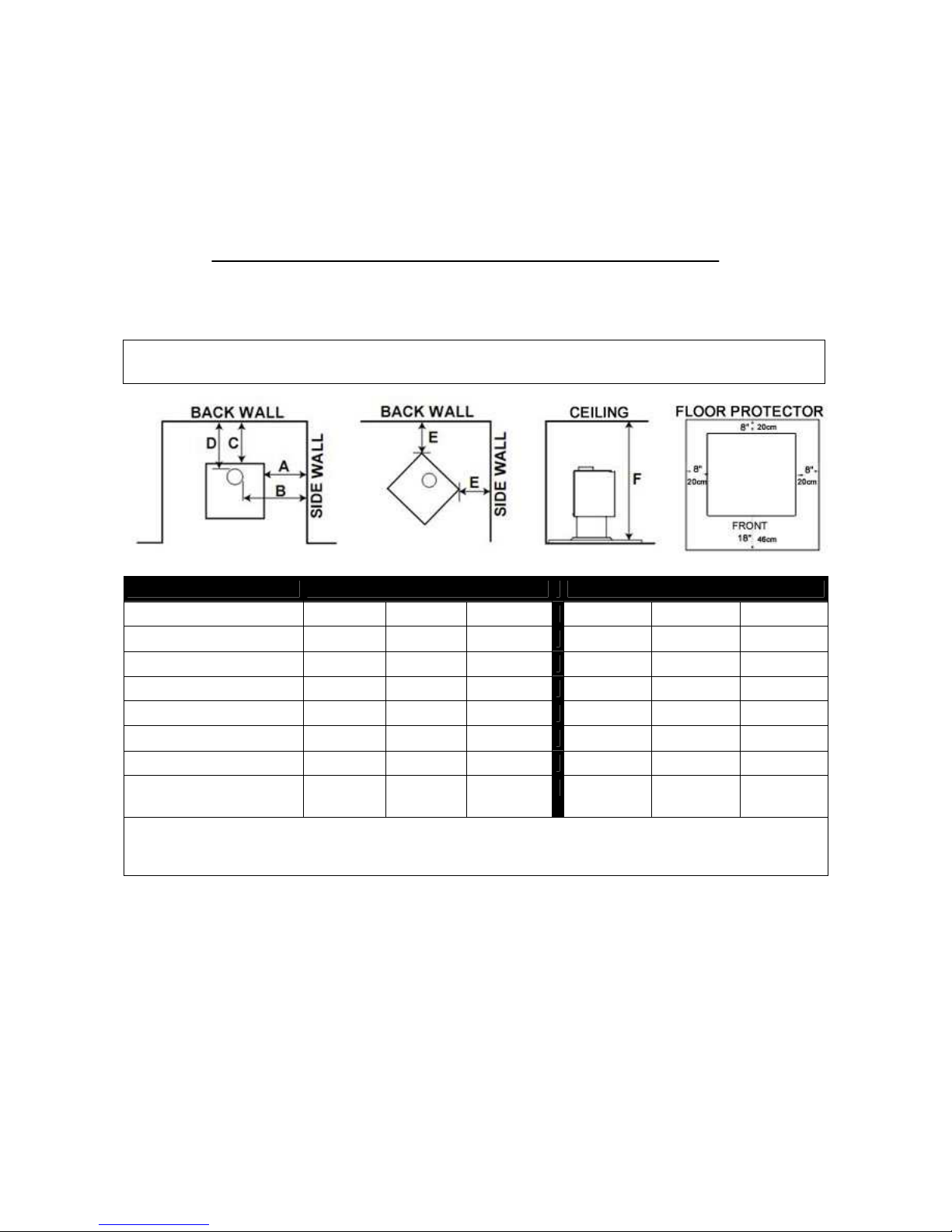
APPLIANCE PLACEMENT
Have an authorized dealer install the appliance. If you install the appliance yourself, have your dealer review
your installation plans and/or installation.
Draw out a detailed plan of the installation including dimensions and verify the dimensions with the
requirements listed in this manual.
You may wish to adjust the appliance position slightly to ensure the vent does not intersect with a framing
member. Appliance must be positioned so that no combustibles are within, or can swing within (e.g. drapes,
doors), 48” of the front of the appliance.
CLEARANCE TO COMBUSTIBLES
DO NOT INSTALL INTO ANY AREA HAVING A HEIGHT LESS THAN 7 FEET (CEILING OF
ENCLOSURE TO APPLIANCE BOTTOM EXCLUDING HEARTH HEIGHT).
PARALLEL & CORNER SINGLE WALL CONNECTOR
DOUBLE WALL CONNECTOR
Lava
Lava
SIDEWALL (A)
SIDEWALL TO FLUE (B)
BACKWALL (C)
BACKWALL TO FLUE (D)
CORNER (E)
CEILING (F) 84”
84”
FLOOR PROTECTOR
SIZE (MIN)
37" x 44"
Clearances can be reduced with shielding acceptable to local authorities. Reduced installation must comply
with NFPA 211 or CAN/CSA-B365.
BACK WALL / MUR ARRIERE
SIDE WALL / MUR ADJACENT
CEILING / PLAFOND
FLOOR PROTECTOR / PROTECTION DE SOL
Page 10
MINIMUM CLEARANCES TO
COMBUSTIBLE SURFACES
Unit to Sidewall - - - - - - - - - - - 27.6"(70 cm)
Unit to Backwall - - - - - - - - - - - -16" (40 cm)
Unit Corner to wall - - - - - - - - 27.6"( 70 cm)
Pipe Connector to Ceiling - - - - - 18" (46 cm)
NOTE: DRYWALL FACED WITH BRICK OR
STONE SHOULD BE CONSIDER A COMBUSTIBLE SURFACE.
CAUTION: KEEP FURNISHING AND OTHER
COMBUSTIBLE MATERIALS AWAY FROM
THE STOVE.
Clearances may only be reduced by means approved by regulatory authority.
OPERATION OF THE STOVE
1. Burn wood only. The wood should be natural, air dried (seasoned) for at least six (6)
months. Before lighting open draft, located on front left or right side of stove. Light wood
using paper, twigs, etc. NEVER USE ANY FLAMMABLE LIQUIDS OR GASOLINE
TO START OR FRESHEN UP A FIRE IN THE STOVE.
2. After the fire has been started, adjust the rate of burning by opening or closing the draft con-
trol.
3. Do NOT touch the stove after firing until is has cooled.
4. Never overfire this stove by building excessively hot fires.
5. If stove begins to glow or turn red, you are overfiring the stove.
6. Inspect stovepipe every 60 days. Replace immediately if stove pipe is rusting or leaking
smoke.
7. Inspect the stove pipes, connectors, and chimney twice monthly during the heating season
and clean if necessary.
CAUTION: SLOW BURNING FIRES AND EXTENDED USE MAY CAUSE EXCESSIVE CREOSOTE BUILDUP. IGNITION OF CREOSOTE/SOOT OR OVERFIRING
MAY CAUSE CHIMNEY FIRE. CHIMNEY FIRES BURN EXTREMELY HOT AND
MAY IGNITE SURROUNDING MATERIALS. IN CASE OF CHIMNEY FIRE CALL
THE FIRE DEPARTMENT IMMEDIATELY.
CHIMNEY MAINTENANCE - Creosote/Soot Formation and Need for Removal
When wood is burned slowly, it produces tar and other organic vapors which combine with ex-
pelled moisture to form creosote. The creosote vapors condense in relatively cool chimney flue
of a slow burning fire. As a result, creosote residue accumulates on the flue lining. When ignited, this soot/creosote makes an extremely hot fire.
The chimney and the chimney connector should be inspected at least twice monthly.
If creosote/soot has accumulated, it should be removed. Failure to remove creosote/soot may
cause a house or building fire. Creosote/soot may be removed by using chimney brush.
Chimney fires burn very hot. If the chimney connector glows red, immediately call the fire de-
partment.
PROVIDE AIR INTO THE ROOM FOR PROPER COMBUSTION.
Page 11

CAUTION: HOT WHILE IN OPERATION. KEEP CHILDREN, ANIMALS, CLOTH-
ING AND FURNITURE AWAY FROM THE STOVE. DO NOT TOUCH HOT STOVE.
CONTACT MAY CAUSE SKIN BURNS. TRAIN CHILDREN TO STAY A SAFE DISTANCE FROM THE UNIT. CHILDREN SHOULD BE ALL THE TIME CAREFULLY
SUPERVISED WHEN THEY ARE IN THE SAME ROOM WITH THE STOVE.
CAUTION: NEVER USE CHEMICALS, GASOLINE, KEROSENE, CHARCOAL
LIGHTER FLUID OR SIMILAR FLAMMABLE LIQUIDS TO START OR FRESHEN
UP A FIRE IN THE STOVE.
KEEP ALL FLAMMEBLE LIQUIDS AWAY FROM THE STOVE-WHETER IN USE
OR IN STORAGE.
OPERATING SAFETY PRECAUTIONS
1. NEVER BUILD EXTREMELY LARGE FIRES IN THE STOVE AS DAMAGE TO
THE STOVE OR SMOKE LEAKAGE MAY RESULT.
2. NEVER OVERFIRE THIS STOVE BY BUILDING EXCESSIVELY HOT FIRES AS
A HOUSE OR BULDING FIRE MAY RESULT. YOU ARE OVERFIRING THE
STOVE IF STOVE OR STOVE PIPE BEGINS TO GLOW OR TURN RED.
3. PROVIDE AIR INTO THE ROOM FOR PROPER COMBUSTION.
4. USE SOLID NATURAL AIR DRIED (SEASONED) WOOD and COAL, only.
5. INSPECT STOVE PIPES, CHIMNEY AND STOVE AT LEAST TWICE A MONTH
AND CLEAN IF NECESSARY.
6. WHILE IN OPERATION, KEEP THE FEED DOOR CLOSED ALL THE TIME,
EXCEPT WHILE TENDING THE FIRE. ALWAYS OPEN DRAFT CONTROLER
BEFORE OPENING THE FEED DOOR.
ABOUT DRAFT:
The principle of draft is that warm air rises. Your chimney provides draft which sucks the
smoke up the chimney. The stove does NOT PUSH out the smoke. Your stove has been design
and approved for use under normal conditions. Unacceptable smoking usually indicates poor
draft in your chimney. Normal operating draft for this stove is 12 Pa +- 2 Pa( 0.04 w.c. - 0.055
w.c.). For draft above 15 Pa ( 0.06 w.c.) install a stovepipe damper. Gauges to measure draft are
readily available at stove stores and are economical to rent or purchase.
Should you have a problem with inadequate draft, you should contact a licensed heating and
cooling contractor for assistance in solving the problem.
PROBABLE CAUSES FOR SMOKING ARE:
Insufficient chimney height above nearby obstructions.
Clogged or obstructed chimney system
Downdraft caused by nearby trees, hills, buildings, etc.
Negative draft. In a cold chimney, a cold air column rushing down the chimney can prevent
stove start-up causing the stove or chimney pipe joins to smoke. SOLUTION: Open nearby
window, and use small strips of newspaper or tinder loosely placed in the firebox that will provide quick and hot heat up the chimney, thereby reversing draft.
Page 12
BACK WALL
CEILING
S
I
D
E
W
A
L
L
2 7 .6 "
70 c m
16"
40 c m
18"
16"
40 cm
46 c m
48"
122 cm
SINGLE WALL PIPE-MINIMUM CLEARANCES FOR USA/CANADA
Some example of clearance reduction;
Using heat shields on back and sidewalls allowing at least 1" of space away from the
walls for ventilation. The inch spacing is necessary to ensure air circulation between
the protection and the wall so that the wall is not subject to high temperatures. The
spacer used must be non-combustible. Another method to achieve the same type of
protection is using brick or masonry with 1" air space between the brick or masonry
and the wall. When reducing distances, please check local codes and consult with
professional installer. Reduced installation must comply with NFPA 211 or CAN/
CSA-B365
- WARNING: Do not place stove to close to the shield. There should be enough space
between for proper air ventilation.
FLOOR PROTECTOR
8" 20cm
8" 8"
20cm 20cm
18" 46 cm
Figure 1. Proper connection of stovepipe
FRONT
Page 13
1. INTRODUCTION
Read the instructions carefully and follow the rules and recommendations. Hereinafter you will find
the data regarding the stove itself, as well as the recommendations for the installation and
maintenance of the stove.
The efficiency of a stove depends on its correct installation, which must be carried out by a
professional following the highest standards and the safety regulations in force.
The place you intend to install the stove must have sufficient airspace and the floor and surrounding
object must be made of a non-flammable material.
Pay attention to the bearing capacity of the floor. In case that the floor cannot endure the weight of
the stove, it is necessary to reinforce it or set additional girders respecting advices of experts.
Moreover, if there is a flammable floor, it must be protected by an insulating plate (steel, brass,
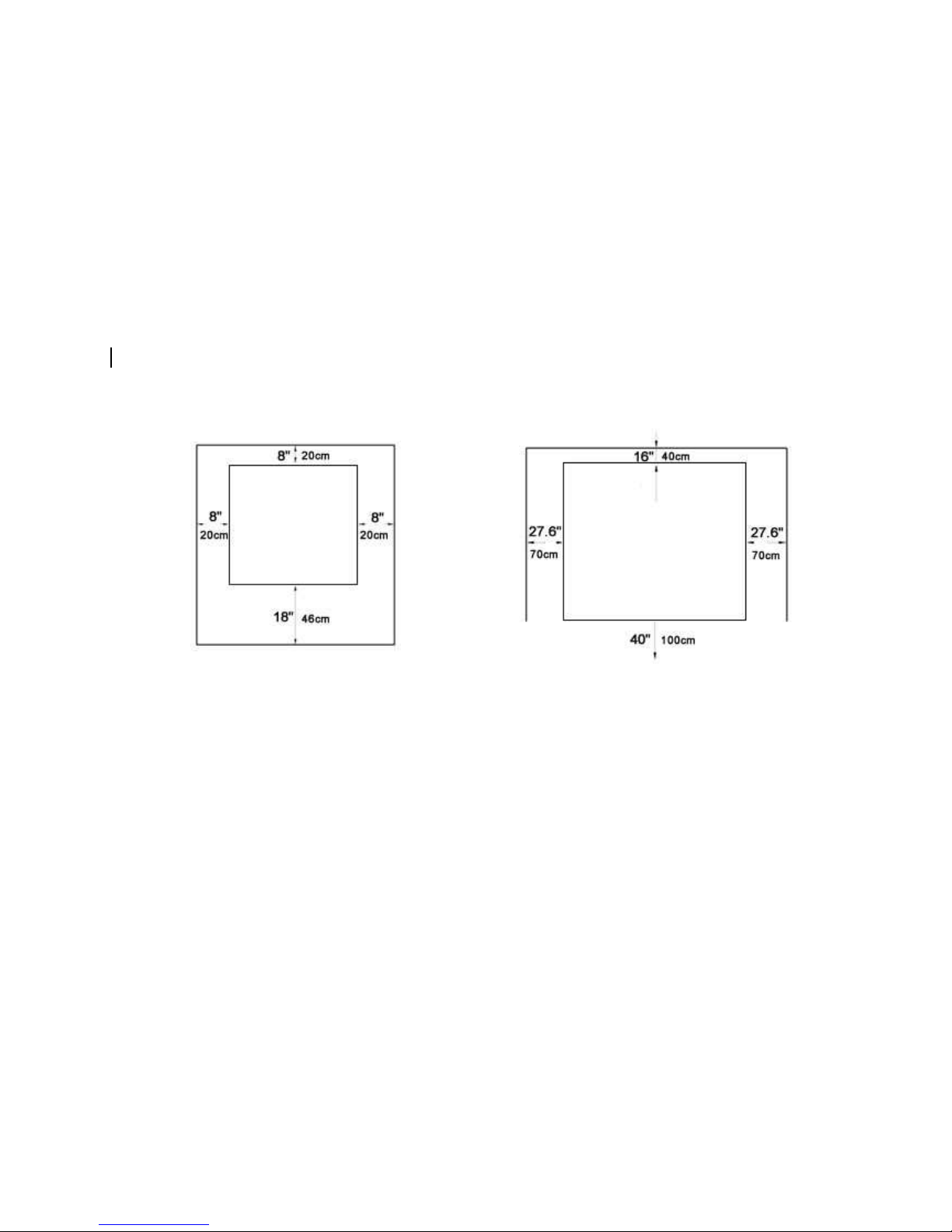
marble, stone, etc.), which extends at least 46 cm(18”) from the front and at least 20 cm(8”) from
the sides. (picture 1). Minimum size 37”(94cm)W x 44(112cm)”D
Do not place armchairs, seats, curtains or any other flammable objects unmentioned here within 100
cm(40”) from the stove, as well as within 70 cm(27.6”) on the sides, and 40 cm(15.8”) from the
back side. (picture 2)
picture 1 picture 2
The cast iron parts are protected by heat resistant paint and during the first few exploitations smoke
and smells which are products of paint stabilization occur. The room has to be properly ventilated.
The stove is to work with the doors closed.
Open the door only in the case of fuel addition. Open the door slowly in order to equalize the
pressure. Abrupt door opening can cause smoke suppression.
Add fuel only when ember is created.
The stove is heated during operation, so take the necessary measures of precaution. The door handle
is heated during operation so use a glove when opening the door. Do not touch hot parts of the
stove.
We recommend installing smoke pipes with installed smoke gasses regulator for obtaining optimal
results.
Children should not be allowed to play near the stove or handle it.
Provide continuous flow of combustion air.
It is forbidden to place explosive devices and matters into the hearth and on parts of the stove.
Parts of packing should be properly disposed. Elements from cardbox, wood or plastic which are
entered into the furnace space should be taken out before putting the stove into operation. Ne
careful when taking out the packaging because wooden bars are connected with rails.
IN CASE OF NON-OBSERVANCE OF THE INDICATIONS ABOVE-QUOTED, THE
MANUFACTURER DISCLAIMS ALL RESPONSIBILITIES FOR POSSIBLE DAMAGE.
Page 14
2. TECHNICAL FEATURES
Definition: solid fuel-burning stove tested according to: EN 13240
Constructive System
*
Rating power in kW 12.5 44,000 btu
Efficiency in % 78.1
Pipe diameter in mm 120 150……(6”)
Maximum quantity of fuel-wood in kg 3.3 7 lbs
Mean content of CO to 13% O2 in % 0.2667
Emission of exhaust gasses in C° - wood
283.3
Size of hearth opening in mm (W x H) 340x286………………(13.4”x11.25”)
Hearth body size (W x H x P) 450x230 x 334………..(17.7”x9”x13.15”)
Stove height in mm 946…………………….(35.43”)
Stove width in mm 540……………………(21.25”)
Stove depth (with handles) in mm 493…………………….(19.4”)
Weight in kg 155…………………….(341lbs)
Outer smoke output in mm 900…………………….(37.24”)
Accessory: glove
* Hearth door is closed automatically (there is the system for automatic door closing with a spring)
□ *
Hearth door is closed automatically
□ *
Hearth door is not closed automatically
Page 15

3. WORKING PRINCIPLE OF THE STOVE
3.1 Description of the stove
The stove is designed to be used for indoor heating. The heat is diffused by radiation through the
panoramic glass and the parts of the stove made of cast iron.
Parts of the stove are made of cast iron, and the hearth is equipped with a panoramic door with heat
resistant glass.
The stove has the primary and secondary air control by which the combustion air is adjusted. The
primary air control must be completely opened during the lightning phase (15 – 20 minutes).
During wood combustion, the primary air control is closed, otherwise the wood burns fast. The
secondary air control enables the glass to stay clean during wood combustion and provides
additional combustion.
3.2 Installation
The installation of the stove must be carried out by qualified people who are aware of the
safety measures regarding the stove installation. A badly installed stove can cause serious accidents
(chimney fires, burning of insulating materials, etc).
3.3 Lighting the stove for the first time
The first time the stove is lit, there will be smoke and odor given off due to the drying of the
protective color. That is normal, because the color stabilizes on temperatures over 350°C.
THE ROOM MUST BE PROPERLY VENTILATED.
Before the lighting, all parts should be cleaned with a dry cloth to remove dust and impurities.
- Upon the first ignition of the stove, we suggest loading recommended quantity of fuel reduced to
half in order to test the stove.
3.4 Ventilation of the room
Good ventilation is essential in order to provide proper operation without any risk to people who
use the room where the stove is installed, because during the combustion the stove uses the oxygen
from the air. It is necessary that the room has adjustable air openings.
ATTENTION
In case of non-observance of the indications, the manufacturer disclaims all responsibilities.
Modifications on the stove are not allowed.
Page 16
4 THE FLUE
Special attention must be paid to the quality of the flue which must be made in accordance with the
standards. The flue must be regularly maintained. The stove is connected to the flue through a
connection on the upper or back side of the stove, by the appropriate smoke pipes. The smoke pipe
must not be positioned too deep in the flue so as not to decrease the surface of the cross-section and,
in that manner, disturb the draft in the flue.
The draught in the flue
An inadequate draught is exclusively the main reason behind most complaints of poor stove
operation! Necessary draught for this type of stove is 12 Pa.
A lower value does not permit proper combustion with the consequent formation of carbon deposits
and excessive production of smoke, which, being unable to flow to the exterior will escape through
the grills or door.
If the draught value is too high, combustion will be too fast, with the consequent dispersion of the
heat through the flue. If the draught is greater than 15Pa, the elements for draught reduction should
be installed.
The signs of a bad draught are:
−
dirty glass, boiling handle
−
smoke coming out into the room
4.1 General characteristics
Add chimney sections, according to the manufacturer’s installation instructions. The chimney must extend at
least, 3 feet above its point of contact with the roof and at least 2 feet higher than any wall, roof, building or
obstacle within 10 feet horizontally.
The chimney guarantees the conveyance of the fumes outwards even when there are strong
horizontal winds and stops them from being blown back down the chimney.
Bad maintenance of chimney is the cause of flue obstruction, due to the breaking and detachment of
plaster, refractory bricks etc. of which the flue is made, as well as due to the combustion product
deposits and intrusion of foreign objects.
Chimney must have sufficient heat insulation, otherwise it can lead to condensation.
The internal parts of the whole flue should have a smooth surface, and the material used should be
refractory and resistant to their degree of acidity, and should be impermeable to gases.
Page 17
4.2 Chimney recommendations
The internal part of the whole flue should have a smooth surface, and the material used should be
resistant to heat and impermeable to gases.
Minimum height, from the pipe
’’’’
s stove collar connector, to the top of chimney is 5m (16 feet).
*USA* Maximum chimney size: square 8
””””
x 8
””””
, round 8” diameter.
Height of the flue Round section Square section
5 m….(197”)
10 m...(394”)
15 m…(591”)
cm. 20/22……(7.8”/8.6”)
cm. 18/20…...(7”/7.8”)
cm. 15/16…...(6”/6.3”)
cm. 20 x 20…..(7.8”x7.8”)
cm. 18 x 18…..(7” x 7”)
cm. 16 x 16…...(6.3” x 6.3”)
4.3 Connection of the stove to the flue
The metal tube connecting the stove to the flue must never have a smaller diameter than the
outlet hole of the appliance.
Try to avoid too many curves and horizontal sections; if this is impossible, ensure that there is
always a slope of at least 2/3 cm(0.78”/1.18”) per linear meter as compensation.
The same flue must never be used for more than one appliance.
Do not decrease the flue section by positioning the pipe connecting the stove and the flue too deep
in the flue.
4.4 Cleaning the tubes and flue
Every time you notice the draught is becoming difficult, you should clean the stove, the tubes,
and the flue.
The removal of soot and carbon residues must be carried out to the highest standards using
appropriate means. Cleaning should be performed when the stove is cold.
The junction pipe for the connection to the chimney must be shortest possible and the junction
points of the single pipes must be hermetic. The connection to the chimney must be performed with
stable and strong pipes. The pipe for smokes exhaust must be fixed hermetically to the chimney.
ATTENTION: Possible flammable pieces in the area of 20cm (8”) around the connection pipes
must be changed with fireproof and not sensitive to heat materials.
For a good operation of the equipment it is essential that in the installation place, there is sufficient
air for combustion. This means that through suitable openings, air must circulate for the
combustion, even with doors and windows closed.
The draught in the chimney should be 12 Pa – The measurement must be done always with the
stove being hot. When the draught exceeds 15 Pa it is necessary to reduce the same with the
installation of an additional flue adjuster (butterfly valve) on the exhaust pipe or in the chimney.
Page 18

5. WOOD
Only burn dry wood! You must not only select quality wood but it must also be dry at the
moment in which you use it.
Remember that the calorific power of the wood drops considerably as the presence of
humidity means that a large part of the heat produced is used to evaporate the water and,
furthermore, the risks of obstruction increase rapidly with the condensation of the vapors in the flue.
Recommended humidity of wood is up to 20%.
5.1 DRYING
Damp wood not only burns badly but also makes the lighting of the fire difficult and damages
the flue. The water vapor transports condensible products such as acetic acid, alcohol, methyl
alcohol and tars which contribute to the formation of incrustations which are detrimental for the
efficiency of your stove.
Fresh cut wood is useless as a fuel. Actually a considerable part of the energy produced is only
used to evaporate the water, which is up to 75% in young wood without bark.
To obtain dry wood (15%-20% humidity) you must cut the weak wood (in winter) to the desired
length and cut it again in pieces with a maximum diameter of 8-15 cm (3.15”-5.9”). You must then
put them in a ventilated shelter for at least 2 years (4 for oak, the first with exposure to the rain to
eliminate the tannin).
You must stack the wood without compressing it to allow the passage of air, which, when
circulating between pieces of wood, releases the humidity and aids drying.
Page 19

5.2 HOW TO SELECT THE RIGHT WOOD
To obtain combustion and optimum efficiency from your stove, you must use firewood on the
basis of the following list.
TYPE OF WOOD QUALITY
HORNBEAM EXCELLENT
OAK EXCELLENT
ASH VERY GOOD
MAPLE VERY GOOD
BIRCH GOOD
ELM GOOD
BEECH GOOD
WILLOW BARELY SUFFICIENT
FIR BARELY SUFFICIENT
ALDER-SCOTCH PINE POOR
LARCH POOR
IME VERY BAD
POPLAR VERY BAD
YOU SHOULD ABSOLUTELY NEVER USE:
Green or damp wood, treated wood (railway sleepers, plywood off-cuts, painted wood, etc.), lowgrade anthracite and coke.
THE USE OF THE ABOVE LISTED MATERIALS AND DAMAGES CAUSED BY THEM
ANNUL ANY FORM OF GUARANTEE AND THE MANUFACTURER DECLINES ALL
RESPONSIBILITY.
6. CLEANING THE STOVE
We recommend removing the ash produced every day. Never allow the ash to accumulate to the
point where it touches the grate; this would obstruct the circulation of primary air and slowly
suffocate the fire.
When cleaning the outside surfaces of the stove, avoid abrasive products which would damage the
protective paint. Do not use chemicals that contain diluent, because the cast parts are protected by
heat resistant paint.
Panoramic door glass should be cleaned with normal detergent and exclusively after getting cold.
After cleaning, rinse with pure water and dry. To clean the parts in tiles use non -abrasive
detergents, water and a soft cloth which do not damage the glaze.
7. CONSUMABLES
The following are considered consumables and therefore not covered by the warranty:
all gaskets, the parts in ceramic hardened glass, the facing of the hearth, the paints, the ceramics and
the parts with chemical coating (chrome, nickel, zinc parts). The warranty does not cover damages
caused by improper installation, incorrect connection not in compliance with the instructions which
accompany the product, or breakdowns caused by tempering from unqualified or unauthorized
personnel.
Page 20

8. SUMMER PAUSE AND RECCOMENDATIONS FOR THE SEASON
After you have cleaned the hearth, the chimney and flue, trying to eliminate completely the ash
and other residuals, you must close the hearth door and its regulators; in case that you are
disconnecting the device from the flue, you must close its openings in order to enable operation of
other devices connected to the same flue.
The cleaning of the flue should be done at least once a year. Check the state of gaskets and
replace them if necessary.
If there is dampness in the room where the stove has been placed, we advise you to put
absorbent salts into the hearth. If you want to keep for long the aesthetic look of the stove it is
important to protect its internal walls in cast iron with neutral Vaseline.
9. SOLUTIONS OF THE PROBLEMS
9.1 The appliance does not work
−
Check that the entrance of the chimney has been carried out perfectly.
−
Check whether the dimensions of the chimney are correct and appropriate to the appliance.
−
Check whether the flue is well isolated from thermo agents and made according to the
standards.
−
The doors of the stove must be well sealed.
9.2 Difficulty in lighting the fire
−
Open the primary air and the smoke register.
−
Use very dry wood.
−
Air the room in order to have a great quantity of oxygen.
−
The flue must be appropriated to the appliance used.
9.3 Smoke comes out
−
Check if the primary air register is opened.
−
Check if the entrance of the chimney presents leaks.
−
Check if the ash or other residuals have obstructed the draining pipe.
-
Insufficient draught.
-
Check the draught in the flue.
-
Check the gaskets.
9.4 The glass gets dirty in a short time
−
Damp wood: use dry wood (max.20% moisture)
−
Wrong fuels (see materials allowed)
−
Too much fuel in the hearth space
−
Draught insufficient (see connection to the flue)
−
Wrong regulation: if the secondary air register is closed, the glass gets dirty in a short time.
9.5 Condensation
−
During the initial lightings the condensation is normal, because the built-in materials contain
dampness.
−
If the problem goes on, check the wood you use; it must not be damp or badly dried.
−
The chimney must not have defects and it must not cool down too quickly the draining gas.
Attention: The manufacturer exclusively uses materials which DO NOT represent health hazards.
The manufacturer reserves the right to make modifications to the appearance, to the dimensions or
to the models themselves without previous notice.
Page 21

10. TECHNICAL DESCRIPTION
10.1 Description
The stove is suitable to heat living spaces or to support an insufficient centralized heating system.
As fuel, it is possible to use wood logs. The stove is made of cast iron and steel plates. The hearth is
internally sheathed with single sheet in cast iron and inside it there is a rotatable and extractable
grate. The hearth is equipped with a panoramic door with glass (resistant up 700 °C). This allows a
wonderful view on the burning flames and maximum heat distribution.
The heating of the environment is achieved:
Through the panoramic glass and the external surfaces of the stove, the heat is radiated into the
environment.
The chimney stove is equipped with registers of primary and secondary air by which the
combustion air is adjusted.
The stove can be attached from the back or through the heating plate.
10.2 PRIMARY air control
With the regulator on the stove door, the passage of air through the ash drawer and the grate in the
fuel direction is adjusted. The primary air is necessary for the combustion process. The ash drawer
must be regularly emptied, so that the ash does not obstruct the primary air entry. Through the
primary air fire is also kept alive.
During wood combustion, the register of primary air must be opened only if necessary (lighting,
increasing the burning intensity), because otherwise the wood burns fast and the stove may
overheat. The regulator operation is shown in the picture.
Page 22
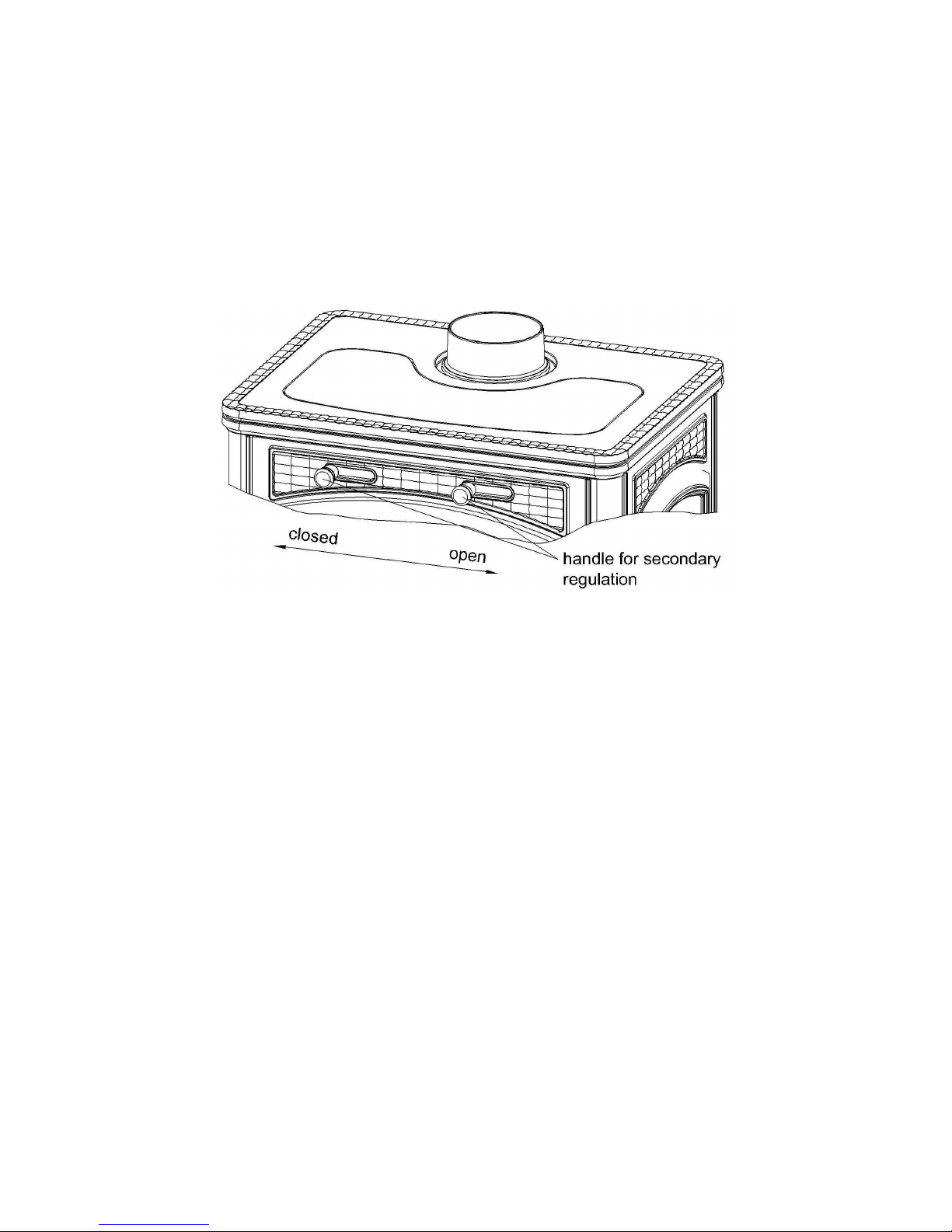
10.3 SECONDARY air control
Over the door of the hearth there is the secondary air control, which, moved in horizontal direction,
regulates secondary air. When the valve is open (the handle moved to the right) it enables a better
wood combustion. Through this regulator, it is possible to adjust the desired combustion course of
the stove.
Leaving the regulator slightly open during the stove operation keeps the glass clean.
11. INSTALLATION
The stove must be connected with a junction to the adequate flue. The junction must be, if possible,
short, straight, or positioned a little uphill. The connections must be tight. It is obligatory to
respect the National and European rules, local regulations concerning building matter and
also fire protection rules. Please apply to your chimney sweeper for all information.
You should provide sufficient air entrance for the combustion in the installation place. The diameter
of the opening for the connection must correspond at least to the diameter of the smokes pipe (Ø152
mm..(6”)). The opening must be equipped with a wall connection for the reception of the exhaust
pipe.
Before installation, verify if your floor can support the weight of the stove, and in case that the
bearing capacity of the floor is insufficient perform measures for increasing the capacity.
The manufacturer is not responsible in case of modification of the product and for the use of
not original spare parts.
12. FIRE SAFETY
In the installation of the stove the following safety measures are to be followed:
a) In order to ensure sufficient thermal insulation, respect the minimum safety distance from objects
or furnishing components flammable and sensitive to heat (furniture, wooden objects, fabrics etc.)
and from materials with flammable structure. All the minimum safety distances are shown on the
product data plate and lower values must NOT be used.
b) In front of the chimney stove there must not be any flammable object or building material,
sensitive to heat, at less than 100 cm(40”) distance. If the stove is installed on a foundation made
of flammable materials, the foundation must be covered with fireproof plates.
c) If the product is installed on a floor which is not completely fire resistant, one must foresee a
fireproof background, for example a steel platform dimensions according to the local regulations.
Page 23

The platform must stick out 20 cm(8”) sideways and 46 cm(18”) on the front side over the loading
door.
d) No flammable components must be present above the product.
The chimney stove must operate exclusively with the ash drawer inserted. The solid residue of the
combustion (ashes) must be collected in a hermetic container, resistant to fire. The stove must never
be ignited when there is gas or steam emissions (e.g. glue for linoleum, gasoline, etc.). Never
deposit flammable materials near the stove. During the combustion there will be a spread of thermal
energy which warms up the surfaces, the door, the fireplace glass, the handles and knobs, the smoke
pipe and the front side of the stove. Please avoid the contact of these parts without gloves or the
relevant tools.
Warn children of the danger and keep them away during the operation of the stove.
The use of a wrong or wet fuel causes the formation of creosote deposits in the flue and will fuel a
chimney fire.
FIRST-AID MEASURES
Should any fire arise in the stack or in the flue:
a) Close the feeding door and the ash drawer door;
b) Close the controls of combustion air;
c) Extinguish the fire using carbon dioxide fire-fighting means (CO2 dust);
d) Seek immediate intervention of FIRE BRIGADE.
DO NOT EXTINGUISH FIRE USING WATER JETS.
When the fire has been extinguished, let the flue be checked by an expert to find possible cracks
and permeable points.
13. AIR ENTRANCE INTO THE INSTALLATION PLACE DURING COMBUSTION
As the stoves take their combustion air from the installation place, it is essential that a sufficient
quantity of air is introduced in the installation room itself.
In case of hermetic doors and windows (for example houses built according to the energy saving
criteria) it is possible that the air entrance is not guaranteed, compromising the draught, the welfare
and the security of the people. It is necessary to guarantee a further air entrance through an external
air intake which is to be positioned nearby appliance or through air connection towards outside or
near the ventilated room.
The entrance of air for combustion into the installation place must not be closed during the
operation of the stove. It is absolutely necessary that in the environment in which the stove operates
there is sufficient air for combustion, i.e. up to 20 m3/h.
An extraction hood (aspirator) installed in the same room or in a room nearby, causes depression
with output of combusted gases (smoke, smell). As consequence it is necessary to ensure more flow
of fresh air.
The depression in an extraction hood can inhale smoke which can have detrimental
consequences to people.
Page 24

14. ALLOWED/FORBIDDEN FUEL
The allowed fuel is made of wood logs and dark coal. One must use only logs of dry wood (water
content max. 20 %).One must load at maximum 2 or 3 logs of wood simultaneously. The wood
pieces should have a length of 30-40 cm(11.8”-15.75”) and a maximum circumference of 30-35
cm(11.8”-13.8”).
The wet wood makes ignition more difficult because it requires a greater quantity of energy to
evaporate the existing water. The humid content has the disadvantage that, with the temperature
lowering, the water condensates first in the hearth and then in the chimney.
Among the others, the following cannot be burnt: remainders of coal, scraps of bark and
panels, humid wood or treated with varnishes, plastic materials, materials of organic origin;
in this case the warranty on the equipment expires.
Variety Kg/m3 Kwh/Kg moistness 20%
Beech 750 4.0
Oak 900 4.2
Elm 640 4.1
Poplar 470 4.1
Larch* 660 4.4
Spruce* 450 4.5
Scots pine * 550 4.4
* wood not suitable for burning
Paper and carton must be used only for ignition.
The combustion of wastes is FORBIDDEN and it may damage the stove and the chimney, causing
health damages and spread of bad smell.
The wood is not a fuel which allows a continuous operation of the appliance, as a consequence the
heating all over the night is not possible.
ATTENTION: the continuous and protracted use of aromatic wood (eucalyptus, myrtle etc.)
quickly damages the cast iron parts of the product.
.
Page 25

15. LIGHTING
IMPORTANT: The first time that the appliance is lit, there will be an odor given off which
disappears after a short use. It must be ensured that, in any case, a good ventilation of the
environment exists. Upon the first ignition we suggest loading a reduced quantity of fuel and
gradually increasing the calorific value of the equipment. The odors and smoke are regular
occurrences which originate from the stabilization of paint with which the parts have been
protected, that is why it is necessary that the room is ventilated.
Therefore, it is extremely relevant to take these easy steps during the lighting:
1. Make sure that a sufficient air change is assured in the room where the appliance is installed.
2. During the first starts, do not load excessively the combustion chamber (about half the quantity
indicated in the instructions manual) and keep the fire continuously ON for at least 6-10 hours
with the regulators less open than the value indicated in the instructions manual.
3. Repeat this operation for at least 4-5 or more times, according to your possibilities.
4. Then load more and more fuel (following in any case the provisions contained in the
installation booklet concerning maximum load) and keep the fire on for a longer time period.
5. During the first starts, no object should be leaned on the appliance or touch enameled surfaces.
6. Once the «break-in» has been completed, it is possible to use the product as per instruction
and avoid abrupt heating with excessive loads.
To light the fire, it is suggested using small wood pieces together with paper or other traded lighting
means.
It is FORBIDDEN to use any liquid substance as for ex. alcohol, gasoline, oil and similar.
Operation with wood:
Open the primary and secondary air control and lit the fire.
After establishing stable operation regime (10 to 15 min), close the primary regulator and adjust the
desired operation regime.
The openings for air (primary and secondary) must be opened together just until the stable
operation regime of the furnace is achieved. Never overload the stove.
Too much fuel and too much air for the combustion may cause overheating and then damage
the stove.
Page 26

16. REGULAR EXPLOITATION
IMPORTANT: due to the fact the door of the hearth has a remarkable size, we suggest you to open
the door very slowly, to avoid the exit of smokes and flames.
For safety reasons the door of the hearth can be opened during the stove operation only for
the loading of the fuel. The hearth door must always remain closed during operation.
Before opening the hearth door, open the primary air regulator, open the door slowly, load the fuel,
close the door and after about 5 or 10 minutes close the primary air control.
Heat emission is adjusted via regulators located on the front side.
They must be opened according to the calorific need. The best combustion is reached when most of
the air for the combustion passes through the regulator of secondary air.
Never overload the stove (compare the technical table - max. quantity of loadable fuel).
The warranty does not cover the damages due to overheating of the equipment.
You should always use the stove with the door closed in order to avoid damages due to overheating.
The adjustment of the regulators is as follows:
Fuel Secondary air (A1) Primary air (B1)
Wood Open Closed
Mass of fuel hourly 3.2-3.3 kg/h 3.2 -3.3kg/h
Besides the adjustment of air for the combustion, the intensity of combustion and then the calorific
value of your stove depend from the chimney. A good flue of requires a more reduced adjustment of
air for the combustion.
To verify the good combustion of the stove, check if the smoke coming out from the chimney and
if the smoke is gray or black, it means that the combustion is not complete (a greater quantity of
secondary air is necessary).
Page 27

17. OPERATION IN TRANSITION PERIODS
During transition periods when the external temperatures are higher, or if there is a sudden increase
of temperature it can happen that the combustion gases inside the flue cannot be completely sucked
out.
The exhaust gases do not come out completely (intense smell of gas). In this case, shake the grating
more frequently and increase the air for the combustion. Then, load a reduced quantity of fuel in
order to permit a rapid burning and the stabilization of the draft.
Then, check whether all openings for the cleaning and the connections to the stack are air-tight. In
case of doubt, do not operate the stove.
18. CLEANING
Let the installation of your stove, the connection to chimney and the ventilation be checked by your
chimney sweeper. For the cleaning of enameled surfaces use soap water or non-aggressive and
materials who are not chemically abrasive. Clean the glass with a detergent and water, and the glass
has to be dry prior using the stove. Do not use abrasive matters that can damage the glass surface.
IMPORTANT: It is possible to use exclusively spare parts clearly authorized and offered by
the manufacturer. In case of need please apply to your dealer!
THE APPLIANCE CAN NOT BE MODIFIED WITHOUT PRODUCER’S CONSENT!
Clean the stove, pipes, and the flue regularly.
18.1 CLEANING OF THE FLUE
A correct lighting, the burning of a proper fuel, the loading of the suggested quantity of fuel, the
right adjustments of the secondary air control, the sufficient draught of the chimney and the
presence of air for the combustion, are essential for the good operation of the appliance.
The appliance must be completely cleaned at least once a year or every time it is needed (in case of
bad working and low yield).The cleaning must be carried out exclusively when the stove is cold.
This operation should be carried out by a chimney sweeper who can simultaneously perform an
audit of the flue (checking possible deposits). During the cleaning, it is necessary to remove from
the appliance the ash drawer and the smokes pipes.
Page 28
18.2 CLEANING OF THE GLASS
Thanks to a specific entry of the secondary air, the building of deposit on the glass of the door is
slowed down in a remarkable way. However, the building of the deposits cannot be avoided with
the use of solid fuels such as wet wood, and this is not to be considered a defect of the appliance.
IMPORTANT:
The cleaning of the sight glass must be carried out only and exclusively with cold appliance to
avoid the glass breaking. Do not use abrasive or chemically aggressive products when cleaning the
hearth glass.
GLASS BREAKING: Considering that the glass is manufactured for temperatures up to 700
°C it should not be subjected to thermal shocks. The break can be caused by mechanic shocks,
(hits or violent closure of the door, etc.). Therefore, its replacement is not included in the
warranty.
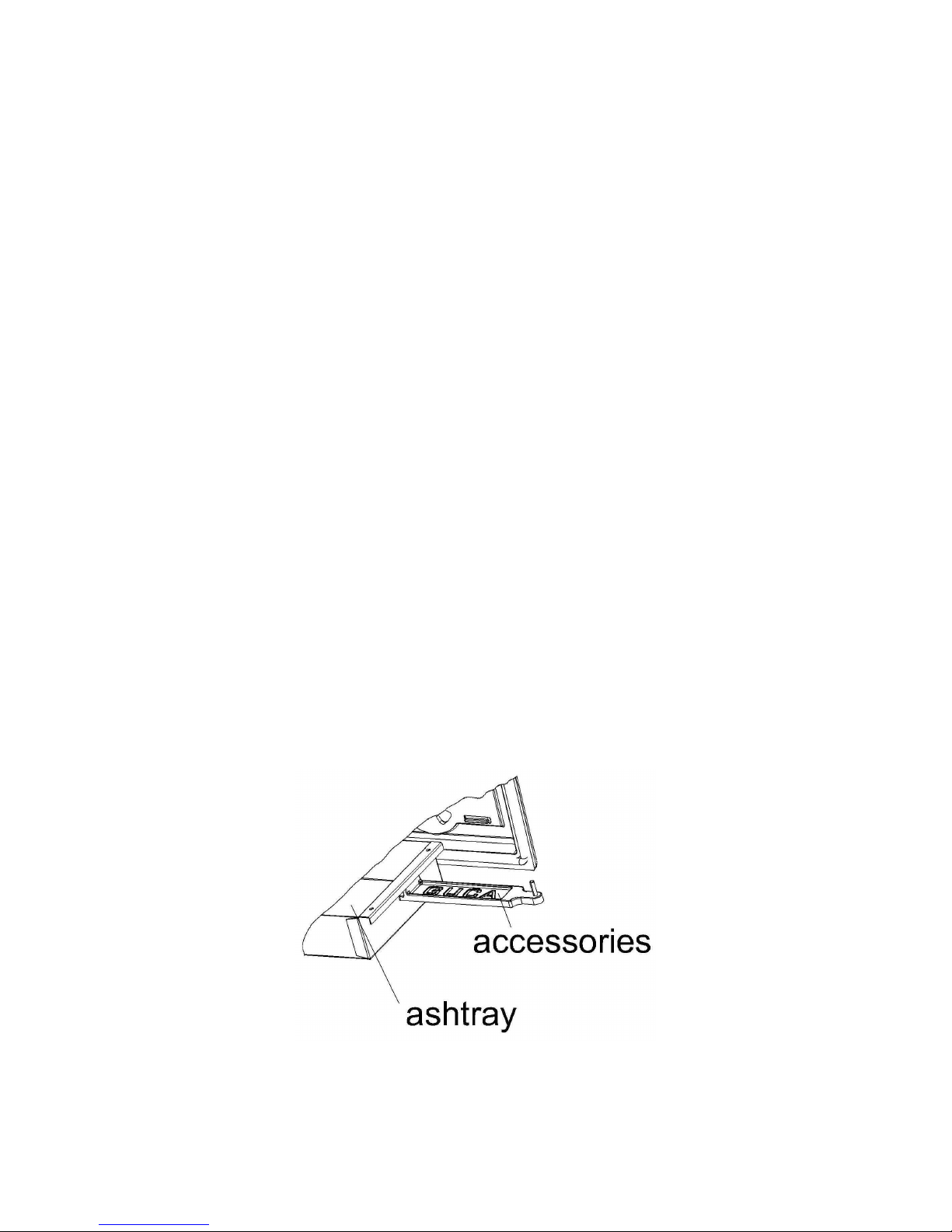
18.3 CLEANING OF THE ASH DRAWER
The stove has a hearth grate and an ash drawer for the collection of ashes. We suggest you to empty
periodically the ash drawer and to avoid filling it up totally, in order not to overheat the grate.
ATTENTION: The ashes removed from the hearth have to be stored in a container made of fireresistant material equipped with an air-tight cover. The container has to be placed on a fire-resistant
floor. Use accessory tools for ash drawer discharge.
The accessory tools are used also for ember and ash drawer dispersion, as shown in the picture.
Page 29

18.4 SUMMER PAUSE
After you have cleaned the hearth, the chimney and the flue, try to eliminate completely the
ash and others residuals. The flue cleaning should be performed at least once per year; in the
meantime check the state of the gasket. If they are not of high quality, they do not guarantee good
stove operation and in that case the gaskets should be replaced.
In presence of dampness in the room where the stove has been placed, we advise you to put
absorbent salts into the hearth. If you want to preserve the aesthetic appearance of the stove, it is
important to protect its inner walls made of cast iron with neutral Vaseline.
We hope that you have read this instruction thoroughly and that you will not have any problems
while using the stove.
In case of any complaints call the local vendor or the manufacturer.
19.
Recommendations for environmental protection
Product
- The device is made of recycable material. Before storing to waste, observe the valid laws on
protection of environment.
- Use only the recommended types of fuel.
- The incineration of organic and inorganic waste is forbidden (plastic, textile, oiled wood,
painted wood etc.) because it discharges carcenogenic and other detrimental materia.
Packaging:
- Packaging material is 100% recyclable.
- When storing to waste, oibserve the local regulations.
- Packaging material (plastic bags, styrofoam etc.) should be held out of the reach of children,
since it is a potential source of danger.
Page 30
Page 31

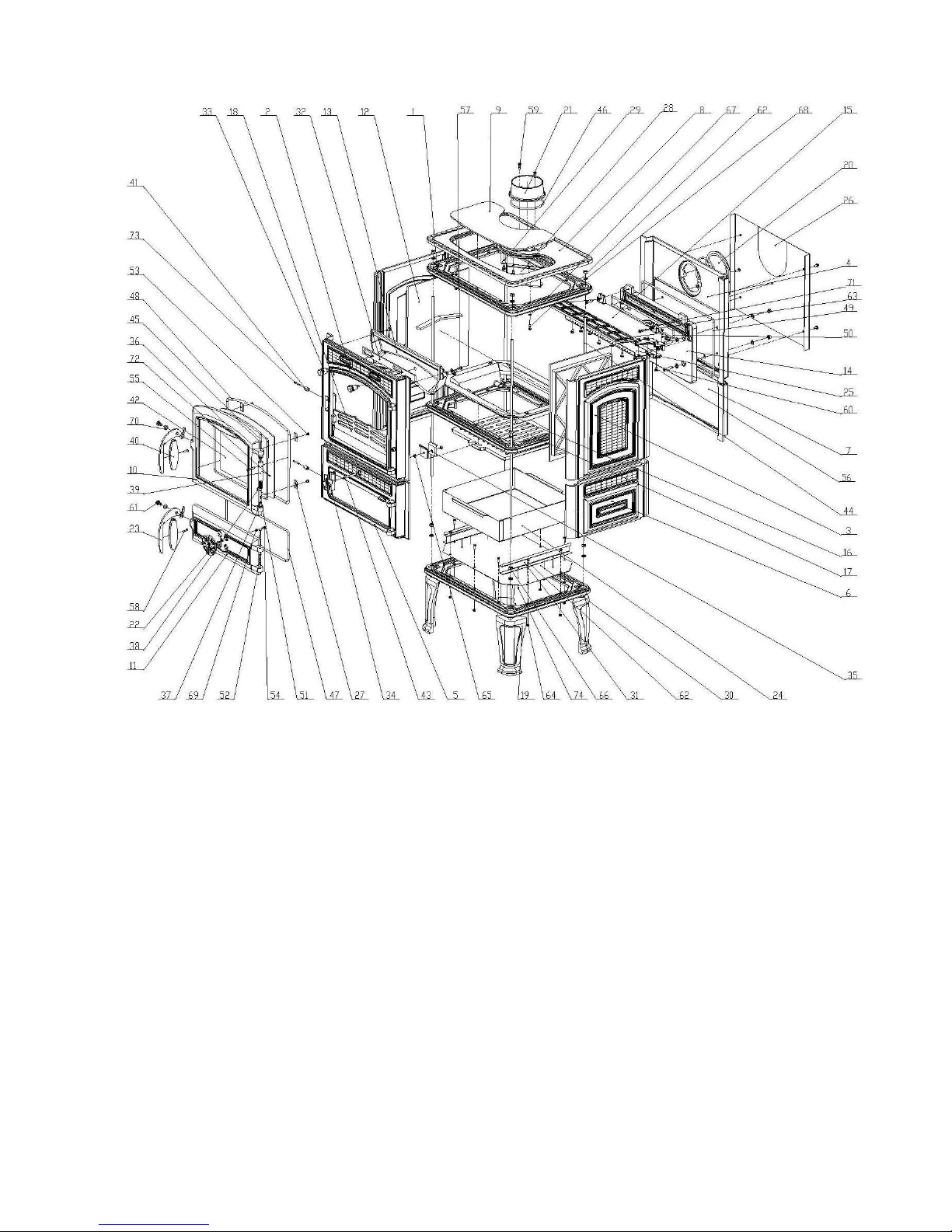
22. P.016 1 44. P.082 4
21. P.015 1 43. P.081 1
20. P.014 1 42. VS-002 1
19. P.068 4 41. P.034 2
18. P.067 1 40. P.033 1
17. P.066 1 39. P.029 1
16. P.065 1 38. P.028 1
15. P.064 1 37. P.027 1
14. P.063 1 36. P.080 1
13. P.062 1 35. P.079 2
12. P.061 2 34. P.083 1
11. P.060 1 33. P.078 2
10. P.059 1 32. P.077 1
9. P.058 1 31. P.076 2
8. P.057 1 30. P.075 1
7. P.056 1 29. P.074 1
6. P.055 2 28. P.073 1
5. P.054 1 27. P.025 4
4. P.053 1 26. P.072 1
3. P.052 2 25. P.071 1
2. P.051 1 24. P.071 1
1. P.050 3 23. P.069 2
position mark units position mark units
Page 32
"Guca IK" products are manufactured under the strict Standard of the
World Recognize ISO 9001: 2000 Quality Assurance Certificate.
Limited One year Warranty
"Guca IK" warrants its products against manufacturing defects to the original purchaser only—i.e., individual (register customer) whose name appear on the warran-
ty registration card., for a period of One year from date of purchase from only an
authorized dealer.
If within the one year period, your product should develop a defect due to materials
or workmanship of the original new product, Guca IK (manufacturer), Sopka Inc
(importer), or your authorized dealer will supply ONLY the parts necessary to make
the repairs. (Labor Not Included) and is subject to following condition and limita-
tions:
This limited warranty does not cover damages caused by misuse, lack of maintenance, accident, alterations, abuse or neglect.
This limited warranty does not cover any scratches, dents, corrosion or discoloring
caused by excessive heat, cleaning chemicals, nor chipping on porcelain enamel
parts, nor any venting components used in the installation.
Installation must be done in accordance with installation instructions included with
product and all local and national building and fire codes.
Guca IK will not be liable for incidental and consequential damage of any nature.
This warranty gives the purchaser specific legal rights which may vary from state to
state. No other warranty is to be implied or expressed, including warranties implied
for a specific or particular purpose.
Guca IK reserves the right to have its representative inspect any product or part
thereof prior to honoring any warranty claim.
CALIFORNIA PROP 65 WARNING:
Use of this product may produce smoke which contains chemicals known to the State of California to
cause cancer, birth defects, or other reproductive harm.
 Loading...