

Page 1

CR, CRI, CRN, CRT
ATEX-approved pumps
Installation and operating instructions
GRUNDFOS INSTRUCTIONS
Page 2

English (GB) Installation and operating instructions
English (GB)
Original installation and operating instructions
These supplementary installation and operating
instructions apply to the ATEX-approved Grundfos
CR pumps.
The CR pumps comply with ATEX Directive 2014/34/
EU.
The pumps are suitable for use in zones classified
according to Directive 1999/92/EC. In case of doubt,
consult the above-mentioned directives, or contact
Grundfos.
1. General information
1.1 Hazard statements
The symbols and hazard statements below may
appear in Grundfos installation and operating
instructions, safety instructions and service
instructions.
CONTENTS
Page
1. General information
1.1 Hazard statements
1.2 Notes
2. Related installation and operating
instructions
3. Receiving the product
4. Explosion protection document
5. Identification
5.1 Nameplate
5.2 Type key
5.3 Drive-end motor bearing
6. Scope of ATEX categories for CR
pumps
7. Installing the product
7.1 Pump with single seal
7.2 Pump with MAGdrive
7.3 Pump with double seal
7.4 Bare-shaft pumps
8. Operating conditions
8.1 Maximum ambient temperature
8.2 Maximum liquid temperature
8.3 Temperature calculation
9. Before starting up and during operation
of an ATEX-approved pump
9.1 Checklist
10. Maintenance and inspection
10.1 Tightening torques
10.2 Shaft seal
2
2
3
3
3
3
4
4
The hazard statements are structured in the
following way:
5
6
7
8
8
8
9
9
10
10
10
11
12
12
14
14
14
DANGER
Indicates a hazardous situation which, if
not avoided, will result in death or serious
personal injury.
WARNING
Indicates a hazardous situation which, if
not avoided, could result in death or
serious personal injury.
CAUTION
Indicates a hazardous situation which, if
not avoided, could result in minor or
moderate personal injury.
SIGNAL WORD
Description of hazard
Consequence of ignoring the warning.
- Action to avoid the hazard.
Read this document before installing the
product. Installation and operation must
comply with local regulations and accepted
codes of good practice.
2
Page 3

1.2 Notes
The symbols and notes below may appear in
Grundfos installation and operating instructions,
safety instructions and service instructions.
Observe these instructions for explosionproof products.
A blue or grey circle with a white graphical
symbol indicates that an action must be
taken.
A red or grey circle with a diagonal bar,
possibly with a black graphical symbol,
indicates that an action must not be taken
or must be stopped.
If these instructions are not observed, it
may result in malfunction or damage to the
equipment.
Tips and advice that make the work easier.
2. Related installation and operating instructions
The X on the nameplate indicates that the pump is
subject to special conditions for safe use as
described in these instructions. The nameplate
markings are described in the table in section
5. Identification.
In addition to these instructions, observe the
following installation and operating instructions:
• CR, CRI, CRN: for standard pumps
• CR, CRI, CRN, CRT: removal of transport bracket
and fitting of motor. For pumps without motor
• MG: Grundfos standard motors.
For special versions of the CR pumps, observe the
relevant installation and operating instructions:
•CRN MAGdrive
• CR, CRI, CRN: double seal, back-to-back
• CR, CRI, CRN: double seal, tandem
• MG: Grundfos standard motors.
3. Receiving the product
If the pump is delivered without a motor, mount the
motor and then adjust the chamber stack and shaft
seal according to the procedure described in the
installation and operating instructions, "Removal of
transport bracket and fitting of motor", supplied with
the pump.
4. Explosion protection document
The combination of CR pump and all monitoring
equipment must be described in the explosion
protection document according to Directive 1999/92/
EC.
English (GB)
3
Page 4

5. Identification
DK-8850 Bjerringbro,Denmark
Model-PN-SN
Type
Hz
pmax/tmax
Tech file no
Made in Denmark
P code: P115482
bar/°C
min
-1
excl.motor 500kg
/hm
3
kW [P2]
H/H max m 0(,
ȘS
B-96123526-98438832
CR255-1-1A-F-A-E-HQQE
435/248
2917
64
CCW
98964685X
99356347
50/60
4.0
0.7 69.7
14.2/22.1
21
435-580/176
II 3G Ex h IIC T4...T3 Gb
English (GB)
5.1 Nameplate
The nameplate on the pump head gives the following
details:
• data of standard pump
• data of ATEX marking
– technical file number
– serial number
– Ex category.
Fig. 1 Example of a CR nameplate with ATEX
approval
ATEX rating
Pos. Description
Group
II
I: Underground in mines
II: Surface equipment
Category
M2: Mining
3G
2G, 3G: Gas/vapours
2D, 3D: Dust
Ex h Protection type
Environment group
IIC: Gas/vapours
IIC
1
T4...T3
TM07 5039 0719
98964685
2
IIIC: Combustible dust
IIIB: Non-magnetic dust
Maximum surface
temperature according to
80079-36.
Temperature range or
specific temperature.
T4...T3: Gas
T125 °C: Dust
EPL (Equipment Protection
Level).
Gb
Gb, Gc: Gas
Db, Dc: Dust
File number for technical file
stored at DEKRA.
Indicates that the equipment
is subject to special
X
conditions for safe use. The
conditions are mentioned in
this document.
Data for the ATEX marking only refers to the part
including the coupling. The motor has a separate
nameplate.
4
Page 5

5.2 Type key
5.2.1 Type key example
Example CR 32- 2 1- X- X- X- X- XXXX
Type range: CR, CRN
Rated flow rate in m
Number of stages
Number of impellers with reduced diameter
Code for pump version
Code for pipe connection
Code for materials
Code for rubber pump parts
Code for shaft seal
5.2.2 Key to codes for pump version
Codes for pump version
A Basic version
BOversize motor
E Pump with certificate
H Horizontal version
I Different pressure rating
K Pump with low NPSH
M Magnetic drive
O Cleaned and dried
P Undersize motor
S High-pressure pump
T Thrust handling device (THD)
U ATEX approved pump
Y Electropolished
Z Pumps with bearing flange
3
/h
English (GB)
5
Page 6

5.3 Drive-end motor bearing
English (GB)
Make sure to use the correct type of drive-end (DE)
motor bearing for the bare-shaft pump. Please check
the specific pump range and pump version stated on
the nameplate and select the corresponding DE
bearing.
Pump version
DE bearing
CR 1-64 pump range
1)
Deep-groove ball
bearing
(62/63xx)
Angular contact
bearing
(73xx)
Deep-groove ball
(62/63xx)
DE bearing
CR 95-255 pump range
Angular contact
bearing
bearing
(73xx)
A Standard pump 0.37 - 3 kW 4-45 kW 75-200 kW 5.5 - 55 kW
Pump with thrust
T
handling device
2)
(THD)
Pump with bearing
Z
1)
2)
2)
flange
Refer to the codes for pump version in section 5.2 Type key.
Factory product variants (FPV).
- - 5.5 - 55 kW Not allowed
0.37 - 45 kW Not allowed 5.5 - 200 kW Not allowed
6
Page 7

6. Scope of ATEX categories for CR pumps
Directive ATEX-approved CR pumps
2014/34/EU GROUP I
Category M
Environment:
EPL1): Ma Mb
1999/92/EC
2)
CR pumps None
Motors None None
2014/34/EU GROUP II
Category 1 Category 2 Category 3
Environment:
1)
EPL
: Ga Da Gb Db Gc Dc
1999/92/EC
2)
G D G D G D
Zone 0 Zone 20 Zone 1 Zone 21 Zone 2 Zone 22
CR pumps None None
Motors None None
1)
EPL: Equipment Protection Level.
2)
Important: The link between groups, categories
and zones is explained in Directive1999/92/EC.
Note that this is a minimum directive. Some EU
countries may therefore have stricter local rules.
The user or installer is always responsible for
checking that the group and category of the
pump correspond to the zone classification of the
installation site.
1 2
-CR
CRI
CRN
CR
CRI
CRN
CRT
• II 2G Ex eb
IIC T3 Gb
• II 2G Ex db
IIC T4 Gb
CR
CRI
CRN
CRT
• II 2D Ex tb
IIIC T125 °C
Db
CR
CRI
CRN
CRT
• II 2G Ex eb
IIC T3 Gb
• II 2G Ex db
IIC T4 Gb
CR
CRI
CRN
CRT
• II 3D Ex tc
IIIC T125 °C
Dc
English (GB)
7
Page 8
7. Installing the product
English (GB)
DANGER
Explosion risk
Death or serious personal injury
- Do not let the pump run dry.
- Make sure that the pump is filled with
pumped liquid during operation.
DANGER
Explosion risk
Death or serious personal injury
- Replace the shaft seal if increased
leakage is observed.
DANGER
Explosion risk
Death or serious personal injury
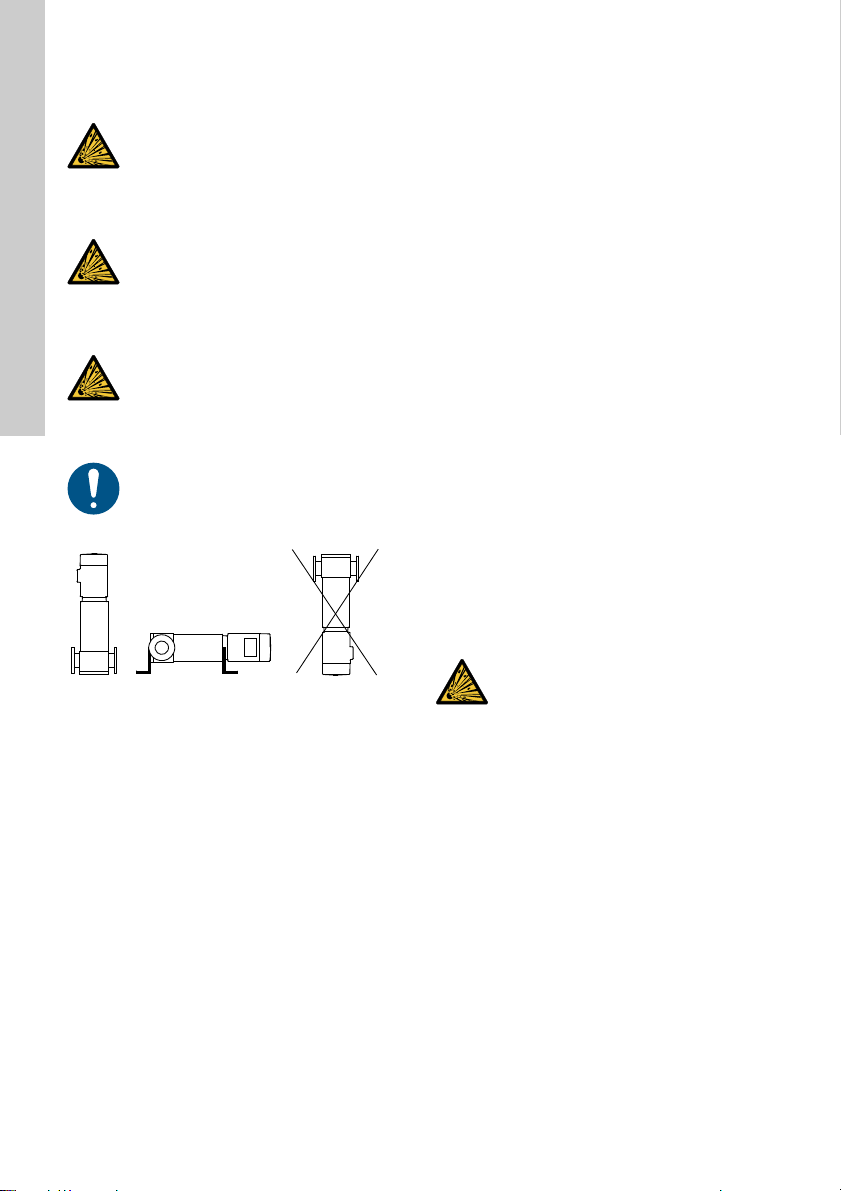
- Always install the pump with the motor
above the pump to avoid overheating of
the motor bearings. See fig. 2.
The responsibility for checking the
functions of the dry-running protection,
such as flow rate, sealing pressure and
temperature of the barrier or flushing
liquid, rests with the installer or owner.
Fig. 2 Positioning the pump
7.1 Pump with single seal
7.1.1 Non-flammable liquids Category 2G/D/M2
Make sure that the pump is filled with pumped liquid
during operation. If this is not possible, ensure
appropriate monitoring, for example dry-running
protection to stop the pump in case of malfunction.
Category 3G/D
No additional monitoring, for example dry-running
protection, is required for the pump system.
7.1.2 Flammable liquids, pump unit Category 2G/D/M2 and 3G/D/M2
Make sure that the pump is filled with pumped liquid
during operation. If this is not possible, ensure
appropriate monitoring, for example dry-running
protection to stop the pump in case of malfunction.
Ensure sufficient ventilation around the pump.
The leakage rate of a shaft seal is 1-10 ml for each
24 hours of operation. For some types of liquids, the
leakage will not be visible due to evaporation. During
the run-in period, larger leakage of 1-20 ml per 24
hours of operation can occur. Liquids like oil or
glycol-water mixtures evaporate slower than water
and will leave residuals. Ensure proper ventilation to
maintain the zone classification.
Category M2
Protect the pump with a guard to prevent damage
from falling or ejected objects.
7.2 Pump with MAGdrive
DANGER
TM01 1241 4102
See the CRN MAGdrive installation and operating
instructions at http://net.grundfos.com/qr/i/
96464310.
Explosion risk
Death or serious personal injury
- Always fill the pump with liquid and
ensure that the required minimum flow
rate is obtained.
8
Page 9

7.3 Pump with double seal
40 50 60 70 80 90 100 110 120
t [°C]
0
10
20
30
Qmin
[%]
Back-to-back or tandem
7.3.1 Non-flammable liquids, pump unit Category 2G/D
Make sure that the pump is filled with pumped liquid
during operation. If this is not possible, ensure
appropriate monitoring, for example dry-running
protection to stop the pump in case of malfunction.
Category 3G/D
No additional monitoring, such as dry-running
protection, is required for the pump system.
7.3.2 Flammable liquids, pump unit Category 2G/D/M2 and 3G/D/M2
Make sure that the pump is filled with pumped liquid
during operation. If this is not possible, ensure
appropriate monitoring, for example dry-running
protection to stop the pump in case of malfunction.
Ensure sufficient ventilation around the pump.
The leakage rate of a shaft seal is 1-10 ml for each
24 hours of operation. For some types of liquids, the
leakage will not be visible due to evaporation. During
the run-in period, larger leakage of 1-20 ml per 24
hours of operation can occur. Liquids like oil or
glycol-water mixtures evaporate slower than water
and will leave residuals. Ensure proper ventilation to
maintain the zone classification.
Category M2
Protect the pump by a guard to prevent damage from
falling or ejected objects.
7.4 Bare-shaft pumps
Bare-shaft pumps with motors of 4 kW and up must
use angular contact bearings.
However, if the pumps are fitted with a thrust
handling device (THD) or a bearing flange, they must
never be used with angular contact bearings. If in
doubt, contact Grundfos.
Check if the pump is fitted with a thrust
handling device (THD). If the pump is a
THD marked pump, follow the instructions
below.
The thrust handling device (THD) is factory-fitted on
CR, CRN 95-255 for motor sizes of 75 kW and
above.
7.4.1 Bare-shaft pumps with a thrust handling device
DANGER
Explosion risk
Death or serious personal injury
- Temperature monitoring of the motor
bearings is required to ensure that the
pump stops in case of overheating.
DANGER
Explosion risk
Death or serious personal injury
- Do not use ATEX motors with angular
contact bearings on pumps fitted with a
thrust handling device (THD).
DANGER
Explosion risk
Death or serious personal injury
- Temperature sensors must be installed
by qualified persons in accordance with
local regulations.
Minimum flow rate
Due to the risk of overheating, do not use the pump
at flows below the minimum flow rate.
The curve below shows the minimum flow rate as a
percentage of the rated flow rate in relation to the
liquid temperature.
Fig. 3 Minimum flow rate in percentage of
nominal flow
English (GB)
TM02 8290 4903
9
Page 10

8. Operating conditions
English (GB)
DANGER
Explosion risk
Death or serious personal injury
- Ensure that the required minimum inlet
pressure is always available.
See the CR, CRI, CRN installation and operating
instructions:
– http://net.grundfos.com/qr/i/96462123
– http://net.grundfos.com/qr/i/99078486
DANGER
Explosion risk
Death or serious personal injury
- Do not operate the pump with higher
liquid temperature than the maximum
liquid temperature (t
pump nameplate.
- The calculated maximum permissible
liquid temperature must not be
exceeded.
) stated on the
max
8.1 Maximum ambient temperature
The maximum ambient temperature for the pump: 20 to +60 °C.
8.2 Maximum liquid temperature
In normal pump operation, the highest temperatures
are to be expected at the surface of the pump casing
and at the shaft seal. The surface temperature will
normally follow the temperature of the liquid.
You can calculate the permissible liquid temperature
by finding the maximum permissible temperature at
the surface of the pump during operation in the table
shown in section 8.3.1 Temperature class, and
reduce it with the temperature contribution from shaft
seals, see table in section 8.3.2 Shaft seal
temperature.
Section 8.3 Temperature calculation contains a
diagram which shows how the maximum surface
temperature depends on the liquid temperature and
the temperature contribution from the shaft seal.
Calculation example
Based on temperature contribution from a HQQX
shaft seal, media class 1, shaft diameter ∅22 and
pressure 2.5 Mpa.
Temperature class (T4) = 135 °C, see section
8.3.1 Temperature class.
Temperature contribution from HQQX shaft seal = 24
°C, see section 8.3.2 Shaft seal temperature.
Safety margin for Group II = 5 °C according to the
ATEX standard.
Result
Maximum permissible liquid temperature:
T4-contribution from shaft seal-safety margin = 135 -
24 - 5 = 106 °C.
Pumps that are allowed to pump liquids up to a
maximum of 150 °C are equipped with a tandem
shaft seal. In this case, the temperature and flow rate
of the flushing liquid must be according to the
description in the installation and operating
instructions "CR, CRI, CRN-Double seal (tandem)" at
http://net.grundfos.com/qr/i/96477555.
Make sure that the combination of CR pump and dryrunning protection is described in the explosion
protection document according to Directive 1999/92/
EC.
The responsibility for checking the correct
flow rate and the temperature of the
flushing liquid rests with the installer or
owner.
Increased leakage rate can indicate
damaged elastomers and rubber parts in
the pump. For some liquid types, the
leakage is not visible due to evaporation.
10
Page 11

8.3 Temperature calculation
1
2
3
The illustration below shows the maximum surface
temperature of the pump as a result of the maximum
liquid temperature and temperature rise in the shaft
seal.
Fig. 4 Maximum surface temperature
Pos. Figure legend
Maximum surface temperature of the
1
pump
Temperature rise in the shaft seal.
2
Calculated by Grundfos. See section
8.3.2 Shaft seal temperature.
3 Maximum liquid temperature
8.3.1 Temperature class
Temperature class
T1 450
T2 300
T3 200
T4 135
T5 100
T6 85
The maximum surface temperature for dust is stated
on the nameplate.
Maximum surface
temperature
[°C]
8.3.2 Shaft seal temperature
In order to calculate the pump surface temperature
and temperature class, the below tables show the
temperature rise in the shaft seal for different shaft
diameters, different pressure values and various
media classes.
Shaft seal: HQQx/HUUx/HQUx and
AUUx/AQQx/DQQx
Rpm: 2900/3500
Pressure [MPa]
12.54
Shaft seal temperature rise [°C]
22 24 26
Rpm: 2900/3500
Pressure [MPa]
12.54
Shaft seal temperature rise [°C]
18 20 22
TM06 4445 2315
Shaft
diameter
[mm]
12
16
22
28
36
Shaft
diameter
[mm]
12
16
22
28
36
Shaft seal: HQBx/HUBx
English (GB)
11
Page 12

9. Before starting up and during
English (GB)
operation of an ATEX-approved
pump
DANGER
Explosion risk
Death or serious personal injury
- Do not run the pump at speeds
exceeding the rated speed. See pump
nameplate.
9.1 Checklist
DANGER
Explosion risk
Death or serious personal injury
- Follow the checklist below.
Observe this checklist:
1. Check that the ATEX rating of the motor, pump
and accessories corresponds to the specified
category. See section 6. Scope of ATEX
categories for CR pumps. If the motor, pump or
accessory categories differ, the lower rating is
valid.
2. If the pump falls under category M2, check that
the pump is protected by a guard to prevent
damage from falling or ejected objects.
3. Clean the cavities behind the pump's coupling
guard on a regular basis to avoid hazardous dust
deposits.
4. Check that the motor output power corresponds
to the required P
5. Check that the pump is as ordered, see
nameplates.
6. Check the axial alignment of the chamber stack.
See the label on the inside of the coupling guard.
Check that the shaft seal components, rubber
parts and seal surfaces are suitable for the
pumped liquid.
7. Check that the shaft can rotate freely. There must
be no mechanical contact between impeller and
chamber.
8. Check that the pump has been filled with liquid
and vented. The pump must never run dry.
9. Check the direction of rotation of the motor, see
the arrow on the top of the fan cover.
10. If you have chosen a pump with double seal,
back-to-back, check that the seal chamber is
pressurised. Always pressurise the chamber
during operation. Always use ATEX-approved
equipment.
of the pump, see nameplates.
2
11. If you have chosen a pump with double seal,
tandem, check that the seal chamber is
completely filled with liquid. The seal chamber
must always be filled with flushing liquid during
operation. The dry-running protection must be
ATEX-approved.
12. Follow the special startup procedures for these
pump types:
– MAGdrive pumps
– pumps with double seal, back-to-back
– pumps with double seal, tandem.
For further information, see the installation and
operating instructions for the pump in question.
13. Check that the liquid temperature never exceeds
the maximum liquid temperature, t
the nameplate.
14. Avoid overheating of the pump.
Operation against a closed outlet valve may
cause overheating. Install a bypass with a
pressure relief non-return valve.
15. Check for abnormal noise during operation to
avoid overheating of the pump.
16. Re-vent the pump in either of these situations:
– the pump has been stopped for a period of
time.
– air has accumulated in the pump.
17. If the pump is with bearing bracket, check for
bearing noise every week. Replace the bearing if
it shows signs of wear.
18. The auto-ignition temperature of the pumped
liquid must be 50 K above the maximum surface
temperature of the pump.
19. Make sure to apply the correct inlet pressure.
Use the correct table for the vapour pressure for
the pumped liquid. See section
9.1.1 Specification and calculation of inlet
pressure.
, stated on
max
12
Page 13

9.1.1 Specification and calculation of inlet
Hv
H
NPSH
Pb
Hf
20
15
12
10
8,0
6,0
5,0
4,0
3,0
2,0
1,0
0,8
0,6
0,4
0,3
0,2
0,1
1,5
120
110
90
100
80
70
60
50
40
30
20
10
0
Hv
(m)
tm
(°C)
150
130
140
25
35
45
40
30
160
170
180
190
62
79
100
126
pressure
Fig. 5 Schematic view of open system with a
CR pump
Calculation of inlet pressure
Calculate the maximum suction lift "H" in m head as
follows:
H = Pb x 10.2 - NPSH - Hf - Hv - Hs
English (GB)
TM02 0118 3800
Pb = Barometric pressure in bar.
Barometric pressure can be set to 1 bar.
In closed systems, Pb indicates the
system pressure in bar.
(10 bar = 1 MPa)
NPSH = Net Positive Suction Head in m head, to
Hf = Friction loss in the inlet pipe in m head
Hv = Vapour pressure for water in m head.
tm = Liquid temperature.
Hs = Safety margin = minimum 0.5 m head.
be read from the NPSH curve in the
appendix* (at the highest flow rate the
pump will be delivering).
* Link to appendix, see section
Appendix with NPSH curves.
at the highest flow rate the pump will be
delivering.
See fig. 6. If the pumped liquid is not
water, then use the vapour pressure for
the liquid which is being pumped.
Fig. 6 Vapour pressure for water in m head
If the calculated "H" is positive, the pump can
operate at a suction lift of maximum "H" m head.
If the calculated "H" is negative, an inlet pressure of
minimum "H" m head is required. There must be a
pressure equal to the calculated "H" during
operation.
Example:
Pb = 1 bar.
Pump type: CR 15, 50 Hz.
Flow rate: 15 m
3
/h.
NPSH (see the appendix*): 1.1 m head.
Hf = 3.0 m head.
Liquid temperature: 60 °C.
Hv (see fig. 6): 2.1 m head.
H = Pb x 10.2 - NPSH - Hf - Hv - Hs [m head].
H = 1 x 10.2 - 1.1 - 3.0 - 2.1 - 0.5 = 3.5 m head.
This means that the pump can operate at a suction
lift of maximum 3.5 m head.
Pressure calculated in bar: 3.5 x 0.0981 = 0.343 bar.
Pressure calculated in kPa: 3.5 x 9.81 = 34.3 kPa.
* Link to appendix, see section Appendix with
NPSH curves.
TM02 7445 3503
13
Page 14

9.1.2 Appendix with NPSH curves
Coupling screw
(4 pcs)
Shaft seal
Shaft seal set screw
(3 pcs)
Shaft seal set screw (3 pcs)
Shaft seal flange screw (4 pcs)
English (GB)
Appendix:
The appendix referred to in section 9.1.1 is
found in the standard CR, CRI, CRN
installation and operating instructions:
http://net.grundfos.com/qr/i/96462123
10. Maintenance and inspection
Service documentation is available in Grundfos
Product Center (http://productselection.grundfos.com/).
If you have any questions, please contact the
nearest Grundfos company or service workshop.
10.1 Tightening torques
DANGER
Explosion risk
Death or serious personal injury
- The coupling screws, shaft seal, shaft
seal flange screws and shaft seal set
screws must be tightened according to
the specified torque values.
10.1.1 Coupling
10.2 Shaft seal
CR, CRI, CRN 1s, 1, 3, 5, 10, 15, 20, 95, 125, 155,
185, 215, 255
Fig. 8 Shaft seal and shaft seal set screws for
Pump size
CR, CRI, CRN
1s, 1, 3, 5
CR, CRI, CRN
10, 15, 20
CR, CRN 95,
125, 155, 185,
215, 255
CR, CRN 32, 45, 64, 90, 120, 150
CR, CRI, CRN 1s, 1, 3, 5, 95, 125, 155,
185, 215, 255
Tightening torque
Shaft seal
Shaft seal set
screws (3 pcs)
M28-35 Nm
M5 - 2.5 Nm
M33-35 Nm
Hex 60-100 Nm
Hex 75-150 Nm
M6-6 Nm
TM07 2395 3418
Fig. 7 Coupling screws
Pump size
CR, CRI, CRN
1s, 1, 3
CR, CRI, CRN
10, 15, 20
CR, CRI, CRN
32, 45, 64, 90
CR, CRI, CRN
120, 150
CR, CRN 95,
125, 155, 185,
215, 255
14
Coupling screws (4 pcs)
Tightening torque
M6-13 Nm
M8-31 Nm
M10-61 Nm
M6-13 Nm
M8-31 Nm
M10-62 Nm
M10-85 Nm
M10-85 Nm
M16-100 Nm
M10-85 Nm
M16-100 Nm
TM07 2396 3418
Fig. 9 Shaft seal flange screws and shaft seal
set screws for CR, CRN 32, 45, 64, 90,
120, 150
Tightening torque
Pump size
CR, CRI, CRN
32, 45, 64, 90
CR, CRI, CRN
120, 150
Shaft seal
flange screws
(4 pcs)
M10-62 Nm M6-6 Nm
TM07 2397 3418
Shaft seal set
screws (3 pcs)
Page 15

YETKİLİ GRUNDFOS SERVİSLERİ
Firma Adres
GRUNDFOS
POMPA
KOCAELİ
SUNPO
ELEKTRİK
ADANA
ARDA POMPA
ANKARA
UĞUR SU
POMPALARI
ANKARA
GROSER A.Ş.
ANTALYA
KOÇYİĞİTLER
ELEKTRİK
BOBİNAJ
ANTALYA
TEKNİK
BOBİNAJ
BURSA
ASİN
TEKNOLOJİ
GAZİANTEP
ARI MOTOR
İSTANBUL
SERİ MEKANİK
İSTANBUL
DAMLA POMPA
İZMİR
ÇAĞRI
ELEKTRİK
KAYSERİ
MAKSOM
OTOMASYON
SAMSUN
DETAY
MÜHENDİSLİK
TEKİRDAĞ
ROTATEK
ENDÜSTRİYEL
TEKİRDAĞ
İLDEM TEKNİK
ISITMA VAN
BARIŞ BOBİNAJ
K.K.T.C.
GEBZE ORGANİZE SANAYİ BÖLGESİ.
İHSAN DEDE CADDESİ.2.YOL
200.SOKAK.NO:204 GEBZE KOCAELİ
YEŞİLOBA MAH. 46003 SOK.
ARSLANDAMI İŞ MERK. C BLOK NO:6/2I SEYHAN ADANA
26 NOLU İŞ MERKEZİ 1120.SOKAK
NO:5/1,5/5 OSTİM/ANKARA
AHİ EVRAN MAHALLESİ ÇAĞRIŞIM
CADDESİ NO:2/15 SİNCAN /ANKARA
ŞAFAK
MAHALLESİ.5041.SOKAK.SANAYİ 28 C
BLOK NO:29 KEPEZ ANTALYA
ORTA MAH. SERİK CAD. NO.116 SERİK
ANTALYA
ALAADDİN BEY MH.624.SK MESE 5 İŞ
MERKEZİ NO:26 D:10 NİLÜFER/BURSA
MÜCAHİTLER MAHALLESİ 54 NOLU
SOKAK.GÜNEYDOĞU İŞ MERKEZİ
NO:10/A ŞEHİTKAMİL
ORHANLI MESCİT MH.DEMOKRASİ
CD.BİRMES SAN.SİT.A-3 BLOK NO:9
TUZLA İSTANBUL
SEYİTNİZAM MAH. DEMİRCİLER SİT.
7.YOL . NO:6 ZEYTİNBURNU İSTANBUL
1203/4 SOKAK NO:2/E YENİŞEHİR İZMİR
ESKİ SANAYİ BÖLGESİ 3.CADDE NO;3B KOCASİNAN-KAYSERİ
19 MAYIS
MAHALLESİ.642.SOKAK.NO:23
TEKKEKÖY SAMSUN
ZAFER MAHALLESİ ŞEHİT YÜZBAŞI
YÜCEL KENTER CADDESİ 06/A BLOK
NO:5-6 ÇORLU TEKİRDAĞ
ZAFER MH. ŞEHİT YÜZBAŞI YÜCEL
KENTER CD. YENİ SANAYİ SİTESİ 08-A
BLOK NO:14 ÇORLU / TEKİRDAĞ
ŞEREFİYE MAH ORDU CAD ARAS AP
NO 75 İPEKYOLU VAN
LARNAKA YOLU ÜZERİ.PAPATYA
APT.NO:3-4 GAZİMAĞUSA
Telefon
Cep telefonu
Faks
0262 679 79 79
0553 259 51 63
0262 679 79 05
0322 428 50 14
0533 461 71 14
0322 428 48 49
0312 385 98 93
0541 805 89 44
0312 385 8904
0312 394 37 52
0532 505 12 62
0312 394 37 19
0242 221 43 43
0532 793 89 74
0242 221 43 42
0242 722 48 46
0532 523 29 34
0242 722 48 46
0224 443 78 83
0507 311 19 08
0224 443 78 95
0342 321 69 66
0532 698 69 66
0342 321 69 61
0216 394 21 67
0532 501 47 69
0216 394 23 39
0212 679 57 23
0532 740 18 02
0212 415 61 98
0232 449 02 48
0532 277 96 44
0232 459 43 05
0352 320 19 64
0532 326 23 25
0352 330 37 36
0362 256 23 56
0532 646 61 42
-
0282 673 51 33
0549 668 68 68
0282 673 51 35
0282 654 51 99
0532 788 11 39
0282 654 51 81
0432 216 20 83
0532 237 54 59
0432 216 20 83
0542 884 06 62
0542 854 11 35
0533 884 06 62
İlgili Kişi
Eposta
EMRAH ŞİMŞEK
esimsek@grundfos.com
LEVENT BAKIRKOL
sunpo-elektrik@hotmail.com
METİN ENGİN CANBAZ
metincanbaz@ardapompa.com.tr
UĞUR YETİŞ ÖCAL
uguryetisocal@gmail.com
DOĞAN YÜCEL
servis@groseras.com
BİLAL KOÇYİĞİT
kocyigitler@kocyigitlerbobinaj.com
GÜLDEN MÜÇEOĞLU
gulden@tbobinaj.com.tr
MEHMET DUMAN
mduman@asinteknoloji.com.tr
EMİN ARI
aycan@arimotor.com.tr
TAMER ERÜNSAL
servis@serimekanik.com
NEVZAT KIYAK
nkiyak@damlapompa.com
ADEM ÇAKICI
kayseri.cagrielektrik@gmail.com
MUSTAFA SARI
info@maksom.com
EROL KARTOĞLU
erol@detay-muhendislik.com
ÖZCAN AKBAŞ
ozcan@rotaendustriyel.com
BURHAN DEMİREKİ
il-dem-teknik@hotmail.com
BARIŞ KIZILKILINÇ
barisbobinaj@hotmail.com
Grundfos companies
Page 16

Grundfos companies
Argentina
Bombas GRUNDFOS de Argentina S.A.
Ruta Panamericana km. 37.500 Centro
Industrial Garin
1619 Garín Pcia. de B.A.
Phone: +54-3327 414 444
Telefax: +54-3327 45 3190
Australia
GRUNDFOS Pumps Pty. Ltd.
P.O. Box 2040
Regency Park
South Australia 5942
Phone: +61-8-8461-4611
Telefax: +61-8-8340 0155
Austria
GRUNDFOS Pumpen Vertrieb
Ges.m.b.H.
Grundfosstraße 2
A-5082 Grödig/Salzburg
Tel.: +43-6246-883-0
Telefax: +43-6246-883-30
Belgium
N.V. GRUNDFOS Bellux S.A.
Boomsesteenweg 81-83
B-2630 Aartselaar
Tél.: +32-3-870 7300
Télécopie: +32-3-870 7301
Belarus
Представительство ГРУНДФОС в
Минске
220125, Минск
ул. Шафарнянская, 11, оф. 56, БЦ
«Порт»
Тел.: +375 17 397 397 3
+375 17 397 397 4
Факс: +375 17 397 397 1
E-mail: minsk@grundfos.com
Bosnia and Herzegovina
GRUNDFOS Sarajevo
Zmaja od Bosne 7-7A,
BH-71000 Sarajevo
Phone: +387 33 592 480
Telefax: +387 33 590 465
www.ba.grundfos.com
e-mail: grundfos@bih.net.ba
Brazil
BOMBAS GRUNDFOS DO BRASIL
Av. Humberto de Alencar Castelo
Branco, 630
CEP 09850 - 300
São Bernardo do Campo - SP
Phone: +55-11 4393 5533
Telefax: +55-11 4343 5015
Bulgaria
Grundfos Bulgaria EOOD
Slatina District
Iztochna Tangenta street no. 100
BG - 1592 Sofia
Tel. +359 2 49 22 200
Fax. +359 2 49 22 201
email: bulgaria@grundfos.bg
Canada
GRUNDFOS Canada Inc.
2941 Brighton Road
Oakville, Ontario
L6H 6C9
Phone: +1-905 829 9533
Telefax: +1-905 829 9512
China
GRUNDFOS Pumps (Shanghai) Co. Ltd.
10F The Hub, No. 33 Suhong Road
Minhang District
Shanghai 201106
PRC
Phone: +86 21 612 252 22
Telefax: +86 21 612 253 33
COLOMBIA
GRUNDFOS Colombia S.A.S.
Km 1.5 vía Siberia-Cota Conj. Potrero
Chico,
Parque Empresarial Arcos de Cota Bod.
1A.
Cota, Cundinamarca
Phone: +57(1)-2913444
Telefax: +57(1)-8764586
Croatia
GRUNDFOS CROATIA d.o.o.
Buzinski prilaz 38, Buzin
HR-10010 Zagreb
Phone: +385 1 6595 400
Telefax: +385 1 6595 499
www.hr.grundfos.com
GRUNDFOS Sales Czechia and
Slovakia s.r.o.
Čajkovského 21
779 00 Olomouc
Phone: +420-585-716 111
Denmark
GRUNDFOS DK A/S
Martin Bachs Vej 3
DK-8850 Bjerringbro
Tlf.: +45-87 50 50 50
Telefax: +45-87 50 51 51
E-mail: info_GDK@grundfos.com
www.grundfos.com/DK
Estonia
GRUNDFOS Pumps Eesti OÜ
Peterburi tee 92G
11415 Tallinn
Tel: + 372 606 1690
Fax: + 372 606 1691
Finland
OY GRUNDFOS Pumput AB
Trukkikuja 1
FI-01360 Vantaa
Phone: +358-(0) 207 889 500
France
Pompes GRUNDFOS Distribution S.A.
Parc d’Activités de Chesnes
57, rue de Malacombe
F-38290 St. Quentin Fallavier (Lyon)
Tél.: +33-4 74 82 15 15
Télécopie: +33-4 74 94 10 51
Germany
GRUNDFOS GMBH
Schlüterstr. 33
40699 Erkrath
Tel.: +49-(0) 211 929 69-0
Telefax: +49-(0) 211 929 69-3799
e-mail: infoservice@grundfos.de
Service in Deutschland:
e-mail: kundendienst@grundfos.de
Greece
GRUNDFOS Hellas A.E.B.E.
20th km. Athinon-Markopoulou Av.
P.O. Box 71
GR-19002 Peania
Phone: +0030-210-66 83 400
Telefax: +0030-210-66 46 273
Hong Kong
GRUNDFOS Pumps (Hong Kong) Ltd.
Unit 1, Ground floor
Siu Wai Industrial Centre
29-33 Wing Hong Street &
68 King Lam Street, Cheung Sha Wan
Kowloon
Phone: +852-27861706 / 27861741
Telefax: +852-27858664
Hungary
GRUNDFOS Hungária Kft.
Tópark u. 8
H-2045 Törökbálint,
Phone: +36-23 511 110
Telefax: +36-23 511 111
India
GRUNDFOS Pumps India Private
Limited
118 Old Mahabalipuram Road
Thoraipakkam
Chennai 600 096
Phone: +91-44 2496 6800
Indonesia
PT. GRUNDFOS POMPA
Graha Intirub Lt. 2 & 3
Jln. Cililitan Besar No.454. Makasar,
Jakarta Timur
ID-Jakarta 13650
Phone: +62 21-469-51900
Telefax: +62 21-460 6910 / 460 6901
Ireland
GRUNDFOS (Ireland) Ltd.
Unit A, Merrywell Business Park
Ballymount Road Lower
Dublin 12
Phone: +353-1-4089 800
Telefax: +353-1-4089 830
Italy
GRUNDFOS Pompe Italia S.r.l.
Via Gran Sasso 4
I-20060 Truccazzano (Milano)
Tel.: +39-02-95838112
Telefax: +39-02-95309290 / 95838461
Japan
GRUNDFOS Pumps K.K.
1-2-3, Shin-Miyakoda, Kita-ku,
Hamamatsu
431-2103 Japan
Phone: +81 53 428 4760
Telefax: +81 53 428 5005
Korea
GRUNDFOS Pumps Korea Ltd.
6th Floor, Aju Building 679-5
Yeoksam-dong, Kangnam-ku, 135-916
Seoul, Korea
Phone: +82-2-5317 600
Telefax: +82-2-5633 725
Latvia
SIA GRUNDFOS Pumps Latvia
Deglava biznesa centrs
Augusta Deglava ielā 60, LV-1035, Rīga,
Tālr.: + 371 714 9640, 7 149 641
Fakss: + 371 914 9646
Lithuania
GRUNDFOS Pumps UAB
Smolensko g. 6
LT-03201 Vilnius
Tel: + 370 52 395 430
Fax: + 370 52 395 431
Page 17

Malaysia
GRUNDFOS Pumps Sdn. Bhd.
7 Jalan Peguam U1/25
Glenmarie Industrial Park
40150 Shah Alam
Selangor
Phone: +60-3-5569 2922
Telefax: +60-3-5569 2866
Mexico
Bombas GRUNDFOS de México S.A. de
C.V.
Boulevard TLC No. 15
Parque Industrial Stiva Aeropuerto
Apodaca, N.L. 66600
Phone: +52-81-8144 4000
Telefax: +52-81-8144 4010
Netherlands
GRUNDFOS Netherlands
Veluwezoom 35
1326 AE Almere
Postbus 22015
1302 CA ALMERE
Tel.: +31-88-478 6336
Telefax: +31-88-478 6332
E-mail: info_gnl@grundfos.com
New Zealand
GRUNDFOS Pumps NZ Ltd.
17 Beatrice Tinsley Crescent
North Harbour Industrial Estate
Albany, Auckland
Phone: +64-9-415 3240
Telefax: +64-9-415 3250
Norway
GRUNDFOS Pumper A/S
Strømsveien 344
Postboks 235, Leirdal
N-1011 Oslo
Tlf.: +47-22 90 47 00
Telefax: +47-22 32 21 50
Poland
GRUNDFOS Pompy Sp. z o.o.
ul. Klonowa 23
Baranowo k. Poznania
PL-62-081 Przeźmierowo
Tel: (+48-61) 650 13 00
Fax: (+48-61) 650 13 50
Portugal
Bombas GRUNDFOS Portugal, S.A.
Rua Calvet de Magalhães, 241
Apartado 1079
P-2770-153 Paço de Arcos
Tel.: +351-21-440 76 00
Telefax: +351-21-440 76 90
Romania
Grundfos Pompe România SRL
S-PARK BUSINESS CENTER, Clădirea
A2, etaj 2, Str. Tipografilor, Nr. 11-15,
Sector 1, Cod 013714, Bucuresti,
Romania,
Tel: 004 021 2004 100
E-mail: romania@grundfos.ro
www.grundfos.ro
Russia
ООО Грундфос Россия
ул. Школьная, 39-41
Москва, RU-109544, Russia
Тел. (+7) 495 564-88-00 (495) 737-3000
Факс (+7) 495 564 8811
E-mail grundfos.moscow@grundfos.com
Serbia
Grundfos Srbija d.o.o.
Omladinskih brigada 90b
11070 Novi Beograd
Phone: +381 11 2258 740
Telefax: +381 11 2281 769
www.rs.grundfos.com
Singapore
GRUNDFOS (Singapore) Pte. Ltd.
25 Jalan Tukang
Singapore 619264
Phone: +65-6681 9688
Telefax: +65-6681 9689
Slovakia
GRUNDFOS s.r.o.
Prievozská 4D
821 09 BRATISLAVA
Phona: +421 2 5020 1426
sk.grundfos.com
Slovenia
GRUNDFOS LJUBLJANA, d.o.o.
Leskoškova 9e, 1122 Ljubljana
Phone: +386 (0) 1 568 06 10
Telefax: +386 (0)1 568 06 19
E-mail: tehnika-si@grundfos.com
South Africa
Grundfos (PTY) Ltd.
16 Lascelles Drive, Meadowbrook Estate
1609 Germiston, Johannesburg
Tel.: (+27) 10 248 6000
Fax: (+27) 10 248 6002
E-mail: lgradidge@grundfos.com
Spain
Bombas GRUNDFOS España S.A.
Camino de la Fuentecilla, s/n
E-28110 Algete (Madrid)
Tel.: +34-91-848 8800
Telefax: +34-91-628 0465
Sweden
GRUNDFOS AB
Box 333 (Lunnagårdsgatan 6)
431 24 Mölndal
Tel.: +46 31 332 23 000
Telefax: +46 31 331 94 60
Switzerland
GRUNDFOS Pumpen AG
Bruggacherstrasse 10
CH-8117 Fällanden/ZH
Tel.: +41-44-806 8111
Telefax: +41-44-806 8115
Tai wan
GRUNDFOS Pumps (Taiwan) Ltd.
7 Floor, 219 Min-Chuan Road
Taichung, Taiwan, R.O.C.
Phone: +886-4-2305 0868
Telefax: +886-4-2305 0878
Thailand
GRUNDFOS (Thailand) Ltd.
92 Chaloem Phrakiat Rama 9 Road,
Dokmai, Pravej, Bangkok 10250
Phone: +66-2-725 8999
Telefax: +66-2-725 8998
Turkey
GRUNDFOS POMPA San. ve Tic. Ltd.
Sti.
Gebze Organize Sanayi Bölgesi
Ihsan dede Caddesi,
2. yol 200. Sokak No. 204
41490 Gebze/ Kocaeli
Phone: +90 - 262-679 7979
Telefax: +90 - 262-679 7905
E-mail: satis@grundfos.com
Ukraine
Бізнес Центр Європа
Столичне шосе, 103
м. Київ, 03131, Україна
Телефон: (+38 044) 237 04 00
Факс.: (+38 044) 237 04 01
E-mail: ukraine@grundfos.com
United Arab Emirates
GRUNDFOS Gulf Distribution
P.O. Box 16768
Jebel Ali Free Zone
Dubai
Phone: +971 4 8815 166
Telefax: +971 4 8815 136
United Kingdom
GRUNDFOS Pumps Ltd.
Grovebury Road
Leighton Buzzard/Beds. LU7 4TL
Phone: +44-1525-850000
Telefax: +44-1525-850011
U.S.A.
GRUNDFOS Pumps Corporation
9300 Loiret Blvd.
Lenexa, Kansas 66219
Phone: +1-913-227-3400
Telefax: +1-913-227-3500
Uzbekistan
Grundfos Tashkent, Uzbekistan The
Representative Office of Grundfos
Kazakhstan in Uzbekistan
38a, Oybek street, Tashkent
Телефон: (+998) 71 150 3290 / 71 150
3291
Факс: (+998) 71 150 3292
Addresses Revised 09.09.2020
Grundfos companies
Page 18

96506846 12.2020
ECM: 1307740
© 2021 Grundfos Holding A/S, all rights reserved.
Trademarks displayed in this material, incl uding but not limited to Grundfos, the Grundfos logo and “be
think innovate” are registered trademarks owned by The Grundfos Group. All rights reserved.
www.grundfos.com
 Loading...