

Page 1

Page 2

Introduction
Thank you for choosing a Gretsch
®
guitar. We believe this new
instrument will give you many years of pleasure.
Please take a few moments to read through this booklet. In it you
will nd answers to many of your questions and other invaluable
information about care and maintenance for your guitar.
A Memo to Guitar Enthusiasts from Fred Gretsch Jr.
Information essential to every guitarist– students, professionals
and hobbyists–is gathered together here for you. Keep it in your
guitar case accessory pocket for quick reference about the care
of your guitar, how to use it to the full extent of its capabilities,
what to demand when purchasing a guitar, and for your personal
le of phone numbers and addresses.
Your musical instrument is a very personal extension of you,
the musician. It must be worthy of your ability and possibilities.
The musician who plays a GRETSCH guitar nds themselves
producing ner tone, developing increasing speed with
less fatigue, and taking new pride in the superb beauty and
craftsmanship of their instrument.
The guitar you play is a de nite factor in the quality of the music
you produce, and a GRETSCH guitar truly glori es the talents
of the artist who commands it.
Page 3

Contents
Moisture Content and Humidity
2
Protection from Temperature and Humidity
2
Cracks in the Wood
3
Finish-Checking
3
General Maintenance
3
Tuning Machines
Tuning 6-String Guitars
4
Tuning 12-String Guitars
5
Changing Strings
5
Re-Stringing Your Guitar with a Fixed Tailpiece
7
The Bigsby
®
Vibrato Tailpiece
7
Re-Stringing the Bigsby
®
Vibrato
8
Truss Rod Adjustment
8
Adjustment of Action
9
Pickup Adjustment
9
Floating Bridge Adjustment
Resolving Tuning Issues
Traveling with Your Guitar
Basic Controls Guide
®
Warranty
Personal Address and Telephone Directory
For detailed speci cations of Gretsch instruments,
please visit our website at: www.gretschguitars.com
Page 4

Wood is a porous, organic material, and
is affected dimensionally by changes in the
made from solid woods, are without a doubt,
more susceptible to the effects of changes
in humidity than laminated instruments, and
therefore require ongoing attention to their
The moisture content of wood is
determined by the relative humidity and
temperature of the surrounding atmosphere.
Relative humidity is expressed as a
percentage of air’s capability to hold
moisture. For example, 30% relative
humidity means that the air is holding 30% of
the moisture it could possibly hold at a given
temperature.
The moisture content for wood and the
relative humidity for air are measured quite
differently. In wood, a 6% moisture content
is present at 30% relative humidity and 72˚ F
temperature, (about 22.2˚ C).
and Humidity
The greatest threats to a ne wood guitar,
temperature and humidity.
High humidity
can cause softening of
the glues used in the construction of the
instrument. Also, as the woods absorb
moisture from the air, it can cause the top
guitars, to expand and rise - making string
your guitar to a drier climate, (either hot or
low
wood can cause shrinkage and cracking, no
matter how long the wood may have been
previously aged. It also can cause the top and
back to shrink, making the string action low.
The collective experience of all of the
major guitar manufacturers today, has
demonstrated that the ideal temperature to
preserve the integrity of solid wood acoustic
guitars is room temperature, which is about
40% to 50%.
In the winter, the forced air systems used
to heat most homes, can drive temperatures
up and humidity levels dangerously low for
guitars. A good measure of protection against
drying out your guitar is to use a room
humidi er.
When the instrument is not in use, we
recommend that you keep it in its case and
use one of the small guitar humidi ers such
dealers. Do not leave the guitar out for long
periods near a heating vent, radiator or in
direct sunlight near a window.
Do not leave your guitar in the trunk of
Please note:
Damage caused to the guitar as the result
®
warranty.
by changes in temperature and humidity.
While a crack may initially be alarming, if
it is taken care of promptly it shouldn’t be a
be repaired without compromising structural
If the crack is in the top, near the bridge,
loosen all the strings to reduce tension,
problem), and have the crack repaired as
Please note: Cracks in
the wood, which occur as the result of
®
warranty.
Page 5
Finish checking, (very small splits in
the nish), usually occurs in winter and is
typically the result of suddenly exposing
temperatures.
All of the materials that make up a
guitar expand and contract with changes
in temperature and humidity, and they do
this at different rates. Wood expands as it
warms, and it does so faster than the nish
placed over it. When this expansion occurs,
the nish does stretch somewhat, but when
it cannot stretch anymore, it will split and
Although it does not affect the tone of the
instrument, this nish checking mars its
When an instrument has been brought
into a building after it has been out in the
Please note: Finish checks,
which occur as the result of exposure to
temperature or humidity changes will not
be covered under the Gretsch warranty.
Clean the instrument after each use, making
well as any of the plated parts, i.e. machine
heads, pickups, etc. with a soft dry cloth.
For gloss nishes, use a non-silicone based
guitar polish. For satin nishes, use only a
nishes, use a soft, slightly damp cloth and
When not playing the instrument, keep it
tuned to pitch and in its case. However, if you
plan to store the instrument for long periods
tension, but do not remove them.
The natural oils in Rosewood and Ebony
ngerboards may dry out over time. Rough,
your fretboard a drink of raw linseed oil
periodically to preserve its integrity and
natural beauty. Remove the strings rst; then
into the wood, let it soak in, and then wipe to
dry any excess oil.
Be careful when using vinyl, plastic or
tubing, as these materials may react with,
Please
the use of non-FMIC-approved polishes,
be covered under the Gretsch
®
warranty.
Tuning Machines
Gretsch
®
uses only the nest tuning
machines. Many of these machines are pre-
lubricated, die-cast, sealed tuners, which
do not require periodic oiling for smooth
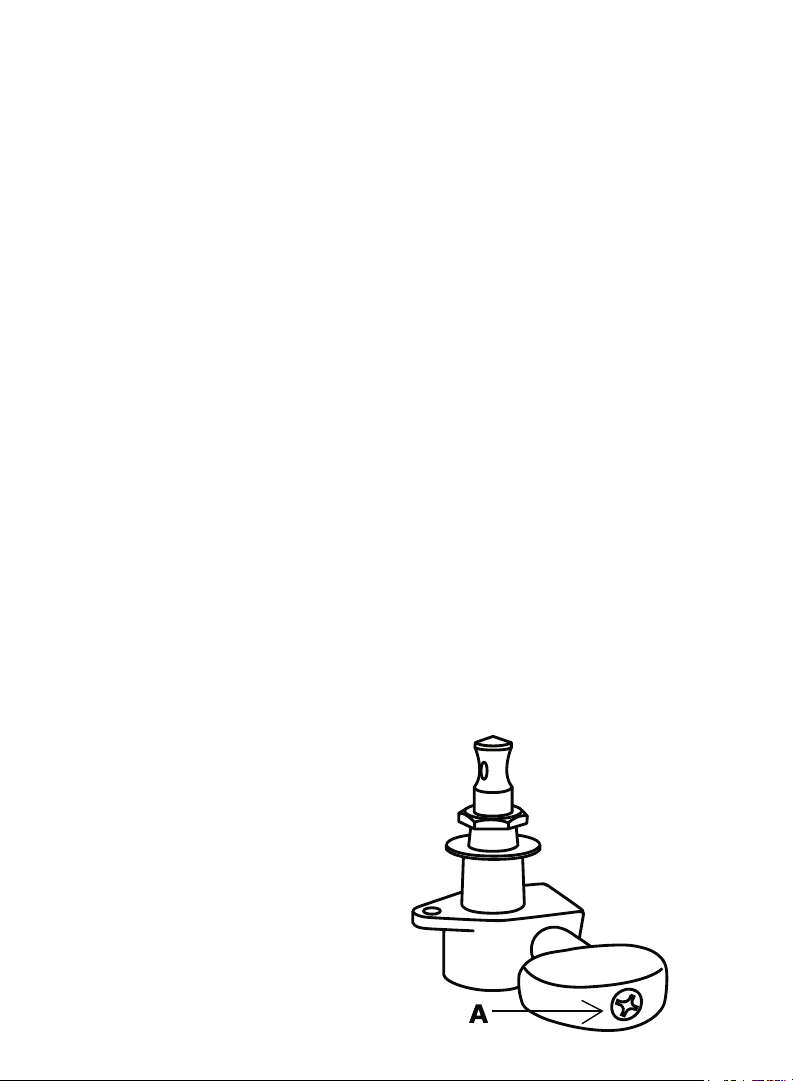
A small tension adjustment screw is located
tension is too loose, the machine may slip
the button may become very dif cult to turn.
Make sure that the adjustment is rm, but not
too tight.
Page 6

Next, depress the “B” string at the 5th fret,
to produce an “E” and tune the thinnest string
to a matching “E”.
Finally, go back and play the low “E” string
“A”, matches the “A” on the adjacent string.
If using an electronic tuner on your electric
guitar, turn the volume up and tune from low
Tuning 12-String Guitars
Due to the tremendous amount of tension
In standard 12-string tuning, the second
pitches, E, A, D, G, B, E, and using the
previous page.
For the E, A, D, and G strings, the rst
its partner. For the B and E strings, the rst
the same pitch), as its partner string.
Many players nd it dif cult to press the
tension caused by the extra strings.
A remedy that some players choose is to
tune the entire guitar to a lower relative pitch,
the rst or second fret, to bring it back up to
where it plays at standard pitch.
The guitar will certainly be easier to play,
the neck over time, but bear in mind that it
will also sacri ce a bit of the tone projection
All Gretsch
®
however, a 12-string tuned at standard
pitch, should be monitored regularly for
For instruments with open gear tuners, make
lightweight oil from time to time for smooth
The Chrome and Gold plating on Gretsch
tuning machines may become degraded from
the acids and oils in nger sweat. Wipe the
machines off with a soft dry cloth after each
use to preserve their appearance and function.
Strings that have not been secured
properly to the tuning machine post may
is commonly misdiagnosed as an issue with
the tuners. Check your string installation
Tuning 6-String Guitars
There are a couple of different methods
your guitar is acoustic, electric or an
tone, you may want to purchase one. It will
dramatically simplify tuning your acoustic or
Always tune from below pitch,
up
to the
pitch. This will help eliminate string slack
possibility of slippage and tuning changes
low
(thickest)
(thinnest): E, A, D, G, B, E.
If you have an acoustic guitar use the A-
440 reference tone on your tuner, a guitar
pitch pipe, an A-440 tuning fork or other
pitch reference, and tune the second string,
“A” to pitch.
Then, depress the second, or “A” string at
the 5th fret, to produce a “D”, and tune the
“D” string to that same pitch.
Next, depress the D string at the 5th fret, to
produce a “G”, and tune the “G” string until
the pitches match.
Next, depress the “G” string at the 4th fret,
to produce a “B”, and tune the “B” string
until the two pitches match.
Page 7

the possible need of truss rod adjustments.
A guitar in need of an adjustment that is
ignored may develop permanent problems.
Please Note: Warpage of the
A fresh set of strings can breathe new life
into your instrument. That is why many
“tone-conscious” touring professionals
performance. While there is no set rule on
how often to change strings, we have found
that most players do not change them nearly
Body oils, acids from sweaty hands and
humidity all interact with the metals in guitar
Don’t wait until your strings break and fall
Worn, oxidized, pitted and dirty strings will
not hold pitch, and simply sound bad. If you
week, we suggest that you change the strings
When changing strings, we recommend that
you remove and replace each string one at a
time, instead of all at once. This will prevent
in neck tension. Each new string should be
tuned up to correct pitch before the next one
is removed.
When tuning a brand new string, always
bring it up to pitch
slowly.
rapid stretching may cause the string to
break.
with a Fixed Tailpiece
The procedure for re-stringing acoustic
guitars, electric guitars and basses, is quite
the tuning machines. There are differences
though, in how the strings are attached to the
bridges of acoustic and electric guitars.
Gretsch
®
at-top acoustics have a pin style
bridge with holes and bridge pins to hold the
paired with the Bigsby Vibrato Tailpiece.
There are also some acoustics and electrics
that have xed tailpieces through which the
To string a at-top, remove the bridge pin
new string into the hole in the bridge, then
re-insert the bridge pin to keep the string
in place. Make sure that the bridge pin is
positioned with the groove over the string.
Do not hammer the bridge pin in. A rm push
with the thumb will secure it in place.
To string an electric with a surface mounted
bridge and xed tailpiece, simply feed the
bridge or slot in the tailpiece.
To attach a string to the machine head,
thread it through the hole or slot on the
machine head, running it halfway around the
post, then underneath the main length of the
main length.
Make sure that each string is seated well,
machine post. This will prevent slipping and
road.
Note: Never cut a string to length before
putting it on your guitar and tuning it to
pitch. Premature cutting may cause the
machine head post.
IMPORTANT NOTE FOR RE-
FLOATING BRIDGE:
into its proper position by the downward
pressure of the strings.
Page 8
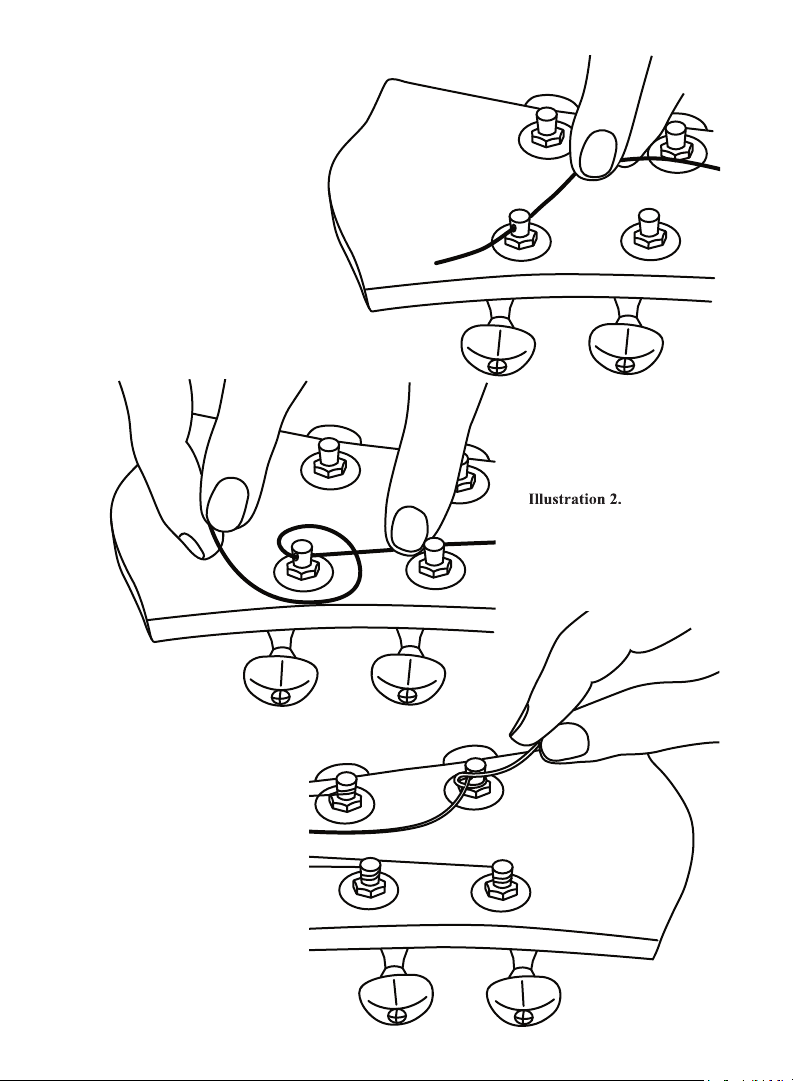
Illustration 1.
near top of string post.
Illustration 2.
halfway around post.
Illustration 3.
Prevent string slippage
by running the short end
halfway around the post,
then underneath and back
Page 9
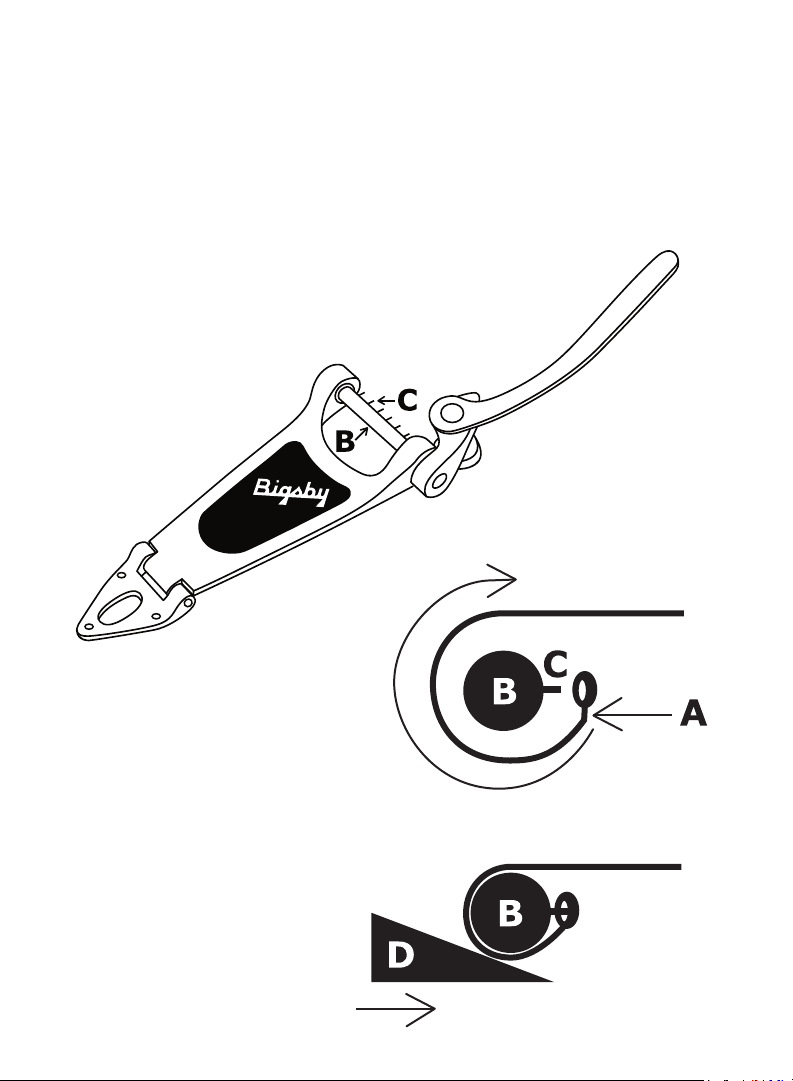
The Bigsby
Vibrato Tailpiece
The Bigsby Vibrato Tailpiece is a time
proven design and has been used by Gretsch
®
Tailpiece has been the choice of guitarists
worldwide - and the choice of world class
guitar builders for standard equipment
Bigsby’s original formulas from the early
fties, Bigsby tremolos are still hand cast,
hand polished and hand assembled. Hand
trouble free service.
o
ball end (A).
2. Feed the string underneath, around and
hold the ball in place.
4. Push a foam wedge (D) into the space
under the axle to keep the string in place on
the pin while winding.
tune to pitch and remove the foam wedge.
Page 10
Truss Rod Adjustment
String tension exerts a tremendous bending
may also cause bowing of the neck.
Gretsch
®
guitars (excluding Lap Steels)
have an adjustable truss rod, running the
length of the neck that counteracts this force,
A truss rod that is too loose will result in
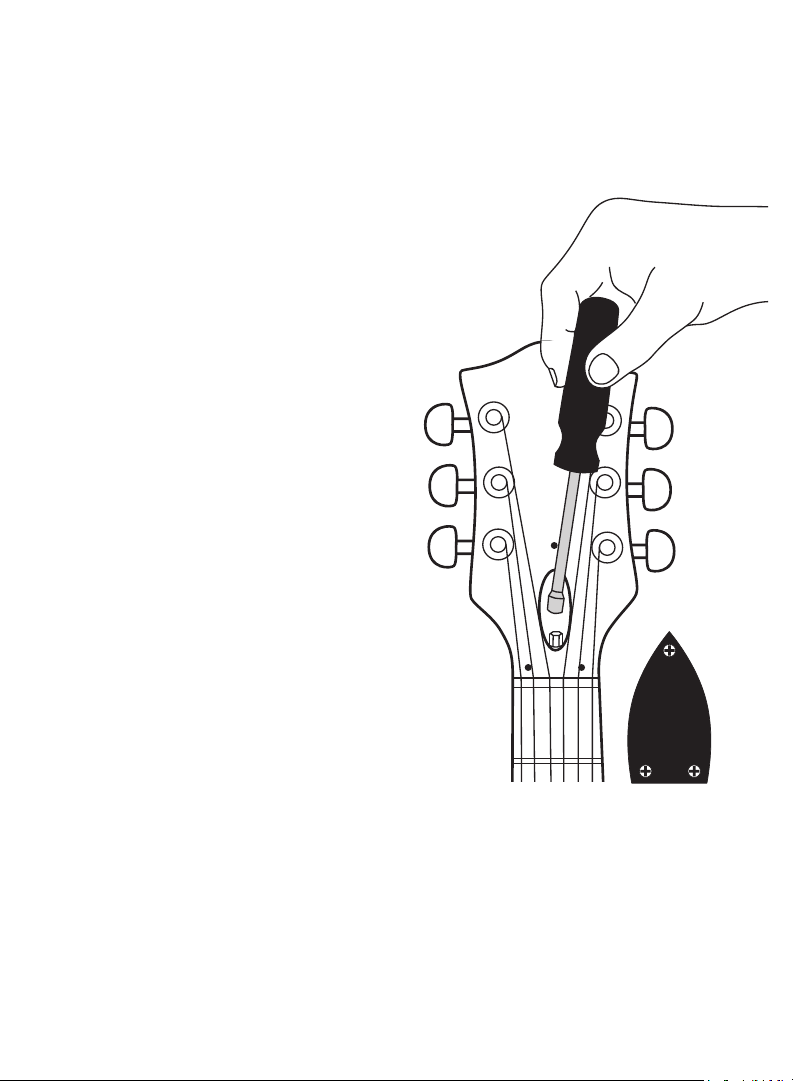
Should the neck of your guitar require
located on the headstock above the nut.
during this procedure.) For
Professional
instruments, insert an 8mm-5/16”
4.
For
Historic and Synchromatic Series
instruments, use a 5mm-3/16” hex wrench.
If the neck has a concave bow, tighten the
truss rod nut by turning it clockwise.
If the neck is humped or has a convex bow,
loosen the truss rod nut by turning it counter
Adjust the rod only a partial turn at a time,
down the neck after each adjustment. Be
If you meet excessive resistance or if you
have any doubts in your ability to make
this adjustment correctly, take your guitar
to an Authorized FMIC Service Center.
Please note: Truss rod adjustments are
will not be covered under the Gretsch
warranty.
Illustration 4.
Professional Series instrument.
Adjustment of Action
String height and tension typically
determine the ease with which the strings
playability is usually called the “action”, and
is determined by the distance between the
Remove truss
rod cover from
headstock. Using
turn rod nut
gently.
Truss rod cover.
Page 11

Depending on your technique or style of
play, high action can sometimes be dif cult to
play, and low action may result in string buzz.
Most electric guitars have height adjustable
bridges with adjustable saddles that allow
you to easily tailor the action to your needs.
On a at-top or classical guitar, adjustment
is a little more involved. To lower the action,
the bridge saddle must be removed, cut
down to the appropriate height and then re-
installed. To raise the action, the saddle must
be removed and replaced by a new, higher
Please note: These types of action
be performed only by an experienced and
A comprehensive guitar setup guide, with
detailed setup speci cations, is available on
the F.M.I.C. Customer Service website at
www.mrgearhead.com
www.mrgearhead.com
Each
Hilo’Tron
TM
head has one set
Filter’Tron
head has two sets of
DynaSonic
head has 6 alnico pole-pieces
with separate height adjustment screws. The
purpose of these adjusting screws is to enable
the player to adjust the tonal balance of their
guitar to their own personal taste. (Note: The
give the best over-all performance for the
majority of guitarists.) However, there are
players who require a speci c type of balance
to t their individual style of playing. By
raising or lowering the pole-pieces with a
particular needs.
make sure that you leave enough clearance
for the string to vibrate freely. Do not let the
screw or pole-piece touch the string.
Gretsch
®
guitars use a variety of “ oating”
bridges including, the compensated
bridge, the original straight bar-bridge, the
®
bridge, coupled
with both xed and vibrato tailpieces.
A oating bridge typically has an arched
wooden or aluminum base that is held in
its proper position on the instrument by
the downward pressure of the strings. If
the bridge is bumped or moved during re-
true.
To reset the intonation adjustment, check
both the 12
th
fret harmonic and the stopped
th
fret tuning of both the high and low E-
If the pitch of the note at the 12
th
fret is
lightly tap the foot of the bridge to move
it back toward the tailpiece until the two
pitches agree.
If the pitch of the note at the 12
th
fret is
at relative to the pitch of harmonic, lightly
tap the foot of the bridge to move it forward
toward the neck until the two pitches agree.
When the harmonic and 12
th
fret pitches
properly intonated.
To ne-tune the fully adjustable bridges,
individual intonation screws while checking
the tuning of the harmonic against the 12
th
IMPORTANT NOTE:
When re-stringing
the strings at the same time, as the bridge
is held into its proper position by the
Page 12
10
Most tuning problems are caused by a
Improper seating and winding of the strings
high).
Friction at the saddle or the nut, (due to a
lack of lubrication), or binding of the string
which does not directly correspond to the size
problem if increasing the gauge size of
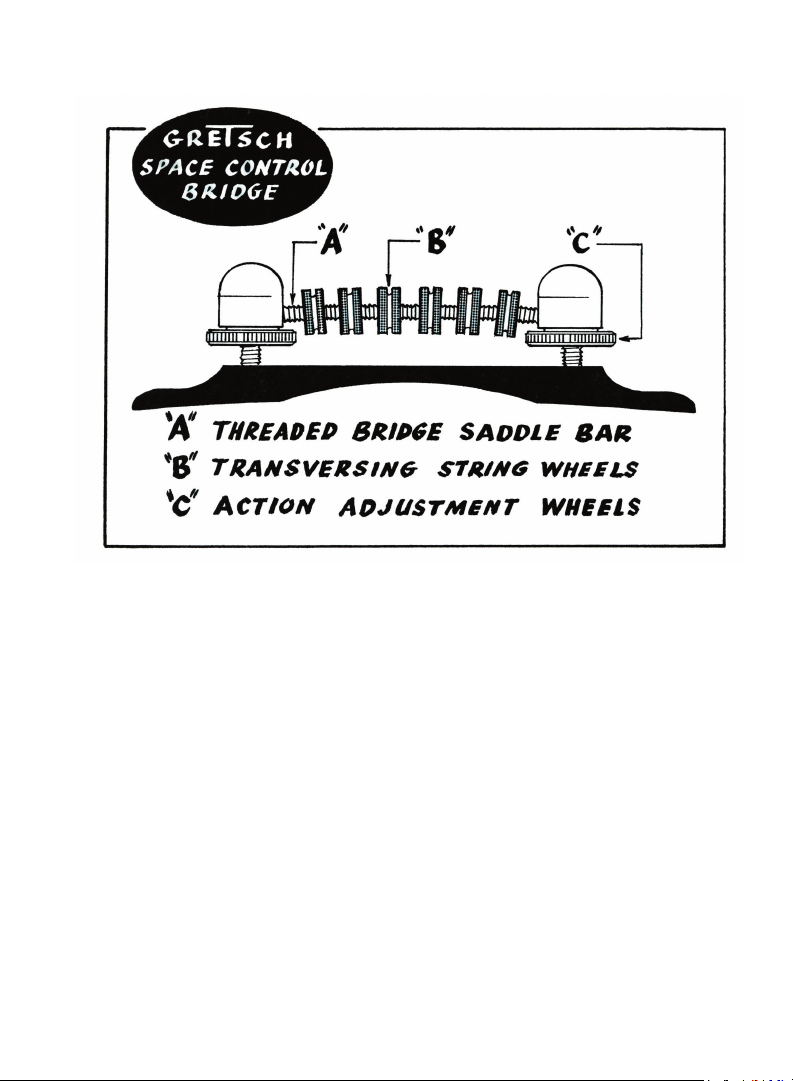
Space Control Bridge Adjustment
The oating Gretsch
®
Space Control Bridge
has been preset at the factory. However,
individual style of play, if they so choose.
The knurled string wheels (B) that move
player to adjust string spacing at the bridge.
Here’s all you do---loosen the string slightly,
lift the string gently in front of the bridge,
then turn the string wheel slowly to move it
in the desired direction. Once the adjustment
has been made to each string, retune your
guitar and enjoy your custom string spacing.
Page 13

Here are a few tips that should help
Make sure that each string is seated well,
machine post.
Tune from low pitch to high, so as not to
leave any slack in the string behind the nut.
If there is any slack, (usually unseen), in the
you start using the tremolo or bending notes.
Make sure the instrument is properly
lubricated. With a Q-tip, touch a small drop
If the strings are stretched and seated
properly on the tuning machines and if all
the points of friction have been lubricated
properly, it should eliminate most of the
tuning problems you’ll ever run into.
Traveling with Your Guitar
Gretsch
®
guitars demonstrate the highest
protection. We recommend that you purchase
designed and tted exclusively for your
guitar to give it the utmost protection. *Keep
your guitar in a case when not playing it.
If you plan to travel, carry your instrument
in a hard shell case at all times for protection.
When traveling by air, your guitar may be
damage, de-tune all of the strings about a
whole step, so that the tension is reduced
Gretsch offers a variety of hardshell
Please contact your local Gretsch dealer for
information on the appropriate replacement
When ordering your factory case please
Servicing Your Guitar
New guitars typically have a settling in
period where adjustments may be necessary
to compensate for wood movement caused by
the tension of the strings. Many experienced
guitar players have learned to adjust the truss
rod or “action” of their own instruments.
If you do not feel comfortable making
these adjustments to your new guitar we
recommend that you return the instrument
to your Gretsch
®
Dealer or to an Authorized
Fender
®
Service Center within 90 days of
the purchase, for an inspection and truss rod
identify and prevent potential damage to the
neck.
If major servicing is required, please
Authorized FMIC Service Center, please
website at
www.gretschguitars.com
www.gretschguitars.com
For comprehensive guitar setup
documentation, visit our FMIC Customer
www.mrgearhead.com
www.mrgearhead.com
Please note: Truss rod adjustments
be routine maintenance and will not be
Page 14
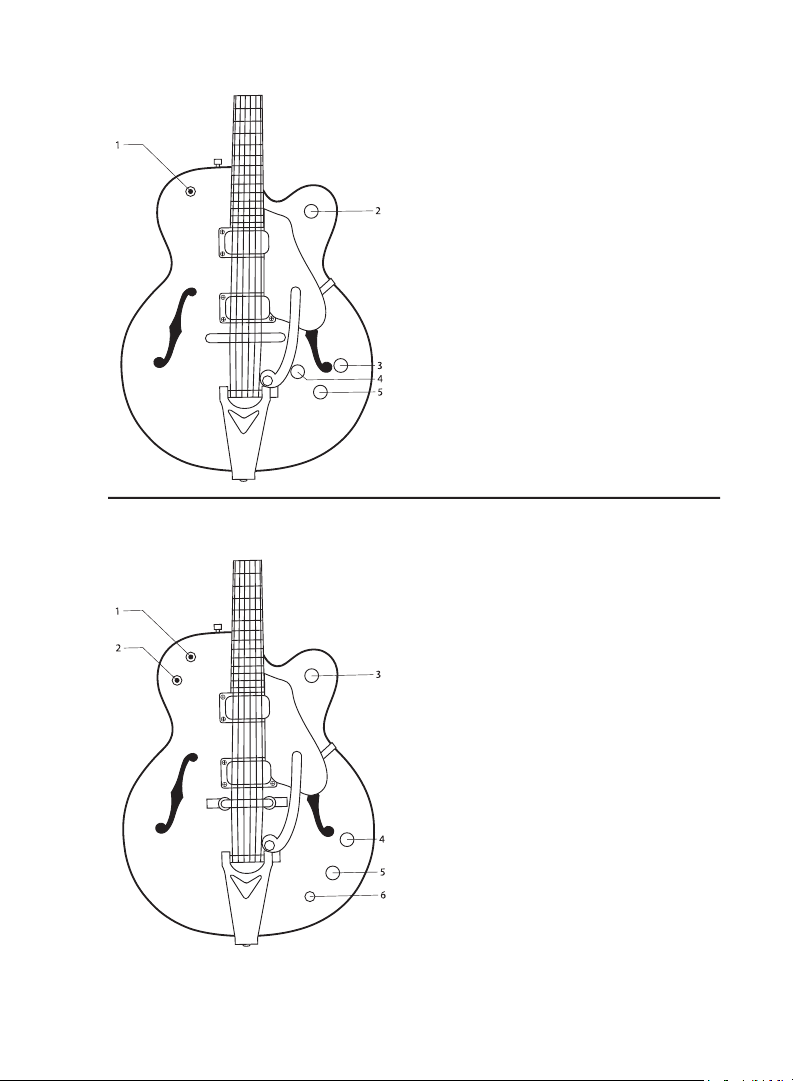
Basic Controls Guide
2. Master Volume
For adjusting overall volume.
For adjusting the tone of the front and rear
pickups.
4. Front Pickup Volume
For controlling the front pickup volume.
For controlling the rear pickup volume.
2. Master Tone Selector
Tone control switch. The exterior of the body
is deep, the center is bypass (Tone 0), and
the interior is shallow, so that the tone can be
For adjusting overall volume.
4. Front Pickup Volume
For controlling the front pickup volume.
For controlling the rear pickup volume.
In the center position, no sound is produced,
regardless of the volume controls. Sound
is produced when switched to either side
position.
Page 15
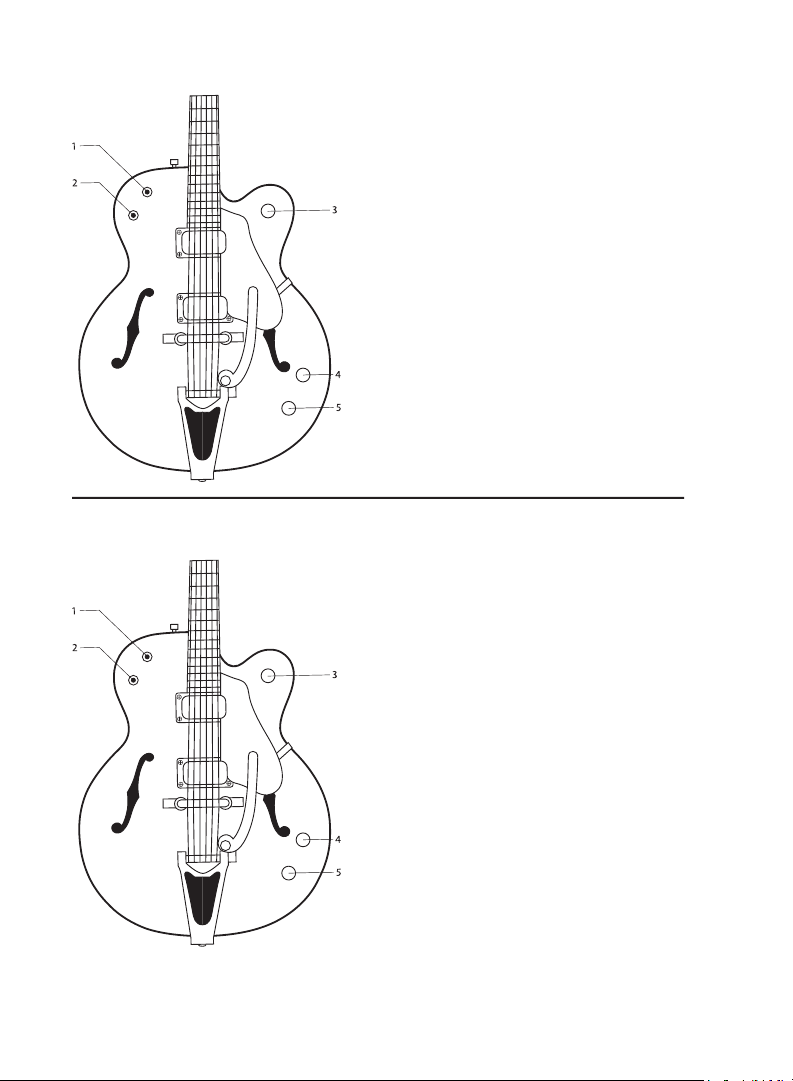
13
2. Master Tone Selector
Tone control switch. The exterior of the body
is deep, the center is bypass (Tone 0), and
the interior is shallow, so that the tone can be
For adjusting overall volume.
4. Front Pickup Volume
For controlling the front pickup volume.
For controlling the rear pickup volume.
Tone control switch. The exterior of the body
is deep, the center is bypass (Tone 0), and
the interior is shallow, so that the tone can be
2. Pickup Selector
For adjusting overall volume.
4. Front Pickup Volume
For controlling the front pickup volume.
For controlling the rear pickup volume.
Page 16

®
FMIC warrants this Gretsch guitar to be free
purchase, subject to the limitations set forth
herein. This warranty applies only to the
when this instrument
is purchased from an authorized Gretsch
dealer, and requires the purchaser to supply
the purchaser, thereon) at the time service is
the purchaser, thereon) at the time service is
requested
requested
Repair service of defects covered by this
warranty can be performed only at an FMIC
Authorized Warranty Service Center, as
designated by FMIC. Remedies beyond
normal service repair of any Gretsch guitar
require both an evaluation of the defect and
the rst point of contact when service of any
kind is required for your Gretsch guitar.
All transportation, insurance and freight
responsibility of the purchaser, as is
Limitations and exclusions
The following items are
not
covered by this
warranty.
Fret wear, saddle wear, nut wear,
2.
maintenance of any kind.
Damage to nishes or cracks,
in temperature or humidity, exposure to or
rubber or other synthetic materials, any other
4.
Damage, corrosion or rusting of any
hardware components caused by humidity,
Any damage to an instrument
resulting from customization or modi cation.
Normal wear and tear on any part
jacks, controls, switches, plated surfaces,
tuning machines, pickguards, zippers, clasps,
handles, latches, case hardware etc.
All other damage and deterioration
due to normal usage, wear and tear, aging,
Any instrument, whose serial
number is missing, altered or tampered with
in any fashion.
Any instrument purchased from
®
Dealer.
Page 17

15
by unauthorized persons (any person other
than an FMIC Certi ed Technician at an
Authorized FMIC Service Center).
FMIC ASSUMES NO LIABILITY FOR
PROPERTY DAMAGE RESULTING
FROM FAILURE OF THIS PRODUCT
NOR ANY LOSS OF INCOME,
FROM THE LOSS OF USE OF SAME DUE
TO DEFECTS OR AVAILABILITY OF
Any warranties implied by law (including
warranties of merchantability or tness)
limited warranty. Some states do not allow
limitations on how long an implied warranty
lasts, so the above limitations may not
the exclusion or limitations of incidental
limitation or exclusion may not apply to you.
This warranty gives you speci c legal rights,
guitars purchased and serviced within the
U.S.A. and Canada. Warranties outside these
FMIC Distributor for your country or region,
length.
EFFECTIVE DATE: JANUARY
1, 2003
FMIC SPECIALTY SALES
Phone: 480-596-9690
www.gretschguitars.com
In case of loss or theft, please record the
pertinent information on your instrument
below:
MODEL____________________________
DATE PURCHASED_________________
PRICE PAID________________________
DEALER___________________________
Page 18

Your Personal Address And Phone Directory
NAME
ADDRESS
PHONE
Page 19

NAME
ADDRESS
PHONE
Page 20

®
GUITARS
FMIC SPECIALTY SALES
www.gretschguitars.com
Rev. A
991-6026-135
 Loading...