

Page 1
Center Channels / Surround-sound
All products include our Happy Ears for Life™ warranty
M
Time / phase-coherent, high-performance speakers featuring Balanced-Phase™ first-order crossovers / Q-Stone™ cast marble, designed by physicist Roy Johnson
Green Mountain Audio
Hear it all. It’s about...time.
| Write 310 South 25th Street COSCO USA 80904 | Call 719.636.2500 |
Visit greenmountainaudio.com | Email ItsAboutTime@greenmountainaudio.com
Vortex | Aperture Center-Shelf | The Ticket
Vortex
center channel
Summary: Designer’s concept
Our Continuum 2 Center Channel debuted in 1999, with features that are today still considered breakthrough advancements.
However, developing and solving the mathematical formulas responsible for the Continuum 3’s pinpoint perfection also led
to the design and development of its center channel, the Vortex.
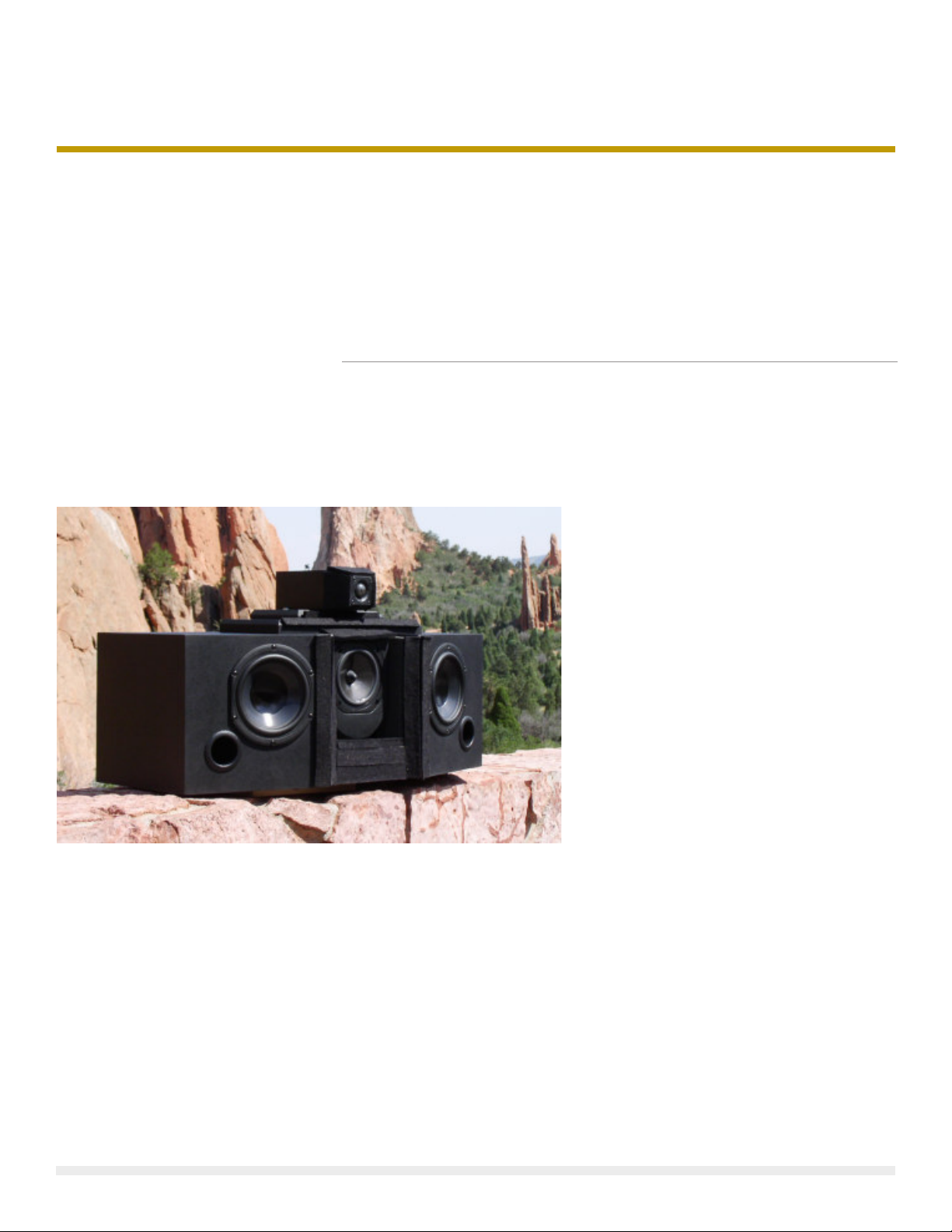
I had six design and engineering goals for the Vortex: 1) Fill a large room from a shelf location, built into wall, or above a
projection television; 2) Produce enough bass that a subwoofer wouldn’t be required; 3) Have very wide dispersion; 4) Soundfield
Convergence™ adjustments for proper sound
from any location; 5) Emit little sound directly to
the sides, or up and down, to prevent reflections
off nearby surfaces; and 6) Isolation feet to avoid
shelf resonance.
There was no escaping the math developed for
the Continuum 3. It showed the importance of
beginning at the listener’s ear and then working
back to the speaker’s position to determine the
size, location, and quantity of the speaker’s
drivers and the cabinet’s size and shape.
The need for wide dispersion led to only one
way to create excellent bass response: Two
smaller woofers flank a single midrange driver
and act exactly like one woofer centered ‘over’
the midrange. The tweeter is mounted directly
above to complete the ‘vertical alignment’
needed for the widest left-to-right dispersion. Two 6.5-inch, high-power, ultra-low distortion woofers were chosen and
angled outwards produced the most uniform low-voice dispersion. Because no 6.5-inch woofer will reach quite low enough
in the bass, each woofer required a proper port.
The midrange driver is placed behind the plane of the two woofers so its sound would reach your ear at the same instant,
for time-coherent sound reproduction. This put the midrange driver inside a short ‘tunnel.’ Lining that short tunnel with the
proper acoustic-absorption materials not only prevented reflections from the surfaces, but also suppressed the middlerange sounds usually sent directly out to the sides, and up and down, for fewer reflections off nearby walls and furniture. A
‘resistive vent’ in the back wall of the Vortex midrange enclosure ‘leaks’ low-frequency air pressure before the natural lowfrequency resonance of the midrange driver can begin, resulting in the best blend between the midrange driver and
woofers. A unique, acoustic labyrinth between the midrange driver and resistive vent absorbs more sound than any other
method while still allowing the vent to supress that low-frequency resonance.
The tweeter’s large rear chamber captures its own rear waves, and it is, in turn, mechanically compression-damped by
dense wool felt placed between it and its Q-Stone™ cast marble enclosure. Thus, a completely non-resonant environment
is created for the microscopic motions of the tweeter’s dome. The shape of the enclosure allows the low treble to spread
into the wool felt immediately surrounding the tweeter, which cuts off low-treble sounds normally sent directly to the sides
Hear it all.
It’s about...time.
M
Page 2

and upwards, for fewer reflections from nearby surfaces. Wool felt below the tweeter throws an ‘acoustic shadow’ onto the
midrange driver, so little treble is reflected from the midrange cone.
Center Channels / Surround-sound
The cabinet construction is a direct descendant of the Continuum 3. Complicated corner joints and a Baltic-birch front
panel for each woofer provide rigid platforms from which the woofers push and pull. To isolate the Vortex, nine neoprene
M
rubber feet of the proper stiffness were used.
Time / phase-coherent, high-performance speakers featuring Balanced-Phase™ first-order crossovers / Q-Stone™ cast marble, designed by physicist Roy Johnson
Through our simple, first-order crossover circuit engineering, all signals from the drivers seamlessly recombine into the
Green Mountain Audio
one original waveform at your ear. For example, the Vortex tweeter is also used in the Continuum 3. It’s so linear in its
operation that the entire crossover circuit feeding it consists of one super-premium capacitor. The midrange driver has a
very rigid and light cone of acrylic polymer impregnated with Kevlar, carbon fibers, and billions of microscopic air bubbles.
It’s 20 percent lighter than the best magnesium cone and has a special suspension. These features allow it to go very high
and also very low to easily blend with the tweeter and imperceptibly with the woofers. It’s also used in the Continuum 3
and, as with the tweeter, is so well-behaved that the entire circuit on the way to it consists of one super-premium capacitor
and three premium capacitors in parallel (making one large capacitor) along with two small Litz-wire oxygen-free-copper
inductors in series. The woofers in the Vortex operate from house-shaking low bass right up to the lower part of the voice
and piano range. Their cones have a low moving-mass of 16.6 grams—lower than most 6.5-inch woofers—and is made of
spun Nomex fibers and polymers that make them very rigid and non-resonant. This allows them to go very high, so they’re
easily blended with the midrange driver. Their special suspensions and intense magnetic fields allow them to go as low as
possible with very little distortion. As with the other drivers, the linear woofers require only one premium, very-low resistance
inductor in their circuit. The first-order crossover design we use presents ideal ‘forks in the road’ for the signal. The
measure of this is a ‘flat impedance curve.’ We call this Balanced-Phase™ crossover design. It’s inside all of our speakers
and allows any amplifier to deliver maximum power with the least distortion.
Since the Vortex midrange driver already lies between the two woofers, its position doesn't need to be adjusted. However,
the tweeter position may be adjusted from front-to-rear to focus the sound up or down in any listening area. This ability to
customize the field of sound was first introduced in 1996 in the Continuum 1 and named Soundfield Convergence™ because
it allows total control and provides the ultimate listening experience. You'll be transported into the action and stand shoulderto-shoulder with the actors. Since two-channel music will have much greater clarity, depth, dynamics, and bass response,
you'll feel as if you're on stage with the musicians. I'm happy to give you the Vortex and the enjoyment it provides.
Hear it all. It’s about...time.
| Write 310 South 25th Street COSCO USA 80904 | Call 719.636.2500 |
Visit greenmountainaudio.com | Email ItsAboutTime@greenmountainaudio.com
All products include our Happy Ears for Life™ warranty
Vortex | Aperture Center-Shelf | The Ticket
Specifications: Drivers, results & pricing
Woofers Two 6.5-inch, low-mass Nomex-fiber rigid cone. Low resonant frequency from highly-compliant ultra-linear
suspension of synthetic rubber and large, fully-vented flat spider; high-power, 2-layer 1.25-inch voice coil, also fullyvented. Cast alloy chassis; 24-ounce magnet, 11mm p-p linear excursion. Enclosure Vented 4th-order Butterworth, tuned
to 45Hz with two-inch ports on front faceplates.
fibers, micro air bubbles). 5.6 grams moving mass. Low resonant frequency from high-compliance suspension. Santoprene
rubber surround, large rear-vented flat spider. One-inch Kapton voice coil, vented via rubber phase plug. Die-cast MgZn
alloy chassis; 12 ounce magnet; 5.2mm linear excursion. Resistively-vented in alliptic, non-diffractive Q-Stone™ cast
marble housing containing damped acoustic line. Response -3dB at 320 and 2870Hz.
linen, hand-coated with polymer. High-compliance, inverse-roll contiguous suspension. Hex-wound copper-clad aluminum
voice coil wire, high-strength aluminum alloy former, Ferrofluid cooled, with 0.46 grams of moving mass. Large, damped
rear chamber. Double neodymium magnets, fully shielded. In alliptic, non-defractive, Q-Stone™ cast-marble housing with
integrated tweeter-chassis damping.
on Soundfield Converged (Soundfield Convergence™) axis, on first-arrival tone bursts, across approximately 75dB dynamic
window.
any two frequencies separated by a 10:1 ratio.
with loudness.
over full bandwidth.
constant until 7kHz, decreasing to cardioid at 10kHz.
Phase™ first-order circuit.
91dB for 2.83V at 1m, at sea level. Dynamically linear within 0.5dB to 100dB. Max SPL 103dB peak at 3m, first-arrival
(without room gain).
crossover parts +/- 0.15 percent. Birthdate November 10, 2004. Size without grille 16.5"H | 14"D | 31"W Weight without
grille 75lbs/34kg. USA pricing, each $4,300. Includes grille. Add shipping, applicable* fees. Finish Black Texture-Kote™.
*Taxes, customs, duties | Prices subject to change without notice | Copyright 2005-2006, Green Mountain Audio | For more visit greenmountainaudio.com
Distortion <0.5 percent harmonic 100Hz to 12kHz, < 1 percent intermodulation, both at 100dB at 1m. I.M.D. is for
Rise time <10 microseconds, positive or negative input. Does not vary with loudness. Polarity Positive,
Dispersion Omni at 41Hz, smoothly decreasing to wide-cardioid at 300Hz; a pattern maintained
Impedance 5.5 Ohms +/- 1 Ohm, from 150Hz to 20kHz. Does not vary with loudness. Sensitivity
Pair matching (when applicable) Amplitude +/- 0.25dB; impedance +/- 0.15 Ohms, 160Hz-8kHz;
Response +/- 0.75dB from 47Hz to 20kHz, -3dB at 41Hz and 24kHz, from 2.5 to 5m,
Hear it all.
Midrange 5.25" Aerogel cone (acrylic polymer gel, carbon and Kevlar
Tweeter Lightweight 28mm dome of
Phase shift +/- 3 degrees acoustically, from 220Hz to 8kHz. Does not vary
Power 7 to 150W (amplifier’s 8 Ohm rating). Crossover Balanced-
It’s about...time.
M
Page 3

Center Channels / Surround-sound
All products include our Happy Ears for Life™ warranty
M
Time / phase-coherent, high-performance speakers featuring Balanced-Phase™ first-order crossovers / Q-Stone™ cast marble, designed by physicist Roy Johnson
Green Mountain Audio
Hear it all. It’s about...time.
| Write 310 South 25th Street COSCO USA 80904 | Call 719.636.2500 |
Visit greenmountainaudio.com | Email ItsAboutTime@greenmountainaudio.com
Vortex | Aperture Center-Shelf | The Ticket
Aperture
center channel / shelf-mount
Summary: Designer’s concept
Whether used as a center-channel, all front channels, or for
two-channel music, the Aperture is specifically designed to deliver
the best possible sound from a bookshelf.
For the best clarity, a combination of ultra-low density
fiberglass and a miniature of our proprietary, Golden-Ratio
Baffle™, derived from our large floorstanding speakers, makes
Aperture’s cabinet extremely quiet inside without restricting
low bass from reaching the port. The cabinet’s front face is
molded from our Q-Stone™ cast-marble and surrounded by
19 wood panels made using four different thicknesses.
The tweeter has its own Q-Stone™ housing, separate from
the woofer enclosure. It applies full mechanical damping to
the the tweeter’s chassis. Reflections from nearby surfaces
are prevented by our proprietary Inverse Acoustic Horn™. It’s
a special shape of acoustic foam and wool felt, and absorbs
sound that’s normally directed to the sides and up and down
the face of the speaker. The tweeter is adjustable from front
to rear so that the sound may be customized to any listening
environment. This same tweeter is also used in our flagship
Continuum 3 because it’s alive with detail and never upset by
harshness in voices or sound effects. I use the Aperture’s
woofer in other speakers because no other woofer will play
with such low distortion at any loudness, from the high-voice
range to the low bass. The bass boost created by nearby
surfaces is offset by a special tuning of the Aperture’s enclosure.
These two drivers must move in unison as they are blended
together by the crossover. Our simple, Balanced-Phase™ ‘firstorder’ crossover circuit keeps this timing the most precise that
has ever been achieved, and extracts power from any amplifier
with the least distortion.
The Aperture is a compact loudspeaker
specifically designed for bookshelf and
home theater placements.
I’m honored to offer a speaker that has been perfectly—and specifically—designed for use on a bookshelf. As
with all speakers we manufacture, you’ll hear all of the original signal—from the lowest bass to the highest
treble notes—and everything in-between, the way they were meant to be heard. You deserve to hear it all.
Hear it all.
It’s about...time.
M
Page 4

Specifications: Drivers, results & pricing
Woofer 6-inch rigid piston, single-pressed paper/carbon fiber cone with ultra-linear suspension, vented under-
hung Kapton voice coil. Shielded, radially-magnetized neodymium-iron-boron magnet.
M
cast marble face with wood cabinet. Two-inch aerodynamic port on front for 4th-order Butterworth tuning at
Time / phase-coherent, high-performance speakers featuring Balanced-Phase™ first-order crossovers / Q-Stone™ cast marble, designed by physicist Roy Johnson
52Hz. Removable top cover for access to adjust tweeter’s position. Neoprene isolation feet. Solid cherry trim.
Green Mountain Audio
Tweeter Lightweight 28mm dome of linen, hand-coated with polymer. High-compliance, inverse-roll contiguous
suspension. Hex-wound copper-clad aluminum voice coil wire, high-strength aluminum alloy former, Ferrofluid
cooled, with 0.46 grams of moving mass. Large, damped rear chamber. Double neodymium magnets, fully
shielded. Mounted in beveled Q-Stone™ cast marble housing with integrated tweeter-chassis damping. Adjustable from front to rear for directing soundfield to listening area (Soundfield Convergence™), for cabinet placed
18 to 72 inches from floor.
Soundfield-Converged axis, on first arrival tone bursts, across 75dB dynamic window.
harmonic 100Hz-12kHz, <1 percent intermodulation, both at 98dB at 1m. I.M.D. is for any two frequencies
separated by a 10:1 ratio.
not vary with loudness.
Polarity Positive, over full bandwidth. Dispersion Omni at 47Hz, quickly decreasing to cardioid at 10kHz.
Power 7 to 150W (amplifier’s 8 Ohm rating). Crossover Balanced-Phase™ first-order circuit. Impedance 4.1 to
5.3 Ohms from 100Hz to 20kHz; 4.1 to 24 Ohms from DC to 100Hz. Does not vary with loudness.
90dB for 2.83V at 1m, at sea level. Dynamically linear within 0.5dB to 100dB. Max SPL 100dB peak at 3m from
a single cabinet, first-arrival (without room gain).
Ohms, 160Hz-8kHz; crossover parts +/- 0.15 percent.
13.5"D.
advancements
Black Texture-Kote™ with inlaid, hand-dyed and lacquered premium cherry trim. Options Factory burn-in 100
hours, $75; 200 hours, $150. NEW! Accessories Coming soon...the Aperture EarMuff!
Hear it all. It’s about...time.
| Write 310 South 25th Street COSCO USA 80904 | Call 719.636.2500 |
Response +/- 0.75dB 55Hz to 20kHz, -3dB at 47Hz and 23kHz, from 2.5 to 6m, on
Phase shift +/- 2 degrees acoustically, from 200Hz to 8kHz on listening axis. Does
Rise time <10 microseconds, positive or negative input. Does not vary with loudness.
Pair matching Amplitude +/- 0.25dB; impedance +/- 0.15
Weight 29lbs/13.2kg each. Contributions to sound reproduction (world “firsts”) 4 Patentable
1 USA pricing, each $2,500. Add shipping, applicable* fees. Matched pairs available. Finish
Visit greenmountainaudio.com | Email ItsAboutTime@greenmountainaudio.com
Birthdate January 3, 2004. Size 10.875"H | 13.875"W |
Center Channels / Surround-sound
All products include our Happy Ears for Life™ warranty
Vortex | Aperture Center-Shelf | The Ticket
Enclosure Q-Stone™
Distortion <0.5 percent
Sensitivity
Hear it all.
*Taxes, customs, duties | Prices subject to change without notice | Copyright 2005-2006, Green Mountain Audio | For more visit greenmountainaudio.com
It’s about...time.
M
Page 5

Center Channels / Surround-sound
All products include our Happy Ears for Life™ warranty
Hear it all. It’s about...time.
M
M
Time / phase-coherent, high-performance speakers featuring Balanced-Phase™ first-order crossovers / Q-Stone™ cast marble, designed by physicist Roy Johnson
Time / phase-coherent, high-performance speakers featuring Balanced-Phase™ first-order crossovers / Q-Stone™ cast marble, designed by physicist Roy Johnson
Green Mountain Audio
Green Mountain Audio
Hear it all. It’s about...time.
| Write 310 South 25th Street COSCO USA 80904 | Call 719.636.2500 |
| Write 310 South 25th Street COSCO USA 80904 | Call 719.636.2500 |
Visit greenmountainaudio.com | Email ItsAboutTime@greenmountainaudio.com
Visit greenmountainaudio.com | Email ItsAboutTime@greenmountainaudio.com
Vortex | Aperture Center-Shelf | The Ticket
Specifications definitions
Response (frequency response) is a measure of how uniformly loud the speaker responds from bass to treble.
Perfection is plus-or-minus zero, across the widest possible frequency band. Plus-or-minus one decibel is a tight
tolerance—a barely audible deviation from perfection. There are many ways to measure response, most of which,
unfortunately, include the sound of the room in which the speaker was measured. We measure using short bursts of
tones which end before any room imposes its own signature.
Distortion comes in two forms, harmonic and intermodulation. Harmonic distortion is the addition of unwanted
harmonics to the original tone. These are measured by a specialized meter which filters out the original signal, leaving
only the harmonics behind. The perfection standard is zero. Intermodulation is what happens when one tone distorts
another tone, such as the bass distorting the voice. Again, a special meter filters out these two original tones to read
the remaining distortions, and a perfect reading is zero.
Phase shift is a measure of the time delay imposed on any frequency, measured as a portion of any frequency’s 360degree period. Perfection is zero degrees across the widest possible frequency band.
Rise time is the ‘get up and go.’ It’s the measure of how long it takes for a speaker to go from ‘no signal’ to ‘full signal.’
Perfection is zero seconds.
Polarity is an indicator of the speaker’s motion with respect to the amplifier’s signal. Normal polarity, the ideal, means
that every driver moves outward into the room for a positive voltage from the amplifier. Inverted polarity means those
drivers ‘suck’ inwards for a positive voltage. Imagine a trumpeter ‘sucking in’ on his horn, instead of blowing outwards
through his instrument. That’s the difference between inverted and normal polarity. Hopefully, each of your stereo
components was made with normal polarity. If not in the owner’s guide, call their service department and ask. If one
component has inverted polarity, you’ll then need to re-invert it by reversing the wires on each speaker, from plus-tominus to minus-to-plus. This won’t hurt your equipment if left uncorrected, but normal polarity results in better sound.
Dispersion describes how widely the sound is scattered across the room. Omni-directional means equal loudness in
all directions, and cardioid means directional. Our speakers’ bass intentionally goes everywhere because the room
works with it. The opposite is true in the ultra-highs, which, at 10kHz, are directed to the front so they don’t reflect from
the side walls. The challenge is to achieve a smooth transition between these two extremes.
Power is the recommended size of amplifier to be used with our loudspeakers. Amplifiers are rated into both 4-Ohms
and 8-Ohms. We benchmark our recommended power ratings using an amplifier’s 8-Ohm rating.
Impedance is a measure of the speaker’s electrical resistance at each frequency. A perfect impedance would be the
same Ohms at all frequencies, over the widest possible bandwidth. An extremely low deviation in impedance allows
the most power from an amplifier at all frequencies and the use of long speaker wires.
Sensitivity is a measure of how much sound is output for a certain signal input. Lower decibels means more power is
required. We could send a specific amount of wattage and measure the resulting loudness in decibels, but wattage
depends upon whether the speaker is either 4-Ohms or 8-Ohms, or even 6-Ohms. This would make it hard to compare
Hear it all.
It’s about...time.
M
Page 6

ratings among different speakers. Instead, a particular voltage is sent in, as measured by a volt meter on the speaker
wires, and then the sound pressure is measured. It’s a better method because that voltage remains the same no matter
which speaker is connected. It’s equivalent to leaving the amplifier’s volume control at the same level while connecting
M
speakers. Our speakers are in the average range of 88-90dB for 2.83 Volts of signal sent by the amplifier, as measured
Time / phase-coherent, high-performance speakers featuring Balanced-Phase™ first-order crossovers / Q-Stone™ cast marble, designed by physicist Roy Johnson
by a microphone placed one meter away, at sea level. Why 2.83 Volts? That much voltage happens to give one Watt
Green Mountain Audio
of power into an 8-Ohm speaker. It produces two Watts of power into 4-Ohms. Why one meter away? It’s an international
standard developed for convenience. The distance is far enough to measure all drivers’ outputs yet not too far away as
to pick up any room echo. Why sea level? Except for Death Valley, Calif., or a few other places around the world
known to be below it, sea level is the point on our globe at which the air is the heaviest with air molecules, and
therefore, the one place where the speaker will have to move the most of them. For example, since air is less dense
with elevation, a speaker at our Colorado Springs factory location (elev. 6,300 feet) requires twice as much power than
it would at sea level.
Max SPL (Maximum Sound Pressure Level) is the peak loudness a sound meter would show at three meters (10 feet
away) from the speakers in an average room. Anything greater than 100dB is ‘shouting loud.’ Room gain means ‘how
much echo from the room’ is adding to that reading. The engineering goal is to no ‘room gain.’
Pair matching involves matching the left and right speakers to each other. Why? We match speakers for balanced
sound from left to right. It’s important to be able to hear voices in their correct proportions to the bass and highs. If not
well-matched, instruments won’t seem to be in their right positions and voices will seem to be off to one side or the
other. There’ll be more voice in one speaker than the other, or more bass, or more highs. A perfect pair match means
that the speakers sound identical to each other, resulting in the clearest sound and most musicality. To make a perfectly
matched pair of speakers means that their loudness (amplitude) matches at each tone. The impedance must match so
the amplifier puts out equal power to each speaker. For the impedance to match, crossover circuit parts must be held
to very tight tolerances. Since we want the speakers to be 100 percent matched, perfection is a zero percent difference
between these crossover parts.
Hear it all. It’s about...time.
| Write 310 South 25th Street COSCO USA 80904 | Call 719.636.2500 |
Visit greenmountainaudio.com | Email ItsAboutTime@greenmountainaudio.com
Center Channels / Surround-sound
All products include our Happy Ears for Life™ warranty
Vortex | Aperture Center-Shelf | The Ticket
Birthdate is the date of the speaker’s first photograph. The entire speaker is made of wood in the picture and is called
“the prototype.” It alone represents many months of work and several stages of design and development. Using only
the one prototype speaker, Designer Roy Johnson then engineers the crossover circuit. All who listen are predictably
amazed at the sound quality and are anxious to listen to a finished pair of speakers. The mastering stage is next. To
master each part of the speaker intended to be marble, Roy uses the prototype as a reference and sculpts new blocks
of wood to perfection. Once each wood master is perfect, any necessary “negative” pieces of wood are expertly
shaped before a large wooden box is built and screwed together. The wood masters and “negatives” are perfectly
placed within the wood boxes and screwed down. A rubber compound is then poured into each of the boxes, which,
depending upon the humidity, may require a couple of days to dry. Roy then cleans and stores each wood master and
personally pours the marble for the first speaker to check tolerances and refine our Q-Stone™ cast marble recipe if needed.
He then assembles an entire speaker and fine-tunes its crossover. Only then is the new model ready for production.
Size/Weight are net values.
Contributions (world “firsts”) to sound reproduction (where shown) is a listing of all the specific advancements in
a particular speaker. So far in his career, Designer Roy Johnson has achieved 53 world “firsts” in sound reproduction.
Several are related to cabinet construction and enclosure shapes while others are innovative leaps forward, such as
his Golden-Ratio Baffle™ and Soundfield Convergence™ user-adjustability.
Patentable advancements (if any) represents a particular speaker’s number of innovative, world “firsts” that will be
formally patented as we continue to grow.
Hear it all.
It’s about...time.
M
 Loading...