

Page 1
OPERATION, SERVICE AND PARTS
For additional copies
at no charge
order 999 6045.1
INSTRUCTION MANUAL
849
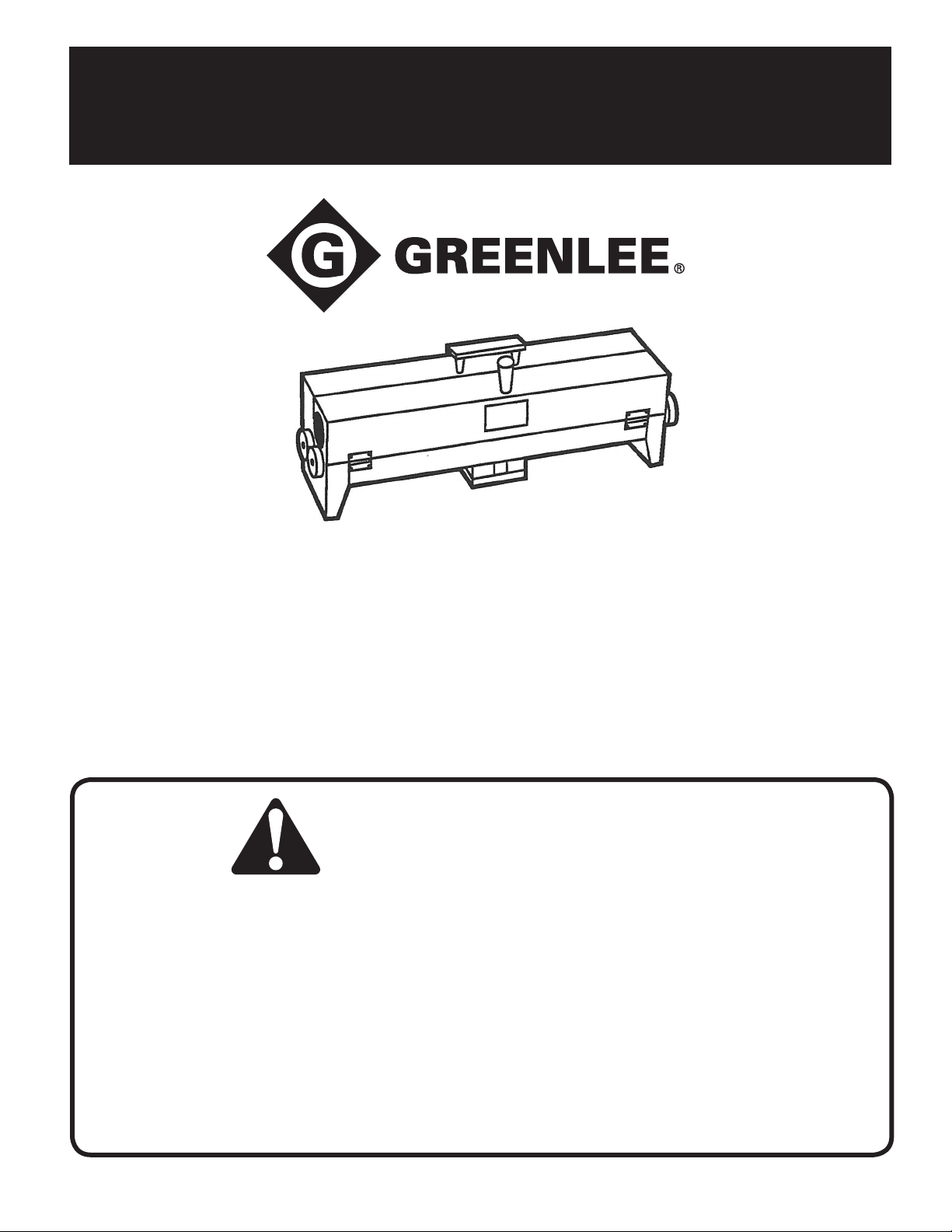
1/2" - 2" ELECTRIC
PVC HEATER
SAFETY FIRST
1. Read and understand all operating instructions before using.
2. This unit is designed to heat PVC conduit only.
Do not use for any other purpose.
3. Operate unit on rm, at, dry surface. Do not
expose heater to rain or snow.
4. Keep volatile or combustible material away
from the heater while in use.
5. Operate unit only in a well ventilated area.
6. Connect the heater to a grounded power
source of equivalent rating (120 V.A.C., 20
amp, 60 cycle).
7. Recommend use of a 20 amp G.F.C.I. Safety
Cord or Adaptor.
8. Wear gloves when operating this unit. When
opening and closing cover, use the attached
handles.
9. When not in use, turn heater off to reduce the
possibility of accidental burns.
10. Never leave conduit in heater unattended, as
conduit will become scorched.
11. Calrod element temperature 1000° F (540° C).
Find Quality Products Online at: [email protected]
999 6045.1 © 2019 Greenlee Tools, Inc. IM-849 REV 7 9/19
www.GlobalTestSupply.com
Page 2
849 1/2" - 2" ELECTRIC PVC HEATER
CONTENTS
Warranty ...................................................................... 2
Specifications ............................................................ 2
Introduction ................................................................. 2
Bending Tips ............................................................... 2
Operation
1. Set Up ................................................................. 3
2. Heating PVC ...................................................... 3
3. Bending PVC ..................................................... 3
Exploded View - No. 849 ......................................... 4-5
Parts List - No. 849 ..................................................... 6
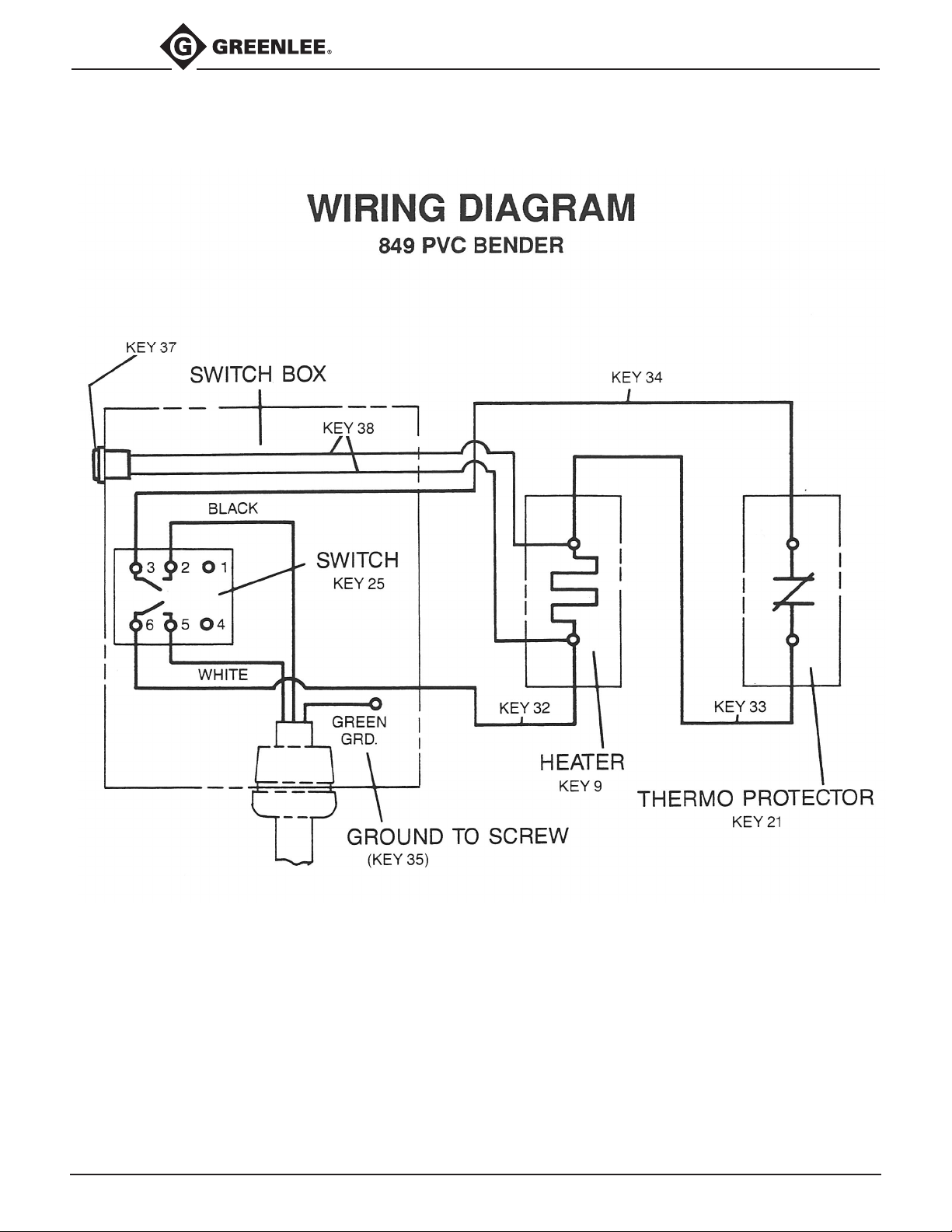
Wiring Diagram .......................................................... 7
WARRANTY
Your Greenlee No. 849 Electric PVC Bender is warranteed
to be free from defects in material and workmanship.
Terms of the warranty are enclosed with your bender
along with the Warranty Certicate Card. IMPORTANT:
This card must be completed and returned in order to put
your warranty into immediate effect.
SPECIFICATIONS
Model No. 849 2" Electric PVC Bender
Power: 120 Volts 20 amp AC, 60 cycle. 3-conduct or 14
Gauge grounded cord with plug supplied with unit.
Operating Temperature: 475° Maximum, thermostat
controlled.
Heating element will reach 1000° F (540° C).
Controls: Single-pole power switch.
Capacity: Up to 2" diameter PVC conduit. Heats 24"
length for 90° elbows of standard radius.
Heatlng Element: Calrod Type
Dimensions: Depth-7", Length-28-1/4", Height-10-3/4"
Weight: 17 lbs.
INTRODUCTION
The Greenlee No. 849 Electric PVC Bender is designed to
provide a single operator with an effective and easily
portable means for heating small diameter PVC conduit for
bending. The only other materials required for making
bends are as follows:
1. Insulated Rubber or other Heavy Duty Gloves
2. Pail of water
3. Sponge or clean rag
4. Scrap PVC for test run
IMPORTANT BENDING TIPS
1. Use this bender only in a well ventilated area. Do not
operate this unit near volatile or combustible materials.
2. Wear insulated gloves when operating this unit and
always use the plastic handles when moving or open ing unit.
3. A few practice bends using sections of scrap PVC are
always recommended so that operator becomes familiar with the operation of this unit.
4. Since a 10 to 15 minute warm-up period is required
before bending can begin, operator should set up unit
and switch on the power as soon as he arrives at the job
site. During warm-up, operator can assemble his mate rials, plan his bends, and mark the bend areas on the
PVC conduit.
5. To help prevent kinks or wrinkles when making 90
degree bends in 2" PVC duct, use 2 Greenlee No.
30976 PVC Plugs to trap the air in the conduct and help
keep the PVC from attening or kinking.
Greenlee Tools, Inc. 4455 Boeing Dr. • Rockford, IL 61109-2988 USA • 815-397-7070
Find Quality Products Online at: [email protected]
www.GlobalTestSupply.com
2
Page 3
OPERATION
849 1/2" - 2" ELECTRIC PVC HEATER
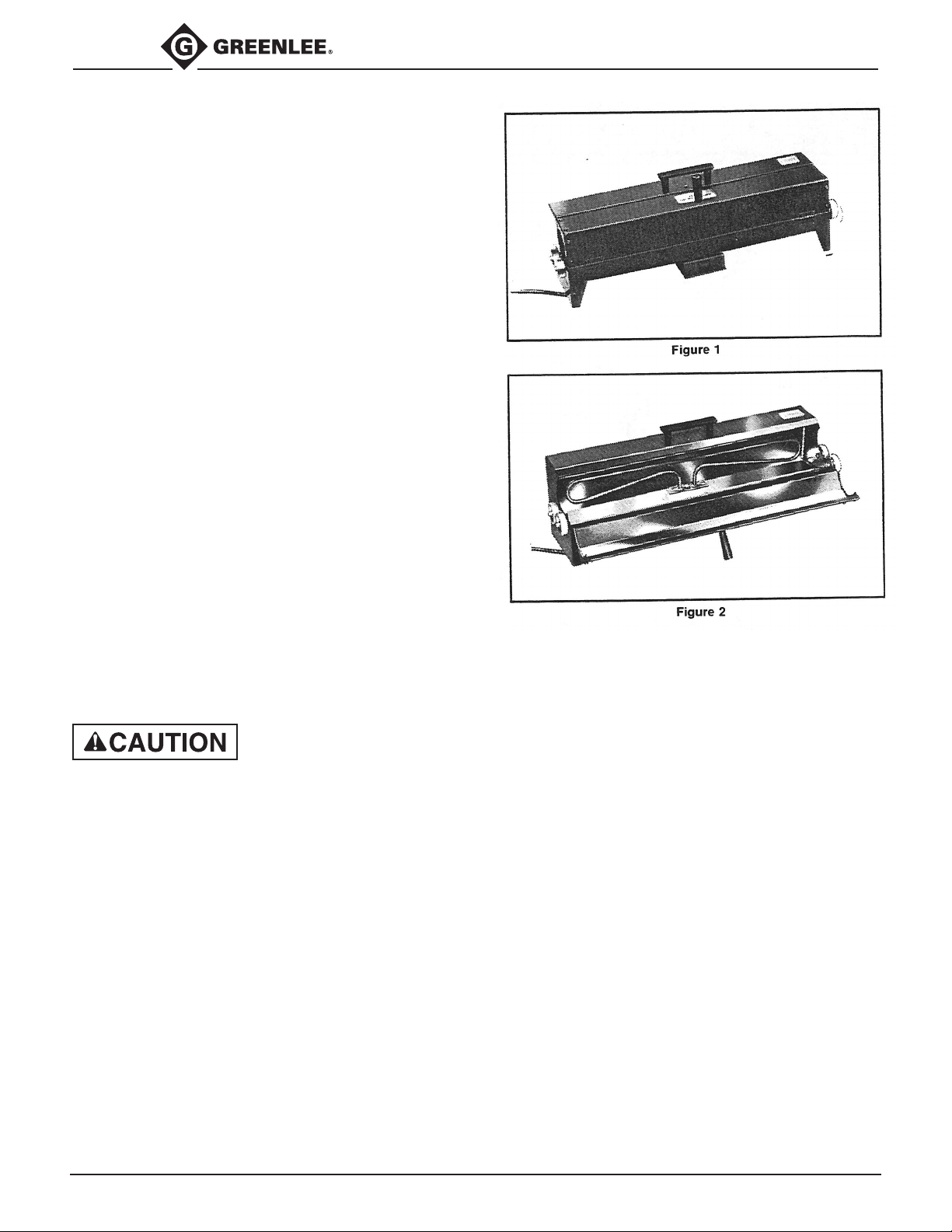
1. Set Up - Connect unit to power source (120 Volts, AC,
60 cycle). Turn switch to on position (built-in pilot light
indicates when unit is operating). After a warm-up
period of 10 to 15 minutes, the heating and bending of
PVC conduit can begin.
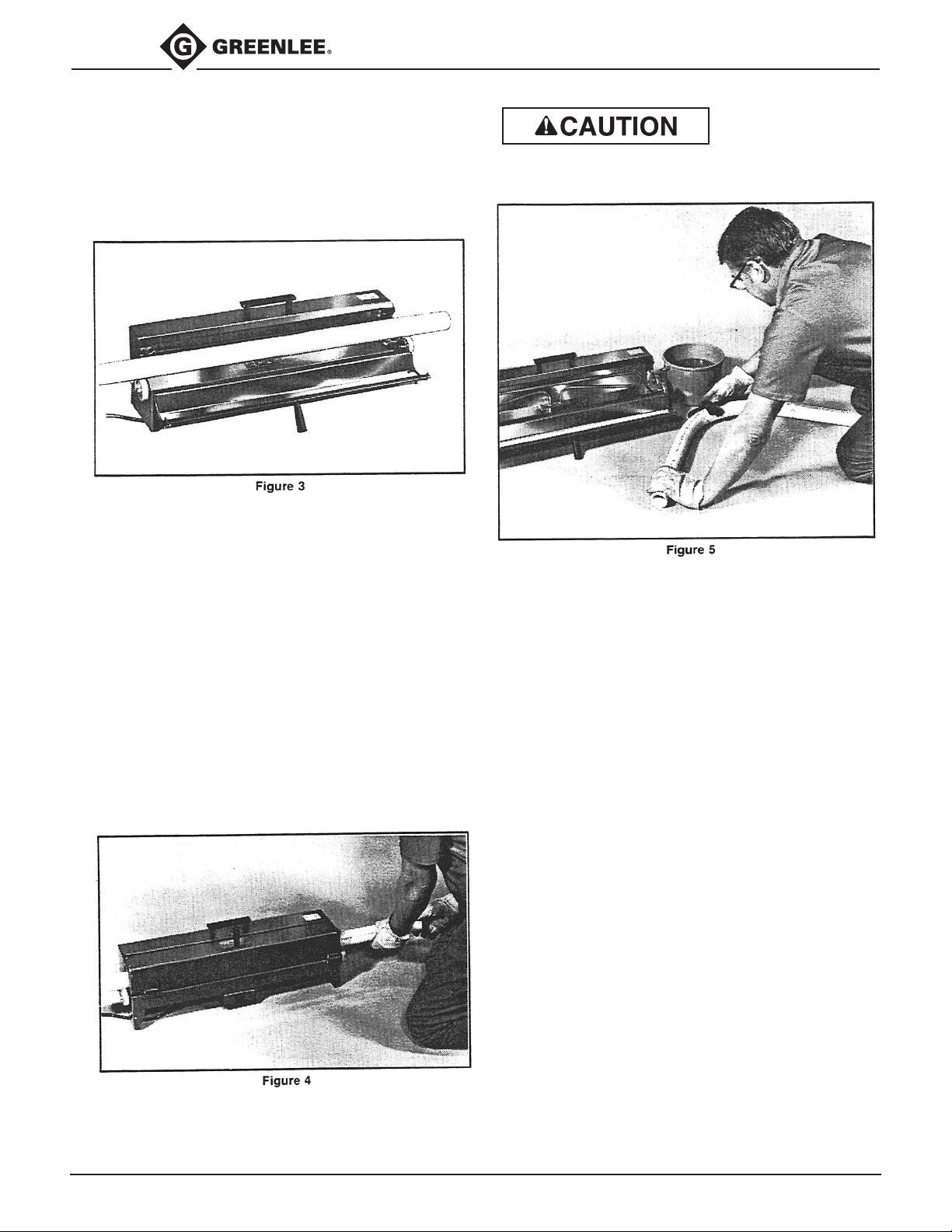
2. Heating PVC - For best results, test for the best heating
time using a few pieces of scrap PVC. With all materials
at hand lower the door of the unit until it is fully open. Lay
rst section of PVC between the pairs of guide rollers on
either end of the unit as shown in Fig. 3. The section of
PVC you wish to bend must be centered within the unit.
Keep door of unit closed during the heating process.
To obtain even heating of the PVC, conduit must be
constantly rotated by hand, as shown in Fig. 4. The
PVC should become pliable enough for bending after
about one minute. Heating time may vary due to differences in size and thickness of the PVC. An automatic
thermostat regulates temperature and prevents overheating of the unit.
Keep a close watch on the PVC and keep close track
of the time to prevent scorching of the conduit.
door and remove from unit, laying the conduit on a at,
clean surface. Bend can now be shaped by hand. To
set the bend, cool the PVC by using a rag or sponge
soaked with cool water, as shown in Fig. 5.
3. Bending PVC - When PVC becomes pliable, lift open
Greenlee Tools, Inc. 4455 Boeing Dr. • Rockford, IL 61109-2988 USA • 815-397-7070
Find Quality Products Online at: [email protected]
www.GlobalTestSupply.com
3
Page 4
849 1/2" - 2" ELECTRIC PVC HEATER
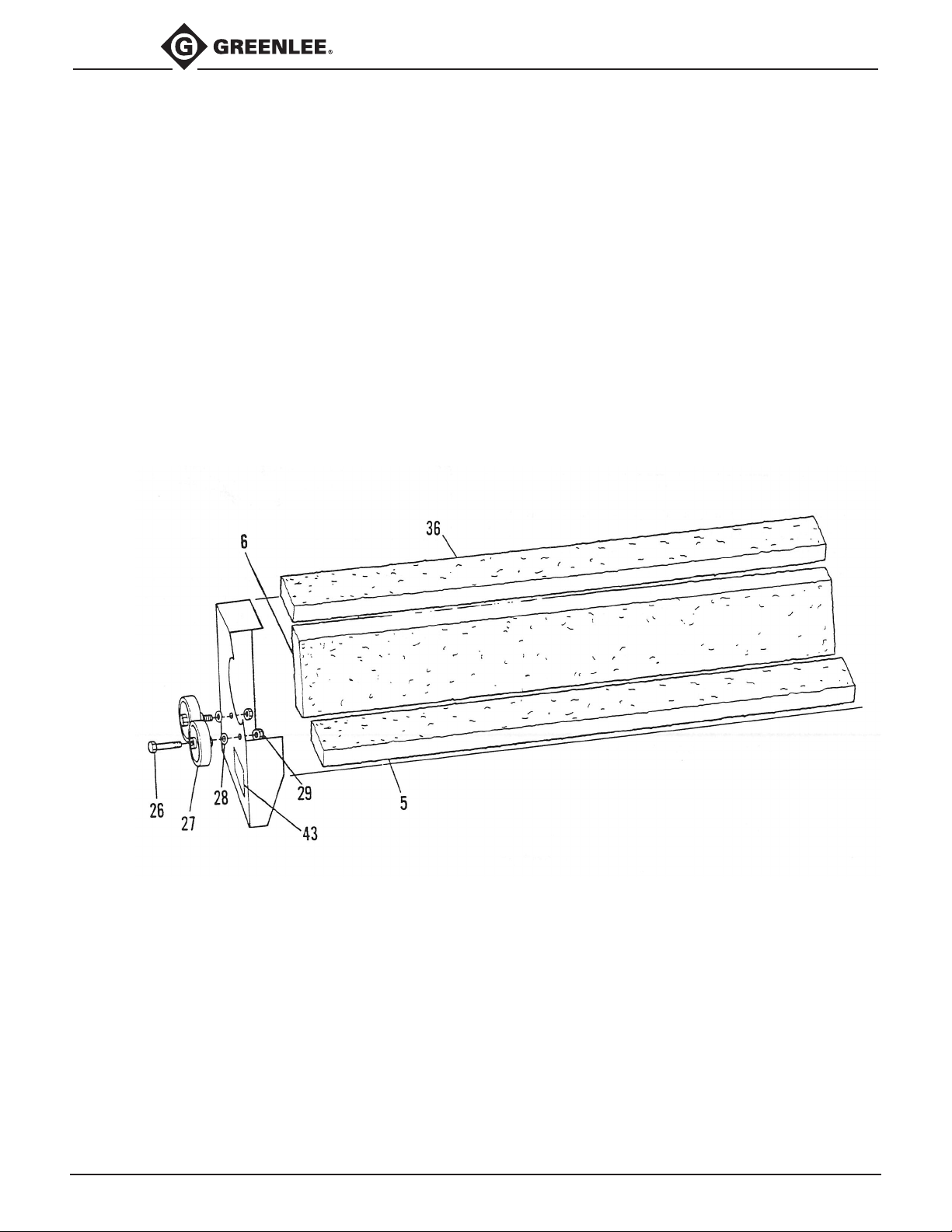
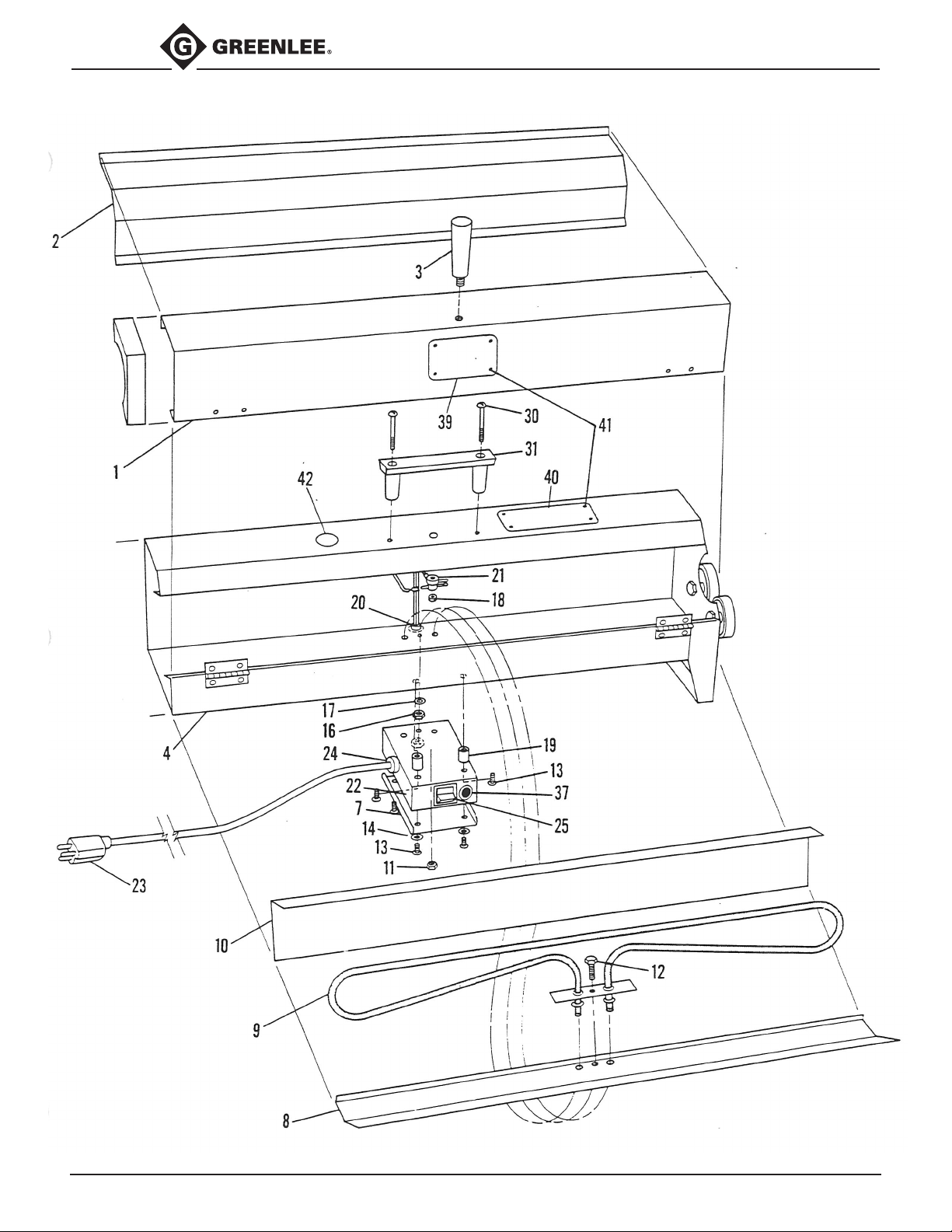
Exploded View
No. 849 2" Electric PVC Bender
Greenlee Tools, Inc. 4455 Boeing Dr. • Rockford, IL 61109-2988 USA • 815-397-7070
Find Quality Products Online at: [email protected]
www.GlobalTestSupply.com
4
Page 5
849 1/2" - 2" ELECTRIC PVC HEATER
Greenlee Tools, Inc. 4455 Boeing Dr. • Rockford, IL 61109-2988 USA • 815-397-7070
Find Quality Products Online at: [email protected]
www.GlobalTestSupply.com
5
Page 6

849 1/2" - 2" ELECTRIC PVC HEATER
Parts List
No. 849 2" Electric PVC Bender
KEY CONTROL NO. DESCRIPTION QTY.
1 502 7773.1 Cover Unit (Key No's. 2, 3, 39, & 4 of Key 41) 1
2 502 7766.9 Reector, Cover 1
3 905 2976.6 Handle, Davies #692 Heat Resistant Black Plastic 1
4 502 7775.8 Housing Unit (Key No's. 5 thru 22, 40, and 4 of Key 41, 42 & 43) 1
5 502 7761.8 Insulation, Top 1
6 502 7762.6 Insulation, Back 2
7 502 7764.2 Cover, Switch Box 1
8 502 7771.5 Reector, Housing 1
9 502 7811.8 Heater 1
10 502 8285.9 Reector, Top Housing 1
11 905 0372.4 Nut, 1/4-20 Hex Jam (for box mounting) 1
12 905 0520.4 Screw, 1/4-20 NC x 3/4 SAE Grade 5 Hex Head Cap
(for heater mounting) 1
13 905 0717.7 Screw, #10-24 x 1/2 Round Head Machine
(for cover plate and box mounting) 6
14 905 0750.9 Washer, #10 Shakeproof Internal Teeth,
3/8 O.D. x .021 Lock 6
16 905 1593.5 Nut, 1/4-20 Zinc Plated Hex (for heater mounting) 1
17 905 1647.8 Washer, 1/4 Shakeproof Internal Teeth Zinc Plated Lock 1
18 905 2434.9 Nut, #8-32 Zinc Plated Hex 1
19 905 2973.1 Spacer, Micro Plastics #166 Nylon (for box mounting) 2
20 918 6008.3 Snap-Bushing, Heyco #SB-500-6 Nylon 1
21 918 6019.9 Thermostat, Bimet #HF-79-114, 475° Range 1
22 502 7763.4 Box Unit, Control (Key No's. 23 thru 25) 1
23 502 7806.1 Cord Unit 1
24 918 6009.1 Bushing, Heyco #SR-7W-2 Nylon Strain-Relief 1
25 918 6015.6 Switch, Carling #RGSCC711RBBA Double Pole 1
26 905 0877.7 Screw, 1/4-20 NC x 1-1/4 SAE Grade 5 Hex Head Cap 4
27 905 2971.5 Wheel, McMaster-Carr #9960-Y-14 1/78
Dia Steel Centered Skate 4
28 905 2339.3 Washer, 5/16 ID x 3/4 OD x 1/16, Zinc Plated 4
29 905 1593.5 Nut, 1/4-20 NC Zinc Plated Hex 4
30 905 2969.3 Screw, #10-24 x 2 Round Head Machine 2
31 905 2970.7 Handle, Daview #4560 Heat-Resistant Black Plastic
WARNING: DUE TO HIGH TEMPERATURES USE ONLY
WIRE UNITS BELOW OR EQUIVALENT. (SEE WIRING DIAGRAM.)
32* 502 7751.0 Wire Unit, 7" (Not Shown) 1
33* 502 7752.9 Wire Unit, 10-1/2" (Not Shown) 1
34* 502 7753.7 Wire Unit, 12" (Not Shown) 1
502 8286.7 Insulation, Control Box (Not Shown) 2
35* 905 2428.4 Screw, #8-32 x 1/4 Parker-Kalen Type-F Zinc-Plated
Slotted Round Head Tapping (Not Shown) 1
918 6008.3 Snap-Bushing, Heyco #SB-500-6 Nylon
(Not Shown; for 3 wire units in housing) 2
36 503 6835.4 Upper Insulation 1
37 918 6474.7 Pilot Light 1
38* 503 7278.5 Wire Unit, Pilot Light 2
39 502 8002.3 Product Decal, 849 1
40 503 7201.7 Warning Decal, Hot 1
41 905 3001.2 Pop Rivet 8
42 503 0392.1 Decal, Damp Warming 1
43 503 6096.5 Decal, Electrical Shock 1
* Not shown on exploded view. See wiring Diagram, page 7.
1
Greenlee Tools, Inc. 4455 Boeing Dr. • Rockford, IL 61109-2988 USA • 815-397-7070
Find Quality Products Online at: [email protected]
www.GlobalTestSupply.com
6
Page 7
849 1/2" - 2" ELECTRIC PVC HEATER
Greenlee Tools, Inc. 4455 Boeing Dr. • Rockford, IL 61109-2988 USA • 815-397-7070
Find Quality Products Online at: [email protected]
www.GlobalTestSupply.com
7
Page 8

Greenlee Tools, Inc.
4455 Boeing Drive, Rockford, IL 61109-2988 USA
800/435-0786, in Illinois call 815/397-7070
Fax: 815/397-1865
Service: 800/435-2932, Canada: 800/233-5924
Printed in U.S.A.
Find Quality Products Online at: [email protected]
www.GlobalTestSupply.com
 Loading...