

Page 1
Page 2

Models covered DB1J 13
DB1S 13, 15, 16, 17, 18.
DB1L 15, 16, 17, 18, 19, 20, 22.
DB1XL 20, 22, 24
Introduction
Preparing the wheelchair for use
Opening the wheelchair
Closing the wheelchair
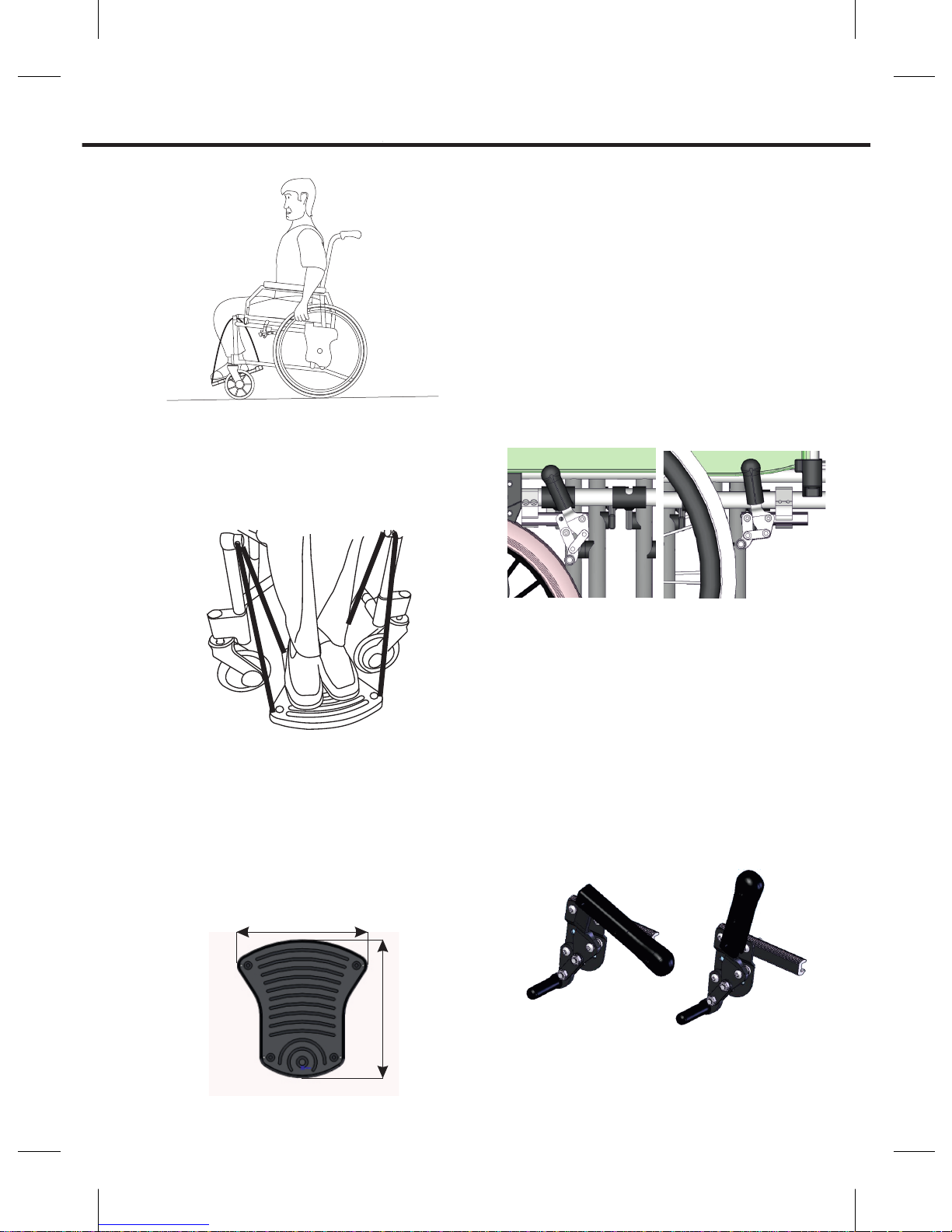
Setting up Footrests
Setting up Brakes
Setting up Armrests
Setting up Wheels
Using the wheelchair safely
General advice and routine user maintenance
Getting in and out
Getting in occupant standing forwards
Getting out occupant standing forwards
Occupant side transfer
Outdoor Visibility
Using the wheelchair safely with heavy occupants
Handling heavy occupants
Build specifications for heavy occupants
Getting around safely and environmental features
Planning a trip
Dealing safely with kerbs
Safe slope
Use of castors
Use of accessories
Use of anti tippers
Use of cushions
Fire Precautions
Use of hand rims and tyres
Use of seatbelts (also posture belts)
Transporting the wheelchair in a vehicle
Transportation with occupant in a vehicle.
Use of four point tie downs and occupant restraints
User Safety Routine Checklist
Technical Data Dimensions
Warranty
GREENCARE DB1 – USER INFORMATION
This information is intended for wheelchair users,
occupants or carers. It is also a useful reference
for service professionals who are prescribing or
handing over a wheelchair to a user. Guides are
issued with serial numbers when supplied with a
chair, and also for information with an accessory.
The Greencare DB1 Wheelchair is intended to
provide mobility for people who are unable to
walk. This guide is for all users. The information
provided is intended to help users understand the
wheelchair, and get the best performance out of it
in safety. Different users may have specific
requirements relating to them individually and
their environment, both indoors and outdoors.
Greencare wheelchairs are built specifically to
meet the needs of individuals who have been
assessed by clinical professionals. Wheelchair
service staff responsible for handing over a
wheelchair to a user should explain its operation
and compatibility with other equipment as
necessary. Occupant transfers in and out of the
wheelchair, and accessibility within the intended
environment should be triale d, and the
wheelchair adjusted accordingly.
Greencare component system modularity allows
a chair to be fine tuned at handover, or
subsequently after a trial period by a trained
wheelchair technician. Greencare staff are
available to assist with assessments and
handovers. Users should take time to read and
understand the wheelchair information before
use. User s sh ould understand how the
wheelchair is intended to function for them and
their responsibilities for its safe use and
maintenance. A wheelchair used and maintained
correctly should last 5 years or more.
A service checklist is included in this guide for
user reference. Recommended frequency of
service checks by a wheelchair technician
depends upon an assessment of usage and
environmental factors. For heavy frequent use a
check every 6 months is recommended. For
occasional use, a check every 36 months is
adequate. Where appropriate the recommended
service interval will be advised. If in doubt users
should contact their local wheelchair service.
Our website www.greencaremobility.co.uk has
downloadable copies of User, Assessment and
Technical Service guides.
Mobility
Page 3

Thank you for choosing a Greencare DB1
Wheelchair.
An advanced stylish modular wheelchair, with
build options for occupant and attendant
control. When received, it will have been built
to order with fittings to meet an assessment of
your need.
Please take the time to read all the information
provided, and take care that all information is
kept safe for future reference
The wheelchair description code and batch
date are on a label on the rear cross brace.
This can be read from the back of the chair.
Each wheelchair has its own specific
identification code serial number .
The serial number is a unique identification
reference and is important in the provision of
spares, and for advice regarding your specific
wheelchair
Serial number of this chair is as indicated.
Other important information can be found on
labels secured to the wheelchair, or provided
with accessory items, such as a cushion, are
additional guidance..
Labels should not be removed. Users are
responsible for ensuring that this product is
maintained and used safely and correctly.
Users requiring more specific advice about the
DB1 wheelchair, or who need more information
about other products from Greencare, can
c o n t a c t t h e G r e e n c a r e w e b s i t e
www. greencaremobility.co.uk
For technical service or repair users should
co ntact their App roved Distributor or
Wheelchair Service Centre.
Please dispose of packaging responsibly.
Introduction
1
Page 4
PREPARING THE WHEELCHAIR FOR USE
Opening the wheelchair
Grip the armrests and push them apart as far
as possible. This may be easier by tilting the
wheelchair sideways slightly, so that the
wheels on one side are clear of the ground.
Put hands on the seat canvas with fingers
pointing into the middle of seat. Push down
and out, with the flat of the hand on the two
sides of the seat, until the chair is completely
open.
The Greencare frame is positively located in
the open position. Press down on the seat
rails and you will feel the frame going into
the final open position. This positive open
lock makes the frame rigid, the seat position
comfortable, and also enables more
effective maneuverability and control.
The Greencare DB1 backrest is available
optionally as a non folding, or folding frame
tube. If a none folding version has been fitted,
the lifting weight of the frame is slightly less,
but the chair will not fold down to the most
compact size. Subsequent changes in
method of use may mean a change of
backrest specification to the other option.
Modularity of build will allow this.
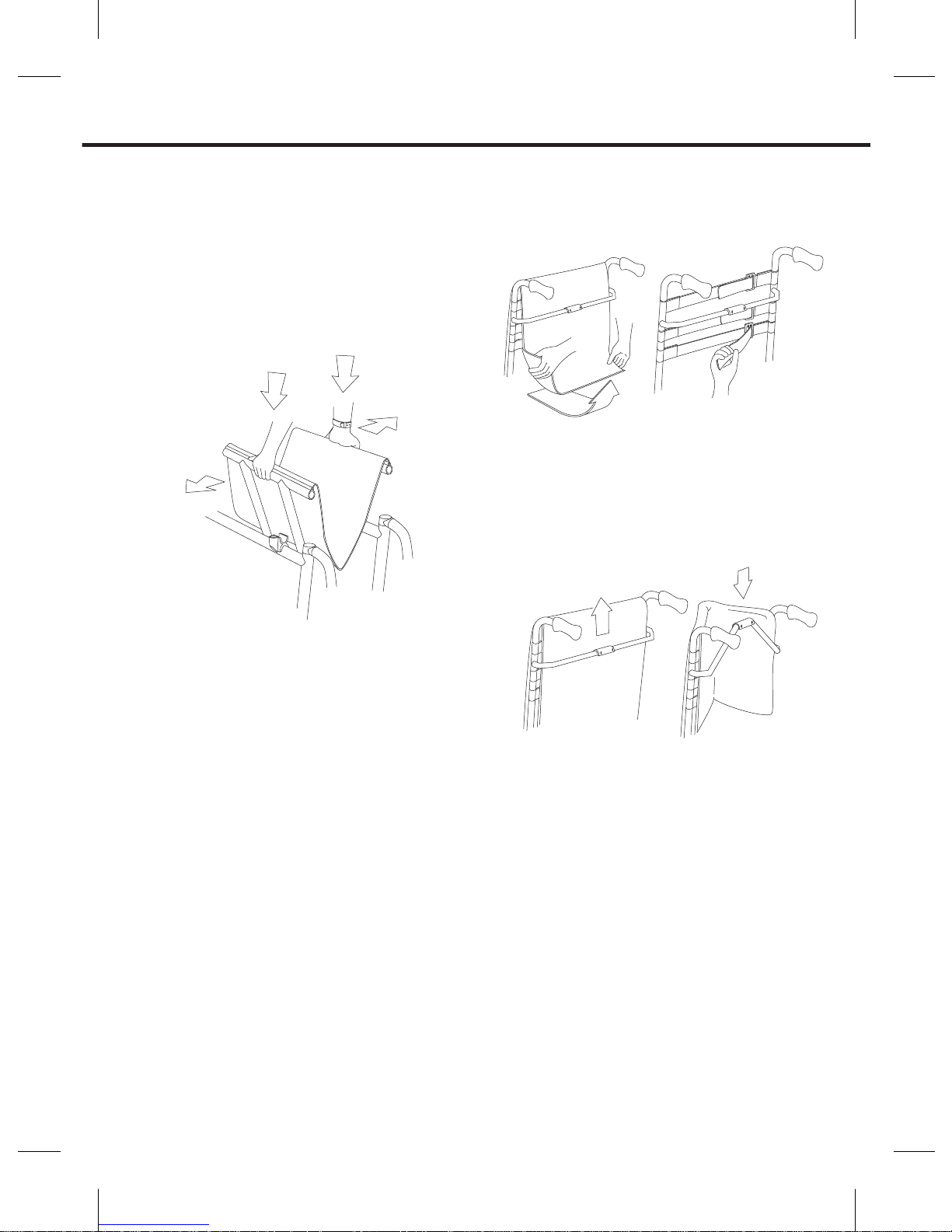
When fitted with a folding backrest, the upper
push handle section will be folded down at the
back of the wheelchair frame. To raise the
backrest, lift the push handles. Backrest
latches on each side will click into position
when the push handle is fully up, provided that
the back brace tension is released. When the
backrest catches locate, push down on the
back brace to tension chair back.
DB1 has the option of an integral lightweight
easy folding cushion support backrest or
tension adjustable cushion support backrest
upholstery. The type provided will be based
upon the assessment of your need.
For occupant comfort and support the backrest
has an additional folding comfort brace. This
unit operates on the over centre lock principle.
It will need to be pressed down in the centre, to
lock out, before the occupant sits in the
wheelchair. Carers should take care when
closing this brace, keeping fingers away from
the closing surfaces, because it locates quickly
to lock out.
The tension adjustable backrest has a support
back cushion supplied separately. when the
chair is packed in its carton. This cushion
should be attached to the inner tension strap
support frame by Velcro.
The tension back support requires to be set up
to conform to the required shape. This should
be set up for you at handover, when the chair
frame has been opened.
Finally push the lower back flap upwards and
under the seat so that the Velcro engages to
close and secure the seat fabric assembly
If a separate seat cushion is provided, as part
of the final specification it should now be
placed in position on the seat (see page 16)
2
Page 5
Closing the wheelchair
For transit and storage, foot plates should be
swivelled upright, or detached. The footplate
has an inbuilt friction grip which retains the
upright position when folded.
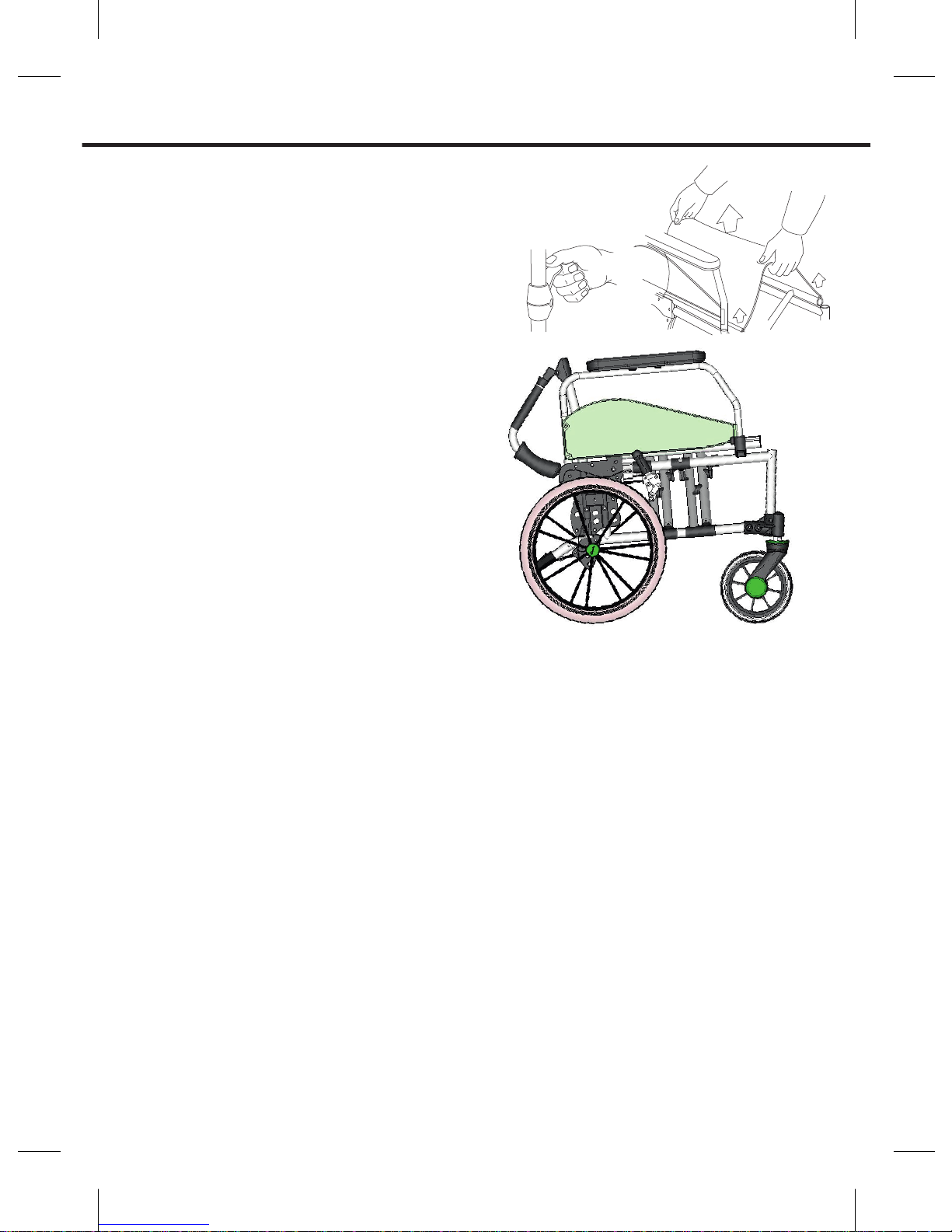
Release the Velcro flap securing the back
support to the underside of the seat. For some
users this operation may require more effort
than expected because velcro is such a strong
connection. Where ease of operation is a
priority, the velcro flap may be left to hang down
without attaching.
The back support upholstery options as shown
on the previous page, affect wheelchair folding.
The thin lightweight integrated back cushion
support, can be conveniently folded.
The thicker more supportive back cushion is
attached by Velcro to inner tension adjustable
support frame straps. This thicker cushion
increases the folded width, and if the storing
space available is limited, it is recommended
that this thicker cushion is removed for folding to
the minimum size.
The comfort locking brace assembly keeps the
backrest tubes in line when the tension straps
are set. This reduces backrest deflection, under
tension pressure and occupant load. This brace
has a central folding feature, which should be
lifted to release when folding.
Backrests may be built with specially re enforced
components for very heavy occupants or those
who create excessive pressure.
On folding backrest models, press down the
latch lever at the back of the hinge. This releases
the backrest locking pin.
To fold the frame, grasp the middle of the seat
canvas at the front and back, and give a sharp
pull upwards. The frame will release from its
location, and the two sides will start to come
together.
PREPARING THE WHEELCHAIR FOR USE
Press the armrests inwards until the chair is
fully closed.
A Velcro secured closing strap is provided at
the top of the pushing handle to keep the
wheelchair in the folded closed position.
This is particularly useful when the tension
adjustable assembly with the thicker back
cushion is left in place when the wheelchair is
folded. This strap should be wrapped around
the opposing push handles to keep the chair
frame from accidentally re opening.
On occupant-propelled wheelchairs, the QD
(quickly detachable) wheels can be removed
to further reduce the individual component
size, or reduce the weight for lifting.
Make sure that the folded wheelchair and
detached components are stored securely
and available for next use.
3
Page 6
PREPARING THE WHEELCHAIR FOR USE
Setting up Backrests
Backrests are built according to occupant
measurements and assessed requirements.
They may include specially reinforced
components for heavy occupants or those
who create excessive pressure.
Backrests may be foldable, with a hinged
push-handle which automatically locks into
place when the back is lifted to the occupant
supporting position. A folding back will allow
storage in a car boot or small space.
When a chair is specified as needing specific
storage requirements, this should be
checked at the handover to ensure
equipment compatibility. Rigid backrests are
suitable when the wheelchair is not stored in
a small space.
If the wheelchair is to be used in transport,
accessibility to this should be checked at
assessment and handover to ensure
equipment compatibility. Backrests can be
supplied to meet occupant requirements with
a range of different support angles. When an
adjustable reclining backrest is fitted, it
allows the carer to set the backrest to a
required occupant support position.
On reclining back chairs the backrest angle is
cable controlled by operating levers on the
push handles. The support height of reclining
backrests will normally have an extension to
the level of the occupants head, according to
assessed need.
Backrest extensions are integrated into the
backrest build and located on special upper
frame tubes. They are supplied with
adjustable tension straps and separate
cushioning of similar construction to the main
back support upholstery.
When the occupant is reclined, weight distribution
reduces the rearward stability of the wheelchair.
As a build standard, rear wheels will be set in the
most stable position, usually with anti-tip
stabili sers. With the backrest rec lined,
manoeuvrability is more difficult for the carer.
A situation in which frequent removal of the head
support extension is required is in vehicle
transportation. In this application an extended
head support may be inconvenient for other
aspects of normal use, because it restricts
visibility and communication for general use. In
such cases the backrest extension will be
removable, with a separate option of individual
push handles, which can be located at the
required pushing height by adjustable fixings. The
separate backrest components should be safely
stored when not in use.
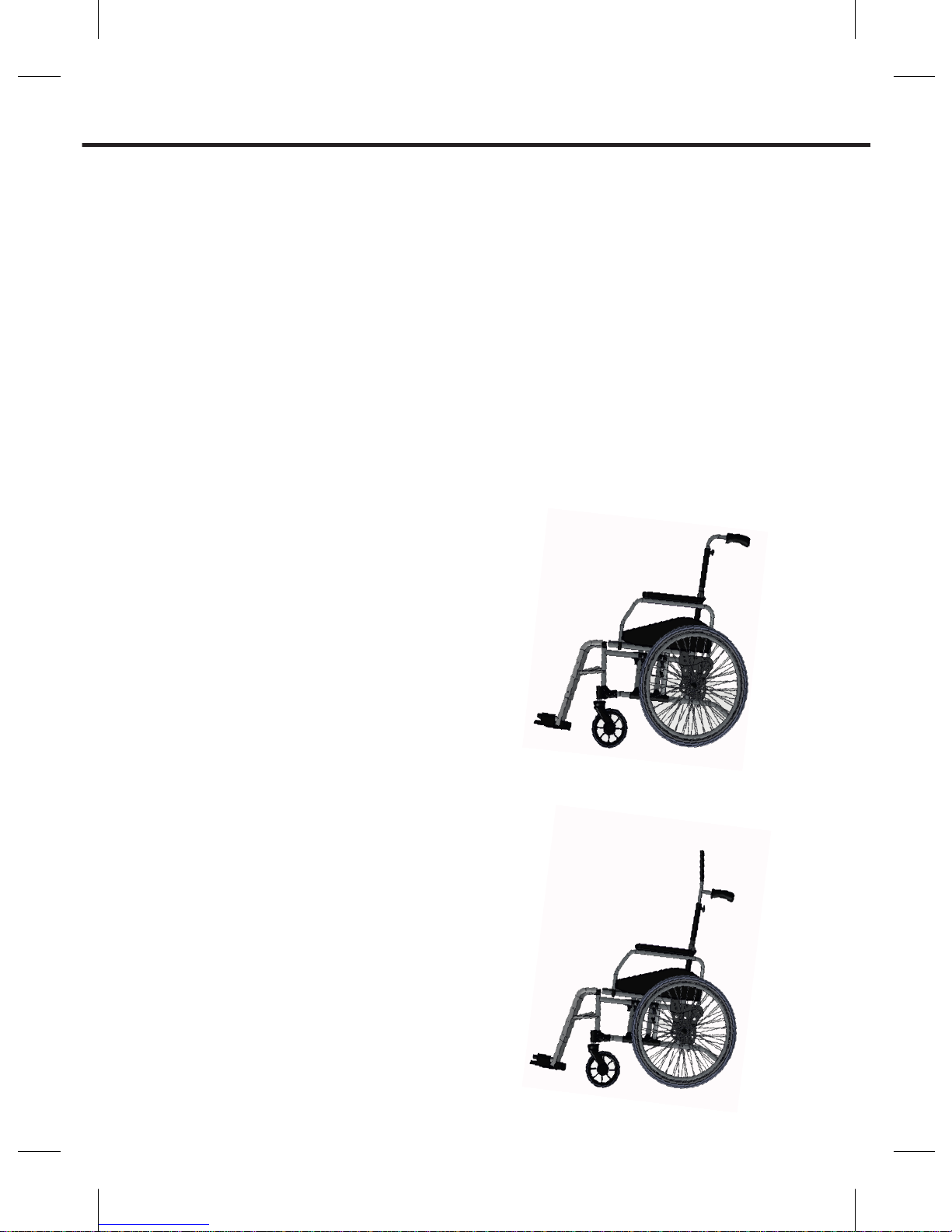
These illustrations show chairs with and without a
backrest extension.
4
Page 7

PREPARING THE WHEELCHAIR FOR USE
Setting up the Footrests
The chair that you have been supplied with
will have a footrest specification configured
to meet your assessed needs. Environment
of use and functional operation determine
the final specification required.
In addition to the configurable foot support
plates, shown opposite, Greencare DB1 has
a choice of detachable footrest brackets, and
footrest support options including an angle
adjustable type a rigid foot bar and a dynamic
foot support for use in tight spaces
The lift and swing type bracket features a
double locking action for increased security.
The frame location stud for this is also
smaller when footrests are removed for
transfer. The swing type bracket swivels into
position and releases with a single touch,
these are easier for the occupant.
To attach the footrest brackets, locate the
upper pivot spigot in the top of the front frame
tube, press down or swivel to locatet in the
forward facing position. To release depress
the trigger on the underside of the mounting
support feature. Footrest brackets should be
swivelled away or removed for occupant
transfer. It is possible to pivot the footrest
bracket inwards or outwards depending on
the user requirement. Footrest brackets
should normally be removed for storage.
For complete footrest bracket removal,
continue to lift so that the upper pivot clears
the front tube location. When removed, place
the footrests carefully in a safe position ready
for the next use.
Lateral position, height and the angle of footrest
support plates on the Greencare DB1 wheelchair
are adjustable. This is set by means of three fixing
screws on the underside of each unit. Each DB1
footrest has a choice of three alignment positions.
This will normally be set to meet user need, with
the central gap between footrests minimized,
when the wheelchair is handed over. It is possible
to adjust footrest height and position, if .
A jacking screw at the end of the footrest bracket
stem adjusts the sideways angle of the footplate.
When unloaded this will be slightly upward facing.
It is normal for this to deflect under foot pressure,
and it can be adjusted to be horizontal by this
screw
The foot support plate height is adjustable by a
range of fixing screw positions, and a series of
threaded holes in the inner stem. Using this
combination of holes, the footrest can be aligned
and tightened in its location.
Footrest height settings are important. A correctly
set footrest height will help to spread the load of
the occupant weight, easing pressure, and
improving the comfort.
The most comfortable seating position is usually
obtained when the occupant thighs are horizontal
and the hips and knees are at right angles.
Footrest adjustments should be explained and
completed at the handover.
Footbar
As an alternative to separate type foot plates it is
possible to fit a foot bar. This is a telescopic frame
that fits into the footrest brackets and locates as
previously described for the footrest. When fitted,
the front of the chair becomes compact and is
more manoeuvrable.
Dynamic Footboard
This is an option for indoor use in a compact
environment like a kitchen. It is an option that can
be fitted or removed as and when required. The
dynamic footboard is suspended by cables set to
measurements from the assessment. It allows the
occupants to be able to get closer to objects like
sinks, tables and etc.
5
Page 8
PREPARING THE WHEELCHAIR FOR USE
Setting up Brakes
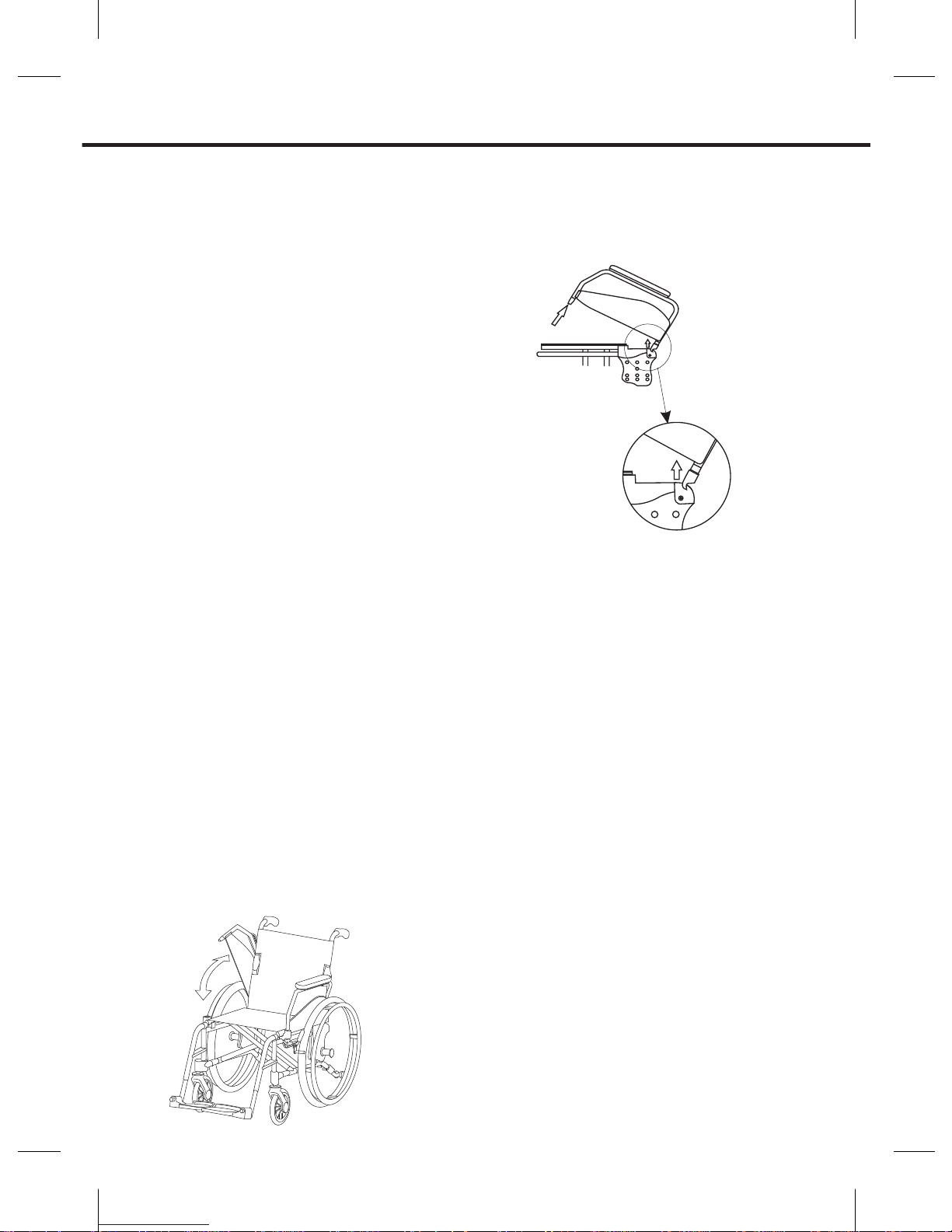
The Greencare brake unit is a toggle action,
requiring operation of a handle on either side.
Brakes should exert sufficient pressure on tyres
to hold the chair on an 8-degree slope. This test
is not a usage recommendation. (Read section
on outdoor safety.)
Brake shoe action of pressing onto the surface
of a pneumatic tyre, requires the tyre to be fully
inflated to the correct operating pressure of 3
bar. Puncture free tyres have a constant
pressure.
When correctly set, brakes should be easily
operated by occupant or carer, as required. A
build option with an extended brake handle is
available to reduce the operating effort.
This extended handle unit can be set up rigidly
or to allow folding down if handle height
reduction is required for side transfer.
When the extended handle is set for folding
down, care should be taken to ensure that it is
returned to the upright position for operation.
Handle options can be fitted retrospectively if
user needs change.
6
It also helps with moverability in confined
spaces, which with the standard footrest
would not be possible.
The dynamic footboard comes in one size but
is able to fit most foot sizes comfortably. The
height is set to length by the suspension
cables and will be made to suit the user of the
wheelchair. The footrest angle can also be
adjusted by fixing the cable length shorter or
longer, front to rear, and this can be held with a
grub screw.
287mm
308mm
Page 9
PREPARING THE WHEELCHAIR FOR USE
The range of wheel positions on the
Greencare frame system require brake
settings to suit wheelchair configuration.
Brakes are clamped in position on the frame.
Position of the clamp can be changed using a
hexagonal Allen key. The brake clamps
incorporate safety grips to maintain the set
position during use. Users should frequently
check that the brake is positioned effectively.
Brake adjustment may be carried out by a
competent person/carer if technical service
support is not available.
Lubrication of the brake mechanism, with a
none toxic lubricant will maintain effective
operation over a long period of use. Lubricant
on the operating face of the brake contact
shoe should be avoided.
Cable operated brakes with levers on the
pushing handle are an additional option to
allow attendant to slow down the chair without
having to reach for the brake handle. Holding
back the speed when going downhill is an
increasing benefit as the occupant weight
increases. It is a recommendation on 150Kg
and 175Kg occupant chairs.
Setting up Armrests and Supports
Armrests are latched at the front of the frame,
in socket locations, and pivoted at the rear of
the backrest location. They can be released at
the front and pivoted upwards and back for
transfer in and out of the chair. They are not be
removable from the chair unless specially
adapted for this purpose.
7
can be made detachable , which can help with
the compactness of the wheelchair and also in
side transfer (see page 11)
The armrest is removed by releasing the latch
and pivoting on the rear of the arm rest. When it
reaches a 30 degree angle the armrest will
release vertically and can be removed.
When not in use for transfer, armrests should be
fully located in the front socket at all times. An
armrest that is not fully located is prone to
accidental damage.
The front socket has a quarter turn feature that
releases the armrest. The armrest can be
swivelled back into the front socket, where it will
latch into position automatically.
The armrest should be secured in position at all
times. It is not recommended that the armrests
are grasped by the attendants to lift the chair
and occupant. Heavy lifting operations should
be avoided.
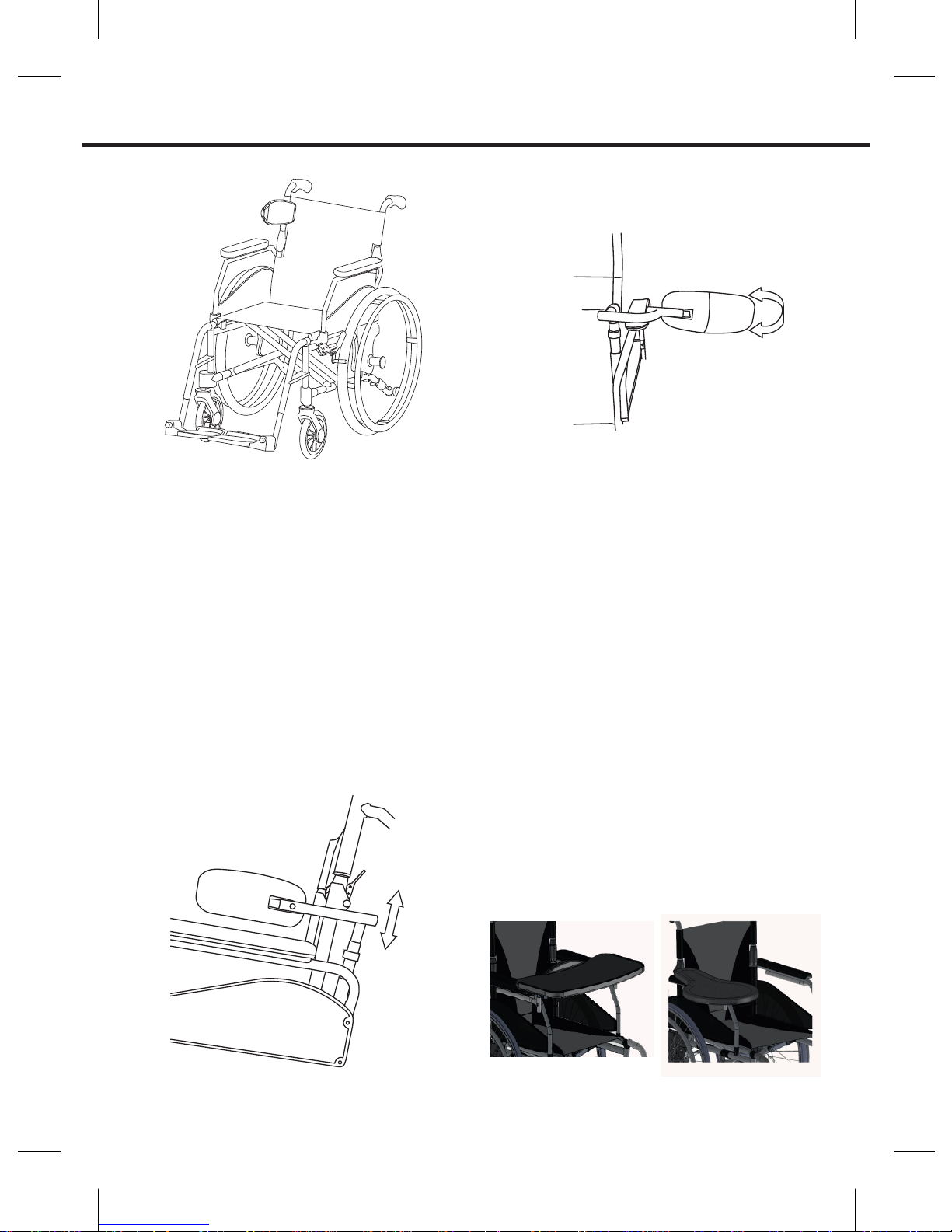
Thoracic supports are also available, these
positioning accessories are most often used to
improve occupant side stability and balance.
They can also ask as tactile reminders, to allow
the occupant maintain optimised posture.
If needed for a special purpose, the armrest
Page 10
PREPARING THE WHEELCHAIR FOR USE
The adjustable thoracic support pads can
offer a wide range of vertical, lateral, depth,
and angle adjustments, while providing
excellent anterior as well as lateral support.
they are also contoured for a natural fit.
It is usual to fit thoracic supports with a none
folding back. When a folding back is fitted the
height adjustability of the thoracic pad position
is restricted.
The thoracic support should not interfere with
the occupants comfort. The support pad can
be raised and swung away during transfers.
8
The thoracic supports can be used singly or as
a pair depending on the users needs.
Greencare support pads are manufactured in a
wipe clean durable material. They should be
kept clean using a mild detergent
Greencare side panels my be produced in a
semi transparent grade of structural plastic,
which has some flexability or rigid aluminium as
determined by the assessment. They should be
kept clean using a soft damp cloth, and mild
detergent. They should not be rubbed with an
abrasive pad.
The Greencare wheelchair has the possibility
to fit an arm pad safety option, Armalight. This
unit has an integral chargeable lighting system.
Tray Supports
The adjustment of support pads positions may
be done at the time of handover.
Page 11
PREPARING THE WHEELCHAIR FOR USE
It may however be found that after a few
weeks use, another preference is established.
Adjustment of wheel position is achieved
through use of simple tools, but the
implications of such a change require a
systematic review and assessment. Users
should not attempt wheel position changes,
When you first receive a chair, spin the wheels
with the brakes off to check for free rotation.
Greencare chairs can be fitted with a range of
wheels. These cover different occupant
weight ratings, and environments.
Fitting specifications available for occupantcontrolled wheelchairs include both fixed, and
quick release (QD) axle fittings, in 510mm dia
( 20 inch) 560mm dia (22inch) a 610mm dia
(24inch)
Wheels fitted to occupant propelled chairs
rated for tall or very heavy occupants include
a 660mm dia (26inch) size.
Wheels fitted to attendant only chairs can be
315mm or importantly 405mm diameter. The
405mm wheel provides good performance
and reduced effort in pushing for the carer.
Attendant propelled 405mm wheels are
available with either fixed axle or quick
release axles. The quick release axle allows
the lifting weight to be reduced by removal the
wheels for storage, e.g. in a car boot.
Oth er wh eel speci fic ations to m eet
environmental or user preferences are
available on custom built chairs.
9
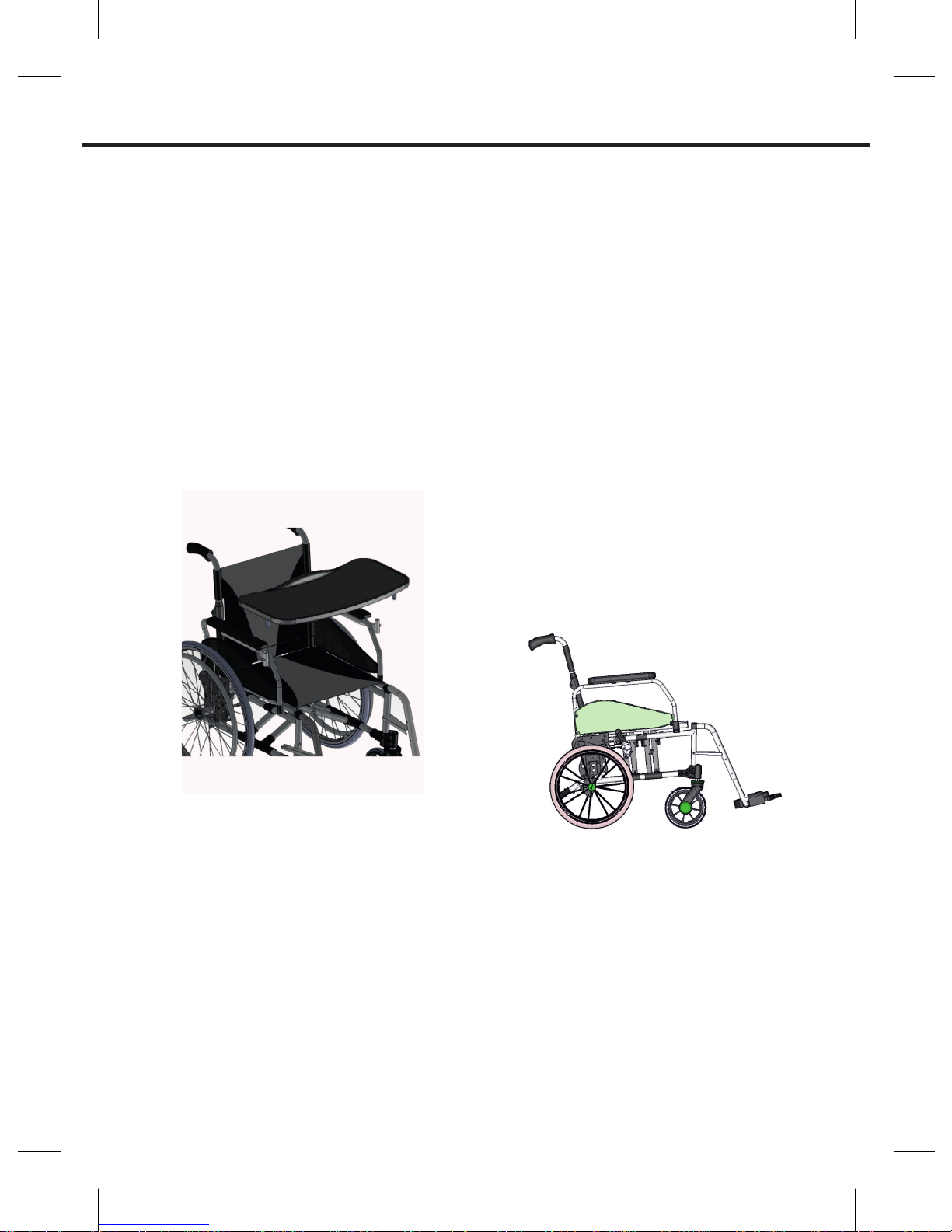
A Greencare tray maybe supplied as part of a
complete wheelchair or retrospectivity should
the user require it. Unlike standard tables, a
Greencare tray is produced to function as a
support in addition to a daily life convenience
Greencare trays come in two styles, the single
arm supporting tray and the full width supporting
tray. They are manufactured using cushioned
support material.
The trays have been specifically designed for
wheelchair use. They are fully removable and
adjustable to fit different seat widths and depths,
and to accommodate a range of occupants
sizes and positions.
When used as a support, the full table tray is
fixed and pushed up against the user, to help
maintain posture.
Setting up Wheels
The chair that has been supplied should have
the correct wheel configuration assessed for
user needs. The Greencare DB1 frame has a
number of wheel specification and position
options.
The wheel on the chair received should be
mounted to meet an assessment of the
occupant weight distribution and meet a
manoeuvrability and stability requirement.
Page 12
10
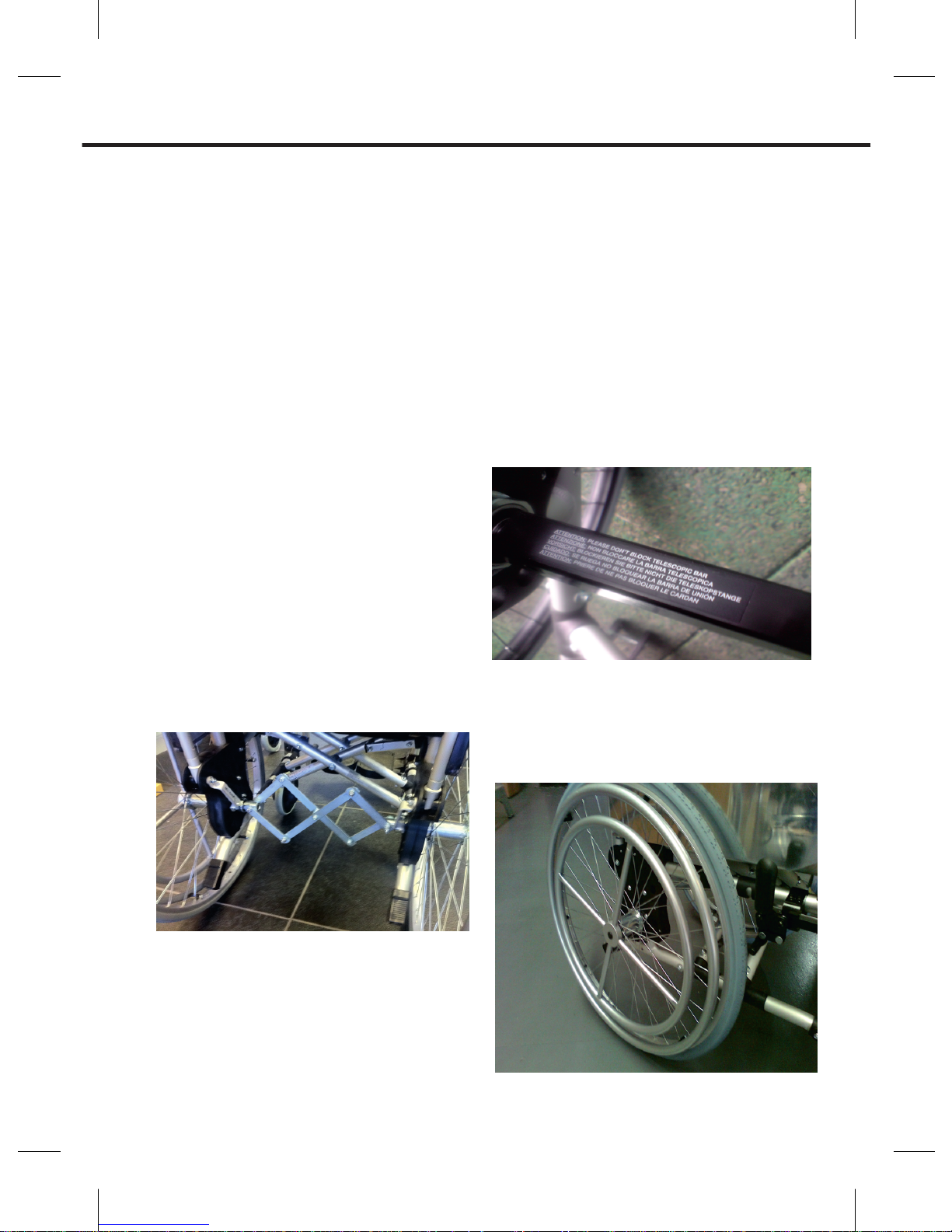
Hemiplaegic Drive Wheelchair
Hemiplaegic users can be supplied with a
chair configured with the propelling wheel on
one side of the frame for the occupant to
control speed and direction with one hand.
Greencare limits this build to chair seat width
up to 22 inches.The wheel on the driving side
has two hand rims. The outer hand rim is fitted
to this wheel directly as standard, but the
inner hand rim is smaller in diameter and
connected by a linkage to the opposite
wheel. The hemiplaegic chair are built
according to the assessment. The inner
driving rim protrudes outside the line of the
outer hand rim. This allows access for
gripping, but increases overall width by 10mm
from technical data measurements of
standard wheelchairs.
The linkage connecting the wheels normally
supplied by Greencare following extensive
trials will be an expanding scissor strut that
opens and closes when the wheelchair
closes. With this expanding system the
wheels are permanently fixed to the frame
and cannot be detached. This is easy to
operate and maintain for the user. However
fixed wheels and drive increase lifting weight
by 6.0Kg from technical data measurements.
A lighter weight option for hemiplegic
operation is a sprung loaded connecting strut
between quick release wheels. This strut has
a recess that engages on the end of each
spindle to provide drive contact. With this
option, the propelling wheels are detachable,
and weight unaffected. The sprung
connecting strut requires removal for folding
the chair. Assembly and removal requires
care. It is recommended that this assembly is
QD wheels should first be assembled
according to setting up procedure. The spring
loaded strut should be depressed and
inserted between wheel spindles before
releasing to engage. This requires some
strength.
When assembled the strut should be checked
by hand to ensure full engagement without
free movement. Carers should be careful not
to trap fingers under the sprung drive
engagement end of strut. The Sprung strut
length is pre set to provide correct drive when
chair is built. It should not be adjusted to make
assembly feel easier, as this will reduce
driving efficiency.
Using either of these drive connections
effectively requires skill that will come with
practice. Operation may be helped by active
user slimline armrest features. The one arm
drive system should always be trialed by user
before final handover to assess suitability.
PREPARING THE WHEELCHAIR FOR USE
Page 13

Quick Detachable ( QD ) wheels can be
removed and fitted to the frame receiver by
depressing the button in the end of the
spindle, whilst pulling the wheel away from
the wheelchair . This operation is easy with a
little practice. When replacing these wheels
always make sure that the spindle is fully
engaged in the frame receiver. Do not attempt
to remove or replace the wheel when the
brake unit is in the on position.
Tyres on occupant-controlled wheelchairs
may be pneumatic or flat free polyurethane.
Tyres pick up dirt when used outdoors. After
an outside trip, they should be wiped down
with a damp cloth, before the chair is taken
back into the house, also checking tyres to
remove pebbles or thorns from the treads. A
possible option through availability of QD
wheels is a pair of wheels for indoor use with
smooth tread tyres and a pair for outdoor use
wih outdoor tread tyres.
Users should check wheels regularly.
Paying attention to security of spokes,
and fit and condition of tyres.
General advice and routine maintenance
The purpose of a wheelchair is to provide
mobility for people who cannot, or find it
difficult to walk. For safety, wheelchairs
should not be used for any other purpose.
Greencare DB1 wheelchairs can be set up or
finely adjusted to suit user and carer needs.
Build options cover active occupant use
through to attendant controlled use. Users
should contact their approved distributor or
local service centre if they are having
problems . An adjustment or alternative build
configuration may help to improve operation
or accessibility.
Users are responsible for keeping the
wheelchair clean, day to day care, and
using their wheelchair according to
information provided in this guide.
PREPARING THE WHEELCHAIR FOR USE
Professional guidance and skills training
should also be provided through the
wh eelchair-is suing centre. Users are
recommended to ensure that they are
confident in wheelchair use, within their
environment. Users and carers, who are
unfamiliar with wheelchair use, should pay
particular attention to safety advice when
transferring in and out of the wheelchair.
Users should understand what regular
maintenance routines are required of them to
keep the wheelchair in a serviceable
condition. These are mainly based upon
cleaning, general function checks and care of
the wheelchair, and do not require the use of
workshop tools. The User Guide includes a
checklist of routine maintenance checks,
which may be carried out by the occupant or
carer or both as is practical. We recommend
that, occupants and carers take an active
interest in the wheelchair condition and its
satisfactory operation.
If the wheelchair is be to be used for
transportation with the seated occupant, the
specified wheelchair and occupant restraint
system and fixing points should be used.
Users, carers and vehicle operators should
understand the use of the recommended
Greencare DB1 wheelchair four-point tie
down and occupant restraint method, as
advised in this guide.
Preventive maintenance and consumable
worn part replacement, through regular
checks by the service centre qualified staff,
are recommended for wheelchairs where the
occupant has an active lifestyle, or is
dependent on the wheelchair as the only
means of mobility. Users should ensure that
wheelchairs made available to service
personnel are thoroughly cleaned
Our website www.greencaremobility.co.uk
ha s reference information for users,
therapists rehabilitation engineers and
technicians, responsible for provision and
ongoing service support of wheelchairs.
11
Page 14
USING THE WHEELCHAIR SAFELY
Getting in and out.
For maximum safety, these operations should
be carried out with the help, or co-operation of
an attendant, even if this is only to hold the
push handles and keep the wheelchair in
position whilst the occupant is carrying out the
transfer operations.
It will be usual for the occupant to transfer in
and out of the wheelchair into another chair or
supporting surface. The wheelchair should be
positioned so that the distance from one
support to the other is minimal, and can be
achieved in a single assisted movement.
The occupant should always try to assist the
attendant wherever possible to share the total
effort. Wheelchair occupants may be heavier
than they look, and handling operations are
often carried out several times in a day, so
getting organised is important in the long
term. Carers should not attempt to lift a
wheelchair occupant without help. If this is not
possible a hoist may be required for these
operations.
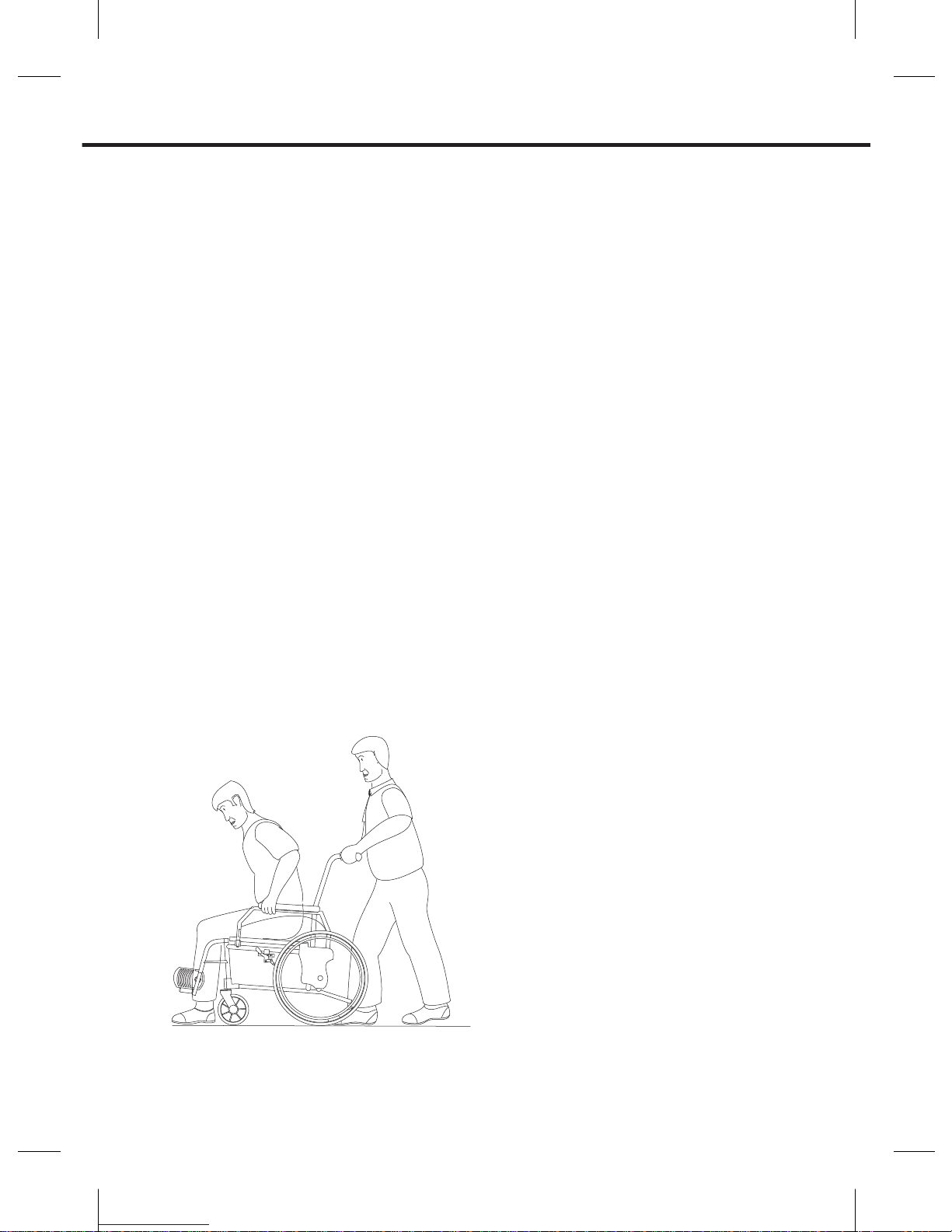
Getting in occupant standing forwards.
Making sure that the brakes are on, flip up the
foot support plates to open up the standing
space at the front of the chair. Footrests may
be detached or swivelled away inwards or
outwards for easier access.
The occupant may be able to help by pushing
on the armrests to provide some body support
whilst being lowered into the seat.Greencare
have an available option of the forward
support armrest which provides additional
grip area for this operation. This is particularly
recommended for very heavy occupants.
When the occupant is seated in the chair, the
footrest plates may be pushed back down to
locate the feet at the required position. At this
point it may be necessary to set the footrest
height and position.
Getting out occupant standing forwards.
Making sure that the brakes are on, flip up the
foot support plates to open up the standing
space in front of the chair. Footrests may be
detached or swivelled away inwards or
outwards for easier access.
The occupant should place a hand on each
armrest, bend slightly forward and place both
feet well back and firmly on the ground, then
push upwards to a standing position to assist
the carer.
Occupant side transfer
Th e occupant normally controls this
operation, with the carer available for
assistance as required. Side transfer should
not be attempted on slopes, or on slippery
surfaces. If there is a gap between the two
seat surfaces, it may help to slide along a
smooth transfer board.
12
Page 15
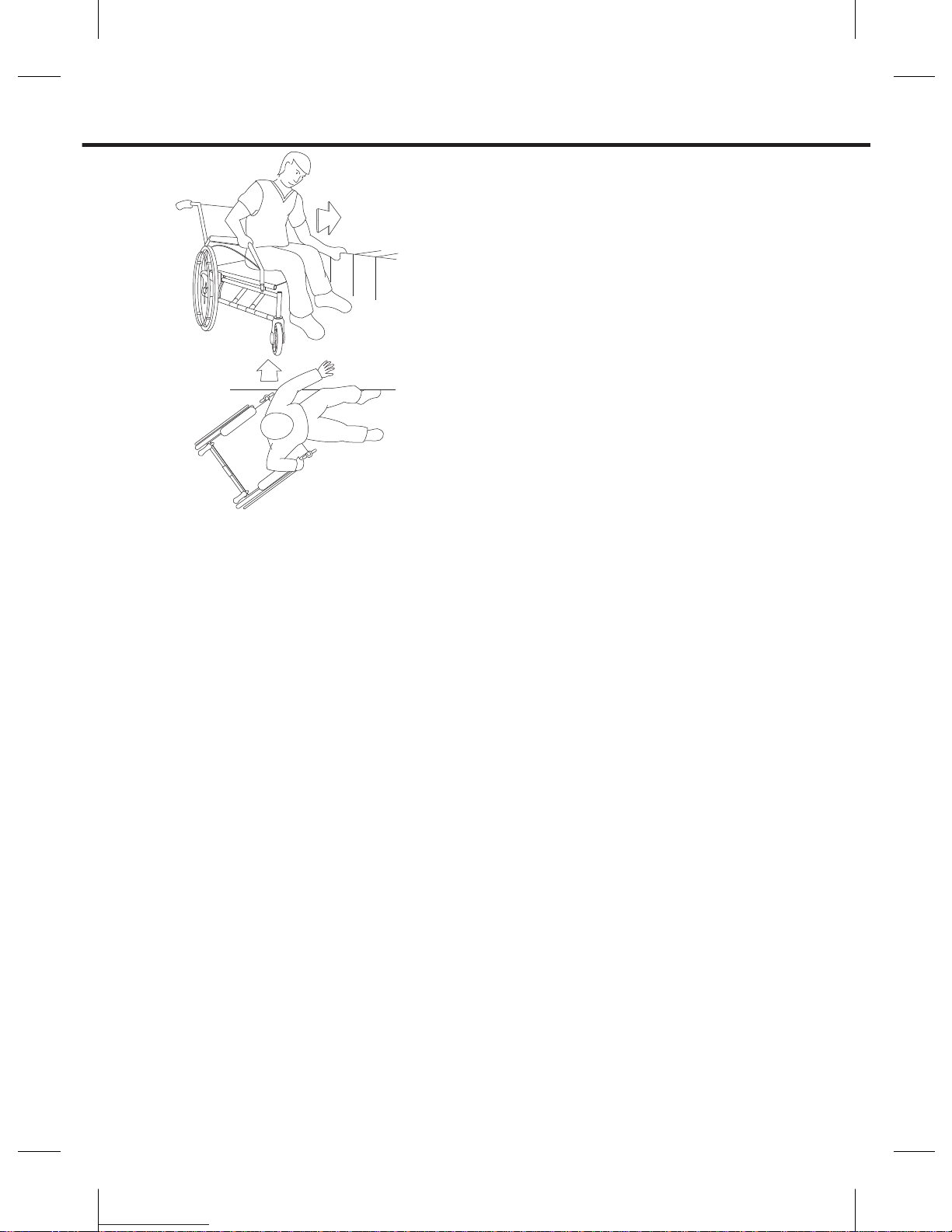
When the wheelchair armrest is swivelled
back or detached, it will allow sideways entry
to the chair and vice versa, from another chair
or car seat. Some physically active
Independent users with upper body and arm
strength may develop skill to carry out this
manoeuvre without help.
We advise for safety reasons that an
attendant should be available, to keep the
next intended seating surface in the required
location, near to the wheelchair, or to provide
assistance if this becomes necessary during
transfer. This is important for amputees who
side transfer.
Making sure the brakes are on, the occupant
should use arm strength to shift position. The
effort and movement for side transfer needs
good co ordination and balance. When
transferring in and out of the car an additional
lever point such as a handle above the car
access door is useful. Side transfer is an
instant operation when done by the skilled
occupant. Transfer is easier when footrest
assemblies are swung back out of the way, or
removed so as not to interfere with the legs.
Where possible feet should be firmly on the
ground. The safest way to side transfer is to
bend slightly forward when shifting the
balance position
Side transfer requires the occupant to have
the ability to use arm strength and leverage
techniques to lift and move sideways, or at
an angle in to the chair, avoiding the rear
wheel that will be above the seat surface
level.
On active propelled chairs, the wheel will
be set at a position suitable for arm reach
and control. This will normally mean that it
will extend above the seat level.
Outdoor visability
When out at night, or in poor visibility
conditions, users should ensure that they and
the wheelchair are visible to other road users
and pedestrians, considering both clothing,
and light reflective trim features.
Armalight pads can be fitted to Greencare
wheelchairs. These have an integrated
rechargeab le safety lighting system,
complete with battery charger. This provides
a light indication of position and direction of
the wheelchair in adverse visibility to road
users and pedestrians up to 100metres.
USING THE WHEELCHAIR SAFELY
13
Page 16

Handling of Heavy occupants
Using a manual wheelchair with a very heavy
occupant demands a lot. Accessibility to and
from the wheelchair ,and pushing or turning a
total heavy weight requires a lot of effort.
Comparative strength of the carer to push and
control occupant weight may be a deciding
factor for safe use.
A small lightweight carer may not be able to
safely control a wheelchair with an occupant
over 125Kg on a slope of 5 degrees or even less,
without additional assistance.
Safe operation with a very heavy occupant may
limit manual wheelchair use to level surfaces
only, with slopes and kerbs being avoided. Very
heavy occupants should understand that carers
cannot put themselves at risk through unsafe
handling practice.
Accessibility factors in the intended usage
environment such as doors, kerbs or ramps may
demand additional handling equipment,
teamwork or other mobility solutions.
Build specifications for heavy occupants
We are all getting bigger. Supply of wheelchairs
for a very heavy occupant is an increasing
requirement. When a seating system is fitted the
total occupant weight can also be increased
significantly. The Greencare DB1 can be
individually built in a relatively lightweight
specification that will meet the identified needs
of both occupant and carer.
Greencare have specific component features
that will enable a wheelchair to be individually
built to meet an identified need. In achieving this
result, the assessment, trial, and handover
process, together with ongoing preventative
maintenance procedures become increasingly
important. This should be advised to the user at
the handover.
The total occupant weight loading on the
wheelchair structure requires strengthening of
load carrying components in keeping with the
individual person, distributing and absorbing
the occupant weight over the entire frame.
Integrated frame features for suppression of
i m p a c t s h o c k s , c o n f i g u r e d wh e e l
specifications, in assessed combinations, for
strength, are included in the final wheelchair
build for a very heavy occupant.
Positioning the wheel relative to the occupant,
for ease of manoeuvrability by a carer are
important features. This needs to be trialed on
an individual basis.
Larger diameter wheels are recommended for
heavy occupant wheelchairs because they
reduce the effort to push. Greencare
recommend the availability of spare wheels for
wheelchairs when the assessment indicates
an increased level of vulnerability.
A buckled wheel, which for an independent
l i g h t w e i g h t u s e r m a y be a s m a l l
inconvenience, becomes a serious issue for a
heavy weight person, creating increased risk
for both occupants and carers. The final
specification for an original heavyweight
occupant wheelchair may also include
additional service spares, that can be made
immediately available, when required in an
emergency.
In some circumstances it will be necessary to
reduce the warranty on component parts to 12
months because of the high usage levels in
heavy occupant applications. This will be
advised at the time of assessment.
GETTING AROUND SAFELY WITH HEAVY OCCUPANTS
14
Page 17
Tight space environments
Greencare build wheelchairs to an assessed
specification, which includes environmental
acce ss cons i dera tion s . U sers sh ould
understand that they have a responsibility to
ensure that the environment is suitable for the
wheelchair.
A relatively simple obstacle removal, may allow
a door to open more fully or provide turning
space that will allow wheelchair operation.
General safety is improved when there is less
clutter around on the floor.
Narrow access builds of occupant propelled
wheelchairs, where handrim and wheel are built
to a minimal width, are a practical solution to
improve access through narrow doors. This
reduces the area for the propelling occupant
hand to grip, and operation of the chair may
require a combined grip on the rim and the tyre.
For this gloves may be an additional
consideration.
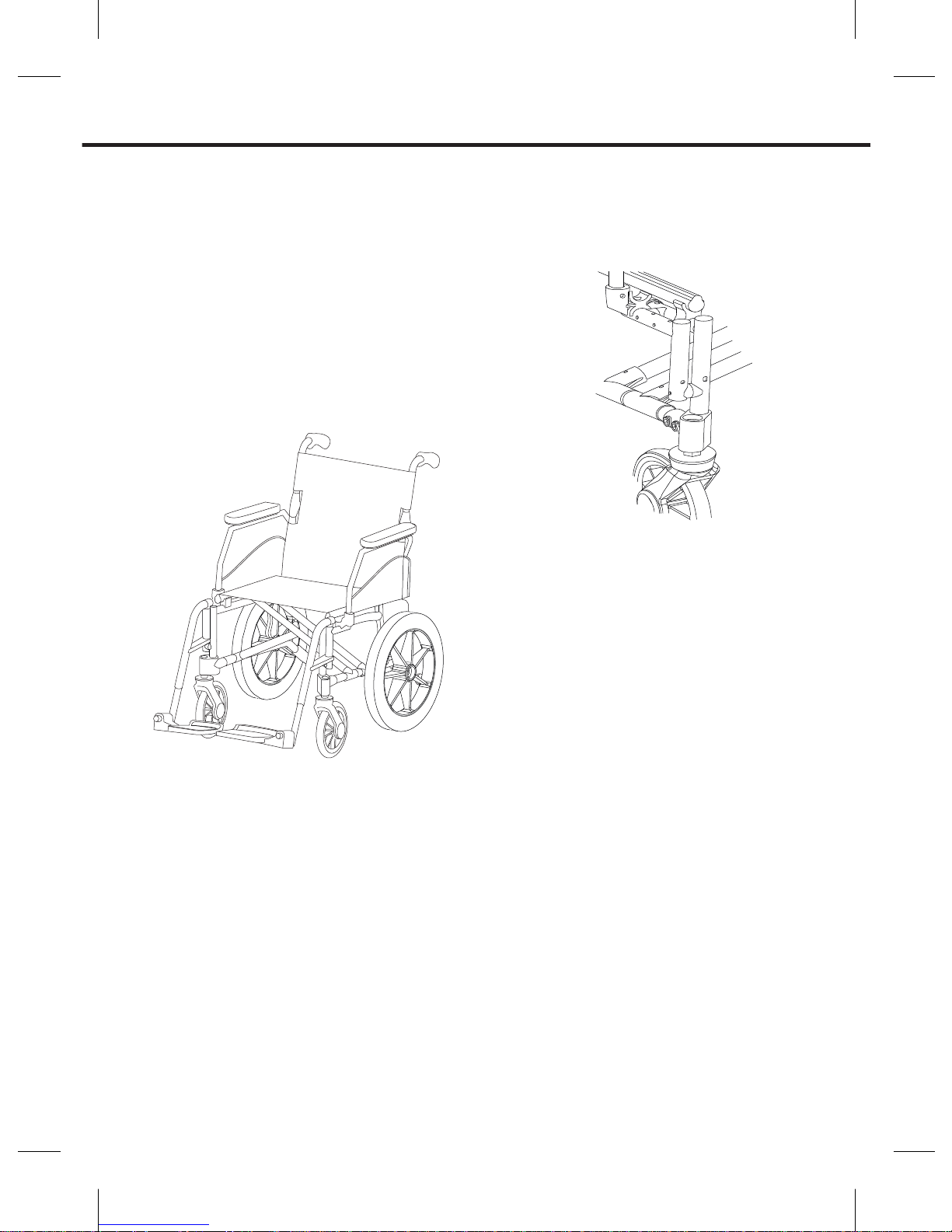
Narrow access builds of attendant propelled
wheelchairs may have an outrigging adaptation,
over the wheels. This increases effective seat
width on a reduced wheelbase. Outrigging
creates an open space at the side of the seat
frame, and a seat cushion must always be fitted
over this open space.
.
Front outriggers offer a choice of footrest
positions. This can be inboard for a compact
turning or outboard to create more leg space
between the frames. This feature will have
been built to accommodate accessed users
requirements.
The front outrigger has the appearance of a
double frame at the front of the wheelchair (as
shown above).
Optional footrest mounting points will be
covered my a protective plug to prevent
incorrect location when footrests are removed.
Wheelchair users should not attempt to
change footrest positions without consultation
with the wheelchair service.
Spatial adaptations of the Greencare Db1
using a combination of different sized wheels,
and frame build options are available to
overcome specific environmental restrictions.
When such adaptations have been carried
out, the correct use and any other special
instructions will be advised to the user at the
time of handover.
Build i n g R e gulati o n s r e cognis e th e
requirement for wheelchair access. Users
have a responsibility to bring concerns about
this to the attention of those responsible for
public access.
GETTING AROUND SAFELY WITH HEAVY OCCUPANTS
15
Page 18

Planning a trip
For a carer and occupant, pushing a
wheelchair can be an enjoyment provided
that there is mutual confidence and
understanding. In this context both carer and
occupant are both wheelchair users.
When first planning a trip, all users should
check the distance and terrain to be covered,
bearing in mind that steps and kerbs are
obstacles that should be avoided if possible,
and a slope going out is a hill coming back.
A combination of slope and camber is
common in many areas. For new users, trying
the chair out on typical surface conditions
nearby is recommended, having friends along
is also a good idea, before venturing on a
longer trip.
Before taking a wheelchair outside, routine
user safety checks on the main components,
and occupant security, should be carried out.
When brakes are set correctly they should
hold the wheelchair from movement on an 8degree slope in either the forwards or
rearwards facing direction. This is a functional
test, to be carried out as part of routine
maintenance. Brakes should not be used to
hold an occupied wheelchair on any slope.
Carers should be familiar with the occupant
personal needs and the operation of the
wheelchair. Where applicable, detachable
features should be checked for security,
before setting out on a journey. The carer
should make sure that the occupant is
comfortable and that clothes, rugs, covers,
seat belt etc do not catch in the wheels.
The carer should walk at a sensible speed,
maintaining a firm grip on the push handles,
advising the occupant before changing
position, tipping the chair or maneuvering,
paying attention to the surface conditions,
avoiding uneven or soft ground. Uneven
ground effects the weight distribution and
control of the wheelchair and should be
avoided.
Kerbs and Active Occupant control.
Physically active, independent people
require wheelchairs which allow them to
safely negotiate kerbs and obstacles when
necessary and generally achieve energy
efficient control and manoeuvrability.
It can be hazardous for an occupant to
attempt wheelie positions on wheelchairs
which are stable above 10 degrees
rearwards static stability, as physical effort
needed to manoeuvre and pull a wheelie can
be excessive, and difficult to maintain,
co ns equently inc reasing th e risk of
accidentally tipping over backwards.
Maximum efficiency of hand propulsion
occurs when occupant centre of gravity and
wheel centre coincide, and is dependent on
the occupant shape and size. The Greencare
system allows the wheelchair to be tailored to
optimise this.
Physically active people with upper body
control may be capable of wheelchair skills
with wheelchairs configured to fine wheel
position balance settings, i.e. below 10
degrees rearward stability. These chairs
should have anti tippers fitted, when supplied
to inexperienced users, allowing the user to
pr ac tice bal ancing t ec hniques, in a
supervised training environment, with the
reassurance that the chair will not easily tip.
Tip outs may be inevitable for a very active
user. Training is a significant factor in
improving safe use. Anti tippers should not
be removed until the occupant is able to deal
with backwards falls and tip outs without
injury occurring as a result.
Generally kerbs should be avoided, access
ramps to be used wherever available. These
are safer and require less effort.
GETTING AROUND SAFELY AND ENVIRONMENTAL FEATURES
16
Page 19
GETTING AROUND SAFELY AND ENVIRONMENTAL FEATURES
It is nevertheless recommended that
wheelchair users understand how to
negotiate kerbs, and lower obstacles of
similar shape, because of the need to be
prepared for circumstances which may arise
in an outdoor situation.
We recommend that even the most active or
independent occupant should not be afraid to
ask for assistance if there is any difficulty
when using a wheelchair outdoors.
Active user balance may be practiced under
supervision, as part of a wheelchair user
training programme, when the anti tippers are
fitted and positioned to suit the wheelbase
configuration and occupant mass distribution.
Occupants who have perfected back wheel
balancing skills may be able to negotiate a low
kerb or thresh hold without assistance. In
order to achieve this, the occupant should be
able to hold the angular balance position of
the moving wheelchair as in a wheelie, and
also adjust body position,by leaning forwards
to shift the combined weight and reduce the
effort in rear wheel climbing.
The rigidity of the Greencare locked frame
system assists in achieving stability and
maintaining control during this operation.
Kerbs and Attendant control.
Method 1.
For an attendant carer controlling the
wheelchair when going down a kerb in this
method, direction of travel is maintained, but
effort required is greater than in method 2.
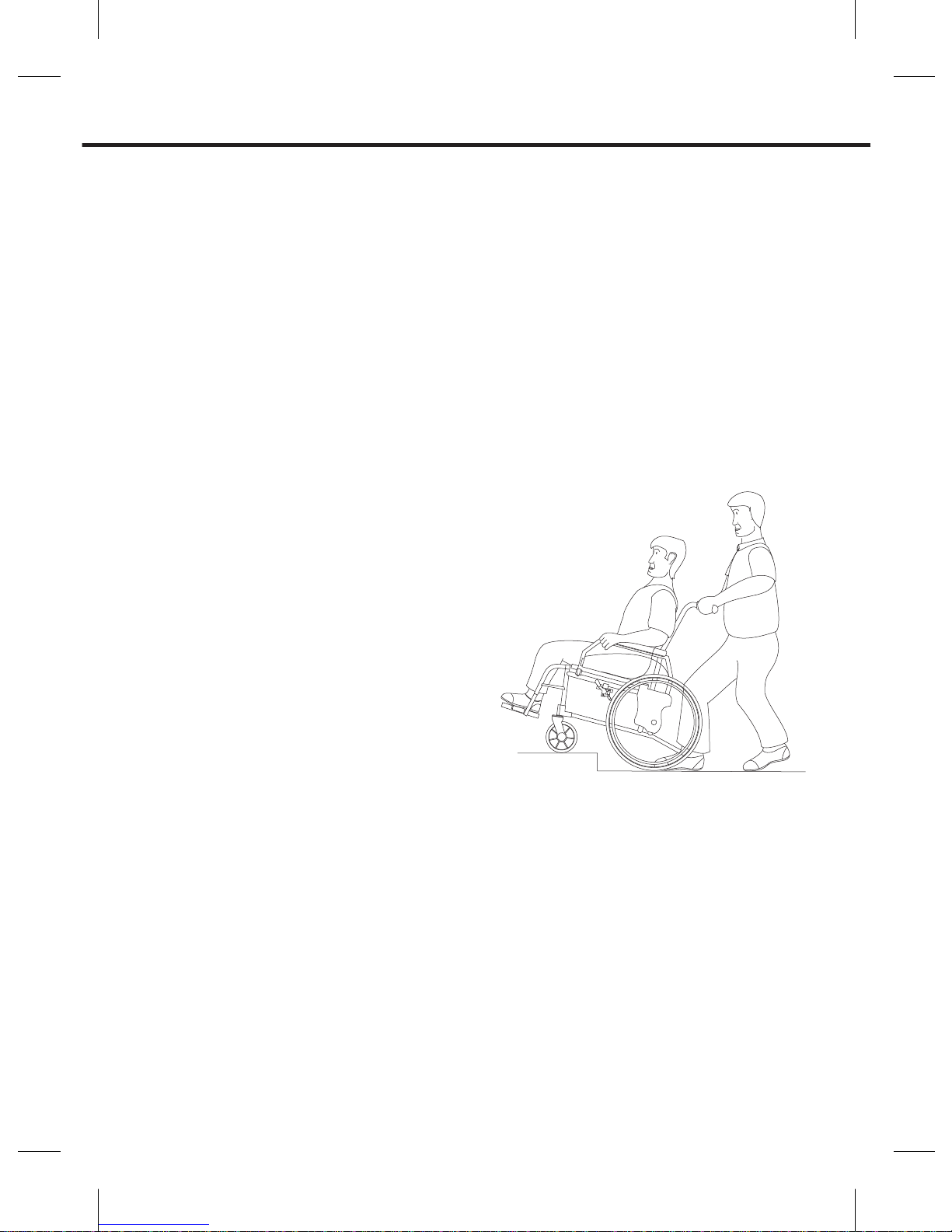
The chair castors should be taken to the edge
of the kerb. The carer should hold the chair
handles firmly, pressing down with the foot on
the rear tipping lever and at the same time
tilting the chair back through pulling the push
handles.
The rear wheels should then be taken to the
kerb edge and the foot removed from the
tipping lever, and the chair lowered down the
kerb on its rear wheels. On reaching the
ground level, the chair should be returned to
stand on all four wheels and gently pushed
forward in the required direction.
Going up a kerb is the reverse of this.
During this operation, the chair must be
maintained in the balanced position on the rear
wheels, and not be tipped forward or the
occupant may fall out. If anti tippers have been
fitted, this operation is more difficult to control,
and they may require to be removed, or
alternative method 2 adopted as below
Method 2.
An alternative method of descending a kerb,
used when anti tippers are fitted, is to
reverse the wheelchair from the direction of
travel and descend the kerb backwards. In
doing this the attendant needs to be aware of
what is going on behind the wheelchair.
The attendant stands on the lower level with
the w hee lch air a nd oc cup ant faci ng
backwards away from the kerb. In this
operation the wheelchair rear wheel is taken to
the edge of the kerb, and allowed to descend to
the lower level.
17
Page 20
Low seat to ground occupant propelled builds
are available on DB1. These may have
compact wheel features to reduce turning
space and special builds for indoor use are
also available. The rear wheel can be fitted in
either the central, or maximum rearwards
stability position. This is more suitable and
convenient for an occupant who assists
propulsion of the wheelchair by pushing along
the ground with the feet. (see illustration
below.)
However a foot propelling occupant is also at
risk of rearwards tip out, should the force
exerted by the propelling foot, overcome the
stability of the wheelchair, at any time, on an
upward slope. A simple object or raised ground
surface could instigate this.
For this reason it is recommended that the foot
propulsion method is used mainly indoors for
tight space manoeuvrability.
Foot propulsion should not be used outdoors
on active balance wheel settings, or where
there are upward facing slopes.
It can be seen that for all users, learning the
geography of an area is important. Users
should check distance and terrain to be
covered, bearing in mind that a slope going out
is a hill coming back.
Forward journey planning can eliminate
difficult manoeuvres, and steps,kerbs or soft
ground may then be avoided, and the journey
less exerting
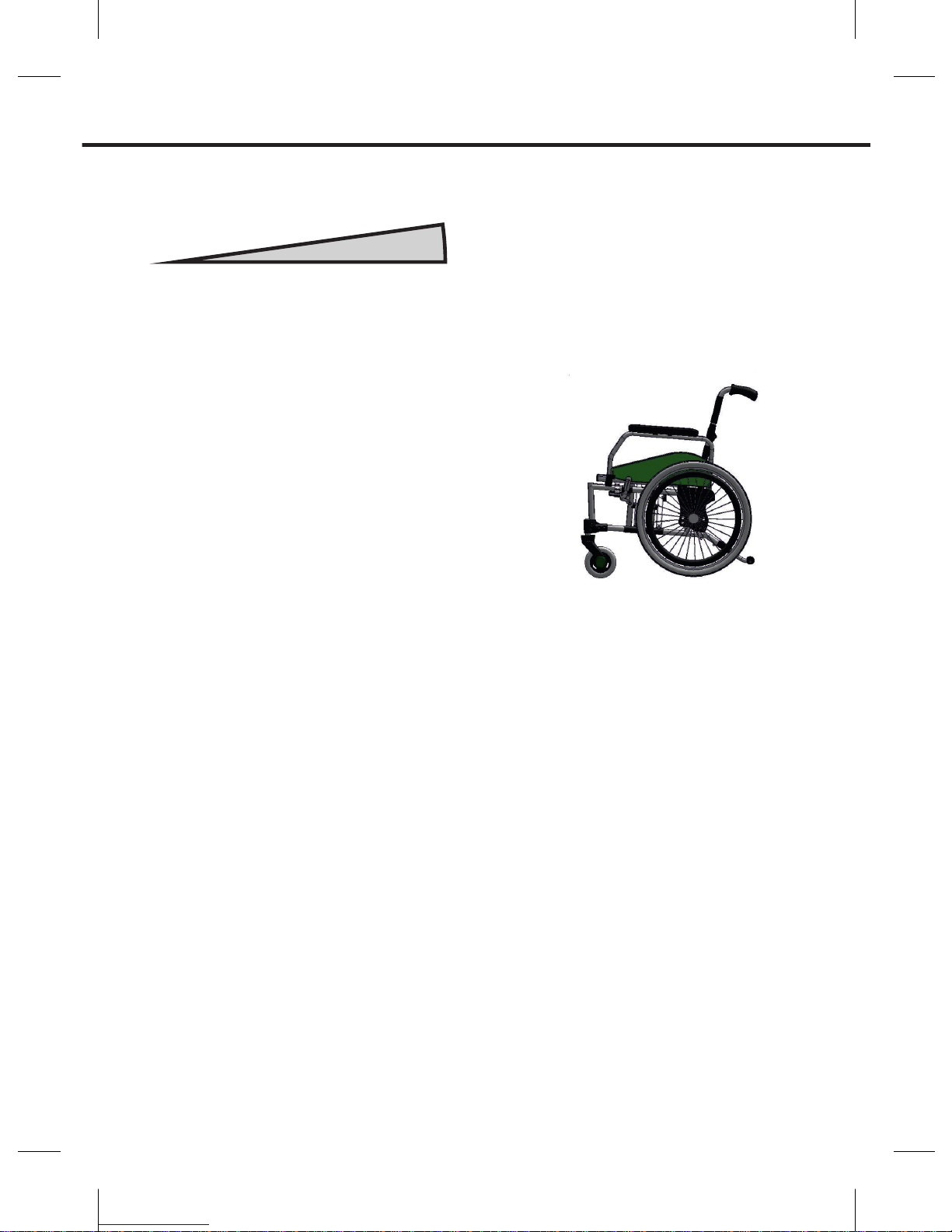
Safe slope (up to 8 Degrees)
For a carer and occupant, pushing a
wheelchair can be an enjoyment provided
that there is mutual confidence and
understanding. In this context both carer and
occupant are both wheelchair users, and can
help each other
A combination of slope and camber is
common in many areas. For new users, trying
the chair out on typical surface conditions
nearby is recommended, before venturing on
a longer trip.
The effort to push a wheelchair up a slope, or
control a wheelchair coming down can be
very high. This is true for both occupant and
attendant propelled wheelchairs.
The comparative pushing force required is
greater when the slope is steep, when the
occupant is heavy, or when the pushing
attendant is small. Modern public buildings
should provid e pe rmanent and saf e
wheelchair ramps with a slope angle which
conforms to regulations.
General advice on recommended safe slope
may need to be reviewed with a reduced
angle. if the carer is relatively small or weak,
and the occupant large and heavy. A review
may also needed as a result of change of use,
or wheelchair modification from its original
assessed build configuration, such as when
special seating is fitted.
GETTING AROUND SAFELY AND ENVIRONMENTAL FEATURES
18
Page 21

GETTING AROUND SAFELY AND ENVIRONMENTAL FEATURES
Many buildings will have wheelchair lifts. Access
ramps built according to current building
regulations should be safe for wheelchair
access. Local authority or public buildings, and
employers should conform to regulations. A
safe slope of up to 8 degrees is recommended.
Such guidance advice, test data and regulations
do not convey actual feel of a wheelchair in the
intended environment. With supervision present
for advice and possible fine tuning adjustment
trails are recommended.
Use of Castors
The DB1 castor is a very adaptable. Wheel
position and diameter can be set to suit needs
of occupant and environment. Wheel positions
that improve forwards stability are available.
Forward stability setting may be suitable for
seating adaptations or addition of accessories,
such as elevated leg or stump support.
Castors are generally maintenance free, users
are recommended to keep them clean,
occasionally checking security of the fitting
points for trouble free and safe operation.
Rough Terrain
Use on rough terrain can cause occupant
discomfort and impact damage to a wheelchair.
Driving over cobble stones and similar surfaces
should be avoided. Reducing speed over rough
terrain is recommended, frequent use over
rough terrain increases the need for service
maintenance and worn part replacement.
Greencare supply castors which improve
occupant comfort performance over a range of
outdoor surfaces. These may be fitted if the
assessment or review highlights such use, or
after a period should the users find that the front
castors are frequently dropping down gaps in
the pavement.
If the wheelchair is crashed, forwards, into a
kerb or similar impact, castors should be
checked for security and damage. If in doubt
users should contact the service department.
Accessories and additional equipment
Greencare DB1 is a modular wheelchair
system. It can be originally built and
customised or adapted with additional
operating or comfort and support features,
such as a reclining backrest or one handed
operation. When additional accessories or
fittings are used, or when more functionality
is built into the wheelchair, any user
additional information provided should also
be read, before attempting to use.
When accessories are fitted the number of
factors for consideration increases. Use is
more complex, and safe routines should be
practiced. Additions such as an elevating leg
support, or a carry bag hanging from the push
handles may have an adverse affect on
stability. Shopping bags or other additional
heavy loads should not be carried in a
wheelchair unless specifically designed for
the purpose. This particularly applies to
hanging items over the push handles, which
can overload the chair and affect stability
resulting in injury if the occupant tips out of
the chair when it is left unattended.
The installation of postural support or seating
system will inevitably change the position of
the occupant centre of gravity. Greencare
DB1 frame and wheelbase system allows
repositioning of the backrest and both front
and rear wheels to optimise centre of gravity
and combined stability of the adapted
wheelchair and occupant.
When a major adaptation has been carried
out a supervised stability assessment test,
using purpose built measuring equipment, in
a clinical rehabilitation environment is
recommended, so that the effect of
wheelchair adjustments can be assessed.
19
Page 22

GETTING AROUND SAFELY AND ENVIRONMENTAL FEATURES
Use of Cushions
Users who spend long periods of time sitting
in a wheelchair will usually require a cushion.
This can be an important part of the postural
specification. If the wheelchair is provided
with a specialised or contoured cushion of
other manufacture, there will be a separate
instruction for its care and use.
For bas ic require ments, Gre encare
wheelchairs maybe supplied complete with a
cushion, which will be labelled accordingly.
The following information is applicable.
The Greencare cushion has internal support
foams that meet UK furniture regulatory
requirements for fire retardency. The outer
cushion surface is a stretchy material that
conforms to occupant shape. The underside
of the cushion cover is a slip resistant
material, which helps to maintain cushion
position on the seat upholstery.
Care should be taken when transferring with
a cushion in position. It is possible the
occupant may slip down into the cushion
during a transfer. Additional effort may be
required to reach the required seating
position. Some active occupants may be
able to do this by pressing down on the
armrests to gain leverage. For less active
users, carers may be required to assist in
transfers to ensure that the occupant is
correctly seated and supported by the
backrest of the wheelchair.
Cushions may be adapted with an additional
velcro strip if this has been assessed as
necessary. Greencare chairs are frequently
built with a low seta to ground height to
ac commodate an assess ed cushion
thickness, and maintain the stability of the
wheelchair when the occupant is seated.
Pressure relieving cushions are often thicker
than comfort cushions.
If after a period of use a different
specification or a thicker cushion is fitted this
may effect wheelchair stability. If the
occupant feels unstable there may be a need
to review the chair configuration.
If a cushion is supplied to a wheelchair , the
footrest height will have been set to provide
the correct support including an allowance
for the cushion thickness. If the occupant
uses the chair set up in this way without a
cushion, localised pressure on the body
contact in the seating area will be increased.
This could cause discomfort leading to skin
damage.
Users and carers should check the cushion
periodically. The Greencare cushion cover
has a zip at the rear under side edge this
allows access to the internal cushion
components for service checks. If
appropriate, there will be may also be an
additional inner lining.
If the cushion cover becomes soiled it can be
removed for washing. Normal washing
temperature of 60 is normally adequate for
domestic cleaning, but cleaning at 80
degrees centigrade and above may be
necessary in a hospital environment.
Cleaning agents containing phenol or
alcohol should not be used. Do not tumble
dry. But ensure the cover is fully dry before
using again.
The support effectiveness of a cushion can
be used over a period of use. If the cushion
becomes damaged or loses its support and
feels to bottom out, it should be brought to
the attention of the wheelchair service, as a
replacement may be required.
20
Page 23
Use of Anti tippers
Anti tippers are available for all Greencare
DB1 models, both occupant and attendant
carer controlled configurations. Attendant
controlled wheelchairs should not need anti
tippers when the chair is being pushed, but
they may be fitted where the occupant spends
long periods in the wheelchair, in a static
situation, or where the occupant is likely to
move about frequently in the chair
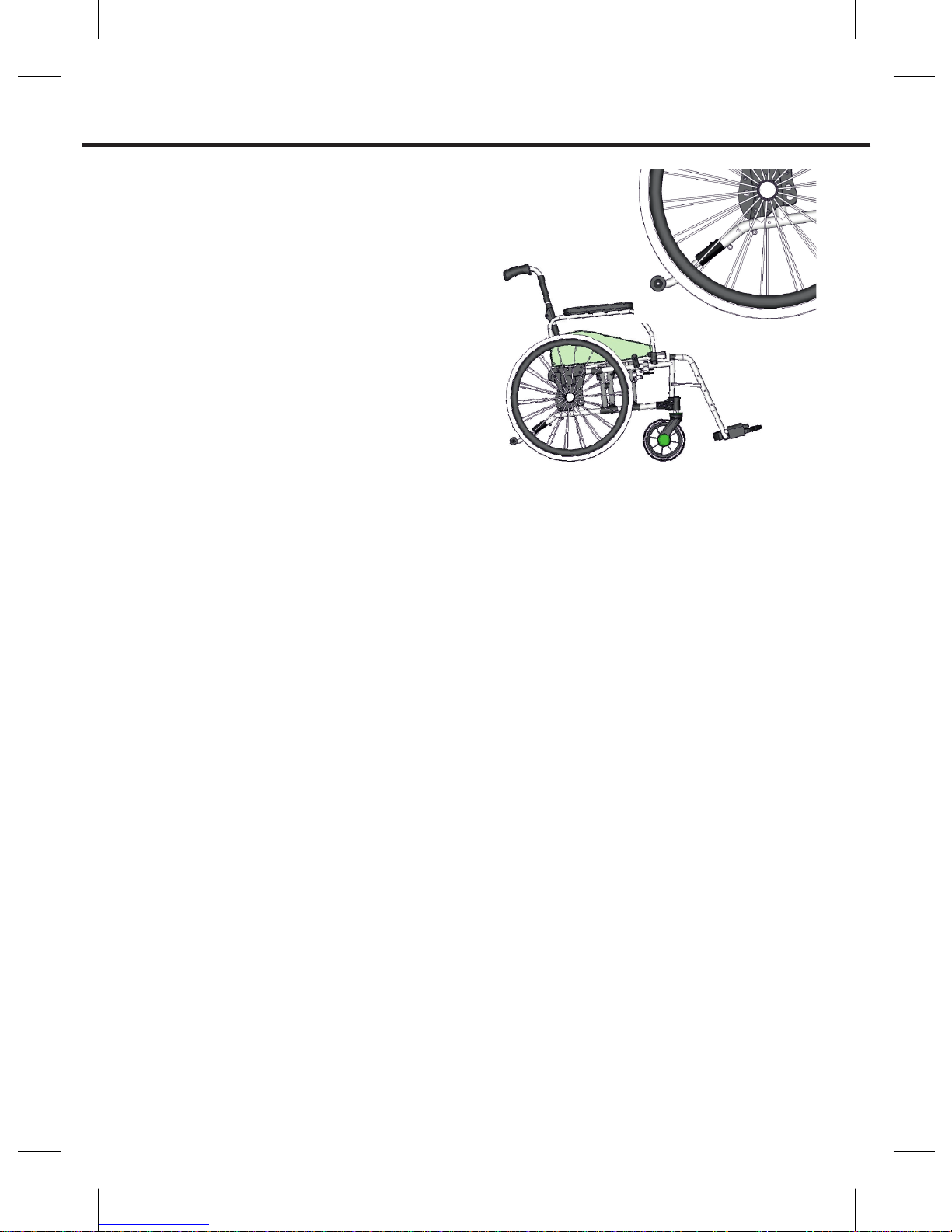
Anti tippers fit into the lower rear frame. They
can be set to allow a degree of rearwards
pivotal movement for manouevre. Anti tippers
are not substitutes for safe and responsible
use. It is possible to remove anti tips for
storage, or to allow a skilled occupant much
more freedom, however, for normal use they
should be replaced in the required position.
With a manual wheelchair, an important factor
in considering what is a safe slope is the effort
demanded from the occupant or attendant
using the chair. Pushing up a steep slope over
a long distance may demand a need to stop
and rest, which in turn demands more effort to
start back upwards again from a stopped
position. Attendant operated hub brakes may
be fitted to assist in such circumstances.
Manouevre, which demands over exertion,
may create risk of injury to both occupant and
or carer, and should be avoided
Users should be aware that anti-tippers
become less effective when the wheelchair is
on an upward facing slope. We recommend
that wheelchairs are not used on slopes
greater than 8 degrees. Before taking a
wheelchair outside, routine user safety
checks on the main components, and
occupant security, should be carried out.
Wh eelchair skil ls t raining under t he
supervision of a knowledgeable person or
professional is recommended for all new
users. Users who are in doubt about safety
and stability should contact their local
wheelchair service for advice.
It is most important that the Assessment
Teams are fully satisfied with user skills
before allowing finely tuned balance
settings, and removal or adjustment of anti
tippers. In some instances a helmet may be
advisable for head protection in the event of
rearward tip-out.
Fire Precautions
Carelessness causes Fire. DB1 wheelchair
uses FR material. This is not a solution.
Prevention and safety is key. Smoking can
cause fires, and is bad for you, A wheelchair
occupant who smokes increases fire risk.
Never underestimate the speed at which a
fire can take hold .Disabled persons are at
greater risk than others in the event of a fire.
The environment in which wheelchairs are
used should incorporate safety precautions
to minimise fire related risks. In buildings
check that fire exits and emergency
evacuation procedures are understood. The
local fire brigade are available for advice on
fire prevention. Do not park the chair against
an open fire or intense heat source. When
parking, the carer should position the chair
so that the occupant can see and
communicate as well as possible.
GETTING AROUND SAFELY AND ENVIRONMENTAL FEATURES
21
Page 24
Use of Hand rims and Tyres
The fitting of polyurethane puncture free
Greentyres eliminates punctures, and provides
reassurance of the user and wheelchair not
being stranded a distance from a service
centre.
Use of polyurethane tyres demands that
spoked wheel condition is maintained to the
specified standard with spoke tension checked
at recommended service intervals. Hand rims
are provided for the occupant to grip and push
round to propel the wheels. Best results will be
obtained by a long pushing stroke that gives a
continuous and smooth forward motion.
Wheels on lightweight DB1 models have
aluminium hand rims and are best for active
users with gloves, who apply hand pressure to
the smooth surface revolving, as a means of
retarding the wheelchair on a downhill slope.
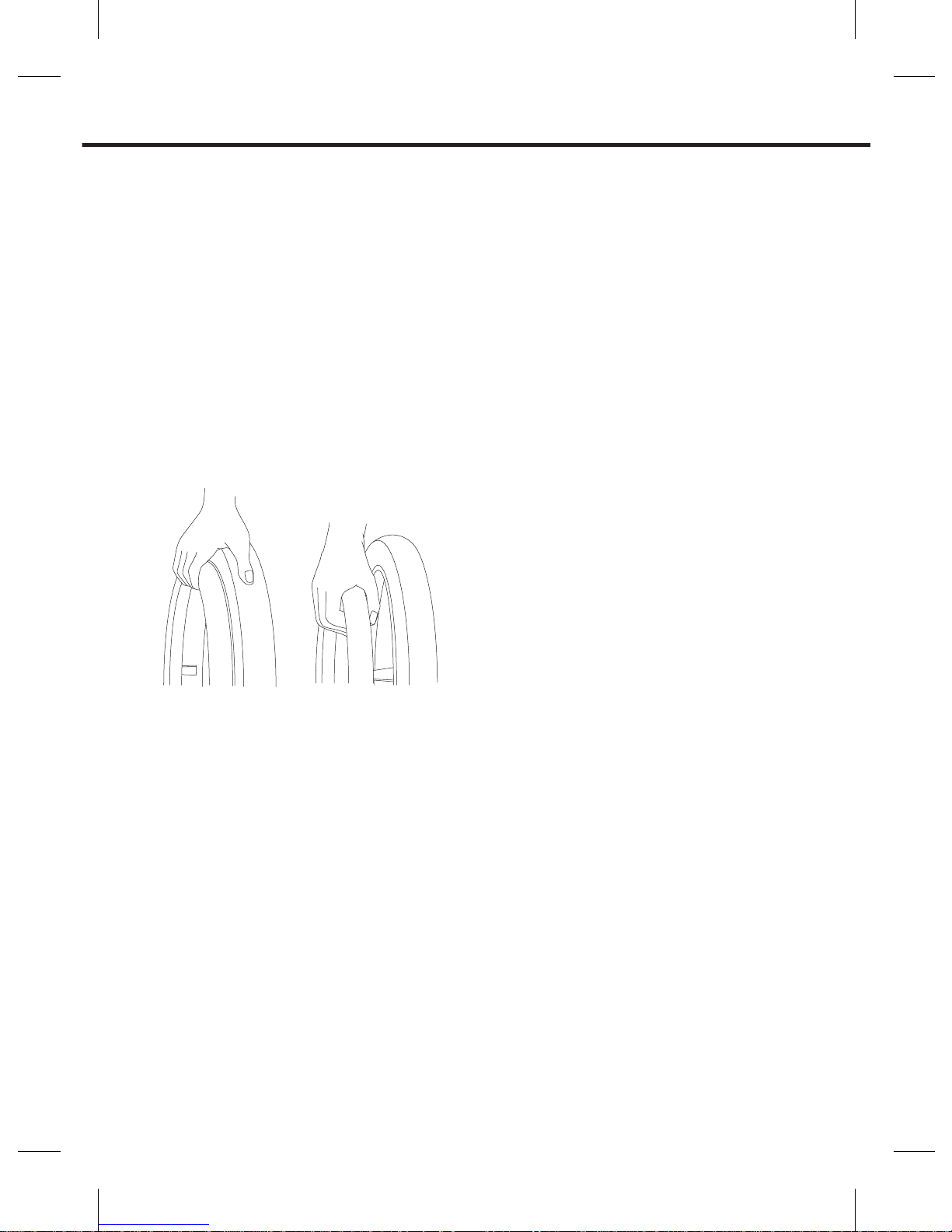
Many users find that gripping across the tyre
and hand rim at the same time gives better
control. This is the required operating mode
when the hand rim is set close to the wheel, to
keep the overall width of the wheelchair down.
We recommend that when operating in this
way, wheelchair gloves are worn.
Hand rims can be removed to reduce overall
width typically for door access. However this
reduces wheel strength. Hand rim removal is
acceptable for indoor use, if occupant is under
150Kg, provided that a carer is present, and
alternative wheels are available as a back up.
Users with hand gripping difficulties may find
larger comfortable section of the optional
Greenrim, a practical feature which improves
safety and confidence in use. Alternatively
propelling wheel builds which reduce overall
width of the wheelchair, using inwards
mounted aluminium hand rims are often a
solution to tight space access.
When using a hand rim to turn a chair round in
a tight space, the occupant should push one
wheel forward, whilst pulling the other wheel
backwards, making sure that there are no
obstructions or bystanders in the turning
space required.
Use of Seatbelts (also posture belts)
DB1 seat belts can be positioned to locate
correctly across the lap of the seated
occupant. They are released and fixed with a
buckle similar to that used in aircraft seats.
Seat belts and harnesses are a precaution for
use outdoors, or for an occupant who needs to
be positioned correctly.
Occupants who are unaware of their
surroundings are more at risk of fall out during
a journey, compared to those who see or react
to a dynamic environment, with expected
changes of speed and direction. Carers
should understand that a seat belt does not
allow irresponsible pushing of the wheelchair
over uneven ground.
Seat belts should not be used to restrain
someone without supervision. A seat belt that
is never used and left to dangle and obstruct
can become a hazard. In such circumstances,
removal of the belt should be agreed and
noted in an assessment report
Where additional support is part of the
assessed need, a specialised belt or support
adaptation may be fitted. Correct use of these
should be individually assessed and
separately advised.
GETTING AROUND SAFELY AND ENVIRONMENTAL FEATURES
22
Page 25

TRANSPORTATION WITH OCCUPANT IN A VEHICLE
Belts should not be used as a means of
securing an uncooperative wheelchair
occupant in position.
A basic security seat belt may be required
after a period of use, if the environment or
method of use changes, or where the
occupant feels a need for greater security in
the wheelchair. The DB1 frame incorporates
belt fitting points, and belts can be fitted
retrospectively if not originally provided with
the wheelchair.
Transportation of wheelc hairs and
occupants in vehicles
Users should understand that the greatest
risk in transportation is when embarking and
disembarking of the wheelchair occupant. A
preferred initial consideration is for the
wheelchair occupant to transfer to a standard
vehicle seat during a journey, with the
wheelchair stored separately and securely.
This however is often not practical when other
aspects of use are taken into account.
If transfer is possible the vehicle seat should
be suitable for the occupant to sit in
throughout the journey.
The occupant should also be able to carry out
the transfer operation with minimal handling
assistance from carers, in the restricted
vehicle space. Carers should not get involved
in unsafe lifting practices.
Storage areas in vehicles should be secure. A
flying wheelchair or component part can
cause a lot of damage and injury if it strikes
anyone.
For the independent occupant who choses to
travel in a wheelchair, good accessibility into
confined spaces is important when using the
allocated spaces on public transport, such as
low floor buses. Greencare DB1 S with short
manoeuvrable frame and wheelbase is
recommended for initial consideration for this
aspect of use.
Use of Four point tie downs and
occupant restraints in specialist vehicles
The DB1 wheelchair incorporates integrated
attachment points for wheelchair and
occupant restraints. Training is available for
carers and transport providers by safety
restraint manufacturers, such as Unwin Ltd
Attention should be given to the following
important safety guidelines.
The wheelchair should be secured to the floor
in a forwards facing direction.
The wheelchair and occupant should be
secured to the vehicle independently.
The wheelchair tie down should be secured to
the points indicated on the frame.
The occupant restraint is routed through the
guides on the chair frame.
More than one person should not occupy the
wheelchair.
Upper occupant restraint should be secured
to the vehicle above shoulder height.
No component of the restraint should pass
through the wheelchair wheels.
Modifications to allow the fitting of restraints
should be approved by Greencare, or an
authorised specialist.
The wheelchair back support frame should be
configured or adapted to incorporate a head
restraint feature.
Loose fitting wheelchair attachments such as
trays should be removed from the wheelchair
unless there is an overriding risk assessed
functional requirement.
23
Page 26
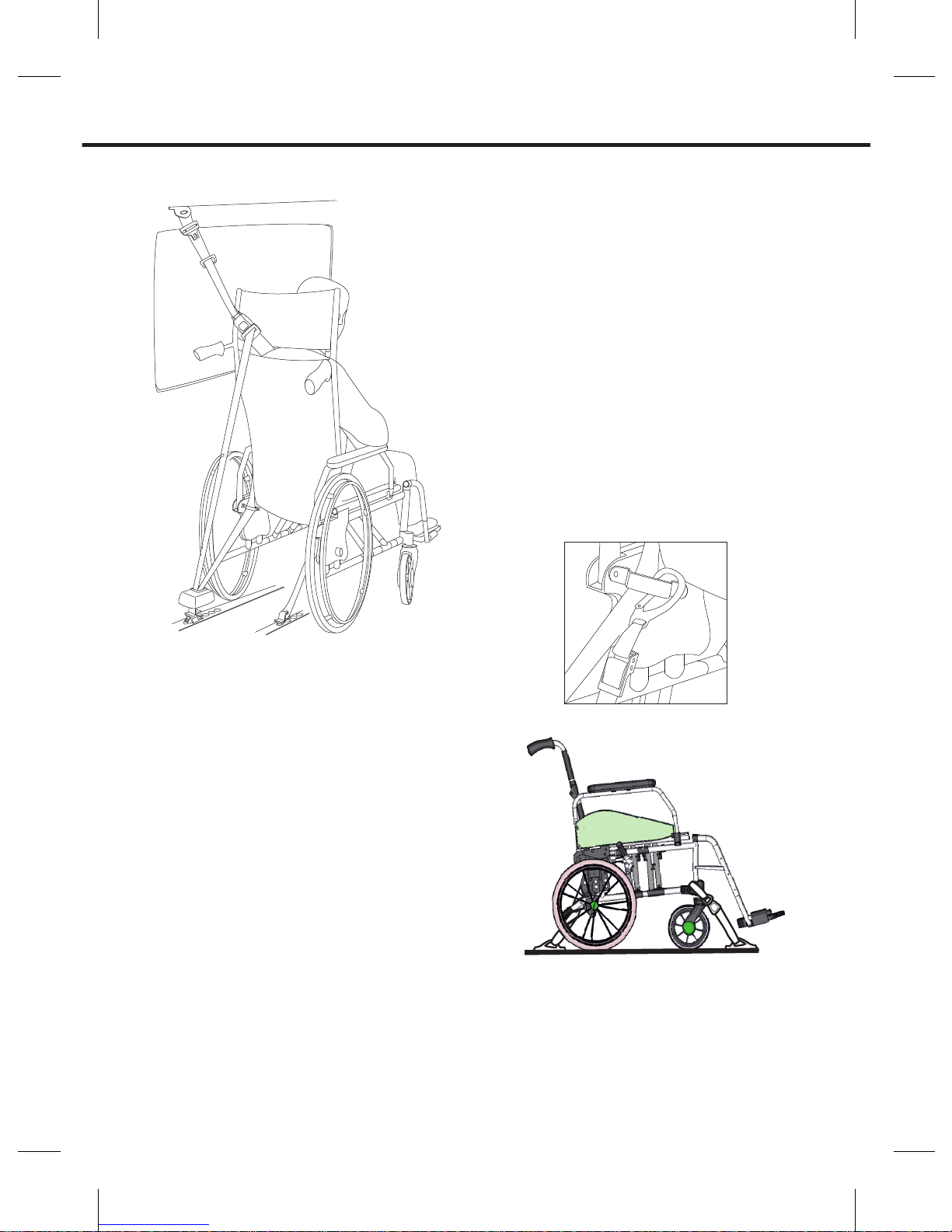
TRANSPORTATION WITH OCCUPANT IN A VEHICLE
The driver of the vehicle carrying wheelchair
users, has the significant responsibility of
ensuring that everyone arrives safely. Minor
surface bumps on the road, such as traffic
calming features can result in unsettling
occupant movement, or displacement of
stored items. Journey planning eliminates the
need for vehicle to encounter surface
hazards.
Wheelchair posture belts and lap straps are
not tested to meet the crash test standards,
but we advise that they should continue to be
used and remain in position during a journey
to provide occupant security and support.
Head restraints are recommended. The
wheelchair can be configured with these as
an original specification item, or approved
restraints fitted as part of the transport
equipment
Transportation crash tested tie down
restraints for both wheelchair and occupant
are part of the actual road vehicle equipment.
The transport provider should maintain them
in a safe working condition.
Db1 has labelled fixing points for wheelchair
downs. Excessive pressure applied by the tie
down has an adverse effect on wheels, as
pressure downwards increases, the area
supporting the load is under compression and
wheel strength is reduced. The hand rim on a
wheelchair wheel has a stabilising effect.
Under no circumstances should hand rims be
removed from wheels that are used in
transportation with tie downs. Please read
instructions issued with WTORS for full
guidance.
The illustrations on this page show DB1 fitted
with the Unwin wheelchair tie down and
occupant restraint system.
BELT GUIDE
24
Page 27
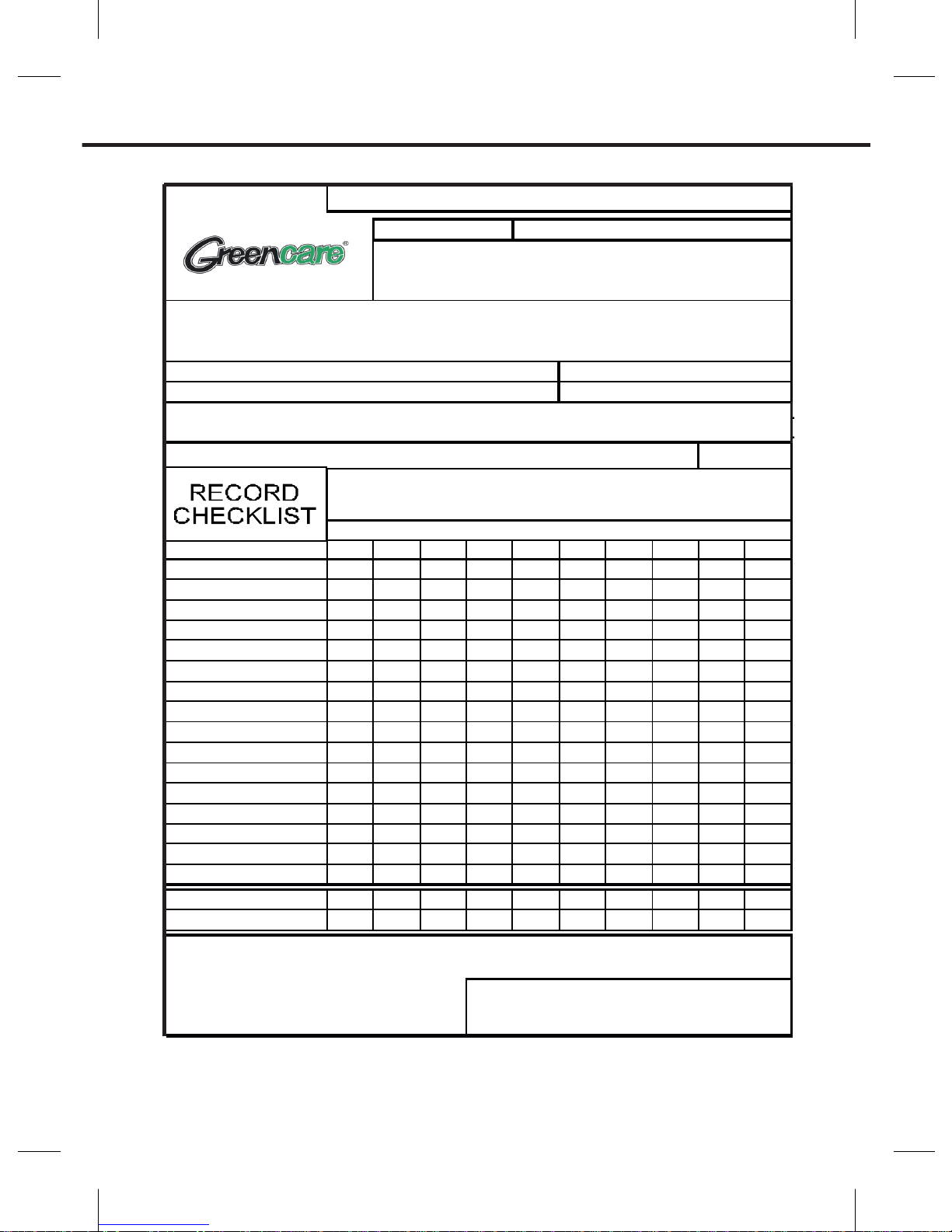
USER OR CARER ROUTINE MAINTENANCE CHECKLIST
25
DB1 MANUAL WHEELCHAIR SERVICE RECORD
Service Ref No.
User / Client Name ..............................................................................................................................
Address.................................................................................................................................................
................................................................................................................................................................
MODEL DESCRIPTION and SIZE .............................................................................................................
OTHER FEATURES......................................................................................................................................
To ensure that your wheelchair remains in first class work ing order
Please ensure that the following checks are carried out at recommended
service intervals by an approved distributor/service agent.
TICK BOX when check is completed
SERVICE No 1 2 3 4 5 6 7 8 9 10
WHEELS
HANDRIMS
TYRES
BRAKES
CASTORS
FOOTRESTS
ARMRESTS
MOVING PARTS
MANOEUVRABILITY
FRAME
ANTI TIPPERS
HAND GRIPS
UPHOLSTERY
LABELLING
ACCESSORY
OTHER
CHECKERS INITIALS
DATE
Greencare Mobility For safety, users should be aware of routine maintenance responsibilities
Riverside Park Road Technical check reference information for service engineers is on gcqa 007
Middlesbrough TS2 1UU
tel 01642 353492
fax 01642 223313
e mail [email protected] for ………………………………..…....…Wheelchair Service
When all tick boxes arecompleted issue a second form as sheet 2 if required.
It is essential for specification of any spare parts.
This form to be included, and retained, with service information.
RECOMMENDED SERVICE INTERVAL assessed according to gcqa 017
Form checked and issued by ………………………………..
To be completed at time of issue by wheelchair service centre
Service Issue DateGreencare BTO Serial Number
Page 28
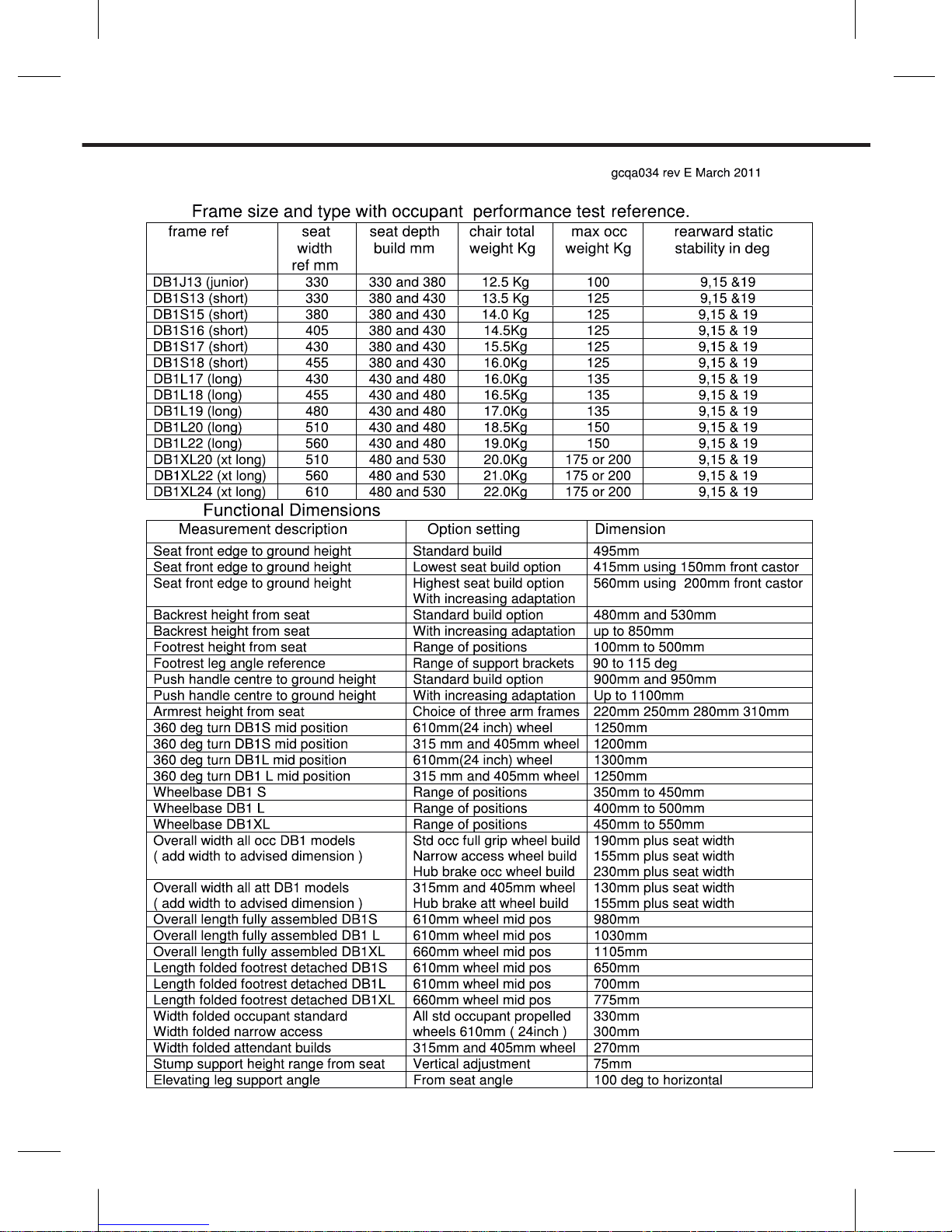
TECHNICAL DATA MEASUREMENTS
26
GREENCARE DB1 TECHNICAL DATA
Page 29

axle position in modular
castor fork
castor wheel
diameter
rear wheel options
( inches unless stated)
front frame
connector type
castor mounting spigot
type
seat to
ground height
comment
twelve o clock offset 150mm 315mm, 20,22,24,26 std height A type M14 thread x 10mm hex height 450mm
centre 200mm 405mm, 22,24,26. std height A type M14 thread x 10mm hex height 500mm
centre 190mm 405mm, 22,24,26. std height A type M14 thread x 10mm hex height 495mm
centre 150mm 20,22,24,26 std height A type M14 thread x 10mm hex height 475mm
six o clock offset 200mm 20 attendant, 26 occ std height A type M16 thread x 35mm hex height 550mm
six o clock offset 200mm 20 attendant, 26 occ std height A type M16 thread x 45mm hex height 560mm highest
six o clock offset 200mm 24,26 std height A type M16 thread x 10mm hex height 525mm
six oclock offset 190mm 24,26 std height A type M14 thread x 10mm hex height 520mm
six o clock offset 150mm 405mm, 22,24,26. std height A type M14 thread x 10mm hex height 500mm
twelve o clock offset 150mm 405mm, 20,22,24 low height B type M14 thread x 10mm hex height 420mm lowest
centre 200mm 20,22,24,26 low height B type M16 thread x 10mm hex height 470mm
centre 190mm 20,22,24,26 low height B type M14 thread x 10mm hex height 465mm
centre 150mm 315mm,20,22,24,26 low height B type M14 thread x 10mm hex height 445mm
six o clock offset 200mm 405mm,22,24,26. low height B type M16 thread x 10mm hex height 495mm
six o clock offset 190mm 405mm,22,24,26. low height B type M14 thread x 10mm hex height 490mm
six o clock offset 150mm 20,22,24,26 low height B type M14 thread x 10mm hex height 470mm
Seat Height from Ground Dimensions
Table of possible seat to ground height dimensions on Db1 wheelchair builds.
Measurements taken at the centre of seat upholstery under load tension. Castor
mounting and rear wheel diameter options and settings as available from March
2011. Standard frame and wheel components as available from March 2010
27
Page 30

Greencare guarantees the products supplied
to be free from manufacturing defects, and
will replace components where necessary
free of charge, for a period of 24 months from
the date of purchase.
This warranty is subject to the condition that
the product has been used, adjusted and
maintained in accordance with this user guide
and maintenance instructions supplied by
Greencare.
This does not affect your statutory rights.
Greencare wheelchairs are designed with the
needs of disabled people in mind. We hope
that our wheelchairs provide their users with
the reliability, comfort and independence
needed for a more improved lifestyle in a
modern environment.
Greencare has a policy of constant product
improvement and reserves the right to
change specifications without prior notice.
In some circumstances it will be necessary to
reduce the warranty on component parts to 12
months because of the high usage levels in
heavy occupant applications. This will be
advised at the time of assessment.
WARRANTY
28
Page 31

ISSUE 31-07-11
Page 32

 Loading...