

Grant Vortex 50/90, Vortex 50/70, Vortex 90/120, Vortex 155/200, Vortex 200/240 User, Installation And Servicing Instructions
...Page 1

USER, INSTALLATION
and
SERVICING INSTRUCTIONS
Vortex Outdoor Condensing Oil Boilers
For use with Kerosene only
Part No. IRL 007 Rev. 03 April 2010
Vortex External Modules
with outputs up to 240,000 Btu/h
This appliance is deemed a controlled service and specific regional statutory
requirements may be applicable.
After installing the boiler leave these instructions with the User
IMPORTANT NOTICE
This appliance must be commissioned upon installation, the information recorded and returned to
Grant Engineering (Ireland) Ltd., using the form contained within the boiler passport provided.
Failure to do so may invalidate the warranty.
EFFIC IENT HEATIN G SO LUTION S
GRANT
Page 2

2
Grant Vortex External Module
Subject PageSection
1 Introduction .............................................. 3
2 User instructions ...................................... 4
3 Boiler technical information .................... 7
4 General boiler information....................... 11
5 Condensate disposal ................................. 20
6 Boiler installation ..................................... 21
7 Commissioning and Boiler passport ........ 31
8 Information for the user ........................... 33
9 Boiler servicing ........................................ 34
10 Wiring diagram ........................................ 37
11 Fault finding ............................................. 38
12 Burner heads ............................................ 40
13 Burner spares ........................................... 41
14 Health and safety information .................. 43
15 EC declaration of conformity .................. 44
LIST OF CONTENTS
Page 3

3
Grant Vortex External Module
During the combustion process, hydrogen and oxygen
combine to produce heat and water vapour. The water
vapour produced is in the form of superheated steam in
the heat exchanger. This superheated steam contains
sensible heat (available heat) and latent heat (heat
locked up in the flue gas). A conventional boiler
cannot recover any of the latent heat and this energy is
lost to the atmosphere through the flue.
The Grant Vortex condensing boiler contains an extra
heat exchanger which is designed to recover the latent
heat normally lost by a conventional boiler. It does this
by cooling the flue gases to below 90° C, thus
extracting more sensible heat and some of the latent
heat. This is achieved by cooling the flue gases to their
dew point (approximately 55° C).
To ensure maximum efficiency, the boiler return
temperature should be 55° C or less, this will enable
the latent heat to be condensed out of the flue gases.
The boiler will achieve nett thermal efficiencies of
100%.
To achieve maximum performance from the Grant
Vortex boiler, it is recommended that the heating
system is designed so that a temperature differential of
20° C between the flow and return is maintained. The
use of modulating circulating pumps (now widely
available) and effective control systems should be
considered.
The Grant Vortex boiler will however still operate at
extremely high efficiencies even when it is not in
condensing mode and therefore is suitable for fitting to
an existing heating system without alteration to the
radiator sizes. The boiler is capable of a maximum
flow temperature of 75° C.
1 - INTRODUCTION
How a condensing boiler works
1.1
Heating system design considerations
1.2
To achieve the maximum efficiencies possible from
the Grant Vortex boiler, the heating system should be
designed to the following parameters:
Radiators:-
Flow temperature 70° C
Return temperature 50° C
Differential 20° C
Underfloor:-
Flow temperature 50° C
Return temperature 40° C
Differential 10° C
1 Size radiators with a mean water temperature of
60° C.
2 Design system controls with programmable room
thermostats or use weather compensating controls
to maintain return temperatures below 55° C.
The boiler should not be allowed to operate with
return temperatures of less than 40° C when the
system is up to operating temperature.
3 The use of a pipe stat is recommended to control
the return temperature when using weather
compensating controls.
Page 4
4
Grant Vortex External Module
2 - USER INSTRUCTIONS
The boiler is fully automatic once switched on, providing
central heating (and also heating your domestic hot water
if you have an hot water cylinder fitted).
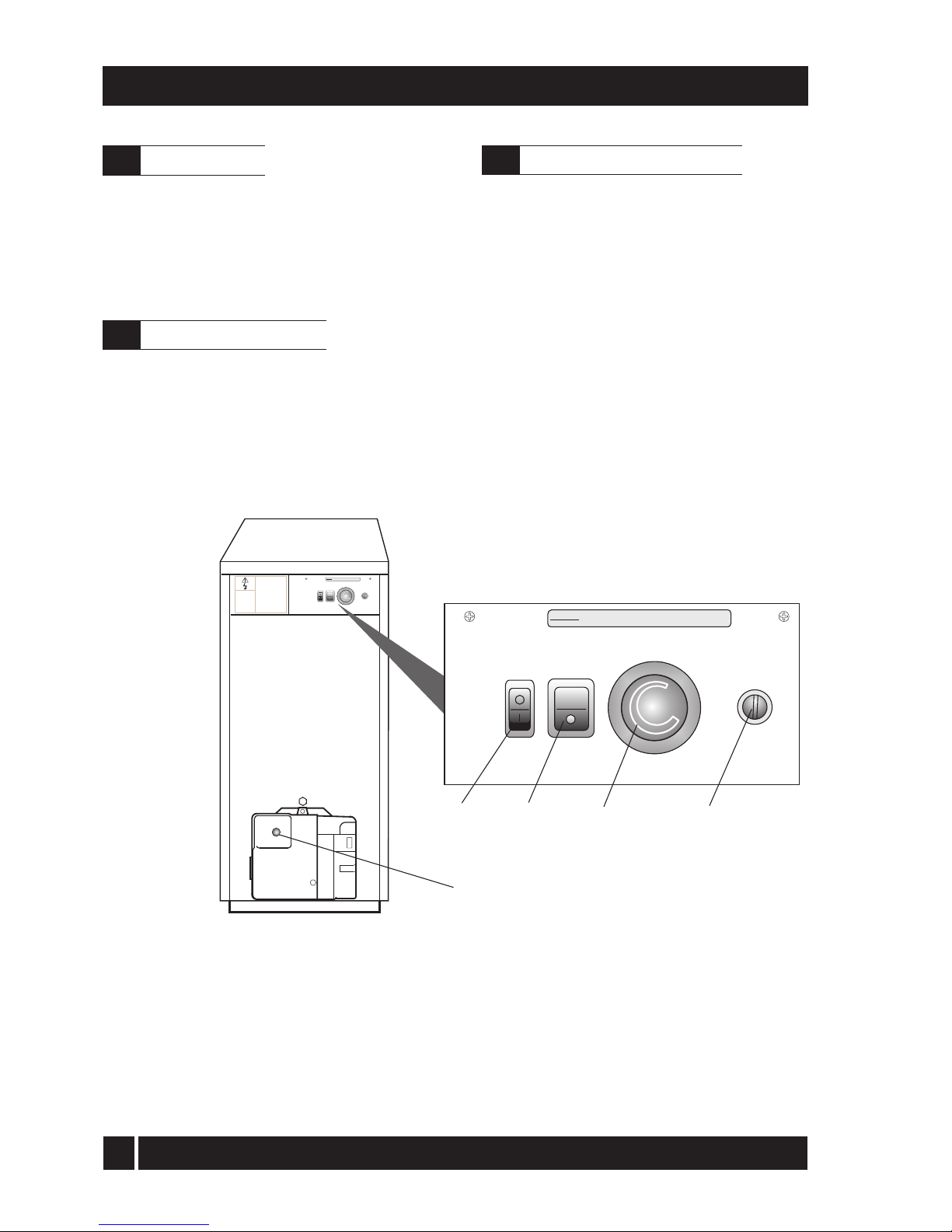
An illuminated On/Off switch, see Fig. A, is fitted to the
External modules, which lights when the boiler is switched
on, but does not necessarily indicate the burner is firing.
To access the External module controls, remove the front
panel by turning the handle and withdrawing it forwards
at the bottom.
Controls for External modules - Fig. A
1 Ensure that - There is sufficient fuel, of the correct
type, in the supply tank and all fuel supply valves are
open. The water supply is on. The electricity supply
to the boiler is off. The Boiler On/Off switch is set to
off (the neon in the switch is not alight). The Test
switch is set to Off. The room thermostat (if fitted) is
at the desired setting. The boiler thermostat is set to
the required setting.
2 Switch on the electricity supply to the boiler.
3 Set the Boiler On/Off switch to on. A neon in the
switch lights when it is in the on position.
The boiler will now light automatically.
About your boiler
2.1
Boiler controls (see Fig. A)
2.2
Lighting your boiler (see Fig. A)
2.3
BOILER ON/OFF SWITCH
ISOLATES PUMP(IF WIRED
INTO BOILER CONTROL
PANEL) & BURNER ONLY.
THIS COVER ISTO BE
REMOVED BYQUALIFIED
PERSONNELONLY
DO NOTREMOVE COVER
WITHOUTISOLATING
SWITCHED LIVEAND
FROST'STAT
PERMANENTLIVE
TESTSWITCH
OVERIDES SYSTEM
CONTROLSTO
OPERATE BOILER
‘Lock-out’ reset button
Boiler front
panel removed
Control Panel
DANGER
THERE IS MORE THAN ONE LIVE SUPPLY TO
THIS CONTROL PANEL
BOILER
OFF
OVERHEAT
RESET
TEST
SWITCH
OFF
HEATING
THERMOSTAT
ON ON
REFER TO WIRING DIAGRAM IN MANUAL
Overheat thermostat
reset button
(under screw cover)
Boiler
thermostat
Boiler
On/Off switch
Test
switch
DANGER
THERE IS MORE THAN ONE LIVE SUPPLY TO
THIS CONTROL PANEL
BOILER
OFF
OVERHEAT
RESET
TEST
SWITCH
OFF
HEATING
THERMOSTAT
ON ON
REFER TO WIRING DIAGRAM IN MANUAL
Page 5

5
Grant Vortex External Module
For short periods - Set the boiler switch to OFF.
To restart, set the switch to ON.
For long periods - Set the boiler switch to OFF. If
required, the fuel supply valve may be closed and the
water and electricity supplies turned off at the mains.
Note: If the electricity, fuel and water supplies are
turned off, the built-in frost thermostat will not
operate.
1 Check that the boiler switch is ON.
2 Check that any remote programmer (if fitted) is
working and is in an 'on' period.
3 Check that all thermostats are set to the desired
setting and are calling for heat.
4 Check if the burner 'Lock-out' reset button (on the
burner) is lit. If it is, press it to start the burner. If
the burner fails to light and goes to 'Lock-out'
again, check that you have sufficient fuel in the
storage tank and that the fuel supply valve is open.
Check that the fire valve in the oil supply line has not
tripped.
5 Ensure that a fuse has not blown or that the
electricity supply has not failed.
6 Check to see if the safety thermostat has operated
(see Section 2.7).
If the burner still fails to light after carrying out these
checks then a fault exists. Switch off the electricity
supply to the boiler and contact your Service engineer.
Grant Vortex External modules operate on Class C2
Kerosene only. You should always quote this type of fuel
when ordering from your supplier.
Do not wait until the fuel runs out before you order
some more. Sludge in the bottom of the tank may be
drawn into the fuel lines. If it is possible, switch off the
boiler when the new supply is delivered and leave the
fuel to settle for an hour before restarting the boiler.
1 Boiler thermostat - This control allows the
temperature of the water leaving the boiler to heat
the radiators and domestic hot water to be adjusted.
Note: If you have a cylinder thermostat on your hot
water cylinder, this will control the temperature of
your domestic hot water. The boiler thermostat
setting must be equal to or above the cylinder
thermostat setting to enable the cylinder thermostat
to control the domestic hot water system.
2 Burner Lock-out reset button - If there is a
burner malfunction, a built-in safety circuit
switches the burner off and the 'Lock-out' reset
button (on the burner) will light. Usually such
malfunctions are short lived and pressing the reset
button will restore normal operation.
If the burner continually goes to 'Lock-out' a fault
exists or the fuel supply is low. If you have
sufficient fuel, you will need to call your Service
engineer.
3 Safety thermostat - Your boiler is fitted with a
safety overheat thermostat which will automatically
switch off the boiler in the case of a control
malfunction causing overheating.
If your boiler goes off and you try to light it but
nothing happens and the 'Lock-out' reset button on
the burner is not lit, the overheat thermostat has
probably operated. The boiler will not light until
the thermostat is reset. To reset, unscrew the small
plastic cap (see Fig. A), press the button then
replace the cap.
If this condition continually repeats, contact your
Service engineer.
4 Ventilation - Always ensure that the boiler has
adequate ventilation. Any ventilation openings
must not be obstructed. Periodically check that
they are clear.
Do not attempt to 'box in' the boiler or build a
compartment around.
Do not place any combustible material around or
on the boiler or flue pipe.
Do not place anything against the door of the
External modules that might obstruct the
ventilation openings.
5 Flue terminal - The flue terminal must not be
obstructed or damaged.
In severe conditions check that the terminal does
not become blocked by snow.
2 - USER INSTRUCTIONS
Turning off your boiler (see Fig. A)
2.4
Points to check if burner fails to light
2.5
About your fuel
2.6
General notes and care of your system
2.7
Page 6

6
Grant Vortex External Module
6 Frost protection - Your Installer may have fitted a
frost thermostat. If not, and you are likely to be
away for a short time, leave the boiler on with the
boiler thermostat set at a low setting. For longer
periods the boiler and system should be drained.
Contact your Service engineer for draining and
filling the system.
The control panel of the External modules includes
a built-in frost thermostat factory set to 5°C.
Note: For Vortex External modules we recommend
that a combined antifreeze and corrosion inhibitor
be used in the primary water system.
7 Cleaning and servicing - Lightly wipe over the
case with a damp cloth and a little detergent. Do
not use abrasive pads or cleaners.
You must have your boiler serviced at least once a
year to ensure safe and efficient operation. Contact
your Service engineer for further details.
Warning note - External equipment operated at
230 volts should not be serviced or repaired
under adverse weather conditions.
8 Failure of electricity supply - If the electricity
supply fails, the boiler will not operate. It should
relight automatically when the supply is restored.
The boiler requires a 230/240 V ~ 50 Hz supply. It
must be protected by a 5 Amp fuse.
Warning: This appliance must be earthed.
If your boiler is operating on a sealed heating system,
the installer will have pressurised the system and
should have told you (or set it on the pressure gauge)
the system pressure when cold (this is normally
between 0.5 and 1.0 bar, which will increase slightly
when hot). If the pressure (when cold) is below the set
pressure mentioned above, you can re-pressurise the
system. If the system requires frequent re-pressurising,
ask your Installer or Service engineer to check the
heating system for leaks and to check the expansion
vessel air charge.
An automatic filling system should not be used on a
sealed central heating system.
The boiler or system will be fitted with an automatic
air vent to remove air from the system. Any air trapped
in the radiators should be removed by venting the
radiators using the vent screw at the top of each
radiator. Only vent a radiator if the top is cool and the
bottom is hot. Excessive venting will reduce the
system pressure, so only vent when necessary and
check the system pressure as mentioned above. Repressurise the system if necessary.
The boiler or system may be fitted with a safety valve
to release excess pressure from the system. If water or
steam is emitted from the end of the safety valve
discharge pipe, switch off the boiler and contact your
Installer or Service engineer.
The expansion vessel air charge must be checked
annually. Failure to maintain an adequate air
charge in the vessel may invalidate the warranty.
To re-pressurise the system by adding water:
1 Only add water to the system when it is cold and
the boiler is off. Do not overfill.
2 Ensure the flexible filling loop (see Fig. B) is
connected and that the shut off valve connecting it
to the boiler is open and the double check valve at
the front is closed.
A valve is open when the operating lever is in line with
the valve, and closed when it is at right angles to it.
3 Gradually open the double check valve on the front
of the filling loop until water is heard to flow.
4 Vent each radiator in turn, starting with the lowest
one in the system, to remove air.
5 Continue to fill the system until the pressure gauge
indicates between 0.5 and 1.0 bar. Close the fill
point valve.
6 Repeat steps 4 and 5 as required.
7 Close the valves either side of the filling loop and
disconnect the loop.
2 - USER INSTRUCTIONS
Electricity supply
2.8
Sealed central heating system
2.9
Sealed system filling loop arrangement - Fig. B
Page 7

7
Grant Vortex External Module
120/155
21
4.7
174
46
157,000
28 mm
28 mm
26.0 mbar
9.5 mbar
4.2 Amp
Boiler technical data
3.1
3 - BOILER TECHNICAL INFORMATION
Model
Water content litre
gal
* Weight (dry) kg
Max. heat output kW
(kerosene) Btu/h
Flow connection
Return connection
Condensate connection
Waterside resistance
Flow/Return temp. diff. of 10°C
Flow/Return temp. diff. of 20°C
Maximum static head
Minimum circulating head
Boiler thermostat range
Limit (safety) stat shut off temp
Max. hearth temperature
Electricity supply
Motor power
Starting current
Running current
Oil connection
Max operating press - sealed sys
Max operating press - open sys
* Weight includes burner but excludes flue.
Vortex External Module
50/90
19
4.2
157
26
88,700
22 mm
22 mm
28.5 mbar
10.0 mbar
2.6 Amp
50/70
16.5
3.6
99
21
71,650
22 mm
22 mm
28.5 mbar
10.0 mbar
4.2 Amp
200/240
50
11
339
70
238,840
1¼" BSP
1¼" BSP
26.0 mbar
9.5 mbar
150 W max.
6.4 Amp
155/200
50
11
335
58
197,876
1¼" BSP
1¼" BSP
26.0 mbar
9.5 mbar
150 W max.
6.4 Amp
90/120
21
4.7
174
36
122,840
28 mm
28 mm
26.0 mbar
9.5 mbar
2.6 Amp
90 W max.
21.5 mm plastic overflow pipe
28 m
1m
65 to 75°C
111°C ± 3°C
Less than 50°C
230/240 V ~ 50 Hz Fused at 5 Amp
0.85 Amp
¼" BSP Male (on end of flexible fuel hose)
2.5 bar
2.5 bar
Page 8

8
Grant Vortex External Module
3 - BOILER TECHNICAL INFORMATION
Note: Grant Vortex External modules are only for use with kerosene.
Grant Vortex External modules using Class C2 kerosene
3.3
Sealed system data - none available for 155/200, 200/240
3.2
Notes:
1 The data given above is approximate only.
2 The above settings may have to be adjusted on site for the correct operation of the burner.
3 Gas Oil is not suitable for use with the Grant Vortex boiler range.
4 The net flue gas temperatures given above are ± 10%.
5 When commissioning the air damper must be adjusted to obtain the correct CO2 level.
6 * Factory settings.
7 The combustion door test point may be used for CO2 and smoke readings only. Do not use this test point for temperature or efficiency readings.
8 When setting the 50/90 to 51,200 or 68,240 Btu/h output or the 120/155 to 123,000 Btu/h output the combustion head must be changed. Refer to Section
7 Commissioning.
When setting the 50/70 to 51,200 Btu/h output the burner air adjuster disc requires repositioning. Refer to Section 9.4 Cleaning the burner.
9 The installer must amend the boiler data label if the output is changed.
Flue gas analysis
To allow the boiler to be commissioned and serviced, the boiler is supplied with a combustion test point on the front cleaning door. When this test point is
used please note the following:
1. The test point is for CO2 and smoke readings only.
2. The boiler efficiency and temperature must be taken from the flue test point on high level and vertical flue adaptors.
3. Low level flues do not contain a test point. The temperature and efficiency readings must be taken from the flue terminal.
(kW)
15.0
18.3
21.0
15.0
20.0
23.0
26.0
26.0
31.5
36.0
36.0
41.5
46.0
46.0
52.0
58.0
58.0
64.0
70.0
(Btu/h)
51,200
62,400
71,650
51,200
68,240
78,500
88,700
88,700
107,500
123,000
123,000
141,600
157,000
156,952
177,424
197,896
197,896
218,368
238,840
Nozzle
0.50/80°EH
0.55/80°EH
0.60/80°EH
0.50/80°EH
0.60/80°EH
0.65/80°EH
0.75/80°EH
0.75/80°EH
0.85/80°EH
1.00/80°EH
1.00/80°EH
1.20/80°S
1.25/80°S
1.25/80°S
1.35/80°S
1.65/80°S
1.65/80°S
1.65/80°S
1.75/80°S
Oil
press.
(bar)
7.0
7.5
9.0
7.0
8.0
8.5
8.0
8.0
9.0
9.1
9.0
8.0
8.0
8.0
9.5
8.0
8.0
9.5
9.5
Smoke
No.
0 - 1
0 - 1
0 - 1
0 - 1
0 - 1
0 - 1
0 - 1
0 - 1
0 - 1
0 - 1
0 - 1
0 - 1
0 - 1
0 - 1
0 - 1
0 - 1
0 - 1
0 - 1
0 - 1
Fuel flow
rate
(kg/h)
1.29
1.56
1.83
1.25
1.67
1.94
2.18
2.18
2.57
3.01
3.01
3.56
3.90
4.01
4.47
5.05
5.05
5.58
6.01
Flue gas
temp.
(°C)
66
73
80
60 - 65
65 - 70
70 - 75
68
68
70
78
78
80
88
75 - 80
75 - 80
75 - 80
75 - 80
75 - 80
75 - 80
CO
2
(%)
12.0
12.0
12.0
12.0
12.0
12.0
12.0
12.0
12.0
12.0
12.0
12.0
12.0
12.0
12.0
12.0
12.0
12.0
12.0
Burner
head type
T1
T1
T1
T1
T1
T2
T2
T3
T3
T3
T3
T5
T5
GIB
GIB
GIB
GIB
GIB
GIB
Heat Output
50/70
Riello RDB2.2
50/90
Riello RDB1
90/120
Riello RDB2
120/155
Riello RDB2.2
155/200
Riello RDB3.2
200/240
Riello RDB3.2
Model and
burner type
*
*
*
HARP/SEDBUK
efficiency
(%)
93
94 - 95
97
92.62
94.1
93.6
*
Air disc
position
B
C
C
-
-
-
-
-
-
-
-
-
-
-
-
-
-
-
-
*
*
Maximum 1.0 bar, Minimum 0.5 bar
2.5 bar
15 mm copper pipe
15 mm copper pipe
Model
Heating system pressure (cold)
Operating pressure of pressure relief valve
Expansion vessel size (approximately)
Max heating system volume (including boiler)
Cold water mains connection
Pressure relief valve discharge connection
Circulating pump head
50/70
10 litres
106 litres
6 m
50/90
12 litres
128 litres
6 m
90/120 and 120/155
16 litres
170 litres
7 m
Burner
head setting
Fixed
Fixed
Fixed
Fixed
Fixed
Fixed
Fixed
Fixed
Fixed
Fixed
Fixed
Fixed
Fixed
0
0
0
0
0
4
Page 9
9
Grant Vortex External Module
3 - BOILER TECHNICAL INFORMATION
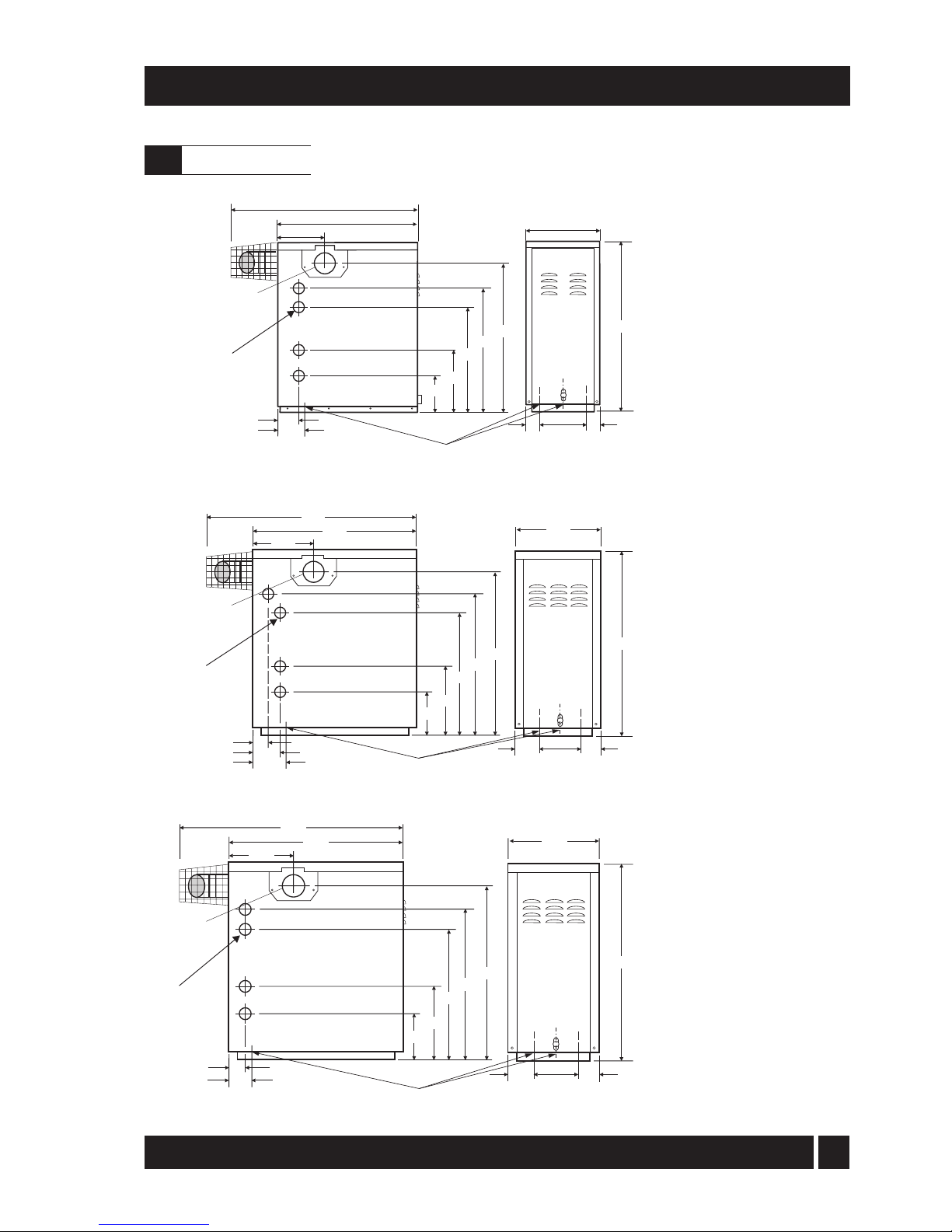
Boiler dimensions
3.4
Fig 1b - 50/90, 90/120 and
120/155dimensions
Fig 1c - 155/200 and 200/240
dimensions
Fig 1a - 50/70
dimensions
4 holes
50mm dia.
in sides
covered with
movable plates
both
879
=
244
=
637
768
517
307
187
99
112
Side flue exit
if required
385
943
734
248
3 holes 50 mm dia.in base of boiler
enclosure covered with movable plates
4 holes
50mm dia.
in sides
covered with
movable plates
both
1154
587
945
233
68
50
1000
1154
816
418
179
1240
=
382
=
Side flue exit
if required
3 holes 50 mm dia.in base of boiler
enclosure covered with movable plates
4 holes
50mm dia.
in sides
covered with
movable plates
both
1005
505
800
269
908
=
320
=
117
132
50
756
A
698
417
192
Side flue exit
if required
3 holes 50 mm dia.in base of boiler
enclosure covered with movable plates
50/90 A = 815
90/120, 120/155 A = 825
Page 10

10
Grant Vortex External Module
Grant Vortex External Modules have an insulated
weatherproof enclosure made of galvanised steel, and
are designed for external installation, either against a
wall or free standing some distance away from the
property, as required. For flue clearances see page 15.
The Vortex External modules are part of the Grant range
of automatic pressure jet oil boilers have been designed
for use with a fully pumped central heating system with
indirect domestic hot water cylinder. They are not suitable
for use with either a direct cylinder or a 'primatic' cylinder
or gravity hot water..
The boilers are suitable for use on open vented or
sealed central heating systems.
All models are supplied with the control panel and
burner factory fitted.
The factory fitted low level discharge flue system can
be adjusted on site for either rear, left hand or right
hand flue outlet position, as required.
An external Plume Diverter kit (Fig. 16) is also available
from your local stockist. Refer to Section 6.4 for further
details.
All burners are pre-set for use with kerosene and are
supplied ready to connect to a single pipe fuel supply
system with a loose flexible fuel line and
3
/8" to 1/4" BSP
male adaptor supplied with the boiler.
If required, an additional flexible fuel line (600 mm) and
3
/8" to 1/4" BSP male adaptor are available to purchase
from your local stockist, for two-pipe oil supply systems.
The temperature of the water leaving the boiler to heat
the radiators and hot water cylinder is User adjustable.
The boiler is fitted with an overheat thermostat (which
allows it to be used on a sealed central heating system)
which will automatically switch off the boiler if the heat
exchanger exceeds a pre-set temperature of 111°C ± 3°C.
The control panel is fitted with an ON/OFF switch,
boiler thermostat control knob and the manual reset
button for the overheat thermostat
Boiler description
4.1
Boiler components
4.2
4 - GENERAL BOILER INFORMATION
Installation of a Grant Vortex boiler must be in
accordance with the following recommendations:-
a Local Building Regulations, and Building
Standards issued by the Department of the
Environment and any local Byelaws etc.
b Model and local Water Undertaking Byelaws.
c Applicable Control of Pollution Regulations.
d The following OFTEC requirements:-
OFST 100 Polythene oil storage tanks for
distillate fuels.
OFST 200 Fuel oil storage tanks and tank
bunds for use with distillate fuels,
lubrication oils and waste oils.
Further information may be obtained from the
OFTEC Technical Information Book 3
(Installation requirements for oil fired boilers
and oil storage tanks).
The installation should also be in accordance with the
latest edition of the following British Standard Codes
of Practice:-
BS 715 Metal flue pipes, fittings, terminals
and accessories.
BS 799:5 Oil storage tanks.
BS 1181 Clay flue linings and flue terminals.
BS 4543:3 Factory made insulated chimneys for
oil fired appliances.
BS 4876 Performance requirements for oil
burning appliances.
BS 5410:1 Code of Practice for oil firing appliances.
BS 5449 Forced circulation hot water systems.
BS 7593 Code of Practice for treatment of
water in heating systems.
BS 7671 Requirements for electrical
installations, IEE Wiring Regulations.
Failure to install and commission appliances
correctly may invalidate the boiler warranty.
IMPORTANT
Before starting any work on the boiler, or fuel supply
please read the health and safety information given in
Section 14 on page 43.
Regulations to comply with
4.3
Page 11

11
Grant Vortex External Module
4 - GENERAL BOILER INFORMATION
4 A metal bowl type filter with a replaceable
micronic filter must be fitted in the fuel supply line
adjacent to the boiler. A shut-off valve should be
fitted before the filter, to allow the filter to be
serviced.
5 A flexible fuel hose, adaptor and 1/4" BSP isolation
valve are supplied loose with the boiler for the final
connection to the burner. If a two pipe system or
'Tiger Loop' type de-aerator is used, an additional
flexible fuel hose (600 mm) and 3/8" to 1/4" BSP male
adaptor are available to purchase from your local
stockist. If a 'Tiger Loop' is fitted it should not be
fitted indoors or within a boiler casing.
6 Metal braided flexible hoses should be replaced
annually when the boiler is serviced. Long life
flexible hoses should be inspected annually and
replaced at least every 60 months.
4.4.3 Single pipe system - (See Fig. 2)
1 Where the storage tank outlet is above the burner
the single pipe system should be used. The height
of the tank above the burner limits the length of
pipe run from the tank to the burner.
2 As supplied the burner is suitable for a single pipe
system.
4.4.1 Fuel storage
The tank should be positioned in accordance with the
recommendations given in BS 5410:1:1997, which gives
details of filling, maintenance and protection from fire.
A steel tank may be used and must be constructed to
BS 799:5:1987 and OFST 200.
A galvanised tank must not be used.
A plastic tank may be used and must comply with
OFST 100.
Note: Plastic tanks should be adequately and
uniformly supported on a smooth level surface, across
their entire base area.
4.4.2 Fuel pipes
1 Fuel supply pipes should be of copper tubing with
an external diameter of at least 10 mm.
Galvanised pipe must not be used.
All pipe connections should preferably use flared
fittings. Soldered connections must not be used on
oil pipes.
2 Flexible hoses must not be used outside the boiler case.
3 A remote sensing fire valve (not a fusible head type)
must be installed in the fuel supply line, with the
sensing head located above the burner.
Recommendations are given in BS 5410:1:1997.
Fuel supply
4.4
Regional statutory requirements may deem this appliance to be a 'controlled service'.
Where this is the case, it is a legal requirement that the appliance is installed and
commissioned either under the remit of building control or by a 'Competent person' such
as a suitably qualified Oftec registered technician.
Fig. 2 - Single pipe system
Filter
Fire
valve
Shut-off
valve
Shut-off
valve
A
Sludge
valve
Fill
pipe
Vent
pipe
Level
gauge
Fuel
storage
tank
Head A
(m)
Maximum pipe run (m)
0.5
1.0
1.5
2.0
10 mm OD pipe
10
20
40
60
12 mm 0D pipe
20
40
80
100
Fire
valve
sensor
Pump
1m
Page 12

12
Grant Vortex External Module
4.4.5 Tiger Loop system - (See Figs. 4 and 5)
1 When the storage tank is below the burner, an
alternative to a two pipe system can be achieved
using the 'Tiger Loop' type oil deaerator. This
effectively removes the air from the oil supply on a
single pipe lift.
2 The de-aerator is connected close to the boiler as a
two pipe system (omitting the non-return valve) as
shown in Fig. 4. Refer to the manufacturers
instructions supplied with the de-aerator.
The de-aerator must be mounted vertically and
externally.
3 To be used with a de-aerator, the burner must be
fitted with an additional flexible fuel hose (a flexible
fuel hose (600 mm) and 3/8" to 1/4" BSP male adaptor
are available to purchase from your local stockist. See
Section 4.4.6.
4.4.4 Two pipe system - (See Fig. 3)
1 When the storage tank outlet is below the burner,
the two pipe system should be used. The pipe runs
should be as shown in Fig. 3. The return pipe
should be at the same level in the tank as the
supply pipe, both being 75 to 100 mm above the
base of the tank. The pipe ends should be a
sufficient distance apart so as to prevent any
sediment disturbed by the return entering the
supply pipe.
2 Avoid the bottom of the tank being more than 3 m
below the burner.
3 A non-return valve should be fitted in the supply
pipe together with the filter and fire valve. A nonreturn valve should be fitted in the return pipe if
the top of the tank is above the burner.
4 To be used with a two-pipe system, the burner
must be fitted with an additional flexible fuel hose
(a flexible fuel hose (600 mm) and 3/8" to 1/4" BSP
male adaptor are available to purchase from your
local stockist.
5 The pump vacuum should not exceed 0.4 bar.
Beyond this limit gas is released from the oil.
For guidance on installation of top outlet fuel tanks and
suction oil supply sizing, see OFTEC booklet T1/139.
Available at www.oftec.org.uk
4 - GENERAL BOILER INFORMATION
Fig. 3 - Two pipe system
Filter
Fire
valve
Shut-off
valve
Shut-off
valve
See
section 4.4.6
A
Return
Supply
Head A
(m)
Maximum pipe run (m)
0
0.5
1.0
1.5
2.0
3.0
3.5
10 mm OD pipe
35
30
25
20
15
8
6
12 mm OD pipe
100
100
100
90
70
30
20
Non
return
valve
Fire
valve
sensor
Sludge
valve
Fill
pipe
Vent
pipe
Level
gauge
Fuel
storage
tank
1m
Page 13

13
Grant Vortex External Module
4 - GENERAL BOILER INFORMATION
4.4.6 Two pipe oil supplies
Riello RDB burner - See Fig. 6
1 The fuel pump is supplied for use with a single
pipe fuel supply system. For use on a two pipe
system, it is necessary to fit the By-pass screw (see
Fig. 6) into the tapping in the return port.
2 The By-pass screw is supplied in the boiler
accessory pack.
3 Remove the plastic burner cover (two screws).
4 Remove and discard the blanking plug from the
return connection of the pump and fit the By-pass
screw using an hexagonal key.
5 Connect the return oil flexible fuel hose to the pump.
6 Connect the 3/8" to 1/4" BSP adaptor to the flexible
fuel hose.
Fig. 4 - De-aeration device system
Fig. 5 - Tiger loop 'de-aeration' device
Fig. 6 - Riello RDB pump
1 Oil inlet connection
2 Return connection
3 By-pass screw
4 Pressure gauge connection
5 Pressure adjuster
6 Vacuum gauge connection
7 Solenoid
8 Supply to nozzle
1
2
3
4
5
6
7
8
1/4" BSP female
connections
Tiger Loop
SUPPLY
TO PUMP
RETURN
FROM PUMP
SUPPLY
FROM TANK
Fire valve
Tankmaster
See
section 4.4.6
Sludge
valve
Fill
pipe
Vent
pipe
Fuel
storage
tank
De-aeration device
e.g. Tiger Loop
See Fig. 5
Fire
valve
sensor
Supply
1m
Return
Page 14

14
Grant Vortex External Module
1 A 230/240 V ~ 50 Hz mains supply is required.
The boiler must be earthed.
2 The supply must be fused at 5 Amp and there must
only be one common isolator for the boiler and
control system, providing complete electrical
isolation.
3 A fused double pole switch or a fused three pin
plug and shuttered outlet socket should be used for
the connection.
4 The power supply cable should be at least 0.75 mm²
PVC as specified in BS 6500, Table 16.
5 All the wiring and supplementary earth bonding
external to the boiler must be in accordance with
the current I.E.E. Wiring Regulations.
6 Any room thermostat or frost thermostat used must
be suitable for use on mains voltage.
7 The boiler requires a permanent mains supply, do
not interrupt it with any external time control.
8 In the event of an electrical fault after installation
of the boiler, the following electrical system checks
must be carried out:- Short circuit, Polarity, Earth
continuity and Resistance to earth.
1 External Modules are supplied with a factory fitted
frost protection thermostat, located inside the
boiler control panel. This is pre-wired to the boiler
electrical system and factory set to 5°C.
2 For total system protection against freezing,
particularly during extended periods without
electrical power, Grant recommend the use of a
combined heating system antifreeze and corrosion
inhibitor, used in accordance with the
manufacturer's instructions.
4 - GENERAL BOILER INFORMATION
1 The External Module must stand on a solid, level
surface capable of supporting the weight of the boiler
when full of water, e.g. a prepared concrete standing,
paving slabs bedded down on sand/cement, or similar.
2 The Module can be installed either against the building
or 'free standing' some distance away from the building.
3 The Module must be positioned such that the
required clearances from the low level flue outlet,
as shown in Fig. 7, are achieved.
4 Adequate clearance must be left around the Module
for servicing. In particular, a minimum clearance of
600 mm above the Module for removal of the top
panel and 600 mm at the opposite end to the flue outlet
for access to the burner.
Sufficient clearance is required at the rear of the
boiler to allow the rear panel to be removed for
access to the condensate trap.
5 The flue terminal must be a minimum distance of
1.8 m from an oil storage tank.
The flue terminal should be positioned so as to
avoid products of combustion accumulating in
stagnant pockets around the building or entering
into buildings.
Electricity supply
4.5
Frost protection
4.6
Boiler location
4.7
Page 15

15
Grant Vortex External Module
4 - GENERAL BOILER INFORMATION
Fig. 7 - Clearances for flue terminals
Distances measured to rim of terminal.
Clearances recommended by Grant Engineering
(IRL) Limited in accordance with Building
Standards and Building Regulations.
Notes:1 An opening means an openable
element, such as an openable
window, or a permanent opening
such as a permanently open air vent.
2 Notwithstanding the dimensions
given, a terminal should be at least
300 mm from combustible material,
e.g. a window frame.
3 A way of providing protection of
combustible material would be to fit
a heat shield at least 750 mm wide.
A Below gutters, eaves or balconies (with protection)
B Horizontally from a door, window or air vent
C Above ground, flat roof or balcony level
D Below gutters, eaves or balconies (without protection)
E From an external corner
F From a terminal facing the terminal
G From a surface facing the terminal
H Vertically from a terminal on the same wall
I Horizontally from a terminal on the same wall
J Directly below an opening, air brick, window, etc.
K From a vertical drain pipe or soil pipe
L From an internal corner
*600
600
300
*600
300
1200
600
1500
**750
600
300
300
Terminal position Min. distance
The terminal should be positioned so as to avoid products of combustion accumulating in stagnant pockets
around the building or entering into buildings. Care should also be taken that the plume from the condensed
flue gases does not cause a nuisance.
Notes: * 75 mm with protection.
** Only applies if one or both terminals are balanced flues.
Page 16

16
Grant Vortex External Module
See Figs. 8, 9, 10 and 11
4 - GENERAL BOILER INFORMATION
Water connections
4.8
Fig. 8 - 50/90 connections
Fig. 9 - 50/70, 90/120, 120/155 connections
The flow and return pipework can exit the boiler
enclosure either through the openings provided in both
sides (under the movable cover plates) and through the
wall when installed against the building, or down and
through the openings provided in the base of the
enclosure for 'free standing' installations.
Ensure the flow pipe is vented as its the highest point
of the boiler.
To avoid the danger of dirt and foreign matter entering
the boiler the complete heating system should be
thoroughly flushed out - before the boiler is connected
and then again after the system has been heated and is
still hot. This is especially important where the boiler
is used on an old system.
For optimum performance after installation, this boiler and its
associated central heating system must be flushed in accordance
with the guidelines given in BS 7593:1992 'Treatment of water
in domestic hot water central heating systems'.
This must involve the use of a proprietary cleaner, such
as BetzDearborn's Sentinel X300 or X400, or Fernox
Restorer. Full instructions are supplied with the
products, but for immediate information, please
contact BetzDearborn on 0151 4209563 or Fernox on
0179 9550811.
For Long term protection against corrosion and scale,
after flushing, it is recommended that an inhibitor such as
Betzdearborn's Sentinel X100 or Fernox MB-1 is dosed
in accordance with the guidelines given in BS 7593:1992.
Failure to implement the guidelines will invalidate the
warranty.
Heating flow
Thermostat phials
Heating return
Heating return
Heating flow
Thermostat phials
Compression straight
Compression elbow
Compression straight
Female socket
in fittings kit
in fittings kit
in fittings kit
fitted
22 mm pipe
22 mm pipe
28 mm pipe
1¼" BSP
Compression
Compression
Compression
Female socket
fitted
fitted
fitted
fitted
Size
Fitting
Fitting
Supplied
Supplied
Flow connection
Return connection
50/70
50/90
90/120, 120/155
155/200, 200/240
22 mm pipe
22 mm pipe
28 mm pipe
1¼" BSP
Size
Boiler model
50/70
50/90
90/120, 120/155
155/200, 200/240
Boiler model
Fig. 10 - 155/200, 200/240 connections
Heating return
Thermostat phials
Heating flow
Page 17

17
Grant Vortex External Module
4 - GENERAL BOILER INFORMATION
See Fig. 12
Grant sealed system kits, incorporating circulating
pumps are available. See Section 6.5 and 6.6.
1 The boiler is only suitable for use with a sealed system
complying with the requirements of BS 5449.
The maximum temperature of the central heating
water is 75°C.
2 The system must be provided with the following
items:a Diaphragm expansion vessel complying with
BS 4814.
b Pressure gauge.
c Safety valve.
d Approved method for filling the system.
Refer to BS 7074:1 for further guidance.
Fig. 11 - All models rear view (panel removed)
3 The expansion vessel can be fitted in either the
return or flow pipework in any of the
recommended positions as shown in Fig. 12. To
reduce the operating temperature of the expansion
vessel diaphragm, position it below the pipe to
which it is connected. The expansion vessel may be
positioned away from the system, providing the
connecting pipe is not less than 13 mm diameter.
4 The pressure gauge should have an operating range
of 0 to 4 bar.
5 The safety valve, set to operate at 2.5 bar, should
be fitted in the flow pipework near to the boiler.
The pipework between the safety valve and boiler
must be unrestricted, i.e. no valves. The safety
valve should be connected to a discharge pipe
which will allow the discharge to be seen, but
cannot cause injury to persons or property.
Fig. 12 Sealed system
Condensate trap
Condensate outlet to drain
Sealing cap must be fitted
Flexible hose from outlet of
condensing heat exchanger
Sealed system kit
4.9
Page 18

18
Grant Vortex External Module
4 - GENERAL BOILER INFORMATION
6 Provision should be made to replace water lost
from the system. This can be done manually (where
allowed by the local water undertaking) using an
approved filling loop arrangement incorporating a
double check valve assembly.
7 An automatic air vent should be fitted to the
highest point of the system as the air vent fitted to
the boiler is for venting the boiler only.
8 The system design pressure (cold) should be between
0.5 and 1.0 bar. This pressure is equivalent to the
maximum static head in bar + 0.3 (1 bar = 10.2 metres
of water).
9 All fittings used in the system must be able to
withstand pressures up to 3 bar.
10 Radiator valves must comply with the requirements
of BS 2767(10):1972.
11 One or more drain taps (to BS 2879) must be used
to allow the system to be completely drained.
12 For proprietary expansion vessel/valve/gauge
packs, refer to the manufacturers instructions for
the correct location on the heating system.
13. An automatic filling valve should not be fitted.
Also refer to Sections 6.5 and 6.6.
1 A 15 mm discharge pipe must be connected to the
safety valve outlet connection. The pipework between
the safety valve and the boiler must be unrestricted,
i.e. no valves. The discharge pipe should terminate so
that it cannot cause injury to persons or property.
2 A 15 mm double check valve ballofix type valve is
provided on the flexible filling loop hose for
connection of the cold mains supply to the heating
system. The cold mains supply should terminate
inside the boiler casing.
3 A drain cock is fitted at the bottom on the front of
the boiler to allow the heating system to be drained
4 The expansion vessel is connected via a flexible
hose to allow it to be moved to gain access to the
baffle cleaning cover. When replacing the vessel,
care should be taken to ensure that the flexible
connecting hose is not twisted.
On underfloor systems it is essential that the return
temperature must be maintained above 40° C to
prevent internal corrosion of the boiler water jacket.
General - Grant boilers are compatible with both
copper and plastic pipe. Where plastic pipe is used it
must be of the oxygen barrier type and be of the
correct class (to BS 7291:Part 1:1990) for the
application concerned.
IMPORTANT: The first metre of pipework
connected to both the heating flow and return
connections of the boiler must be made in copper on
all types of system - sealed or open-vented.
Sealed systems - If plastic pipe is to be used, the
installer must check with the plastic pipe manufacturer
that the pipe to be used is suitable for the temperature
and pressures concerned. Pipe must be Class S to BS
7291: Part 1:1990.
Underfloor systems - Plastic pipe may be used on
Underfloor systems where the plastic pipe is fitted
after the thermostatic mixing valve. Copper tube must
be used for at least the first metre of flow and return
primary pipework between the boiler and the
underfloor mixing/blending valves.
Pipework materials
4.12
Underfloor heating systems
4.11
Water connections - Sealed system kit
4.10
Page 19

19
Grant Vortex External Module
5 - CONDENSATE DISPOSAL
General requirements
5.1
Connections
5.2
Pipework
5.3
When in condensing mode the Grant Vortex boilers
produce condensate from the water vapour in the flue
gases. This condensate is slightly acidic with a ph
value of around 3 (similar to vinegar). Provision must
be made for the safe and effective disposal of this
condensate.
Condensate can be disposed of using one of the
following methods of connection:
Internal connection (preferred option)
• into an internal domestic waste system (from
kitchen sink, washing machine, etc.)
• directly into the soil stack
External connection
• into an external soil stack
• into an external drain or gulley
• into a rainwater hopper (that is part of a combined
system where sewer carries both rainwater and foul
water)
• purpose made soakaway
All condensate disposal pipes MUST be fitted with a
trap - whether they are connected internally or
externally to a domestic waste system/soil stack or run
externally to a gully, hopper or soakaway.
Connections into a rainwater hopper, external drain or
gulley should be terminated inside the hopper/drain/
gulley below the grid level but above the water level.
Condensate disposal pipes should not be connected
directly into rainwater downpipes or to waste/soil
systems connected to septic tanks.
Condensate should not be discharged into 'grey water'
systems that re-use water used in the home (not
including water from toilets).
It should be noted that connection of a condensate pipe
to the drain may be subject to local Building Control
requirements.
Condensate disposal pipework must be plastic (plastic
waste or overflow pipe is suitable).
IMPORTANT: Copper or steel pipe is NOT suitable
and MUST NOT be used for condensate disposal.
Condensate disposal pipes should have a minimum
'nominal' diameter of 22 mm (¾") - e.g. use 21.5 mm
OD polypropylene overflow pipe.
Condensate disposal pipes must be fitted with a fall
(away from the boiler) of at least 2.5° (~45 mm fall
per metre run).
Note: Where it is not possible for the pipe to fall
towards the point of discharge - either internally into a
waste system or externally to a gulley (e.g. for boilers
installed in a basement), it will be necessary to use a
condensate pump.
Condensate disposal pipes should be kept as short as
possible and the number of bends kept to a minimum.
Pipes should be adequately fixed to prevent sagging,
i.e. at no more than 0.5 metre intervals.
External pipework
Ideally, external pipework, or pipework in unheated
areas, should be avoided. If unavoidable, external
pipework should be kept as short as possible (less than
3 metres) and 32 mm waste pipe used to minimise the
risk of ice blocking the pipe in freezing conditions.
The number of bends, fittings and joints on external
pipes should be kept to a minimum to reduce the risk
of trapping condensate.
Note: For boiler installed in an unheated area such as
an outhouse or garage, all condensate pipework should
be considered as an ‘external’.
To keep external pipework to a minimum, locate the
soakaway as close as possible to the boiler but ensure
it is at least 1 metre from building foundations and
away from other services, e.g. gas, electricity, etc.
The condensate pipe may be run above or below
ground level and can enter either the top or side of the
soakaway tube. Refer to Fig.13.
Ensure that the drainage holes in the soakaway tube
face away from the building.
Backfill both the soakaway tube, and the hole around
it, with 10 mm limestone chippings.
Condensate soakaway
5.4
Page 20

20
Grant Vortex External Module
Fig. 14 - Condensate trap
5 - CONDENSATE DISPOSAL
Fig. 13 - Purpose made condensate soakaway
Ground level
32 mm waste pipe external to the building
2.5 fall
O
25 mm
300 mm
400 mm
min.
Two rows of3x12mm
holes at 25 mm centres
and 50 mm from the bottom
of the tube. Holes facing
away from the property.
Cement seal
100 mm
plastic
tube
Sealed
end
Backfill with 10 mm
limestone chippings
Only use a soakaway where the soil is porous and
drains easily. Do not use in clay soils or where the
soil is poorly drained.
WARNING: Any damage due to condensate backing
up into the boiler due to a high water table, in the case
of a soakaway, or flooded drains when the condensate
disposal is via a gulley or soil stack, is not covered by
the Grant product warranty.
Grant Vortex External Modules are supplied with a factoryfitted condensate trap to provide the required 75 mm water
seal in the condensate discharge pipe from the boiler.
This trap incorporates a float (which will create a seal
when the trap is empty) and an overflow warning
outlet (fitted with a plastic sealing cap), See Fig. 14.
Condensate trap
5.5
The trap is factory-fitted inside the boiler casing,
mounted in the rear of the boiler (opposite end to the
burner) on the inside of the right hand side panel - in
an accessible position to allow for routine
maintenance. See Fig. 11.
A flexible hose connects the outlet of the condensing
heat exchanger to the trap inlet. Ensure the straight
connector on the hose is fully pushed onto the 'top hat'
inlet connector of the trap.
With the trap fitted inside the boiler casing, the sealing
cap MUST be fitted.
If connecting the condensate discharge (either internally
or externally) into a waste system or soil stack - the
sealing cap MUST be fitted in the trap outlet.
Condensate trap
Condensate
outlet to drain
Overflow warning
outlet
(with cap)
Condensate drain pipe
from boiler
Page 21

21
Grant Vortex External Module
5 - CONDENSATE DISPOSAL
The condensate trap outlet is at an angle of 48° below
the horizontal. This is to automatically give a 3° fall on
any 'horizontal' runs of condensate disposal pipe. Refer
to Fig.13.
The outlet of the trap will accept 21.5 mm to 23 mm
OD Polypropylene overflow pipe for the condensate
discharge pipe.
Possible routes for disposal pipework
The casing of the Vortex External Module has several
50 mm diameter openings in both the sides and base of
the casing. These are designed to allow pipework to
pass through the casing, as required, to suit the
installation. These openings can be used to allow the
condensate disposal pipe to exit the casing in one of
the following ways:
Side outlet – The lower opening on either side of the
boiler casing can allow the condensate disposal pipe to
be installed as follows:
• Connection to an internal stack – passing back
through the wall of the house
• Connection to an external soil stack adjacent to the
boiler
• Discharge into an adjacent (external) drain or
gulley
• Discharge into a soakaway – with pipe either above
or below ground level
Bottom outlet – There are three openings in the base
of the boiler casing that can allow the condensate
disposal pipe to be installed as follows:
• Discharge into a drain or gulley beneath the boiler
(e.g. drain built in to the concrete base for the
boiler)
• Discharge into a soakaway – with pipe below
ground level
The trap MUST be checked at regular intervals (e.g.
on every annual service) and cleaned as necessary to
ensure that it is clear and able to operate.
Note: The bottom bowl is sealed to the trap body and
cannot be removed.
To inspect and clean the trap:
1 Disconnect flexible condensate hose from inlet
connector.
2 Unscrew the outlet connection nut.
3 Remove the outlet connector and nut from trap.
4 Remove trap from bracket.
5 Remove float from trap – clean if necessary.
6 Inspect inside of trap and clean as necessary.
7 Re-assemble trap, re-fit to boiler and re-connect
flexible hose. Ensure that hose is fully pushed onto
the trap inlet connector.
IMPORTANT: Failure to regularly check and clean
the condensate trap may result in damage to the boiler
and will not be covered by the Product Warranty.
Condensate disposal pipework
5.6
Inspection and cleaning of trap
5.7
Page 22

22
Grant Vortex External Module
1 Carefully remove the packaging from the boiler
and lift it off the pallet.
2 The flue terminal guard is supplied loose inside the
boiler.
3 Remove the case top panel (four screws).
4 The flue may exit the casing from the left, right or rear
of the casing. The casing has two removable blanking
panels and a flue exit panel. Fit the panel with the flue
exit hole and seal in the required position.
5 Slacken the wing nuts holding the flue elbow and
rotate the elbow to the required direction for the
flue to exit the casing.
6 Push the end of the flue terminal section with the
red seal through the seal in the casing. The terminal
has been factory lubricated. Take care not to
dislodge or damage the red seals.
7 Carefully insert the terminal into the flue elbow until
the bend of the terminal contacts the outer casing,
then, pull the terminal forward approximately 25 mm
and rotate the bend so that the outlet is horizontal.
Rear Exit - The flue must discharge away from the
building.
Side Exit - The flue should discharge towards the
rear of the casing to prevent flue gases re-entering
the boiler casing through the air inlet vents on the
casing front door.
The flue terminal must be fitted horizontally to
prevent dripping from the end of the terminal.
6 - BOILER INSTALLATION
Unpack the boiler
6.1
Fig. 15
8 Tighten the wing nuts holding the flue elbow and fit the
stainless steel flue guard using the two screws provided.
9 The top panel of the casing has been designed so that
it may be fitted to create a slight slope away from the
side positioned against the wall. To tilt the top panel,
loosen the four top panel casing screws, one at each
corner and push down on the side furthest from the
wall. Tighten the screws. See Fig. 15.
1 If the boiler is to be fitted against the wall, prepare the
wall to accept the heating system pipework. To mark
the wall for drilling, refer to Fig. 1 for the positions of
the pipework openings in the enclosure sides.
Note: Pipework should be insulated where it
passes through the wall into the boiler enclosure.
If the boiler is to be installed 'free standing' (i.e.
away from a wall) and the pipework run
underground, slide away the covers to open the two
pipe openings in the base of the boiler enclosure.
Using a sharp knife, cut through the polystyrene in
the base, around the edge of the holes, to allow the
flow and return pipes to enter the enclosure.
2 The electrical supply to the boiler should be routed
through the wall in a suitable conduit, such that it
enters the boiler enclosure via one of the unused
pipework openings. The cable can be routed to the
front of the boiler, for connection to the boiler
control panel, either over the top or beneath the
boiler heat exchanger. Heat resistant PVC cable, of
at least 1.0 mm² cross section should be used
within the boiler enclosure.
Preparations for installation
6.2
Page 23

23
Grant Vortex External Module
6 - BOILER INSTALLATION
If the Grant sealed system kit is fitted, refer to Section
6.6 for details on filling and venting the sealed heating
system.
See Figs. 16 and 17
Where it is not possible to terminate the factory supplied
low level flue, there are two alternative options;
Plume diverter kit - This single wall stainless steel flue
accessory is designed to divert the flue gases up and
terminate at a higher level than the factory supplied
terminal. When fitting the plume diverter kit, follow the
instructions supplied with the kit. See Fig. 16.
Horizontal system - This option uses a straight boiler
connector, elbows and extensions as shown in Fig. 17.
A complete list of flue components are given on page 25.
All flue components are stainless steel and fully insulated
with 'O' ring seals and locking bands.
1 The flue must terminate in a down draught free area,
i.e. at least 600 mm above the point of exit through the
roof or preferably above the ridge level.
2 The condensate may be allowed to run back into
the boiler. A condensate drain at the base of the
flue system is not required.
3 The flue terminal must be at least 600 mm from
any opening into the building, and 600 mm above
any vertical structure or wall less than a horizontal
distance of 750 mm from the terminal.
It is important to ensure that the flue system is sealed
and that condensate cannot escape. Up to 1.5 l/h of
condensate can be produced in a conventional flue
system.
Flue systems
6.4
3 The oil supply line should be installed up to the
position of the boiler. Refer to Section 4.4.2 for
details. The final connection into the boiler enclosure
can be made with 10 mm soft copper, routed along the
base of the enclosure (either between the enclosure
and wall or in front of the enclosure) to enter through
one of the holes located in the bottom edge side panel,
at the front (burner) end.
Refer to Section 4.8 and 4.19 and Figs. 8, 9, 10 or 11.
for the size, type and position of the connections.
The Flow and Return pipework can be routed to either
side of the boiler as required.
For condensate disposal pipework refer to Section 5.
1 To gain access to the water connections, remove
the two screws securing the bottom of the back
panel and remove it by withdrawing it forwards at
the bottom. Remove the top casing panel.
2 To gain access to the burner, remove the front
panel by turning the handle and withdrawing it
forwards at the bottom..
3 If required, fit the Grant sealed system kit, see
Section 6.5.
4 Carefully manoeuvre the boiler in position to line
up with pipework through the wall. Complete the
water connections.
Note: Check that the baffles are in position and
that the cleaning cover is correctly fitted and a
good seal made.
5 If the boiler is installed against a wall, fit the wall
flashing strip. Position the strip with the bottom
edge of the wider flange 20 mm above the
enclosure top panel, with the narrow flange (with
the three fixing holes) flat against the wall. The
strip should overhang the top panel by an equal
amount at each end.
Mark the position of the three fixing holes onto the
wall, drill and plug the wall and secure the strip
with suitable screws (not supplied).
6 Fill and vent the water system and check for leaks,
rectifying where necessary.
Make the water connections
6.3
Page 24

24
Grant Vortex External Module
6 - BOILER INSTALLATION
Fig. 16 - Plume diverter kit (Outdoor boiler)
Self tapping
screw 3mm
(x2)
Locking band
(x2)
Telescopic
locking band
(x1)
Locking band
(x2)
Adjustable
wall bracket
(x2)
Terminal
elbow (x1)
Telescopic
flue pipe
1000mm long
(x2)
Starter elbow
(x1)
Plume diverter kit components
GPDA90 = 1240 - 2080
GPDA200 = 1290 - 2140
Page 25

25
Grant Vortex External Module
Fig. 17 - Horizontal external flue
Garden wall
Outdoor
module
Garden wall
Extensions
45° elbows
Straight
terminals
Straight
starter
Maximum horizontal
length 3 metres
6 - BOILER INSTALLATION
The following flue components are available from your local stockist
50/70 and 50/90 models
Item
External starter elbow
External starter - straight
150 mm extension
250 mm extension
450 mm extension
950 mm extension
195-270 mm adjustable extension
45° elbow
High level terminal
Vertical terminal
Wall bracket - standard
Wall bracket - extended
Straight terminal - Horizontal flue
Part No.
GKM90
GKM90C
GX150/90
GX250/90
GX450/90
GX950/90
GXA250/90
GE45/90
GTH90
GTV90
GWB90
GEB90
GTL90
90/120, 120/155, 155/200 and 200/240 models
Item
External starter elbow
External starter - straight
150 mm extension
250 mm extension
450 mm extension
950 mm extension
195-270 mm adjustable extension
45° elbow
High level terminal
Vertical terminal
Wall bracket - standard
Wall bracket - extended
Straight terminal - Horizontal flue
Part No.
GKM200
GKM200C
GX150/200
GX250/200
GX450/200
GX950/200
GXA250/200
GE45/200
GTH200
GTV200
GWB200
GEB200
GTL200
Page 26

26
Grant Vortex External Module
Fig. 19 - 50/70 rear view (showing pump assembly)
6 - BOILER INSTALLATION
See Figs. 18 and 19
1 The kit includes the following items:
Pressure relief valve and automatic air vent
Manifold pipe
10 litre expansion vessel with flexible hose and
sealing washer
Expansion vessel mounting bracket
Filling loop kit
Pressure gauge (mounted on compression tee)
6 m head circulating pump with 22 mm gate type
valves
15 mm copper pressure relief valve discharge pipe
(in two pieces with push-fit connector)
Pump support bracket (with fixing screws)
2 Unscrew and remove the two nuts and washers
from the two cleaning door studs. Remove cleaning
door from boiler.
3 Remove the ½" BSP black iron plug from the front
of the boiler waterway, using a 3/8" drive socket
wrench.
4 Fit the ½" BSP straight connector end of the
flexible expansion vessel hose into the tapping on
the front of the waterway using a suitable thread
sealant.
5 Fit the ¾" BSP connection on the flexible
expansion vessel hose to the vessel using the black
rubber sealing washer supplied and tighten the
union nut.
6 Replace the cleaning door on the two door studs.
Fit the expansion vessel mounting bracket onto the
studs. Replace the nuts and washers and re-tighten
to secure door and bracket.
Sealed system kit - 50/70
6.5a
7 Fit the pressure relief valve and automatic air vent
onto the manifold pipe. Then fit the manifold pipe
end into the 22mm compression connector on the
boiler flow pipe. Refer to Fig. 18.
Fig. 18 - 50/70 top view (showing automatic air
vent, pressure relief valve and manifold)
Pressure relief valve
Manifold
pipe
Automatic
air vent
Pressure relief
valve discharge pipe
Tectite
connector
8 Fit both 22 mm pump valves to the circulating
pump using the sealing washers provided.
9 Fit the pump support bracket, with the screws
provided, using the two holes in the left hand side
panel flange (viewed from rear of boiler as shown
in Fig. 19).
Pump support
bracket
Screws
Pump and
valve assy.
Page 27

27
Grant Vortex External Module
10 Fit the pump/pump valve assembly to the end of
the pressure relief valve/auto air vent manifold
pipe. Ensure that the pump shaft is horizontal and
the pump motor is facing towards the right side of
the boiler (viewed from the rear as shown in Fig.
19). The flow arrow on the body of the pump must
face in the required direction of flow – away from
the boiler flow connection – downwards in this
case.
11 Ensure that the pump/valve assembly is supported
by the bracket. The upper part of the lower valve
should rest on the support bracket, with the body of
the valve passing through the cut-out. Connect the
flow pipework to the lower pump valve.
12 Assemble the two sections of the pressure relief
valve discharge pipe using the 15 mm straight
push-fit connector provided. Adjust the pressure
relief valve so that the outlet points to the rear left
corner of the boiler (viewed from the rear of the
boiler).
13 Fit the pressure relief valve discharge pipe to the
pressure relief valve outlet using the nut and olive
provided. Route the pipe down the left hand rear
side of the boiler and locate the lower end through
the slot in the bottom flange of the left hand side
panel.
14 The circulating pump may be wired into the boiler
control panel if required. Refer to Section 10.
15 The pressure gauge and filling loop should be
installed in a convenient position inside the
building.
6 - BOILER INSTALLATION
Sealed system kit - 50/90
6.5b
See Fig. 20
1 The kit includes the following items:
Pressure relief valve and automatic air vent
Manifold pipe
12 litre expansion vessel with flexible hose and
sealing washer
Filling loop kit
Pressure gauge (mounted on compression Tee)
6 m head circulating pump with 22 mm gate type valves
15 mm copper pressure relief valve discharge pipe
2 Remove the ½” BSP black iron plug from the front of
the boiler waterway, using a 3/8" drive socket wrench.
3 Fit the ½” BSP straight end of the flexible
expansion vessel hose to the tapping on the front of
the waterway using a suitable thread sealant.
4 Position the 12 litre expansion vessel on the front
of the boiler combustion door locating the bracket
into the slot of the combustion door.
5 Fit the ¾” BSP connection of the flexible
expansion vessel hose to the vessel using the black
rubber washer supplied and tighten the nut.
6 Fit the 22 mm compression elbow onto the boiler
flow connection.
7 Fit the pressure relief valve and automatic air vent
onto the manifold pipe. Then fit the manifold pipe
end into the 22mm compression connector on the
boiler flow pipe.
8 Fit both 22 mm pump valves to the circulating
pump using the sealing washers supplied.
9 Fit the pump assembly to the automatic air vent/
pressure relief valve assembly ensuring that the
pump shaft is horizontal and the pump motor is
facing towards the front of the boiler. The flow
arrow on the body of the pump must face in the
direction of flow away from the boiler connection.
10 Fit the pressure relief valve discharge pipe to the
pressure relief valve using the nut and olive
supplied. Route the discharge pipe through the slot
in the base of the right hand side panel. Push the
panel insulation back to expose the slot.
11 The circulating pump may be wired into the boiler
control panel if required. Refer to Section 10.
12 The pressure gauge and filling loop should be
installed in a convenient postion inside the
building.
Page 28

28
Grant Vortex External Module
6 - BOILER INSTALLATION
5 Fit the vessel support bracket to the bottom two studs
of the combustion door and refit the nuts and washers.
Tighten to ensure an adequate seal is made.
6 Position the 16 litre expansion vessel onto the
support bracket in front of the boiler combustion
door locating the top of the vessel behind the
control panel first.
7 Screw in the locking screw on the base of the
bracket to secure the vessel in place.
8 Fit the ¾” BSP connection of the flexible
expansion vessel hose to the vessel using the black
rubber washer supplied and tighten the nut.
Sealed system kit - 90/120 and 120/155
6.5c
Fig. 20 - Sealed system pump assembly
Automatic air vent
Flow connection
on top of boiler
Compression elbow
Front of boiler
9 Fit the 28 mm compression elbow onto the boiler
flow connection.
10 Fit the pressure relief valve and automatic air vent
onto the manifold pipe. Then fit the manifold pipe
end into the 28mm compression connector on the
boiler flow pipe.
11 Fit both 28 mm pump valves to the circulating
pump using the sealing washers supplied.
12 Fit the pump assembly to the automatic air vent/
pressure relief valve assembly ensuring that the
pump shaft is horizontal and the pump motor is
facing towards the front of the boiler. The flow
arrow on the body of the pump must face in the
direction of flow away from the boiler connection.
13 Fit the pressure relief valve discharge pipe to the
pressure relief valve using the nut and olive
supplied. Route the discharge pipe through the slot
in the base of the right hand side panel. Push the
panel insulation back to expose the slot.
14 The circulating pump may be wired into the boiler
control panel if required. Refer to Section 10.
The expansion vessel fitted is supplied with a charge
pressure of 1.0 bar (equivalent to a max. static head of
10.2 metres). The charge pressure must not be less
than the actual static head at the point of connection.
Do not pressurise the vessel above 1.5 bar.
The air pressure in the vessel must be checked annually.
The central heating system volume, using the expansion
vessel as supplied, must not exceed the recommended
volumes. If the system volume is greater, an extra
expansion vessel (complying with BS 4841) must be
fitted as close as possible to the central heating return
connection on the boiler. The charge pressure of the extra
vessel must be the same as the vessel fitted in the boiler.
Refer to BS 7074:1 for further guidance.
The air charge pressure may be checked using a tyre
pressure gauge on the expansion vessel Schraeder
valve. The vessel may be re-pressurised using a
suitable pump. When checking the air pressure the
water in the heating system must be cold and the
system pressure reduced to zero.
See Fig. 20
1. The kit includes the following items:
Pressure relief valve and automatic air vent
assembly
Manifold pipe
16 litre expansion vessel with flexible hose and
sealing washer
Filling loop kit
Pressure gauge(mounted on compression Tee)
7 m head circulating pump with 28 mm gate type valves
15 mm copper pressure relief valve discharge pipe
2 Remove the ½” BSP black iron plug from the front of
the boiler waterway, using a 3/8" drive socket wrench.
3 Fit the ½” BSP straight end of the flexible
expansion vessel hose to the tapping on the front of
the waterway using a suitable thread sealant.
4 Remove the nuts and washers from the boiler
combustion door.
Sealed system expansion vessel pressure
6.6
Page 29

29
Grant Vortex External Module
6 - BOILER INSTALLATION
See wiring diagrams in Section 10
Note: A test switch is fitted to the control panel to
allow the boiler to be test-fired. When On, the
switch by-passes the external control system.
1 Undo the three screws and remove the lefthand
cover from the control panel to gain access to the
boiler terminal block.
2 Pass the mains power supply cable through the
cable grommet in the control panel, through the
cable clamp and connect to the terminal block as
follows:-
Live (brown) to terminal 2 - marked permanent
live
Neutral (blue) to terminal 3 - marked mains
neutral
Earth (green/yellow) to terminal 4 - marked
mains earth
3 If the circulating pump is to be fitted within the
boiler enclosure, the pump live must be connected
to terminal 7 of the boiler terminal block.
Pass the pump power supply cable through the
cable grommet in the control panel, through the
cable clamp and connect to the terminal block as
follows:-
Earth (green/yellow) to terminal 10 - marked E
Neutral (blue) to terminal 9 - marked N
Live (brown) to terminal 7
Connecting the pump in this way allows it to be
isolated using the isolating switch fitted in the boiler
control panel, for servicing or maintenance work.
4 Ensure that the cable clamp is tightened and that all
cables are secure.
5 Replace the cover on the control panel, with the
yellow warning label facing outwards and secure with
the three screws.
Do not switch on the electrical power to the
External Module at this stage.
See Fig. 6
If a two pipe system is to be used refer to Section 4.4.6.
1 Remove the oil inlet plug from the fuel pump and
connect the elbow of the flexible fuel hose supplied
with the boiler.
2 Connect the flexible fuel hose to the rigid supply
using the adaptor supplied. The supply enters the
enclosure through one of the holes in the bottom of
the side panels.
1 Automatic air vent(s) are fitted to the top of the
boiler. Check that the small cap on the top of each
air vent is screwed on fully, then unscrew it one
complete turn - the cap remains in this position
from now on.
2 If the flexible filling loop is used to fill the system, ensure
it is connected and that the valve connecting it to the
system is open and the valve at the front is closed.
A valve is open when the operating lever is in line with
the valve, and closed when it is at right angles to it.
3 Ensure that the mains cold water supply valve is open
(operating lever in line with the valve), then turn on the
mains cold water supply and gradually open the front
valve on the filling loop until water is heard to flow.
4 Vent each radiator in turn, starting with the lowest
one in the system, to remove air.
5 It is important that the pump is properly vented to
avoid it running dry and damaging its bearings. To
gain access to the pump for venting it is necessary
to remove the top panel, or rear panel (50/70 model
only).
Remove the cap, then unscrew and remove the plug
from the centre of the pump. Using a suitable
screwdriver rotate the exposed spindle about one
turn. Replace the plug and cap.
6 Check the operation of the safety valve by turning
the head anticlockwise until it clicks. The click is
the safety valve head lifting off its seat allowing
water to escape from the system.
Check that this is actually happening.
7 Continue to fill the system until the pressure gauge
indicates between 0.5 and 1.0 bar. Close the fill point
valve and check the system for water soundness,
rectifying where necessary. Water may be released
from the system by manually operating the safety
valve until the system design pressure is obtained.
Connect the power supply
6.7
Connect the fuel supply
6.8
Fill the sealed system
6.9
Page 30

30
Grant Vortex External Module
6 - BOILER INSTALLATION
Burner components
6.10
Fig. 21 - RDB burner components
1 Pump
2 Control box
3 Reset button with lock-out lamp
4 Flange with gasket (do not remove from boiler)
7
8
1
2
3
5
4
6
5 Air damper adjustment screw
6 Air supply tube connection (balanced flue)
7 Pump pressure adjustment screw
8 Pressure gauge connection
Note:
Remove the factory fitted air inlet spigot adaptor (item 6, above) from the air intake on
the top right hand side of the burner and fit the grey plastic air inlet grille in its place.
See Note below
8 The system design pressure (cold) should be
between 0.5 bar and 1.0 bar. The pressure is
equivalent to the maximum static head in bar + 0.3
(1 bar = 10.2 metres of water), where the static
head is the vertical height from the centre of the
expansion vessel to the highest point of the system.
9 Close the valves either side of the filling loop and
disconnect the loop.
Page 31

31
Grant Vortex External Module
7 - COMMISSIONING and BOILER PASSPORT
Refer to Fig. 22 for boiler controls
Note: Check that the baffles are in position and
that the cleaning cover is correctly fitted and a
good seal made.
IMPORTANT:
Check that the turbulators are in position and that
the ends are vertical (see Fig. 28).
Note: If the 50/90 model is down-rated to 68,240 or
51.200 Btu/h, or the 120/155 to 123,000 Btu/h the
burner head must be changed. See Section 3.3 and
Sections 9.2 and 9.4.
The Riello RDB 2.2 burner fitted to 50/70 boiler
incorporates a secondary air adjustment shutter located
within the air inlet housing. If the burner is to be
down-rated to the minimum output of 51,200 Btu/h, it
is essential that this internal shutter be correctly
adjusted. To do this proceed as follows:
1. Switch off the boiler and isolate from the electrical
supply.
2. Remove the burner from the boiler.
3. Undo the two screws and remove the air inlet cover
from the side of the burner.
Fig. 22
4. The secondary air shutter disc is factory set in position
‘C’ – i.e. with the cut-out marked C located against
the die-cast boss on the fan housing. See Fig 23.
5. Remove the screw from the centre of the air shutter
disc, and re-position the disc such that the cut-out
‘B’ (see Section 3.3) is located against the cast
boss on the fan housing. Replace the screw in the
centre of the air shutter disc and tighten.
6. Re-fit the air inlet cover to the side of the burner.
7. Change nozzle - Refer to Section 3.3 for correct
nozzle for new output setting.
8. Re-fit the burner to the boiler.
Fig. 23 - 50/70 burner air adjuster disc (shown
set to position 'C')
D
E
F
G
H
L
M
I
Boiler Passport - The Installer is responsible for completing the boiler passport supplied with this boiler and
returning the paperwork to Grant Engineering (IRL) Ltd.. This appliance must be correctly commissioned in
accordance with the appliance instructions and the details returned to Grant Engineering (IRL) Ltd. using the
address shown on the back of this manual.
BOILER ON/OFF SWITCH
ISOLATES PUMP(IF WIRED
INTO BOILER CONTROL
PANEL) & BURNER ONLY.
THIS COVER ISTO BE
REMOVED BYQUALIFIED
PERSONNELONLY
DO NOTREMOVE COVER
WITHOUTISOLATING
SWITCHED LIVEAND
FROST'STAT
PERMANENTLIVE
TESTSWITCH
OVERIDES SYSTEM
CONTROLSTO
OPERATE BOILER
‘Lock-out’ reset button
Boiler front
panel removed
Control Panel
DANGER
THERE IS MORE THAN ONE LIVE SUPPLY TO
THIS CONTROL PANEL
BOILER
OFF
OVERHEAT
RESET
TEST
SWITCH
OFF
HEATING
THERMOSTAT
ON ON
REFER TO WIRING DIAGRAM IN MANUAL
Overheat thermostat
reset button
(under screw cover)
Boiler
thermostat
Boiler
On/Off switch
Test
switch
DANGER
THERE IS MORE THAN ONE LIVE SUPPLY TO
THIS CONTROL PANEL
BOILER
OFF
OVERHEAT
RESET
TEST
SWITCH
OFF
HEATING
THERMOSTAT
ON ON
REFER TO WIRING DIAGRAM IN MANUAL
Page 32

32
Grant Vortex External Module
7 - COMMISSIONING
It is important that the following commissioning
procedure is carried out to ensure safe and efficient
operation of the boiler.
1 Check that the water system has been vented (and
pressurised if sealed system) and there are no leaks.
Ensure the flow pipe has been vented.
2 Check that all fuel line valves are open.
3 Remove the plastic burner cover (two screws) if it
was not previously removed.
4 Connect a combined vent manifold and pressure
gauge to the pressure gauge connection port on the oil
pump. See Fig. 21. Open the vent screw on your vent
manifold to vent the supply while the pump is running.
5 Check that all system controls are calling for heat and
turn the boiler thermostat to maximum. Switch on the
electricity supply.
Note: The boiler will start as soon as the electricity
supply to it is switched on.
6 The burner fan should start and the burner should
light within about 12 seconds. If the burner does
not light and the 'Lock-out' reset button lights, wait
for about 45 seconds then press the reset button to
restart the ignition process. This procedure may
have to be repeated several times during first
lighting.
7 With the burner alight, check the fuel pressure.
Refer to the Technical Information, Section 3.3.
Adjust the pressure if necessary - see Fig. 21.
8 Operate the boiler until it reaches normal operating
temperature. Check oil supply/return pipe for leaks,
rectifying where necessary.
9 Check the operation of the boiler thermostat.
Ensure that by turning it anticlockwise it switches
the burner off.
10 With the burner alight, re-check the fuel pressure
and re-adjust if necessary. Turn the boiler off,
remove the pressure gauge and replace the plug in
the pump.
11 Having ensured that there are no oil leaks, replace the
burner cover.
12 Relight the boiler and allow it to run for 20
minutes.
Insert combustion probe into the end of the flue
terminal to measure the CO2 level.
Do not use the boiler test point.
13 Check the smoke number, if satisfactory check the
CO2. Set the CO2 to the value given in Section 3.3
for the boiler concerned.
Use the hexagonal key supplied to adjust the
burner air damper (see Fig. 21) as required.
Turning the screw anti-clockwise closes the
damper and increases CO2 level, turning the screw
clockwise opens the damper and reduces CO2 level.
Re-check the smoke number if the damper has been
moved. Under no circumstances must the smoke
number be above 1.
Note: It is important that the air damper is
correctly set.
Note: To obtain the correct CO2 level, the final
flue gas reading must be taken with all casing
panels fitted.
14 Check the flue gas temperature.
15 When the boiler has been adjusted and is running
satisfactorily, balance the central heating system by
adjusting the radiator lock shield valves. Start with
the radiator nearest the boiler and adjust the valves
to achieve the required temperature drop across
each radiator. If thermostatic radiator valves have
been installed, check the system by-pass.
16 Switch off the boiler.
17 With the system hot, check again for leaks,
rectifying where necessary. Drain the system while
it is hot to complete the flushing process. Refill and
vent (and pressurise if a sealed system) the system.
18 A suitable central heating system inhibitor must be
added to protect the system against the effect of
corrosion.
19 Replace the top, front and rear panels.
Note: After commissioning the boiler complete the
boiler passport that comes supplied with the boiler and
return the commissioning details to Grant Engineering
(IRL) Ltd..
If the boiler is to be left in service with the User, set
the controls and room thermostat (if fitted) to the
User's requirements.
If the boiler is not to be handed over immediately,
close the boiler fuel supply valve and switch off the
electricity supply.
If there is any possibility of the boiler being left during
frost conditions, then the boiler and system should be
drained.
Page 33

33
Grant Vortex External Module
7 - COMMISSIONING
IMPORTANT NOTE:
A combustion test point is provided on the front cleaning
door.
This test point is not suitable for measuring the final CO
2
level, smoke number, boiler efficiency or conventional
flue draught.
At this test point on the cleaning cover the flue gas
temperature reading will be higher than that measured in
the flue thus resulting in an inaccurate efficiency reading.
To obtain an accurate flue gas CO2 level, smoke number,
temperature and efficiency, the reading can only be
measured at the low level flue terminal or the test point
on the conventional flue starter elbow where fitted with
all the casing panels fitted.
8 - INFORMATION FOR THE USER
The User must be advised (and demonstrated if
necessary) of the following important points:-
1 How to light and turn off the boiler and how to
operate the system controls.
2 The precautions necessary to prevent damage to
the central heating system and to the building, in
the event of the boiler not being in operation
during frost conditions.
3 The importance of servicing the boiler to ensure
safe and efficient operation. This should normally
only be required once a year.
4 The type of fuel used.
5 That any servicing or replacement of parts must
only be carried out by a suitably qualified engineer.
6 Ensure that the boiler controls and room thermostat
(if fitted) are set to the User's requirements.
7 If the boiler is used on a sealed heating system, tell
the user the system pressure and show them the
position of the safety valve discharge pipe.
8 Show the User how to reset the overheat thermostat
and how to restart the boiler if it goes to 'Lock-out'.
Leave this Instruction manual with the User.
To ensure your continued Boiler Warranty, the annual
service must be carried out by an OFTEC Registered
Technician or an otherwise competent person.
Use of non-competent persons may invalidate this
warranty. A list of OFTEC Registered Technicians is
available at www.oftec.org or alternatively telephone
OFTEC on 0845 658 5080 (UK) or 01 864 5771 (ROI).
Page 34

34
Grant Vortex External Module
9 - BOILER SERVICING
To ensure efficient operation of the boiler it is
recommended that it is checked and serviced as necessary
at regular intervals. The frequency of servicing will
depend upon the particular installation conditions and
usage, but in general once per year should be adequate.
Servicing and replacement of parts must only be
carried out by a suitably qualified engineer.
Important: Details of every service should be entered
in the boiler passport. This information may be
required to validate the Grant extended warranty.
IMPORTANT
Before starting any work on the boiler, or fuel supply
please read the health and safety information given in
Section 14 on page 43.
Note: A test switch is fitted to the control panel to
allow the boiler to be test-fired. When On, the
switch by-passes the external control system.
1 Check the flue terminal and ensure it is not blocked
or damaged.
2 Run the boiler and check the operation of its controls.
3 Ensure that all water/fuel system connections and
fittings are sound. Remake any joints and check the
tightness of any fittings that may be leaking.
If the boiler is used on a sealed central heating
system, check the system pressure, check the
operation of the pressure relief valve and check the
expansion vessel air charge. See Section 6.6.
Refill, vent and re-pressurise the system as
necessary. See Section 6.9.
4 Check that the louvres in the front panel are clear.
5 Remove any sludge/water from the fuel tank by
opening the sludge valve at the lower end of the tank.
6 With the fuel supply valve closed, clean/replace the
filter element and clean the filter bowl.
7 Flexible fuel supply hoses should be inspected
annually when the boiler is serviced and braided
hoses replaced every year. If in doubt replace the
hoses.
Warning: Before servicing, set the boiler On/Off
switch to Off, isolate the electricity supply and close
the fuel supply valve. Allow the boiler to cool.
The data label on the inside of the case side panel will
indicate the nozzle fitted.
1 Remove the front panel by turning the handle and
withdrawing it forwards at the bottom.
2 Remove the four screws securing the top panel and
carefully lift it off, taking care not to damage the
insulation.
Note: The top panel has been designed to provide
a slight fall away from the side positioned against a
wall, the side of the top panel with the fixing
screws closer to the bottom edge is the highest side
and goes against the wall.
3 Remove the burner fixing nut (top of mounting
flange) and withdraw the burner.
If required, disconnect the flexible oil hose(s), use
a suitable container to prevent any oil spillage.
Note: If two flexible hoses are connected to the
burner, identify (mark if necessary) which is the
inlet and return if they are to be disconnected.
1 Remove the nuts and washers securing the front
cleaning door and withdraw the door. Take care - it
is heavy.
2 Remove the baffles as shown in Fig. 24, 25, 26 or
27.
3 Remove all deposits from the baffle plates and all
the boiler internal surfaces using a stiff brush and
scraper if necessary.
4 Check the condition of the flue, clean as necessary.
5 Check the condition of the front cleaning door seal,
replace if necessary.
6 Replace the baffles, ensuring they are correctly
fitted. See Fig. 24, 25, 26 or 27.
Note: 50/70 - Ensure that the front handle on the
top baffle (No. 4) is correctly located over the front
section of baffle No. 3.
7 Pull out the spiral turbulators from the heat exchanger
tubes. See Fig. 28.
Clean the turbulators using a stiff brush
Test the heat exchanger condensate drain by
pouring water into one of the lower tubes and
observe whether the water dicharges from the
22mm condensate outlet. Replace the turbulators.
IMPORTANT: When replacing the turbulators
ensure that the flat end sections are all positioned
vertically.
Important notes prior to servicing
9.1
Dismantling prior to servicing
9.2
Cleaning the boiler
9.3
Page 35

35
Grant Vortex External Module
9 - BOILER SERVICING
Fig. 25 - 50/90 baffles
Fig. 26 - 90/120 and 120/155 baffles
1
2
3
4
Fig. 24 - 50/70 baffles
8 Replace the front cleaning door, ensuring the seal
is in good condition and secure it in position with
the nuts and washers previously removed. Tighten
to form a seal.
9 Remove the condensate trap and check that it is not
blocked and is operating correctly, i.e. the float is
free to move. Clean the trap and float as required.
Refer to Section 5.7.
10 Check that the boiler condensate outlet is
unobstructed. Clean if necessary.
Fig. 27 - 155/200, 200/240 baffles
Top baffle
Bottom baffle
Fig. 28 - Removal/replacement of spiral
turbulators (50/90 shown)
Turbulators
Position in vertical plane
IMPORTANT:
The ends of the
turbulators must
be vertical
Page 36

36
Grant Vortex External Module
9 - BOILER SERVICING
Fig. 29
4 ± 0.3 mm
3 to 3.5 mm
Clamp screw
Cleaning the burner
9.4
50/70, 70/90, 90/120 and 120/155 - See Section 13
1 Combustion head - Loosen the two screws
securing the combustion head and withdraw the
head. Clean and refit the combustion head.
2 Inspect the ignition electrodes - Remove the
combustion head.
Loosen the electrode clamp screw and withdraw the
electrode assembly. Wipe clean and check for any
cracks in the ceramic insulation. Replace if necessary.
Check the electrode settings
Electrode tips approximately 4 mm apart and 3 to
3.5 mm in front of the nozzle, see Fig 29.
3 Nozzle - The nozzle should be replaced on an
annual service - Check that the nozzle size and type
are correct, refer to table in Section 3.3 and boiler
data label.
With the combustion head removed, loosen the
electrode assembly clamp screw and slide the
electrodes away from the nozzle.
Do NOT attempt to clean the nozzle.
Remove the nozzle using a good fitting spanner
(16 mm). The use of an ill-fitting spanner will
damage the nozzle and could lead to an incorrect
flame pattern. Always check the electrode
settings after replacing the nozzle, see Fig. 29.
155/200 or 200/240 models - See Section 13.2 and Fig. 30
1 Combustion head - Loosen the two screws
securing the combustion head (NOT the screws in
the slotted ring, Fig. 32) and withdraw the head.
Clean and refit the combustion head.
2 Inspect the ignition electrodes - Remove the
combustion head.
Loosen the electrode clamp screw, disconnect the
leads and withdraw the electrode assembly. Wipe
clean and check for any cracks in the ceramic
insulation. Replace if necessary.
3 Check the electrode and diffuser settings - Fig. 31
To adjust the diffuser disc: Loosen the diffuser clamp
screw and slide the disc along the nozzle holder to
achieve the gap 'A' in Fig. 31, tighten the screw.
To adjust the electrodes: Loosen the electrode
clamp screw and move the electrode unit to achieve
the gap 'B' in Fig. 31, tighten the screw.
Fig. 30
Combustion
head
Combustion head
fixing screw
Electrode clamp
screw
Electrode
leads
Nozzle
holder
Diffuser clamp
screw
Burner
flange
Fig. 31
A
B
Electrode clamp screw
5.75
0
-0.2
3
+0.5
0
Diffuser clamp screw
4.0
+0.5
7.5
+0.7
- 0.5
_
B
A
Diffuser disc
4 The combustion head position is adjustable on the
155/200 and 200/240 burners. Check that it is fully
closed (position 0), or the 4th line if the 200/240
has been set to maximum output (70 kW).
To adjust the head setting, refer to Fig. 32 and
proceed as follows: Loosen the two screws in the
slotted ring - NOT the two fixing screws, and turn
the blast tube until '0' lines up with the edge of the
slotted ring. Tighten the two screws.
Page 37

37
Grant Vortex External Module
9 - BOILER SERVICING
Vortex External Module wiring diagram
Colour code: br - Brown, r - Red, bl - Blue, y - Yellow, g/y - Green/Yellow
1
2
3
4
5
6
7
8
9
10
11
12
13
L
L
N
E
L
N
E
L
N
E
Earth to
switch cover
Control box
chassis earth
Control box
chassis earth
Test
switch
Limit
thermostat
C
2
Boiler
thermostat
C
1
Frost
thermostat
1
2
Mains On/Off
switch
5B
2A
4B
1A
Switched Live
Permanent Live
Mains Neutral
Mains Earth
To CH valve if required
Pump Live
Pump Neutral
Pump Earth
Burner Live
Burner Neutral
Burner Earth
g/y
y
g/y
g/y
g/y
g/y
g/y
g/y
g/y
br
br
bl
bl
r
r
r
y
bl
y
y
r
bl
r
r
r
Fig. 32
0
Screw
Slotted ring
Screw Combustion
head
Combustion
head fixing
screw
All models
1 Photocell - The photocell is a push-fit in the burner
body. Carefully pull out the photocell to clean.
2 Burner fan - With the air intake grille or spigot
removed, remove the screws securing the fan
housing cover (R/H side of burner) and remove the
cover. Inspect the fan and housing and clean as
necessary. Replace the cover.
3 Pump filter - With the burner cover removed,
remove the four screws securing the pump end
cover. Remove the filter and wash in kerosene.
Check for the presence of sludge or water. Replace
the filter and end cover, ensure the 'O' ring is in
position.
Re-assemble in reverse order.
To ensure safe and efficient operation of the boiler
it is important that re-commissioning is carried out,
especially combustion checks (CO2 level, flue gas
temperature and smoke number) after the boiler
has been serviced.
Refer to the Commissioning instructions starting on
page 31.
10 - WIRING DIAGRAM
Page 38

38
Grant Vortex External Module
11 - FAULT FINDING
Burner fault finding
11.1
Motor/pump
seized
or tight
Replace
motor
capacitor
Burner
motor runs
Check L & N
to control
box
Check
boiler
controls
Motor gives
50 Volts
to white wire
*
Replace
burner
motor
Repair
or replace
motor/pump
Lockout
after 12 sec
purge
Lockout
within
1 second
Replace
solenoid
coil
Coil of
solenoid
sound **
Repair or
replace
oil pump
Washing
pressure
1to2bar
Photocell
sound ***
If balanced flue,
remove air tube
and retest
Reseal
balanced flue
or reposition flue
Replace
photocell
Drive
coupling
broken
Pump
produces
pressure
Replace
nozzle
Contaminated
fuel or
filter
Combustion
air set
Flame off
and
relights
Boiler or
flue
blocked
Combustion
head set
YES
NO
YES
YES
YES
YES
YES
YES
YES
YES
YES
YES
YES
YES
YES
NO
YES
NO
NO
NO
Check and
set the
electrodes
Replace
the
control box
Ignition
spark
proved
NO
NO
NO
NO
NO
OK
NO
NO
NO
NO
Solenoid
valve
operating
Replace
control
box
Check oil
pressure
regulator
Replace coil
and/or
stem valve
Nozzle
atomising
fuel
NO
YES
NO
NO
Notes
*
**
***
Motor white wire returns 50 - 53 V AC
to control box.
Test solenoid coil for continuity or 100
ohms.
Test photocell by disconnecting it in
control box. If burner fires and then
goes to lockout, photocell should be
replaced.
It is best to replace the photocell if it is
suspect.
Burners on balanced flue systems can
recirculate flue products causing
burner recycling. If this happens,
check flue position and sealing.
Page 39

39
Grant Vortex External Module
11 - FAULT FINDING
Boiler fault finding
11.2
Warning: Always isolate the electricity supply to the boiler before working on the boiler.
Ensure that an adequate supply of fuel is available and that the fuel supply valve
is open.
Check the condition of the fuel filter, clean if necessary.
Ensure fuel supply is reaching burner and vent pump.
Ensure electricity supply to the boiler is switched on and that all controls are calling
for heat.
Ensure that the overheat thermostat has not tripped, reset if necessary.
Check that a mains supply is present at the burner terminal block. If not, check the
boiler and overheat thermostat.
Press the reset button on the burner control box if it is lit.
Refer to burner fault finding flow diagram.
If the flame is unstable, check the combustion settings.
Refer to burner fault finding flow diagram.
Insufficient air supply - check the air damper setting and the condition of the fan.
Check the nozzle size and type.
Fuel pressure may be too high - check and adjust.
Insufficient air supply - check the air damper setting and the condition of the fan.
Check the nozzle size and type.
Insufficient air supply - check the air damper setting and the condition of the fan.
Check the nozzle size and type.
Fuel pressure may be too low - check and adjust.
Insufficient draught - clean boiler heat exchanger and check condition of flue.
Undersize nozzle and/or low fuel pressure.
Check condition of boiler heat exchanger and clean if necessary.
Check the boiler thermostat.
Check the combustion settings.
Check the condition of the fuel filter.
Faulty boiler thermostat.
Check all fuel line connections, remake as necessary.
Check boiler cleaning cover and seal are correctly fitted.
Check burner is correctly fitted onto flange.
Check flue is correctly sealed into flue outlet of boiler.
Check the condensate pipe and trap are operating correctly.
Faults Remedies
Boiler will not start
1 No fuel supply.
2 No electricity supply.
3 Burner not starting - fuel and
electricity supplies present.
4 Burner lights but goes to 'lock-out'.
Boiler works but:-
5 Visible smoke from flue or high
smoke number.
6 Burner pulsates.
7 Flame slow to stabilise during start up.
8 Water temperature low.
9 Boiler operating on overheat
thermostat.
10 Oil odours.
11 Combustion fumes smell.
Page 40

40
Grant Vortex External Module
12 - BURNER HEADS
Vortex External Module - Burner Heads
20 dia.
15 x 4.5dia.
5 x R5
T2 - 50/90
20dia.
15 x 5.5dia.
5 x R5
T3 - 90/120, 120/155
23dia.
15 x 5.5dia.
5 x R5
T5 - 120/155
18dia.
15 x 4dia.
5 x R3
T1 - 50/70, 50/90
GIB - 155/200, 200/240
Page 41

41
Grant Vortex External Module
1 Not applicable ........................................... -
2 Flange ....................................................... 3005786
3 Combustion head T1 - 50/70, 50/90 .......... 3002507
3 Combustion head T2 - 70/90 ..................... 3002423
3 Combustion head T3 - 90/120, 120/155 .... 3002447
3 Combustion head T5 - 120/155 ................. 3002533
4 Electrode assembly .................................... 3007513
5 Electrode bracket ...................................... 3006552
6 Nozzle holder ............................................ 3008642
7 Collar ........................................................ 3008643
8 High voltage lead ...................................... 3008794
9 Air damper assembly ................................. 3008647
10 Fan - 50/70 ................................................ 3005708
10 Fan - 90/120 .............................................. 3008645
10 Fan - 50/90, 120/155 ................................. 3005788
11 Photocell ................................................... 3008646
12 Capacitor 4.5 µF ....................................... 3002837
13 Seal kit ...................................................... 3008878
Key No. Description Part No. Key No. Description Part No.
14 Needle valve ............................................. 3007582
15 Regulator .................................................. 3008651
16 Pump seal .................................................. 3000439
17 Pump ........................................................ 3008654
18 'O' ring ...................................................... 3007162
19 Filter - 'O' ring ........................................... 3008653
20 Connector ................................................. 3003602
21 Flexible pipe ............................................. 3007672
22 Tube .......................................................... 3008644
23 Pressure gauge connector .......................... 3008876
24 Drive coupling .......................................... 3000443
25 Solenoid .................................................... 3008648
26 Motor ........................................................ 3002836
27 Cover ........................................................ 3008649
28 Control box assembly ................................ 3008652
29 Solenoid lead ............................................ 3008851
30 Cover ........................................................ 3008879
31 Air intake cover ......................................... 3008649
13 - BURNER SPARE PARTS
Riello RDB1, 2, 2.2 burner - exploded view
13.1
Page 42

42
Grant Vortex External Module
Riello RDB3.2 burner - exploded view
13.2
1 Flange ............................................. 3008637
2 Combustion head GIB ..................... 3002572
3 Diffuser disc assembly .................... 3020180
4 Nozzle holder .................................. 3002570
5 High voltage lead ............................ 3008794
6 Collar .............................................. 3008957
7 Seal kit ............................................ 3008963
8 Air damper assembly ....................... 3008839
9 Insulation ........................................ 3008958
10 Fan .................................................. 3005799
11 Photocell ......................................... 3008646
12 Cover .............................................. 3008962
13 Electrode ......................................... 3020121
14 Capacitor 5 µF ................................ 3008960
15 Connector ....................................... 3003602
Key No. Description Part No. Key No. Description Part No.
16 Flexible pipe ................................... 3005720
17 Motor .............................................. 3008964
18 Pressure gauge connector ................ 3008876
19 Tube ................................................ 3008961
20 Drive coupling ................................ 3000443
21 Solenoid .......................................... 3008648
22 Solenoid lead .................................. 3008851
23 Pump .............................................. 3008654
24 Pump seal ........................................ 3000439
25 Filter - 'O' ring ................................. 3008653
26 Regulator ........................................ 3008651
27 Needle valve ................................... 3007582
28 Control box assembly ...................... 3008652
29 Cover .............................................. 3008649
13 - BURNER SPARE PARTS
Page 43

43
Grant Vortex External Module
14 - HEALTH AND SAFETY INFORMATION
Under the Consumer Protection Act 1987 and Section 6 of the Health & Safety at Work Act 1974, we are required to
provide information on substances hazardous to health (COSHH Regulations 1988).
Adhesives, sealants and paints used in the manufacture of the product are cured and present no known hazards when
used in the manner for which they are intended.
The following other materials are present in the product:
Insulation materials
Material Types: Ceramic fibre board, mineral wool.
Description: Rigid board, slabs, sleeves, gaskets, ropes.
Known Hazards: May cause temporary irritation or rash to skin. High dust levels may irritate eyes and upper
respiratory system.
Precautions: Avoid unnecessary or rough handling, or harsh abrasion of boards. Normal handling and use of
material should not produce high dust levels.
Avoid inhalation, and contact with skin and eyes.
After handling always follow normal good hygiene practices.
Protection: Use disposable gloves, face mask and eye protection.
First Aid: Eyes - If irritation occurs, wash eyes with copious amounts of water. If symptoms persist, seek
immediate medical advice.
Skin - If irritation occurs, wash under running water before washing with soap and water.
Inhalation - Remove to fresh air, drink water to clear throat and blow nose to remove dust/fibres.
Ingestion - Drink plenty of water.
Sealants
Material Types: Silicone elastomer.
Description: Sealant and adhesive.
Known Hazards: Irritation to eyes.
Precautions: Avoid inhalation of vapour, contact with eyes and prolonged or repeated contact with skin.
After handling always follow normal good hygiene practices.
Protection: Use eye protection. Rubber or plastic gloves should be worn where repeated contact occurs and a
face mask worn when working in confined spaces.
First Aid: Eyes - Flush eyes with water for 15 minutes. Seek immediate medical attention.
Skin - Wipe off and wash with soap and water.
Inhalation - Remove to fresh air.
Kerosene and Gas oil fuels (Mineral oils)
Known Hazards: The effect of mineral oils on the skin vary according to the duration of exposure and the type of oil.
The lighter fractions remove the protective grease naturally present on the skin, leaving it dry, liable
to crack and more prone to damage by cuts, abrasions and irritant chemicals.
Skin rashes (Oil acne) most often on arms, but also on any part of the body in contact with oil or
oily clothing.
Contact with fuel oils can cause dermatitus.
Precautions: Avoid as far as possible any skin contact with mineral oil or with clothing contaminated with
mineral oil.
The use of a lanolin-based barrier cream is recommended, in conjunction with regular washing with
soap and rinsing with water to ensure all oil is removed from the skin.
Take care to prevent clothing, especially underwear, from becoming contaminated with oil.
Do not put oily rags or tools in pockets, especially trouser pockets.
Have first-aid treatment at once for an injury, however slight.
Do not inhale any vapours from mineral oils.
Page 44

D247
GRANT ENGINEERING (IRELAND) LTD.,
CRINKLE, BIRR, CO. OFFALY.
Telephone: (057) 9120089 / 9120352
This manual is accurate at the date of printing but will be superseded and should be
disregarded if specifications and/or appearances are changed in the interests of continued
product improvement.
All goods sold are subject to our official Conditions of Sale, a copy of which may be
obtained on application.
© Grant Engineering (Ireland) Limited 2010. No part of this manual may be reproduced
by any means without prior written consent.
TERMS OF GUARANTEE
1. The Company shall mean Grant Engineering (Ireland) Limited.
2. The Boiler is guaranteed for a period of 12 months from the date of installation, providing that any work
undertaken is authorised by the company and carried out by an approved service agent.
3. The shell (heat exchanger) of oil boilers supplied by Grant Engineering (Ireland) Limited are guaranteed for a
period of 5 years from the date of installation. All other boiler components, excluding consumables (such as
nozzles and filters), for 1 year from the date of installation.
4. This guarantee does not cover breakdowns caused by incorrect installation, neglect, misuse, accident or
failure to operate this boiler in accordance with the manufacturers instructions.
5. This guarantee is not transferable unless sanctioned by the Company.
6. The Company will endeavour to provide prompt service in the unlikely event of a problem occurring, but
cannot be held responsible for any consequence of delay however caused.
7. This guarantee does not cover labour, handling or shipping.
8. This guarantee applies to boilers installed on the island of Ireland both North and South. Provision for
warranty cover elsewhere is subject to agreement with Grant Engineering (Ireland) Limited.
EFFICIENT HEATING SOLUTIONS
15 - EC DECLARATION OF CONFORMITY
We declare that the Grant Vortex range of Oil Boilers equipped with Riello RDB burners approved to
EN 267: 1991 satisfy the requirements of the following European Directives:-
1. 89/336/EEC - Electromagnetic Compatibility Directive
Referred to the generic standards EN 55014: 1993, EN 50082: 1: 1992
2. 73/23/EEC - Electrical Equipment Safety Regulations Directive
Referred to the generic standard NO: 3260: The Electrical Equipment (Safety) Regulations: 1994
3. 92/42/EEC - Hot Water Boiler Efficiency Directive
Referred to the generic standard The Boiler (Efficiency) (Amendment) Regulations 1994
(SI 1994/3083)
 Loading...