

Page 1
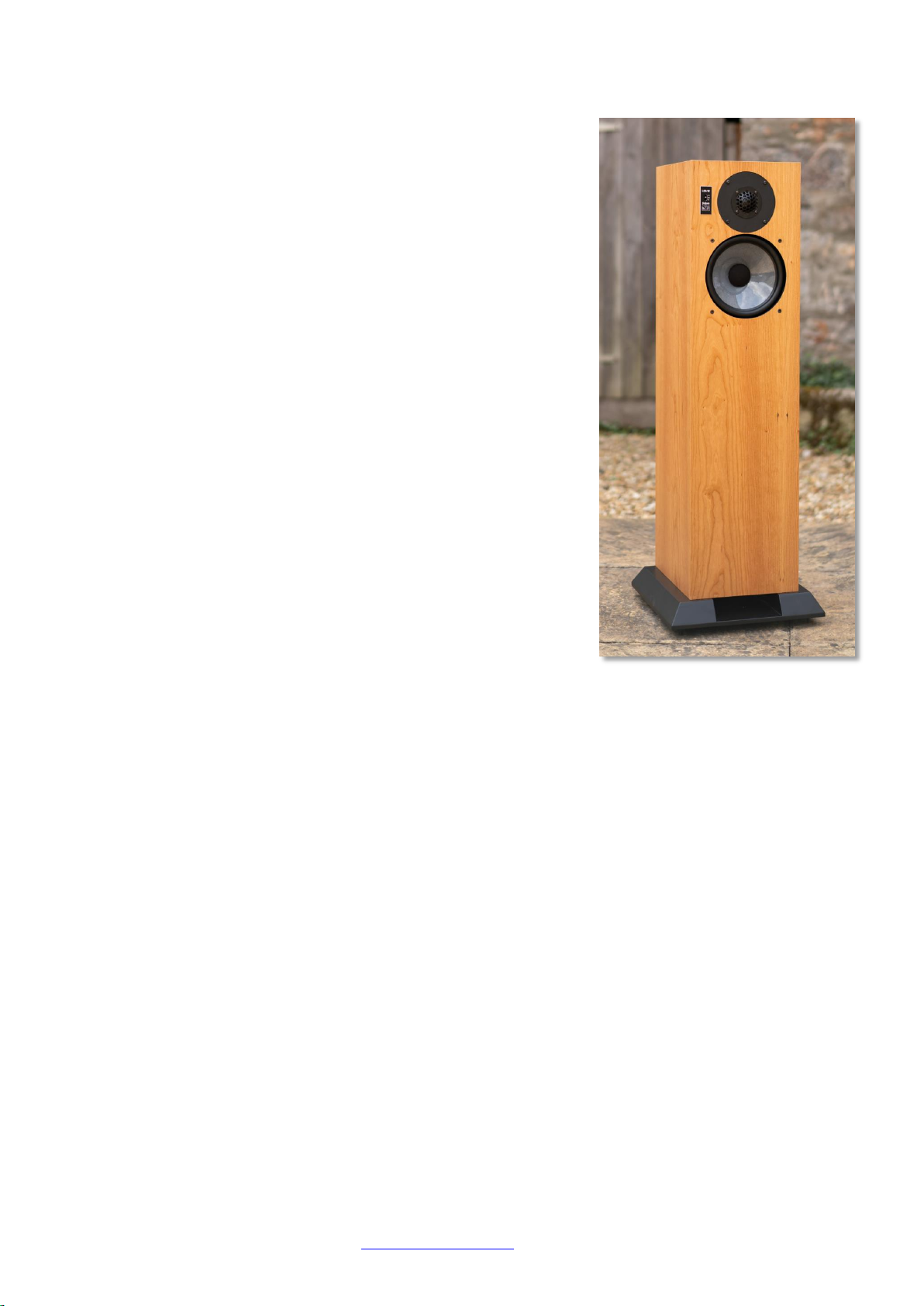
LS5/9f Monitor Loudspeakers
Owner’s Manual
Thank you for purchasing this loudspeaker system from Graham
Audio, which was hand-built using the finest materials. Used
carefully, they will provide many years of listening enjoyment.
Please spend a few minutes reading these instructions before
using your new loudspeakers.
Positioning your loudspeakers
The Graham Audio LS5/9f is a floor-standing loudspeaker with
an integrated plinth that includes provision for spikes, which are
recommended for carpeted floors – they must be carefully
adjusted to ensure the loudspeaker is absolutely stable, and
periodically checked to ensure they have not worked loose. For
other floor types, spikes might not be appropriate – contact your
dealer for advice.
As is normal, determining the optimum position for your
loudspeakers in your listening room should be the subject of
some experimentation. As a starting point, try positioning them
such that you and the two loudspeakers form an equilateral
triangle. If possible, try to keep them away from side walls, as
reflections from these might affect the stereo image. Remember
also that the distance between the loudspeakers and the rear
wall will have an effect on the bass level and quality. In a rectangular room, you can usually expect
best results from pointing the loudspeakers across the narrow dimension of the room, but every
room is different, and there are no firm rules! The loudspeakers should be angled in to face you,
but again, this can be varied according to taste.
Nearly every listening room can be improved with acoustic treatment. A thick carpet (or large rug)
is recommended, as reflections from hard floors are always detrimental. Large expanses of bare
walls can be similarly problematic, and reflections from these can be treated with absorbent
materials or diffused with irregular surfaces such as bookcases. In professional environments,
acoustic treatment is the norm.
Connecting your loudspeakers
Please ensure that the cables are long enough to be neatly dropped down behind the loudspeaker
to minimise the risk of trip hazards.
Always switch off the amplifier when connecting up the loudspeakers because some amplifiers can
be damaged by even a brief short circuit.
For best results, we recommend that you use stranded cable with a cross-sectional area of 2.5mm2
(the majority of “79-strand” cables should meet that specification). Remember that some specialist
loudspeaker cables can have unusual electrical characteristics that adversely affect the operation
of some amplifier-loudspeaker combinations, so seek advice from your dealer if in any doubt.
There is a single pair of terminals on the rear of each loudspeaker which accept bare wire, spade
connectors, or 4mm plugs. The latter is recommended for convenience and connection quality.
Graham Audio Limited www.grahamaudio.co.uk 0044 (0)1626 361168
Page 2

The terminals are colour-coded red and black, and it is essential that for each loudspeaker the red
System
2 way reflex
Nominal impedance
8Ω
Enclosure
Thin wall damped
Sensitivity
89dB SPL (2.83V, 1m)
Finish
Real wood veneer
Maximum output
Over 104dB for a pair at 2m
Dimensions (h/w/d)
105cm by 35cm by 37cm
(including plinth)
Bass/midrange
200mm Diaphnatone
Polypropylene
Weight
25kg
Tweeter
34mm Audax HD13D34H
Frequency response
40Hz to 20kHz ±2dB
Recommended amplifier
power
50 to 200 watts unclipped
programme
terminal of your amplifier connects to the red terminal of the loudspeaker, and likewise for the black
terminals. If the bass seems weak, and/or the stereo image is indistinct, check that both
loudspeakers are connected to the amplifier with the same polarity.
Listening recommendations
Your Graham Audio loudspeakers are extremely revealing of problems in the preceding audio
chain, and should be partnered with high quality equipment. In particular, low powered amplifiers
driven into clipping will sound especially poor with any high quality monitor loudspeaker.
We recommend using an amplifier with between 50 and 200 watts per channel. The lower figure
might be suitable for domestic use in smaller rooms, but in a larger space – or for professional use –
a more powerful amplifier will be required. Please note that these numbers can only be an
approximate guide.
The loudspeakers were voiced with the grilles in place and it is recommended that the grilles be left
on at all times. The grilles are retained using hidden neodymium magnets and can be readily
removed if desired.
Behind the grille is a tweeter level adjustment switch which is intended for fine-tuning the treble
response. The adjustment is relatively subtle and in most listening rooms best results will be found
with the switch in the default “0” position, but experimentation is encouraged.
Caring for your loudspeakers
Retain all packing materials for future use. The natural wood veneer should be cleaned regularly
with a soft clean cloth. Avoid wax-based furniture polishes and all forms of solvents. Remove the
grille before cleaning the cloth with a soft brush, and replace to keep dust out - avoid touching the
diaphragms of the drive units. Like any wooden item, the loudspeakers should be placed in a dry
environment, away from sources of heat and out of direct sunlight.
Specifications
Graham Audio Limited www.grahamaudio.co.uk 0044 (0)1626 361168
 Loading...