

Page 1
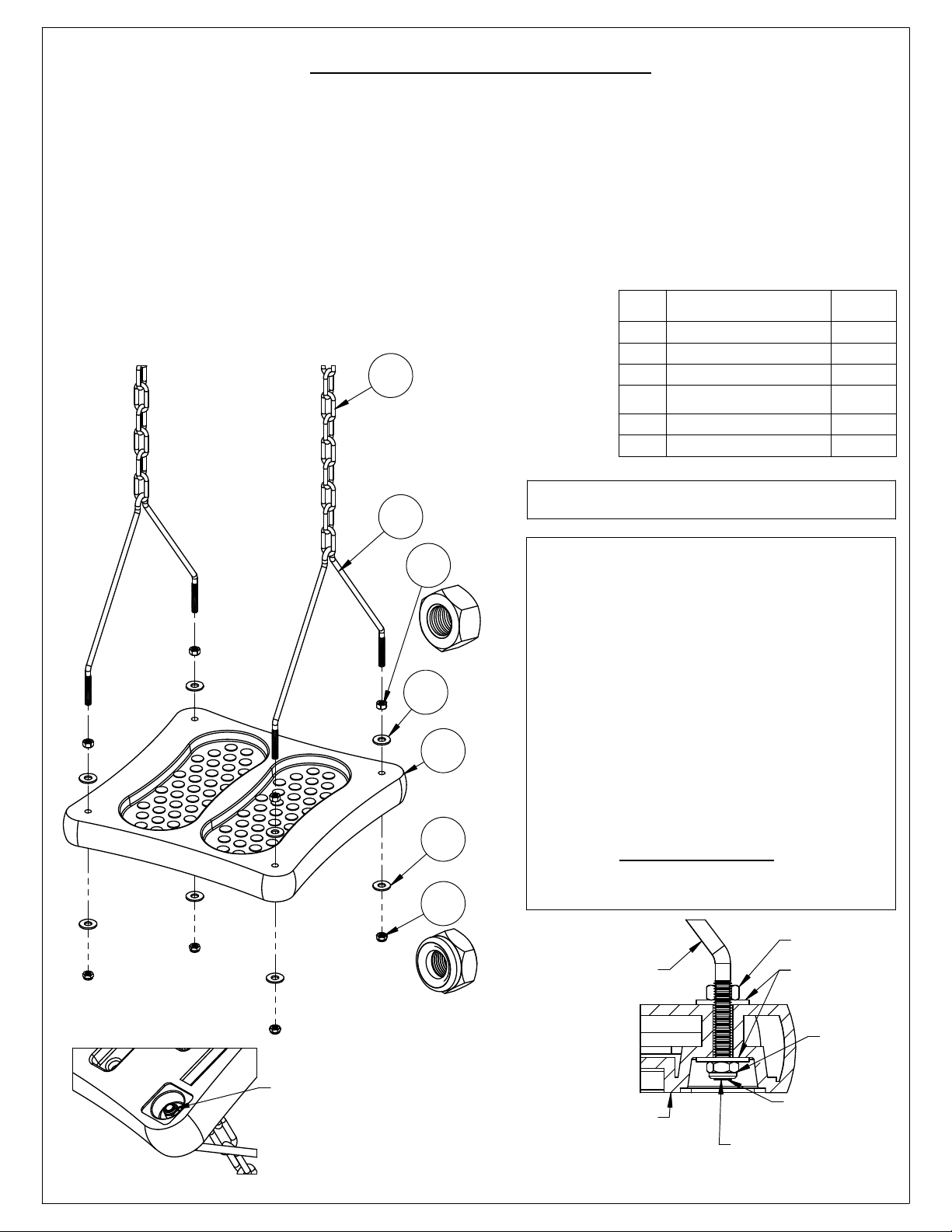
04-0026 Stand-N-Swing
1: The Stand-N-Swing has a molded plastic base and comes with chains. The chains are about 63" in
length and are plastisol coated for about 52-1/2" along the length. The uncoated length is the top
and will get attached to swing hangers or spring clips that connect to swing hangers. The plastisol
coating helps prevent getting fingers pinched in chains and helps prevent getting long hair from
being caught between chain links.
2: There are many different ways to connect the chains to the swing hangers that exist on your swing
set or custom swing. Always follow the manufacturer's directions on how to attach the swing to the
swing hangers.
3: Safety comes first when swinging. Always obey the safety rules when swinging and when walking
around a swing set. We have included a Safety Tips guide on page 2.
4: Stand-N-Swing Weight LImit: 150 lbs
A
Letter Description
AChain 2
B Hanger Wire 2
C Nut M8 X 1.25 4
Washer10.5mm I.D. X
D
EBase 1
F Lock Nut M8 X 1.25 4
Tools required: Ratchet wrench with 1/2" socket and
1/2" box end wrench.
24mm O.D.
B
Quantit
y
8
C
D
E
D
F
STEP 1: PLACE A HANGER WIRE (B) THROUGH THE
BOTTOM GREEN COATED CHAIN LINK FROM CHAIN
(A).
STEP 2: THREAD THE NUTS (C) ONTO EACH END OF THE
HANGER WIRE (B). THREAD THE NUTS UP AS FAR AS
THEY WILL GO.
STEP 3: PLACE A WASHER (D) OVER EACH END OF THE
HANGER WIRE (B). INSERT HANGER WIRE (B) INTO THE
HOLES IN BASE (E) AS SHOWN.
STEP 4: HOLD ONTO HANGER WIRE (B) AND FLIP THE
BASE OVER.
STEP 5: PLACE A WASHER (D) OVER EACH END OF THE
HANGER WIRE (B). THREAD A LOCK NUT (F) ONTO
EACH END OF HANGER WIRE (B). TIGHTEN THE LOCK
NUT UNTIL THERE IS ONE THREAD EXPOSED ABOVE THE
LOCK NUT. (F)
STEP 6: FLIP THE BASE OVER AND TIGHTEN BOTH OF THE
NUTS (C) BUT DO NOT OVER-TIGHTEN.
REPEAT STEPS 1 THROUGH 6 FOR THE OTHER SIDE OF
THE BASE.
NUT (C)
HANGER WIRE
WASHERS (D)
BOTTOM VIEW
LEAVE ONE THREAD ABOVE THE
LOCK NUT.
*FOR RESIDENTIAL USE ONLY*
*FOR CHILDREN AGES 3-11*
BOTTOM OF THE BASE
LOCK NUT
(F)
1 THREAD PAST
LOCK NUT (F)
END OF HANGER
SHOULD NOT
EXTEND BEYOND THE
BOTTOM OF THE BASE.
Page 2

SAFETY TIPS FOR SWINGS
On-site adult supervision is required.
Teach children not to walk close to, in front of, behind, or between moving swings or other moving playground
equipment.
Teach children to sit in and never stand on swings. (Exception to this rule is a product called "Stand -N- Swing")
Teach children not to twist the chains and ropes and not to loop them over the swing beam, since this may reduce
the strength of the chain or rope.
Teach children not to jump from swings that are in motion.
Teach children not to push empty seats. The seat may hit them and cause injury.
Teach children to sit in the center of swings with their full weight on the seats.
Teach children not to use the equipment in a manner other than intended.
Parents should have the children dress appropriately with well-fitting shoes. Loose clothing such as scarves and
ponchos should not be worn. Always take off, tie up or tuck in cords and drawstrings on children's clothing. These
things can get caught on playground equipment and strangle a child.
Teach children not to climb when the equipment is wet.
Teach children not to attach items to the playground equipment that are not specifically designed for use with the
equipment, such as, but not limited to, jump ropes, clothesline, pet leashes, cables and chains, as they may cause a
strangulation hazard.
Teach children to never wrap their legs around swing chain.
Teach children to never slide down the swing chain.
Protective surfacing under swings is recommended. "To and Fro" swings should have a fall zone extending a
minimum of 6' from the outer edge of the support structure on each side. The "fall zone" in front and back of the
swing should extend out a minimum distance of twice the height of the swing as measured from the ground to the
top of the swing support structure. Swings should have a minimum of 8 inches between them. (ASTM F-1148-09) The
bottom of a swing should not be less than 8 inches above the protective surfacing material. (ASTM F-1148-09) Home
Playground Safety Specification ASTM F-1148-09 may be purchased online. A guide for Public Playground Safety from
the U.S. Consumer Product Safety Commission may be downloaded at: www.cpsc.gov/cpscpub/pubs/325.pdf
A fall zone for a "tire swing" capable of unlimited lateral motion will be equal to a minimum horizontal distance of
Y + 72 in. in all directions from the pivot point of the swing. Y equals the vertical distance between the pivot point
and the top of the tire swing. Protective surfacing is recommended in the fall zone for tire swings.
If any of the following conditions are noted they should be removed, corrected or repaired immediately to prevent
injuries:
Hardware that is loose, worn, or those that have protrusions or projections.
Scattered debris, litter, rocks or tree roots.
Missing or damaged equipment components, such as swing seats.
Remove plastic swing seats and take indoors (or do not use) when the temperature drops below 32o F.
Oil all metallic moving parts monthly during the usage period.
Check swing seats, ropes, cables and chains monthly during usage season for evidence of deterioration.
Replacement should be made of any swing seat that has developed cracks in the plastic seats or has exposed metal in
the edges of the swing seat. If there are already exposed metal inserts on the edge of the seat, immediately remove
the seat and chains to prevent serious injury. Ropes, cables and chains should be removed and replaced if excessive
wear is found.
 Loading...