

Page 1
SAFETY DATA SHEET
Issuing Date 07-Jun-2012
Revision Date 15-May-2017
Revision Number 2
_____________________________________________________________________________________________
The supplier identified below generated this SDS using the UL SDS template. UL did not test, certify, or approve the substance described in this SDS, and
all information in this SDS was provided by the supplier or was reproduced from publically available regulatory data sources. UL makes no representations
or warranties regarding the completeness or accuracy of the information in this SDS and disclaims all liability in connection with the use of this information or
the substance described in this SDS. The layout, appearance and format of this SDS is © 2014 UL LLC. All rights reserved.
_____________________________________________________________________________________________
_____________________________________________________________________________________________
Page 1 / 12
1. IDENTIFICATION OF THE SUBSTANCE/PREPARATION AND OF THE
COMPANY/UNDERTAKING
Product identifier
Product Name
GOOP HAND CLEANER
Other means of identification
Synonyms
Item No’s – 12, 57, 105, 64
Recommended use of the chemical and restrictions on use
Recommended Use
Hand Cleaner or Soap - Heavy Duty - Non-Aerosol
Uses advised against
No information available
Details of the supplier of the safety data sheet
Supplier Name
CRITZAS INDUSTRIES, INC.
Supplier Address
4041 PARK AVENUE
ST. LOUIS
MO
63110
US
Supplier Phone Number
Phone:314-7738510
Fax:314-773-4837
Contact Phone314-773-8510
Supplier Email
Emergency telephone number
2. HAZARDS IDENTIFICATION
Classification
This chemical is considered hazardous by the 2012 OSHA Hazard Communication Standard (29 CFR 1910.1200).
Serious eye damage/eye irritation
Category 1
Page 2
Revision Date 15 May-2017
_____________________________________________________________________________________________
_____________________________________________________________________________________________
Page 2 / 12
Skin sensitization
Category 1
GHS Label elements, including precautionary statements
Emergency Overview
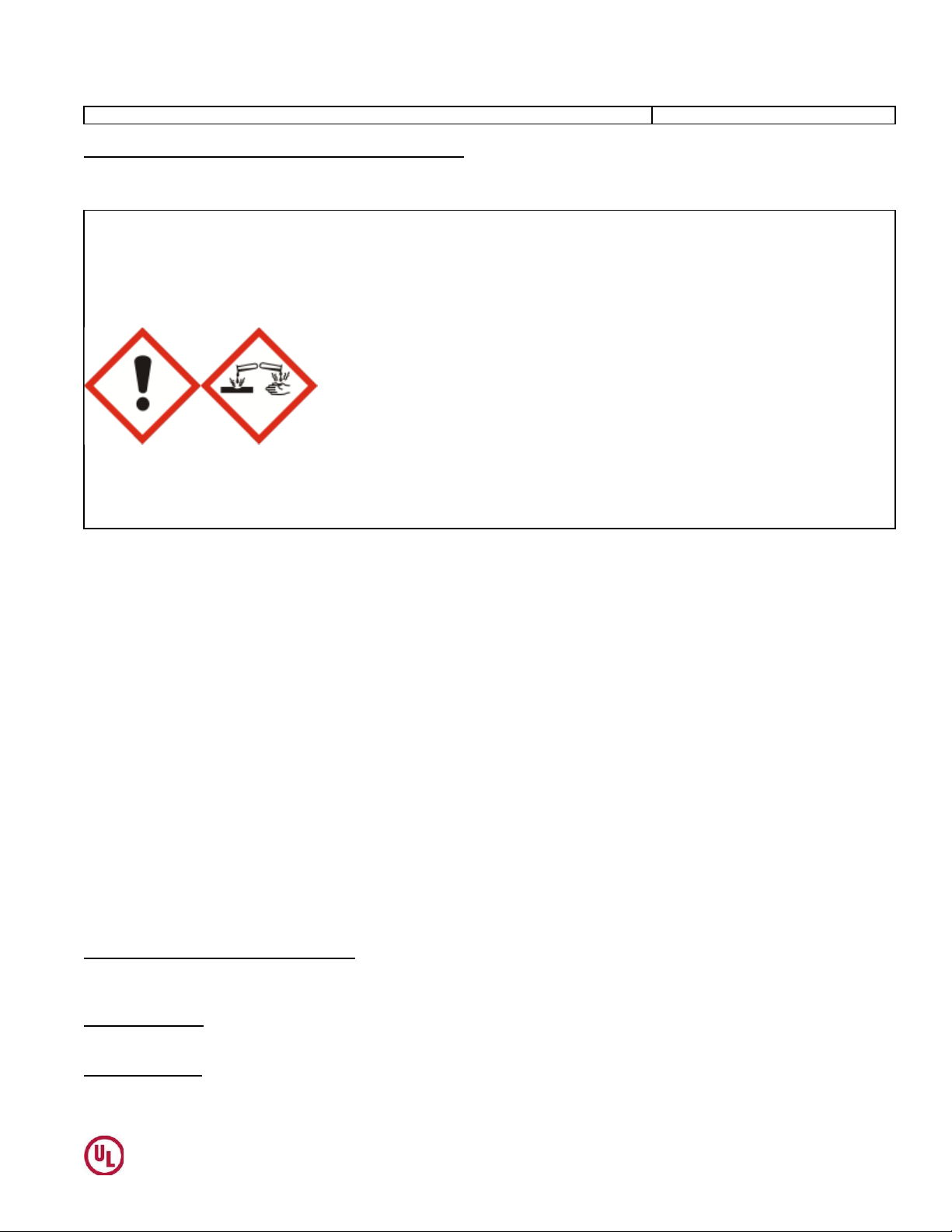
Signal word
Danger
Hazard Statements
Causes serious eye damage
May cause an allergic skin reaction
.
Appearance White
Physical state Solid Gel Consistency
Paste / Gel Liquid
Odor Sweet
Precautionary Statements - Prevention
Wear protective gloves/protective clothing/eye protection/face protection
Avoid breathing dust/fume/gas/mist/vapors/spray
Contaminated work clothing should not be allowed out of the workplace
Precautionary Statements - Response
Specific treatment (see supplemental first aid instructions on this label)
Eyes
IF IN EYES: Rinse cautiously with water for several minutes. Remove contact lenses, if present and easy to do. Continue rinsing
Immediately call a POISON CENTER or doctor/physician
Skin
IF ON SKIN: Wash with plenty of soap and water
If skin irritation or rash occurs: Get medical advice/attention
Wash contaminated clothing before reuse
Precautionary Statements - Storage
None
Precautionary Statements - Disposal
Dispose of contents/container to an approved waste disposal plant
Hazards not otherwise classified (HNOC)
Not applicable
Unknown Toxicity
5.6% of the mixture consists of ingredient(s) of unknown toxicity
Other information
Page 3

Revision Date 15 May-2017
_____________________________________________________________________________________________
_____________________________________________________________________________________________
Page 3 / 12
Causes mild skin irritation
Repeated or prolonged skin contact may cause allergic reactions with susceptible persons
Interactions with Other Chemicals
Irritants. Sensitizers. Epoxies.
3. COMPOSITION/INFORMATION ON INGREDIENTS
.
Chemical Name
CAS No
Weight-%
Trade Secret
Petroleum distillates, hydrotreated light
64742-47-8
30 - 60
*
Oleic acid
112-80-1
3 - 7
*
Alcohols, C10-16, ethoxylated
68002-97-1
3 - 7
*
Triethanolamine
102-71-6
1 - 5
*
Glycerin
56-81-5
1 - 5
*
*The exact percentage (concentration) of composition has been withheld as a trade secret
4. FIRST AID MEASURES
First aid measures
General Advice
Immediate medical attention is required. Show this safety data sheet to the doctor in
attendance.
Eye contact
Rinse immediately with plenty of water, also under the eyelids, for at least 15 minutes. Keep
eye wide open while rinsing. Do not rub affected area. Seek immediate medical
attention/advice.
Skin contact
Wash off immediately with soap and plenty of water for at least 15 minutes. May cause an
allergic skin reaction. In the case of skin irritation or allergic reactions see a physician.
Inhalation
Remove to fresh air. Get medical attention immediately if symptoms occur.
Ingestion
Rinse mouth immediately and drink plenty of water. Never give anything by mouth to an
unconscious person. Do NOT induce vomiting. Call a physician.
Self-protection of the first aider
Avoid contact with skin, eyes or clothing. Use personal protective equipment as required.
Wear personal protective clothing (see section 8).
Most important symptoms and effects, both acute and delayed
Most Important Symptoms and
Effects
Burning sensation. Itching. Rashes. Hives.
Indication of any immediate medical attention and special treatment needed
Notes to Physician
May cause sensitization of susceptible persons. Treat symptomatically.
Page 4

Revision Date 15 May-2017
_____________________________________________________________________________________________
_____________________________________________________________________________________________
Page 4 / 12
5. FIRE-FIGHTING MEASURES
Suitable Extinguishing Media
Use extinguishing measures that are appropriate to local circumstances and the surrounding environment.
Unsuitable extinguishing media
CAUTION: Use of water spray when fighting fire may be inefficient.
Specific hazards arising from the chemical
Thermal decomposition can lead to release of irritating gases and vapors. In the event of fire and/or explosion do not breathe fumes.
May cause sensitization by inhalation and skin contact. Product is or contains a sensitizer. May cause sensitization by skin contact.
Uniform Fire Code
Irritant: Liquid
Hazardous Combustion Products
Carbon oxides.
Explosion Data
Sensitivity to Mechanical Impact
No.
Sensitivity to Static Discharge
No.
Protective equipment and precautions for firefighters
As in any fire, wear self-contained breathing apparatus pressure-demand, MSHA/NIOSH (approved or equivalent) and full protective
gear.
6. ACCIDENTAL RELEASE MEASURES
Personal precautions, protective equipment and emergency procedures
Personal precautions
Avoid contact with skin, eyes or clothing. Use personal protective equipment as required.
Ensure adequate ventilation.
Other Information
Refer to protective measures listed in Sections 7 and 8.
Environmental precautions
Environmental precautions
Refer to protective measures listed in Sections 7 and 8. Prevent further leakage or spillage if
safe to do so.
Methods and material for containment and cleaning up
Methods for containment
Prevent further leakage or spillage if safe to do so.
Methods for cleaning up
Soak up with inert absorbent material. Pick up and transfer to properly labeled containers.
Page 5
Revision Date 15 May-2017
_____________________________________________________________________________________________
_____________________________________________________________________________________________
Page 5 / 12
7. HANDLING AND STORAGE
Precautions for safe handling
Handling
Handle in accordance with good industrial hygiene and safety practice. Avoid contact with
skin, eyes or clothing. Do not eat, drink or smoke when using this product. Take off
contaminated clothing and wash before reuse.
Conditions for safe storage, including any incompatibilities
Storage
Keep containers tightly closed in a dry, cool and well-ventilated place. Store locked up. Keep
out of the reach of children. Protect from moisture. Store away from other materials.
Incompatible Products
Strong oxidizing agents. Strong acids. Strong bases.
8. EXPOSURE CONTROLS/PERSONAL PROTECTION
Control parameters
Exposure Guidelines
Chemical Name
ACGIH TLV
OSHA PEL
NIOSH IDLH
Petroleum distillates, hydrotreated light
64742-47-8
TWA: 5 mg/m3
STEL: 10 mg/m3
(as oil mist)
TWA: 5 mg/m3
(as oil mist)
Triethanolamine
102-71-6
TWA: 5 mg/m3
-
Glycerin
56-81-5
TWA: 10 mg/m3 mist
TWA: 15 mg/m3 mist, total
particulate
TWA: 5 mg/m3 mist, respirable
fraction
(vacated) TWA: 10 mg/m3 mist,
total particulate
(vacated) TWA: 5 mg/m3 mist,
respirable fraction
ACGIH TLV: American Conference of Governmental Industrial Hygienists - Threshold Limit Value OSHA PEL: Occupational Safety and Health
Administration - Permissible Exposure Limits NIOSH IDLH Immediately Dangerous to Life or Health
Other Exposure Guidelines
Vacated limits revoked by the Court of Appeals decision in AFL-CIO v. OSHA, 965 F.2d 962
(11th Cir., 1992) See section 15 for national exposure control parameters
Appropriate engineering controls
Engineering Measures
Showers
Eyewash stations
Ventilation systems
Individual protection measures, such as personal protective equipment
Eye/face protection
Tight sealing safety goggles.
Skin and body protection
Wear protective gloves and protective clothing.
Respiratory protection
No protective equipment is needed under normal use conditions. If exposure limits are
Page 6

Revision Date 15 May-2017
_____________________________________________________________________________________________
_____________________________________________________________________________________________
Page 6 / 12
exceeded or irritation is experienced, ventilation and evacuation may be required.
Hygiene Measures
Handle in accordance with good industrial hygiene and safety practice. Avoid contact with
skin, eyes or clothing. Wear suitable gloves and eye/face protection. Do not eat, drink or
smoke when using this product.
9. PHYSICAL AND CHEMICAL PROPERTIES
Physical and Chemical Properties
Physical state
Solid Gel Consistency, Paste / Gel, Liquid
Appearance
White
Odor
Sweet
Color
No information available
Odor Threshold
No information available
Property
Values
Remarks Method
pH
7 None known
Melting / freezing point
No data available
None known
Boiling point / boiling range
No data available
None known
Flash Point
No data available
None known
Evaporation Rate
No data available
None known
Flammability (solid, gas)
No data available
None known
Flammability Limit in Air
Upper flammability limit
No data available
Lower flammability limit
No data available
Vapor pressure
No data available
None known
Vapor density
No data available
None known
Specific Gravity
.90
None known
Water Solubility
Soluble in water
None known
Solubility in other solvents
No data available
None known
Partition coefficient: n-octanol/water
No data available
None known
Autoignition temperature
No data available
None known
Decomposition temperature
No data available
None known
Kinematic viscosity
No data available
None known
Dynamic viscosity
No data available
None known
Explosive properties
No data available
Oxidizing properties
No data available
Other Information
Softening Point
No data available
VOC Content (%)
No data available
Particle Size
No data available
Particle Size Distribution
Page 7
Revision Date 15 May-2017
_____________________________________________________________________________________________
_____________________________________________________________________________________________
Page 7 / 12
10. STABILITY AND REACTIVITY
Reactivity
No data available.
Chemical stability
Stable under recommended storage conditions.
Possibility of Hazardous Reactions
None under normal processing.
Hazardous Polymerization
Hazardous polymerization does not occur.
Conditions to avoid
None known based on information supplied.
Incompatible materials
Strong oxidizing agents. Strong acids. Strong bases.
Hazardous Decomposition Products
Carbon oxides.
11. TOXICOLOGICAL INFORMATION
Information on likely routes of exposure
Product Information
.
Inhalation
Specific test data for the substance or mixture is not available. May cause irritation of
respiratory tract.
Eye contact
Specific test data for the substance or mixture is not available. Causes serious eye damage.
(based on components). Severely irritating to eyes. May cause irreversible damage to eyes.
Skin contact
Specific test data for the substance or mixture is not available. May cause irritation.
Prolonged contact may cause redness and irritation. Repeated exposure may cause skin
dryness or cracking.
Ingestion
Specific test data for the substance or mixture is not available. Ingestion may cause irritation
to mucous membranes. Ingestion may cause gastrointestinal irritation, nausea, vomiting and
diarrhea.
Component Information
Chemical Name
Oral LD50
Dermal LD50
Inhalation LC50
Petroleum distillates, hydrotreated
light
64742-47-8
> 5000 mg/kg ( Rat )
> 2000 mg/kg ( Rabbit )
> 5.2 mg/L ( Rat ) 4 h
Oleic acid
112-80-1
> 5000 mg/kg ( Rat )
-
-
Triethanolamine
102-71-6
= 4190 mg/kg ( Rat )
> 20 mL/kg ( Rabbit )
-
Glycerin
56-81-5
-
> 10 g/kg ( Rabbit )
-
Information on toxicological effects
Symptoms
Erythema (skin redness). May cause blindness. Burning. Itching. Rashes. Hives.
Page 8
Revision Date 15 May-2017
_____________________________________________________________________________________________
_____________________________________________________________________________________________
Page 8 / 12
Delayed and immediate effects as well as chronic effects from short and long-term exposure
Sensitization
May cause sensitization of susceptible persons. May cause sensitization by skin contact.
Mutagenic Effects
No information available.
Carcinogenicity
The table below indicates whether each agency has listed any ingredient as a carcinogen.
Chemical Name
ACGIH
IARC
NTP
OSHA
Triethanolamine
102-71-6
Group 3
IARC (International Agency for Research on Cancer)
Group 3 - Not Classifiable as to Carcinogenicity in Humans
Reproductive toxicity
No information available.
STOT - single exposure
No information available.
STOT - repeated exposure
No information available.
Chronic Toxicity
No known effect based on information supplied.
Target Organ Effects
Eyes. Skin. Respiratory system.
Aspiration Hazard
No information available.
Numerical measures of toxicity Product Information
The following values are calculated based on chapter 3.1 of the GHS document
ATEmix (oral)
8,375.00 mg/kg
Page 9
Revision Date 15 May-2017
_____________________________________________________________________________________________
_____________________________________________________________________________________________
Page 9 / 12
12. ECOLOGICAL INFORMATION
Ecotoxicity
The environmental impact of this product has not been fully investigated.
Chemical Name
Toxicity to Algae
Toxicity to Fish
Toxicity to Microorganisms
Daphnia Magna (Water
Flea)
Petroleum distillates,
hydrotreated light
64742-47-8
96h LC50: = 2.2 mg/L
(Lepomis macrochirus) 96h
LC50: = 2.4 mg/L
(Oncorhynchus mykiss) 96h
LC50: = 45 mg/L
(Pimephales promelas)
96h LC50: = 4720 mg/L
Oleic acid
112-80-1
96h LC50: = 205 mg/L
(Pimephales promelas)
Triethanolamine
102-71-6
96h EC50: = 169 mg/L
(Desmodesmus subspicatus)
72h EC50: = 216 mg/L
(Desmodesmus subspicatus)
96h LC50: 10600 - 13000
mg/L (Pimephales promelas)
96h LC50: > 1000 mg/L
(Pimephales promelas) 96h
LC50: 450 - 1000 mg/L
(Lepomis macrochirus)
24h EC50: = 1386 mg/L
Glycerin
56-81-5
96h LC50: 51 - 57 mL/L
(Oncorhynchus mykiss)
24h EC50: > 500 mg/L
Persistence and Degradability
No information available.
Bioaccumulation
Chemical Name
Log Pow
Triethanolamine
102-71-6
-2.53
Glycerin
56-81-5
-1.76
Other adverse effects
No information available.
13. DISPOSAL CONSIDERATIONS
Waste treatment methods
Disposal methods
This material, as supplied, is not a hazardous waste according to Federal regulations (40
CFR 261). This material could become a hazardous waste if it is mixed with or otherwise
comes in contact with a hazardous waste, if chemical additions are made to this material, or if
the material is processed or otherwise altered. Consult 40 CFR 261 to determine whether the
altered material is a hazardous waste. Consult the appropriate state, regional, or local
regulations for additional requirements.
Contaminated Packaging
Dispose of contents/containers in accordance with local regulations.
California Hazardous Waste Codes
561
Page 10

Revision Date 15 May-2017
_____________________________________________________________________________________________
_____________________________________________________________________________________________
Page 10 / 12
14. TRANSPORT INFORMATION
DOT
NOT REGULATED
Proper Shipping Name
NON REGULATED
Hazard Class
N/A
TDG
Not regulated
MEX
Not regulated
ICAO
Not regulated
IATA
Not regulated
Proper Shipping Name
NON REGULATED
Hazard Class
N/A
IMDG/IMO
Not regulated
Hazard Class
N/A
RID
Not regulated
ADR
Not regulated
ADN
Not regulated
15. REGULATORY INFORMATION
International Inventories
TSCA
Complies
DSL
All components are listed either on the DSL or NDSL.
TSCA - United States Toxic Substances Control Act Section 8(b) Inventory
DSL/NDSL - Canadian Domestic Substances List/Non-Domestic Substances List
US Federal Regulations
SARA 313
Section 313 of Title III of the Superfund Amendments and Reauthorization Act of 1986 (SARA). This product does not contain any
chemicals which are subject to the reporting requirements of the Act and Title 40 of the Code of Federal Regulations, Part 372
SARA 311/312 Hazard Categories
Acute Health Hazard
Yes
Chronic Health Hazard
No
Fire Hazard
No
Sudden release of pressure hazard
No
Reactive Hazard
No
CWA (Clean Water Act)
This product does not contain any substances regulated as pollutants pursuant to the Clean Water Act (40 CFR 122.21 and 40 CFR
122.42)
CERCLA
This material, as supplied, does not contain any substances regulated as hazardous substances under the Comprehensive
Environmental Response Compensation and Liability Act (CERCLA) (40 CFR 302) or the Superfund Amendments and
Page 11
Revision Date 15 May-2017
_____________________________________________________________________________________________
_____________________________________________________________________________________________
Page 11 / 12
Reauthorization Act (SARA) (40 CFR 355). There may be specific reporting requirements at the local, regional, or state level
pertaining to releases of this material
US State Regulations
California Proposition 65
This product does not contain any Proposition 65 chemicals.
U.S. State Right-to-Know Regulations
Chemical Name
New Jersey
Massachusetts
Pennsylvania
Rhode Island
Illinois
Oleic acid
112-80-1
X
Triethanolamine
102-71-6
X
X
X
Glycerin
56-81-5
X
X
X
X
International Regulations
Mexico
National occupational exposure limits
Component
Carcinogen Status
Exposure Limits
Glycerin
56-81-5 ( 1 - 5 )
-
10mg/m3 (mist) TWA
Mexico - Occupational Exposure Limits - Carcinogens
Canada
WHMIS Hazard Class
Not determined
16. OTHER INFORMATION
NFPA
Health Hazards 2
Flammability 0
Instability 0
Physical and
Chemical Hazards -
HMIS
Health Hazards 3
Flammability 0
Physical Hazard 0
Personal Protection
X
Prepared By
Product Stewardship
23 British American Blvd.
Latham, NY 12110
1-800-572-6501
Issuing Date
07-Jun-2012
Revision Date
15-May-2017
Revision Note
No information available
Disclaimer
The information provided in this Safety Data Sheet is correct to the best of our knowledge, information and belief at the
date of its publication. The information given is designed only as a guidance for safe handling, use, processing, storage,
transportation, disposal and release and is not to be considered a warranty or quality specification. The information
relates only to the specific material designated and may not be valid for such material used in combination with any
other materials or in any process, unless specified in the text
End of Safety Data Sheet
Page 12

Revision Date 15 May-2017
_____________________________________________________________________________________________
_____________________________________________________________________________________________
Page 12 / 12
 Loading...