

Page 1

Page 2
GB1
Notice
Thank you for purchasing a HUMAX product. Please read this user’s manual
carefully to be able to safely install, use and maintain the product at maximum
performance. Keep this user’s manual next to your product for future reference.
The information in this user’s manual is subject to change without notice.
Copyright (Copyright © 2016 HUMAX Corporation)
Not to be copied, used or translated in part or whole without HUMAX’s prior
consent in writing except approval of ownership of copyright and copyright law.
Meaning of Symbols
To reduce the risk of electric shock, do not remove cover (or back).
No user serviceable parts inside. Refer servicing to qualified service
personnel.
This symbol indicates dangerous voltage inside the product that
presents a risk of electric shock or personal injury.
This symbol indicates important instructions accompanying the
product.
Warnings, Cautions and Notes
Throughout this manual, pay special attention to the following marks that indicate
hazardous situations.
Warning
Indicates a hazardous situation which could result in serious injury
Caution
Indicates a situation which could damage the equipment or other apparatus
Note
Indicates additional information to make the user aware of possible problems
and information of importance to help understand, install, use and maintain the
device.
Warranty
The warranty does not cover parts which may become defective due to misuse of
the information contained in this manual.
‘WEEE’ Instructions
This product should not be disposed with other household wastes at the end
of its working life. Please separate this from other types of wastes and recycle
it responsibly to promote the sustainable reuse of material resources. This will
prevent possible harm to the environment or human health from uncontrolled
waste disposal.
Domestic users:
Please contact either the retailer where you purchased this product or their
local government office for details of where and how they can take this item for
environmentally safe recycling.
Business users:
Contact your supplier and check the terms and conditions of the purchase
contract. This product should not be mixed with other commercial wastes for
disposal.
Trademarks
• Irdeto is a trademark of Irdeto Access B.V.
• Manufactured under license from Dolby Laboratories. Dolby, Dolby Audio and
the double-D symbol are trademarks of Dolby Laboratories.
• the HDMI Logo, and High-Definition Multimedia interface
are trademarks and registered trademarks of HDMI
Licensing LLC.
• This item incorporates copy protection technology that is protected by U.S.
patents and other intellectual property rights of Rovi Corporation. Reverse
engineering and disassembly are prohibited.
Note: The model name is located on the bottom of this product.
Notice
Page 3

GB2
For Your Safety
For Your Safety
Safety Instructions
1. POWER SUPPLY
• Operate this product only from the type of power supply
shown on the marking label. If you do not know the
type of power supplied to your home, contact your local
power company.
• Disconnect the power supply before you start any
maintenance or installation procedures.
2. OVERLOADING
• Make sure that the wall outlet, extension cord and
adapter have a sufficient power rating for the appliance.
If not, this can cause an electric shock or fire.
3. LIQUID
• Do not expose this product to liquids. Do not put
objects filled with liquid on the product.
4. CLEANING
• Disconnect the product from the wall outlet before you
clean it.
• Use a moist cloth to clean the product. Do not use
solvents. Wipe the surface gently with a soft cloth as it
may get scratched.
5. VENTILATION
• Make sure that the slots on top of the product are not
blocked. It is necessary to have a sufficient airflow into
the unit.
• Do not put electronic equipment on the product.
• Do not put objects on the product. This will block the
ventilation or cause damage to the surface.
• Maintain a minimum distance of 10cm around the
product for sufficient ventilation.
6. ATTACHMENTS
• Do not use any unsupported attachments as these may
be hazardous or cause damage to the product.
7. LIGHTNING, STORM OR NOT IN USE
• Unplug the product from the wall outlet and disconnect
the antenna during a thunderstorm or when left
unattended and unused for long periods of time. This
will prevent damage to the unit due to lightning and
power-surges.
8. EXTRANEOUS OBJECTS
• Do not insert anything through the openings in the
unit, where they can touch dangerous voltage points or
damage parts.
9. REPLACEMENT OF PARTS
• When replacement of parts is required, be sure the
service technician uses replacement parts specified
by the manufacturer or those that have the same
characteristics as the original part. Unauthorised
substitution may result in additional damage to the unit.
10. CONNECTION TO THE SATELLITE DISH
• Disconnect the power supply before you connect or
disconnect the cable from the satellite dish/cable TV
signal/aerial. If not, this can cause damage to the LNB/
cable TV line/aerial.
11. CONNECTION TO THE TV
• Disconnect the power supply before you connect or
disconnect the cable from the TV. If not, this can cause
damage to the TV.
12. EARTHING (satellite only)
• Earth the LNB cable to the system earth for the satellite
dish.
13. LOCATION
• Place the product indoors to avoid exposure to
lightning, rain or sun. Do not place it near a radiator or
heat register.
• Keep at least 10 cm clearance from any other appliances
susceptible to electromagnetic influences such as a TV
or a VCR.
• If you place the product on a rack or a bookcase, make
sure that there is adequate ventilation and that you have
followed the manufacturer’s instructions for mounting.
• Do not place the product on an unstable surface where
it can fall. A falling product can cause serious injury to a
personnel and serious damage to the appliance.
14. ENVIRONMENT
• Attention should be drawn to the environmental aspects
of battery disposal.
• Care is required for the use of this apparatus in tropical
and/or moderate climates.
Cautions and Warnings
1. To avoid damage of the power adaptor
• Do not modify or process the power cord or plug
arbitrarily.
• Do not bend or twist the power cord.
• Make sure to disconnect the power cord while you hold
the plug.
• Keep heating appliances as far as possible from the
power cord to prevent the cover vinyl from melting.
• The mains plug, as a disconnection device, shall remain
readily accessible by the user.
• All-pole main switch shall remain readily operable. (For
products with power switch)
2. To avoid electrical shock
• Do not open the main body.
• Do not insert metal or inflammable objects inside the
product.
• Do not touch the power plug with wet hands.
• Disconnect the power cord in case of lightning.
• Unplug the power cable before you install the antenna
cable.
3. To avoid damage of product
• Do not use the product when it is out of order. If you
continue to use the product when defective, this
may cause serious damage. Make sure to contact the
customer service centre if the product is out of order.
• Do not insert metal or alien substance into the slots for
the modules or Smartcards. It may cause damage to the
product and reduce its life span.
• Do not overly pile objects on the product. It may cause
cracks, deformation and discoloration.
Page 4

GB3
AccessoriesContents
Note: Accessories may vary according to
location.
Contents & Accessories
Notice ........................................ 1
For Your Safety ................................ 2
Contents & Accessories ........................ 3
Contents
Accessories
Getting Started ............................... 4
Front & Rear
Connections
Remote Control
Wizard
Watching TV .................................. 8
Home
Channel List
Smart Search
TV Guide
System Settings
Settings ......................................13
General Settings
Network Settings
Channel Settings
Search Channels [Fixed Antenna]
Search Channels [SCD Antenna]
Appendix ..................................... 18
Specification
Trouble Shooting
HUMAX Customer Support
Glossary
Open Source Software Notice
Warranty Certificate
OMAN-TRA
R/3405/16
D100428
Quick Start Guide
User’s Manual
Remote Control
/ Batteries
Quick Start Guide/
User's Manual
HDMI Cable
Power Adaptor
Page 5
GB4
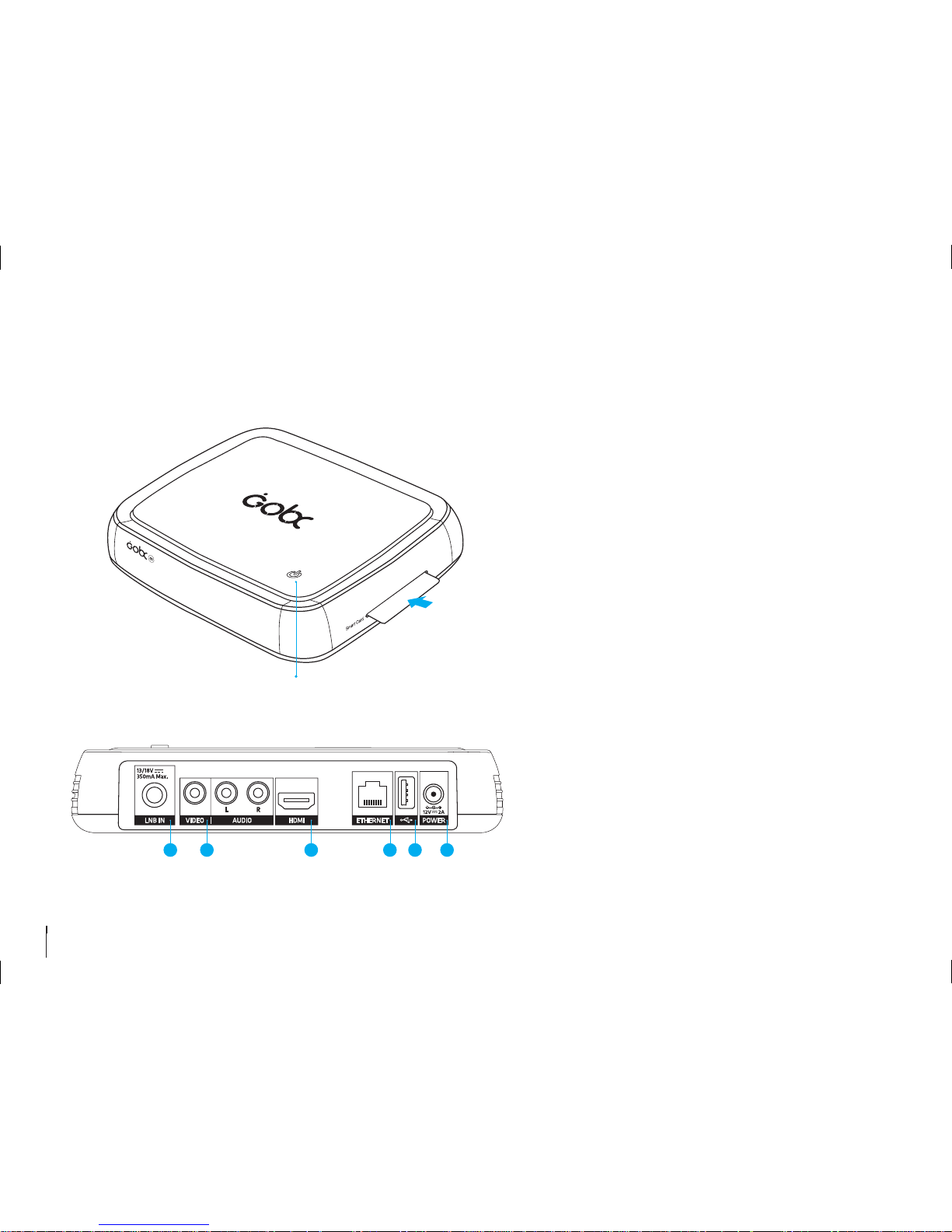
Front & Rear
Note: The image may differ from the actual product.
Getting Started
Inserting the Smartcard
1. Hold the Smartcard horizontally with the
electronic chip facing downwards.
2. Insert the Smartcard into the slot.
1 LNB IN: Connect a satellite antenna cable.
2 VIDEO/AUDIO: Use an RCA cable to connect to the TV.
3 HDMI: Use an HDMI cable to connect to the TV.
4 Ethernet: Connect an Ethernet cable.
5 USB: For technical support only.
6 Power Adaptor: Use the power adaptor to connect to the power
supply.
Standby
1 2 3 4 5 6
STANDBY
Switches between operation and standby modes
Page 6
GB5
Connections
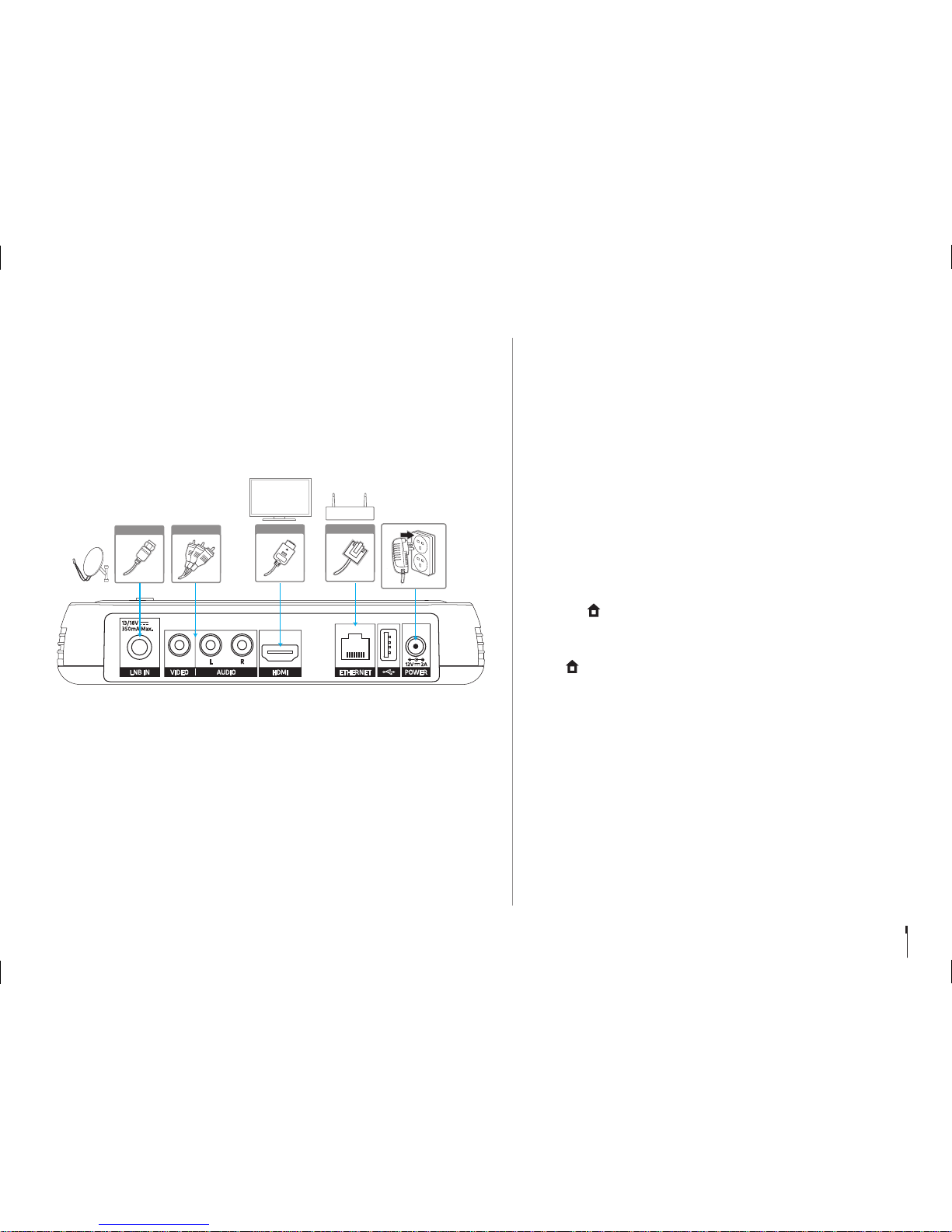
This section describes how to connect your product to match your particular devices and
to gain optimum signal quality.
Warning: Connect all devices before you plug any power cords into the wall outlet.
Always turn off the product, TV and other devices before you connect or
disconnect any cables.
Note:
• If you encounter any problems setting up your product, please contact your local
retailer or HUMAX Customer Service.
• Connecting your TV directly to the audio/video output of the product will assure a
more vivid picture and enhance your viewing enjoyment.
Connecting the Antenna
1 Connect the Antenna to the LNB IN.
Connecting the TV
2-1 Using an HDMI cable
For the best picture quality, use an HDMI cable to connect to the TV.
2-2 Using an RCA cable
Using an RCA cable provides a lower resolution because the HD signal
cannot be received in full resolution.
Connecting the Network
3-1 Connecting to the LAN
1. Use the Ethernet cable to connect the product to the LAN router.
2. Set the options for the LAN.
(Go to > SETTINGS > Network Settings to set the network
options.)
3-2 Connecting to the Wireless LAN
Go to > SETTINGS > Network Settings > Configure WLAN and set
the options for the wireless LAN.
Note:
• We recommend the network connection over a direct LAN.
• Make sure that the distance between the Wireless LAN access point
and the product is not too far away. This may lower the quality of
service.
Connecting the Power
4 Use the power adaptor to connect the power supply.
Getting Started
6
Router
3-1
Ethernet
TV
HDMI
2-1
RCA Cable
2-2
Antenna
1
4
Page 7
GB6
Remote Control
Getting Started
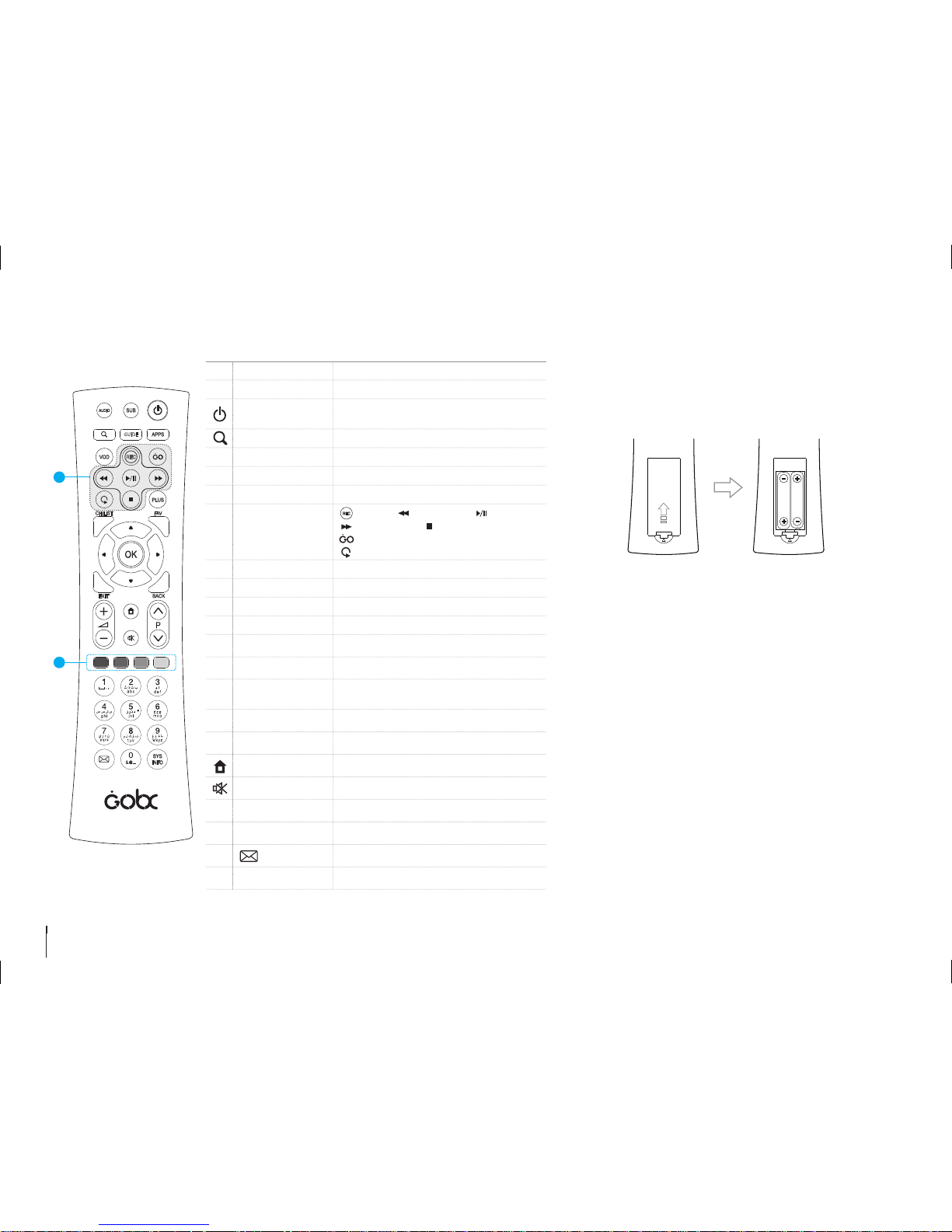
AUDIO Displays the audio list
SUB Displays subtitle
STANDBY
Switches between operation and standby
modes
SEARCH Run Smart Search
GUIDE Displays the programme guide
APPS Goes to TV APPS (Currently not supported)
VOD Goes to VOD services
1
Playback Control
Buttons (Currently
not supported)
Record, Fast Rewind, Play/Pause,
Fast Forward, Stop
Displays the recording list
Instant Replay
PLUS Displays option menus
CH LIST Displays the channel list
FAV Displays the favourite channel list
ARROW Buttons Moves the cursor up, down, left or right
OK Selects a menu or confirms
EXIT Exits all On-Screen Display (OSD) screens
BACK
Returns to the previous channel or the
previous screen
⊿
+/-
Changes the audio volume
P ∧/∨
Changes the channel or page
HOME Displays the HOME menu
MUTE Mutes audio
2
COLOUR Buttons For interactive applications
NUMERIC (0-9)
Displays mail messages
SYSINFO Displays system information
Note: Playback control buttons may not be enabled on your
product.
Inserting Batteries
Insert the batteries matching the plus(+) and minus(-) at each end.
Important notice
The batteries of your remote control are 2 x AAA type, 1,5VDC.
Do not mix different types of batteries or new and old batteries.
Do not use rechargeable batteries. In order to avoid any risk
of explosion, observe polarities indicated inside the battery
compartment. Replace only with the type of batteries specified
above. Do not subject to excess heat such as SUN and Fire,
do not recharge them. If you are not using the remote control
for a long period of time, remove the batteries. Please respect
the environment and prevailing regulations! Batteries must be
collected separately from other refuse! Before you dispose of
batteries, ask your dealer whether they are subject to special
recycling and if he will accept them for disposal.
1
2
GUIDE
Battery
Page 8

GB7
Getting Started
Wizard
The installation wizard operates automatically when you power on the product
for the first time or do factory default in menu.
Note: If you exit the installation wizard without fully completing the channel
searching procedure, you may not have all of the channels available. In this
case, go to > SETTINGS > Channel Settings > Search Channels and
search for more channels.
1. Language
Select the appropriate language from the list.
2. Network Connection
Make sure that the Ethernet cable is connected to the Ethernet port or the
wireless network is enabled. Configure the network setting.
3. Terms and conditions
Agree or disagree to share anonymous data about how you use your products. If
you agree, this is very helpful for us to make better products.
Note: You cannot skip this step to proceed the installation wizard.
4. Country Selection
Select your country. This step will be shown if the network is not connected.
5. Channel Search
All of the MBC channels will be searched automatically. To search more channels,
go to SETTINGS > Channel Settings > Search Channels.
6. Customer Registration
Register your GOBX to enjoy more various channels MBC provides. You can visit
GOBX.com to register.
7. Result
The result of the installation wizard will show. Select EXIT.
Page 9
GB8
Watching TV
Home
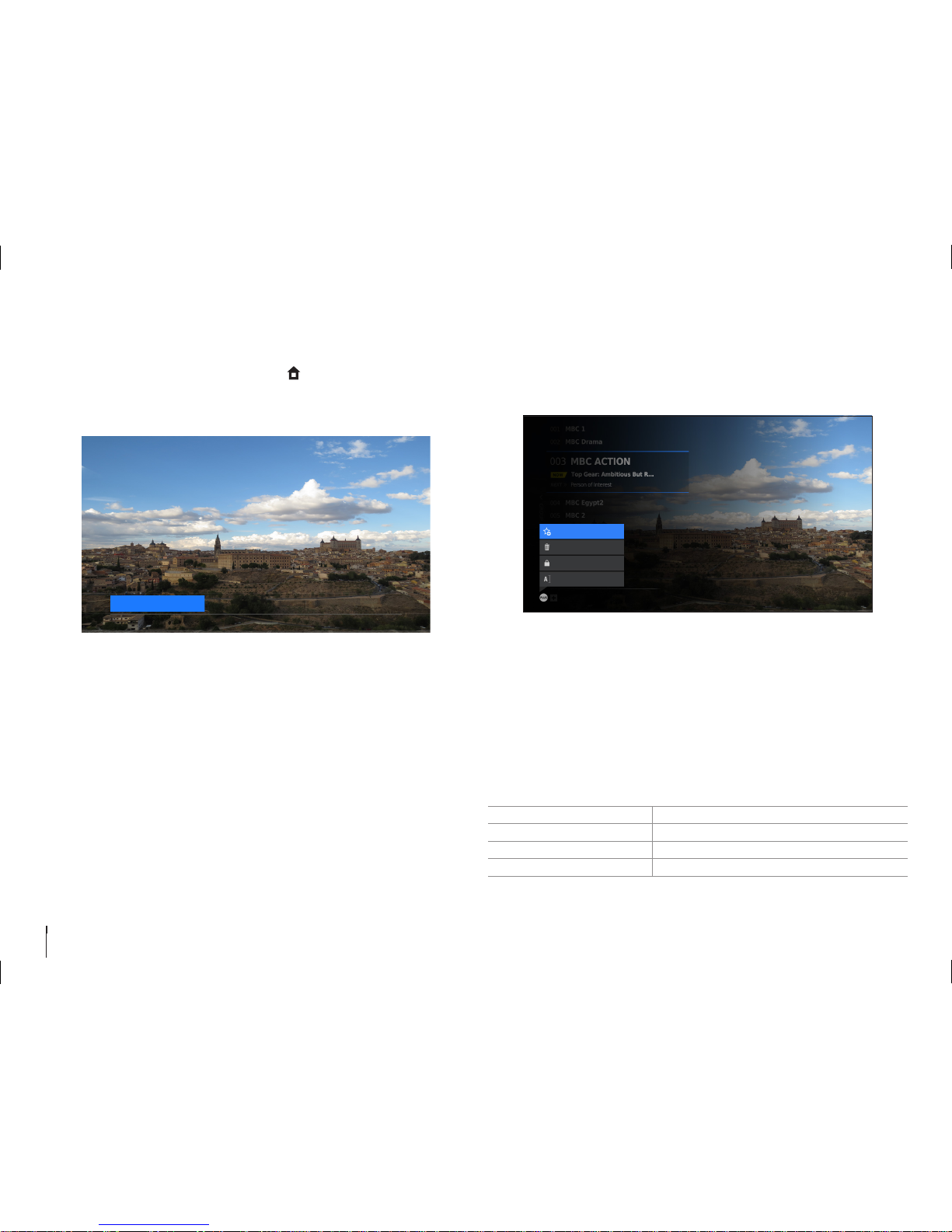
You can go to the home menu by pressing the button. From the home menu,
you can easily reach the main menus.
• Press the
/
button to go to CHANNELS, GUIDE or SETTINGS.
Channel List
You can access the channel list.
• Press the CH LIST button while watching live TV.
Changing Channels
Select a programme and press the OK button.
You can also enter the channel number directly.
Changing Channel Group
1. Press the button while the channel list is displayed.
2. Select a channel group and press the OK button.
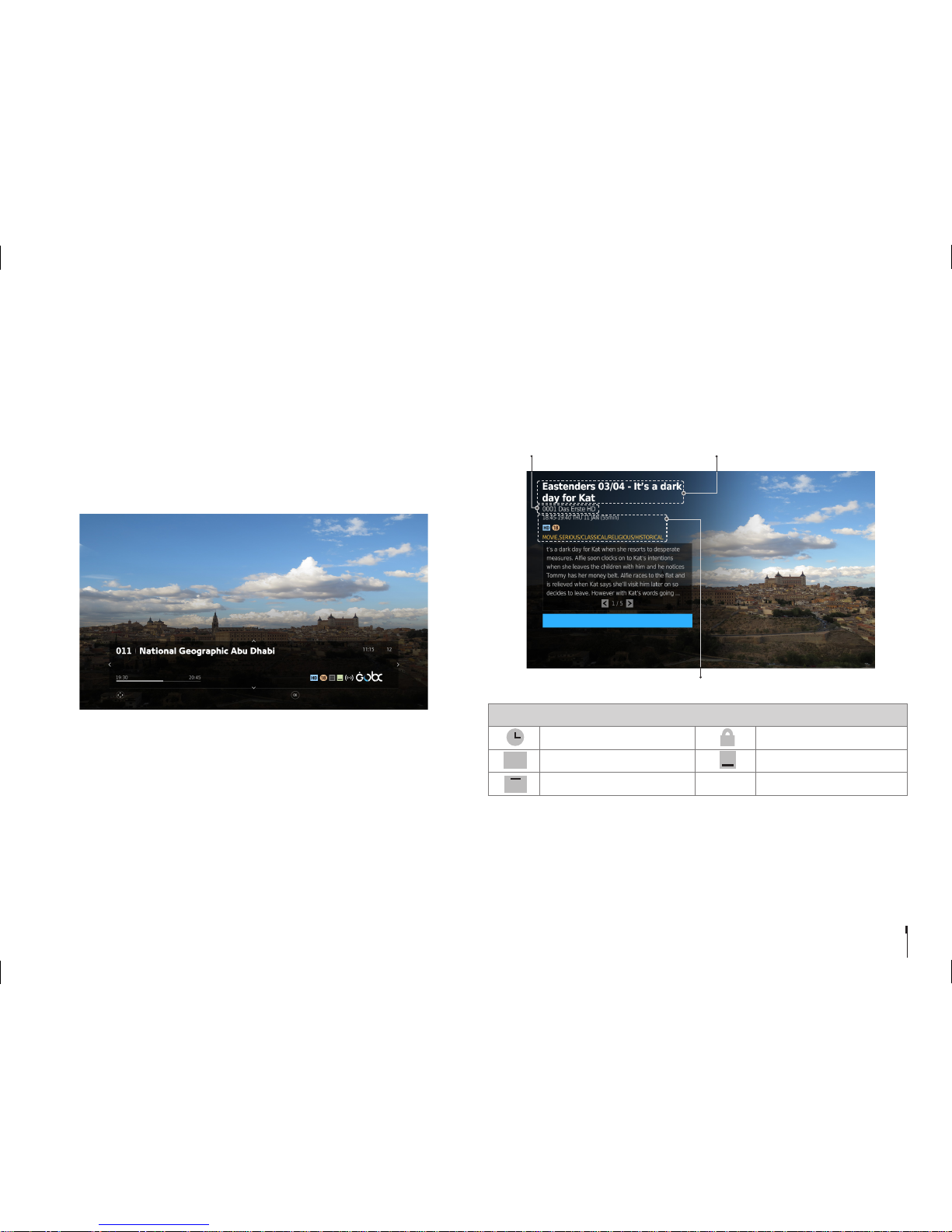
Editing Channels in Channel List
Select the channel you want to edit and press the PLUS button.
ADD TO / EDIT FAV Add/Edit favourite channels.
DELETE Delete channels from channel list.
PARENTAL LOCK/UNLOCK Lock channels to block access.
RENAME Change channel name.
Note: You cannot delete or rename MBC channels.
CHANNELS GUIDE SETTINGS
ADD TO FAV.
DELETE
OPTION - TV
PARENTAL LOCK
RENAME
Page 10
GB9
Watching TV
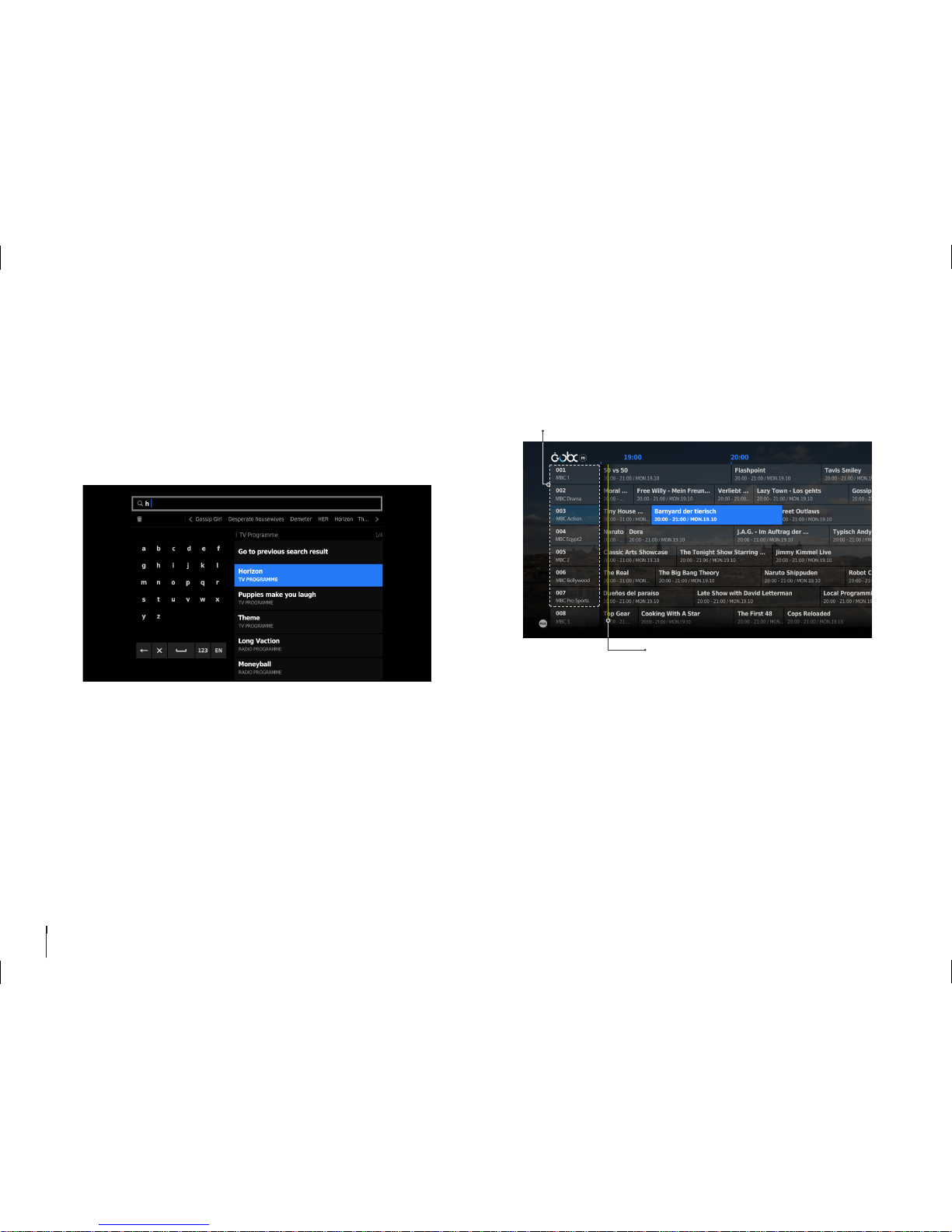
Watching Extended Info Banner
1. To find out more about the programme you are watching, press the OK
button. Then you can see the Channel Information Bar.
2. Press the OK button again to display programme detail.
You can watch a programme or set reminders for future programmes.
Programme Icons
Reminder (blue) Locked programme
HD programme Programme with subtitle
CAS programme
Watching Channel Information Bar
You can see what’s on later and schedule reminders for future programmes.
1. Select a channel in the channel list and press the OK button to display the
channel Information Bar.
2. Press the
/
button to see the previous or next programmes.
3. Select a future programme and press the OK button. You can see the
programme information and easily set a reminder.
Note: A reminder conflict occurs when you schedule a new reminder on the same
time as the previously scheduled reminder.
Setting TV Options
• Press the PLUS button while watching live TV to change resolution, display
format, audio language and subtitle language.
HD
HD
18
HD
18
HD
18
NA
IR
CHANNEL/PROGRAMME NAVIGATION
Program Title Area
PROGRAMME DETAIL
NOV
Channel number and name
Running time, date, genre
Programme name
WATCH LIVE TV
Page 11
GB10
TV Guide
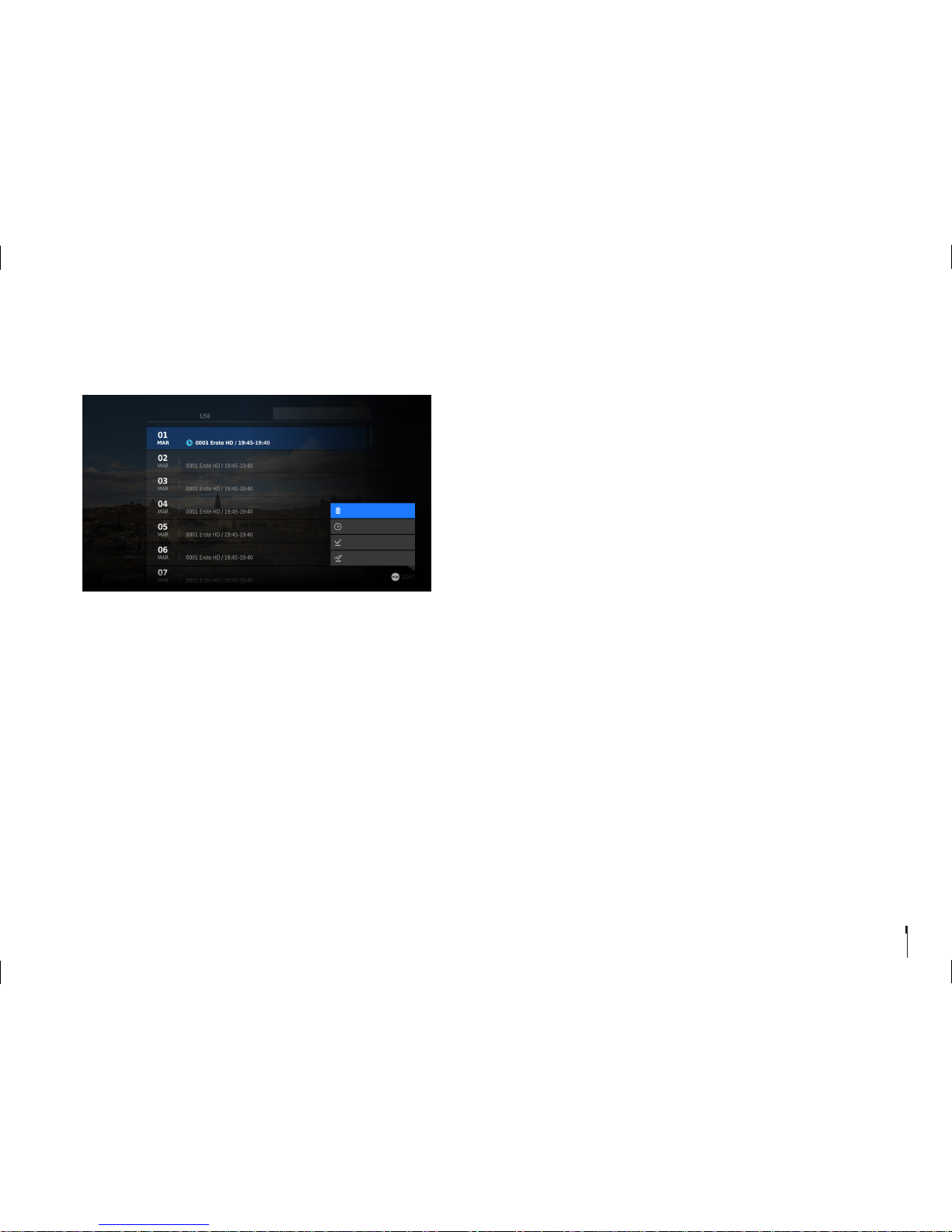
You can see the programme schedule of each channel, and schedule reminders
for future programmes.
• Press the EPG button.
Watching Live TV
1. Select a current programme and press the OK button to watch live TV. You
can enter the channel number directly.
Note: Press the P ∧/∨ button to change a page.
Changing Channel Group
1. Press the PLUS button and select CHANGE GROUP.
2. Select the channel group and press the OK button.
You can see the channels only in the group.
Jumping to Date
1. Press the PLUS button and select JUMP TO DATE.
2. Select a date and press the OK button.
You can also move to a certain date by long pressing the
/
button.
Watching TV
Smart Search
You can search programmes and look up related programmes.
1. Press the SEARCH button. A virtual keyboard will display.
2. Enter a keyword to list programmes. Whenever you enter a character, the
search results will display.
Note: Up to 10 search words are displayed for 24 hours. To delete the search
history, select CLEAR ALL and then press the OK button.
CLEAR ALL
Channel number and name
Current time
OPTION
19.08.2016
FRI 08:22
TODAY
Page 12
GB11
Watching TV
Managing Schedules
You can schedule programmes or edit schedules.
Setting Reminders
1. Press the PLUS button in TV Guide.
2. Select MANAGE SCHEDULE.
3. Select ADD A SCHEDULE at the right top of the screen and press the OK
button.
4. Select channel, date, time, duration and repeat options to set a reminder.
Note:
• If the programme conflicts with another programme, adjust the scheduling
appropriately.
• If the channel is locked, you will be prompted to enter your password. The
default password is 0000. If you have forgotten your password, please contact
your local distributor.
Editing Schedules
1. Press the PLUS button in TV Guide.
2. Select MANAGE SCHEDULE.
3. Press the PLUS button again to display the editing menu.
4. Select RESCHEDULE to change the preset reminder.
5. Select channel, date, time, duration and repeat options.
MBC 1
MBC Drama
MBC Action
MBC Eqypt2
MBC 2
MBC Bollywood
MBC Pro Sports
DELETE
RESCHEDULE
SELECT
ADD A SCHEDULE
SELECT ALL
EDIT
SCHEDULE
Page 13

GB12
Settings
System Settings
Press the button. Select SETTINGS and then System Settings.
GOBX Software Update
You can update the software when available.
Power Timer
You can set the time the product powers on or powers off.
Power Management
• Automatic Power Down: Set the time to enter standby mode automatically if
no user interaction occurs during the time.
HDMI-CEC
If your TV supports HDMI CEC, you can turn on or off the TV or control the TV
volume using the STB remote control.
• TV Power Control: Set to On to turn your TV on or off automatically when the
product is turned on or off.
• TV Volume Control: Set to On to control your TV volume with the STB remote
control.
Conditional Access
You can view the Smartcard information.
Mail Messages
You can view notification from the GOBX team.
Factory Default
You can restore your product to factory settings.
Warning: Note that once you perform factory default, all user configured data will
be reset. Shortly after you complete the factory default, the installation
wizard will appear automatically.
Page 14

GB13
Settings
General Settings
Press the button. Select SETTINGS and then General Settings.
Parental Control
• Change Password: Enter a new password.
Note:
• Enter the password to view the blocked programmes.
• The default password is 0000. If you have forgotten your password, please
contact your local distributor.
Languages
You can set the system language, audio language or subtitle language.
Video
You can set the screen ratio, display format and screen resolution.
Audio
• HDMI: You can select the digital audio signal for HDMI output.
• Audio Type: You can select the audio type.
• Lip-Sync Delay: You can adjust the sound difference between audio and
video.
On-Screen Display
• Info Display Timeout: You can set the duration the channel information bar is
displayed whenever you change the channel.
• Channel List Timeout: You can set the duration the channel list is displayed
even though there is no user interaction.
• TV Guide Timeout: You can set the duration the TV guide is displayed even
though there is no user interaction.
• Subtitle Font: You can set the subtitle font.
Reminders
• Reminder Notice Time: You can set the time the reminder notice message
pops up in advance.
• Repeat: Set to On to display the reminder notice again 10 seconds before a
programmes starts.
Privacy Policy, Terms and Conditions
You can agree to GOBX terms and Conditions and Privacy Policy.
Page 15

GB14
Network Settings
Press the button. Select SETTINGS and then Network Settings.
You can have direct access to Network Settings in the home screen when the
network is disconnected.
Configuring LAN
1. Select Configure LAN.
2. Select your IP configuration type between DHCP and Manual.
• DHCP: If you use a router or modem that has a DHCP (Dynamic Host
Configuration Protocol) server function, select DHCP. The IP address will
automatically be determined.
• Manual: If there is no DHCP server on the network and you want to set
the IP address manually, select Manual. Enter the values for IP Address,
Netmask, Gateway Address and DNS Address.
3. Select APPLY to connect to the selected network and press the OK button.
Note:
• When entering the IP address manually, enter digits without spaces.
• The network is connected by wired LAN when both wireless and wired LAN
are activated.
• HUMAX recommends the network connection over a wired LAN.
Settings
Configuring WLAN
1. Select Configure WLAN.
2. Select the wireless LAN network and press the OK button.
Note:
• If you choose a locked wireless network, you need to enter the password to
proceed.
• If your network does not appear in the list, press the PLUS button. You can
enter the network name manually to connect to the hidden network.
Network Connection Status
You can view the connection status of the local area network or the Internet.
Select RETRY if either network is disconnected.
Page 16
GB15
Settings
Channel Settings
Press the button. Select SETTINGS and then Channel Settings.
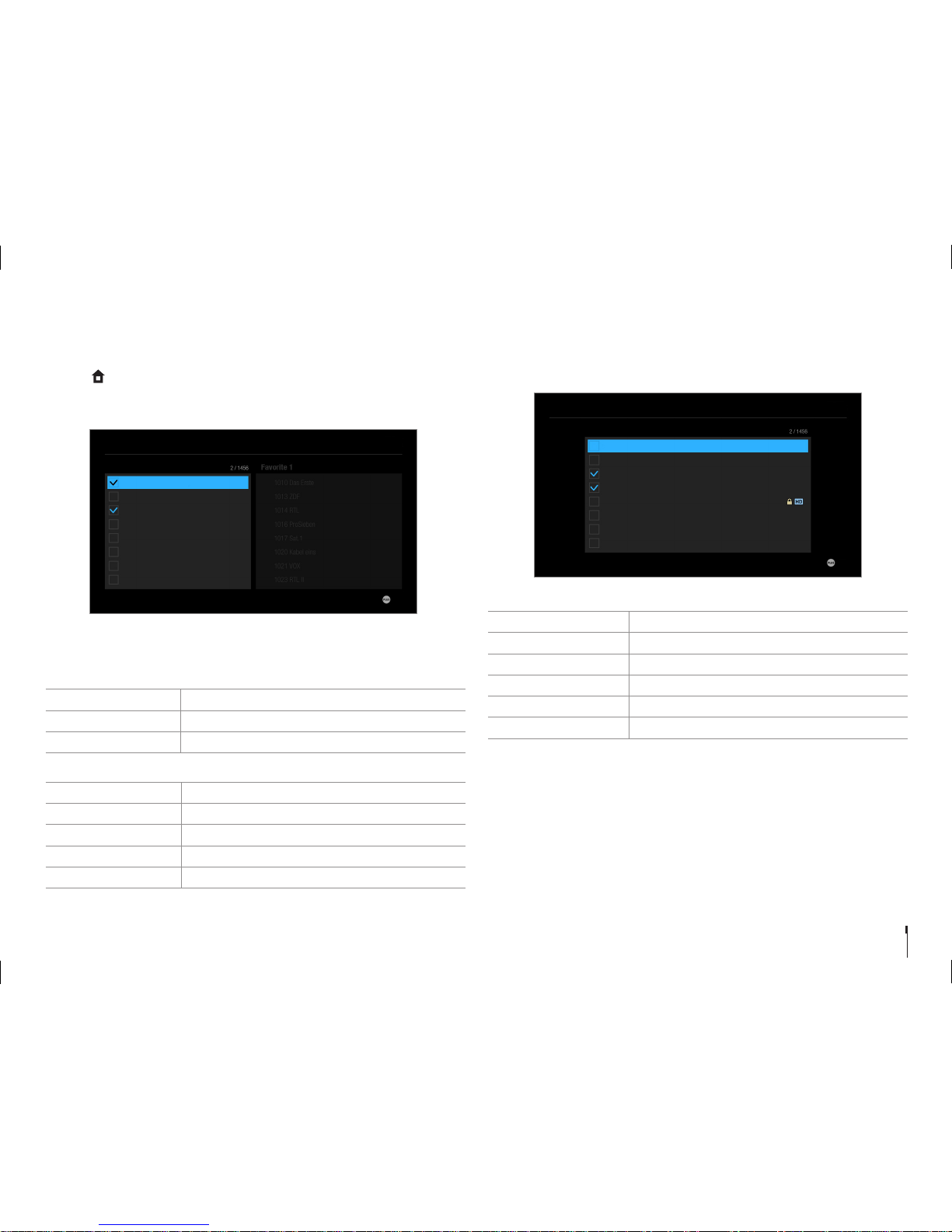
Setting Favourite Channels
Note: Press the EXIT button to exit. Press the BACK button to return to the
previous screen.
Select the channels from the left column and press the PLUS button.
ADD TO FAV. Add to favourite channels.
CHANGE GROUP List channels in another channel group.
SELECT/DESELECT ALL Mark or release all channels.
Select the channels from the right column and press the PLUS button.
REMOVE Remove from favourite group.
MOVE Move the channel in the favourite group.
CHANGE FAVOURITE Change to another favourite group.
RENAME FAVOURITE Rename the favourite group.
SELECT/DESELECT ALL Mark or release all channels.
Editing Channel List
You can delete, lock or rename channels in the channel list.
Select a channel and press the PLUS button.
DELETE Delete channels from channel list.
PARENTAL LOCK/UNLOCK Lock channels to block access.
RENAME Change channel name.
MOVE Move the channel using the p/q button.
CHANGE GROUP List channels of another channel group.
SELECT/DESELECT ALL Mark or release all channels.
Signal Test
You can check the signal strength and quality of the searched channels.
Import Channels
You can bring channel database from your USB memory stick.
Export Channels
You can store channel database in your USB memory stick.
EDIT
FAVOURITE CHANNELS
001 MBC 1
002 MBC Drama
003 MBC Action
004 MBC Eqypt2
005 MBC 2
006 MBC Bollywood
007 MBC Pro Sports
008 MBC 3
19.08.2016
FRI 08:22
EDIT
EDIT CHANNEL LIST
19.08.2016
FRI 08:22
001 MBC 1
002 MBC Drama
003 MBC Action
004 MBC Eqypt2
005 MBC 2
006 MBC Bollywood
007 MBC Pro Sports
008 MBC 3
TV
TV
Page 17
GB16
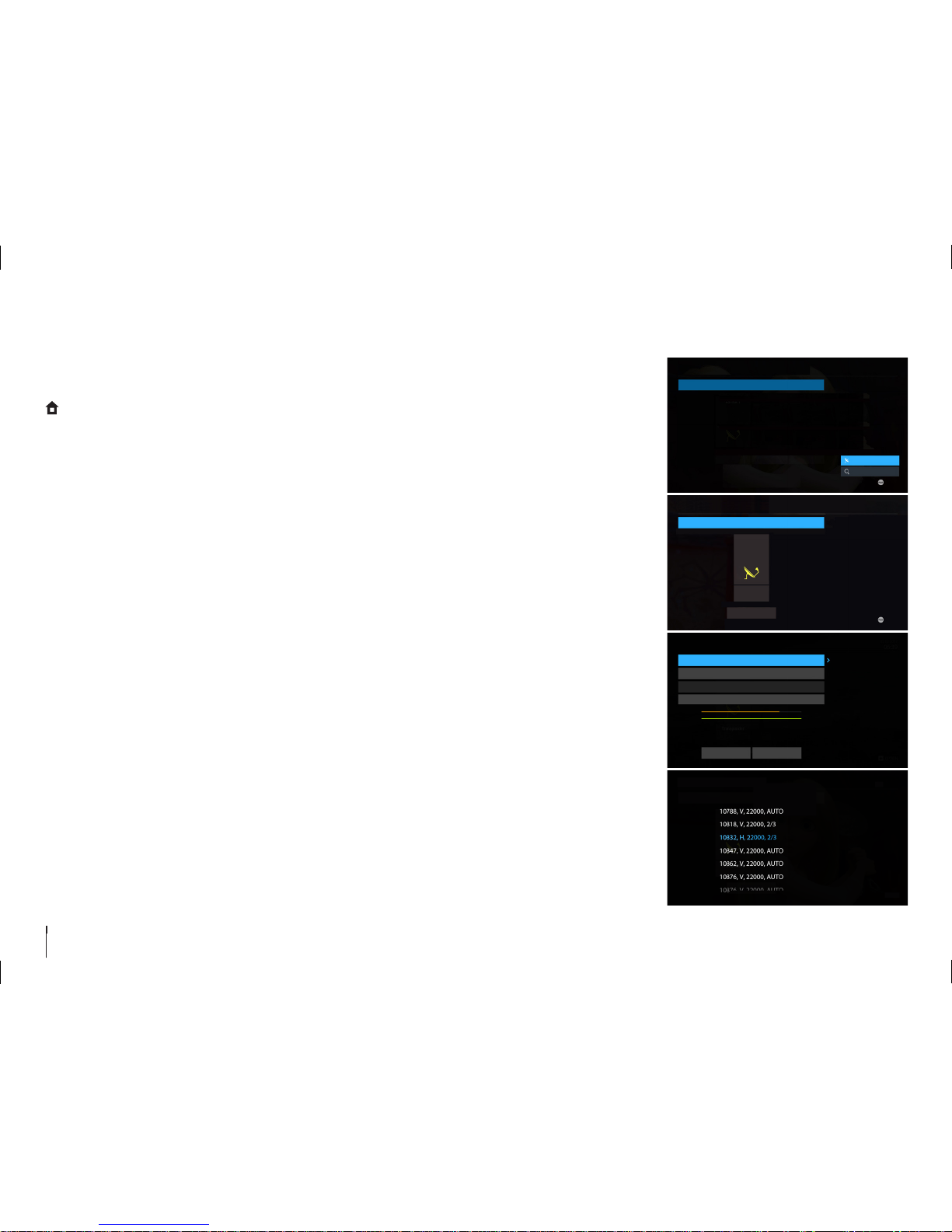
Search Channels allows you to configure your antenna and search the TV and radio channels.
> SETTINGS > Channel Settings > Search Channels
1 Press the PLUS button and select Antenna Type.
Select Fixed Antenna and press the OK button.
2 Select Switch Type and select LNB Only or DiSEqC.
3 Select a satellite figure and press the OK button.
• Satellite: Select the satellite.
• LNB Frequency: Select the LNB frequency.
• DiSEqC: Select the DiSEqC switch.
• Test Transponder: Check the signal status of each transponder and select the one with the best quality.
Select OK.
4 Select Transponder under the activated satellite figure and press the OK button.
Select a value in the transponder list.
5 Select SEARCH and press the OK button. The found channels will be listed.
6 When the search is completed, select SAVE and press the OK button.
Note:
• Select User Define to enter the options directly.
• Select STOP and press the OK button to stop the channel search.
• All channels will be deleted if you change the antenna type.
• The default password is 0000. If you have forgotten your password, please contact your local distributor.
Changing Search Option
• Network Search: Select On to search more channels based on the network information of the selected
transponder.
• Scrambled Type: All – FTA – CAS
• Channel Type: All – TV – Radio
Select OK and press the OK button.
Settings
Search Channels [Fixed Antenna]
1
2
3
4
option
option
SEARCH CHANNELS
SEARCH CHANNELS
Transponder
All
ASTRA 2
Universal
SEARCH
Switch Type
Switch Type
Switch Type
Satellite
LNB Frequency
Test Transponder
Strength 75%
Quality 100%
ASTRA 1 (19,2 E)
Universal
10714, H, 22000, A
LNB Only
LNB Only
Antenna Type
Search Option
19.08.2016
FRI 08:22
19.08.2016
FRI 08:22
SEARCH CHANNELS
SEARCH CHANNELS
CANCELOK
SEARCH
Satellite Settings
All
None
Page 18
GB17
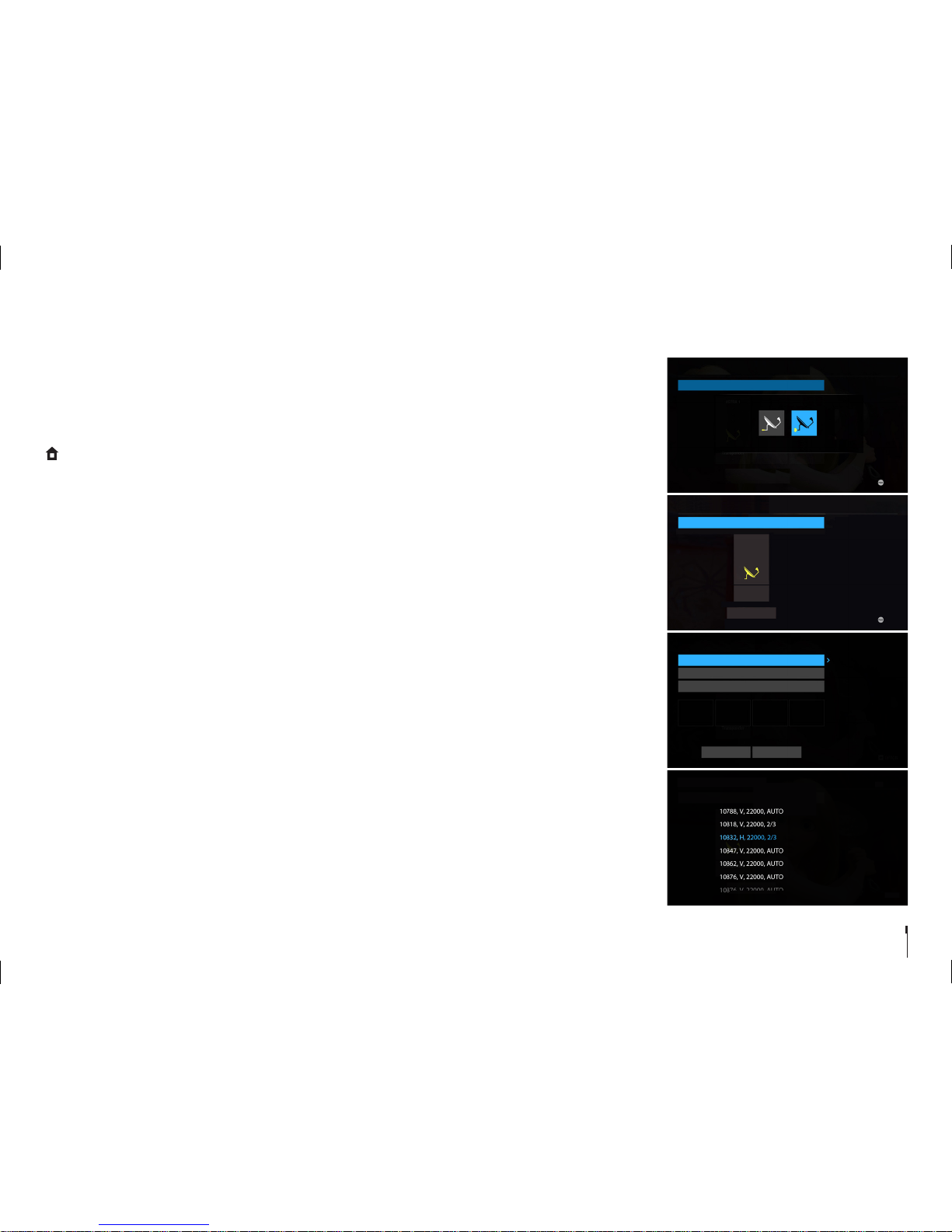
Single Cable Distribution enables the delivery of broadcast programming over a single cable to multiple users
eliminating the numerous cables required to support other electronics devices.
If you are using more than one satellite set-top box, set one set-top box at a time and turn off the others while
setting. Refer to the satellite antenna manual for details.
> SETTINGS > Channel Settings > Search Channels
1 Press the PLUS button and select Antenna Type.
Select SCD Antenna and press the OK button.
2 Select SCD Setting and press the OK button.
• Tuner: Select Tuner 1.
• User Band: Select from User Band 1~8.
• Band Frequency: The frequency is set based on the channel of tuner.
Select OK.
3 Select a satellite figure and press the OK button.
• Satellite: Select the satellite.
• LNB Frequency: Select the LNB frequency.
• Test Transponder: Check the signal status of each transponder and select the one with the best quality.
Select OK.
4 Select Transponder under the activated satellite figure and press the OK button.
Select a value in the transponder list.
5 Repeat the steps above to set more satellites.
Select SEARCH and press the OK button. The found channels will be listed.
7 When the search is completed, select SAVE and press the OK button.
Note:
• Select User Define to enter the options directly.
• Select STOP and press the OK button to stop the channel search.
• All channels will be deleted if you change the antenna type.
• The default password is 0000. If you have forgotten your password, please contact your local distributor.
• The user band and band frequency of each tuner has to be set differently.
Search Channels [SCD Antenna]
Settings
19.08.2016
FRI 08:22
19.08.2016
FRI 08:22
1
2
3
4
option
SEARCH CHANNELS
Transponder
-
Tuner 1
User band 1
1210Mhz
Position 1
Satellite
-
SEARCH
SCD Setting
Tuner
Satellite
User Band
Band Frequency
Tuner 1
Tuner 1
User Band 1
1210Mhz
SEARCH CHANNELS
SEARCH CHANNELS
CANCELOK
SEARCH CHANNELS
Switch Type
LNB Only
option
Select your antenna type.
Fixed
Antenna
SCD
Antenna
SCD Settings
Switch Type
SEARCH
All
None
Page 19
GB18
Appendix
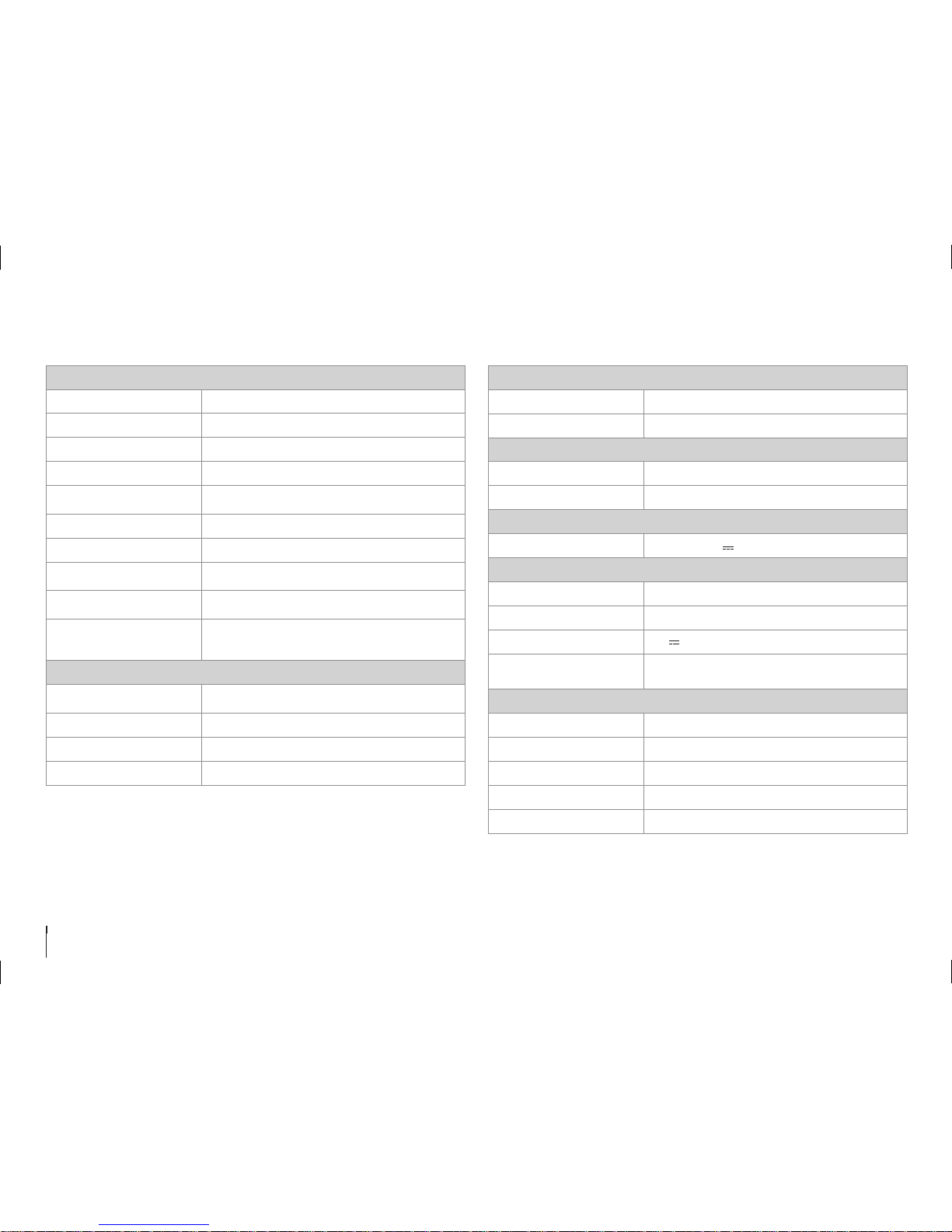
Specification
Tuner & Channel
No. of Tuners 1
Input Connector F-Type, IEC 169-24, Female, 1 x Input
Frequency Range 950 MHz to 2150 MHz
Signal Level -25~-69dBm
LNB Power & Polarisation
Vertical: +13.3 V , Horizontal: +18.3 V
Current: MAX. 350 mA (overload protection)
22kHz Tone 22 kHz ± 4 kHz Tone
DiSEqC Control 1.0, 1.2, USALS compatible
Demodulation
DVB-S2 - Compliant to EN302 307,
DVB-S - Compliant to EN300 421
Input Symbol Rate
DVB-S2 : 3~42 MBaud(QPSK) , 3~30 MBaud(8PSK)
DVB-S : 2~45 MBaud
FEC Mode
DVB-S: Auto, 1/2, 2/3, 3/4, 5/6, 7/8
DVB-S2: Auto, 1/2, 3/5, 2/3, 3/4, 4/5, 5/6, 8/9, 9/10(QPSK)
Auto, 1/2, 3/5, 2/3, 3/4, 4/5, 5/6, 8/9, 9/10(8PSK)
Video/Audio Processing
Video Decoding
MPEG2 (MP@HL), H.264 ([email protected]),
H.265/HEVC (Main, Main10 profile)
Video Resolution 1080p, 1080i, 720p, 576p, 576i
Audio Decoding MPEG1 Layer-I/II/III, Dolby Audio
Audio Mode Mono/Single channel/Dual channel/Joint stereo/Stereo
Memory
Flash Memory 256 MByte
RAM 512 MByte
Audio/Video/Data In/Out
Video RCA-Type(CVBS), HDMI/HDCP
Audio Audio L/R
Data In/Out
USB USB 2.0 Host (5V 500mA Max.)
Power Supply
Input Voltage 100~240V AC, 50/60Hz
Type Adaptor
Power Consumption 12 V 2.0 A
Protection
Separate internal fuse.
The input should be protected against lightning.
Physical Specification
Size (WxDxH) 203 x 166 x 40 (mm)
Weight (Net) 0.72 kg
Operating Temperature 0 °C to +50 °C
Storage Temperature -10 °C to +70 °C
Storage Humidity 5 %~100 %
Note: The specifications are subject to change without notice.
Page 20
GB19
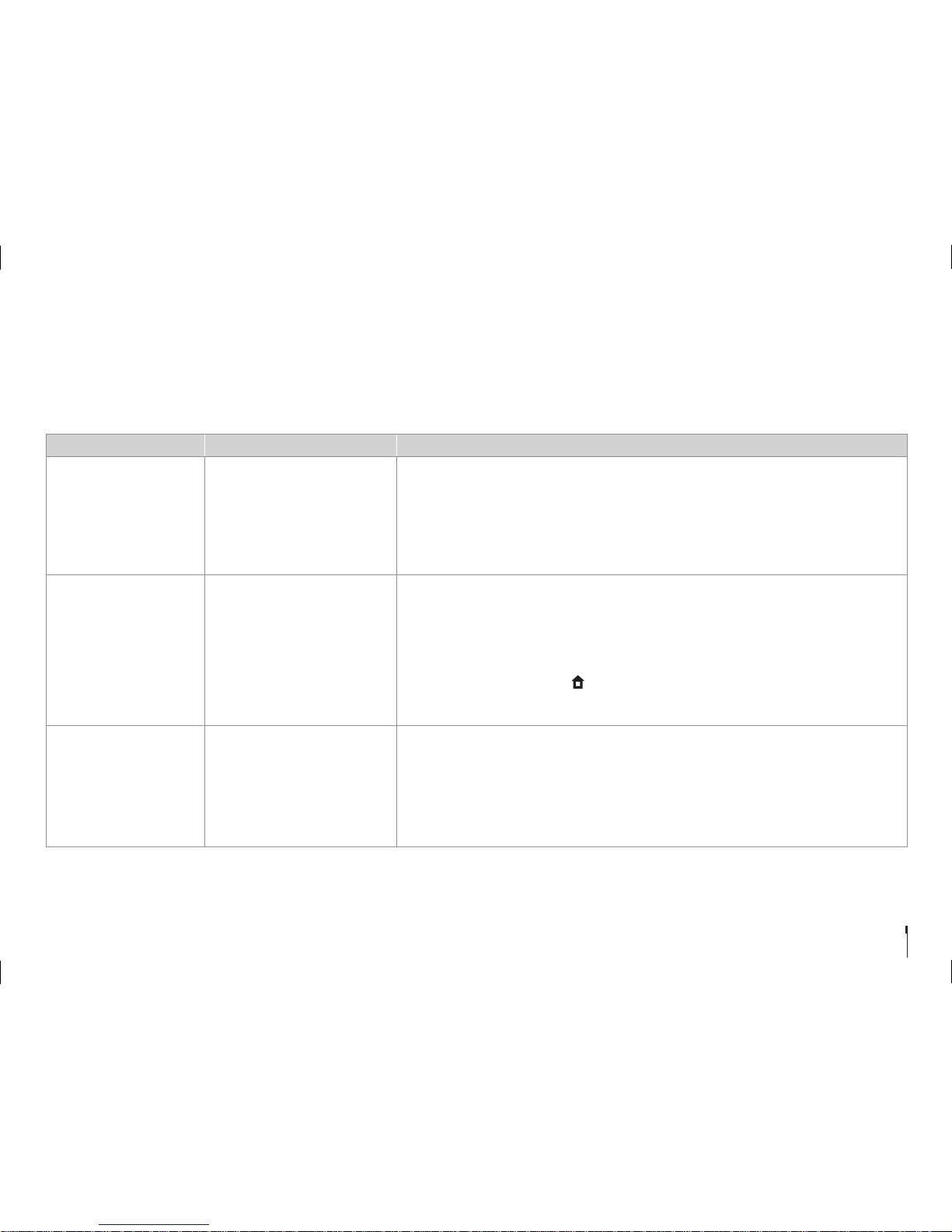
Trouble Shooting
Before contacting the customer service center, make sure to read the tips below carefully. If the problem persists after you complete the following procedure, please
contact HUMAX customer service for further instructions.
General
Problem Possible Cause What to Do
No picture
(Nothing shows on the TV)
HDMI cable not securely
connected.
• Make sure that the product is powered on and in operation mode.
• Make sure that the AV or HDMI cable is firmly connected to the TV.
• Check the brightness level of the TV.
• Check if the channel is currently on air. Contact the broadcaster to ensure that the channel is
running.
• Check if the input source of your TV is set for the AV or HDMI depending on how your product
is connected to the TV.
No picture
(No channels)
Antenna is disconnected.
Antenna is damaged/misaligned.
Out of digital signal area.
Antenna is not positioned.
• Make sure that the product is powered on and in operation mode.
Press the STANDBY button.
• Make sure that the AV or HDMI is firmly connected to the TV.
• Make sure that the antenna cable is properly connected to the product.
• Press the Input or Source button on the TV remote and select AV or HDMI mode depending
on how your product is connected to the TV.
• Search channels again. Go to > SETTINGS > Channel Settings > Search Channels.
• Check if the channel is currently on air. Contact the broadcaster to ensure that the channel is
running.
Poor Picture
Sound quality
Electro magnetics from electronic
devices around the product can
cause the issue.
Poor/faulty HDMI cable
• Make sure there is no mobile phone or microwave oven near the product.
• Keep the power and the RF cables apart from each other.
• Adjust the antenna direction to get a better picture.
Note: If the antenna is covered with snow, the RF is weakened by heavy rain, or the antenna
position is changed by strong wind, the condition of the sound and picture may
temporarily be poor. However, the poor sound and picture quality due to weather
conditions cannot be accepted as a malfunction of product.
Appendix
Page 21
GB20
Appendix
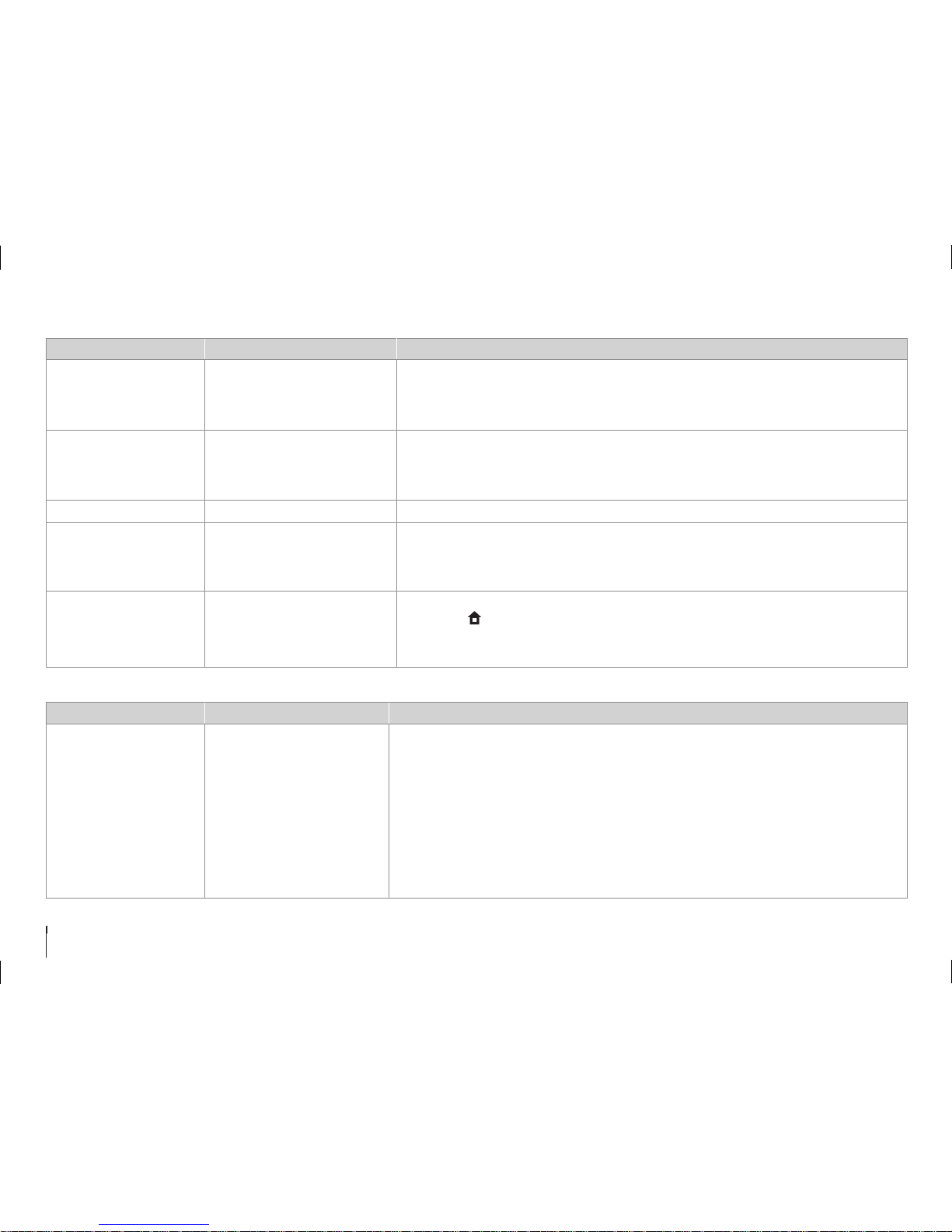
Problem Possible Cause What to Do
No sound AV/HDMI cables are not connected
properly or faulty.
Volume is set to minimum or
mute.
• Check that your AV or HDMI cable is connected correctly.
• Check the volume levels of your TV and the product.
• Check if the product or TV is on mute.
• Check audio type or soundtrack option. (where applicable)
No response to remote
control
Low batteries • To control the product, the top end of the remote control should point directly towards the
receiving part of the product.
• Remove and reinsert the batteries in the remote control.
• Replace the batteries in the remote control for a new set.
No password information • The default password is always 0000.
Channel search does not
work
Antenna is disconnected.
Antenna is damaged/misaligned.
Out of digital signal area.
Antenna is not positioned.
• Make sure that the antenna cable is properly connected to the product.
Cannot update the new
software
Network is not set up. • Check if the network is configured properly. You can check the network connection status by
going to > SETTINGS > Networks Settings.
Note: If your product stays connected to the network, everytime you turn off the product it will
search for any updates available on air.
Network
Problem Possible Cause What to Do
Cannot connect to the
Internet
Too far from the wireless router
Walls or obstacles between the
product and the router cause
interference.
Faulty Ethernet cable
Wrong password
• If wireless network is not available in your home, use an Ethernet cable to connect the product
and the router.
• Turn off the product and the router and then on to refresh the network.
• Move the product closer to the wireless router or remove any obstacles from between them.
• If you use an Ethernet cable, change the Ethernet cable.
• Check if other network devices in the same network are connecting to the internet okay.
• Check the network password.
Note:
• Wireless router is built in your product.
• The home network environment may cause the Internet speed slow down.
Page 22
GB21
Appendix
HUMAX Customer Support
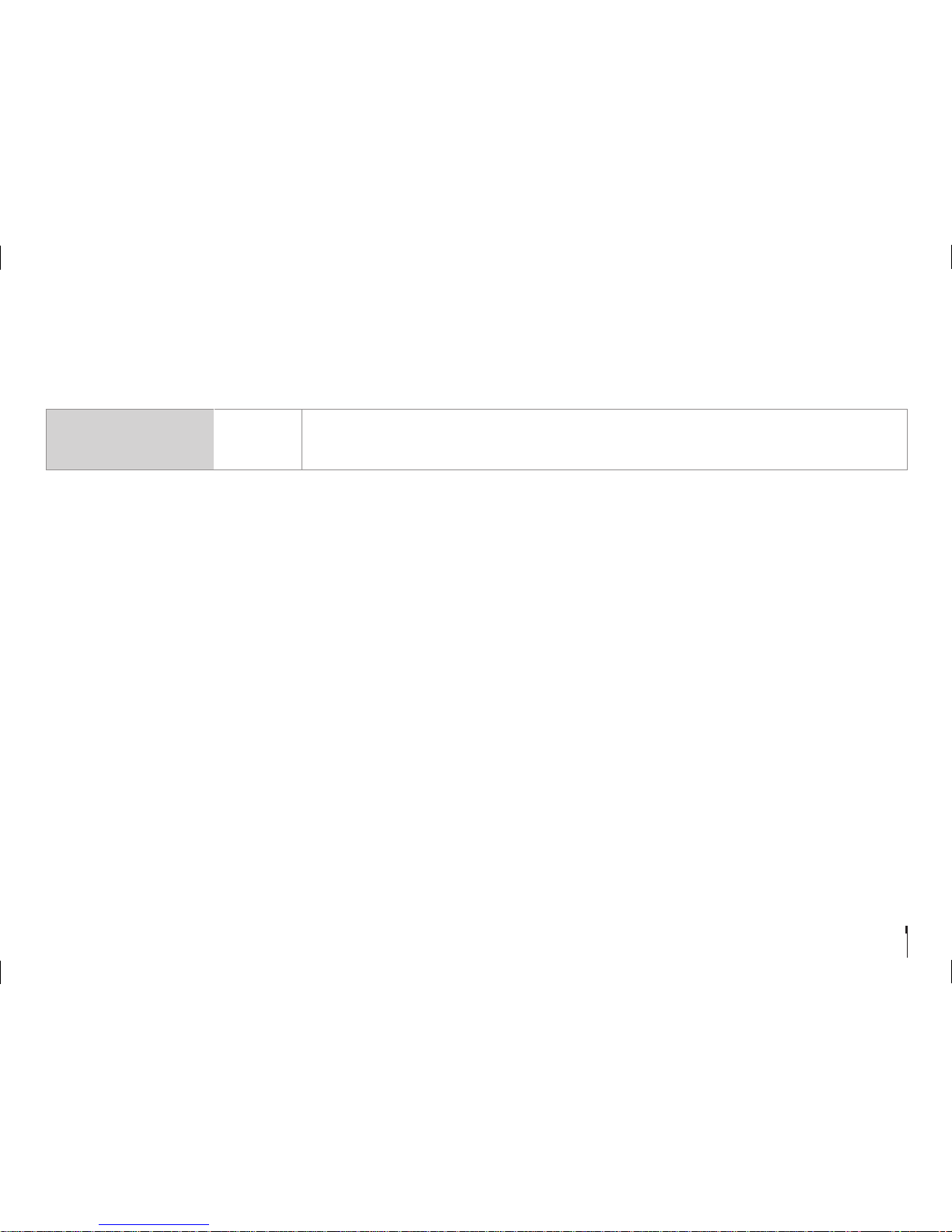
Information concerning troubleshooting, software upgrade and product support is provided in the following website. Should your product require warranty service,
please contact the customer service center of which telephone number is on the website.
Middle East (Dubai. UAE)
E-mail:
Website:
Language:
[email protected]
http://www.humaxdigital.com/me/support
Arabic / English
Note: For hardware repair, please visit our website.
Page 23

GB22
Appendix
Glossary
CVBS (Composite Video Baseband Signal)
A technology for transmitting video signals via a cable.
Mixes luminance (brightness) and the chrominance
(colour) signals together.
DiSEqC (Digital Satellite Equipment Control)
A DiSEqC compatible set-top box relies on a switching box
which detects the 22kHz tone pulsing rapidly on and off. In
this way, a certain set-top box can control numerous LNBs
through a DiSEqC switching box.
Dolby Digital
An encoding system that digitally compresses up to 5.1
discrete channels of audio (left front, centre, right front,
left surround, right surround) into a single Bitstream. A low
frequency effect (LFE) channel is included providing the
sound needed for special effects.
DVB (Digital Video Broadcasting)
A set of standards that define digital broadcasts using
satellite, cable or terrestrial systems.
EPG (Electronic Program Guide)
An electronic equivalent to a printed television listings
magazine. It is an application used with digital set-top
boxes and digital television sets to list current and
scheduled programs that are or will be available on each
channel, including a short summary or commentary for
each Program. The information supplied in the EPG is sent
and updated by the channel broadcaster.
Frequency
The property of a signal measured in cycles per second
(=Hz).
FTA (Free- To-Air)
An unscrambled broadcaster allowing customers to view
channels or services without paying any subscription.
HDMI (High-Definition Multimedia Interface)
An all-digital audio/video interface that supports standard,
enhanced, or high-definition video, plus multi-channel
digital audio on a single cable. It transmits all ATSC HDTV
standards and supports 8-channel digital audio.
LNB (Low Noise Block)
A device that is mounted on an arm facing your satellite
dish, focusing on satellite signals. A LNB converts signals
received from satellite to a lower frequency and sends
them to a satellite set-top box via coaxial cable.
OTA (Over the Air)
A standard for the transmission of software for equipment,
through a broadcast system. Manufacturers reserve the
right for deciding the release of the software for their
products.
PID (Packet Identifier)
A set of numbers identifying stream packets contained
within a single data stream.
Polarisation
The direction of the electrical and magnetic fields of
a signal. Satellites use both vertical and horizontal
polarisation, meaning that a frequency can be used twice.
QPSK (Quadrature Phase Shift Keying)
Digital modulation technique in which the carrier phase
can have one of four possible values.
RF (Radio Frequency)
Television signals are modulated onto RF signals and are
then demodulated by the tuner of your TV or STBs.
RGB (Red – Green – Blue)
A technology for transmitting video signals via a cable.
RGB is a system to represent red, green, and blue colours
on a TV or monitor display. Red, green, and blue can be
combined in various proportions to obtain any colour.
Smartcard
A credit card sized card that contains updateable chip
memory. It is used to access Pay TV (encrypted) channels
or services.
S-Video (Super-Video)
Sometimes referred to as Y/C video; a technology for
transmitting video signals via a cable. It is a video signal
transmission in which the luminance (brightness) and the
chrominance (colour) signals are transmitted separately to
achieve superior picture clarity.
Transponder
A satellite is divided up in parts called transponders. A
transponder is one distribution section of thes satellite.
Each transponder can be used for distribution of several
channels or services.
Page 24

GB23
Appendix
Open Source Software Notice
HUMAX products use certain open source operating system software
distributed pursuant to GNU GENERAL PUBLIC LICENSE Version 2 and GNU LESSER GENERAL LICENSE
Version 2.1 each as defined and published by the Free Software Foundation, Inc.
The following GPL and LGPL software source codes used in this product can be
provided and this offer is valid for up to three years from the date of original download
of the software or purchase of product containing such software. Please contact us at
[email protected].
GPL Software
linux
busybox
xfsprogs
MT7601U
dnsmasq
libdsmcc
LGPL Software
uClibc
libexif
id3lib
lxc
FFmpeg
DirectFB
FreeType License (FTL) Software
freetype
Portions of this software are copyright © <2007> The FreeType Project (www.
freetype.org).
All rights reserved.
OpenSSL License Software
OpenSSL
This product includes cryptographic software written by Eric Young.(eay@cryptsoft.
com)
This product includes software written by Tim Hudson. ([email protected])
This product includes software developed by the OpenSSL Project for use in the
OpenSSL Toolkit.(http://www.openssl.org)
Use, modification and redistribution of the Open Source Software is governed by the
terms and conditions of the applicable Open Source License. The GNU General Public
License (GPL) v2 is shown below.
The GNU General Public License (GPL)
Version 2, June 1991
Copyright (C) 1989, 1991 Free Software Foundation, Inc.51 Franklin Street, Fifth Floor,
Boston, MA 02110-1301, USA Everyone is permitted to copy and distribute verbatim
copies of this license document, but changing it is not allowed.
Preamble
The licenses for most software are designed to take away your freedom to share and
change it. By contrast, the GNU General Public License is intended to guarantee your
freedom to share and change free software--to make sure the software is free for all its
users. This General Public License applies to most of the Free Software Foundation’s
software and to any other program whose authors commit to using it. (Some other Free
Software Foundation software is covered by the GNU Lesser General Public License
instead.) You can apply it to your programs, too. When we speak of free software, we
are referring to freedom, not price. Our General Public Licenses are designed to make
sure that you have the freedom to distribute copies of free software (and charge for this
service if you wish), that you receive source code or can get it if you want it, that you
can change the software or use pieces of it in new free programs; and that you know
you can do these things.
To protect your rights, we need to make restrictions that forbid anyone to deny you
these rights or to ask you to surrender the rights. These restrictions translate to certain
responsibilities for you if you distribute copies of the software, or if you modify it.
For example, if you distribute copies of such a program, whether gratis or for a fee, you
must give the recipients all the rights that you have. You must make sure that they,
too, receive or can get the source code. And you must show them these terms so they
know their rights.
We protect your rights with two steps: (1) copyright the software, and (2) offer you this
license which gives you legal permission to copy, distribute and/or modify the software.
Also, for each author’s protection and ours, we want to make certain that everyone
understands that there is no warranty for this free software. If the software is modified
by someone else and passed on, we want its recipients to know that what they have
is not the original, so that any problems introduced by others will not reflect on the
original authors’ reputations.
Finally, any free program is threatened constantly by software patents. We wish to avoid
the danger that redistributors of a free program will individually obtain patent licenses,
in effect making the program proprietary. To prevent this, we have made it clear that
any patent must be licensed for everyone’s free use or not licensed at all.
The precise terms and conditions for copying, distribution and modification follow.
TERMS AND CONDITIONS FOR COPYING, DISTRIBUTION AND MODIFICATION
0. This License applies to any program or other work which contains a notice placed
by the copyright holder saying it may be distributed under the terms of this General
Public License. The “Program”, below, refers to any such program or work, and a
“work based on the Program” means either the Program or any derivative work under
copyright law: that is to say, a work containing the Program or a portion of it, either
verbatim or with modifications and/or translated into another language. (Hereinafter,
translation is included without limitation in the term “modification”.) Each licensee is
addressed as “you”.
Activities other than copying, distribution and modification are not covered by this
License; they are outside its scope. The act of running the Program is not restricted, and
the output from the Program is covered only if its contents constitute a work based on
the Program (independent of having been made by running the Program). Whether
that is true depends on what the Program does.
1. You may copy and distribute verbatim copies of the Program’s source code as you
receive it, in any medium, provided that you conspicuously and appropriately publish
on each copy an appropriate copyright notice and disclaimer of warranty; keep intact all
the notices that refer to this License and to the absence of any warranty; and give any
other recipients of the Program a copy of this License along with the Program. You may
charge a fee for the physical act of transferring a copy, and you may at your option offer
warranty protection in exchange for a fee.
2. You may modify your copy or copies of the Program or any portion of it, thus forming
a work based on the Program, and copy and distribute such modifications or work
under the terms of Section 1 above, provided that you also meet all of these conditions:
a) You must cause the modified files to carry prominent notices stating that you
changed the files and the date of any change.
b) You must cause any work that you distribute or publish, that in whole or in part
contains or is derived from the Program or any part thereof, to be licensed as a whole at
no charge to all third parties under the terms of this License.
c) If the modified program normally reads commands interactively when run, you
must cause it, when started running for such interactive use in the most ordinary way,
to print or display an announcement including an appropriate copyright notice and a
notice that there is no warranty (or else, saying that you provide a warranty) and that
users may redistribute the program under these conditions, and telling the user how to
view a copy of this License. (Exception: if the Program itself is interactive but does not
normally print such an announcement, your work based on the Program is not required
to print an announcement.)
These requirements apply to the modified work as a whole. If identifiable sections
of that work are not derived from the Program, and can be reasonably considered
independent and separate works in themselves, then this License, and its terms, do
not apply to those sections when you distribute them as separate works. But when
you distribute the same sections as part of a whole which is a work based on the
Program, the distribution of the whole must be on the terms of this License, whose
permissions for other licensees extend to the entire whole, and thus to each and every
part regardless of who wrote it.
Thus, it is not the intent of this section to claim rights or contest your rights to work written entirely by you; rather, the intent is to exercise the right to control the distribution
of derivative or collective works based on the Program. In addition, mere aggregation
of another work not based on the Program with the Program (or with a work based on
the Program) on a volume of a storage or distribution medium does not bring the other
work under the scope of this License.
3. You may copy and distribute the Program (or a work based on it, under Section 2) in
object code or executable form under the terms of Sections 1 and 2 above provided
that you also do one of the following:
a) Accompany it with the complete corresponding machine-readable source code,
which must be distributed under the terms of Sections 1 and 2 above on a medium
customarily used for software interchange; or,
b) Accompany it with a written offer, valid for at least three years, to give any third party,
for a charge no more than your cost of physically performing source distribution, a
complete machine-readable copy of the corresponding source code, to be distributed
under the terms of Sections 1 and 2 above on a medium customarily used for software
interchange; or,
c) Accompany it with the information you received as to the offer to distribute corresponding source code. (This alternative is allowed only for noncommercial distribution
and only if you received the program in object code or executable form with such an
offer, in accord with Subsection b above.) The source code for a work means the preferred form of the work for making modifications to it. For an executable work, complete
source code means all the source code for all modules it contains, plus any associated
interface definition files, plus the scripts used to control compilation and installation of
the executable. However, as a special exception, the source code distributed need not
include anything that is normally distributed (in either source or binary form) with the
major components (compiler, kernel, and so on) of the operating system on which the
executable runs, unless that component itself accompanies the executable. If distribution of executable or object code is made by offering access to copy from a designated
place, then offering equivalent access to copy the source code from the same place
counts as distribution of the source code, even though third parties are not compelled
to copy the source along with the object code.
4. You may not copy, modify, sublicense, or distribute the Program except as expressly
provided under this License. Any attempt otherwise to copy, modify, sublicense or
distribute the Program is void, and will automatically terminate your rights under this License. However, parties who have received copies, or rights, from you under this License
will not have their licenses terminated so long as such parties remain in full compliance.
5. You are not required to accept this License, since you have not signed it. However,
nothing else grants you permission to modify or distribute the Program or its derivative
works. These actions are prohibited by law if you do not accept this License. Therefore,
by modifying or distributing the Program (or any work based on the Program), you
indicate your acceptance of this License to do so, and all its terms and conditions for
copying, distributing or modifying the Program or works based on it.
6. Each time you redistribute the Program (or any work based on the Program), the
recipient automatically receives a license from the original licensor to copy, distribute
or modify the Program subject to these terms and conditions. You may not impose any
further restrictions on the recipients’ exercise of the rights granted herein. You are not
responsible for enforcing compliance by third parties to this License.
7. If, as a consequence of a court judgment or allegation of patent infringement or for
any other reason (not limited to patent issues), conditions are imposed on you (whether
by court order, agreement or otherwise) that contradict the conditions of this License,
they do not excuse you from the conditions of this License. If you cannot distribute so
as to satisfy simultaneously your obligations under this License and any other pertinent
obligations, then as a consequence you may not distribute the Program at all. For
example, if a patent license would not permit royalty-free redistribution of the Program
by all those who receive copies directly or indirectly through you, then the only way you
could satisfy both it and this License would be to refrain entirely from distribution of the
Program. If any portion of this section is held invalid or unenforceable under any particular circumstance, the balance of the section is intended to apply and the section as a
whole is intended to apply in other circumstances. It is not the purpose of this section to
induce you to infringe any patents or other property right claims or to contest validity of
any such claims; this section has the sole purpose of protecting the integrity of the free
software distribution system, which is implemented by public license practices. Many
people have made generous contributions to the wide range of software distributed
through that system in reliance on consistent application of that system; it is up to the
author/donor to decide if he or she is willing to distribute software through any other
system and a licensee cannot impose that choice.
This section is intended to make thoroughly clear what is believed to be a consequence
of the rest of this License.
8. If the distribution and/or use of the Program is restricted in certain countries either
by patents or by copyrighted interfaces, the original copyright holder who places the
Program under this License may add an explicit geographical distribution limitation
excluding those countries, so that distribution is permitted only in or among countries
not thus excluded. In such case, this License incorporates the limitation as if written in
the body of this License.
9. The Free Software Foundation may publish revised and/or new versions of the
General Public License from time to time. Such new versions will be similar in spirit to
the present version, but may differ in detail to address new problems or concerns.
Each version is given a distinguishing version number. If the Program specifies a
version number of this License which applies to it and “any later version”, you have
the option of following the terms and conditions either of that version or of any later
version published by the Free Software Foundation. If the Program does not specify
a version number of this License, you may choose any version ever published by the
Free Software Foundation.
10. If you wish to incorporate parts of the Program into other free programs whose
distribution conditions are different, write to the author to ask for permission. For software which is copyrighted by the Free Software Foundation, write to the Free Software
Foundation; we sometimes make exceptions for this. Our decision will be guided by
the two goals of preserving the free status of all derivatives of our free software and of
promoting the sharing and reuse of software generally.
NO WARRANTY
11. BECAUSE THE PROGRAM IS LICENSED FREE OF CHARGE, THERE IS NO WARRANTY
FOR THE PROGRAM, TO THE EXTENT PERMITTED BY APPLICABLE LAW. EXCEPT
WHEN OTHERWISE STATED IN WRITING THE COPYRIGHT HOLDERS AND/OR OTHER
PARTIES PROVIDE THE PROGRAM “AS IS” WITHOUT WARRANTY OF ANY KIND, EITHER
EXPRESSED OR IMPLIED, INCLUDING, BUT NOT LIMITED TO, THE IMPLIED WARRANTIES
OF MERCHANTABILITY AND FITNESS FOR A PARTICULAR PURPOSE. THE ENTIRE RISK AS
TO THE QUALITY AND PERFORMANCE OF THE PROGRAM IS WITH YOU. SHOULD THE
PROGRAM PROVE DEFECTIVE, YOU ASSUME THE COST OF ALL NECESSARY SERVICING,
REPAIR OR CORRECTION.
12. IN NO EVENT UNLESS REQUIRED BY APPLICABLE LAW OR AGREED TO IN WRITING
WILL ANY COPYRIGHT HOLDER, OR ANY OTHER PARTY WHO MAY MODIFY AND/OR
REDISTRIBUTE THE PROGRAM AS PERMITTED ABOVE, BE LIABLE TO YOU FOR DAMAGES,
INCLUDING ANY GENERAL, SPECIAL, INCIDENTAL OR CONSEQUENTIAL DAMAGES
ARISING OUT OF THE USE OR INABILITY TO USE THE PROGRAM (INCLUDING BUT NOT
LIMITED TO LOSS OF DATA OR DATA BEING RENDERED INACCURATE OR LOSSES
SUSTAINED BY YOU OR THIRD PARTIES OR A FAILURE OF THE PROGRAM TO OPERATE
WITH ANY OTHER PROGRAMS), EVEN IF SUCH HOLDER OR OTHER PARTY HAS BEEN
ADVISED OF THE POSSIBILITY OF SUCH DAMAGES.
END OF TERMS AND CONDITIONS
How to Apply These Terms to Your New Programs
If you develop a new program, and you want it to be of the greatest possible use to
the public, the best way to achieve this is to make it free software which everyone can
redistribute and change under these terms. To do so, attach the following notices to
the program. It is safest to attach them to the start of each source file to most effectively
convey the exclusion of warranty; and each file should have at least the “copyright” line
and a pointer to where the full notice is found.
One line to give the program’s name and a brief idea of what it does.
Copyright (C) yyyy name of author This program is free software; you can redistribute it
and/or modify it under the terms of the GNU General Public License as published by the
Free Software Foundation; either version 2 of the License, or (at your option) any later
version. This program is distributed in the hope that it will be useful, but WITHOUT ANY
WARRANTY; without even the implied warranty of MERCHANTABILITY or FITNESS FOR A
PARTICULAR PURPOSE. See the GNU General Public License for more details. You should
have received a copy of the GNU General Public License along with this program; if not,
write to the Free Software Foundation, Inc., 51 Franklin Street, Fifth Floor, Boston, MA
02110-1301, USA. Also add information on how to contact you by electronic and paper
mail. If the program is interactive, make it output a short notice like this when it starts
in an interactive mode:
Gnomovision version 69, Copyright (C) year name of author Gnomovision comes with
ABSOLUTELY NO WARRANTY; for details type `show w’. This is free software, and you are
welcome to redistribute it under certain conditions; type `show c’ for details.
The hypothetical commands `show w’ and `show c’ should show the appropriate
parts of the General Public License. Of course, the commands you use may be called
something other than `show w’ and `show c’; they could even be mouse-clicks or menu
items-whatever suits your program. You should also get your employer (if you work as
a programmer) or your school, if any, to sign a “copyright disclaimer” for the program, if
necessary. Here is a sample; alter the names:
Yoyodyne, Inc., hereby disclaims all copyright interest in the program `Gnomovision’
(which makes passes at compilers) written by James Hacker.
signature of Ty Coon, 1 April 1989
Ty Coon, President of Vice
This General Public License does not permit incorporating your program into proprietary programs. If your program is a subroutine library, you may consider it more useful
to permit linking proprietary applications with the library. If this is what you want to do,
use the GNU Library General Public License instead of this License.
GNU Lesser General Public License (LGPL)
Version 2.1, February 1999
Copyright (C) 1991, 1999 Free Software Foundation, Inc. 51 Franklin Street, Fifth Floor,
Boston, MA 02110-1301 USA Everyone is permitted to copy and distribute verbatim
copies of this license document, but changing it is not allowed.
[This is the first released version of the Lesser GPL. It also counts as the successor of the
GNU Library Public License, version 2, hence the version number 2.1.]
Preamble
The licenses for most software are designed to take away your freedom to share and
change it. By contrast, the GNU General Public Licenses are intended to guarantee
your freedom to share and change free software--to make sure the software is free
for all its users.
This license, the Lesser General Public License, applies to some specially designated
software packages--typically libraries--of the Free Software Foundation and other
authors who decide to use it. You can use it too, but we suggest you first think carefully
about whether this license or the ordinary General Public License is the better strategy
to use in any particular case, based on the explanations below. When we speak of free
software, we are referring to freedom of use, not price. Our General Public Licenses are
designed to make sure that you have the freedom to distribute copies of free software
(and charge for this service if you wish); that you receive source code or can get it if you
want it; that you can change the software and use pieces of it in new free programs;
and that you are informed that you can do these things. To protect your rights, we need
to make restrictions that forbid distributors to deny you these rights or to ask you to
surrender these rights. These restrictions translate to certain responsibilities for you if you
distribute copies of the library or if you modify it. For example, if you distribute copies
of the library, whether gratis or for a fee, you must give the recipients all the rights that
we gave you. You must make sure that they, too, receive or can get the source code.
If you link other code with the library, you must provide complete object files to the
Page 25

GB24
Appendix
recipients, so that they can relink them with the library after making changes to the
library and recompiling it. And you must show them these terms so they know their
rights. We protect your rights with a two-step method: (1) we copyright the library, and
(2) we offer you this license, which gives you legal permission to copy, distribute and/or
modify the library. To protect each distributor, we want to make it very clear that there
is no warranty for the free library. Also, if the library is modified by someone else and
passed on, the recipients should know that what they have is not the original version,
so that the original author’s reputation will not be affected by problems that might be
introduced by others.
Finally, software patents pose a constant threat to the existence of any free program. We
wish to make sure that a company cannot effectively restrict the users of a free program
by obtaining a restrictive license from a patent holder. Therefore, we insist that any patent license obtained for a version of the library must be consistent with the full freedom
of use specified in this license. Most GNU software, including some libraries, is covered
by the ordinary GNU General Public License. This license, the GNU Lesser General Public
License, applies to certain designated libraries, and is quite different from the ordinary
General Public License. We use this license for certain libraries in order to permit linking
those libraries into non-free programs. When a program is linked with a library, whether
statically or using a shared library, the combination of the two is legally speaking a
combined work, a derivative of the original library. The ordinary General Public License
therefore permits such linking only if the entire combination fits its criteria of freedom.
The Lesser General Public License permits more lax criteria for linking other code with
the library. We call this license the “Lesser” General Public License because it does Less
to protect the user’s freedom than the ordinary General Public License. It also provides
other free software developers Less of an advantage over competing non-free programs. These disadvantages are the reason we use the ordinary General Public License
for many libraries. However, the Lesser license provides advantages in certain special
circumstances. For example, on rare occasions, there may be a special need to encourage the widest possible use of a certain library, so that it becomes a de-facto standard.
To achieve this, non-free programs must be allowed to use the library. A more frequent
case is that a free library does the same job as widely used non-free libraries. In this case,
there is little to gain by limiting the free library to free software only, so we use the Lesser
General Public License. In other cases, permission to use a particular library in non-free
programs enables a greater number of people to use a large body of free software. For
example, permission to use the GNU C Library in non-free programs enables many more
people to use the whole GNU operating system, as well as its variant, the GNU/Linux
operating system. Although the Lesser General Public License is Less protective of the
users’ freedom, it does ensure that the user of a program that is linked with the Library
has the freedom and the wherewithal to run that program using a modified version of
the Library. The precise terms and conditions for copying, distribution and modification
follow. Pay close attention to the difference between a “work based on the library” and a
“work that uses the library”. The former contains code derived from the library, whereas
the latter must be combined with the library in order to run.
TERMS AND CONDITIONS FOR COPYING, DISTRIBUTION AND MODIFICATION
0. This License Agreement applies to any software library or other program which
contains a notice placed by the copyright holder or other authorized party saying it may
be distributed under the terms of this Lesser General Public License (also called “this
License”). Each licensee is addressed as “you”. A “library” means a collection of software
functions and/or data prepared so as to be conveniently linked with application
programs (which use some of those functions and data) to form executables. The
“Library”, below, refers to any such software library or work which has been distributed
under these terms. A “work based on the Library” means either the Library or any
derivative work under copyright law: that is to say, a work containing the Library or a
portion of it, either verbatim or with modifications and/or translated straightforwardly
into another language. (Hereinafter, translation is included without limitation in the term
“modification”.) “Source code” for a work means the preferred form of the work for making modifications to it. For a library, complete source code means all the source code
for all modules it contains, plus any associated interface definition files, plus the scripts
used to control compilation and installation of the library. Activities other than copying,
distribution and modification are not covered by this License; they are outside its scope.
The act of running a program using the Library is not restricted, and output from such
a program is covered only if its contents constitute a work based on the Library (independent of the use of the Library in a tool for writing it). Whether that is true depends on
what the Library does and what the program that uses the Library does.
1. You may copy and distribute verbatim copies of the Library’s complete source code
as you receive it, in any medium, provided that you conspicuously and appropriately
publish on each copy an appropriate copyright notice and disclaimer of warranty; keep
intact all the notices that refer to this License and to the absence of any warranty; and
distribute a copy of this License along with the Library. You may charge a fee for the
physical act of transferring a copy, and you may at your option offer warranty protection
in exchange for a fee.
2. You may modify your copy or copies of the Library or any portion of it, thus forming
a work based on the Library, and copy and distribute such modifications or work under
the terms of Section 1 above, provided that you also meet all of these conditions:
a) The modified work must itself be a software library.
b) You must cause the files modified to carry prominent notices stating that you
changed the files and the date of any change.
c) You must cause the whole of the work to be licensed at no charge to all third parties
under the terms of this License.
d) If a facility in the modified Library refers to a function or a table of data to be supplied
by an application program that uses the facility, other than as an argument passed
when the facility is invoked, then you must make a good faith effort to ensure that, in
the event an application does not supply such function or table, the facility still operates,
and performs whatever part of its purpose remains meaningful. (For example, a
function in a library to compute square roots has a purpose that is entirely well-defined
independent of the application. Therefore, Subsection 2d requires that any applicationsupplied function or table used by this function must be optional: if the application does
not supply it, the square root function must still compute square roots.) These requirements apply to the modified work as a whole. If identifiable sections of that work are not
derived from the Library, and can be reasonably considered independent and separate
works in themselves, then this License, and its terms, do not apply to those sections
when you distribute them as separate works. But when you distribute the same sections
as part of a whole which is a work based on the Library, the distribution of the whole
must be on the terms of this License, whose permissions for other licensees extend to
the entire whole, and thus to each and every part regardless of who wrote it.
Thus, it is not the intent of this section to claim rights or contest your rights to work written entirely by you; rather, the intent is to exercise the right to control the distribution
of derivative or collective works based on the Library. In addition, mere aggregation of
another work not based on the Library with the Library (or with a work based on the
Library) on a volume of a storage or distribution medium does not bring the other work
under the scope of this License.
3. You may opt to apply the terms of the ordinary GNU General Public License instead
of this License to a given copy of the Library. To do this, you must alter all the notices
that refer to this License, so that they refer to the ordinary GNU General Public License,
version 2, instead of to this License. (If a newer version than version 2 of the ordinary
GNU General Public License has appeared, then you can specify that version instead if
you wish.) Do not make any other change in these notices. Once this change is made
in a given copy, it is irreversible for that copy, so the ordinary GNU General Public
License applies to all subsequent copies and derivative works made from that copy. This
option is useful when you wish to copy part of the code of the Library into a program
that is not a library.
4. You may copy and distribute the Library (or a portion or derivative of it, under Section
2) in object code or executable form under the terms of Sections 1 and 2 above
provided that you accompany it with the complete corresponding machine-readable
source code, which must be distributed under the terms of Sections 1 and 2 above on
a medium customarily used for software interchange. If distribution of object code is
made by offering access to copy from a designated place, then offering equivalent access to copy the source code from the same place satisfies the requirement to distribute
the source code, even though third parties are not compelled to copy the source along
with the object code.
5. A program that contains no derivative of any portion of the Library, but is designed
to work with the Library by being compiled or linked with it, is called a “work that
uses the Library”. Such a work, in isolation, is not a derivative work of the Library, and
therefore falls outside the scope of this License. However, linking a “work that uses the
Library” with the Library creates an executable that is a derivative of the Library (because
it contains portions of the Library), rather than a “work that uses the library”. The
executable is therefore covered by this License. Section 6 states terms for distribution
of such executables.
When a “work that uses the Library” uses material from a header file that is part of the
Library, the object code for the work may be a derivative work of the Library even
though the source code is not. Whether this is true is especially significant if the work
can be linked without the Library, or if the work is itself a library. The threshold for this
to be true is not precisely defined by law. If such an object file uses only numerical
parameters, data structure layouts and accessors, and small macros and small inline
functions (ten lines or less in length), then the use of the object file is unrestricted,
regardless of whether it is legally a derivative work. (Executables containing this object
code plus portions of the Library will still fall under Section 6.)
Otherwise, if the work is a derivative of the Library, you may distribute the object code
for the work under the terms of Section 6. Any executables containing that work also fall
under Section 6, whether or not they are linked directly with the Library itself.
6. As an exception to the Sections above, you may also combine or link a “work that
uses the Library” with the Library to produce a work containing portions of the Library,
and distribute that work under terms of your choice, provided that the terms permit
modification of the work for the customer’s own use and reverse engineering for
debugging such modifications.
You must give prominent notice with each copy of the work that the Library is used in
it and that the Library and its use are covered by this License. You must supply a copy of
this License. If the work during execution displays copyright notices, you must include
the copyright notice for the Library among them, as well as a reference directing the
user to the copy of this License. Also, you must do one of these things:
a) Accompany the work with the complete corresponding machine-readable source
code for the Library including whatever changes were used in the work (which must
be distributed under Sections 1 and 2 above); and, if the work is an executable linked
with the Library, with the complete machine-readable “work that uses the Library”, as
object code and/or source code, so that the user can modify the Library and then relink
to produce a modified executable containing the modified Library. (It is understood that
the user who changes the contents of definitions files in the Library will not necessarily
be able to recompile the application to use the modified definitions.)
b) Use a suitable shared library mechanism for linking with the Library. A suitable
mechanism is one that (1) uses at run time a copy of the library already present on
the user’s computer system, rather than copying library functions into the executable,
and (2) will operate properly with a modified version of the library, if the user installs
one, as long as the modified version is interface-compatible with the version that the
work was made with.
c) Accompany the work with a written offer, valid for at least three years, to give the
same user the materials specified in Subsection 6a, above, for a charge no more than
the cost of performing this distribution.
d) If distribution of the work is made by offering access to copy from a designated place,
offer equivalent access to copy the above specified materials from the same place.
e) Verify that the user has already received a copy of these materials or that you have
already sent this user a copy.
For an executable, the required form of the “work that uses the Library” must include
any data and utility programs needed for reproducing the executable from it. However,
as a special exception, the materials to be distributed need not include anything that
is normally distributed (in either source or binary form) with the major components
(compiler, kernel, and so on) of the operating system on which the executable runs,
unless that component itself accompanies the executable.
It may happen that this requirement contradicts the license restrictions of other
proprietary libraries that do not normally accompany the operating system. Such
a contradiction means you cannot use both them and the Library together in an
executable that you distribute.
7. You may place library facilities that are a work based on the Library side-by-side in
a single library together with other library facilities not covered by this License, and
distribute such a combined library, provided that the separate distribution of the
work based on the Library and of the other library facilities is otherwise permitted, and
provided that you do these two things:
a) Accompany the combined library with a copy of the same work based on the Library,
uncombined with any other library facilities. This must be distributed under the terms
of the Sections above.
b) Give prominent notice with the combined library of the fact that part of it is a work
based on the Library, and explaining where to find the accompanying uncombined
form of the same work.
8. You may not copy, modify, sublicense, link with, or distribute the Library except
as expressly provided under this License. Any attempt otherwise to copy, modify,
sublicense, link with, or distribute the Library is void, and will automatically terminate
your rights under this License. However, parties who have received copies, or rights,
from you under this License will not have their licenses terminated so long as such
parties remain in full compliance.
9. You are not required to accept this License, since you have not signed it. However,
nothing else grants you permission to modify or distribute the Library or its derivative
works. These actions are prohibited by law if you do not accept this License. Therefore,
by modifying or distributing the Library (or any work based on the Library), you indicate
your acceptance of this License to do so, and all its terms and conditions for copying,
distributing or modifying the Library or works based on it.
10. Each time you redistribute the Library (or any work based on the Library), the recipient automatically receives a license from the original licensor to copy, distribute, link
with or modify the Library subject to these terms and conditions. You may not impose
any further restrictions on the recipients’ exercise of the rights granted herein. You are
not responsible for enforcing compliance by third parties with this License.
11. If, as a consequence of a court judgment or allegation of patent infringement or for
any other reason (not limited to patent issues), conditions are imposed on you (whether
by court order, agreement or otherwise) that contradict the conditions of this License,
they do not excuse you from the conditions of this License. If you cannot distribute so
as to satisfy simultaneously your obligations under this License and any other pertinent
obligations, then as a consequence you may not distribute the Library at all. For
example, if a patent license would not permit royalty-free redistribution of the Library by
all those who receive copies directly or indirectly through you, then the only way you
could satisfy both it and this License would be to refrain entirely from distribution of the
Library. If any portion of this section is held invalid or unenforceable under any particular
circumstance, the balance of the section is intended to apply, and the section as a
whole is intended to apply in other circumstances. It is not the purpose of this section to
induce you to infringe any patents or other property right claims or to contest validity of
any such claims; this section has the sole purpose of protecting the integrity of the free
software distribution system which is implemented by public license practices. Many
people have made generous contributions to the wide range of software distributed
through that system in reliance on consistent application of that system; it is up to the
author/donor to decide if he or she is willing to distribute software through any other
system and a licensee cannot impose that choice. This section is intended to make
thoroughly clear what is believed to be a consequence of the rest of this License.
12. If the distribution and/or use of the Library is restricted in certain countries either
by patents or by copyrighted interfaces, the original copyright holder who places the
Library under this License may add an explicit geographical distribution limitation
excluding those countries, so that distribution is permitted only in or among countries
not thus excluded. In such case, this License incorporates the limitation as if written in
the body of this License.
13. The Free Software Foundation may publish revised and/or new versions of the Lesser General Public License from time to time. Such new versions will be similar in spirit to
the present version, but may differ in detail to address new problems or concerns.
Each version is given a distinguishing version number. If the Library specifies a version
number of this License which applies to it and “any later version”, you have the option
of following the terms and conditions either of that version or of any later version published by the Free Software Foundation. If the Library does not specify a license version
number, you may choose any version ever published by the Free Software Foundation.
14. If you wish to incorporate parts of the Library into other free programs whose
distribution conditions are incompatible with these, write to the author to ask for
permission. For software which is copyrighted by the Free Software Foundation, write
to the Free Software Foundation; we sometimes make exceptions for this. Our decision
will be guided by the two goals of preserving the free status of all derivatives of our free
software and of promoting the sharing and reuse of software generally.
NO WARRANTY
15. BECAUSE THE LIBRARY IS LICENSED FREE OF CHARGE, THERE IS NO WARRANTY
FOR THE LIBRARY, TO THE EXTENT PERMITTED BY APPLICABLE LAW. EXCEPT WHEN
OTHERWISE STATED IN WRITING THE COPYRIGHT HOLDERS AND/OR OTHER PARTIES
PROVIDE THE LIBRARY “AS IS” WITHOUT WARRANTY OF ANY KIND, EITHER EXPRESSED
OR IMPLIED, INCLUDING, BUT NOT LIMITED TO, THE IMPLIED WARRANTIES OF
MERCHANTABILITY AND FITNESS FOR A PARTICULAR PURPOSE. THE ENTIRE RISK AS
TO THE QUALITY AND PERFORMANCE OF THE LIBRARY IS WITH YOU. SHOULD THE
LIBRARY PROVE DEFECTIVE, YOU ASSUME THE COST OF ALL NECESSARY SERVICING,
REPAIR OR CORRECTION.
16. IN NO EVENT UNLESS REQUIRED BY APPLICABLE LAW OR AGREED TO IN WRITING
WILL ANY COPYRIGHT HOLDER, OR ANY OTHER PARTY WHO MAY MODIFY AND/OR
REDISTRIBUTE THE LIBRARY AS PERMITTED ABOVE, BE LIABLE TO YOU FOR DAMAGES,
INCLUDING ANY GENERAL, SPECIAL, INCIDENTAL OR CONSEQUENTIAL DAMAGES ARISING OUT OF THE USE OR INABILITY TO USE THE LIBRARY (INCLUDING BUT NOT LIMITED
TO LOSS OF DATA OR DATA BEING RENDERED INACCURATE OR LOSSES SUSTAINED BY
YOU OR THIRD PARTIES OR A FAILURE OF THE LIBRARY TO OPERATE WITH ANY OTHER
SOFTWARE), EVEN IF SUCH HOLDER OR OTHER PARTY HAS BEEN ADVISED OF THE
POSSIBILITY OF SUCH DAMAGES.
END OF TERMS AND CONDITIONS
How to Apply These Terms to Your New Libraries
If you develop a new library, and you want it to be of the greatest possible use to the
public, we recommend making it free software that everyone can redistribute and
change. You can do so by permitting redistribution under these terms (or, alternatively,
under the terms of the ordinary General Public License).
To apply these terms, attach the following notices to the library. It is safest to attach
them to the start of each source file to most effectively convey the exclusion of warranty;
and each file should have at least the “copyright” line and a pointer to where the full
notice is found. one line to give the library’s name and an idea of what it does.> Copyright (C) year name of author This library is free software; you can redistribute it and/or
modify it under the terms of the GNU Lesser General Public License as published by the
Free Software Foundation; either version 2.1 of the License, or (at your option) any later
version. This library is distributed in the hope that it will be useful, but WITHOUT ANY
WARRANTY; without even the implied warranty of MERCHANTABILITY or FITNESS FOR A
PARTICULAR PURPOSE. See the GNU Lesser General Public License for more details.
You should have received a copy of the GNU Lesser General Public License along with
this library; if not, write to the Free Software Foundation, Inc., 51 Franklin Street, Fifth
Floor, Boston, MA 02110-1301 USA Also add information on how to contact you by
electronic and paper mail. You should also get your employer (if you work as a programmer) or your school, if any, to sign a “copyright disclaimer” for the library, if necessary.
Here is a sample; alter the names:
Yoyodyne, Inc., hereby disclaims all copyright interest in the library `Frob’ (a library for
tweaking knobs) written by James Random Hacker.
signature of Ty Coon, 1 April 1990
Ty Coon, President of Vice
Page 26
GB25
Middle East (Dubai. UAE)
E-mail:
Website:
Language:
[email protected]
http://www.humaxdigital.com/me/support
Arabic/English
IMPORTANT:
Keep this Certificate together with the Original invoice or receipt in a safe place and show
them to the retailer or place of purchase whenever a warranty repair is necessary.
· Model No.:
· Serial No.:
· Date of Purchase:
· Dealer’s Signature:
· Customer’s Signature:
HUMAX thanks you for your recent HUMAX product purchase.
For your benefit, we recommend that you record your serial number, found on the product,
and other purchase information on this card and keep it with your personal records, along
with proof of purchase. This information will allow us to better serve your needs.
WARRANTY CONDITIONS
Keep this Certificate together with the original invoice or receipt in a safe place and show
them to the retailer or place of purchase whenever a warranty repair is necessary.
HUMAX CONSUMER WARRANTY
HUMAX warrants this product to be free of defects in materials and workmanship, subject
to the conditions set forth overleaf.
Warranty Certificate
CONDITIONS
1. The HUMAX Warranty is valid for a period of one year from the date of first purchase.
2. In the event that this product fails to function properly during the warranty period, the
retailer or distributor will make this product capable of operating for the purpose of which
it was designed, without charging for labour and parts.
3. This warranty will be honoured only if the Warranty Certificate has been duly completed
by the purchaser and is presented to the retailer with the original invoice or receipt.
4. This warranty does not cover shipping or transportation charges from you to us.
5. The obligations of the distributor are limited to the repair of defect parts. Costs and risks of
transport to the retailer as well as removal and installation of the product, and any other
costs directly or indirectly related to its repair, are not covered by the warranty.
6. All warranty repairs performed by non-authorized repair shops will not be reimbursed and
if such repairs damage this product such damage will not be covered by this warranty.
7. This warranty is not applicable in cases other than defects in materials or workmanship
and, in particular, does not cover:
periodic check-ups, adjustments, maintenance or conversions as well as replacement of
parts due to normal wear and tear;
damage caused by accidents, negligence, modifications, use of non-HUMAX parts,
improper use, installation or package;
damage caused by lightning, water, fire, acts of war, public disturbances, incorrect mains
voltages, incorrect ventilation or any other cause beyond the control of the distributor;
products where the label bearing the serial number has been removed, defaced or is
illegible.
8. This warranty is offered to any person who has legally obtained possession of this product
within the warranty period.
9. HUMAX’s maximum liability shall not exceed the actual purchase price paid by you for
the product. In no event shall HUMAX be liable for special, incidental, consequential or
indirect damages.
Page 27
 Loading...