

Page 1
WinFrog Device Group: Magnetometer
Device Name/Model: GSM-19 (GSM-19M or GSM-19MD)
MARINE MAGNETICS CORPORATION
(formerly GEM Systems Inc.)
52 West Beaver Creek Rd., Unit 14/16,
Device Manufacturer:
Device Data String(s)
Output to WinFrog:
WinFrog Data String(s)
Output to Device:
WinFrog Data Item(s) and their
RAW record:
DEVICE DESCRIPTION:
A magnetometer is an instrument that measures Magnetic Flux Density (in Tesla’s). The
Earth generates a relatively strong magnetic field, which produces flux densities, in air
or water. The values of the earth’s magnetics r ang e from a low of about 18 micr o Tesla
(µT) near South America, to a high of over 60 microTesla in the Arctic Circle.
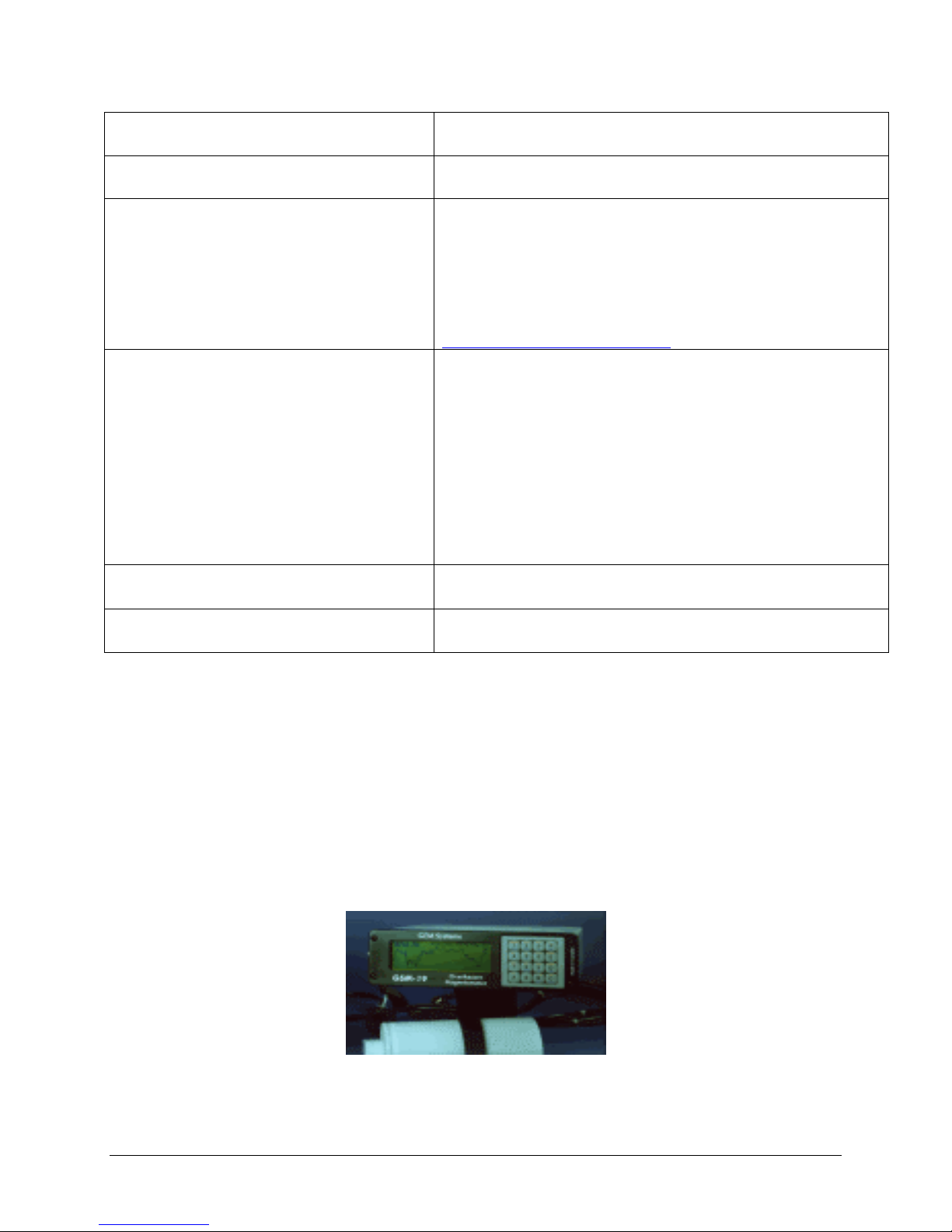
The GSM-19 Marine Magnetometer utilizes an omnidirectional Overhauser sensor and
can be configured to operate via the Overhouser effect or as a conventional proton
precession unit. See Configuration Details section for information on the Overhauser
effect.
Richmond Hill Ontario, Canada, L4B 1L9
Phone: (905) 764-8008, Fax: (905)764-2949
Email: [email protected], web: www.gemsys.on.ca
www.marinemagnetics.com
RS-232 ASCII output
Time = gpstime, else time is read from
magnetometer as hours, minutes, seconds.
Other parameters read for GSM19M: measurement
time, and magneticField.
Other parameters read for GSM-19MD:
magneticField, signal strength, depth of fish, leak,
measureme nt time, quality, warning message and
status.
See Configuration Details for Warning Messages.
N/A
MAGNETOMETER 800
The GSM-19 consists of one Overhauser sensor, an electronic ‘fish’ assembly and an
FSK transceiver unit. The fish and sensor are packaged in a sealed container with a
WinFrog User’s Guide - Appendix C – Magnetometer / GSM-19 Page 1 of 5
Page 2
single coax cable that can be up to 1000m long (for the standard version), and up to 10
Km long for the extended range version. The transceiver unit connects to a power
supply outputting between 15VDc and 35VDc. The unit also connects to standard RS232C port. It is recommended to operate the unit at as high a Voltage as possible to
avoid excessive Voltage drop across the coax cable.
Any standard GSM-19 ground console can be fitted with a special pressurized sensor
(fish) for marine operation. The fish can be towed up to 100m behind a vessel. This
configuration is the GSM-19 Shallow Marine Magnetometer.
The GSM-19MD (Marine Deep) Magnetometer is a complete magnetometer integrated
into a towed housing. The GSM-19MD Fish can operate at depths up to 300m, with
1000m of kevlar tow cable. Sixteen fish can be networked on the tow cable – which has
a breaking point of 2000Kg - creating gradiometer configurations.
DEVICE CONFIGURATION INSTRUCTIONS
WINFROG I/O DEVICES > EDIT I/O:
Baud Rate: 9600
Data Bits: 8
Stop Bits: 1
Parity: None
RS-232C bi-directional communication.
WINFROG I/O DEVICES > CONFIGURE DEVICE:
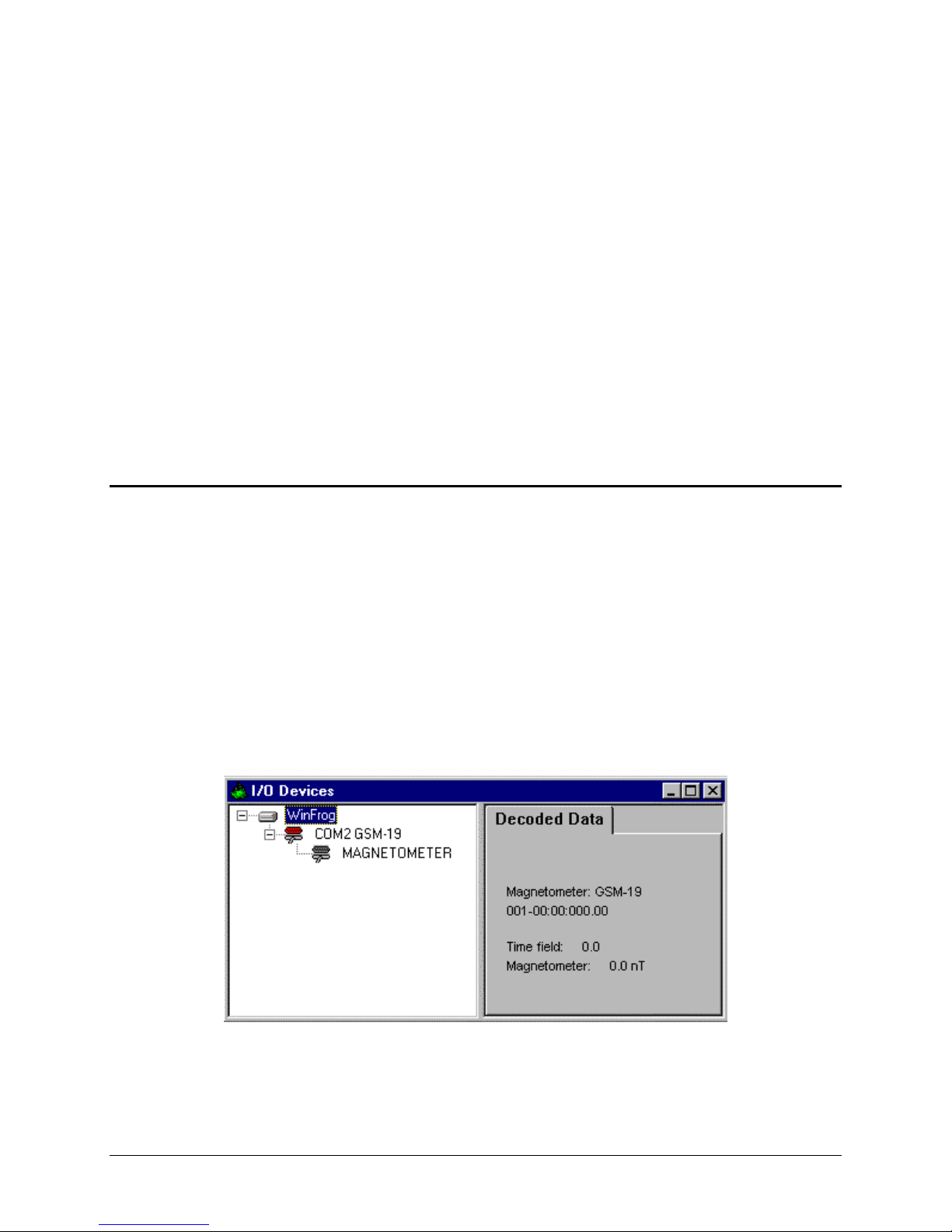
The GSM-19 is added to WinFrog from the Magnetometer device group. The
MAGNETOMETER data item is added along with the GSM-19 device.
You must select the GSM model type (GSM-19 or GSM-19MD) at the device level.
WinFrog User’s Guide - Appendix C – Magnetometer / GSM-19 Page 2 of 5
Page 3
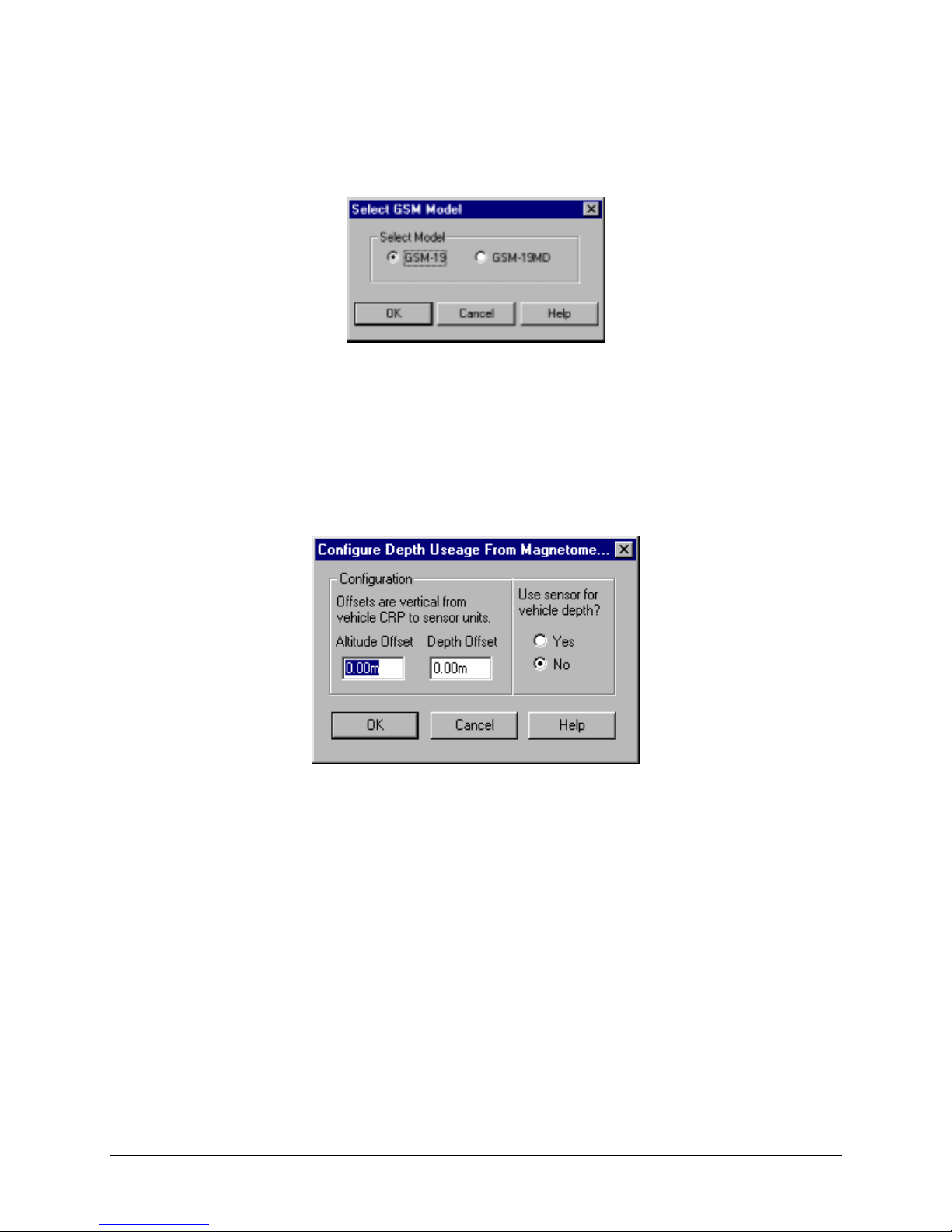
The default configuration is GSM-19. To configure for GSM-19MD input, right-click in
the I/O Devices window and choose Configure Device (i.e. the Select GSM Model
dialog does not open automatically when the device is added to WinFrog).
WINFROG VEHICLE > CONFIGURE VEHICLE DEVICES > DEVICE DATA ITEM >
EDIT:
MAGNETOMETER Data Item:
Once the MAGNETOMETER data item has been added to the vehicle device list it must
be edited to suit the application.
This data item must be added to a vehicle for data recording to occur. After the data
item is attached to a vehicle, the type 800 Raw Data Record will be saved (if RAW data
recording is occuring) for post processing options.
It should be noted that both of the offset options are vertical offsets measured from the
CRP of the vessel to the respective sensors with up being positive.
The “Use for vehicle Depth” option allows you to display the vehicle depth (depth sensor
measured + offset) in the Vehicle Text window by selecting “yes”. If “no” is selected and
no other depth sensor devices are added to this vehicle, the depth will be displayed as
zero in the vehicle text window.
Since the GSM19 does not include depth in its telegram the “Use sensor for vehicle
depth” must be set to ‘No’, otherwise the vehicle depth will always be 0.
The GSM19MD outputs depth but not altitude, so only the depth offset has any effect.
WinFrog User’s Guide - Appendix C – Magnetometer / GSM-19 Page 3 of 5
Page 4

Raw Data String:
800,name,time,magnetic field,signal strength,depth,quality,leakage,tuning,
voltage,altitude
Values no sent by this instrument will be 0.
INSTRUMENT CONFIGURATION DETAILS:
Overhauser Effect:
In a standard proton magnetometer sensor a proton rich liquid is required to produce
a precession signal, while the Overhauser effect sensor must also have a free
radical added to the liquid. The free radical ensures the presence of free, unbound
electrons that couple with protons, to produce a two-spin system. A strong RF
magnetic field is used to disturb the electron-proton coupling. By saturating free
electron resonance lines, the polarization of protons in the sensor liquid is greatly
increased.
The Overhauser effect offers a more powerful method of proton polarization than
standard DC polarization. This means stronger signals are achieved from smaller
sensors, and with less power.
Warning Messages Output from GSM-19:
• Weak Signal
• Gradient Condition
• Poor Reading
• Instrument Mistuned
• No Signal
Specifications:
Resolution: 0.01nT
Accuracy: 0.2nT
Maximum depth for echoso und er : Standard Sensor=128m (sensi ti vity of 0.5m)
Communication: Text (ASCII) or Binary. WinFrog uses ASCII
Maximum Power Consumption: 3.5Watts (typical operation around 1Watt)
Features:
• graphic display that displays real time profiles of data.
• interactive menu
• 0.5MB memory standard
• real-time RS-232 output (and standard, programmable RS-232 high-speed
data transfer (to 38.4 kBps) with ultra-fast raw dump feature)
• continuous radio frequency polarization and special sensors to maximize the
signal-to-noise ratio
• instrument sensitivity
• resolution 0.01 nT
WinFrog User’s Guide - Appendix C – Magnetometer / GSM-19 Page 4 of 5
Page 5

• accuracy (0.2 nT)
• standard tow cable is Kevlar jacket designed to prevent rotational preference.
Magnetometer Units:
1 gamma = 1nT where T stands for Tesla.
1000 gammas = 1µT = 1 Killogamma
WinFrog User’s Guide - Appendix C – Magnetometer / GSM-19 Page 5 of 5
 Loading...