

GAZ lomain KGL P Series, lomain KGM P Series Installation, Operation And Maintenance Instructions
Page 1

Battery Installation,
Operation and
Maintenance Instructions
NEXT GENERATION
OF BATTERIES
KGM...P
KGL...P
Visit us at www.enersys.com
Page 2

1. Receiving the battery
Cells must not be stored in their packaging, therefore, unpack the
battery immediately upon receipt. Do not tilt the package or turn
it upside down. The battery cells are equipped with a blue plastic
transport plug.
battery cells will be delivered filled and
charged. The battery is ready for installation. Replace the transport
plug with the red vent cap included in the accessories just before
use (see section 7).
The battery must not be charged with the transport plug installed
as this can damage the battery.
2. Storage
The rooms provided for storing the batteries must be clean, dry,
cool (+10°C to +30°C) and well ventilated. Cells must not be stored
in the transport packaging and must not be exposed to direct
sunlight or UV-radiation.
If the cells are delivered in plywood boxes, open the boxes before
storage and remove the packing material on the top of the cells. If
the cells are delivered on pallets, remove the packing material on
the top of the cells.
Filled
cells can be stored up to 12 months from the day of
delivery.
Storage of filled cells at a temperature above +30°C will result in a
loss of capacity of approximately 5% per 10 degrees per year. It is
very important that the cells are sealed with the plastic transport
plugs tightly in place. This is to be checked after receiving the
goods. In case of electrolyte loss during transport, refill the cell up
to the “MAX” mark with genuine electrolyte before storage.
3. Installation
The installation should be carried out in accordance with the
requirements of IEC 62485-2:2010, Part 2 “Safety Requirements
for secondary batteries and battery installations – Part 2: Stationary
batteries” . For non-stationary installations, specific standards may
also apply.
3.1 Location
Install the battery in a dry and clean room. Avoid exposure to direct
sunlight and heat. The battery will give the optimal performance
and maximum service life if the ambient temperature range is
between +10°C and +30°C.
3.2 Ventilation
During the last phase of charging, battery gases are released (a
mixture of oxygen and hydrogen). Ventilation is necessary, even if
the generation of gas is very low during float charging.
Compliance with local regulations as to ventilation may be
necessary for certain applications. If there are no special
regulations, standard IEC 62485-2:2010, Part 2 must be met.
3.3 Setting up
Always follow the assembly drawings, circuit diagrams and other
separate instructions. In the case of parallel string connection
only use battery cells of the same capacity, design and age up to a
maximum of two parallel strings. For parallel connection of more
than two strings, please contact the manufacturer for technical
approval. Use nickel-plated cable lugs for cable connections.
The transport plugs must be replaced with the red vent caps
included in the accessories.
Tighten the terminal screws with corresponding tightening torque
as per table 1.
It is recommended to use a calibrated torque wrench.
Table 1: Torque loading for terminal screws:
2
Warning!
The gases emitted during charging are explosive. The electrolyte (potassium hydroxide, KOH) is highly corrosive. Exposed metal parts of
the battery always conduct a voltage and are electrically active parts. Precautions in accordance with IEC 62485-2:2010 must be observed.
Shield eyes Read instructions
Shield eyes Read instructions
Contains lead
Clean all acid splash in eyes or on skin
with plenty of clean water.
Then seek medical help.
Acid on clothing is to be washed with
water
Warning: Risk of fire, explosion, or
burns. Do not disassemble, heat above
60ºC, or incinerate. Avoid any short
circuit. Metallic parts under voltage on
the battery, do not place tools or items
on top of the battery
Care for your safety
No smoking, no naked flames, no
sparks
Shield eyes Read instructions
Electrical hazard Danger Re-cycle scrap batteries.
Contains lead
Electrolyte is corrosive
Clean all acid splash in eyes or on skin
with plenty of clean water.
Then seek medical help.
Acid on clothing is to be washed with
water
Warning: Risk of fire, explosion, or
burns. Do not disassemble, heat above
60ºC, or incinerate. Avoid any short
circuit. Metallic parts under voltage on
the battery, do not place tools or items
on top of the battery
Shield eyes Read instructions
Contains lead
Contains lead
Warning: Risk of fire, explosion, or
burns. Do not disassemble, heat above
60ºC, or incinerate. Avoid any short
circuit. Metallic parts under voltage on
the battery, do not place tools or items
Care for your safety
No smoking, no naked flames, no
sparks
Shield eyes Read instructions
Observe the instructions for use and place them
visibly close to the battery! Work only on batteries
after receiving instruction from qualified personnel!
When working on batteries wear safety glasses and
protective clothing. All metallic personal objects, such
as rings, watches, bracelets etc. shall be removed
before starting work on the battery! Only use insulated
tools! Comply strictly with the accident prevention
regulations and your national Health and Safety
standards as well as IEC 62485-1:2010
Electrolyte is harmful to skin and eyes. Therefore, after
an accidental contact with the electrolyte flood the
eyes immediately with large quantities of clean water
for an extended period of time of at least 15 minutes.
In all cases, consult a doctor immediately! Clothing
contaminated with electrolyte should be washed in
water immediately!
Warning: Risk of fire, explosion, or burns! Avoid any
short circuit! Metallic parts of the battery are always
under voltage on the battery, do not place tools or
items on top of the battery!
Electrolyte is highly corrosive!
Cells are heavy! Make sure they are safely installed!
Only use suitable transport equipment!
No smoking! Do not allow naked flames, embers or
sparks near the battery due to the risk of explosion
or fire!
The Installation, Operation and Maintenance Instructions
must be strictly observed.
Non-compliance with the Installation, Operation and
Maintenance Instructions, use of nongenuine spares and
the usage of other than by EnerSys/GAZ specified parts,
use of additives to the electrolyte and unauthorised
tampering will invalidate any entitlement to warranty.
Used batteries with this
symbol are recyclable products
and have to be put into
a recycling system. Used
batteries must be disposed of
as special waste in accordance
with all standards.
WARNING!
Never use sulphuric acid or
acidic water.
Acid will damage the battery!
Male terminal Female terminal
M10 : 8 Nm
Connectors and terminals should be protected by a thin layer
coating of anti-corrosion grease.
M8 : 20-25 Nm
M10 : 25-30 Nm
Ni-Cd
Cd
Page 3

3
3.4 Electrolyte
The electrolyte for
NiCd batteries consists of a diluted
potassium hydroxide (KOH) solution (specific gravity 1.20 kg/litre
+/-0.01 kg/litre) with a lithium hydroxide component, in accordance
with IEC 60993:1989. The potassium hydroxide solution is prepared
in accordance with factory regulations. The specific gravity of the
electrolyte does not indicate the state of charge of the battery. The
specific gravity changes very little during charging and discharging,
and has limited relationship to the temperature.
When checking the electrolyte levels, a variation in level between
cells is not unusual and is due to the different quantity of gas held
in the separators of each cell. Before the battery is put into service
for the first time, check that the electrolyte level is not lower than
10mm below the “MAX” mark. There is usually no need to adjust
it.
If the electrolyte level is lower than the “MIN” level during service,
the battery should not be disconnected from the charger for a time
longer than 12 hours.
If visual inspection is not possible, due to restricted view, use
an electrolyte level testing tube to check the electrolyte level.
For further instructions, please contact your GAZ/EnerSys
representative.
GAZ
cells fulfil the requirements of IEC 62259:2003, para
7.9 for gas recombination efficiency.
3.5 Commissioning
The following instructions are valid for commissioning between
+20°C and +30°C. For different conditions please contact GAZ.
Charging with constant current is the preferred method.
If a site test is requested, it must be carried out in accordance with
IEC 62259:2003.
According to IEC 62259:2003, 0.1 C
5
A is also expressed as 0.1 It A.
The reference test current It is expressed as:
Example:
0.1 It A means:
10 A for a 100 Ah battery or
50 A for a 500 Ah battery
3.5.1 Commissioning with contant current
cells stored up to 6 months:
A commissioning charge is normally not required and the cells
are ready for service. If full performance is necessary immediately,
a commissioning charge of 10 hours at 0.1 I
t
A is recommended.
This procedure is carried out without the red low-pressure vents
installed.
During the charge the temperature should be checked
(see section 5).
cells stored for more than 6 months up to 1 year:
A commissioning charge of 15 hours at 0.1 I
t
A is necessary.
This procedure is carried out without the red low-pressure vents
installed.
During the charge the temperature should be checked
(see section 5).
3.5.2 Commissioning with constant voltage
A commissioning charge is normally not required and the cells are
ready for service. If the charger´s maximum voltage setting is too
low to supply constant current charging, divide the battery into two
parts and charge them individually.
cells stored up to 6 months:
A commissioning charge is normally not required and the cells
are ready for service. If full performance is necessary immediately,
a commissioning charge of 20 hours at 1.65 V/cell with current
limited to 0.1 I
t
A is recommended.
This procedure is carried out without the red low-pressure vents
installed.
During the charge the temperature should be checked
(see section 5).
cells stored more than 6 months and up to 1 year:
A commissioning charge of 30 hours at 1.65 V/cell with current
limited to 0.1 I
t
A is necessary.
This procedure is carried out without the red low-pressure vents
installed.
During the charge the temperature should be checked
(see section 5).
In the case of variable charging conditions, please consult your
GAZ
®
representative.
3.5.3 Commissioning at ambient temperature above +30°C
Constant current charging is the only appropiate method for
commissioning under such temperature conditions. During the whole
process the electrolyte temperature must be monitored.
The electrolyte temperature should never exceed +45°C.
On exceeding +45°C the charging should be temporarily interrupted
until the electrolyte temperature drops to +40°C.
Duration: 20 hours
Charging current: 0.1 I
t
A
In case of any interruption during the commissioning process, the total
charge time must be extended by the duration of the downtime.
4. Charging in operation
Do not open or remove the low pressure vent caps during
operation. The charging current limit should be 0.1 It A maximum in
general.
In order to reduce the water consumption it is recommended, but
not obligatory to adjust the charge voltage.
Operation in high
temperature area (>35°C): Temperature coefficient of -2 mV/K
Operation in low
temperature areas (<20°C): Temperature coefficient of -3mV/K
Recommended charging voltages for ambient temperatures from
+20°C to +35°C are:
Two step charge
Float charge: 1.40-1.42 V/cell
Boost charge: 1.45-1.46 V/cell
Current limitation: 0.1 I
t
A
Single step charge
Charging voltage: 1.42-1.44 V/cell
Current limitation: 0.1 I
t
A
5. Periodic maintenance
GAZ® cells require a minimum amount of maintenance.
In order to maintain maximum performance, the following is
recommend:
Standard service inspection:
In a regular twelve month period, carry out a check-up under
normal float conditions. Depending on site location, local
regulations, or special application requests, these check-ups can
vary in frequency or period.
When performing the standard service inspections please be sure
to carry out the following:
• General appearance and cleanliness of all the batteries and the
battery room.
The battery must be kept clean using only water. Do not use a
wire brush or solvents/additives of any kind. Ventilation must
fulfill the requirements of section 3.2.
Cn Ah
1h
I
t
A=
Page 4

4
6. Additional warning notes
Lead-acid and NiCd batteries shall preferably be accommodated
in separate rooms. Where both battery types are located in the
same room, the charging gases from the lead-acid batteries must
be kept away from the NiCd batteries. Tools for lead-acid batteries
must not be used for NiCd batteries.
Risk of short circuit and fire:
Do not place electrically conductive objects such as tools etc. on
top of the battery!
Risk of injury:
No rings or metal bracelets should be worn during the assembly
of the battery.
Risk of explosion:
Open the doors of the battery cabinet during charging so that the
charging gases can escape.
The charging gases from batteries are explosive. Do not allow
naked flames, sparks or other sources of ignition in the vicinity of
the battery!
Caution – potassium hydroxide solution is corrosive!
A potassium hydroxide solution is used as electrolyte. It is a
highly corrosive liquid which can cause severe damage to health
if it comes into contact with eyes or skin (risk of blinding). Even
swallowing a small quantity may cause internal injuries.
When working with the electrolyte, and on the cells or batteries,
rubber gloves, safety glasses with side guards, and protective
clothing must always be worn!
Contact with the eyes:
Flood eyes immediately with large quantities of water for 10 to 15
minutes. Consult a doctor immediately.
Contact with the skin:
Remove contaminated clothing immediately and wash the
affected skin areas with large quantities of water. In case of
discomfort seek medical advice.
Swallowing:
Rinse the mouth immediately with large quantities of water and
keep drinking large amounts of water. Do not provoke vomiting.
Call an emergency doctor immediately.
In the event of injuries:
Rinse thoroughly for a long time under running water. Consult a
doctor immediately.
• Electrolyte level
Visually check the electrolyte level. Refilling is recommended
when the electrolyte level reaches the “MIN“ mark. However it
must never drop below the “WARNING LEVEL” mark. Adjust
the electrolyte level only in fully charged conditions. Only use
distilled or deionized water to top-up the cells in accordance
with IEC 60993:1989.
NOTE: Once the battery has been filled with the correct electrolyte
at the factory, there is no need to regulary check the electrolyte
density. Interpretation of density measurements is difficult and
could lead to misunderstandings.
• Electrical parameters
Check the float voltage measurements of every single cell and
the battery charging current.
It is important that the recommended charging voltage remains
unchanged. High water consumption of the battery is usually
caused by improper voltage settings of the charger. If a singlecell voltage of below 1.35V is detected during float charging, it
is recommend to charge the cell(s) separately in accordance to
section 3.5.1 Commissioning with constant current
If a battery is connected in parallel, the charging current in the
strings should also be checked to ensure equality.
• Electrolyte temperature:
Check the electrolyte temperature from one of the cells in the
middle of the battery from time to time. The temperature of the
electrolyte should never exceed +45°C, as higher temperatures
have a detrimental effect on the performance and lifetime of
the cells. During charging, the electrolyte temperature should
be ≤35°C. In the case of the temperature exceeding +45°C, the
charging should be temporarily interrupted until the electrolyte
temperature has dropped to +35°C. In the case of low ambient
temperatures or electrolyte temperatures that reduce to –25°C,
this does not have a detrimental effect on the battery, and only
causes a temporary reduction of capacity.
Extended service inspection:
Regular check every 24 months
In addition to the standard service inspection the following
measures are required:
• Connector torque and corrosion protection:
Check that all connectors, nuts and screws are correctly
torqued. All metal parts of the battery should be coated with a
thin layer of anti-corrosion grease supplied by GAZ. Do not coat
any plastic parts of the battery, for example cell cases.
Measurement readings - battery log book:
It is recommended to utilize a battery log book. This log book
should record all significant events such as power cuts, service
activities, inspections, discharge tests, equalizing charges, topping
Page 5
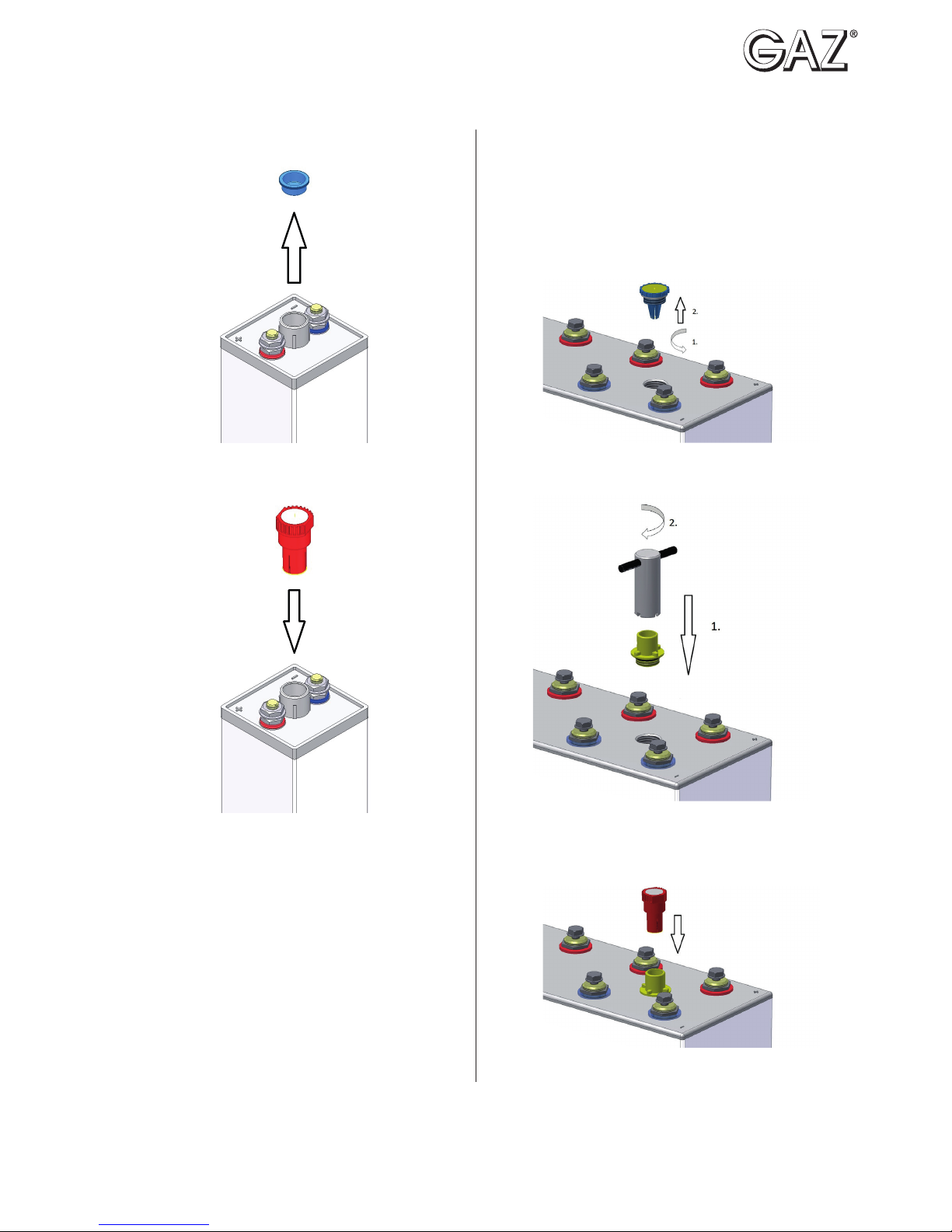
5
7. Removal of the Transportation Plugs and Fitting of Vent Caps
KGL 12-440 P
KGM 11-400 P
KGL 500-1570 P
KGM 450-1560 P
Step 1
(before commissioning charge)
Step 1
(before commissioning charge)
Step 2
(after commissioning charge)
Step 2
Step 3
(after commissioning charge)
Page 6
6
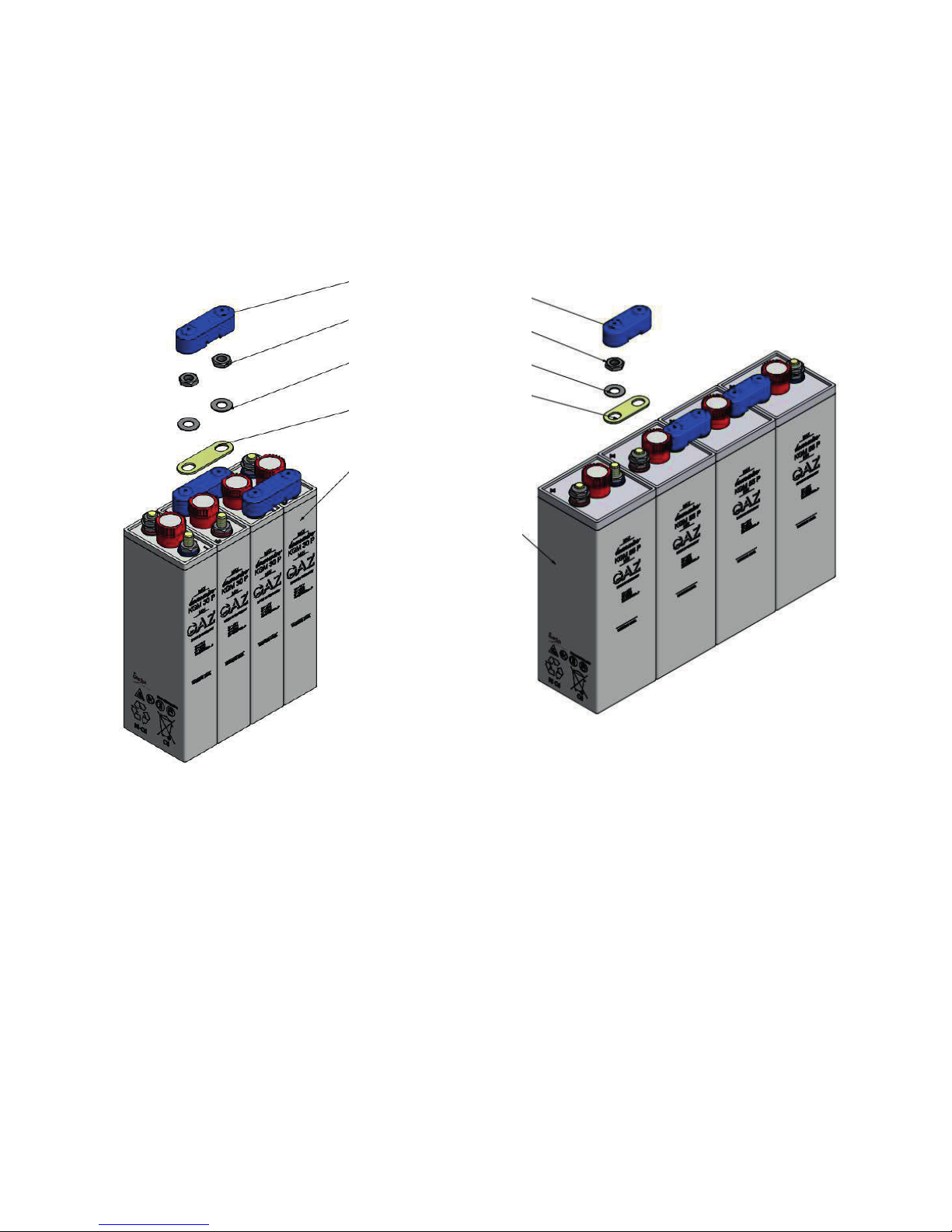
7. Design principals - Exploded view
KGL 12-35 P
KGM 11-30 P
KGL 45-60 P
KGM 40-55 P
1
2
3
4
5
Cell container
Cell connector
Spring washer
Hexagonal screw
Connector cover
1
2
3
4
5
Cell container
Cell connector
Spring washer
Hexagonal screw
Connector cover
KGL 45-60 P
KGM 40-55 P
Cell container
Cell connector
Spring washer
Hexagonal screw
Connector cover
Note, typical layout only. Refer to section 9 for details
KGL 12-35 P
KGM 11-30 P
1 Cell
2 Cell connector
3 Spring washer
4 Nut
5 Connector cover
8. Layout details: inter-cell connection
KGL 45-60 P
KGM 40-55 P
1 Cell
2 Cell connector
3 Spring washer
4 Nut
5 Connector cover
1
5
4
3
2
1
5
4
3
2
Page 7
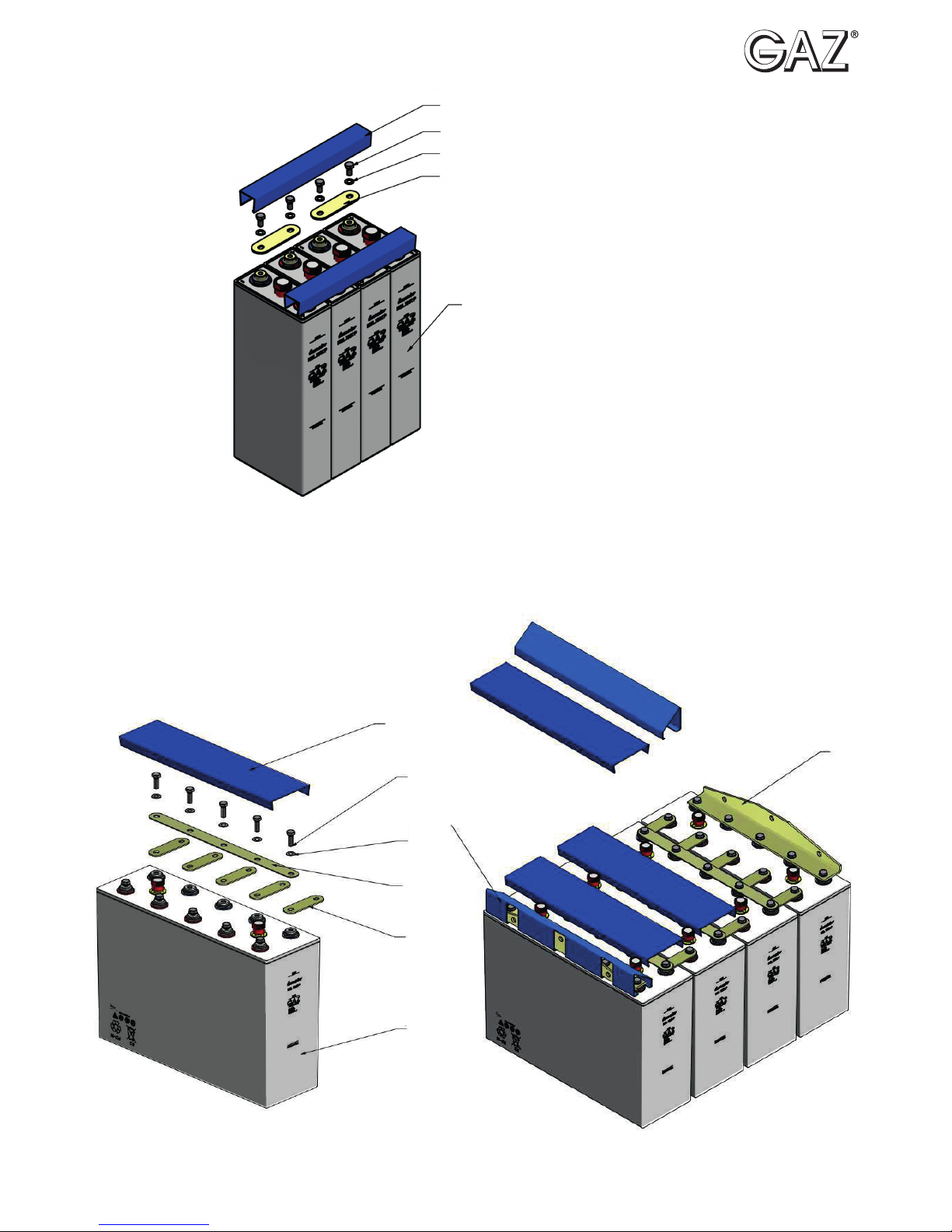
KGL 500-1570 P
KGM 450-1350 P
1 Cell
2 Cell connector
3 Terminal connector
4 Spring washer
5 Screw
6 Connector cover
7 End terminal connector
8 Cover end terminal
connector
7
Note, typical layout only. Refer to section 9 for details
KGL 70-440 P
KGM 65-400 P
1 Cell
2 Cell connector
3 Spring washer
4 Screw
5 Connector cover
1
5
4
3
2
1
5
4
3
2
6
7
8
Page 8
8
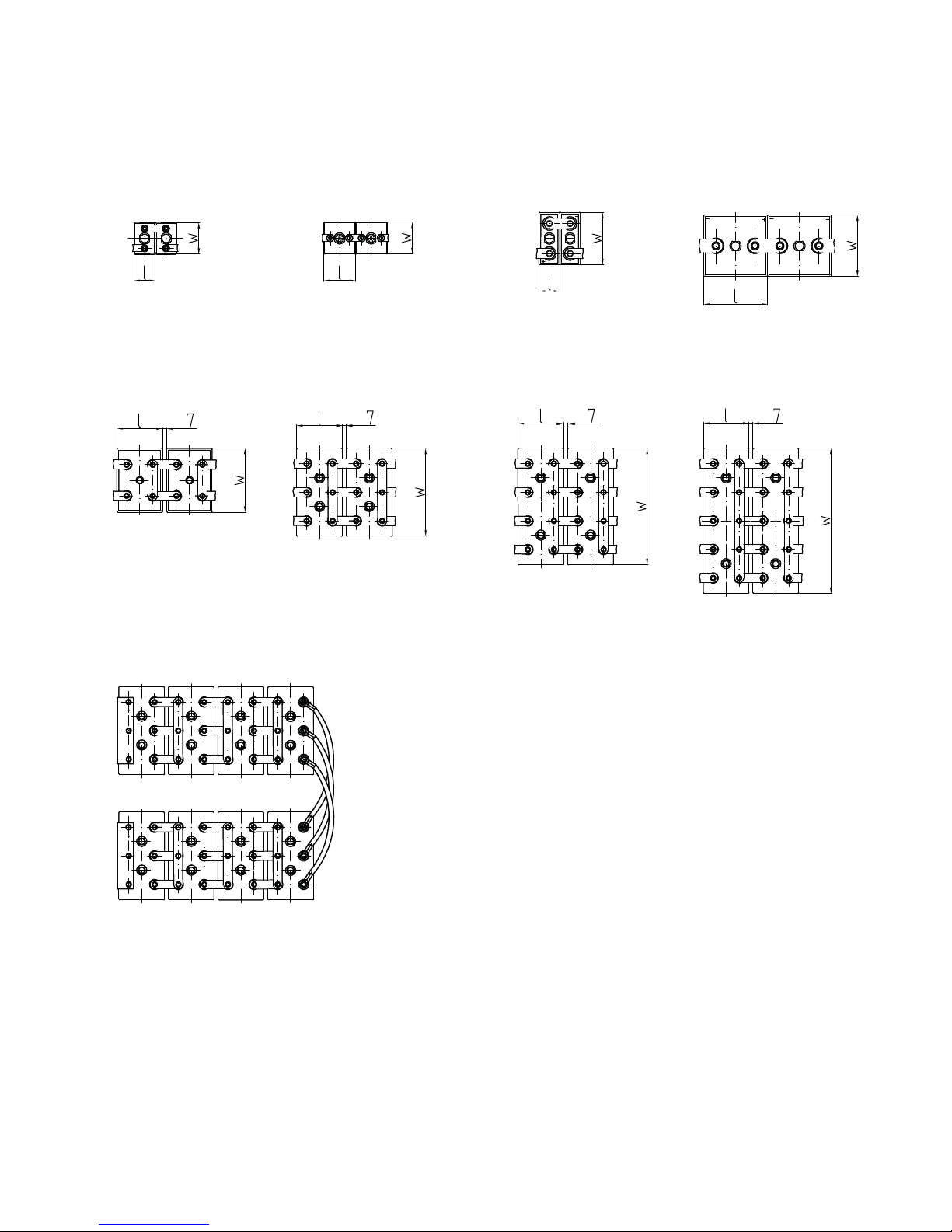
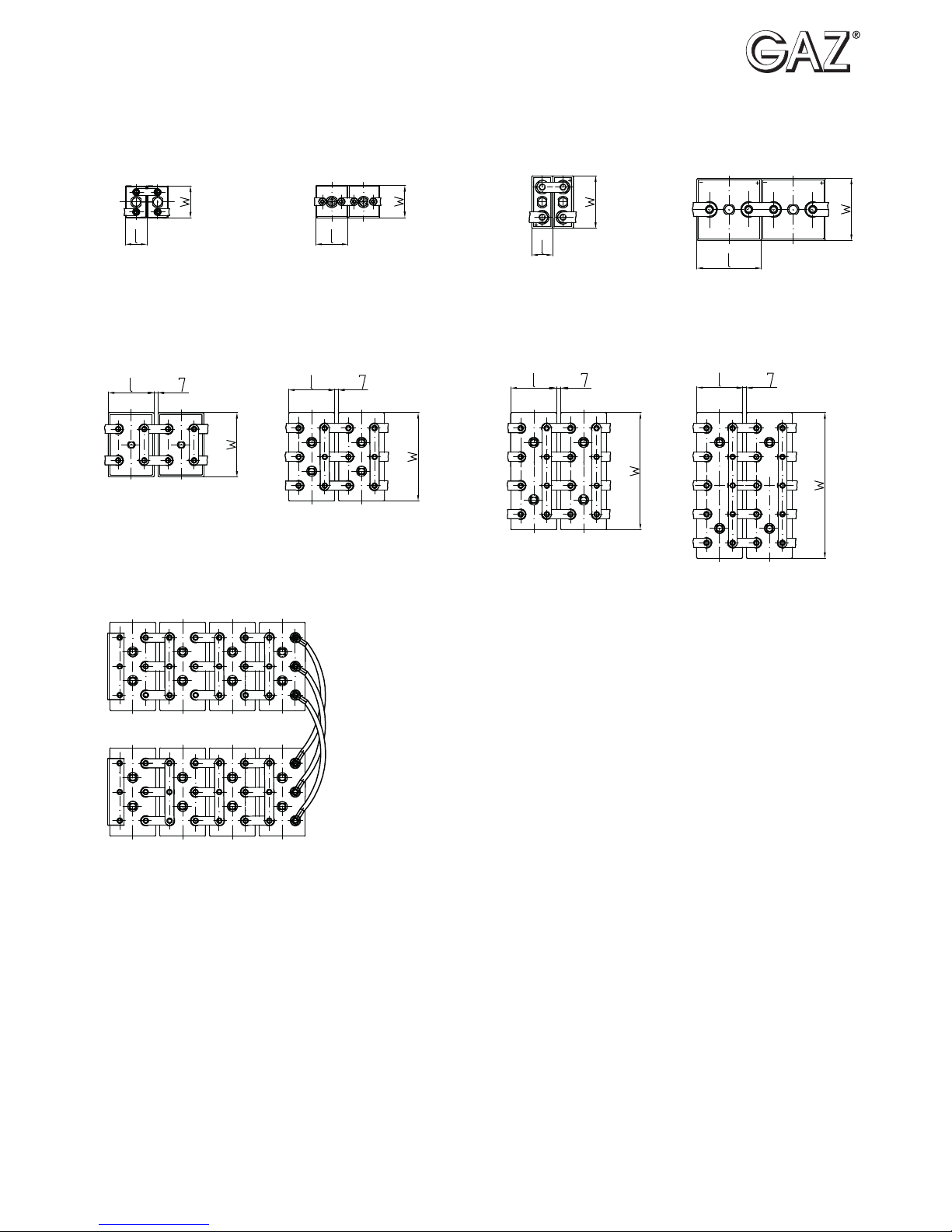
KGL...P
KGL 12 P - KGL 35 P
(Male thread M10)
KGL 500 P - KGL 645 P
(Female thread M10)
KGL 45 P - KGL 60 P
(Male thread M10)
KGL 665 P - KGL 835 P
(Female thread M10)
KGL 70 P - KGL 275 P
(Female thread M8)
KGL 890 P - KGL 1110 P
(Female thread M10)
KGL 300 P - KGL 440 P
(Female thread M10)
KGL 1260 P - KGL 1570 P
(Female thread M10)
Cells assembled in a 2 row
configuration
9. Cell Layout
Page 9
9
KGL...M
KGM 11 P - KGM 30 P
(Male thread M10)
KGM 40 P - KGM 55 P
(Male thread M10)
KGM 65 P - KGM 250 P
(Female thread M8)
KGM 270 P - KGM 400 P
(Female thread M10)
KGM 450 P - KGM 570 P
(Female thread M10)
KGM 600 P - KGM770 P
(Female thread M10)
KGM 800 P - KGM 1130 P
(Female thread M10)
KGM 1250 P - KGM 1350 P
(Female thread M10)
Cells assembled in a 2 row
configuration
Page 10
Publication No. EN-GAZ Iomain-IOM-004 - May 2017 - Subject to revisions without prior notice. E.&O.E.
EnerSys Asia
152 Beach Road
Gateway East Building #11-03
Singapore 189721
Tel: +65 6508 1780
EnerSys World Headquarters
2366 Bernville Road, Reading
PA 19605, USA
Tel: +1-610-208-1991 /
+1-800-538-3627
EnerSys EMEA
EH Europe GmbH
Baarerstrasse 18
6300 Zug, Switzerland
© 2017 EnerSys. All rights reserved. Trademarks and logos are the property of EnerSys and its affiliates unless otherwise noted.
Contact
 Loading...