

Page 1
BACKGAMMON
Players: 2
Equipment: 15 dark and 15 light color glass pieces (stones)
game board, dice, & doubling die
Object: Be the rst player to move all your stones around
the points on the game board to your home table (your inner
table) and “bear them off” (remove them from the game
board). Usually, several games are played, with the winner
of each game earning points–the rst to reach a score of 10
points wins the match.
belonging to the same player that may rest on one point.
A point housing two or more stones of the same player is
BLOCKED against an opponent, and his stones may not
land on that point, although it may be jumped. When a player
cannot move because of blocked points he loses the move.
Blots: A single stone resting on a point is a BLOT; an
opponent may land on the point and HIT the blot, which
sends it to the bar at the center of the board. A stone on the
Bar must start over on his opponent’s 1-point. This stone
on the Bar must reenter his opponent’s inner table before
making another move. He cannot enter on a blocked point.
Two or more blots may be hit in one play.
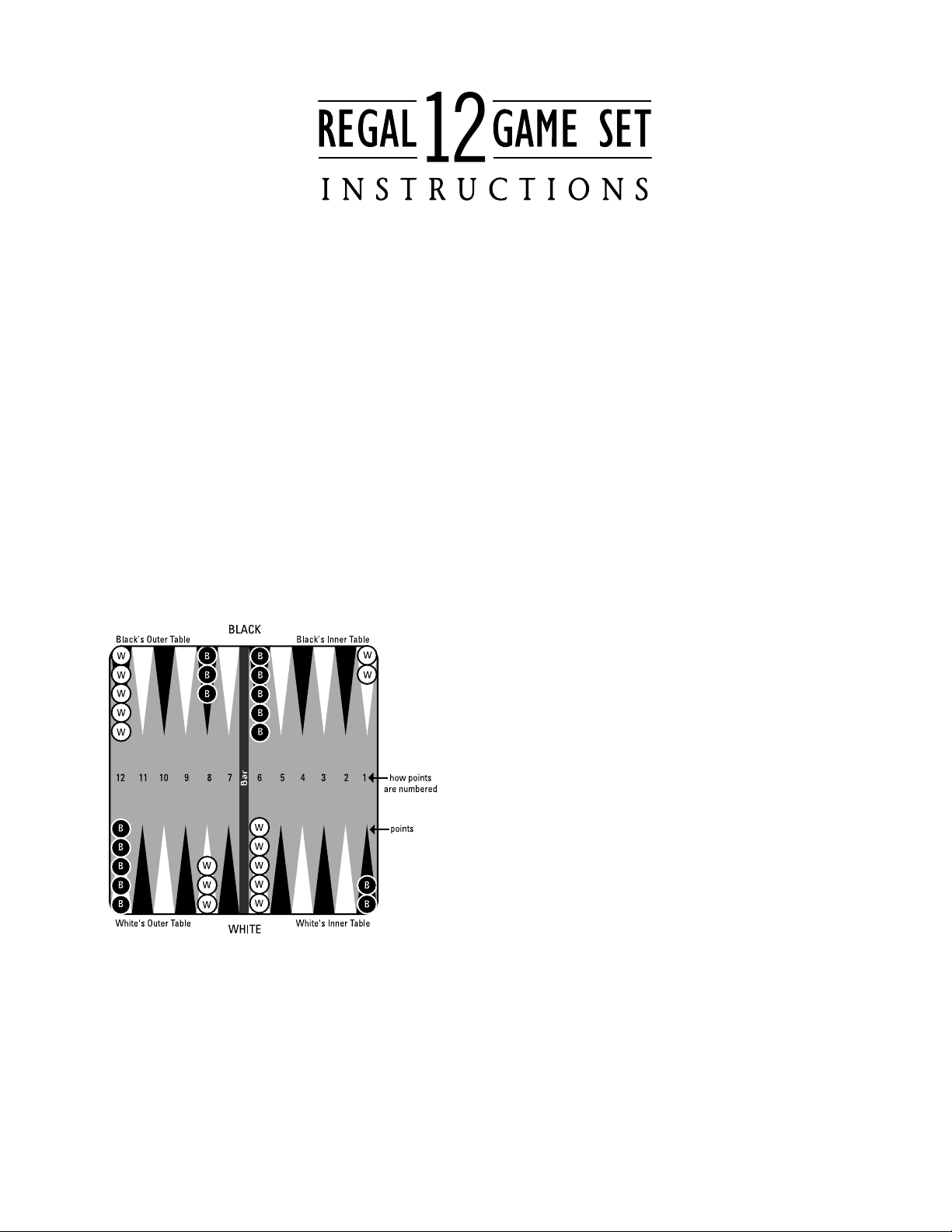
Set Up: 15 black tokens, 15 white tokens. Players choose
to be the black or white and then set up the game board as
shown below. The game tokens in backgammon are referred
to as “stones.” Each player rolls a die to determine who has
the rst move, ties are rerolled. The player with the highest
number will begin the game by using the two high numbers
of the dice that were just cast by himself and his opponent.
Moving Stones: Count begins on point next to one on
which a stone rests. In general, a player moves the stones
one at a time along the points in a loop that extends from
his opponent’s 1-point to his own 1-point. The opponent’s
stones travel in the opposite direction. Dice advance a stone
forward the rolled number of points and the stone comes to
rest at the base of the point. A player can move two stones,
one for each die, or a single token twice, once for each die.
A player can choose to use only one die, but it must be the
highest count die. If a player rolls doubles, they are doubled
again. (example: a 5-5 becomes a 5-5-5-5 which equals four
separate moves). There is no limit to the number of stones
Bearing Off: When either player succeeds in moving all of
his stones around the board to his inner table, he starts to
“bear off” (remove) stones from points corresponding to the
dice thrown. The player can either move a stone within his
inner table or bear it off. For example, a 1-2 that is rolled,
may be used to bear off a stone from the 1-point and the
2-point, or the player may choose to move a stone from the
3-point to the 6-point. When casting a number higher than
any point covered, a stone from the highest point may bear
off, but he cannot bear off a stone if the point indicated is
vacant and there is a stone on a higher counting point. If,
while bearing off, a token is HIT, the player’s stone goes to
the Bar and must reenter in the usual way. This stone must
travel all around the board to his inner table again before
more stones can be moved or taken off.
Doubling: The doubling cube (the die w/numbers) changes
winners’ scores dramatically; therefore, games are played
to 20 or 50 or more points. At the beginning of the game the
doubling die is neutral and is placed face up on the 64. At
any time during the game a player can turn it so that the 2
is face up and offer it as a “bet” to his opponent, raising the
stakes of the game. If the bet is accepted by the opponent,
the game is now worth 2 points to the winner (instead of the
standard 1 point). If the opponent rejects the bet, he forfeits
the game and his opponent earns 1 point. If the opponent
accepted the bet, he now has the right to double the bet to a
4 later in the game and in turn, the opponent must choose to
accept or forfeit. This scenario may continue indenitely but
there are usually not more than four or ve in any game. The
points increase as follows: 2,4,8,16,32, etc.
Gammon/Backgammon: The winner of the game is the
rst player to remove all his stones from the board. If the
loser has not borne off any of his stones, it is called a
GAMMON and the stakes of the game are doubled. If the
loser still has stones on the winner’s home table, it is called
1
Page 2

3
a BACKGAMMON and the game stakes triple. This includes
stakes raised by doubling.
CHECKERS
Players: 2
Equipment: 12 white & 12 black wooden pieces, game
board
Object: Capture all you opponent’s tokens.
Setup: Place the game board so that there is a dark square
to the left of each player. Using the black and white tokens,
each player places four tokens on the rst three rows or dark
squares i.e.. 12 tokens per player. Black always starts, and
play is only on the white squares.
Game play: A token moves diagonally one square at a time,
forward–not backward. If a token reaches the far side of the
board it becomes a king (stack two playing pieces to indicate
a king) and can now move diagonally in any direction. A
token may also “leap-frog” over another token if there is
a vacant square beyond and if the other token belongs to
the opponent. The jumped token is removed from the board
(captured). If a player fails to capture an opponent’s token
the opponent’s token may on his next turn remove the
offending token. This does not count as his move.
Winner: Play continues until one player wins by capturing all
of his opponent’s tokens, or a draw is declared.
CHESS
Players: 2
Equipment: 16 white & 16 black chess pieces, game board
second row in front of these chess pieces.
Game Play: The pawns can only move forward. For the rst
advance from its initial square on the second rank, the pawn
has the option of moving one or two squares, but thereafter
may move only one square at a time. The rook moves only
on the ranks and les any distance and the bishop moves
only on the diagonals. The queen can move in any direction.
The knights are the only pieces which are able to change
direction during the course of a move and “jump over” one’s
own or one’s opponent’s pieces; a knight takes one step of
one single square along the le or rank and then, still moving
away from the square that it has left, takes one step along
the diagonal. The king may move in any direction, one step
at a time.
All pieces start from the pawns in the normal direction of
movement described above. However, the pawns which
normally only move in a straight line, may only capture
diagonally to the front, left or right and only while moving
forward. It is not obligatory to capture your opponent. If the
king is threatened, check must be given (the player must
declare check). The opponent is then obliged to protect his
king by moving the king to another square or moving one
or his own pieces between it and the threatening token or
capturing the opposing attacker. If he is unable to make any
of the above moves, the king is said to be checkmated and
the game ends is favor of the opponent.
Castling: Castling is a compound move of the king and one
rook (formally called ‘castle) that may be made, if at all, only
once in a game. It is legal if neither the king nor the rook
has yet moved. If all the squares between them on the rank
are vacant, and no adverse piece commands two squares
nearest the king on the side on which castling is to be carried
out, and if the king is not in check. The move is executed
by moving the king two squares towards the rook and then
placing the rook on the square passed over by the king.
Setup: Lots are drawn to establish who has the white
chessmen and, thus, who can move rst. This player is then
allotted the 16 white chess pieces and the other player the
16 black chess pieces. The board is positioned so that each
player has a dark corner square on his left. The rooks are
positioned on the two corner squares to the left and right.
Next to these come the two knights, one on the left and
one on the right. Next to these come the two bishops and in
the center, the queen and king. The white queen is always
positioned on a light square and the black queen on a dark
square. The eight pawns are then placed adjacently in the
CHINESE CHECKERS
Players: 2-6
Equipment: 60 colored pegs (10 in each color), game board
Object: Be the rst player to move all of your pegs to the
triangle opposite your starting triangle on the game board.
Setup: Each player chooses 10 pegs of the same color
and places them in the triangle of the star nearest him. The
2
Page 3
colors of the pegs do not have to match the color of the point
they are placed in, but it is helpful.
Game play: The youngest player begins, and play moves to
the left in a clockwise rotation, with each player making one
move at a time. A peg may move in any direction as long as
it follows the lines of holes on the game board. A player may
jump over a peg, providing there is an empty space opposite
the jumped peg. A player may jump more than one peg only if
there is an empty space opposite each peg jumped. Players
may play as partners or against each other. No player can
refuse to move out of his starting triangle to prevent another
player from winning.
Winner: The rst player to successfully move all of his pegs
into the opposite triangle wins the game.
ELIMINATION
Winner: The rst player’s piece to reach circle “12” is the
winner.
HYSTERIA
Players: 1
Equipment: 4 each of two different color wood or glass
different game pieces (total of eight), pair of dice
Game Play: Place one color of pieces on circles #1 through
#4. Place the other four pieces on the circles #7 through #10.
Circles #5 & #6 will be left empty. By jumping pieces, one at
a time (forward only), or by moving pieces forward, player
tries to get pieces to the opposite ends of the game board.
If the player is successful, the nished game board will have
pieces in opposite positions of the starting game board.
Players: 1
Equipment: 10 wood or glass game pieces, pair of dice
Game Play: Place a game piece on each circle. Roll the dice
and remove the pieces corresponding to the total of the dice
or any combination that adds up to the total. For example, if
you roll a two and a three on the dice, you may remove the
pieces on the #2 circle and the #3 circle or the #5 circle (the
sum of the two dice). At least one piece must be removed
after each role to continue. Remove all the pieces to win!
HORSE RACE
Players: 2
Equipment: 2 wood or glass different colored game pieces,
pair of dice
Game Play: Roll dice to determine which player starts. High
roll goes rst. Each player chooses a game piece and places
it on the “start.” A player must roll a two on one die or in the
sum of the two dice to advance to the circle marked “2”. For
circle “3”, the player must roll a three on one of the dice or
in the sum of the two dice. Player 1 continues in this way
until he is unable to consecutively roll the correct number.
Player 2 then tries to advance his game piece around the
track by rolling the dice in the same manner as player 1. If
a player lands on an opponent’s game piece, the opponent
goes back to start.
MANCALA
Players: 2
Equipment: 48 glass game pieces (“stones”), game board
Object: Collect the most stones in your Mancala before one
player’s bins are empty.
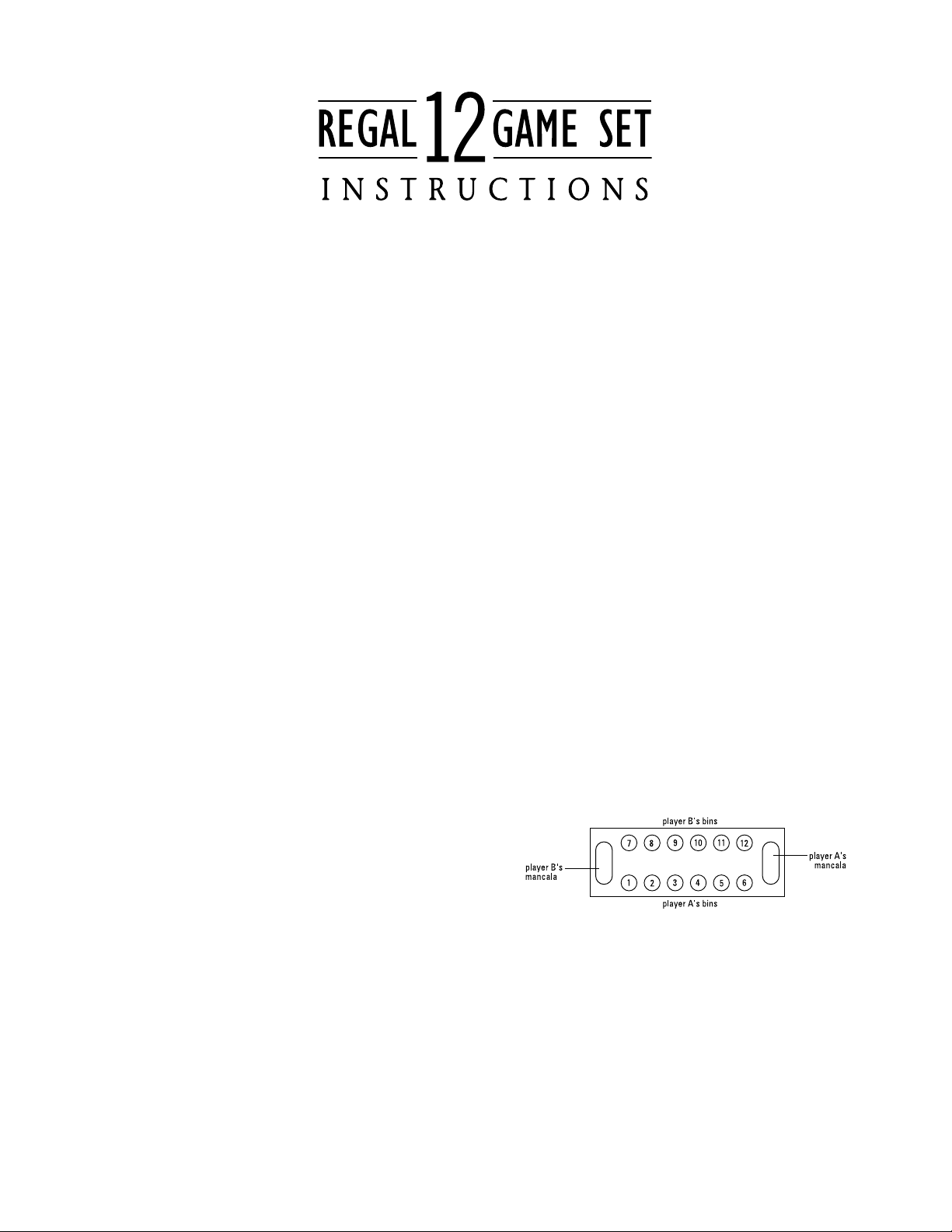
Set-up: Place four stones in each of the bins numbered 1
through 12 as shown in the diagram below.
Game Play: Player A’s bins are those numbered 1-6. Player
B’s bins are those numbered 7-12. Decide which player will
play rst by the ip of a coin. The rst player then picks up
all of the stones in one of the bins on his side of the game
board. For example, Player A would pick-up the stones in
any of the bins numbered 1-6. The player then proceeds
by placing one stone at a time in each of the adjacent bins
counter-clockwise around the board.
If the last stone is placed in a player’s own Mancala, then
he gets a second turn. A player never places a stone in an
opponents Mancala, it is always skipped. Remaining stones
are placed in the following adjacent bins. For example,
3
Page 4
5
player A picks up eight stones from bin #6, then he places a
stone in his Mancala and then bins #7, 8, 9, 10, 11, 12. He
then skips his opponent’s Mancala, and places the remaining
stone in bin #1. If the last stone of a player’s turn lands in
an empty bin on his side of the game board, then the player
gets to collect all the stones in his opponent’s bin which is
directly opposite, as well as the single stone placed in his
own bin. These collected stones are placed in his Mancala.
Players may not touch the stones to count them and once a
player has touched the stones, he must play them.
Winner: Play ends when one player’s six bins are empty.
The other player then places all remaining stones from his
bins into his own Mancala. (the player who ends the game
does not always win!) Players then count all the stones in
their Mancalas. The player with the most stones wins the
game.
MILL
Players: 2
Equipment: 9 light colored game pieces, 9 dark colored
game pieces, game board
TIMBER TUMBLE
Players: 2 or more
Equipment: 48 rectangular blocks
Object: Remove the blocks one at a time, but don’t make
the tower tumble!
Set-up: Place three blocks next to each other, with a space
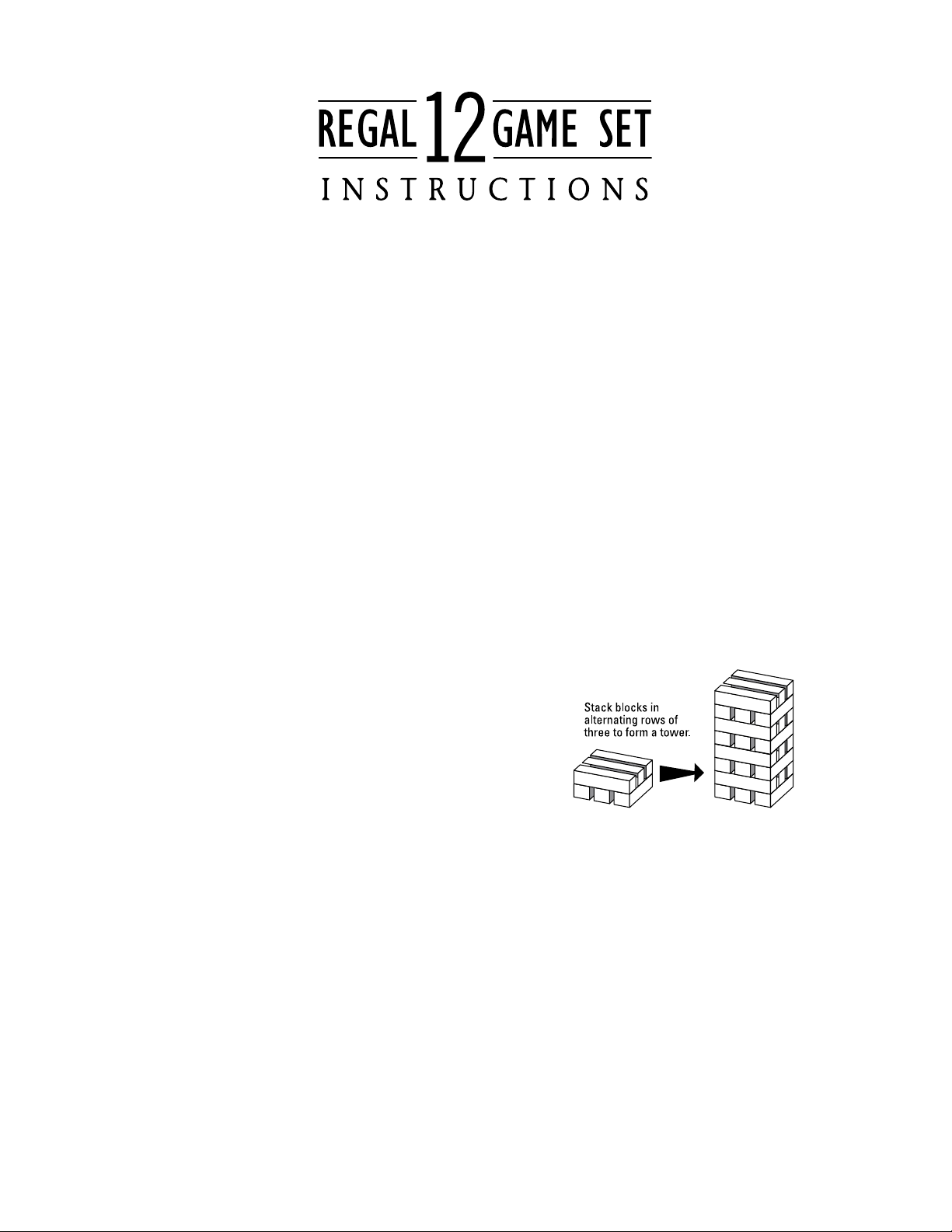
between them. Then place three more blocks on top of the
rst three, but in the opposite direction. (See diagram) Keep
building the pile until all of the blocks have been used.
Game play: The youngest player goes rst, and play
continues to the left, with each player taking his turn by
removing a block and placing it onto the top of the tower. The
placed block should be laid in the same crisscross pattern
that the tower was built. Players may use only one hand to
remove and place blocks. Players may touch a block to see
if it is loose. If the block is moved and it is not placed onto
the top, it must be returned to it’s original position. Players
should be careful to not make the tower tumble!
Object: Be the rst player to reduce your opponent to two
game pieces on the game board.
Set-up: Each player chooses the color of game pieces he
will play with (light or dark). Players then take turns placing
the their pieces one at a time, on the game board with the
intention of setting up a “mill” (a mill is three of one player’s
game pieces in a row).
Game Play: After all playing pieces are placed on the board,
players move their pieces one space at a time to try to get
additional “mills.” When a player gets a “mill,” he removes
one of his opponent’s game pieces from the game board and
sets it aside. Players are not allowed to take a playing piece
from a already created “mill.”
Winning: The winner is the rst player to reduce his
opponent to two playing pieces on the game board.
Winner: The winner is the last player to successfully place
a block on top of the tower without making it tumble. When
the tower tumbles on a player’s turn, the preceding player
wins the game.
TIC TAC TOE
Players: 2
Equipment: 5 light (O’s) and 5 dark (X’s) color stones, game
board
Object: Be the rst player to get three game pieces in a
row.
Set-up: The X player begins game by placing X-token on
any of the nine squares. Then the O player does the same.
4
Page 5
The game alternates between X and O players placing
tokens on the game board.
Winner: The rst player to line three of their tokens in a
row either vertically, horizontally or diagonally, wins. Should
neither player complete this, game ends in a tie.
TRICKY TRIANGLE
Players: 1
Equipment: 14 game pieces, game board
Object: Remove as many game pieces as possible.
Set-up: Arrange pieces on circles so that all but one circle is
covered by a game piece.
Game Play: Jump game pieces one at a time. Game pieces
must be adjacent to one another to jump or be jumped.
When a game piece is jumped by another game piece, it
must land in an empty circle on the other side of the jumped
game piece. The game piece that is jumped is then removed
from the board. Continue to do this, until no other game
pieces are able to be jumped. Count the number of game
pieces left on the game board. See the chart do determine
score. Try to have only one game piece left! Players may
play one another by taking turns playing and calculating the
score for each round.
1 piece left......1000 pts.
2 pieces left..... 500 pts.
3 pieces left..... 250 pts.
4 pieces left..... 100 pts.
©2002 Fundex Games, Ltd. • P.O. Box 421309 • Indianapolis, IN 46242 • Questions or comments? Write to us at the address above,
call 1.800.486.9787 or email [email protected] • www.fundexgames.com • MADE IN CHINA
5
 Loading...