

Page 1
This symbol on the product or in the instructions means that your electrical and electronic equipment should be disposed
at the end of its life separately from your household waste. There are separate collection systems for recycling in the EU.
For more information, please contact the local authority or your retailer where you purchased the product.
Page 2
How to use your new
Model MCF98 - MCF145 - MCF205
Chest Freezer
Page 3
GETTING TO KNOW YOUR CHEST FREEZER
Location
Levelling the Freezer
Make sure the Freezer is level. If the Freezer is not level, the lid and
.
Cleaning before use
Wipe the inside of the Chest Freezer with a weak solution of bicarbonate of soda. Then rinse with warm
water using a ‘wrung-out’ sponge or cloth. Wipe completely dry before replacing the basket. You could
clean the Freezer externally with wax polish. If you require more information refer to ‘Cleaning inside
the Freezer’ on page 6.
Before plugging in YOU MUST
Check that you have a socket which is compatible with the plug supplied with the Chest Freezer. If not,
8egap no SNOITCENNOC LACIRTCELE dellac noitces eht ees
Before switching on!
DO NOT SWITCH ON UNTIL TWO HOURS AFTER MOVING THE FREEZER.
The coolant
needs time to settle. We recommended you read the section called SAFETY on pages 9.
Before using your Freezer
Before placing frozen foods in your Chest Freezer, turn the Freezer on and wait for 24 hours, to make
sure it is working properly and to allow the Freezer to fall to the correct temperature.
Your Freezer
should not be
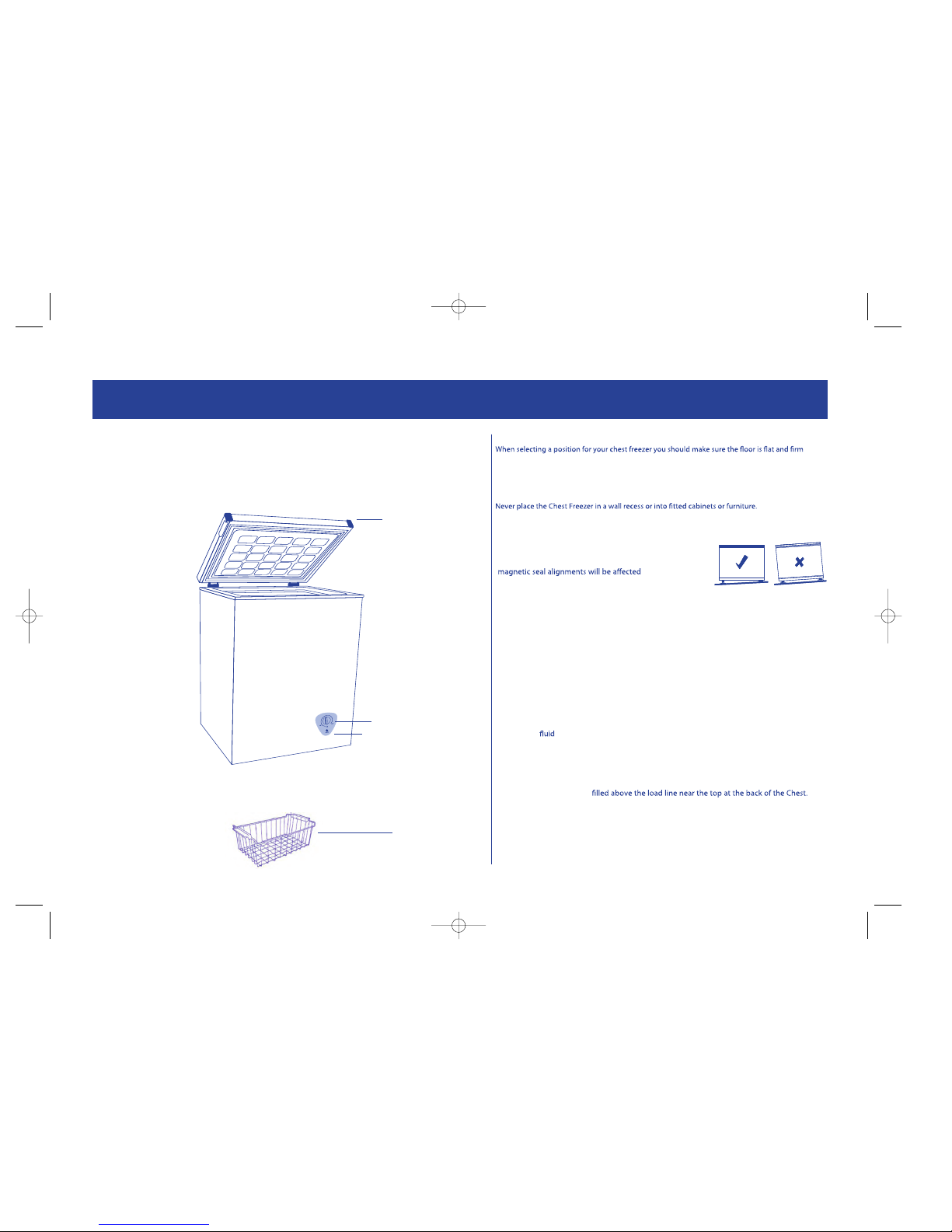
Freezer Basket
The Basket is designed to be placed inside the
Freezer.
FREEZER CHEST LID
CONTROL PANEL
BASKET
Before use
Please read all instructions carefully before using your new Fridgemaster Chest Freezer. For
indoor and domestic use only.
Please keep these instructions in a safe place for future reference.
2
POWER ON LIGHT
GETTING TO KNOW YOUR CHEST FREEZER
and the room is well ventilated with an average room temperature of between 16ºC and 32ºC.
Avoid locating your Chest Freezer near a heat source, e.g. cooker, boiler or radiator.
Also avoid direct sunlight. If you are placing your Freezer in a outer building such as a garage or annex
ensure that the Chest Freezer is placed above the damp course, otherwise condensation will occur
on the Chest Freezer cabinet.
When your Chest Freezer is working the sides will become warm. It must therefore be installed so
that there is 10cm of free space at the back of the Chest Freezer and 5cm at the sides.
Do not drape the Freezer with any covering .
Page 4
USING YOUR CHEST FREEZER
Operating instructions
Switching on your Freezer
1 As soon as the Freezer is plugged in the Orange power light, on the control panel, will glow.
2 Allow 24 hours for the Chest Freezer t o reach the set temperature, see adjusting the temperature.
Noises inside the Freezer!
If you have not owned a freezer before, you may notice that it makes some rather unusual noises. Most of these are
perfectly normal, but you should be aware of them!
GURGLING, WHOOSHING
These noises are caused by the circulation of the refrigerant liquid in the cooling system. It has
become more pronounced
HUMMING, PURRING OR PULSATING
This is the compressor motor working, as it pumps the refrigerant around the system.
Is the Freezer cold enough?
A few days after you start using your Freezer you may wish to check that it is running at the correct temperature.
You will need a special Freezer thermometer available from most supermarkets and hardware shops.
The temperature should be -18˚C or lower.
Indicator Lights
ORANGE - MAINS POWER ON
This light glows continually when
electricity is being supplied to the Freezer.
If the light goes out, check:
• That the plug has not been removed
accidentally.
• That the switch on the electricity socket
is turned on.
• That the fuse in the plug has not blown.
Try another household appliance, such
as a lamp, in the socket.
If all the above are in order, the orang e
lamp bulb may have blown. Call your
Customer Service Department if this is
the case.
USING YOUR CHEST FREEZER
3
since the introduction of CFC free gases. This is not a fault and will not affect the performance of your freezer
Adjusting the temperature
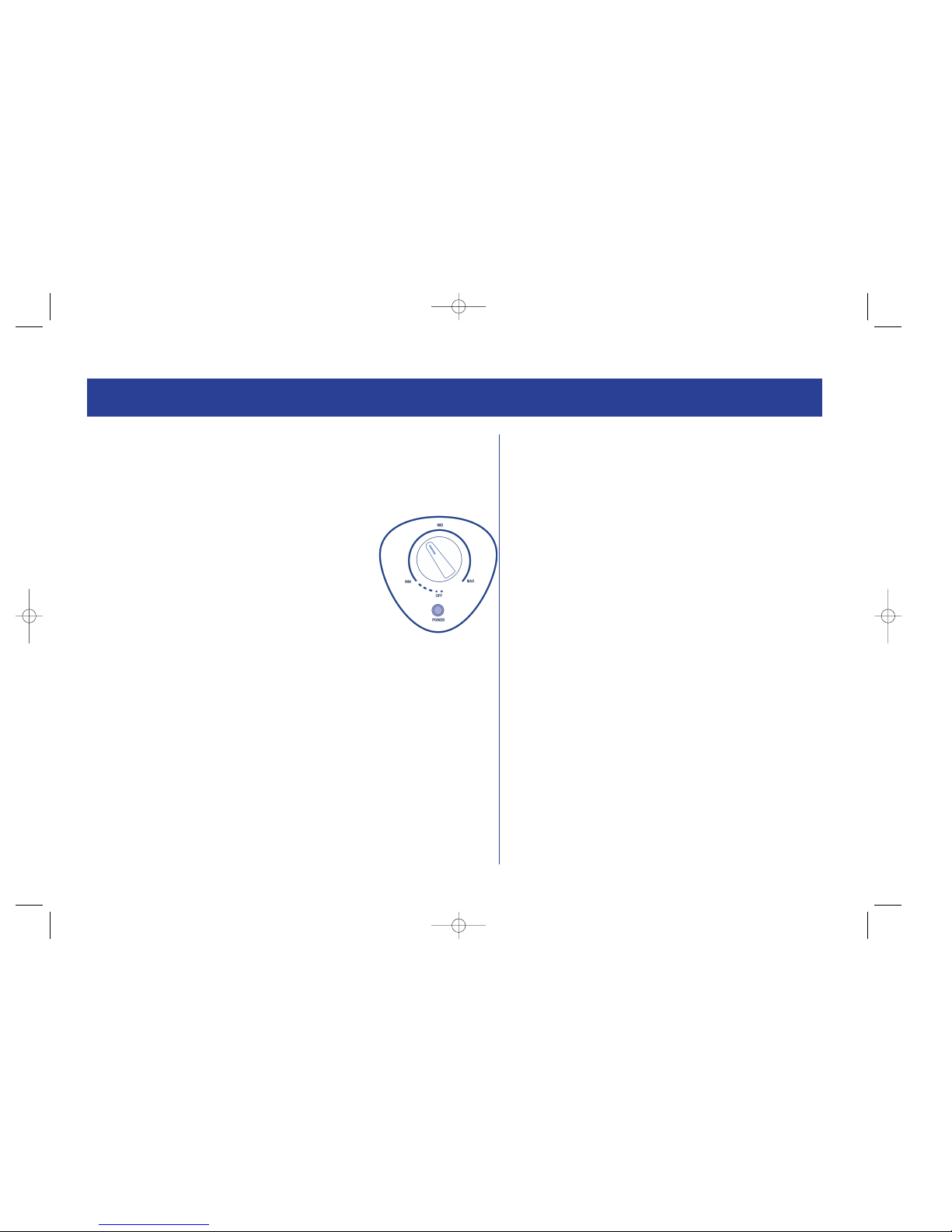
The internal temperature of your appliance is controlled by a Thermostat.
Max position makes the apppliance colder and it s used for fast freezing
The recommended position is between MID but should be adjusted according
to its environment. The appliance may not operate correctly if it is in a particularly hot or
cold room or if the lid is opened often or for prolonged periods.
‘
Page 5
Freezing Fresh Foods
Useful tips
Use quality food and handle it as little as possible.
Freeze food in small quantities, it freezes faster, takes less time to thaw
and enables you to eat it in the quantity you need.
When freezing fresh foods do not place them in contact with already
frozen foods.
Freezing fresh foods
First, estimate the amount of food you will be freezing.
Turn the thermostat to Max. It will therefore freeze quicker and keep
in the goodness.
However you should use it sparingly to conserve energy.
What not to Freeze
Bananas, Pomegranates or Pears. Carbonated liquids should never be
frozen.
USING YOUR CHEST FREEZER
To Thaw
1 Cover food loosely.
2 Thaw at room temperature. Don’t forget that thawing in a warm area
encourages the growth of bacteria.
3 Always make sure there are no ice crystals in the food before cooking,
particularly with meat. These crystals indicate that the food is not fully
thawed. They result in lower temperatures when cooking. Lower
cooking temperatures may not destroy dangerous bacteria.
4 Cook food as soon as possible after thawing.
5
Oven Thawing
Many microwaves and ovens have thaw settings.
To avoid bacterial build up, only use these if you intend to cook the food
immediately afterwards.
Safety Tips
• Never re-freeze anything that has thawed out unless you cook it
•
Useful Tips
• Re-seal packs properly after removing items. This prevents drying or
‘freezer burn’ and a build up of frost on any remaining food.
Shopping for frozen foods
Your Freezer is 4 star
When you are buying frozen food, look at the Storage Guidelines on the
packaging. You will be able to store each item of frozen food for the
period shown against the 4 star rating. This is usually the period stated as
‘Best Before’, on the front of the packaging.
Check the freezer temperature
Check the temperature of the frozen food cabinet in the shop where you
buy your frozen foods. It should show a temperature lower than -18°C.
Choose packs carefully
Take a quick look at the frozen food package and make sure it is in
perfect condition.
Purchase frozen food last
Always buy frozen products last on your shopping trip or visit to the
supermarket.
Keep frozen foods together
When you are going around the supermarket and when you are travelling
home, if you keep all the fr ozen foods together they will help to keep
each other cold.
Store food straight away
Don’t buy frozen food unless you can freeze it straight away. Special
insulated bags can be bought from most supermarkets and hardware
shops. These keep frozen food cold for longer.
Thawing frozen food
For some foods, thawing before cooking is unnecessary. Vegetables and
pasta can be added directly to boiling water or steam cooked. Frozen
sauces and soups can be put into a saucepan and heated gently until
thawed.
4
Drain off and throw away any liquid lost during thawing.
again, to kill off harmful bacteria.
Never re-freeze thawed shellfish.
TO FREEZE MAX SETTING
A loaf of bread not required
A small casserole
MODELL MCF98 24 hrs. before placing food in freezer
and 24 hrs. after placing food in freezer.
24 hrs. before placing food in freezer and
24 hrs. after placing food in freezer.
and 24 hrs. after placing food in f
reezer
MAX
MODELL MCF145
MAX
MODELL MCF205
MAX
24 hrs. before placing food in freezer
IMUM OF 13KG
IMUM OF 9.5KG
IMUM OF 15KG
Page 6
USING YOUR CHEST FREEZER
Label everything
•
Many foods look the same when frozen, so careful labelling will help
avoid forgetting what an item is. Storage times being exceeded could
cause food poisoning.
• You can buy special freezer tape for use in low temperatures. This
tape is available in white, so you can use it to write the items
contents on. You can buy special freezer labels and pens. Labels
vegetables green.
• Write the contents and date.
If you are really organised add the weight and notes on cooking such
what is in each drawer.
This will save opening the lid and searching around unnecessarily.
Preparations for freezing
• Leave cooked food to cool completely.
• Chill food in a fridge before freezing if possible.
• Consider how you want to cook the food before freezing it.
• Don’t freeze food in metal containers if yo u may want to microwav e
it straight from the Freezer.
•
polythene bags, plastic containers, aluminium foil (heavy grade only,
if in doubt, double wrap).
Don’t use aluminium foil for acidic foods (such as citrus fruits) Don’t
• Exclude as much air from the container as possible. You could buy a
special vacuum pump which sucks excessive air
out of the packaging.
• Leave a small amount of ‘air space’ when
freezing liquids, to allow for expansion.
• You can use the space in the freezer most
with liquids, such as stew) in square blocks.
This is known as ‘preforming’.
Pour the liquid into a polythene bag
which is inside a square sided
container. Freeze it like this, then
remove it from the container and seal
the bag.
Recommended Storage Periods
(when frozen from fresh)
Fruit Syrup or Sugar packed Fruit up to 12 months
Open Frozen or Puréed Fruit up to 18 months
Fruit juices up to 6 months
Beef up to 12 months
Lamb up to 9 months
Veal up to 6 months
Pork up to 6 months
Minced meat up to 3 months
Cured meats up to 2 months
Sausages up to 3 months
Packed bacon up to 3 months
Smoked bacon/ chops/ gammon steaks up to 2 months
Unsmoked bacon/ chops/ gammon steaks up to 1 month
Chicken up to 12 months
Duck up to 5 months
Goose up to 5 months
Turkey up to 6 months
up to 3 months
up to 2 months
Smoked salmon up to 3 months
Caviar don’t freeze
up to 1 month
Butter up to 6 months
Cheese up to 9 months
Cream - double/ whipping up to 3 months
Eggs - only freeze separated up to 6 months
Suet up to 6 months
Milk up to 1 month
Yogurt up to 6 weeks
5
Page 7
MAINTENANCE
Defrosting
After a period of time frost will build up in certain areas, for example, on the
sides and just below the lid. As a temporary measure, this frost should be
scraped away using a plastic scraper. NEVER use metal or sharp instruments.
Move existing foods to one side of the cabinet, scrape
and remove the
frost, then move your foods back in order to gain a ccess to the other side.
Complete defrosting will however, become necessary, approximately twice
per year, or if the frost layer exceeds 2-5cm (1-2”) to maintain the
running times and costly energy consumption.
This should be carried out if the frost build up cannot be scraped away, or
if it begins to interfere with the food storage. Choose a time when the
stock of frozen food is low and proceed as follows:
Cleaning inside the Freezer
You should clean the Freezer internally with a weak solution of
bicarbonate of soda. Then rinse with warm water using a ‘wrung-out’
sponge or cloth. Wipe the Freezer dry before replacing the basket.
Cleaning the outside of the Freezer
Use standard furniture polish to clean the Freezer exterior. Make sure that
the Lid is closed, to prevent polish getting on the magnetic lid seal or
inside.
The grille of the condenser at the back of the Freezer and the adjacent
components can be vacuumed using a soft brush attachment.
Troubleshooting
Power cut
If you have a freezer thermometer, place it in the Freezer where you can
get easy access to it to read when the power returns. If the internal
temperature is -18°C or less when the power returns, your food is safe.
The food
in your Freezer will remain frozen for approx 12 hours with the
lid closed. If you know the power is going to be cut, turn the thermo stat
to MAX 24 hours before, this will make the Freezer colder than
normal. If there is no warning, turn the thermostat to MAX after the
power cut. Don’t open the lid more than necessary.
The Freezer is particularly cold
You may have accidentally turne d the thermost at to Max.
The Freezer is particularly warm
The compressor may not be working. Turn the thermostat t o Max. If
there is no humming noise, it is not working.
Call your Customer Service Department.
The Freezer is not working
Check it is plugged in and switched on. Check that the fuse in the plug
has not blown. Plug in another appliance, such as a lamp, to see if the
socket is working.
Condensation appears on the outside of the Freezer
This may be due to a change in the room temperature or by being placed
the problem continues call your Customer Service Department.
1
leave the lid open. Ideally the frozen food should be put into another
several sheets of newspaper or large towels and then a thick rug or
blanket and keep it in a cool place.
2 Scrape away as much frost buildup as possible using a plastic scraper.
Thawing of the remainder can be speeded up by placing bowls of hot
water inside the cabinet and closing the lid. As the solid frost loosens,
prize it away with a plastic scraper.
3 When defrosting is completed,clean your Chest Freezer as
described in ‘Cleaning inside the Freezer’
6
efficiency of the Freezer. Excessive frost build up results in increased
Take out the frozen food, turn the Freezer off at the mains supply and
Freezer or refrigerator. If this is not possible wrap the food, firstly in
in a location without a dampcourse. Wipe off any residue of moisture. If
Page 8
TECHNICAL SPECIFICATIONS
Moving your Freezer
Location
Do not locate your Freezer near a heat source, eg. cooker, boiler or
radiator. Also avoid direct sunlight .
Levelling the Freezer
Make sure the Freezer is level.
If the Freezer is not level, the lid and magnetic seal alignments will be
Do not turn on the Freezer for 2 Hours
After the Freezer is in place it needs to be left for 2 hours. The coolant
Installation
Warning - do not cover or block vents or grilles of your appliance.
Servicing
Repairs and maintenance of the appliance should only be performed by an
authorised technician
7
MAINTENANCE
Model MCF98 MCF145 MCF208
Rated Voltage 220-240 220-240 220-240
(V)
Rated Frequency 50 50 50
(Hz)
Gross Volume
(Litres) 99 146 206
(Cubic Feet) 3.50 5.16 7.28
Freezing Capacity (kg/24 Hours) 9.5 13 15
Star Rating 4 Star 4Star 4 Star
Weight 27 31
36
(kg)
Product Dimension h/w/d 83.6/56.3/52.6 82.5/72.6/56.2 83.0/94.6/57.6
(cm)
Sound Decibel Rating 45 45 45
(dB[A]
Refrigerant R600a R600a R600a
The policy of Fridgemaster is one of continuously seeking new ways
of improving its products. Therefore the Company reserves the right to
change the specification of items illustrated and described, at any time.
Page 9
8
Disposal
Old appliances still have some residual value. An environmentally friendly
method of disposal will ensure that valuable raw materials can be
recovered and used again. The refrigerant used in your appliance and
insulation materials require special disposal procedures. Ensure that none
of the pipes on the back of the appliance are damaged prior to disposal.
Up to date information concerning options for disposing of your old
appliance and packaging from the new one can be obtained from your
Locks
entrapped keep the key out of reach and not in the vicinity of the
appliance.
as a safeguard.
THIS APPLIANCE MUST BE EARTHED.
and carefully disposed of. To avoid a possible shock hazard, do not insert the
discarded plug into a socket
.
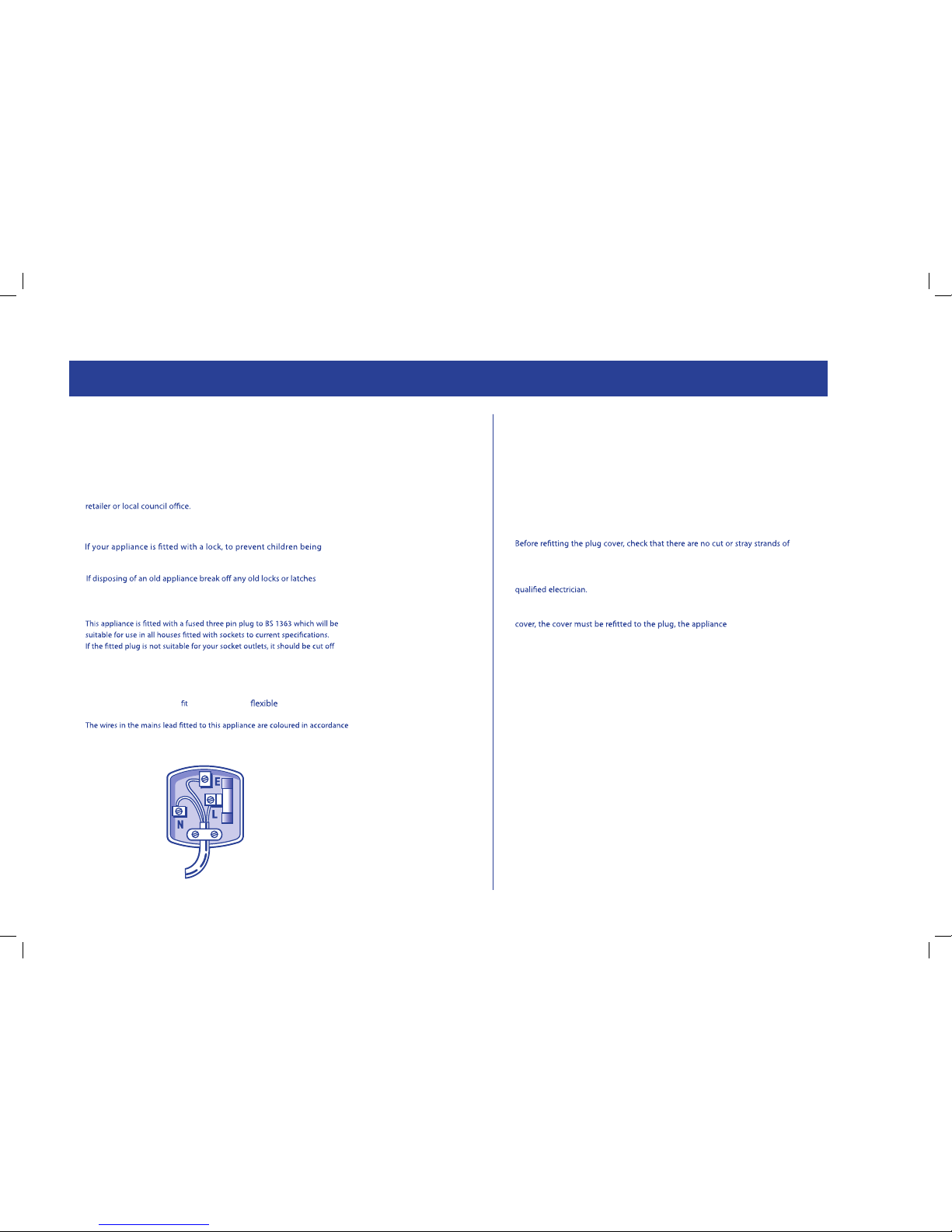
Fitting a new plu g
If for any reason you need to
a new plug, The
Mains Lead must be c onnected as shown here.
with the following code:
CONNECT GREEN
AND YELLOW TO
EARTH (E) (Note:
some appliances do
not have earth wires.)
CONNECT
BLUE TO
NEUTRAL (N)
MAKE SURE THE CABLE IS
HELD BY THE CLAMP
CONNECT
BROWN TO
LIVE (L)
ELECTRICAL CONNECTIONS
If the colours of the wires in the mains lead of this appliance do not
correspond with the coloured markings identifying the terminals in your plug,
proceed as follows:
The wire which is coloured Green and Yellow MUST be connected to the
terminal which is marked with the letter E (Earth) or symbol
coloured Green.
The wire which is coloured Blue MUST be connected to the terminal which is
marked with the letter N or coloured Black. The wire which is coloured Brown
MUST be connected to the terminal which is marked with the letter L or
coloured Red.
wire inside the plug.
Use a 13 Amp BS1362 fuse, only BSI or ASTA approved fuses should be used.
If you are in any way unsure which plug or fuse to use, always refer to a
Note: After replacing or changing a fuse on a moulded plug which has a fuse
must not be used
without a fuse cover. If lost, replacement fuse cove rs can be obtained from an
electrical shop.
This appliance complies with the following EEC Directives: 73 / 23 EEC
(Low
Voltage Directive) 89 / 336 EEC (EMC Directive).
Page 10
9
SAFETY
WARNING
IT IS HAZARDOUS FOR ANYONE
OTHER THAN AUTHORISED SERVICE
PERSONNEL TO CARRY OUT
SERVICING OR REPAIRS WHICH
INVOLVE THE REMOVAL OF COVERS.
TO AVOID THE RISK OF AN
ELECTRIC SHOCK DO NOT ATTEMPT
REPAIRS YOURSELF.
Locks
If your refrigerator is fitted with a lock, to prevent children being
entrapped keep the key out of reach and not in the vicinity of the
appliance. If disposing of an old refrigerator, break off any old locks or
latches as a safeguard.
The appliance was designed and manufactured in compliance with
international safety standards. The following warnings are provided
for safety reasons and must be read carefully.
This appliance complies with the following
Community Directives:
- 73/23/EEC of 19/02/73 (Low Voltage) and subsequent amendments;
- 89/336/EEC of 03/05/89 (Electromagnetic Compatibility)
and subsequent amendments;
- 2002/96/CE.
Information concerning disposal
Disposal of packaging
The packaging protects your appliance from damage during
transit. Please contribute to a better environment by disposing of
the packaging materials in an environmentally friendly manner.
Observe local environmental standards when disposing of packaging
material for recycling purposes.
Please ask your dealer or inquire at your local authority about current
means of disposal.
Keep packaging materials out of the reach of children! It can become
a choking or suffocation hazard.
Disposal of your old appliance
Old appliances are not worthless rubbish! Recycling old
appliances can reclaim valuable raw materials.
This appliance has been identified in accordance with the
European directive 2002/96/EC on Waste Electrical and
Electronic Equipment – WEEE.
The directive requires that old household electronic appliances must not
be disposed of in the normal unsorted municipal waste stream. Old
appliances must be collected separately in order to optimise the recovery
and recycling of the materials they contain and reduce the impact on
human health and the environment. The crossed out “wheeled bin” symbol
on the product reminds you of your obligation, that when you dispose of
the appliance it must be separately collected.
Consumers may take their old appliances to public waste collection areas,
other communal collection areas, or if national legislation allows return it
to a retailer when purchasing a similar new product.
Old appliances still have some residual value. An environmentally friendly
method of disposal will ensure that valuable raw materials can be
recovered and used again. The refrigerant used in your appliance and
insulation materials require special disposal procedures. Ensure that none
of the pipes on the back of the appliance are damaged prior to disposal.
Up to date information
concerning options for disposing of your old
appliance and packaging from the new one can be obtained from your
local council office.
Redundant appliances:
Cut off the mains plug and discard it. Refrigerators contain refrigerants
and the insulation contains gases. Refrigerant and gases must be disposed
of properly.
Ensure the tubing of the refrigerant circuit is not damaged prior to
proper disposal.
Page 11

10
Safety and warning information
Before you switch ON the appliance
Please read the operating and installation instructions carefully. They
contain important information on how to install, use and maintain
the appliance. Keep all documentation for subsequent use or for the
next owner.
Technical safety
This appliance contains a small quantity of environmentally friendly but
flammable R600a refrigerant. Ensure that the tubing of the refrigeration
circuit is not damaged during transportation and installation. Leaking
refrigerant may ignite.
If damage has occurred
- Keep naked flames and/or ignition sources away from the appliance.
- Pull out the mains plug.
- Thoroughly ventilate the room for several minutes.
- Notify customer services.
The more refrigerant an appliance contains, the larger the room must be.
Leaking refrigerant can form a flammable gas-air mixture in rooms which
are too small. The room must be at least 1m
3
per 8 g of refrigerant.
The amount of refrigerant in your appliance is indicated on the rating label
on your appliance.
Important information when using the appliance
• This appliance is not intended for use by persons (including children)
with reduced physical, sensory or mental capabilities, or experience or
knowledge, unless they have been given supervision or instructions
concerning the use of the appliance by a person responsible for their
safety
. Children should be supervised to ensure that they do not play
with the appliance.
• If the supply cord is damaged, it must be replaced by the manufacturer,
its service agent or similarly qualified persons in order to avoid a hazard.
• Never use electrical appliances inside the refrigerator (e.g. heater,
electric ice maker, etc.). Explosion hazard!
• Never use a steam cleaner to clean the appliance. The steam may pen-
etrate electrical parts and cause a short circuit. Risk of electric shock!
• Do not store products which contain flammable propellants (e.g. spray
cans) or explosive substances in the appliances. Explosion hazard!
• Do not stand or support yourself on the base, drawers or doors, etc.
• Before defrosting and cleaning the appliance, pull out the mains plug or
switch off the fuse. Do not pull out the mains plug by tugging the cable.
• Commercially frozen pre-packed food should be stored in accordance
with the frozen food manufacturers instruction.
• Bottles containing a high percentage of alcohol must be sealed and
stored in an upright position.
• Keep plastic parts and the door seal free of oil and grease. Otherwise,
the plastic and door seal will become porous.
• Never cover or block the ventilation openings for the appliance.
• Do not store bottled or canned drinks (especially carbonated drinks)
in the ice compartment. Bottles and cans may explode!
• Never put frozen food, or ice cubes, straight from the ice compartment
into your mouth. Risk of frost burns to the lips and tongue!
• Avoid prolonged touching of frozen food, ice or the inner freezer walls
or tubing etc. Risk of frost burns to the skin.
• Do not scrape off frost or stuck frozen food with a knife or pointed
object. You could damage the refrigerant tubing. Leaking refrigerant
may ignite. Only use a plastic scraper.
• In the case of malfunction, under no circumstances should you attempt
to repair the appliance yourself. Repairs carried out by inexperienced
persons may cause injury or further malfunctioning to the appliance.
• When the appliance is unplugged please wait for 5 minutes before
plugging it in again. Otherwise, the compressor will be overloaded.
• Do not use electrical appliances such as a hairdryer or heaters
near your refrigerator.
• Do not store inflammable gases or liquids inside your refrigerator.
Children in the household
• Keep children away from the packaging and its parts. Danger of
suffocation from folding cardboard and plastic film!
• Do not allow children to tamper with the controls or play with the
appliance. It is not a toy. Under no circumstances should children
be allowed to sit on the bins or hang from the door.
• If the appliance features a lock, keep the key out of the reach
of children.
General requirements
• The appliance is designed for domestic use inside the home and is not
intended for commercial or industrial use.
• The appliance must be used to store food products by adults only and
according to the instruction manual.
• Try to avoid keeping the door open for long periods or opening the
door too frequently in order to conserve energy.
• Do not fill the appliance with too much food: cold air must circulate
freely for food to be preserved properly.
SAFETY
Page 12

NOTES
11
 Loading...