

Page 1

Page 2

Page 3
3
Safety and warning information
Before you switch ON the appliance
Please read the operating and installation instructions carefully. They
contain important information on how to install, use and maintain
the appliance. Keep all documentation for subsequent use or for the
next owner.
Technical safety
This appliance contains a small quantity of environmentally friendly but
flammable R600a refrigerant. Ensure that the tubing of the refrigeration
circuit is not damaged during transportation and installation. Leaking
refrigerant may ignite.
If damage has occurred
- Keep naked flames and/or ignition sources away from the appliance.
- Pull out the mains plug.
- Thoroughly ventilate the room for several minutes.
- Notify customer services.
The more refrigerant an appliance contains, the larger the room must be.
Leaking refrigerant can form a flammable gas-air mixture in rooms which
are too small. The room must be at least 1m per 8g of refrigerant. The
amount of refrigerant in your appliance is indicated on the rating label
on your appliance.
Important information when using the appliance
â This appliance is not intended for use by persons (including children)
with reduced physical, sensory or mental capabilities, or experience or
knowledge, unless they have been given supervision or instructions
concerning the use of the appliance by a person responsible for their
safety. Children should be supervised to ensure that they do not play
with the appliance.
â If the supply cord is damaged, it must be replaced by the manufacturer,
its service agent or similarly qualified persons in order to avoid a hazard.
â Never use electrical appliances inside the fridge freezer (e.g. heater,
electric ice maker, etc.). Explosion hazard!
â Never use a steam cleaner to defrost or clean the appliance.
The steam may penetrate electrical parts and cause a short circuit.
Risk of electric shock!
â Do not store products which contain flammable propellants (e.g. spray
cans) or explosive substances in the appliances. Explosion hazard!
â Do not stand or support yourself on the base, drawers or doors, etc.
â Before defrosting and cleaning the appliance, pull out the mains plug or
switch off the fuse. Do not pull out the mains plug by tugging the cable.
â Bottles containing a high percentage of alcohol must be sealed and
stored in an upright position.
â ,esiwrehtO .esaerg dna lio fo eerf laes rood eht dna strap citsalp peeK
the plastic and door seal will become porous.
â
Never cover or block the ventilation openings for the appliance.
â Do not store bottled or canned drinks (especially carbonated drinks)
in the freezer. Bottles and cans may explode!
â Never put frozen food, or ice cubes, straight from the freezer
compartment into your mouth. Risk of frost burns to the lips
and tongue!
â Avoid prolonged touching of frozen food, ice or the inner freezer walls
or tubing etc. Risk of frost burns to the skin!
â Do not scrape off frost or stuck frozen food with a knife or pointed
object. You could damage the r
efrigerant tubing. Leaking refrigerant
may ignite. Only use a plastic scraper.
â In the case of malfunction, under no circumstances should you attempt
to repair the appliance yourself. Repairs carried out by inexperienced
persons may cause injury or further malfunctioning to the appliance.
â When the appliance is unplugged, please wait for 5 minutes before
plugging it in again otherwise, the compressor will be overloaded.
â Do not extend or fold the power cord. Keep the power cord away from
the compressor, because the temperature of the compressor surface
will rise when in operation. Insulation could be weakened and leakage
would occur.
â Do not locate the fridge freezer in moist surroundings to avoid the
metal parts getting rusty. Do not spray water into the fridge freezer,
otherwise it will weaken the insulation and cause leakage.
â Keep your fridge freezer away from any volatile or combustible
materials such as gas, petrol, alcohol, lacquer, and banana oil, etc.
The abovementioned objects should not be stored in the fridge freezer.
â When fixing or moving the refrigerator, please do not decline more
than 45º.
â Do not put unstable or heavy articles on top of the fridge freezer.
â Do not touch frozen foods in the freezer chamber with wet hands as the
water on your hands may be frozen and stuck to the food you touch.
â Do not clip the power supply cord.
â Keep away from inflammable spray.
â When gas leakage occurs, do not touch the fridge freezer until the
gas valve is turned off and the air in the room is fresh and clean.
â Keep water away to avoid weakening of the insulation.
â Do not use mechanical devices or any other means to accelerate the
defrosting process, except those recommended by the manufacturer.
â Do not use electrical appliances inside the food storage
compartments of the fridge freezer, unless they are of a type
recommended by manufacturer.
â Do not discard of useless and old refrigerators at will in order to avoid
environment pollution.
â Young children should be supervised to ensure that they do not play
with the appliance.
â Do not damage the refrigerant circuit (applicable only for appliances
with refrigeration circuits which are accessible to the user).
â If the door seals do not fit against the cabinet, on any side, warm the seal
with hot water and tease it into position. This can be done using a hair
dryer but care must be taken not to overheat the seal or burn your hands.
Children in the household
â Keep children away from the packaging and its parts. Danger of
suffocation from folding cardboard and plastic film!
â Do not allow children to tamper with the controls or play with the
appliance. It is not a toy. Under no circumstances should children
be allowed to sit on the bins or hang from the door.
â If the appliance features a lock, keep the key out of the reach
of children.
General requirements
â The appliance is designed for domestic use inside the home and is not
intended for commercial or industrial use.
â The appliance must be used to store and freeze food products by adults
only and according to the instruction manual.
â Try to avoid keeping the door open for long periods or opening the door
too frequently in order to conserve energy.
â Do not fill the appliance with too much food: cold air must circulate
freely for food to be preserved properly.
SAFETY
Page 4

Page 5
5
USING YOUR FRIDGE FREEZER
Salad bin
This is the most humid part of the fridge. Store vegetables, fruit,
fresh salad items, eg. unwashed whole lettuce, whole tomatoes,
radishes, etc here.
WE RECOMMEND THAT ALL PRODUCE KEPT IN THE SALAD BIN
IS WRAPPED.
NOTE: ALWAYS WRAP AND STORE RAW MEAT, POULTRY AND FISH ON
THE LOWEST SHELF AT THE BOTTOM OF THE FRIDGE. THIS WILL STOP
THEM DRIPPING ONTO, OR TOUCHING OTHER FOODS.
DO NOT STORE INFLAMMABLE GASES OR LIQUIDS IN THE FRIDGE.
Noises inside the fridge freezer
If you have not owned a refrigerator or freezer before, you may notice
that it makes some rather unusual noises. Most of these are perfectly
normal, but you should be aware of them!
Gurgling, whooshing
These noises are caused by the circulation of the refrigerant liquid in the
cooling system. It has become more pronounced since the introduction of
your fridge freezer.
Humming, purring or pulsating
This is the compressor motor working, as it pumps the refrigerant around
the system.
Shopping for chilled foods
Don’t buy in your lunch hour!
Unless you have a fridge at work to keep the food cold in the afternoon.
Leaving food in your car or at room temperature for a prolonged period
of time could raise food temperature to the level at which harmful
bacteria grow.
Switching on your fridge freezer
1. Before your fridge freezer is plugged in, open the fridge door and
adjust the thermostat control to the highest setting.
2.
Once the fridge freezer has cooled down, adjust the thermostat
control to a suitable setting.
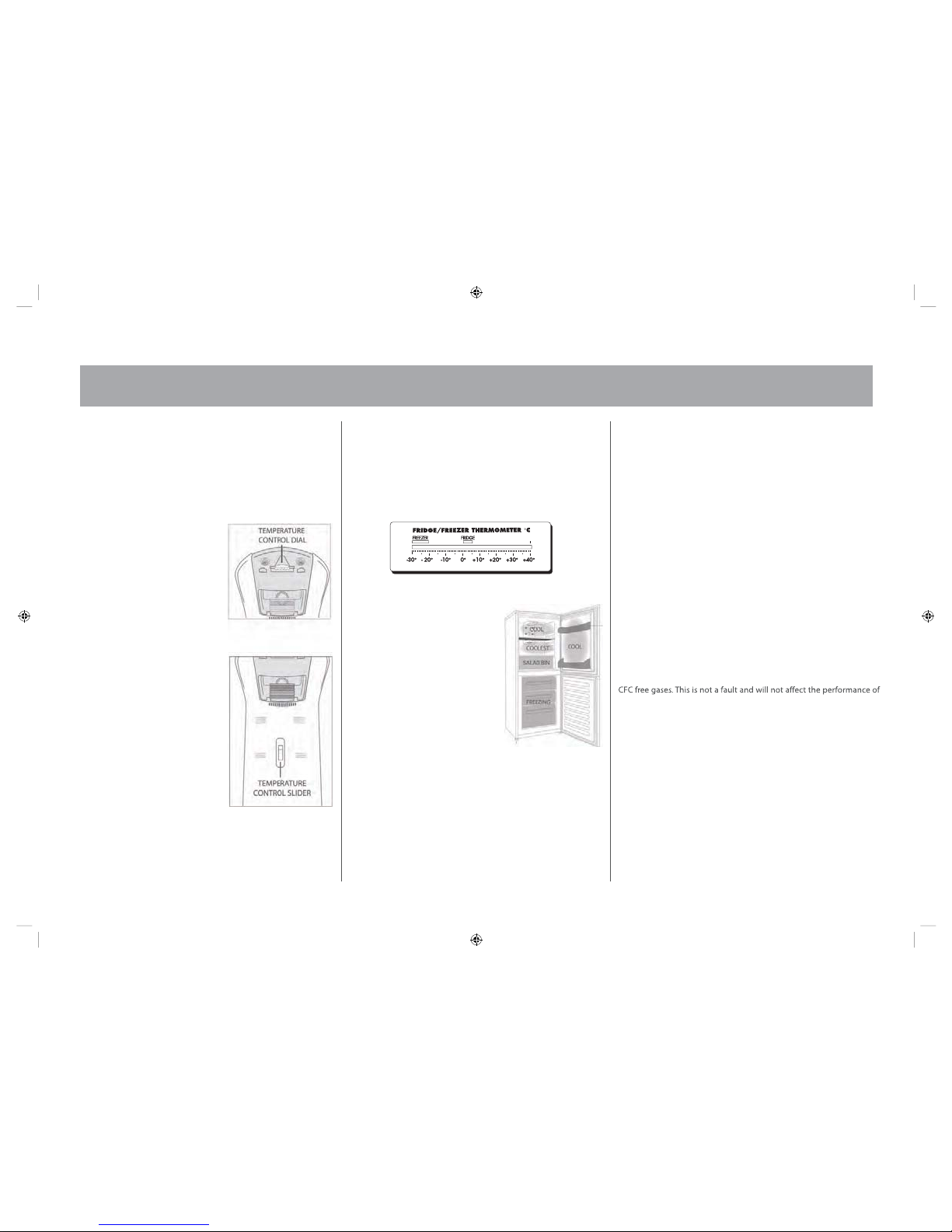
Adjusting the temperature
To change the internal temperature
of the fridge freezer, use the control
dial located inside the fridge. The
recommended setting is between 3 and
4 for normal use. The fridge freezer may
not operate at the correct temperature if
it is in a particularly hot or cold room or
if you open the doors very often.
The temperature control slider is used
to adjust the air flow in the fridge.
With the slider in the UP position, the
volume of cold air is reduced and in the
DOWN position, the volume of cold air is
increased. If you require the food to cool
faster, position the slider in the DOWN
position. For normal operating use, keep
the slider in the middle position.
Is the fridge freezer cold enough?
If you are concerned that your fridge freezer is not being kept cold
enough, and wish to check the temperature, you will need a special fridge
thermometer available from most supermarkets and hardware shops.
Place the thermometer on the middle shelf of the fridge cabinet or the
middle basket of the freezer, where it can be read easily. Leave overnight,
the temperature in the fridge should be between Ò& and Ò& and -Ò&
or lower in the freezer. See ‘Adjusting the temperature’.
Where to store your food in the fridge
Cool area
This is where to store foods which will
keep longer if they are kept cool. Milk,
eggs, yogurt, fruit juices, hard cheeses, eg.
cheddar. Opened jars and bottles of salad
dressings, sauces and jams. Fats, eg. butter,
margarine, low-fat spreads, cooking fats
and lard.
Coldest area: 0°C to 5°C
This is where foods which must be cold
to keep them safe should be kept:
â Raw and uncooked foods. Theseshould
always be wrapped.
â Pre-cooked chilled foods, eg. ready meals, meat pies, soft cheeses.
â Pre-cooked meats eg. ham.
â Preparedsalads (including pre-washed chopped, pre-packed mixed
green salads, rice, potato salad etc).
â Desserts,eg. fromage frais,home-prepared food and leftovers or
cream cakes.
Temperature control slider
Page 6
6
USING YOUR FRIDGE FREE ZER
Keep chilled foods together
When you are going around the supermarket and when you are travelling
home if you keep all the chilled foods together they will help to keep each
other cold.
Use a cool bag
Special insulated bags can be bought from most supermarkets and
hardware shops. These keep food cold for longer, but are only for getting
chilled foods home, not storing it.
Unwrap as soon as you get home
Always unpack and place chilled foods in the fridge freezer before storing
dry food-stuffs.
Shopping for frozen foods
When you are buying frozen food, look at the storage guidelines on the
packaging. You will be able to store each item of frozen food for the
period shown against the 4 star rating. This is usually the period stated
as ‘Best Before’, on the front of the packaging.
Choose packs carefully
Take a quick look at the frozen food package and make sure it is in
perfect condition.
Purchase frozen food last
Always buy frozen products last on your shopping trip or visit to
the supermarket.
Keep frozen foods together
When you are going around the supermarket and when you are travelling
home, if you keep all the frozen foods together they will help to keep
each other cold.
Store food straight away
Don’t buy frozen food unless you can freeze it straight away. Special
insulated bags can be bought from most supermarkets and hardware
shops. These keep frozen food cold for longer.
Thawing frozen food
For some foods, thawing before cooking is unnecessary. Vegetables
and pasta can be added directly to boiling water or steam cooked.
Frozen sauces and soups can be put into a saucepan and heated gently
until thawed.
Tips for keeping food perfect in the
fridge freezer
Leave space around food
This will allow cold air to circulate around the fridge freezer. It will also
mean the fridge freezer doesn't have to use so much power.
Wrap up food!
To prevent transfer of flavours and drying out, food should be separately
packed or covered. Fruit and vegetables need to be wrapped.
Let pre-cooked food cool properly
Always let pre-cooked food cool down before you put it in the fridge
freezer. This will stop the internal temperature of the fridge freezer
from rising.
Shut the door
To prevent cold air escaping, limit the number of times you open the
door. When returning from shopping, sort foods to be kept in your
fridge freezer while the door is closed.
Preparations for freezing
â Leave cooked food to cool completely.
â
Chill
food in the fridge before freezing if possible.
â
Consider how
you
want to cook the food beforefreezing it.
â Don’t freeze food in metal containers as you may want to microwave
it straight from the freezer.
â Use special freezer bags available from ,mlif rezeerf ,stekramrepus
polythene bags, plastic containers, aluminium foil (heavy grade only,
if in doubt, double wrap). Don’t use aluminium foil for acidic foods
(such as citrus fruits). Don’t use thin cling film or glas
s. Don’t use used
food containers (unless cleaned thoroughly first).
â Exclude as much air from the container as possible. You could buy a
special vacuum pump which sucks excessive air out of the packaging.
â Leave a small amount of ‘air space’ when freezing liquids, to allow
for expansion.
â You can use the space in the fridge freezer most efficiently if you freeze
liquids (or solids with liquids, such as stew) in square blocks. This is
known as ‘preforming’. Pour the liquid into a polythene bag which is
inside a square sided container. Freeze it like this, then remove it from
the container and seal the bag.
Page 7
7
USING YOUR FRIDGE FREE ZER
Freezing fresh foods
The golden rules
Use quality food and handle it as little as possible. Freeze food in small
quantities, it freezes faster, takes le ss time to thaw and enables you to
eat it in the quantity you need.
Freezing fresh foods
First, estimate the amount of food you will be freezing. Turn the
thermostat dial to the maximum setting which makes your freezer colder
(approx -28°C), it will therefore freeze quicker and keep in the goodness.
However you should use it sparingly to conserve energy. Remember to
reset the thermostat dial to the normal setting when you have finished
freezing fresh foods.
EZEERF OT
.deriuqer ton daerb fo faol A
A small casserole
srh 2 mg009/bl2 ot pU . before placing food in freezer
and 4 hrs. after placing food in freezer.
rezeerf ni doof gnicalp erofeb .srh 24 gk 3 / sbl
6.6 fo mumixaM
and 24 hrs. after placing food in freezer.
What not to freeze
Bananas, pomegranates, pears, carbonated liquids as they can explode
or anything in a glass container, as these may crack.
NOTE: Do not store inflammable gases or liquids in the freezer.
To thaw
1 Cover food loosely.
2 Thaw at room temperature. Don’t forget that thawing in a warm area
encourages the growth of bacteria.
3 Always make sure there are no ice crystals in the food before cooking,
particularly with meat. These crystals indicate that the food is not
fully thawed. They result in lower temperatures when cooking.
Lower cooking temperatures may not destroy dangerous bacteria.
4 Cook food as soon as possible after thawing.
5 Drain off and throw away any liquid lost during thawing.
Oven thawing
Many microwaves and ovens have thaw settings. To avoid bacterial build
up, only use these if you intend to cook the food immediately afterwards.
Safety tips
â Never re-freezeanything that has thawed out unless you cook it
again, to kill off harmful bacteria.
â
Never re-freeze thawed shellfish.
Useful tip
Re-seal packs properly after removing items. This prevents drying or
‘freezer burn’ and a build up of frost on any remaining food.
Label everything
â Many foods look the same when frozen, so careful labelling will help
avoid forgetting what an item is. Storage times being exceeded could
cause food poisoning.
â You can buy special freezer tape for use in low temperatures
This tape is available in white, so you can use it to write the items
contents on. You can buy special freezer labels and pens. Labels come
in different colours which can help you use your freezer effectively.
For instance you could colour code meat red and vegetables green.
Using a different colour label for each quarter of the year will help
you rotate your frozen food more efficiently.
â Write the contents and date. If you are really organised add the
weight and notes on cooking such as ‘thaw first’, or ‘cook from
frozen’
and keep a separate ‘log-book’ of what is in each drawer.
This will save opening the door and searching around unnecessarily.
Recommended storage periods
(when frozen from fresh)
shtnom 21 ot pu tiurf dekcap ragus ro purys tiurF
pshtnom 81 otu tiurf deérup ro nezorf nepO
Fruit juices up to 6 months
Lamb up to 10 months
Beef up to 10 months
Pork up to 6 months
Veal up to 6 months
tae
m decniM up to 3 months
Cured meats up to 2 months
Sausages up to 3 months
Packed bacon up to 3 months
Smoked bacon/ p shtnom 2 otu skaets nommag /spohc
Unsmoked bacon/ p htnom 1 otu skaets nommag /spohc
Chicken up to 8 months
Duck up to 5 months
Goose up to 5 months
Turkey up to 6 months
White fish up to 5 months
pshtnom 2 otu
nomlas gnidulcni hsif yliO
Smoked salmon up to 3 months
Caviar don't freeze
Shellfish up to 1 month
Butter up to 6 months
Cheese up to 6 months
Suet up to 6 months
pshtnom 3 otu gnippihw /elbuod - maerC
shtnom 01 ot pu detarapes
e
zeerf ylno - sggE
Milk up to 1 month
Page 8
8
REVERSING THE DOOR SWING
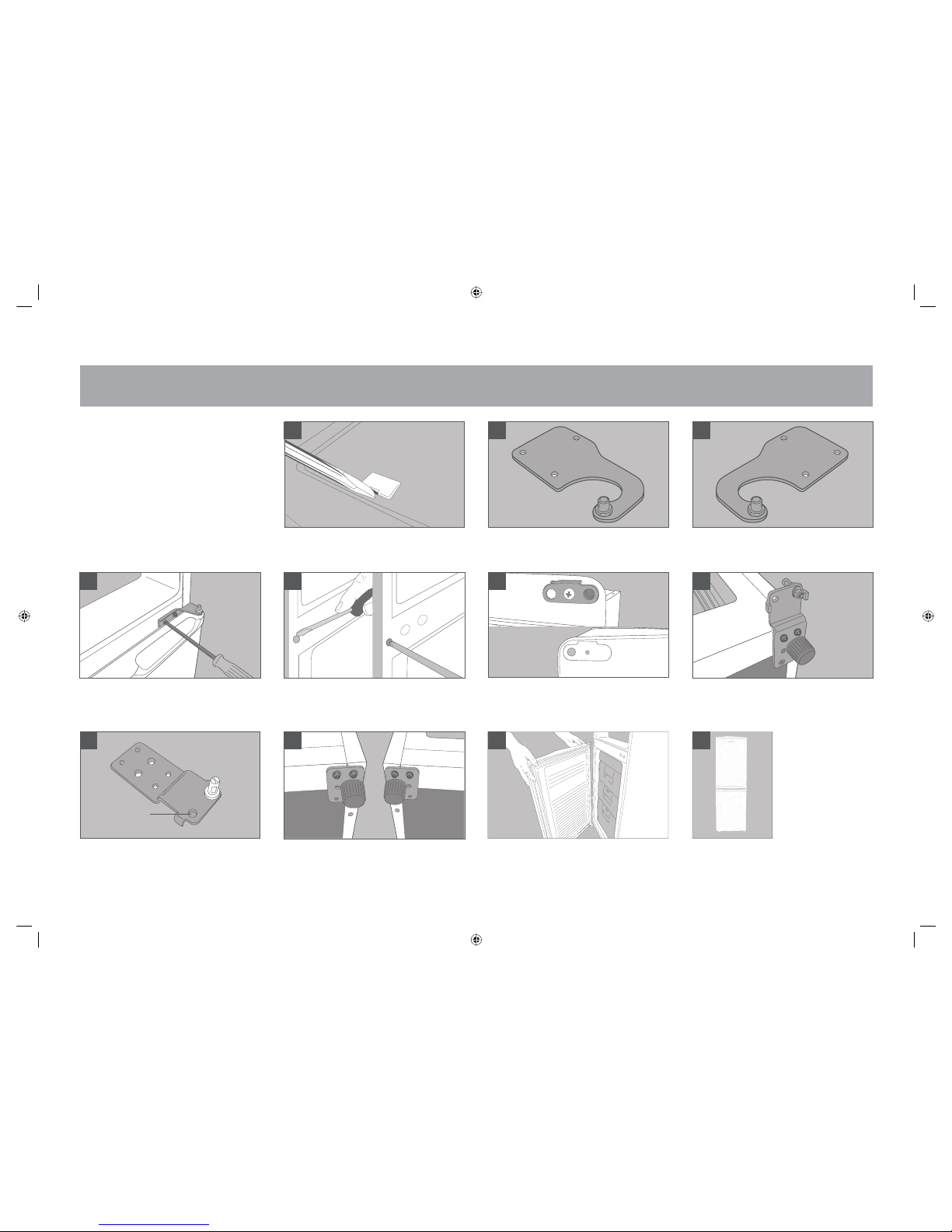
The door of your fridge freezer can be reversed.
â Ensure the fridge freezer is unplugged and empty.
â We recommend you have someone to assist you.
Tools required
â Phillips style screwdriver.
â Flat bladed screwdriver.
â 8mm socket or spanner.
â 10mm socket or spanner.
When trying to gain access to the base of the fridge
freezer, do not tip it back at more than a 45° angle.
Rest the fridge freezer on soft foam packaging or similar
material to avoid damaging the back of the appliance
Remove the four blanking plates from the top of the
fridge freezer with a flat bladed screwdriver. Remove
the screws underneath with a Phillips screwdriver.
Remove the pin from the bracket and replace it into
the same hole from the other side.
Replace doors and brackets in reverse order.
10
11
2
3
Place the fixing plate on the opposite side of the
appliance, secure it with the three bolts, and screw
the foot into position.
9
Remove the hinge pin from position 1 and replace
it in position 2. Place the hinge on the opposite side
of the cabinet, secure it with the three bolts, and
screw in the foot into position.
Position 2
8
Check both doors are aligned horizontally and vertically
and that the seals are closed on all sides before finally
tightening hinge bolts. Replace the lid and screws.
If the door seals do not
fit against the cabinet, on
any side, warm the seal
with hot water and tease
it into position. This can be
done using a hair dryer but
care must be taken not to
overheat the seal or burn
your hands.
Use the 8mm socket or spanner to remove the three
bolts above the door hinge. Lift off the bracket.
Remove the fridge door.
Remove the blanking plates and screw cover.
Remove screw and replace screw on the
opposite side.
Remove the middle hinge using the 8mm socket or
spanner. Take care not to lose the spacer if fitted.
Lift the freezer door off the bottom hinge.
Tilt the fridge freezer back, no more than 45°, to
access the bottom hinge
and feet. Remove the feet
and the bolts sec
uring the right hand hinge plate
and the left hand fixing plate.
54 7
1
Remove the hinge insert plate from the bottom of
the fridge and freezer doors. Replace the plate on
the opposite side.
6
Page 9
9
MAINTENANCE
Cleaning inside the fridge freezer
The refrigerator should be cleaned every month. You should clean the
refrigerator internally with a weak solution of bicarbonate of soda.
Rinse with warm water using a wrung-out sponge or cloth. Wipe the
fridge freezer dry before replacing the food. Wash the baskets and shelves
in warm soapy water. Ensure they are completely dry before replacing in
the fridge freezer. Plug in and switch on the mains supply.
Cleaning the outside of the
fridge freezer
Use standard furniture polish to clean the fridge freezer exterior.
Make sure that the doors are closed to prevent polish getting on the
magnetic door seal or inside. The grille of the condenser at the back
of the fridge freezer and the adjacent components can be vacuumed
using a soft brush attachment.
Cleaning tip
Clean when food stocks are low.
CLEANING
Defrosting
The fridge freezer is controlled by a tmer and can defrost automatically.
The defrost water flows down to the evaporating tray which is located at
the top of the compressor, and evaporates automatically.
Moving your fridge freezer
Location
Do not place your fridge freezer near a heat source, eg. cooker, boiler
or radiator. Also avoid direct sunlight.
Levelling the fridge freezer
Make sure the fridge freezer is level. Use the rotating levelling feet at
the front. If the fridge freezer is not level, the doors and magnetic seal
alignments will be affected.
Do not turn on the fridge freezer for four hours
After the fridge freezer is in place, it needs to be left for four hours.
The coolant fluid needs time to settle.
Installation
Don’t cover or block the vents or grilles of your appliance.
Servicing
Repairs and maintenance of the appliance should only be performed
by an authorised, qualified technician.
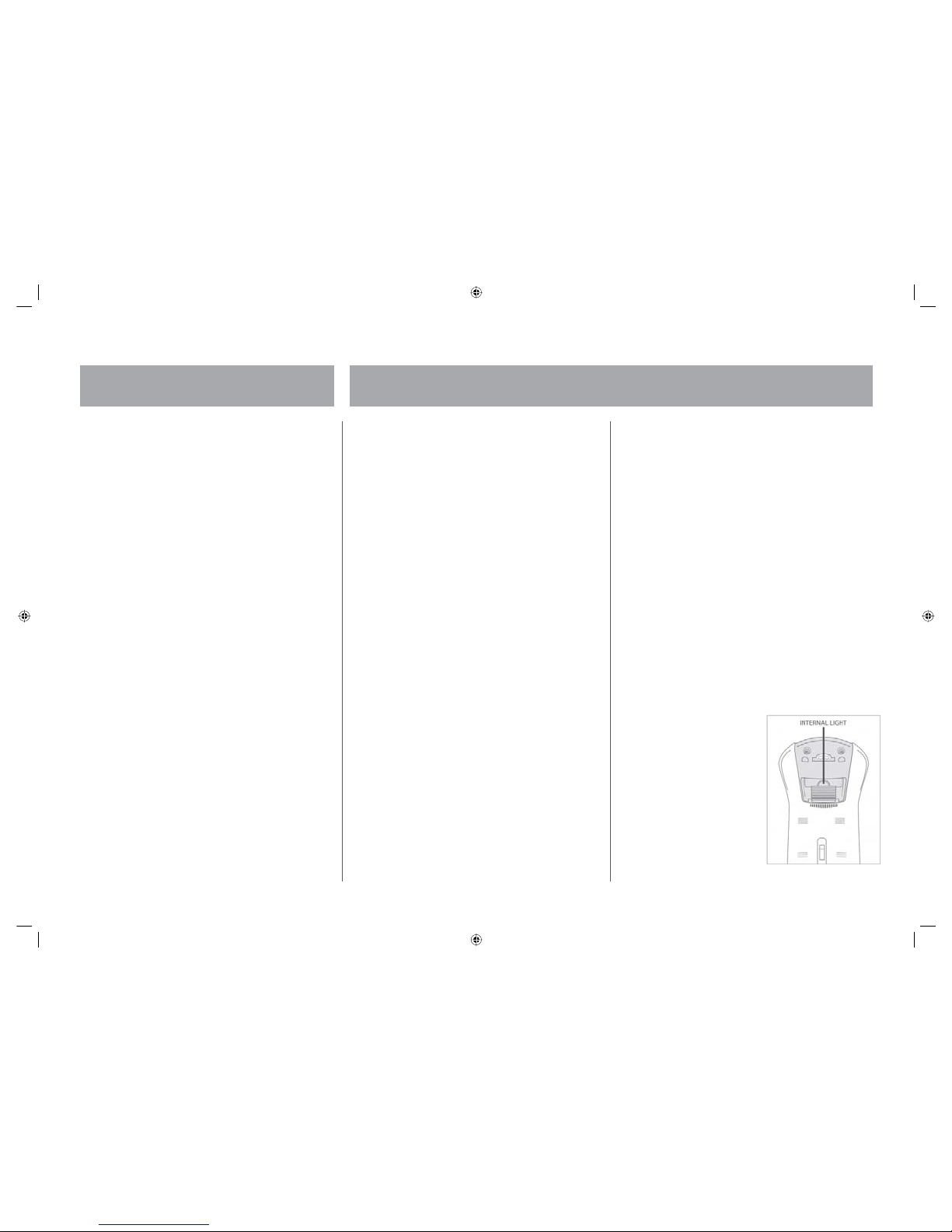
Changing the internal light
1 Before carrying out the bulb
replacement, always switch off the
fridge freezer and disconnect the
electrical suppl
y.
2 Use a cross-head screwdriver to take
the two screws out.
3 Remove the light cover.
4 Unscrew the light bulb.
5 Replace with a new bulb (10w) that
is the same size and shape as the
previous one.
6 Replace the light cover.
7 Re-connect your fridge freezer to the
electrical supply and switch on.
Page 10
49
Page 11
11
THIS APPLIANCE MUST BE EARTHED.
This appliance is fitted with a fused three pin plug to BS 1363
which will be suitable for use in all houses fitted with sockets to
current specifications.
If the fitted plug is not suitable for your socket outlets, it should be cut
off and carefully disposed of. To avoid a possible shock hazard, do not
insert the discarded plug into a socket.
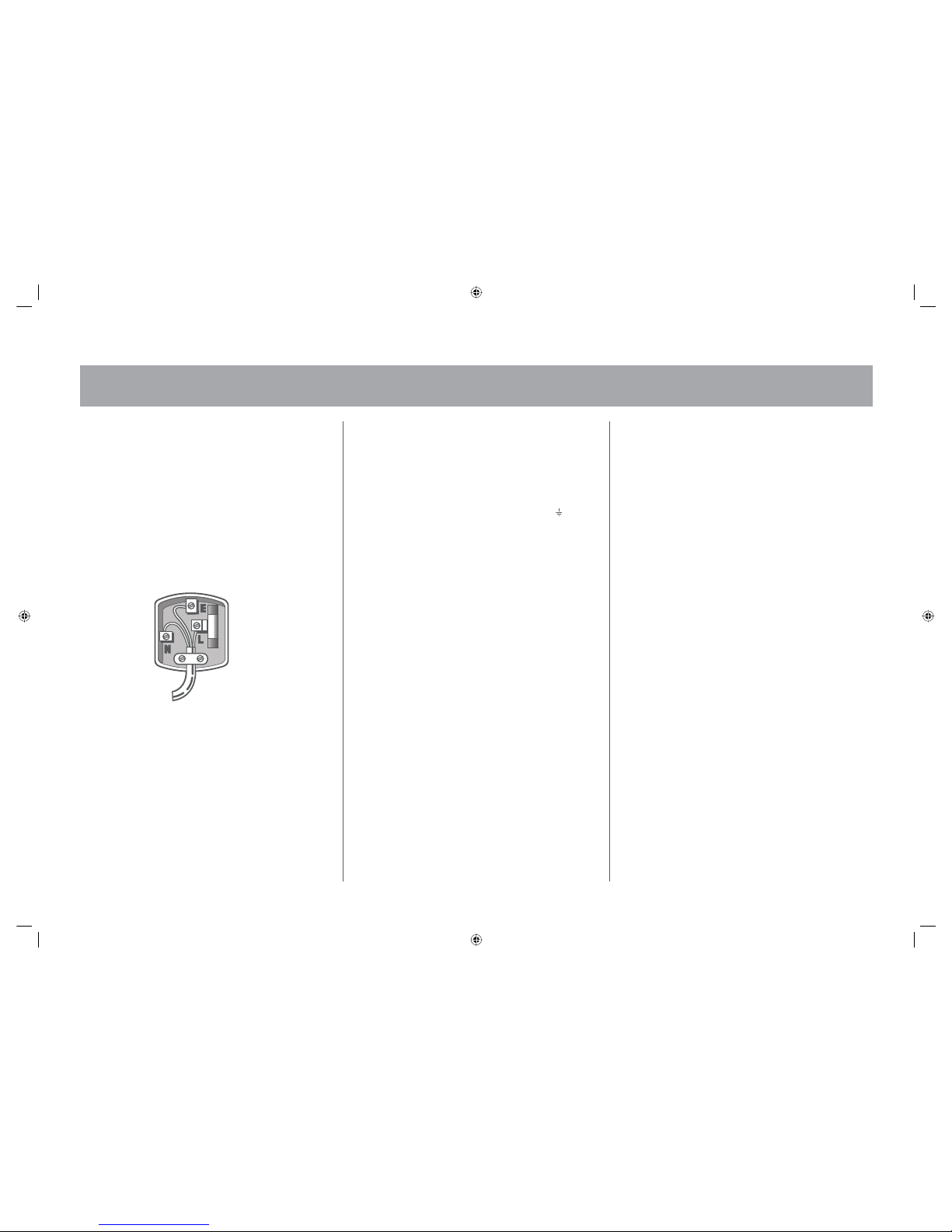
Fitting a new plug
If for any reason you need to fit a new plug, the flexible mains lead must
be connected as shown here.
CONNECT GREEN
AND YELLOW TO EARTH (E)
(Note: some appliances do
not have earth wires.)
CONNECT BLUE TO
NEUTRAL (N)
MAKE SURE THE CABLE
IS HELD BY THE CLAMP
CONNECT BROWN
TO LIVE (L)
ELECTRICAL CONNECTIONS
The wires in the mains lead fitted to this appliance are coloured in
accordance with the following code:
If the colours of the wires in the mains lead of this appliance do not
correspond with the coloured markings identifying the terminals in your
plug, proceed as follows:
The wire which is coloured Green and Yellow MUST be connected to the
terminal which is marked with the letter E (Earth) or symbol
or
coloured Green. The wire which is coloured Blue MUST be connected
to the terminal which is marked with the letter N or coloured Black. The
wire which is coloured Brown MUST be connected to the terminal which
is marked with the letter L or coloured Red.
Before refitting the plug cover, check that there are no cut or stray
strands of wire inside the plug.
Use a 13 Amp BS1362 fuse, only BSI or ASTA approved fuses should be
used. If you are in any way unsure which plug or fuse to use, always refer
to a qualified electrician.
Note: After replacing or changing a fuse on a moulded plug which has
a fuse cover, the cover must be refitted to the plug, the appliance must
not be used without a fuse cover. If lost, replacement fuse covers can be
obtained from an electrical shop.
This appliance complies with the following EEC Directives: 73 / 23 EEC
(Low Voltage Directive) 89 / 336 EEC (EMC Directive).
Page 12
 Loading...