

Page 1
Submersible Euent Pumps
2FFSTEP
0.5 & 1 HP @ 3450 RPM
Installation, Operation &
Maintenance Manual
IMPORTANT! - Read all instructions in this manual before operating or servicing
a pump.
Page 2
General Safety Information
Before installation, read the following
instructions carefully. Failure to
follow instruction and safety
information could cause serious
bodily injury, death and/or property
damage. Each Flo Fab product is
carefully inspected to insure proper
performance. Closely following these
instructions will eliminate potential
operating problems, assuring years
of trouble-free service.
DANGER
"Danger" indicates an
imminently hazardous situation
which, if not avoided, WILL result in
death or serious injury.
WARNING
"Warning" indicates
an imminenty hazardous situation
which, if not avoided, MAY result in
death or serious injury.
CAUTION
"Caution" indicates a
potentially hazardous situation
which, if not avoided, MAY result in
minor or moderate injury.
IMPORTANT! - Flo Fab Pumps is not
responsible for losses, injur y or
death r e sulting from failure to
observe these safety precautions,
misuse, abuse or misapplication of
pumps or equipment.
ALL R E TURNED
P R ODUC T S MUST B E
CLEANED, SANITIZED, OR
DECONTAMINATED PRIOR TO
SHIPMENT, TO INSURE EMPLOYEES
WILL NOT BE EXPOSED TO HEALTH
HA Z ARDS IN HANDLING SAID
MATERIAL. ALL APPLICABLE LAWS
AND REGULATIONS SHALL APPLY.
WARNING
junc tion connec tions must be in
accordance with the National Electric
Code and all applicable state and local
codes. Requirements may vary depending
on usage and location.
Installation, wiring, and
WARNING
I nstalla tion and
servicing is to be conducted by
qualied personnel only.
Keep clear of suction and
discharge openings. Do not
insert ngers in pump with
power connected; the impeller can
cause serious injury.
Always wear eye protection
when working on pumps. Do
not wear loose clothing that
may become entangled in moving
parts.
DANGER
Pumps build up heat
and pressure during
operation. Allow time
for pumps t o c ool
before handling or servicing the
pump or a ny accessor y i tems
associated with or near the pump.
DANGER
T his pump is not
i n t ended f or use in
swimming pools or water
installations where there is
human contact with pumped uid.
DANGER
Risk of electric shock. To
reduce risk of electric shock,
always disconnec t pump
from power source before
handling any aspect of the pumping
system. Lock out power and tag.
WARNING
Do not use these
pumps in water over 104º F. Do not
exceed manufacturers recommended
maximum performance, as this could
cause the motor to overheat.
DANGER
Do not lift, carry or
hang pump by the electrical
cables. Damage to the
electrical cables can cause
shock, burns or death. Never handle
connected power cords with wet
hands. Use appropriate lifting device.
WARNING
Sump and sew age
pumps often handle materials which
could cause illness or disease. Wear
adequate protective clothing when
working on a used pump or piping.
Never enter a basin after it has been
used.
DANGER
Failure to permanently
ground the pump, motor and
controls before connecting
to power can cause shock,
burns or death.
DANGER
These pumps are not to
be installed in locations
classied as hazardous in
accordance with the National
Electric Code, ANSI/NFPA 70.
WARNING
The Uniform Plumbing
Code ( UPC ) sta tes that sewage
systems shall have an audio and visual
alarm that signals a malfunction of the
systems, that are required to reduce
the potencial for property damage.
IMPORTANT! - Prior to installation,
record Model Number, Serial, Amps,
Voltage, Phase and HP from pump
name plate for the future reference.
Also record the Voltage and Current
Readings at Startup:
Model Number: ____________________
Serial: ____________________
Amps:_______ Voltage:_______
Phase:_______ HP:_______
01
Page 3
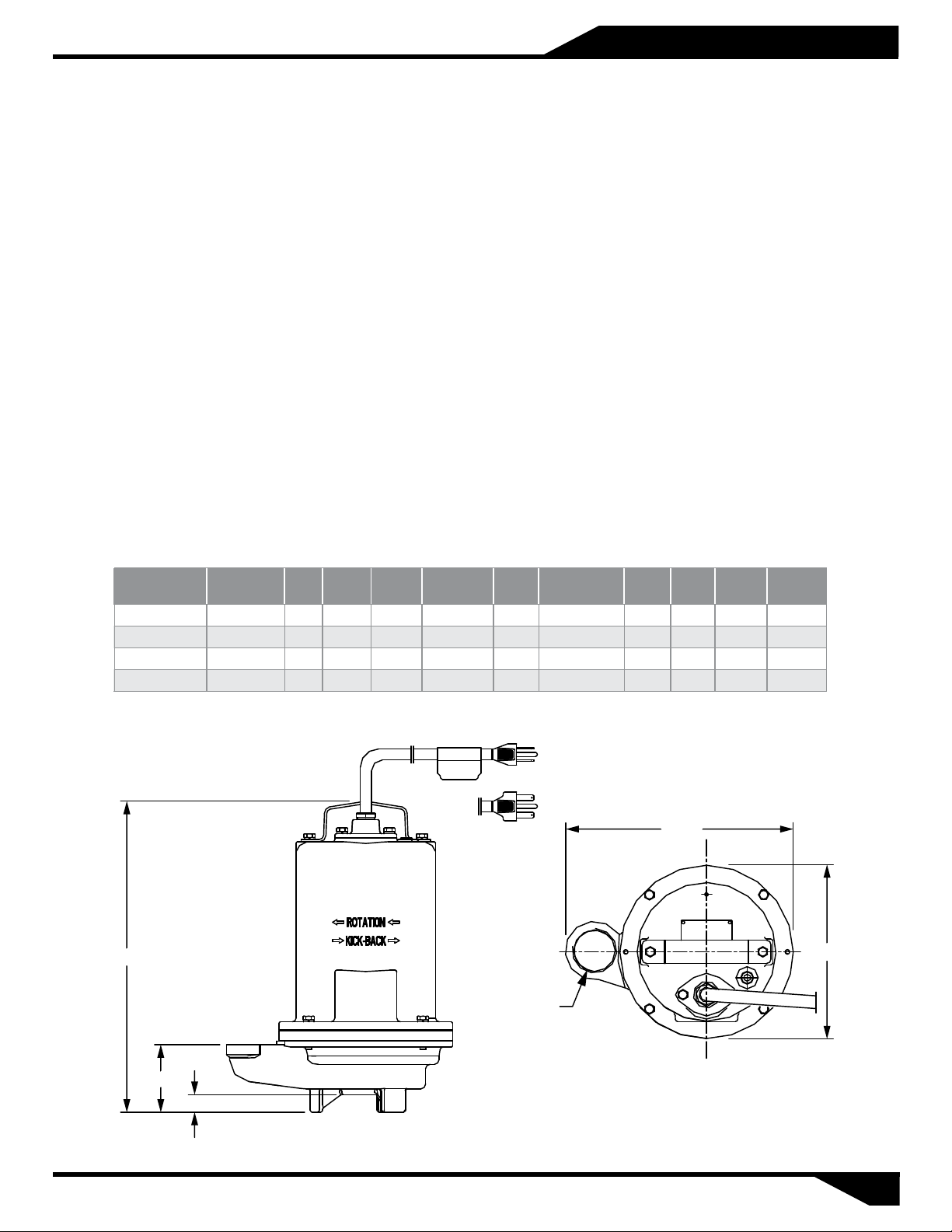
Specications & Dimensions
DISCHARGE: 2" NPT, vertical.
SPHERICAL SLD HNDLG: 3/4"
LIQUID TEMPERATURE: 104° F (40° C) continuous.
VOLUTE: Cast iron ASTM A-48 class 30.
MOTOR HOUSING: Cast iron ASTM A-48 class 30.
SEAL PLATE: Cast iron ASTM A-48 class 30.
IMPELLER: Single vane enclosed. Polypropylene with stainless steel insert.
SHAFT: Stainless steel.
O-RINGS: Square shaped Buna-N.
PAINT: Air dry enamel, water based.
SEAL: Outboard single mechanical, oil lled chamber. carbon / ceramic / Buna-N, with
stainless steel hardware.
HARDWARE: 300 series stainless steel.
CORD ENTRY: 20 ft of neoprene cord, sealed against moisture.
BEARINGS: Ball, single row, oil lubricated.
MOTOR: NEMA L, single phase, permanent split capacitor, oil lled, with
overload
in motor.
OPTIONAL EQUIPMENT: Additional cord, seal material, impeller trims, slide rail coupling (SRC-2).
protection
MODEL PART No. HP VOLTS PHASE
2FFSTEP
2FFSTEP
2FFSTEP
2FFSTEP
A = Automatic Float Switch.
16.53"
512 0.5 115 1 3450 13.1 26.2 G 14/3 SOW 80
512A 0.5 115 1 3450 13.1 26.2 G 14/3 SOW 80
522 0.5 230 1 3450 5.6 13.2 E 14/3 SOW 80
1022
-
-
-
- 1 230 1 3450 9.1 23.5 f 14/3 SOW 80
RPM
(Nominal)
MAX
AMPS
2" NPT
LOCKED
ROTOR AMPS
NEMA
CODE
CORD
SIZE
12.16"
CORD
TYPE
WEIGHT
(pounds)
9.25"
3.6"
0.94"
02
Page 4
Recommendations and Warnings
Receiving inspection
Upon receiving the pump, it should
be inspected for damage or
shortages. If damage has occurred,
le a claim immediately with the
company that delivered the pump. If
the manual is removed from the
packaging, do not lose or misplace.
Storage
Any product that is stored for a
period longer than six (6) months
from the date of purchase should be
bench tested prior to installation. A
bench test consists of, checking the
impeller to assure it is free turning
and a run test to assure the motor
(and switch if provided) operate
properly.
Controls
Manual models require a separate
approved pump control device or
panel for automatic operation. Be
sure the ele
control selected properly match the
electrical specications of the pump.
ctrical specication of the
Installation
There are two methods of installing
euent pumps:
1. In a Flex-Hose system, most
commonly used in interceptor
tanks, and
2. A slide rail in a package system or
concrete wet well, which allows
the pump(s) to be installed or
removed without requiring
personnel to enter the wet well.
The sump, basin or lift station shall
be sealed and vented in accordance
with local plumbing codes. This
pump is designed to pump
sewage, euent or wastewater,
non-explosive and non-corrosive
liquids and shall NOT be installed
in locations classied as hazardous
in accordance with the National
Electrical Code (NEC) ANS
70 or Canadian Electric Code (CEC).
The pump should never be installed
in a trench, ditch, or hole with a dirt
bottom. The legs will sink into the
dirt and the suction will become
plugged.
I/NFPA
Liquid Level Controls
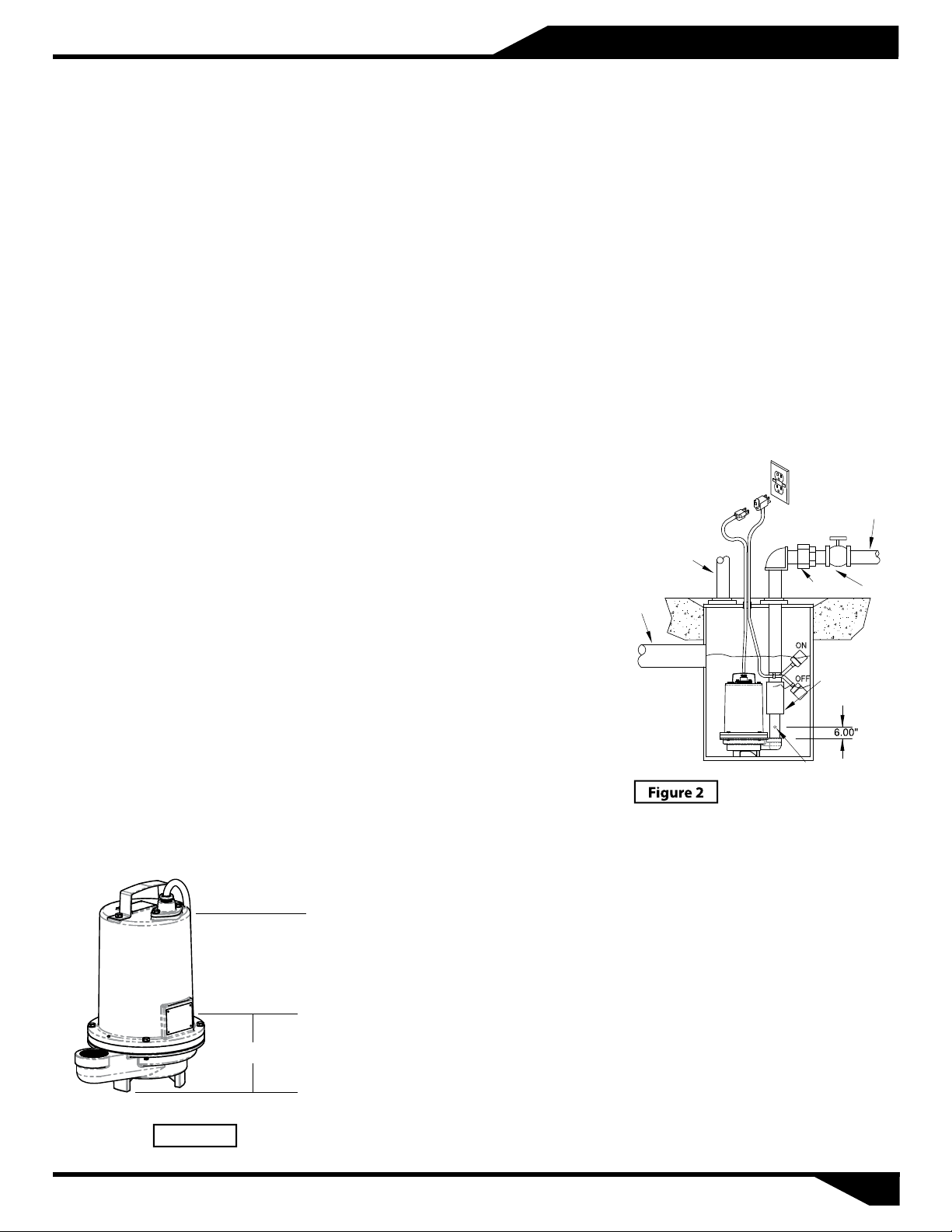
Typical Discharge Pipe Mounted:
Refer to Figure 2 below which shows
a typical installation of a 1 phase 120
or 240 volt pump using a level
control mounted to the discharge
piping with a piggy-back plug. The
level control should have adequate
clearance so it cannot hang up in it’s
swing and that the pump is
completely submerged when the
level control is in the "O" mode. By
adjusting the cord tether the control
level can be changed.
Typical Installation with Wide
Angle Level Control
DISCHARGE
VENT
UNION
INLET
GATE
VALVE
CHECK VALVE
Submergence
The pump should always be
operated in the submerged
condition. The minimum sump liquid
level should never be less than above
the pump’s volute (See Figure 1).
Recommended
Submergence
Level
Minimum
Submergence
Level
6"
Bottom of Feet
Figure 1
The installation should be at a
sucient depth to ensure that all
plumbing is below the frost line. If
this is not feasible, remove the check
valve and size the basin to
accommodate the additional
backow volume.
Discharge Piping
Discharge piping should be as short
as possible and sized no smaller than
the pump discharge. Do not reduce
the discharge pipe size below that
which is provided on the pump.
Both a check valve and a shut-o
valve are recommended for each
pump. The check valve is used to
prevent backow into the sump. The
shut-o valve is used to manually
stop system low during pump
servicing.
Drill ¼" dia. vent hole
to prevent air locking
Level Control Basic Instructions:
Plug the level control plug into the
GFI receptacle, then plug the pump
into the piggy-back plug (See Figure
3). One cycle of operation should be
observed, so that any potential
problems can be corrected.
It is recommended that the level
control oat should be set to insure
that the liquid in the sump never
drops below the top of the motor
housing or a minimum level of 6
inches above the basin oor.
03
Page 5

Installation & Service
115V, 1Ph
230V, 1Ph
Overload Protection:
Single Phase - The stator in-winding
overload protector used is referred to
as an inherent overheating protector
and operates on the combined eect
of temperature and current. This
means that the overload protector
will trip out and shut the pump o
the
windings become too hot, or the
load current passing through them
becomes too high.
IMPORTANT! - The overload will then
automatically reset and start the
pump up after the motor cools to a
safe temperature. In the event of an
o verload, the source of this condition
should be determined and corrected
immediately.
WARNING
PUMP TO CYCLE OR RUN IF AN
OVERLOAD CONDITION OCCURS.
DO NOT ALLOW THE
if
2.Check Pump Rotation - Improper
motor rotation can result in poor
pump performance and can
damage the motor and/or pump.
Check rotation on three phase
units by momentarily applying
power and observe the "kickback".
3.Name Plate - Record the
information from the pump name
plate to drawing in front of manual
for future reference.
4.Insulation Test - An insulation
(megger) test should be performed
on the motor. Before
into service. The resistance values
(ohms) as well as the voltage (volts)
and current (amps) should be
recorded.
the pump
is put
Figure 3
Electrical Connections
Power cable:
The power cable mounted to the
pump must not be modied in any
way except for shortening to a
specic application. Any splice
between the pump and the control
panel must be made in accordance
with the electric codes. It is
recommended that a junction box, if
used, be mounted outside the sump
or be of at a minimum Nema 4
construction if located within the wet
well. DO NOT USE THE POWER
CABLE TO LIFT PUMP.
Always rely upon a Certied
Electrician for installation.
If current through the temperature
sensor exceeds the values listed, an
intermediate control circuit relay
must be used to reduce the current
or the sensor will not work properly.
TEMPERATURE SENSOR ELECTRICAL
RATINGS
Volts Continuous
Amperes
110-120 3.00 30.0
220-240 1.50 15.0
Wire Size:
If longer power cable is required
c a qualied electrician for onsult
proper wire size.
Inrush
Amperes
Pre-Operation
1.Check Voltage and Phase -
Compare the voltage and phase
information stamped on the
pump name plate.
5.Pump-Down Test - Be sure pump
has been properly wired, lowered
into the basin, sump or lift station,
check the system by lling with liquid
and allowing the pump to operate
through its pumping cycle. The time
needed to empty the system, or
pump-down time along with the
volume of water, should be recorded.
Maintenance
No lubrication or maintenance is
required. Perform the following
checks when pump is removed from
operation or when pump
performance deteriorates:
a)Inspect motor chamber for oil
level and contamination.
b)Inspect impeller and body for
excessive build-up or clogging.
c)Inspect motor, bearings and shaft
seal for wear or leakage.
04
Page 6

Service
Servicing
Cooling Oil - Anytime the pump is
removed from operation, the cooling
oil in the motor housing should be
checked visually for oil level and
contamination. To check oil, set unit
upright. Remove pipe plug from
housing. With a ashlight, visually
inspect the oil in the housing to make
sure it is clean and clear, light amber
in color and free from suspended
particles. Milky white oil indicates the
presence of water. Oil level should be
just above the motor when pump is
in vertical position.
Oil Testing
Drain oil into a clean, dry container
by placing pump on it’s side,
remove pipe plug (20), from
housing (10).
Check oil for contamination using
an oil tester with a range to 30 kV
breakdown.
If oil is found to be clean and
uncontaminated (measuring
above 15 V breakdown), re ill the k f
housing.
If oil is found to be dirty or
contaminated (or measures below
15 breakdown), the pump must kV
be carefully inspected for leaks at
the shaft seal, conduit box, o-rings,
pipe plug and pressure valve,
before re illing with oil. To locate f
the leak, perform a pressure test.
After leak is repaired, dispose of old
oil properly, and re ill with new oil.f
Pressure Test (If oil has been
drained) - Remove pipe plug from
housing. Apply pipe sealant to
pressure gauge assembly and tighten
into hole. Pressurize motor housing
to 10 PSI. Use soap solution around
the sealed areas and inspect joints
for "air bubbles".
If, after ve minutes, the pressure is
still holding constant, and no
"bubbles" are observed, slowly bleed
the pressure and remove the gauge
assembly. Replace oil. Leek must be
ted and repaired if pressure does
loca
not hold.
Pressure Test (If oil has NOT been
drained) - Oil should be at normal
level. Remove pipe plug from
housing. Apply pipe sealant to
pressure gauge assembly and tighten
into hole. Pressurize motor housing to
10 PSI. Use soap solution around the
sealed areas above the oil level and
inspect joints for "air bubbles". For
sealed areas below oil level, leeks will
seep oil. If, after ve minutes, the
pressure is still holding constant, and
no "bubbles"/oil seepage is observed,
slowly bleed the pressure and remove
the gauge assembly. Replace oil. Leek
must be located and repaired if
pressure does not hold.
Pressure builds up extremely
fast, increase pressure by
"TAPPING" air nozzle. Too
much pressure will damage
seal. DO NOT exceed 10 PSI.
Oil Replacement - Set unit upright
and rell with new cooling oil as per
table below . Fill to just above motor,
but below capacitor as an air space
must remain in the top of the housing
to compensate for oil expansion.
Apply pipe thread compound to
threads of pipe plug then assemble
to housing.
DO NOT overll oil.
Overlling of housing with oil
can create excessive and
dangerous hydraulic pressure
which can destroy the pump
and create a hazard.
Overlling oil voids warranty.
Cooling Oil
Recommended Supplier/Grade
BP Enerpar SE100
Conoco Pale Paran 22
Mobile D.T.E. Oil Light
Shell Canada Transformer-10
Texaco Diala-Oil-AX
Disassembly & Assembly
Impeller U-cup, V-ring and Volute:
Disconnect power. Remove cap
screws and lock washers vertically lift
motor, housing and seal plate
assembly from volute. Clean out
volute if necessary. Inspect gasket
and replace if cut or damaged. Check
U-cup for damage. If replacement is
needed, cut the U-cup from the
volute and clean surface of bore.
Clean and examine impeller, for
cracks or breakage and replace if
required. To remove impeller, place a
at screwdriver in the slot of the end
of the shaft to hold the shaft
stationary while unscrewing the
impeller.
05
Page 7

Service
To reassemble, clean the threads with
thread locking compound cleaner.
Apply removable Loctite® 242 or
equivalent to shaft threads. Screw
impeller onto the shaft hand tight
while using a screwdriver in the slot
at the end of the shaft to hold it
stationary. Rotate impeller to check
for binding. Install U-cup by applying
adhesive to bore of volute. Be sure
not to get adhesive on inside
diameter of U-cup.
Position gasket on volute ange and
position impeller and motor housing
assembly on volute.
CAUTION
the U-cup is not pushed out of place
when assembling volute to rest of the
pump.
Position lock washer on cap screw
and screw into volute. Torque to 100
in/lbs. Check for free rotation of
impeller.
Shaft Seal:
To examine or replace shaft seal,
disassemble volute and impeller as
stated. Remove retaining ring, spring
and rotating member from shaft.
Inspect seal for signs of uneven wear
pattern on stationary members, chips
and scratches on either seal face. DO
NOT interchange seal components,
eplace the entire shaft seal . If
r
replacing seal, remove stationary by
prying out with lat screwdrive . f r
To reassemble, clean seal cavity in
seal plate and oil. Press seal’s
stationary member rmly into seal
plate, use a seal tool or pipe.
Be sure the inside lip of
Handle seal parts with
extreme care. DO NOT
damage lapped surfaces.
Nothing should come in contact with
the seal face except the seal tool. Be
sure the stationary is in straight.
Lightly oil (Do not use grease) shaft
and inner surface of bellows. Slide
rotating member onto stationary
using a seal tool. Place spring and
retaining ring onto rotating member.
Assemble impeller and volute as
described.
Motor, Capacitor and Bearings:
Remove volute and impeller as
previously stated and drain oil from
housing. Remove shaft seal. Position
unit upright, using blocks to avoid
resting unit on shaft. Unscrew cable
cap screws and remove compression
ange and power cord. Remove snap
ring with a at head screwdriver.
Pull the terminal block out of the
housing using a T-bolt or a pair of
pliers and a .25-20 screw in the
threads of the terminal block. Leave
slack on the motor leads connected
underneath. Use needle nose pliers
to pull each female connector o of
the pins on the underside of the
terminal block. The voltage should be
noted.
Remove cap screws from seal plate
and lift housing from seal plate.
Remove square ring, replace if cut or
damaged. Disconnect capacitor leads
from capacitor. Remove motor bolts,
lift cover, body and stator assembly
from seal plate. Remove snap ring to
remove rotor assembly. Remove
bearings and with a wheel puller.
Check motor capacitor with an Ohm
meter by rst grounding the
capacitor by placing a screwdriver
across both terminals and then
removing screwdriver. Connect Ohm
meter (set on high scale) to terminals.
If needle moves to innity (∞) then
drifts back, the capacitor is good.
If needle does not mov
innity (∞) and does not drift back,
replace capacitor. Inspect motor
winding for shorts and check
resistance values. Check rotor for
wear. If rotor or the stator windings
are defective, the complete motor
must be replaced.
Slide rotor/shaft with bearings and
into seal plate until bearing seats into
seal plate. Install snap ring into seal
plate.
Place stator over rotor, lining up
motor bolts with holes in seal
Place spring washer on bearing and
cover onto rotor/stator assembly.
Position capacitor so that it will lay on
the opposite side of the cable entry
boss of the housing. Install bracket
and reconnect capacitor leads.
Torque motor bolts to in/lbs. Set
square ring in grove on seal plate.
Lower housing down onto seal plate
while aligning holes and stringing
motor leads through the cord entry
bore. Place cap screws through seal
plate into housing and torque to 60
in/lbs. Reconnect motor leads to the
underside of the terminal block.
Place o-ring into groove in terminal
block and lubricate with dielectric oil.
Press the terminal block into the
housing so it seats completely below
the snap ring groove. Place snap ring
into groove in cord entry bore of
housing.
Power Cable Connection:
Check pow
damage and replace if required. Rell
the cooling oil. Insert female end of
cord plug into housing bore aligning
timing markwith hole in terminal
block. Compress cord plug with
compression ange by tightening
cap screws with lock washers into the
housing. Torque to 132 in/lbs.
er cord for cracks or
e or moves to
plate.
06
Page 8

FFBPSTEP
Repair Parts
For Repair Part Please supply: Model Number and Serial as shown on
Name Plate, and Part Description and Part Number as shown on Parts List.
07
Page 9

FFBPSTEP
ITEM DESCRIPTION QTY MATERIAL
1 Cable Assembly 20 ft SOW
2 O-ring Ø4.5" x 3.1" 1 NBR40
3 Pump body 1 HT200
4 Capacitor 25uf/370V 90 °C 1 Aluminium
5 Upper bearing plate 1 ZL102
6 Bearing 6203 2
7 Wave washer 39 1 65Mn
8 Temperature protector 1
9 Stator 1
10 Rotor component 1
11 Stator component 1
12 Hex head bolt 5/16" 4 304
13 Spring washer 8 304
14 Lower bearing plate O-ring 1 NBR40
15 Lower bearing plate 1 HT200
16 Impeller Ø117.3 1 Polypropylene
17 Casing 1 HT200
18 "U" shpe ring Ø31.5
19 Casing sealing washer 1 Rubber
20 Hex socket cap screws 1/4" - 20UNCx28 2 304
21 "V" shape ring 1 NBR40
22 Mechanical seal Ø31.8 x Ø15.9 x 32.5 1 SiC/SiC
23 Elastic collar 40 1 65Mn
24 Elastic collar 17 2 65Mn
25 Lengthern bolt #8-32 x 140 4 Q235A
26 Flat washer 4 4 Q235A
27 Spring washer 4 4 65Mn
28 Capacitor clamp 1 08F
29 Cross recessed pan head screw M4x8 2 Q235A
30 Ground lead 1
31 Hex bolt 5/16" - 18UNCx25 4 304
32 Hex socket pipe stopper 3/8" - 18 NPT 1 304
33 Handle 1 3
34 Name plate 1 304
35 Nail for name plate 2x4 4 Cu
36 Float switch (optional) 1
37 Clamp (optional) 1 2Cr13+NBR40
38 Cross recess pan head screw #10-32UNFx12 (optional) 1 304
39 Trademark signs 1 304
x Ø44.3 x 6.5 1 NBR40
04
Parts List
For Repair Part Please supply: Model Number and Serial as shown on
Name Plate, and Part Description and Part Number as shown on Parts List.
08
Page 10

Troubleshooting Chart
Risk of electric shock. Always disconnect the pump from the power source before handling inspections or repairs.
Symptom Possible Cause(s) Corrective Action
1. Poor electrical connection, blown fuse, tripped
breaker or other interruption of power;
improper power supply
2. Motor or switch inoperative (go to manual
Pump will not run
Pump will not turn o
Pump hums but doesn’t run
Pump delivers insucient capacity
Pump cycles too frequently or runs periodically
when f ixtures are not in use
Pump shuts of f and turns on independent of
switch, (trips thermal overload protector).
CAUTION! Pump may start unexpectedly.
Disconnect power supply.
Pump operates noisily or vibrates excessively
NOTE: Flo Fab Pumps assumes no responsibility for damage or injury due to disassembly in the eld. Disassembly of the pumps or supplied accessories other
than at Flo Fab Pumps or its authorized service centers, automatically voids warranty.
operation)
2a. Float movement restricted
2b. Switch will not activate pump or is defective
2c. Defective motor
3. Insu cient liquid level
2a. Float movement restricted
2b. Switch will not activate pump or is defective
4. Excessive inow or pump not properly sized for
application
9. Pump may be air locked causing pump not to ow
14. H-O-A switch on panel is in "HAND" position
1. Incorrect low voltage
8. Impeller jammed or loose on shaft, or inlet
plugged
1. Incorrect low voltage
4. Excessive inow or pump not properly sized for
application
5. Discharge restricted
6. Check valve partially closed or installed backwards
7. Shut-o valve closed
8. Impeller jammed or loose on shaft, or inlet
plugged
9. Pump may be air locked causing pump not to ow
10. Piping xtures leaking or discharge be
nozzle
6. Check valve partially closed or installed backwards
11. Fixtures are leaking
15. Ground water entering basin
1. Incorrect low voltage
4. Excessive inow or pump not properly sized for
application
8. Impeller jammed or loose on shaft, or inlet
plugged
12. Excessive water temperature (internal
protection only)
2c. Worn bearings, motor shaft bent
5. Debris in impeller cavity or broken impeller
10. Pump running backwards
13. Piping attachments to building structure too
loose or rigid
fore the
1. Check all electrical connections for security.
Have electrician measure current in motor leads,
if current is within ± 20% of locked rotor Amps,
impeller is probably locked. If current is 0,
overload may be tripped. Remove power, allow
pump to cool, then re-check current.
2a. Reposition pump or clean basin as required to
provide adaquate clearance for oat
2b. Disconnect level control. Set ohmmeter for a
low rang, such as 100 ohms full scale and
connect to level control leads. Actuate level
control manually and check to see that
ohmmeter shows zero ohms for closed switch
and full scale for open switch. (Float Switch)
2c. Check winding insulation (Megger Test) and
winding resistance. If check is outside of range,
dry and re-check. If still defective, replace per
service instructions.
3. Make sure liquid level is above the pump
4. Re-check all sizing calculations to determine
proper pump size.
5. Check discharge line for restrictions, including
ice if line passes through or into cold areas.
6. Remove and examine check valve for proper
installation and freedom of operation
7. Open valve
8. Check impeller for freedom of operation,
security and condition. Clean impeller cavity
and inlet of any obstruction
9. L
oosen union slightly to allow trapped air to
escape. Verify that turn-o level of switch is set
so that the suction is always ooded. Clean vent
hole
10. Check rotation. If power supply is three phase,
reverse any two of three power supply leads to
ensure proper impeller rotation
11. Repair xtures as required to eliminate leakage
12. Check pump temperature limits and uid
temperature
13. Replace portion of discharge pipe with exible
connector or tighten existing piping.
14. Turn to automatic position
15. Check for leaks around basin inlet and outlets
09
Page 11

 Loading...