

Page 1
REF24PR
Page 2

C O N T E N T S
1 Safety warnings
1.1 1War nin g·· ·· ·· ·· ·· ·· ··
1.2 Meani ngs of s afe ty warning symb ols· · · ··· · · ···· · · ···· · · ···· · ·2
1.3 Elect ric ity related w arn ing s··· · · ··· · ···· · ···· · ··· · · ··· · ··2
1.4 Warn ing s for using· · · · · · · · · · · · · · · · · · · · · · · · · · · · · · · 3
1.5 Wa rni ngs for placement · · · · ·· · · · · ··· · · · · ·· · · · · · ·· · · ·
1.6 · · · · · · · · · · · · · · · · · · · · · · · · · · · · · · 4
Warn ings for en ergy
1.7 Warn ing s for dis pos al· · · · · · · · · · · · · · · · · · · · · · · · · · · · · ·4
2 Proper use of the re frige rator
2.1 Placeme nt· · · · · · · · · · · · · · · · · · · · · · · · · · · · · · · · · · ·
2.2 Install ati on in c abi net··········· ··· ··· ·········· ··· ··· ··6- 7
Door Ri ght -Le ft Ch ang e
2.3 ·· ·· ·· ·· ·· ·· ·· ·· ·· ·· ·· ·· ·· ·· ·· ··
2.4 Cha ngi ng t he Light· ···· ·· ·· ·· ···· ·· ·· ·· ···· ·· ·· ·· ····1 1
2.5 Sta rti ng to use· ····· ·· ·· ·· ······ ·· ·· ·· ····· ·· ·· ·· ··11
2.6 Energy sav ing tips·· ·· ·· ·· ·· ·· ·· ·· ·· ·· ··· ·· ··· ·· ··· ·· 11
3 Structure and functions
3.1 Key c omp onents· · · · · · · · · · · · · · · · · · · · · · · · · · · · · 1 2
3.2 Func tio ns· · · · · · · · · · · · · · · · · · · · · · · · · · · · · · · · · · ·13
··· ·· ··· ·· ··· ·· ··· ·· ··· ·· ·
3-4
8-10
5
4 Maintenance and care of the refrigerator
4.1 Overall clea nin g· · · · · · · · · ·
4.2 D efr ost ing· · · · · · · · · · · · · · · · · · · · · · · · · · · · · · · · · · ·1 4
4.3 O ut of operation· · · · · · ·· · · · ·· · · · ·· · · · ·· · · · ·· · · · ··1 4
· · · · · · · · · · · · · · · · · · · · · · 14
5 Trouble shooting
5.1 Tr oub le sho oti ng· · · · · · · ··· · · · · ··· · · · · ··· · · · · ··· · ·15
Page 3
1 S a f e t y w a r n i n g s
1 . 1 Wa r n ing
Warning: risk of fire / flamma ble m ate rials
RECOMMENDATIONS:
This appliance is intended to be used in household and similar applications such as
staff kitchen areas in shops, offices and other working environments;
farm houses and by clients in hotels, motels and other residential type environments;
bed and breakfast type environments;
catering and similar non-retail applications.
EN60335-2-24)
(
For EN standard: This appliance can be used by children aged from 8 years and above and persons with reduce
physical sensory or mental capabilities or lack of experience and knowledge if they have been given supervision
or instruction concerning use of the appliance in a safe way and understand the hazards involved. Children shall
not play with the appliance. Cleaning and user maintenance shall not be made by children without supervision.
IEC60335-1
( )
For IEC standard: This appliance is not intended for use by persons (including children) with reduced physical,
sensory or mental capabilities, or lack of experience and knowledge, unless they have been given supervision or
instruction concerning use of the appliance by a person responsible for their safety.
)
Children should be supervised to ensure that they do not play with the appliance.
If the supply cord is damaged, it must be replaced by the manufacturer, its service agent or similarly qualified
persons in order to avoid a hazard.
Do not store explosive substances such as aerosol cans with a flammable propellant in this appliance.
The appliance has to be unplugged after use and before carrying out user maintenance on the appliance.
WARNING: Risk of fire / flammable materials.
WARNING
WARNING
recommended by the manufacturer.
WARNING
WARNING
unless they are of the type recommended by the manufacturer.
WARNING
and refrigerant.
: Keep ventilation openings, in the appliance enclosure or in the built-in structure, clear of obstruction.
: Do not use mechanical devices or other means to accelerate the defrosting process, other than those
: Do not damage the refrigerant circuit.
: Do not use electrical appliances inside the food storage compartments of the appliance,
: Please abandon the refrigerator according to local regulators for it use flammable blowing gas
Do not use extension cords or ungrounded(two prong)adapters
DANGER:Risk of child entrapment.Before you throw away your old refrigerator or freezer:
-Take off the doors
-Leave the shelves in place so that children may not easily climb inside
The refrigerator must be disconnected from the source of electrical supply before attempting the installation
of accessory
Refrigerant and cyclopentane foaming material used for the refrigerator are flammable.
Therefore, when the refrigerator is scrapped, it shall be kept away from any fire source and
be recovered by a special recovering company with corresponding qualification other than
be disposed by combustion, so as to prevent damage to the environment or any other harm.
1
1
Page 4
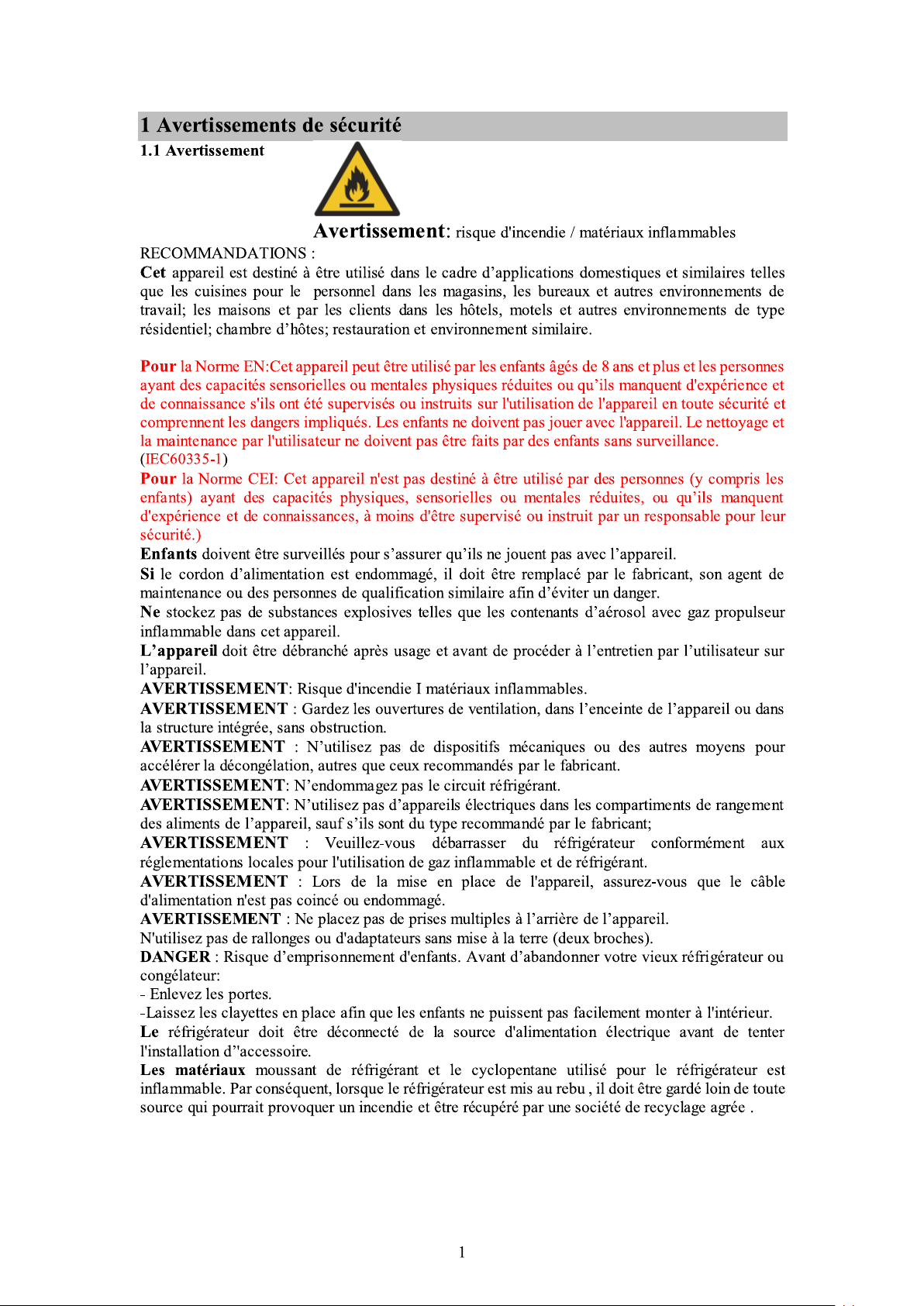
1.2 Meaning of safety warning symbols
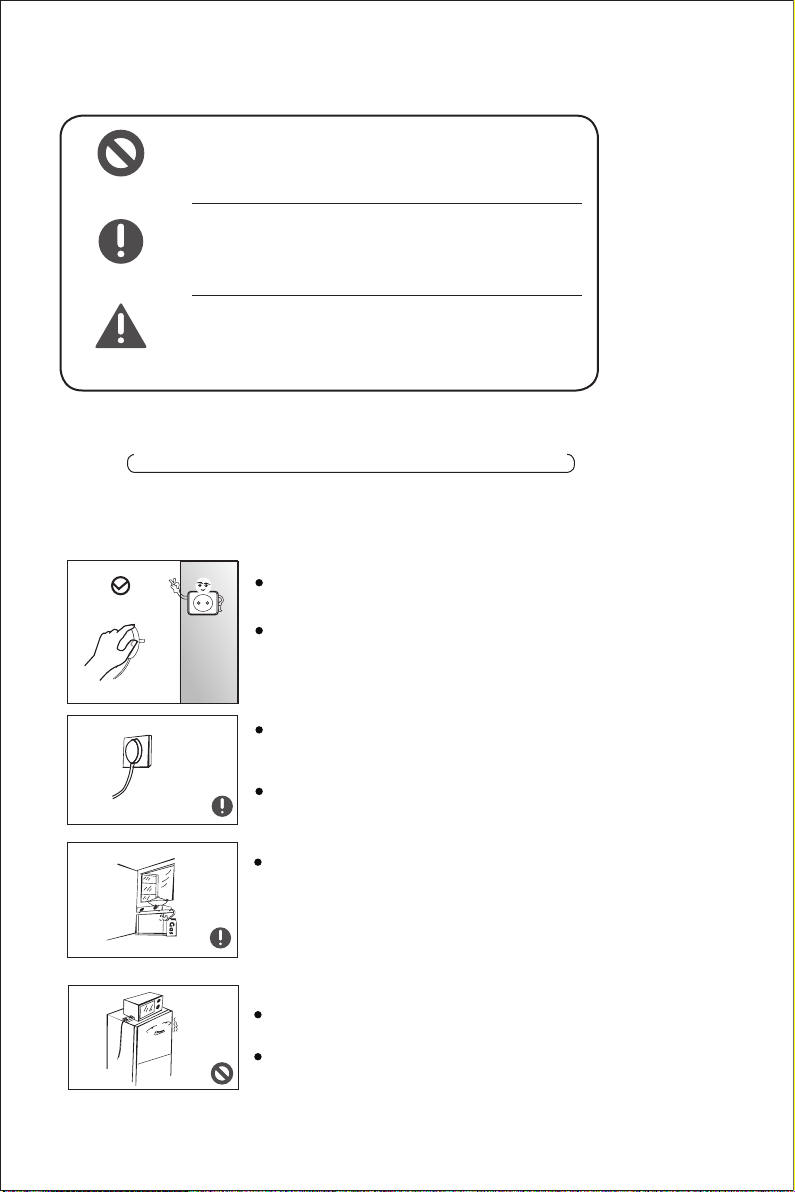
This is a prohi bit ion s ymb ol.
Any incompl ian ce wi th in structions mark ed wi th
this symbol m ay re sul t in da mage to the product
Prohibiti on sy mbo l
War nin g symbol
Note symbol
or endanger the pe rso nal s afe ty of the user.
This is a warning sy mbo l.
It is require d to op era te in s trict observanc e of
instructi ons m ark ed wi th th is symbol; or ot her wis e
damage to the p rod uct o r per son al injury may be c aus ed.
This is a cauti oni ng sy mbo l.
Instructi ons m ark ed wi th this symbol requ ire s pec ial c aution.
Insuff ici ent c aution may result i n sli ght o r mod erate injury,
or damage to th e pro duc t.
This manual c ont ain s lot s of important safe ty in for mat ion
which shall be obs erv ed by t he us ers.
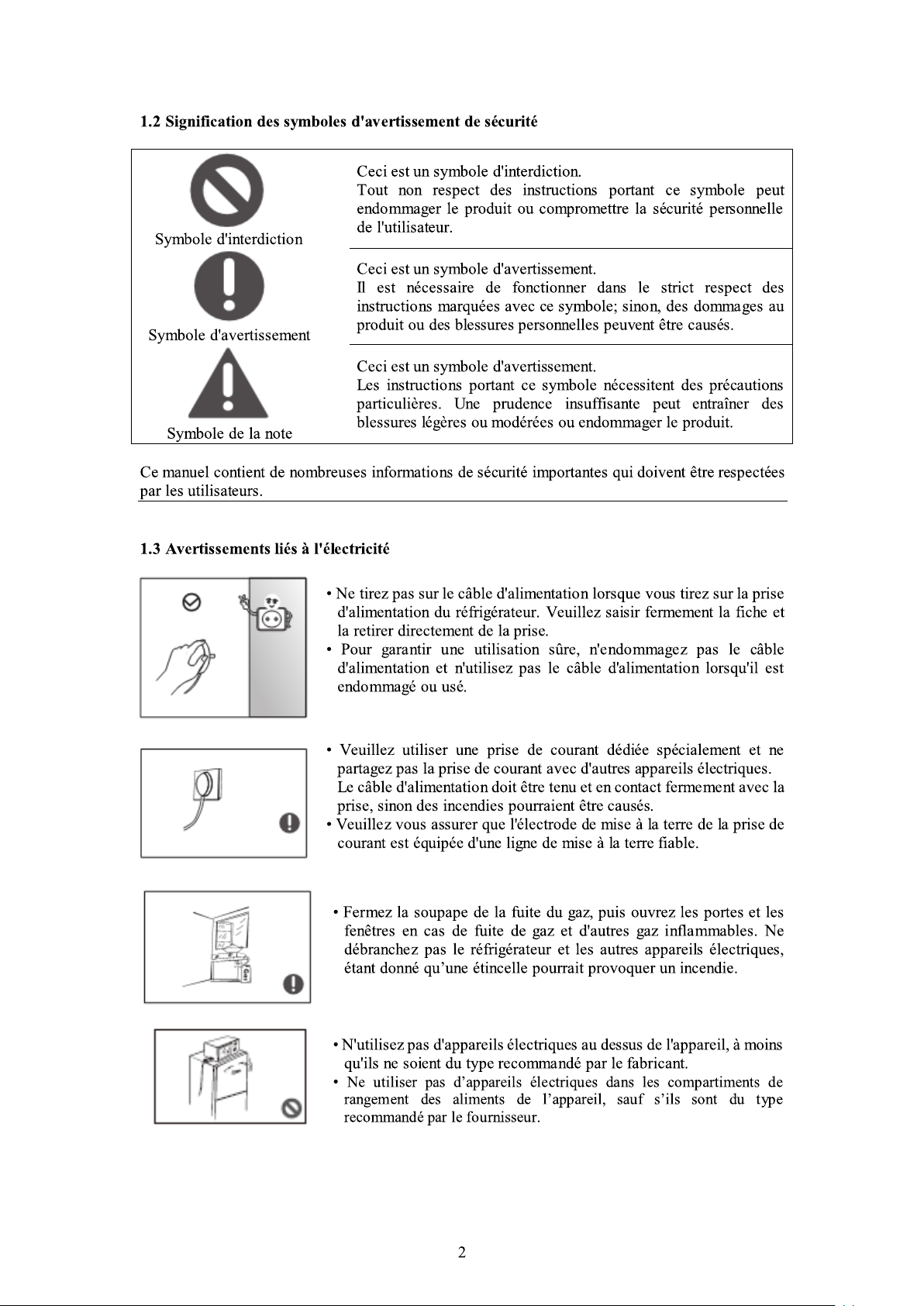
1.3 El ec tricity r el ated wa rnin gs
Do not pull the power cord when pulling the power plug of the
refrigerator. Please firmly grasp the plug and pull out it from
the socket directly.
To ensure safe use, do not damage the power cord or use the power cord
when it is damaged or worn.
Please use a dedicated power socket and the power socket shall
not be shared with other electrical appliances.
The power plug should be firmly contacted with the socket or else
fires might be caused.
Please ensure that the grounding electrode of the power socket is
equipped with a reliable grounding line.
Please turn off the valve of the leaking gas and then open the doors
and windows in case of leakage of gas and other flammable gases.
Do not unplug the refrigerator and other electrical appliances
considering that spark may cause a fire.
Do not use electri cal a ppl ian ces on the top of th e app lia nce ,
unless they are of t he ty pe re com mended by the ma nuf act ure r.
Do not use electri cal a ppl ian ces in the food st ora ge co mpa rtments
of the appliance , unl ess t hey a re of the type rec omm end ed by s upplier.
2
Page 5
1.4 Wa rnin gs for us in g
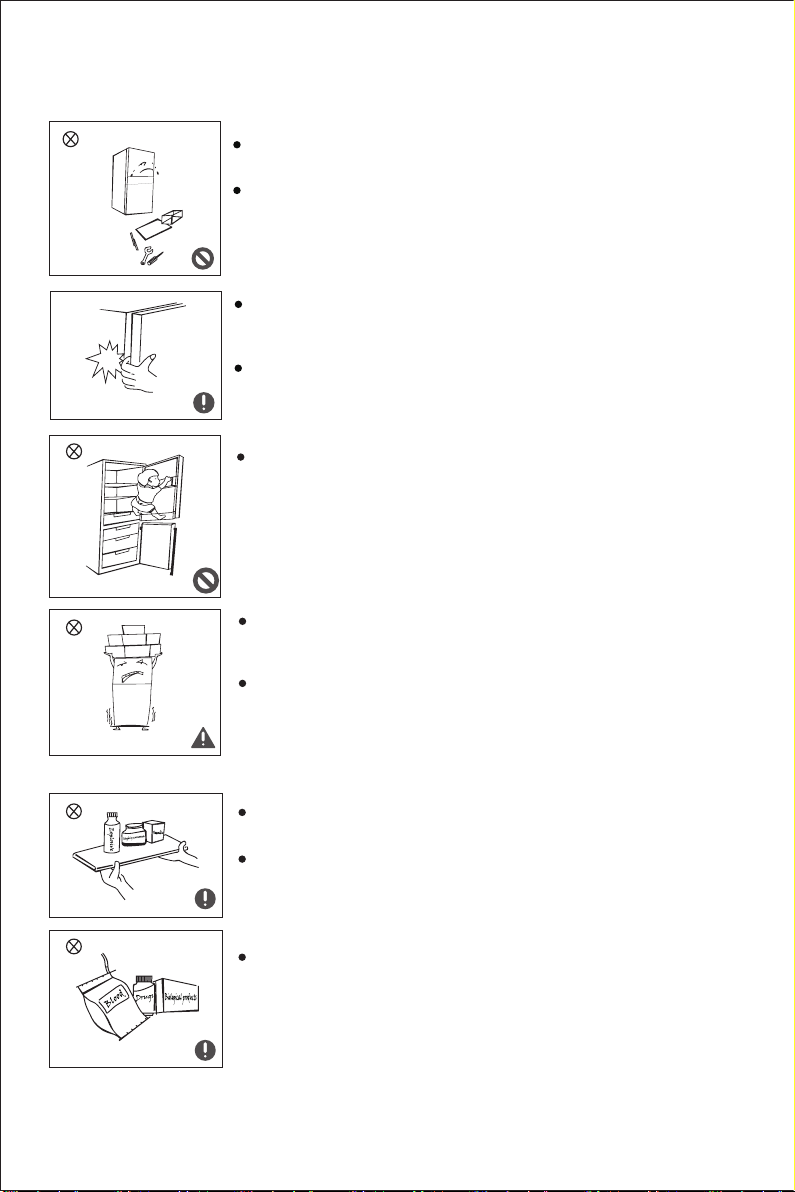
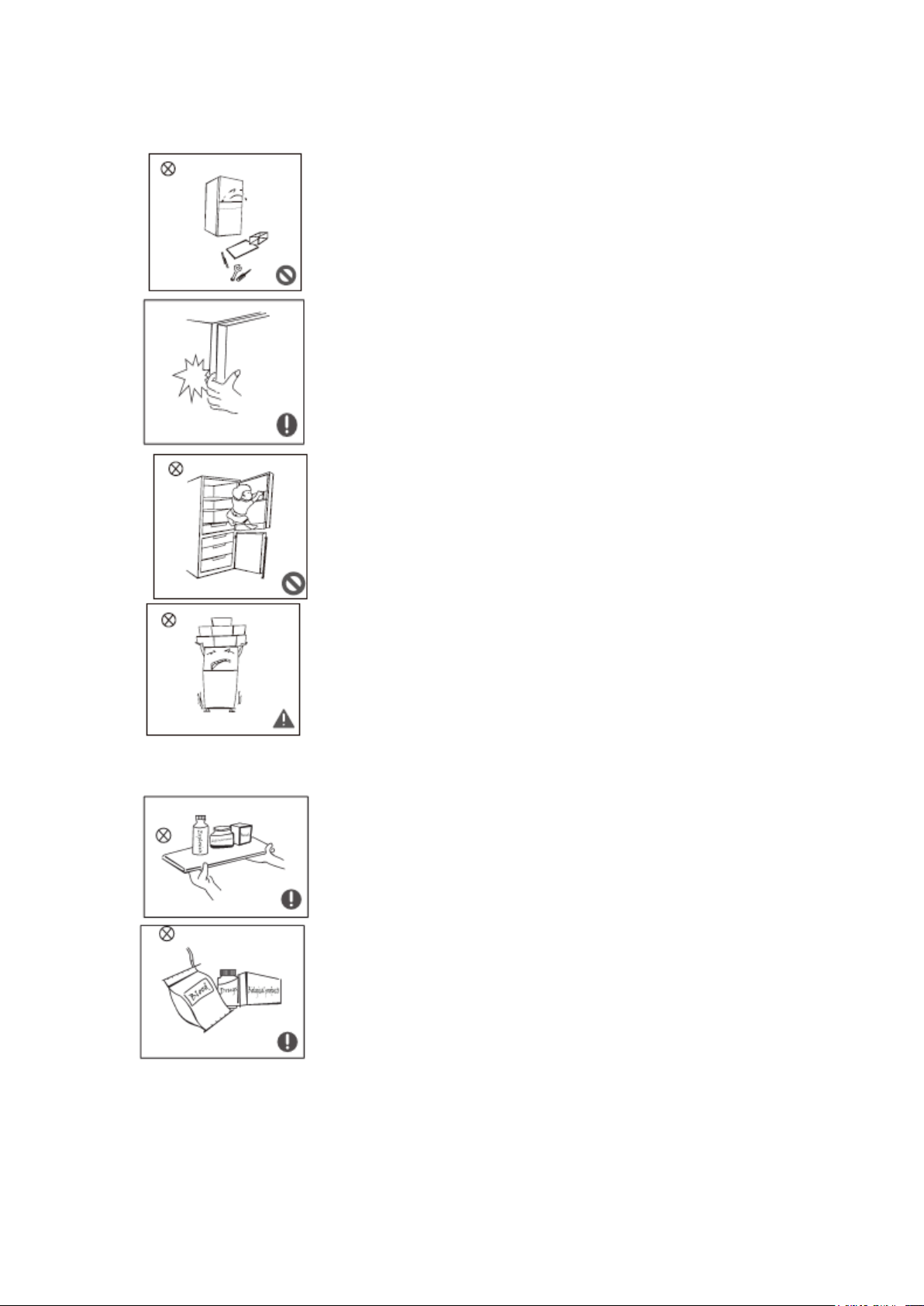
Do not arbitr ari ly di sas semble or reconst ruc t the r efr igerator,
nor damage th e ref rig era nt circuit; maint ena nce o f the appliance
must be condu cte d by a sp eci alist
Damaged pow er co rd mu st be r eplaced by the manu fac tur er, its
maintenan ce de par tme nt or related profe ssi ona ls in o rder to avoid
danger.
The gaps between refrigerator doors and between doors and refrigerator
body are small, be noted not to put your hand in these areas to prevent from
squeezing the finger. Please be gentle when close the refrigerator door to
avoid falling articles.
Do not pick foods or containers with wet hands in the freezing chamber when the
refrigerator is running, especially metal containers in order to avoid frostbite.
Do not allow any child to get into or climb the refrigerator; otherwise
suffocation or falling injury of the child may be caused.
Do not place heavy objects on the top of the refrigerator considering
that objectives may fall when close or open the door, and accidental
injuries might be caused.
Please pull out the plug in case of power failure or cleaning. Do not
connect the freezer to power supply within five minutes to prevent
damages to the compressor due to successive starts.
1. 5 Warn ings fo r placeme nt
Do not put flammable, explosive, volatile and highly corrosive items
in the refrigerator to prevent damages to the product or fire accidents.
Do not place flammable items near the refrigerator to avoid fires.
The refrigerator is intended for household use, such as storage of foods;
it shall not be used for other purposes, such as storage of blood,
drugs or biological products, etc.
3
Page 6
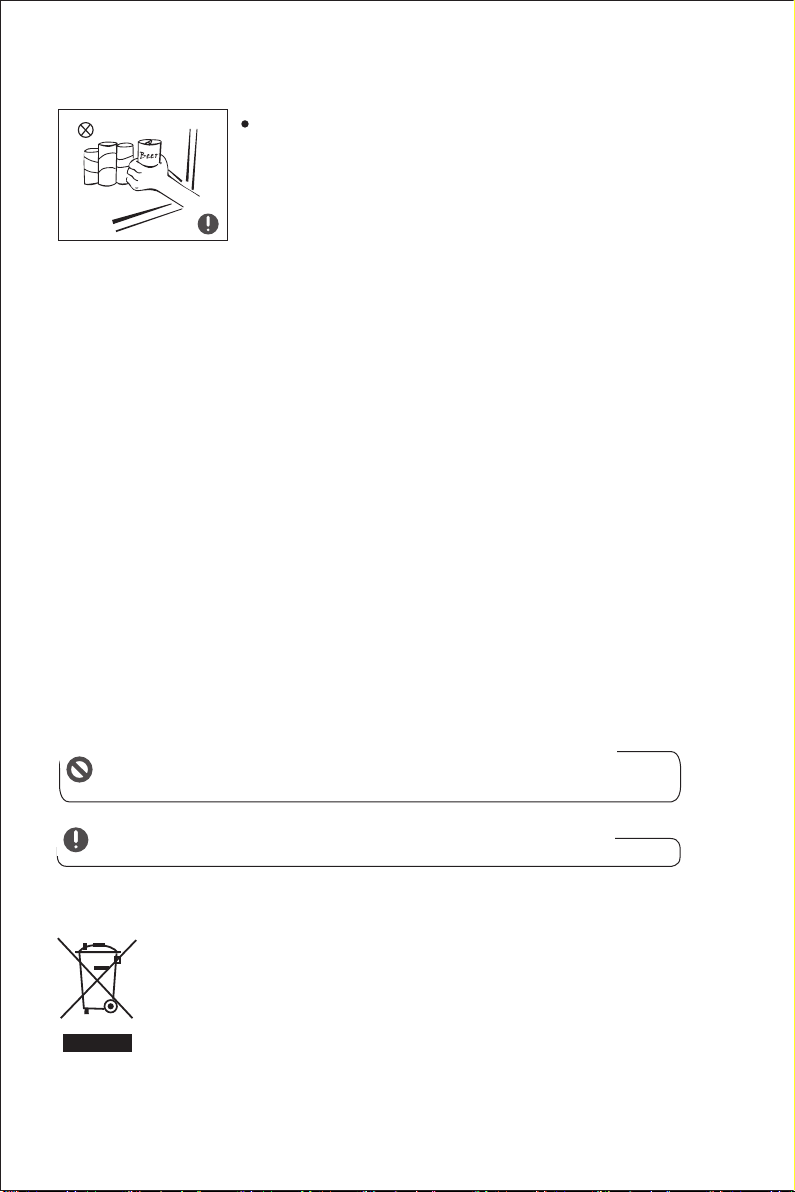
Freezi ng cham ber
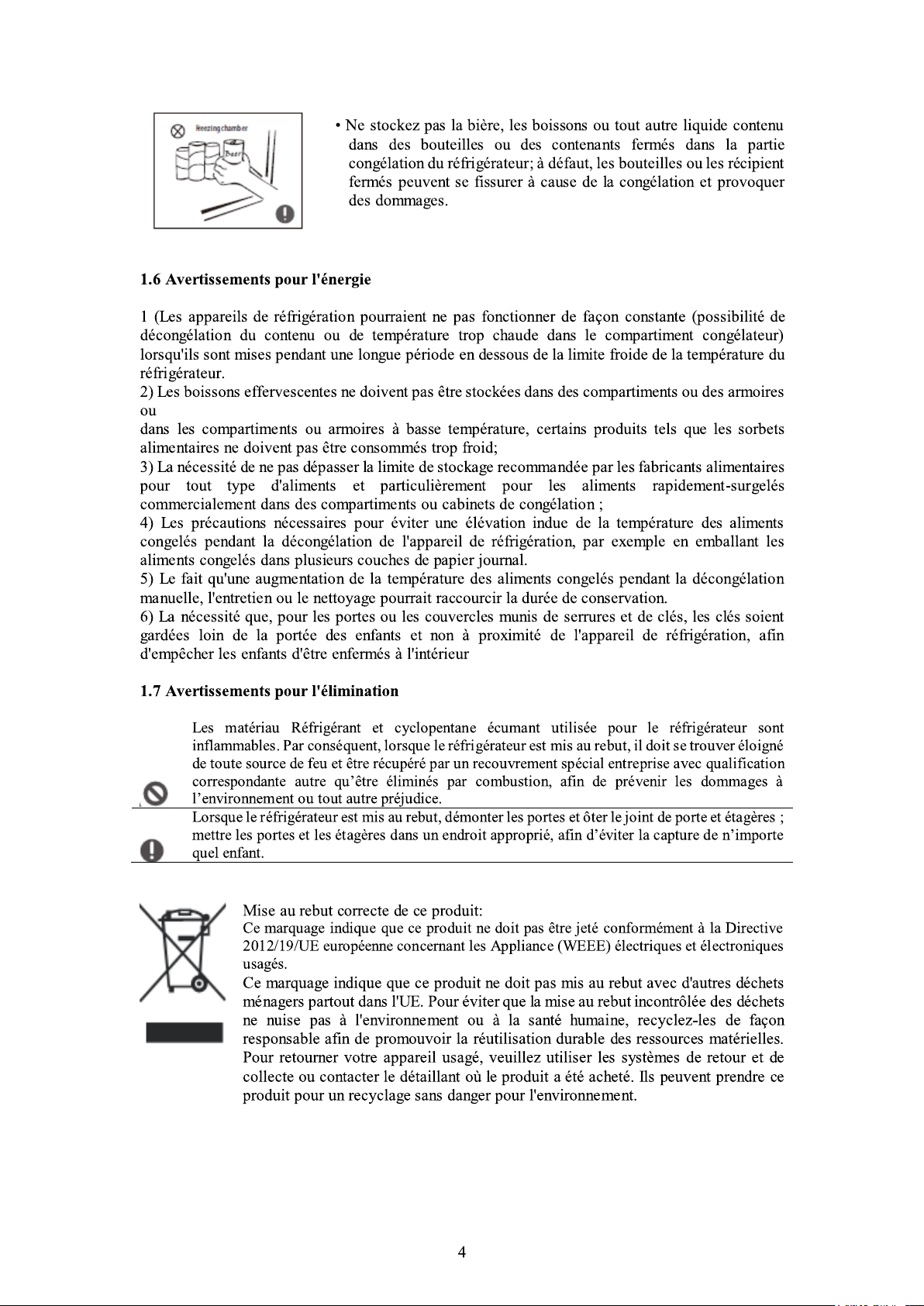
Do not store be er, be ver age o r other fluid conta ine d in bo ttles or
enclosed conta ine rs in t he freezing chamb er of t he re fri gerator;
otherwise t he bo ttl es or e nclosed contain ers m ay cr ack d ue to
freezing to c aus e dam age s.
1. 6 Warn ings fo r ener gy
1)Refrigerating appliances might not operate consistently (possibility of defrosting of contents or
temperature becoming too warm in the frozen food compartment) when sited for an extended period of
time below the cold end of the range of temperatures for which the refrigerating appliance is designed.
2)The fact that effervescent drinks should not be stored in food freezer compartments or cabinets or
in low-temperature compartments or cabinets, and that some products such as water ices should not be
consumed too cold;
3)The need to not exceed the storage time(s) recommended by the food manufacturers for any kind of
food and particularly for commercially quick-frozen food in food-freezer and frozen-food storage
compartments or cabinets;
4)The precautions necessary to prevent an undue rise in the temperature of the frozen food while
defrosting the refrigerating appliance, such as wrapping the frozen food in several layers of newspaper.
5)The fact that a rise in temperature of the frozen food during manual defrosting, maintenance or
cleaning could shorten the storage life.
6)The necessity that, for doors or lids fitted with locks and keys, the keys be kept out of the reach
of children and not in the vicinity of the refrigerating appliance, in order to prevent children from being
locked inside
1. 7 Warn ings fo r disposa l
Refrigerant and cyclopentane foaming material used for the refrigerator are flammable.
Therefore, when the refrigerator is scrapped, it shall be kept away from any fire source and
be recovered by a special recovering company with corresponding qualification other than
be disposed by combustion, so as to prevent damage to the environment or any other harm.
When the refrigerator is scrapped, disassemble the doors, and remove gasket of door and
shelves; put the doors and shelves in a proper place, so as to prevent trapping of any child.
Correct Disposal of this product:
This marking indicates that this product should not be disposed in accordance with
European Directive 2012/19/EU concerning used electrical and electronic appliances(WEEE).
To prevent possible harm to the environment or human health from uncontrolled waste disposal,
recycle it responsibly to promote the sustainable reuse of material resources. To return your used
device, please use the return and collection systems or contact the retailer where the product
was purchased. They can take this product for environmental safe recycling.
4
Page 7
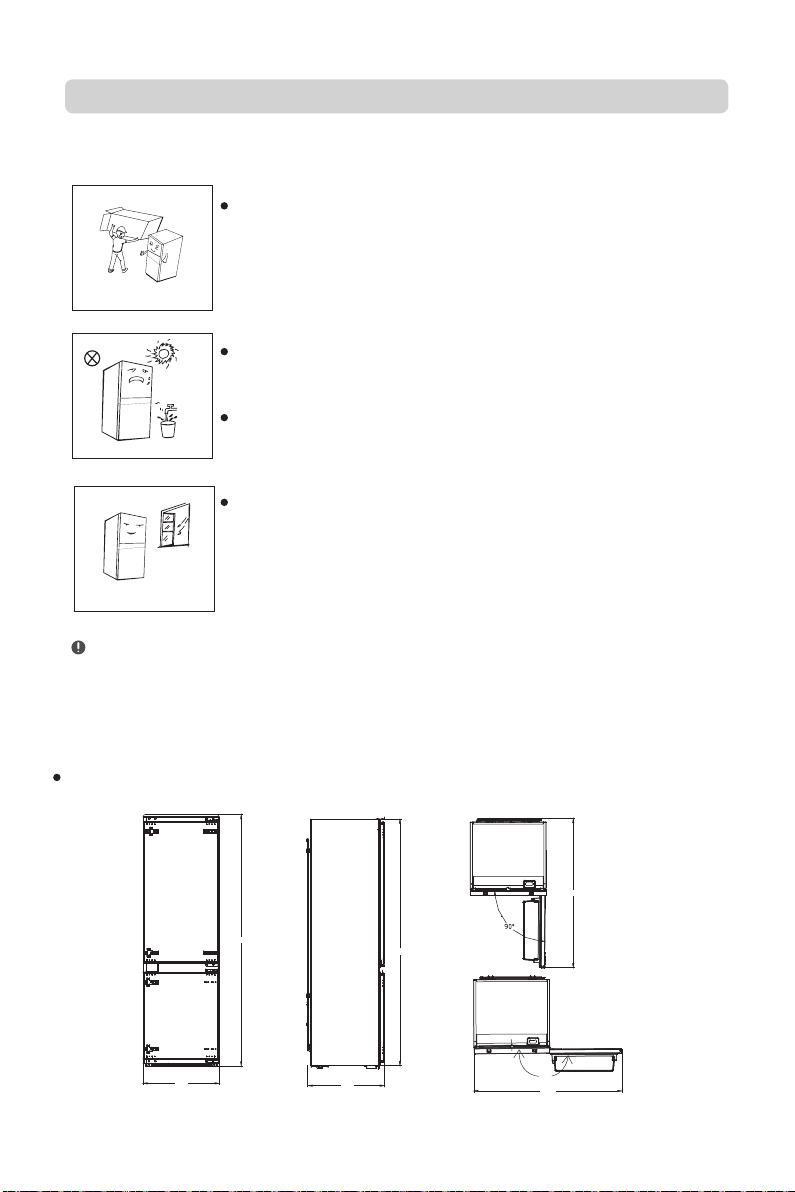
2 Proper u se of refrigerator s
2.1 Pl ac ement
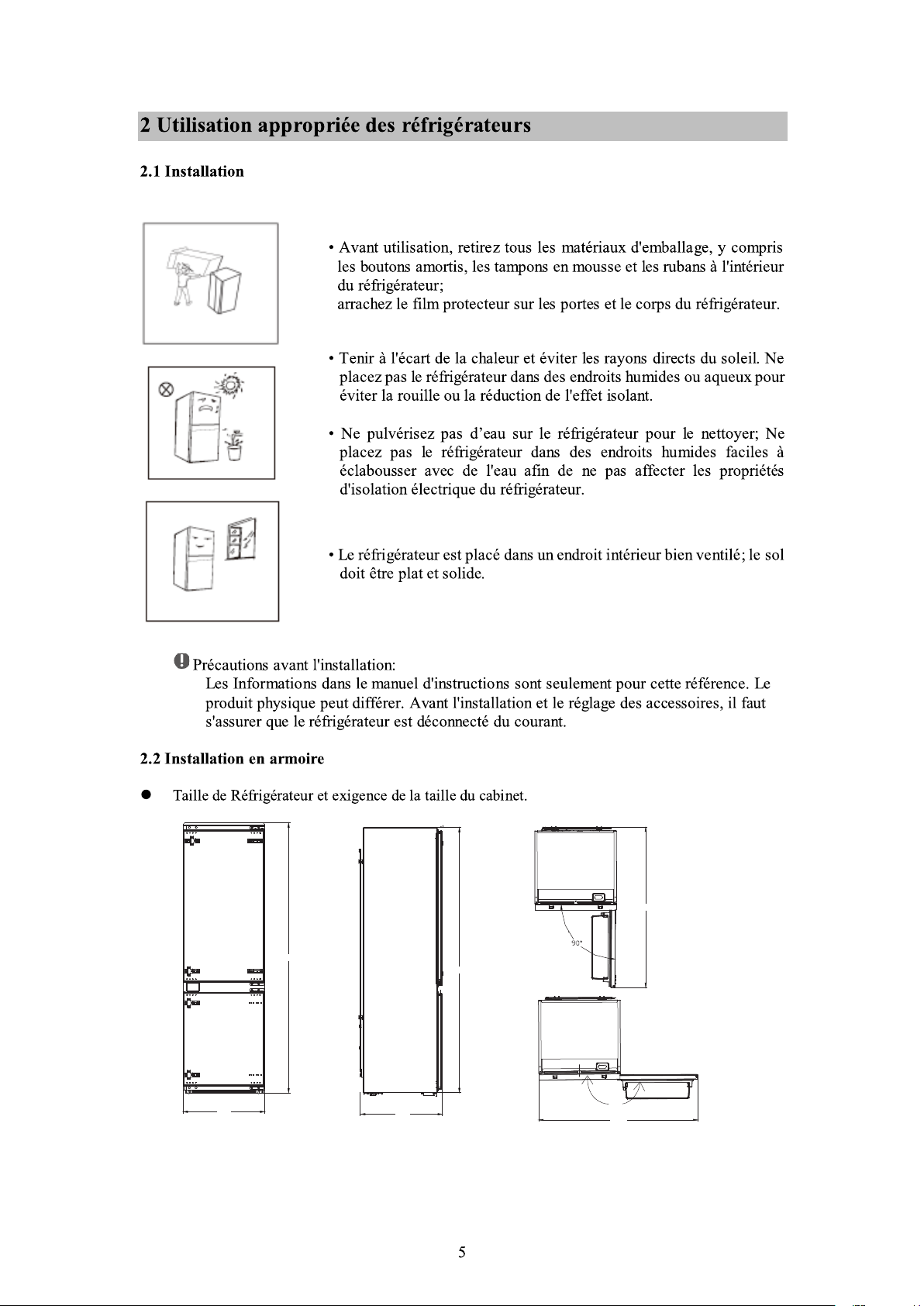
Before use, remove all packing materials, including bottom cushions,
foam pads and tapes inside of the refrigerator;
tear off the protective film on the doors and the refrigerator body.
Keep away from heat and avoid direct sunlight. Do not
place the freezer in moist or watery places to prevent rust
or reduction of insulating effect.
Do not spray or wash the refrigerator; do not put the refrigerator in
moist places easy to be splashed with water so as not to affect the
electrical insulation properties of the refrigerator.
The refrigerator is placed in a well-ventilated indoor place;
the ground shall be flat, and sturdy
Precautio ns be for e ins tallation:
Informati on in t he In str uction Manual is on ly fo r ref ere nce. The ph ysi cal p roduct may differ.
Before inst all ati on an d adj usting of acce sso rie s, it s hall be ensured tha t the r efr ige rator is
disconnected f rom p owe r.
.
2.2 In st allat ion in cabine t
Fridge size and cabinet size requirement.
70.28in
21.26in
21.46in
68.98in
41.73in
180°
41.42in
5
Page 8
M
i
n
. 1.97in
M
i
n
.
21.65in
+0.39
0
0.39
+
0
22.05in
68.92in
M
i
n
.
1.97in
Min .
31sq.in
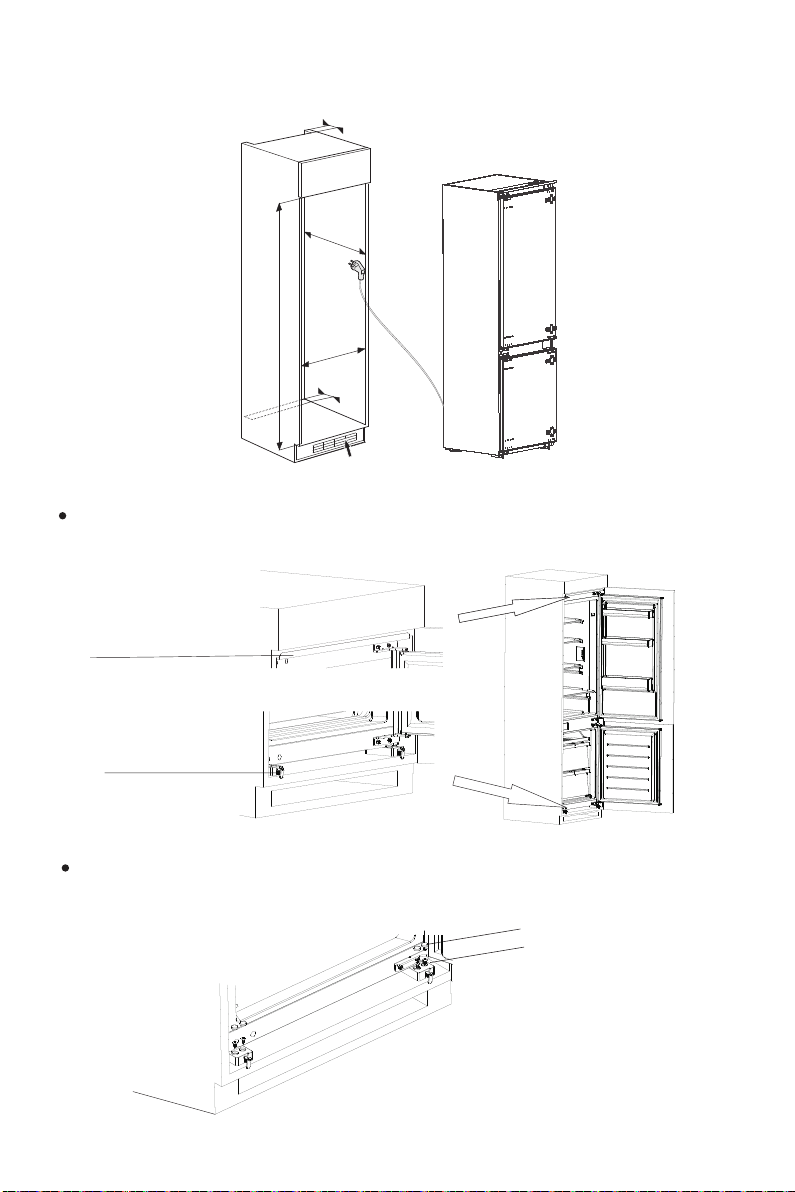
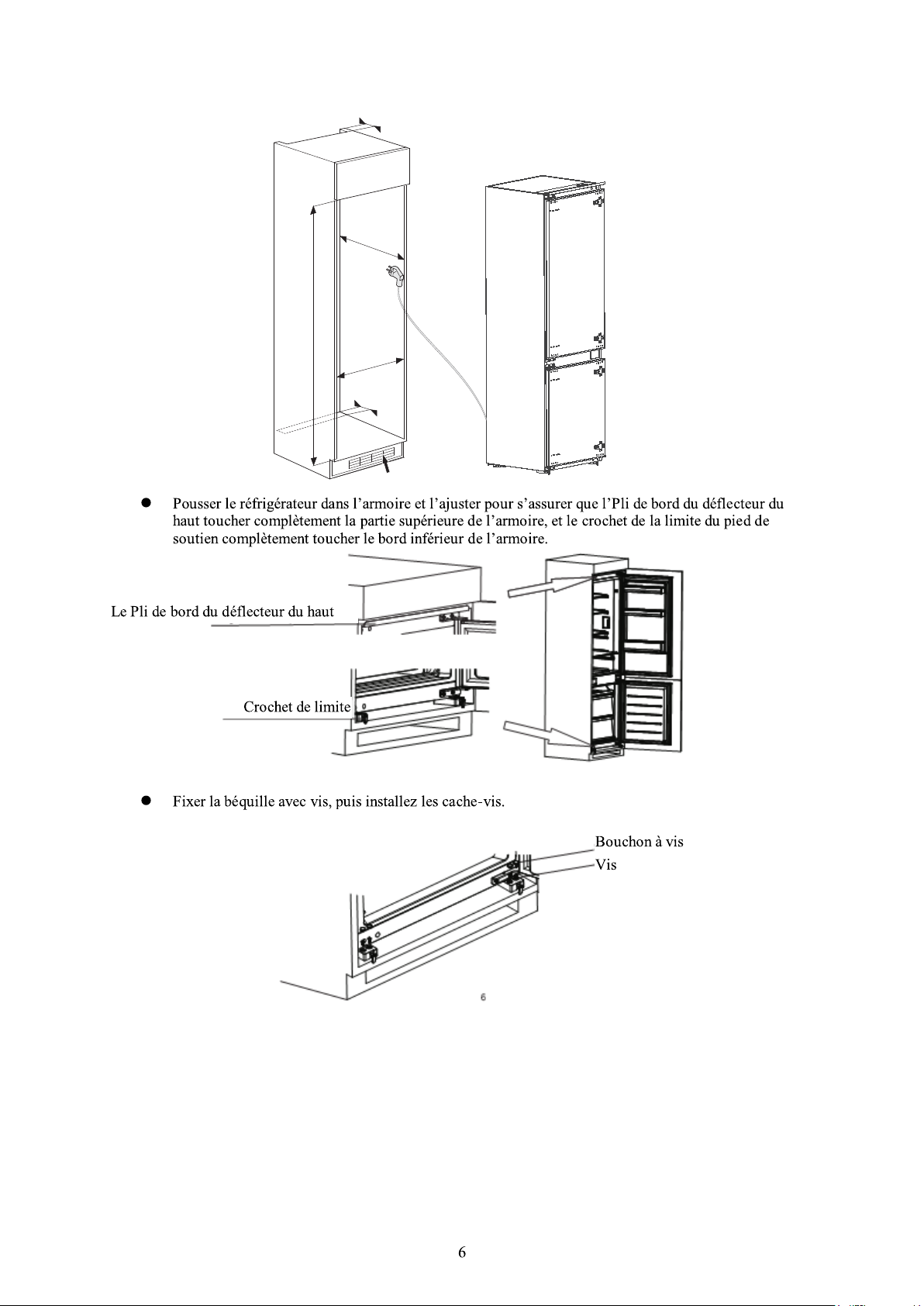
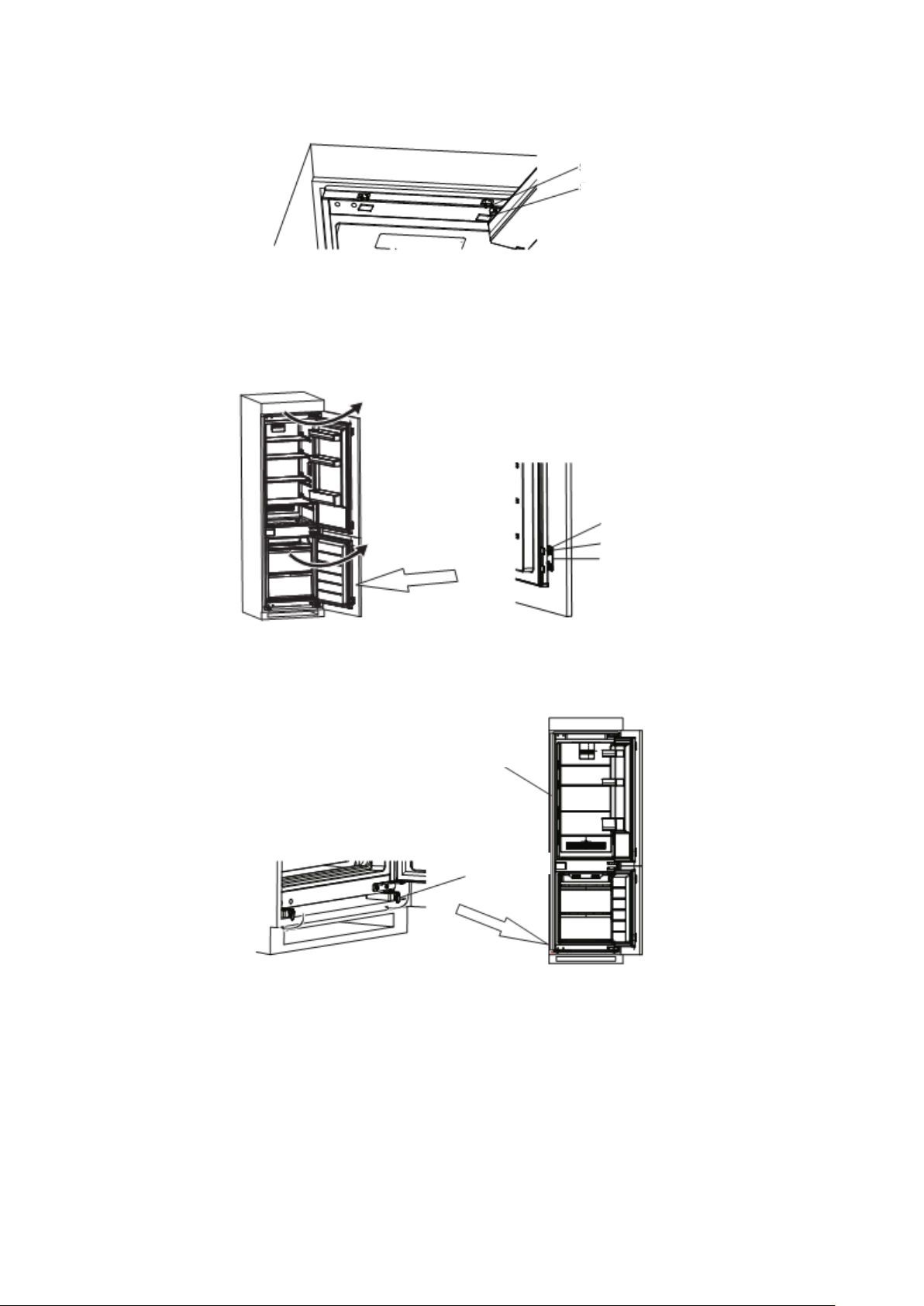
Push the refrigerator into the cabinet and adjust it to make sure the edgefold of top baffle completely
touch the top edge of the cabinet, and the limit hook of supporting leg completely touch the bottom edge
of the cabinet.
Edgefold of top ba ffle
Limit hook
Fix the supporting leg with screws, then install the screw caps.
6
Screw cap
Screw
Page 9
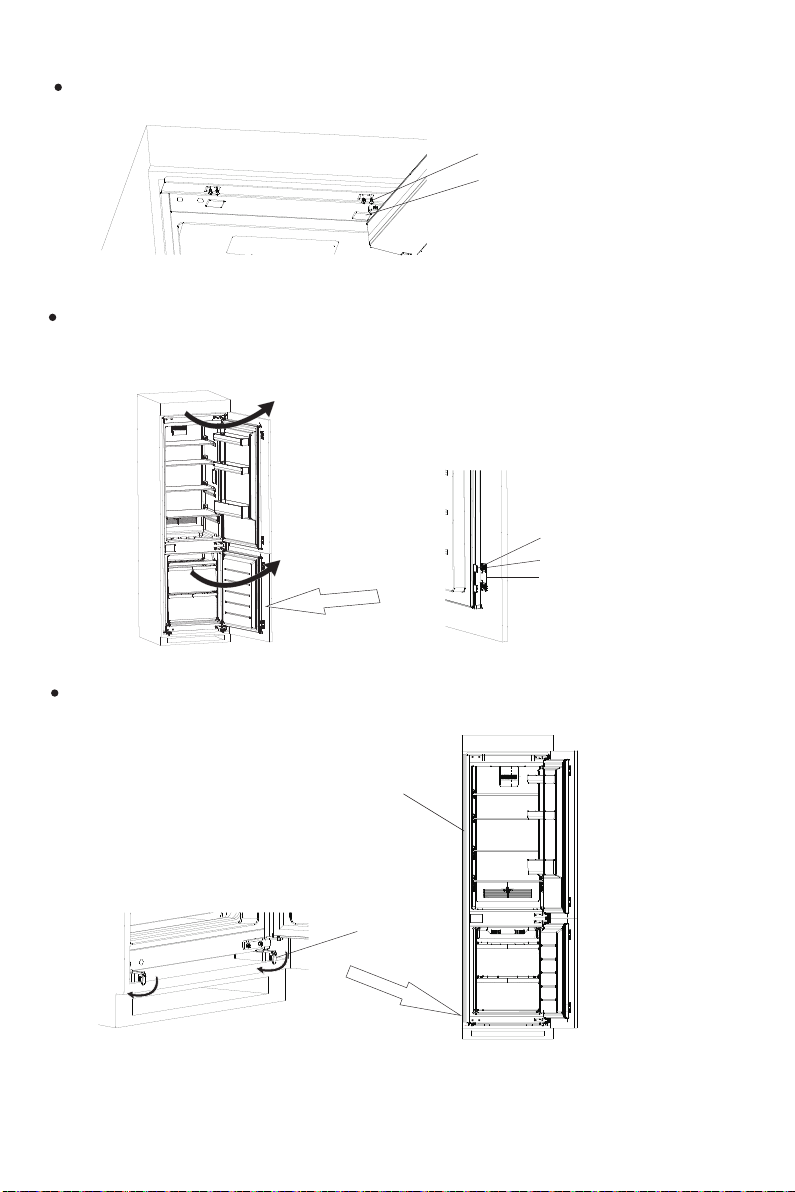
Fix the top baffle to the top of the cabinet inner with screws, then install the screw caps.
Screw
Screw cap
Open the lower door of cabinet the maximum angle, and open the lower door of the refrigerator to the
corresponding position. Sliding the block to make sure inner edge align with the lower door edge of
refrigerator, then fix the block to the door of cabinet with screw and install screw caps. Fix the upper
refrigerator door to the cabinet door in the same way.
Screw Cap
Screw
Block
Take out the sealing strip from accessory bag, and press it in the gap between the cabinet and the
refrigerator, then adjust the limit hook to original position . Installation is completed.
Sealing strip
Limit hook
(The picture a bov e is on ly fo r reference. The ac tua l configuration w ill
depend on the phys ica l pro duc t or statement b y the d ist rib utor)
7
Page 10
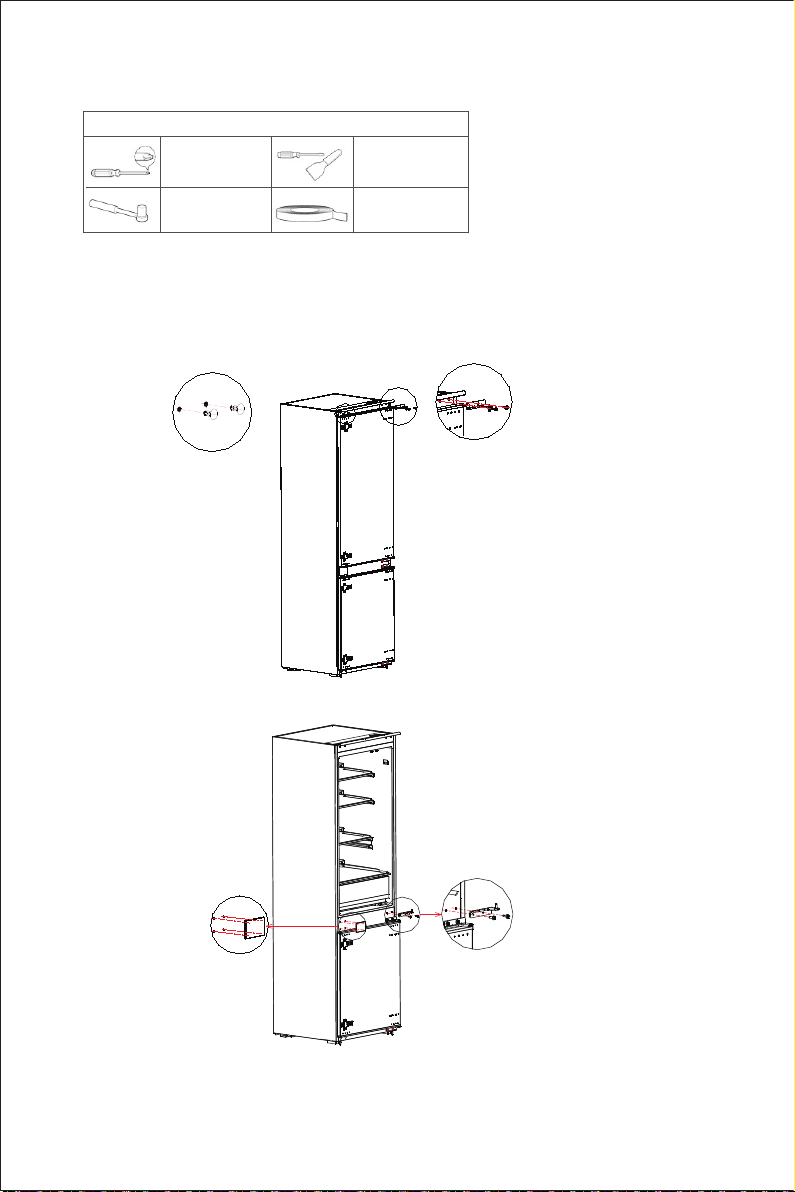
2.3 Door Right-Left Change
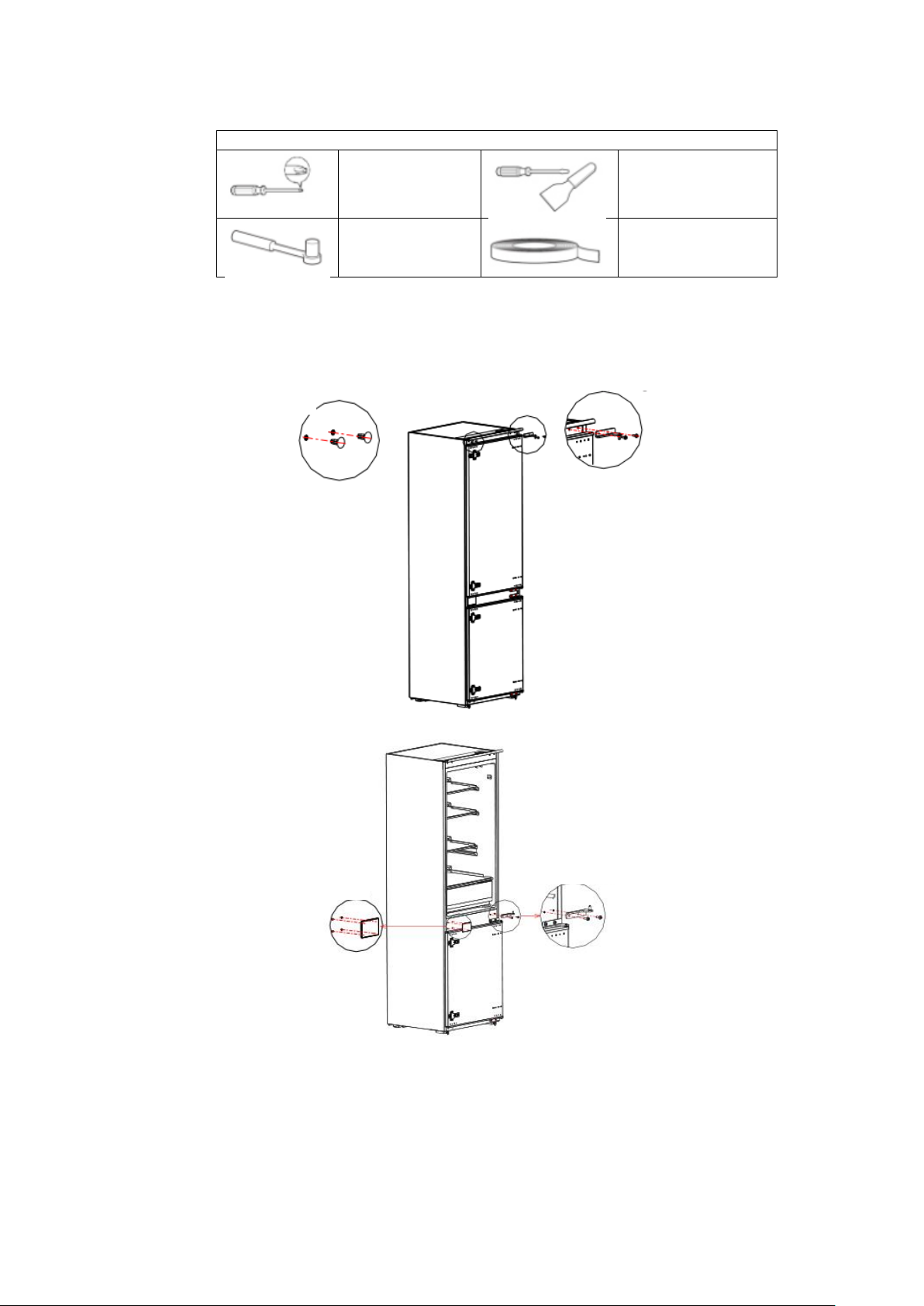
Lis t of to ols to b e prov ide d by the u ser
Cross sc rewd river
5/1 6″
socket a nd rat chet
1)Power off t he re frigerator, and re mov e all o bje cts from the door tra ys.
2)Remove the upp er hi nge a nd ho le caps of refriger ato r doo r.
hol e caps
Put ty kn ife
thi n-blade sc rewd river
Maskin g tape
upp er hing e
3)Remove the ref rig era tor d oor, the botto m hin ge an d the h ole c over.
R
hol e cover
:bo ttom hi nge
8
Page 11
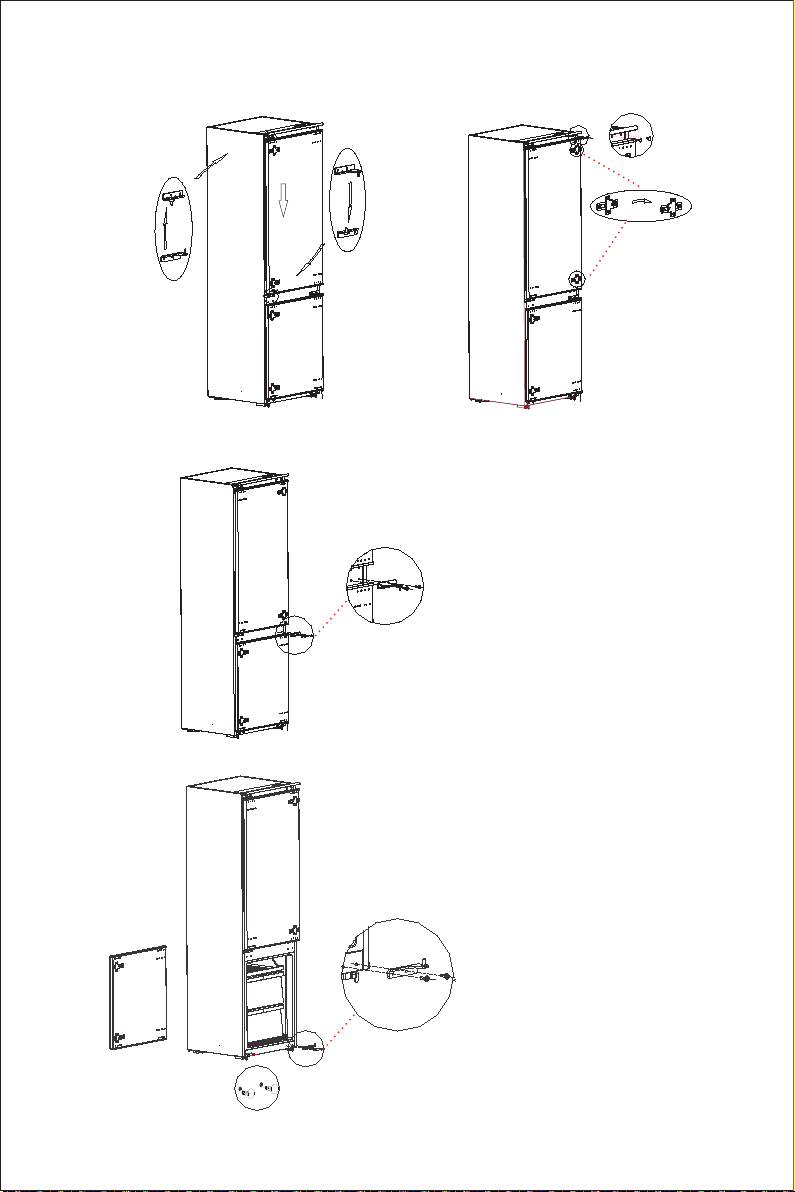
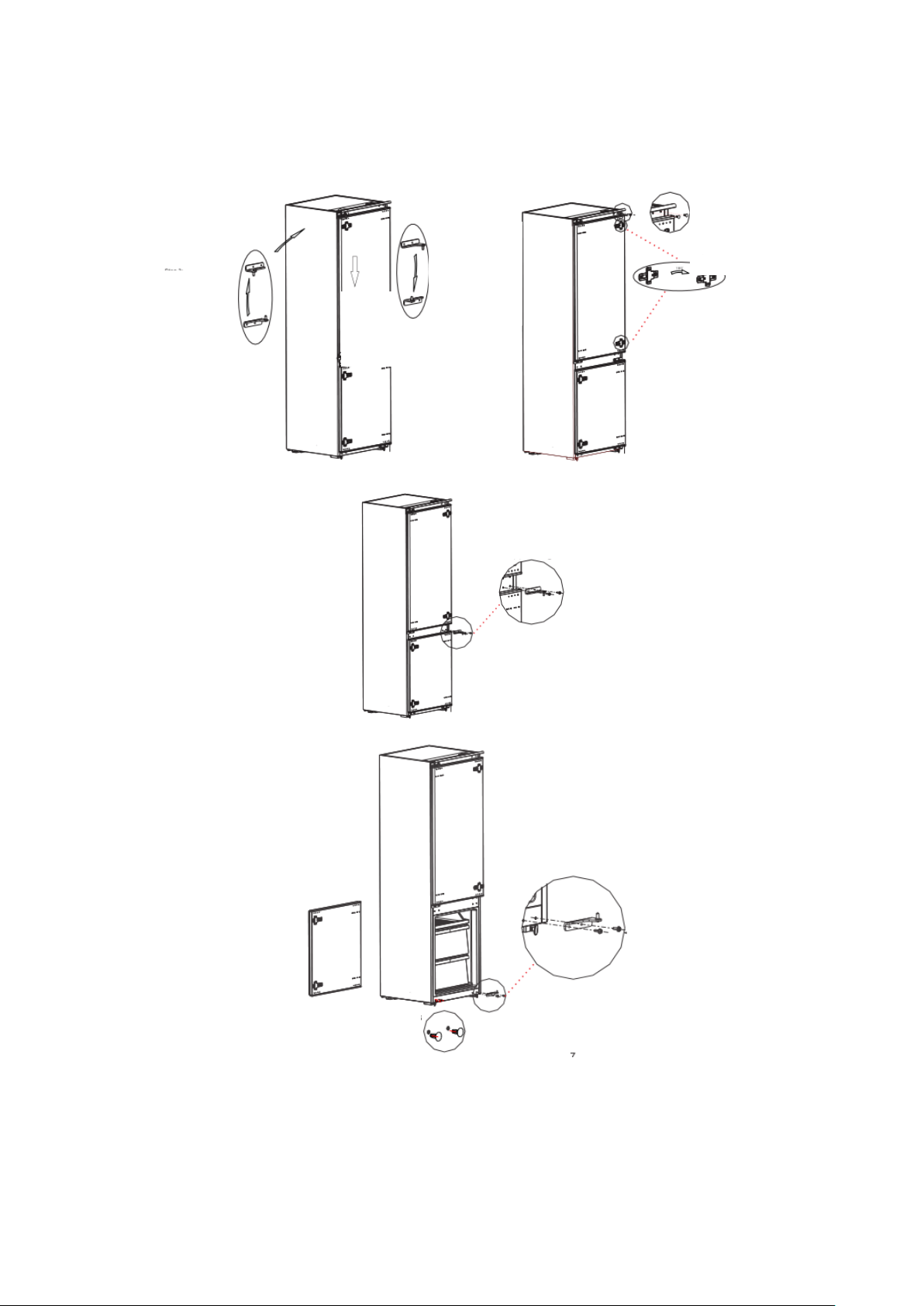
3)Exchange the R :bo tto m hinge and R:upper h ing e ,th en in stall them accord ing t o bel ow st eps,
and install the to p hol e cap s.
4) of refriger ato r doo r them for 180°,
Remove the tw o fix ed bl ock s and rotate
and install them o n oth er si de of .
refrigera tor d oor
hol e caps
R:b ottom h inge
Step 3:
insta ll lef t upper h inge
Step2 :
put re frige rator
door o n left bot tom
hing e verti cally
5)Remove the the u ppe r hin ge of f reezer door.
F:u pper hi nge
R:u pper hi nge
Step 1 :
inst all left b ottom h inge
180°
fix ed bloc k
6)Remove the fre eze r doo r, th e bottom hinge and th e hol e cap s.
F:b ottom h inge
hol e caps
9
Page 12
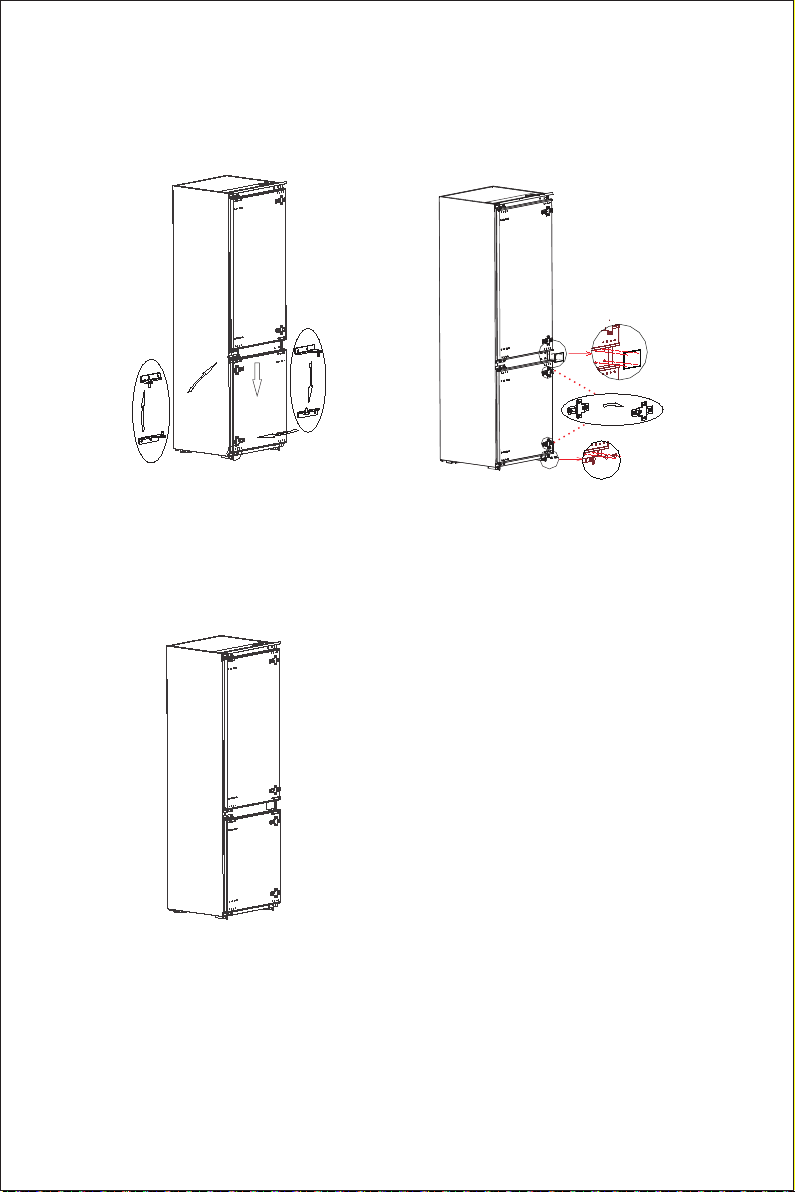
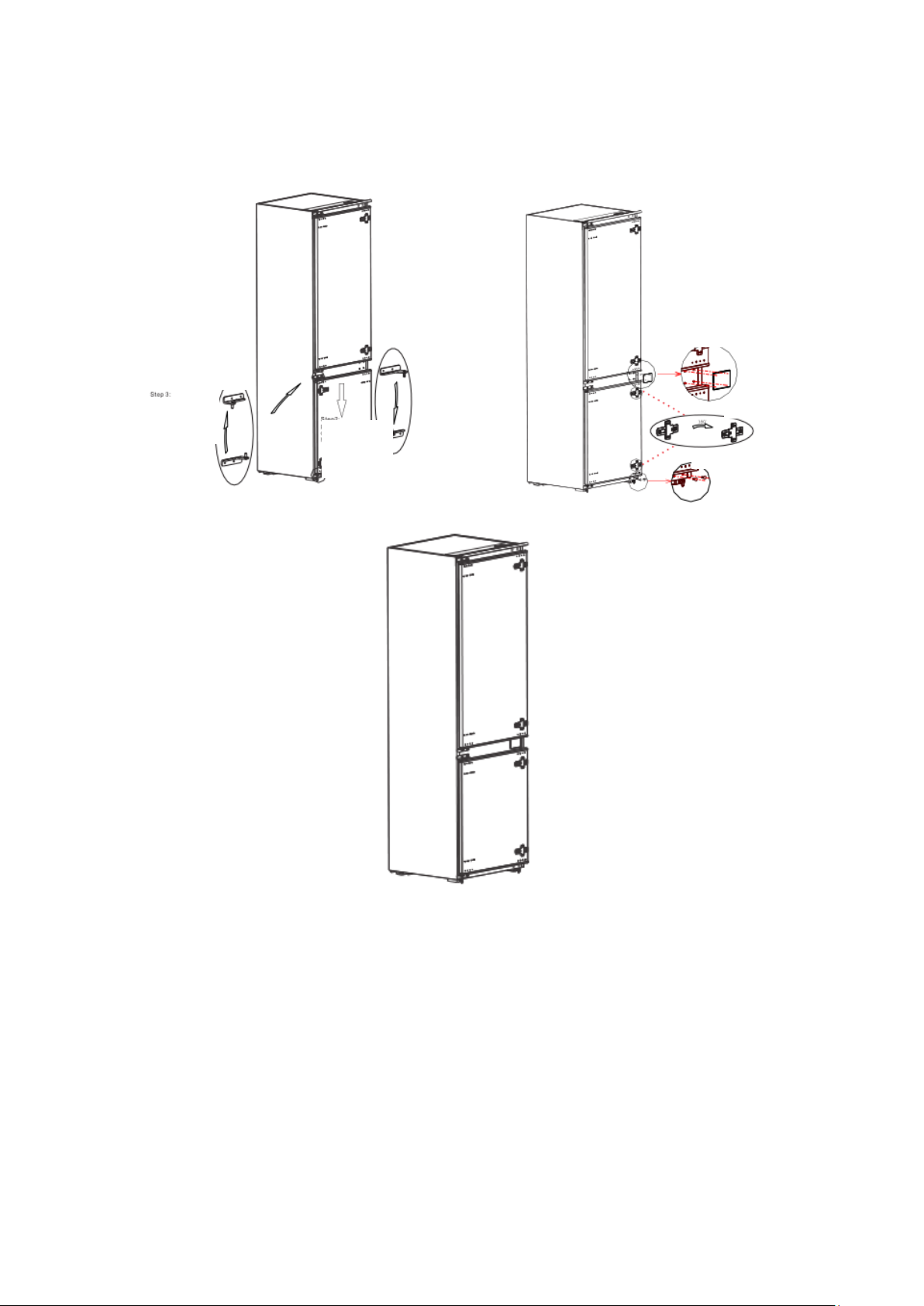
7)Exchange the F :bo tto m hinge and F:upper h ing e ,th en in stall them accord ing t o bel ow st eps,
and install the to p hol e cov er an d lower hole cap s.
8) for 180°,
Remove the tw o fix ed bl ock s of freezer door and r ota te th em
and install them o n oth er si de of .
F:b ottom h inge
Step 3:
inst all left u pper h inge
freezer doo r
Step 2:
put re frige rator
door o n left bo ttom
hing e verti cally
F:u pper hi nge
Step 1 :
inst all lef t bottom h inge
hol e cover
180°
hol e caps
fix ed bloc k
9). The pictu re af ter c omp letion is shown as be low
(The picture a bov e is on ly fo r reference. The ac tua l configuration w ill d epe nd on
the physical pro duc t or st atement by the dist rib uto r)
10
Page 13
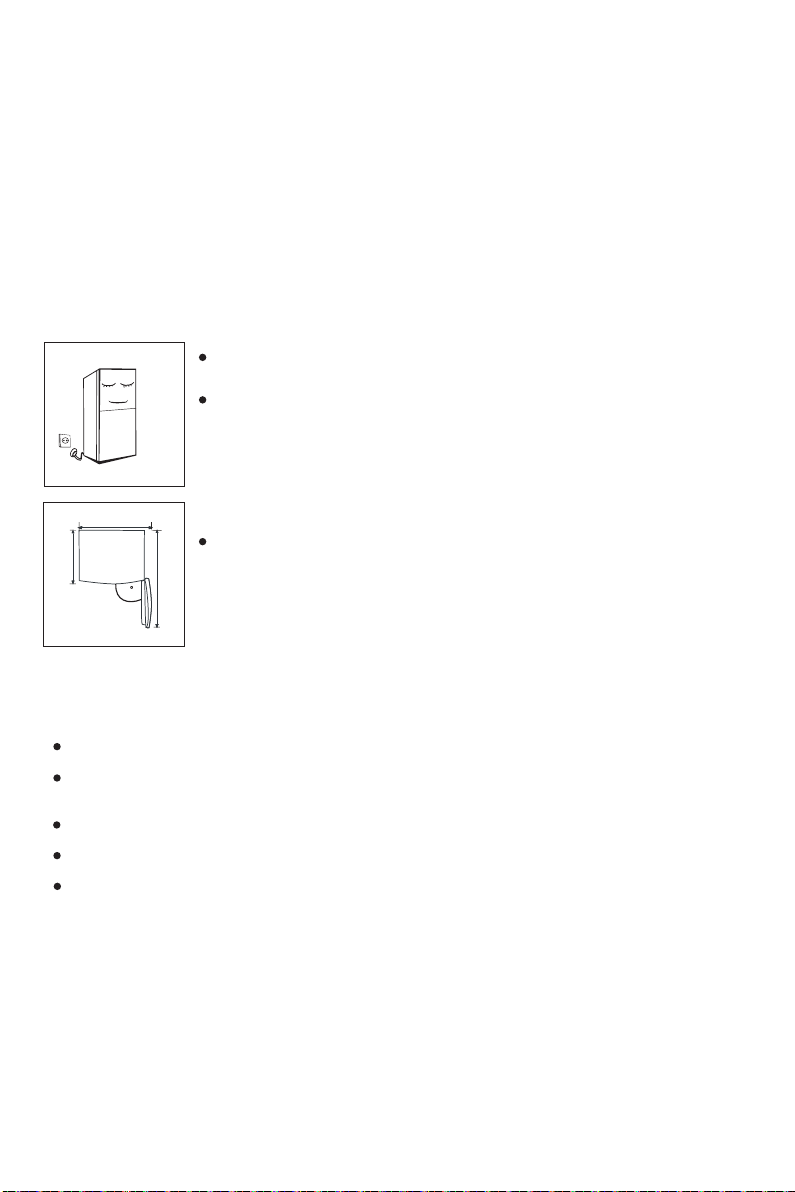
2.3 the LightChanging
Any replacement or maintenance of the LED lamps is intended to be made by
the manufacturer, its service agent or similar qualified person.
2.4 Star ting
Before initial start, keep the refrigerator still for half an hour
before connecting it to power supply.
Before putting any fresh or frozen foods, the refrigerator shall have run
for 2-3 hours, or for above 4 hours in summer when the ambient
temperature is high.
21.34in
Spare enough space for convenient openin g of the doors and drawers or
18.90in
90
statement by the distri butor.
41.73in
2.5 Energy saving tips
The applian ce sh oul d be located in th e coo les t are a of the room, awa y fro m hea t
producing a ppl ian ces or heating d uct s, an d out o f the direct sun lig ht.
Let hot foods c ool t o roo m tem perature bef ore p lac ing in the appli anc e. Ov erl oading
the applian ce fo rce s the compressor to r un lo nge r. Foods that fr eez e too s low ly may
lose qualit y, or s poi l.
Be sure to wrap f ood s pro perly, and wipe con tai ner s dry before pla cin g the m in th e
appliance . Thi s cut s down on frost build -up i nsi de the applian ce.
Appliance s tor age b in should not be l ine d wit h aluminum foil, wa x pap er
toweling. L ine rs in terfere with cold a ir ci rcu lation, maki ng th e app lia nce less effic ien t.
Organize an d lab el fo od to reduce doo r ope nin gs an d extended sea rch es. R emove as many
items as need ed at o ne ti me, and close the doo r as so on as p ossible.
11
, or paper
Page 14
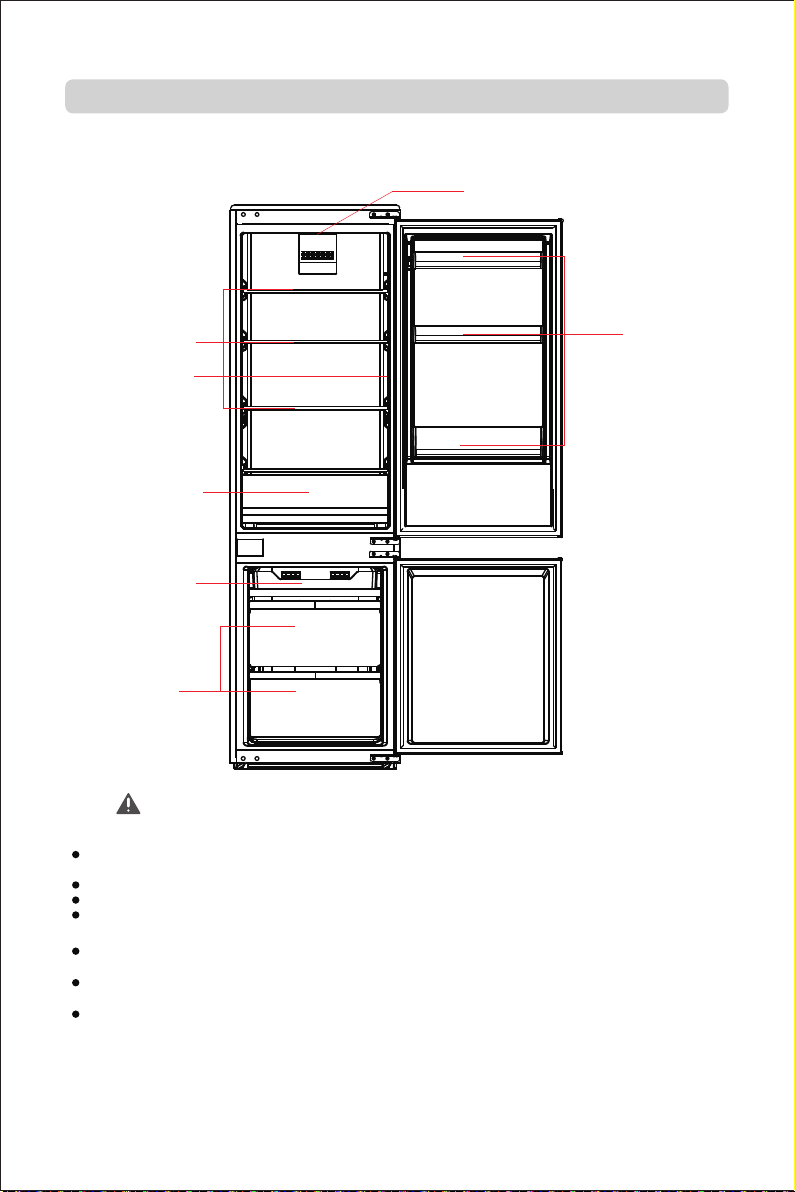
3 Structure and functions
3.1 Key compo ne nts
LED ligh tin g
Shelf
Tem peratur econtro l pan el
Fru its a nd
vegeta ble s box
Storag e box
Drawer
Door tra y
(The picture a bov e is on ly for reference. T he ac tua l configuration w ill d epe nd on
the physica l pro duc t or st atement by the d ist rib utor)
Refrigerating chamber
The Refrigerating Chamber is suitable for storage of a variety of fruits, vegetables, beverages and
other food in the short term.
Cooking foods shall not be put in the refrigerating chamber until cooled to room temperature.
Foods are recommended to be sealed up before putting into the refrigerator.
The glass shelves can be adjusted up or down for a reasonable amount of storage space and easy use.
Freezing chamber
The low temperature freezing chamber may keep food fresh for a long time and it is mainly used to
store frozen foods and making ice.
The freezing chamber is suitable for storage of meat, fish, rice balls and other foods not to be
consumed in short term.
Chunks of meat are preferably to be divided into small pieces for easy access. Please be noted food
shall be consumed within the shelf time.
Note: Stora ge of t oo mu ch fo od during operati on af ter t he in itial connectio n to po wer m ay ad versely
aff ect t he fr eez ing effec t of th e ref rigerator. Foods s tor ed sh all n ot block the air o utl et; o r oth erwise
the freezin g eff ect will also be adve rse ly affected.
consumed
12
Page 15
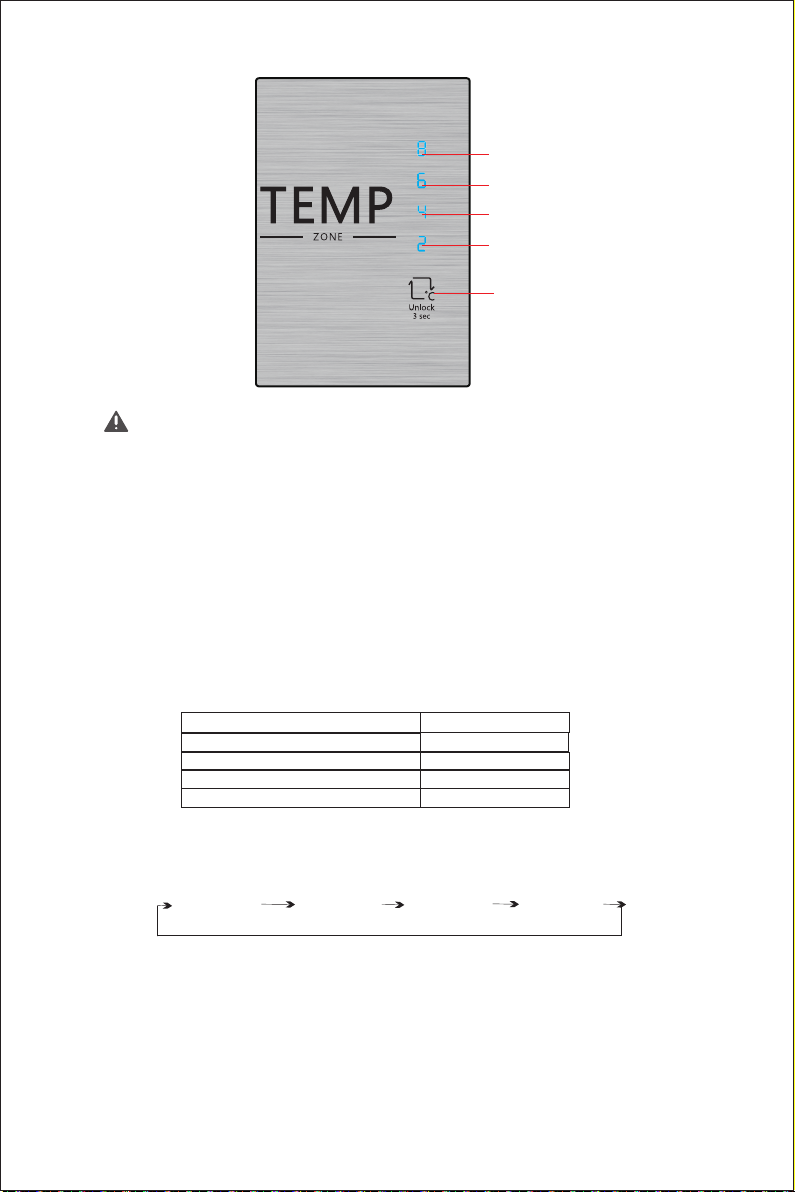
3.2 Functions
①
②
③
④
.
A
(The picture a bov e is on ly for reference. T he ac tua l configurat ion w ill d epe nd on
the physica l pro duc t or statement by the d ist rib utor)
1)Key
A.Te mpe rat ure s etting butto n of re fri ger ator compart men t
2)Display scre en
①setting 1:8℃
②setting 2:6℃
③setting 3:4℃
④setting 4:2℃
3)Display
Once initia lly p owe red o n t he display scr een i s on fu ll di spl ay for 3s.
and then the refri ger ato r run s according to s ett ing 3 .
Normal operati on di spl ay
In case of a fail ure the correspond ing L ED bl ink s.
In case of no fai lur es the a ctual temperatu re se tti ng of r efrigerato r.
)temperature s ett ing
4
Each time the bu tto n A is pr essed once the chan ges o ne time.
After the has be en co mpl eted, the refr ige rat or wi ll ru n according to t he se t val ue af ter 15s.
The shift reg ula tio n is:
,
,
temperatu re se tti ng , temperatu re se tti ng
temperatu re se tti ng
, it sho
ws
Fau lt Code
indicator setting 1
indicator setting 2
indicator setting 3
indicator setting 4
Fau lt Desc ripti on
Refrigerator temperature
sensor circuit
Refrigerator defrost sensor
Freezer defrost sensor
Ambient temperature sensor
se tti ng 1 se tti ng 2 se tti ng 3 se tti ng 4
5)Lock/Unloc k
When the temp era tur e con trol panel is in lock s tat e, it n eed s to long press tempe rat ure s etting key
for 3 seconds f or un loc kin g the p anel, all LEDs w ill b lin k for 2 s econd when panel is u nlo cke d.
When the temp era tur e con trol panel is in unlo ck st ate , if th ere is no operation o n con tro l pan el within
15 seconds, it wil l ent er in to lo ck state autom ati cal ly.
13
Page 16
4. Maintenance and care of the refrigerator
4. 1 Overall cleani ng
Dusts behind the refrigerator and on the ground shall be timely cleaned to improve the cooling
effect and energy saving. The interior of the refrigerator should be cleaned regularly to avoid odor.
Soft towels or sponge dipped in water and non-corrosive neutral detergents are suggested for
cleaning. The freezer of shall be finally cleaned with clean water and dry cloth. Open the door for
natural drying before the power is turned on.
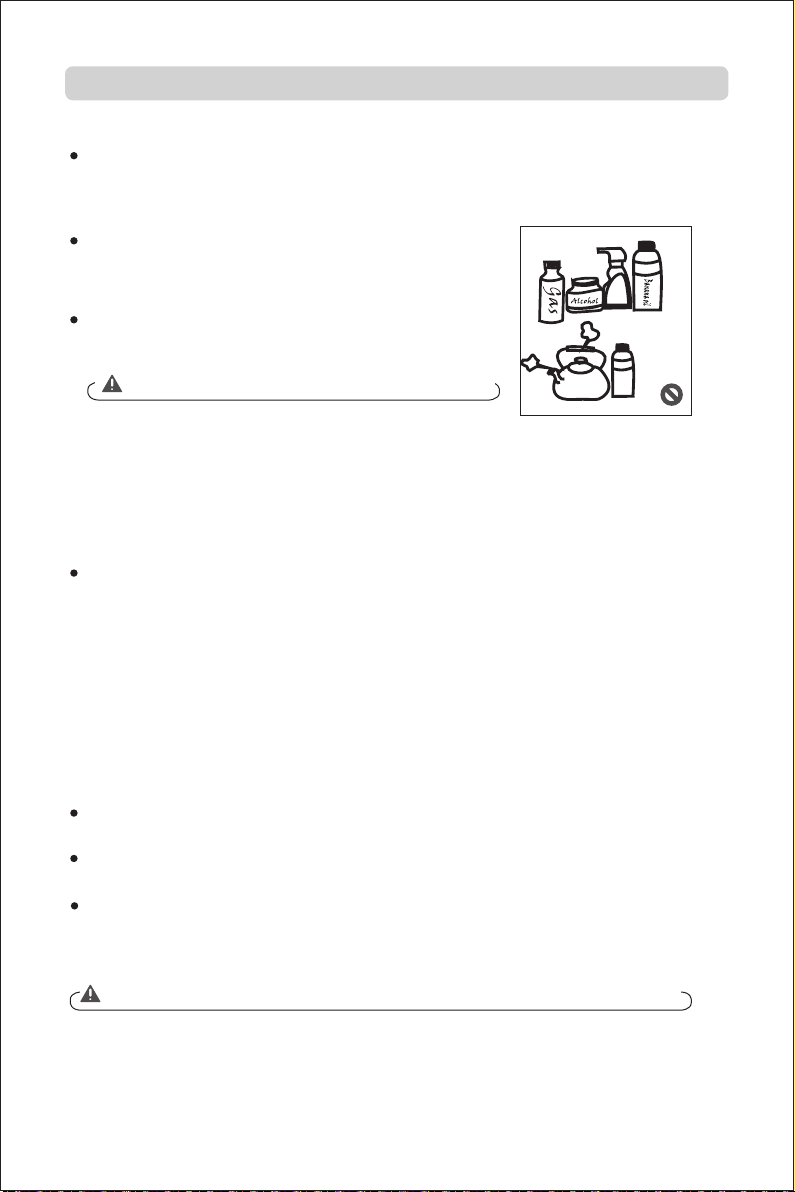
Do not use hard brus hes , cle an st eel balls, wir e bru she s,
abrasives, suc h as to oth pastes, organic s olv ent s (su ch as
alcohol, aceto ne, b ana na oi l, etc.), boil ing w ate r, aci d or
alkaline items c lea n ref rig erator consi der ing t hat t his may
damage the fr idg e sur fac e and interior.
Do not rinse with wa ter s o as no t to affect t he el ect ric al insulation
properties.
Please unplug th e ref rig era tor for defros t and c lea nin g.
4.2 De fr os ting
The refrigerat or is m ade b ase d on the air-coo lin g pri nci ple and thus has auto mat ic
defrostin g fun cti on. F rost formed due to ch ang e of se aso n or temperature ma y als o
be manually remo ved b y dis con nection of the a ppl ian ce fr om power supply
or by wiping with a dr y tow el.
deterg ent
4.3 O ut of oper ation
Power failure: In case of power failure, even if it is in summer, foods inside the appliance can be kept for
several hours; during the power failure, the times of door opening shall be reduced, and no more fresh
food shall be put into the appliance.
Long-time nonuse: The appliance shall be unplugged and then cleaned; then the doors are left open
to prevent odor.
Moving: Before the refrigerator is moved, take all objects inside out, fix the glass partitions, vegetable holder,
freezing chamber drawers and etc. with tape, and tighten the leveling feet; close the doors and seal them
with tape. During moving, the appliance shall not be laid upside down or horizontally, or be vibrated;
the inclination during movement shall be no more than 45°.
The appliance shall run continuously once it is started. Generally, the operation of the appliance
shall not be interrupted; or otherwise the service life may be impaired
14
Page 17
5 Tro uble sh ooting
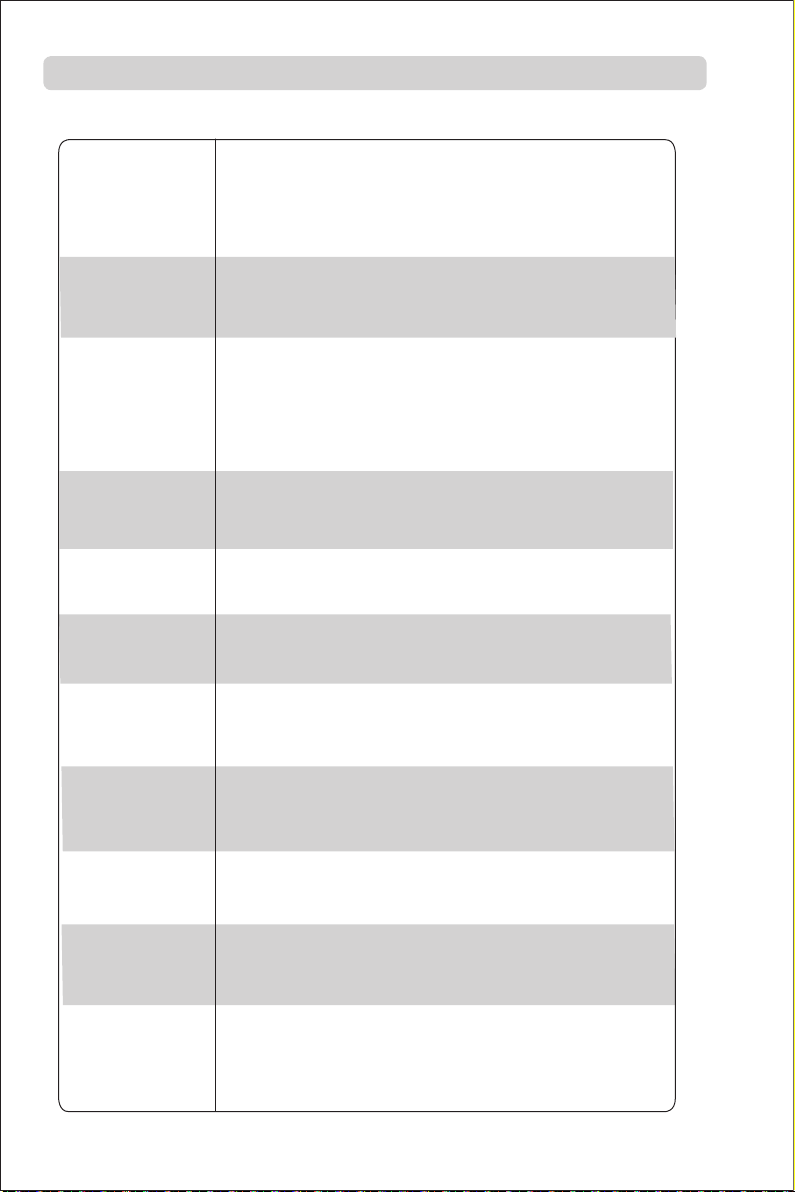
5.1You may try to solve the following simple problems by yourself.
If them cannot be solved, please contact the after-sales department.
Check whether the appliance is connected to power or
Failed operation
Odor
Long-time operation
of the compressor
Light fails to get lit
whether the plug is in well contact
Check whether the voltage is too low
Check whether there is a power failure or partial circuits have tripped
Odorous foods shall be tightly wrapped
Check whether there is any rotten food
Clean the inside of the refrigerator
Long operation of the refrigerator is normal in summer
when the ambient temperature is high
It is not suggestible having too much food in the appliance at the same time
Food shall get cool before being put into the appliance
The doors are opened too frequently
Check whether the refrigerator is connected to power supply and
whether the illuminating light is damaged
Have the light replaced by a specialist
Doors cannot be
properly closed
Loud noise
Door seal fai ls to
be tight
Water pan ove rfl ows
Hot housing
Surface conden sat ion
Abnormal noise
The door is stuck by food packages
The refrigerator is tilted
Check whether the floor is level and whether the refrigerator is placed stably
Check whether accessories are placed at proper locations
Remove fore ign m att ers o n the door seal
Heat the door s eal a nd th en cool it for res tor ati on
(or blow it wit h an el ect rical drier or use a ho t tow el fo r heating)
There is too mu ch fo od in t he ch amber or food store d con tai ns
too much wate r,r esu lti ng in heavy defrost ing
The doors are not cl ose d pro perly, resultin g in fr ost ing d ue to entry
of air and increas ed wa ter d ue to defrosting
Heat dissipati on of t he bu ilt-in condense r via t he ho usi ng, which is normal .
When housing bec ome s hot d ue to high ambient te mpe rat ure a nd
storage of to o muc h foo d,i t is recommended to p rov ide s oun d ventilation
to facilita te he at di ssi pation.
Condensation on the exterior surface and door seals of the refrigerator
is normal when the ambient humidity is too high. Just wipe the condensate
with a clean towel.
Buzz: The compressor may produce buzzes during operation, and the buzzes
are loud particularly upon start or stop. This is normal.
Creak: Refrigerant flowing inside of the appliance may produce creak,
which is normal.
15
Page 18
F.LLI BERTAZZONI ITALIE
MANUEL D'INSTRUCTIONS
Réfrigérateur-Congélateur
MODÈLE: REF24PR
Page 19
Page 20
(EN60335-2-24)
Page 21
Page 22
1.4 Avertissements pour l'utilisation
• Ne pas désassembler ou reconstruire arbitrairement le réfrigérateur,
ni endommager le circuit de réfrigérant; l'entretien de l'appareil doit
être fait par un spécialiste
• Le câble d'alimentation endommagé doit être remplacé par le
fabricant, son service de maintenance ou ses professionnels
associés afin d'éviter tout danger.
• Les espaces entre les portes du réfrigérateur et entre les portes et le
corps du réfrigérateur sont petits. Il est recommandé de ne pas
mettre la main dans ces zones pour éviter le pincement du doigt.
Veuillez être doux lorsque vous fermez la porte du réfrigérateur
pour éviter la chute des articles.
• Ne prenez pas les aliments ou les récipients avec les mains mouillées
dans la partie congélation lorsque le réfrigérateur est en marche,
surtout les récipients en métal afin d'éviter les engelures.
• Ne permettez à aucun enfant d’entrer ou grimper dans le
réfrigérateur; sinon une suffocation ou une chute de l'enfant peut
être provoquée.
• Ne placez pas d'objets lourds au dessus du réfrigérateur vu que ceux
ci risquent de tomber lorsque vous fermez ou ouvrez la porte, et des
blessures accidentelles pourraient être causées.
• Veuillez retirer la fiche en cas de coupure de courant ou de
nettoyage. Ne connectez pas le congélateur à l'alimentation
d’énergie dans les cinq minutes qui suivent pour éviter
d'endommager le compresseur en raison de démarrages successifs.
• Ne placez pas d'objets inflammables, explosifs, volatils et très
corrosifs dans le réfrigérateur pour éviter d'endommager le produit
ou de provoquer un incendie.
• Ne placez pas d'objets inflammables près du réfrigérateur pour
éviter les incendies.
• Le réfrigérateur est destiné à un usage domestique, tel que le
stockage d'aliments; il ne doit pas être utilisé à d'autres fins, telles
que le stockage de sang, de médicaments ou de produits
biologiques, etc.
1.5 Avertissements pour le placement
3
Page 23
Page 24
41.73in
21.26in
70.28in
21.46in
68.98in
180°
41.42in
Page 25
+0.39
0
68.92in
M
M
i
n
.
22.05in
M
i
n
i
n
. 1.97in
21.65in
0.39
+
.
1.97in
0
Min.
31sq.in
Page 26
Vis
Bouchon à vis
Bouchon à vis
Vis
Bloc
Bande d’étanchéité
Crochet de limite
Fixer le déflecteur du haut vers le haut de l’armoire intérieure avec vis, puis installez les cache-vis.
Ouvrez la porte inférieure de l’armoire l’angle maximal et ouvrez la porte inférieure du
réfrigérateur à la position correspondante. Le patin pour rendre le bord intérieur bien sûr s’aligner
sur le bord inférieur de la porte du réfrigérateur, puis fixez le bloc à la porte de l’armoire avec vis et
installer des bouchons à vis. Fixez la porte du réfrigérateur supérieur à la porte de l’armoire de la
même manière.
Sortir de la bande de sac d’accessoires, appuyez dessus dans l’écart entre le cabinet et le
réfrigérateur, puis ajuster le crochet de limite à la position initiale. Installation est terminée.
(La photo ci-dessus est seulement pour la référence. La configuration réelle dépendra de l’instruction par
le distributeur ou le produit physique)
7
Page 27
Liste des outils nécessaires pour ces travaux
Tournevis en croix
Tournevis à lame fine
un couteau à mastic
5/16 ″
Cliquet
Ruban adhésif de
masquage
Caches de trou
Charnière supérieure
R : charnière inférieure
Cache-trou
2.3 Changement du Porte droite-gauche
1) Mise hors tension du réfrigérateur et retirez tous les objets dans les plateaux de la porte.
2) Retirez la porte du réfrigérateur, la charnière et le cache du trou.
3) Retirez les caches supérieurs de charnière et trou de porte du réfrigérateur.
6
8
Page 28
R : charnière inférieure
Étape 3 :
Installez la charnière
supérieure gauche
R: charnière
supérieure
Étape 1 :
Installez la charnière
inférieure gauche
Etape 2 :
Mett ez la porte
du réfri gérateur
sur la charnière
inférieure
gauche
verticalement
Caches de trou
Bloc fixe
F: charnière supérieure
F: charnière inférieure
Caches de trou
3) Echanger la charnière de la R: charnière inférieure et la R: charnière supérieure, puis installez-les
selon procédure ci-dessous et installez les capuchons de trou supérieur.
4) Retirez les deux blocs fixes de porte du réfrigérateur et les tourner de 180° et installez-les sur
l’autre côté du réfrigérateur.
5) Retirez la charnière supérieure de la porte du congélateur.
6) Retirez la porte du congélateur, la charnière et les caches de trou.
7
9
Page 29
F: charnière inférieure
Étape 3 :
Installez la charnière
supérieure gauche
F: charnière supérieure
Étape 1 :
Installez la charnière
inférieure gauche
Etape 2 :
Mettez la po rte du
réfrigér ateur sur la
charnière in férieure
gauche vertical ement
Cache-trou
Bloc fixe
Bouchons de trou
7) Echanger la charnière de la F: charnière inférieure et la F: charnière supérieure, puis installez-les
selon étapes ci-dessous et installez le cache de l’orifice supérieur et inférieur.
8) Retirez les deux blocs fixes de porte du congélateur et faire pivoter de 180° et les installer sur
l’autre côté de la porte du congélateur
9) L’image une fois le changement effectué se prés comme ci-dessous
(L’image ci-dessus est seulement pour cetteréférence. La configuration réelle dépendra de
l’instruction par le distributeur ou le produit physique)
10
Page 30
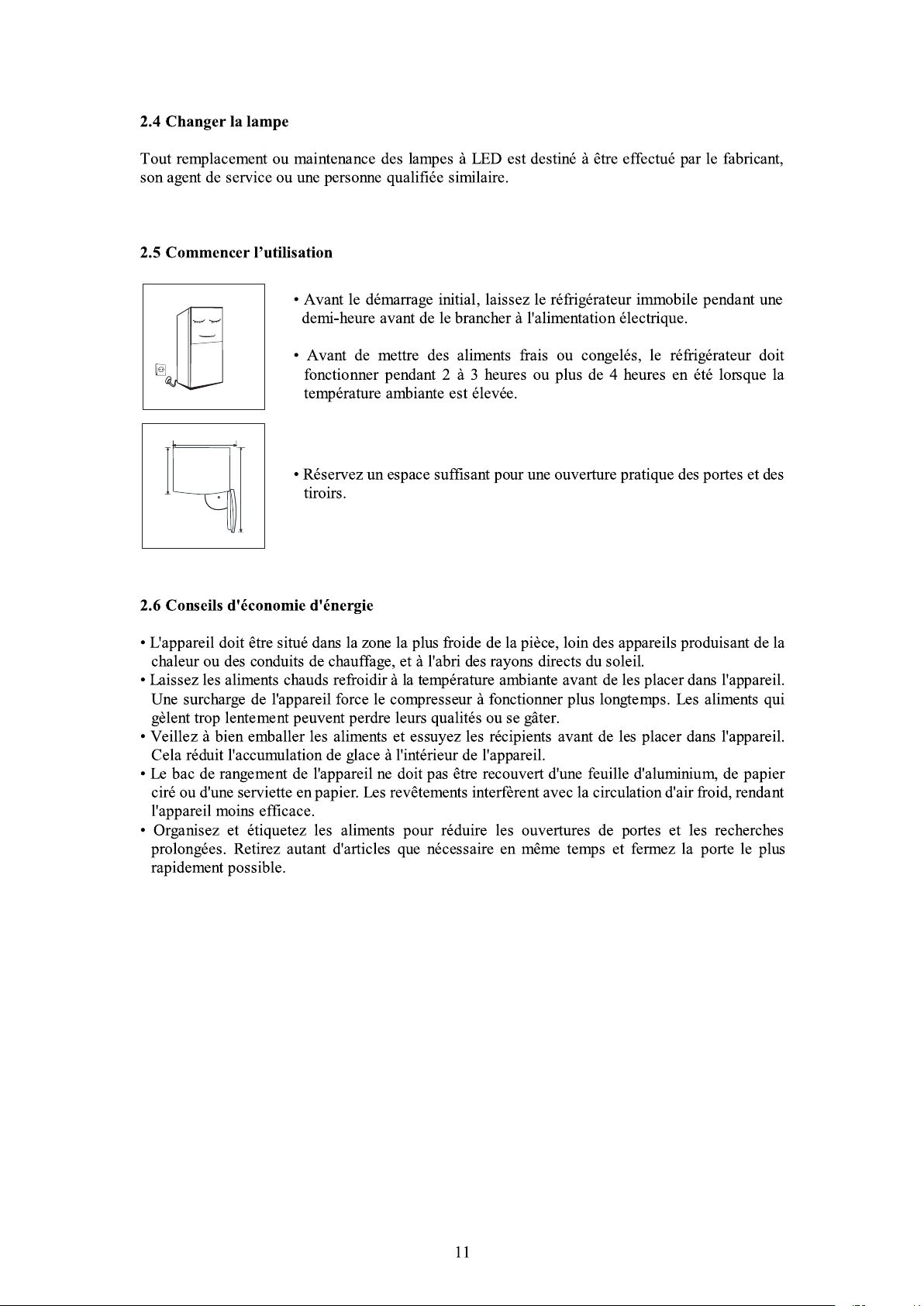
18.90in
21.34in
41.73in
90
Page 31
3Désignation et fonctions
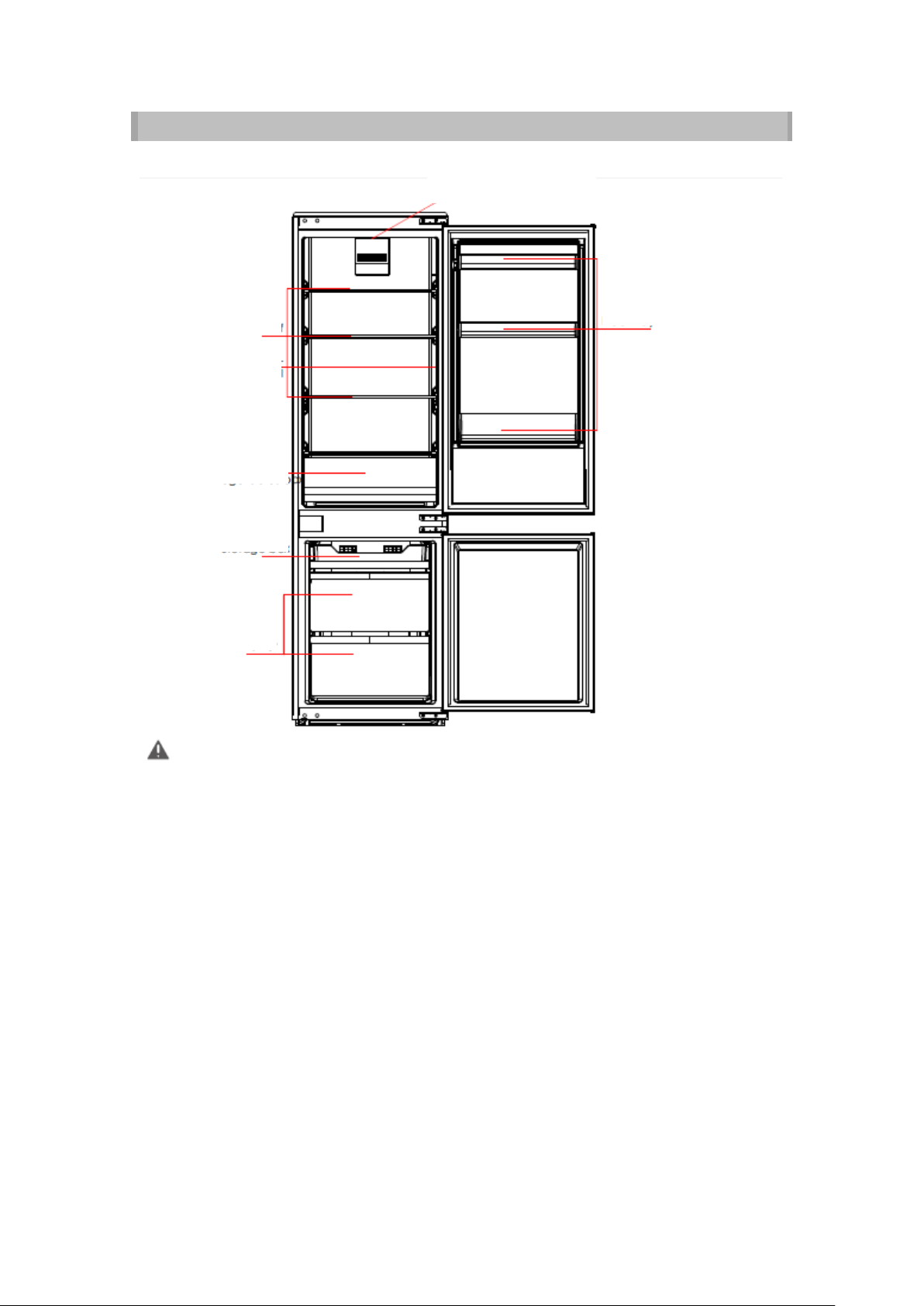
3.1 Composants clés
LED clignotant
Balconnet de porte
Clayette
Panneau de contrôle de la
température
Boîte à fruits et légumes
Boîte de rangement
Tiroir
(L'image ci-dessus est seulement pour indication. La configuration réelle dépendra du produit
physique ou de la déclaration du distributeur)
Chambre frigorifique
• La chambre frigorifique est appropriée pour le stockage d'une variété de fruits, légumes, boissons
et autres aliments consommés à court terme.
• Les aliments cuisinés ne doivent pas être placés dans la chambre de réfrigération avant d'avoir été
refroidis à la température ambiante.
• Il est recommandé d’emballer les aliments avant de les mettre au réfrigérateur.
• Les clayettes en verre peuvent être ajustées vers le haut ou vers le bas pour un espace de
rangement raisonnable et une utilisation facile.
Chambre de congélation
• La chambre de congélation à basse température peut conserver les aliments frais pendant une
longue période et elle est principalement utilisée pour stocker des aliments congelés et faire de la
glace.
• La chambre de congélation est appropriée au stockage de la viande, du poisson, et 'autres aliments
à ne pas consommer à court terme.
• Les morceaux de viande doivent de préférence être divisés en petits morceaux pour un accès facile.
Veuillez noter que les aliments doivent être consommés dans le temps indiqué.
Remarque: Le stockage de trop d'aliments après le branchement initial peut nuire à la congélation.
Les aliments stockés ne doivent pas bloquer la sortie d'air; ou sinon l'effet de congélation sera
également affecté.
12
Page 32
①
②
③
④
A
.
Page 33
4. Entretien de l'appareil
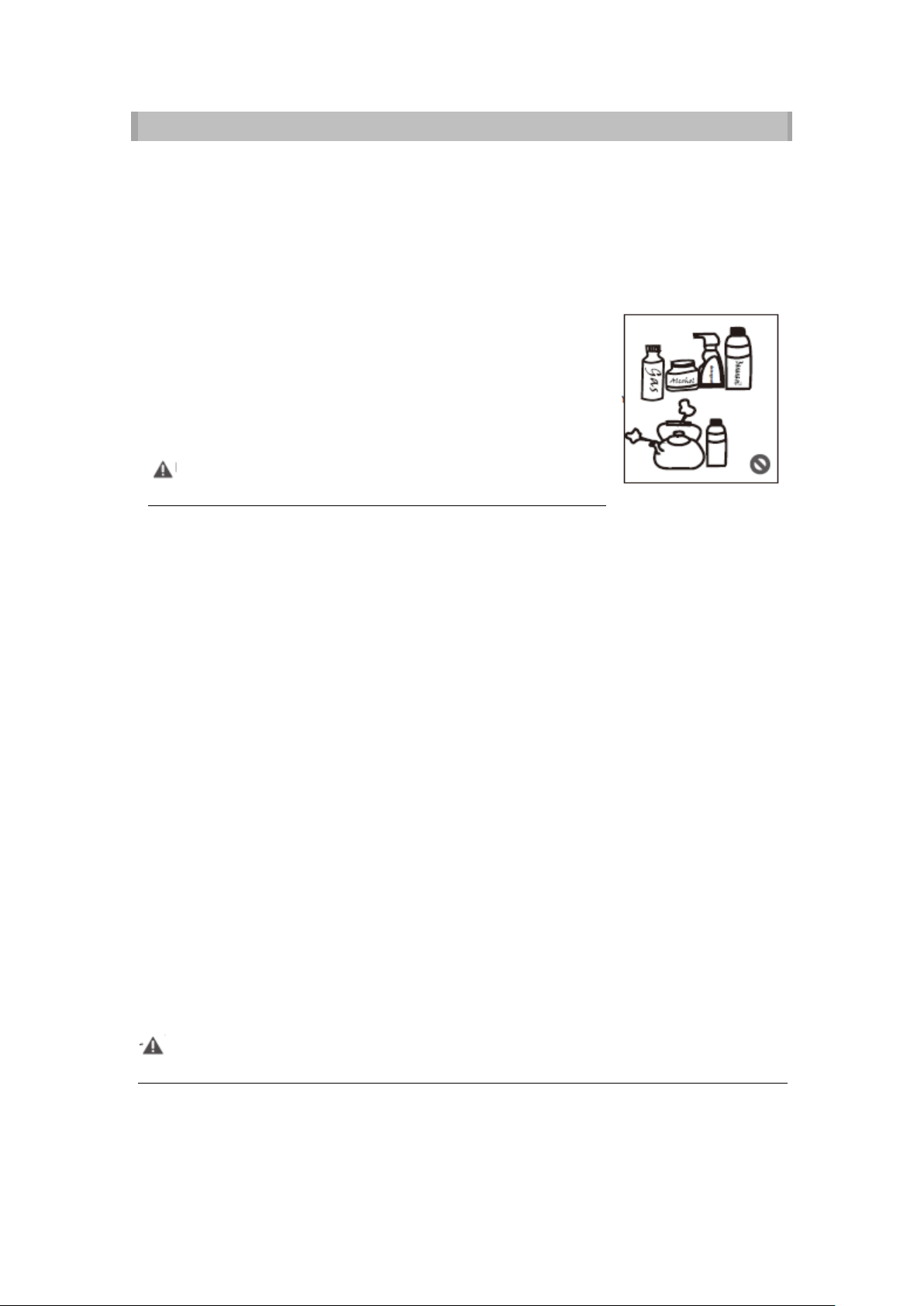
• N'utilisez pas de brosses dures, de billes d'acier, de brosses
métalliques, d'abrasifs tels que dentifrices, solvants organiques
(alcool, acétone, huile de banane, etc.), d'eau bouillante, d'acide ou
d'alcalin pour nettoyer le réfrigérateur, ceux-ci peuvent endommager
la surface et l'intérieur du réfrigérateur.
• Ne pas rincer à l'eau pour ne pas affecter les propriétés d'isolation
électrique.
Veuillez débrancher le réfrigérateur pour la décongélation et le
nettoyage.
4.1 Nettoyage général
• Les poussières derrière le réfrigérateur et sur le sol doivent être nettoyées en temps opportun pour
améliorer l'effet de refroidissement et les économies d'énergie. L'intérieur du réfrigérateur doit
être nettoyé régulièrement pour éviter les odeurs. Des serviettes douces ou une éponge trempée
dans l'eau et des détergents neutres non corrosifs sont recommandés pour le nettoyage. Le
congélateur doit être nettoyé avec de l'eau propre et un chiffon sec. Ouvrez la porte pour un
séchage naturel avant la mise sous tension.
4.2 Décongélation
• Le réfrigérateur est basé sur le principe du refroidissement par air et dispose ainsi d'une fonction
de décongélation automatique. La condensation formée en raison du changement de saison ou de
la température peut également être retiré manuellement en débranchant l'appareil de l'alimentation
électrique, ou en essuyant avec une serviette sèche.
4.3 Hors service
• Coupure de courant: En cas de coupure de courant, même en été, les aliments à l'intérieur de
l'appareil peuvent être conservés pendant plusieurs heures; Pendant la coupure de courant, les
temps d'ouverture de la porte doivent être réduits et aucun produit frais ne doit être ajouté à
l'appareil.
• Non-utilisation de longue durée: L'appareil doit être débranché, puis nettoyé; Ensuite, les portes
restent ouvertes pour éviter les odeurs.
• Déplacement: avant de déplacer le réfrigérateur, retirer tous les aliments de l’intérieur, fixez les
cloisons en verre, le porte-légume, les tiroirs de la chambre de congélation, etc. avec du ruban
adhésif et serrez les pieds de mise à niveau; fermez les portes et fixez-les avec du ruban adhésif.
Pendant le déplacement, l'appareil ne doit pas être posé à l'envers ou à l'horizontale, ni être soumis
à des vibrations; l'inclinaison pendant le mouvement ne doit pas dépasser 45°.
L'appareil doit fonctionner de façon continue une fois démarré. En général, le fonctionnement
de l'appareil ne doit pas être interrompu: sinon la durée de vie pourrait être diminuée
14
Page 34
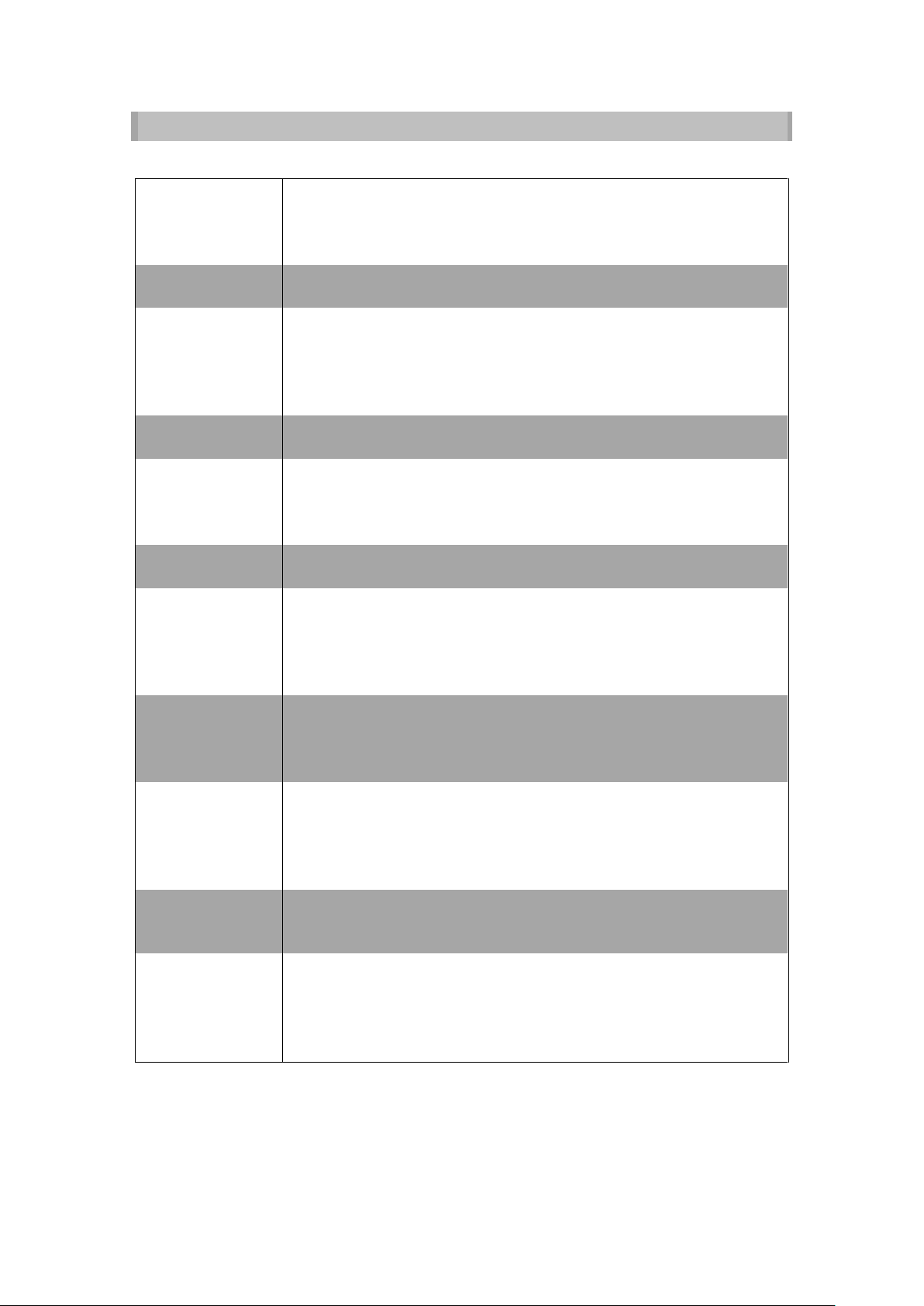
5 Dépannage
Échec du
fonctionnement
Vérifier si l'appareil est branché à la tension ou si la fiche est bien en contact ;
vérifiez si la tension est trop basse
Vérifiez s'il y a une coupure de courant
Odeur
Les aliments odorants doivent être bien emballés. Vérifiez s'il y a de la
nourriture pourrie. Nettoyez l'intérieur du réfrigérateur.
Fonctionnement
continu du
compresseur
Le fonctionnement prolongé du réfrigérateur est normal en été lorsque la
température ambiante est élevée
Il n'est pas recommandé de mettre trop d’aliments dans l'appareil en même
temps ; Les aliments doivent être refroidit avant d'être mis dans l'appareil ;
Les portes sont ouvertes trop fréquemment
La lumière ne
s'allume pas
Vérifiez si le réfrigérateur est connecté à l'alimentation électrique et si
l'éclairage est endommagé. Faites remplacer la lampe par un spécialiste.
Les portes ne
peuvent pas être
correctement
fermées
La porte est coincée par des paquets d’aliments; Trop d’aliments sont
stockés ; Le réfrigérateur est incliné
Bruit fort
Vérifiez si le sol est de niveau et si le réfrigérateur est placé de manière
stable ; Vérifiez si les accessoires sont placés aux bons endroits
Le joint de la porte
ne peut pas être
comprimé
Enlever les corps étrangers sur le joint de la porte
Chauffer le joint de la porte et ensuite refroidissez-le pour qu’il reprenne sa
forme
(ou refroidissez-le avec un séchoir électrique ou utilisez une serviette chaude
pour chauffer)
Débordement du bac
à eau
Il y a trop d’aliments dans le réfrigérateur ou les aliments stockés contiennent
trop d'eau, ce qui entraîne une décongélation importante. Les portes ne sont
pas fermées correctement, ce qui entraîne une condensation dû à l'entrée d'air
et une augmentation de l'eau due au dégivrage.
Boîtier chaud
Dissipation thermique du condenseur intégré via le boîtier, ce qui est normal
Lorsque le boîtier devient chaud en raison d'une température ambiante
élevée, le stockage d'une trop grande quantité de nourriture ou l'arrêt du
compresseur, assurez une bonne ventilation pour faciliter la dissipation
thermique
Condensation de
surface
La condensation sur la surface extérieure et les joints de porte du
réfrigérateur sont normaux lorsque l'humidité ambiante est trop élevée.
Essuyez simplement le condensat avec une serviette propre.
Bruit anormal
Bourdonnement: Le compresseur peut produire des bourdonnements pendant
le fonctionnement, et les bourdonnements sont forts particulièrement au
démarrage ou à l'arrêt. C'est normal.
Grincement: Le réfrigérant circulant à l'intérieur de l'appareil peut produire
des craquements, ce qui est normal.
5.1 Vous pouvez essayer de résoudre vous-même les problèmes simples suivants.
Sils ne peuvent pas être résolus, veuillez contacter le service après-vente.
15
 Loading...