

Page 1
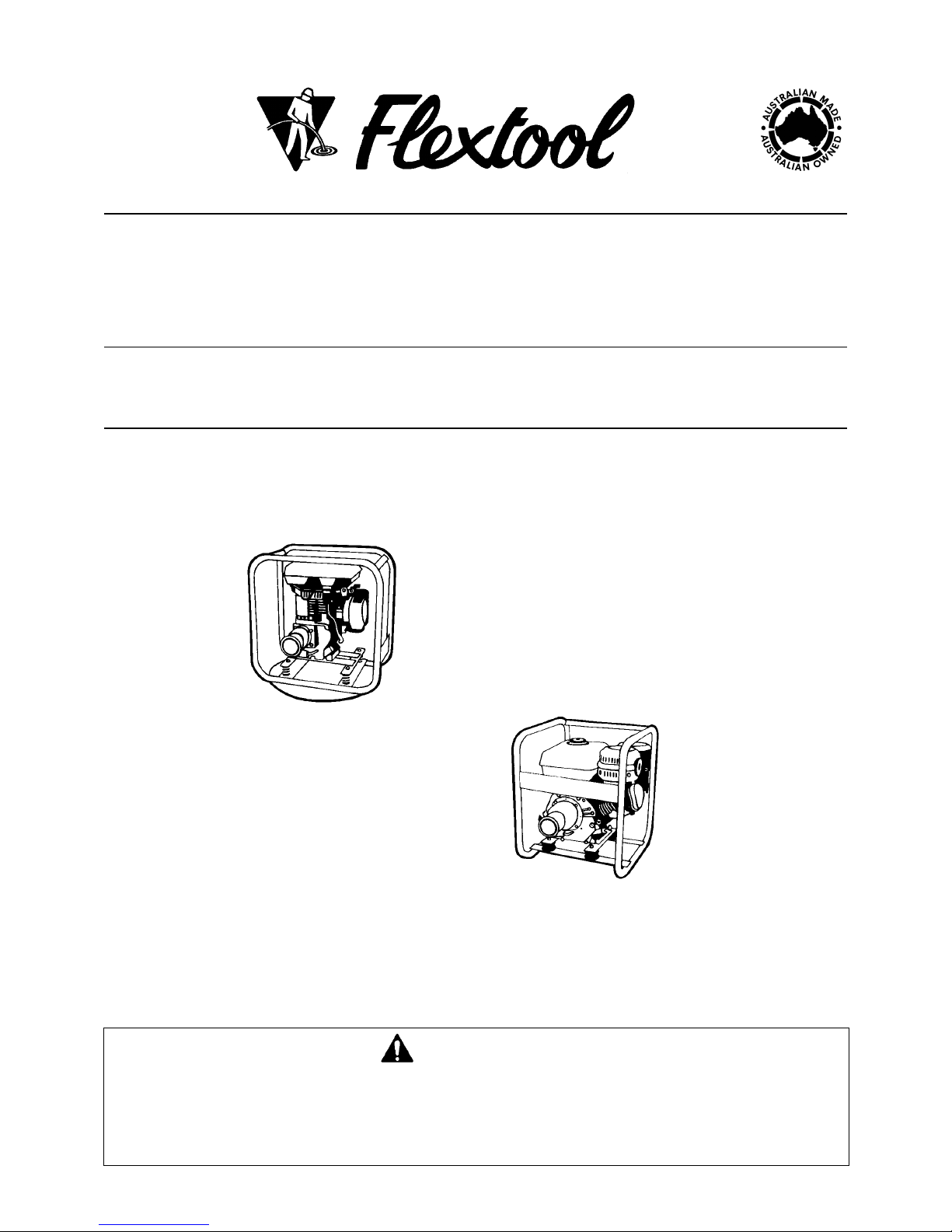
PETROL DRIVE UNIT
DP4 - DP6
OPERATING INSTRUCTIONS
WARNING
To reduce the risk of injury, all operators and maintenance personnel must read and understand
these instructions before operating, changing accessories, or performing maintenance on
Flextool power equipment. All possible situations cannot be covered in these instructions.
Care must be exercised by everyone using, maintaining or working near this equipment.
Page 2

Introduction..............................................................2
Applications.............................................................2
Function...................................................................2
Functions and controls............................................2
Hazards and risks..................................................2-3
Operation ................................................................3
Care and preventive maintenance..........................3
Service.....................................................................3
Cleaning and storage..............................................3
Specifications ..........................................................4
Trouble shooting......................................................4
Warranty..................................................................4
Spare parts and service ..........................................4
Thank you for your selection of Flextool equipment.
Flextool have specialised in the design and manufacture
of quality products since 1951.
We have taken care in the design, manufacture and testing of this product. It is covered by a six month warranty. Should service or spare parts be required, prompt
and efficient service is available from our branches.
General Safety Instructions for the Operation of
Power Equipment
The goal of Flextool is to produce power equipment that
helps the operator work safely and efficiently. The most
important safety device for this or any tool is the operator. Care and good judgement are the best protection
against injury. All possible hazards cannot be covered
here, but we have tried to highlight some of the important items, individuals should look for and obey Caution,
Warning and Danger signs placed on equipment, and
displayed in the workplace. Operators should read and
follow safety instructions packed with each product.
Learn how each machine works. Even if you have previously used similar machines, carefully check out each
machine before you use it. Get the "feel" of it and know
its capabilities, limitations, potential hazards, how it
operates, and how it stops.
Heavy duty concrete vibrators, 28 mm - 60 mm dia.
Submersible pumps, up to 50 mm discharge.
This portable drive unit is designed to power flexshaft
drive submersible pumps and model VP (pendulum)
vibrators. A quick action 60 mm diameter flexible shaft
coupling with aluminium alloy housing, rotary trigger
latch and hardened 45 mm 3-tooth dog drive enable
ease of use by allowing the operator to simply engage or
disengage the flexible shaft coupling, to facilitate either
a change of position or a change of flexshaft driven
device.
Bell housing / Rotary trigger
Is mounted directly to the motor and enables quick connection between the coupling and the 3-tooth dog drive
mounted on the crankshaft. The rotary trigger latch
assures a positive engagement between drive dogs.
Motor
The motor is controlled by an on/off switch or push button switch mounted on the motor below the fuel tank.
To STOP the machine TURN the switch to the OFF position or PRESS the push button in until the motor stops.
Honda, Robin and Vanguard motors are fitted with an oil
sensor device that will stop the motor or prevent starting
when the crankcase oil level falls below a safe level.
The motor speed is controlled by a throttle lever mounted below the air cleaner. The throttle should be adjusted to the maximum position when operating a flexible
shaft driven device.
NEVER allow any person to operate a machine without
adequate instruction.
ENSURE all operators read, understand and follow the
operating instructions.
SERIOUS INJURY may result from improper or careless
use of this machine
! MECHANICAL HAZARDS
DO NOT operate the machine unless all protective
guards are in place
KEEP hands and feet clear of rotating and moving parts
as they will cause injury if contacted.
BE CAREFUL not to come in contact with the muffler
when the engine is hot, since it can cause severe burns.
ENSURE that the motor operation switch is in the OFF
position and the spark plug ignition lead is disconnected
before removing guards or making adjustments.
ENSURE both the machine and the operator are stable
by setting up on level terrain and the machine will not
move or fall while in operation or unattended.
DO NOT leave the machine in operation while it is unattended.
DO NOT increase the governed no-load motor speed
above 3,000 r/min on an engine with a power output of
less than 5.6 kW, or a flexible shaft smaller than 16 x
38mm. Any increase may result in personal injury and
damage to the machine.
KEEP bystanders and animals clear of the work area.
HAZARDS AND RISKS
FUNCTIONS AND CONTROLS
FUNCTION
APPLICATIONS
INTRODUCTION
CONTENTS
2
Page 3

ENSURE that repairs to the motor and machine are carried out by COMPETENT personnel.
! FIRE & EXPLOSION HAZARDS
PETROL is extremely flammable and explosive under
certain conditions.
ENSURE that petrol is only stored in an approved storage container.
DO NOT refuel the motor while it is in operation or hot.
DO NOT refuel the motor in the vicinity of sparks, a
naked flame or a person smoking.
DO NOT overfill the fuel tank and avoid spilling petrol
when refuelling. Spilled petrol or petrol vapour may
ignite. If spillage occurs, ensure that the area is dry
before starting the motor.
ENSURE that the fuel tank cap is securely fitted after
refuelling.
! CHEMICAL HAZARDS
DO NOT operate or refuel a petrol motor in a confined
area without adequate ventilation.
CARBON MONOXIDE exhaust gases from internal combustion motor driven units can cause death in confined
spaces.
! NOISE HAZARDS
EXCESSIVE NOISE can lead to temporary or permanent loss of hearing.
! ADDITIONAL HAZARDS
Slip/Trip/Fall is a major cause of serious injury or death.
Beware of excess hose, the flexible shaft and water left
on the walking or work surface.
DO NOT allow waste water to accumulate under foot.
Exercise caution and ensure that the perimeter of ele-
vated formwork or platforms is protected.
Exercise care when working in the vicinity of unprotect-
ed holes or excavations
For information on correct starting procedures refer to
the engine manufacturers operation manual.
Before engaging the flexshaft with a petrol drive unit
start the motor using the recoil starter, increase the
speed to full throttle and allow it to warm up for a few
minutes. (If the motor is fitted with an on/off switch this
must first be turned ON before starting.)
Stop the motor.
Turn the bell housing trigger 180 degrees. Insert the
flexshaft coupling fully into the housing of the drive unit
and release the trigger. Push the coupling into the housing and twist the flexible shaft until the drive dogs are
fully engaged and the trigger returns to the horizontal
position.
The motor may now be started
Drive units should be operated on a level surface. If the
surface is not level the drive unit should be restrained to
ensure that it does not move due to vibration or the
weight of a pump and hose or vibrator.
Check the condition of the drive dog regularly and that
the three tooth drive dogs are fully meshed. The position of the drive dog on the crank shaft is critical and
should also be checked. The correct distance from the
face of the teeth to the face of the bell housing is 73 mm
(2.875 inches).
Worn coupling housings and poorly operating triggers
together with worn grooves in the shaft coupling will lead
to a shorter operating life and should be replaced before
they have worn excessively.
Check the oil level in the petrol motor crankcase daily.
Change the oil in the petrol motor crankcase regularly to
minimise wear.
Inspect, clean and/or replace the motor air cleaner regularly, particularly when operating in a dusty environment.
Inspect, clean and/or replace the spark plug regularly.
Keep the unit clean and free of concrete residue.
Ensure the cooling fins on the motor are kept unob-
structed.
CLEANING AND STORAGE
SERVICE
CARE AND PREVENTIVE MAINTENANCE
OPERATION
3
Page 4

Motor
DP4 - Delta DE180 3.7 kW output petrol
Honda GX160 4.1 kW output petrol
Robin EY20 3.7 kW output petrol
Vanguard 115432 4.1 kW output petrol
DP6 Honda GX240 6.0 kW output petrol
Robin EY28 5.6 kW output petrol
Governed Speed
DP4 - 3,000 r/min
DP6 - 3,000 - 3,600 r/min
Weight (kg)
DP4
Economy Model DP4 Standard Model
Delta 30 Delta 33
Honda 25 Honda 28
Robin 26 Robin 28
Vanguard 29 Vanguard 32
DP6
Honda 34
Robin 38
Shipping Size (l x w x h)
DP4 500 mm x 446 mm x 545 mm
DP6 540 mm x 480 mm x 610 mm
FLEXTOOL products are covered by warranty for a period of six (6) months from the date of purchase against
defects in material or workmanship provided that:
• The product concerned has been operated and maintained in accordance with the operating instructions.
• Has not been damaged by accident, misuse or
abuse.
• Has not been tampered with or repaired by any unauthorised person.
The owner is responsible for the cost of transportation to
and from the authorised repairer and the unit is at the
owners risk while in transit to and from the repairer.
Flextool (Aust.) Pty. Ltd.
A.C.N. 004 502 961
Melbourne
Head Office P 0 Box 1102
191 Wellington Street Tel: (03) 9419 6300
Collingwood Vic. 3066 Fax: (03) 9417 1391
Australia
Sydney
29 Crescent Street Tel: (02) 9818 5722
Rozelle N.S.W. 2039 Fax: (02) 9818 3276
Brisbane
17 Ross street Tel: (07) 3252 2306
Newstead Qld. 4006 Fax: (07) 3252 5359
Adelaide
68 Daws Road Tel: (08) 8374 4300
Edwardstown S.A. 5039 Fax: (08) 8374 4194
Perth
3 / 47 Tate Street Tel: (08) 9451 2077
Bentley W.A. 6102 Fax: (08) 9350 5011
Free Call: Tel: 1 800 801 108
Outside the above metropolitan areas.
SPARE PARTS AND SERVICE
WARRANTY
TROUBLESHOOTING
SPECIFICATIONS
SYMPTOM POSSIBLE CAUSES AND CORRECTION
Motor will not start. • Check the ON/OFF switch to ensure that it is switched ‘ON’.
• Check the fuel supply.
• If a Honda or Robin motor is fitted check the crankcase oil level as an oil
sensor device is fitted to these motors which prevents starting and stops
the motor when the oil level is low.
• Ensure the spark plug ignition lead is connected.
• Check the carburettor jet and bowl to ensure they are clean.
Motor stops. • Check the fuel supply.
• Check that the fuel cock is turned on.
• Check the condition of the air filter.
• Check the oil level.
Motor lacks power. • Check the condition of the air filter.
• Check the condition of the spark plug.
F2475 Issue 9808
 Loading...