

Page 1
O
O
OO
O
O
OO
w
w
ww
w
w
ww
SSSS
m
m
mm
SSSS
m
m
mm
n
n
nn
n
n
nn
aaaa
aaaa
e
e
ee
e
e
ee
llll
llll
llll
llll
bbbb
bbbb
r
r
rr
r
r
rr
oooo
oooo
''''
s
s
ss
''''
s
s
ss
aaaa
aaaa
tttt
tttt
m
m
mm
m
m
mm
ssss
ssss
uuuu
uuuu
pppp
pppp
a
a
aa
a
a
aa
tttt
tttt
oooo
oooo
n
n
nn
n
n
nn
1111
1111
u
u
uu
u
u
uu
0000
0000
ffff
ffff
a
a
aa
a
a
aa
tttt
tttt
llll
llll
Page 2

Index
1 - Introduction
2 - Flexboat history
3 - Builders Certificates
4 - Vessel Registration
5 - Owner responsibilities
6 - Features of the small boats up to 10 ft
6.1 - Miniflex, MiniflexS and TD 8 line of foldable boats
6.1.1 - Assembly, disassembly and transportation of boats with folding bottom
6.2 - TD 10 boat that can be disassembled
6.1.2 - Assembly, disassembly and transportation of boats that can be disassembled
6.3 - Mini SR, SR 9.5, SR 10 and SR 10 S line of rigid bottom boats
7 - Dimensions
8 - Knowing the Miniflex
9 - Knowing the Miniflex S
10 - Knowing the TD 8
11 - Knowing the TD 10
12 - Knowing the Mini SR
13 - Knowing the SR 9.5
14 - Knowing the SR 10
15 - Knowing the SR 10 S
16 - Basic items for all models
17 - How to inflate your Flexboat
18 - Maximum capacity
19 - Engine ratings
20 - Maintenance and cleaning
20.1 - Hull and cockpit cleaning
20.2 - Tube cleaning
20.2.1 - Using the Hypalon cleaning Blue Kit
20.3 - Stainless steel cleaning
20.4 - Windshield cleaning
20.5 - Upholstery cleaning
20.6 - Cleaning products NOT TO BE USED on board
21 - Before navigation
21.1 - Complete checklist, still in land
21.2 - In-water checklist
21.3 - Engine starting checklist
22- Onboard safety
23 - Anchoring your Flexboat
23.1 - Launching the anchor
23.2 - Retrieving the anchor
24 - Navigation tips
25 - Returning from your trip
26 - Fuel
26.1 - Fueling the boat
26.2 - Using the right fuels
27 - Engine care
28- Small repairs on the tubes
29 - Air valve replacement
30 - Final considerations
31 - Warranty
32 - Warranty card
2
Page 3

Congratulations! You have just purchased a FLEXBOAT.
versatile and dynamic vessel. Stability, safety and high capacity a
the highest quality materials and components to build our boats. The tubes are built with the best
material imported from France, a fabric made of Hypalon, Neoprene and Polyester which is highly hermetic and
emely resistant to abrasion, chemicals, sun rays, and wear & tear. The use of those materials guarantees
superior durability.
good moments in the water
ead this manual. Here you will learn how to h
how to take care of your boat, do some basic troubleshooting,
rranty. Our goal is helping you getting the most of your Flexboat so you can enjoy it
are under constant development and improvement. All images, drawings, descriptions and
specifications in this manual reflect the most current models
Flexboat reserves the right to do changes to this Manual at any time as needed.
Late 1988 Jaime Jose Alves Silva, an entrepreneur from Rio de Janeiro, decided to settle in Sao Paulo after
arching for technology and for the most advanced materials in order to start
building the best inflatable boats in Brazil.
FLEXBOAT CONSTRUCOES NAUTICAS LTDA was born in 1990 in its facility located in the city of Atibaia, 40
ulo, on a 270,000 s
Atibaia was chosen due to its prime location as a transportation hub and also because it is close to the main
marine markets in Brazil's south / southeast regions.
8 years have demanded lots of work and dedication. During this period FLEXBOAT has created a
brand name which is a reference of quality. It has turned into a synonym of inflatable boats.
Since its inception FLEXBOAT has been using Hypalon (special fabric
from France) to build its tubes. This material and its incomparable features guarantees the boats will have the
highest safety standard. It makes sure the boats will last longer. When used in conjunction with other hi
raw materials and components and when handled by a team of highly trained and qualified workers the final
result is FLEXBOAT, the best inflatable boat made in Brazil.
After starting building small inflatables up to 12 feet long Flexboat kept on
release of the SR 1000, the largest (33 ft) and most advanced inflatable build in Brazil. Until now more than
15,000 boats were built and sold in Brazil, USA, Caribbean and Europe.
pment of boats focused on military use and since then we have become
the main vendor for Brazil armed forces. Federal Police, Navy, Firemen, First Responders, IBAMA and Ambient
Police are among FLEXBOAT customers.
FLEXBOAT is looking to the future and wor
offering larger boats with a cabin, and other innovations, both for the Brazilian and International markets. In the
military and professional sectors, FLEXBOAT is developing a new line of p
Small boats up to 10ft
re just some of its strengths.
To make sure you achieve this we strongly suggest you
it in a safe way. You will also learn
how to properly maintain it. And you will also
o Dias Highway. The city of
based on rubber and neoprene, imported
expanding its product line until the
king onto increasing its product offering in the leisure market by
roducts that will be second to none.
1 - Introduction
A lightweight,
We only use
extr
Flexboat inflatables’ a
Boating means spending
r
find information about its wa
safely.
Our products
Owner’s Manual –
.
andle your boat and how to use
and
available.
2 – Flexboat history
travelling to Italy and France se
miles from the city of Sao Pa
Since then 2
In 2005 FLEXBOAT started the develo
q ft area right across the Fernã
gh quality
This is FLEXBOAT!
Best regards,
THE FLEXBOAT TEAM
3
Page 4
All our boats are subjected to quality tests before delivery to the customer, guaranteeing a superior level of
You should register your boat according to the local laws and regulations. Please contact your nearest marine
authorities or your closest FLEXBOAT dealer if needed
The owner or user is responsible for acknowledging
Correct usage and maintenance of the boat and its systems
Passengers safety preparation and train
Knowledge of the boats systems
Knowledge of the sea conditions
Owner’s Manual –
Small boats up to 10ft
and following the requirements and procedures below:
3 – Quality you can trust
quality.
4 - Vessel registration
5 – Owner responsibilities
• Coast Guard registration
• Insurance
• Warranty registration
• Warranty terms and conditions
•
• Safety equipment
•
•
•
• Safe practices
• No use of drugs and alcohol
• Environmental regulations
• Accident reports
• Operators license if needed
ing
4
Page 5
Features of the small boats up to 10 ft
ts was developed to work as support boats for larger vessels and t
Depending on its bottom style, the small boats are divided into three groups as follows:
Boats that can be disassembled
TD
fits into a small carrying bag;
assures excellent p
om plate and the bottom planks are made of fiberglass thus increasing its durability even
when exposed to bad weather.
disassembly
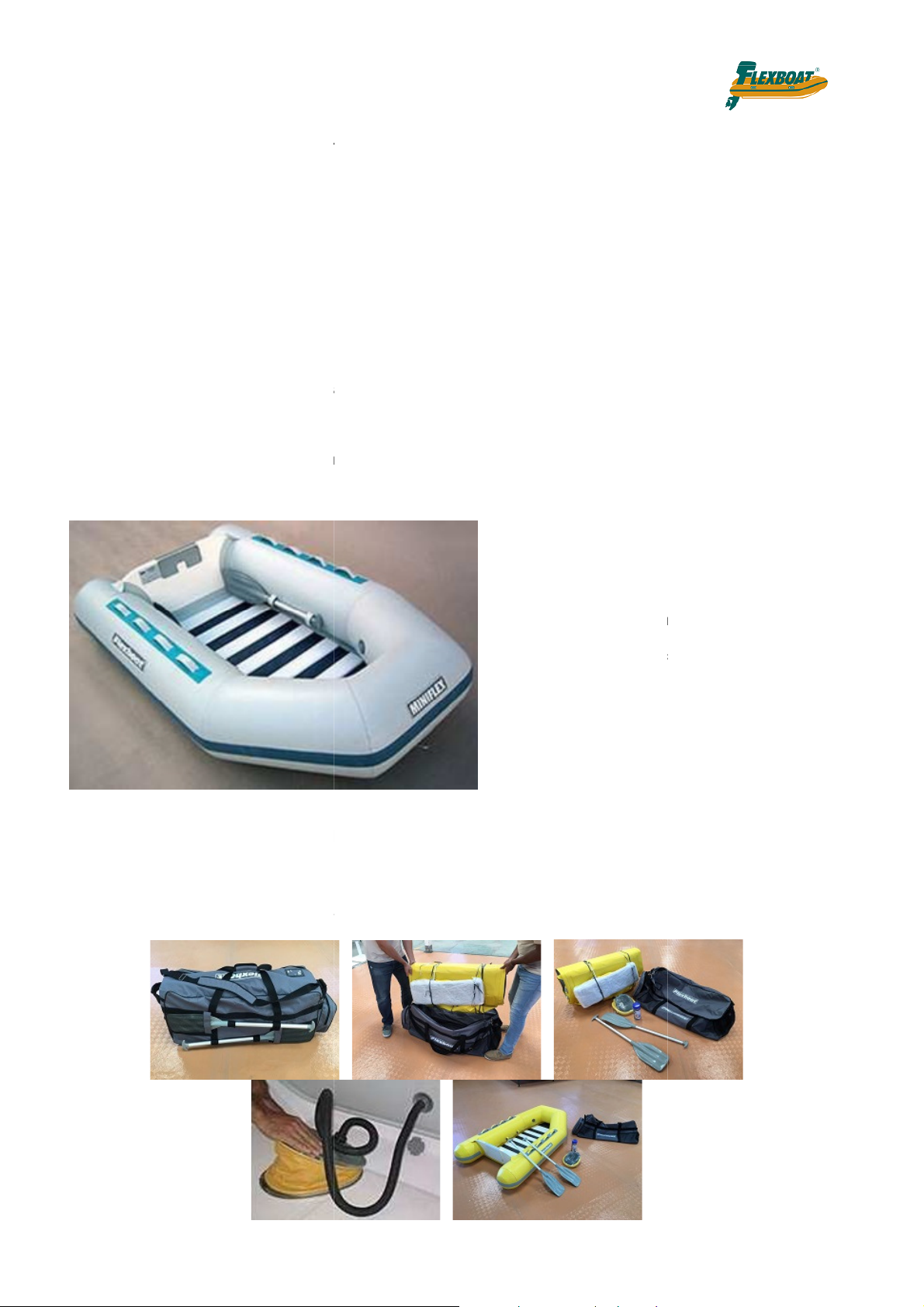
The foldable boats are very light and fit into a carrying bag which was specially developed for
its transportation. Assembling and disassembling the Miniflex is a simple process that can de
Se
ee detailed inflating instructions
Small boats up to 10ft
Flat bottom with
fiberglass planks and Hypalon fabric.
som plate and bottom
consist of marine ply
encapsulated with reinforced fiberglass
with orthophthalic polyester resin,
450 g/m² of fabric and
Coremat. Finishing in isopht
coat with NPG and anti
and transportation of boats with fold
Se
6 -
Flexboat line of small boa
friendly boat.
a)
Folding boats
b)
c)
Boats with rigid bottom
6.1 - Miniflex, Miniflex-S and
Ideal to support larger vessels;
When folded, it
Very light;
Easy to be transported;
Its hydrodynamics
The trans
Owner’s Manual –
-8 line of foldable boats
erformance and maneuverability;
Bottom type:
Materials: Tran
planks
o be a family
wood
reinforced with
halic gel
UV.
6.1.1 Assembly,
ing bottom
performed by anyone.
e a step by step explanation below:
S
in item 17 of this manual.
5
Page 6
TD 10 boat that can be disassembled
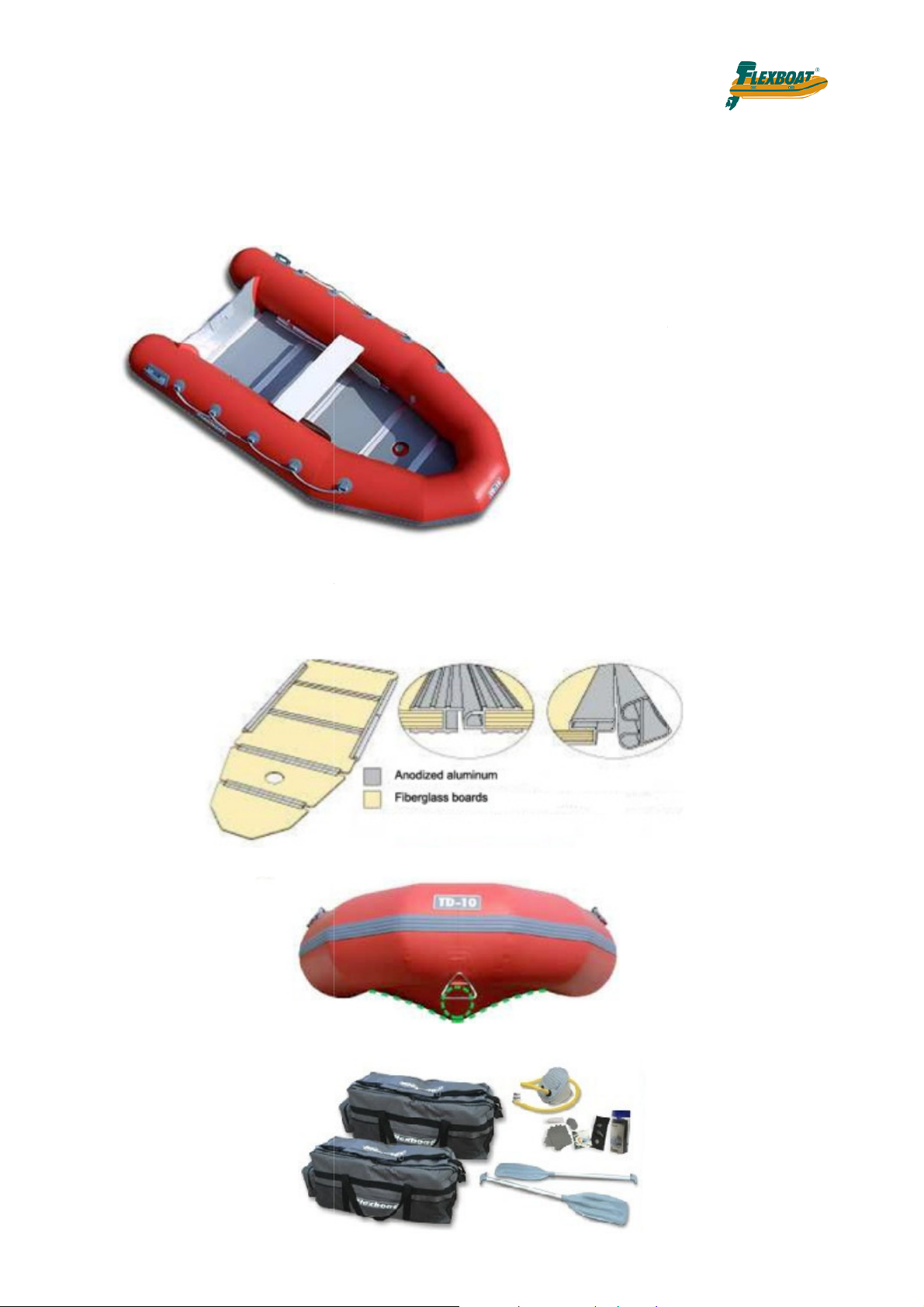
The TD 10 has a removable bottom. When disassembled it is fitted in two separate carrying bags that can
cle. Transverse and longitudi
rigidity to the bottom during navigation.
.1 Assembly, disas
Owner’s Manual –
Small boats up to 10ft
nal aluminum profiles guarantee
pe: V bottom with
and inflatable keel with
Hypalon fabric
Materials: Hypalon f
aluminum profiles.
ly and transportation of boats that can be
6.2 -
be transported in any vehi
bottom panels and assure
6.2
disassembled
semb
a perfect fit for the
Bottom ty
fiberglass
.
fiberglass
with anodyzed
abric, and
6
Page 7
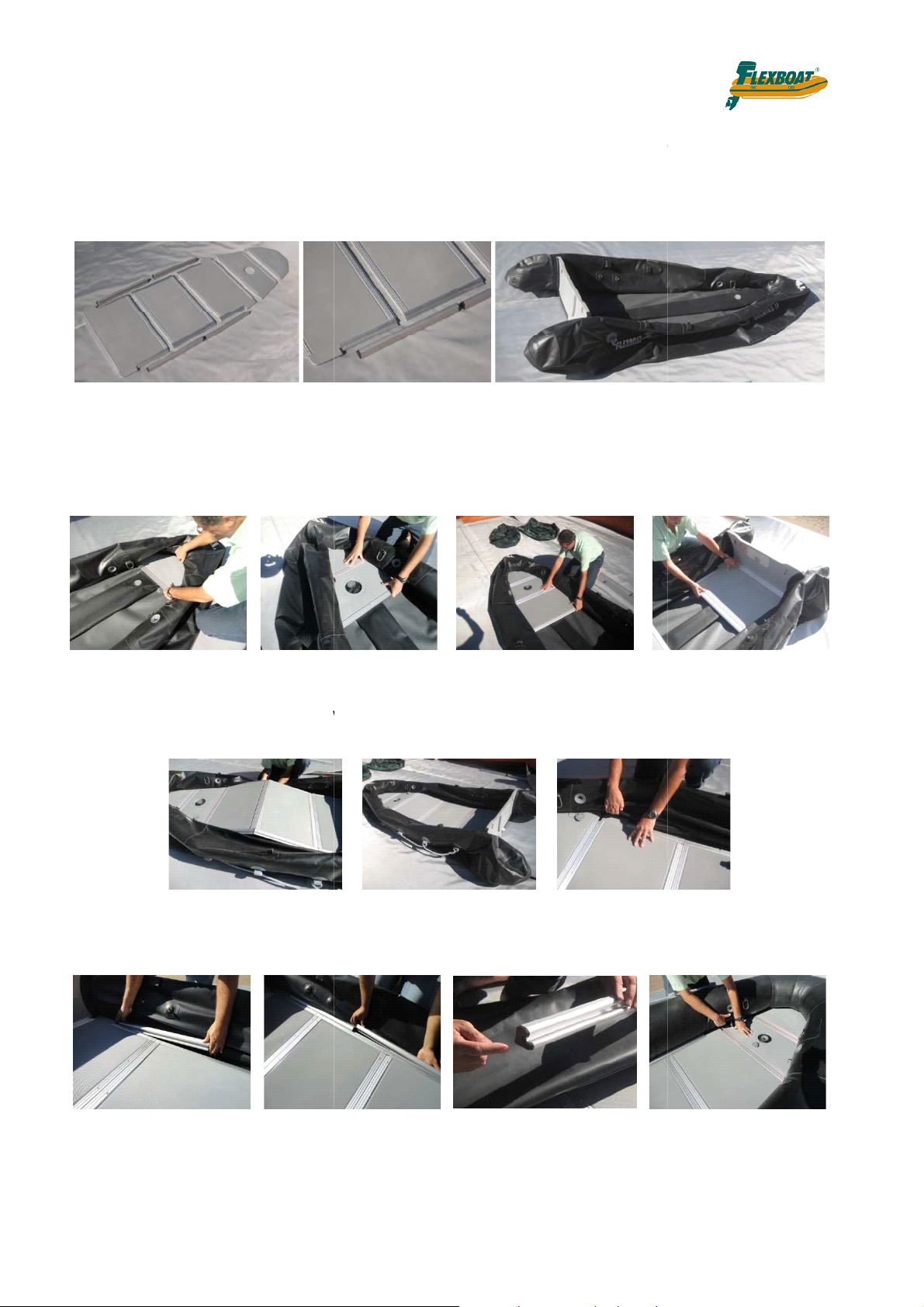
The TD 10 comes in two separate carrying bags. One bag stores the tubes and the other bag stores
arranging
the bottom in the boat
Install the bottom parts following their numbers. Start at the bow
Part # 4 should be the last one to be put in place.
the final fitting by applying some down pressure in
adjust the side fabric from the tube to the sides of the floor.
4 pieces of side aluminum profiles by fitting them to the sides of the floor. Check the final
pump a little air on each tube to help the bottom to
e inflation of the tubes. Only after the
inflate the keel of the boat. Inflate the keel until the bottom it straight and has a V shape.
Small boats up to 10ft
and move your way to the
fit part # 4 into part # 5 and slightly raise part #3 to do
the whole floor
accommodate
inflated to their correct pressure it is t
Step 1– Preparing the parts.
Laying the bottom out and
Step 2 – Installing
stern until you get to part # 5.
Owner’s Manual –
the
disassembled bottom.
the rubber parts.
with part # 1
Install the
adjustment of the floor.
First
order to accommodate
in place. Then
Step 3– Inflating the boat
Inflate the tubes. First
complete th
tubers are
correctly. Then
ime to
7
Page 8
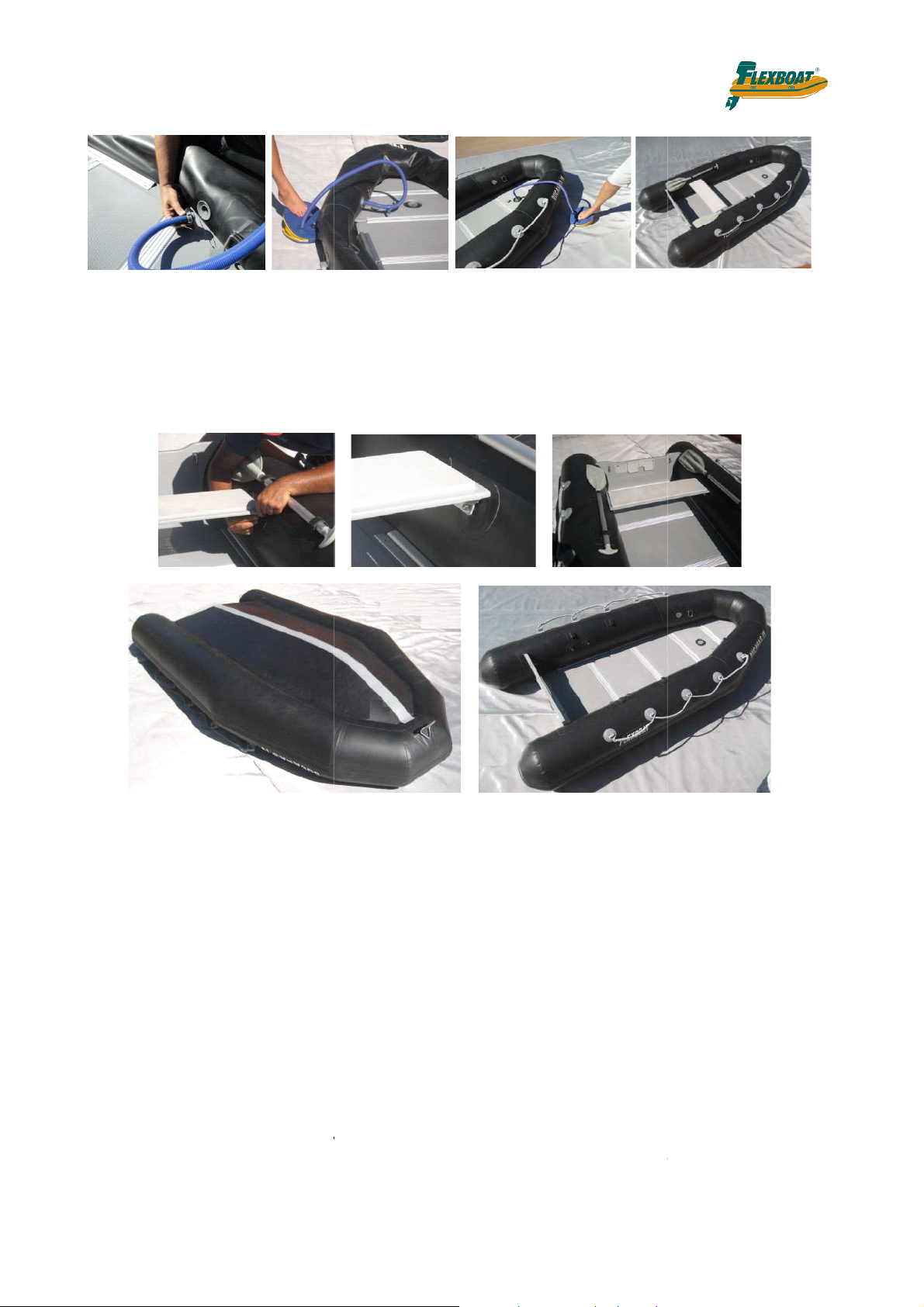
Fit the seat onto the screw installed on the tube. Tighten the bolts. Repeat on the o
nflated keel
Mini SR, SR 9.5, SR 10 and SR 10 S line of rigid bottom boats
They all have a rigid fiberglass bottom which makes them suited for a
Reinforced fiberglass hull laminated with orthophtalic polyester resin, reinforced with
alic gel coat with NPG and anti
fiberglass hull laminated with orthophtalic polyester resin, reinforced with
, and injected polyurethane foam between the hull and liner
Small boats up to 10ft
ny kind of use and activity.
450 g/m² of fabric and
. Finishing in isopht
Step 4 – Installing the seat
Owner’s Manual –
ther side.
6.3-
MINI-SR, SR 9.5 and SR 10
I
Lifeline
Coremat finishing in isophth
SR 10-S
Reinforced
Coremat
NPG and anti UV.
-UV.
450 g/m² of fabric and
halic gel coat with
8
Page 9
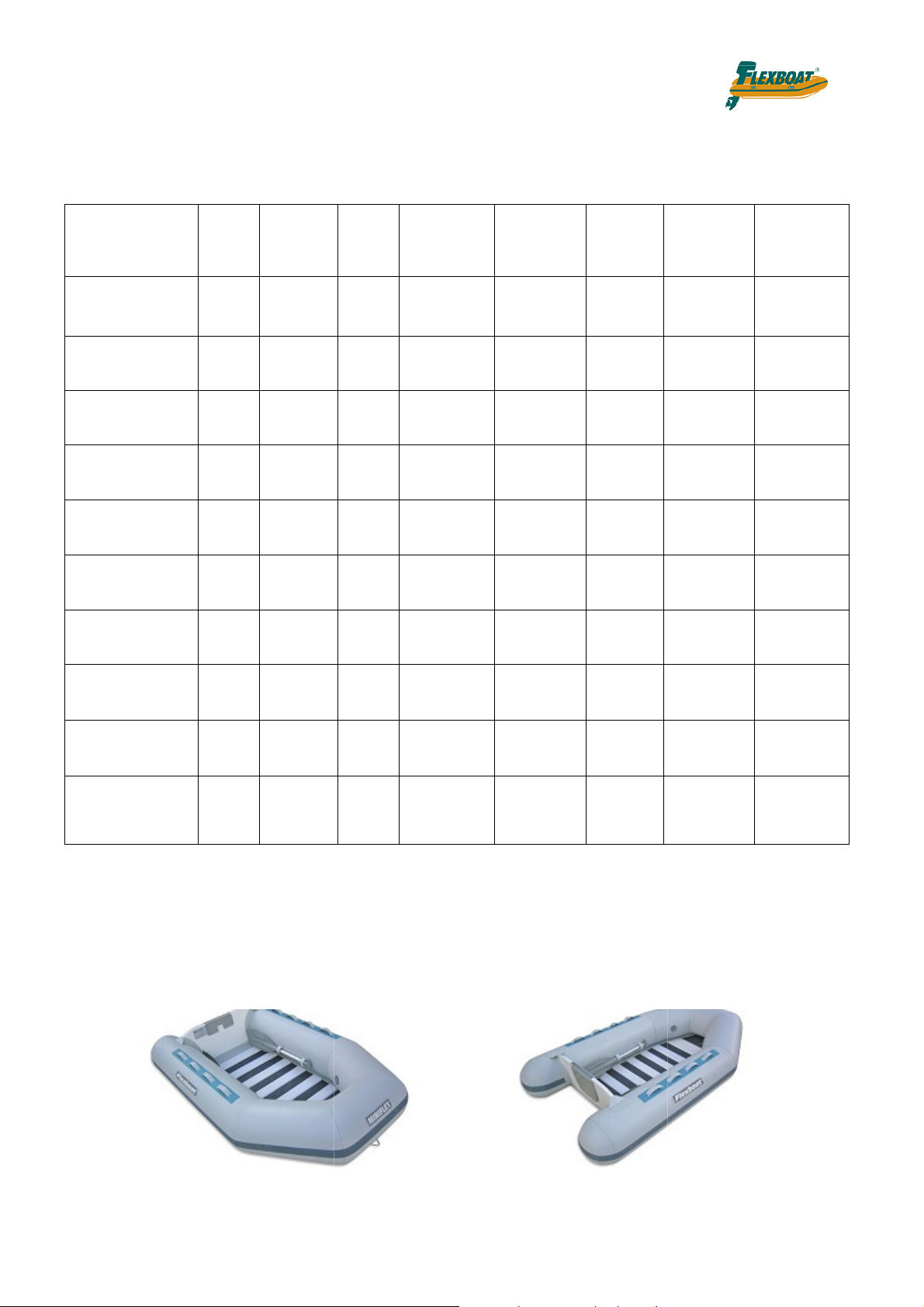
Small boats up to 10ft
7
– Dimensions
Owner’s Manual –
Length overall
(outside)
Length overall
(inside)
Beam
(outside)
Beam (inside)
Tube diameter
Quantity of
chambers
Max person
capacity
Max HP
recommended
Miniflex Miniflex S
6 ft 7 in 7 ft 5 in
4 ft 4 in
4 ft 4 ft 4 in
1 ft 10 in 2 ft 2 in
1 ft 1 in 1 ft 1 in
2
2
3.3hp 4hp
5 ft 2 in
2
3
TD-8 TD-10 Mini SR SR-9.5
8 ft 2 in
5 ft 10 in 7 ft 5 in 5 ft 2 in 6 ft 5 in
5 ft 5 ft 4 in 4 ft 4 in 5 ft 5 in
2 ft 5 in
1 ft 1 in
2
4
5hp 15hp 4hp 8hp
10 ft 7 ft 5 in 9 ft 5 in
2 ft 6 in 2 ft 2 in 2 ft 4 in
1 ft 4 in /
1 ft 2 in
3
5
1 ft 1 in 1 ft 5 in
2
3
2
5
SR-10 SR-10 S
10 ft 3 in 10 ft
7 ft 3 in 7 ft 6 in
5 ft 8 in 5 ft 4 in
2 ft 9 in 2 ft 6 in
1 ft 5 in
3
5
15hp 15hp
1 ft 4 in /
1 ft 2 in
2
5
Product line
Weight (w/o
engine)
8
– Knowing the Miniflex
Foldable Foldable
46 lb 62 lb
Foldable Disassembled
82 lb 106 lb 73 lb 128 lb
Rigid
bottom
Rigid
bottom
Rigid
bottom
150 lb 132 lb
Rigid
bottom
9
Page 10
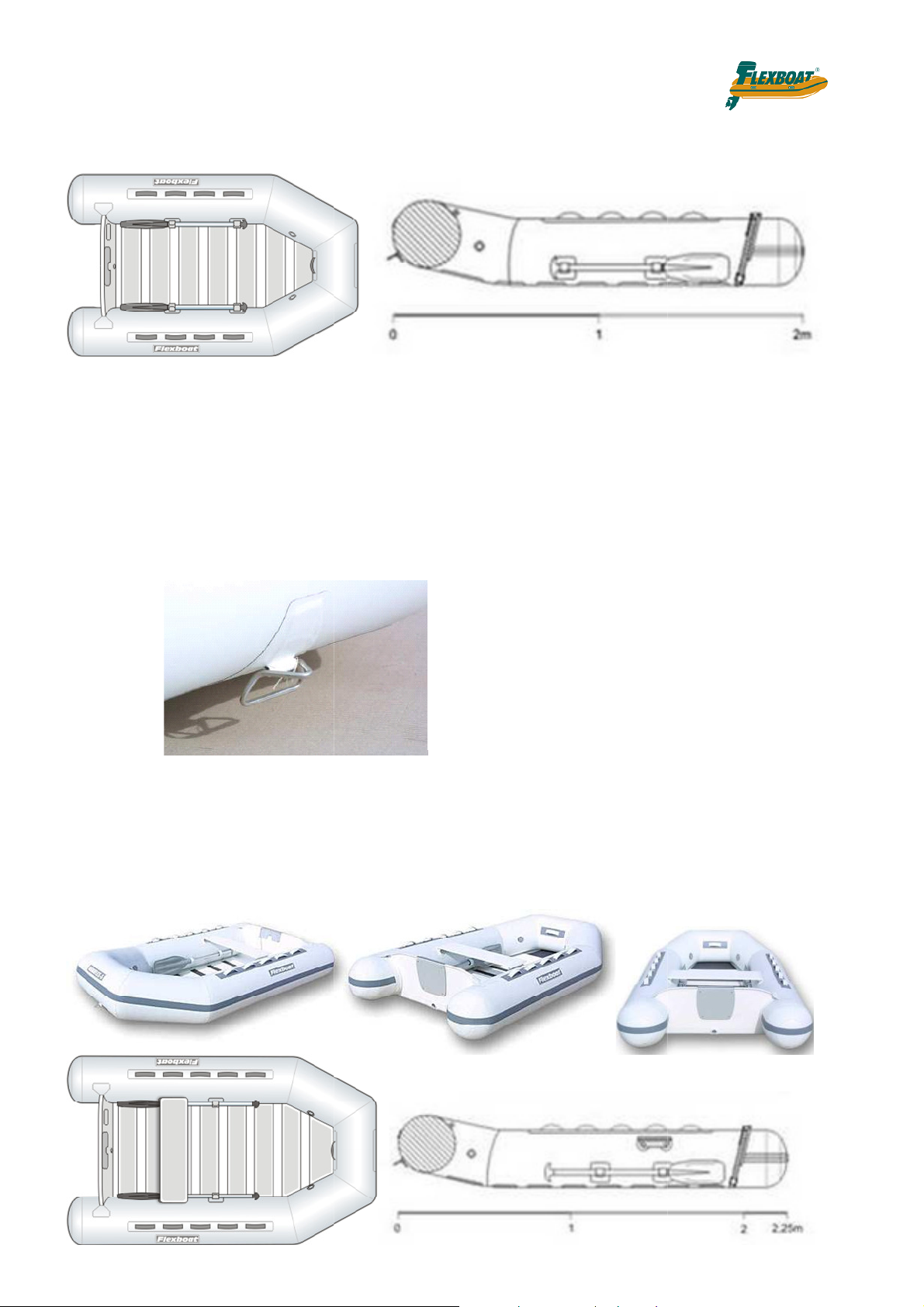
rubber handle in the bow
Small boats up to 10ft
Triangular shaped stainless steel
fixture in the bow, for towing, anchoring
Items located at the transom plate:
Nylon plate
Boat ID label
Drainplug with valve
There is an internal
Owner’s Manual –
, vulcanized to the tube.
9
– Knowing the Miniflex-S
and tying to the dock.
10
Page 11
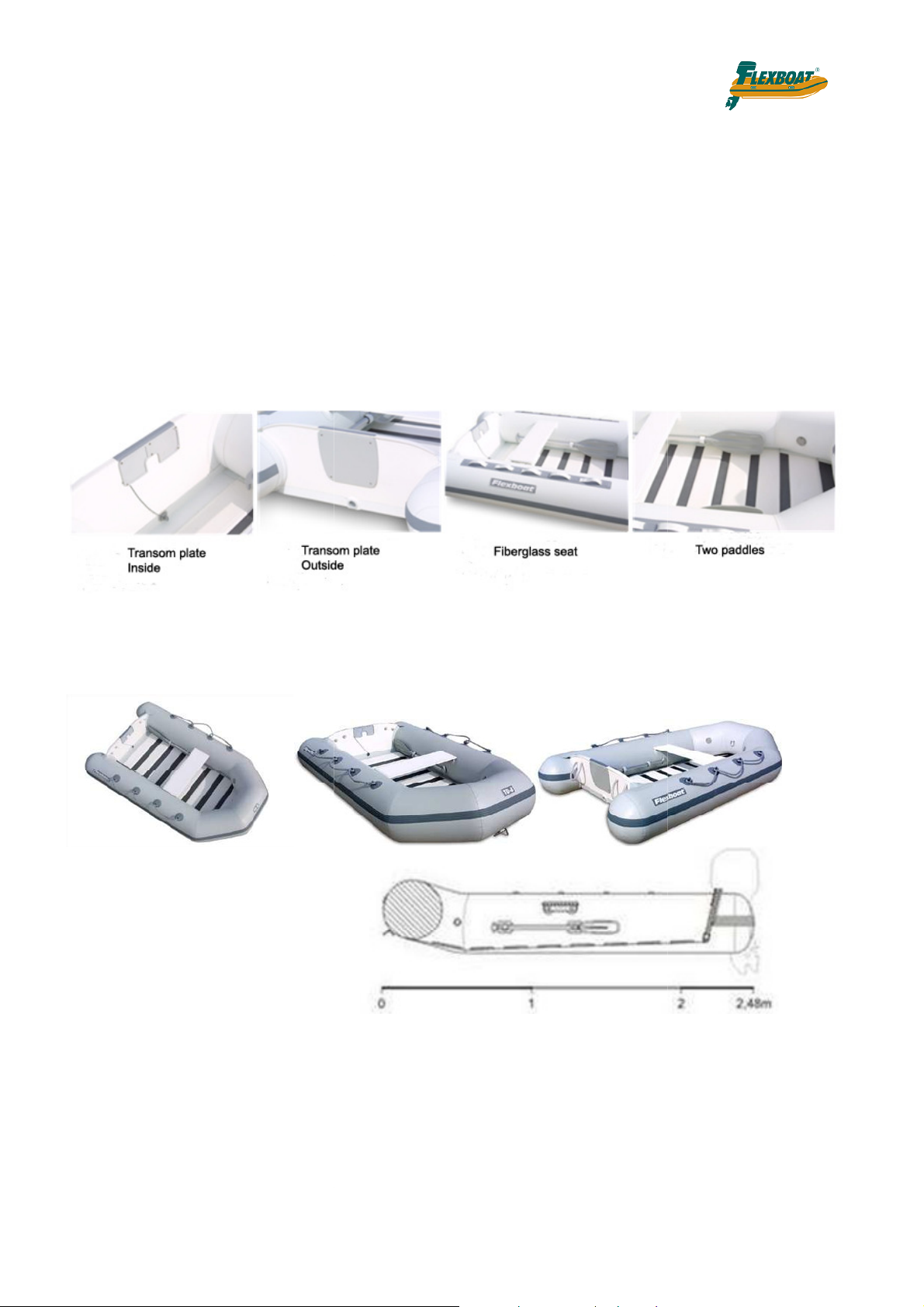
steel D ring in the bow
EVA padded fiberglass captain seat.
Triangular shaped stainless steel fixture in the bow, for towing, anchoring and tying to the dock.
There is a internal rubber handle in the boat, vulcanized to the tube, and a triangular shaped
fixture in the bow, for towing, anchoring and tying to the dock.
Two polyamide straps for transpo
Stainless steel D ring in the bow
n seat.
Triangular shaped stainless steel fixture in the bow, for towing, anchoring and tying to the dock.
Small boats up to 10ft
Items located at the transom plate:
Nylon plate
Boat ID label
Drainplug with valve
Stainless
Owner’s Manual –
stainless steel
10
– Knowing theTD-8
Items located at the transom plate:
Nylon plate
Boat ID label
Drainplug with valve
EVA padded fiberglass captai
rtation
11
Page 12
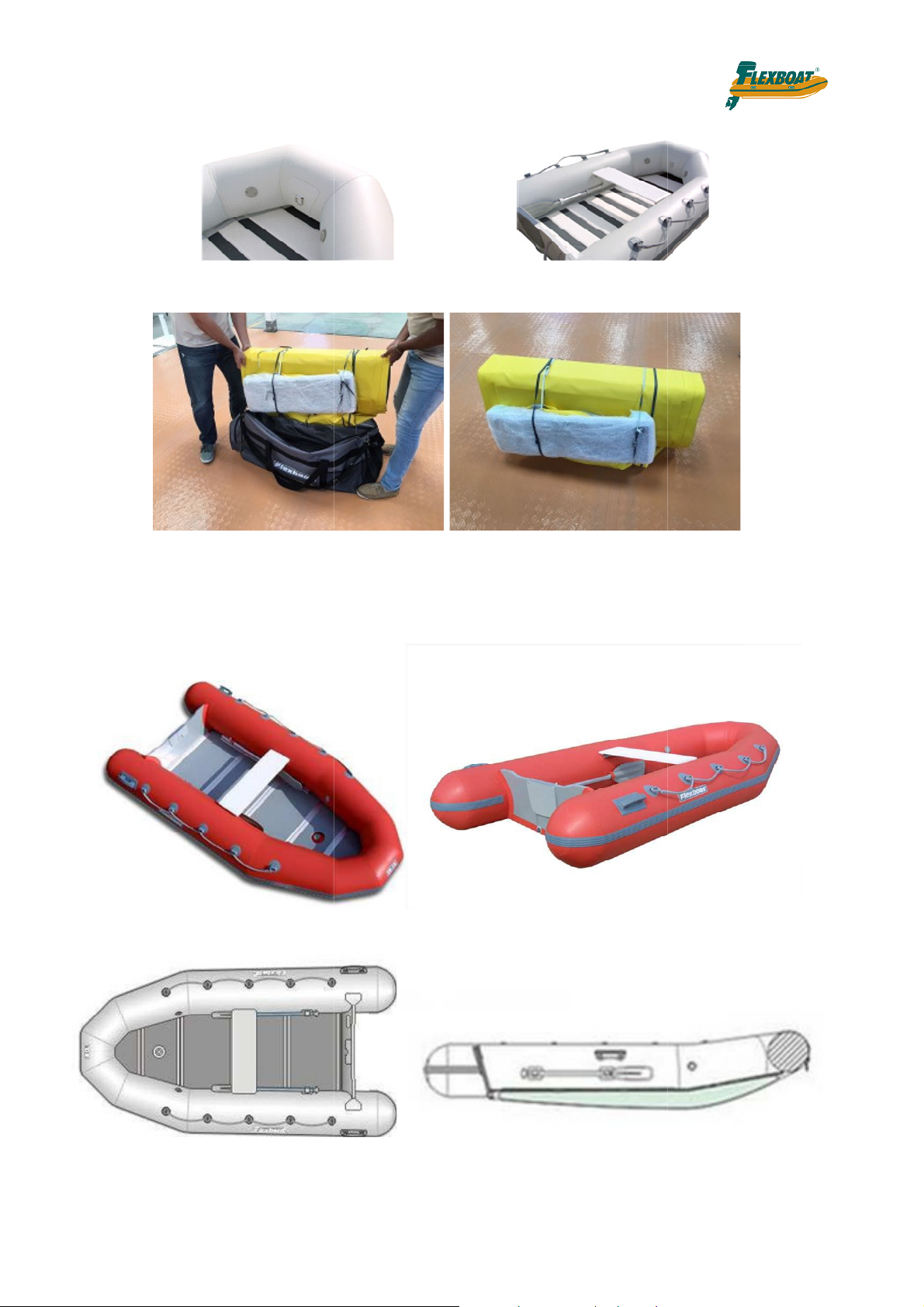
carrying bag
Small boats up to 10ft
Two paddles
Bow
Owner’s Manual –
TD 8
11– Knowing the TD 10
12
Page 13
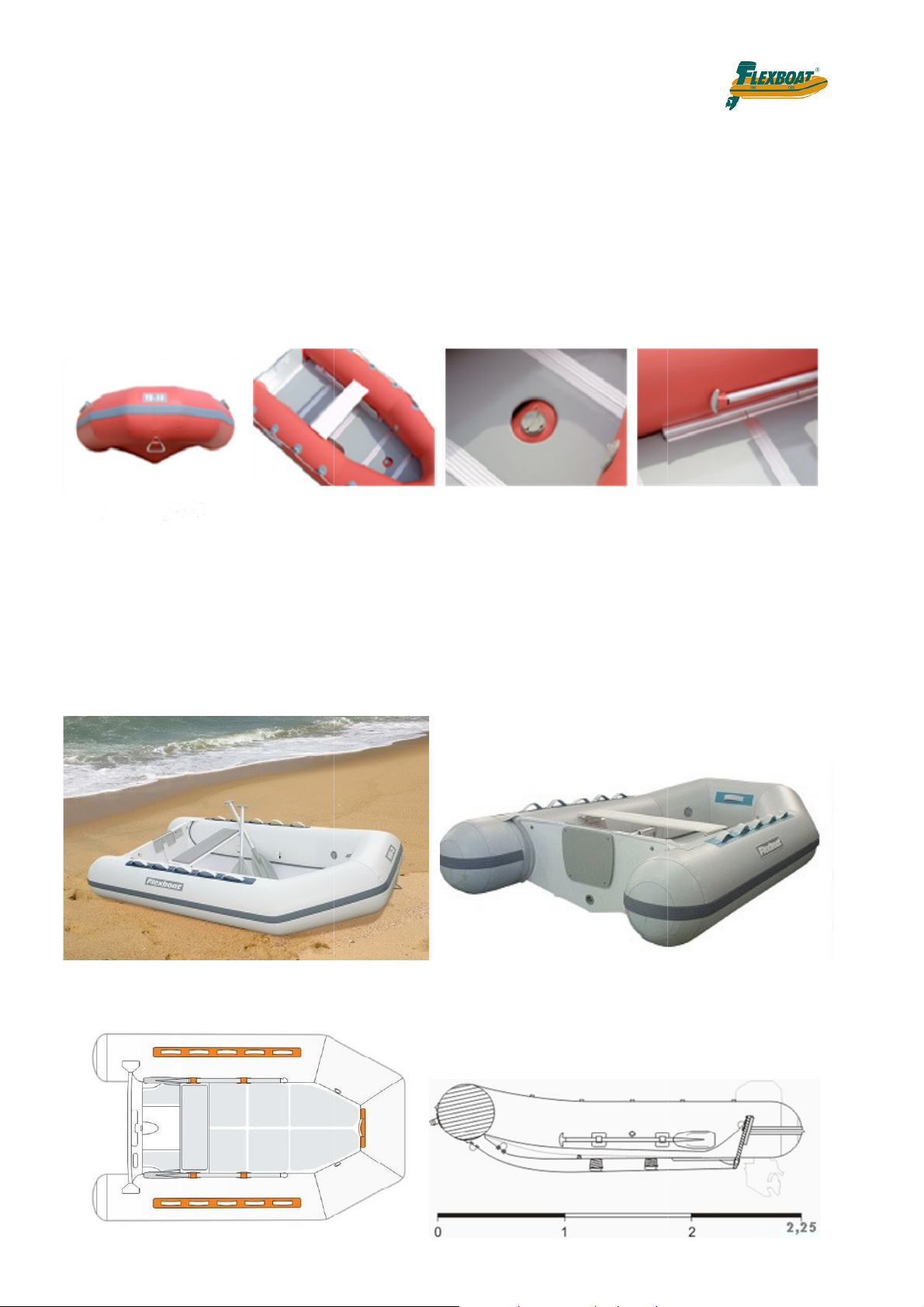
seat.
Triangular shaped stainless steel fixture in the bow, for t
Small boats up to 10ft
owing, anchoring and tying to the dock.
Items located at the transom plate:
Nylon plate
Boat ID label
Drainplug with valve
EVA padded fiberglass captain
Inflatable keel.
Owner’s Manual –
Towing fixture
12 – Knowing the Mini-SR
Seat Air valve
Paddle
13
Page 14
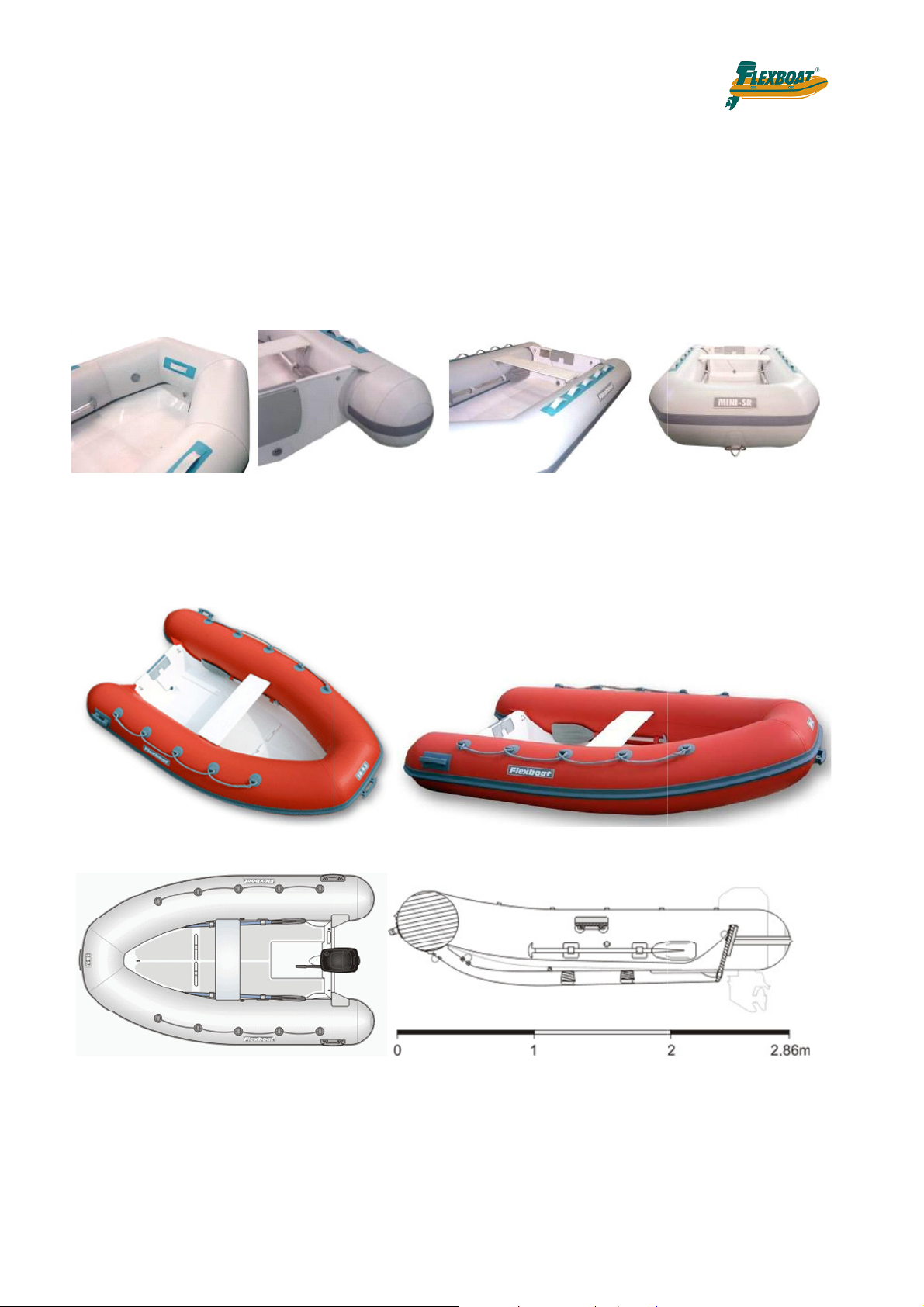
captain
Rubber handle in the bow, vulcanized to the tube
captain
located in the bow, inside the boat.
Small boats up to 10ft
Items located at the transom plate:
Nylon plate
Boat ID label
Drainplug with valve
EVA padded fiberglass
13 – Knowing the SR 9.5
Owner’s Manual –
seat.
.
Items located at the transom plate:
Nylon plate
Boat ID label
Drainplug with valve
Two stainless steel U bolts
EVA padded fiberglass
U ring
seat.
14
Page 15
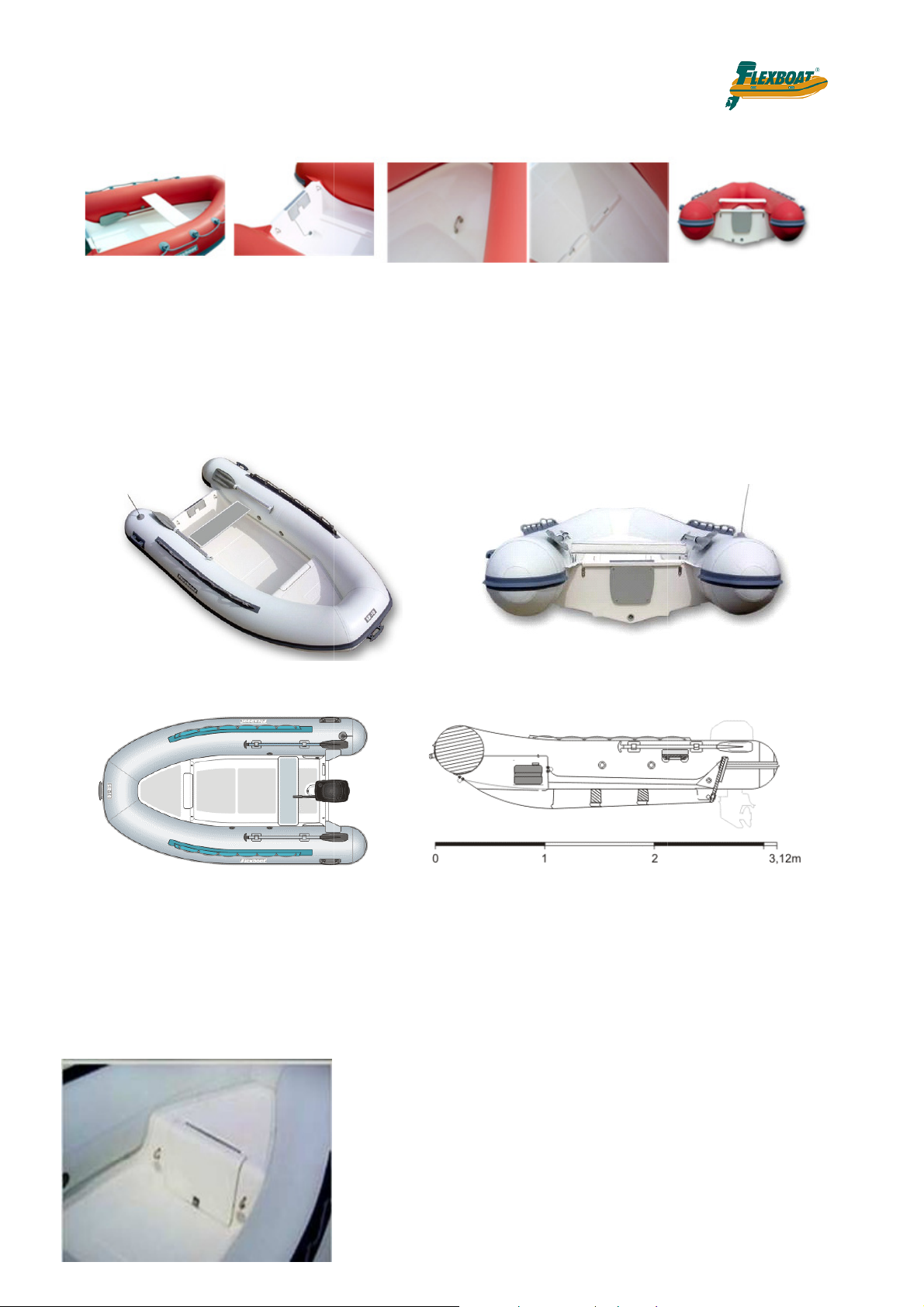
plate
wo stainless steel lifting rings
o stainless steel tow rings
Owner’s Manual –
Small boats up to 10ft
Transom with
Fuel tank compartment located in the bow improves weight
distribution offering quick planning and great overall perfo
Bow storage compartment with fiberglass cover and stainless
ternal stainless steel rings, fuel tank and
compartment serves as a bow
the bow, located at the fiberglass hull
1 2
1-Fiberglass seat; 2-Transom
14 – Knowing the SR-10
3 4
; 3-U ring; 4-Fuel tank location; 5-
5
drain valve
Items located at the transom plate:
Nylon plate
Boat ID label
Drain plug with valve
T
Tw
EVA padded fiberglass captain seat
Nylon flag pole located in the tube.
steel latch with 2 in
fuel hose and clamps. This
Two vents
Two lifting rings
Stainless steel tow ring in
bow.
rmance.
with
seat.
15
Page 16
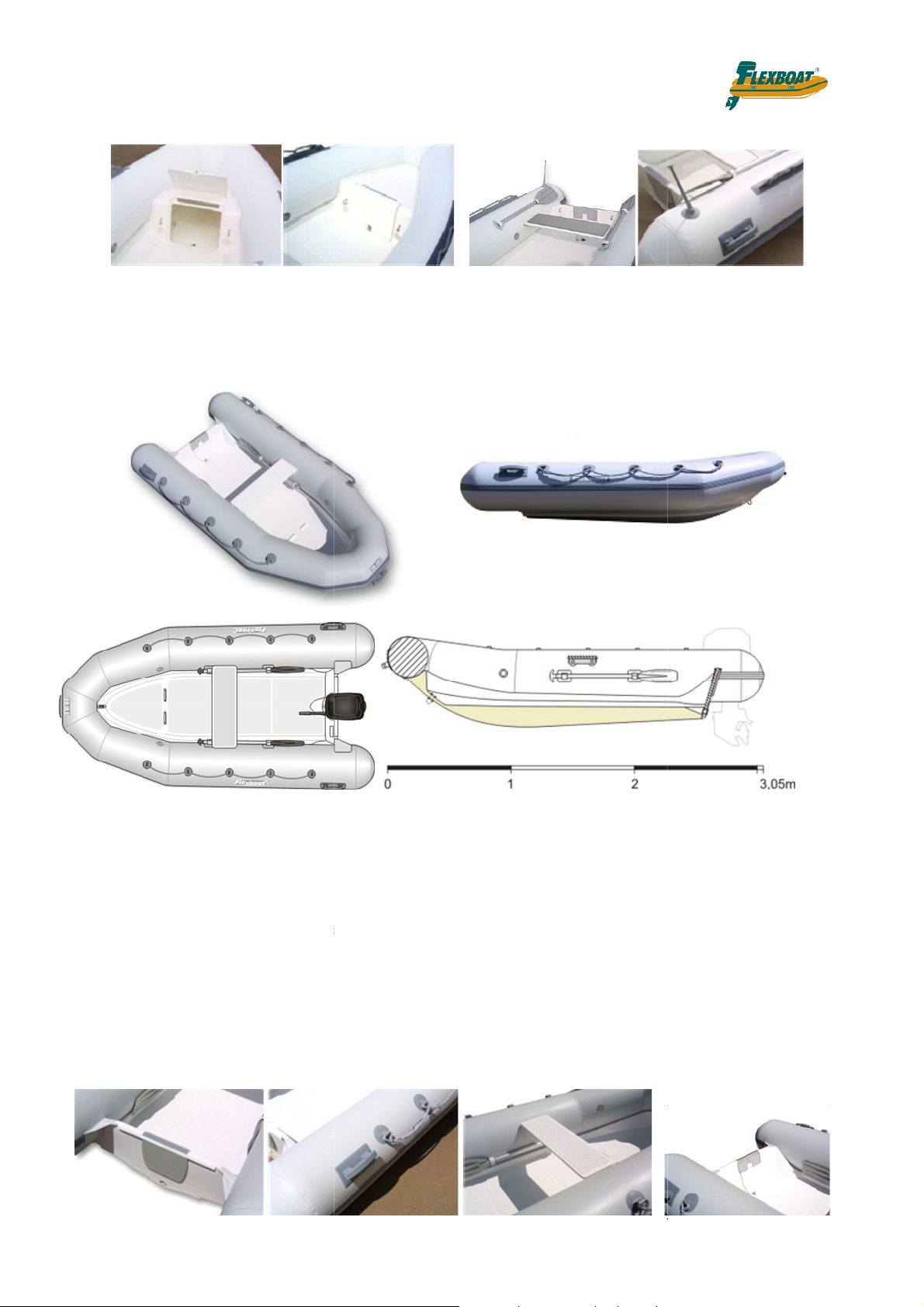
Fuel tank compartment
Two stainless steel tow rings
EVA padded fiberglass captain seat.
stainless steel ring to tie the fuel tank.
Double fiberglass hull with injected polyurethane between hull and liner
bber handle on the sides of the tubes
Rubber handle
Small boats up to 10ft
T
15 - Knowing the SR 10-S
Owner’s Manual –
EVA padded seat
Flag pole
Items located at the transom plate:
Nylon plate
Boat ID label
Drain plug with valve
Internal
Stainless steel tow ring
Conic shaped tubes
Ru
Transom plate
Fiberglass seat
ransom and drain valve
16
Page 17
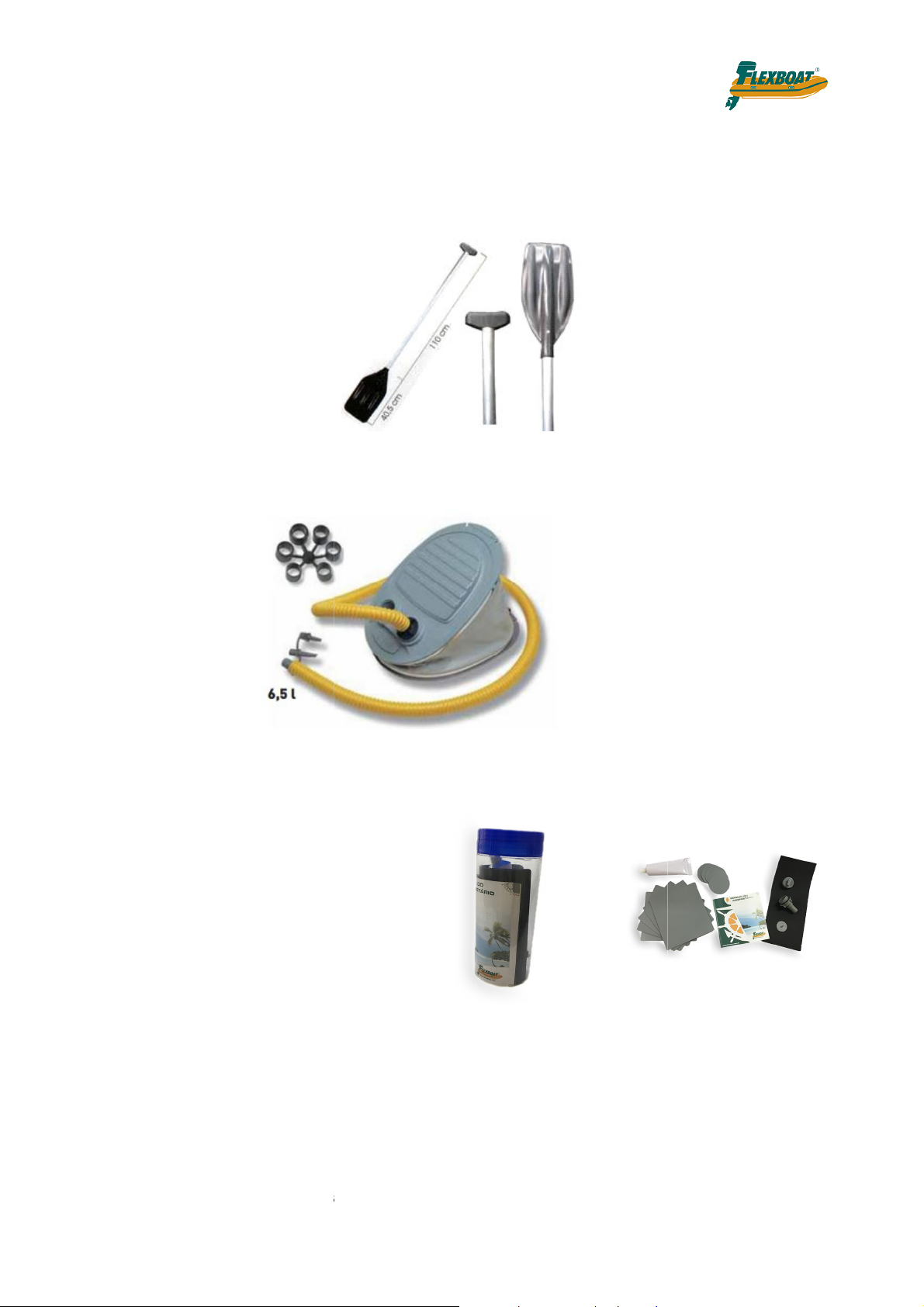
Two aluminum paddles with nylon blades. Total
1 Plastic container (the kits container)
5 pc Hypalon fabric 2 1/2 in diameter
1 pc Hypalon adhesive 3 ounces
The Hypalon fabric color matches the color of the tubes of the boat.
All FLEXBOAT boats are equipped with a pump.
ce that when pressed releases the air in the tubes. If this device is pressed and turned
clockwise ¼ turn, the valve will remain op
Small boats up to 10ft
16 - Basic items for all models
•
• Small foot pump
Repair kit containing:
5 pc Hypalon fabric 5 in x 4 in
1 pc air valve adapter
1 pc 120 metal sandpaper
1 pc Flexboat owners’ manual
1 pc drain plug membrane
1 pc rubber plug
Note:
17 - Inflating your Flexboat
The air valves have a devi
Owner’s Manual –
length 3 ft 7 in.
17
Page 18
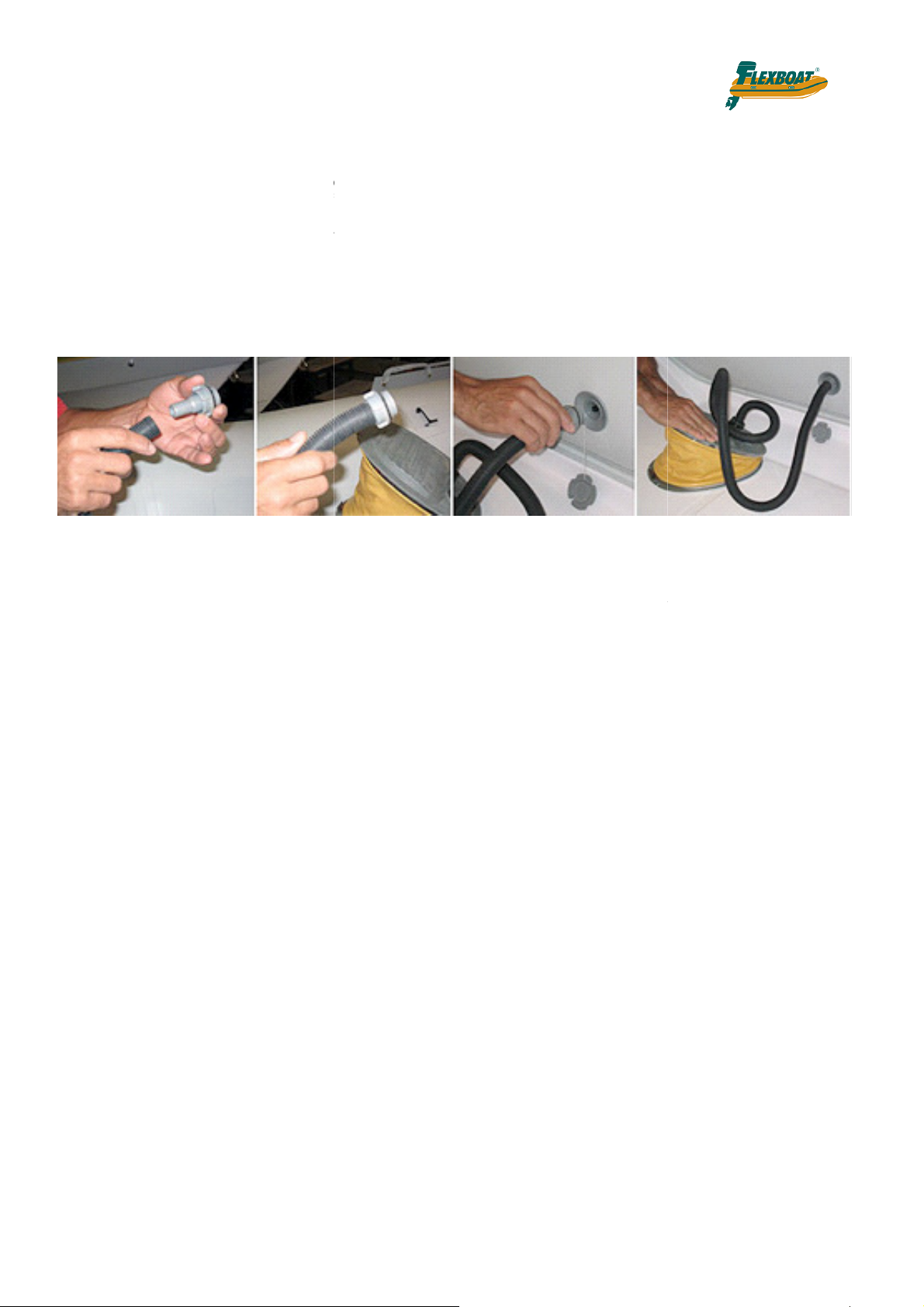
amount of air inside the tubes, just press it (withou
Along with the pump, you will find an adapter that should be screwed to the air valve and fitted into the pump
hose so that there is no air loss when inflating.
First inflate all the air chambers a little, without much p
the chambers until they are stiff and without wrinkles.
The air pressure of the chambers should be kept at 3 psi. In practice, the tubes are correctly inflated when by
s they don't yield more than ¼ of an inch. (6 mm)
Remember that the action of the sun increases the air pressure in the tubes. If you intend to leave your inflatable
out of the water and exposed to the sun for too long you should relieve the air pres
central part of the air valve a few times. This problem does not occur when you are boating, as the contact with
FLEXBOAT boats have an identification plate indicating the maximum
be transported under normal conditions. The nameplate is located on the hull near the transom
Weight above recommended violates regulations. Do not carry more weight or passengers than what is on the
he number of seats is not necessarily the indication of the number of people that the boat can safely carry.
Weight above recommended, improper loading and inadequate weight distribution are significant c
extra caution in rou
We recommend that you do not install motors with higher horsepower than what is stated on the nameplate
Inflatable boats are light thus require less engine power to do the same job as other types
Bigger than reasonable motorization in inflatables red
Motorization higher than recommended may cause:
Hurt the certification and construction standards.
Put too much weight in the stern whi
Greater difficulty in finding the right the distribution.
Damages to the transom.
Owner’s Manual –
Small boats up to 10ft
Then complete the air in
sure slightly by squeezing the
capacity of persons and cargo possible to
t turning it) as often as needed.
ressure, just to shape the boat.
pressing them with the finger
the water cools the tubes.
18 – Capacity
nameplate.
T
accidents. Always use
gh waters.
19 – Engine ratings
affixed to the product.
of heavier vessels.
uces stability and steerability.
► Accidents
►
►
►
►
ch will raise the bow.
auses of
18
Page 19

Maintenance and cleaning of your Flexboat
Hull and deck cleaning (Fiberglass parts)
gel coat
waterproofs and protects the hull. Washing the hull with fresh water whenever possible helps to conserve
recommended
safe option) or with mild soap, dry it thoroughly and apply a layer of high
surface of the hull. Afterwards, just polish it with a dry cloth.
water. Never use petrol, acetone
If the boat stays in the water, it is important to remove it periodically to clean the hull below the waterline.
Barnacles should be removed with a wooden scraper or plastic spatula, so as not to damage the gelco
The inside of the boat also needs to be aired and cleaned frequently, especially if there are mattresses,
carpets, rugs, and other accessories that could become moldy.
Gel Coat surfaces are slippery
Be careful while applying the wax.
FIRE OR EXPLOSION HAZARD: Cleaning products may be flammable, explosive
and / or cause personal injury.
Wash inflatable tubes with clean fresh water and neutral detergent. Use a soft brush to remove stains.
Clean the valves regularly with neutral detergent and a small brush. Do not use silicone,
If you purchase and use the Hypalon BLUE KIT for cleaning Hypalon, you will ensure the color and
extend the life of your Flexboat over many years.
Make sure the boat is completely dry before covering it during storage
Do not use plastic tarps as they do not breathe. The recommended ones are the acrylic tarpaulins.
.2.1 Using the BLUE KIT to clean the Hypalon
In order to ensure the efficiency of the cleaning kit, we recommend that you follow the instructions
lly and use appropriate safety equipment when handling the product.
NEW MAGIC Cleaner (For frequent cleaning)
1. Spray the product on surfaces of 2 ft X 2 ft
2. Wipe with a soft brush or sponge
3. Rinse with clean water
loth
Small boats up to 10ft
ester based paint that forms the outer layer of the boat,
to wash the entire hull with water and mild detergent (dis
quality wax on the entire
Remove stains using detergent diluted with
Take extreme care when walking on a
Make sure your paths are not slippery.
ng instructions carefully before
20 -
20.1 –
The main care is with the
it.
Once a year, it is
or the bottom paint.
Owner’s Manual –
, a type of poly
or any solvent based on Acetone or Toluol.
WARNING!
hwasher is a
-
at
SLIPPERY SURFACES:
-
when wet.
wet surface.
-
Read the cleani
use.
20.2 – Tube cleaning
grease or
petroleum based products.
.
carefu
STEP 1 -
20
4. Wipe dry with a soft c
19
Page 20

For boats that are new or in very good condition, or in case of frequent cleaning we recommend
1 with water.
SHMUFFEX Deep Cleaner (for deep cleaning and disrupting the action of
ray the product directly on the surface to be cleaned.
2. Wait for the action of the active ingredient for at least one hour, do not brush.
Avoid prolonged contact with metal surfaces.
100 Sealant (To seal and create a protective film)
2. Wipe with a cloth moistened with the product and allow
3. Wipe again with a clean, dry cloth.
The drying time may vary according to temperat
ainless steel hardware cleaning
Your Flexboat has several STAINLESS STEEL parts that require special care to prevent CORROSION.
There are places in the ocean where the water is cleaner a
clean, and there are places in the ocea
cleaner and saltier the water is where you are using your boat, the more corrosion problems you will
Some people believe stainless steel does not rust. It does. All stainless steels
in its composition. Corrosion on any steel will mostly depend on the carbon level, the presence of
contamination in the water, and electrolysis.
class raw materials in its products but even the best quality stainless steel is subject
to corrosion. Simple contact with a tool made of regular
may contaminate an
It is normal for electrons to "leal" through the cracks (where stainless steel parts make contact with
fiberglass), and that is where the electrolysis usually begins (corrosion).
Flexboat has been researching and using t
to date we can state that only frequent cleaning with fresh water and soap can keep the corrosion
After each use of the boat in saltwater, always clean the stainless steel
Detergent or ammonia cleaner may also be used).
To remove rust spots from stainless steel parts, the simplest and easiest way is using Semorim, an
oxalic acid based product found in any supermarket. Apply with gloves and
and spread with a soft sponge (do not use anything rough because it may stain or scratch the surface).
Rub it until it covers the entire area to be cleaned. Then wash with soap and water. If the stain does not
e process again. Once the part is free of rust, use marine wax, the same one used to
polish hulls, because it will serve to conserve and protect against corrosion. Instead of Semorim, one can
also use chromed metal cleaners or #2 polisher, mixed with cocon
But with Semorim, it's easier, faster, and cheaper.
ever use ab
Owner’s Manual –
Small boats up to 10ft
ure. Any surface should be dry before using the
nd there are places where the water is not so
where water is saltier, and places where salt is not present. The
have some carbon content
or with a stainless steel part or bolt from
echniques to avoid or reduce this process for years. However,
parts with soap and water. (Note:
goggles. Pour a few drops
ut soap. Both have the same effect.
COMMENTS:
diluting the product up to 1x
STEP 2 microorganisms)
1. Sp
3. Rinse with clean water
4. Wipe dry with a soft cloth
COMMENTS:
STEP 3 – GUMEMP
1. Spray the product evenly
COMMENTS:
product.
20.3 – St
drying.
have.
Flexboat uses first-
another manufacturer
process under control.
come out, repeat th
n
steel
d generate undesirable rust spots.
Important note: n
.
20
Page 21
Windshield cleaning (acrylic)
erficial dirt using just water
tilize soft cloth and mild soap
emove small scratches with a soft clean cloth and automotive wax.
Be careful when cleaning parts. A dry cloth and many glass cleaners
may cause scratches. Solvents attack the surface.
sponge or brush, mild soap and warm water.
in a well ventilated place, without direct contact with the sun.
Remove the upholstery of the bat when not in us
with the finish of the
Cleaning products NOT TO BE USED on board.
Rugged sponges or steel sponges should be avoided altogether, either to clean fiberglass surfaces or to
clean metal or stainless steel parts. Not
serious problems penetrating the fiber and forming rust spots which are impossible to remove. Chlorine
based cleansers, as well as abrasive soaps are also not recommended they can be chemically ha
, and may compromise the brightness of the surfaces.
t so you don't forget anything
Set the destination: Never leave the dock without first knowing where you are going to. Take a good
the nautical chart and do not be ashamed to ask everything about the region to those who know
it well. Make a navigation plan, prioritizing the short paths. And do not forget the nautical charts.
Check the tide table: If you go to sea, check also the tide
and not being able to return. Or, worse, running aground.
Check the weather forecast: Check the local forecast well before setting off, especially in summer,
when storms are most frequent.
n: A moving boat generates wind, which masks the heat. But the sun continues to
Clothes: It is essential to carry warm clothing on board, even if the day is warm and beautiful. Time
suddenly changes and what was a hot day turns into an unbearable col
third more fuel: The basic safety rule dictates that you use one third of fuel to go,
another third to come back and the same amount as the margin for contingencies. There are two
issues you should consider at this point: how much fue
Owner’s Manual –
Small boats up to 10ft
Use cold water to rinse and allow
Mold may appear if ventilation is not
e as they can interfere
, its residues can cause
table. Otherwise, you run the risk of leaving
l you will carry and at what speed. From there
20.4 –
1- Clean sup
2- U
3- Rinse thoroughly
R
WARNING!
20.5 – Upholstery cleaning
Wipe the fabric with a soft
drying
adequate.
WARNING!
20.6–
to the gel coat
21 – Before navigation
21.1 - Check-lis
•
look at
•
•
• Lightweight sunscree
burn.
•
• Fuel up to one-
gel coat.
only they can scratch the gel coat
-
rmful
d day.
21
Page 22

you should know how many miles you can go with that amount of fuel taking into account these two
elements: Quantity of fuel and speed.
Prevent nausea: Encourage everyone on board with some nausea propensity to
medicine. At least an hour before leaving. If one wants to vomit, do it in the water and to the side where
the wind blows through the hull
Check the engine, the oil level, eng
Make sure the outboard is securely attached.
Check the battery charge level.
Check the validity of the fire extinguisher
Ensure that the crew is wearing lifejackets.
Do not forget the documentatio
license must be on the boat at all times.
Inform the port authority about your departure: When leaving the marina, let us know where you are
going and tell us the expected time of return.
Capacity: Do not exceed the recommended capacity of your boat, (engraved on the nameplate at the
the weight on board: Do not let weight concentrate in the same place, as this can
lity. The smaller the boat, the more important it is to evenly distribute the weight on board.
ATTENTION: Inflatable boats usually raise the bow before going into plane. Place a passenger on the
bow, and as soon as the plane begins have him move to evenly
Always take twice as much water and food: Ideally, one should take about twice as much food and
water as necessary for any eventuality that extends the trip.
Take towels, dive masks and some nautical toys: Rarely does a tour end with
hence the need for towels. The diving mask has dual purpose: it amuses and it may be useful for
removing a line that may have been caught by the propeller as an example.
Drain plug: Close the drain plug of the boat's transom. And
deplete the water that eventually entered in the bilge
Communication: Check the operation of your communication radio. Whoever goes out on the water
must always have a way of communicating with the mainland in the
Always carry the repair kit, the inflator pump and the pair of oars.
Other useful equipment to have on board:
Anchor, sufficient lines, drinking water, a small mirror for emergency signaling, a whistle a
Also recommended is a bit of fishing line, hooks and artificial baits.
If you have not been on the boat in a long time and are planning a family weekend, stop by the marina
first and open the boat. If you have a captain or mate, make this a rou
Turn the Wheel to both sides to check if it is working appropriately.
Turn the main switch on and check if the instruments come alive.
(gauges)
Throttle and shifting forward
Throttle and shifting on reverse
Check the horn (remember the horn is a safety item at sea).
Owner’s Manual –
Small boats up to 10ft
ine instruments and propulsion systems.
n: Registration, insurance and in some Countries a nautical driver's
distribute the weight.
out anyone taking a dive
it should only be opened on the back, to
event of an emergency. Take at
tine. At least once a week.
•
• See if the boat is really ok:
a.
b.
c.
• Safety equipment:
a.
b.
•
•
•
stern of the boat)
• Correctly distribute
affect stabi
•
•
•
- the so-called "leeward edge."
This is very important!
take preventive
-
•
•
least the cell phone.
•
•
•
•
21.2 - In water check list
Steering system –
Main switch –
- Navigation lights
- Mast light
- Instrument panel
- Instrument lights
nd a knife.
22
Page 23

check list
Before starting the engine, make sure that the po
that the engine cooling water intake is submerged.
Electronic engines have 2 stages in the ignition key, the first stage tests the alarm system for:
Temperature, low oil level and water pressure. The sec
age only after the alarm test ha
Make sure that the control lever is in the NEUTRAL
Make sure that the emergency switch device is
forget to attach the lanyard to your wrist).
Check the water circulation on the engine.
Check the oil level of the drive.
he cooling system. (Applicable to
: For further details on operation, periodic servicing and maintenance of the engine refer to the
never, ever
Onboard safety rules must be non
be clear and direct in the orders, especially with children, who are not much aware of the risks of
Helping anyone who is in danger in the water is a must. But towing another boat, may not be a good
Idea. If it is necessary, stay close to the boat which is having
to do something you don't know, because
If you are forced to tow another boat, remember that y
space to stop. Therefore drive at low speeds and with great caution.
It is mandatory to have at least one lifejacket for each
they should be kept in easy access place. And all passengers should know where to find them.
Never exceed the passenger capacity of your boat.
It is not a bad idea to have small children wearing lifejackets a
falling into the water. And not every child can swim or float.
Those with small children or pets on board should consider putting a safety net in the boat's railing. It
prevents small beings from slipping and involu
Always have an adult in charge of the children, all the time, especially when the boat is in motion.
Respect your boat's navigation limits. A boat for protected waters should never venture itself into
ssengers in the
Every boat is required to have safety equipment on board, as required by the local authorities, in
quantity corresponding to its size and navigation categ
If someone accidentally falls into the water, do not lose sight of him or have someone look at him or
her all the time. This will help a lot in the rescue, since the human body is restricted to a simple head
No matter how hot it may be,
Remember that when diving with air cylinders you should always have someone else diving with
you! Also, always signal where you are diving, so the other boats do not pass by.
close to beaches (the
someone. And be very careful with swimmers, not letting anyone in the water get close to the moving
boat. Remember: propellers are like sharp blades. Therefore, always switch off the engines wh
Fires are more frequent (and harmful) on boats than wrecks!
anything that can lead to fire should be avoided. Be very careful, therefore, with barbecues on board.
Owner’s Manual –
Small boats up to 10ft
wer trim is all the way down, that is, thus ensuring
ond stage triggers the ignition. You should
the motor will not start.
otherwise the motor will not start. (Do not
engines)
eone drive your FLEXBOAT without being prepared for
negotiable. So exercise your power as a "vessel commander" and
until help arrives, but don't try
u and the other boat
passenger. Even if you don't wear it all times
ll the time, there is always the risk of
when boating. A Sharp turn or acceleration can make them
limit is 660 feet (200 meters)), except to embark or disembark
They are the # 1 threat on board and
21.3 - Engine starting
trigger the second st
Check engine temperature.
Check the oil and fuel level.
Check the coolant level of t
Note
engine manufacturer's manual.
22 – Onboard safety
Rule number 1:
that.
navigation.
open ocean.
Don't carry pa
fall into the water.
, drive or let som
-
the result can be even worse.
sun pad
s finished.
position; otherwise
attached;
stern drive
problems
o
ntarily passing beneath it.
ory.
will need twice as much
out of water.
Never get too
people are in the water.
leave alcoholic beverages off any boat trip.
en
23
Page 24

Be very careful with some issues, such as:
Knowing the bottom where the anchor is to be launched is fundamental. The best places are those of
sand, better than those of rocks, seaweed or mud.
You should consider the circular movement that the boat will do around the anchor depending on the
wind direction, the sea current and the depth. This will help you safely launch th
When retrieving the anchor you should take into account:
The boat's engine must be working and you should move the boat toward the anchor, while slowly
Never cross an area with boats on anchor.
Remember that good seamanship recommends slow speeds (less than 5 knots) at the exit and arrival of
boats in ramps, marinas, floating docks, etc. Special attention should be given to the presence of bathers.
congested boat areas, and avoi
Avoid cutting in front of another boat in motion or reducing the distance dangerously, especially in low
visibility situations, thus avoiding risky and especially dangerou
Never throw garbage, cans, oil or any polluting material into the water.
Have everyone on board sit down before accelerating. When you are leaving or entering the open sea by an
unfamiliar route, try to do this about one hour before high tide.
When in a channel, always stay to starboard, because these places are like two
If you are boating and your boat has a T
need to be aware of bridges and cables,
Watch for large ships as they are unable to maneuver fast, and they often don't even see small boats.
PWCs and boats have to avoid all other types of boat because they are more a
however, whoever comes from the right side has the right of way. Even so, as a precaution,
boats even if you have the right of way. It is better to rely on your intuition than on the nautical education of
way: boats do not have right or left, but starboard and port, respectively. In order not to be confused,
remember the heart which is to the left of the human body, that is, on our "good side". Therefore, "port".
All types of vessels must avoid rowing boats
It is always best to boat with wind and waves coming from the stern than from the bow. But on rough seas
the boat can become unstable and start to "surf" the waves.
At night, the darker the boat is the better visibility the pilot will have. It is therefore recommended to reduce
the instrument panel illumination to a minimum.
s flaps, use them. They help a lot in balancing the hull, keeping it level. If, for example, your
boat is heavily loaded at the stern, move the flaps down to "lower" the bow.
The flaps also serve to balance the boat laterally. Each time you lower the fl
If by any chance, you lose power and the engine goes out, the first thing to do is to anchor with the bow
facing the waves while troubleshooting or seeking help. It is much safer than leavin
Small boats up to 10ft
released with the anchor should not be less than 3 times the local depth.
e anchor to the sea
unnecessary
So, if you get aground, just wait for the water
way streets.
TOP, remember that they are tall and that, for this very
. Also, stay tuned for speed, because any small wake can feel
In this case, try to steer the boat and navigate
ap from one side, the boat will
g the boat adrift.
23 - Anchoring your Flexboat
23.1 Launching the anchor
•
• The ideal amount of cable to be
•
23.2 – Retrieving the anchor
•
raising it at the same time.
Owner’s Manual –
24 – Navigation tips
•
•
• Avoid zigzagging in crowded or
•
•
•
to rise and leave.
•
•
•
•
others.
• By the
•
like a "tsunami" to a canoe.
•
s maneuvers
especially power cables.
d causing
wakes.
-
gile. In case of doubt,
reason, you
avoid other
at a 45 degree angle to both.
•
• If your boat ha
•
tilt slightly to the other side.
•
24
Page 25

When driving, attach the safety cutoff lanyard to the wrist as it shuts off the engine immediately if you fall
into the water. It also prevents the vessel from moving forward without anyone in command.
If someone wants to do some water s
facing the skier, controlling their movements all the time. This way the captainwill not need to look back.
Pay close attention also to the waves. Even those small and seemingly harml
Also note that when entering certain ports there may be certain standards that you must comply with. Safety
standards are precautions that you should always take into account.
e boat, remove the cover from the drain valve and increase the speed so the
It prevents risks and energy consumption, without having to turn "off" each and
: Open the drain plug to drain any water that may be in the bilge.
: Use clean water, even if you have used your boat in fresh water.
: There are several types of anti
: Do not leave any wet objects inside the boat, even if only moist.
: Always drain bilge water to avoid bad odors.
If the boat is to be stored in the water
is operating. Simple cares like these can prevent accidents.
: Always keep your inflatable boat dry and washed with fresh water.
: The worst enemy of your inflatable boat
Fresh water flushing: Running the engine in fresh water is very important for its long life and should be
done whenever you use the boat in salt water. Always f
Apply protective spray on the engine and on the power trim pump.
Never leave old gasoline in the engine for more than 30 days:
Run the engine at least every 15 day
Make preventive inspection every 6 months.
For a smoother fueling, open the auxiliary vent installed on the console.
On vessels with portable fuel tanks, fueling should be done is carri
Special care should be used when
You should always have a fire extinguisher close and should not smoke while handling any type of
fuel. In gasoline engines you should
Bad fuels can damage the engine
Bad fuel may be the main reason for corrosion in the internal parts of an engine.
times more sulfur than the intern
which means it has a tendency to absorb moisture from the air
absorbs water from the environment. In the tanks of boats that are not used very often, the effect of
d water mixed with dies
Small boats up to 10ft
ki, have another person on board standing with their backs to the rider,
ess are much more powerful
cabinets and drawers. They are based
ilet valves and make sure that the automatic bilge pump
sand inside it. It acts just like sandpaper between
lush the engine with fresh water.
ed out off the boat.
d spilling into the water or to the deck of the boat.
ensure that there are no accumulated gases in the bilge
ational standard. In addition, because it is
•
•
•
than that of your boat.
•
• If you notice water inside th
water goes out completely.
25 – Returning from your trip
• Turn off the main switch every accessory and equipment.
• Drain plug
• Wash the side and the deck
• Avoid mold
on calcium chloride.
• Wet objects
• Water in the bilge
•
• Cleaning the boat
• Sand
the fabric and other parts.
• Engine care:
a.
b.
c. Apply wax the cover and drive.
• How to conserve the engine:
a.
b.
c.
d. Periodically replace the anode.
Owner’s Manual –
-mold products, ideal for
: close the to
is leaving
s.
26 – Fuel
26.1 Fueling the boat
compartment.
fueling to avoi
26.2 -
Some diesel fuels have many
a hygroscopic liquid -
sulfur an
- it naturally
-organisms
25
Page 26

colonies called sludge that further accelerates the oxidation of some internal engine components. It is
see. And, for that very reason, the wor
With gasoline it is not different. Current legislation allows for Ethanol to be mixed with gasoline, and this
ends up aggravating the process of early "rotting" of the gasoline in the
Impurities, both in diesel and gasoline, corrode and compromise the injector nozzles of the engines.
Engines may suffer from excessive fuel consumption because the fuel will not burn properly. At the same
se. And there will be a tendency for all fuel nozzles to rust, with risks of
clogging the fuel flow and preventing the engine from running.
Carefully chose where to fuel your boat
Do not leave fuel sitting in the tank for long perio
Run the engines at least once every 2 weeks
Empty the fuel tank if the boat will not be used for more than 3 months
of the engine defects are caused by lack of use! So, run the engin
ine doesn't start when turning the key, check that the lever is in neutral
• Before calling a mechanic or panicking, see also if there is fuel in the tank.
ce, but primarily extend the life of fuel. If you have a diesel engine
install magnetic decontaminators (ALGAEX style) on the fuel line to destroy bacteria that, due to moisture,
• In order not to have so many problems with fuel
oxygen of the air and changes its properties), the ideal is to keep the boat with the tank full, and for no more
than one month. This avoids the oxidation and condensation of water inside the ta
with fuel the engine an be damaged.
• If the boat will not be used for a long period, it is best to empty the tank completely. You can do this by
placing a thick hose in the supply nozzle (use a piece of cloth to seal it) and inject
• Be sure to follow the manufacturer's preventive maintenance schedule, which may require service every 50
or even 200 hours of use, or every six months to one year, depending on the engine. This way there will b
regular maintenance parts being periodically replaced like filters, belts, oil, grease and lubricating spray.
This should not be too expensive or complicated, and it would assure your engine is always ready to go.
• A crack on the paint of the engine cow
ve an outboard engine you should always flush it with fresh water when returning to the dock.
Simply attach a hose to the water inlet, in the drive. Make sure there is good water p
• Every engine has anodes made of zinc or aluminum that absorb the corrosion that would attack it. They are
called sacrificial anodes or simply anodes and must be replaced whenever its wear has reached half of it.
longer protect the motor.
• If the engine oil is whitish, it is mixed with water. Replace it immediately and call a mechanic because the
cylinder head gasket may be damaged.
• After flushing an outboard, leave it in an upright position so the water can ea
• Besides fuel, spark plugs are the main cause of problems in outboard engines, especially two
engines. Always have a set of new spark plugs ready for replacement.
engine, install filt
and fuel system once a year as dirt and water can cause clogging and damage the engine.
• Always check the condition of the propeller and see if it is not bent, cracked or with barnacles,
performance. Fishing lines can also damage the shaft oring and bushing.
• If the starting rope of a manual start outboard breaks, remove a spark plug, inject some gasoline or
lubricating spray (type WD 40) into the cylinder and turn the engi
• When starting diesel engines keep them at idle for about one minute to avoid problems with turbochargers.
• Diesel engines will last longer if noz
Owner’s Manual –
Small boats up to 10ft
st of all, as it affects a vital component in
tanks of the boats.
t least once every 15 days.
t happens quite often.
Many
"aging" in the tank (in fact fuel reacts in contact with the
nk. When water is mixed
l may be a sign of overheating. Have it examined by a mechanic.
ressure in the hose.
sily drain from the cooling
ers to prevent impurities and water in the fuel. Clean the fuel tank
ne flywheel with any other
ressure in the hose.
rust that you cannot
boats - the engine itself!
time, performance will be wor
Therefore we recommend:
27 – Engine care
• Most
• If the eng
"detail".
• Additives improve boat performan
may form in the tank.
ds
e a
. I
people forget this little
, also
ing air through the vent
with a compressor.
• If you ha
Otherwise, it will no
system.
• If you have a stern drive
works.
which affects
rope. It usually
e
-stroke
To do this,
26
Page 27
run them at maximum speed for about one minute and before turning them
off at once let them run at idle for five minutes
stern drive
engine compartment, as well as a blower. And always open the engine compartment hood before starting
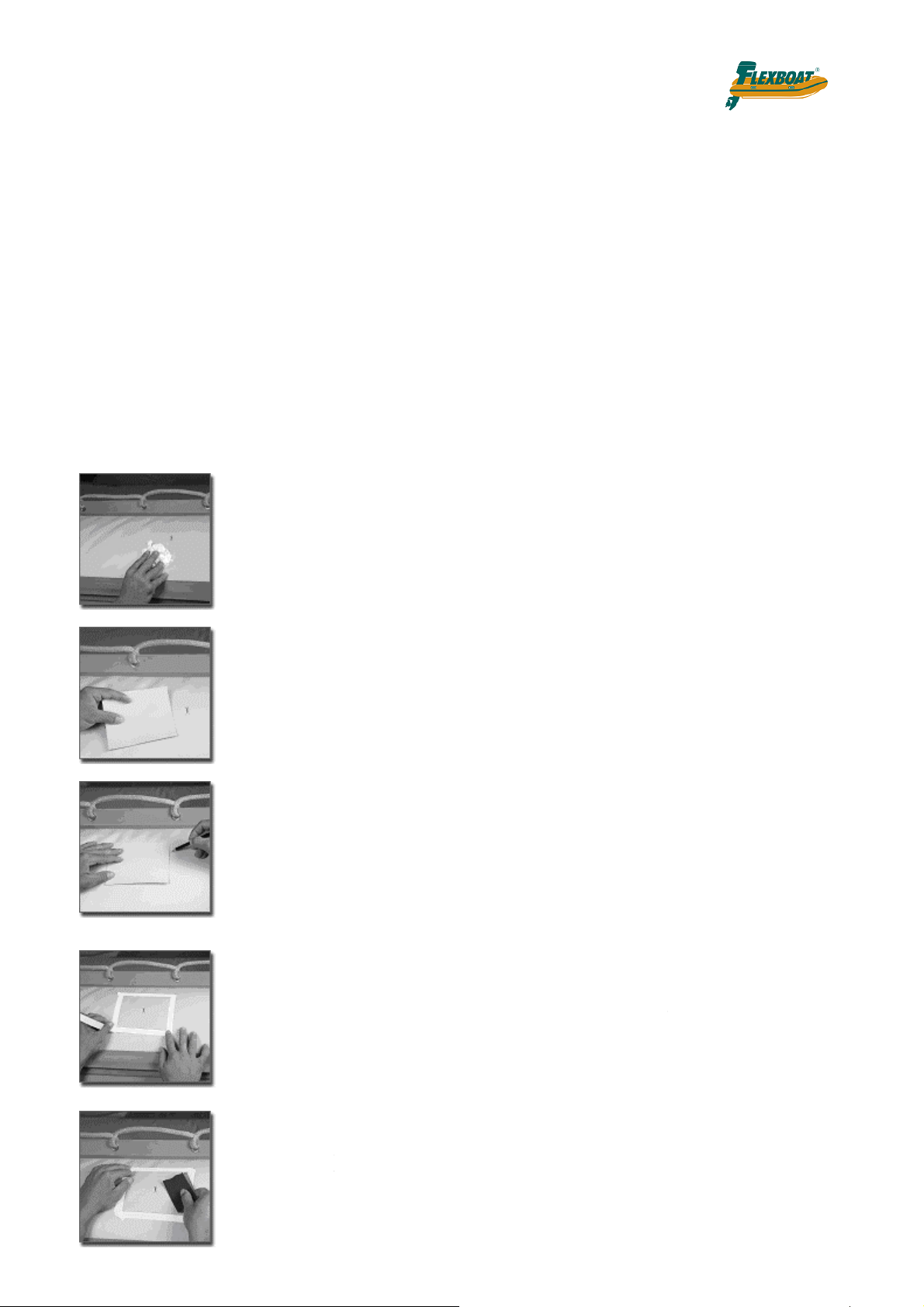
The inflatable boat manufactured in Hypalon and Neoprene allows the user to r
FLEXBOAT inflatables are equipped with a
pieces of fabric in the same color as the boat and sandpaper.
n the surface to be repaired. If there is any greasy substance,
wash the area with soap and water and then dry and clean with a
little acetone
Once the surface has been cleaned, choose a piece of fabric that
the damaged area well.
Using the piece of fabric as a template, then use a pencil to mark
the area to be repaired
Mask the area around the marking done with the pencil, limiting
the area so there is not excess sanding.
Then sand th
that this operation produces. The same process should be done on
the piece of fabric that will be vulcanized. After the sanding operation,
both parts will be ready for vulcanization
Small boats up to 10ft
engine you should make sure you have a vapor d
epair small holes in a simple
, containing special adhesive for cold vulcanization,
e entire area to be repaired, removing all the dust
when you are back at the dock,
If your Flexboat has a gasoline
the engine to prevent fire.
28. Small repairs on the tubes
Owner’s Manual –
.
etector in the
way.
In case of a hole proceed as follows:
1- Clea
2will cover
repair kit
-based solvent (eg thinner).
3-
4-
5-
27
Page 28
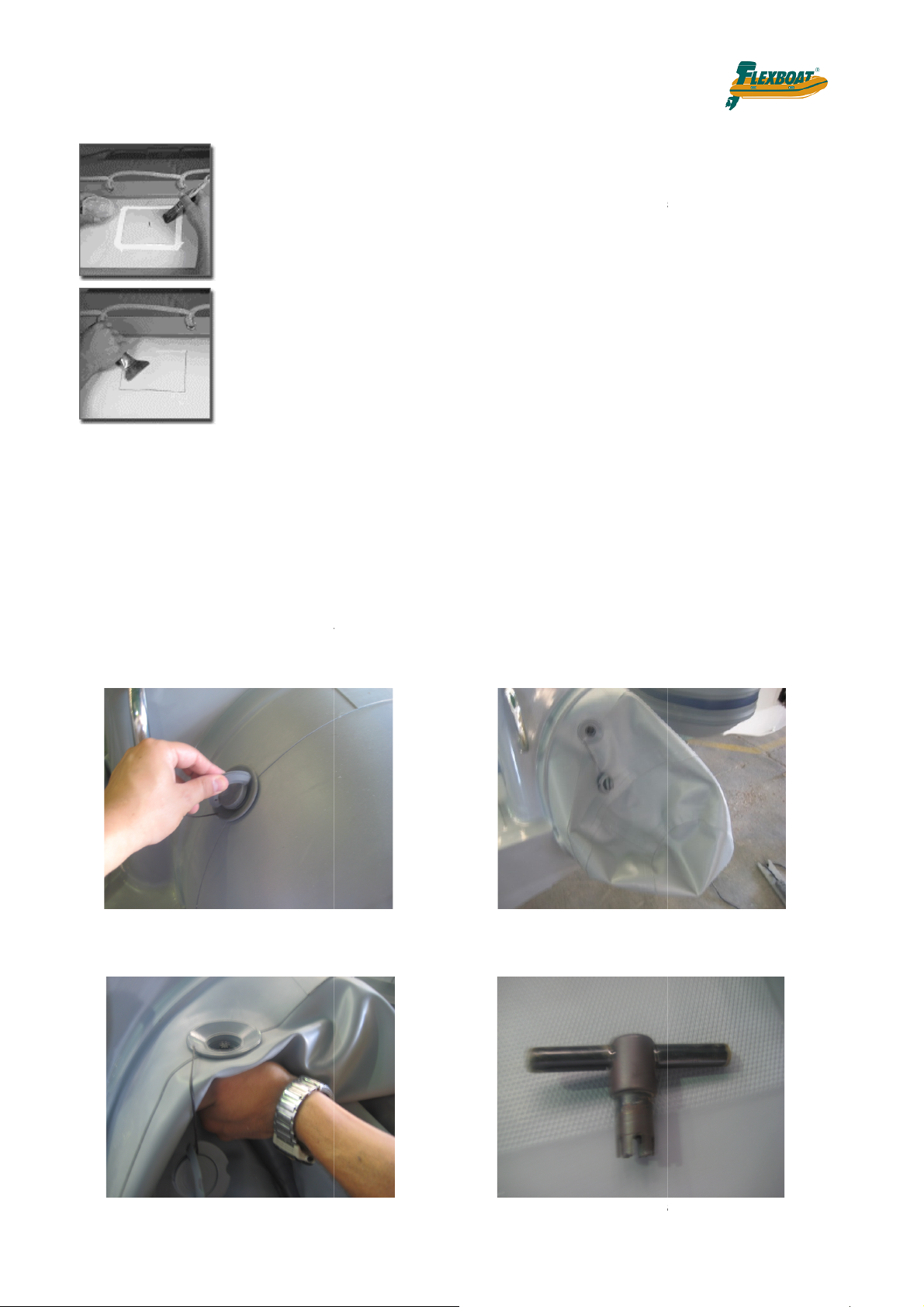
After sanding
coat of adhesive to both using a brush or your fingertips. Make sure
the adhesive is well spread, let it dry for about 10 to 15 minutes,
depending on the ambient temperature. After the first coat has dried
apply the second coat, spreading the adhesive well and let it dry
again for 10 to 15 minutes.
Join the two parts, preventing air bubbles from forming and then
firmly press the surface using a piece of Wood. At the end of the
operation it is neces
the cold vulcanization process.
Repairs of small holes in inflatable boats must be done with the boat deflated.
Damage repairs that do not involve air leakage should be done with the boat fully i
Major repairs must be carried out by the manufacturer or by qualified service personnel.
It is very rare for the air valves to malfunction. There is the possibility of air leaks if the valve is not tightly
Step 1: Take the air valve off
Step 3: Firmly hold the air valve so
its inner part does not fall inside the tube
Small boats up to 10ft
and cleaning the parts to be vulcanized, apply one
sary to wait a minimum of 24 hours to complete
Step 2: Deflate the tube
Step 4: air valve replacement tool
,
Comments:
•
•
•
Owner’s Manual –
6 -
7-
nflated.
29 - Air valve replacement
closed.
28
Page 29
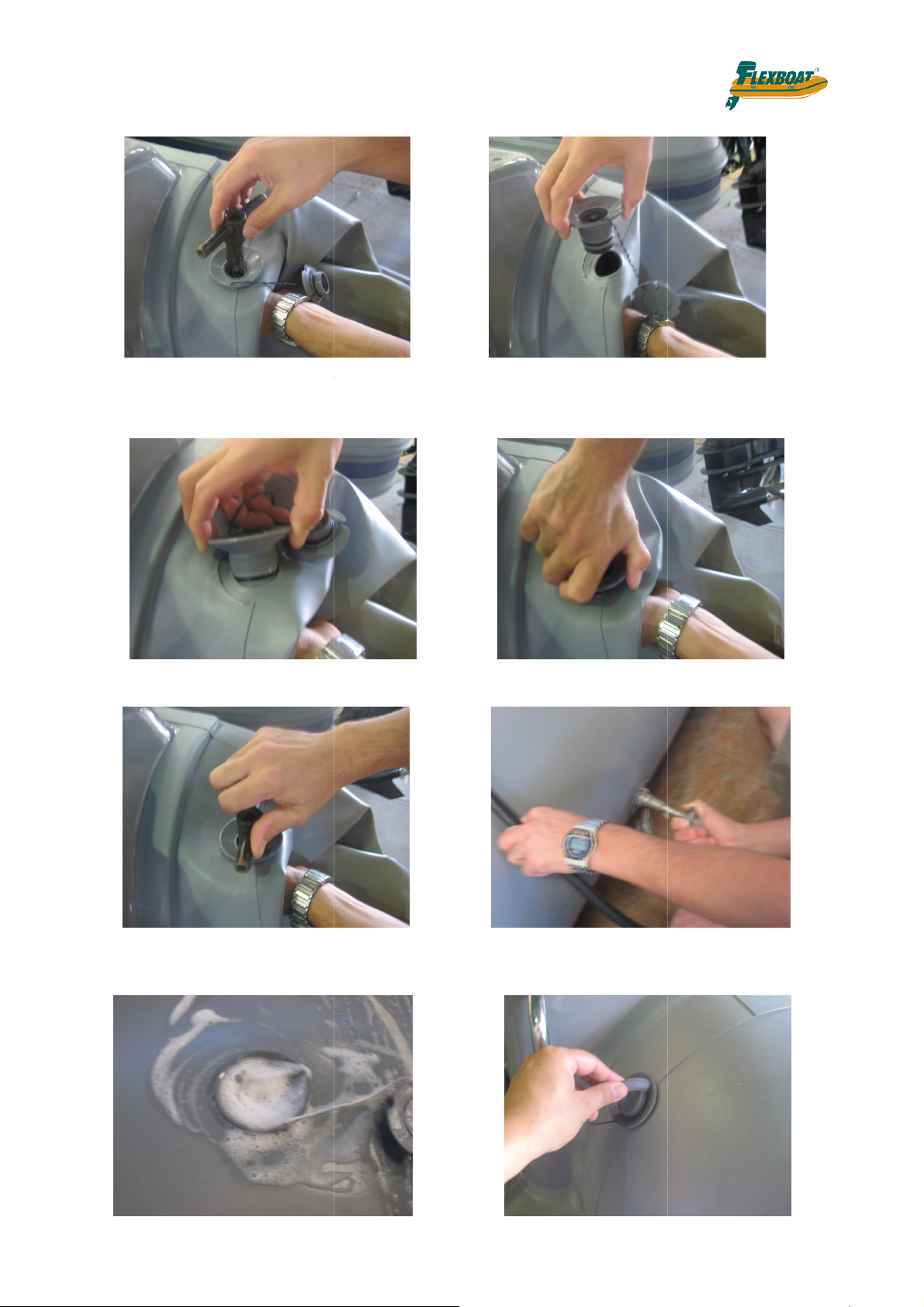
air valve in place.
Step 9: Use the tool in order to do the final tightening
Step 11: Use water and soap to check for air leaks
Step 5: Place the tool in the valve while
still holding the inner part.
Owner’s Manual –
Small boats up to 10ft
Step 8: Screw the new valve by hand until it is firm.
Step 10: Inflate the tube to 0,213 bar or 3,1 PSI
Step 12: Close the valve.
Step 6: Take off the damaged valve
while still holding the inner part.
Step 7: Install the new
.
29
Page 30
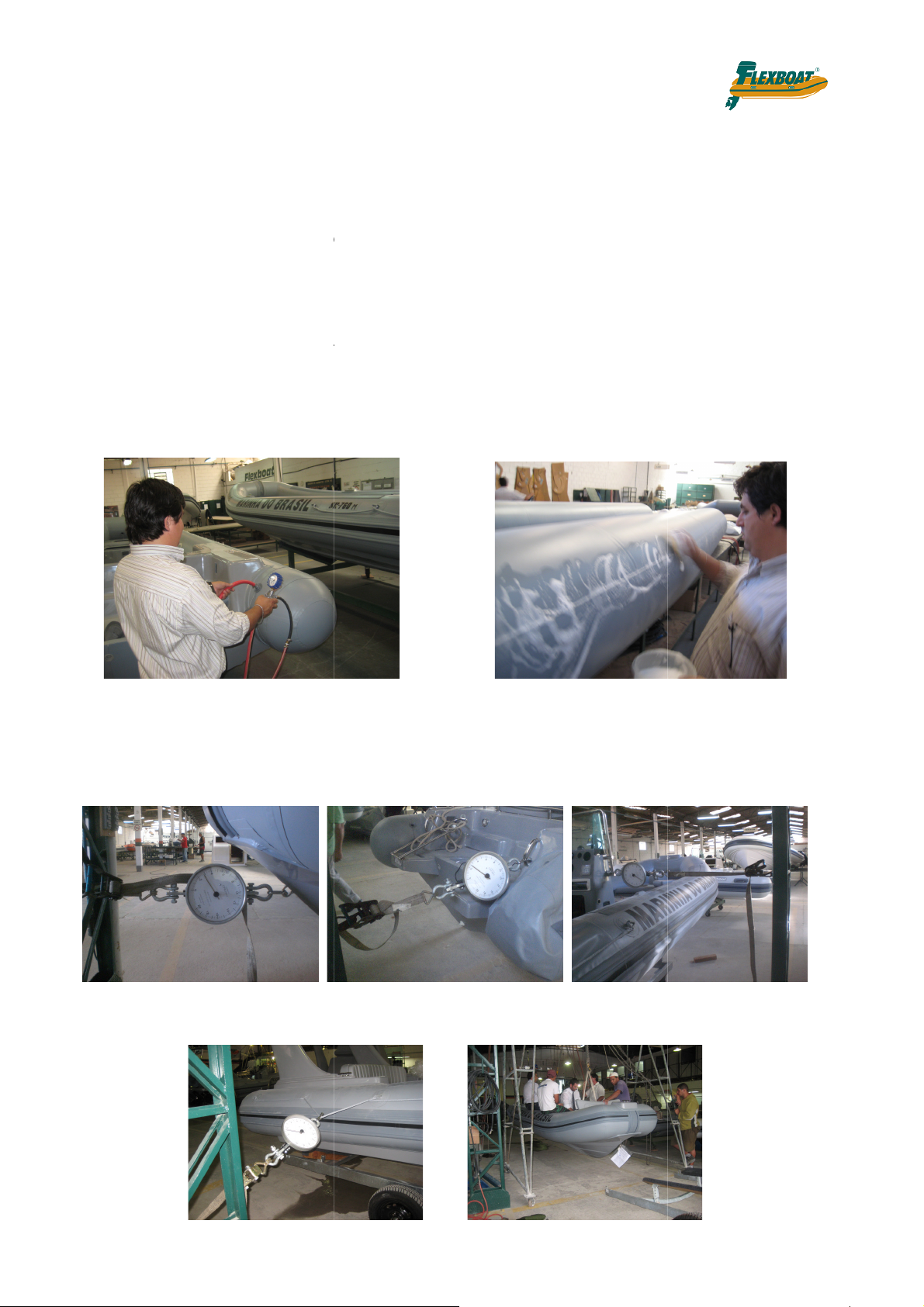
FLEXBOAT inflatable boats have tubes with two or more hermetically sealed independent air chambers
(depending on model). Eventual air leakage in one of the chambers will not drastically reduce floa
allowing continued navigation at slow speeds safely.
rigid FLEXBOAT inflatable boats (SR line), also known as R.I.B. combine rigid fiberglass hull with
tubes (inflatable part of the product). The rigid hull provides fast planning a
boat while the tubes provide the stability and safety common to inflatable boats.
Flexboat inflatable boats undergo various tests to ensure you receive the best product.
Resistance tube testing
Resistance testing of rings and handles
Resistance testing life
Small boats up to 10ft
nd the hydrodynamics of a regular
Air leak tube testing
Resistance testing console handle
ting testing at full load
30 - Final considerations
•
• All semi-
•
Tube testing
Owner’s Manual –
tability, thus
Resistance testing bow ring
Resistance testing stern ring
-line Lif
30
Page 31
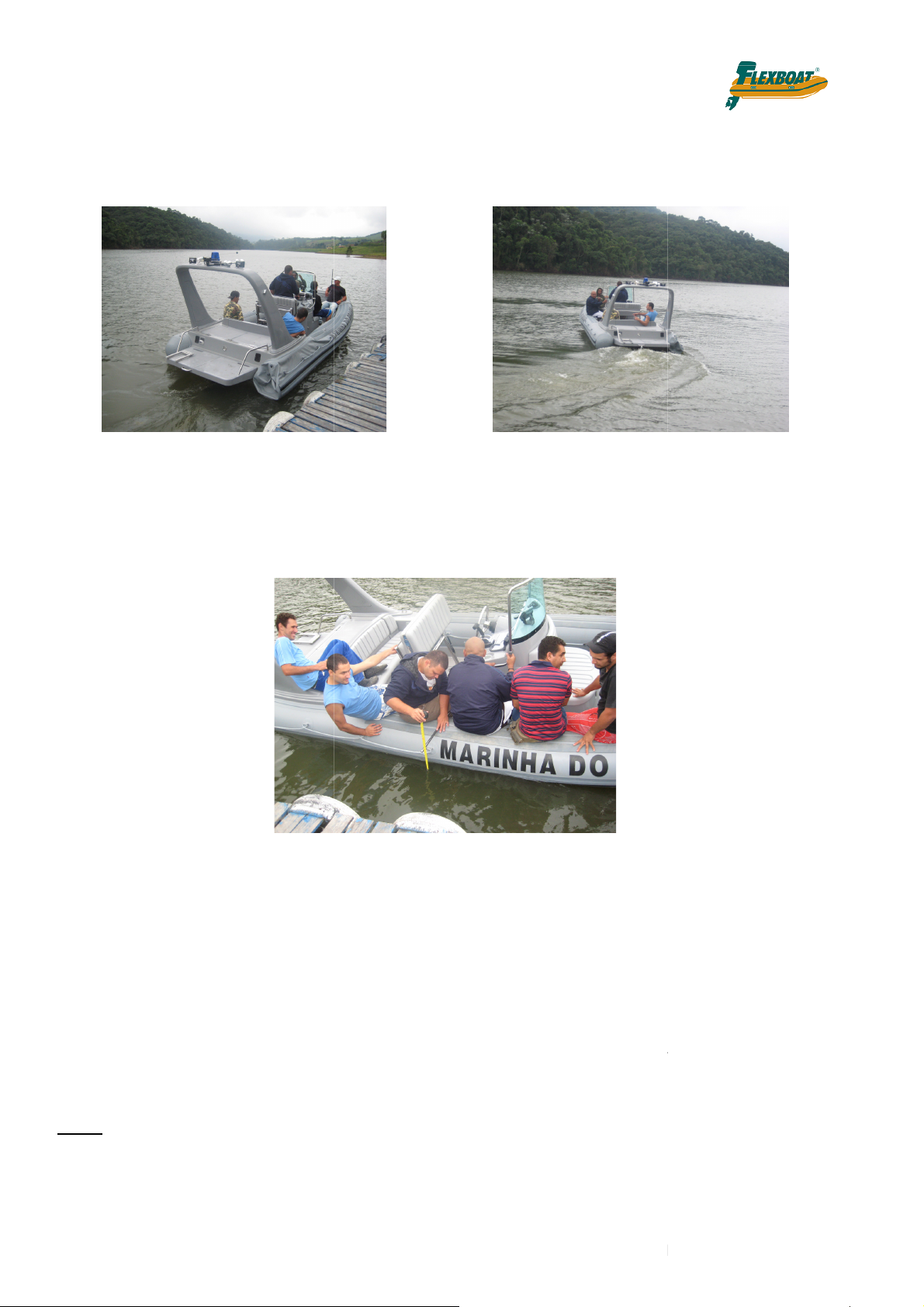
Navigation with damaged tube testing
deflated
All crew sitting in one side of the boat.
Flexboat provides warranty to the original purchaser of a properly registered FLEXBOAT inflatable boat and
agrees to repair or replace, for the period indicated below, from the date of purchase of the vessel, the products
ured by Flexboat that in normal use, for the purpose they were designed, present defects of
1) Equipment and accessories that are not manufactured by Flexboat (
) will be covered by their manufacturer's warranties for one (1) year.
2) Flexboat reserves the right to make changes to the design and materials of its vessels without incurring any
obligation to incorporate such changes into units
consumers. All FLEXBOAT obligations re
Owner’s Manual –
Small boats up to 10ft
Boat running with deflated tubes
Engines, Electronics, Control Cables,
already complete or in the possession of its resellers and
Two adjacent air chambers were
Free bord testing
31 – Warranty
I – Limited Warranty
manufact
manufacture or material and / or labor
Notes:
e.g.
Steering Cables and hardware
31
Page 32

3) FLEXBOAT does not authorize its
responsibilities on its behalf related to the sale of its vessels.
This warranty will be valid for five (5) years, under the conditions established in this certificate.
URISM / MILITARY VESSELS:
This warranty will be valid for three (3) years, under the conditions established in this certificate.
a) FLEXBOAT warrants its tube fabric against porosity deterioration; its tube seams against separ
valves; and its fiberglass hulls against structural defects in materials and workmanship.
b) FLEXBOAT will repair the vessel at no cost to the owner during the warranty period, provided that the vessel
Flexboat’s
accompanied by this certificate of warranty.
c) FLEXBOAT will only replace parts that are by them and in its sole discretion, considered defective;
right at any time to modify, discontinue or alter characteristics of any model it
produces as well as the conditions expressed herein, without thereby being able to respond to the owner of the
el, as set out in this Warranty Certificate, it is assumed that the purchaser
has full knowledge of all the warranty conditions and the Owner's
ground to claim ignorance of any of the clauses and conditions conta
claims to know and accept without reservations.
f) FLEXBOAT does not assume any obligation or responsibility for additions or modifications to this warranty.
nt that have been installed by the owner are not covered by FLEXBOAT warranty.
b) The warranty will not cover the cost of shipping the boat and parts to / from the dealer or service center for
c) This warranty does not cover the expense
vessel, rescue of any kind, personal or material damages of the owner or of third parties.
d) This warranty shall be automatically cancelled if the hull identification number attached to
ed, damaged or has been removed
replacement by unauthorized personnel.
e) The warranty will be cancelled if the boat is used in competitions or for any purpose other than
designed, or if the vessel was involved in a collision or have been towed improperly, or if the vessel was lifted
f) The warranty will be cancelled if the boat has not been properly stored and inflated in accordance with the
andards recommended by the manufacturer. Minor damages like gelcoat grazing or blistering are not covered
Small boats up to 10ft
representatives or any other person to cr
facility in Florida, in accordance with the terms of this warranty,
For this reason the customer has no
ined in these instruments that the customer
s related to fuel, displacement of personnel, transportation of the
and if the vessel has undergone any alteration, repair or
II – Term of Warranty
a) LEISURE VESSELS:
b) SERVICE / WORK / TO
III – Warranty coverage
reseller’s
Owner’s Manual –
eate or include
ation; its tube
is sent to the local dealership or to
d) FLEXBOAT reserves the
vessel or third parties;
e) Upon taking possession of the vess
IV - Warranty exclusions
a) Accessories or equipme
warranty repairs.
Manual.
the transom has
been alter
for which it was
improperly.
st
32
Page 33

g) The vessel must not be operated with a different type of engine from which it was approved nor with engines
s higher than each boat model limit, or the warranty will be cancelled.
h) The warranty does not cover the following items:
Collision, punctures, riots, vandalism, theft or fire.
Vessels which have been modified in any way in their format, v
Surface damage or corrosion from abnormal environmental conditions, including but not limited to
chemical spillage, acid rain, hail, thunderstorms and lightning.
Normal decay, wear and tear, discoloration, deform
Cost of maintenance and routine cleaning.
Costs resulting from misuse, including but not limited to transportation and freight
i) The warranty will not cover defects that ar
must be printed and filled when the boat is sold, and mailed to
Flexboat's office in Florida within thirty (30) days of
Small boats up to 10ft
the manufacturer's
ect, aging of material such as
e not reported to an authorized dealer or to FLEXBOAT within fifteen
the purchase.
under warranty.
Owner’s Manual –
with horsepower rating
specifications.
metals, plastics or fiberglass.
days of the finding thereof.
32. Warranty Card
The card below
arying from
ation, negl
original
fabric,
33
Page 34
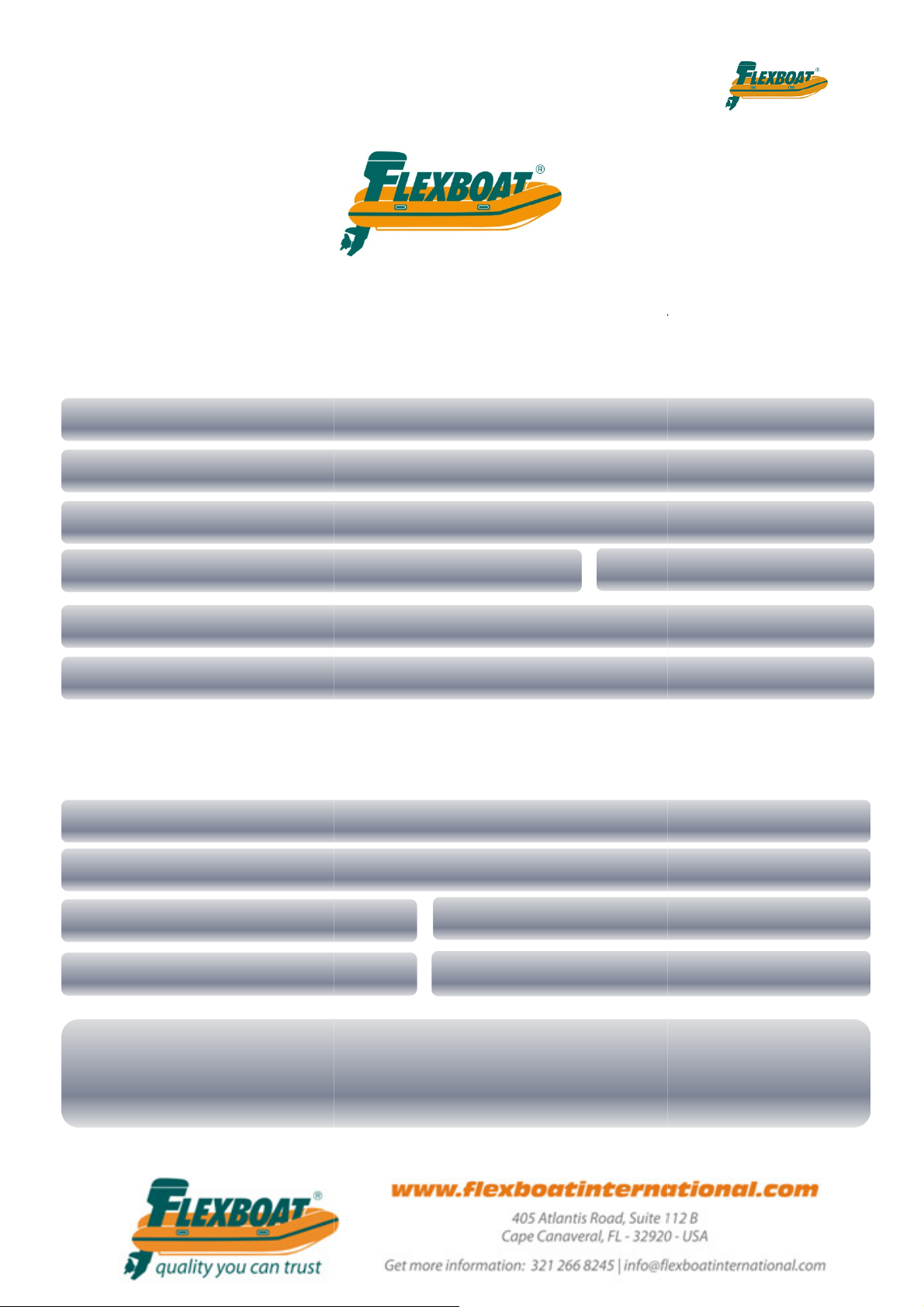
WARRANTY CARD
YOUR
YOURYOUR
YOUR
Small boats up to 10ft
Code
Full name:
Address:
City:
Owner’s Manual –
CUSTOMER
CUSTOMER
CUSTOMERCUSTOMER
State:
Phone with Area Code:
E-mail:
Model:
Serial number:
Tube color:
Date of sale:
____FFFFLEXBOAT
LEXBOAT
LEXBOATLEXBOAT
Decoration color:
Date of delivery:
Zip
:
Dealer
34
 Loading...