

Page 1
P
rinted in Mexico
M08-0146-012 J1
1
1/10
FIRE SAFETY TIPS
Follow safety rules and prevent hazardous situations:1) Use smoking
m
aterials properly.Never smoke in bed. 2) Keep matches or lighters
away from children;3) Store flammable materials in proper containers;
4) Keep electrical appliances in good condition and don’t overload
e
lectrical circuits; 5) Keep stoves, barbecue grills, fireplaces and
chimneys grease- and debris-free;6) Never leave anything cooking
on the stove unattended;7) Keep portable heaters and open flames, like
c
andles, away from flammable materials;8) Don’t let rubbish
accumulate.
K
eep alarms clean, and test them weekly.Replace alarms immediately
i
f they are not working properly.Smoke Alarms that do not work cannot
alert you to a fire.Keep at least one working fire extinguisher on every
f
loor, and an additional one in the kitchen.Have fire escape ladders or
o
ther reliable means of escape from an upper floor in case stairs are
blocked.
BASIC SAFETY INFORMATION
•
Dangers, Warnings, and Cautions alert you to important
operating instructions or to potentially hazardous situations.Pay
s
pecial attention to these items.
•
This Smoke/CO Alarm is approved for use in single-family
r
esidences.
•
This combination Smoke/Carbon Monoxide Alarm has two separate alarms.This carbon monoxide alarming device is designed to
d
etect carbon monoxide gas from ANY source
o
f combustion.It will only indicate the presence of carbon monoxide or smoke that reaches the sensors.This Alarm is not designed
t
o sense gas, heat or flames.
•
This Smoke/CO Alarm cannot operate without working
batteries. Removing the batteries for any reason, or failing to
r
eplace the batteries at the end of their service life, removes your
p
rotection.
•
NEVER ignore any alarm. See “If Your Smoke/CO Alarm Sounds”
for more information on how to respond to an alarm.Failure to
r
espond can result in injury or death.
•
The Silence Features are for your convenience only and will not
c
orrect a problem.See "Using the Silence Features" for details.
Always check your home for a potential problem after any alarm.
F
ailure to do so can result in injury or death.
•
Test this Smoke/CO Alarm once a week.If the Alarm ever fails to
test correctly, have it replaced immediately! If the Alarm is not
working properly, it cannot alert you to a problem.
• This product is intended for use in ordinary indoor locations of fami
ly living units.It is not designed to measure CO levels in compliance with Occupational Safety and Health Administration (OSHA)
commercial or industrial standards. Individuals with medical condit
ions that may make them more sensitive to carbon monoxide may
consider using warning devices which provide audible and visual
signals for carbon monoxide concentrations under 30 ppm.For
a
dditional
information on carbon monoxide and your medical condition contact your physician.
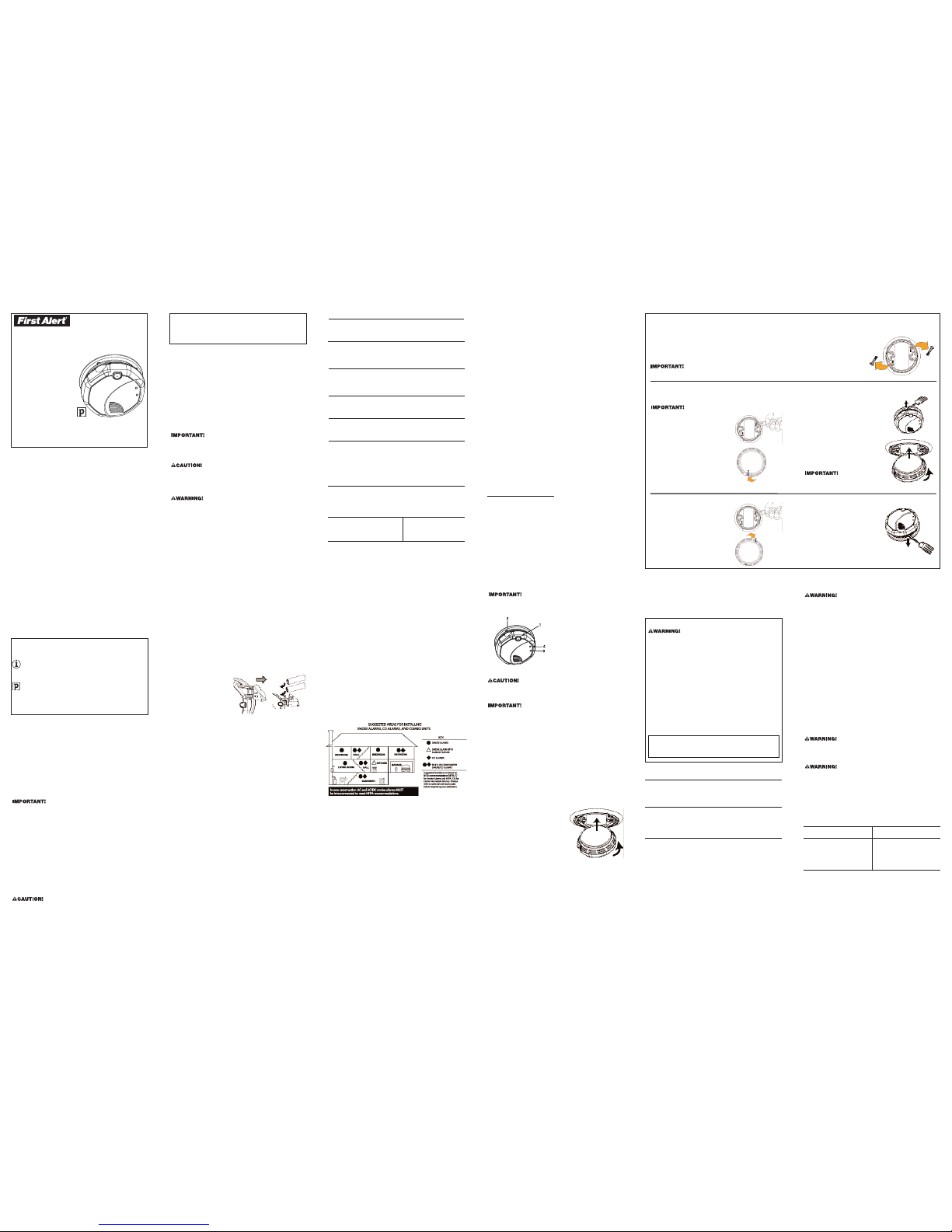
ONELINK®COMBINATION
SMOKE & CARBON MONOXIDE ALARM
W
ITH PROGRAMMABLE LOCATION
F
eatures:
• Separate sensors to detect
s
moke and CO;the two
alarm sensors work
independently
•
Visual signals to indicate
alarm levels of smoke or CO
•
Wireless interconnect
• Powered by two “AA”
b
atteries
• Side access drawer for
e
asy battery replacement
USER’S MANUAL
WHAT YOU WILL SEE WITH THIS ALARM
U
nder Normal Operations
H
orn: Silent
P
ower/Smoke LED:Flashes Green once a minute
CO LED:Off
W
hen You Test the Alarm
H
orn: Continuous beeping
S
moke LED:Flashes Red in sync with the hor n patter n
H
orn: 4 fast beeps, pause, 4 fast beeps
CO LED: Flashes Red in sync with the hor n patter n
I
f Battery Becomes Low or is Missing
Horn: chirps once a minute
Power/Smoke LED:Flashes Green On for 2 seconds/Off for
2
seconds.Low Batter y Latch is now engaged.
C
O LED:Off
If Alarm is Not Operating Properly (MALFUNCTION SIGNAL)
H
orn: 3 chirps every minute
P
ower/Smoke LED:3 Flashes approximately once a minute
C
O LED:Off
A
larm has reached its End of Life
Horn: 3 chirps every minute
P
ower/Smoke LED:3 Flashes approximately once a minute
C
O LED:Off
Alarm Levels of CO are Detected
Horn: 4 beeps, pause, 4 beeps*
P
ower/Smoke LED:Off
C
O LED:During Alar m: Flashes Red in sync with the horn pattern.
After Alarm: Flashes Red On for 2 seconds/Off for 2
s
econds.CO Alar m Latch is now engaged.
*NOTE:If unit goes into CO alarm, the regular 4 beeps-br ief pause
c
ycle will repeat for four minutes.After four minutes, the pause will
i
ncrease to one minute.
S
moke is Detected
Horn: Continuous beeping
P
ower/Smoke LED:During Alar m: Flashes Red in sync with the
horn pattern. After Alarm:Flashes Red On for 2 seconds/
O
ff for 2 seconds.Smoke Alarm Latch is now engaged.
CO LED: Off
S
moke Alarm is Silenced
H
orn: Off
Power/Smoke LED:Flashes Red
C
O LED:Off
C
O Alarm is Silenced
H
orn: Off
Power/Smoke LED:Off
C
O LED:Flashes Red
M
odel
S
CO500A
1
INSTALLATION
WHERE TO INSTALL THIS ALARM
M
inimum coverage for Smoke Alarms, as recommended by the National
Fire Protection Association (NFPA), is one Smoke Alarm on every floor,
in every sleeping area, and in every bedroom (See “Regulatory
I
nformation For Smoke Alarms”for details on the NFPA
recommendations).
F
or CO Alarms, the National Fire Protection Association (NFPA)
recommends that a CO Alarm should be centrally located outside of
each separate sleeping area in the immediate vicinity of the bedrooms.
F
or added protection, install additional CO Alarms in each separate
bedroom, and on every level of your home.
NOTE:For added protection, install an additional Smoke/CO Alarm at least
4
.6 meters (15 feet) away from the furnace or fuel burning heat source
where possible.In smaller homes or in manufactured homes where this
distance cannot be maintained, install the Alarm as far away as possible
f
rom the furnace or other fuel burning source. Installing the Alar m closer
than 15 feet (4.6 meters) will not harm the Alarm, but may increase the
frequency of unwanted alarms.
In genera
l, install combination Smoke and Carbon Monoxide Alarms:
• In the hall near every sleeping area.If your home has multiple
sleeping areas, install a unit in each.If a hall is more than 12 meters
(40 feet) long, install a unit at each end.
•
On every level of your home, including finished attics and basements.
•
Inside every bedroom, especially if people sleep with the door partly
or completely closed.
•
At the top of first-to-second floor stairs.
•
At the bottom of the basement stairs.
•
For additional coverage, install Alarms in all rooms, halls, and
storage areas, where temperatures normally remain between 4.4
O
C
and 37.8
O
C (40OF and 100OF).
Recommended Placement
•
When installing on the w
all, the top edge of Smok
e Alarms should
be placed between 102 mm (4 inches) and 305 mm (12 inches)
from the wall/ceiling line.
• When installing on the ceiling, place the Alarm as close to the center
as possib
le
.
•
In either case
, install at least 102 mm (4 inches) from where the
wall and ceiling meet.See “Avoiding Dead Air Spaces” for more
information.
NOTE:For any location, make sure no door or other obstruction could
keep carbon monoxide or smoke from reaching the Alarm.
Installing Smoke/CO Alarms in Mobile Homes
For minimum security install one Smoke/CO Alarm as close to each
sleeping area as possib
le
.
F
or more secur
ity
, put one unit in each room.
Many older mobile homes (especially those built before 1978) have little
or no insulation. If your mobile home is not well insulated, or if you are
unsure of the amount of insulation, it is impor
tant to install units on
inside w
alls only.
32
HOW TO INSTALL THIS ALARM
For quick installation instructions see the “Quick and Easy Guide to
Programming Your ONELINK®Alarm and Using the Optional Features”.
T
his combination Smoke
/CO Alarm
was designed to be mounted on the
ceiling or wall.It is not a tabletop device. You must install this device on
the ceiling or wall as outlined below.Read “Where To Install This Alarm”
b
efo
re start
ing.
Tools you will need:pencil, drill with 5mm or 3/16” drill bit,
Phillips scre
wdriver, hammer.
• Do not install this unit over an electrical junction box.Air
currents around junction boxes can prevent smoke from reaching
the sensing chamber and prevent the unit from alarming.Only AC
powered units are intended for installation over junction boxes.
If you want to lock the battery compartment, or lock the Smoke/CO
Alarm to the mounting bracket, please read the “Optional Locking
Features”section in the “Quick and Easy Guide to Programming Your
ONELINK
®
Alarm and Using the Optional Features” attachment be fore
y
ou begin installation.
1. Hold the mounting bracket against the ceiling (or wall) so the vertical
mounting slot is aligned in the 12 o’clock position and trace around
the inside of the mounting slots (vertical and horizontal mounting).
2. Put the unit where it won’t get covered with dust when you drill the
mounting holes.
3. Using a 5 mm (3/16”) drill bit, drill a hole through the center of the
oval outlines you traced.
4. Insert the plastic screw anchors (in the plastic bag with screws) into
the holes
.Tap the screw anchors gently with a hammer, if necessary,
until they are flush with the ceiling or wall.
5.
Line the mounting br
ac
k
et up over the plastic screw anchors.
6. Screw the mounting bracket to the ceiling or wall through the mounting slots using the two screws provided.
7.
Attach the Smoke/CO Alar
m to the mounting br
acket.Line up the
guides on the alarm’s base with the
guides
on the mounting br
ac
k
et.
When guides
are lined up, turn the base clockwise
(r
ight) until it snaps into place.
NOTE:Once the Alarm is snapped
onto the mounting br
acket, you
can rotate the Alar
m to adjust the
alignment.
8. Test the Smoke/CO Alarm.
See “Weekly Testing”for details.
PARTS OF THIS SMOKE/CO ALARM
1
T
est/Silence Button
2
Batter
y Compartment
3
P
ower/Smoke Alarm LED
4
C
O Alarm LED
WIRELESS OPERA
TION
First Alert®ONELINK®Technology is the easy, cost-effective way to
pro
vide y
our family with whole-home safety.All ONELINK
®
Alar
ms
communicate with each other without wires or connectors.When one
Alarm sounds, they all sound.This provides your family with an earlier
w
ar
ning of potential danger, and gives you more time to react.
The comm
unication distance (range) between any two ONELINK
®
Alar
ms
is typically 15 meters (50 feet) inside of a home.Some features of a
home, such as the number of floors, number/size of rooms, furniture and
types of b
uilding materials used may reduce the range of the Alarms.
Examples include: suspended ceilings, ductwork, large metallic appliances (refrigerators) and metal studs.A feature of ONELINK®Alarms is
that the
y operate as a mesh network.All Alarms will repeat any alarm
signal that is received to all other ONELINK®Alarms. Interference from
structural conditions can be overcome by adding additional Alarms to
route the wireless signal around obstr
uctions
.
• The range and proper operation of any wireless device will vary
depending on its surroundings
.
It is v
er
y impor
tant that each Alar
m
is tested individually before and after installation to make sure that
all Alarms respond properly.
• The ONELINK
®
Alarms are not to be used outdoors or to transmit
betw
een buildings.The Alarms will not communicate properl y
under these conditions
.
• Metal objects and metallic wallpaper may interfere with
signals from wireless Alar
ms
.Alar ms should be tested after
changes to your home such as remodeling, moving furniture, and
with metal doors opened and closed.
Your First Alert
®
ONELINK®Smoke/CO Alarm will automatically commu-
nicate both potential f
ires and carbon mono
xide presence with all other
First Alert®ONELINK®Smoke/CO Alarms.
INDUSTR
Y CANAD
A NO
TICE:
Oper
ation is subject to the following
two conditions:
(1)
This device may not cause harmful interference, and (2) this device
must accept any interference received, including interference that may
cause undesired operation. IC:5882A-5001L
Changes or modifications not expressly approved by BRK Brands, Inc.
could void the user’s authority to operate the equipment.
4 5 6
INTRODUCTION
Thank you for choosing First Alert®for your Smoke and Carbon
M
onoxide Alarm needs.You have purchased a state-of-the-art Smoke &
Carbon Monoxide Alarm designed to provide you with early warning of a
smoke and/or Carbon Monoxide danger.Key features include:
Smoke & Carbon Monoxide Combination Alarm. One alar m protects
against two deadly household threats.
ONELINK
®
Enabled. Alarm automatically communicates with other
O
NELINK
®
e
nabled alarms when installed.
S
pread Spectrum Horn Tone. Lower and varying horn frequency
makes it easier for elderly with normal age related hearing loss to hear
horn. Sweeps through the 2200 – 3400 Hz range.
RF Interconnect. Reliable and secure radio frequency communication
b
etween alarms. 915 MHz frequency with 65,000 security codes and 3
channel frequency hopping.
Single Button Test/Silence eliminates confusion. Depending on what
mode the alarm is in, pushing the button provides different functions
s
uch as testing the alarm, silencing the alarm, re-testing the alarm when
in silence and clearing the Latching features.
Two Silence Features. Temporarily silence low battery chirp for up to
eight hours before replacing low battery or silence an unwanted alarm for
s
everal minutes.
T
wo Latching Features. Alarm Latch:Easily identifies initiating alarm
even after alarm condition has subsided.Low Battery Latch: Identifies
which unit is in low battery condition.
Perfect Mount System includes a gasketless base for easy installation
a
nd a mounting bracket that keeps the alarm secure over a wide
rotation range to allow for perfect alignment.
End of Life Signal. Pro
vides audib
le conf
irmation alarm needs to be
r
eplaced.
© 2010 BRK Bra
nds,
Inc. A
ll ri
ghts reserved.
Distributed by BRK Brands, Inc.
3
901 Liberty Street Road, Aurora, IL 60504-8122
Consumer Affairs:(
800) 323-9005 • www.
fi
rstalert.com
A
ll First Alert
®
S
moke
Alarm
s conform to regulatory requirements,
including ULC S531 and are designed to detect particles of
combustion.Smoke par ticles of varying number and size are
produced in all f
i
res.
Ionization technology is gener
ally more sensitive than photoelectric
technology at detecting small particles, which tend to be produced
in greater amounts by flaming fires, which consume combustible
mater
ials rapidly and spread quickly.Sources of these fires may include
paper burning in a wastebasket, or a grease fire in the kitchen.
Photoelectric technology is generally more sensitive than ionization
technology at detecting large particles, which tend to be produced
in greater amounts by smoldering fires, which may smolder for
hours before bursting into flame.Sources of these fires may include cigarettes burning in couches or bedding.
For maximum protection, use both types of Smoke Alarms on each level
and in every bedroom of your home.
TO LOCK THE BATTERY COMPARTMENT
D
o not lock the battery compartment until you install the
batteries and test the Alarm.
I
f the unit does not alarm during
testing, DO NOT lock the battery
c
ompartment! Install new batteries and
t
est again.If the Alar m still does not
alarm, replace it immediately.
1
. Using needle-nose pliers, detach
one locking pin from the mounting
b
racket.
2
. After batteries are inserted, then
push the locking pin through the
hole near the battery door latch on
t
he back of the Alarm.
OPTIONAL LOCKING FEATURES
TO LOCK THE MOUNTING BRACKET
1. Using needle-nose pliers, detach
o
ne locking pin from the mounting
b
racket.
2. Insert the locking pin through the
hole on the back of the Alarm as
s
hown in the diagram.
3
. When you attach the Alarm to the
mounting bracket, the locking pin’s
head will fit into a notch on the
b
racket.
The optional locking features are designed to prevent unauthorized removal of the batteries or alarm.It is not necessary to activate the locks in singlef
amily households where unauthorized battery or Alarm removal is not a concern.
These Alarms have two separate locking features:one to lock the battery compartment, and the other to lock the
A
larm to the mounting bracket.You can choose to use either feature independently, or use them both.
Tools you will need: • Needle-nose pliers • Standard flathead screwdriver.
Both locking features use locking pins, which are molded into the mounting bracket.Depending on which locking
features you use, remove one or both pins from the mounting bracket using needle-nose pliers.
To permanently remove either locking pin, insert a flathead screwdriver between the locking pin and the lock, and
p
ry the pin out of the lock.
TO UNLOCK THE BATTERY COMPARTMENT
1
. Remove the Alarm from the
m
ounting bracket.If the unit is
l
ocked to the bracket, see the
section “To Unlock the Mounting
B
racket.”
2
. Insert a flathead screwdriver under
the head of the locking pin, and
g
ently pry it out of the battery
c
ompartment lock. (If you plan to
relock the battery compartment,
s
ave the locking pin.)
3. To relock the battery compartment,
close the battery door and reinsert
l
ocking pin in lock.
4. Reattach the Alarm to the mounting
b
racket.
W
hen replacing the batteries, always
t
est the Alarm before relocking the bat-
tery compartment.
TO UNLOCK THE MOUNTING BRACKET
1. Insert a flathead screwdriver into the
r
ectangular cut-out on the mounting
b
racket nearest to the locking pin.
2. Pry the Alarm away from the bracket
by pushing up on the screwdriver and
t
urning the Alarm counterclockwise
(left) at the same time.
IF YOUR SMOKE/CO ALARM SOUNDS
WHAT TO DO FIRST–IDENTIFY THE TYPE OF
ALARM SIGNAL
Ref
er to pre
vious section
“
W
hat You Will See With This Alarm”.
AFTER AN ALARM
After the emergency responders arrive, the premises aired out, and
y
our CO Alar
m remains in its nor
mal condition, y
ou can chec
k what
the highest carbon monoxide level sensed was:
Action:
1.
Press & Hold
Test Button, if you would like to clear the highest
level sensed.
If you would like to keep the highest level in memory, do not
press an
ything.
IF THE SMOKE ALARM SOUNDS
R
ESPONDING TO AN ALARM
• If the unit alarms and you are not testing the unit, it is warning you
o
f a potentially dangerous situation that requires your immediate
attention.NEVER ignore any alar m. Ignoring the alarm may result in
injury or death.
•
Never remove the batteries from a battery operated Smoke/CO
Alarm
to stop an unwa
nted alarm
(caused by cooking smok
e
, etc.).
Removing batteries disables the alarm so it cannot sense smoke,
a
nd removes your protection.Instead open a window
or fa
n the smoke
aw
a
y from the unit.
The alarm will reset automati-
cally.
•
If the unit alarms get everyone out of the house immediately.
WHAT TO DO IN CASE OF FIRE
• Don’t panic;stay calm. Follow your family escape plan.
• Get out of the house as quickly as possible.Don’t stop to get
dressed or collect anything.
• Feel doors with the back of your hand before opening them.
If a door is cool, open it slo
wly
.Don’t open a hot door. Keep doors
and windows closed, unless you must escape through them.
• Cover your nose and mouth with a cloth (preferably damp).
T
ake short, shallow breaths.
• Meet at your planned meeting place outside your home, and
do a head count to make sure everybody got out safely.
• Call the Fire Department as soon as possible from outside.
Give y
our address, then your name.
• Never go back inside a burning building for any reason.
•
Contact your Fire Department for ideas on making your home
safer.
Alar
ms have various limitations.See "General Limitations of Smoke/CO
Alarms" for details.
USING THE SILENCE FEATURES
Ne
v
er remo
v
e the batteries to quiet an unwanted alarm.Removing the
batteries disables the alarm and removes your protection.
The Silence F
eature is intended to tempor
arily silence the horn while
you identify and correct the problem.Do not use the Silence Feature in
emergency situations.It will not correct a CO problem or extinguish a
f
ire.
The Silence Feature can temporarily quiet an unwanted alarm for several
min
utes
.
Y
ou can silence this Smoke/CO Alarm by pressing the
Test/Silence button on the alarm cover for at least 3-5 seconds.
After the
T
est/Silence b
utton is released, the Red LED
blinks during the
silence mode.
When the Smok
e Alar
m
is Silenced
When the CO Alar
m
is Silenced
The Smok
e Alar
m will remain
silent for up to 15 minutes, then
return to normal operation.
If the smoke has not cleared–or
continues to increase–the device
will go bac
k into alar
m.
The CO Alar
m will remain silent
for up to 4 minutes.
After 4 min
utes
, if CO le
v
els
remain potentially dangerous the
horn will start sounding again.
STEP BY STEP GUIDE
TO PROGRAMMING
THIS ALARM
NOTE:Steps 1 through 3 need to be completed within two minutes. If
more than tw
o minutes pass, the Green power LED will stop blinking.
Simply open the battery drawer of the second Alarm and repeat steps 1
through 3.
1. Insert the batteries into the
batter
y drawer of the next
Alarm. DO NOT CLOSE THE
DRAWER.
2. Press and hold the test
b
utton and then close the
battery drawer.
3. Once you hear the unit chirp,
release the test button.
The Green power LED will start to blink indicating the ONELINK
®
Alarm is waiting for program data from one of the other setup
ONELINK®Alarms
.
4. Press and hold the test button on the first Alarm, until the second
Alarm
chirps and its Green power LED stops blinking.Then release
the test button.
5. If you have purchased the hardwired battery back-up ONELINK
®
Alar
m, you can now connect the hardwired Alarm by installing the
three-wire connector on the ceiling to the Alarm.
6. Repeat steps 1-5 for additional ONELINK
®
Alarms.
You have now successfully linked your new ONELINK
®
Alarms.
T
o add additional Alarms at a later time, follow steps 1 through 5.
ADDING AND LINKING ADDITIONAL ONELINK®ALARMS
WHERE THIS ALARM SHOULD NOT BE INSTALLED
D
o NOT locate this Smoke/CO Alarm:
•
In garages, furnace rooms, crawl spaces and unfinished attics.Avoid
e
xtremely dusty, dirty or greasy areas.
•
Where combustion particles are produced. Combustion par ticles
form when something burns.Areas to avoid include poorly ventilated
k
itchens, garages, and furnace rooms.Keep units at least 6 meters
(20 feet) from the sources of combustion particles (stove, furnace,
w
ater heater, space heater) if possible.In areas where a 6 meter
(
20-foot) distance is not possible – in modular, mobile, or smaller
homes, for example – it is recommended the Smoke Alarm be
p
laced as far from these fuel-burning sources as possible.The
p
lacement recommendations are intended to keep these Alarms at a
reasonable distance from a fuel-burning source, and thus reduce
“
unwanted” alar ms. Unwanted alarms can occur if a Smoke Alarm is
p
laced directly next to a fuel-burning source.Ventilate these areas
as much as possible.
•
Within 1.5 meters (5 feet) of any cooking appliance.In air streams
n
ear kitchens.Air currents can draw cooking smoke into the smoke
s
ensor and cause unwanted alarms.
•
In extremely humid areas.This Alarm should be at least 3 meters
(10 feet) from a shower, sauna, humidifier, vaporizer, dishwasher,
l
aundry room, utility room, or other source of high humidity.
•
In direct sunlight.
•
In turbulent air, like near ceiling fans or open windows.Blowing air
m
ay prevent CO or smoke from reaching the sensors.
• In areas where temperature is colder than 4.4
O
C (40OF) or hotter
than 37.8
O
C (100OF).These areas include non-airconditioned crawl
s
paces, unfinished attics, uninsulated or poorly insulated ceilings,
porches, and garages.
• In insect infested areas.Insects can clog the openings to the sensing
chamber.
•
Less than 305 mm (12 inches) away from fluorescent lights.
E
lectrical “noise” can interfere with the sensor.
•
In “dead air”spaces. See “Avoiding Dead Air Spaces”.
AVOIDING DEAD AIR SPACES
“Dead air” spaces may prevent smoke from reaching the Smoke/CO
A
larm.To avoid dead air spaces, follow installation recommendations
below.
O
n ceilings, install Smoke/CO Alarms as close to the center of the
ceiling as possible.If this is not possible, install the Smoke/CO Alarm at
l
east 4 inches (102 mm) from the wall or corner.
For wall mounting (if allowed by building codes), the top edge of
S
moke/CO Alarms should be placed between 102 mm (4 inches) and
305 mm (12 inches) from the wall/ceiling line, below typical “dead air”
spaces.
On a peaked, gabled, or cathedral ceiling, install first Smoke/CO Alarm
w
ithin 0.9 meters (3 feet) of the peak of the ceiling, measured
h
orizontally.Additional Smoke/CO Alarms may be required depending
on the length, angle, etc.of the ceiling's slope. Refer to NFPA 72 for
d
etails on requirements for sloped or peaked ceilings.
I
MPORTANT! PLEASE READ CAREFULLY AND SAVE.
This user’s manual contains important information about your
C
ombination Carbon Monoxide & Smoke Alarm’s operation.If you are
i
nstalling this Alarm for use by others, you must leave this manual—or
a copy of it—with the end user.
L
ISTED TO
ULC S531 and
CSA 6.19
STANDARDS
IF YOUR CO ALARM SOUNDS
IF THE ALARM SIGNAL SOUNDS:
1. Immediately move to fresh air—outdoors or by an open door or
window.Do a head count to check that all persons are accounted
f
or.Do not re-enter the premises, or move away from the open
door or window until the emergency services responder has
arrived, the premises have been aired out, and your CO Alarm
remains in its normal condition.
2. Call your emergency services, fire department or 911.Write down
the n
umber of your local emergency service here:
______________________________________________________
“ALARM-MOVE TO FRESH AIR”
If you hear the alarm horn and the Red light is flashing,
move everyone to a source of fresh air.
DO NO
T disconnect the batteries from the CO Alarm!
Page 2
7 8 9
WHAT YOU NEED TO KNOW ABOUT CO
WHAT IS CO?
C
O is an invisible, odorless, tasteless gas produced when fossil fuels
d
o not burn completely, or are exposed to heat (usually fire).Electrical
appliances typically do not produce CO.
T
hese fuels include:Wood, coal, charcoal, oil, natural gas, gasoline,
k
erosene, and propane.
C
ommon appliances are often sources of CO.If they are not properly
m
aintained, are improperly ventilated, or malfunction, CO levels can rise
q
uickly.CO is a real danger now that homes are more energy efficient.
“
Air-tight” homes with added insulation, sealed windows, and other
w
eatherproofing can “trap”CO inside.
SYMPTOMS OF CO POISONING
The following symptoms may be related to CARBON MONOXIDE
POISONING and should be discussed with ALL members of the
h
ousehold:
M
ild Exposure: Headaches, running nose, sore eyes, often described as
“
flu”-like symptoms;
M
edium Exposure: Dizziness, drowsiness, vomiting;
Extreme Exposure: Unconsciousness, brain damage, death.
M
any cases of reported CARBON MONOXIDE POISONING indicate
that while victims are aware they are not well, they become so disoriente
d they are unable to save themselves by either exiting the building or
c
alling for assistance.
T
his CO Alarm measures exposure to CO over time.It alarms if CO
l
evels are extremely high in a short period of time, or if CO levels reach
a certain minimum over a long period of time.The CO Alarm generally
s
ounds an alarm before the onset of symptoms in average, healthy
a
dults.Why is this important? Because you need to be warned of a
potential CO problem while you can still react in time.Also, young
c
hildren and pets may be the first affected.The average healthy adult
m
ight not feel any symptoms when the CO Alarm sounds.However,
people with cardiac or respiratory problems, infants, unborn babies,
p
regnant mothers, or elderly people can be more quickly and severely
affected by CO.If you experience even mild symptoms of CO poisoning,
consult your doctor immediately!
FINDING THE SOURCE OF CO AFTER AN ALARM
C
arbon monoxide is an odorless, invisible gas, which often makes it
d
ifficult to locate the source of CO after an alarm.These are a few of
the factors that can make it difficult to locate sources of CO:
•
House well ventilated before the investigator arrives.
•
Problem caused by “backdrafting.”
• Transient CO problem caused by special circumstances.
Because CO may dissipate by the time an investigator arrives, it may
b
e difficult to locate the source of CO. BRK Brands, Inc. shall not be
o
bligated to pay for any carbon monoxide investigation or service call.
POTENTIAL SOURCES OF CO IN THE HOME
Fuel-burning appliances like:por table heater, gas or wood burning fire-
place,
gas kitchen range or cooktop, gas clothes dryer.
Damaged or insufficient venting:corroded or disconnected water heater
v
ent pipe, leaking chimney pipe or flue, or cracked heat
e
xchanger
, blocked or clogged chimney opening.
Improper use of appliance/device:operating a barbecue grill or
v
ehicle in an enclosed area (like a garage or screened porch).
T
ransient CO Problems:“transient” or on-again-off-again CO problems
can be caused by outdoor conditions and other special circumstances.
The following conditions can result in transient CO situations:
1.
Excessive spillage or reverse venting of fuel appliances caused by
outdoor conditions such as:
•
Wind direction and/or velocity, including high, gusty winds.
Heavy air in the vent pipes (cold/humid air with extended periods
between cycles).
• Negative pressure differential resulting from the use of exhaust
f
ans
.
•
Several appliances running at the same time competing for
limited fresh air.
• Vent pipe connections vibrating loose from clothes dryers,
furnaces, or water heaters.
• Obstructions in or unconventional vent pipe designs which can
amplify the above situations.
2. Extended operation of unvented fuel burning devices (range, oven,
f
ireplace).
3.
Temperature inversions, which can trap exhaust close to the ground.
4. Car idling in an open or closed attached garage, or near a home.
These conditions are dangerous because they can trap exhaust in your
home.Since these conditions can come and go, they are also hard to
recreate dur
ing a CO investigation.
HOW CAN I PROTECT MY FAMILY FROM
CO POISONING?
A
CO Alarm is an excellent means of protection.It monitors the air and
sounds a loud alarm before Carbon Monoxide levels become threatening
f
or average, healthy adults.
A CO Alarm is not a substitute for proper maintenance of home
a
ppliances.
T
o help prevent CO problems and reduce the risk of CO poisoning:
• Clean chimneys and flues yearly.Keep them free of debris,
l
eaves, and nests for proper air flow.Also, have a professional
c
heck for rust and corrosion, cracks, or separations.These
conditions can prevent proper air movement and cause backd
rafting.Never “cap” or cover a chimney in any way that would
b
lock air flow.
• Test and maintain all fuel-burning equipment annually.Many local
g
as or oil companies and HVAC companies offer appliance
inspections for a nominal fee.
•
Make regular visual inspections of all fuel-burning appliances.
C
heck appliances for excessive rust and scaling.Also check the
f
lame on the burner and pilot lights.The flame should be blue. A
yellow flame means fuel is not being burned completely and CO
m
ay be present.Keep the blower door on the furnace closed.
U
se vents or fans when they are available on all fuel-burning
appliances.Make sure appliances are vented to the outside. Do
n
ot grill or barbecue indoors, or in garages or on screen porches.
•
Check for exhaust backflow from CO sources.Check the draft
hood on an operating furnace for a backdraft.Look for cracks on
f
urnace heat exchangers.
•
Check the house or garage on the other side of shared wall.
•
Keep windows and doors open slightly.If you suspect that CO
is escaping into your home, open a window or a door.Opening
w
indows and doors can significantly decrease CO levels.
I
n addition, familiarize yourself with all enclosed materials.Read this
m
anual in its entirety, and make sure you understand what to do if your
CO Alarm sounds.
REGULATORY INFORMATION FOR
S
MOKE/CO ALARMS
REGULATORY INFORMATION FOR CO ALARMS
WHAT LEVELS OF CO CAUSE AN ALARM?
C
anadian Standards Association 6.19-01 requires residential CO Alarms
to sound when exposed to levels of CO and exposure times
as described below.They are measured in parts per million (ppm) of CO
o
ver time (in minutes).
CSA 6.19-01 Required Alarm Points*:
•
If the alarm is exposed to 400 ppm of CO, IT MUST ALARM
BETWEEN 4 and 15 MINUTES.
•
If the alarm is exposed to 150 ppm of CO, IT MUST ALARM
BETWEEN 10 and 50 MINUTES.
•
If the alarm is exposed to 70 ppm if CO, IT MUST ALARM
BETWEEN 60 and 240 MINUTES.
*
Approximately 10% COHb exposure at levels of 10% to 95% Relative
Humidity (RH).
T
he unit is designed not to alarm when exposed to a constant level
of 30 ppm for 30 days.
CO Alarms are designed to alarm before there is an immediate life
t
hreat.Since you cannot see or smell CO, never assume it’s not present.
• An exposure to 100 ppm of CO for 20 minutes may not affect
a
verage, healthy adults, but after 4 hours the same level may cause
headaches.
•
An e
xposure to 400 ppm of CO ma
y cause headaches in a
verage,
healthy adults after 35 minutes, but can cause death after 2 hours.
Standards:
Canadian Standards Association 6.19-01.
According to Canadian Standards Association 6.19-01:“Carbon monoxide alarms covered by these requirements are intended to respond to the
presence of carbon mono
xide from sources such as
, b
ut not
limited to, exhaust from internal-combustion engines, abnormal operation of fuel-fired appliances, and fireplaces.CO Alarms are intended to
a
larm
at carbon monoxide levels below those that could cause a loss of
ability to react to the dangers of Carbon Monoxide exposure.”This CO
Alarm monitors the air at the Alarm, and is designed to alarm before CO
l
ev
els become life threatening.This allows you precious time to leave
t
he house and correct the problem.This is only possible if Alarms are
located, installed, and maintained as described in this manual.
Gas Detection at Typical Temperature and Humidity Ranges:The
CO Alarm is not f
ormulated to detect CO levels below 30 ppm typically.
Tested for false alarm resistance to Methane (500 ppm), Butane (300
ppm), Heptane (500 ppm), Ethyl Acetate (200 ppm), Isopropyl Alcohol
(200 ppm) and Carbon Dioxide (5000 ppm).Values measure gas and
vapor concentrations in parts per million.
Audible Alarm:85 dB minimum at 3 meters (10 feet).
REGULA
TORY INFORMATION FOR SMOKE ALARMS
RECOMMENDED LOCA
TIONS FOR SMOKE ALARMS
Installing Smoke Alarms in Single-Family Residences
The National Fire Protection Association (NFPA), recommends one
Smoke Alarm on every floor, in every sleeping area, and in every
bedroom. In new construction, the Smoke Alarms must be AC powered
and interconnected. See “Agency Placement Recommendations” for
details.For additional coverage, it is recommended that you install a
Smoke Alarm in all rooms, halls, storage areas, finished attics, and
basements, where temperatures normally remain between 4
O
C (40OF)
and 38OC (100OF).Make sure no door or other obstruction could keep
smoke from reaching the Smoke Alarms.
More specifically, install Smoke Alarms:
•
On ev
ery level of your home, including finished attics and basements.
• Inside every bedroom, especially if people sleep with the door partly
or completely closed.
• In the hall near every sleeping area.If your home has multiple
sleeping areas
, install a unit in each.If a hall is more than 12 meters
long (40 feet), install a unit at each end.
•
At the top of the first-to-second floor stairway, and at the bottom of
the basement stairw
a
y
.
Specif
ic requirements for Smoke Alarm installation vary from state to
state and from region to region. Check with your local Fire Department
for current requirements in your area.It is recommended AC or AC/DC
units be interconnected f
or added protection.
ABOUT SMOKE ALARMS
B
attery (DC) operated Smoke Alarms: Provide protection even when
electricity fails, provided the batteries are fresh and correctly installed.
U
nits are easy to install, and do not require professional installation.
A
C powered Smoke Alarms:Can be interconnected so if one unit senses smoke, all units alarm.They do not operate if electricity fails.
AC with battery (DC) back-up:will operate if electricity fails, provided the
b
atteries are fresh and correctly installed. AC and AC/DC units must be
installed by a qualified electrician.
ONELINK
®
Smoke Alarms with battery (DC) back-up: Interconnects with
all ONELINK
®
enabled Smoke and Smoke/CO Alarms without wires or
c
onnectors, so when one alarm sounds, they all sound.Will operate if
electricity fails, provided the batteries are fresh and correctly installed.
Units are easy to install, and do not require professional installation.
Smoke/CO Alarms for Solar or Wind Energy users and battery backup
p
ower systems:AC powered Smoke/CO Alarms should only be operated with true or pure sine wave inverters.Operating this Alarm with most
battery-powered UPS (uninterruptible power supply) products or square
w
ave or “quasi sine wave”inverters will damage the Alarm.
If you are not sure about your inverter or UPS type, please consult with
the manufacturer to verify.
S
moke Alarms for the hearing impaired: Special pur pose Smoke Alarms
s
hould be installed for the hearing impaired.They include a
visual alarm and an audible alarm horn, and meet the requirements of the
A
mericans With Disabilities Act.Can be interconnected so if one
u
nit senses smoke, all units alarm.
S
moke alarms are not to be used with detector guards unless the
combination has been evaluated and found suitable for that purpose.
All these Smoke Alarms are designed to provide early warning of fires if
l
ocated, installed and cared for as described in the user’s manual, and if
smoke reaches the Alarm.If you are unsure which type of Smoke Alarm
to install, refer the National Fire Protection Association (NFPA) Standard
7
2 (National Fire Alarm Code) and NFPA 101 (Life Safety Code).
National Fire Protection Association, One Batterymarch Park, Quincy, MA
02269-9101. Local building codes may also require specific units in new
c
onstru
ction or in different areas of the home
.
SPECIAL COMPLIANCE CONSIDERATIONS
This unit alone is not a suitable substitute for complete fire detection syst
ems
i
n places housing many
people—like apartment buildings, condominiums, hotels, motels, dormitories, hospitals, long-term health care facilities,
nursing homes, day care facilities, or group homes of any kind—even if they
were once single-family homes.It is not a
suitable substitute for complete fire detection systems in warehouses, industrial facilities, commercial buildings, and special-purpose non-residential
buildings which require special fire detection and alarm systems.Depending
on the building codes in your area, this unit may be used to provide additional protection in these facilities.
The following information applies to all five types of buildings listed
below:
In new construction, most building codes require the use of AC or AC/DC
powered Smoke Alarms only.AC, AC/DC, or DC powered Smoke Alarms
can be used in existing construction as specified by local building codes.
Refer to NFPA 72 (National Fire Alarm Code) and NFPA 101 (Life Safety
Code), local building codes, or consult your Fire Department for detailed
fire protection requirements in buildings not defined as “households.”
1.Single-Family Residence:
Single family home, townhouse.It is recommended this unit be installed
on every level of the home, in every bedroom, and in each bedroom hallway.
2.Multi-Family or Mixed Occupant Residence:
Apartment building, condominium.This unit is suitable for use in
individual apar
tments or condos, provided a primary fire detection
system already exists to meet fire detection requirements in common
areas like lobbies, hallways, or porches.Using this unit in common areas
ma
y not provide sufficient warning to all residents or meet local fire
protection ordinances/regulations.
3.Institutions:
Hospitals
, da
y care facilities,long-term health care facilities. This unit is
suitable for use in individual patient sleeping/resident rooms, provided
a primary fire detection system already exists to meet fire detection
requirements in common areas lik
e lob
bies, hallways, or porches.
Using this unit in common areas may not provide sufficient warning to all
residents or meet local fire protection ordinances/regulations.
4.Hotels and Motels:
Also boarding houses and dormitories.This unit is suitable for use inside
individual sleeping/resident rooms
, pro
vided a pr
imar
y f
ire detection sys
tem already exists to meet fire detection requirements in common areas
like lobbies, hallways, or porches.Using this unit in common areas may
not pro
vide suff
icient w
ar
ning to all residents or meet local f
ire
protection ordinances/regulations.
5.
W
arehouses/Commercial Buildings:
DO NO
T use this Smoke/CO Alarm in warehouses, industrial or
commercial buildings, special-purpose non-residential buildings, RVs,
boats, or airplanes.This Smoke/CO Alarm is specifically designed for
residential use, and may not provide adequate protection in non-residential applications.
Printed in Mexico M08-0146-012 J1 11/10
First Aler
t
®
is a registered tr
ademark of the First Alert Trust used
under license.
ONELINK
®
is a registered tr
ademark of BRK Brands, Inc.
LIMITED
WARRANTY
BRK Br
ands, Inc., ("BRK") the maker of First Alert
®
br
and products warrants that for a period of seven years from the date of purchase, this product will be
free from defects in material and workmanship.BRK, at its option, will repair or replace this product or any component of the product found to be defective
during the warranty period. Replacement will be made with a new or remanufactured product or component. If the product is no longer available, replacement ma
y be made with a similar product of equal or greater value.This is your exclusive warranty.
This warranty is valid for the original retail purchaser from the date of initial retail purchase and is not transferable.Keep the original sales receipt. Proof of
purchase is required to obtain warranty performance.BRK dealers, service centers, or retail stores selling BRK products do not have the right to alter,
modify or any way change the terms and conditions of this warranty.
This warranty does not cover normal wear of parts or damage resulting from any of the following:negligent use or misuse of the product, use on improper
voltage or current, use contrary to the operating instructions, disassembly, repair or alteration by anyone other than BRK or an authorized service center.
Further, the warranty does not cover Acts of God, such as fire, flood, hurricanes and tornadoes or any batteries that are included with this unit.
BRK shall not be liable for any incidental or consequential damages caused by the breach of any express or implied warranty.Except to the extent prohibited
b
y applicable law, any implied warranty of merchantability or fitness for a particular purpose is limited in duration to the duration of the above warranty.Some
states, provinces or jurisdictions do not allow the exclusion or limitation of incidental or consequential damages or limitations on how long an implied warranty
lasts, so the above limitations or exclusion may not apply to you.This warranty gives you specific legal rights, and you may also have other rights that vary
from state to state or province to province.
How to Obtain Warranty Service
Ser
vice: If ser vice is required, do not retur n the product to your retailer. In order to obtain warranty service, contact the Consumer Affairs Division at
1-800-323-9005, 7:30 AM - 5:00 PM Central Standard Time, Monday through Friday.To assist us in serving you, please have the model number and date of
purchase available when calling.
F
or Warranty Service return to:BRK Brands, Inc., 25 Spur Drive, El Paso, TX 79906 U.S.A.
Battery: BRK Brands, Inc.make no warranty, express or implied, written or oral, including that of merchantability or fitness for any particular purpose with
respect to batter
y
.
TROUBLESHOOTING GUIDE
I
f the Alarm... Problem... You should...
Horn "chirps" about once per minute. Low battery warning. Install two new AA batteries*.
H
orn sounds 3 "chirps" every minute. MALFUNCTION SIGNAL. Device is not working
properly, and needs to be replaced.
U
nits under warranty should be returned to
manufacturer for replacement.See “Limited
Warranty”for details.
T
he Alarms are linked but do not communicate
with each other.
P
ossible interference.Reference the Wireless
Operation section of this manual.
M
ove Alarms to different locations.Add an
additional Alarm between the unresponsive
Alarms to route the signal around obstructions.
Carbon Monoxide Alarm ONLY:
CO Alarm goes back into alarm 4 minutes after
y
ou Silence it.
CO levels indicate a potentially dangerous
s
ituation.
IF YOU ARE FEELING SYMPTOMS OF CO
P
OISONING, EVACUATE your home and call
911 or the Fire Depart
ment.Refer to "If The CO
Alarm Sounds" for details.
CO Alar
m sounds frequently e
v
e
n though no high
levels of CO are revealed in an investigation.
The CO Alar
m ma
y be improperl
y located.R
efe
r
to “Where to Install This Alarm”for details.
Relocate y
our Alar
m.I
f frequent alarm
s
continue, have home rechecked for potential
C
O problems.You may be experiencing an inter-
mittent CO prob
lem.
Smoke Alarm ONLY:
Smoke Alarm sounds when no smoke is visible.
Unwanted alarm may be caused by nonemergency source like cooking smoke.
Silence Alarm using manual button; clean the
Alarm’s cover with a soft, clean cloth.If frequent
unwanted alarms continue, relocate your Alarm.
Alarm may be too close to a kitchen, cooking
a
ppliance, or steamy bathroom.
*
F
or a list of acceptable replacement batteries, see “Regular Maintenance.”
If you have questions that cannot be answered by reading this manual, call Consumer Affairs at 1-800-323-9005, M-F 7:30 a.m.to 5:00 p.m. (CST)
The light flashes (RED) and the horn sounds 3
“chirps” every minute.
END OFLIFE SIGNAL.
Alarm needs to be replaced.
Immediately replace the Alarm.
T
his Smoke/CO Alarm is intended for residential use.It is not intended for
use in industrial applications where Occupational Safety and Health
A
dministration (OSHA) requirements for Carbon Monoxide Alarms must
b
e met.The Smoke Alarm portion of this device is not intended to alert
hearing impaired residents.Special pur pose Smoke Alarms should be
i
nstalled for hearing impaired residents (CO Alarms are not yet available
for the hearing impaired).
S
moke/CO Alarms may not waken all individuals.Practice the escape
p
lan at least twice a year, making sure that everyone is involved – from
kids to grandparents.Allow children to master fire escape planning and
p
ractice before holding a fire drill at night when they are sleeping.
I
f children or others do not readily waken to the sound of the Smoke/CO
A
larm, or if there are infants or family members with mobility limitations,
m
ake sure that someone is assigned to assist them in fire drill and in the
e
vent of an emergency.It is recommended that you hold a fire drill while
f
amily members are sleeping in order to determine their response to the
s
ound of the Smoke/CO Alarm while sleeping and to determine whether
t
hey may need assistance in the event of an emergency.
S
moke/COAlarms cannot work without power.Battery operated units cannot work if the batteries are missing, disconnected or dead, if the wrong
t
ype of batteries are used, or if the batteries are not installed correctly.
A
C units cannot work if the AC power is cut off for any reason (open fuse
or circuit breaker, failure along a power line or at a power station, electrical
f
ire that burns the electrical wires, etc.). If you are concerned about the limitations of battery or AC power, install both types of units.
This Smoke/CO Alarm will not sense smoke or CO that does not reach
the sensors.It will only sense smoke or CO at the sensor. Smoke or CO
m
ay be present in other areas.Doors or other obstructions may affect the
rate at which CO or smoke reaches the sensors.
If bedroom doors are usually closed at night, we recommend you
i
nstall an alarm device (Combination CO and Smoke Alarm, or separate
CO Alarms and Smoke Alarms) in each bedroom and in the hallway
between them.
T
his Smoke/CO Alarm may not sense smoke or CO on another level of
t
he home.Example: This alarm device, installed on the second floor,
may not sense smoke or CO in the basement.For this reason, one
a
larm device may not give adequate early warning.
R
ecommended minimum protection is one alarm device in every
sleeping area, every bedroom, and on every level of your home.Some
e
xperts recommend battery powered Smoke and CO Alarms be used in
c
onjunction with interconnected AC powered Smoke Alarms.For details,
see “About Smoke Alarms”for details.
S
moke/CO Alarms may not be heard.The alarm horn loudness meets or
exceeds current standards of 85 dB at 3 meters (10 feet).However, if the
S
moke/CO Alarm is installed outside the bedroom, it may not wake up a
s
ound sleeper or one who has recently used drugs or has been drinking
alcoholic beverages.This is especially true if the door is closed or only
p
artly open. Even persons who are awake may not hear the alarm horn if
t
he sound is blocked by distance or closed doors.Noise from
t
raffic, stereo, radio, television, air conditioner, or other appliances may
a
lso prevent alert persons from hearing the alarm horn. This Smoke/CO
A
larm is not intended for people who are hearing impaired.
T
he Alarm may not have time to alarm before the fire itself causes dam-
a
ge, injury, or death, since smoke from some fires may not reach the
unit immediately.Examples of this include persons
s
moking in bed, children playing with matches, or fires caused by violent
explosions resulting from escaping gas.
This Smoke/CO Alarm is not a substitute for life insurance.
T
hough this Smoke/CO Alarm warns against increasing CO levels or the
presence of smoke, BRK Brands, Inc.does not warrant or imply in any
way that they will protect lives.Homeowners and renters must still insure
t
heir lives.
T
his Smoke/CO Alarm has a limited life.Although this Smoke/CO Alarm
and all of its parts have passed many stringent tests and are designed
t
o be as reliable as possible, any of these parts could fail at any time.
T
herefore, you must test this device weekly.The unit should
be replaced immediately if it is not operating properly.All Smoke/CO
A
larms need to be replaced every 5 years.All Smoke Alarms need to be
r
eplaced every 10 years.
T
his Smoke/CO Alarm is not foolproof.Like all other electronic devices,
this Smoke/CO Alarm has limitations.It can only detect smoke or CO
t
hat reaches the sensors.It may not give early warning of the source of
s
moke or CO is in a remote part of the home, away from the alarm
device.
C
onstant exposure to high or low humidity may reduce battery life.
GENERAL LIMITATIONS OF SMOKE/CO ALARMS
1110 12
REGULAR MAINTENANCE
This unit has been designed to be as maintenance-free as possib
le
, b
u
t
there are a few simple things you must do to keep it working properly.
U
se only the replacement batteries listed below.The unit may not operate properly with other batteries. Never use rechargeable
b
atteries since they may not provide a constant charge.
•
Test it at least once a week.
•
Clean the Smoke/CO Alarm at least once a month;gently vacuum the
outside of the Smok
e/CO Alarm using your household vacuum’s soft
brush attachment. A can of clean compressed air (sold at computer
or office supply stores) may also be used.Follow manufacturer
instructions for use.Test the Smoke/CO Alarm. Never use water,
cleaners or solvents since they may damage the unit.
• If the Smoke/CO Alarm becomes contaminated by excessive dirt,
dust and/or grime, and cannot be cleaned to avoid unwanted
alarms, replace the unit immediately.
• Relocate the unit if it sounds frequent unwanted alarms.See “Where
This Alarm Should Not Be Installed”for details.
Choosing a replacement batter
y:
Your Smoke/CO Alarm requires two standard AA batteries.
The following batteries are acceptable as replacements:
Energizer E91
.
These batteries are available at many local retail stores.
Actual battery service life depends on the Smoke/CO Alarm and the
en
vironment in which it is installed. All the batteries specified above
are acceptable replacement batteries for this unit.Regardless of the
manufacturer’s suggested battery life, you MUST replace the battery
immediately once the unit star
ts “chirping” (the “low battery warning”).
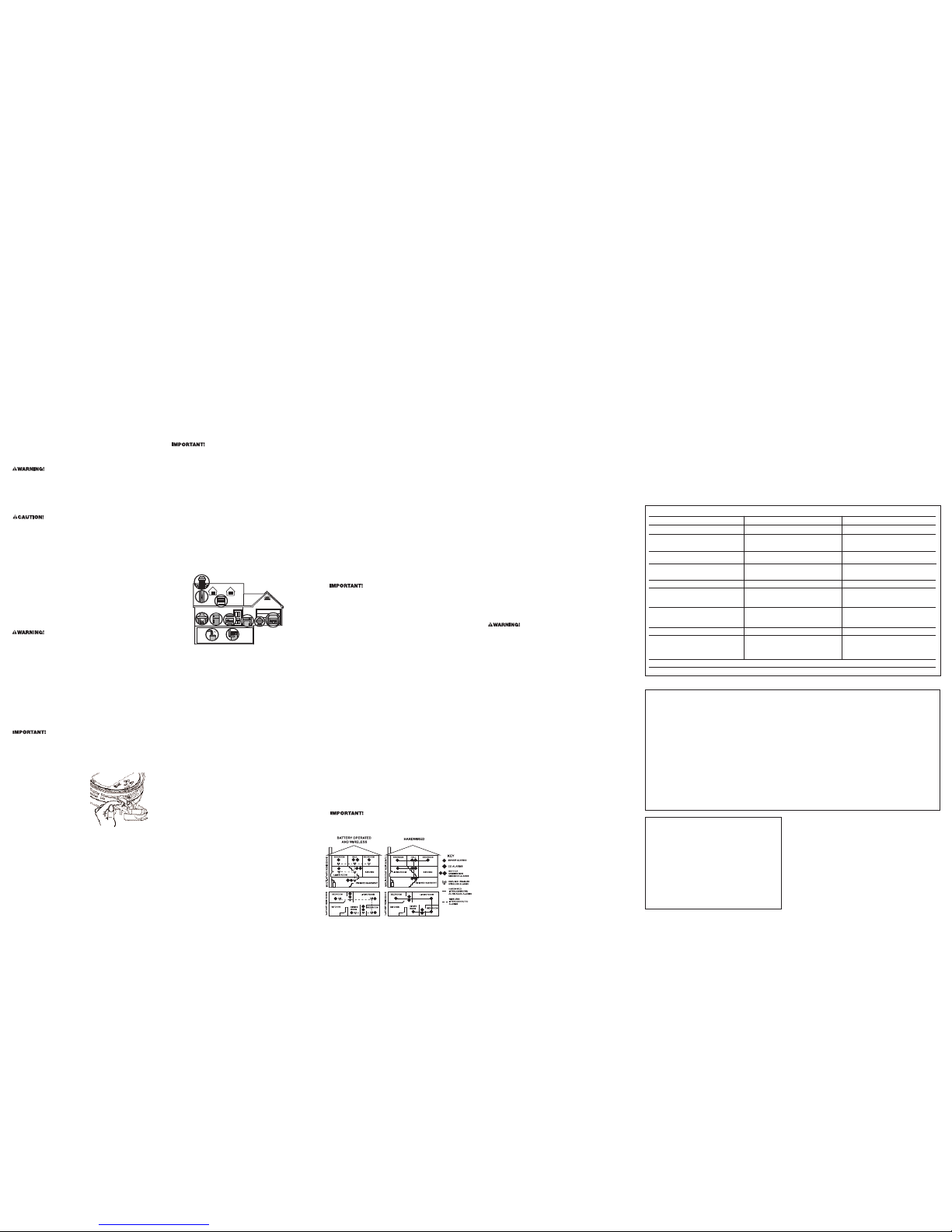
To replace the batteries (without removing Alarm from
the ceiling or w
all):
1. Open the battery compartment.
2.
Press tabs A and B as shown in the
diagram and remove each battery.
3. Insert the new batteries, making sure
they snap completely into the battery
compar
tment.Match the ter minals
on the ends of the batteries with the
terminals on the unit.
4.
Close the batter
y compar
tment, and
then test the unit by pressing the
Test/Silence button.
WEEKLY TESTING
•
NEVER use an open flame of any kind to test this unit.
Y
ou might accidentally damage or set fire to the unit or to your
home.The built-in test switch accurately tests the unit’s
o
peration as required by Underwriters’Laboratories of
C
anada (ULC). NEVER use vehicle exhaust! Exhaust may cause
permanent damage and voids your warranty.
•
DO NOT stand close to the Alarm when the horn is sounding.
E
xposure at close range may be harmful to your hearing.When
testing, step away when horn starts sounding.
It is important to test this unit every week to make sure it is working properly.Using the test button is the recommended way to test this Smoke/CO
A
larm.
You can test this Smoke/CO Alarm bypressing and holding the
T
est/Silence button on the Alarm cover until Alarm Voicesays “Testing”
(
typically 3-5 seconds).
During testing, you will see and hear the following sequence:
• The Alarm Voice will say “Testing.”The Horn will sound
c
ontinuous beeping.The Alarm Voice will say “Warning, evacuate
smoke in [Location, example:“Kitchen”]. Evacuate.”The Power/
Smoke LED flashes Red and the CO LED will be Off.
• Next the Horn will sound 4 beeps, pause, 4 beeps. The Alarm
Voicewill say “Warning, evacuate carbon monoxide in [Location,
e
xample:“Kitchen”]. Evacuate.”The Power/Smoke LED will be Off
and the CO LED flashes Red.
If the unit does not alarm, make sure the batteries are correctly installed,
a
nd test again.If the unit still does not alarm, replace it immediately.
SILENCING THE LOW BATTERY WARNING
T
his silence feature can temporarily quiet the low battery warning “chirp”
for up to 8 hours.You can silence the low battery warning “chirp” by
p
ressing the Test/Silence button on the alarm cover.
O
nce the low battery warning “chirp” silence feature is activated, the unit
continues to flash the Green light twice a minute for 8 hours.After 8
h
ours, the low battery “chirp” will resume. Replace the batteries as soon
a
s possible;this unit will not operate without battery power!
T
o deactivate this feature:Press the Test/Silence button again.
The unit will go into Test Mode and the low battery warning will resume
(
LED flashes and unit sounds “chirp” once a minute).
L
ATCHING FEATURES
Alarm Latch is activated after an Alarm is exposed to alarm levels of
smoke or carbon monoxide.After smoke or CO levels drop below alarm
levels, the “Smoke/Power”LED and/or the “CO” Red LED will begin to
flash On for 2 seconds/Off for 2 seconds.It will continue to flash or “latch”
for about 15 minutes, to give you time to determine which unit
initiated the alarm.
L
ow Battery Latch is activated when the Alarm is in the "low battery
c
ondition".When this occurs, the Smoke/Power LED flashes Green
On for 2 seconds/Off for 2 seconds for about 15 minutes.This feature
i
s designed to help you identify which Alarm needs to have the battery
r
eplaced. Although, the Alarm will sound the low batter y chir p approximately once every minute, sometimes during the initial stages of
"
low battery", the Alarm will chirp in greater intervals than one minute,
s
ometimes up to several hours, until the battery reaches a steady low
battery level.This innovative feature eliminates the frustration of waiting
f
or and/or identifying which unit is chirping.
AGENCY PLACEMENT RECOMMENDATIONS
N
FPA 72 (National Fire Code) Chapter 11
“
For your information, the National Fire Protection Association's
S
tandard 72, reads as follows:”
“11.5.1 One- and Two-Family Dwelling Units.”
“11.5.1.1 Smoke Detection.Where required by applicable laws, codes, or
s
tandards for the specified occupancy, approved single- and multiple -
s
tation Smoke Alarms shall be installed as follows:(1) In all sleeping
r
ooms.Exception: Smoke Alarms shall not be required in sleeping rooms
i
n existing one- and two-family dwelling units.(2) Outside of each
s
eparate sleeping area, in immediate vicinity of the sleeping rooms.
(
3) On each level of the dwelling unit, including basements.Exception:
I
n existing one- and two family dwelling units, approved Smoke Alarms
p
owered by batteries are permitted.”
“
A.11.8.3 Are More Smoke Alarms Desirable?The required number
o
f Smoke Alarms might not provide reliable early warning protection
f
or those areas separated by a door from the areas protected by the
r
equired Smoke Alarms.For this reason, it is recommended that the
h
ouseholder consider the use of additional Smoke Alarms for those
areas for increased protection.The additional areas include the basem
ent, bedrooms, dining room, furnace room, utility room, and hallways
n
ot protected by the required Smoke Alarms.The installation of Smoke
Alarms in kitchens, attics (finished or unfinished), or garages is not
n
ormally recommended, as these locations occasionally experience
conditions that can result in improper operation.”
For your records, please record:
Date Purchased: ______________/_________________
Where Purchased:
__________________________________________
Date Installed: ____________/____________Month/Year
Replace alar
m 7 y
ears after installation.
Please wr
ite the date in the
space provided:
_____________/____________Month/Y
ear
The alar
m will also provide an audible End-of-Life Signal
approximately 7 years after installation to remind you to
replace the unit.
Do not unplug the alar
m or remove the batteries until you get
replacement.
Page 3
I
mprimé au Mexique
M08-0146-013 J1
1
1/10
CONSEILS DE SÉCURITÉ INCENDIE
Respectez les règles de sécurité et prévenez les situations dangereuses :
1
) Utilisez le matériel de fumeur correctement.Ne fumez jamais au lit ;
2
) Gardez les allumettes et les briquets hors de la portée des enfants ;
3) Rangez les matières inflammables dans des contenants appropriés ;
4
) Maintenez les appareils électriques en bon état et ne surchargez pas les
c
ircuits électriques ; 5) Maintenez les cuisinières, les grilles de barbecue, les
foyers et les cheminées exempts de graisse et de dépôts ;6) Ne faites jamais
d
e cuisson sans surveillance sur une cuisinière ;7) Gardez les chaufferettes
p
ortatives et les flammes ouvertes, comme les chandelles, loin des matériaux
inflammables ;8) Ne laissez pas les ordures s'accumuler.
G
ardez les avertisseurs propres et les tester sur une base hebdomadaire.
Remplacez les avertisseurs sans délai s'ils s'avèrent défectueux.Les avertisseurs de fumée qui ne fonctionnement pas ne peuvent pas vous alerter
e
n cas d'incendie.Gardez au moins un extincteur d'incendie en état de
fonctionnement sur chaque étage et en conserver un de plus dans la cuisine.
Faites en sorte qu'il y ait des échelles d'évacuation ou un autre moyen
f
iable d'évacuation d'un étage supérieur en cas d'obstruction de l'escalier.
RENSEIGNEMENTS ÉLÉMENTAIRES CONCERNANT LA
SÉCURITÉ
•
Danger,Avertissement et Attention vous signalent des instructions
d
e fonctionnement importantes ou des situations potentiellement
d
angereuses. Accorder une attention particulière à ces notations.
•
Cet avertisseur de fumée/CO est approuvé pour une utilisation
dans des résidences unifamiliales.
• Cet avertisseur de fumée/CO combiné est doté de deux systèmes
d
’alarmes distincts. Le système d’alarme de monoxyde de
c
arbone est conçu pour détecter le gaz de monoxyde de carbone
provenant de TOUTE source à combustible.Ce système n’indique
q
ue la présence de monoxyde de carbone ou de fumée au niveau
d
u capteur.Il n'est pas conçu pour détecter le gaz, la chaleur ou
les flammes.
•
Le présent avertisseur de fumée/CO ne peut fonctionner sans
piles chargées.Le fait de retirer les piles pour quelque raison que
ce soit, ou de négliger de remplacer les piles à la fin de leur vie
u
tile, supprime toute protection.
• NE JAMAIS ignorer une alerte. Consultez « En cas de déclenchem
ent de votre avertisseur de fumée/CO » pour de plus amples renseignements sur la façon de réagir à une alarme. Ne pas réagir à
une telle alarme peut entraîner des lésions,voire la mort.
•
Les fonctions Silence sont prévues pour votre commodité,elles
ne remédient à aucun problème.Voir « Utilisation des fonctions
Silence » pour de plus amples détails.Contrôlez toujours votre
f
oyer à la recherche d'un problème potentiel après toute alarme.
Ne pas le faire peut entraîner des lésions,voire la mort.
• Contrôlez cet avertisseur de fumée/CO une fois par semaine.
S
i l'avertisseur ne réagit pas correctement,faites-le remplacer
i
mmédiatement ! Un avertisseur qui ne fonctionne pas normalement ne peut signaler un problème.
• Ce produit est prévu pour une utilisation dans les lieux habituels
d
'habitation familiaux intérieurs.Il n'est pas conçu pour mesurer
les niveaux de CO conformément aux normes commerciales
ou industrielles de l'OSHA (Occupational Safety and Health
A
dministration).Les personnes rendues plus sensibles au
monoxyde de carbone par des états médicaux pourront envisager
de recourir à des dispositifs émettant des signaux sonores et
v
isuels en présence de concentrations de monoxyde de carbone
inférieures à 30 ppm.Pour de plus amples renseignements sur le
mono
xyde de carbone ainsi que sur votre état médical, communi-
quer avec votre médecin.
AVERTISSEMENT !
AVERTISSEMENT !
ATTENTION !
AVERTISSEMENT !
ATTENTION !
IMPORTANT !
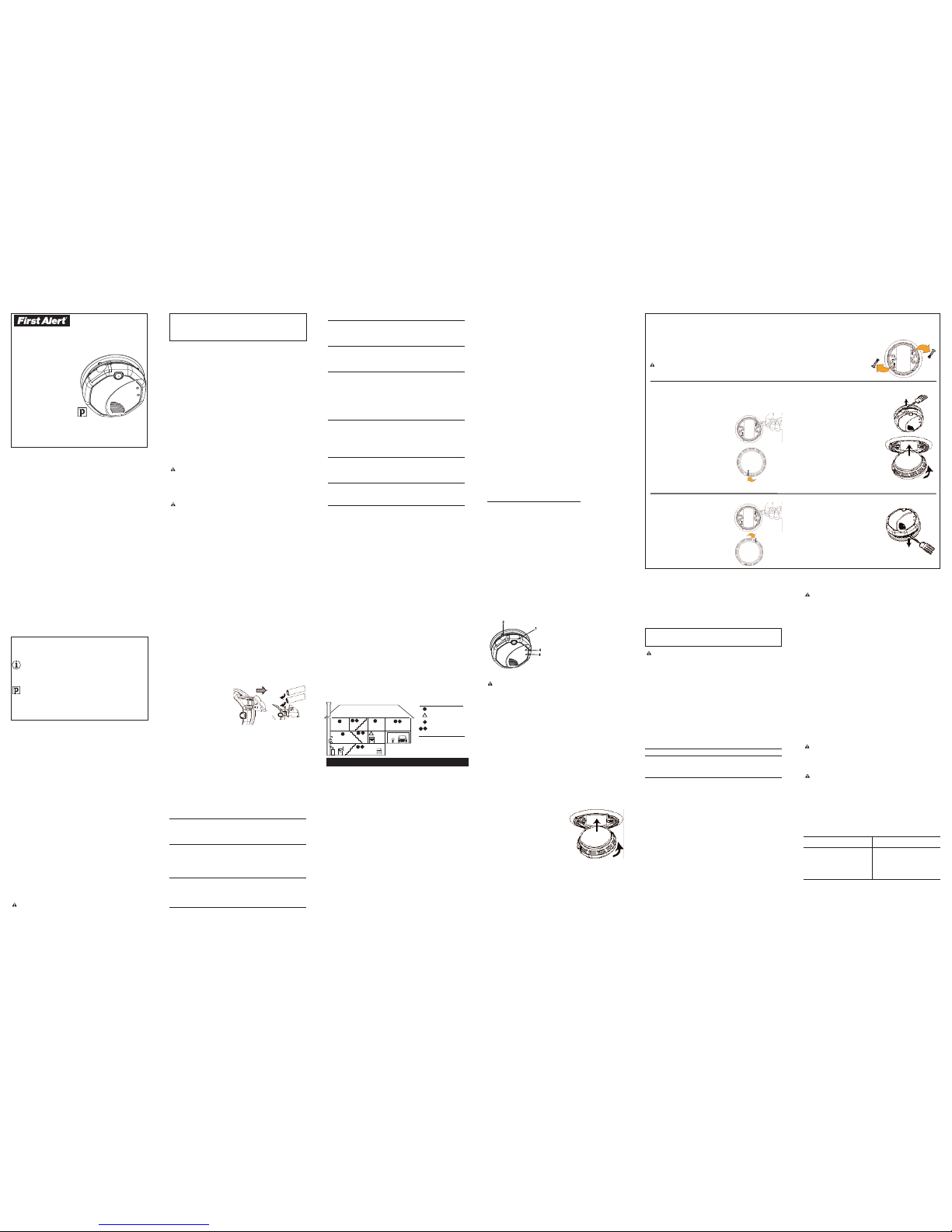
Avertisseur de fumée et de
monoxyde de carbone combiné
à emplacement programmable ONELINK
®
C
aractéristiques :
•
Des capteurs distincts
p
our la fumée et le CO.
L
es deux capteurs de détection
fonctionnent indépendamment
l
’un de l’autre
•
Signaux visuels indiquant les
n
iveaux dangereux de fumée
ou de CO
• Interconnexion sans fil
• Alimenté par deux piles « AA »
•
Tiroir à accès latéral pour un
r
emplacement facile des piles
MANUEL DE
L’UTILISATEUR
CE Q
UE L'ON PEUT VOIR SUR L’AVERTISSEUR
CE QUE L'ON PEUT VOIR SUR L’AVERTISSEUR, suite
S
i l'alarme de fumée est assourdie :
Signal sonore :éteint
Témoin d'alimentation/alarme de fumée :la DEL d’alimentation ROUGE
c
lignote.
T
émoin d’alerte de CO : éteint
S
i l'alarme de CO est assourdie :
S
ignal sonore :éteint
Témoin d'alimentation/alarme de fumée :éteint
Témoin d’alerte de CO :la DEL d’alimentation ROUGE clignote.
M
odèle
S
CO500NVA
1
MONTAGE
OÙ MONTER CET AVERTISSEUR
Comme protection minimale en ce qui a trait aux avertisseurs de fumée,
l
a National Fire Protection Association (NFPA) recommande un avertisseur de
f
umée à chaque étage, dans toutes les aires de couchage et dans chaque
chambre à coucher (Voir « Information réglementaire concernant les
a
vertisseurs de fumée » pour plus de détails concernant les recommandations
d
e la NFPA).
E
n ce qui a trait aux avertisseurs de CO,la National Fire Protection
Association (NFPA) recommande d’installer l’avertisseur de CO à un endroit
central à l’extérieur de chaque aire de couchage dans l’environnement
i
mmédiat des chambres à coucher.Pour un surcroît de protection, monter
des avertisseurs de CO supplémentaires dans chaque chambre à coucher
et à chaque étage du foyer.
REMARQUE : Pour une protection accrue, où cela est possible, installer un
autre avertisseur de fumée/CO à moins 4,6 mètres (15 pieds) d’une fournaise
o
u d’une autre source de chaleur alimentée par du mazout.Dans les maisons
de petites tailles ou maisons usinées où cette distance ne peut
être maintenue
,
installer l’a
vertisseur aussi loin que possible de la fournaise
o
u autre source de chaleur alimentée par du mazout.Le fait d’installer
l’avertisseur à moins de 4,6 mètres (15 pieds) n’endommagera pas
l’a
ver
tisseur, mais peut accroître la fréquence d’alarmes non désirées.
De façon g
énérale
,monter des
avertisseurs de fumée/CO combinés :
• Dans le couloir près de chaque aire de couchage.Si votre foyer compte
p
lusieurs aires de couchage
,
installer un appareil dans chacune d’elles
.
S
i un couloir mesure plus de 12 mètres de long (40 pieds), installer un
appareil à chaque extrémité.
•
À chaque étage de votre foyer, y compris les greniers finis et les sous-sols.
• Dans chaque chambre à coucher, particulièrement si les personnes
dorment la porte partiellement ou complètement fermée.
• Dans le haut de l’escalier menant du premier étage au second.
• Dans le bas de l’escalier du sous-sol.
•
Pour une protection accrue, installer des avertisseurs dans toutes les
p
ièces, les couloirs et les aires de rangement ou la température se situe
généralement entre 4.4° C et 37.8° C (40° F et 100° F).
Emplacement recommandé
•
P
our les a
vertisseurs de fumée/CO montés contre un mur, leur bord
supérieur doit être placé à une distance comprise entre 102 mm (4
pouces) et 305 mm (12 pouces) de la ligne délimitant le mur du plafond.
•
Pour les avertisseurs montés au plafond, les installer aussi près que
possible du centre de celui-ci.
• Dans un cas comme dans l’autre, s'assurer qu'il est fixé à au moins
102 mm (4 pouces) du plaf
ond de la ligne délimitant le mur du plafond.
V
oir « Éviter les espaces sans courant d’air » pour de plus amples
renseignements.
REMARQUE : Quel que soit l’emplacement choisi, s’assurer qu’aucune porte
ou autre obstruction n’empêche le monoxyde de carbone ou la fumée d’atteindre l’a
v
er
tisseur
.
Montage d’avertisseurs de fumée/CO dans les maisons
mobiles et les véhicules de plaisance
Pour une sécurité minimale, monter un avertisseur de fumée/CO aussi près
que possible des aires de couchage.Pour une sécurité accrue, monté un
a
v
er
tisseur dans chaque chambre
.
Beaucoup de maisons mobiles
(particulièrement celles qui ont été fabriquées avant 1978) ont peu de
revêtement isolant ou n’en n’ont pas du tout. Si votre maison mobile n’est
pas bien isolée
,
ou si v
ous n’êtes pas cer
tain du deg
ré d’isolation de celle-ci,
il est important de monter les appareils sur les murs de division seulement.
32
COMMENT MONTER CET AVERTISSEUR
Pour les instructions d’installation rapides, vous référer au « Guide de
r
éférence rapide sur la programmation et l’utilisation des fonctions
optionnelles de l’avertisseur ONELINK®».
C
et a
ver
tisseur de fumée/CO combiné a été conçu pour être monté sur
un plafond ou sur un mur.Ce n’est pas un appareil de table. Cet appareil
doit être monté au plafond ou sur un mur conformément à ce qui suit.Lire
«
Où monter cet a
v
er
tisseur » a
vant de débuter.
O
utils nécessaires : crayon, perceuse à mèche de 5mm (3/16 po), tournevis
normal à lame plate, marteau.
• Ne pas monter cet appareil au-dessus d’une boîte de jonction
électrique. Les courants d’air autour des boîtes de jonction
peuvent empêc
her la fumée d’atteindre la chambre de détection
et empêcher l’appareil de déclencher une alarme.Seuls les
appareils alimentés par le c.a. conviennent pour être montés
au-dessus des boîtes de jonction.
Pour verrouiller le compartiment de piles ou celui de l’avertisseur de
fumée/CO sur le support de fixation, voir la section « Systèmes de
verr
ouillage optionnels » du « Guide de référence rapide sur la
programmation et l’utilisation des fonctions optionnelles de l’avertisseur ONELINK
®
» avant de commencer.
1. Plaquez le support de fixation contre le plafond (ou mur) de sorte que la
fente verticale soit alignée sur la position midi et délinéez l'intérieur des
f
entes de fixation avec un crayon (montage vertical et horizontal).
2.
Placez l'appareil dans un lieu où il ne sera pas couvert de poussière lors
du forage des trous de montage.
3. À l'aide de la mèche de 5 mm (3/16 po), percez un trou au centre des
contours que vous avez tracés.
4. Insérez les chevilles d'ancrage en plastique (dans le sachet en plastique
a
vec les vis) dans les trous.Enfoncez les chevilles d'ancrage doucement
à l'aide d'un mar
teau, au besoin, jusqu'à ce qu'elles arrivent à égalité du
plafond ou du mur.
5. Alignez le support de fixation sur les chevilles d'ancrage en plastique.
6. Vissez le support de fixation sur le plafond ou le mur à travers les fentes
de fixation à l'aide des deux vis fournies.
7. Fixez l'avertisseur de fumée/CO sur le
support de fixation.Alignez les dispositifs
de guidage de la base de l'a
v
er
tisseur sur
les dispositifs de guidage du support de
fixation.Une fois les dispositifs de
guidage alignés
, tour
nez la base dans le
sens horaire (vers la droite) jusqu'à ce
qu'elle s'enclenche en place.
REMARQUE :Une fois l'avertisseur
enc
lenc
hé sur le suppor
t de fixation,
vous pouvez le tourner pour l'aligner.
8.
Essa
y
ez l'a
v
er
tisseur de fumée/CO
.
Consultez « Essai hebdomadaire » pour de plus amples détails.
AVERTISSEMENT !
ATTENTION !
IMPORTANT !
AVERTISSEMENT !
ATTENTION !
AVERTISSEMENT !
ATTENTION !
IMPORTANT !
P
IÈCES DE CET AVERTISSEUR
DE FUMÉE/CO
1 Bouton d'Essai/Silence
2 Compartiment à piles
3 DEL d'alimentation et d'alerte pour
la fumée
4 DEL d'alerte au CO
FONCTIONNEMENT SANS FIL
La technologie ONELINK®de First Alert®est un moyen facile et économique
de protéger votre famille avec un dispositif de sécurité pour toute la maison.
T
ous les avertisseurs ONELINK
®
comm
uniquent entre eux sans fil ni
connecteur.Quand un avertisseur déclenche l'alerte, les autres déclenchent
tous l'alerte.Votre famille est avertie très vite d'un danger potentiel et elle
dispose de plus de temps pour réagir
.
La distance de communication (ou portée) des avertisseurs ONELINK
®
est
génér
alement de 15 mètres (50 pi) à l'intérieur d'un domicile.Cer taines
caractéristiques du domicile, comme le nombre d'étages, le nombre/la taille
des pièces, le mobilier et les types de matériaux de construction utilisés
peuv
ent réduire la portée des avertisseurs.
Parmi les exemples :Plafonds suspendus, réseau de gaines, appareils
ménagers de grande taille (réfrigérateurs) et poteaux métalliques.L'une des
car
actéristiques des avertisseurs ONELINK
®
est qu'ils f
onctionnent comme
un réseau maillé.Tous les avertisseurs relaient tout signal d'alarme reçu par
l'un des avertisseurs ONELINK®.Les per turbations résultant des conditions
str
ucturelles peuv
ent être sur
montées en ajoutant des a
v
er
tisseurs pour
permettre au signal de contourner les obstacles.
•
La por
tée et le bon f
onctionnement de tout dispositif sans fil
dépendent de son milieu.Il est impor tant de contrôler chaque
avertisseur individuellement avant et après le montage afin de
s'assurer que tous les a
ver
tisseur
s réagissent adéquatement.
• Les avertisseurs ONELINK
®
ne doivent pas être utilisés ni
l’e
xtérieur ni pour la transmission entre édifices.Les aver tisseurs
ne pourr
ont comm
uniquer adéquatement dans de telles
conditions.
•
Des objets et papier
s peints métalliques peuvent causés de
l’interférence aux signaux des avertisseurs sans fil.Il faut faire
l'essai des avertisseurs après toute modification apportée au
domicile
,
par e
x
emple
,
après un réaména
g
ement ou un déplaçant
du mobilier,ou lorsque les portes métalliques ont été ouvertes et
fermées.
Votre avertisseur à fumée/CO ONELINK
®
First Alert®signalera automatiquement la présence potentielle d'un incendie ou de monoxyde de carbone à
tous les autres a
v
er
tisseurs ONELINK
®
First Aler
t
®
.
A
VERTISSEMENT D'INDUSTRIE CANADA :
Le f
onctionnement est soumis
aux deux conditions suivantes :(1) Ce dispositif ne doit pas causer de
per
turbations nuisibles, et (2) ce dispositif doit accepter toute perturbation
reçue
, ycompris celles susceptibles de causer un fonctionnement non désiré.
IC:5882A-5001L
Les c
hang
ements ou modifications non e
xpressément appr
ouvés par
BRK Brands, Inc. peuvent annuler le droit d'usage de cet appareil.
AVERTISSEMENT !
ATTENTION !
AVERTISSEMENT !
ATTENTION !
IMPORTANT !
4 5 6
I
NTRODUCTION
M
erci d'avoir choisi la marque First Alert
®
e
n achetant votre avertisseur de
fumée et de monoxyde de carbone.Vous avez fait l’achat d’un avertisseur
d
e fumée et de monoxyde de carbone à la fine pointe de la technologie avec
a
lertes précoces permettant de vous protéger contre des dangers de la fumée
et/ou du monoxyde de carbone.
P
armi les fonctions clés :
Avertisseur de fumée et de monoxyde de carbone combiné. Unavertisseur
p
rotège contre deux dangers domestiques potentiellement mortels.
A
vertisseur activé par une alerte ONELINK
®
.
L’avertisseur activé communique automatiquement avec d’autres avertisseurs ONELINK®interconnectés.
Sonnerie de l’avertisseur à modulation à spectre étalé. La basse fréquence
et la variation de tonalités de la sonnerie de l’avertisseur permettent aux gens
â
gés en perte normale d’ouïe de bien entendre l’alerte. Balayage de fréquence
entre 2200 et 3400 Hz.
Interconnexion en fréquence radio. Communication de fréquence radio
fiable et sécurisée entre avertisseurs.915 MHz, 65 000 codes de sécurité et
3
canaux en mode de saut de fréquence.
Bouton d'Essai/Silence uniquesupprimant la confusion. Selon le mode sur
lequel se trouve l’avertisseur, le fait d'appuyer sur le bouton donne accès à diff
érentes fonctions, telles l'essai de l’avertisseur, l'assourdissement de l’avertisseur, l'essai répété de l'alarme sur le mode Silence et la suspension de la
fonction de verrouillage.
Deux modes d’assourdissement. Assourdit temporairement le signal
d’épuisement huit heures avant le remplacement de la pile épuisée ou
a
ssourdit les alarmes non désirées pendant quelques minutes.
Deux modes de verrouillage.Verrouillage de l’alarme : permet d’identifier
f
acilement l’avertisseur qui a initié l’alarme même après son arrêt.
Verrouillage de l’épuisement de la pile. Permet d’identifier l’appareil ayant une
pile épuisée.
L
e système de fixation parfaitcomprend une base sans joint pour un
montage facile et un nouveau support de fixation qui maintient l’avertisseur
de façon sûre sur un g
r
and arc de rotation af
in de per
mettre un alignement par-
f
ait.
Signal de fin de vie. Un signal sonore est émis lorsqu’il f
aut remplacer
l’alarme.
© 2010 BRK Brands, Inc. Tous droits réservés.
Distribué par BRK Brands, Inc.
3901 Liberty Street Road, Aurora, IL 60504-8122
Service à la clientèle : (800) 323-9005 • www.firstalert.com
T
ous les a
vertisseurs de fumée First Alert
®
sont conf
ormes aux
e
xigences réglementaires, y compris la norme ULC S531,et sont conçus
d
e manière à détecter les particules de combustion.Des particules de
fumée en quantité et de f
ormats v
ariables se produisent avec tous les
t
ypes d'incendies.
La technologie à ionisation est génér
alement plus sensib
le que la
technologie photoélectrique pour la détection des fines particules
a
yant tendance à se produire en plus grand nombre avec les feux
flambants qui consument r
apidement les matér
iaux combustibles et
progressent avec vigueur.Les sources de ces incendies peuvent inclure du
p
apier qui brûle dans une corbeille ou un feu de graisse dans la cuisine.
La technologie photoélectrique est généralement plus sensible que
la technologie à ionisation dans la détection des grandes particules
a
yant tendance à se produire en grand nombre avec les feux à
progression lente qui peuvent couver pendant des heures avant de
s'enflammer.Les sources de ces incendies peuvent inclure les cigarettes
qui br
ûlent dans des sofas ou dans la literie.
Pour une protection maximale,utilisez les deux types d'avertisseurs de
fumée sur c
haque étage et dans chaque chambre à coucher de votre foyer.
POUR VERROUILLER LE COMPARTIMENT DES PILES
Ne verrouillez pas le compartiment des piles tant que vous n'avez pas
i
nstallé les piles et contrôlé le fonctionnement de l'avertisseur.
S
i l’appareil ne déclenche pas d’alarme pendant l’essai,NE PAS ver-
r
ouiller le compartiment des piles !
I
nstaller des piles neuves et réessayer.Si
l
’avertisseur ne déclenche toujours pas
d
’alarme, le remplacer sans délai.
1. À l’aide d’une pince à becs pointus,
d
étacher une broche de verrouillage
du support de montage.
2. Lorsque les piles sont insérées,
poussez la broche de verrouillage dans le
t
rou près du verrou du compartiment des
piles à l’arrière de l’avertisseur.
SYSTÈMES DE VERROUILLAGE OPTIONNELS
AVERTISSEMENT !
ATTENTION !
IMPORTANT !
POUR VERROUILLER LE SUPPORT DE MONTAGE
1
. À l’aide d’une pince à becs pointus,
d
étachez une broche de verrouillage
du support de montage.
2. Introduisez la broche de verrouillage
d
ans le trou situé à l'arrière de
l
'avertisseur de la façon illustrée
sur le schéma.
3. En fixant l’avertisseur sur le support
de montage, la tête de la broche de
v
errouillage se loge dans une
encoche du support.
L
es systèmes de verrouillage optionnels sont conçus pour empêcher le retrait non autorisé des piles ou de l’avertisseur.Il n’est pas nécessaire
d
’actionner les verrous dans les résidences unifamiliales où le retrait non autorisé des piles ou de l’avertisseur n’est pas à craindre.
C
es avertisseurs comportent deux dispositifs de verrouillage distincts : l’un d’entre eux verrouille le compartiment de pile et l’autre verrouille l’avertisseur sur le sup-
p
ort de montage. On peut choisir d’utiliser chacune de ces fonctions indépendamment, ou de les utiliser toutes les deux.
O
utils nécessaires : • Pince à becs pointus • Tournevis normal à lame plate.
C
es deux systèmes de verrouillage ont recours à des broches de verrouillage, lesquelles sont moulées dans le support de
m
ontage.À l’aide d'une pince à becs pointus, retirer l'une des broches, ou les deux, du support de montage, selon le nombre
d
e systèmes de verrouillage souhaité.
P
our retirer l’un ou l’autre des verrous de façon permanente,introduire le tournevis à lame plate entre la broche de
v
errouillage et le verrou,et extraire la broche du verrou.
AVERTISSEMENT !
POUR DÉVERROUILLER LE COMPARTIMENT DES
PILES
1
. Détacher l’avertisseur du support de
m
ontage.Si l’appareil est verrouillé
sur le support, voir la section
«
Déverrouillage du support de
m
ontage ».
2. Introduire un tournevis à tête plate sous
l
a tête de la broche de verrouillage et
la forcer délicatement hors du verrou du
compartiment des piles. (Si l’on
s
ouhaite reverrouiller ultérieurement le
compartiment des piles, conserver la
b
roche de verrouillage.)
3. Pour reverrouiller le compartiment des
p
iles et fermer le couvercle de la pile et
réintroduire la broche de verrouillage
dans le verrou.
4
. Remontez l'avertisseur sur le support
d
e fixation.
À
l’occasion du remplacement des piles,contrôler toujours
l’avertisseur avant de verrouiller à nouveau le compartiment des piles.
AVERTISSEMENT !
ATTENTION !
IMPORTANT !
POUR DÉVERROUILLER LE SUPPORT DE MONTAGE
1
. Introduisez un tournevis plat dans la
découpe rectangulaire du support de fixa
tion le plus proche de la broche de verr
ouillage.
2. Écartez l'avertisseur du support en
p
oussant le tournevis vers le haut et en
tournant en même temps l'avertisseur
dans le sens antihoraire (vers la
g
auche).
SI VOTRE AVERTISSEUR DE CO DÉCLENCHE UNE
ALERTE
Le déclenchement de cet appareil indique la présence de monoxyde de
carbone (CO), un gaz qui peut être MORTEL.
S
i le signal de l’alarme retentit (4 bips) :
1. Se rendre immédiatement là où il y a de l’air frais, à l’extérieur ou près
d’une f
enêtre ou d’une porte ouverte. S’assurer que tout le monde est
présent.Ne pas regagner les lieux ou s’éloigner de la fenêtre ou de la
porte ouverte avant que les services d’urgence arrivent, que les lieux
aient été bien aérés et que l’avertisseur de CO soit en bon état de
fonctionnement;
2. Appeler votre service d’urgence local (numéro de téléphone) (brigade de
pompiers ou le 911)
Remarque :Si le signal sonore de « ser vice » retentit (dépistage des pannes,
c’est-à-dire 3 bips) :(le fabricant fournira la description des
mesures à adopter).
AVERTISSEMENT !
Si l'avertisseur sonore à CO retentit et si le témoin
à
CO r
oug
e c
lignote, déplacez tout le monde à l'air frais.
NE QUITTEZ PAS les piles !
S’IL S’AGIT D’UNE ALARME DE FUMÉE/CO
QUE FAIRE EN PREMIER LIEU—IDENTIFIER LE TYPE
D’ALARME
S
e référer à la section précédente
« Ce que l’on peut voir sur l’avertisseur ».
SUIV
ANT UNE ALARME
P
our v
érifier la pointe maximale enregistrée de CO lors de l’alarme après
l’arrivée de l’enquêteur, après que la maison ait été bien aérée et que
l’a
vertisseur de CO se remet en conditions normales, suivre l’étape suivante :
Étape à suivre :
1.Pour effacer la pointe maximale enregistrée, maintenir enfoncé le bouton
d’Essai/Silence.
Pour conserver la pointe maximale de CO en mémoire, ne pas appuyer sur
le bouton.
QUE FAIRE SI L’ALARME RETENTIT
R
ÉPONDRE À UNE ALERTE
•
Si l’alarme retentit alorsque l’on n’est pas en train d’e
x
écuter un
essai, cela signale une situation potentiellement dangereuse qui
e
xige une attention immédiate. Ne JAMAIS ignorer une alarme.
Cela pourrait entraîner des b
lessures ou la mor
t.
• Ne retirez jamais les piles d'un avertisseur à piles dans le but de
neutraliser une fausse alarme (causée par la fumée de cuisson,
etc.).
Le fait de retirer les piles désactive l'avertisseur et rend impossible
la détection de la fumée, annulant votre protection. Ouvrez plutôt
une f
enêtre ou é
vacuer la fumée loin de l'appareil.
L'a
ver
tisseur se
réenclenchera automatiquement.
• En cas d’alarme, faire sortir tout le monde de la maison immédiatem
ent.
MESURES À PRENDRE EN CAS D'INCENDIE
•
Ne paniquez pas,demeurez calme.Suivez le plan d'évacuation prévu.
• Sortez de la maison aussi vite que possible.Ne vous arrêtez pas pour
vous habiller ou rassembler de quelconques objets.
•
Tâtez les portes du revers de la main avant de les ouvrir.Si la porte est
fraîche, ouvrez-la lentement.N'ouvrez pas une porte qui est chaude.
Gardez les portes et les fenêtres fermées à moins qu'il ne s'agisse
d'issues de secours
.
• Couvrez-vous le nez et la bouche avec un chiffon (humide de
préf
érence).Respirez à petits coups.
•
Réunissez-vous au lieu de rencontre prévu à l'extérieur de la maison et
comptez tout le monde afin de vérifier que toutes les personnes sont
sor
ties et en sécurité.
• Appelez le service des incendies le plus rapidement possible une fois à
l'extérieur.Donnez l'adresse d'abord avant de vous identifier.
• Ne retournez jamais à l'intérieur d'un édifice en feu quelle qu'en soit la
raison.
• Communiquez avec le service des incendies local pour apprendre à
mieux sécur
iser le foyer.
Les a
ver
tisseur
s présentent diverses limitations.Voir « Limitations
générales des avertisseurs de fumée/CO » pour de plus amples détails.
AVERTISSEMENT !
AVERTISSEMENT !
UTILISATION DES FONCTIONS SILENCE
Ne retirez jamais les piles pour mettre en sourdine une fausse alarme.
Retirer les piles in
v
alide l'a
vertisseur et supprime sa protection.
La f
onction Silence est conçue pour mettre pro
visoirement en sourdine l'avertisseur sonore pendant que vous identifiez et remédiez au problème.N'utilisez
pas la fonction Silence dans les situations urgentes.Elle ne remédiera pas à
la présence de CO et n'éteindr
a pas un incendie
.
La fonction Silence peut temporairement neutraliser une fausse alarme
pendant plusieurs min
utes
.
On peut mettre l'avertisseur de fumée/CO en
sourdine en appuyant de 3 à 5 secondes sur le bouton d'Essai/Silence situé
sur le couvercle de l'avertisseur.
Quand on relâche le bouton Essai/Silence, la DEL rouge clignote sur le mode
sourdine.
AVERTISSEMENT !
Si l’a
ver
tisseur de fumée est mis
en sourdine
Si l’a
ver
tisseur de CO est mis en
sourdine
L
’avertisseur de fumée sera mis en
sourdine pendant un maximum de
15 min
utes et reviendra ensuite à
son f
onctionnement normal.
Si la fumée n’a pas dispar
ue ou si
elle contin
ue à augmenter
, l'appareil
déclenchera à nouveau une alarme.
Il demeure silencieux pendant un
maximum de 4 minutes.
Si les niveaux de CO demeurent
potentiellement dangereux au bout
de 4 min
utes
, l'a
v
er
tisseur sonore
retentit à nouveau.
ÉT
APES À SUIVRE POUR LA
PR
OGRAMMATION DE L’AVERTISSEUR
R
EMARQ
UE : Les opérations 1 à 3 doivent être exécutées en deux
m
inutes.S'il s'écoule plus de deux minutes la DEL verte d'alimentation
cesse de clignoter.Il suffit d'ouvrir le logement de piles du second
a
vertisseur et de répéter les opérations 1 à 3.
1. Introduisez les piles dans le
logement de piles de l'a
vertisseur suivant.NE FERMEZ
PAS LE LOGEMENT.
2. Appuyez sur le bouton d'essai
et maintenez-le enfoncé puis
f
ermez le compartiment des
piles.
3. Quand vous entendez l'appareil
émettre un bif, relâchez le bouton d'essai.La DEL d'alimentation VERTE
commencera à clignoter, indiquant que l'avertisseur ONELINK
®
attend les
données de programme de l'un des autres avertisseurs ONELINK
®
de la configuration.
4. Appuyez sur le bouton d'Essai/Silence du premier avertisseur et
maintenez-le enf
oncé jusqu'à ce que le second avertisseur émette
un gaz
ouillis et que sa DEL d'alimentation v
er
te cesse de clignoter.
Relâchez alors le bouton d'essai.
5. Si vous avez acheté un avertisseur ONELINK
®
câblé à piles de secours,
il peut maintenant être connecté à l'a
vertisseur câblé en montant le
connecteur trifilaire du plafond sur l'avertisseur.
6.
Répétez les opérations 1 à 5 pour des avertisseurs ONELINK
®
supplé
-
mentaires
.
Les nouveaux avertisseurs ONELINK
®
sont désormais reliés avec succès.Pour ajouter des avertisseurs supplémentaires ultérieurement, exécutez les opérations 1 à 5.
POUR AJOUTER OU INTERCONNECTER DES
A
VERTISSEURS ONELINK
®
OÙ NE PAS MONTER CET AVERTISSEUR
N
E PAS placer cet avertisseur de fumée/CO :
•
Dans les garages, chaufferies ou toute autre lieu extrêmement
p
oussiéreux, sale ou graisseux.
•
Là où des particules de combustion sont produites.Les par ticules de
combustion se forment quand quelque chose brûle.Les lieux à éviter
s
ont notamment :les cuisines mal aérées, les garages et les chaufferies.
M
aintenir les appareils à 6 mètres (20 pi) au moins des sources de
p
articules de combustion (cuisinière, fournaise, chauffe-eau, appareil
d
e chauffage d’appoint).Dans les lieux où il est impossible de maintenir
c
ette distance de 6 mètres (20 pi) — les maisons modulaires ou mobiles
e
t les maisons de petite taille, par exemple — il est recommandé de
p
lacer l’avertisseur de fumée/CO aussi loin que possible de ces sources
à
combustible.Les recommandations de placement ont pour but de
m
aintenir ces avertisseurs à une distance raisonnable de toute source à
c
ombustible, et de réduire de ce fait les alarmes « intempestives ».Les
a
larmes intempestives se produisent quand un avertisseur de fumée/CO
e
st placé directement à côté d’une source à combustible.Aérer ces lieux
l
e mieux possible.
•
À moins de 4,6 mètres (15 pieds) d’une fournaise ou d’une autre source
de chaleur alimentée par du mazout ou d'appareils au mazout comme
un chauffe-eau.
•
Dans les espaces à forte humidité.Cet avertisseur doit être à une
distance minimale de 3 mètres (10 pi) de toute baignoire, douche, sauna,
humidificateur, vaporisateur, lave-vaisselle, buanderie, pièce de service
o
u toute autre source d’humidité élevée.
•
Directement au soleil.
• Dans l’air turbulent, comme à proximité de ventilateurs de plafond, ou de
f
enêtres ouvertes.L’air en circulation risque d’empêcher le fumée/CO
d’atteindre les capteurs.
• Dans les lieux où la température est inférieure à 4° C (40° F) ou
s
upérieure à 38° C (100° F).Ces lieux comprennent les vides sanitaires
n
on climatisés, les greniers non finis, les plafonds non ou mal isolés, les
vérandas et les garages.
•
Dans les endroits infestés d’insectes.Les insectes peuvent obstruer les
o
uvertures de la chambre de détection et entraîner de fausses alarmes.
•
À moins de 30,5 cm (12 pouces) de lampes fluorescentes.Des parasites
d’origine électrique peuvent faire obstacle au capteur.
•
Dans les vides d’air non ventilés.Voir la section « Éviter les vides d’air
n
on ventilés ».
ÉVITER LES VIDES D'AIR NON VENTILÉS
Les « vides d’air » peuvent empêcher les émanations d’atteindre l’avertisseur
de fumée/CO.Afin d’éviter les vides d’air, appliquer les recommandations de
m
ontage qui suivent.
S
ur les plafonds, installer les avertisseurs de fumée/CO aussi près que
possible du centre du plafond.Si c’est impossible, installer l’avertisseur de
fumée/CO à au moins 10 cm (4 pouces) du mur ou du coin.
P
our le montage mural (si les codes du bâtiment le per mettent), le bord
supérieur des avertisseurs de fumée/CO doit être placé entre 10 cm (4 pouces)
et 30 cm (12 pouces) de la ligne du mur et du plafond.
Sur un plafond pointu ou à pignon ou sur un plafond cathédrale, monter
l
e premier avertisseur de fumée/CO dans une limite de 0,9 mètres (3 pieds) du
faîte de plafond, mesuré horizontalement.D’autres avertisseurs de fumée/CO
peuvent être nécessaires selon la longueur, l'angle, etc.de la pente du plafond.
C
onsulter l’article 72 de la NFPA pour obtenir les détails relatifs aux exigences
en ce qui a trait aux plafonds en pente ou aux plafonds pointus.
I
MPORTANT ! LIRE ATTENTIVEMENT ET CONSERVER.
C
et avertisseur a été expédié avec un manuel d’instructions qui
contient des informations importantes sur son fonctionnement.
S
i vous installez cet appareil pour le compte d’une autre personne,
v
ous devez laisser ce manuel ou une copie de celui-ci à l’utilisateur.
H
OMOLOGUÉ
NORME
ULC S531 et
C
SA 6.19
EMPLACEMENTS SUGGÉRÉS POURMONTER LES AVERTISSEURS DE FU MÉE,
LES AVERTISSEURS DE CO ET LESAPPAREILS COMBINANT LES DEUX DÉTECTIONS
AVERTISSEUR DE FUMÉE
AVEC FONCTION SILENCE
AVERTISSEURS DE CO
LES DEUXOU UNAVERTISSEUR
COMBINANT LES DEUX TYPES
DEDÉTECTION
AVERTISSEURS DE FUMÉE
LÉGENDE :
Les emplacements suggérés sont basés
sur les recommandations de la NFPA
(norme NFPA 72 pour les avertisseurs de
fumée et NFPA 720 pour les avertisseurs
de monoxyde de carbone). Toujours
consulter les codes nationaux et locaux
avantd'entreprendre toute installation.
Dans les nouvelles constructions des avertisseurs de fumée alimentés par le Secteur et par
Secteur/CCDOIVENT être interconnectés afin de respecter les recommandations de la NFPA.
CHAMBRE
ÀCOUCHER
CHAMBRE
ÀCOUCHER
CHAMBRE
ÀCOUCHER
SOUS–SOL
GARAGE
CUISINE
SÉJOUR
COULOIR
COULOIR
En conditions normales
Signal sonore :silencieux
T
émoin d'alimentation/alar
me de fumée :
la DEL d’alimentation
VERTE
clignote toutes les minutes
Témoin d’alerte de CO :éteint
Au moment du test de l’avertisseur :
Signal sonore :émet un signal continu
Témoin d’alimentation/alarme de fumée :la DEL d’alimentation ROUGE
clignote suiv
ant la même séquence que le signal sonore
.
Signal sonore :4 bips rapides, pause, 4 bips rapides
La DEL d’alimentation ROUGE de témoin de CO clignote suivant la
même séquence que le signal sonore
.
Si les piles sont faib
les ou manquantes :
Signal sonore :
alerte sonore une fois par minute
Témoin d'alimentation/alarme de fumée :la DEL d’alimentation VERTE
clignote pendant 2 secondes puis s’éteint pendant 2 secondes.Le
v
errouillage de l’épuisement de la pile s’enclenche.
Témoin d’alerte de CO :éteint
S
i l’avertisseur ne fonctionne pas normalement (signal de défaillance) :
Signal sonore :émet 3 bips toutes les minutes
Témoin d'alimentation/alarme de fumée :la DEL d’alimentation ROUGE
clignote 3 fois environ chaque minute.
T
émoin d’alerte de CO : éteint
Lorsque l’avertisseur a atteint sa fin de vie utile :
S
ignal sonore :émet 3 bips toutes les minutes
T
émoin d'alimentation/alarme de fumée : la DEL d’alimentation clignote 3
f
ois environ chaque minute.
Témoin d’alerte de CO :éteint
Détection de CO :
S
ignal sonore :émet 4 bips, pause, 4 bips*
T
émoin d'alimentation/alarme de fumée : éteint
T
émoin d’alerte de CO : Durant l’alarme :la DEL d’alimentation ROUGE
clignote suivant la même séquence que le signal sonore.Après l’alarme :
c
lignote ROUGE pendant 2 secondes, puis s’éteint pendant 2 secondes.
L
e verrouillage de l’alarme de CO s’enclenche.
*Remarque : si l’alerte de CO est déclenchée, le cycle régulier de 4 bips,
brève pause se répétera pendant quatre minutes.Après quatre minutes, la
p
ause augmentera à une minute.
D
étection de fumée :
S
ignal sonore :émet des bips continus
T
émoin d'alimentation/alarme de fumée : Durant l’alar me : la DEL
d’alimentation ROUGE clignote suivant la même séquence que le signal
s
onore.Après l’alarme : la DEL d’alimentation ROUGE clignote pendant 2
s
econdes, puis s’éteint pendant 2 secondes.Le verrouillage de
l’alarme de fumée s’enclenche.
Témoin d’alerte de CO :éteint
Page 4
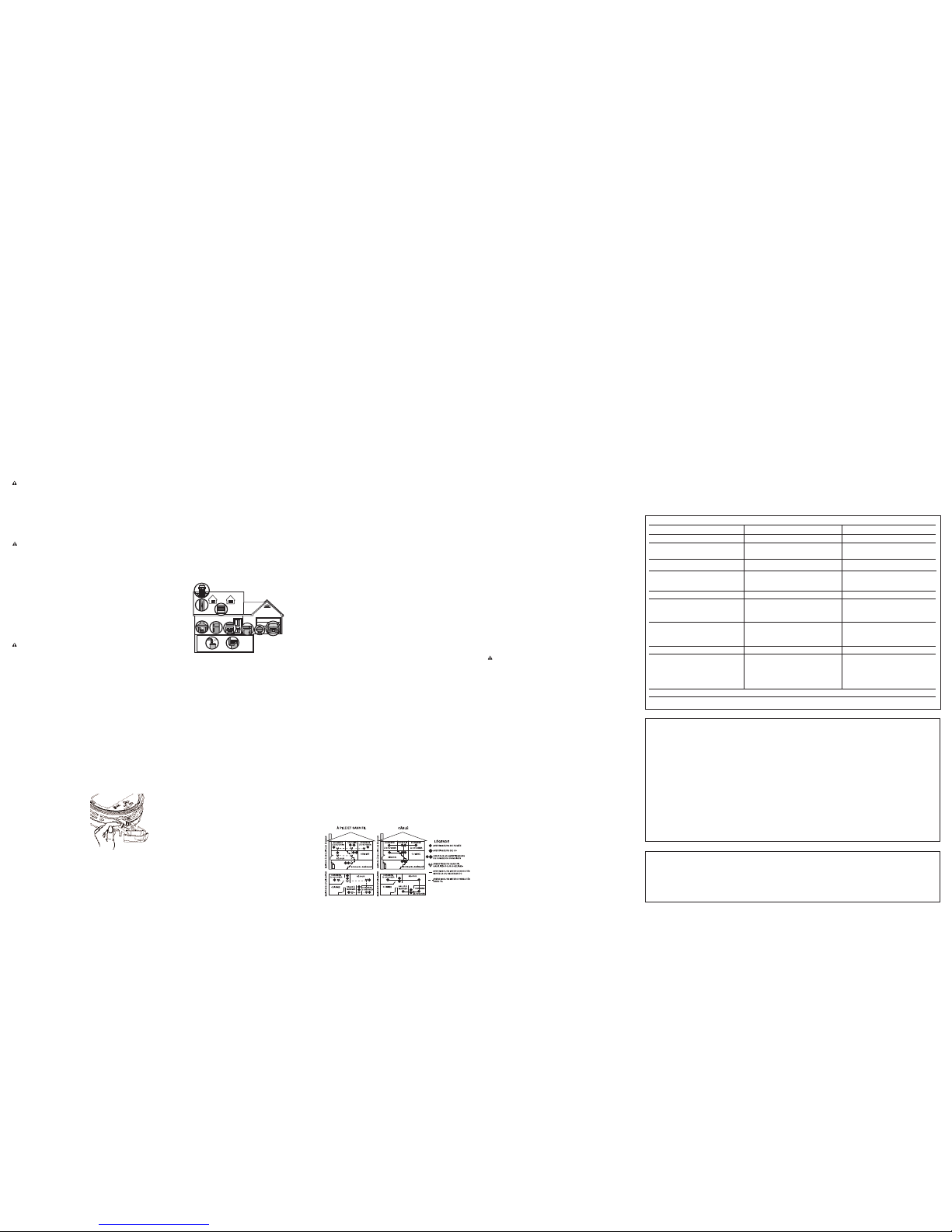
7 8 9
CE QU’IL FAUT SAVOIR À PROPOS DU CO
QU’EST-CE QUE LE CO ?
Le monoxyde de carbone (CO) est un gaz invisible, inodore et insipide produit
l
ors de la combustion incomplète des combustibles fossiles ou lorsque ceux-ci
s
ont exposés à la chaleur (généralement le feu).Les appareils électriques ne
produisent généralement pas de CO.
Ces combustibles comprennent : le bois, la houille, le charbon de bois,
l
’huile, le gaz naturel, l’essence, le kérosène et le propane.
D
es appareils communs sont souvent une source de CO.S’ils sont mal
e
ntretenus ou aérés, ou en mauvais état, la concentration de CO peut monter
r
apidement.Le CO présente un vrai danger maintenant que les maisons sont
é
conergétiques.Les maisons étanches munies d’isolation suppléme ntai re et
d
otées de fenêtre scellées et d’autres matériaux d’étanchéité peuvent
e
mpêcher le CO de fuir vers l’extérieur.
SYMPTÔMES D’INTOXICATION PAR MONOXYDE DE
CARBONE
L
es symptômes suivants peuvent être indicatifs d’EMPOISONNEMENT AU
M
ONOXYDE DE CARBONE et il convient d’en discuter avec TOUS les
membres du ménage :
F
aible exposition :Maux de tête, nez qui coule, yeux qui brûlent, symptômes
qui ressemblent à ceux de la grippe ;
Exposition moyenne : Étourdissements, somnolence, vomissements ;
E
xposition extrême : Perte de conscience, lésion cérébrale, décès.
L
’étude de nombreux cas D’EMPOISONNEMENT AU MONOXYDE DE
C
ARBONNE révèle que, tout en étant conscientes, les victimes ne se sentent
p
as bien ;elles deviennent si désorientées qu’elles sont incapables de se
s
auver en quittant l’édifice ou en appelant à l’aide.
Cet avertisseur de CO mesure l’exposition au CO au cours d’un certain
t
emps.Il déclenche une alarme si les concentrations de CO sont extrême-
m
ent élevées pendant une courte période, ou si elles atteignent un certain
seuil minimal pendant une longue période.Cette alar me est généralement
d
éclenchée avant l’apparition de symptômes chez les adultes moyens en
bonne santé.Pourquoi cela est-il important ? Parce qu’il faut être averti d’un
problème potentiel de CO alors qu’il est encore temps de réagir.En outre,
l
es jeunes enfants et les animaux de compagnie peuvent être touchés en premier.Il est possible que l’adulte moyen en bonne santé ne ressente aucun
symptôme lors du déclenchement de l’alarme.Toutefois, les personnes
p
résentant des problèmes cardiaques ou respiratoires, les enfants en bas
âge, les bébés en gestation, les femmes enceintes et les personnes âgées
peuvent être intoxiquées plus rapidement et plus gravement par le CO.Si l’on
r
essent des symptômes, même légers, d’intoxication au monoxyde de car-
bone, consulter immédiatement un médecin !
DÉCOUVRIR LA SOURCE DE CO APRÈS UNE ALARME
Le monoxyde de carbone est un gaz inodore et invisible, ce qui rend difficile
la localisation de son origine après une alarme.Voici quelques-uns des
f
acteurs qui rendent la localisation de CO plus difficile après l’alarme :
•
La maison est bien aérée avant l’arrivée de l’enquêteur.
• Le problème est dû au refoulement.
•
Il s’agit d’un problème passager dû à des conditions spéciales.
S
i le CO se disperse avant l’arrivée de l’enquêteur, il pourra s’avérer difficile
d’en localiser la source.BRK Brands, Inc. ne sera pas obligé de rembourser
les frais entraînés par toute enquête sur la présence de monoxyde de
c
arbone ou par tout appel de service.
SOURCES POTENTIELLES DE CO AU FOYER
A
ppareils à combustion comme : chaufferettes d’appoint, foyer à gaz ou à
b
ois, cuisinière à gaz, sécheuse à gaz.
Système de ventilation endommagé ou insuffisant : tuyau de ventilation
de chauffe-eau déconnecté ou rouillé, conduit ou tuyau de cheminée présentant des fuites, échangeur de chaleur fissuré, ouverture de cheminée
obstruée ou colmatée.
Mauvaise utilisation d’un appareil ou d’un dispositif : fonctionnement
d’un barbecue ou d’une voiture dans un endroit fermé comme un garage ou
une véranda.
Pr
oblèmes de CO passagers : les prob
lèmes passagers ou intermittents
peuvent être dûs à des conditions extérieures ou autres.
Les conditions suiv
antes peuvent causer des problèmes de CO
passagers :
1.
Déversement excessif ou évacuation refoulée d’appareils à combustion
provoqué par des conditions extérieures telles que :
•
Direction et/ou vitesse du vent, y compris vents forts et rafales.Air
lourd dans les tuyaux d’évacuation (air froid/humide avec de longues
périodes entre les cycles).
• Différentiel de pression négatif résultant de l’utilisation de ventilateurs
de tir
age
.
• Plusieurs appareils fonctionnant simultanément avec une quantité d’air
frais limitée.
•
Raccords de tuyaux d’évacuation desserrés par les vibrations au
niveau des sécheuses, fournaises ou chauffe-eau.
•
Obstruction du tuyau d´évacuation ou design inhabituel de ce dernier,
susceptibles d’aggraver les situations ci-dessus.
2.
Fonctionnement prolongé d’appareils à combustion sans évacuation
(cuisinière, four, cheminée).
3.
Inversions de température, susceptibles de maintenir les gaz d’échappement au sol.
4. Véhicules tournant au ralenti dans un garage attenant ou proche, ouvert
ou fermé.
Ces conditions sont dangereuses parce qu’elles peuvent maintenir les gaz
d’échappement dans v
otre maison.
Ces conditions étant inter
mittentes
, il est
difficile de les recréer lors d’une enquête visant à trouver une source de CO.
AVERTISSEMENT !
ATTENTION !
IMPORTANT !
COMMENT PROTÉGER MA FAMILLE CONTRE L’INTOXICATION
P
AR LE MONOXYDE DE CARBONE, suite
• Effectuer des inspections périodiques de tous les appareils à combust
ion.S’assurer qu’ils ne présentent pas d’entar trage ou de rouille
e
xcessive.Vérifier également la flamme du brûleur et les veilleuses.
La flamme doit être bleue.Les flammes jaunes indiquent que la
c
ombustion est incomplète et la présence possible de CO.Garder la
t
rappe de la soufflante de la fournaise fermée.Utiliser des bouches
d’aération ou des ventilateurs sur tous les appareils à combustion
l
orsqu’ils sont disponibles.S’assurer que tous les appareils sont
é
vacués à l’extérieur.Ne pas faire de grillades à l’intérieur, dans un
garage ou dans une véranda fermée.
•
S’assurer que les sources de CO ne refoulent pas de gaz d’échappement, que le coupe-tirage d’une fournaise en fonctionnement ne refoule
p
as de CO et que les échangeurs de chaleur de la fournaise
n
e sont pas fissurés.
•
Vérifier la maison ou le garage situé de l’autre côté d’un mur commun.
•
Garder les portes et les fenêtres légèrement ouvertes.Si on souçonne
u
ne fuite de CO dans la maison, ouvrir une fenêtre ou une porte pour
diminuter de façon significative les niveaux de CO.
Il importe aussi de se familiariser avec tout le matériel inclus.Lire le
p
résent manuel de bout en bout pour comprendre ce qu’il faut faire en
c
as d’alerte au CO.
COMMENT PROTÉGER MA FAMILLE CONTRE
L’INTOXICATION PAR LE MONOXYDE DE CARBONE
Un a
v
er
tisseur de CO est un e
xcellent mo
y
en de protection.
Il sur
veille la
qualité de l’air et déclenche une alarme sonore puissante avant que les
concentrations de monoxyde de carbone deviennent dangereuses pour les
adultes mo
y
ens en bonne santé
.
Un a
ver
tisseur de CO ne remplace pas un bon entretien des appareils
ména
gers.
P
our é
viter les prob
lèmes posés par le CO et réduire les r
isques d’intoxication :
• Nettoyer chaque année les cheminées et leurs conduits. Veiller à ce
qu’ils soient e
x
empts de débr
is de f
euilles et de nids af
in de per
mettre
une circulation normale de l’air.Demander à un professionnel de vérifier l’absence de rouille et de corrosion, de fissures ou de séparations
qui pourraient empêcher l’air de bien circuler et provoquer un refoulement.
Ne jamais installer un chapiteau de cheminée ou la couvrir de
manière à obstruer la circulation de l’air.
• Faire l’essai et entrenir tous les appareils à combustion une fois l’an.
De nombreux distributeurs de gaz, d’huile ou de systèmes CVCA offrent
un ser
vice d’inspection d’appareils moyennant une somme minime.
Suite...
RENSEIGNEMENTS RÉGLEMENTAIRES
CONCERNANT LES AVERTISSEURS DE FUMÉE/CO
RENSEIGNEMENTS RÉGLEMENTAIRES
CONCERNANT LES AVERTISSEURS DE CO
Q
UELS NIVEAUX DE CO PROVOQUENT UNE ALARME ?
L
a norme CSA 6.19 exige que les avertisseurs de CO à usage résidentiel
déclenchent une alarme lorsque qu'ils sont exposés aux niveaux de CO et
p
endant les durées d'exposition décrits ci-dessous.Ces niveaux sont mesurés
e
n parties par million (ppm) de CO sur une certaine durée (en minutes).
P
oints d'alarme exigés par à la norme CSA 6.19* :
•
Si l'avertisseur est exposé à 400 ppm de CO, IL DOIT DÉCLENCHER
UNE ALARME toutes les 4 à 15 MINUTES.
• Si l'avertisseur est exposé à 150 ppm de CO, IL DOIT DÉCLENCHER
UNE ALARME toutes les 10 à 50 MINUTES.
•
Si l'avertisseur est exposé à 70 ppm de CO, IL DOIT DÉCLENCHER
U
NE ALARME toutes les 60 à 240 MINUTES.
* Exposition d'environ 10 % de COHb à des niveaux d'humidité relative (HR)
d
e 10 % à 95 %.
C
et appareil est conçu pour ne pas déclencher d'alarme lorsqu'il est exposé à
un niveau constant de 30 ppm pendant 30 jours.
L
es avertisseurs de CO sont conçus pour déclencher une alarme avant qu'un
d
anger de mort soit présent. Le CO étant invisible et inodore, ne jamais sup-
poser qu'il n'est pas présent.
• Une exposition à plus de 100 ppm de CO pendant 20 minutes n'a pas
d
'influence nocive sur des adultes moyens en bonne santé, mais au
bout de 4 heures le même niveau pourra provoquer des maux de tête.
•
Une exposition à 400 ppm de CO pourra provoquer des maux de tête
chez les adultes moyens en bonne santé au bout de trente-cinq
minutes, elle pourra néanmoins provoquer la mort au bout de 2 heures.
N
ormes : CSA 6.19-01.
S
elon la norme CSA 6.19-01 : Les avertisseurs de monoxyde de carbone
couverts par ces exigences sont conçus pour réagir à la présence d'oxyde de
c
arbone provenant de diverses sources, sans y être limitées, telles que :gaz
d
'échappement de moteurs à combustion interne, fonctionnement
anormal d'appareils à combustible et des foyers.Les avertisseurs de
C
O sont conçus pour détecter des niveaux de monoxyde de carbone
au-dessous de ceux pouvant entraîner une perte de capacité à réagir aux
dangers d'une exposition au mono
x
yde de carbone.Cet avertisseur de CO
c
ontrôle l'air et est conçu pour se déclencher avant que les niveaux de CO
constituent une menace pour la vie.Cela vous donne un temps précieux pour
vous per
m
ettre de quitter la maison et de corriger le problème.Cela est
s
eulement possible que si les avertisseurs sont situés, installés et entretenus
selon les directives de ce manuel.
Températures et humidités typiques de détection de gaz :L’avertisseur
n'est pas conçu pour généralement détecter des niveaux de CO de moins de
3
0 ppm.
Soumis à des essais de résistance aux f
ausses alar
mes en présence
de méthane (500 ppm), butane (300 ppm), heptane (500 ppm), acétate
d'éthyle (200 ppm), alcool isopropylique (200 ppm) et de gaz carbonique
(5000 ppm).
Les valeurs indiquent les concentrations de gaz et de vapeurs en
p
arties par million.
A
vertisseur sonore : 8
5 dB minim
um à 3 mètres (10 pi).
AVERTISSEMENT !
ATTENTION !
IMPORTANT !
RENSEIGNEMENTS RÉGLEMENTAIRES
CONCERNANT LES AVERTISSEURS DE FUMÉE
EMPLACEMENTS RECOMMANDÉS POUR LES AVERTISSEURS DE
FUMÉE
Installation des avertisseurs de fumée dans les résidences unifamiliales
La National Fire Protection Association (NFPA) recommande l’installation
d’un avertisseur de fumée à chaque étage, dans chaque aire de couchage
et dans chaque chambre à coucher
.
Dans les nouv
elles constructions, les
avertisseurs de fumée doivent être alimentés en c.a.et être interconnectés.
Voir « Recommandations d’installation de l’organisme ».Pour une protection
accr
ue
, il est recommandé d'installer un a
vertisseur de fumée dans toutes
les chambres à coucher, dans les couloirs, les espaces de rangement, les
greniers finis et les sous-sols où la température se situe généralement entre
4° C (40° F) et 38° C (100° F).
S’assurer qu’aucune por
te ou tout autre
obstacle n’empêchera la fumée d’atteindre les avertisseurs de fumée.
Plus précisément,installer des aver tisseurs de fumée :
•
À chaque étage de v
otre foyer, y compris les greniers finis et les sous-
sols
.
•
Dans chaque chambre à coucher, particulièrement si les personnes
dorment la porte partiellement ou complètement fermée.
• Dans le couloir près de chaque aire de couchage.Si votre demeure
compte plusieurs aires de couchage, installer un appareil dans chacune
d’elles.Si le couloir mesure plus de 12 mètres de long (40 pieds), installer
un appareil à chaque extrémité.
•
Dans le haut de l'escalier menant du premier au deuxième étage et dans
le bas de l'escalier du sous-sol.
Les exigences précises relatives à l'installation des avertisseurs de fumée
v
ar
ient selon l'état, la pro
vince et la région.
Vérifiez auprès du service des
incendies local en ce qui concerne les exigences s'appliquant à la région
visée.Il est recommandé que les appareils alimentés en c.a. ou en
c.a./c.c.
soient inter
connectés pour une pr
otection accrue
.
AVERTISSEMENT !
ATTENTION !
IMPORTANT !
AU SUJET DES AVERTISSEURS DE FUMÉE
A
vertisseurs de fumée alimentés par une pile (c.c.) : Ils assurent une
protection même en cas de panne de courant, à condition que la pile
f
onctionne et qu’elle soit bien montée.Il n’est pas nécessaire que les
a
ppareils soient montés par un professionnel, ils sont faciles à installer.
A
vertisseurs de fumée alimentés par le c.a.: Ils peuvent être interconnectés
de telle sorte que tous les avertisseurs déclenchent l’alarme si l’un deux
détecte de la fumée.Ils ne fonctionnent pas en cas de panne de courant.
A
vertisseurs alimentés par le c.a. avec pile (c.c.) de secours :
Ils fonctionnent en cas de panne de courant, à condition que la pile soit en
bon état et correctement montée.Les appareils alimentés par le c.a. et par
c
ircuit c.a./c.c.doivent être montés par un électricien cer tifié.
A
vertisseurs de fumée ONELINK
®
a
limentés par le circuit c.a.et dotés de
p
iles de secours (c.c.) : Les interconnexions à par tir de ONELINK
®
p
ermettent le fonctionnement des avertisseurs de fumée et de fumée/CO sans fils ou
c
onnecteurs, de telle sorte que lorsqu'une alarme retentit, les autres retentis-
s
ent aussi.En cas de panne de courant, les appareils fonctionneront à condition que les piles fonctionnent et qu'elles soient correctement
m
ontées.Les appareils sont faciles à installer et n'exigent pas l'intervention
d
'un professionnel.
A
vertisseurs de fumée/CO pour les utilisateurs d’énergie solaire ou
é
olienne et les systèmes d’alimentation par batteries de secours :
Les avertisseurs de fumée/CO alimentés par le c.a.ne doivent fonctionner
qu’avec des inverseurs d'onde sinusoïdale réelle.Faire fonctionner cet
a
vertisseur à partir de la plupart des blocs d’alimentation de type à système
d’alimentation sans coupure à batterie ou d’inverseurs à onde carrée, ou
quasi-sinusoïdale, endommagera l’avertisseur.Si vous n’êtes pas sûr
d
u type d’inverseur ou de système d’alimentation sans coupe dont vous
disposez, veuillez consulter le fabricant afin de vérifier.
A
vertisseurs de fumée pour les personnes malentendantes : Des
avertisseurs de fumée spéciaux doivent être installés pour les personnes
malentendantes.Ils comprennent une alarme visuelle et une alar me sonore
e
t rencontrent les exigences de l'Americans With Disabilites Act.Ils peuvent
être interconnectés de telle sorte que tous les avertisseurs déclenchent
l’alarme si l’un deux détecte de la fumée.
On ne doit pas utiliser de grilles protectrices avec les avertisseurs de
fumée à moins que la combinaison ait été évaluée et déclarée adéquate.
Tous ces avertisseurs de fumée son conçus de manière à déclencher
r
apidement une alarme d'incendie lorsqu’ils sont correctement montés et
entreten
us selon les indications du Man
uel de l'utilisateur et si la fumée
atteint l’avertisseur.Si vous n'êtes pas certain du type d’avertisseur de fumée
à
installer, voir l'article 72 de la National Fire Protection Association (NFPA) et
l’ar
ticle 101 de la NFP
A (Lif
e Safety Code) National Fire Protection
Association, One Batterymarch Park, Quincy, MA 02269-9101 É.-U.
L
es codes du bâtiment de votre localité peuvent également exiger certains
appareils en par
ticulier dans une nouv
elle constr
uction ou dans différentes
parties de votre foyer.
CONSIDÉRATIONS SPÉCIALES DE
CONFORMITÉ
Ce seul appareil ne convient pas pour remplacer les systèmes complets
de détection des incendies pour les endroits logeant un grand nombre
d
e per
sonnes,comme les immeubles résidentiels, les condominiums, les
hôtels, les motels, les résidences d’étudiants, les hôpitaux, les centres
hospitaliers de soins de longue durée,les foyers pour personnes âgées,
l
es ser
vices de garde ou n'importe quel foyer de groupe,même si ceux-ci
ont déjà été des maisons unifamiliales.Cet appareil n’est pas un remplacement convenable pour les systèmes complets de détection des
incendies dans les entrepôts,
les installations industrielles,les édifices
commerciaux et les édifices non résidentiels à vocation particulière,
pour lesquels des systèmes spéciaux de détection des incendies et
d'alarme sont nécessaires.
Selon les codes du bâtiment de votre région,
cet appareil peut convenir pour fournir une protection supplémentaire
dans ces étab
lissements.
Les informations suivantes s’appliquent aux cinq types d’édifices
én
umérés ci-dessous :
Dans les nouvelles constructions, la plupart des codes du bâtiment exigent
l’utilisation d’a
vertisseurs de fumée alimentés par le c.a.ou le c.a./c.c.
exclusivement.Les avertisseurs de fumée alimentés par le c.a., le c.a./c.c.
ou le c.c.peuvent être utilisés dans les constructions existantes selon les spécif
ications des codes du bâtiment locaux.Consulter l’ar ticle 72 NFPA (National
Fire Alarm Code) et l’article 101 NFPA (Life Safety Code), les codes du bâtiment locaux ou s’adresser au service des incendies de votre localité pour les
détails concer
nant les exigences en matière de protection incendies des édi-
fices qui ne sont pas définis comme des « ménages ».
1.
Résidence unifamiliale :
Résidence unifamiliale, maison de ville.L’installation de cet appareil est
recommandée à chaque étage du foyer, dans chaque chambre à coucher
et dans chaque couloir conduisant à des chambres
.
2. Les résidences plurifamiliales ou d’occupation mixte :
Les immeubles d’habitation, copropriétés.Cet appareil convient pour les
appar
tements individuels ou les copropriétés à condition qu’un système
primaire de détection des incendies soit déjà installé afin de répondre aux
exigences de détection des incendies dans les aires communes comme les
halls d’entrée, les couloirs ou les vérandas.L’utilisation de cet appareil dans
les aires communes ne peut procurer un avertissement suffisant à tous les
résidents ou être conforme à toutes les réglementations/ordonnances locales
en matière de protection contre les incendies.
3. Institutions : Hôpitaux, les services de garde, les centres hospitaliers de
soins de longue durée.Cet appareil convient pour les chambres individuelles
des patients/résidents à condition qu’un système pr
imaire de détection des
incendies soit déjà installé afin de répondre aux exigences de détection des
incendies dans les aires communes comme les halls d’entrée, les couloirs ou
les vérandas.L’utilisation de cet appareil dans les aires communes ne peut
procurer un avertissement suffisant à tous les résidents ou être conforme à
toutes les réglementations/ordonnances locales en matière de protection contre les incendies.
4. Hôtels et motels : Également les pensions et les résidences d’étudiants.
Cet appareil con
vient pour les chambres individuelles/chambres de résidents
à condition qu’un système primaire de détection des incendies soit déjà installé afin de répondre aux exigences de détection des incendies dans les aires
comm
unes comme les halls d’entrée, les couloirs ou les vérandas.L’utilisation
de cet appareil dans les aires comm
unes ne peut procurer un a
v
er
tissement
suffisant à tous les résidents ou être conforme à toutes les
réglementations/ordonnances locales en matière de protection contre les
incendies.
5.
Entrepôts/Bâtiments industriels :
N'utilisez P
AS cet a
vertisseur de
fumée/CO dans des entrepôts, des bâtiments industriels ou commerciaux, des
bâtiments spécialisés non résidentiels
, des véhicules récréatifs, des bateaux
ou des aéronefs.Cet avertisseur de fumée/CO est spécialement conçu pour
une application résidentielle et, il est possible qu'il n'assure
pas une protection adéquate dans des applications non résidentielles
.
AVERTISSEMENT !
Imprimé au Mexique M08-0146-013 J1 11/10
First Aler
t
®
est une marque déposée de First Aler
t
Trust utilisée sous
licence.
ONELINK
®
est une marque déposée de BRK Brands, Inc.
GARANTIE LIMITÉE
BRK BRANDS, INC., (« BRK »), fabricant des produits First Alert®garantit pendant une période de sept ans à compter de la date d’achat, ce produit
contre tout vice de matériaux et de main-d’œuvre.BRK se réser ve le droit de réparer ou de remplacer ce produit ou tout composant défectueux pendant la
durée de la garantie.Ce produit ou composant sera remplacé par un produit ou composant neuf ou remis à neuf. Si le produit n’est plus offert, il sera remplacé par un produit semblable de valeur égale ou supérieure.Ceci est votre garantie exclusive.
La gar
antie est valable pour l’acheteur initial au détail, à compter de la date de l’achat, et n’est pas transférable.Conserver le reçu de caisse original.
Une preuve d’achat est requise pour faire valoir la garantie.Les concessionnaires, centres de service ou magasins qui vendent des produits BRK n’ont pas
le droit de modifier ou de changer de quelque façon que ce soit les conditions de la présente garantie.
Cette garantie ne couvre pas l’usure normale des pièces ou les dommages résultant de la négligence, l’abus du produit, l’utilisation d’une tension ou d’une alimentation inadéquate, l’usage inadéquat, ainsi que le démontage, la réparation ou la modification du produit par toute personne autre que BRK ou un centre de ser
vice agréé.La garantie ne couvre pas les cas de force majeure tels les incendies, inondations, ouragans et tornades ou les piles fournies avec ce
produit.
BRK ne sera responsable d’aucuns dommages indirects ou consécutifs causés par l’inobservation de toute garantie expresse ou implicite.Sauf dans la
mesure interdite par la loi appplicable, toute garantie implicite de valeur marchande ou d’adaptation à une fin particulière est limitée dans le temps à la
durée de la présente garantie.Cer tains, états, provinces ou juridictions n’autorisent pas l’exclusion ou la limitation des dommages indirects ou consécutifs
ou les limitations quant à la pér
iode de gar
antie implicite
.
Il est donc possib
le que les limitations ou e
xclusions ci-dessus ne s’appliquent pas à vous.La
présente garantie confère des droits légaux spécifiques aux utilisateurs et il se peut que d’autres droits s’appliquent selon l’état ou la province.
P
our obtenir un ser
vice de garantie
Entretien-dépanna
g
e :
Si une inter
v
ention est nécessaire
, ne pas retourner le produit au détaillant.Pour obtenir un service de garantie, s’adresser au
Service à la clientèle au 1 800-323-9005 entre 7 h 30 et 17 h, heure normale du centre, du lundi au vendredi. Pour vous aider à mieux vous servir, être en
mesure d’indiquer le n
uméro de modèle et la date d’achat du produit.
P
our une inter
vention d'entretien-dépanna
ge au titre de la garantie, retourner à :
BRK Br
ands
, Inc., 25 Spur Dr
ive, El Paso, TX 79906
Pile : BRK Br
ands
, Inc.
n’offre aucune gar
antie
, e
xpresse ou implicite
, écrite ou orale, y compris une garantie de qualité marchande ou d'adaptation à une
fin particulière en ce qui concerne l’achat.
GUIDE DE DÉPANNAGE
Si l'avertisseur... Problème... Il faut...
É
met un bip toutes les minutes. Signal de l'épuisement de la pile. Monter deux piles « AA » neuves*.
L
e signal sonore émet trois bips chaque minute. SIGNAL DE DÉFAILLANCE.L’appareil ne
fonctionne pas correctement et doit être remplacé.
L
es appareils sous garantie devraient être retournés
au fabricant afin d’être remplacés.Voir « Garantie
l
imitée » pour de plus amples détails.
L
es avertisseurs sont interconnectés mais ne
communiquent pas entre eux.
P
ossibilité d’interférence.Se référer à la section
« Fonctionnement sans fil » du manuel.
D
éplacez les avertisseurs à différents emplacements.
Ajoutez un autre avertisseur entre les avertisseurs
q
ui ne communiquent pas entre eux pour permettre
a
u signal de contourner les obstacles.
A
vertisseur de monoxyde de carbone SEULEMENT :
L
'avertisseur de CO déclenche une nouvelle alerte
4 minutes après que vous l'ayez mis en sourdine.
L
es niveaux de CO indiquent la présence d'un
danger potentiel.
S
IVOUS RESSENTEZ LES SYMPTÔMES D'UNE
INTOXICATION OXYCARBONÉE, ÉVACUEZ votre
d
omicile et appelez le 911 ou les pompiers
.
C
onsultez « Si l'avertisseur de CO déclenche
l'alarme » pour de plus amples détails.
L
'a
v
er
tisseur de CO déclenche l'alar
me bien qu'une
i
nvestigation plus poussée ne décèle aucun niveau
élevé de CO.
I
l est possib
l
e que l'a
v
er
tisseur de CO soit monté à
u
n mauvais endroit.Consultez « Où monter cet
avertisseur » pour de plus amples détails.
C
hanger l'a
v
er
tisseur d'emplacement.
Si les alarmes
f
réquentes se poursuivent, faire vérifier une nouvelle
fois qu'il n'y a pas de source problématique de
C
O dans la maison.
I
l est possib
le qu'on soit en
p
résence de fuites intermittentes de CO.
A
vertisseurde fumée SEULEMENT :
L'a
vertisseur
de fumée déclenche un signal sonore
alors qu’on ne voit pas de fumée.
Les f
ausses alarmes peuvent provenir de sources
qui ne présentent aucune urgence, comme la fumée
de cuisson.
Neutr
aliser l'alarme sonore à l'aide du bouton
d'Essai/Silence ;nettoyer le couvercle de
l'avertisseur à l'aide d'un chiffon doux et propre.En
cas d'alar
mes intempestives répétées, changer
l'emplacement de l'avertisseur.Il se peut que l'avertisseur soit trop près d'une cuisine,d'un appareil de
cuisson ou d'une salle de bains très humide
.
*Pour une liste des piles de rechanges acceptables, consulter la section « Entretien périodique ».
Si vous avez des questions auxquelles ce manuel ne peut pas répondre, appeler le Service aux consommateurs au 1 800 323-9005 entre 7 h 30 et 17 h, heure nor-
male du centre
, du lundi au vendredi.
La DEL (ROUGE) clignote et le signal sonore émet
trois bips chaque minute.
Signal de fin de vie.
L’avertisseur doit être remplacé.
Il faut remplacer l’avertisseur immédiatement.
1110 12
ENTRETIEN PÉRIODIQUE
Cet appareil a été conçu de manière à nécessiter le moins d’entretien
p
ossible, mais quelques mesures simples s'imposent afin de le maintenir
en bon état de f
onctionnement.
N’utiliser que les piles de remplacement figurant dans la liste cidessous. Il est possible que l’appareil ne fonctionne pas normalement
avec d’autres piles.Ne jamais utiliser de piles rechargeables, car elles
risquent de ne pas fournir une charge complète.
• E
n faire l’essai au moins une fois par semaine.
• Nettoyer l’avertisseur de fumée/CO au moins une fois par mois ;passer
doucement l’aspir
ateur à l’extérieur de l’avertisseur de fumée/CO en
utilisant la brosse d’époussetage de l'aspirateur.Un contenant d’air
comprimé filtré (vendu chez les détaillants de matériel informatique) peut
également être utilisé
.Suivre les instructions du fabricant pour l’emploi.
Essayer l’avertisseur de fumée/CO.Ne jamais utiliser d’eau, de produits
de nettoyage ou de solvants, qui sont susceptibles d’endommager
l’appareil.
• Si l’avertisseur de fumée/CO devient encombré d’un excès de saletés,
de poussières et/ou de souillures et qu'il ne peut être netto
yé de manière
à empêcher les fausses alarmes, remplacer l'appareil immédiatement.
• Changer l’emplacement de l'appareil si celui-ci émet fréquemment des
fausses alarmes.Voir « Où ne pas monter cet avertisseur » pour plus de
détails
.
Choisir une pile de rechange :
Cet avertisseur de fumée/CO exige deux piles AA standard.On peut aussi
utiliser des piles Energiz
er E91.
On tr
ouve ces piles dans la plupart des
magasins.
La durée de vie des piles dépend de l’a
vertisseur et de l’environnement
dans lequel il se trouve.Toutes les piles mentionnées ci-dessus conviennent
comme piles de rechange pour cet appareil.Ne pas se fier aux normes du
f
abricant.Il FAUT remplacer les piles dès que l’alarme commence à émettre
des bips (le « signal d'épuisement de la pile »).
AVERTISSEMENT !
ATTENTION !
IMPORTANT !
AVERTISSEMENT !
Pour remplacer les piles (sans déplacer l'avertisseur
du plaf
ond ou du m
ur) :
1. Ouvrez le compartiment de la pile.
2. Appuyez sur les onglets A et B illustrés
sur le schéma et retirez les piles.
3. Introduisez les piles neuves en vous
assurant qu'elles sont enclenchées complètement dans le compar
timent des
piles.Faites correspondre les bornes du
bout des piles aux bornes
de l'appareil.
4.
Fermez le compartiment des piles,
v
ér
if
iez ensuite l'appareil en appuy
ant
sur le bouton d'Essai/Silence.
ESSAI HEBDOMADAIRE
•
NE JAMAIS utiliser aucun type de flamme ouverte pour faire
l
’essai cet appareil.Vous pourriez endommager ou brûler accidentellement l’appareil ou causer un incendie dans votre foyer.
L
e commutateur d’essai intégré teste le fonctionnement de
l
’appareil avec précision conformément aux exigences des
Laboratoires des assureurs du Canada (ULC).NE JAMAIS utiliser
l
es gaz d’échappement d’un véhicule ! De tels gaz d’échappement
p
euvent provoquer un endommagement permanent et annuler la
garantie.
•
NE PAS se tenir trop près de l’appareil quand il émet son signal
sonore. L’exposition à une distance rapprochée peut être nuisible
p
our l’ouïe. Lors des essais, s’écarter de l’appareil quand
l
’avertisseur sonore retentit.
Faire l’essai de cet appareil toutes les semaines est important afin
d
e vérifier qu’il fonctionne normalement.L’utilisation du bouton
d’Essai/Silence est la manière recommandée de tester cet avertisseur de
fumée/CO.
P
our tester cet avertisseur de fumée/CO,maintenir enfoncé le bouton
Essai/Silence sur le couvercle de l’avertisseur (de 3 à 5 secondes).
D
urant le test, vous remarquerez la séquence suivante :
• L’avertisseur émet des bips continus.La DEL d’alimentation/alarme
ROUGE clignote et la DEL de COest éteinte.
•
Après, l’avertisseur émet 4 bips, pause et 4 bips.La DEL
d’alimentation/alarme est éteinte et la DELde CO ROUGE clignote.
Si l’a
vertisseur n’émet aucune alarme, s’assurer que les piles soient bien
installées et tester à nouveau.Si l’appareil n’émet toujours pas d’alarme,
l
e remplacer immédiatement.
AVERTISSEMENT !
ATTENTION !
AVERTISSEMENT !
MISE EN SOURDINE DU SIGNAL SONORE
D'AVERTISSEMENT D'ÉPUISEMENT DE LA PILE
La fonction Sourdine peut assourdir provisoirement le signal d'avertissement
d
e l'épuisement de la pile pendant un maximum de 8 heures.On peut mettre
e
n sourdine le signal d'avertissement de l'épuisement de la pile en appuyant
sur le bouton d'Essai/Silence situé sur le couvercle de l'avertisseur.
Quand on active la fonction de mise en sourdine le bip d'épuisement de la
p
ile, le témoin vert de l'appareil continue à clignoter deux fois par minute pendant 8 heures.Au bout de huit heures, le signal d'épuisement de la pile (des
b
ips) recommence.Remplacez les piles dès que possible ; l'appareil ne
p
ourra pas fonctionner sans l'alimentation des piles !
P
our désactiver cette fonction : Enfoncez à nouveau le bouton d'Essai/
S
ilence.L'appareil passera au mode d'essai et le signal d'épuisement de
la pile reprendra (le DEL clignotera et l'appareil émettra un bip à toutes les
m
inutes).
FONCTIONS DE VERROUILLAGE
L
e verrouillage de l’avertisseurest activé lorsqu’un avertisseur est exposé
à des niveaux dangereux de fumée et de monoxyde de carbone.Une fois que
les niveaux de fumée ou de CO baissent sous les niveaux dangereux,
l
a DEL d’alimentation/alarmeet/ou la DEL ROUGE de « CO » clignote
pendant 2 secondes et s’éteint pendant 2 secondes.La DEL clignote
continuellement ou « se verrouille » pendant environ 15 minutes pour vous
p
ermettre d’identifier l’avertisseur qui a déclenché l’alarme.
L
e verrouillage de l’épuisement de la pileest activé lorsque l’alarme est
en mode « d’épuisement de la pile ».À ce moment, la DEL
d
’alimentation/alarmeVERTE clignote pendant 2 secondes et s’éteint
p
endant 2 secondes pendant environ 15 minutes.Cette fonction a été conçue
pour permettre l’identification de l’avertisseur dont la pile est épuisée.Même
si l’avertisseur émet un signal sonore faible toutes les
m
inutes, parfois durant les stades initiaux d’avertissement « d’épuisement de
l
a pile », l’avertisseur émet un signal sonore à des intervalles excédant une
minute, parfois pendant plusieurs heures jusqu’à ce que la pile atteigne un
n
iveau minimal pour le remplacement.Cette fonction innovatrice permet
l
’identification rapide de l’appareil qui émet un signal sonore.
Pour vos dossiers,veuillez noter :
La date d’achat :_______________/________________
Le lieu d’ac
hat :
____________________________________________
La date d’installation : ____________/____________Mois/Année
Remplacer l’avertisseur 7 ans après son installation. Noter cette
date dans l’espace pré
vue :
_____________/____________Mois/Année
L
’avertisseur émet une alerte sonore de fin de vie après
7 ans suivant son installation pour signaler qu’il faut remplacer
l’appareil.
Ne pas débranc
her l’avertisseur ni enlever les piles avant de vous
procurer un nouvel appareil.
LIMITATIONS GÉNÉRALES DES AVERTISSEURS DE FUMÉE/CO
C
et avertisseur de fumée/CO est conçu pour une utilisation résidentielle.
Il n’est pas conçu pour une utilisation dans des applications industrielles,
p
our lesquelles il est nécessaire de se conformer aux exigences de l’OSHA
(
Occupational Safety and Health Administration) en matière d’avertisseurs de
monoxyde de carbone.L’avertisseur de fumée intégré à cet appareil n’est pas
c
onçu pour alerter les résidents malentendants. Des avertisseurs de fumée
s
péciaux doivent être installés pour les résidents malentendants (les avertisseurs de CO ne sont pas encore disponibles pour les malentendants).
L
es avertisseurs de fumée/CO ne réveillent pas nécessairement toutes
l
es personnes. Conduire au moins deux répétitions du plan d’évacuation
chaque année, en veillant à ce que tout le monde y participe – des enfants
aux grands-parents.Permettre aux enfants de se familiariser avec le plan
d
’évacuation en cas d’incendie et de le répéter avant de déclencher un
exercice d’évacuation de nuit pendant leur sommeil.Si les enfants et d'autres
personnes ne se réveillent pas d’eux-mêmes quand l’alarme se déclenche, ou
s
’il y a des enfants en bas âge ou des personnes présentant des limitations
de mobilité, veiller à désigner quelqu’un pour les aider lors
de l’exercice d’évacuation ou en cas d’urgence.Il est recommandé de
d
éclencher un exercice d’évacuation pendant que les membres de la famille
dorment. Cela per mettra de déterminer leurs réactions à l'alar me pendant leur
sommeil mais aussi s'ils auront besoin d'aide en cas d'urgence.
L
es avertisseurs de fumée/CO ne fonctionnent pas en l'absence
d’alimentation. Les appareils à pile ne peuvent pas fonctionner si la pile
e
st manquante, déconnectée ou épuisée ou si un mauvais type de pile est
u
tilisé, ou encore si la pile n'est pas correctement montée.Les appareils
alimenté par le c.a.ne peuvent fonctionner si l'alimentation c.a. est coupée
p
our quelque raison que ce soit (fusible grillé, disjoncteur déclenché, panne le
l
ong du circuit ou à une station électrique, feu électrique qui consume les fils
électriques, etc.).Si les limites de l’alimentation par pile ou par le c.a. vous
p
réoccupent, installer les deux types d’appareils.
C
et avertisseur de fumée/CO ne détectera pas la fumée ou le monoxyde
de carbone qui n’atteint pas le capteur.Il ne détecte que la fumée ou le CO
q
ui atteint le capteur.Il peut y avoir de la fumée ou du CO à d’autres endroits.
L
es portes ou autres obstacles peuvent influer négativement sur la vitesse à
laquelle le CO ou la fumée atteint les capteurs.Si les por tes des chambres à
c
oucher sont généralement fermées la nuit, nous recommandons l’installation
d
’un appareil de détection (avertisseur de fumée/CO combiné, ou avertisseur
de CO et avertisseur de fumée séparés) dans chaque chambre à coucher et
d
ans le couloir qui les sépare.
C
et avertisseur de fumée/CO peut ne pas détecter les émanations de
fumée ou de CO situées à un autre niveau du foyer.Exemple : Cet appareil
d
e détection, installé au deuxième étage, peut ne pas détecter les émanations
d
e fumée ou de CO présentes au sous-sol.Pour cette raison, un seul avertisseur de CO ne suffira pas pour signaler rapidement un danger de façon
a
déquate.La protection adéquate recommandée est d’un appareil de
détection dans chaque aire de couchage, chaque chambre à coucher et à
c
haque étage du foyer.Certains experts recommandent l’utilisation conjointe
d
es avertisseurs de fumée et des avertisseurs de CO alimentés par pile avec
des avertisseurs de fumée interconnectés alimentés par le circuit c.a.Pour
p
lus de détails, voir « Au sujet des avertisseurs de fumée ».
I
l est possible qu’on n’entende pas les avertisseurs de fumée/CO.
L
e niveau sonore de l’avertisseur est conforme ou supérieur aux normes
a
ctuelles de 85 dB à 3 mètres (10 pieds).Toutefois, si l’avertisseur de fumée/
C
O est installé à l’extérieur de la chambre à coucher, il est possible qu’il ne
r
éveille pas des personnes dormant profondément ou une personne ayant
r
écemment utilisé des drogues ou consommé des boissons alcoolisées.Cela
e
st particulièrement vrai si la porte est fermée ou seulement entrouverte.
M
ême des personnes éveillées pourront ne pas entendre l’avertisseur sonore
s
i le signal est bloqué par la distance ou des portes fermées.Le bruit produit
p
ar la circulation, les chaînes stéréophoniques, les radios, les téléviseurs, les
c
limatiseurs ou d’autres appareils ménagers peuvent également empêcher
l
es personnes d’entendre l’avertisseur sonore.Cet avertisseur de fumée/CO
n
’est pas conçu pour alerter les personnes malentendantes.
L
’avertisseur peut ne pas déclencher une alarme avant que le feu ne
c
ause des dommages, des blessures corporelles voire même la mort
p
arce que la fumée de certains feux peut ne pas atteindre l’appareil
i
mmédiatement. Des exemples de ces feux comprennent les personnes
f
umant au lit,les enfants qui s'amusent avec des allumettes ou les
i
ncendies causés par de violentes explosions résultant de fuites de gaz.
Les avertisseurs de CO ne remplacent pas une assurance sur la vie.
Bien que cet avertisseur de fumée/CO prévienne de l’élévation des niveaux
de CO, ou de la présence de fumée, BRK Brands.Inc. ne garantit pas et
ne laisse nullement entendre qu’ils protégeront des vies.Il appartient aux pro priétaires et locataires de contracter une assurance sur la vie.
C
et avertisseur de fumée/CO a une durée limitée. Bien que l’avertisseur de
fumée/CO et ses pièces aient été soumis à des essais très rigoureux et qu’ils
s
oient conçus pour être aussi fiables que possible, n’importe laquelle de ces
p
ièces peut tomber en panne à tout moment.Par conséquent, vous devez
faire l’essai hebdomadaire de cet appareil.Si l’essai de cet avert isseu r ne se
d
éroule pas normalement, le remplacer immédiatement.Tous les avertisseurs
d
e fumée/CO doivent être remplacés tous les cinq ans.Tous les avertisseurs
de fumée doivent être remplacés tous les 10 ans.
Cet avertisseur de fumée/CO n'est pas à toute épreuve. Comme tous les
autres dispositifs électroniques, cet avertisseurs de fumée/CO a ses limitat
ions.Ils ne peuvent détecter que la fumée ou le CO qui atteint les capteurs. Il
peut ne pas déclencher un signal d'avertissement précoce si la source de
fumée ou de CO provient d’une source éloignée de l’appareil de détection
d
ans une autre partie du foyer.
L'exposition constante à des taux d'humidité élevés ou bas peut réduire
l
a longévité des piles.
RECOMMANDATIONS D’INSTALLATION DE L’ORGANISME
NFPA 72 (Code national de prévention des incendies) Chapitre 11
«
Pour information, la norme 72 du Code national de prévention des
i
ncendies énonce ce qui suit :»
«
11.5.1 Habitations simples et doubles.»
« 11.5.1.1 Avertissement de fumée.Lorsque cela est exigé par les lois,
c
odes ou normes en vigueur pour l'usage spécifié, des avertisseurs de fumée
mono ou multipostes approuvés seront montés comme suit :(1) Dans toutes
les chambres à coucher. Exception : Les avertisseurs de fumée ne seront
p
as obligatoires dans les chambres à coucher des habitations simples et doubles existantes.(2) À l'extérieur de chaque chambre à coucher, dans
le voisinage immédiat des chambres à coucher.(3) À chaque niveau de
l
'habitation, sous-sol y compris. Exception : Dans les habitations simples
ou doubles, des avertisseurs de fumée alimentés par piles approuvés sont
aurorisés.»
«
A
.11.8.3 D'autres avertisseurs de fumée sont-ils nécessaires ?
Le nombre d'avertisseurs de fumée suggéré peut s'avérer insuffisant pour
assurer une alarme rapide et fiable en ce qui a trait aux endroits séparés par
u
ne porte des endroits qui sont protégés par les avertisseurs de fumée requis.
Par conséquent, il est recommandé que l'occupant envisage l'utilisation
d'avertisseurs de fumée complémentaires pour ces endroits afin d'assurer
u
ne meilleure protection.Les endroits supplémentaires incluent le sous-sol,
les chambres à coucher, la salle à dîner, la chaufferie, la salle de rangement/
lavage et les entrées qui ne sont pas protégées par les avertisseurs de fumée
r
equis.L'installation d'avertisseurs de fumée dans les cuisines, les greniers
(finis ou non) ou les garages n'est normalement pas recommandée car ces
endroits présentent occasionnellement des conditions susceptibles de causer
u
n mauvais fonctionnement des appareils.»
 Loading...