

Page 1
1
Models SA4121B,
SA4120, 4120B,
4120, 4120SB
Printed in Mexico
M08-0056-001
K1 07/04
IMPORTANT!
PLEASE READ CAREFULLY AND SAVE.
This user’s manual contains important information about your Smoke Alarm’s
operation. If you are installing this Smoke Alarm for use by others, you must
leave this manual—or a copy of it—with the end user.
USER’S MANUAL
SMOKE AND FIRE* ALARMS
AC Powered Ionization Smoke Alarm
Models 4120, SA4120
Input: 120V AC ~, 60Hz, 0.05A
AC Powered Ionization Smoke Alarm with
Battery Back-Up and Silence Feature
Models 4120SB, SA4121B
Input: 120V AC ~ , 60Hz, 0.05A
AC Powered Ionization Smoke Alarm
with Battery Back-Up
Model 4120B
Input: 120V AC ~ , 60Hz, 0.05A
TABLE OF CONTENTS
Fire Safety Tips. . . . . . . . . . . . . . . . . . . . . . . . . . . . . . . . . . . . . . . . . . . . . . . . . . . 1
Before You Install This Smoke Alarm . . . . . . . . . . . . . . . . . . . . . . . . . . . . . . . . . 1
How To Install This Smoke Alarm . . . . . . . . . . . . . . . . . . . . . . . . . . . . . . . . . . . . 2
Locking Features . . . . . . . . . . . . . . . . . . . . . . . . . . . . . . . . . . . . . . . . . . . . . . . . . 3
Understanding the Indicator Lights and Alarm Horn Patterns. . . . . . . . . . . . . . 4
Weekly Testing . . . . . . . . . . . . . . . . . . . . . . . . . . . . . . . . . . . . . . . . . . . . . . . . . . . 4
Regular Maintenance . . . . . . . . . . . . . . . . . . . . . . . . . . . . . . . . . . . . . . . . . . . . . . 4
If This Smoke Alarm Sounds . . . . . . . . . . . . . . . . . . . . . . . . . . . . . . . . . . . . . . 4-5
What To Do In Case Of Fire . . . . . . . . . . . . . . . . . . . . . . . . . . . . . . . . . . . . . . . . . 5
Using the Silence Feature (Models SA4121B, 4120SB). . . . . . . . . . . . . . . . . . . . 5
If You Suspect a Problem. . . . . . . . . . . . . . . . . . . . . . . . . . . . . . . . . . . . . . . . . . . 5
Recommended Locations For Smoke Alarms. . . . . . . . . . . . . . . . . . . . . . . . . . . 5
Locations To Avoid For Smoke Alarms . . . . . . . . . . . . . . . . . . . . . . . . . . . . . . 5-6
About Smoke Alarms . . . . . . . . . . . . . . . . . . . . . . . . . . . . . . . . . . . . . . . . . . . . . . 6
Special Compliance Considerations . . . . . . . . . . . . . . . . . . . . . . . . . . . . . . . . . . 6
Limitations of Smoke Alarms. . . . . . . . . . . . . . . . . . . . . . . . . . . . . . . . . . . . . . . . 6
Limited Warranty. . . . . . . . . . . . . . . . . . . . . . . . . . . . . . . . . . . . . . . . . . . . . . . . . . 6
All Rights Reserved. © 2004 BRK Brands, Inc.
BRK Brands, Inc., 3901 Liberty Street Road, Aurora, IL 60504-8122
Consumer Affairs: (800)323-9005 • www.firstalert.com • www.brkelectronics.com
*All First Alert®and BRK®Smoke Alarms conform to regulatory requirements,
including UL217 and are designed to detect particles of combustion. Smoke particles of varying number and size are produced in all fires.
Ionization technology is generally more sensitive than photoelectric technology
at detecting small particles, which tend to be produced in greater amounts by
flaming fires, which consume combustible materials rapidly and spread quickly.
Sources of these fires may include paper burning in a wastebasket, or a grease fire in the
kitchen.
Photoelectric technology is generally more sensitive than ionization technology at
detecting large particles, which tend to be produced in greater amounts by smoldering fires, which may smolder for hours before bursting into flame. Sources of
these fires may include cigarettes burning in couches or bedding.
For maximum protection, use both types of Smoke Alarms on each level and in
every bedroom of your home.
ELECTRICAL SHOCK HAZARD. Turn off the power to the area where the Smoke
Alarm is installed before removing it from the mounting bracket. Failure to turn off
the power first may result in serious electrical shock, injury or death.
•
This unit will not alert hearing impaired residents. It is recommended that you
install special units which use devices like flashing strobe lights to alert hearing
impaired residents.
•
Installation of this unit must conform to the electrical codes in your area; Article
760 of NFPA 70 (NEC), NFPA 72, NFPA 101; SBC (SBCCI); UBC (ICBO); NBC
(BOCA); OTFDC (CABO), and any other local or building codes that may apply.
Wiring and installation must be performed by a licensed electrician. Failure to
follow these guidelines may result in injury or property damage.
•
This unit must be powered by a 24-hour, 120VAC
pure sine wave
60Hz circuit. Be
sure the circuit cannot be turned off by a switch, dimmer, or ground fault circuit
interrupter. Failure to connect this unit to a 24-hour circuit may prevent it from
providing constant protection.
•
This Smoke Alarm must have AC or battery power to operate.
On Models SA4121B and 4120B/SB Only: If the AC power fails, battery back-up
will allow the alarm to sound for at least 4 minutes. If AC power fails and the
battery is weak, protection should last for up to 7 days. If AC power fails and the
battery is dead or missing, the alarm cannot operate.
•
Never disconnect the power from an AC powered unit to stop an unwanted
alarm. Doing so will disable the unit and remove your protection. In the case of a
true unwanted alarm open a window or fan the smoke away from the unit. The
alarm will reset automatically when it returns to normal operation. Never remove
the batteries from a battery operated unit to stop an unwanted alarm (caused by
cooking smoke, etc.). Instead open a window or fan the smoke away from the
unit. The alarm will reset automatically.
•
Connect this unit ONLY to other compatible units. See “How To Install This
Smoke Alarm” for details. Do not connect it to any other type of alarm or
auxiliary device. Connecting anything else to this unit may damage it or prevent
it from operating properly.
•
On Models SA4121B, 4120B/SB Only:
The battery compartment will not close
unless a battery is installed. This warns you the unit will not operate under
DC power without a battery.
• Do not stand too close to the unit when the alarm is sounding. It is loud to
wake you in an emergency. Exposure to the horn at close range may harm
your hearing.
•
Do not paint over the unit. Paint may clog the openings to the sensing
chambers and prevent the unit from operating properly.
FIRE SAFETY TIPS
Follow safety rules and prevent hazardous situations: 1) Use smoking materials properly.
Never smoke in bed. 2) Keep matches or lighters away from children; 3) Store flammable
materials in proper containers; 4) Keep electrical appliances in good condition and don’t
overload electrical circuits; 5) Keep stoves, barbecue grills, fireplaces and chimneys greaseand debris-free; 6) Never leave anything cooking on the stove unattended; 7) Keep portable
heaters and open flames, like candles, away from flammable materials; 8) Don’t let rubbish
accumulate.
Keep alarms clean, and test them weekly. Replace alarms immediately if they are not working properly. Smoke Alarms that do not work cannot alert you to a fire. Keep at least one
working fire extinguisher on every floor, and an additional one in the kitchen. Have fire
escape ladders or other reliable means of escape from an upper floor in case stairs are
blocked.
BEFORE YOU INSTALL THIS SMOKE ALARM
IMPORTANT! Read “Recommended Locations for Smoke Alarms” and “Locations to
Avoid for Smoke Alarms” before beginning. This unit monitors the air, and when smoke
reaches its sensing chamber, it alarms. It can give you more time to escape before fire
spreads. This unit can ONLY give an early warning of developing fires if it is installed,
maintained and located where smoke can reach it, and where all residents can hear it, as
described in this manual. This unit will not sense gas, heat, or flame. It cannot prevent or
extinguish fires.
Understand The Different Type of Smoke Alarms
Battery powered or electrical? Different Smoke Alarms provide different types of
protection. See “About Smoke Alarms” for details.
Know Where To Install Your Smoke Alarms
Fire Safety Professionals recommend at least one Smoke Alarm on every level of your
home, in every bedroom, and in every bedroom hallway or separate sleeping area. See
“Recommended Locations For Smoke Alarms” and “Locations To Avoid For Smoke
Alarms” for details.
Know What Smoke Alarms Can and Can’t Do
A Smoke Alarm can help alert you to fire, giving you precious time to escape. It can
only sound an alarm once smoke reaches the sensor. See “Limitations of Smoke
Alarms” for details.
Check Your Local Building Codes
This Smoke Alarm is designed to be used in a typical single-family home. It alone will not
meet requirements for boarding houses, apartment buildings, hotels or motels. See
“Special Compliance Considerations”
for details.
Page 2
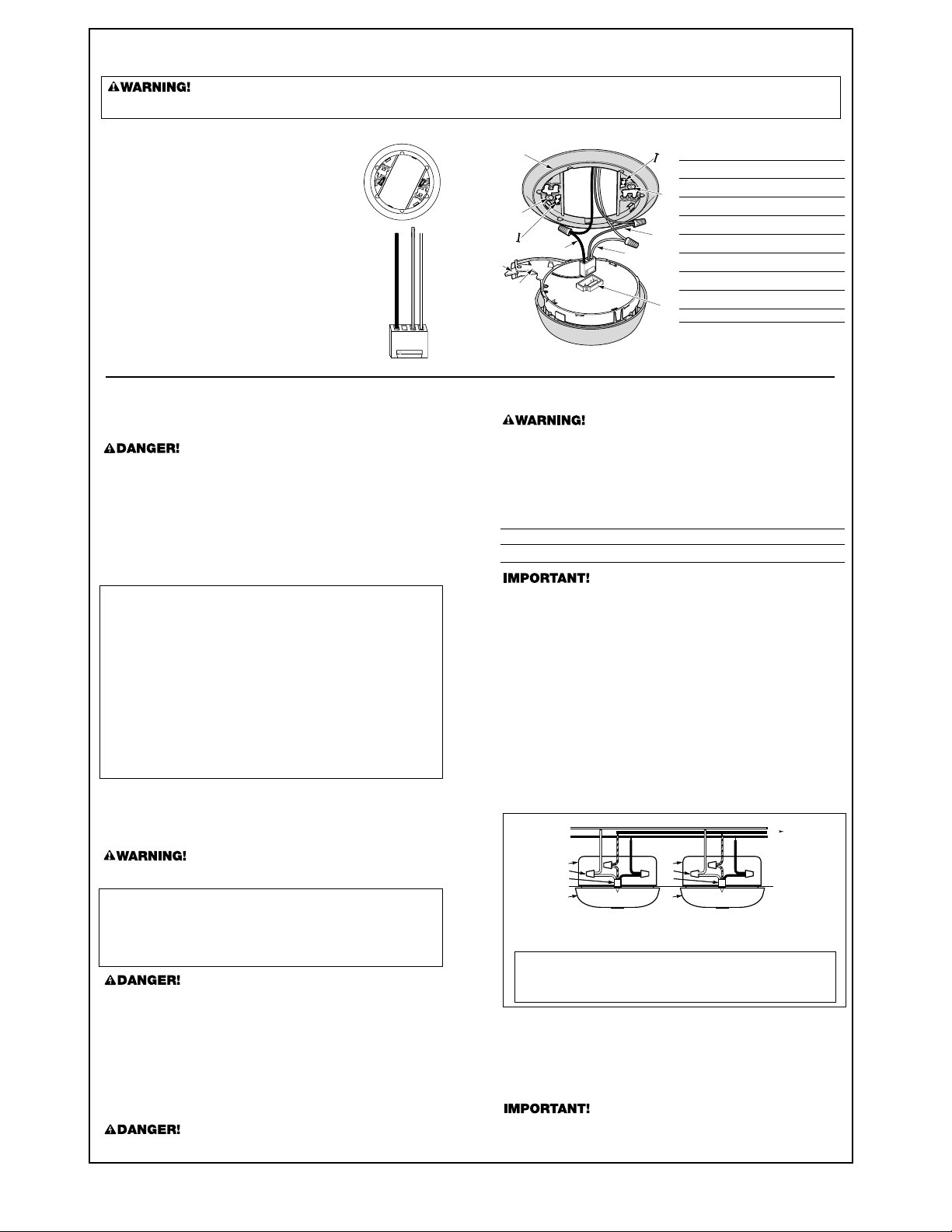
The Mounting Bracket:
To remove the mounting bracket from the Smoke Alarm base,
hold the Smoke Alarm base firmly and twist the mounting bracket counterclockwise. The mounting bracket installs onto the junction box. It has a variety of screw slots to fit most boxes.
The Power Connector:
The power connector plugs into a power input block on the Smoke
Alarm. It supplies the unit with AC power.
• The black wire is “hot.”
• The white wire is neutral.
• The orange wire is used for interconnect.
If you need to remove the power connector, insert a flat screwdriver
blade between the power connector and the security tab inside the
power input block. Gently pry back the tab and pull the connector free.
The Parts of This Unit
1 Mounting Bracket
2 Mounting Slots and Screws*
3 Locking Pins (break out of bracket)
4 Hot (Black) AC Wire
5 Neutral (White) AC Wire
6 Interconnect (Orange) Wire
7 Latch to Open Battery Compartment
8 Swing-Out Battery Compartment
9 Quick-Connect Power Connector
*Not included
The basic installation of this Smoke Alarm is similar whether you want to install one
Smoke Alarm, or interconnect more than one Smoke Alarm. If you are interconnecting
more than one Smoke Alarm, you MUST read “Special Requirements For Interconnected
Smoke Alarms” below before you begin installation.
ELECTRICAL SHOCK HAZARD. Turn off power to the area where you will install this
unit at the circuit breaker or fuse box before beginning installation. Failure to turn off
the power before installation may result in serious electrical shock, injury or death.
1. Remove the mounting bracket from the base, and attach it to the junction box.
Models SA4121B, 4120B, and 4120SB: Install battery back-up. Battery back-up
cannot work until you install the battery in the correct position (Match “+” to “+” and
“-” to “-”).
Or, activate the battery back-up by removing the “Pull to Activate Battery Back-Up”
tab.
Push and hold test button until the alarm sounds: 3 beeps, pause, 3 beeps, pause.
2. Using wire nuts, connect the power connector to the household wiring.
3. Plug the power connector into the back of the Smoke Alarm.
4.
Position the base of the Smoke Alarm over the mounting bracket and turn. The Alarm
can be positioned over the bracket every 60°. Turn the Smoke Alarm clockwise (right)
until the unit is in place.
5. Check all connections.
Improper wiring of the power connector or the wiring leading to the power connector will cause damage to the Alarm and may lead to a non-functioning Alarm.
ELECTRICAL SHOCK HAZARD. Do not restore power until all Smoke Alarms are completely installed. Restoring power before installation is complete may result in serious
electrical shock, injury or death.
6. Make sure the Smoke Alarm is receiving AC power. Under normal operation, the
Green power indicator light will shine continuously.
7. If the Green power indicator light does not light,
TURN OFF POWER TO THE
JUNCTION BOX
and recheck all connections. If all connections are correct and the
Green power indicator still does not light when you restore the power, the unit
should be replaced immediately.
8. Test each Smoke Alarm. Press and hold the test button until the unit alarms. When
testing a series of interconnected units you must test each unit individually.
Make sure all units alarm when each one is tested.
If any unit in the series does not alarm, TURN OFF POWER and recheck connections. If
it does not alarm when you restore power, replace it immediately.
Special Requirements For Interconnected Smoke Alarms
• Failure to meet any of the above requirements could damage the units and
cause them to malfunction, removing your protection.
• AC and AC/DC Smoke Alarms can be interconnected. Under AC power, all
units will alarm when one senses smoke. When power is interrupted, only
the AC/DC units in the series will continue to send and receive signals. AC
powered Smoke Alarms will not operate.
Interconnected units can provide earlier warning of fire than stand-alone units, especially if a fire
starts in a remote area of the dwelling. If any unit in the series senses smoke, all units will alarm.
To determine which Smoke Alarm initiated an alarm, see table:
On Initiating Alarms Red LED(s) flashes(flash) rapidly
On All Other Alarms Red LED is Off
Interconnect units within a single family residence only. Otherwise all households will
experience unwanted alarms when you test any unit in the series. Interconnected units will
only work if they are wired to compatible units and all requirements are met. This unit is
designed to be compatible with:
First Alert®Smoke Alarm Models SA4120, SA4121B, SA4919B, SA100B and BRK
Electronics
®
Smoke Alarm Models 100S, 2002RAC, 4120, 4120B, 4120SB, 4919, 5919,
5919TH;
BRK Electronics®Heat Alarm Models HD6135F, HD6135FB; Smoke/CO Alarm
Model SC6120B; Relay Module RM3.
Interconnected units must meet ALL of the following requirements:
• A maximum of 18 compatible units may be interconnected
(Maximum of 12 Smoke Alarms).
• The same fuse or circuit breaker must power all interconnected units.
• The total length of wire interconnecting the units should be less than 1000 feet
(300 meters). The interconnect wire should be #18 gauge or larger, rated at least
300V. If an interconnect wire is not already part of your household wiring, you will
need to install one. This type of wire is commonly available at Hardware and
Electrical Supply stores.
•
All wiring must conform to all local electrical codes and Article 760 of NFPA 70 (NEC).
Refer to NFPA 72, NFPA 101, and/or your local building code for further connection
requirements.
HOW TO INSTALL THIS SMOKE ALARM
THE PARTS OF THIS SMOKE ALARM
This Smoke Alarm is designed to be mounted on any standard wiring junction box up to a 4-inch size, on either the ceiling or wall (if allowed by local codes). Read “Recommended Locations
For Smoke Alarms” and “Locations to Avoid For Smoke Alarms” before you begin installation.
Tools you will need: • Needle-nose pliers or utility knife• Standard Flathead screwdriver.
FOLLOW THESE INSTALLATION STEPS
STAND-ALONE ALARM ONLY:
• Connect the white wire on the power connector to the neutral wire in the junction
box.
• Connect the black wire on the power connector to the hot wire in the junction
box.
• Tuck the orange wire inside the junction box. It is used for interconnect only.
INTERCONNECTED UNITS ONLY:
Strip off about 1/2” (12 mm) of the plastic coating on the orange wire on the
power connector.
• Connect the white wire on the power connector to the neutral wire in the junction
box.
• Connect the black wire on the power connector to the hot wire in the junction
box.
•
Connect the orange wire on the power connector to the interconnect wire in the
junction box. Repeat for each unit you are interconnecting. Never connect the hot or
neutral wires in the junction box to the orange interconnect wire. Never cross hot
and neutral wires between Alarms.
STAND-ALONE ALARM ONLY:
• If you are only installing one Smoke Alarm, restore power to the junction box.
INTERCONNECTED UNITS ONLY:
• If you are interconnecting multiple Smoke Alarms, repeat steps 1-5 for each
Smoke Alarm in the series. When you are finished, restore power to the
junction box.
A. Unswitched 120VAC
60 Hz source
B. To additional units; Maximum = 18 total (Maximum
12 Smoke Alarms)
1. Smoke Alarm
2. Ceiling or Wall
3. Power Connector
4. Wire Nut
5. Junction Box
6. Neutral Wire (Wht)
7. Interconnect Wire
(Orange)
8. Hot Wire (Blk)
Models SA4121B and 4120SB Only: During installation, if you accidentally press the
Silence button, the alarm will “chirp” once a minute for up to 15 minutes and the Test
feature will be temporarily disabled. This is normal. The “chirping” will stop once the
alarm returns to normal operation.
Make sure the Alarm is not receiving excessively noisy power. Examples of noisy power could be major appliances on the same circuit, power from a generator or solar power, light
dimmer on the same circuit or mounted near fluorescent lighting. Excessively noisy power may cause damage to your Alarm.
2
1
3
2
2
3
7
4
8
5
6
9
6
B
}
7
8
A
}
5
4
3
2
1
5
4
3
1
Page 3
LOCKING FEATURES
The locking features are designed to prevent unauthorized removal of the battery or Alarm. It is not necessary to activate the locks in single-family households where unauthorized
battery or Alarm removal is not a concern.
These Smoke Alarms have two separate locking features: one to lock the battery compartment, and the other to lock the Smoke Alarm to the mounting bracket.
You can choose to use either feature independently, or use them both.
Tools you will need:• Needle-nose pliers or utility knife • Standard/Flathead screwdriver.
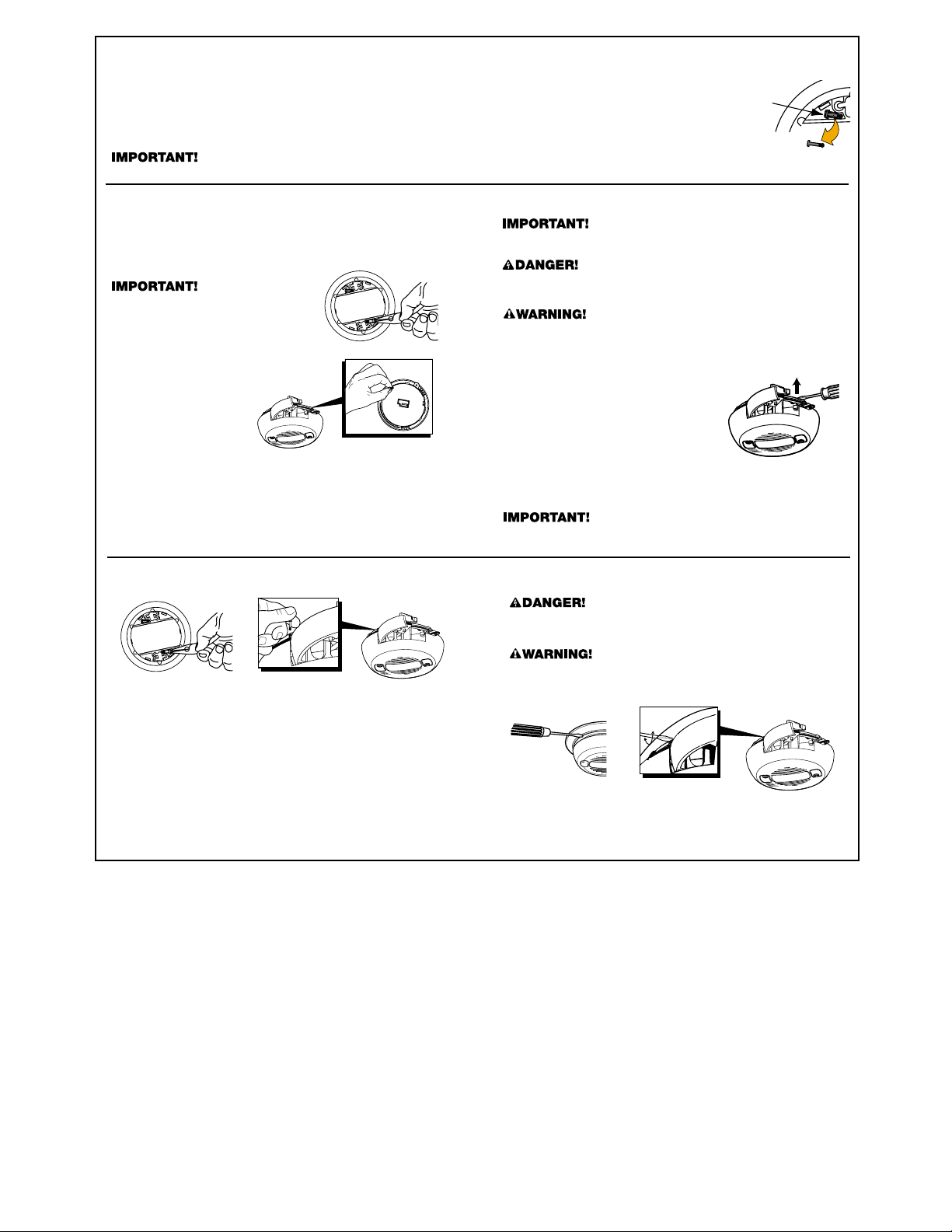
Both locking features use locking pins, which are molded into the mounting bracket. Using needle nose pliers or a utility knife, remove one or both pins from the
mounting bracket, depending on how many locking features you want to use.
To permanently remove either lock, insert a flathead screwdriver between the locking pin and the lock, and pry the pin out of the lock.
TO LOCK THE BATTERY COMPARTMENT
(Models SA4121B, 4120B, and 4120SB Only)
Do not lock the battery compartment until you have installed the battery and tested
the battery back-up.
1. Push and hold test button until the alarm sounds:
3 beeps, pause, 3 beeps, pause.
If the unit does not alarm during testing, DO NOT
lock the battery compartment! Install a new battery
and test again. If the Smoke Alarm still does not
alarm, replace it immediately.
2. Using needle-nose pliers or a
utility knife, detach one locking
pin from the mounting bracket.
3. Push the locking pin through
the black dot on the label on
the back of the Smoke Alarm.
TO UNLOCK THE BATTERY COMPARTMENT
(Models SA4121B, 4120B, and 4120SB Only)
Once the Smoke Alarm is installed, you must disconnect it from the AC power before
unlocking the battery compartment.
ELECTRICAL SHOCK HAZARD. Turn off the power to the area where the Smoke Alarm
is installed before removing it from the mounting bracket. Failure to turn off the power
first may result in serious electrical shock, injury or death.
Always discharge the branch circuit before servicing an AC or AC/DC Smoke Alarm.
First, turn off the AC power at the circuit breaker or fuse box. Next, remove the battery
from Smoke Alarms with battery back-up. Finally, press and hold the test button for 5-10
seconds to discharge the branch circuit.
1. Remove the Smoke Alarm from the mounting
bracket. If the unit is locked to the bracket, see
the section “To Unlock the Mounting Bracket.”
2. Disconnect the power connector by gently prying
it away from the back of the Smoke Alarm.
3. Insert a flathead screwdriver under the head of the
locking pin, and gently pry it out of the battery
compartment lock. (If you plan to relock the battery
compartment, save the locking pin.)
4. To relock the battery compartment, close the
battery door and reinsert locking pin in lock.
5. Reconnect the power connector to the back of the Smoke Alarm, reattach the Smoke
Alarm to the mounting bracket, and restore the power.
When replacing the battery, always test the Smoke Alarm before relocking the battery
compartment.
TO UNLOCK THE MOUNTING BRACKET
ELECTRICAL SHOCK HAZARD. Turn off the power to the area where the Smoke
Alarm is installed before removing it from the mounting bracket. Failure to turn off
the power first may result in serious electrical shock, injury or death.
Always discharge the branch circuit before servicing an AC or AC/DC Smoke Alarm.
First, turn off the AC power at the circuit breaker or fuse box. Next, remove the battery
from Smoke Alarms with battery back-up. Finally, press and hold the test button for 510 seconds to discharge the branch circuit.
1. Insert a flathead screwdriver between the mounting bracket pin and the mounting
bracket.
2. Pry the Smoke Alarm away from the bracket by turning both the screwdriver and the
Smoke Alarm counterclockwise (left) at the same time.
TO LOCK THE MOUNTING BRACKET:
1. Using needle-nose pliers, detach one locking pin from mounting bracket.
2. Insert the locking pin into the lock located on the pivoting hinge of the battery door.
3. When you attach the Smoke Alarm to the mounting bracket, the locking pin’s head
will fit into a notch on the bracket.
Locking Features (Continued)
3
Locking Pin
Page 4

IF THIS SMOKE ALARM SOUNDS
RESPONDING TO AN ALARM
During an alarm, you will hear a loud, repeating horn pattern: 3 beeps, pause, 3 beeps,
pause.
•
If the unit alarms and you are not testing the unit, it is warning you of a potentially
dangerous situation that requires your immediate attention. NEVER ignore any
alarm. Ignoring the alarm may result in injury or death.
• Never disconnect the AC power to quiet an unwanted alarm. Disconnecting the
power disables the Alarm so it cannot sense smoke. This will remove your protection. Instead, open a window or fan the smoke away from the unit. The
Alarm will reset automatically.
• If the unit alarms get everyone out of the house immediately.
•
ELECTRICAL SHOCK HAZARD: Attempting to disconnect the power connector
from the unit when the power is on may result in electrical shock, serious injury or
death.
When an interconnected system of AC powered units is in alarm, the alarm indicator light
on the unit(s) that initiated the alarm will blink rapidly. It will remain OFF on any remaining
units.
If the unit alarms, get everyone out of the dwelling immediately.
If the unit alarms and you are certain that the source of smoke is not a fire—cooking smoke
or an extremely dusty furnace, for example—open a nearby window or
door and fan the
smoke away from the unit (
Models SA4121B and 4120SB Only: use the Silence Feature to
silence the Alarm). This will silence the alarm, and once the smoke clears the unit will reset
itself automatically.
WEEKLY TESTING
• NEVER use an open flame of any kind to test this unit. You might accidentally
damage or set fire to the unit or to your home. The built-in test switch accurately
tests the unit’s operation as required by Underwriters Laboratories, Inc. (UL). If
you choose to use an aerosol smoke product to test the Smoke Alarm, be certain
to use one that has been Listed to Underwriters Laboratories, Inc. Safety
Standards, and use it only as directed. Use of non-UL Listed products or improp
er
use of UL Listed products may affect the Smoke Alarm’s sensitivity, and may void
your warranty.
• If the Alarm ever fails to test properly, replace it immediately. Products under
warranty may be returned to the manufacturer for
replacement. See “Limited
Warranty” at the end of this manual.
DO NOT stand close to the Alarm when the horn is sounding. Exposure at close range
may be harmful to your hearing. When testing, step away when horn starts sounding.
It is important to test this unit every week to make sure it is working properly. Using the
test button is the recommended way to test this Smoke Alarm.
Press and hold the test
button on the cover of the unit until the alarm sounds (the unit may continue to alarm for a few
seconds after you release the button). If it does not alarm, make sure the unit is receiving
power and test it again. If it still does not alarm, replace it immediately.
During testing, you
will hear a loud, repeating horn pattern: 3 beeps, pause, 3 beeps, pause.
When testing a series of interconnected units you must test each unit individually. Make sure
all units alarm when each one is tested.
REGULAR MAINTENANCE
Use only the replacement batteries listed below. The unit may not operate properly
with other batteries. Never use rechargeable batteries since they may not provide a
constant charge.
This unit has been designed to be as maintenance-free as possible, but there are a few
simple things you must do to keep it working properly:
• Test it at least once a week.
• Clean the Smoke Alarm at least once a month; gently vacuum the outside of the
Smoke Alarm using your household vacuum’s soft brush attachment. Test the Smoke
Alarm. Never use water, cleaners or solvents since they may damage the unit.
• If the Smoke Alarm becomes contaminated by excessive dirt, dust and/or grime, and
cannot be cleaned to avoid unwanted alarms, replace the unit immediately.
• Relocate the unit if it sounds frequent unwanted alarms. See “Locations To Avoid For
Smoke Alarms” for details.
•
Models SA4121B/SB Only: When the battery back-up becomes weak, the Smoke
Alarm will “chirp” about once a minute (the low battery warning). This warning should
last 7 days, but you should replace the battery immediately to continue your protection.
Models SA4121B, 4120B/SB Only – Choosing a replacement battery:
Your Smoke Alarm requires one standard 9V battery. The following batteries are acceptable
as replacements: Duracell #MN1604, (Ultra) #MX1604; Eveready (Energizer) #522. You may
also use a Lithium battery like the Ultralife U9VL-J for longer service life between battery
changes.
These batteries are available at many local retail stores.
Actual battery service life depends on the smoke alarm and the environment in which it is
installed. All the batteries specified above are acceptable replacement batteries for this unit.
Regardless of the manufacturer’s suggested battery life, you MUST replace the battery
immediately once the unit starts “chirping” (the “low battery warning”).
UNDERSTANDING THE INDICATOR LIGHTS AND ALARM HORN PATTERNS
NOTE: When power is applied, unit(s) may alarm momentarily.
*When any Smoke Alarm in an interconnected series triggers an alarm, its red LED will flash
rapidly. The red LEDs will remain OFF on any remaining alarms in the series. This feature
helps responders identify which unit(s) triggered the alarm.
AC Power
All Models
DC Power
Models SA4121B,
4120B, 4120SB
Normal Operation Constant Green LED
Flashing Red LED approx.
once/minute
No Audible Alarm
Green LED Off
Flashing Red LED
No Audible Alarm
Test Condition Constant Green LED
Rapidly Flashing LED
Audible Alarm
Green LED Off
Rapidly Flashing LED
Audible Alarm
Alarm Condition*
(Initiating Unit)
Constant Green LED
Rapidly Flashing
Red LED
Audible Alarm
Green LED Off
Rapidly Flashing LED
Audible Alarm
4
Page 5
5
If This Smoke Alarm Sounds, Continued
WHAT TO DO IN CASE OF FIRE
• Don’t panic; stay calm. Follow your family escape plan.
• Get out of the house as quickly as possible. Don’t stop to get dressed or collect
anything.
• Feel doors with the back of your hand before opening them. If a door is cool, open it
slowly. Don’t open a hot door. Keep doors and windows closed, unless you must
escape through them.
• Cover your nose and mouth with a cloth (preferably damp). Take short, shallow
breaths.
• Meet at your planned meeting place outside your home, and do a head count to make
sure everybody got out safely.
• Call the Fire Department as soon as possible from outside. Give your address, then
your name.
• Never go back inside a burning building for any reason.
• Contact your Fire Department for ideas on making your home safer.
Alarms have various limitations. See "Limitations of Smoke Alarms" for details.
IF YOU SUSPECT A PROBLEM
Smoke Alarms may not operate properly because of dead, missing or weak batteries, a
build-up of dirt, dust or grease on the Smoke Alarm cover, or installation in an improper
location. Clean the Smoke Alarm as described in “Regular Maintenance,” and install a fresh
battery, then test the Smoke Alarm again. If it fails to test properly when you use the test
button, or if the problem persists, replace the Smoke Alarm immediately.
• If you hear a “chirp” once a minute, replace the battery.
• If you experience frequent non-emergency alarms (like those caused by cooking
smoke), try relocating the Smoke Alarm.
• If the alarm sounds when no smoke is visible, try cleaning or relocating the
Smoke Alarm. The cover may be dirty.
• If the alarm does not sound during testing, make sure it is receiving AC power
from the household current.
Always discharge the branch circuit before servicing an AC or AC/DC Smoke Alarm.
First, turn off the AC power at the circuit breaker or fuse box. Next, remove the battery
from Smoke Alarms with battery back-up. Finally, press and hold the test button for 5-10
seconds to discharge the branch circuit.
If the Smoke Alarm is still not operating properly, and it is still under warranty, please see
“How to Obtain Warranty Service” in the Limited Warranty.
Do not try fixing the alarm yourself – this will void your warranty!
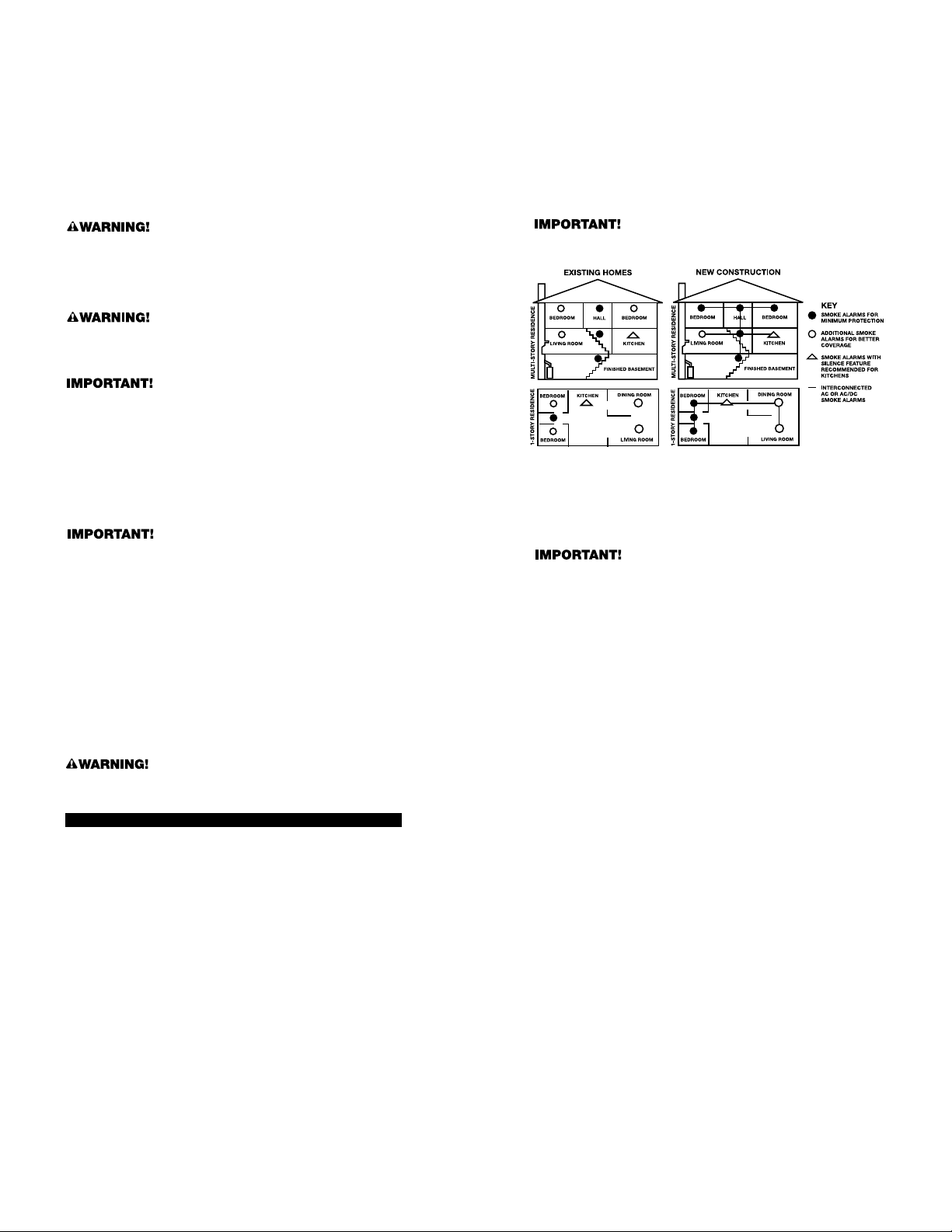
RECOMMENDED LOCATIONS FOR SMOKE ALARMS
Installing Smoke Alarms in Single-Family Residences
The National Fire Protection Association (NFPA), recommends one Smoke Alarm on every
floor, in every sleeping area, and in every bedroom. In new construction, the Smoke Alarms
must be AC powered and interconnected. See “Agency Placement Recommendations” for
details. For additional coverage, it is recommended that you install a Smoke Alarm in all
rooms, halls, storage areas, finished attics, and basements, where temperatures normally
remain between 40˚ F (4˚ C) and 100˚ F (38˚ C). Make sure no door or other obstruction
could keep smoke from reaching the Smoke Alarms.
More specifically, install Smoke Alarms:
• On every level of your home, including finished attics and basements.
• Inside every bedroom, especially if people sleep with the door partly or completely
closed.
• In the hall near every sleeping area. If your home has multiple sleeping areas, install a
unit in each. If a hall is more than 40 feet long (12 meters), install a unit at each end.
• At the top of the first-to-second floor stairway, and at the bottom of the basement
stairway.
Specific requirements for Smoke Alarm installation vary from state to state and from region
to region. Check with your local Fire Department for current requirements in your area.
It is
recommended AC or AC/DC units be interconnected for added protection.
INSTALLING SMOKE ALARMS IN MOBILE HOMES & RVS
For minimum security install one Smoke Alarm as close to each sleeping area as possible. For
more security, put one unit in each room. Many older mobile homes (especially those built
before 1978) have little or no insulation. If your mobile home is not well insulated, or if you are
unsure of the amount of insulation, it is important to install units on inside walls only. Smoke
Alarms should be installed where temperatures normally remain between 40˚ F (4˚ C) and 100˚ F
(38˚ C).
WARNING: Test units used in RVs after the vehicle has been in storage, before
every trip, and once a week while in use. Failure to test units used in RVs as described
may remove your protection.
This equipment should be installed in accordance with NFPA (National Fire Protection
Association) 72 and
101. National Fire Protection Association, One Batterymarch Park, Quincy,
MA 02269-9101.
Additional local building and regulatory codes may apply in your area.
Always check compliance requirements before beginning any installation.
AGENCY PLACEMENT RECOMMENDATIONS
NFPA 72 (National Fire Code)
Smoke Alarms shall be installed in each separate sleeping room, outside each sleeping area in
the immediate vicinity of the bedrooms and on each additional story of the family living unit,
including basements and excluding crawl spaces and unfinished attics.
In new construction, Alarms shall be so arranged that operation of any one Alarm shall cause
the operation of all Alarms within the dwelling.
Smoke Detection-Are More Smoke Alarms Desirable?
The required number of Smoke
Alarms might not provide reliable early warning protection for those areas separated by a door
from the areas protected by the required Smoke Alarms. For this reason, it is recommended
that the householder consider the use of additional Smoke Alarms for those areas for
increased protection. The additional areas include the basement, bedrooms, dining room, furnace room, utility room, and hallways not protected by the required Smoke Alarms. The installation of Smoke Alarms in kitchens, attics (finished or unfinished), or garages is not normally
recommended, as these locations occasionally experience conditions that can result in
improper operation.
California State Fire Marshal (CSFM)
Early warning detection is best achieved by the installation of fire detection equipment in all
rooms and areas of the household as follows: A Smoke Alarm installed in each separate
sleeping area (in the vicinity, but outside bedrooms), and Heat or Smoke Alarms in the living
rooms, dining rooms, bedrooms, kitchens, hallways, finished attics, furnace rooms, closets,
utility and storage rooms, basements, and attached garages.
LOCATIONS TO AVOID FOR SMOKE ALARMS
For best performance, AVOID installing Smoke Alarms in these areas:
• Where combustion particles are produced. Combustion particles form when something
burns. Areas to avoid include poorly ventilated kitchens, garages, and furnace rooms.
Keep units at least 20 feet (6 meters) from the sources of combustion particles (stove,
furnace, water heater, space heater) if possible. In areas where a 20-foot (6 meter)
distance is not possible – in modular, mobile, or smaller homes, for example – it is
recommended the Smoke Alarm be placed as far from these fuel-burning sources as
possible. The placement recommendations are intended to keep these Alarms at a
reasonable distance from a fuel-burning source, and thus reduce “unwanted” alarms.
Unwanted alarms can occur if a Smoke Alarm is placed directly next to a fuel-burning
source. Ventilate these areas as much as possible.
• In air streams near kitchens. Air currents can draw cooking smoke into the sensing
chamber of a Smoke Alarm near the kitchen.
Continued...
USING THE SILENCE FEATURE (MODELS SA4121B
AND 4120SB ONLY)
The Silence Feature on these units can temporarily quiet an unwanted alarm for up to 15
minutes.
The Silence Feature does not disable the unit—it makes it temporarily less sensitive to
smoke. For your safety, if smoke around the unit is dense enough to suggest a potentially dangerous situation, the unit will stay in alarm or may re-alarm quickly. If you do
not know the source of the smoke, do not assume it is an unwanted alarm. Not
responding to an alarm can result in property loss, injury, or death.
While the unit is in the “silence mode,” the test button will not operate. The Alarm cannot be
tested while in the silence mode.
To silence Smoke Alarms in an interconnected series:
1. To silence multiple alarms in an interconnected series, you must press the silence button on the unit(s) that triggered the alarm.
NOTE: The red light under the silence button on the initiating alarm will flash rapidly. The red
light will be off on all other Smoke Alarms.
2. Once you activate the Silence feature, you will hear a reminder “chirp” on the initiating
alarm about once a minute (for up to 15 minutes).
3. While the units are in the “silence mode,” the test buttons will not operate. The alarms
cannot be tested while in the silence mode.
4. The “chirping” on the initiating alarm will stop once the unit returns to normal operation.
The Silence Feature on these units can temporarily quiet an unwanted alarm for up to 15
minutes. To use this feature, press the “Push to Silence” button on the cover. Once you activate it, you will hear a reminder “chirp” about once a minute (for up to 15 minutes) and the
Test feature is temporarily disabled. The “chirping” will stop once the unit returns to normal
operation.
If the unit will not silence and no heavy smoke is present, or if it stays in
silence mode continuously, it should be replaced immediately.
Page 6

6
Printed in Mexico
M08-0056-001
K1 07/04
First Alert®is a registered trademark of the First Alert Trust.
BRK
®
is a registered trademark of BRK Brands, Inc.
LIMITED WARRANTY
BRK Brands, Inc., ("BRK") the maker of First Alert®brand and BRK®brand products, warrants that for a period of ten years from the date of purchase, this product will be free
from defects in material and workmanship. BRK, at its option, will repair or replace this
product or any component of the product found to be defective during the warranty period. Replacement will be made with a new or remanufactured product or component. If
the product is no longer available, replacement may be made with a similar product of
equal or greater value. This is your exclusive warranty.
This warranty is valid for the original retail purchaser from the date of initial retail purchase
and is not transferable. Keep the original sales receipt. Proof of purchase is required to
obtain warranty performance. BRK dealers, service centers, or retail stores selling BRK
products do not have the right to alter, modify or any way change the terms and conditions of this warranty.
This warranty does not cover normal wear of parts or damage resulting from any of the
following: negligent use or misuse of the product, use on improper voltage or current, use
contrary to the operating instructions, disassembly, repair or alteration by anyone other
than BRK or an authorized service center. Further, the warranty does not cover Acts of
God, such as fire, flood, hurricanes and tornadoes or any batteries that are included with
this unit.
BRK shall not be liable for any incidental or consequential damages caused by the breach
of any express or implied warranty. Except to the extent prohibited by applicable law, any
implied warranty of merchantability or fitness for a particular purpose is limited in duration
to the duration of the above warranty. Some states, provinces or jurisdictions do not allow
the exclusion or limitation of incidental or consequential damages or limitations on how
long an implied warranty lasts, so the above limitations or exclusion may not apply to
you. This warranty gives you specific legal rights, and you may also have other rights that
vary from state to state or province to province.
How to Obtain Warranty Service
Service:
If service is required, do not return the product to your retailer. In order to obtain
warranty service, contact the Consumer Affairs Division at 1-800-323-9005, 7:30 AM 5:00 PM Central Standard Time, Monday through Friday. To assist us in serving you,
please have the model number and date of purchase available when calling.
303 Nelson Avenue, Neosho, MO 64850-8806.
Battery: BRK Brands, Inc. make no warranty, express or implied, written or oral, including
that of merchantability or fitness for any particular purpose with respect to battery.
Locations to Avoid for Smoke Alarms, Continued
• In very damp, humid or steamy areas, or directly near bathrooms with showers. Keep
units at least 10 feet (3 meters) away from showers, saunas, dishwashers, etc.
• Where the temperatures are regularly below 40˚F (4˚ C) or above 100˚ F (38˚ C) including
unheated buildings, outdoor rooms, porches, or unfinished attics or basements.
• In very dusty, dirty, or greasy areas. Do not install a Smoke Alarm directly over the
stove or range. Clean a laundry room unit frequently to keep it free of dust or lint.
• Near fresh air vents, ceiling fans, or in very drafty areas. Drafts can blow smoke away
from the unit, preventing it from reaching sensing chamber.
• In insect infested areas. Insects can clog openings to the sensing chamber and cause
unwanted alarms.
• Less than 12 inches (305 mm) away from fluorescent lights. Electrical “noise” can interfere with the sensor.
• In “dead air” spaces. “Dead air” spaces may prevent smoke from reaching the Smoke
Alarm.
AVOIDING DEAD AIR SPACES
“Dead air” spaces may prevent smoke from reaching the Smoke Alarm. To avoid dead air
spaces, follow the installation recommendations below.
On ceilings, install Smoke Alarms as close to the center of the ceiling as possible. If this is
not possible, install the Smoke Alarm at least 4 inches (102 mm) from the wall or corner.
For wall mounting (if allowed by building codes), the top edge of Smoke Alarms should be
placed between 4 inches (102 mm) and 12 inches (305 mm) from the wall/ceiling line, below
typical “dead air” spaces.
On a peaked, gabled, or cathedral ceiling, install the first Smoke Alarm within 3 feet (0.9
meters) of the peak of the ceiling, measured horizontally. Additional Smoke Alarms may be
required depending on the length, angle, etc. of the ceiling's slope. Refer to NFPA 72 for
details on requirements for sloped or peaked ceilings.
SPECIAL COMPLIANCE CONSIDERATIONS
This Smoke Alarm alone is not a suitable substitute for complete fire detection systems in
places housing many people—like apartment buildings, condominiums, hotels, motels, dormitories, hospitals, long-term health care facilities, nursing homes, day care facilities, or
group homes of any kind—even if they were once single-family homes. It is not a suitable
substitute for complete fire detection systems in warehouses, industrial facilities, commercial buildings, and special-purpose non-residential buildings which require special fire detection and alarm systems. Depending on the building codes in your area, this Smoke Alarm
may be used to provide additional protection in these facilities.
The following information applies to all four types of buildings listed below:
In new construction, most building codes require the use of AC or AC/DC powered Smoke
Alarms only. AC, AC/DC, or DC powered Smoke Alarms can be used in existing construction as
specified by local building codes. Refer to NFPA 72 (National Fire Alarm Code) and NFPA 101
(Life Safety Code), local building codes, or consult your Fire Department for detailed fire protection requirements in buildings not defined as “households.”
1. Single-Family Residence:
Single family home, townhouse. It is recommended Smoke Alarms be installed on every
level of the home, in every bedroom, and in each bedroom hallway.
2. Multi-Family or Mixed Occupant Residence:
Apartment building, condominium. This Smoke Alarm is suitable for use in individual apartments or condos, provided a primary fire detection system already exists to meet fire detection requirements in common areas like lobbies, hallways, or porches. Using this Smoke
Alarm in common areas may not provide sufficient warning to all residents or meet local fire
protection ordinances/regulations.
3. Institutions: Hospitals, day care facilities, long-term health care facilities. This Smoke
Alarm is suitable for use in individual patient sleeping/resident rooms, provided a primary fire
detection system already exists to meet fire detection requirements in common areas like
lobbies, hallways, or porches. Using this Smoke Alarm in common areas may not provide
sufficient warning to all residents or meet local fire protection ordinances/regulations.
4. Hotels and Motels: Also boarding houses and dormitories. This Smoke Alarm is suitable
for use inside individual sleeping/resident rooms, provided a primary fire detection system
already exists to meet fire detection requirements in common areas like lobbies, hallways, or
porches. Using this Smoke Alarm in common areas may not provide sufficient warning to all
residents or meet local fire protection ordinances/regulations.
LIMITATIONS OF SMOKE ALARMS
Smoke Alarms have played a key role in reducing deaths resulting from home fires worldwide.
However, like any warning device, Smoke Alarms can only work if they are properly located,
installed, and maintained, and if smoke reaches the Alarms. They are not foolproof.
Smoke alarms may not waken all individuals. Practice the escape plan at least twice a
year, making sure that everyone is involved – from kids to grandparents. Allow children to
master fire escape planning and practice before holding a fire drill at night when they are
sleeping. If children or others do not readily waken to the sound of the smoke alarm, or if
there are infants or family members with mobility limitations, make sure that someone is
assigned to assist them in fire drill and in the event of an emergency. It is recommended that
you hold a fire drill while family members are sleeping in order to determine their response
to the sound of the smoke alarm while sleeping and to determine whether they may need
assistance in the event of an emergency.
Smoke Alarms cannot work without power. Battery operated units cannot work if the batteries are missing, disconnected or dead, if the wrong type of batteries are used, or if the batteries are not installed correctly. AC units cannot work if the AC power is cut off for any reason
(open fuse or circuit breaker, failure along a power line or at a power station, electrical fire that
burns the electrical wires, etc.). If you are concerned about the limitations of battery or AC
power, install both types of units.
Smoke Alarms cannot detect fires if the smoke does not reach the Alarms. Smoke from
fires in chimneys or walls, on roofs, or on the other side of closed doors may not reach the
sensing chamber and set off the Alarm. That is why one unit should be installed inside each
bedroom or sleeping area—especially if bedroom or sleeping area doors are closed at night—
and in the hallway between them.
Smoke Alarms may not detect fire on another floor or area of the dwelling. For example, a
stand-alone unit on the second floor may not detect smoke from a basement fire until the fire
spreads. This may not give you enough time to escape safely. That is why recommended minimum protection is at least one unit in every sleeping area, and every bedroom on every level of
your dwelling. Even with a unit on every floor, stand-alone units may not provide as much protection as interconnected units, especially if the fire starts in a remote area. Some safety
experts recommend installing interconnected AC powered units with battery back-up (see
“About Smoke Alarms”) or professional fire detection systems, so if one unit senses smoke, all
units alarm. Interconnected units may provide earlier warning than stand-alone units since all
units alarm when one detects smoke.
Smoke Alarms may not be heard. Though the alarm hor n in this unit meets or exceeds current standards, it may not be heard if: 1) the unit is located outside a closed or partially closed
door, 2) residents recently consumed alcohol or drugs, 3) the Alarm is drowned out by noise
from stereo, TV, traffic, air conditioner or other appliances, 4) residents are hearing impaired or
sound sleepers.
Special purpose units, like those with visual and audible alarms, should be
installed for hearing impaired residents.
Smoke Alarms may not have time to alarm before the fire itself causes damage, injury,
or death, since smoke from some fires may not reach the unit immediately. Examples
of this include persons smoking in bed, children playing with matches, or fires caused
by violent explosions resulting from escaping gas.
Smoke Alarms are not foolproof. Like any electronic device, Smoke Alarms are made of
components that can wear out or fail at any time. You must test the unit weekly to ensure your
continued protection. Smoke Alarms cannot prevent or extinguish fires. They are not a substitute for property or life insurance.
Smoke Alarms have a limited life. The unit should be replaced immediately if it is not operating properly. You should always replace a Smoke Alarm after 10 years from date of purchase.
Write the purchase date on the space provid
ed on back of unit.
ABOUT SMOKE ALARMS
Battery (DC) operated Smoke Alarms: Provide protection even when electricity fails, provided the batteries are fresh and correctly installed. Units are easy to install, and do not
require professional installation.
AC powered Smoke Alarms: Can be interconnected so if one unit senses smoke, all
units alarm. They do not operate if electricity fails.
AC with battery (DC) back-up: will
operate if electricity fails, provided the batteries are fresh and correctly installed. AC and
AC/DC units must be installed by a qualified electrician.
Smoke Alarms for Solar or Wind Energy users and battery backup power systems: AC
powered Smoke Alarms should only be operated with true or pure sine wave inverters.
Operating this Smoke Alarm with most battery-powered UPS (uninterruptible power supply)
products or square wave or “quasi sine wave” inverters
will damage the Alarm. If you are
not sure about your inverter or UPS type, please consult with the manufacturer to verify.
Smoke Alarms for the hearing impaired: Special purpose Smoke Alarms should be
installed for the hearing impaired. They include a visual alarm and an audible alarm horn,
and meet the requirements of the Americans With Disabilities Act. These units can be interconnected so if one unit senses smoke, all units alarm.
All these Smoke Alarms are designed to provide early warning of fires if located, installed and
cared for as described in the user’s manual, and if smoke reaches the Alarm. If you are unsure
which type of unit to install, refer to NFPA (National Fire Protection Association) 72 (National
Fire Alarm Code) and NFPA 101 (Life Safety Code). National Fire Protection Association, One
Batterymarch Park, Quincy, MA 02269-9101.
Local building codes may also require specific
units in new construction or in different areas of the home.
 Loading...