

Page 1
What Everyone Should
Know to Stop Bleeding
After an Injury
Page 2

THE HARTFORD CONSENSUS
The Joint Committee to Increase Survival from Active Shooter and Intentional
Mass Casualty Events was convened by the American College of Surgeons in
response to the growing number and severity of these events. The committee
met in Hartford Connecticut and has produced a number of documents with recommendations. The documents represent the consensus opinion of a multi-disciplinary committee involving medical groups, the military, the National Security
Council, Homeland Security, the FBI, law enforcement, re rescue, and EMS.
These recommendations have become known as the Hartford Consensus. The
overarching principle of the Hartford Consensus is that no one should die from
uncontrolled bleeding. The Hartford Consensus recommends that all citizens
learn to stop bleeding.
Further information about the Hartford Consensus and bleeding control can be
found on the website: Bleedingcontrol.org
2
Page 3
SAVE A LIFE:
What Everyone Should Know
to Stop Bleeding After an Injury
Authors:
Peter T. Pons, MD, FACEP
Lenworth Jacobs, MD, MPH, FACS
Acknowledgements:
The authors acknowledge the contributions of Michael Cohen
and James “Brooks” Hart, CMI to the design of this manual.
Some images adapted from Adam Wehrle, EMT-P and NAEMT.
© 2017 American College of Surgeons
Page 4

CONTENTS
SECTION 1 3
■
Introduction
■
Primary Principles of Trauma Care Response
■
The ABCs of Bleeding
SECTION 2 5
■
Ensure Your Own Safety
SECTION 3 6
■
A – Alert – call 9-1-1
SECTION 4 7
■
B – Bleeding – nd the bleeding injury
SECTION 5 9
■
C – Compress – apply pressure to stop the bleeding by:
■
Covering the wound with a clean cloth and applying
pressure by pushing directly on it with both hands, OR
■
Using a tourniquet, OR
■
Packing (stuff) the wound with gauze or a clean cloth and
then applying pressure with both hands
SECTION 6 13
■
Summary
2
Page 5

SECTION 1: INTRODUCTION
Welcome to the Stop the Bleed: Bleeding Control for the
Injured information booklet. Injury results from a wide variety
of causes, including accidents or intentional harm, and in a
wide variety of locations, such as your home or workplace.
It is important that as many people as possible survive their
injuries if they sustain trauma.
Uncontrolled bleeding is the number one cause of
preventable death from trauma. The greater the number
of people who know how to control bleeding in an injured
patient, the greater the chances of surviving that injury.
You can help save a life by knowing how to stop bleeding if
someone, including yourself, is injured.
In this booklet, you will learn the various ways to control
bleeding, whether you only have your two hands to use or
whether you have a full trauma rst aid kit available to you.
“Uncontrolled bleeding is the number one
cause of preventable death from trauma.”
3
Page 6

PRIMARY PRINCIPLES OF
TRAUMA CARE RESPONSE
■
Ensure your own safety
■
The ABCs of Bleeding
■
A – Alert – call 9-1-1
■
B – Bleeding – nd the bleeding injury
■
C – Compress – apply pressure to stop the
bleeding by:
1. Covering the wound with a clean cloth and applying
pressure by pushing directly on it with both hands,
OR
2. Using a tourniquet, OR
3. Packing (stufng) the wound with gauze or a clean
cloth and then applying pressure with both hands.
We will go over each of these points as we go through
this booklet.
A: Alert
4
■
B: Bleeding
■
C: Compress
Page 7

SECTION 2:
ENSURE YOUR OWN SAFETY
■
Before you offer any help, you must ensure your
own safety!
■
If you become injured, you will not be able to help
the victim
■
Provide care to the injured person if the scene is safe
for you to do so
■
If, at any time, your safety is threatened, attempt to
remove yourself (and the victim if possible) from danger
and nd a safe location
■
Protect yourself from blood-borne infections by wearing
gloves, if available
5
Page 8
SECTION 3:
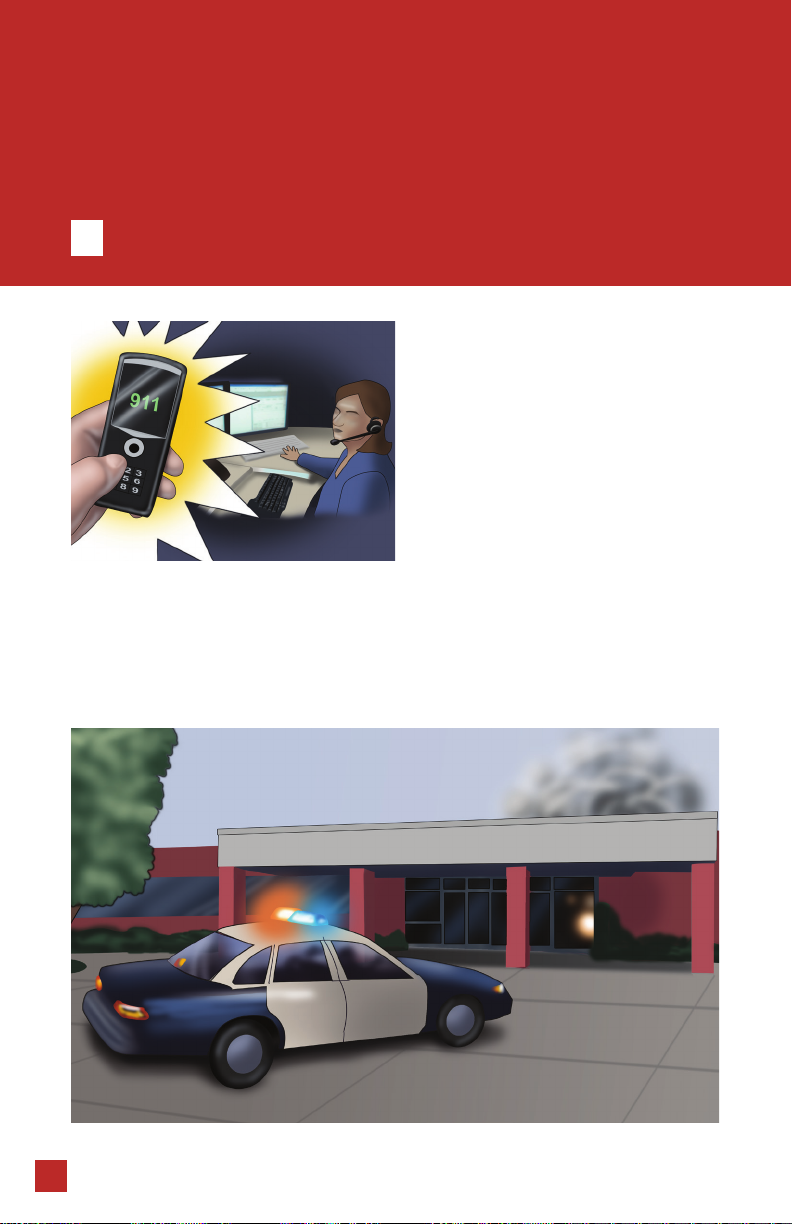
ALERT – CALL 9-1-1
A
■
Get help
■
OR
■
■
This will notify emergency medical responders and,
depending on the situation, police ofcers to respond
to the scene
A
Call 9-1-1 yourself,
Tell someone to call
9-1-1
6
Page 9
SECTION 4:
BLEEDING
B
■
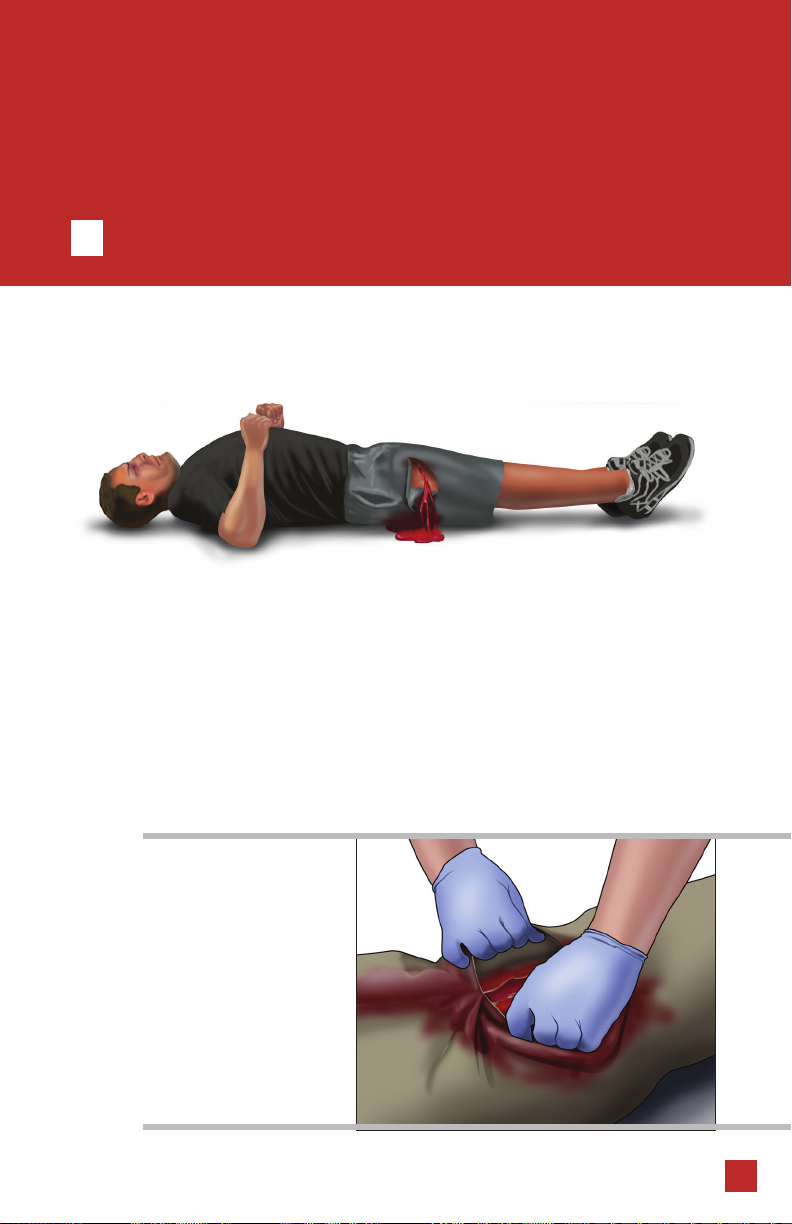
Find the source of bleeding
■
Open or remove the clothing over the wound so you can
clearly see it
■
Look for and identify “life-threatening” bleeding
BA
By removing
clothing, you
will be able to
see injuries
that may have
been hidden
or covered.
7
Page 10
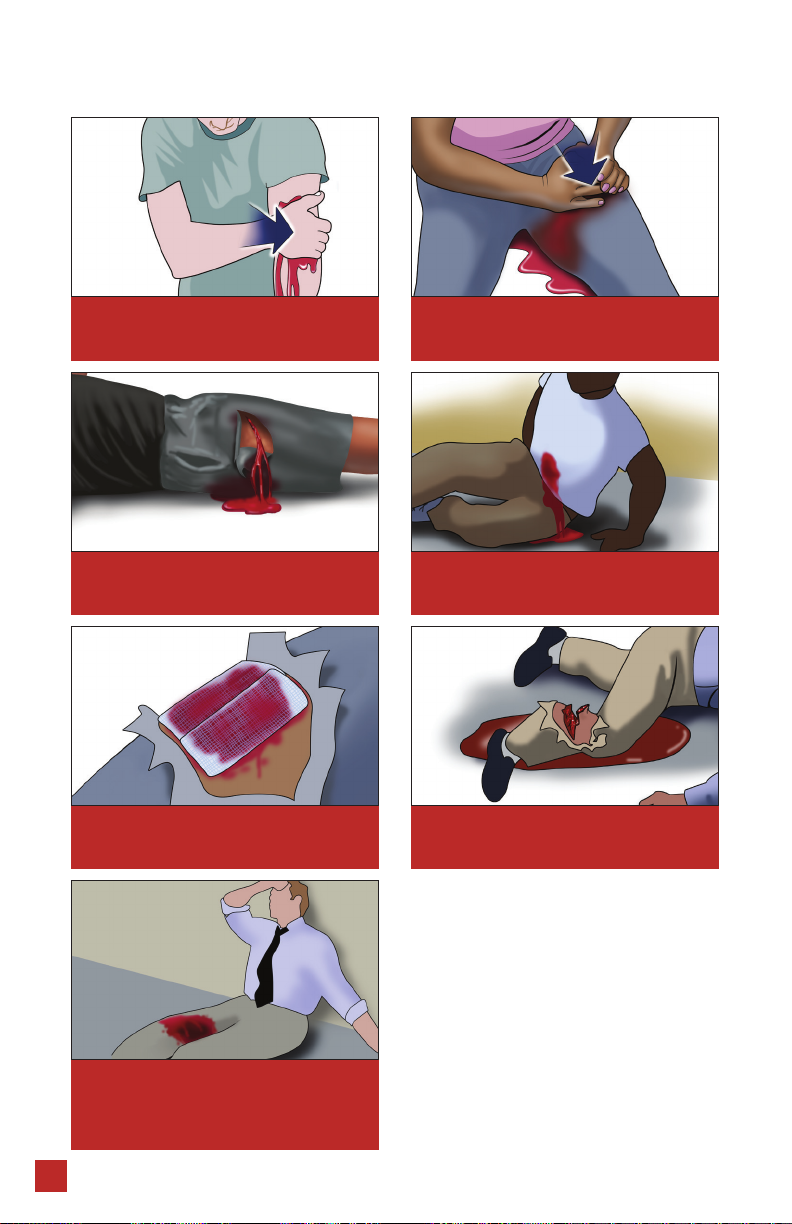
What is “life-threatening” bleeding?
Blood that is spurting out
of the wound.
Blood that is pooling on
the ground
Bandages that are soaked
with blood
Blood that won’t stop
coming out of the wound
Clothing that is soaked
with blood
Loss of all or part of an
arm or leg
Bleeding in a victim
who is now confused
or unconscious
8
Page 11

SECTION 5:
COMPRESS
C
KEY POINT: There are a number of methods that
can be used to stop bleeding and they all have one
thing in common – compressing a bleeding blood
vessel in order to stop the bleeding.
■
If you don’t have a trauma rst aid kit:
■
Apply Direct Pressure on the wound
Cover the wound with a clean cloth and apply pressure
by pushing directly on it with both hands (see page 10)
■
If you do have a trauma rst aid kit:
■
For life-threatening bleeding from an arm or leg and
a tourniquet is available:
Apply the tourniquet (see page 11)
C
■
For life-threatening bleeding from an arm or leg and
a tourniquet is NOT available OR for bleeding from
the neck, shoulder or groin:
Pack (stuff) the wound with a bleeding control (also
called a hemostatic) gauze, plain gauze, or a clean cloth
and then apply pressure with both hands (see page 12)
We will discuss each of these actions in more detail in the
next few pages.
9
Page 12
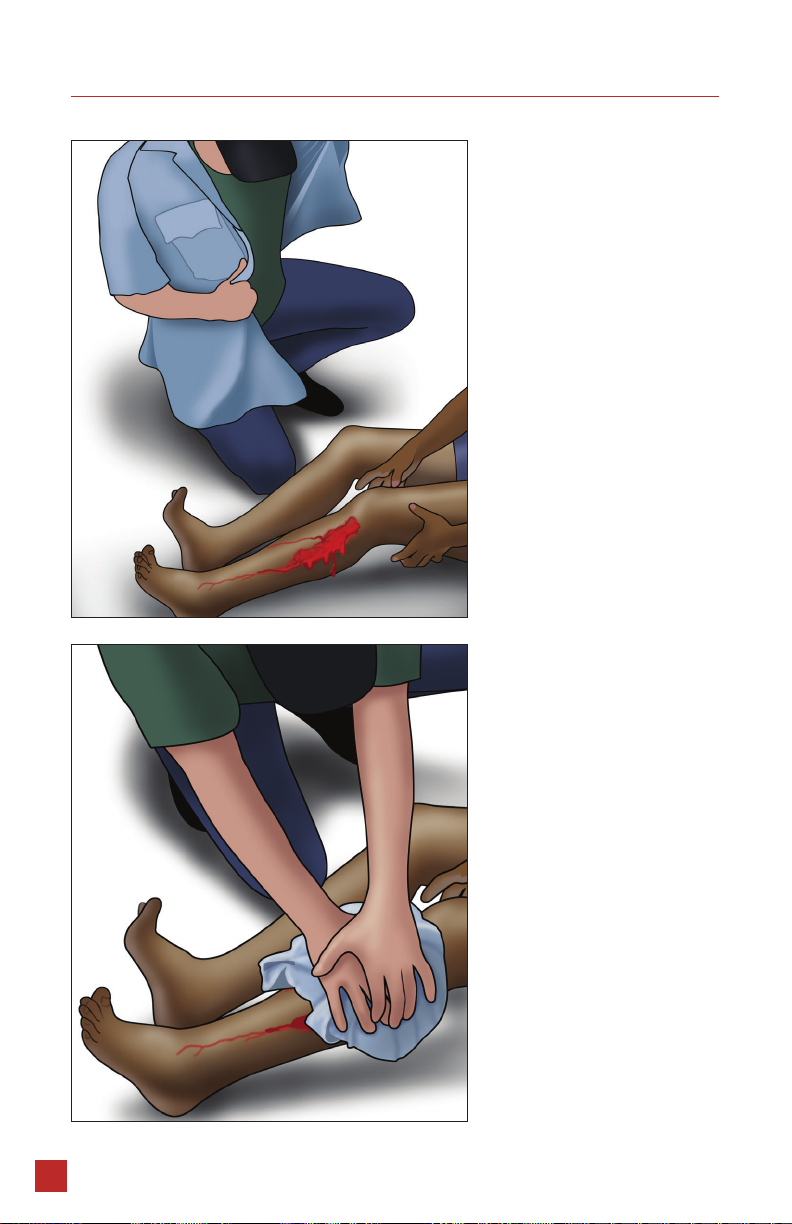
DIRECT PRESSURE ON A WOUND
1. Take any clean
cloth (e.g. shirt)
and cover the
wound
2. If the wound is
large and deep,
try to “stuff” the
cloth down into
the wound
3. Apply continuous
pressure with
both hands
directly on top
of the bleeding
wound
10
4. Push down as
hard as you can
5. Hold pressure to
stop bleeding.
Continue pressure
until relieved
by medical
responders
Page 13
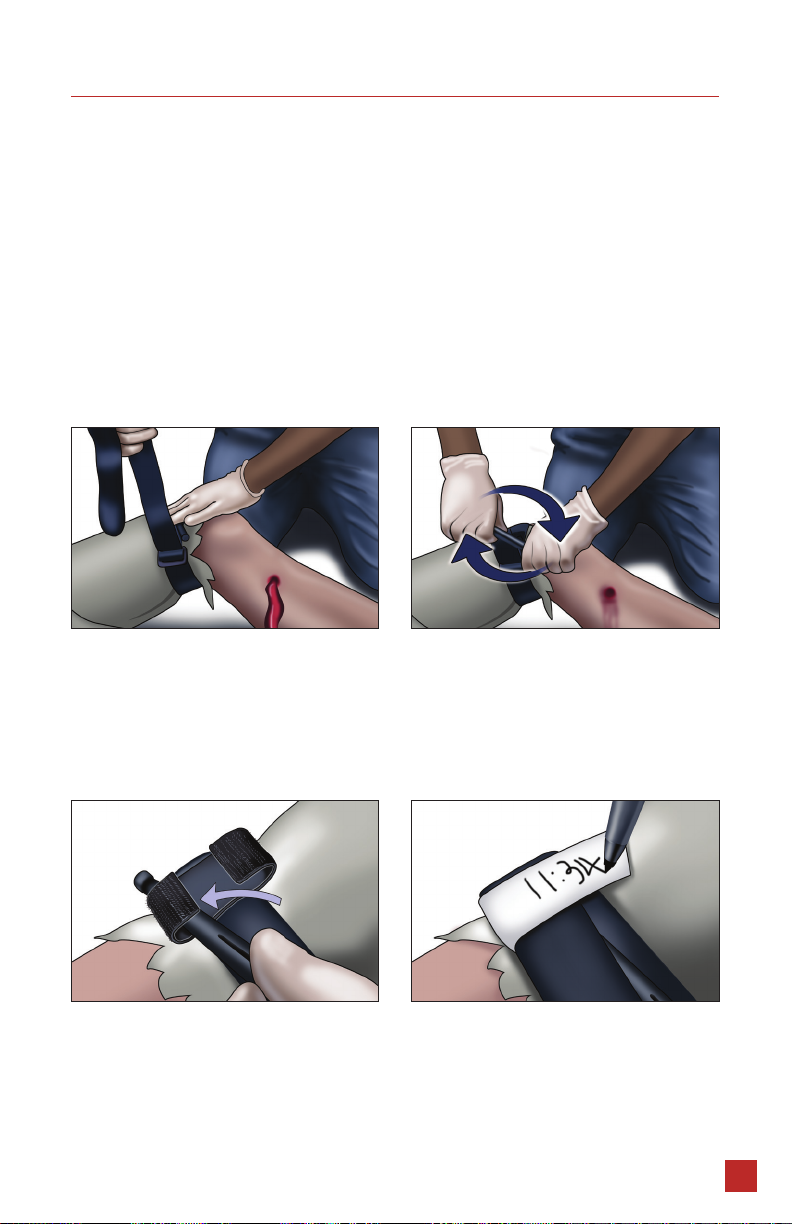
APPLYING A TOURNIQUET
If you do have a trauma rst aid kit:
For life-threatening bleeding from an arm or leg and a
tourniquet is available:
■
Apply the tourniquet
1. Wrap the tourniquet around the bleeding arm or leg about
2 to 3 inches above the bleeding site (be sure NOT to place
the tourniquet onto a joint – go above the joint if necessary)
2. Pull the free end of the
tourniquet to make it as
tight as possible and
3. Twist or wind the
windlass until bleeding
stops
secure the free end
4. Secure the windlass to
keep the tourniquet tight
5. Note the time the
tourniquet was applied
Note: A tourniquet will cause pain but it is necessary to
stop life-threatening bleeding.
11
Page 14
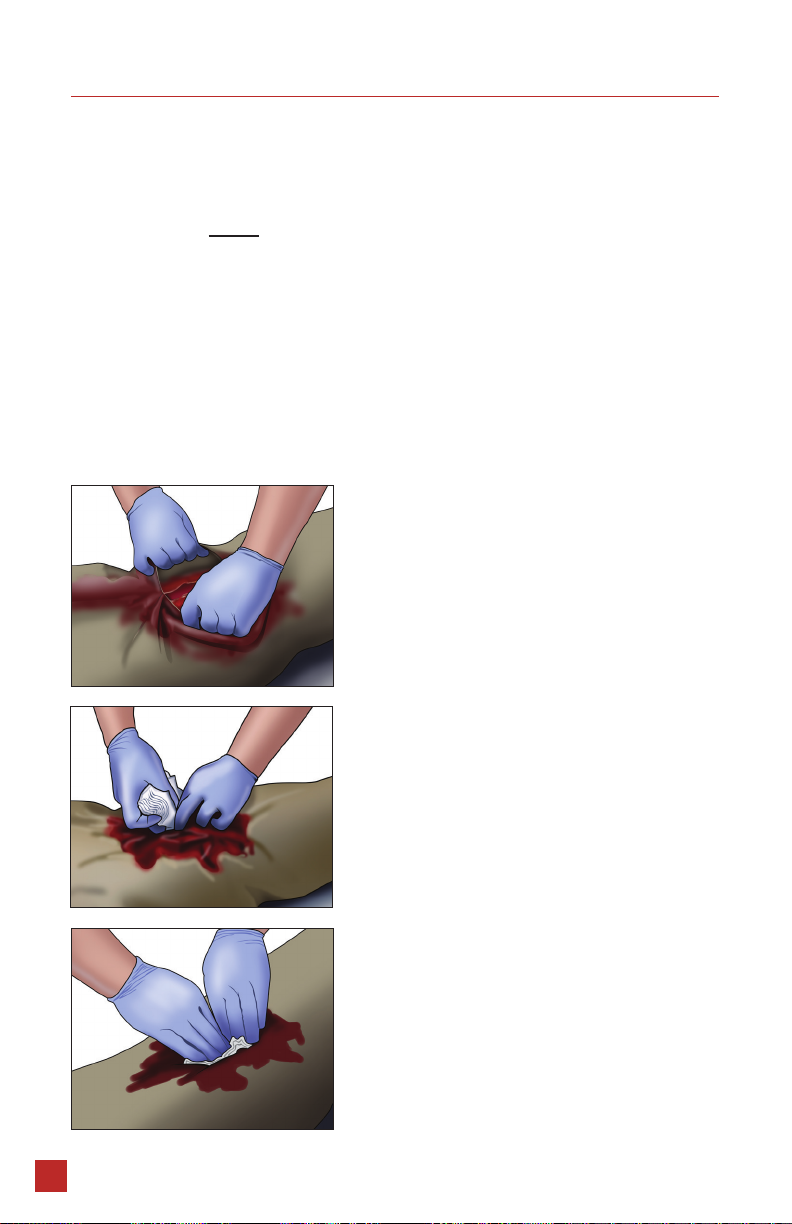
WOUND PACKING AND DIRECT PRESSURE
If you do have a trauma rst aid kit:
For life-threatening bleeding from an arm or leg and a
tourniquet is NOT available
OR
For life-threatening bleeding from the neck, shoulder or groin:
■
Pack (stuff) the wound with bleeding control gauze (also
called hemostatic gauze), plain gauze, or a clean cloth
and then apply pressure with both hands.
1. Open the clothing over the
bleeding wound
2. Wipe away any pooled blood
12
3. Pack (stuff) the wound with
bleeding control gauze
(preferred), plain gauze, or
clean cloth.
4. Apply steady pressure with
both hands directly on top of
the bleeding wound
5. Push down as hard as you can
6. Hold pressure to stop bleeding.
Continue pressure until relieved
by medical responders.
Page 15
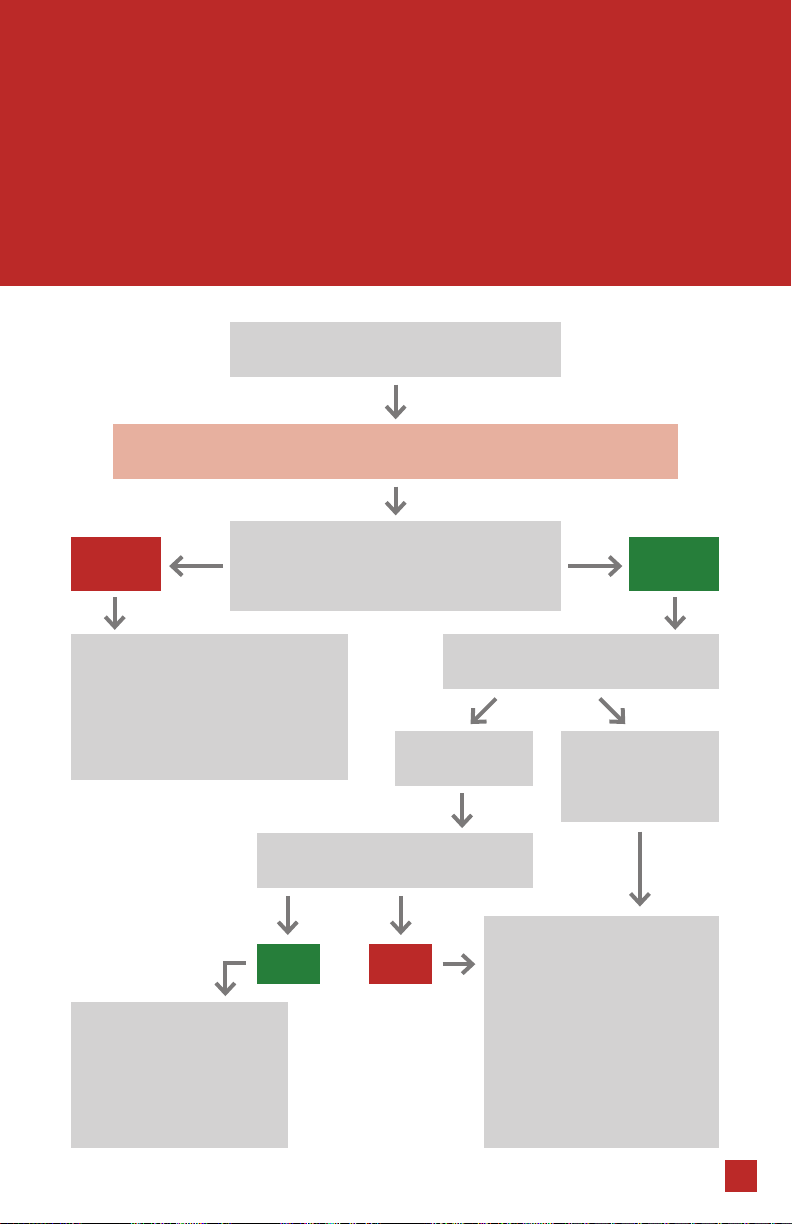
SECTION 6: SUMMARY
Assure your safety
Look for Life-Threatening Bleeding
NO YES
■
Use any clean cloth
■
Apply steady direct
Is a Trauma First
Aid Kit available ?
Where is the wound?
pressure directly on
the wound
Arm or leg
neck, shoulder,
groin
Is tourniquet available?
■
Pack the wound
with bleeding control (hemostatic)
gauze (preferred),
any gauze, or
clean cloth
■
Apply steady
direct pressure
■
Apply above the
bleeding site
■
Tighten until the
bleeding stops
NOYES
13
Page 16
The only thing more tragic than a
death from bleeding…
IS A DEATH THAT COULD
HAVE BEEN PREVENTED.
The ‘Stop the Bleed’ campaign was initiated by a federal interagency workgroup convened by the National
Security Council Staff, The White House. The purpose of the campaign is to build national resilience by
better preparing the public to save lives by raising awareness of basic actions to stop life threatening
bleeding following everyday emergencies and man-made and natural disasters. Advances made by military
medicine and research in hemorrhage control during the wars in Afghanistan and Iraq have informed the
work of this initiative which exemplies translation of knowledge back to the homeland to the benet of the
general public. ‘Stop the Bleed’ is a registered service mark of the Department of the Defense.
Use of the equipment and the training does not guarantee that all bleeding will be stopped or that all lives
will be saved.
© 2017 American College of Surgeons
 Loading...