

Page 1

WHITE PAPER
Final Inverter Technology™
for Electrostatic Speakers
Final Sound Solutions
INTRODUCTION
Electrostatic speaker systems have been considered the absolute state of the art in
audio reproduction since the 1960’s, when the legendary KLH 9 first made its
debut. Shortly after, Infinity Systems introduced the Servo Static One, a full range
electrostatic design that was considered the best speaker of all time and led to
Infinity’s current position as one of the leading speaker brands in the world. In the
early 1990’s, Martin Logan popularized the concept of “hybridization”, the process
of blending dynamic and electrostatic technologies to achieve a higher level of
performance in a smaller physical space. These “integrated” hybrids achieved high
levels of sales when they became sleek and sexy instead of big and boxy
Electrostatic speakers are known for there clarity and transparency of sound, as well
for the very low distortion because amongst others the very low mass of the moving
diaphragm. Besides the very high sound quality, traditional electrostatic speakers
had also a number of principal disadvantages such as a very low impedance as
soon as the frequency goes above 1000hz even as low as one Ohm by 20000hz
(need for expensive and powerful amplifiers). Another known disadvantage for
traditional electrostatic speakers is the beamy pattern of the sound distribution
resulting in a narrow spot of the listening place. Because of the very principle of the
sound reproduction, electrostatic speakers need very large surfaces to reproduce
Bass tones (expensive)
Final loudspeaker systems are equipped with electrostatic transducers. The
electrostatic principle is based on the fact that two objects possessing a positive
Page 2

charge will experience a repulsive force and a positive and a negative charged
object show an attractive force.
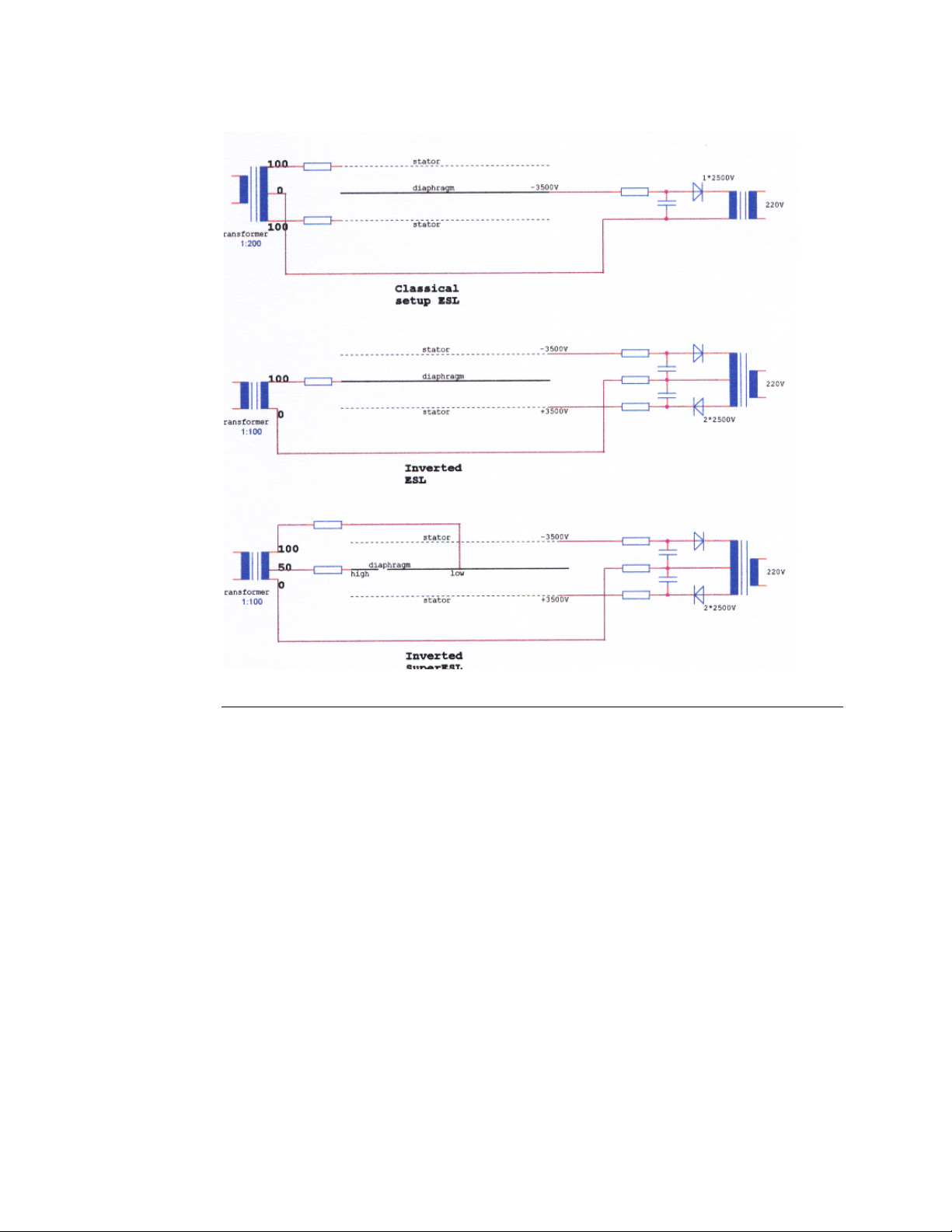
In case of electrostatic loudspeaker elements a thin Mylar® film, permanently
charged by means of a high voltage unit, is suspended between two perforated
plates. In case of the traditional Electrostatic speaker, the audio signal from the
amplifier is transformed in to a high voltage by means of an audio transformer and
delivered to the perforated plates as an alternating current.
The alternating electrical field caused by the two perforated plates (the stators) will
push and pull the film (the membrane). The membrane itself will move the air and
therefore produce sound waves.
Although the electrostatic principle is fairly simple there are a lot of problems to
solve. For instance we are dealing with a high voltage system so advanced
insulation technologies are necessary. On the other hand the design of the audio
transformer is crucial for the sound quality of the loudspeaker.
THE FINAL SOUND INVERTER’S UNIQUE SELLING POINTS
Ultra Low distortion
Transparency and life-like sound
High-definition sound (a lot of detail)
High Impedance resulting in lower power and lower-cost amplifiers
Broad Stereo Image
Excellent sensitivity on normal listening distance
Much less affected by room reflections (against walls, ceiling and floor)
resulting in a lower-cost for the Home Theatre Installation.
The Inverter principle results in a high degree of safety allowing the design
to comply with the UL and CE requirements
The Inverter also needs smaller electronics, resulting in a flat and digital
lifestyle design.
Final Sound Solutions modular design allows applying manufacturing technologies
that allow for much lower manufacturing cost prices and as such more attractive
end-user prices.
Page 3

THE INVERTER: THE FINAL SOUND SOLUTION
Final Sound developed the Inverter Electrostat over the last two years in
order to solve a number of the disadvantages of electrostats while keeping
the benefits.
Diaphragm
Stator plates
Additionally FSS has improved the diaphragm technology substantially, so it will
last much longer than traditional electrostats.
Page 4
THE FINAL SOUND ELECTROSTATIC CONCEPT
The Final electrostatic loudspeakers consist of the following basic components:
The electrostatic element. This element is a sandwich of two perforated plates. In
between these plates a thin film (the membrane) is suspended. The plates are
coated with special epoxy polyester to obtain a proper insulation. The membrane is
made electrically conductive by means of a coating process. Final uses VHB (very
high bonding) tapes to build the sandwiches.
The audio transformer. Final has developed its own state of the art audio
transformers. Special core materials and insulation techniques are applied. The
audio transformer is for a major part responsible for the performance of the speaker.
On today’s market suitable audio transformers for ESL purposes are not available.
The high-voltage unit. A high voltage unit powers each electrostatic element. This
unit delivers the polarization voltage to the stator plates. The power consumption of
the electrostatic loudspeakers is very low.
The frame. The electrostatic elements are fixed in a rigid framework. The newest
Page 5

generation Final speakers have a beautiful framework made of extruded alloy tubes.
The satin finished framework gives the speaker a unique cool look. On the other
hand the extrusion profiles enable large volume production. A unique feature of the
HT systems is that the electrostatic panels can be delivered in a wall-mounted
version and a floor standing version.
The subwoofer unit. This unit is specially designed to reproduce the lower
frequency range of the Home Theater system. The subwoofer cabinet is suited with
a special woofer powered by a high-end amplifier. To perform a perfect match with
the electrostatic elements the woofer is able to reproduce music signals up to 300
Hz.
The frames of speaker panels are made of satin finished extruded alloy profiles. This
offers a great flexibility in dimensions. The panels are constructed with perforated
plates, which are assembled with VHB (Very High Bonding) tapes. Because of this
method the production of a speaker panel can be done very quick and efficient.
Large-scale production can lower the cost price and after all lower the consumer
price. This will enlarge the potential market tremendously.
Its unique technology of electrostatic speakers allows a superb sound quality
combined with an excellent price /performance ratio. Its extreme flat design allows
not only floor standing but also wall mounting. Its patent protected and patentpending electrostatic technology allows a far better price performance than
competing systems
WHY DOES AN ELECTROSTATIC LOUDSPEAKER (ESL) SOUND LOUDER?
When characterizing the sensitivity of loudspeakers in general it is common
practice to express this magnitude in dB/1 meter/1 watt or 2,83 volts. This works
fine as a measure for dynamic speakers as these are point sources, but asks for
some more detailed explanation for line sources. An electrostatic speaker is mostly
a line source and moreover it is a dipole.
Both aspects will be treated here.
A conventional cone-type loudspeaker is a point source, moreover it usually only
radiates in the forward direction. An ESL is a line source and it usually radiates as
much at the front as at the rear.
When a long line source is measured at 1-meter distance, the microphone usually
receives its sound from a limited part of the total sounding surface. Therefore the
figures obtained by such a measurement do not rightly reflect the listener’s
impression of the sound level.
Acoustical theory shows that the sound level of a point source diminishes
–naturally- with 6 dB per doubling of the measuring distance, while long line
sources like ESL’s show a decrease of 3dB per doubling of the distance. When
seated at a distance of typically 4 meters in a room, the sound intensity out of a
Page 6

point source is 12 dB lower than at the usual but not very practical measuring
distance of 1 meter.
From a line source like a large electrostat, when auditioned at 4 meters, the loss is
not 12dB but 6 dB only.
An example may clarify this phenomenon:
A good cone-type loudspeaker, behaving as a point source has a “sensitivity of
86dB/watt/1 meter”. At the usual 4-meter distant listening position, the sound level
has dropped to 86 – 12 = 74 dB. A big ESL, when auditioned at the same distance
will produce a sound level of 86 – 6 = 80dB. A 6 dB difference.
The second property of ESL’s is its dipole character. A conventional speaker only
radiates to the front, as the back is usually closed by the box.
An ESL radiates its sound energy both to the front as to the rear and this rear sound
energy will be reflected to the walls and added to the waves coming from the front.
This will contribute to the overall sound level impression of the listener. Were these
two waves in phase, it would lead to an increase of 6dB. But generally this is not
the case of course. An estimation of a 3dB difference is realistic.
Let us sit down again at our listening position at 4 meters of our 86 dB/1 meter/ 1
watt loudspeaker and add the two phenomena as described above together.
The point source will yield (see above) a sound level of 86 – 12 = 74 dB at 4 meters
distance.
The long ESL will yield 86 – 6 + 3dB = 83dB at 4 meters.
This is an important 9 dB of difference at the listening position. Smaller ESL’s are
not an ideal line source, but still are dipoles with their 3 dB advantage. A smaller
ESL/86dB in this context, will yield a sound level at 4 meters of some 86 – 9 + 3 dB
= 80dB, still 6dB ahead of a point source with the same measured 86 db/1 meter/ 1
watt/2.83 volts.
When Final specifies 86 dB/1 meter/1 watt, it is measured with the standardized
method. For large ESLs one has to add 9 db to that figure: it effectively becomes 95
dB equivalent as compared to a point source: a normal cone loudspeaker. For small
ESL’s one has to add 6 dB to that figure: this effectively becomes 92 dB equivalent
in order to get the right impression of the capabilities of ESL’s versus cone
loudspeakers.
The last pitfall in interpreting the measurement results of ESL’s, has –again- to do
with its long, mostly vertical- dimensions.
When assessing the frequency characteristic at the usual distance of 1 meter, there
maybe considerable differences in distances between the microphone and the
different parts of the ESL: from the middle the distance, of course, is 1 meter. But
Page 7

from the extremities of a 52 cm high 80 ESL the distance is, Root ( 100^2+26^2) =
103.3 cm. This is a half wavelength at approx. 4000 Hz. At this frequency the
waves from the extremes of the ESL will more or less cancel out the waves
emanating from the centre. The curve will lead an uninformed experimenter to
believe that the frequency characteristic falls with 3 dB per octave beyond this first
cancellation frequency! Measuring however at 4-meter distance, this first
canceling-frequency will be at 16000 Hz. A 120 cm long ESL like the FINAL model
400 will experience its “first cancellation frequency” at around 3600 Hz.
For a listener in a room with some reverberation –not being a “dead” room- this
phenomenon is quite unimportant, as all waves coming back to him from all walls
and the floor and ceiling will smooth out the undulations experienced in the
measuring set-up in a non-reverberating room or with software canceling all
reflections.
When judging the measurements of an ESL in a non-reverberating set-up, one can,
for a quick assessment of the qualities of an ESL, accept the following rules:
measuring the behavior at low frequencies can be done at the usual 1 meter
distance, high frequencies can best be measured at a distance of 4 meter or more.
ELECTROSTATIC VERSUS DYNAMIC LOUDSPEAKER
Comparisons between electrostatic (ESL) and dynamic (cones) loudspeakers and
descriptions of the operation of ESLs have been made in all shapes and forms,
enough to fill a small library. So this introduction is limited to a short enumeration
of the most salient differences between the two systems, hoping this subject is well
known to readers.
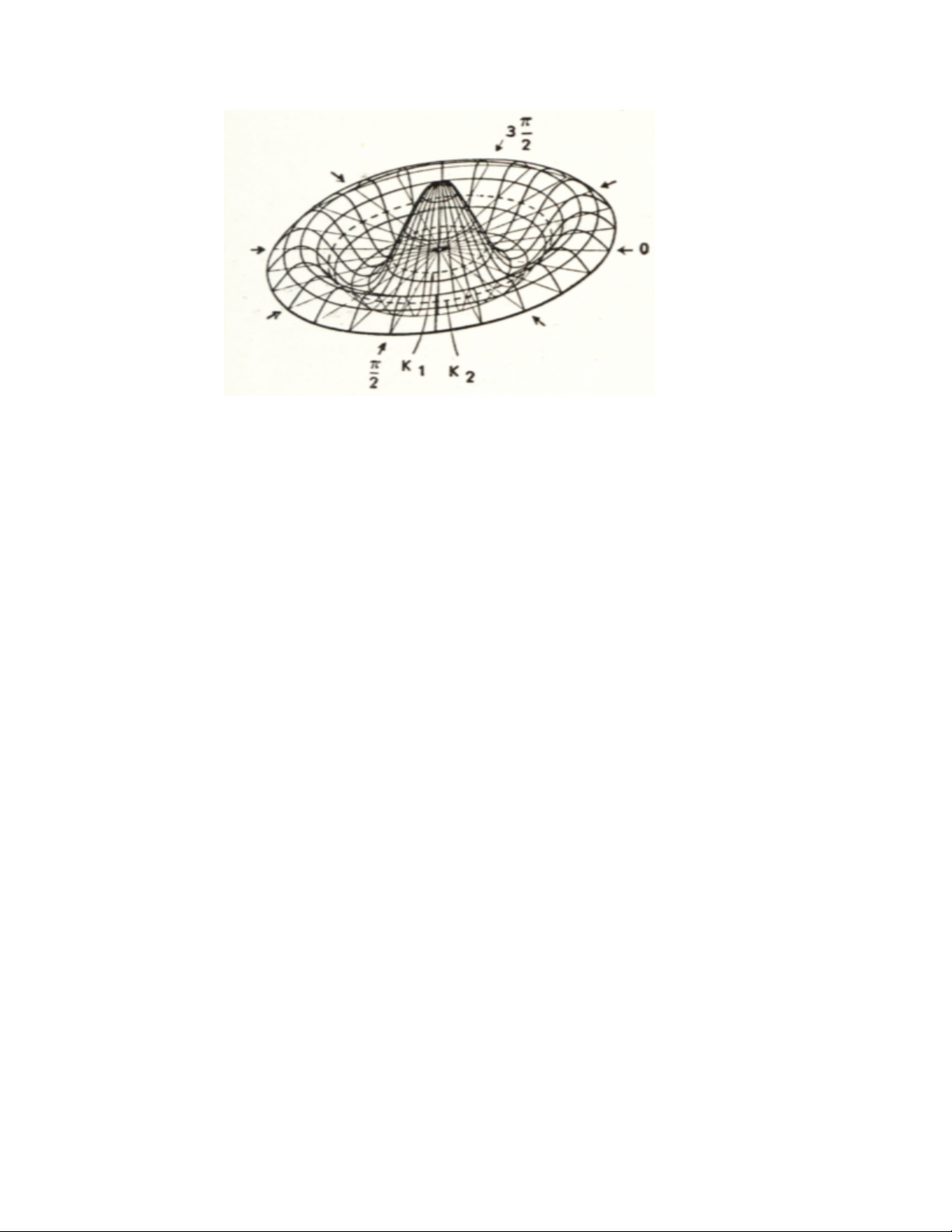
1. Electromagnetic or dynamic loudspeakers have cones driven by some form
of a coil moving in a magnetic field – flat or circular. These cones are usually
excited at the center for bass and middle tone speakers or at the perimeter in the
case of tweeters and are hoped to move exactly in accordance with the electrical
current through the coil. In practice however, cones move more or less like shaking
a rug, than like an ideal stiff surface. See the diagram below just to excite your
imagination. One may hope the mean value of the movement over the total surface
is neat enough to give an acceptable and musical representation of our beloved
sound material.
Page 8
2. ESL diaphragms have considerably less weight than cones: the diaphragm of
an 80i weighs less than 1 gram. As much as 100 liter of air weighing 1 kg per m3.
In an ESL such a diaphragm is 12 micron thick and it weighs as little as a layer of
air of 12 mm thick: 6 mm on both sides. In an ESL the diaphragm is driven
simultaneously and homogeneously over the entire surface. Dampened as it is by
its surrounding air this thin and ultra light foil does not get the tiniest chance to
invent movements of its own.
3. Cones have the advantage of a long stroke, so the surface of an ESL
diaphragm should be many times larger than that of a cone to move the same
number of air molecules. But be aware: the ESL moves air at both sides as
explained above. Low frequency output from ESL’s is admittedly nice and clean,
but usually no too strong, unless the ESL’s surface is huge and at the same token it
gets quite expensive.
4. Final’s finest model 1.4, now baptized 1400i, has a surface per loudspeaker
of 0,7 square meters. If this were a round cone it’s radiating diameter should be
95cm or 37 inch! Our smallest model (model 80) today has one tenth of the surface
of the 1400 and that is 0,07 square meter. Its equivalent diameter should be 12
inch, still the measurement of a very respectable cone-speaker.
5. Dynamic loudspeakers are usually housed in not dumb-and-dead boxes,
which -these boxes too, alas- have their own contribution to the sound of music.
ESL’s have no such boxes, at the expense of the performance in the bass
frequencies.
6. Dynamic loudspeakers require the frequency spectrum to be divided into
two, three or more sub-bands. This brings about the use of LC-filters with their own
influence on the sound.
7. ESL’s, due to their large radiating surface, tend to exhibit bundling of the
higher end of the audio spectrum, reducing the dimensions of the so-called sweet
spot. FINAL has found out how to fight this phenomenon.
Page 9

8. Most ESL’s on the market require high end amplifiers because of their weird
impedance over frequency: values can be found as low as 1 ohm at 20kHz. And
very capacitive too as this 1 ohm is the equivalent of 8 microfarad. This in itself is a
strange phenomenon because theoretically the sensitivity of an ESL increases with
frequency and one would, based on electrical energy in versus audio energy out,
expect some sort of inverse behavior.
9. Full range electrostats usually have a limited sensitivity. 86 dB is commonly
found whereas dynamic loudspeakers exhibit sensitivity more like 86 to 92 dB
without recurring the use of exponential horns and other additional means
(measured at 2,83 volt in and at a distance of 1 meter). This has been discussed
thoroughly above. The sound is louder than you would conclude from the specs.
10. The industry in the past decennia has predominantly made large and
expensive Electrostatic Loudspeakers in rather small quantities mainly for the highend market, and not yet addressed the middle segment. Part of this is due to a
vicious circle whereas small quantities do not lead to a quick decrease of the cost
of manufacturing, nor a quick run down the learning curve. Dynamic loudspeakers
on the contrary, are made in huge quantities and varieties worldwide and so are
cheaply available.
11. The application of the high voltages necessary in an ESL presents a
challenge as to the safety as laid down for instance in ETL and UL-requirements
related to human safety and fire hazard. Finals Inverter solution has solved this
12. ESL’s are sensitive to dust, smoke and moisture: these particles tend to
shorten their lifetime. However Final has developed a new type of diaphragm with
a protective coating to enable a long lifetime
13. ESL’s are line sources and so behave in a completely different manner as
point sources in the build-up of the acoustic field.
© 2005 FINAL SOUND SOLUTIONS FINAL SOUND SOLUTIONS
Eisenhowerweg 8d
5466 AC Veghel
The Netherlands
Telephone: +31 (0) 413 311 115
www.finalsound.com
9.26.05
Inverter Technology is a trademark of Final Sound Solutions
 Loading...