

Page 1
USER AND
MAINTENANCE MANUAL
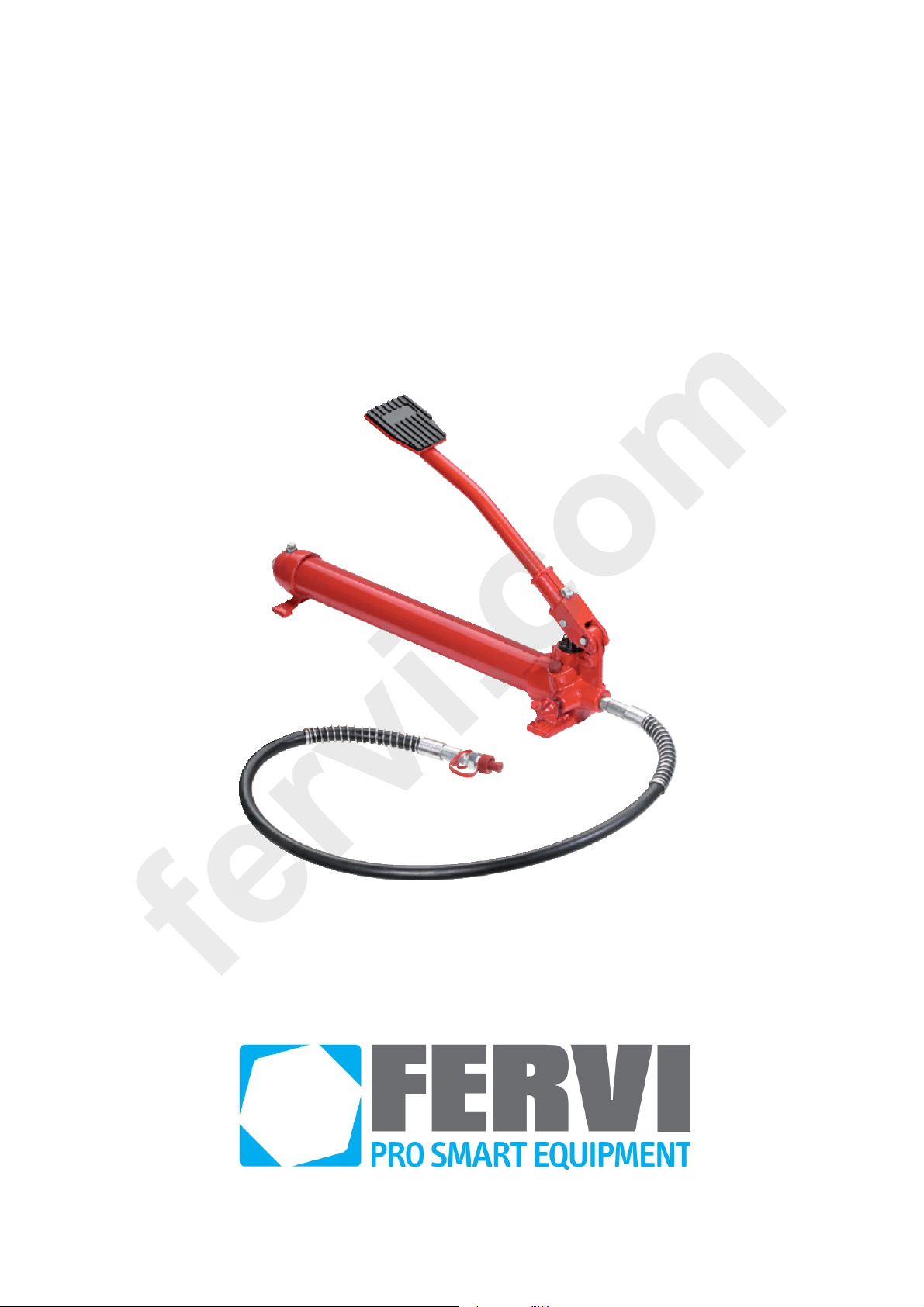
Hydraulic pump
Art. 0271
TRANSLATION OF THE ORIGINAL INSTRUCTIONS
fervi.com
Page 2

MACHINES AND
ACCESSORIES
Page
2of15
FOREWORD
Read this manual before operation
TRANSLATION OF THE ORIGINAL INSTRUCTIONS
It is compulsory to read this instruction manual before star
ting operation. The guarantee that
the machine will function and perform properly is strictly dependent upon the application of all
the instructions contained in this manual.
Operator Qualifications
The workers responsible for using this machine mus
t have all necessary information,
education and receive adequate training regarding safety, including:
a)
Conditions of use for the equipment;
b)
Foreseeable, abnormal situations;
c)
pursuant to art. 73 of Legislative Decree no. 81/08.
We guarantee the Machine's
conformity to specifications and technical instructions
described in the Manual on the date of issuance and listed herein; On the other hand,
the machine may also be subject to important technical changes in the future, without
the manual being updated.
T
herefore, contact FERVI for information about modifications that could be
implemented.
REV. 1
May 2013
fervi.com
Page 3
MACHINES
AND
ACCESSORIES
Page
3of15
INDEX
1
GENERAL INFORMATION
................................
................................
...........
4
2
GENERAL SAFETY WARNI
NG
................................
................................
.....
5
2.1
T
ECHNICAL
S
UPPORT
................................
................................
................................
.......
5
2.2
O
THER
P
ROVISIONS
................................
................................
................................
........
5
3
INTENDED USE AND DES
CRIPTION OF THE PUMP
................................
.....
6
3.1
I
DENTIFICATION
P
LATE AND
P
ICTOGRAMS
................................
................................
...........
7
3.2SAFETY
DEVICES
................................
................................
................................
........
7
4
TECHNICAL SPECIFICAT
IONS
................................
................................
...
8
5
IMPROPER USES AND PR
ECAUTIONS
................................
........................
8
6
TRANSPORTING, LIFTIN
G AND MOVING
................................
...................
9
7
USING THE PUMP
................................
................................
....................
10
7.1
C
OMMISSIONING
................................
................................
................................
..........
10
7.2
P
RESSURE
R
ELEASE
................................
................................
................................
.......
10
8
MAINTENANCE
................................
................................
........................
11
9
TROUBLESHOOTING
................................
................................
................
13
10
WAREHOUSE STORAGE
................................
................................
.........
13
11
DECOMMISSIONING
................................
................................
.............
13
12
EXPANDED DRAWING AND
SPARE PARTS
................................
............
14
fervi.com
Page 4
MACHINES AND
ACCESSORIES
Page
4of15
1
GENERAL INFORMATION
This manual is considered an integral part of the machine to which it was attached at the time
of purchase.
The manufacturer reserves the material and intellectual property rights of this publication and
prohib
its the disclosure and copying of any part herein without prior written consent.
The purpose of this manual is to provide the knowledge necessary for the use and
maintenance of the
pedal operated hydraulic
pump
and
create a sense of responsibility
and an u
nderstanding of the capabilities and limitations of the means entrusted to the
operator.
Operators must be properly trained and prepared, so make sure that this manual is read and
consulted by the staff responsible for commissioning, operation and maintena
nce of the
pump. This is to make all operations the safest and most effective possible for those who
carry out these tasks. Therefore, it is imperative to strictly comply with the requirements in
this manual, a necessary condition for safe and satisfactory
operation of the pump.
Before using the machine, authorized personnel must:
carefully read this technical document;
know which protections and safety devices are available, their location and how they
work.
The users must be properly trained, that they ar
e aware of all the information and
instructions in this manual and are aware of the potential risks of operating the pump.
The manufacturer declines all responsibility for any damage to people and/or things
caused by non
-
observance of the instructions in t
his manual.
Modifications to the machine carried out by the user must be considered their sole
responsibility, therefore the manufacturer declines all responsibility for any damage
caused to persons and/or property resulting from maintenance performed by
u
nqualified personnel and in a manner different from the operating procedures
shown below.
It is strictly forbidden to modify or remove safety devices and caution labels. If this must be
done (for example, for cleaning or repair), make sure that no one can
use the pump.
G
RAPHIC RISK ALERTS A
ND SAFETY AND OPERAT
IONAL WARNINGS
The following images were designed to attract the attention of the reader/user for correct and
safe use of the machine:
Pay Attention
This highlights behavioural rules to keep order
and prevent damage to the machine and/or the
occurrence of dangerous situations.
Residual Risks
This highlights the presence of dangers that cause residual risks to which the operator must
pay attention in order to avoid injury or damage to property.
fervi.com
Page 5
MACHINES
AND
ACCESSORIES
Page
5of15
2
GENERAL
SAFETY WARNING
Even if you are already familiar with the
Hydraulic
Pump,
you must read this manual
carefully to acquire full knowledge of the machine and general precautions to be observed
during operation.
Risks Associated with Using the Mac
hine
For safe use of the pump, it is necessary to take note of all the requirements for the
prevention of accidents detailed in the various sections of this manual.
The pump must only be used by personnel who have been specially trained by
authorized pers
onnel.
Only use the pump with single
-
acting cylinders.
Before starting work, make sure that the pump is in good condition.
Do not adjust the safety valve!
Place the pump on a flat, solid and durable work surface.
Do not perform tasks on the machine oth
er than those for which it was designed,
this
particularly refers to the size of the load being lifted
. In other words, do not load
the pump beyond its capacity.
If you use the pump to lift a vehicle, lock the wheels of the vehicle with the parking
brake.
Always use a safety support, such as a tripod, to support the load in case you
need to work under the load.
It is recommended that users of this publication, for maintenance and repair, have a
basic knowledge of the mechanical principles and procedures inh
erent in repair
techniques.
Replace worn or damaged parts, check that the repairs and protection work correctly
before operating.
Make sure that the work environment is forbidden to children, non
-
employees and
animals.
2.1
Technical Support
For any problems or
concerns, please do not hesitate to contact the dealer who sold the item.
2.2
Other Provisions
The first thing to do when starting work is to check the presence and integrity of the
protections and the operation of the safety devices.
Do not use the Pump if
it is defective!
fervi.com
Page 6
MACHINES AND
ACCESSORIES
Page
6of15
3
INTENDED USE AND DES
CRIPTION OF THE PUMP
The
Hydraulic Pump Art. 0271
is designed to provide pressure to cylinders or single
-
acting
hydraulic tools.
The pump must be used on surfaces that are supportive, flat, smooth, and adequately st
rong
and hard.
The operating temperature is within
–
20/+50°C.
The working environment must also be sufficiently well lit to ensure maximum operational
safety (at least 200 lux are recommended).
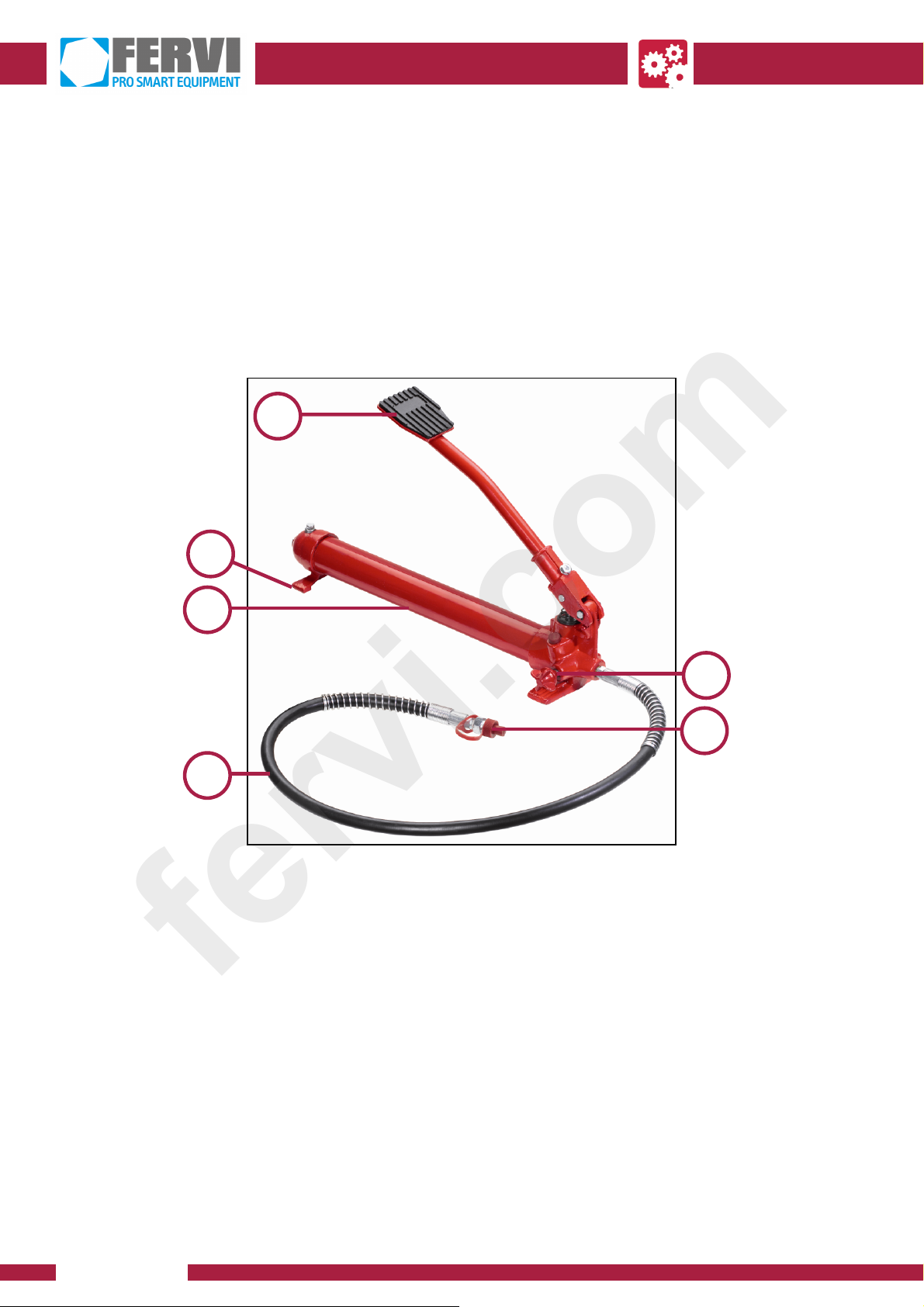
Figure
1–General v
iew.
Hydraulic pump
Art. 0271
is composed of:
Two steel support legs (1);
a pumping unit made up of the hydraulic cylinder and oil tank (2);
a pedal (3) for driving the pump;
a flexible tube (4) for the hydraulic oil, equipped with screw connection (5);
a knob for adjusting the lowering speed (6);
3
1
2
4
6
5
fervi.com
Page 7
MACHINES
AND
ACCESSORIES
Page
7of15
3.1
Identification Plate and Pictograms
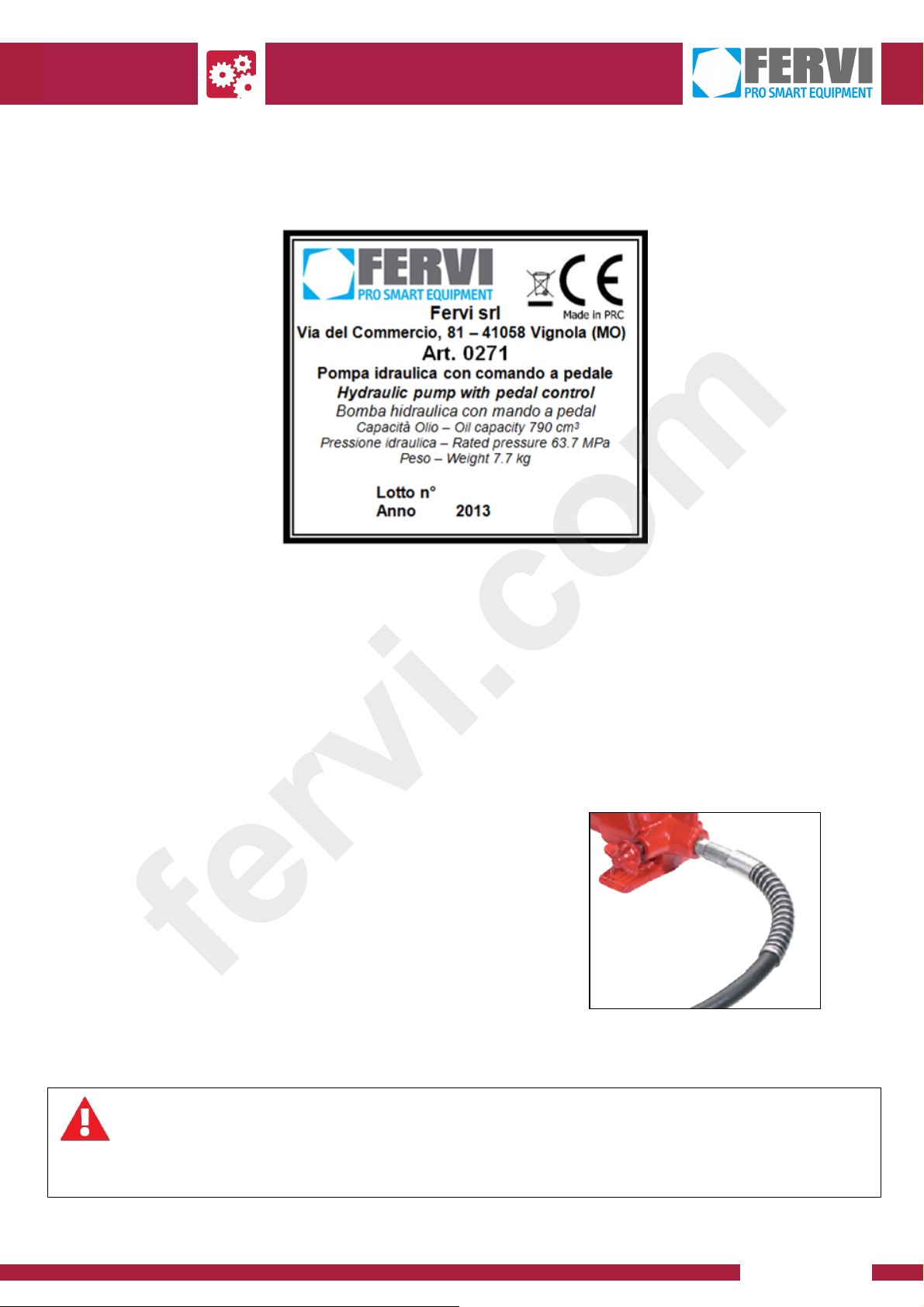
The identification plate is attached to the hydraulic cylinder or on the lifting accessory.
Figure
2–Identification plate.
N
OMINAL MAXIMUM CAPAC
I
TY
The
maximum hydraulic pressure
is indicated on the plate, which is what the pump can
exert under standard conditions, such as:
the in condition that is efficient and conservative;
is applied to a flat, hard and durable surface.
The maximum hydraulic
pressure must never be exceeded. The maximum lifting
capacity must be calculated in advance in accordance with the tool/load
3.2
SAFETY DEVICES
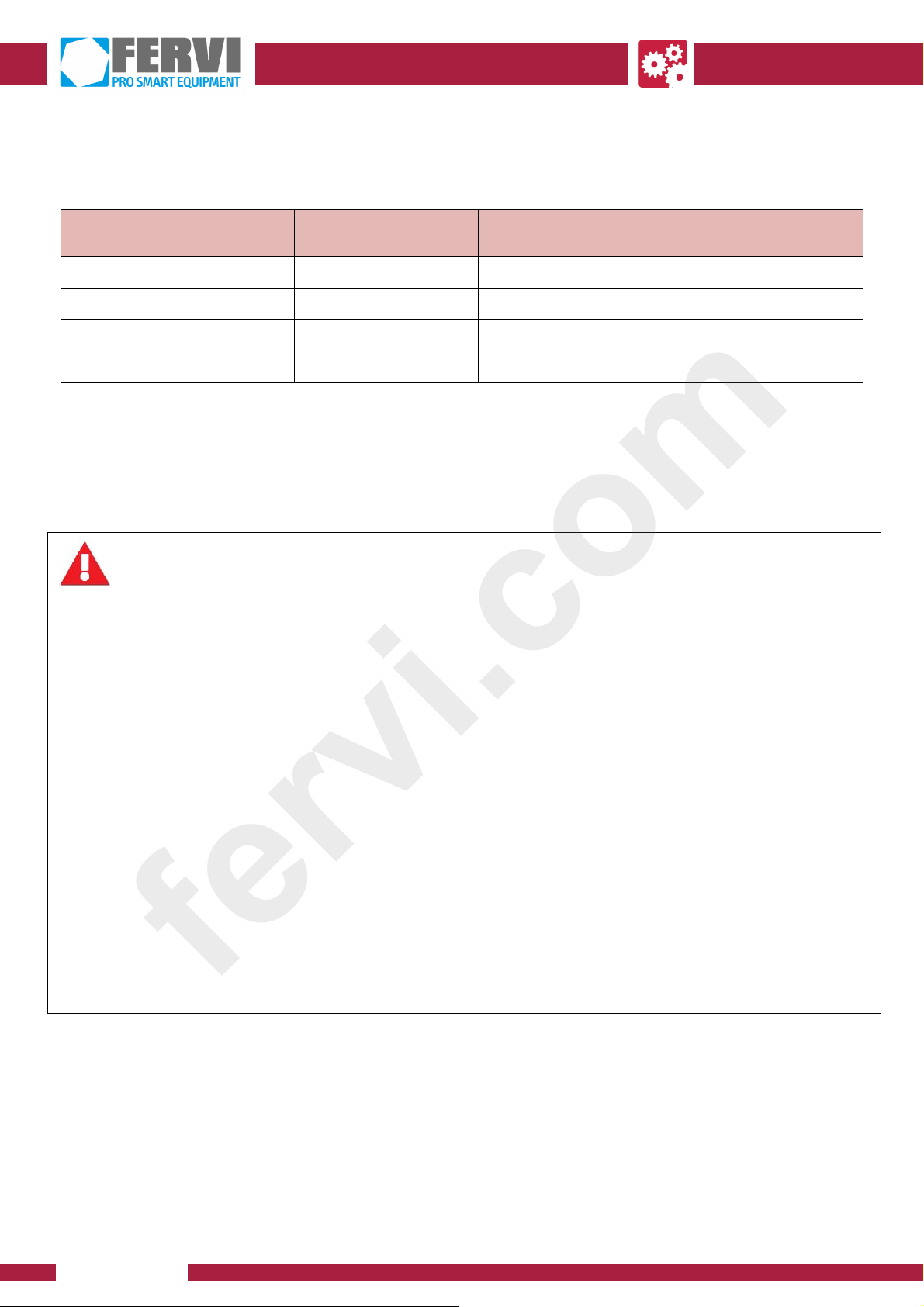
The flexible tube that carries the high
-
pressure
hydraulic oil, is connected by an external hose and
protected by
a metal connector, which is adapted to
prevent excessive bending at the connection points.
Figure
3–Hose protector.
Pump Overload
It is strictly forbidden to alter or modify the hose.
The tube should only be replaced
with one of equal characteristics.
fervi.com
Page 8
MACHINES AND
ACCESSORIES
Page
8of15
4
TECHNICAL SPECIFICAT
IONS
Description
Unit of
measurement
Art. 0271
Nominal pressure
MPa
63.7
Oil tank
cm3790
Empty mass
kg
7.7
Package dimensions
mm
73 x 37.5 x 19
5
IMPROPER USES AND PR
ECAUTIONS
The following
actions, which obviously cannot cover the entire range of potential possibilities
for "misuse" of the machine, are to be considered strictly prohibited.
THE FOLLOW IS STRICTLY PROHIBITED:
Using the pump to lift persons and/or animals that could fall.
Using the pump to lift loads while people are passing near the machine.
Working under lifted loads without using additional safety supports, such as a tripod.
Exceeding the maximum capacity of the pump, as indicated on the identification plate.
Lifting "da
ngerous" loads (molten metals, acids, radio
-
active materials, fragile and/or
crumbly).
Leaving the pressure pump unattended.
Allowing untrained personnel to use the pump.
Using the pump if you are not mentally and physically capable of doing so.
Using the
pump without due care.
Using the pump for purposes other than those for which it was designed.
Using the pump in environmental conditions for which it was not intended (poor
weather conditions, refrigerators, high magnetic fields, etc.).
Using the machine
in potentially explosive atmospheres.
Use the pump with insufficient lighting.
Using the pump on offshore boats.
Placing the pump in contact with foodstuffs.
fervi.com
Page 9
MACHINES
AND
ACCESSORIES
Page
9of15
6
TRANSPORTING, LIFTIN
G AND MOVING
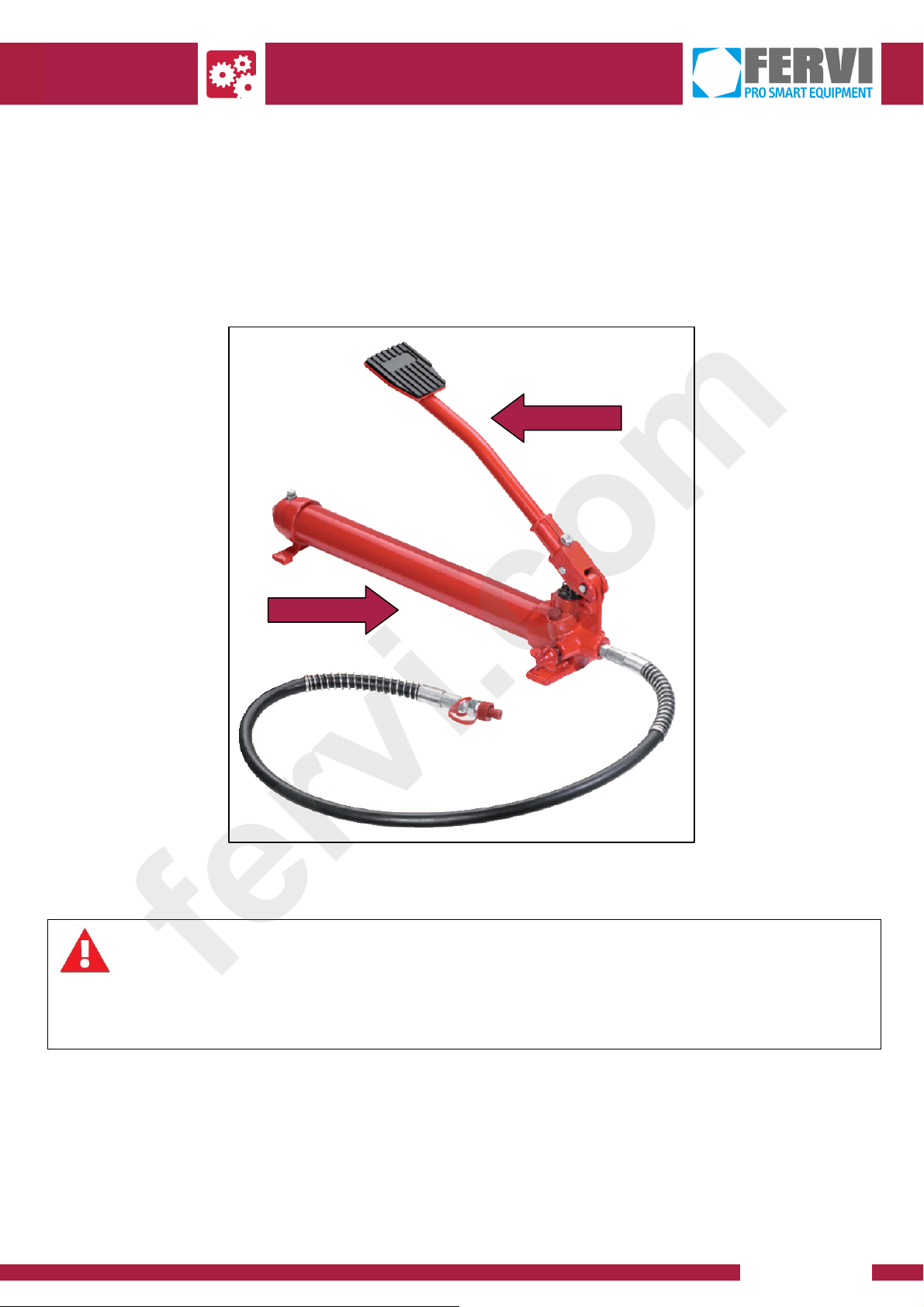
The operator may manually lift the pump for transporting. Make
sure the drain valve screw is
fully tightened.
The operator is to grasp the pump with both hands, using the pedal and the base of the
hydraulic cylinder as lifting points (
Figure
4
).
Figure
4–Transporting the pump.
Avoid Dropping to Protect Feet from Crushing
Move the pump by holding it with both hands, one on the gripping handle and one
below the hydraulic cylinder.
Do not hold with just one hand. It co
uld fall and crush your feet!
fervi.com
Page 10
MACHINES AND
ACCESSORIES
Page
10of15
7
USING THE
PUMP
Avoid Crushing Body Parts
Lifting heavy loads involves the risk of crushing or shearing body parts resulting from
mishandling. The assigned workers must be equipped with normal accident prevention
equipm
ent, such as gloves and safety shoes.
Workers involved in load lifting must operate the pump carefully and pay the utmost
attention.
In particular, the pump, lift and load should be controlled during movement.
It is absolutely forbidden to work under a loa
d that is lifted and supported only by a
hydraulic lift.
Hose Rupture
Before operating the pump, check the integrity and correct mounting of the hose.
7.1
Commissioning
To commission the pump for use, it is necessary to do the following:
1.
Place the pump
on a uniform surface that is strong enough for the task to be
performed.
2.
Check the oil level in the tank by lifting the appropriate cap, and eventually fill the tank
up to the optimum level.
3.
Remove the protective cap from the hydraulic hose and
connect it
to a cylinder or a lifting accessory.
4.
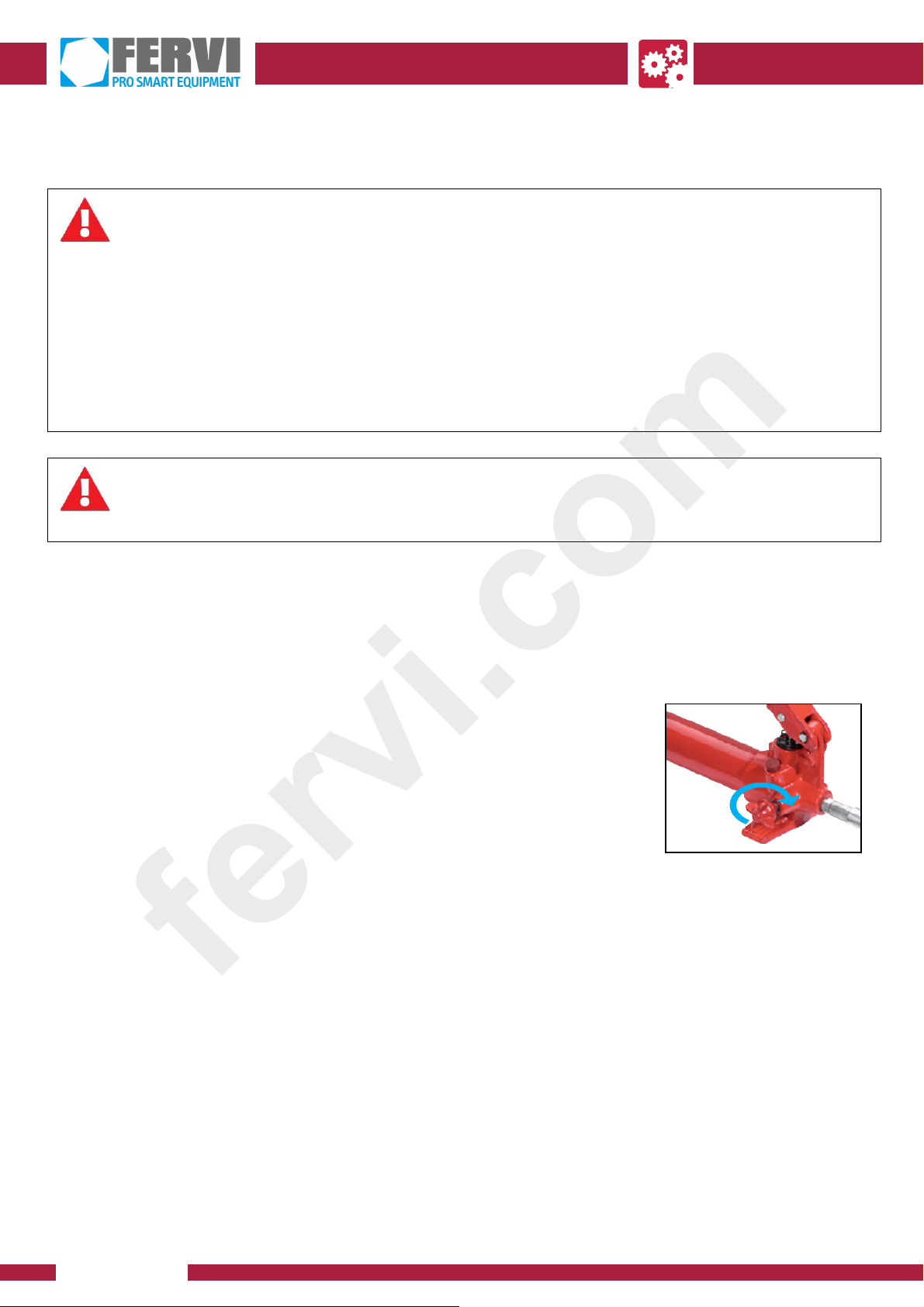
Make sure that the vent valve is closed by turning the control
knob clockwise.
5.
To pressurize the pump, raise the rod on the hydraulic
cylinder by manually operating the pumping pedal on the
piston pump. Continue pumpin
g until the desired height is
reached.
Figure
5–Control
knob.
7.2
Pressure Release
To lower the piston rod on the hydraulic cylinder, decrease the pressure inside the circuit by
opening vent valve and
slowly turning the knob counter
-
clockwise.
fervi.com
Page 11
MACHINES
AND
ACCESSORIES
Page
11of15
8
MAINTENANCE
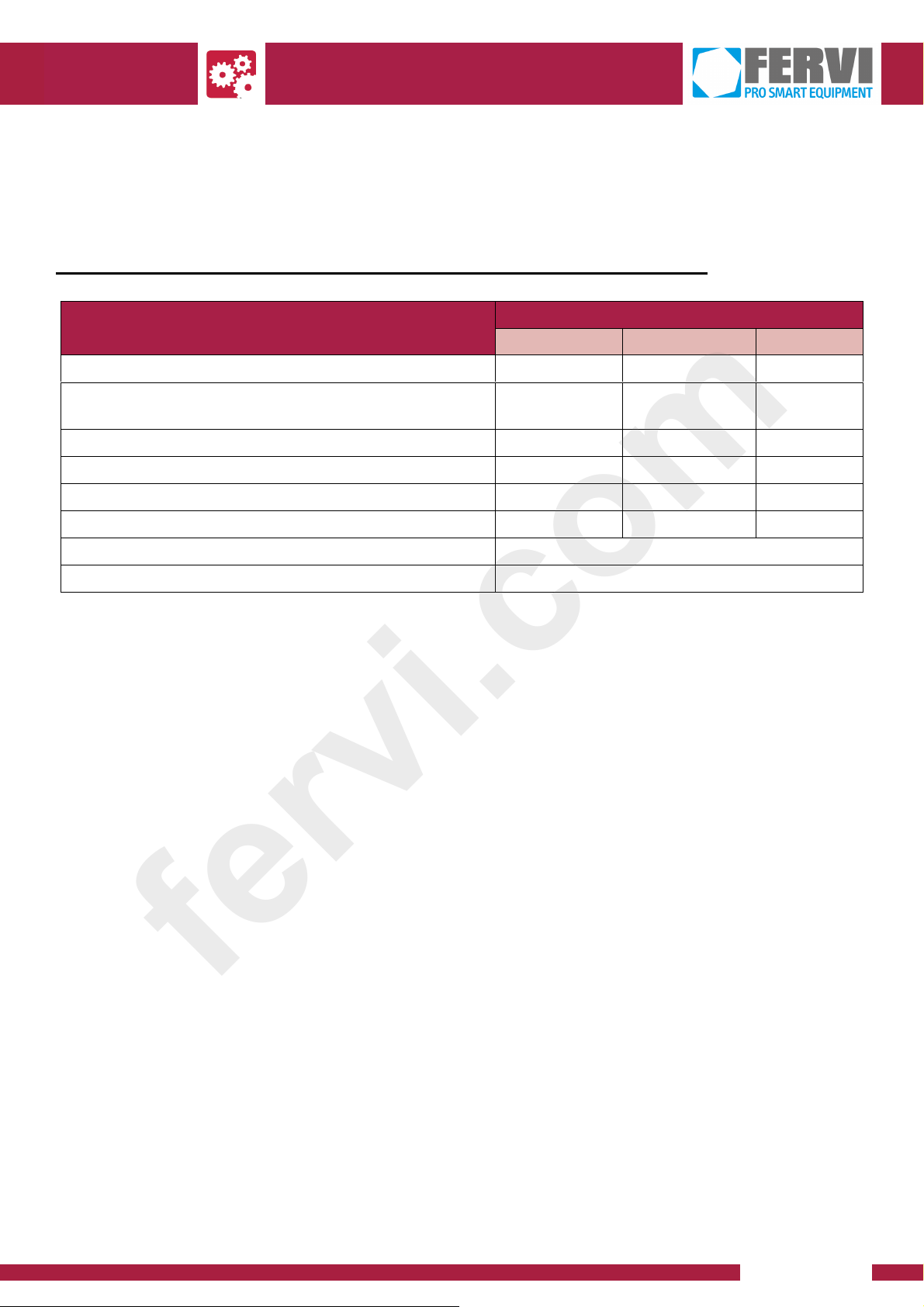
The purpose of this chapter is to provide the timing and maintenance procedures required to
maintain the
Hydraulic Pump.
Maintenance and repairs must be performed by qualified personnel.
ACTION
Fre
quency
Daily
Weekly
Monthly
1.
General visual inspection
X
2.
Check the legibility of the identification
plates
X
3.
Check for the absence of oil leaks
X
4.
General cleaning
X
5.
Lubrication and greasing
X
6.
Check the hydraulic oil level and top up
X
7.
Bleed air from the circuit
If necessary
8.
Replace the hose
By the expiration date
1.
General visual inspection:
check the general condition of the pump and if there are any
damaged or missing parts.
2.
Check the clear visibility and legibility of labels:
the
identification label on the pump
must be perfectly visible and legible. It is necessary to keep it clean and ask for a
replacement if it becomes illegible.
3.
Check for the absence of hydraulic oil leaks:
No measurable accidental loss must be
admitted in the
hydraulic circuit, except slight moistening that is not sufficient to form a
drop.
4.
General Cleaning:
cleaning is necessary to free the structure and movable parts from
the accumulation of dust, dirt and stains caused by excess lubricant. Use implements,
e
quipment and detergents or solvents commonly used for cleaning industrial equipment.
5.
Lubrication
and greasing:
it is necessary to grease the moving parts of the pump, such
as pins, hinges and levers on the pumping system.
6.
Check the hydraulic oil level and
top up:
Check the oil level and, if necessary, top up
with mineral hydraulic oil.
place the pump in a horizontal position;
completely release the pressure by turning the knob counter
-
clockwise;
unscrew the oil filler cap with a screwdriver;
add hydraulic m
ineral oil (fill up to the bottom edge of the opening);
bleed the air;
replace the cap and use a screwdriver to tighten.
fervi.com
Page 12
MACHINES AND
ACCESSORIES
Page
12of15
Precautions when replacing the oil
Only use hydraulic oil top up the oil level.
Do not use brake fluid or engine oil.
Add oil o
nly when the pressure inside the pump has been fully released.
7.
Bleeding air from the hydraulic circuit:
To remove any air bubbles in the hydraulic
system of the pump, which could reduce its efficiency, follow the following instructions:
turn the knob cou
nter
-
clockwise, then unscrew the oil filler cap using a screwdriver;
pump repeatedly to release the air;
replace the cap and use a screwdriver to tighten;
check that the pump functions properly.
If you still have problems, repeat the procedure or, if neces
sary, contact the Service
Centre.
8.
Replacing the hose
: attached hydraulic hoses are marked with working pressure levels,
the burst pressure level and the expiration date. Replace the hose with one that has the
same characteristics.
Replace the hose
Neve
r use the hose past the expiration date provided by the manufacturer and indicated on
the hose itself.
fervi.com
Page 13
MACHINES
AND
ACCESSORIES
Page
13of15
9
TROUBLESHOOTING
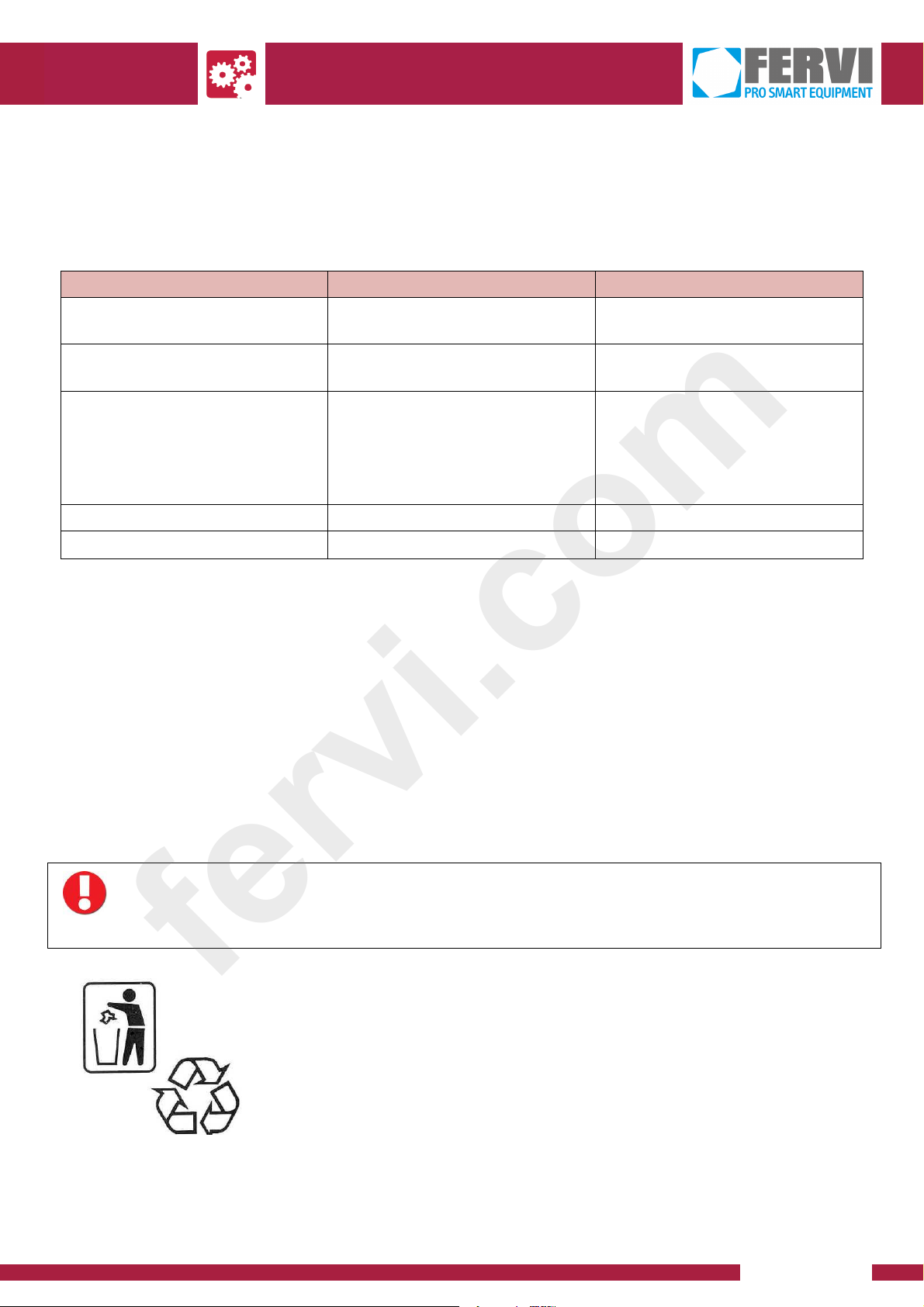
The type of problem/defect is in indicated in the following table along with the possible causes and possible solutions. The
table is
a useful troubleshooting aid for the person maintaining the machine.
Defect
Cause
Solution
The oil is not pressurized.
The vent valve is not closed
well.
Close the vent valve.
The pressure decreases
under stress.
The vent valve is not closed
well.
Clo
se the vent valve.
The pump is noisy.
A.
The pneumatic circuit is
not properly lubricated.
B.
The spring and/or pump
shaft are worn.
A.
Add lubricating oil inside
the air fitting.
B.
Check the integrity of
the pump with Customer
Service.
The pump is weak.
Low oil le
vel.
Add hydraulic oil.
The oil leaks from the tank.
Tank overflow.
Remove the excess oil.
10
WAREHOUSE STORAGE
In the event that the machine should be stored and unused for some time, proceed as
follows:
Release all pressure from inside the pump;
Keep t
he vent slightly unscrewed;
Keep the pump indoors and free from moisture.
11
DECOMMISSIONING
If the pump is to be scrapped, its parts must be disposed of in a differently.
Respect the Environment!
Contact a specialist centre for the collection of waste
materials.
The structure of the pump is made of steel while some seals are
made of polymeric material. The pump and the tank contain
hydraulic oil. In this regard, divide the materials according to their
nature, employing spe
cialist companies which are authorised for
their disposal, in accordance with the requirements of law.
fervi.com
Page 14
MACHINES AND
ACCESSORIES
Page
14of15
12
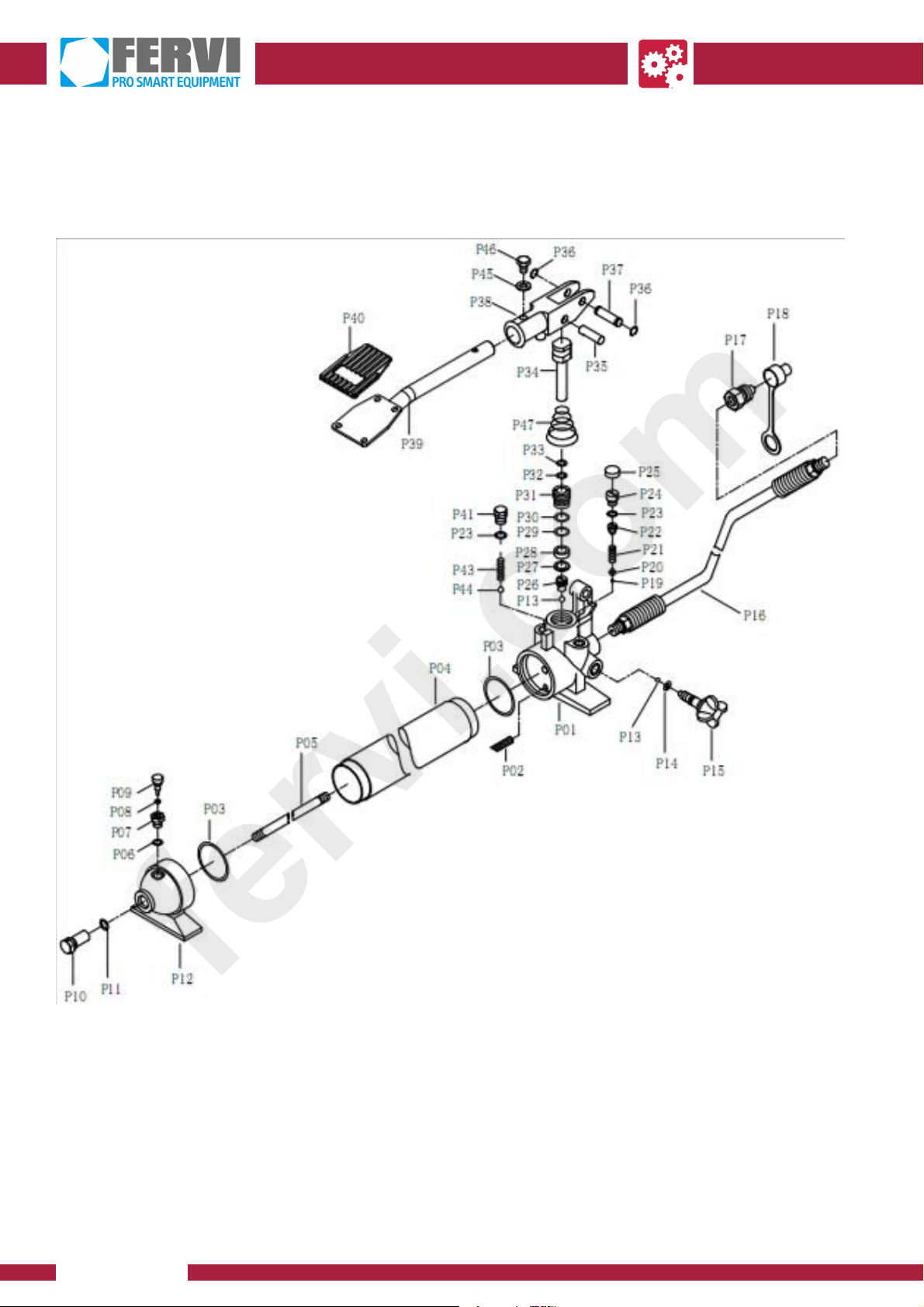
EXPANDED DRAWING AND
SPARE PARTS
fervi.com
Page 15
MACHINES
AND
ACCESSORIES
Page
15of15
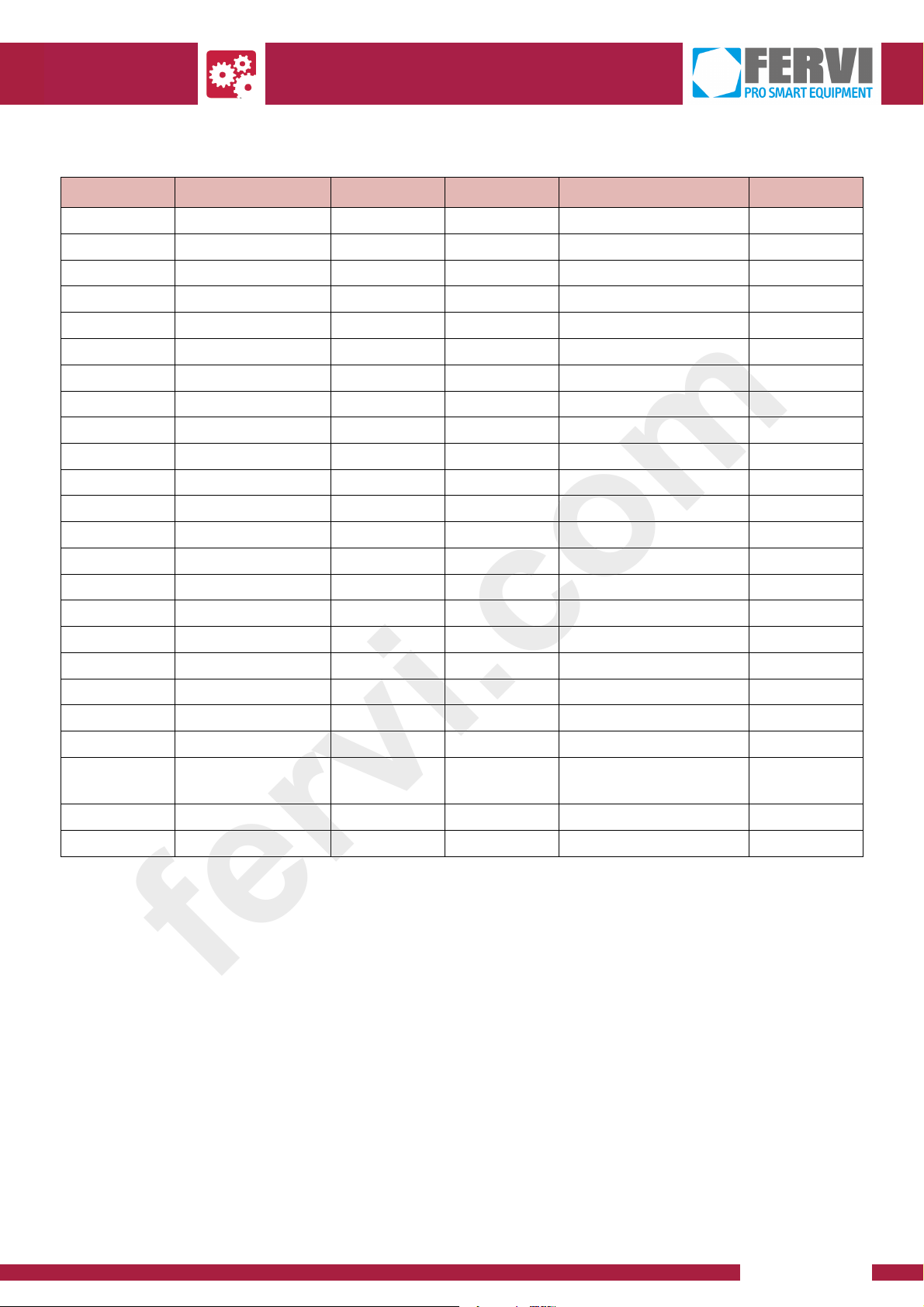
Ref.
Description
Quantity
Ref.
Description
Quantity
0271/P01
Valve block
1
0271/P25
Plastic cap
1
0271/P0
2
Oil
filter
1
0271/P26
Screw
1
0271/P03
O-ring
2
0271/P27
Nylon ring
1
0271/P04
Tank
1
0271/P28
Sealing ring
1
0271/P05
Oil tank shaft
1
0271/P29
O-ring
1
0271/P06
Nylon ring
1
0271/P30
Nylon ring
1
0271/P07
Fill cap
1
0271/P31
Screw
1
0271/P08
Seal
ing ring
1
0271/P32
O-ring
1
0271/P09
Vent screw
1
0271/P33
Nylon ring
1
0271/P10
Screw
1
0271/P34
Piston
1
0271/P11
O-ring
1
0271/P35
Linchpin
1
0271/P12
Support foot
1
0271/P36
Seeger
2
0271/P13
Steel ball
2
0271/P37
Linchpin
1
0271/P14
O-ring
10271/P38
Drive arm
1
0271/P15
Release valve
1
0271/P39
Pedal
1
0271/P16
Hydraulic hose
1
0271/P40
Rubber pedal cover
1
0271/P17
Joint
1
0271/P41
Screw
1
0271/P18
Cap connector
1
0271/P42
Screw
1
0271/P19
Steel ball
1
0271/P43
Spring
1
0271/P20
Ball cup
1
0271/P44
Steel ball
1
0271/P21
Spring
1
0271/P45
Washer
1
0271/P22
Safety valve
screw
1
0271/P46
Bolt
1
0271/P23
O-ring
2
0271/P47
Spring
1
0271/P24
Screw
1
fervi.com
 Loading...