

Page 1
FEA
PHOTON FUZZ MK2
www.fealabs.com
Battery replacement:
Remove the four screws on the bottom cover to access the battery
compartment. If storing the unit for long periods of time the battery
should be removed to prevent corrosion of the battery snap. Be sure
to place the battery wires along the side of the battery in the battery
pocket and use care while replacing the bottom cover.
Warranty:
The FEA PHOTON FUZZ is fully covered for a period of 5 (five) years
and the foot switches are covered for 1 (one) year against defects in
material and workmanship. Abuse and neglect are not covered under
the warranty. Any modifications or repairs not authorized by FEA
voids all warranties. The customer will be responsible for shipping
cost to and from FEA Labs for repairs. Contact me before attempting
to ship a unit for repair at: [email protected].
All repairs made outside of the warranty period will be very
reasonable (usually only the cost of the parts)… your satisfaction is
priority one.
Contact FEA Labs at:
www.fealabs.com
REV 2.1
Page 2

Technical Specifications:
DRIVE gain (max): +54dB
DRY LEVEL gain (max): +8dB
EQ Frequencies: LOW 50Hz, HIGH 3KHz
EQ boost/cut: +/- 14dB
DRY blend LP filter: Full-band, 160Hz, 1600Hz
OCTAVE LP filter: Full-band, 500Hz, 4000Hz
Pre-fuzz HP filter: 55Hz, 110Hz, 220Hz
Maximum Output: 14.5dBu
Frequency Response: 20Hz – 20KHz -1.5dB @ 20Hz
(Bypassed)
Input Impedance: 1M ohm
Output Impedance: 1K ohm
Current Consumption: Approx. 40mA
Battery Life: Approx. 14 hours continuous use
Power adapter (optional): 9VDC 2.1mm negative center pin
About the design:
The Photon Fuzz MK2 gets its name from an active component in the
circuit that utilizes infrared light to control the fuzz distortion element.
Light is made up of photon particles, so the name represents the
action that is at the heart of this very unique fuzz circuit.
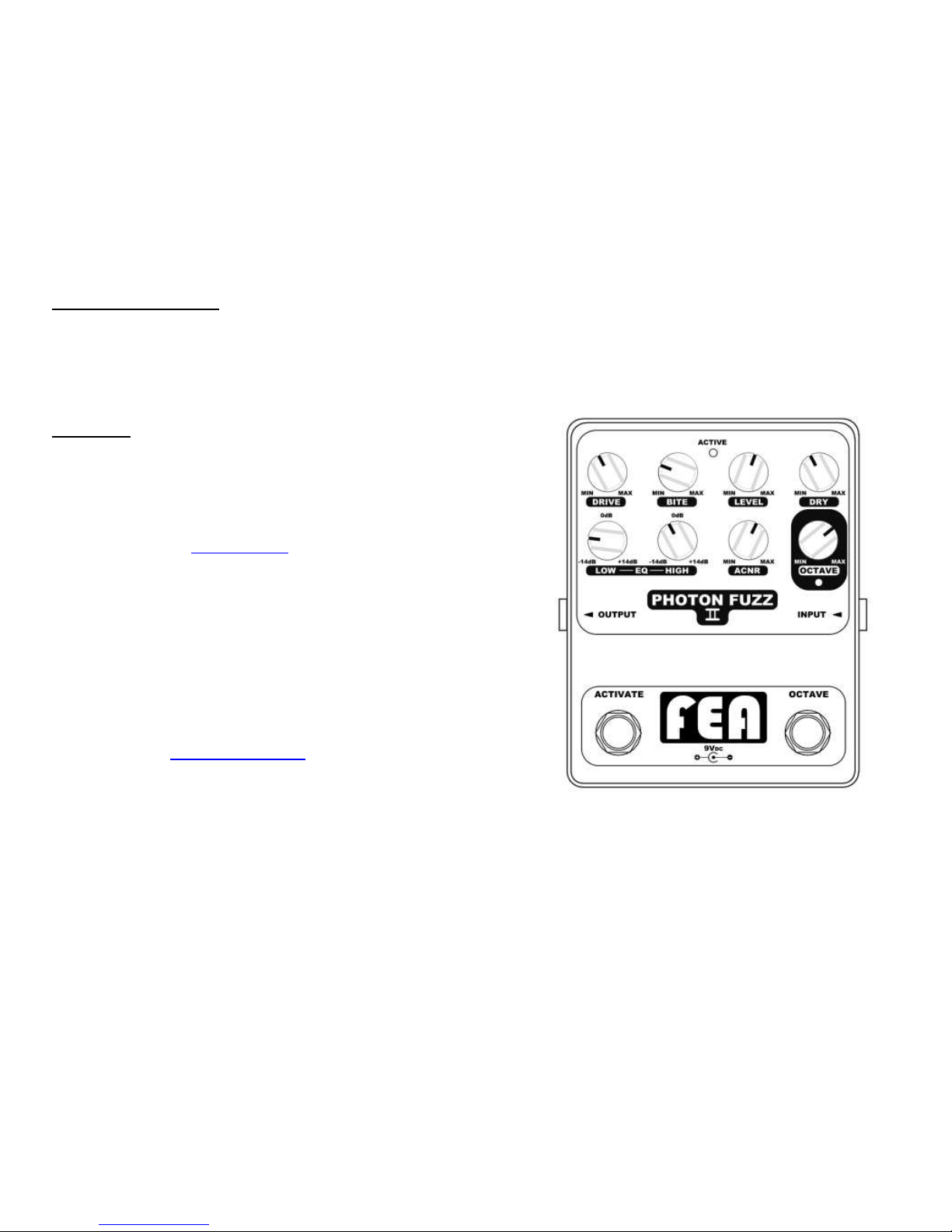
The Photon Fuzz was designed with versatile features for both bass
and guitar players. There are three controls for the fuzz and its level,
with a 2-band EQ to shape the fuzz tone. A dry blend level control is
included for bass players and there is an octave distortion level
control that is selected via footswitch. The ACNR (Active Coring
Noise Reduction) control covers a wide range, from no affect on the
fuzz signal, to a gated fuzz effect.
The two controls that define the type and depth of fuzz are the drive
and bite. The drive control sets the overall gain for the signal in the
distortion circuit. The bite control sets the activation point where the
fuzz distortion engages upon the signal and it behaves differently for
lower and higher drive settings. Using the bite control with lower drive
settings will give the player dynamic fuzz that will react and clean up
well with the signal from the instrument. With higher drive settings the
bite control will set depth of fuzz and sustain. This combination of two
controls for the fuzz distortion allows for a wide range of textures from
classic to modern.
There are two DIP switches located on the back of the circuit board
that select the frequency for the pre-fuzz high-pass filters. These
filters provide 55Hz, 110Hz and 220Hz high-pass filtration before the
fuzz circuitry.
For bass players there is a dry level blend. The blending of a dry
signal with the fuzz is useful to restore the lower bass frequencies that
can get masked with heavy fuzz. This blend control is also very
useful for players that want to retain their instruments natural sound
and only need a bit of fuzz to cut through a dense mix. The dry signal
has two low-pass filters that are selectable from the DIP switch
located on the back of the circuit board. This allows the user to run
the dry signal with the full audio spectrum or with the higher
frequencies filtered. The filters have cut-off frequencies of 1600Hz
and 160Hz.
Page 1
Page 6
Page 3
The 2-band EQ is an active Baxandall boost/cut design. The EQ is
only applied to the fuzz signal, so that your dry signal remains
natural.
The octave distortion is selected by a footswitch. The octave is a
full-wave rectifier distortion circuit located after the fuzz and its 2band EQ circuit. This circuit acts as a distortion intensifier of the
fuzz, which is ideal for busting out into a solo. As with the dry signal
blend, the octave signal also has two low-pass filters that are
selectable from the DIP switch on the back of the circuit board. The
filters have cut-off frequencies of 4000Hz and 500Hz. These filters
are useful to tame some of the high frequency artifacts that this
octave distortion method generates.
The Photon Fuzz uses two quality op-amp buffers and electronic
switching for its bypass circuit. The buffered bypass is designed to
be very low noise with no tonal coloration.
The dual rail power supply in the Photon Fuzz is built on its own
discrete circuit board to physically separate it from the audio circuits.
This power supply provides 18Volts (+9V and -9V) to the fuzz circuit
board to provide plenty of headroom for the signal. The power
supply generates this dual voltage from a 9VDC power adapter or
battery.
Frank E. Appleton (FEA)
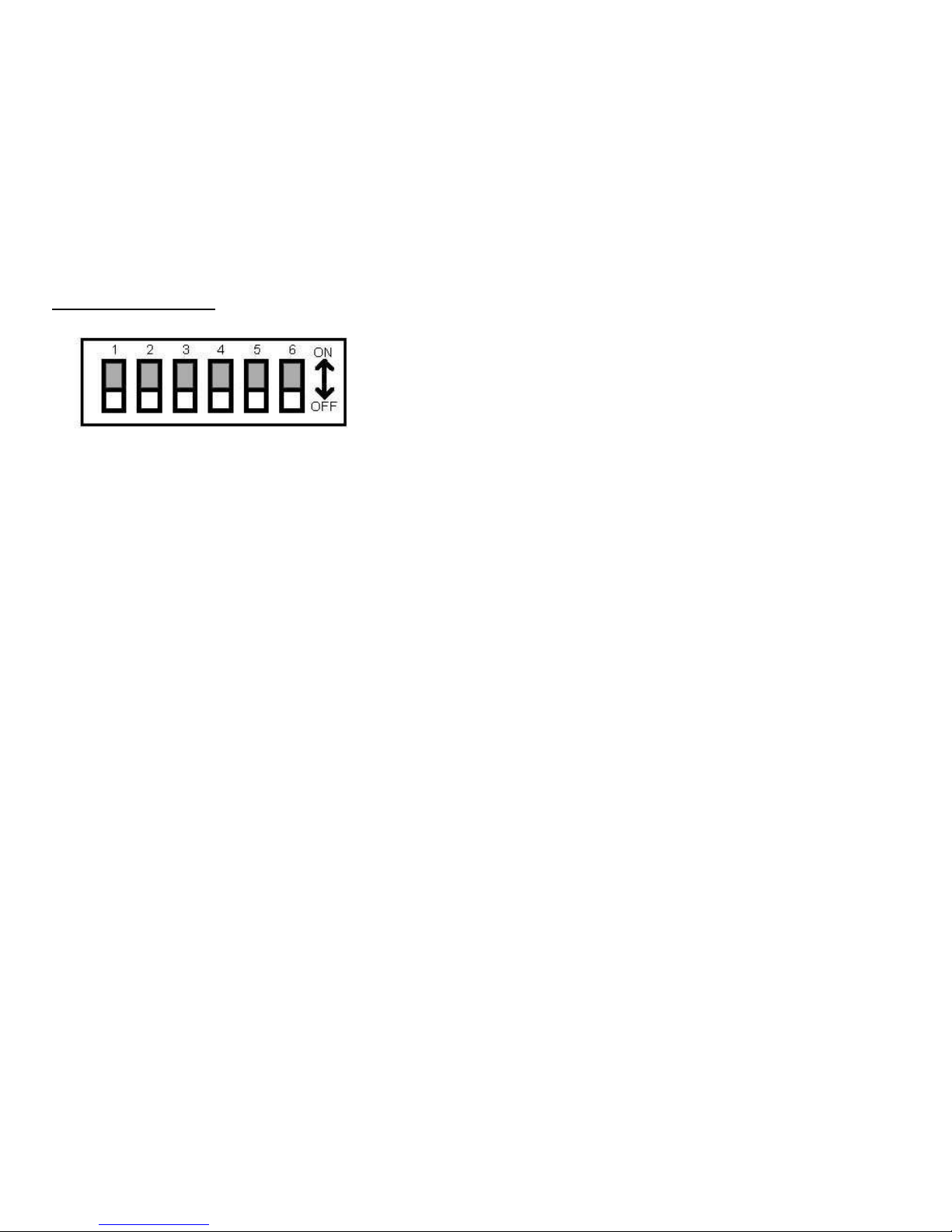
DIP Switch Settings:
The DIP switches are located on the back of the circuit board.
They can be accessed by removing the bottom cover.
DRY blend high frequency filter switch #1 and #2
Both OFF = Full band (no filter)
SW #1 ON = 1600 Hz
SW #2 ON = 160 Hz
OCTAVE high frequency filter switch #3 and #4
Both OFF = Full band (no filter)
SW #3 ON = 4000 Hz
SW #4 ON = 500 Hz
Pre-fuzz high pass filter switch #5 and #6
Both OFF = 220 Hz
SW #5 ON = 110 Hz
SW #6 ON = 55 Hz
Page 5
Page 2
Page 4

The “switch on” power supply current is less than 1µA
(micro amp) on the signal ground at the INPUT jack. This is
approximately 45,000 times (-93dB) less than the commonly
used method of connecting the battery’s negative terminal
to ground via the sleeve of the plug inserted into the INPUT
jack. The “switch on” sensing method used in the FEA
PHOTON FUZZ keeps nearly all of the circuit’s generated
white noise and transient currents out of the INPUT stage
signal ground. Extreme measures have been taken to keep
the power and signal paths as clean as possible. NOTE:
Unplug the cord from the INPUT jack when not in use to
prolong battery life.
Features:
DRIVE control to adjust the fuzz signal gain for depth and
sustain.
BITE control selects the point where the “photon clipping”
engages upon the signal.
LEVEL adjusts the fuzz output level.
LOW and HIGH boost/cut EQ controls for the fuzz tone.
ACTIVATE foot switch places the Photon Fuzz in the signal
chain or in buffered Bypass mode.
OCTAVE foot switch activates a post fuzz and EQ octave-up
type of distortion.
OCTAVE control adjusts the level of the octave-up distortion
when activated.
DRY control sets the level of the clean dry signal to be mixed
with the fuzz distortion.
ACNR (Active Coring Noise Reduction) control sets a dead
zone around the zero crossing in the amplitude of the fuzz
signal. This allows for no dead zone, to a small zone for
noise reduction, to a wider zone for a gated fuzz effect.
Two DIP switches provide three selectable pre-fuzz high-
pass filter frequencies of 55Hz, 110Hz and 220Hz.
Two DIP switches that select the octave distortion high
frequency cut-off for full-band, 4KHz or 500Hz.
Two DIP switches that select the dry signal blend high
frequency cut-off for full-band, 1.6KHz or 160HZ.
The power supplies onboard voltage charge pump allows the
circuitry to operate at 18volts (+9 and –9 volt rails) from a
single 9 volt battery or 9 volt DC power adapter. This allows
the signal plenty of headroom from active electronic guitars
and aggressive playing techniques.
Page 3
Page 4
 Loading...