

Page 1
FEA
DUAL ENGINE
COMPRESSOR LIMITER
www.fealabs.com
Battery replacement:
Remove the four screws on the bottom cover to access the battery
compartment. If storing the unit for long periods of time the battery
should be removed to prevent corrosion of the battery snap. Be sure
to place the battery wires along the side of the battery in the battery
pocket and use care while replacing the bottom cover.
Warranty:
The FEA Dual Engine Compressor Limiter is fully covered for a period
of 5 (five) years and the footswitches are covered for 1 (one) year
against defects in material and workmanship. Abuse and neglect are
not covered under the warranty. Any modifications or repairs not
authorized by FEA voids all warranties. The customer will be
responsible for shipping cost to and from FEA Labs for repairs.
Contact FEA before attempting to ship a unit for repair at:
All repairs made outside of the warranty period will be very
reasonable (usually only the cost of the parts)… your satisfaction is
priority one.
Contact FEA Labs at:
www.fealabs.com
REV 1.2
Page 2

Technical Specifications:
ATTACK: COMP: 2mS to 150mS
LIMITER: 100µS to 50mS
ADAPTIVE RELEASE: COMP: 50mS to 600mS
LIMITER: 45mS to 380mS
RATIO: COMP: 1.5:1 to 20:1
LIMITER: :1
THRESHOLD: COMP: -39dBu to
LIMITER: -35dBu to
Make-up GAIN: 0 to 23dB
Maximum Input: 13dBu
Maximum Output: 15dBu
Frequency Response: 20Hz – 20KHz +1/-3dB
Input Impedance: 1M ohm
Output Impedance: 10K ohm
Current Consumption: Approx. 34mA
Battery Life: Approx. 15 hours continuous use
Power adapter : 9VDC 2.1mm negative center pin
(Not Included)
About the design:
The FEA DUAL ENGINE COMPRESSOR LIMITER is designed with
both audiophile and studio quality features that many musicians will
enjoy.
The FEA DE-CL utilizes two sidechain control engines for audio signal
dynamics control. The compressor sidechain is based off of the FEA
Opti-FET compressor sidechain for its smooth compression qualities.
The DE-CL limiters sidechain is optimized specifically for high
performance limiter operation. The limiter has an adjustable attack so
that it can also be used as a very high ratio compressor if desired.
Both the limiter and compressor control a single optical gain cell in the
audio path for parallel processing of the audio signal dynamics. This
compressor and limiter configuration allows for multi-slope
compression that is found in some high-end rack units.
This is the first FEA compressor/limiter that utilizes adaptive release
circuitry. Adaptive release is sometimes referred to as “program
dependent release” by other compressor manufacturers. Adaptive
release is designed to behave more like the dynamic response of our
human hearing. If the instrument signal triggers the threshold in short
bursts then the release will be fairly quick. If the threshold is
continually activated over a period of several seconds, then the
release will be slower. This adaptive release sounds very natural and
balanced.
The DE-CL utilizes an audiophile grade Burr-Brown SoundPlus™
operational amplifier for the output amplifier. The Burr-Brown™
amplifier was specifically chosen for its outstanding performance. The
output amplifier circuit also contains a warmth control. The warmth
circuit is designed to integrate amplifier characteristics and harmonics
that have a warming tonal change. With the warmth control set to
minimum, the output amplifier operates in a clear, linear fashion for
very low distortion. As the warmth control is increased, the output
amplifier is made to operate in an increasing asymmetrical mode
along with transient nonlinearities. The range of the warmth circuit is
very large and can create tonal warming harmonics far beyond typical
warm sounding amplifiers. The input stage is a high impedance, hi-fi
amplifier buffer. The input amplifier has been designed to have
minimal signal distortion, minimal noise and maximum headroom for
all input signal levels.
Page 1
Page 6
Page 3
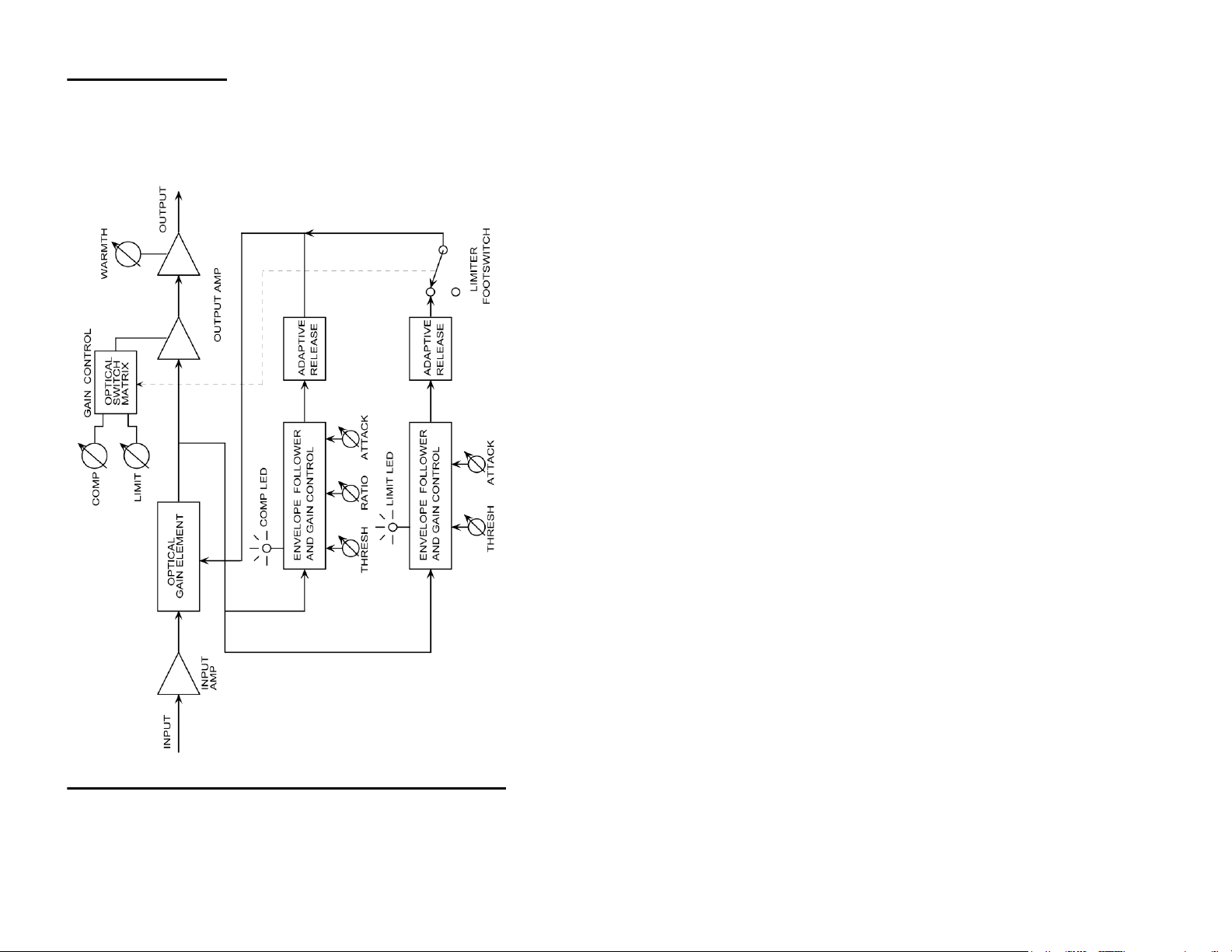
The DE-CL utilizes optical switching for the compressor and limiter
gain controls for when the limiter is activated and deactivated. This
optical switching matrix has very low noise and distortion. This type
of quiet switching is ideal for selecting or deselecting the limiter mid
song.
The Silonex AOI’s (analog optical isolators) used in the FEA DE-CL
utilize a combination formula for the photocell to overcome
limitations found in other traditional optical components affecting
reaction and recovery times. This fast current monitored Silonex
AOI allows the sidechain in the compressor and limiter to accurately
control the dynamics of the compression. The purely resistive photo
element in the AOI exhibits less noise and distortion than most
designs using a VCA (voltage controlled amplifier). A good number
of audiophiles advocate that only high-quality passive components
should be in the audio signal path and this is one application that I
would have to agree with them.
The dual rail power supply in the DE-CL is built on an isolated circuit
board. The power supply is over filtered two times to assure
exceptionally clean power for the signal circuitry. This power supply
provides 18Volts (+9V and -9V) to the compressor circuit board to
provide plenty of headroom for the signal. The power supply was
designed to provide separate power for all of the sidechain control
circuitry. This assures that any natural electrical noise that the
compressor sidechain control circuitry generates will not bleed into
the signal circuitry. I have not seen this approach to power
distribution in any of the other manufacturer’s guitar effects. Is it
overkill? Maybe…but I feel that it is absolutely crucial to eliminate
every bit of noise where possible.
The case is a standard Hammond aluminum enclosure. After the
Hammond case is CNC machined and sanded it is then
professionally color powder coated. The aluminum faceplate is then
applied and then the entire case is clear epoxy powder coated for
protection.
Frank E. Appleton (FEA)
Block Diagram:
Page 5
Page 2
Page 4

film type. The signal coupling capacitors are tight
tolerance, quiet, multi-layer and metallized polyester film
type.
Optical switching for the gain controls for quiet switching
when the limiter is activated and deactivated.
The power supplies onboard voltage charge pump allows
the circuitry to operate at 18volts (+9 and –9 volt rails) from
a single 9-volt battery or DC power adapter. This allows the
signal plenty of headroom from active electronic guitars
and aggressive playing techniques (i.e. pop and slap).
The “switch on” power supply current is less than 1µA
(micro amp) on the signal ground at the INPUT jack. This is
approximately 45,000 times (-93dB) less than the commonly
used method of connecting the battery’s negative terminal
to ground via the sleeve of the plug inserted into the INPUT
jack. The “switch on” sensing method used in the FEA Dual
Engine Compressor Limiter keeps nearly all of the circuit’s
generated white noise and transient currents out of the
INPUT stage signal ground. Extreme measures have been
taken to keep the power and signal paths as clean as
possible. NOTE: Unplug the cord from the INPUT jack when
not in use to prolong battery life.
The power and grounds for the audio path circuitry are
quasi-isolated from the sidechain power and grounds to
protect the audio signal from spurious noise. The power for
the signal amplifiers is exceptionally clean, filtered twice for
each rail and all filter stages are oversized.
Features:
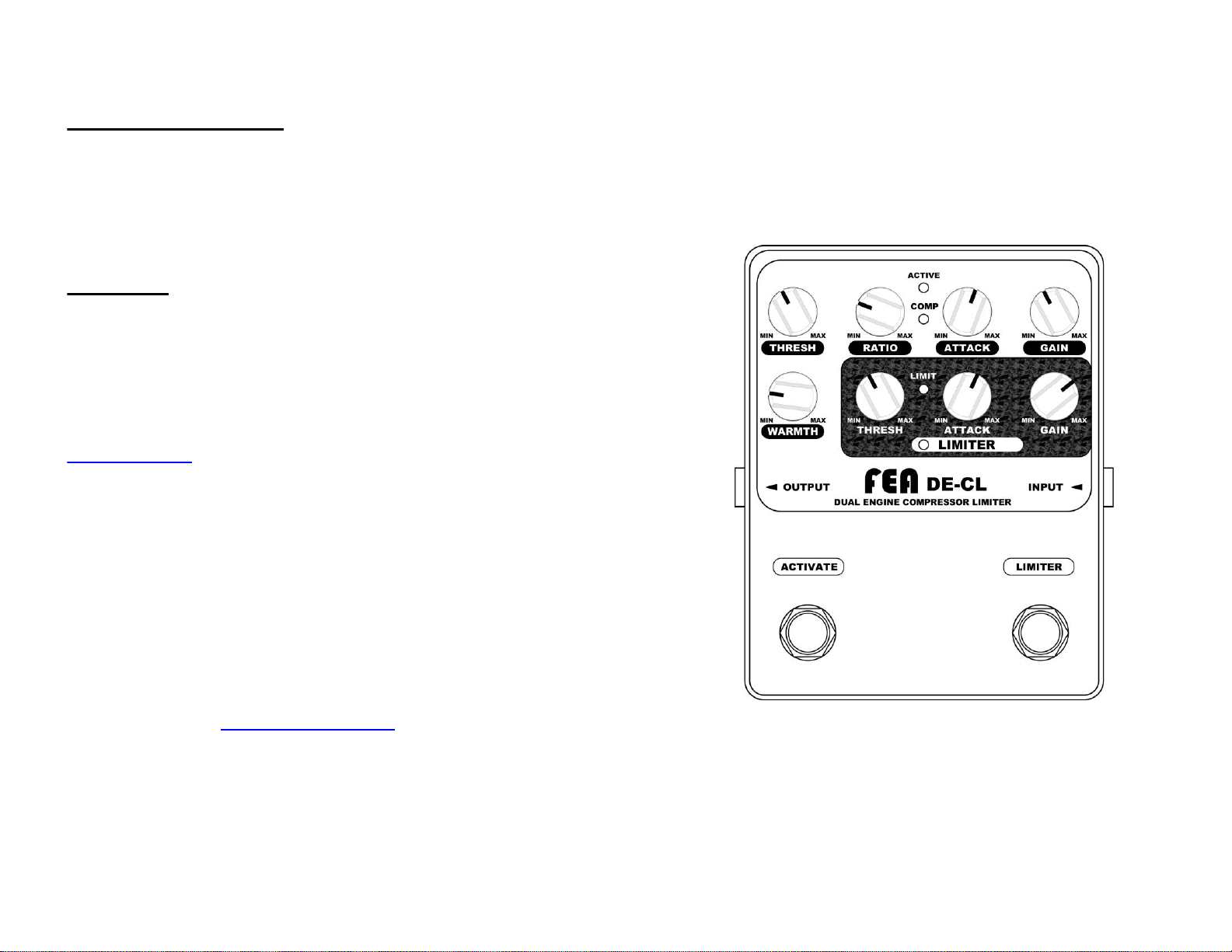
THRESHOLD, RATIO, ATTACK and GAIN controls for the
compressor and THERSHOLD, ATTACK and GAIN controls
for the limiter. The control ranges for the ATTACK have been
optimized for their function and for use on both bass and
guitar.
The compressor exhibits soft-knee compression at lower
RATIO settings and hard-knee at maximum RATIO settings.
The limiter exhibits hard-knee limiting at all times. The
COMP and LIMIT LED’s indicate when the THRESHOLD has
been reached. These LED’s do not indicate the RELEASE
response.
The compressor sidechain utilizes precision full-wave
rectification of the audio signal for the THRESHOLD circuits
for accurate envelope tracking. This also reduces the
possibility of “pumping” with very low frequencies.
Threshold sensitivity is easily adjustable with a trimmer
potentiometer located on the back of the main PCB. The
sensitivity range accommodates very high and very low
output instruments. (See label on the inside back cover.)
The compressor and limiter utilize adaptive release circuitry
for a natural response.
ACTIVATE footswitch places the compressor/limiter in the
signal chain or in Direct Bypass mode. In Direct Bypass
mode the signal at the input is directly connected to the
output and does not pass through any electronics.
LIMITER footswitch enables the limiter function. The limiter
operates in parallel with the compressor for signal dynamics
control. NOTE: When the limiter is active the compressors
gain control is deactivated and the limiters gain control sets
the output level.
WARMTH control modifies the function of the output
amplifier from operating in a clean, linear mode to a
harmonically enriched warm mode.
The signal compression and limiting is accomplished with
only a resistive component (Light Dependent Resistor or
Photocell). All resistors in the circuit are low noise 1% metal
Page 3
Page 4
 Loading...